Proceeding Paper

Tensile Behavior of Romanian ‘Țurcana’ Sheep Wool Waste-Fibers: Influence of Body Region †

by
Corina Sosdean
1,
Susana Piçarra
2,3,
Sergiu-Valentin Galatanu
4,* and
Liviu Marsavina
4,5
1
Department of Mechatronics, Politehnica University of Timisoara, 300006 Timisoara, Romania
2
Escola Superior de Tecnologia do Barreiro, Instituto Politécnico de Setúbal, 2839-001 Lavradio, Portugal
3
Centro de Química Estrutural, Institute of Molecular Sciences, Instituto Superior Técnico, Universidade de Lisboa, 1049-001 Lisboa, Portugal
4
Department of Mechanics and Strength of Materials, Politehnica University of Timisoara, 300006 Timisoara, Romania
5
Romanian Academy—Timisoara Branch, 300223 Timisoara, Romania
*
Author to whom correspondence should be addressed.
Presented at the 8th International Conference of Engineering Against Failure (ICEAF VIII), Kalamata, Greece, 22–25 June 2025.
Eng. Proc. 2025, 119(1), 17; https://doi.org/10.3390/engproc2025119017
Published: 12 December 2025

Abstract

Europe produces over 200,000 tons of coarse wool annually, a material often undervalued despite its potential in sustainable applications. This study investigates the mechanical behavior of individual “Țurcana” wool fibers through tensile testing, with samples collected from different body regions of the same sheep. Complementary SEM and FTIR analyses were employed to characterize the morphology and chemical constitution of the fibers. The results revealed clear differences in mechanical performance and morphology among fibers from different regions, as well as variations within the same region, while slightly differences in chemical constitution were detected by ATR-FTIR across the body parts.

1. Introduction

Sheep wool is a renewable, recyclable, and sustainable material with a low environmental footprint. However, under European Environmental Regulations (EC Regulation 1069/2009; EU Regulation 142/2011) [1], greasy wool (raw wool) is classified as animal by-product waste/special waste and must be processed at specialized facilities for incineration or landfill. Once thoroughly washed, disinfected, and sterilized at 130 °C, it may be legally buried or burned without a permit. Illegal disposal remains a major environmental concern, as approximately 95% of raw wool is unsuitable for the textile market, making annual sheep shearing primarily a financial burden for farmers [2]. According to Report Linker data from 2023 [3], Romania is leading European raw wool production, with the “Țurcana” sheep breed, the most common and oldest local sheep in Romania, playing a central role.
Mechanical and chemical properties of wool fibers vary depending on different factors. The studies of Mioč et al. [4] determined the significant influence of breed on the fleece yield and wool-fiber diameter. The composition of sheep wool (e.g., keratin content, mineral/trace elements) shows large dependence on both breed and environmental factors [5]. Aging and environmental conditions affect the mechanical properties of sheep wool [6].
In the past decade wool has been subsequently used in the construction sector and repurposed for building materials such as thermal and acoustic insulation panels [7,8,9,10], reinforcement fibers [11,12,13], and composite materials [14,15,16]. Lately, wool fibers have started to be used in 3D printing [17,18].
In this work, individual “Țurcana” wool fibers are investigated to assess their potential for sustainable composite applications. The following section presents the test samples, chemical characterization, morphology, and tensile property evaluation. This is followed by the experimental results, including scanning electron micrographs (SEM), ATR-FTIR spectra, and tensile testing outcomes. The study concludes with a discussion of the key findings, highlighting the influence of sampling location on fiber strength and providing insights into the structural and chemical features that support the use of “Țurcana” wool as reinforcement in bio-based composites.

2. Materials and Methodology

2.1. Test Samples

In this study, single wool fibers from the “Turcana” breed—an autochthonous Romanian sheep breed known for its coarse wool and adaptability to mountainous regions—were collected from four distinct body regions: back (Ba), lateral side (La), abdomen (Ab) and neck (Ne). The fibers were obtained from batches of raw sheared wool that had been previously washed with plain water and air-dried. For each body region, a total of ten fibers, each with different lengths, were sampled. For each fiber, 12 width measurements were taken, using an optical microscope, at 10 mm intervals, starting from the position corresponding to the fixed end of the wool fiber (WF) in the testing apparatus. Measurements were strictly confined to the gauge length of 40 mm to ensure consistency across specimens and maintain compatibility with the mechanical testing parameters. Table 1 presents the mean widths and variation in the WF across the examined body regions.

2.2. Structural Characterization and Morphology

Structural characterization was performed using Fourier Transform Infrared Spectroscopy with Attenuated Total Reflectance (ATR-FTIR). Spectra were acquired on a Thermo Nicolet 5700 spectrometer with diamond crystal over a range of wavenumbers from 4000 to 700 cm−1, with a resolution of 4 cm−1 and 320 scans. Transmittance was recorded at each wavelength to generate the spectra.
Scanning electron microscopy (SEM) was employed to observe the morphology of the filaments (7 filaments of each body part). SEM was performed using a Phenom ProX G6 instrument with an operating voltage of 10 kV. Elemental composition was determined by energy-dispersive X-ray spectroscopy (EDS) using the same instrument with an operating voltage of 15 kV. Prior to SEM/EDS analysis, the samples were coated with Au/Pd to enhance conductivity and improve image quality.

2.3. Tensile Testing

Tensile tests were carried out using a METROTECH universal testing machine at a crosshead speed of 2 mm/min, with a gauge length of 40 mm. An AEP TCA-type load transducer, with a maximum capacity of 5 kg, was utilized to record experimental data.
Following the tensile tests, data on force, time, and displacement were recorded. These measurements were subsequently used to construct the stress–strain curves. Stress, expressed in MPa, represented the load sustained by the fiber and was calculated by dividing the measured force by the initial cross-sectional area, which was determined from the fiber diameters measured under the optical microscope. Strain, expressed in %, was defined as the ratio of the fiber elongation to the original gauge length and was calculated by dividing the displacement by the initial distance between the clamping grips.

3. Results and Discussion

3.1. Scanning Electron Micrographs (SEM)

Figure 1 shows SEM images of two filaments collected from different body parts, in both lateral and cross-sectional views. Most filaments are covered by cuticles of varying prominence, whereas others appear smooth. Although no strict correlation with the body parts was observed, as different morphologies can be observed in wool filaments collected from the same region, a trend can be noticed, with the differences attributed to the age of the collected filaments. In fact, the neck (Ne) shows the most pronounced cuticles, followed by the back (Ba) and the abdomen (Ab), while the cuticles on the lateral part (La) are almost nonexistent. EDS analysis was also performed on these filaments, revealing a similar elemental composition, mainly composed by carbon (61.8 ± 2.4 mol %), nitrogen (10.46 ± 0.95 mol %), oxygen (22.6 ± 1.7 mol %), sulfur (4.69 ± 0.72 mol %), plus hydrogen (not detectable by EDS). These results are consistent with the proteinaceous nature of wool fibers, which are composed of amino acids and have these elements in their constitution.

3.2. ATR-FTIR Spectra

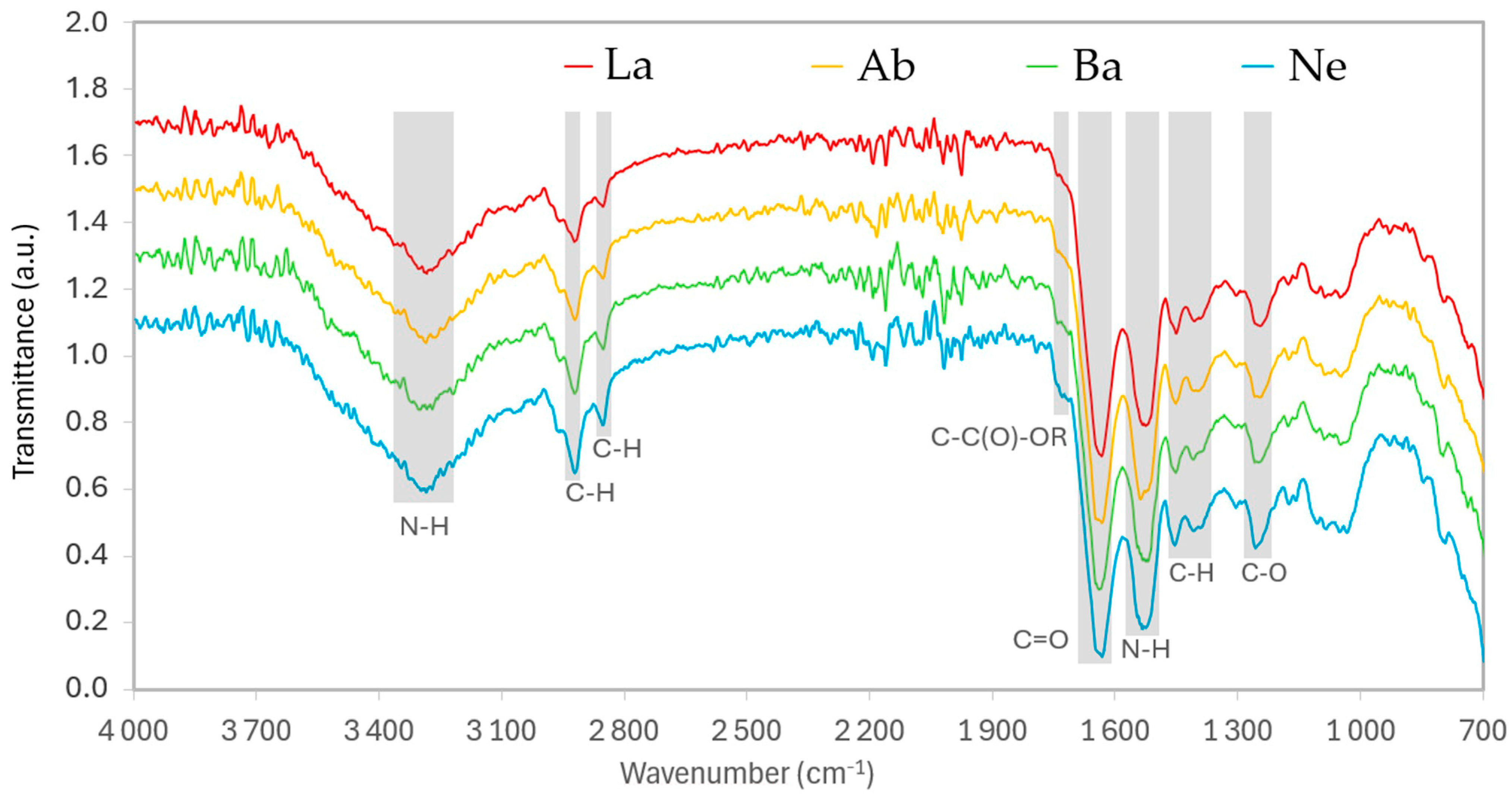
Some filaments collected from different body parts of the sheep were further analyzed by ATR-FTIR. Specific chemical bonds vibrate at specific wavenumbers, enabling the identification of the chemical structure of the filaments [19]. The ATR-FTIR spectra and the corresponding band assignments are shown in Figure 2. The spectra exhibit the characteristic vibration bands of bonds typically present in keratin, with no significant differences detected among the spectra obtained from different body parts within the spectral resolution. An exception is the shoulder assigned to ester groups, C-C(O)-OR, which appears slightly more intense in neck (Ne) fibers and less pronounced in lateral (La) fibers, likely corresponding to the lipids or waxes from the cuticles [20]. This observation is consistent with SEM results, which showed more prominent cuticles in the neck region and less pronounced in the lateral fibers.

3.3. Tensile Properties

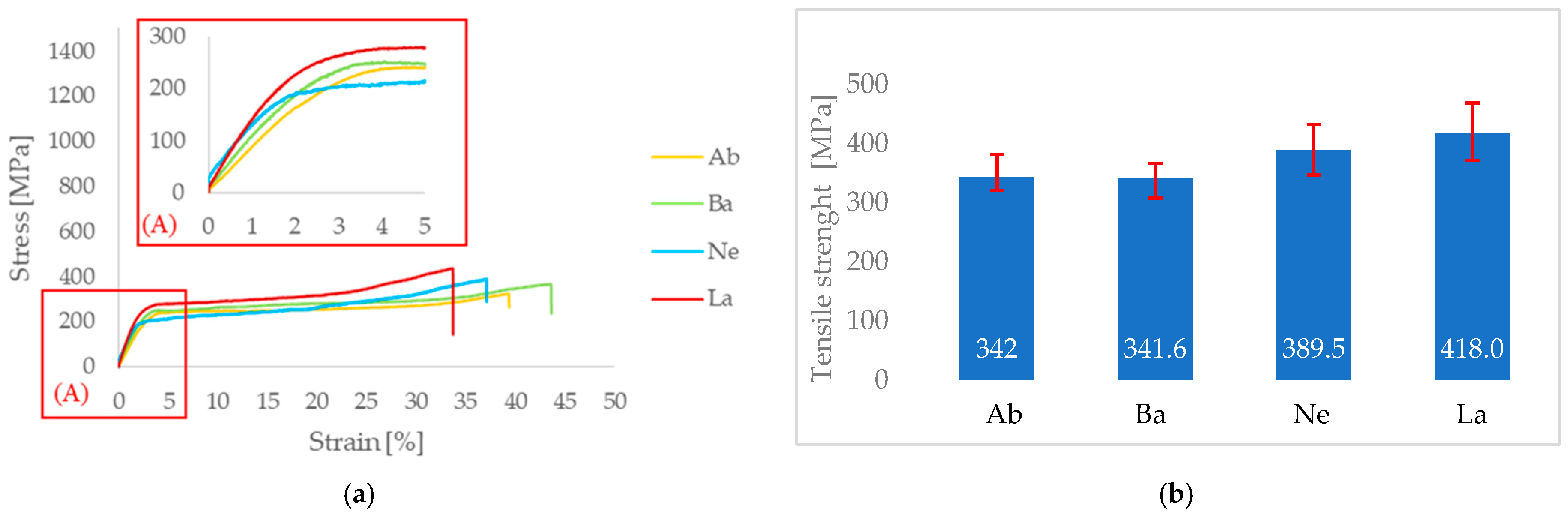
In Figure 3a, the representative stress–strain curves are presented for wool fibers (WF) collected from different body regions of the sheep, namely the abdomen (Ab), back (Ba), neck (Ne), and lateral side (La).
The curves show an initial linear-elastic region followed by yielding and plastic deformation with a broad plateau, ending in a sudden fracture at maximum stress. These mechanical behavior regions are consistent with previous studies on Merino sheep wool, [21].
La exhibits the highest yield stress (~280 MPa) and ultimate average tensile strength (UTS) (~420 MPa), while Ne shows the lowest values, with a yield stress of ~200 MPa and UTS of ~390 MPa. In terms of ductility, Ba shows the highest ductility, failing at ~45% strain, while La at about 35% and Ne and Ab both fail between 35–40 strain.
La exhibits significant upward curvature after yielding, indicating strong strain hardening, whereas Ne, Ab and Ba display less curvature, suggesting weaker strain hardening. These large differences in staple strength across the body of a sheep was also mentioned in the studies conducted by Rottenbury et al. [22] and Ross et al. [23].
In Figure 3b it can be observed that La shows the highest average tensile strength (~420 MPa), followed by Ne (~390 MPa), while Ab and Ba exhibit lower average tensile strengths, around ~342 MPa.
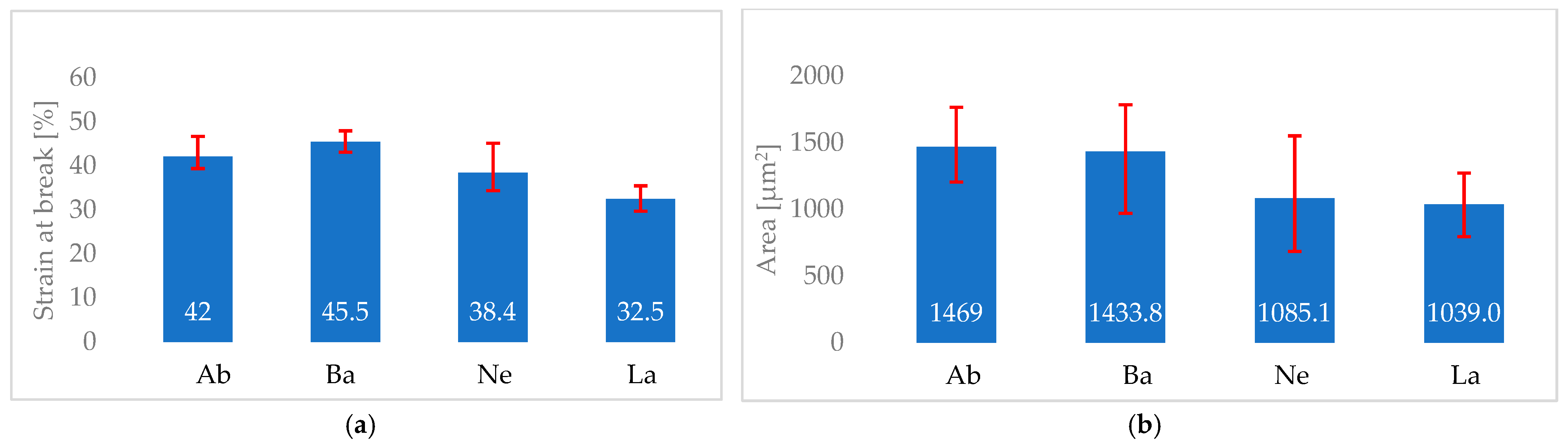
In Figure 4a it can be seen that Ba exhibits the highest average strain at break (~45%), pointing to it being the most ductile material. Ab and Ne show similar strain at break values of around 40%, demonstrating moderate ductility. In contrast, La has the lowest strain at break (~30%), making it the least ductile and more susceptible to brittle failure.
The cross-sectional area was calculated using the mean width (previously presented in Table 1) of the representative WF within each of the considered body regions. According to Figure 4b, Ab and Ba exhibit an average cross-sectional area of about 1500 µm, while Ne and La have a much smaller average cross-sectional area (~1050 µm2). As earlier mentioned by [24], the mean diameter is the most important property to determine the quality of wool fibers. Even though the WF were collected from specific body parts of the same sheep according to [25], over an entire fleece, or even within a representative wool sample, fiber diameter is not homogenous, but ranges from 10 to 70 μm.
The study continues the research presented by Sosdean et al. in [26] where tensile tests were conducted on “Turcana” WF obtained from a batch of sheared wool. Due to noticeable variations in the tensile behavior among the samples, they were categorized into four main classes based on their tensile strength and strain characteristics. This variability led to the hypothesis that the sampling location on the sheep’s body may significantly influence the mechanical properties of the wool, warranting further investigation. The present study offers valuable insights into how wool fiber characteristics vary across different parts of the sheep’s body. Based on their tensile behavior it can be concluded that samples from the lateral part (La) exhibit the highest tensile strength, around 420 MPa and 30% strain, followed by samples from the neck (Ne) with approximatively 390 MPa and 40% strain, while samples from the belly/abdomen (Ab) and back reach a tensile strength of about 340 MPa at a 42% strain, 45% respectively.
SEM images indicate that filaments from the neck (Ne) exhibit the most prominent cuticles, while those from the lateral part (La) are the smoothest (although some variability exists within each region). ATR-FTIR analysis supports this observation, as the most intense ester band was detected in the Ne spectrum and the weakest in the La spectrum, with the ester groups originating from the lipids and waxes present in the cuticles. All ATR-FTIR spectra displayed the typical keratin bands, with no major differences detected. These results indicate that the observed differences in mechanical properties cannot be fully explained by the factors initially identified, pointing to the influence of other contributing variables. For example, studies conducted by [7] indicate that single fiber tensile tests reveal a significant gauge length effect, with the strength and failure strain of longer fibers (50 mm) being approximately 40% lower than those of shorter fibers (10 mm). Also, according to [27] the tensile strength, tenacity and elongation are higher in the coarsest fibers.

4. Conclusions

This study analyzed wool fibers (WF) collected from the back, lateral side, abdomen, and neck of a sheep, providing valuable insights into the tensile behavior of ‘Țurcana’ WF from across different body regions. The findings align with those of [28], which examined variation in raw wool characteristics—such as body location, differences along individual fibers, and differences between fibers within the same staple—and concluded that, while differences between body regions exist, variation among fibers from different sheep is even greater. Consequently, the limited number of fibers collected from a single sheep represents a key limitation of the present work.
SEM revealed morphological variability across body regions, which is supported by the slight differences in the ester group content observed in ATR-FTIR analysis. Additional quantitative techniques could further clarify the structure–property relationships.
Further research should involve larger sample sizes, comprehensive statistical analyses, and additional tests on fiber morphology and chemical composition to better identify and understand the differences in mechanical properties and investigate the potential of “Țurcana” wool as a reinforcement material for sustainable, high-performance bio-based composites.

Author Contributions

Conceptualization, C.S. and S.-V.G.; methodology, S.P. and S.-V.G.; software, S.-V.G. and S.P.; validation, C.S., S.-V.G., S.P. and L.M.; formal analysis, S.-V.G.; investigation, C.S., S.P. and S.-V.G.; resources, S.P. and L.M.; data curation, C.S., S.P. and S.-V.G.; writing—original draft preparation, C.S., S.P. and S.-V.G.; writing—review and editing, C.S., S.P. and S.-V.G.; visualization, S.-V.G.; supervision, S.P. and L.M.; project administration, L.M.; funding acquisition, L.M. All authors have read and agreed to the published version of the manuscript.

Funding

This research was funded by the Ministry of Research, Innovation and Digitization, CNCS—UEFISCDI grant number PN-IV-P1-PCE-2023-1446, within PNCDI IV.

Institutional Review Board Statement

Not applicable.

Informed Consent Statement

Not applicable.

Data Availability Statement

The datasets generated and analyzed during the current study are held by the authors and can be made available upon reasonable request. Requests for access to the data should be directed to the corresponding author.

Conflicts of Interest

The authors declare no conflicts of interest.

References

  1. Available online: https://eur-lex.europa.eu/eli/reg/2009/1069/oj (accessed on 1 September 2025).
  2. Parlato, M.C.; Porto, S.M.; Valenti, F. Assessment of sheep wool waste as new resource for green building elements. Build. Environ. 2022, 225, 109596. [Google Scholar] [CrossRef]
  3. Available online: https://www.reportlinker.com/dataset/1ddf31187e58067ffe53896af63077724fb102cf?utm (accessed on 1 September 2025).
  4. Mioč, B.; Džaja, A.; Širić, I.; Kasap, A.; Antunović, Z.; Držaić, V. The Influence of Breed and Body Region on the Wool Fibre Diameter. Poljoprivreda 2025, 31, 60–65. [Google Scholar] [CrossRef]
  5. Janíček, M.; Massányi, M.; Kováčik, A.; Halo, M., Jr.; Tirpák, F.; Blaszczyk-Altman, M.; Massányi, P. Content of Biogenic Elements in Sheep Wool by the Regions of Slovakia. Biol. Trace Elem. Res. 2025, 203, 1886–1897. [Google Scholar] [CrossRef]
  6. Starkova, O.; Sabalina, A.; Voikiva, V.; Osite, A. Environmental effects on strength and failure strain distributions of sheep wool fibers. Polymers 2022, 14, 2651. [Google Scholar] [CrossRef]
  7. Tămaş-Gavrea, D.R.; Dénes, T.O.; Iştoan, R.; Tiuc, A.E.; Manea, D.L.; Vasile, O. A Novel Acoustic Sandwich Panel Based on Sheep Wool. Coatings 2020, 10, 148. [Google Scholar] [CrossRef]
  8. Borlea, S.I.; Tiuc, A.E.; Nemeş, O.; Vermeşan, H.; Vasile, O. Innovative use of sheep wool for obtaining materials with improved sound-absorbing properties. Materials 2020, 13, 694. [Google Scholar] [CrossRef] [PubMed]
  9. Jose, S.; Shanumon, P.S.; Kadam, V.; Tom, M.; Thomas, S. Preparation, characterisation and application of biodegradable coarse wool-poly (lactic acid) sandwich composite. Polym. Bull. 2024, 81, 10293–10310. [Google Scholar] [CrossRef]
  10. Guna, V.; Yadav, C.; Maithri, B.R.; Ilangovan, M.; Touchaleaume, F.; Saulnier, B.; Grohens, Y.; Reddy, N. Wool and coir fiber reinforced gypsum ceiling tiles with enhanced stability and acoustic and thermal resistance. J. Build. Eng. 2021, 41, 102433. [Google Scholar] [CrossRef]
  11. Alyousef, R.; Aldossari, K.; Ibrahim, O.; Mustafa, H.; Jabr, A. Effect of sheep wool fiber on fresh and hardened properties of fiber reinforced concrete. Int. J. Civ. Eng. Technol. 2019, 10, 190–199. [Google Scholar]
  12. Wani, I.A. Experimental investigation on using sheep wool as fiber reinforcement in concrete giving increment in overall strength. Mater. Today Proc. 2021, 45, 4405–4409. [Google Scholar] [CrossRef]
  13. Parlato, M.C.M.; Cuomo, M.; Porto, S.M.C. Natural fibers reinforcement for earthen building components: Mechanical performances of a low quality sheep wool (“Valle del Belice” sheep). Constr. Build. Mater. 2022, 326, 126855. [Google Scholar] [CrossRef]
  14. Sharma, Y.K.; Meena, A.; Sahu, M.; Dalai, A. Experimental investigation on mechanical and thermal characteristics of waste sheep wool fiber-filled epoxy composites. Mater. Today Proc. 2023. [Google Scholar] [CrossRef]
  15. Bharath, K.N.; Manjunatha, G.B.; Santhosh, K. Failure analysis and the optimal toughness design of sheep–wool reinforced epoxy composites. In Failure Analysis in Biocomposites, Fibre-Reinforced Composites and Hybrid Composites; Woodhead Publishing: Davangere, India, 2019; pp. 97–107. [Google Scholar]
  16. Szatkowski, P.; Tadla, A.; Flis, Z.; Szatkowska, M.; Suchorowiec, K.; Molik, E. The potential application of sheep wool as a component of composites. Rocz. Nauk. Pol. Tow. Zootech. 2021, 17, 1–8. [Google Scholar] [CrossRef]
  17. Siddiqui, M.S.; Rabbi, M.S.; Ahmed, R.U.; Billah, M.M. Biodegradable natural polymers and fibers for 3D printing: A holistic perspective on processing, characterization, and advanced applications. Clean. Mater. 2024, 14, 100275. [Google Scholar] [CrossRef]
  18. Haque, A.N.M.A.; Naebe, M.; Mielewski, D.; Kiziltas, A. Waste wool/polycaprolactone filament towards sustainable use in 3D printing. J. Clean. Prod. 2023, 386, 135781. [Google Scholar] [CrossRef]
  19. McGregor, B.A.; Liu, X.; Wang, X.G. Comparisons of thr Fourier Transform Infrared Spectra of cashmere, guard hair, wool and another animal fibers. J. Text. Inst. 2017, 109, 813–822. [Google Scholar] [CrossRef]
  20. Albanell, C.B.; Carrer, V.; Marti, M.; Iglesias, J.; Iglesias, J.; Coderch, L. Solvent-extracted wool wax: Thermotropic properties and skin efficacy. Skin Pharmacol. Physiol. 2018, 31, 198–205. [Google Scholar] [CrossRef] [PubMed]
  21. Thompson, A.N. Intrinsic Strength of Merino Wool Fibres. Ph.D. Thesis, Department of Animal Science, University of Adelaide, Adelaide, Australia, 1998. [Google Scholar]
  22. Rottenbury, R.A.; Bow, M.R.; Kavanagh, W.J.; Caffin, R.N. Staple strength variation in Merino flocks. Wool Technol. Sheep Breed. 1981, 29, 143–148. [Google Scholar]
  23. Ross, D.A.; Meikle, H.E. The processing significance of variations in staple strength within and between fleeces. In Proceedings of the 7th International Wool Textile Research Conference, Tokyo, Japan, 28 August–3 September 1985; pp. 45–54. [Google Scholar]
  24. Bouagga, T.; Harizi, T.; Sakli, F.; Zoccola, M. Correlation between the mechanical behavior and chemical, physical and thermal characteristics of wool: A study on Tunisian wool. J. Nat. Fibers 2020, 17, 28–40. [Google Scholar] [CrossRef]
  25. Wood, E. Textile Properties of Wool and Other Fibres; Wool Research Organization of New Zealand: Christchurch, New Zealand, 2003; pp. 272–290. [Google Scholar]
  26. Sosdean, C.; Galatanu, S.V. Tensile properties of Romanian “Țurcana” sheep wool farm-waste fibers. IOP Conf. Ser. Mater. Sci. Eng. 2024, 1319, 012034. [Google Scholar] [CrossRef]
  27. Sharma, A.; Pant, S. Properties of camel kid hair: Chokla wool blended yarns and fabrics. Stud. Home Community Sci. 2013, 7, 139–143. [Google Scholar] [CrossRef]
  28. Scobie, D.R.; Grosvenor, A.J.; Bray, A.R.; Tandon, S.K.; Meade, W.J.; Cooper, A.M.B. A review of wool fibre variation across the body of sheep and the effects on wool processing. Small Rumin. Res. 2015, 133, 43–53. [Google Scholar] [CrossRef]
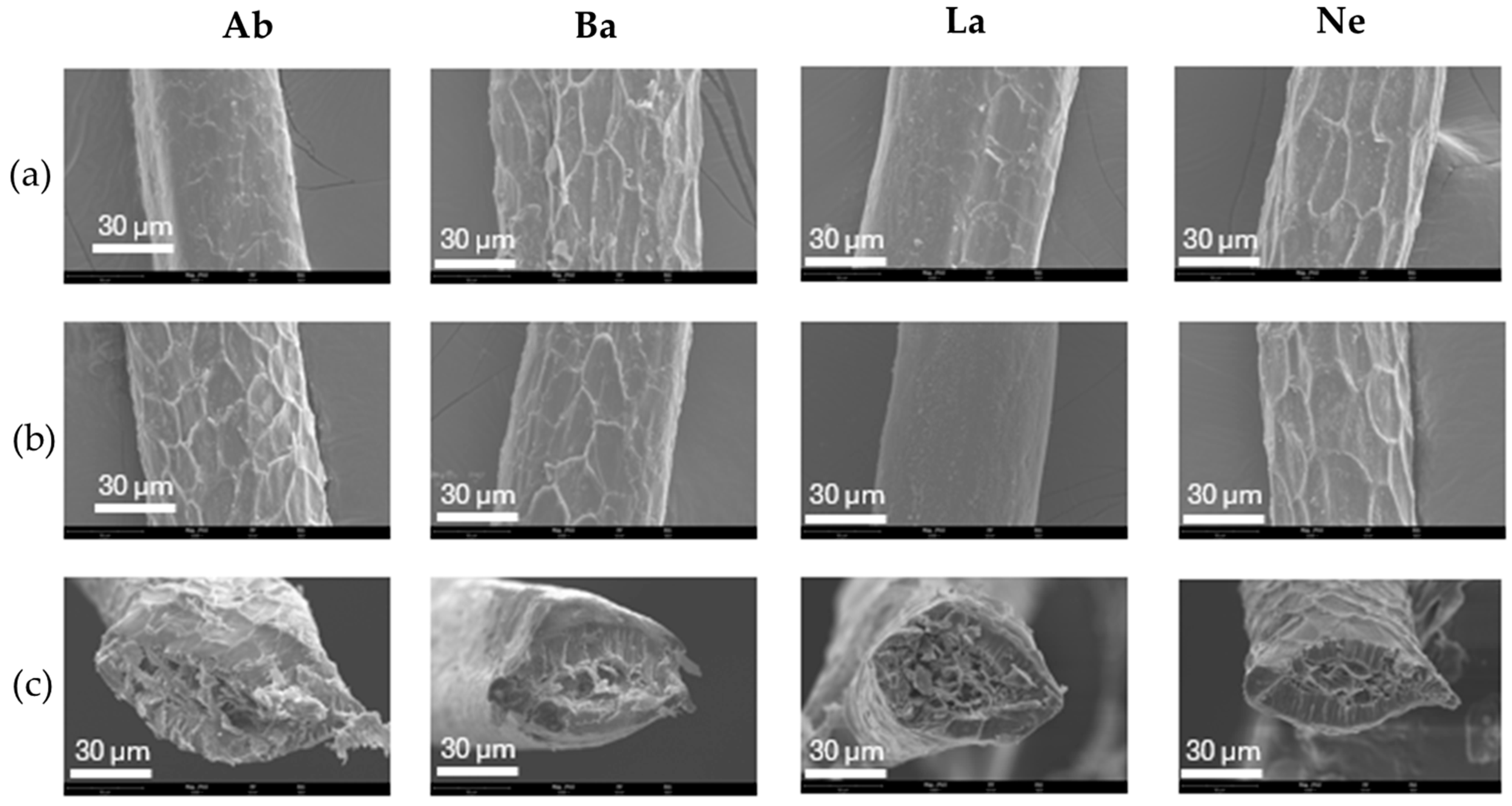
Figure 1. SEM images of three filaments from each body part of the sheep: (a,b) lateral views, (c) cross-sectional views of the fiber cuts.
Engproc 119 00017 g001
Figure 2. ATR-FTIR spectra of filaments collected from the different body parts, with band assignments to the corresponding chemical bonds.
Engproc 119 00017 g002
Figure 3. (a) Stress–strain curve for WF from all four regions and (b) variability of tensile strength.
Engproc 119 00017 g003
Figure 4. (a) Variability of strain and (b) variability of diameter.
Engproc 119 00017 g004
Table 1. Average width of the WF samples.
WF Width per Body Region (µm)
Back (Ba)Lateral (La)Abdomen (Ab)Neck (Ne)
Sample137.0040.2545.6742
238.833545.1733.11
345.6734.5841.8344.44
435.1736.7539.1735
546.3331.8344.0029.56
644.6734.2547.4243.22
737.8333.3342.1731
847.6737.7540.6738.11
945.004039.3336.33
1046.7538.9244.8335.78
Min35.1731.8339.1729.56
Max47.6740.2547.4244.44
Average42.4936.2743.0336.86
Standard deviation4.712.9082.8155.083
Disclaimer/Publisher’s Note: The statements, opinions and data contained in all publications are solely those of the individual author(s) and contributor(s) and not of MDPI and/or the editor(s). MDPI and/or the editor(s) disclaim responsibility for any injury to people or property resulting from any ideas, methods, instructions or products referred to in the content.