A Privacy-Preserving Health Monitoring Framework Using Federated Learning on Wearable Sensor Data †

Abstract
1. Introduction
1.1. Research Objectives and Questions
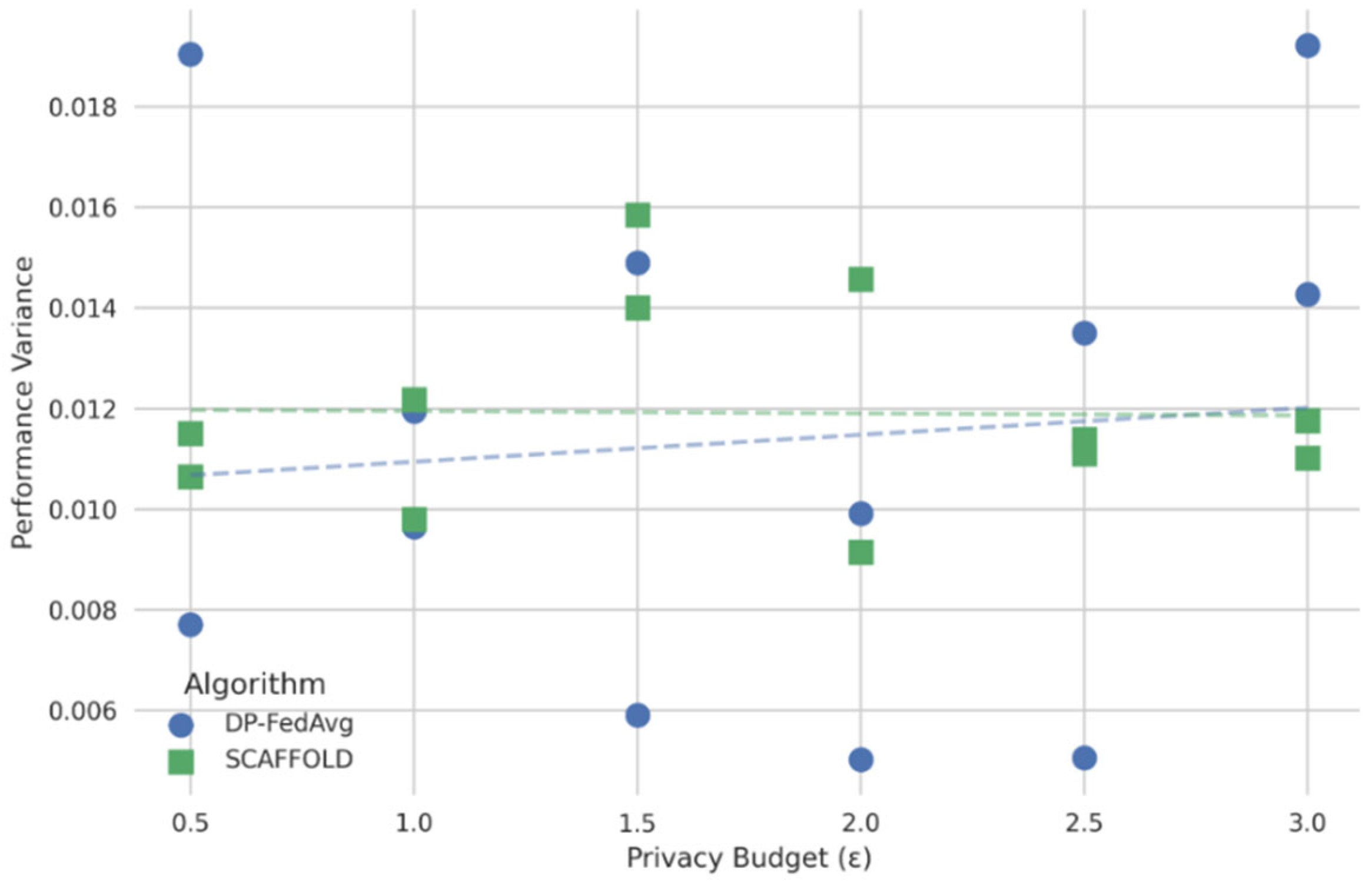
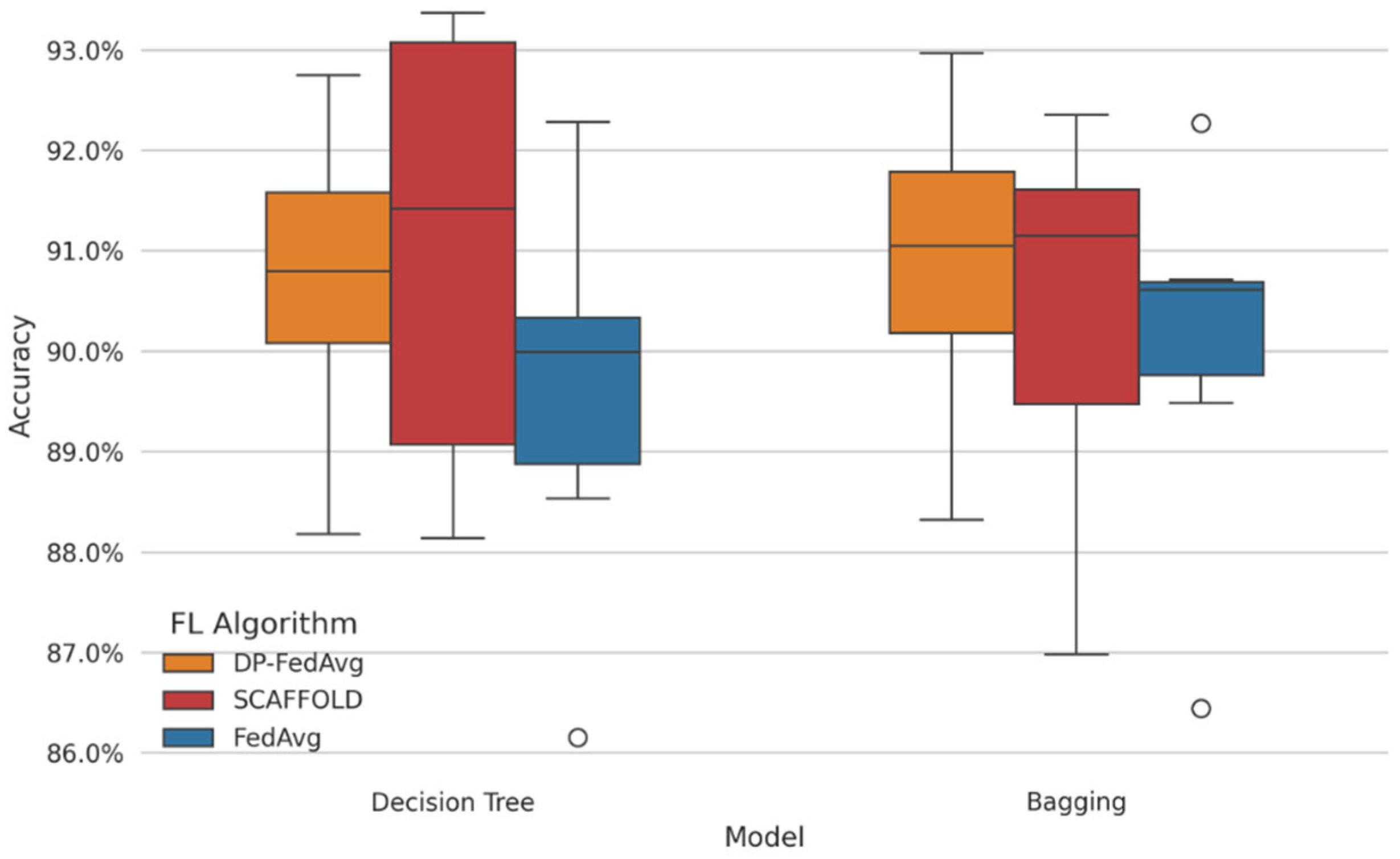
- Can communication-efficient algorithms (like DP-FedAvg or SCAFFOLD) sustain performance across weak learners (e.g., Decision Tree) while enhancing privacy and reducing variance?
- How does model complexity influence the performance drop when transitioning from centralized to federated learning?
1.2. Contributions of the Paper
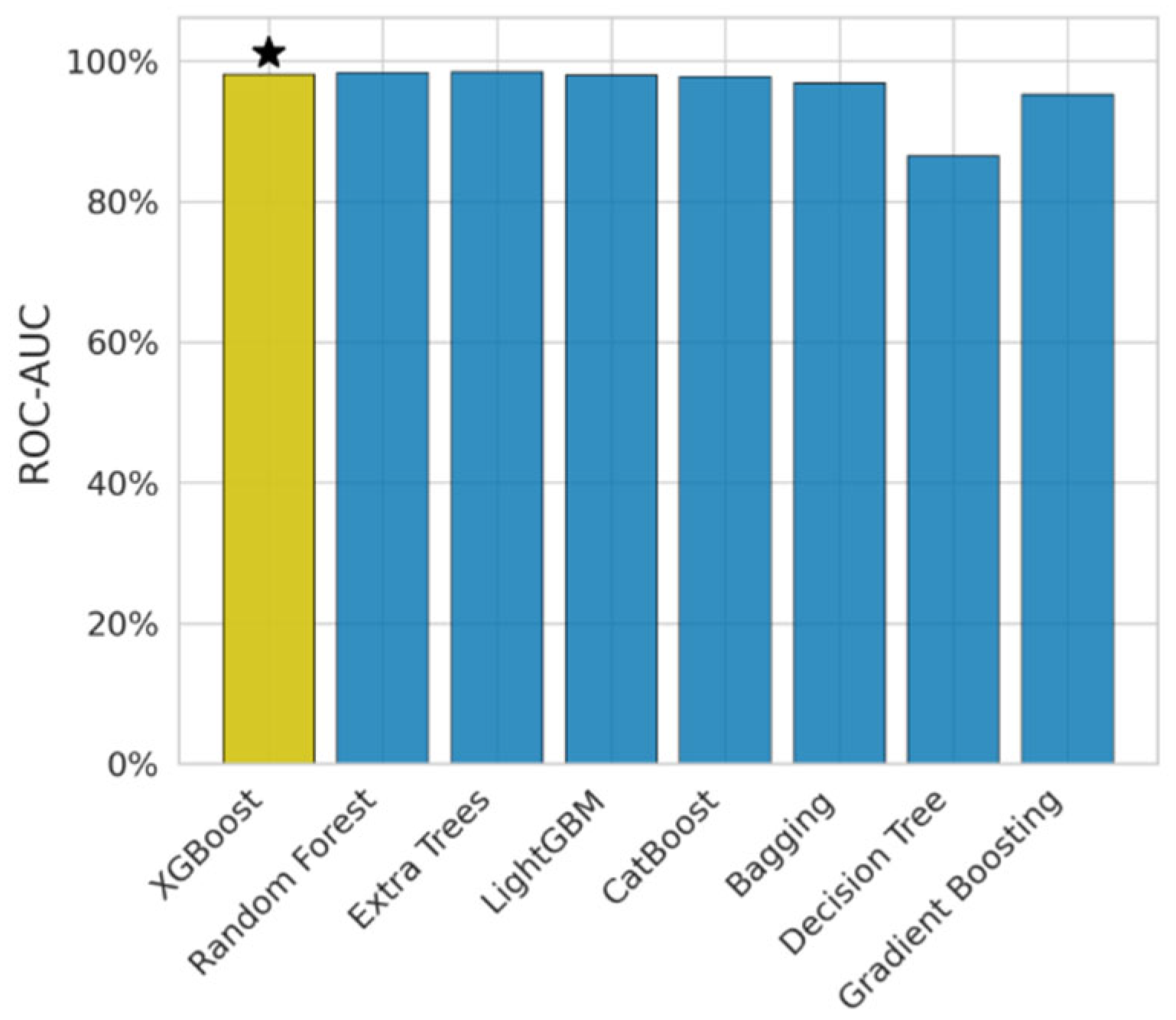
- In this paper, we have used the eight ensemble learning models for both centralized as well as federated learning. Here we estimated results with and without a privacy mechanism.
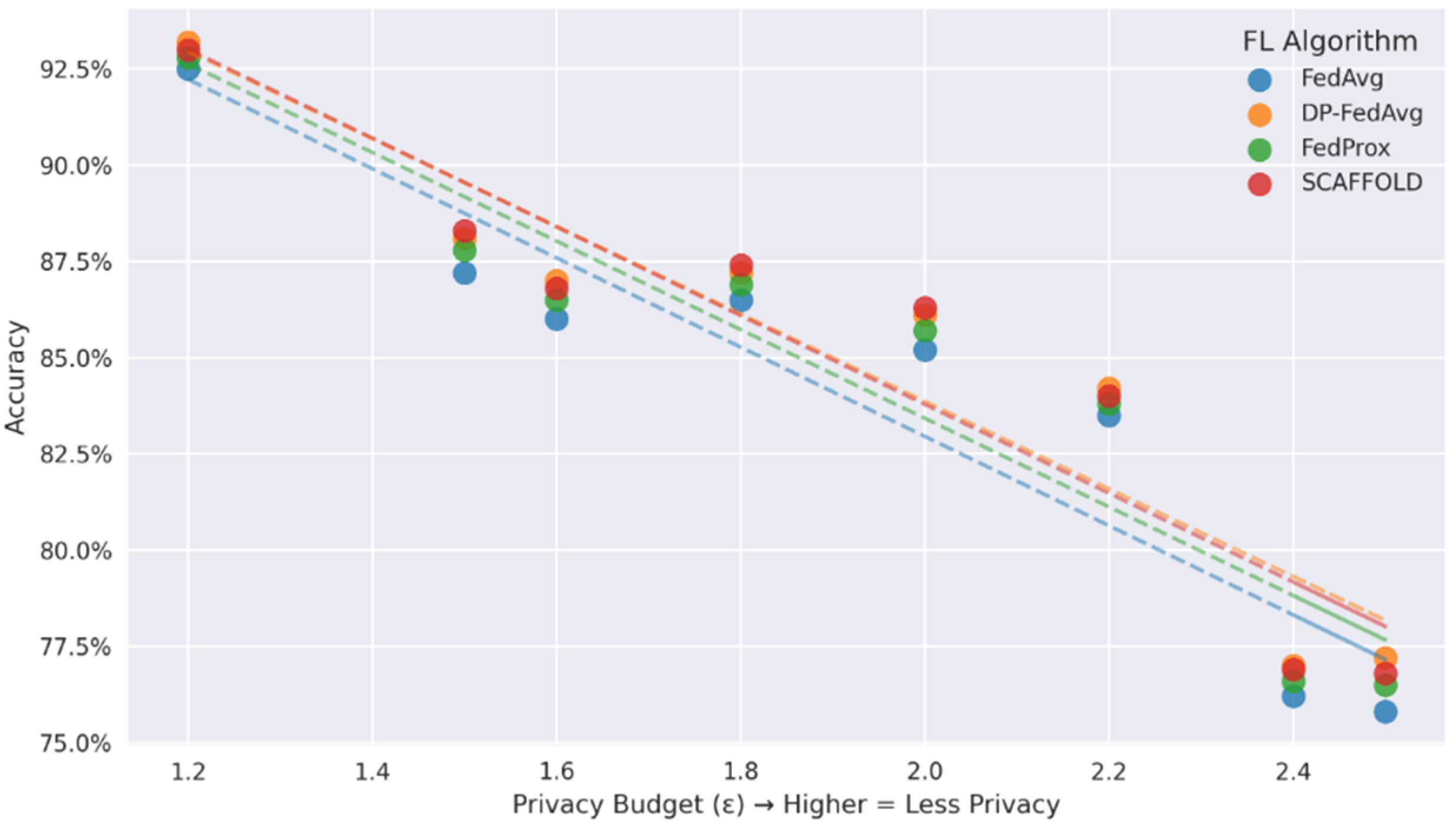
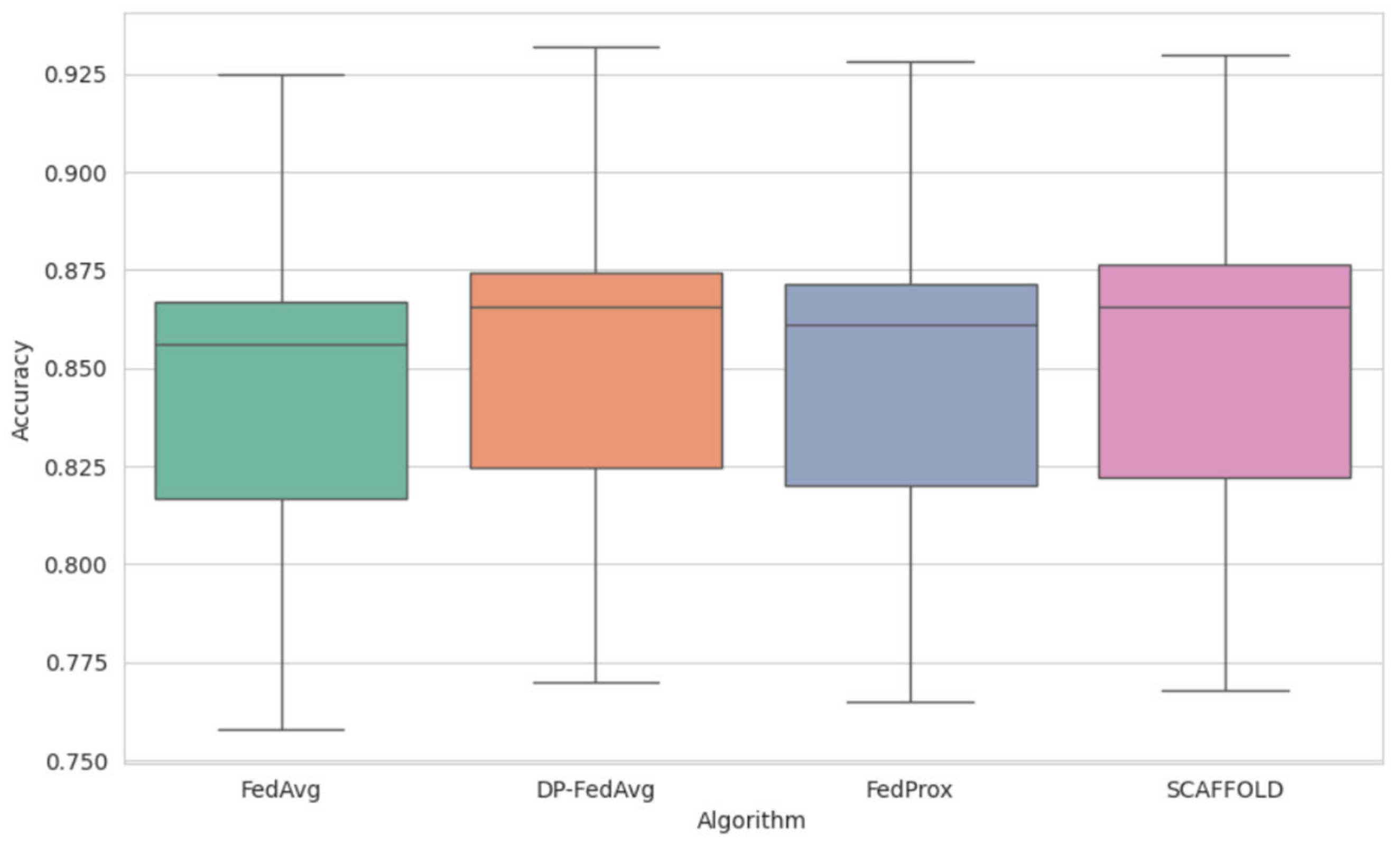
- We estimated the AUC-ε and Accuracy-ε–ε curves and discuss how privacy budgets affect performance across the different algorithms (FedAvg, DP-FedAvg, FedProx, and SCAFFOLD).
2. Related Work
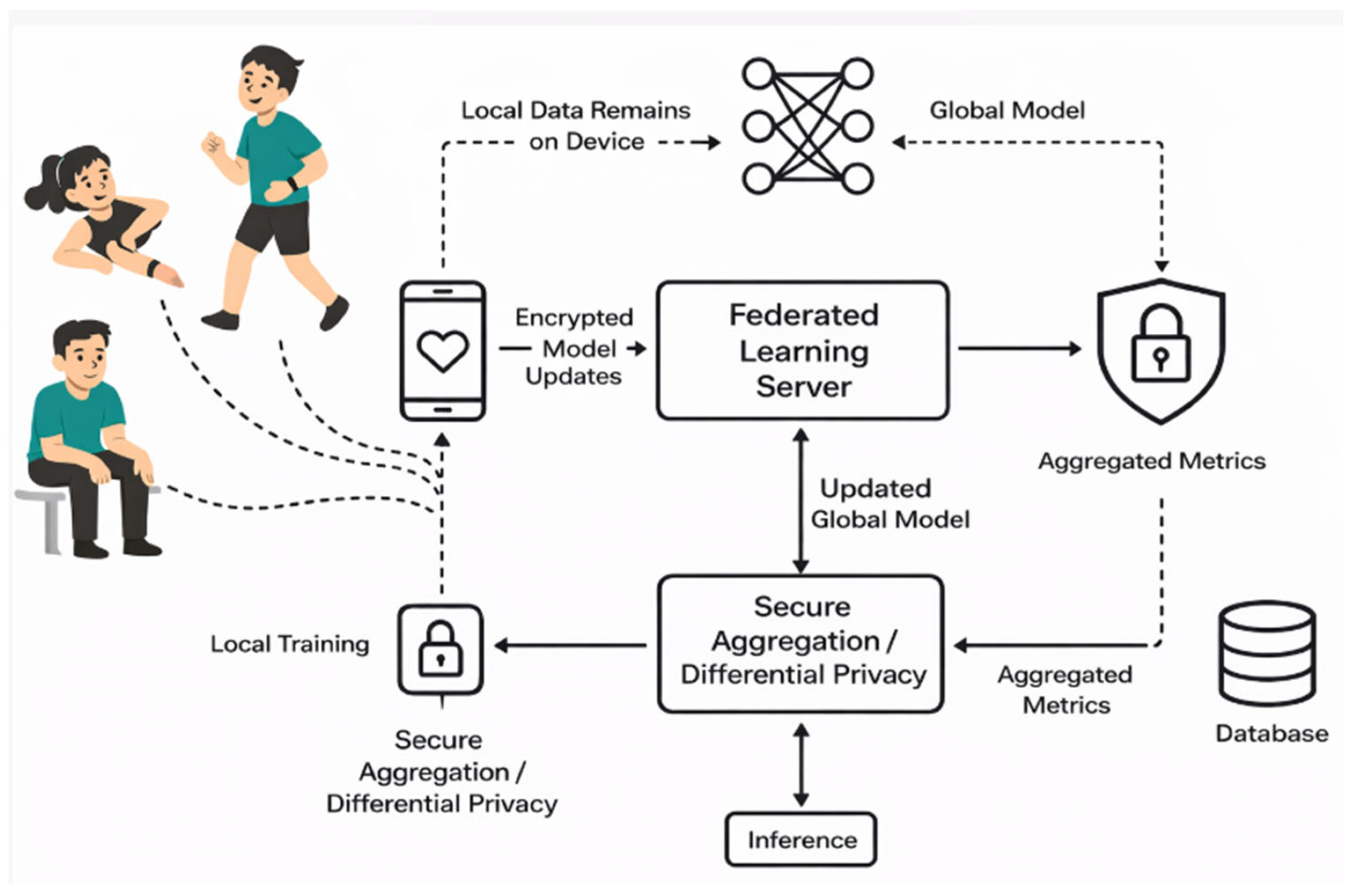
3. Proposed Model for Secure Health Data Aggregation and Prediction Through Federated Learning
- : Trained ML model (e.g., CNN, LSTM).
- : Final learned weights after T rounds.
4. Results and Discussion
5. Conclusions
Author Contributions
Funding
Institutional Review Board Statement
Informed Consent Statement
Data Availability Statement
Conflicts of Interest
Abbreviations
| RF | Random Forest |
| GB | Gradient Boosting |
| FL | Federated Learning |
| ML | Machine Learning |
| XGB | XGBoost |
References
- Das, S.; Dutta, S.; Hazra, S.; Nandi, S.; Bandyopadhyay, A.; Disha, M. Personalized Healthcare Empowered: Federated Learning Integration with Wearable Device Data for Enhanced Patient Insights. In Proceedings of the 2024 IEEE Region 10 Symposium (TENSYMP), New Delhi, India, 27–29 September 2024; IEEE: Piscataway, NJ, USA, 2024; pp. 1–6. [Google Scholar]
- Aminifar, A.; Shokri, M.; Aminifar, A. Privacy-preserving edge federated learning for intelligent mobile-health systems. Future Gener. Comput. Syst. 2024, 161, 625–637. [Google Scholar] [CrossRef]
- Wang, W.; Li, X.; Qiu, X.; Zhang, X.; Brusic, V.; Zhao, J. A privacy-preserving framework for federated learning in smart healthcare systems. Inf. Process. Manag. 2023, 60, 103167. [Google Scholar] [CrossRef]
- Mishra, A.; Saha, S.; Mishra, S.; Bagade, P. A federated learning approach for smart healthcare systems. CSI Trans. ICT 2023, 11, 39–44. [Google Scholar] [CrossRef]
- Arikumar, K.S.; Prathiba, S.B.; Alazab, M.; Gadekallu, T.R.; Pandya, S.; Khan, J.M.; Moorthy, R.S. FL-PMI: Federated learning-based person movement identification through wearable devices in smart healthcare systems. Sensors 2022, 22, 1377. [Google Scholar] [CrossRef] [PubMed]
- Ghosh, S.; Ghosh, S.K. FEEL: FEderated LEarning Framework for ELderly Healthcare Using Edge-IoMT. IEEE Trans. Comput. Soc. Syst. 2023, 10, 1800–1809. [Google Scholar] [CrossRef]
- Zhang, F.; Kreuter, D.; Chen, Y.; Dittmer, S.; Tull, S.; Shadbahr, T.; Preller, J.; Rudd, J.H.F.; Aston, J.A.D.; Schönlieb, C.B.; et al. Recent methodological advances in federated learning for healthcare. Patterns 2024, 5, 101006. [Google Scholar] [CrossRef] [PubMed]
- Akhmetov, A.; Latif, Z.; Tyler, B.; Yazici, A. Enhancing healthcare data privacy and interoperability with federated learning. PeerJ Comput. Sci. 2025, 11, e2870. [Google Scholar] [CrossRef] [PubMed]

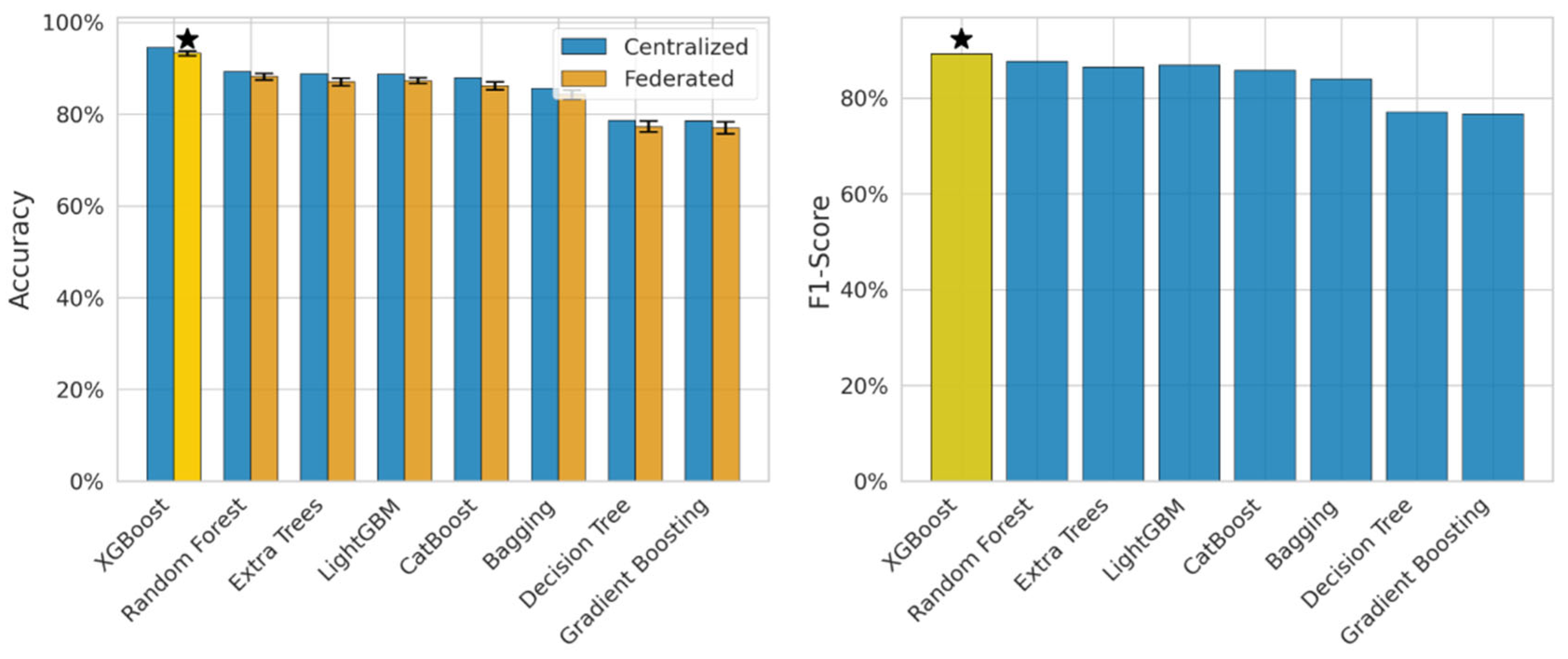




| Model | Accuracy | Precision | Recall | F1-Score | ROC-AUC |
|---|---|---|---|---|---|
| RF | 0.8923 | 0.892 | 0.8923 | 0.892 | 0.9852 |
| ET | 0.8875 | 0.8871 | 0.8875 | 0.887 | 0.9876 |
| LGBM | 0.8867 | 0.8868 | 0.8867 | 0.8865 | 0.9855 |
| XGBoost | 0.9453 | 0.9088 | 0.8943 | 0.9043 | 0.9845 |
| CatBoost | 0.8787 | 0.8783 | 0.8787 | 0.8782 | 0.983 |
| Bagging | 0.8555 | 0.856 | 0.8555 | 0.8556 | 0.9715 |
| DT | 0.7861 | 0.7863 | 0.7861 | 0.7857 | 0.8715 |
| GB | 0.7845 | 0.7859 | 0.7845 | 0.7844 | 0.9568 |
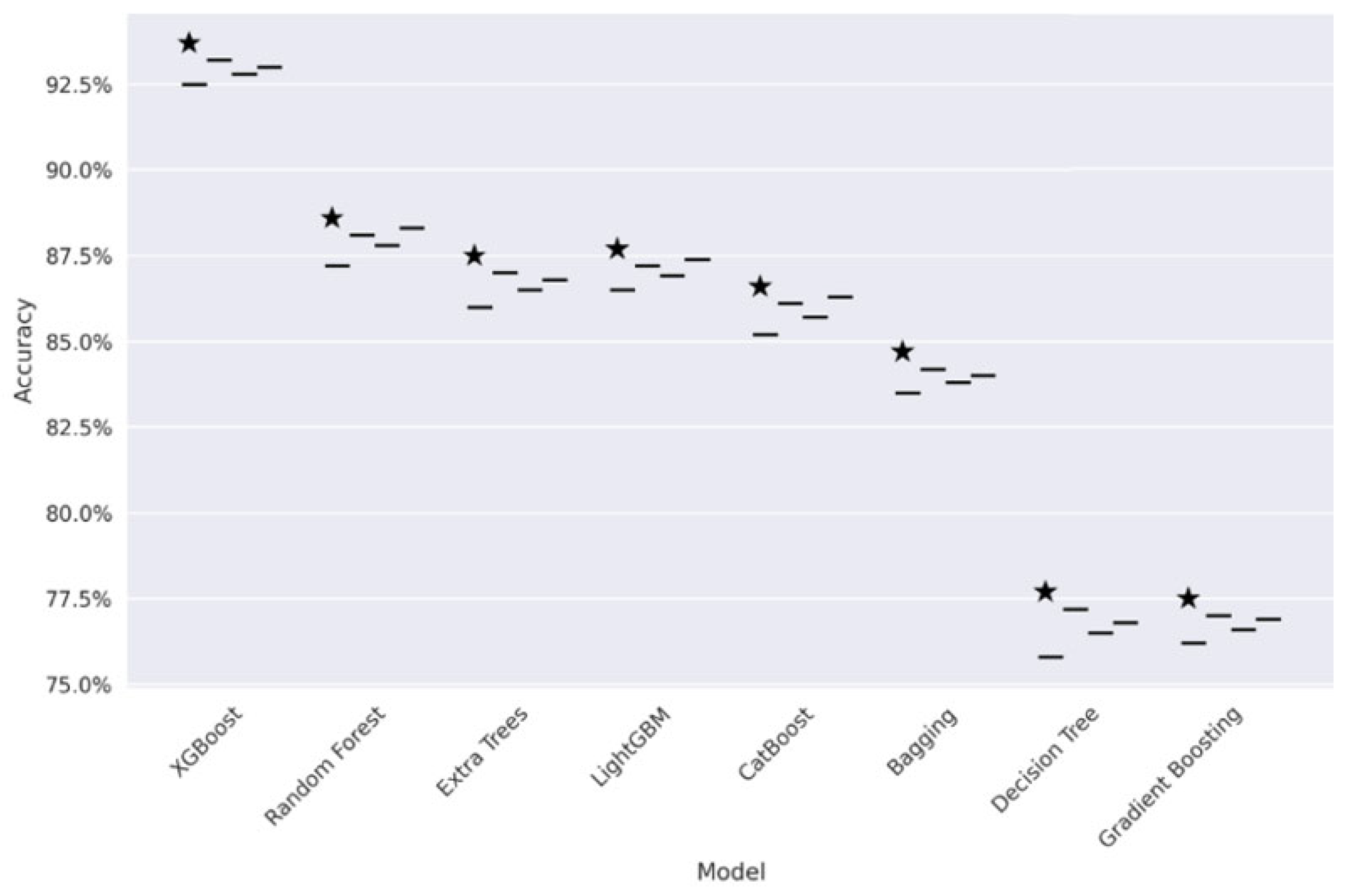
| Model | Accuracy (Centralized) | Accuracy (Federated ± std) | Precision (FL) | Recall (FL) | F1-Score (FL) | ROC-AUC (FL) | Comm. Rounds | Privacy Budget (ε) |
|---|---|---|---|---|---|---|---|---|
| XGBoost | 0.9453 | 0.9321 ± 0.005 | 0.901 ± 0.006 | 0.885 ± 0.004 | 0.892 ± 0.005 | 0.981 ± 0.003 | 50 | 1.2 |
| RF | 0.8923 | 0.8812 ± 0.007 | 0.879 ± 0.005 | 0.873 ± 0.006 | 0.876 ± 0.004 | 0.983 ± 0.002 | 50 | 1.5 |
| ET | 0.8875 | 0.8698 ± 0.008 | 0.865 ± 0.006 | 0.864 ± 0.007 | 0.864 ± 0.005 | 0.984 ± 0.003 | 50 | 1.6 |
| LGBM | 0.8867 | 0.8724 ± 0.006 | 0.868 ± 0.007 | 0.870 ± 0.005 | 0.869 ± 0.006 | 0.980 ± 0.004 | 50 | 1.8 |
| CatBoost | 0.8787 | 0.8615 ± 0.009 | 0.859 ± 0.008 | 0.858 ± 0.007 | 0.858 ± 0.007 | 0.978 ± 0.005 | 50 | 2 |
| Bagging | 0.8555 | 0.8421 ± 0.010 | 0.840 ± 0.009 | 0.838 ± 0.008 | 0.839 ± 0.008 | 0.968 ± 0.006 | 50 | 2.2 |
| DT | 0.7861 | 0.7723 ± 0.012 | 0.771 ± 0.011 | 0.769 ± 0.010 | 0.770 ± 0.010 | 0.865 ± 0.008 | 50 | 2.5 |
| GBoosting | 0.7845 | 0.7698 ± 0.013 | 0.768 ± 0.012 | 0.766 ± 0.011 | 0.767 ± 0.011 | 0.952 ± 0.007 | 50 | 2.4 |
| Model | FedAvg | DP-FedAvg | FedProx | SCAFFOLD | Best Algorithm |
|---|---|---|---|---|---|
| XGBoost | 0.925 ± 0.006 | 0.932 ± 0.005 | 0.928 ± 0.005 | 0.930 ± 0.004 | DP-FedAvg |
| Random Forest | 0.872 ± 0.008 | 0.881 ± 0.007 | 0.878 ± 0.007 | 0.883 ± 0.006 | SCAFFOLD |
| Extra Trees | 0.860 ± 0.009 | 0.870 ± 0.008 | 0.865 ± 0.008 | 0.868 ± 0.007 | DP-FedAvg |
| LightGBM | 0.865 ± 0.007 | 0.872 ± 0.006 | 0.869 ± 0.006 | 0.874 ± 0.005 | SCAFFOLD |
| CatBoost | 0.852 ± 0.010 | 0.861 ± 0.009 | 0.857 ± 0.009 | 0.863 ± 0.008 | SCAFFOLD |
| Bagging | 0.835 ± 0.012 | 0.842 ± 0.010 | 0.838 ± 0.011 | 0.840 ± 0.010 | DP-FedAvg |
| Decision Tree | 0.758 ± 0.014 | 0.772 ± 0.012 | 0.765 ± 0.013 | 0.768 ± 0.012 | DP-FedAvg |
| Gradient Boost | 0.762 ± 0.015 | 0.770 ± 0.013 | 0.766 ± 0.014 | 0.769 ± 0.013 | DP-FedAvg |
Disclaimer/Publisher’s Note: The statements, opinions and data contained in all publications are solely those of the individual author(s) and contributor(s) and not of MDPI and/or the editor(s). MDPI and/or the editor(s) disclaim responsibility for any injury to people or property resulting from any ideas, methods, instructions or products referred to in the content. |
© 2025 by the authors. Licensee MDPI, Basel, Switzerland. This article is an open access article distributed under the terms and conditions of the Creative Commons Attribution (CC BY) license (https://creativecommons.org/licenses/by/4.0/).
Share and Cite
Panigrahi, R.; Padhy, N. A Privacy-Preserving Health Monitoring Framework Using Federated Learning on Wearable Sensor Data. Eng. Proc. 2025, 118, 73. https://doi.org/10.3390/ECSA-12-26567
Panigrahi R, Padhy N. A Privacy-Preserving Health Monitoring Framework Using Federated Learning on Wearable Sensor Data. Engineering Proceedings. 2025; 118(1):73. https://doi.org/10.3390/ECSA-12-26567
Chicago/Turabian StylePanigrahi, Rasmita, and Neelamadhab Padhy. 2025. "A Privacy-Preserving Health Monitoring Framework Using Federated Learning on Wearable Sensor Data" Engineering Proceedings 118, no. 1: 73. https://doi.org/10.3390/ECSA-12-26567
APA StylePanigrahi, R., & Padhy, N. (2025). A Privacy-Preserving Health Monitoring Framework Using Federated Learning on Wearable Sensor Data. Engineering Proceedings, 118(1), 73. https://doi.org/10.3390/ECSA-12-26567