Proceeding Paper

Facile Wet-Chemical Synthesis of Graphene Oxide-Hydroxyapatite Composite for Potent, Accelerated and Synergistic Sonophotocatalytic Degradation of Diclofenac Under Light and Ultrasound Irradiation †

by
Joe Mari Biag
1,
Justin Carl Briones
1,
Crystal Cayena Dancel
1,
Florely De Villa
1,
Christian Ibarra Durante
1,
Rugi Vicente Rubi
1,2 and
Rich Jhon Paul Latiza
1,2,*
1
Chemical Engineering Department, College of Engineering, Adamson University, 900 San Marcelino St., Ermita, Manila 1000, Philippines
2
Adamson University Laboratory of Biomass, Energy and Nanotechnology (ALBEN), Adamson University, 900 San Marcelino St., Ermita, Manila 1000, Philippines
*
Author to whom correspondence should be addressed.
Presented at the 4th International Electronic Conference on Processes, 20–22 October 2025; Available online: https://sciforum.net/event/ECP2025.
Eng. Proc. 2025, 117(1), 8; https://doi.org/10.3390/engproc2025117008
Published: 3 December 2025

Abstract

The widespread disposal of pharmaceutical waste, particularly diclofenac (DCF), poses a significant threat to aquatic ecosystems. The current degradation methods, including biological treatments and standalone advanced oxidation processes, often prove insufficient, leaving residual DCF concentrations. This study proposes a novel solution using a rapidly synthesized graphene oxide/hydroxyapatite (GO/HAp) nanocomposite via wet-chemical precipitation to enhance DCF degradation through synergistic sonophotocatalysis. The synthesized nanocomposite’s structure was confirmed using Fourier transform infrared spectroscopy FTIR, x-ray diffraction XRD, and scanning electron microscope SEM analyses, revealing the successful formation of a hexagonal HAp phase on GO sheets. Optimization of the sonophotocatalytic parameters revealed that pH and loading significantly influenced degradation, while time had a less pronounced effect. The optimal conditions (a pH pf 4, 45 mg GO/HAp, 30 min) achieved a remarkable 93.86% DCF degradation, significantly outperforming standalone photocatalysis (72.76%) and sonolysis (63.76%). This enhanced performance is attributed to the synergistic effect of sonophotocatalysis, which increases the active surface area and radical generation, coupled with the high surface area and adsorption capacity of the GO/HAp nanocomposite. This research demonstrates that rapid wet-chemical synthesis of the GO/HAp nanocomposite, coupled with an optimized sonophotocatalytic process, offers a potent, accelerated, and efficient method for degrading DCF, paving the way for improved pharmaceutical wastewater treatment. Ultimately, this research provides a foundation for developing effective water treatment solutions to combat pharmaceutical contaminants.

1. Introduction

The growing global concern over pharmaceutical residues in aquatic environments, such as the widely used drug diclofenac (DCF), stems from its persistence and the partial ineffectiveness of traditional wastewater treatments in its removal [1,2]. While advanced oxidation processes are being explored, the synergistic combination of sonolysis and photocatalysis, known as sonophotocatalysis, offers a more effective approach by enhancing free radical generation and degradation rates [3,4]. This efficacy can be further amplified using novel nanocomposites; this study introduces a GO/HAp nanocomposite that combines the high surface area of graphene oxide (GO) [5] with the excellent, biocompatible adsorption properties of hydroxyapatite (HAp) [6], an environmentally benign alternative to common metallic oxides [7,8]. Furthermore, the heterojunction formed between GO and HAp facilitates efficient charge separation and reduces electron-hole recombination, thereby enhancing the overall photocatalytic activity for DCF degradation. This research presents a novel, rapid wet-chemical method for synthesizing this GO/HAp nanocomposite and investigates its application in the sonophotocatalytic degradation of DCF. The work’s novelty lies in the facile synthesis coupled with its optimized use in a synergistic system for DCF removal.

2. Materials and Methods

2.1. Chemicals, Materials and Equipment

Chemicals including GO, diclofenac sodium salt, and calcium nitrate tetrahydrate were sourced from Sigma Aldrich, Singapore, while ammonium hydroxide, diammonium phosphate, sodium hydroxide, and deionized water were from DKL Laboratories Supply (Quezon City, Philippines). Material characterization was performed using Fourier Transform Infrared (FTIR) Spectroscopy (Perkin Elmer Spectrum Two, PerkinElmer, Waltham, MA, USA) at Adamson University (Manila, Philippines), X-ray Diffraction (XRD) (Maxima XRD- Shimadzu 2000, Shimadzu Corporation, Kyoto, Japan) at the University of the Philippines Diliman (Quezon City, Philippines), and Field Emission Scanning Electron Microscopy (FE-SEM) (Dual Beam Helios Nanolab 600i, FEI Company, Hillsboro, OR, USA) at the Advanced Device and Materials Testing Laboratory (ADMATEL-DOST, Taguig City, Philippines), while degradation experiments were conducted in a custom-built sonophotocatalytic reactor.

2.2. Experimental Setup

The sonophotocatalytic degradation experiments were performed in a custom-designed reactor consisting of a wooden enclosure containing three 20 W ultraviolet lamps at the top and a 40 kHz ultrasonic bath at the bottom, where beakers with the DCF solution and nanocomposite were placed for simultaneous treatment.

2.3. Experimental Design

A Full Factorial design using Minitab software (version 20.2) was employed to systematically investigate the effects and interactions of three independent variables: pH, GO/HAp loading, and time, as detailed in Table 1. A total of 27 unique experimental conditions were tested in triplicate for reliability, resulting in 81 randomized experimental runs to minimize bias.

2.4. Experimental Procedure

2.4.1. Rapid Wet-Chemical Synthesis of GO/HAp Nanocomposite

The GO/HAp nanocomposite was synthesized via a rapid wet-chemical precipitation method by creating a calcium dihydrogen phosphate precursor solution containing dispersed GO, which was then added dropwise to concentrated (25%) NH3·H2O under vigorous stirring. The pH was maintained above 10 using NH3·H2O to facilitate the formation of a white precipitate over approximately 30 min, which was then collected, washed to a neutral pH, and dried in a vacuum oven at 110 °C overnight.

2.4.2. Preparation of Diclofenac Solution

A 20 ppm working solution of diclofenac was prepared by diluting 1000 mg/L stock solution of diclofenac sodium salt in distilled water.

2.4.3. Sonophotocatalytic Degradation Process

Degradation experiments were conducted at ambient temperature in 150 mL of the 20 ppm diclofenac solution, with the pH adjusted using 0.1 M H2SO4 or 0.1 M NaOH. Small volumes were used to minimize variations in the total volume and ionic strength of the solution. After adding the specified GO/HAp loading, the solution was simultaneously exposed to (ultraviolet) UV and ultrasound for a predetermined time and then filtered. To study kinetics, experiments were run under optimized conditions with samples taken at intervals between 1 and 30 min. For comparison, control experiments using only sonolysis or photocatalysis were also performed under these optimized conditions.

3. Results and Discussion

3.1. Characterization of GO/HAp Nanocomposite

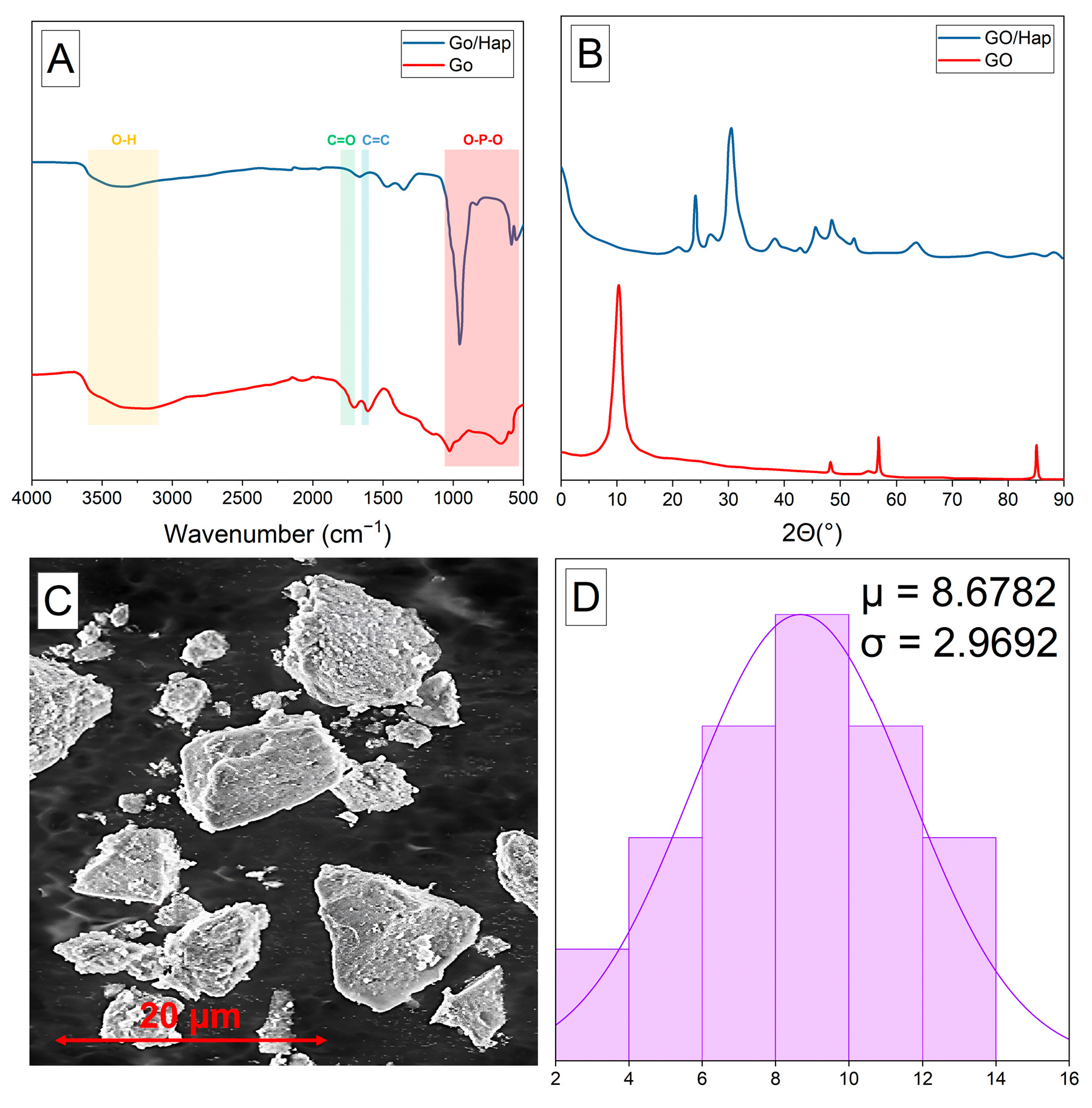
FTIR, XRD, and SEM analyses confirmed the successful synthesis of the GO/HAp nanocomposite by characterizing its functional groups, crystalline structure, and morphology. Figure 1A displays the FTIR spectra. The spectrum for GO showed characteristic peaks for oxygen-containing functional groups, including a broad O-H stretch (3202.04 cm−1), C=O (1721.15 cm−1), C=C (1620.19 cm−1), and alkoxy C-O stretching vibrations, confirming successful graphite oxidation [9,10]. In the GO/HAp nanocomposite spectrum, a broad peak at 3386.91 cm−1 is attributed to adsorbed water. Sharp, characteristic HAp peaks appeared at 1024.07 cm−1, 600.63 cm−1, and 560 cm−1, corresponding to P-O stretching (1024.07 cm−1) and O-P-O bending (600.63 cm−1 and 560 cm−1) vibrations in PO43− groups, indicating high crystallinity. Peaks for GO’s C=C (around 1678 cm−1) and C=O (around 1512 cm−1) stretching were present but with reduced intensity, suggesting a strong interaction between GO and HAp [11]. The absence of other significant peaks confirmed the nanocomposite’s purity. Additionally, optical analysis suggests that the incorporation of GO narrows the band gap compared to pristine HAp, thereby enhancing light absorption and photocatalytic efficiency under the UV irradiation used.
The XRD patterns are shown in Figure 1B. The GO pattern featured a sharp diffraction peak at 2θ = 10.31° (001), characteristic of the increased interlayer spacing from oxidation [9,12]. The GO/HAp pattern displayed sharp peaks at 2θ = 26.10°, 31.02°, 32.35°, 34.12°, 39.87°, and 49.80°, which match the hexagonal HAp phase (Joint Committee on Powder Diffraction Standards, JCPDS no. 09-0432) and confirm its crystalline nature. The characteristic GO peak was absent in the nanocomposite, likely due to the dominance of crystalline HAp and the exfoliation of GO sheets during synthesis [10,11].
The SEM image in Figure 1C shows GO’s characteristic wrinkled, sheet-like structure with distributed HAp particles. The HAp particles were agglomerated, with a mean particle size of 8.6782 μm and a standard deviation of 2.9692 μm (Figure 1D). This agglomeration is common for nano-sized HAp synthesized via rapid precipitation. Despite this, the image confirms the successful integration of HAp onto the GO sheets, likely anchored by oxygen-containing functional groups [10,13].

3.2. Optimization and Effects of Process Parameters on Sonophotocatalytic Degradation of DCF

A full factorial experimental design was used to optimize the sonophotocatalytic degradation of DCF. The effects and interactions of three parameters—pH, GO/HAp loading, and time—were analyzed using Minitab to maximize DCF degradation.

3.2.1. Optimization Using Full Factorial RSM

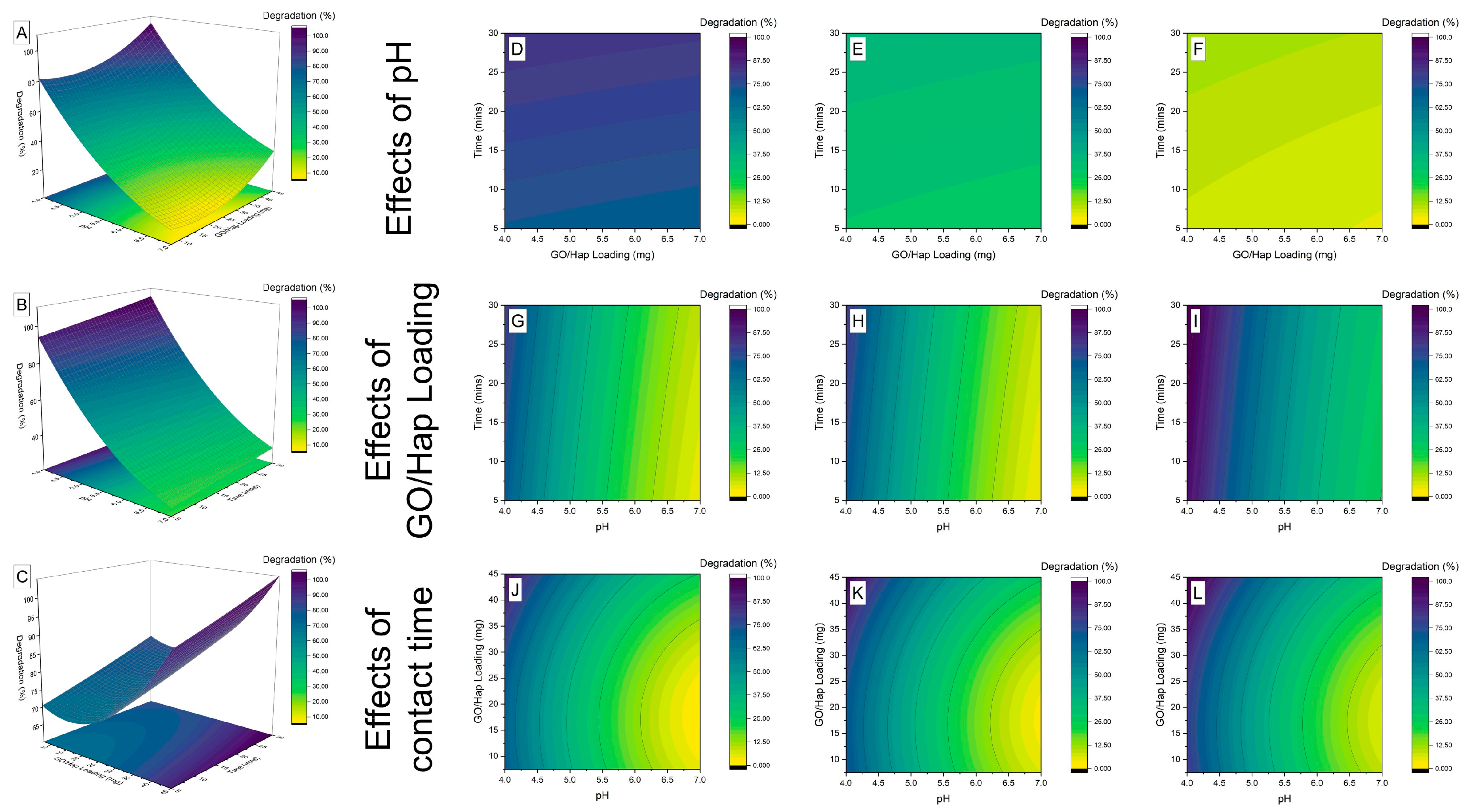
Response surface methodology (RSM) was used to visualize the relationship between the variables and DCF degradation, as shown in the 3D surface plots in Figure 2A–C. The plots demonstrate the combined effects of the parameters. Figure 2A shows that degradation is highest at low pH (4) and high GO/HAp loading (45 mg). Figure 2B highlights that pH has a more dominant effect than time, with degradation being significantly higher at pH 4 regardless of duration. Figure 2C, at the optimal pH of 4, shows that both loading and time positively influence degradation, with the maximum achieved at high levels of both (45 mg and 30 min).
The analysis of variance (ANOVA) results (Table 2) validate these observations. The model was highly significant (F-value = 11.19, p-value = 0), with an R-squared value of 85.56%, indicating a good fit. The analysis confirmed that pH (p < 0.0001) and GO/HAp loading (p = 0.011) are significant model terms, while time (p = 0.329) and interaction terms were not. A composite desirability of 1 confirmed the effectiveness of the optimization.
The derived model equation is:
Degradation (%) = 300.6 − 76.9A − 0.83B + 0.73C + 5.07AA + 0.0304BB +
0.0021CC − 0.034AB − 0.091AC + 0.0001BC,
where A, B, and C are pH, loading, and time, respectively. Based on the analysis, the optimal conditions for achieving nearly 100% DCF degradation were determined to be pH 4, 45 mg GO/HAp loading, and 30 min time.

3.2.2. Effects of Individual Parameters on Sonophotocatalytic Degradation of DCF

The contour plots in Figure 2D–L further illustrate the individual parameter effects. The plots clearly show that degradation is highest at pH 4 and decreases significantly at pH 5.5 and 7 (Figure 2D–F). This confirms pH is the most critical factor, as its large negative coefficient (−76.9) in the model equation indicates. An acidic environment favors the formation of hydroxyl radicals and enhances interactions between the catalyst and DCF molecules [14,15]. Increasing GO/HAp loading also improved degradation by providing more active sites, as shown in Figure 2G–I [14,15]. Time had the least impact (Figure 2J–L), supporting the ANOVA finding that it was not a significant factor and indicating the process is relatively rapid.

3.3. Kinetics Study

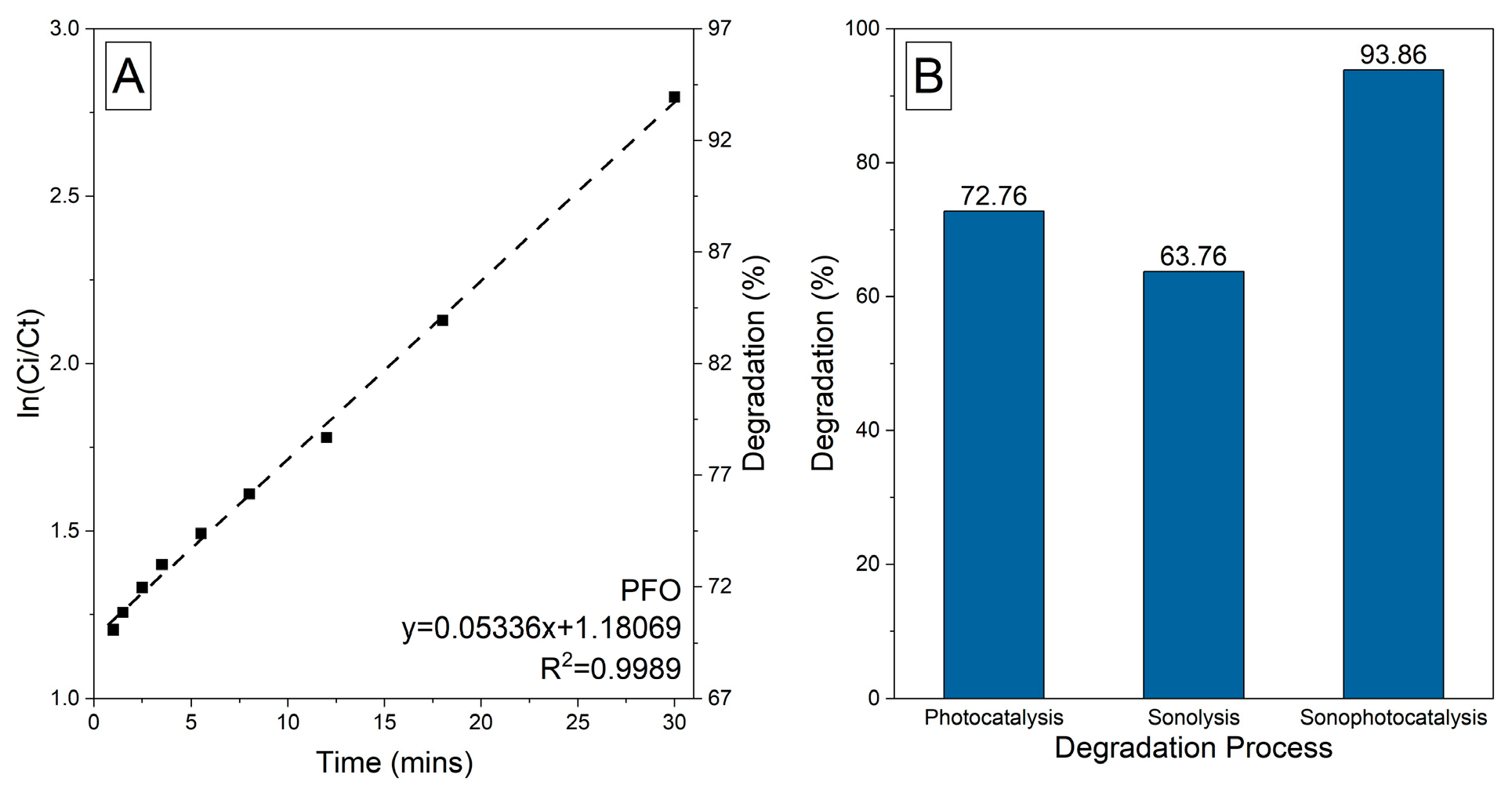
A kinetic study was performed under optimal conditions (pH 4, 45 mg GO/HAp loading). As shown in Figure 3A, the degradation of DCF followed a pseudo-first-order (PFO) kinetic model, confirmed by a strong linear fit (R2 = 0.9989). This suggests the degradation rate is primarily governed by the availability of active sites on the nanocomposite surface. The high surface area of GO/HAp, suggested by the porous morphology observed in SEM, and enhanced adsorption in the acidic environment, facilitated by GO’s oxygen-containing functional groups (hydroxyl, epoxy, and carboxyl), support this surface-limited mechanism. The rapid reaction is driven by a high concentration of hydroxyl radicals reacting with adsorbed DCF molecules [16,17].

3.4. Comparison of Sonolysis, Photocatalysis, and Sonophotocatalysis

To demonstrate the synergistic effect, sonophotocatalysis was compared to sonolysis alone and photocatalysis alone under optimal conditions. The results in Figure 3B show that the combined process achieved significantly higher DCF degradation (93.90%) than sonolysis (63.76%) or photocatalysis (72.76%) individually. This synergy is attributed to several factors: increased production of hydroxyl radicals from both mechanisms [18]; enhanced mass transfer of DCF to the catalyst surface due to ultrasonic mixing; and the physical effects of ultrasound, which prevent particle agglomeration and clean the catalyst surface, maintaining active site availability and potentially creating surface defects that enhance photocatalytic activity [18,19]. The acidic medium further aids this process by promoting DCF adsorption onto the GO component [14,18].
The degradation efficiency was calculated using the formula: Degradation (%) = (C0 − Ct)/C0 × 100, where C0 represents the initial DCF concentration and Ct is the concentration at time t.

3.5. Implications of Potent, Accelerated, and Optimized Degradation of DCF Using GO/HAp Nanocomposite

The potent, accelerated, and optimized sonophotocatalytic degradation of DCF using the GO/HAp nanocomposite has significant implications for wastewater treatment. The high degradation efficiency (93.90%) demonstrates the system’s potential to effectively remove persistent pharmaceutical pollutants. The rapid kinetics, following a pseudo-first-order model, suggests that treatment can be achieved with shorter residence times, leading to more compact and cost-effective systems. Systematic optimization ensures maximum performance and resource efficiency. This environmentally friendly approach, which uses a biocompatible HAp-based catalyst, offers a promising solution to mitigate the ecological impact of pharmaceutical contaminants and provides a foundation for developing next-generation water treatment technologies [19,20,21].

4. Conclusions

This study demonstrated the highly effective sonophotocatalytic degradation of DCF using a rapidly synthesized GO/HAp nanocomposite. Characterization confirmed the successful formation of the nanocomposite, and process optimization identified pH and catalyst loading as the most significant factors. Under optimal conditions (pH 4, 45 mg GO/HAp, 30 min), 93.90% of DCF was degraded, significantly outperforming sonolysis or photocatalysis alone due to synergistic effects. This facile synthesis and optimized synergistic system offer a potentially cost-effective and environmentally friendly solution for advancing water remediation technologies.

Author Contributions

J.M.B., J.C.B., C.C.D., F.D.V. and C.I.D.: Conceptualization, data curation, formal analysis, investigation, methodology, validation, visualization, writing—original draft. R.V.R.: Conceptualization, data curation, project administration, supervision, validation, writing—review & editing. R.J.P.L.: Visualization, writing—review & editing. All authors have read and agreed to the published version of the manuscript.

Funding

This research received no external funding.

Institutional Review Board Statement

Not applicable.

Informed Consent Statement

Not applicable.

Data Availability Statement

The authors declare that the data supporting the findings of this study are available within the paper. Should any raw data files be needed in another format they are available from the corresponding author upon reasonable request.

Conflicts of Interest

The authors declare no conflicts of interest.

References

  1. Sivodia, C.; Sinha, A. Valorization of nano-scrap carbon iron filings as heterogeneous electro-Fenton catalyst for the removal of anticancer drug: Insight into degradation mechanism. Environ. Sci. Pollut. Res. 2025, 32, 4603–4618. [Google Scholar]
  2. Latiza, R.J.P.; Mustafa, A.; Delos Reyes, K.; Nebres, K.L.; Abrogena, S.L.; Rubi, R.V. Optimization, characterization, reversible thermodynamically favored adsorption, and mechanistic insights into low-cost mesoporous Fe-doped kapok fibers for efficient caffeine removal from water. Sep. Sci. Technol. 2025, 60, 1643–1658. [Google Scholar]
  3. Bognár, S.; Jovanović, D.; Despotović, V.; Finčur, N.; Putnik, P.; Šojić Merkulov, D. Advancing Wastewater Treatment: A Comparative Study of Photocatalysis, Sonophotolysis, and Sonophotocatalysis for Organics Removal. Processes 2024, 12, 1256. [Google Scholar] [CrossRef]
  4. Kabasa, S.; Sun, Y.; Wang, S.; Bulka, S.; Wang, J.; Chmielewski, A.G. Chloroquine degradation under Fenton-assisted electron beam irradiation in aqueous solution. Environ. Sci. Pollut. Res. 2025, 32, 4894–4909. [Google Scholar]
  5. Hao, Q.; Liu, S.; Wang, X.; Zhang, P.; Mao, Z.; Zhang, X. Progression from graphene and graphene oxide to high-performance epoxy resin-based composite. Polym. Degrad. Stab. 2024, 223, 110731. [Google Scholar] [CrossRef]
  6. Studziński, W.; Gackowska, A.; Kudlek, E.; Przybyłek, M. Environmental and toxicological aspects of sulfamethoxazole photodegradation in the presence of oxidizing agents. Environ. Sci. Pollut. Res. 2025, 32, 4733–4753. [Google Scholar]
  7. Pahasup-anan, T.; Suwannahong, K.; Kampeerapappun, P.; Rangkupan, R.; Dechapanya, W. Conditional Optimization on the Photocatalytic Degradation Removal Efficiency of Formaldehyde using TiO2—Nylon 6 Electrospun Composite Membrane. Appl. Sci. Eng. Prog. 2025, 18, 7509. [Google Scholar]
  8. Thao, T.Q.; Thu Hien, N.T.; Lam, P.T.; Huy, N.N.; Thi, P.T.; Thanh, N.T.; Toan, P.P.; Thich, L.T.; Thuy, N.T. Exploring the Mechanism for the Photocatalytic Degradation of Oxytetracycline in Water Using TiO2 and Supplementary Oxidants. Appl. Sci. Eng. Prog. 2025, 18, 7651. [Google Scholar]
  9. Sayem, M.A.; Hossen Suvo, M.A.; Syed, I.M.; Bhuiyan, M.A. Effective adsorption and visible light driven enhanced photocatalytic degradation of rhodamine B using ZnO nanoparticles immobilized on graphene oxide nanosheets. Results Phys. 2024, 58, 107471. [Google Scholar] [CrossRef]
  10. Pruna, A.; Poliac, I.; Busquets Mataix, D.; Ruotolo, A. Synergistic effects in ZnO nanorod films by pulsed electrodeposition on graphene oxide towards enhanced photocatalytic degradation. Ceram. Int. 2024, 50, 4622–4631. [Google Scholar] [CrossRef]
  11. Mizar, K.; Mulyati, S.; Aprilia, S.; Aulia, M.P.; Arahman, N. Preparation of tungsten trioxide/graphene oxide/hydroxyapatite (WO3/GO/HAp) for photocatalytic removal of methylene blue under visible light. Case Stud. Chem. Environ. Eng. 2024, 10, 100870. [Google Scholar] [CrossRef]
  12. Usman, M.; Ahmed, A.; Khalid, A.; Rafiq, M.; Algarni, M.; Albalawi, A.N.; Aldhafeeri, Z.M.; Hasan, M. Unveiling the synthesis of magnetically separable magnetite nanoparticles anchored over reduced graphene oxide for enhanced visible-light-driven photocatalytic degradation of dyes. Diamond Relat. Mater. 2024, 149, 111575. [Google Scholar] [CrossRef]
  13. Kahraman, E.; Nasun-Saygili, G. 5-Fluorouracil adsorption on graphene oxide-amine modified graphene oxide/hydroxyapatite composite for drug delivery applications: Optimization and release kinetics studies. Heliyon 2024, 10, e38494. [Google Scholar] [CrossRef] [PubMed]
  14. Batista, J.A.F.; Mendes, J.; Moretto, W.E.; Quadro, M.S.; Dos Santos, J.H.Z.; De Escobar, C.C. Sunlight removal of diclofenac using g-C3N4, g-C3N4/Cl, g-C3N4/Nb2O5 and g-C3N4/TiO2 photocatalysts. J. Environ. Chem. Eng. 2024, 12, 113016. [Google Scholar] [CrossRef]
  15. Castro, M.A.M.; Tranquilin, R.L.; Paiva, A.E.M.; Teodoro, M.D.; Correa, M.A.; Motta, F.V.; Bomio, M.R.D. Improvement of dye degradation by photocatalysis and synergistic effect of sonophotocatalysis processes using CaMoO4/g-C3N4 heterojunction. Optik 2024, 300, 171682. [Google Scholar] [CrossRef]
  16. Dihingia, H.; Pathak, S.; Lalmalsawmdawngliani; Tiwari, D.; Kim, D.-J. A sustainable solution for diclofenac degradation from water by heterojunction bimetallic nanocatalyst. J. Taiwan Inst. Chem. Eng. 2025, 166, 105096. [Google Scholar] [CrossRef]
  17. Monjezi, Z.; Tarlani, A.; Esfahani, H.; Asghar, A.; Salemi, A.; Zadmard, R.; Vosough, M. Simultaneous photocatalytic degradation of remdesivir, favipiravir, and diclofenac from aqueous solutions using a quaternary plasmonic Ag/Ag-SG-TiO2-rGO photocatalyst: Synthesis, characterization, optimization, and toxicity assessment. J. Water Process. Eng. 2024, 67, 106267. [Google Scholar] [CrossRef]
  18. Ghosh, S.; Sahu, M. Ultrasound for the degradation of endocrine disrupting compounds in aqueous solution: A review on mechanisms, influence of operating parameters and cost estimation. Chemosphere 2024, 349, 140864. [Google Scholar] [CrossRef]
  19. Latiza, R.J.P.; Rubi, R.V. Circular Economy Integration in 1G+2G Sugarcane Bioethanol Production: Application of Carbon Capture, Utilization and Storage, Closed-Loop Systems, and Waste Valorization for Sustainability. Appl. Sci. Eng. Prog. 2025, 18, 7448. [Google Scholar]
  20. Latiza, R.J.P.; Olay, J.; Eguico, C.; Yan, R.J.; Rubi, R.V. Environmental applications of carbon dots: Addressing microplastics, air and water pollution. J. Hazard. Mater. Adv. 2025, 17, 100591. [Google Scholar] [CrossRef]
  21. Oliveira, R.A.; Castro, M.A.M.; Porto, D.L.; Aragão, C.F.S.; Souza, R.P.; Silva, U.C.; Bomio, M.R.D.; Motta, F.V. Immobilization of Bi2MoO6/ZnO heterojunctions on glass substrate: Design of drug and dye mixture degradation by solar-driven photocatalysis. J. Photochem. Photobiol. A 2024, 452, 115619. [Google Scholar] [CrossRef]
Figure 1. Characterization of GO and GO/HAp nanocomposite: (A) FTIR spectra of GO (blue) and GO/HAp nanocomposite (red); (B) XRD patterns of GO (blue) and GO/HAp nanocomposite (red); (C) SEM image of GO/HAp nanocomposite; (D) Particle size distribution of HAp within the GO/HAp nanocomposite.
Engproc 117 00008 g001
Figure 2. (A) 3D surface plot of pH and GO/HAp loading vs. degradation (time = 30 min); (B) 3D surface plot of pH and time vs. degradation (GO/HAp loading = 45 mg); (C) 3D surface plot of GO/HAp loading and time vs. degradation (pH = 4); (DF) Contour plots of GO/HAp loading and time vs. degradation at pH 4, 5.5, and 7, respectively; (GI) Contour plots of pH and time vs. degradation at GO/HAp loadings of 7.5, 26.25, and 45 mg, respectively; (JL) Contour plots of pH and GO/HAp loading vs. degradation at times of 5, 15, and 30 min, respectively.
Engproc 117 00008 g002
Figure 3. (A) PFO kinetics plot of DCF degradation; (B) Comparison of DCF degradation efficiency using sonolysis alone, photocatalysis alone, and the combined sonophotocatalytic process.
Engproc 117 00008 g003
Table 1. Full factorial experimental design matrix.
Levels
Factors−101
pH45.57
GO/HAp Loading7.526.2545
Time51530
Table 2. ANOVA, model summary, and optimal solution for the full factorial model.
ANOVA
SourceDFAdj SSAdj MSF-Valuep-Value
Model926,280.4292011.190
Linear324,758.28252.731.640
A122,378.722,378.785.80
B12115.12115.18.110.011
C1263.7263.71.010.329
Square31466.7488.91.870.172
A21781.9781.930.101
B21684.2684.22.620.124
C210.60.600.962
Interaction346.315.40.060.981
AB110.910.90.040.841
AC135.435.40.140.717
BC10000.996
Error174434.2260.8
Total2630,714.6
Model Summary
SR-sqR-sq(adj)R-sq(pred)
16.150485.56%77.92%64.65%
Optimal Solution
pHLoadingTimeDegradationDesirability
445301001
Disclaimer/Publisher’s Note: The statements, opinions and data contained in all publications are solely those of the individual author(s) and contributor(s) and not of MDPI and/or the editor(s). MDPI and/or the editor(s) disclaim responsibility for any injury to people or property resulting from any ideas, methods, instructions or products referred to in the content.