1. Introduction
Watercourses form dynamic hydrosystems that play a fundamental role in sediment retention and transport, groundwater recharge, and the provision of habitats for aquatic and riparian organisms [
1]. These three ecological functions—sedimentary, hydrogeological, and ecological—correspond to the hydromorphological quality elements defined by the Water Framework Directive (WFD) [
2]. Since the mid-20th century, industrialization, intensive agriculture, and urbanization have led to extensive river engineering interventions, including channel straightening, bank reinforcement, and the construction of weirs and levees. Such modifications have disrupted natural morphological variability, reduced the retention capacity of floodplains, and interrupted ecological connectivity, ultimately contributing to a significant decline in biodiversity and ecological stability [
1,
2].
In response to these adverse impacts, the HEM 2014 methodology—designed for monitoring hydromorphological indicators of ecological quality in watercourses—was developed. HEM 2014 assesses hydromorphological naturalness based on a set of indicators grouped into three spatial zones: the channel, the banks/riparian zone, and the floodplain [
1]. The methodology is aligned with European standards ČSN EN 14614 [
3] and ČSN EN 15843 [
4], and classifies river conditions into five categories: high, good, moderate, poor, and bad, in accordance with the WFD’s ecological status framework [
1,
2].
Contemporary trends in river assessment increasingly emphasize the importance of riparian vegetation and bank dynamics [
5]. Emerging technologies such as UAVs equipped with high-resolution RGB photogrammetry and artificial neural networks (ANN) significantly enhance the identification of hydromorphological features, achieving accuracies exceeding 81% [
6]. These methods offer faster, more objective, and spatially detailed monitoring capabilities compared to traditional field-based approaches like HEM. While the HEM 2014 protocol remains a robust and standardized tool, particularly suited for river restoration planning, its integration with remote sensing technologies can further improve the accuracy and objectivity of hydromorphological assessments.
2. Materials and Methods
2.1. Overview of the Bílovka Stream
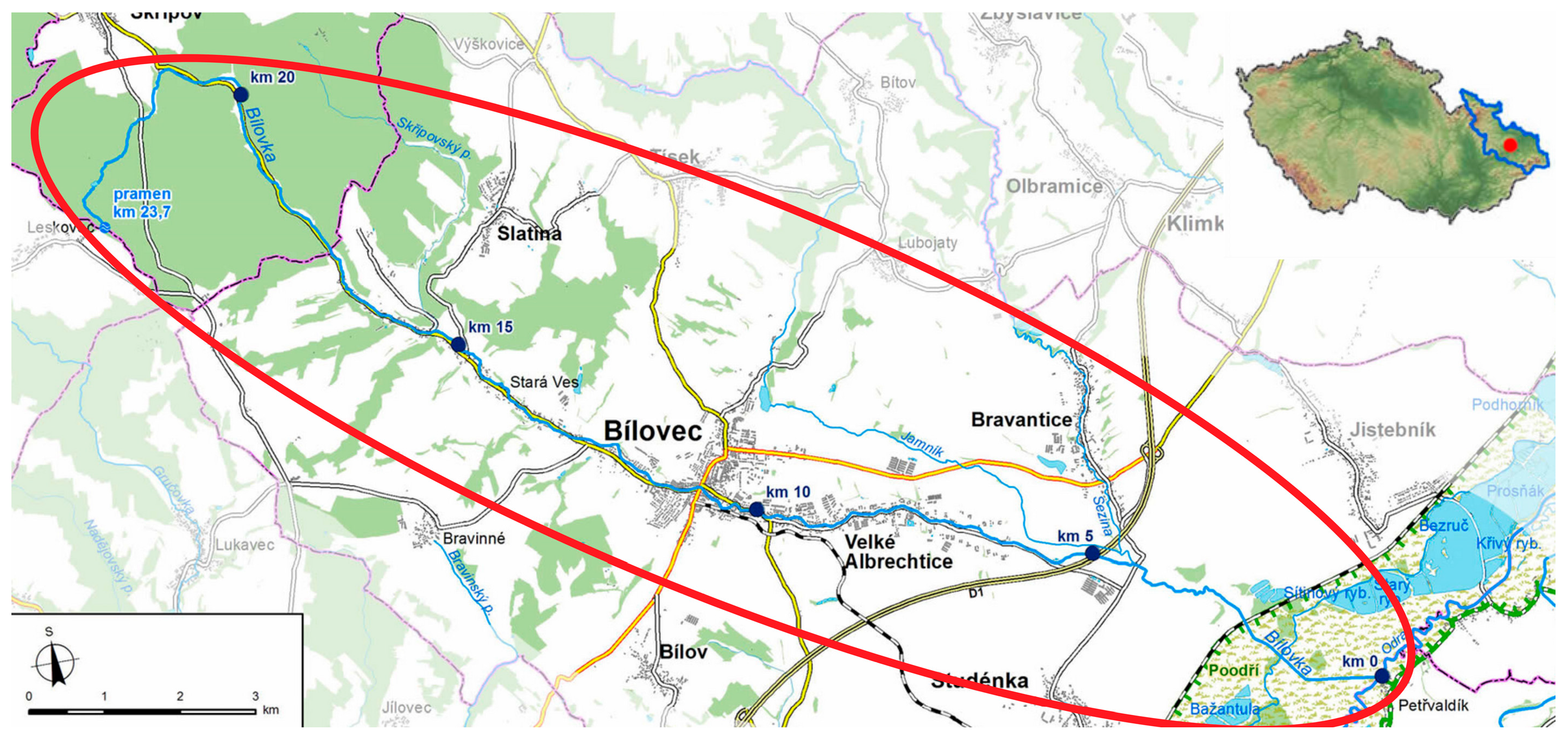
The Bílovka Stream is a left-bank tributary of the Odra River located in the Moravian-Silesian Region. It originates at an elevation of 585 metres above sea level near the village of Leskovec and discharges into the Odra near the village of Petřvaldík within the Poodří Protected Landscape Area, at an elevation of 223 m above sea level. The stream has a total length of 23.7 km. Its catchment area spans several geomorphological units, ranging from the Heřmanice Highlands to the Odra Floodplain. From a hydrological perspective, Bílovka is characterized as a rain-fed stream with pronounced seasonal variations in flow regime. Historically, the stream has undergone numerous channel modifications, particularly in its central section, where it was straightened, reinforced, and technically stabilized to protect adjacent settlements from flooding. The stream flows through both undeveloped agricultural landscapes and urbanized areas, making it a suitable case study for comparing the effects of different types of anthropogenic influences (see in
Figure 1).
2.2. HEM 2014 Methodology
The HEM 2014 methodology represents a standardized tool for assessing the hydromorphological characteristics of watercourses in the Czech Republic. It was developed by the T. G. Masaryk Water Research Institute in cooperation with the Ministry of the Environment of the Czech Republic, in response to the requirements of the EU Water Framework Directive (2000/60/EC), which mandates the assessment not only of chemical and biological status, but also of the hydromorphological condition of water bodies [
1].
The core principle of the methodology lies in comparing the current state of a watercourse with a reference condition—defined as a natural or minimally impacted stream of the same typology. HEM 2014 is structured into three assessment zones:
(I) Channel zone—evaluates parameters such as flow path, depth variability, bed substrate, and morphology.
(II) Bank and riparian zone—include bank stability, vegetation structure, and anthropogenic modifications.
(III) Floodplain zone—focuses on floodplain land use, flood dynamics, and the presence of natural landscape elements.
A total of 17 parameters are evaluated, including: flow path (TRA), morphological variability (MOR), bed substrate (SUB), longitudinal (KON) and lateral (PRU) continuity, riparian and bank vegetation structure (BRV, PVE), and floodplain land use (UZN) [
1,
7].
The final score for a given river reach is expressed as a weighted average of the individual indicator scores, and the reach is subsequently classified into one of five condition categories: very good, good, moderate, poor, or bad [
1]. The HEM methodology allows for the integration of two monitoring approaches:
- -
Remote (desktop) monitoring—utilizes orthophoto maps, historical cartographic sources (e.g., Second Military Survey), digital elevation models (DEM), and other GIS data layers
- -
Field survey—includes in situ visual assessments, data validation, and measurement of physical and geographical parameters.
This dual approach provides a comprehensive understanding of river landscape dynamics, including the identification of historical alterations, the extent of anthropogenic impacts, and recommendations for restoration planning [
8]. The methodology is aligned with European technical standards ČSN EN 14614 (assessment of hydromorphological features) and ČSN EN 15843, ensuring its compatibility with EU requirements. Its main advantages include relative ease of implementation, high informational value, and adaptability to various types of watercourses in the Czech Republic [
9].
2.3. Description of Selected Reaches
For the purposes of comparative analysis, two river reaches with contrasting characteristics were selected. The first reach is located in the upper part of the stream, upstream of the village of Stará Ves. This section lies within an agricultural and forested landscape and has experienced minimal human intervention. The channel retains its natural meandering course, is accompanied by meadow and forest vegetation, and exhibits no significant anthropogenic pressures.
The second reach is situated within the urban area of the town of Bílovec. Here, the stream has been straightened, reinforced with concrete and stone structures, partially culverted, and the adjacent areas are built-up or intensively utilized. In this reach, riparian vegetation is almost entirely absent, morphological diversity is lacking, and the natural connection to the floodplain has been disrupted. This contrasting selection provided a clear illustration of differences in ecological status based on the degree of anthropogenic influence.
2.4. Calculation of Ecological Quality of the Reaches
The calculations are based on the sum of the products of the final scored values of individual parameters and their respective weighting coefficients, divided by the total weighting coefficient for the relevant group of indicators corresponding to the specific stream type.
The overall ecological quality of the entire stream (all monitored reaches) is calculated as a weighted average of the hydromorphological quality scores of all individual reaches, with the weighting factor being the length of each reach, as shown in Equation (1) [
10].
HMSVÚ—resulting ecological quality of the entire monitored water body (–)
HMSi—ecological quality of the i-th reach (–)
Li—length of the i-th reach (m)
n—number of monitored reaches within the stream (–) [
2]
This calculation yields a value representing the final score for the entire mapped water body. By assigning this value to one of the classes defined in
Table 1, the resulting hydroecological status of the monitored stream is determined.
2.5. Map Data Utilization
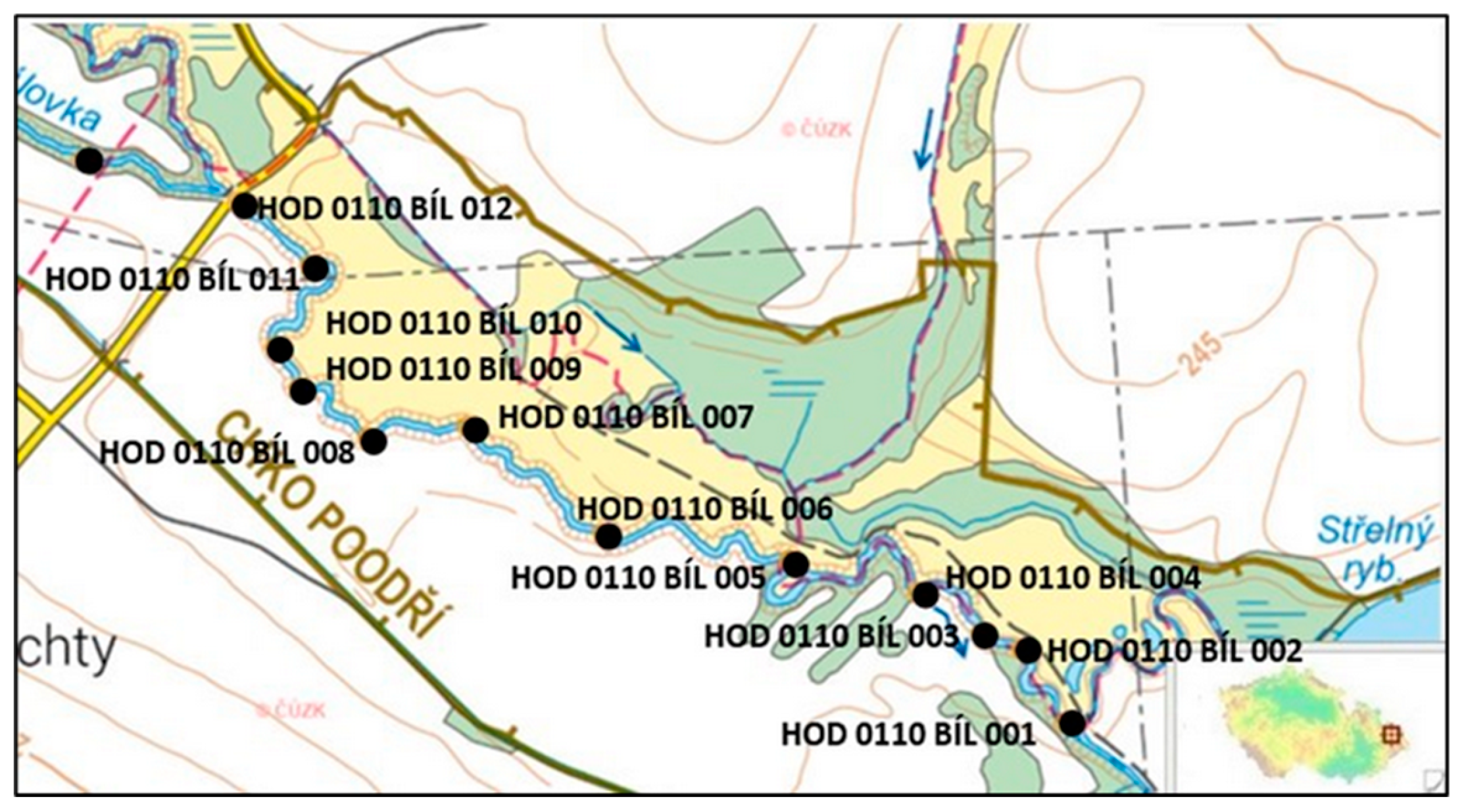
Cartographic sources played a key role in determining the start and end points of the individual monitored reaches (see
Figure 2). Historical maps from the Second and Third Military Surveys (note: Second Military Survey maps were missing for some areas) were used to assess whether the course of the stream had a natural or already modified character. Available online map viewers also enabled the identification of floodplain areas.
Each monitored reach was marked on the map with a unique ID code identifying the Bílovka stream and the specific monitored section. The designation HOD 0110 BÍL XXX is structured as follows:
HOD—Upper Odra River Basin (Horní tok Odry)
0110—Sequential number of the monitored reach
BÍL—Abbreviation for the Bílovka stream
XXX—Specific reach, numbered from the mouth of the Bílovka upstream (e.g., 001 to 024).
2.6. Fieldwork
The aim of the fieldwork was to evaluate the ecological quality of the watercourse, with a specific focus on hydromorphological indicators, which are essential for assessing the overall condition of the stream.
The assessment was conducted directly in the field, at the site of the monitored watercourse. Each indicator was visually evaluated based on the actual conditions observed within the respective reach. The recorded values were subsequently entered into a standardized form designed for hydromorphological assessment.
As part of the field activities, the exact start and end points of the monitored reach were determined using GPS coordinates. These coordinates enable precise replication of the measurements in future surveys. For documentation purposes, enough photographs were taken to capture the entire monitored section of the stream.
3. Results and Discussion
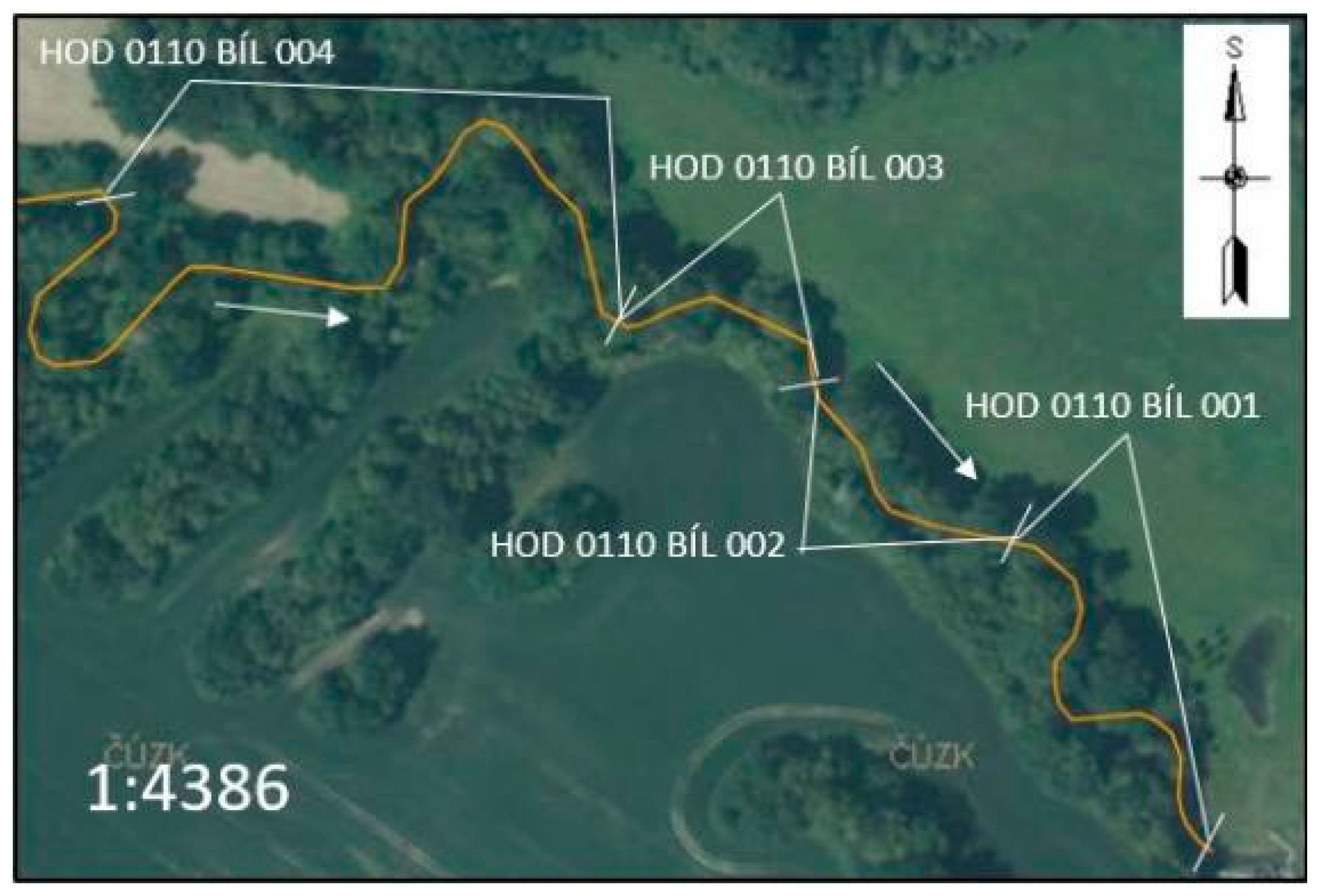
The first monitored reach begins at river kilometre 2.5 upstream and is located in an open, non-urbanized landscape (
Table 2).This is a natural, unregulated section of the stream, although it shows clear signs of revitalization, including the linear planting of small-leaved lime trees (
Tilia cordata) and herbaceous vegetation along both banks—features that are consistent across all monitored reaches. The reach exhibits a meandering channel pattern (see in
Figure 3).
A significant layer of sediment was observed on the streambed, which impeded proper monitoring. Additionally, gravel deposits forming point bars were present. Several deadwood trunks were identified within the channel; however, they do not obstruct fish migration. The flow dynamics remain unchanged, with a visible gliding current.
The riparian zone on the left bank has been left to natural development and is composed of self-seeded woody vegetation and linear plantings, with agricultural land use on both banks. The channel is deep with a trough-like (concave) cross-section. Based on comparisons with historical maps, this section of the stream has not been subject to anthropogenic modifications in its planform.
The assessment results clearly confirmed the anticipated differences between the two reaches. In the near-natural reach, an average score of 1.5 was recorded, corresponding to very good ecological quality. Parameters such as channel width variability, presence of deadwood, natural bed substrate, and the natural character of riparian vegetation reached values close to the reference condition. The channel exhibited a meandering pattern with diverse flow dynamics, including pools and rifles.
In contrast, the modified reach showed scores exceeding 2.4, indicating a severely modified stream. Significant differences were observed particularly in indicators such as longitudinal connectivity (PPK), structure of riparian vegetation (SBV), width variability (SVK), bed structure (STD), floodplain integrity (INP), and riparian land use (VZP).
The calculated values of the ecological quality of individual reaches of the Bílovka stream are summarized in tabular form in
Table 3. The total assessed length of the stream was 4.456 km. Based on these values, an overall ecological quality score for the monitored reaches of the Bílovka stream was calculated.
According to the HEM 2014 methodology, this score is referred to as HMKvú (Hydromorphological Quality of the Water Body). The calculated value was 2.1, which corresponds to Quality Class 2, indicating a slightly modified watercourse.
The overall assessment confirmed that the reach located outside the built-up area exhibits a high degree of naturalness, while the section within the municipalities of Velké Albrechtice and Bílovec is significantly affected by human activity.
The absence of natural structures in urbanized areas leads to reduced ecological stability, diminished retention capacity, and disruption of the hydrological regime. These findings highlight the importance of targeted restoration measures aimed at restoring the ecological functions of the stream and improving landscape connectivity.
4. Conclusions
The application of the HEM methodology has proven to be a suitable tool for the systematic assessment of the condition of small watercourses, particularly in the context of planning restoration projects.
It enables rapid and comparable evaluations and provides concrete data for the design of measures that can contribute to the improvement of ecological status. An important aspect is the use of historical sources (e.g., the Second Military Survey), which allows for the assessment of the extent of past modifications.
The methodology also supports the integration of field-based and remote data, making it a flexible tool for evaluating larger spatial units. Its broader application is recommended in regional and municipal water management planning frameworks.
This study confirmed the applicability of the HEM 2014 methodology for assessing the ecological status of small streams. Its application to the Bílovka stream successfully identified key differences between a natural and a technically modified reach, providing a valuable foundation for the proposal of restoration measures. Given its simplicity, standardization, and ability to combine field and remote sensing data, HEM is a suitable method for planning stream restoration projects at the regional level.
Author Contributions
Conceptualization, T.D., V.V., K.J.Š. and M.A.; methodology, T.D. and V.V.; investigation, M.A.; writing—original draft preparation, T.D., K.J.Š. and V.V.; writing—review and editing, T.D. and V.V.; funding acquisition, V.V. All authors have read and agreed to the published version of the manuscript.
Funding
This research received no external funding.
Institutional Review Board Statement
Not applicable.
Informed Consent Statement
Not applicable.
Data Availability Statement
The original contributions presented in this study are included in the article. Further inquiries can be directed to the corresponding author.
Conflicts of Interest
The authors declare no conflicts of interest.
References
- Ministry of the Environment of the Czech Republic. HEM 2014—Methodology for Monitoring Hydromorphological Indicators of Ecological Quality of Watercourses; Ministry of the Environment of the Czech Republic: Prague, Czech Republic, 2014.
- Langhammer, J. Methodology for Type-Specific Assessment of Hydromorphological Indicators of Ecological Quality of Watercourses; Ministry of the Environment of the Czech Republic: Prague, Czech Republic, 2014.
- ČSN EN 14614; Water Quality—Guidance on Hydromorphological Assessment of Rivers. Czech Standards Institute: Prague, Czech Republic, 2021.
- ČSN EN 15843; Water Quality—Guidance Standard on Determining the Degree of Modification of River Hydromorphology. Czech Standards Institute: Prague, Czech Republic, 2010.
- Del Tánago, M.G.; Martínez-Fernández, V.; Aguiar, F.C.; Bertoldi, W.; Dufour, S.; de Jalón, D.G.; Garófano-Gómez, V.; Mandzukovski, D.; Rodríguez-González, P.M. Improving river hydromorphological assessment through better integration of riparian vegetation: Scientific evidence and guidelines. J. Environ. Manag. 2021, 292, 112730. [Google Scholar] [CrossRef] [PubMed]
- Casado, M.R.; Gonzalez, R.B.; Kriechbaumer, T.; Veal, A. Automated Identification of River Hydromorphological Features Using UAV High Resolution Aerial Imagery. Sensors 2015, 15, 27969–27989. [Google Scholar] [CrossRef] [PubMed]
- T.G. Masaryk Water Research Institute. HEM 2014—Hydromorphological Evaluation of the Ecological Status of Watercourses; T. G. Masaryk Water Research Institute: Prague, Czech Republic, 2014. [Google Scholar]
- Hrádek, M.; Langhammer, J. Application of Hydromorphological Assessment Methods for Identification of Anthropogenic Pressures on Rivers. Water 2013, 5, 292–311. [Google Scholar] [CrossRef]
- Šípek, V.; Matoušková, M.; Dvořák, M. Comparative analysis of selected hydromorphological assessment methods. Environ. Monit. Assess. 2010, 169, 309–319. [Google Scholar] [CrossRef] [PubMed]
- Nováková, J.; Melčáková, I.; Švehláková, H.; Marčáková, L.; Matějová, T.; Klímsa, L. Hydromorphological Assessment of the Porubka River. IOP Conf. Ser. Earth Environ. Sci. 2017, 92, 012046. [Google Scholar] [CrossRef]
| Disclaimer/Publisher’s Note: The statements, opinions and data contained in all publications are solely those of the individual author(s) and contributor(s) and not of MDPI and/or the editor(s). MDPI and/or the editor(s) disclaim responsibility for any injury to people or property resulting from any ideas, methods, instructions or products referred to in the content. |
© 2025 by the authors. Licensee MDPI, Basel, Switzerland. This article is an open access article distributed under the terms and conditions of the Creative Commons Attribution (CC BY) license (https://creativecommons.org/licenses/by/4.0/).