Abstract
Antihypertensive drugs exhibit high resistance and low biodegradability, which leads to their insufficient removal in conventional treatment processes. This study focuses on the removal of selected pharmaceuticals from wastewater using physical–biological methods. These methods included pretreatment by an electrostatic field and biodegradation by a mixed culture of Rhodococcus bacteria.
1. Introduction
Antihypertensive drugs are a group of medications primarily used to treat high blood pressure, which is one of the leading causes of cardiovascular disease [1]. According to the National Health Information Institute [2] in the Czech Republic, the number of patients with hypertension increased by almost 400,000 between 2013 and 2023. This means that one in five Czechs is being treated for high blood pressure.
This trend is also reflected in the consumption of antihypertensive drugs, which has been growing for a long time. With the increasing number of patients taking these drugs, a higher occurrence of active substances and their metabolites in wastewater can also be expected. According to the Organisation for Economic Co-operation and Development (OECD), patients excrete 30–90% of the administered drug dose in the form of metabolites or unchanged form in urine or feces [3,4]. Residues often exhibit high persistence and low biodegradability, leading to their inadequate removal in conventional treatment processes and further release into the environment.
From the group of antihypertensive drugs, diuretics such as furosemide may be prescribed for high blood pressure. It is a loop diuretic that inhibits the reabsorption of Na+/K+/2Cl− in the ascending part of the Henle loop, thereby increasing water excretion in the urine and lowering blood pressure. Furosemide can be metabolized in the body to glucuronide, saluamine furosemide, or 4-chloro-5-sulfamoylanthranilic acid, but most of it (60% in adults, 84.5% in children) is excreted unchanged [5]. The resulting metabolites can be removed from conventional wastewater treatment plants (WWTPs) by almost 80%. However, the active substance itself is persistent in its unchanged form in conventional treatment processes [6].
Another drug prescribed for high blood pressure is metoprolol, which belongs to the group of beta-blockers for hypertension. These beta-blockers slow down the heart rate and reduce the strength of the heartbeat, thereby helping to lower blood pressure [7]. Metoprolol is one of the most commonly prescribed beta blockers, accounting for over 80% of total consumption in Europe together with atenolol. The specific proportion of individual substances varies, of course, depending on the country and time period [8]. In 2019–2020, metoprolol ranked 9th among the most commonly used drugs in the Czech Republic [9]. Metoprolol is metabolized in the body to alpha-hydroxy-metoprolol and 4’-hydroxy-metoprolol. Approximately 95% of the oral dose is excreted in the urine, with only 5–10% being unchanged; in individuals with slow metabolism (so-called slow metabolizers), this proportion may rise to 30–40% [7,10].
Telmisartan is also a commonly prescribed antihypertensive drug. It is an antihypertensive drug from the group of angiotensin II receptor antagonists (known as sartans), which blocks the binding of angiotensin II to AT1 receptors, causing vasodilation and a reduction in blood pressure [11]. No active metabolites are formed after ingestion, and the substance is therefore excreted unchanged [11,12].
All of the above-mentioned drugs have also been detected in surface waters in the Czech Republic and have been classified as among the most frequently found drugs in surface waters in the Czech Republic [13,14]. Telmisartan, for example, has been detected in 99% of 256 profiles in surface waters in the Czech Republic over a long period of time, and high concentrations have been measured since 2020 [15].
A large number of studies have investigated ways of removing the above-mentioned drugs. For example, furosemide has been degraded using bacteria such as Agrobacterium tumefaciens and Arthrobacter ureafaciens [16] or fungi such as Aspergillus candidus, Cunninghamella echinulata, and Trametes versicolor [17]. Furthermore, its photodegradation has been described, whereby furosemide reacts to visible light, sunlight, or UV radiation. In the field of innovative processes, the results are often variable. Oxidation methods using hydrogen peroxide and UV radiation show good efficacy. The use of absorption on xylitol, lignite or activated carbon (in powder or granular form) also shows interesting results, with an efficacy of more than 60% [5]. Advanced methods such as the use of electrochemical oxidation techniques have also been investigated for the degradation of metoprolol. Research has shown that the use of conductive diamond electrochemical oxidation can very effectively decompose metoprolol in wastewater [18]. In the field of advanced methods, heterogeneous catalytic ozonation, investigated by Nannou [19], has shown promise, demonstrating effectiveness in removing various pharmaceuticals, including telmisartan, in a continuous flow setting.
All of the above-mentioned pharmaceuticals (metoprolol, furosemide, telmisartan) are persistent in conventional wastewater treatment processes and thus continue to enter the environment. This study focused on the possibility of removing multiple types of pollutants using biodegradation preceded by physical pretreatment. Physical pretreatment uses the advanced oxidation methods mentioned above and consists of exposing the sample to an electrostatic field, assuming the breakdown of the individual matrixes, which facilitates the following biodegradation by a bacterial mixture of Rhodococcus degradans, Rhodococcus erythropolis and Rhodococcus rhodochrous.
2. Materials and Methods
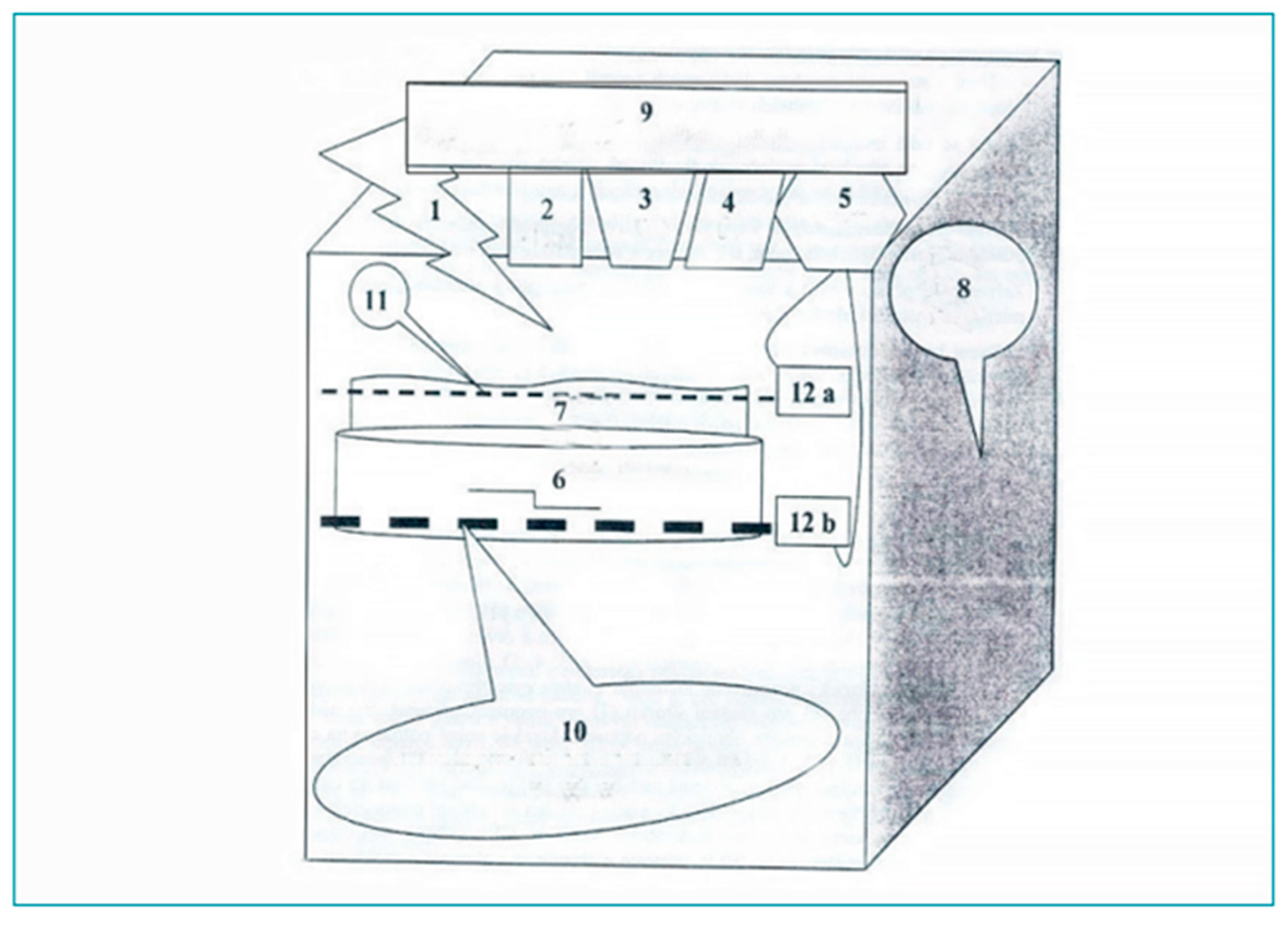
Wastewater samples were taken before entering the recipient from a selected treatment plant in the Moravian-Silesian Region. These were continuously (24-h) combined samples. All glass bottles were purified before sampling. The glass bottles were stored in cooling boxes both during sampling and transport to the laboratory. All samples were sent for initial HPLC/MS/MS analysis to the ALS Czech Republic, s.r.o. laboratory in Ostrava. Some of the samples were first exposed to physical pretreatment on a redesigned patented device for physical waste treatment (EP 2388068) [20], which is presently designed as a laboratory test device. The device can be used for combined or single pre-treatment. Within this experiment, the samples were subjected to an electrostatic field. The technical design of the device is shown in Figure 1. For subsequent biodegradation, bacteria of the genus Rhodococcus from the Czech Collection of Microorganisms at the Faculty of Science, Masaryk University in Brno were used.
Figure 1.
Technical design of the device for physical waste pre-treatment. Legend: 1, 2, 3, 4, 5—generators of force fields (spark discharge–high temperature plasma, microwave field, ultrasound, UV radiation, electrostatic field–non-thermal plasma), 6—plastic sample container, 7—sample ready to testing, 8—Faraday cage, 9—supporting bridge carrying generators 1–5, including their drives, switches, and circuit breakers, 10, 11—conductive metal grid, 12 a, b—HV supply cables connected to generator 5 (electrostatic field) (Reprinted from Refs. [20,21]).
- Laboratory Analysis
- Procedure for Preparing Wastewater Testing3
The wastewater samples were submitted for primary HPLC/MS/MS analysis to the ALS Czech Republic, s.r.o. laboratory in Ostrava. Afterwards, some of the samples were submitted for physical pretreatment to T. G. Masaryk Water Research Institute (VUV TGM) in Ostrava, where the samples were subjected to physical pretreatment on an EP 2388068 device under the effect of an electrostatic field at a voltage of 15 kV and a current of 0.1 mA for 8 h.
After physical pretreatment and transport of the samples to the laboratory, 1 L water samples were poured into 2 L biodegradation beakers using the following procedure:
“Bacteria” samples
A combination of 1 L of water (without physical pretreatment), 200 mL of M011 Soyabean Casein Digest Medium (Tryptone Soya Broth) culture medium, and 200 mL of a mixed culture of Rhodococcus degradans (4446 CCM), Rhodococcus erythropolis (277 CCM), and Rhodococcus rhodochrous (2751 CCM).
Samples “physical + bacteria”
A combination of 1 L of water after physical pretreatment, 200 mL of culture medium M011 Soyabean Casein Digest Medium (Tryptone Soya Broth) and 200 mL of a mixed culture of bacteria Rhodococcus degradans (4446 CCM), Rhodococcus erythropolis (277 CCM) and Rhodococcus rhodochrous (2751 CCM).
Control samples
A combination of 1 L of water (not physically pretreated) and 400 mL of distilled water.
“Physical control” samples
A combination of 1 L of water after physical pretreatment and 400 mL of distilled water.
All measurements were carried out at a temperature of 23 °C, pH 8.1, under continuous oxygenation using JK-AP7500 360 L/h aerators (JK Animals, Chotěšov, Czech Republic). The samples were biodegraded over a period of 20 days. During the measurements, distilled water was regularly added to prevent evaporation of the liquid phase.
- Sample Analysis
All measurements were finished after 20 days. The samples were then placed in pre-purified glass bottles and transported in cool boxes to the ALS Czech Republic, s.r.o. laboratory in Ostrava for HPLC/MS/MS analysis.
3. Results and Discussion
We will examine the results for metoprolol in more detail, as the data for furosemide and telmisartan are inconclusive. This is consistent with studies by Olvera-Vargas, Liu and Kaiser [22,23,24], which state that these two drugs are not readily biodegradable. However, we can at least compare the values of the drug concentrations we detected in the treatment plant with other studies. In Europe, the median concentration of furosemide in the influent to WWTPs is around 2.6 μg/L, ranging from 0.525 μg/L for Iceland to 13 μg/L for the Czech Republic. The average concentration of furosemide is around 4.4 μg/L, and the average concentrations are relatively close to the medians, with the exception of the Czech Republic, where Rozman [25] found a maximum concentration of 71.5 μg/L for the municipality of Onšov [5]. Our measured data of 0.814 μg/L and 1.221 μg/L are among the lower values in this range. Telmisartan was detected in wastewater at concentrations of 0.69 μg/L [26], 4.35 μg/L [27], and 2.3 μg/L [28]. Our measured data on telmisartan concentrations of 1.093 μg/L and 0.101 μg/L are again among the lower values.
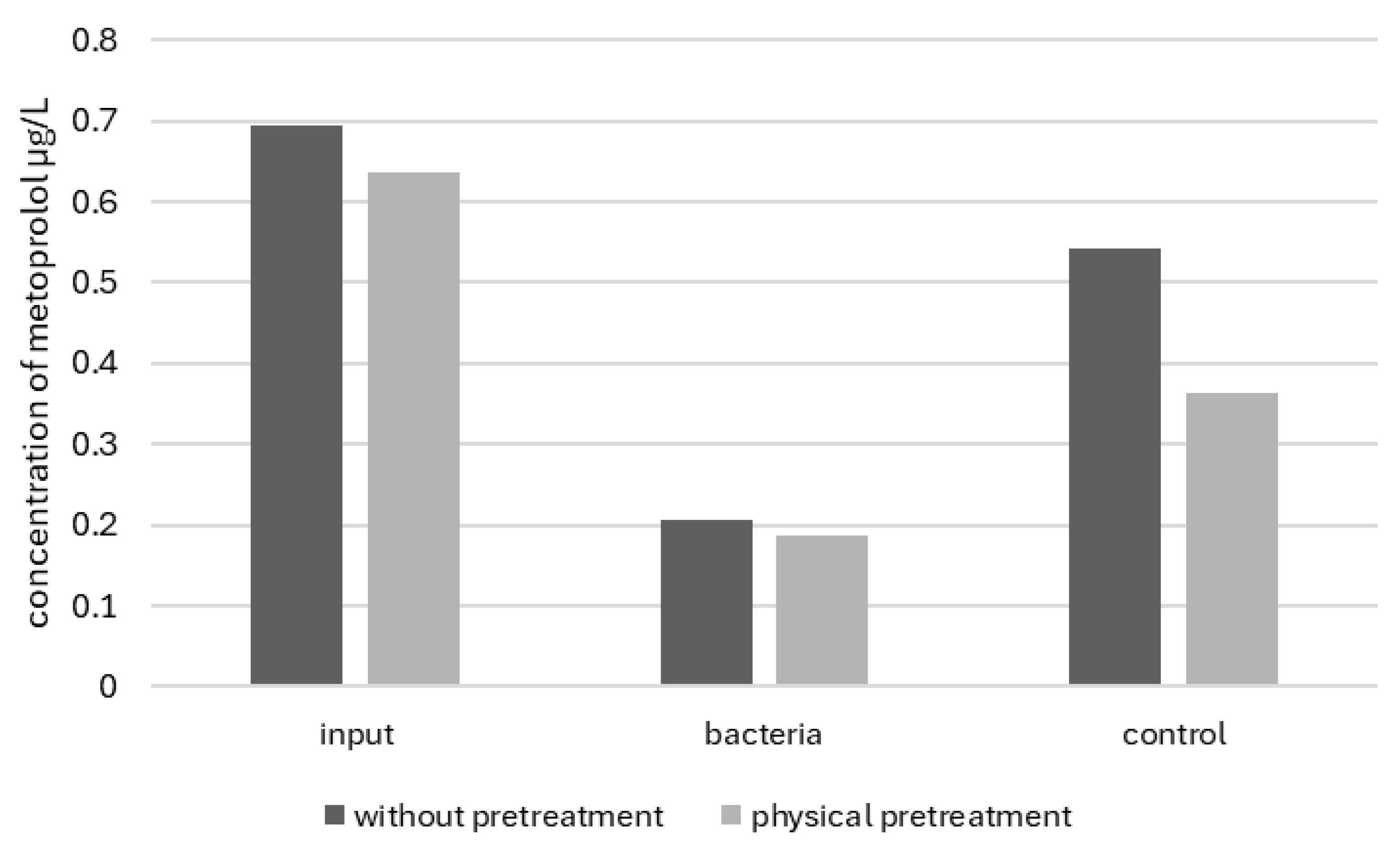
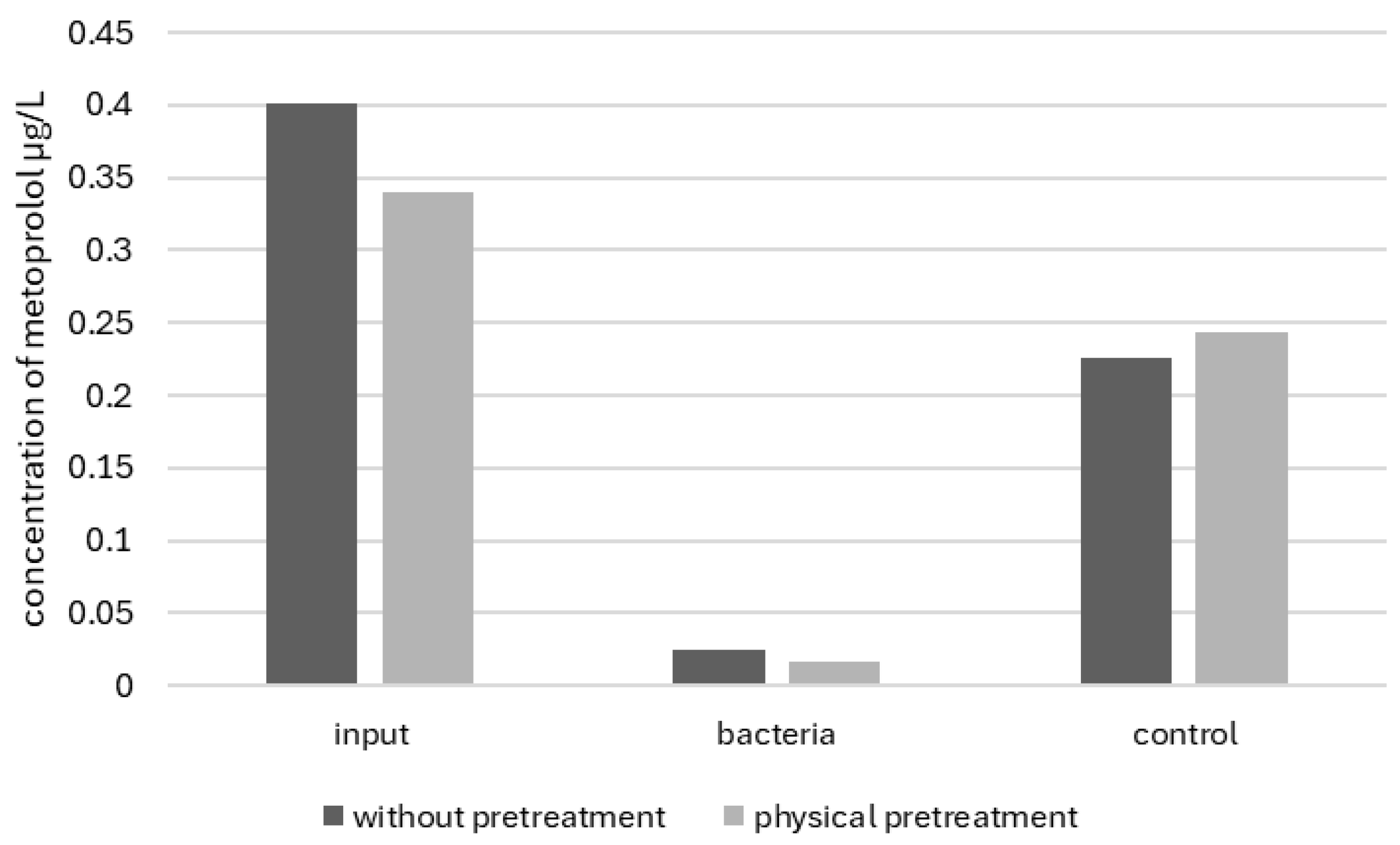
The metoprolol concentrations we measured, 0.693 μg/L and 0.401 μg/L, correspond to the range reported in studies by Maurer and Scheurer [10,29], which report detected concentrations in the range of 0.160–2 μg/L. Figure 2 and Figure 3 below show and compare the metoprolol concentrations we measured in 2023 and 2024.
Figure 2.
Measured concentrations of metoprolol from samples taken in 2023.
Figure 3.
Measured concentrations of metoprolol from samples taken in 2024.
Metoprolol responded well to biodegradation by Rhodococcus bacteria. In the 2023 sampling, biodegradation reduced the concentration of metoprolol in the samples by 70%. Using a combination of physical pretreatment and biodegradation, the concentration in the samples was reduced by 69%, which is a negligible difference.
In 2024, biodegradation reduced the concentration of metoprolol by 94% and physical pretreatment by 95%.
4. Conclusions
Antihypertensive drugs are drugs that should be given increased attention, as their use in the population is growing, and thus, the concentration of these substances in the environment is increasing. Our experiment showed that biodegradation is not very suitable for the groups of diuretics and sartans, but β-blockers respond very well to biodegradation. In the future, the experiment should also focus on shorter biodegradation times to bring the results closer to real conditions in wastewater treatment plants, as well as on new possibilities for combining physical pretreatment with biodegradation to increase the efficiency of combined processes.
Author Contributions
Conceptualization, M.U. and N.D.; methodology, R.K.; validation, R.K. and T.S.; formal analysis, R.K. and M.U.; investigation, N.D.; resources, A.P.; data curation, N.D. and R.K.; writing—original draft preparation, M.U. and N.D.; writing—review and editing, R.K. and T.S.; visualization, N.D. and A.P.; supervision, R.K.; project administration, M.U.; funding acquisition, M.U. All authors have read and agreed to the published version of the manuscript.
Funding
This research was funded by the Student Grant Competition (SGS), project No. SP2023/051, Faculty of Mining and Geology, VSB-Technical University of Ostrava, Czech Republic, and the Environmental Research Center “Waste and Circular Economy and Environmental Safety” (CEVOOH–SS02030008), receiving financial support from the Technology Agency of the Czech Republic within the 2nd public competition Program for the Support of Applied Research, Experimental Development and Innovation in the Field of the Environment–Environment for Life (project No. SS02030008).
Institutional Review Board Statement
Not applicable.
Informed Consent Statement
Not applicable.
Data Availability Statement
The original contributions presented in this study are included in the article. Further inquiries can be directed to the corresponding author.
Conflicts of Interest
The authors declare no conflicts of interest. The funders had no role in the design of the study; in the collection, analyses, or interpretation of data; in the writing of the manuscript; or in the decision to publish the results.
Abbreviations
| OECD | Organisation for Economic Co-operation and Development |
| WWTPs | Wastewater treatment plant |
| UV | Ultraviolet radiation |
| HPLC | High-Performance Liquid Chromatography |
| MS/MS | Tandem Mass Spectrometry (Mass Spectrometry/Mass Spectrometry) |
| VUV TGM | T. G. Masaryk Water Research Institute |
References
- Reinhart, M.P.L.; Muntner, D.B.; Chaturvedi, L.D.S. Bookshelf. Available online: https://www.ncbi.nlm.nih.gov/books/NBK554579/ (accessed on 10 July 2025).
- Ústav zdravotnických informací a statistiky ČR. Hypertenze (Infografika). Available online: https://www.nzip.cz/clanek/2087-hypertenze-infografika (accessed on 10 July 2025).
- OECD. Pharmaceutical Residues in Freshwater; OECD Publishing: Paris, France, 2019. [Google Scholar]
- Kotyza, J.; Soudek, P.; Kafka, Z.; Vaněk, T. Léčiva–„Nový” Environmentální Polutant. Chem. Listy 2009, 540–547. [Google Scholar]
- Sandré, F.; Moilleron, R.; Morin, C.; Garrigue-Antar, L. Comprehensive Analysis of a Widely Pharmaceutical, Furosemide, and Its Degradation Products in Aquatic Systems: Occurrence, Fate, and Ecotoxicity. Environ. Pollut. 2024, 348, 123799. [Google Scholar] [CrossRef]
- Verdini, F.; Abramova, A.; Boffa, L.; Calcio Gaudino, E.; Cravotto, G. The Unveiling of a Dynamic Duo: Hydrodynamic Cavitation and Cold Plasma for the Degradation of Furosemide in Wastewater. Sci. Rep. 2024, 14, 6805. [Google Scholar] [CrossRef]
- Wiysonge, C.S.; Bradley, H.A.; Volmink, J.; Mayosi, B.M.; Opie, L.H. Beta-Blockers for Hypertension. Cochrane Database Syst. Rev. 2017, 2017, CD002003. [Google Scholar] [CrossRef]
- Sangare, S.; Belaidi, S.; Belahlou, K.; Bouaziz, C.; Seraghni, N.; Sehili, T. Metoprolol Removal and Mineralization by TiO2 and Iron Pillared Clay Nanocomposite: Impact of Operating Parameters, Water Matrices, and Solar Light. J. Environ. Manag. 2025, 386, 125781. [Google Scholar] [CrossRef]
- ALS Czech Republic. Výskyt Léčiv v Odpadních Vodách a Potenciální Dopad Na Pitné Vody; ALS Czech Republic: Prague, Czech Republic, 2024. [Google Scholar]
- Maurer, M.; Escher, B.; Richle, P.; Schaffner, C.; Alderi, A. Elimination of β-Blockers in Sewage Treatment Plants. Water Res. 2007, 41, 1614–1622. [Google Scholar] [CrossRef]
- Muambo, K.E.; Im, H.; Macha, F.J.; Oh, J.-E. Reproductive Toxicity and Molecular Responses Induced by Telmisartan in Daphnia Magna at Environmentally Relevant Concentrations. Environ. Pollut. 2024, 359, 124525. [Google Scholar] [CrossRef] [PubMed]
- Ladhari, A.; La Mura, G.; Di Marino, C.; Di Fabio, G.; Zarrelli, A. Sartans: What They Are for, How They Degrade, Where They Are Found and How They Transform. Sustain. Chem. Pharm. 2021, 20, 100409. [Google Scholar] [CrossRef]
- Ministerstvo životního prostředí. Zpráva o Životním Prostředí České Republiky 2022; Ministerstvo životního prostředí: Prague, Czech Republic, 2023; ISBN 978-80-7674-102-7.
- Placová, K.; Halfar, J.; Brozova, K.; Heviankova, S. Issues of Non-Steroidal Anti-Inflammatory Drugs in Aquatic Environments: A Review Study. Eng. Proc. 2023, 57, 13. [Google Scholar]
- Český hydrometeorologický ústav. Hydrologická Bilance Množství a Jakosti Vody České Republiky 2020; ČHMÚ: Prague, Czech Republic, 2020. [Google Scholar]
- Laurencé, C.; Rivard, M.; Martens, T.; Morin, C.; Buisson, D.; Bourcier, S.; Sablier, M.; Oturan, M.A. Anticipating the Fate and Impact of Organic Environmental Contaminants: A New Approach Applied to the Pharmaceutical Furosemide. Chemosphere 2014, 113, 193–199. [Google Scholar] [CrossRef]
- Badia-Fabregat, M.; Lucas, D.; Pereira, M.A.; Alves, M.; Pennanen, T.; Fritze, H.; Rodríguez-Mozaz, S.; Barceló, D.; Vicent, T.; Caminal, G. Continuous Fungal Treatment of Non-Sterile Veterinary Hospital Effluent: Pharmaceuticals Removal and Microbial Community Assessment. Appl. Microbiol. Biotechnol. 2015, 100, 2401–2415. [Google Scholar] [CrossRef]
- Martín de Vidales, M.J.; Sáez, C.; Cañizares, P.; Rodrigo, M.A. Metoprolol Abatement from Wastewaters by Electrochemical Oxidation with Boron Doped Diamond Anodes. J. Chem. Technol. Biotechnol. 2011, 87, 225–231. [Google Scholar] [CrossRef]
- Nannou, C.; Kaprara, E.; Psaltou, S.; Salapasidou, M.; Palasantza, P.-A.; Diamantopoulos, P.; Lambropoulou, D.A.; Mitrakas, M.; Zouboulis, A. Monitoring of a Broad Set of Pharmaceuticals in Wastewaters by High-Resolution Mass Spectrometry and Evaluation of Heterogenous Catalytic Ozonation for Their Removal in a Pre-Industrial Level Unit. Analytica 2022, 3, 195–212. [Google Scholar] [CrossRef]
- Sezima, T.; Sikora, E. Device for Physical Waste Treatment. CZ/EP 2388068, 20 August 2014. [Google Scholar]
- Sezima, T.; Sikora, E.; Kučerová, R. Možnosti Kombinovaných Způsobů Úpravy Vybraných Druhů Odpadů Za Pomoci Experimentálního Zařízení pro Fyzikální Zpracování Odpadů Za Účelem Jejich Dalšího Využití. Vodohosp. Tech.-Ekon. Inf. 2020, 62, 28. [Google Scholar] [CrossRef]
- Olvera-Vargas, H.; Leroy, S.; Rivard, M.; Oturan, N.; Oturan, M.; Buisson, D. Microbial Biotransformation of Furosemide for Environmental Risk Assessment: Identification of Metabolites and Toxicological Evaluation. Environ. Sci. Pollut. Res. 2016, 23, 22691–22700. [Google Scholar] [CrossRef] [PubMed]
- Liu, F.; Nielsen, A.H.; Vollertsen, J. Sorption and Degradation Potential of Pharmaceuticals in Sediments from a Stormwater Retention Pond. Water 2019, 11, 526. [Google Scholar] [CrossRef]
- Kaiser, T.; Fundneider, T.; Lackner, S. Biodegradation Kinetics of Organic Micropollutants in Biofilters for Advanced Wastewater Treatment–Impact of Operational Conditions and Biomass Origin on Removal. Water Res. X 2024, 24, 100235. [Google Scholar] [CrossRef] [PubMed]
- Rozman, D.; Hrkal, Z.; Váňa, M.; Vymazal, J.; Boukalová, Z. Occurrence of Pharmaceuticals in Wastewater and Their Interaction with Shallow Aquifers: A Case Study of Horní Beřkovice, Czech Republic. Water 2017, 9, 218. [Google Scholar] [CrossRef]
- Ofrydopoulou, A.; Nannou, C.; Evgenidou, E.; Christodoulou, A.; Lambropoulou, D. Assessment of a Wide Array of Organic Micropollutants of Emerging Concern in Wastewater Treatment Plants in Greece: Occurrence, Removals, Mass Loading and Potential Risks. Sci. Total Environ. 2022, 802, 149860. [Google Scholar] [CrossRef]
- Loos, R.; Carvalho, R.; António, D.C.; Comero, S.; Locoro, G.; Tavazzi, S.; Paracchini, B.; Ghiani, M.; Lettieri, T.; Blaha, L.; et al. EU-Wide Monitoring Survey on Emerging Polar Organic Contaminants in Wastewater Treatment Plant Effluents. Water Res. 2013, 47, 6475–6487. [Google Scholar] [CrossRef]
- Petrovic, M. Methodological Challenges of Multi-Residue Analysis of Pharmaceuticals in Environmental Samples. Trends Environ. Anal. Chem. 2014, 1, e25–e33. [Google Scholar] [CrossRef]
- Scheurer, M.; Ramil, M.; Metcalfe, C.D.; Groh, S.; Ternes, T.A. The Challenge of Analyzing Beta-Blocker Drugs in Sludge and Wastewater. Anal. Bioanal. Chem. 2009, 396, 845–856. [Google Scholar] [CrossRef] [PubMed]
Disclaimer/Publisher’s Note: The statements, opinions and data contained in all publications are solely those of the individual author(s) and contributor(s) and not of MDPI and/or the editor(s). MDPI and/or the editor(s) disclaim responsibility for any injury to people or property resulting from any ideas, methods, instructions or products referred to in the content. |
© 2025 by the authors. Licensee MDPI, Basel, Switzerland. This article is an open access article distributed under the terms and conditions of the Creative Commons Attribution (CC BY) license (https://creativecommons.org/licenses/by/4.0/).