You are currently viewing a new version of our website. To view the old version click .
Engineering Proceedings
  • Proceeding Paper
  • Open Access

1 December 2025

Adaptive Urban Furniture and Its Role in the Climate Resilience of Public Space †
and
Department of Urban Engineering, Faculty of Civil Engineering, VSB—Technical University of Ostrava, 708 00 Ostrava-Poruba, Czech Republic
*
Author to whom correspondence should be addressed.
Presented at the 5th International Conference on Advances in Environmental Engineering, Ostrava, Czech Republic, 26–28 November 2025.

Abstract

This article explores the integration of urban design and climate strategy at the scale of small urban architecture. It offers a comparative overview of case studies—realized projects, research prototypes, and strategic manuals—highlighting urban furniture as a tool for climate adaptation and outlining decision-making methods in public administration.

1. Introduction

Contemporary cities face a profound transformation of their environmental context, driven by the accelerating impacts of climate change. Intense heat episodes, irregular precipitation patterns, and the gradual decline of urban biodiversity are redefining the fundamental requirements for the function and form of public space. In this dynamic setting, traditional urban planning approaches—historically grounded in stability, mono-functionality, and esthetic formalism—are increasingly being called into question. There is a growing need for tools that can respond flexibly to new challenges while simultaneously providing environmental functions and social value [1,2].
While adaptation measures are the subject of intense discussion and institutional support in areas such as strategic planning and transport infrastructure, smaller scales of the urban environment—including minor architectural and street furniture elements—often remain overlooked. Yet their significance extends far beyond mere functional or esthetic qualities. These elements enable direct interaction between users and public space. They not only provide opportunities for short-term stays but also shape people’s relationship to place, influence microclimatic conditions, and serve as a medium through which environmental agendas can be communicated [3].
Over the past decade, interest in the concept of so-called “resilient cities”—cities capable of responding to climatic and social stressors through adaptive strategies—has grown. This approach does not focus solely on technical solutions but also considers the cultural, community, and behavioral dimensions of urban life. Within this context, adaptive urban furniture gains importance as a means to test new approaches on a small scale and to generate data or feedback for larger-scale interventions [4,5].
At the same time, the role of designers and urban planners is evolving—from creators of form to facilitators of processes who integrate the technical, social, and environmental aspects of space. Research focusing on adaptive urban furniture thus becomes an entry point to a broader debate on the democratization of space, users’ rights, and decentralized approaches to urban governance. In this sense, adaptive elements function not only as physical objects but also as catalysts for institutional and cultural transformation [6,7].
This article seeks to reflect on these emerging tendencies and contribute to their systematization. By analyzing adaptive urban furniture as a tool for climate resilience, it opens up space for further investigation of urban transformation in times of environmental uncertainty. The scientific significance of this topic lies not only in its timeliness but, above all, in its capacity to link environmental sciences with architecture, urbanism, and public policy within a unified analytical framework.

2. Materials and Methods

The research presented in this article stems from the need to connect design and urban planning thinking with climate strategy at the scale of small urban architecture. The aim is not only to provide a quantitative assessment of the functionality of individual elements but, above all, to create a conceptual and design framework that can serve as a guide for designers, urban planners, and municipal authorities in developing and implementing adaptive solutions.
The methodological approach is based on a combination of qualitative and comparative methods that make it possible to identify and describe the key principles governing the functioning of adaptive urban furniture. The primary method is a literature review, which includes current research in the fields of climate adaptation, resilient urbanism, and environmental design. This review was conducted systematically, with an emphasis on relevant European and Czech sources.
The second methodological component involves the study of strategic documents and manuals issued by public institutions that define the framework conditions for implementing adaptation measures in cities. In particular, manuals for public space design, climate strategies, and pilot projects focused on small-scale architecture were analyzed.
An important tool was a comparative overview of case studies, covering concrete implementations, research prototypes, and experimental installations of furniture with environmental functions. This comparison made it possible to identify common features, implementation limitations, and success factors across different geographical and cultural contexts.
This was complemented by a critical reflection on the Czech context, focusing on the specific conditions of Central Europe—especially climatic extremes, the institutional framework, and the cultural perception of public space.
To ensure validity, the collected data were coded into thematic categories that correspond to the main research questions:
  • In what ways can urban furniture contribute to the climate resilience of public space?
  • Which structural, material, and functional principles have proved to be essential?
  • What barriers and opportunities are associated with implementing adaptive elements in different urban contexts?
The main research objectives of the article can be summarized as follows:
  • To formulate a basis for considering urban furniture as an active climate element within urban space.
  • To provide a systematic analysis of existing international approaches in adaptive design.
  • To assess the specific conditions of the Czech context and the possibilities for applying proven principles.
  • To describe methods and recommendations suitable for preparing, testing, and implementing adaptive furniture installations, with regard to participation and management.
This methodological foundation makes it possible to move from a general discussion of climate resilience to practical design reflection, which is at the core of the following chapters. The entire approach respects the principles of an interdisciplinary perspective and reflects the need to integrate technical, ecological, and socio-cultural aspects in the planning of public spaces.

3. Adaptive Urban Furniture as an Instrument of Environmental Urbanism

With the increasing occurrence of climate extremes in urban environments—especially in the form of drought, heat waves, and the overheating of paved surfaces—the need to design public spaces not only from an esthetic and functional perspective but also with regard to climate adaptation is becoming ever more pronounced. Public space is no longer understood merely as a backdrop for residents’ everyday activities but as an active component of urban resilience [7,8].
In this context, adaptive urban furniture is understood as a type of furniture that, through its design, material solutions, or functional integration, responds to changing climatic conditions and the environmental needs of a given location. Adaptive urban furniture can be categorized according to the main function through which it responds to climatic conditions. Many elements often combine several of these aspects simultaneously [9].
Table 1 below provides an overview of the main functional types of adaptive urban furniture, their key characteristics, and examples of practical applications. This categorization helps to better understand the various principles through which individual elements contribute to cooling, water retention, or the enhancement of urban biodiversity. The table also serves as a brief introduction to the detailed analysis developed in the subsequent sections of this chapter.
Table 1. Aspects of Adaptive Urban Furniture [10,11,12].

3.1. Urban Microclimate and Thermal Adaptation

Such furniture is not static—on the contrary, it is designed with an emphasis on modularity, reconfigurability, and often includes digital sensors that monitor temperature, humidity, or occupancy. It represents a typical example of micro-adaptation at the street scale, complementing macro-level planning strategies at the scale of entire urban areas. Modular adaptive urban furniture enables micro-interventions that collectively reshape the climatic behavior of public spaces without requiring major infrastructural changes [5,13].
The relationship between urban spatial configuration, materials, and microclimatic conditions has already been thoroughly documented in numerous studies. A key conceptual framework here is the so-called Urban Heat Island (UHI) effect, in which heat accumulates in built-up areas compared to the surrounding natural environment [14]. The emergence of UHI is influenced by dark surfaces (asphalt, concrete), dense development without ventilation corridors, and a low proportion of vegetation and water features.
Adaptive furniture plays the role of a mitigation element in this context. For example, strategically placed shading structures in areas with intense solar radiation can reduce surface temperatures by up to 19 °C and air temperatures by 3–5 °C [15]. A combination of shade, vegetation, and evaporation (for example, through misting) significantly improves thermal comfort for public space users.
Well-positioned furniture can also guide air flow, support street ventilation, and reduce surface evaporation. Ergonomic shaping of seating surfaces is equally important—they should not overheat users, should allow ventilation underneath the seat, and should reflect solar heat.

3.2. Nature-Based Solutions and Synergies with Urban Furniture

Modern adaptive urban furniture ideally connects with the concept of Nature-Based Solutions (NBSs), which is a strategy that uses natural processes to address environmental and social challenges in cities. In the case of urban furniture, this means integrating vegetation (e.g., green roofs on benches, climbing plants), water cycles (retention containers, capillary irrigation), and natural materials with low thermal capacity.
According to Wang (2024), even small interventions such as benches with greenery and planter boxes can become an important part of the urban climate system if they are connected into a network of so-called micro-green infrastructures. Moreover, these elements act as carriers of an ecological narrative by communicating the idea of sustainability directly to public space users [16].
Mobile adaptive elements, which can be relocated according to the season, shade needs, or spatial typology, are considered particularly effective. Their functions can be further expanded with solar panels, LED lighting, and digital sensors, enabling real-time monitoring of temperature and humidity [5].

3.3. Impact on Public Space and Microclimate

The implementation of adaptive urban furniture brings a range of benefits for the quality of public space, the urban microclimate, and urban ecology:
  • Improving thermal comfort
    Shading and cooling help to lower ambient temperatures during hot days. Research shows that combining shading and evaporation can noticeably reduce perceived temperatures in the surrounding area—for example, CityTree reports a local temperature drop of up to 4 °C. Shaded benches and shelters thus help to counteract the Urban Heat Island effect. A study from Vancouver recommends installing as many elements as possible that offer shelter from both heat and rain, ensuring that public space remains usable even during extreme weather. Placing benches in natural or artificial shade protects vulnerable groups (such as seniors and children) from overheating. Air misting devices and drinking fountains provide opportunities for cooling down and staying hydrated during heat waves. Overall, the more pleasant the microclimate, the longer and more willingly people stay in public spaces, which supports community life [17].
  • Water retention and runoff reduction
    Furniture that captures rainwater helps cities better manage heavy rainfall events. Green roofs and “water benches” can retain significant amounts of water—for example, sedum roofs on bus stops in Utrecht act like sponges and improve rainwater management. This reduces pressure on sewer systems during storms, and part of the retained water is used for evaporation, which further cools the surrounding area. Vertical green walls with integrated irrigation systems (as seen in Merelbeke) function as rain gardens—they absorb water during rainfall and gradually release it into the air or use it for plant growth. This extends the time that water is retained on-site and reduces the risk of local flooding. Water from reservoirs (like those in the Waterbench) can also be used for manual watering of nearby flowerbeds during dry periods, helping to conserve potable water. In this way, adaptive furniture contributes to the creation of small-scale elements of blue-green urban infrastructure [18].
  • Supporting biodiversity
    Integrating vegetation into furniture expands urban habitats. “Bee bus stops” have introduced hundreds of new mini-gardens with nectar-rich plants into the streets of Utrecht, attracting bees and butterflies. In London and other UK cities, dozens of bee bus stops are being built in cooperation with conservation organizations, which select local flower mixes suitable for native pollinators. These green roofs not only support insects but also offer shelter for small birds and improve fragmented green infrastructure by acting as “stepping stones” for urban wildlife. Green walls on furniture can be planted with a diverse mix of species, including grasses, herbs, and mosses, which increase biodiversity compared to bare facades. Some urban benches or shelters also incorporate features such as insect hotels (panel-shaped bug boxes) or birdhouses attached to shelter structures. In this way, furniture actively supports urban fauna and contributes to ecological stability in urbanized environments [19].
  • Social and esthetic benefits
    Adaptive elements enhance the attractiveness of public spaces and can improve people’s experience of spending time outdoors. For example, bus stops with flower roofs or benches surrounded by greenery are more esthetically appealing than conventional metal structures—research indicates that the presence of greenery reduces stress and improves users’ moods. People then use public spaces more, spend more time outside, and meet each other more often, which strengthens community interactions and brings streets to life. As a representative of the UK Wildlife Trust noted in connection with the bee bus stops project: even a small green element in a busy place is important because it is “a visible reminder of the small changes that can create more space for nature.” Adaptive furniture thus also serves an educational role—people see a practical example of adaptation to climate challenges directly in the streets. Moreover, for example, if a bus stop offers protection from heat, it may increase the attractiveness of public transport, indirectly helping to reduce emissions from car traffic. Overall, climate-resilient furniture makes cities more pleasant, healthier, and more sustainable for their inhabitants [20].

4. European Approaches to Environmentally Oriented Urban Furniture

Diverse geographic, climatic, and cultural conditions across European cities have led to different approaches to the design and installation of public space elements. However, in Central and Southern Europe, a certain convergence can be observed in the way small-scale architecture is conceived as a strategic tool for transforming the urban environment. This chapter presents selected approaches that have significantly contributed to redefining the role of urban furniture in the context of climate adaptation.
The Józsefváros district in Budapest, known for its historic architecture and socially diverse population, became a pilot site in 2023 for a participatory project focused on spatial interventions in overheated streets. Based on the principles of the New European Bauhaus, the project involved local residents, designers, and municipal managers in the design process for temporary furniture intended to improve outdoor comfort during the summer months [21]. The elements designed were not standard urban furniture but temporary structures combining seating areas, wooden panels with vegetation, and shading features made from natural fabrics. Emphasis was placed on low material demands, recyclability, and easy mobility. In addition to their physical aspects, the social dimension was crucial—the furniture was installed in locations identified by residents as “unhealthy” or “unpleasant” and served as a focal point for neighborhood activities. The project demonstrated that an effective intervention in the environment does not have to be permanent or expensive if it is well designed, rooted in the local context, and linked to community needs.
Another example is the “bee bus stops” in Utrecht (Netherlands). The city of Utrecht equipped 316 bus stops with green roofs planted with sedum succulents. These sedum roofs help capture fine dust, retain rainwater, and cool the surrounding air. They also create microhabitats for pollinators, supporting biodiversity in the urban environment. Additional sustainable features of these bus stops include the installation of solar panels (on 96 stops) and energy-efficient LED lighting; the benches are made from renewable bamboo. This initiative has become a model for other cities in Europe—similar “bee stops” have appeared in the UK, Scandinavia, and Belgium [22].
On the central square in Merelbeke (Belgium), a prototype of a combined bicycle shelter and bench with vegetated elements was installed in 2022. The “Groene fietsbank” (green cycle bench) combines multiple functions: it serves as a covered bicycle stand with e-bike charging options and, at the same time, as shaded, cooled seating thanks to its integrated vertical green wall and water-retaining green roof. This furniture “mini-oasis” helps mitigate the urban heat island effect and improve the microclimate in paved urban areas—the green wall cools the air through evaporation, and rainwater collected by the roof is gradually used by the vegetation. The project was created within the European Interreg Cool Towns program, which focuses on innovative adaptation measures against urban heat. Operational data (temperature, humidity) is monitored by the province to verify the green wall’s contribution to perceived cooling for passersby. The success of the prototype led to plans for a similar “green bench” (without the bike stand) in another city, Oostende [23].
A prototype of climate-adaptive seating, “Sit Together,” presented in 2024 by the multidisciplinary studio Topotek 1 (Germany) in cooperation with the company MDT-tex and exhibited in the courtyard of a university in Milan, combines the traditional European bench and an ancient Persian wind tower into an innovative shelter. The bench has two sides with different surfaces: one side is darker and warmer (absorbing solar heat for the winter season), while the other is lighter and cooler (reflecting sunlight). A conical “tower” in the center protects the seating area from the sun and contains misting nozzles that activate in hot weather to cool the passing air, which flows through vents into the seating space. In summer, the bench offers a gentle breeze and cooling effect, while in winter, the darker surface accumulates heat to enhance comfort. This design illustrates how passive strategies (color, shape) and simple technology (misting) can adapt furniture to different seasons. The project responds to new social needs in the era of climate change—the goal is to create a pleasant place for people to gather outdoors in all weather conditions [24].
Belgian designer Barbara Standaert designed a concrete bench with an integrated planter that also serves as a rainwater reservoir, the “Waterbench.” The bench’s porous concrete surface allows precipitation to filter into a sealed reservoir section with a capacity of about 280 L, from which water is gradually released to the roots of the planted vegetation. This provides irrigation with minimal maintenance and contributes to cooling the surroundings through the evaporation of stored water. An overflow outlet allows excess water to drain during heavy rains. Thanks to its porous surface, the seat remains dry even shortly after rain, as water immediately seeps into the structure. The Waterbench brings greenery and the natural water cycle back into the urban landscape, helping to reduce rapid runoff into sewers. This innovative element won the Henry van de Velde Award 2020 in the Habitat category [25].
The German startup Green City Solutions has introduced the so-called CityTree in cities such as Berlin, Paris, Amsterdam, and London: a freestanding panel covered with moss and other plants, incorporating an integrated bench. This unit filters air (moss microbes absorb particulate matter and other pollutants) and, according to measurements, can cool the surrounding air by up to 4 °C. Equipped with IoT sensors, the CityTree monitors air quality, humidity, and temperature and automatically activates ventilation or irrigation as needed to maximize its efficiency. Solar panels provide power, and an integrated water reservoir enables rainwater recycling. This hybrid of a bench and a biotechnological filter represents an innovative combination of microclimate improvement and a place to sit and rest [26].
In 2025, Sádaba, Luzarraga, and Lenzi published a study on the development of modular furniture with an environmental function as part of broader nature-based solutions. The research design, presented in the journal Urban Science, focused on developing a multifunctional unit intended for medium-sized cities with a shortage of greenery. This module combines seating, a rainwater reservoir, vegetation, and shading within a single compact body. Principles of circular design were applied—components could be reused, easily dismantled, or replaced. A novelty was the integrated micro-humidity control that automatically supplied water to plants according to current climatic conditions. Although primarily an experimental prototype, test results in public space showed that people perceived this type of installation positively not only in terms of comfort but also esthetically and symbolically—they viewed it as “an element of environmental care.” [5].
“This concept solution—called a modular urban pod—bridges the gap between natural infrastructure and everyday public use through intuitive, climate-conscious design.” [5].

Urban Manuals: Prague, Vienna, Rotterdam

While the previous examples illustrate new and experimental approaches, most European cities develop their strategies primarily through official documents and guidelines that codify approaches to the design of urban furniture.
Vienna has been working for several years with the principle of the so-called climate-active public space, where furniture is seen as a means of reducing overheating and enhancing the quality of stay. The city’s manuals recommend, for example, the use of easily combinable modules, integrated planters with vegetation, or water features incorporated into benches and shelters [27].
Rotterdam is developing the so-called Climate Adaptive Bench—a simple concept in which each bench is not only a place to rest but also serves as a moisture indicator or irrigation unit for the surrounding greenery. This strategy is part of the broader Rotterdam Climate Proof framework [28].
Prague has drawn inspiration mainly from the Viennese and Barcelona approaches. Within the Public Space Design Manual (IPR Prague, 2020), emphasis is placed on variability, material sustainability, and contextualization [28]. Climate aspects are still only a supplementary criterion, but the current revision of the document already works with the integration of adaptive design principles [29].

5. Results—A Comparison of Approaches to Adaptive Urban Furniture

From the previous chapter, three main approaches can be identified that are suitable for comparison, as shown in Table 2.
Table 2. Comparison of Three Approaches to Adaptive Urban Furniture.

5.1. Design and Technological Strategies

The design of adaptive urban furniture often combines multiple strategies to achieve the desired resilience and flexibility.

5.1.1. Modularity and Flexibility

Climate conditions and user needs can change over time, which is why sustainable designs focus on modular systems. Modular furniture can be easily rearranged, expanded, or repaired, which extends its lifespan. For example, the city of Melbourne adopted a strategy similar to the automotive industry—it designed its street furniture with an emphasis on easy replication of spare parts and long service life, so that components can be simply replaced and recycled. Similarly, the Urban Oasis concept in Bilbao uses modules with circular openings in the pavement (rain gardens) combined with interchangeable functional elements above ground (canopies, benches, etc.), which can be arranged as needed for mobility or shelter. The modular approach also enables easy pilot testing—for example, parklets are often designed as modular kits that can be installed temporarily and, if successful, permanently integrated [30].

5.1.2. Smart Technologies and Data

As already mentioned, the integration of IoT sensors, automation, and data analytics enables urban furniture to respond intelligently. Climate sensors can measure temperature, air quality, humidity, or the occupancy of a given location. Based on this data, adaptive features can be activated—from the misting systems mentioned earlier, to lighting activation, or even displaying warnings (such as heat alerts on digital panels). Solar panels and, in some cases, small wind turbines installed on the furniture provide local energy generation to power these smart systems. Data collected by sensors can also be useful for municipal managers: for example, the “smart benches” tested in Prague report the number of users, which helps determine where to place additional benches or when maintenance is needed. This data-driven strategy increases efficiency and resilience—the system can issue early warnings about overheating, dried-out greenery, or other issues that can then be addressed proactively [31]. Similar to Tichý et al. (2021) [30] showing the potential of advanced sensor and monitoring systems in detecting thermal characteristics of the urban environment [31], adaptive furniture can integrate smart technologies for collecting microclimatic data and optimizing operation. The integration of sensors and automated monitoring can contribute to more effective management of thermal comfort and maintenance of furniture elements [32].

5.1.3. Innovative Materials and Passive Design

Adaptive urban furniture makes use of materials that either respond to surrounding conditions or are designed to withstand them in the long term. One example is the use of thermally adaptive surfaces—dark materials that absorb heat (suitable for the winter-facing side of a bench) versus light, reflective surfaces (for the summer side). This solution can be seen in the Sit Together bench, where the color of the surface naturally regulates its temperature. Another approach involves phase-change materials (PCM) integrated into seating or shelters, which absorb excess heat and release it slowly (in practice, still mainly at the research stage). The porous concrete of the Waterbench ensures that after rainfall, water drains into the reservoir below while the surface dries quickly. Additionally, materials must be durable (resistant to UV radiation, moisture, and vandalism) so that the elements can withstand extreme heat, frost, and heavy rain. New materials, such as cooling coatings with high solar reflectance, are used on urban furniture surfaces to keep them cooler to the touch. Sustainable composition is also important—for example, using recycled plastics, locally sourced wood, or biocomposites helps reduce the carbon footprint of furniture production [33,34].

5.1.4. Multipurpose Functionality and Esthetics

Good adaptive design often combines multiple functions into a single element, saving space and multiplying benefits. This can be seen in the Belgian cycle bench (bike parking + greenery + seating) or the CityTree (bench + air filter). Such integration addresses multiple challenges simultaneously (heat, water, air quality, lack of seating) and increases the attractiveness of the element for users and managers alike—it is easier to justify the investment if the feature serves multiple purposes. An esthetic and appealing design is also crucial—people will only use urban furniture if they feel comfortable in the space. The Waterbench example shows that greenery and water can “spark curiosity and social interaction—bringing people together and encouraging conversation.” Attractive adaptive elements can also serve as educational objects in public spaces—informational signs can explain to passersby how a given element works (e.g., that a green wall cools the surrounding air by X degrees). In this way, furniture helps raise general awareness of climate adaptation. Among all identified types, the most effective for climate mitigation are green and water-retentive furniture (such as the Waterbench, bee bus stops, and modular green walls), which simultaneously cool the air through evapotranspiration, increase biodiversity, and manage rainfall. Shading and reflective elements show the strongest effect on user comfort, while solar and smart benches bring added value by producing renewable energy and collecting environmental data. The integration of multiple adaptive functions in a single element—combining shade, water, greenery, and data—proves to deliver the highest environmental return per investment unit.

5.2. Challenges in Implementing Adaptive Elements in Public Space

Experiences from European cities and experimental projects show that despite growing interest in climate-conscious public space design, the practical application of adaptive urban furniture remains burdened by a range of structural, technical, and cultural barriers. These obstacles are not only a matter of investment costs but often relate to the very nature of public space as a place of shared responsibility, conflicting interests, and long-term care. The challenges can be summarized into five main criteria:
  • Maintenance Load and Furniture Management
    One of the most commonly cited barriers to implementing multifunctional or green elements is the mismatch between design ambition and actual maintenance capacity. Public institutions often face staffing and budget constraints, which limit their ability to regularly care for vegetation, refill retention tanks, or repair worn components. Especially in the case of furniture that includes biologically active elements (e.g., climbing plants, planters with capillary irrigation), it has become clear that without a clearly defined maintenance plan and collaboration with the community, there is a risk of rapid deterioration and loss of function. This reveals a dilemma between the esthetic impact of the design at the time of installation and its long-term operational viability.
  • Resistance to Vandalism and Informal Use
    Another dimension is the vulnerability of furniture to deliberate damage or unauthorized use. This is particularly relevant for temporary or mobile elements, which often face conflicts between the designer’s intention and the way the public “appropriates” the space. The challenge is not only to prevent damage but also to ensure adaptive flexibility without compromising durability and safety. In this context, the use of robust materials with a natural patina (e.g., corten steel, recycled plastics, concrete with natural texture) has proven effective, as these not only reduce repair costs but also better withstand operational wear and tear. Placement and composition also play a key role—elements in well-frequented spaces are less prone to damage than those that are isolated or anonymous.
  • Cultural Acceptability and Public Perception
    The acceptance of new types of furniture depends not only on their physical presence but also on users’ relationship to the space and its transformations. In some cases, environmentally oriented elements are perceived as “foreign” or as signs of institutional intervention in the natural order of the street or square. Especially in historic contexts, the installation of an unusual element may face esthetic or cultural barriers that are not easily predicted in advance. Successful implementation is supported when furniture is not only functional but also carries cultural or symbolic value—evoking a sense of place, history, or community identity. This opens opportunities for collaboration between designers and local artists or architects, who can help connect technical goals with the cultural context.
  • Participation and Long-Term Sustainability
    Although participation is often seen as key to the success of public interventions, its implementation is complex and does not always guarantee effective outcomes. Without professional facilitation or a clear framework, the participatory process can slide into a formal gesture without real impact on the final design. At the same time, even the best participation during design does not guarantee that users will take long-term responsibility for the condition and functionality of the furniture. In this respect, effective links with schools, community associations, or the business sector can help—they can act as “stewards” of the element, formally or symbolically.
  • Institutional Barriers and Regulatory Frameworks
    The introduction of innovative elements often clashes with outdated norms, technical standards, or missing guidelines that cannot accommodate the new functional logic of adaptive design. For example, furniture combining seating and a retention tank may not formally fit into existing infrastructure catalogs, complicating its approval and funding. For this reason, it is necessary to update not only technical and operational documentation but also the institutional planning logic, making it more open to experiments, prototypes, and interim solutions. Cities such as Vienna and Rotterdam demonstrate that pilot projects and subsequent field testing can serve as effective mechanisms to bridge this gap.

5.3. Summary of Challenges in Implementing Adaptive Urban Furniture Within the Three Identified Approaches

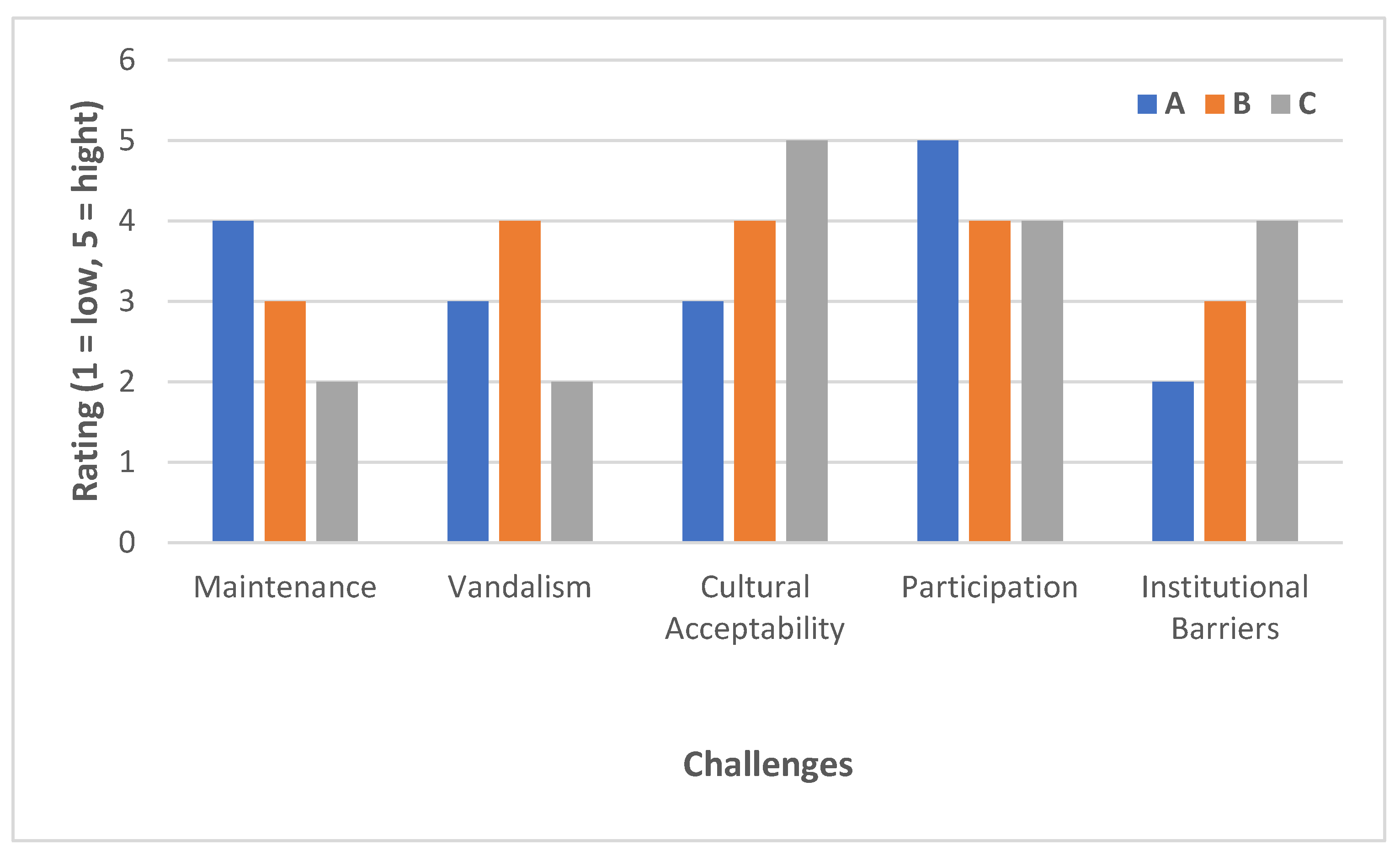
Based on the three identified fundamental approaches to implementing adaptive urban furniture—each bringing different benefits and specific challenges—summary Figure 1 illustrates the distribution of the main challenges across these approaches.
Figure 1. Comparison of key challenges associated with the implementation of adaptive urban furniture across three identified approaches.
  • Approach A—Community-Oriented Model
    This approach emphasizes resident participation and community engagement. The result is a high degree of acceptance among target groups and the strengthening of local identity. On the other hand, it often struggles with maintenance issues and an increased risk of vandalism, especially where a system for long-term care is lacking.
  • Approach B—Technology-Oriented Model
    This model relies on the use of advanced technologies, sensors, and intelligent systems. Its advantage is relatively low maintenance demands (particularly in the case of research prototypes); however, significant barriers emerge in terms of cultural acceptability and more frequent occurrences of vandalism—likely due to the perception of such elements as “foreign.”
  • Approach C—Institutional Model
    Institutionally driven approaches aim for stability, long-term sustainability, and systematic integration of furniture into the urban environment. The advantage is a lower degree of vandalism and well-established maintenance mechanisms. However, this model often encounters obstacles related to institutional barriers and lower cultural flexibility, especially when introducing new forms of furniture.
Figure 1 shows comparison of key challenges associated with the implementation of adaptive urban furniture across three identified approaches (A—Community-Oriented Model, B—Technology-Oriented Model, C—Institutional Model). The chart shows the relative intensity of five main challenges (1 = low, 5 = high): maintenance demands, vulnerability to vandalism, cultural acceptability, participation requirements, and institutional barriers.
These differences show that there is no universal approach, but rather that each city or project must choose an implementation strategy with regard to its specific context—whether cultural, organizational, or technological.

5.4. Economic Aspects of Adaptive Urban Furniture

The implementation of adaptive furniture inevitably raises the question of economic sustainability. While the initial costs of innovative elements (for example, solar benches or modular green walls) are typically 20–40% higher than those of standard urban furniture, long-term benefits often offset the investment. According to the Rotterdam Climate Proof and Cool Towns projects, the payback period of adaptive elements ranges between 5 and 10 years, primarily due to reduced maintenance of surrounding vegetation, lower energy consumption, and decreased heat-related health costs. Economically, adaptive furniture also increases the use value of public spaces. Areas equipped with climate-responsive elements show up to a 15% higher frequency of visits and longer dwell times, supporting local businesses. The inclusion of modular or locally manufactured components can reduce life-cycle costs by 25–30%, while using recycled or bio-based materials lowers the embodied carbon footprint.
For municipalities, the combination of green infrastructure funds, EU adaptation programs, and participatory budgeting represents a viable financing model. The economic perspective thus confirms that adaptive urban furniture is not an expense but a cost-effective investment in long-term climate resilience and public health.

6. A Framework for a Czech Model of Adaptive Urban Furniture

Based on the current insights, case studies, and critical reflection, there is a clear need for a methodological foundation for approaching adaptive urban furniture that takes into account the specific characteristics of Czech cities. Given the varying sizes of settlements, climatic fluctuations in different regions, and the degree of institutional readiness, it is appropriate to propose a flexible and scalable framework that does not dictate the specific form of each element but instead provides a structural guide for its design and implementation.

6.1. Design Principles for the Czech Context

Within the Czech context, the following five design principles can be recommended as starting points for the development of adaptive urban furniture:
  • Spatial Adaptation
    Furniture should be designed with consideration for the micro-location—that is, its specific orientation to sunlight, air flow, proximity to surrounding buildings, and patterns of pedestrian movement. Universal elements that ignore the unique features of each site reduce the effectiveness of climate-related benefits.
  • Integrated Simplicity
    Adaptivity should not be synonymous with technological complexity. Simple and intuitive multifunctionality is preferred—for example, a bench that provides shade and also collects rainwater, without requiring electrical power.
  • Modularity and Combinability
    Elements should be designed as modular units that can be connected into larger assemblies—this allows their size and function to be adapted according to budget constraints or the character of the place.
  • Material Appropriateness
    The materials used must withstand the continental climate’s fluctuations while maintaining a low carbon footprint. Wood (FSC-certified), concrete with recycled content, or secondary raw material plastics should be considered standard starting points. Repairability and the possibility of component replacement are also essential.
  • Human Scale and Accessibility
    Ergonomics, accessibility, and visual clarity play a crucial role—the user must immediately understand the function of the element. Adaptive furniture should also respect the esthetics of the given district or municipality and avoid creating a sense of technological alienation.

6.2. Structure of the Design Framework

Based on the principles outlined above, it is possible to define a Design Framework for Adaptive Urban Furniture for Czech Cities, which can serve as a checklist for designers and investors (see Table 3).
Table 3. Design framework for adaptive mobility for Czech cities.

6.3. Czech Legislative Framework

For the preparation and implementation of elements and sets of adaptive urban furniture in the Czech context, the key legal regulations relate primarily to construction law, public procurement, and the regulations governing the rights and obligations of public organizations and institutions. First and foremost, it is necessary to consider Act No. 283/2021 Coll., the Building Act [34], which sets out the conditions for the placement of buildings and construction objects, including small structures and furniture elements in public spaces.
Another important legal framework is Act No. 134/2016 Coll., on Public Procurement [35], which applies to the procurement of furniture funded from public resources. In practice, this means that the acquisition and installation of adaptive urban furniture by public entities (e.g., cities, municipalities, regions, or schools) must comply with the principles of transparency, equal treatment, and non-discrimination.
It is also necessary to take into account Act No. 128/2000 Coll., on Municipalities (Municipal Government) [36], and Act No. 129/2000 Coll., on Regions (Regional Government) [37]. These laws define the powers of municipalities and regions in the management of public spaces and property, and in the exercise of both independent and delegated authority.
In connection with public space and its modifications, other regulations may also play a role, such as Act No. 20/1987 Coll., on State Heritage Conservation [38], or Act No. 114/1992 Coll., on the Protection of Nature and the Landscape [39], if furniture is to be installed in protected areas or culturally significant sites. The installation of furniture must also comply with local ordinances and regulatory plans, which may further specify the conditions for interventions in public spaces.
Overall, it can be said that the implementation of adaptive urban furniture in the Czech legal environment requires a multidisciplinary approach, combining knowledge of building regulations, administrative law, spatial planning, and the principles of public procurement. Public institutions must therefore ensure procedural correctness while transparently communicating the intent and chosen procedures to the public and communities directly affected by the installation of adaptive furniture. For public institutions acting in the role of contracting authorities, it is essential to choose methods and processes appropriate for this type of initiative, and it is highly advisable to apply principles of open and adequate communication.

7. Decision-Making for Public Projects

From the above, it follows that decision-making regarding the implementation and actual installation of adaptive urban furniture will primarily take place within the environment of public contracting authorities. It is also clear that the involvement of local communities and non-public organizations in this process is not only appropriate but, from the perspective of establishing a successful strategy, essential.
It is important that local communities have the space to express their opinions and provide support, as well as the opportunity to adjust or reject a proposal if necessary. It is equally crucial that they have access to an appropriate platform that ensures the fair assessment of ideas and proposals. For a public institution, it is also important to be able to present its intentions on such a platform, to allow them to undergo public discussion, to be evaluated, and subsequently to make an informed decision based on the outcomes.
It is evident that involving the public requires an appropriate form and approach. One suitable method of communication and decision-making is the Bottom-up approach.

7.1. The Bottom-Up Approach in Public Projects

The bottom-up approach in decision-making for public projects represents a method in which local actors—residents, communities, entrepreneurs, non-profit organizations, or local governments—actively participate in the preparation, planning, and implementation of public projects. In contrast to the traditional top-down approach, where decisions come from central authorities, the bottom-up approach emphasizes participation and grassroots initiative.
Key characteristics of the bottom-up approach:
  • Public Participation
    Citizens and local communities are not merely recipients of decisions but active co-creators. They are involved, for example, through public consultations, working groups, or participatory budgeting.
  • Better Knowledge of the Local Context
    Local actors often have a deeper understanding of the specific problems and needs of a given area, which leads to more targeted and effective solutions.
  • Increasing Civic Engagement and Trust
    Active involvement of residents in decision-making strengthens the sense of belonging, responsibility, and trust in institutions.
  • Innovative and Flexible Solutions
    Thanks to diverse perspectives and experiences, innovative ideas often emerge that central planners might not have anticipated.
  • Supporting Project Sustainability
    Projects that arise from the needs and proposals of the community have a greater chance of long-term acceptance, support, and maintenance.
One method commonly used within the bottom-up approach is participatory budgeting.

7.2. Participatory Budgets

The principle of using participatory budgets is to involve residents and local communities in developing their own proposals, discussing them, and recommending projects for implementation that are fully or partially funded from the public budget.
Participatory budgeting is widely used as a tool for democratic participation in planning public expenditures. It enables citizens not only to submit proposals but also to directly decide on the allocation of a portion of city or district budgets [40]. This process strengthens the sense of responsibility and co-ownership of public space and encourages local residents to take an active and responsible approach not only to public space planning but also to ongoing care for the environment in which they live.

7.3. Principles of Participatory Budgeting

Participatory budgeting (PB) is a process of democratic decision-making in which citizens directly decide how a portion of the public budget will be used. A typical process includes collecting proposals, assessing feasibility, public discussion, and voting. By its nature, PB fully aligns with bottom-up approaches. PB enables the public to engage in open discussion about the use of public resources while applying core democratic principles that ensure equal access to the preparation and decision-making process.
In the context of urban governance, PB is a tool of participatory governance that expands the role of citizens in decision-making beyond traditional elections and contributes to greater transparency and legitimacy of public decisions.
Participatory methods are based on the belief that public decision-making should be not only effective but also legitimate and inclusive. Public involvement brings valuable knowledge of the local context, fosters trust in institutions, and contributes to higher acceptance of the final project [41].
Forms of participation can be scaled from mere information-sharing (e.g., publishing project plans) to consultation (e.g., surveys, public hearings) to active collaboration and co-decision-making.
The full model of participatory budgeting—covering the entire process from proposal, through presentation and consultation, to decision-making on public funding—is used by municipal districts of the Statutory City of Ostrava. Within annual calls for proposals, the municipal district Ostrava-Jih regularly implements projects ranging from several hundred thousand to several million Czech crowns.

7.4. Participatory Budgeting and Adaptive Urban Furniture

Adaptive urban furniture includes elements of public space that can be easily modified, relocated, or adapted to different functions and the needs of residents. Typical examples include modular benches, portable tables, mobile planters, or flexible shelters that enhance user comfort and the attractiveness of public spaces. At the same time, these elements are expected to meet standard requirements for urban furniture while providing additional value.
Adaptive furniture may therefore face comments or criticism from the local community, indifference, or, in some cases, outright rejection. It is important to give local residents the opportunity to express critical feedback and to enable their active participation in preparation. Ideally, the interest in installing adaptive furniture should arise from the needs and demands of the local community. Public authorities can then manage the entire initiative and make transparent decisions about funding and implementation.
Participatory budgeting is a suitable mechanism for financing such innovative solutions because it directly involves the community in deciding which furniture elements best meet its needs [42]. This approach contributes to more effective resource allocation and increases the likelihood that the purchased elements will be used.
In practice, in Czech municipal districts such as Ostrava-Jih, participatory budgets are mainly used for smaller projects ranging from hundreds of thousands to several million Czech crowns, which improve the quality of public space (Ostrava-Jih, 2024). Although adaptive furniture elements have not yet been widely implemented in this location, participatory budgeting provides a suitable framework for their future adoption.

7.5. Multi-Criteria Decision-Making for Public Construction Investments

Decision-making processes for public construction projects are not limited to purely technical and economic rationality. Given the nature of public investments, their impact on the public, and the need for democratic legitimacy, complex methods that consider multiple value dimensions and involve citizens in co-decision-making are becoming increasingly important. Among these methods, multi-criteria decision-making techniques are particularly relevant.

7.6. Multi-Criteria Decision-Making

Multi-Criteria Decision-Making (MCDM) methods provide an analytical framework for comparing investment options based on multiple, often non-compatible criteria—for example, cost, functionality, environmental impacts, esthetic values, and public acceptability. These methods have proven effective in European planning, especially for strategic project selection and spatial decision-making [43].
MCDM methods are also well suited for deciding on projects that may be small in financial and technical terms but are significant from the perspective of local communities. In this context, cost forecasting models, as commonly applied in the construction industry [44], can provide useful input for MCDM processes related to the planning, budgeting, and implementation of adaptive urban furniture. MCDM enables a transparent process for not only gathering data and opinions but also evaluating a wide range of often competing implementation options.
Several suitable MCDM methods are available for assessing small-scale investment projects, including those that involve adaptive urban furniture. Some appropriate methods for detailed effectiveness assessment include:
  • Weighted Sum;
  • TOPSIS (Technique for Order Preference by Similarity to Ideal Solution);
  • AHP (Analytic Hierarchy Process);
  • ELECTRE;
  • PROMETHEE.

8. Discussion and Conclusions

The analysis of adaptive urban furniture confirms that urban climate resilience is not solely a matter of macro-level planning or large-scale infrastructure projects, but that small, thoughtfully designed elements of public space can also play a crucial role. These elements—whether they are benches with greenery, shading pergolas, water-integrated furniture, or smart modules with sensors—represent a unique interface between urban infrastructure and the everyday experience of users. At this intersection, environmental function, cultural symbolism, and the social significance of space come together.
The results of this study show that adaptive furniture can be an effective tool for mitigating urban heat islands, retaining rainwater, and supporting urban biodiversity. At the same time, it plays an important role in strengthening residents’ connection to place and their willingness to use public spaces even under conditions of climate extremes. This potential has been confirmed by numerous international case studies, which demonstrate that even relatively small interventions in public space, if designed intelligently and in collaboration with the community, can generate significant microclimatic and social effects.
Nevertheless, it is important to acknowledge certain limitations of this research. The analysis presented is primarily based on a literature review, comparative case study analysis, and a reflection on strategic documents. What is still lacking is systematic field verification under Czech conditions and long-term monitoring of the performance of adaptive furniture in specific locations. Future research should therefore combine this conceptual framework with real pilot testing, sensor network monitoring, and data collection on impacts on microclimate, user comfort, and resident behavior.
The discussion shows that the findings of this article are consistent with modern approaches to resilient urbanism and the concept of nature-based solutions (NBSs), which are increasingly applied in European cities. It is clear that small-scale urban architecture can be a functional part of blue-green infrastructure, and that its significance lies not only in technically addressing climate stressors but also in its capacity to communicate environmental values to the public. Compared to existing literature, this study confirms that the most effective approaches combine the design of furniture with local community participation and a long-term strategy for management and maintenance.
In practice, inadequate institutional support, missing standards, and limited maintenance capacities often emerge as major obstacles that hinder the deployment of adaptive urban furniture. Experiences from other cities confirm that the mere design of innovative elements is not enough—successful implementation requires the integration of technical solutions with appropriate legal and organizational frameworks, as well as active public engagement. Adaptive urban furniture should therefore not be seen as an isolated feature, but rather as part of a broader blue-green urban infrastructure, planned and managed through interdisciplinary collaboration between designers, urban planners, environmental specialists, technology companies, and municipalities.
These insights suggest that participatory processes, pilot testing, and mechanisms for verifying functionality and public acceptance should be integral to the design and implementation phases. Each project should also include a clearly defined strategy for operation and maintenance that accounts for the specific requirements of vegetation and water features. Smart technologies, such as sensors and IoT systems, can serve as tools for monitoring operational conditions, collecting data on temperature, humidity, or usage patterns, and enabling city administrations to optimize maintenance and respond to real-time needs.
A significant challenge for the Czech context is the need to overcome legislative and institutional barriers that complicate the introduction of innovative forms of furniture. Updating public space design manuals, sharing good practice examples among cities, and conducting pilot projects with clearly defined impact assessments can be a first step toward systematically integrating adaptive urban furniture into strategic planning.
In conclusion, adaptive urban furniture should not be viewed merely as a technological or design innovation but as part of a deeper transformation in the way we approach cities and their public spaces. In an era of climate challenges and environmental uncertainty, it symbolizes flexibility, openness, and the capacity to respond to changing conditions. The true potential of adaptive furniture lies not only in technically improving the microclimate but above all in its ability to strengthen residents’ relationship to place and support everyday use of public space even under demanding climatic conditions.
Future research should therefore aim not only to optimize structural and material solutions but also to monitor long-term impacts on human behavior, quality of life, and social cohesion. Economic evaluation should become a standard part of future pilot testing to demonstrate cost–benefit relationships of adaptive elements under different climatic and social conditions. Quantifying cooling efficiency, water retention capacity, and lifecycle costs will support decision-makers in scaling such solutions across urban networks. A key issue remains that of fair accessibility—ensuring that adaptive elements do not become an exclusive feature of representative city centers, but instead contribute to a higher quality of life even in peripheral or disadvantaged urban areas. This study thus opens space for a broader interdisciplinary dialog between architecture, urbanism, environmental sciences, and public policy, forming a basis for cities that are truly resilient, inclusive, and capable of responding flexibly to the challenges of the future.

Author Contributions

Conceptualization, D.K.; methodology, D.K. and V.M.; software, D.K.; validation, D.K. and V.M.; formal analysis, D.K.; investigation, D.K.; resources, D.K. and V.M.; data curation, D.K. and V.M.; writing—original draft preparation, D.K.; writing—review and editing, D.K.; visualization, D.K.; supervision, D.K.; project administration, D.K.; funding acquisition, D.K. All authors have read and agreed to the published version of the manuscript.

Funding

This study is funded by the resources for the support of science and research of VSB—Technical University of Ostrava.

Institutional Review Board Statement

Not applicable.

Data Availability Statement

No new data were created or analyzed in this study. Data sharing is not applicable to this article.

Conflicts of Interest

The authors declare no conflict of interest.

References

  1. Kumar, P.; Debele, S.E.; Khalili, S.; Halios, C.H.; Sahani, J.; Aghamohammadi, N.; Andrade, M.d.F.; Athanassiadou, M.; Bhui, K.; Calvillo, N.; et al. Urban heat mitigation by green and blue infrastructure: Drivers, effectiveness, and future needs. Innovation 2024, 5, 100588. [Google Scholar] [CrossRef]
  2. Li, X.; Stringer, L.C.; Dallimer, M. The Impacts of Urbanisation and Climate Change on the Urban Thermal Environment in Africa. Climate 2022, 10, 164. [Google Scholar] [CrossRef]
  3. Rinaldi, A.; Viviani, S.; Busciantella-Ricci, D. Urban Furniture Design Strategies to Build Healthy and Inclusive Neighborhoods. Sustainability 2025, 17, 859. [Google Scholar] [CrossRef]
  4. Sádaba, J.; Alonso, Y.; Latasa, I.; Luzarraga, A. Towards Resilient and Inclusive Cities: A Framework for Sustainable Street-Level Urban Design. Urban Sci. 2024, 8, 264. [Google Scholar] [CrossRef]
  5. Sádaba, J.; Luzarraga, A.; Lenzi, S. Designing for Climate Adaptation: A Case Study Integrating Nature-Based Solutions with Urban Infrastructure. Urban Sci. 2025, 9, 74. [Google Scholar] [CrossRef]
  6. Cowan, M.; Dupre, K.; Fernando, R. Exploring the Relationship between Urban Design and Social Capital: A Systematic Quantitative Literature Review. Architecture 2024, 4, 493–514. [Google Scholar] [CrossRef]
  7. Bleicher, J.; Kumar, P. A Novel Framework integrating Resilient and Sustainable Urbanism for Designing Climate Resilient Sustainable Urban Neighbourhoods. Sustain. Cities Soc. 2025, 130, 106577. [Google Scholar] [CrossRef]
  8. Forczek-Brataniec, U.; Jamioł, K. The Role of Public Space in Building the Resilience of Cities: Analysis of Representative Projects from IFLA Europe Exhibitions. Sustainability 2024, 16, 5105. [Google Scholar] [CrossRef]
  9. Grabiec, A.M.; Łacka, A.; Wiza, W. Material, Functional, and Aesthetic Solutions for Urban Furniture in Public Spaces. Sustainability 2022, 14, 16211. [Google Scholar] [CrossRef]
  10. Alotaibi, B.S.; Khalifa, K.R.M.; Abuhussain, M.A.; Dodo, Y.A.; Alshenaifi, M.; Yahuza, M.S.; Algamadi, M.; Al-Tamimi, N.; Maghrabi, A.; Abba, S.I. Integrating Renewable-Based Solar Energy into Sustainable and Resilient Urban Furniture Coupled with a Logical Multi-Comparison Study of Cyprus and Saudi Arabia. Processes 2023, 11, 2887. [Google Scholar] [CrossRef]
  11. Croce, S.; Vettorato, D. Urban surface uses for climate resilient and sustainable cities: A catalogue of solutions. Sustain. Cities Soc. 2021, 75, 103313. [Google Scholar] [CrossRef]
  12. Paudel, S.; States, S.L. Urban green spaces and sustainability: Exploring the ecosystem services and disservices of grassy lawns versus floral meadows. Urban For. Urban Green. 2023, 84, 127932. [Google Scholar] [CrossRef]
  13. Vujovic, S.; Haddad, B.; Karaky, H.; Sebaibi, N.; Boutouil, M. Urban Heat Island: Causes, Consequences, and Mitigation Measures with Emphasis on Reflective and Permeable Pavements. CivilEng 2021, 2, 459–484. [Google Scholar] [CrossRef]
  14. Kong, J.; Zhao, Y.; Carmeliet, J.; Lei, C. Urban Heat Island and Its Interaction with Heatwaves: A Review of Studies on Mesoscale. Sustainability 2021, 13, 10923. [Google Scholar] [CrossRef]
  15. Dzyuban, Y.; Hondula, D.M.; Coseo, P.J.; Redman, C.L. Public transit infrastructure and heat perceptions in hot and dry climates. Int. J. Biometeorol. 2022, 66, 345–356. [Google Scholar] [CrossRef] [PubMed]
  16. Wang, D.; Xu, P.-Y.; An, B.-W.; Guo, Q.-P. Urban green infrastructure: Bridging biodiversity conservation and sustainable urban development through adaptive management approach. Front. Ecol. Evol. 2024, 12, 1440477. [Google Scholar] [CrossRef]
  17. First in Science: City Trees Can Reduce Urban Heat Island Effect. Available online: https://ncelenviro.org/articles/first-in-science-city-trees-can-reduce-urban-heat-island-effect/ (accessed on 27 June 2025).
  18. Koscikova, Z.; Krivtsov, V. Environmental and Social Benefits of Extensive Green Roofs Applied on Bus Shelters in Edinburgh. Land 2023, 12, 1831. [Google Scholar] [CrossRef]
  19. Transforming Bus Stops Across Europe into “Living Roofs” to Attract Pollinators. Available online: https://www.onegreenplanet.org/environment/transforming-bus-stops-biodiversity-havens-europe/ (accessed on 27 June 2025).
  20. Tyrväinen, L.; Ojala, A.; Korpela, K.; Lanki, T.; Tsunetsugu, Y.; Kagawa, T. The influence of urban green environments on stress relief measures: A field experiment. J. Environ. Psychol. 2014, 38, 1–9. [Google Scholar] [CrossRef]
  21. Ghira, Z.A.; Heilemann, J. Urban heat adaptation through co-design of public space using the new European Bauhaus principles: A case study of Józsefváros, Budapest. Discov. Sustain. 2025, 6, 203. [Google Scholar] [CrossRef]
  22. Innovatief Stadsmeubilair Als Maatregel Tegen Hittestress. Available online: https://pers.oost-vlaanderen.be/innovatief-stadsmeubilair-als-maatregel-tegen-hittestress-163k2a (accessed on 27 June 2025).
  23. Sit Together Interni Cross Vision Fuorisalone 2024. Available online: https://www.topotek1.de/events/sit-together/ (accessed on 27 June 2025).
  24. A Rainwater Collecting Bench Made with Porous Concrete. Available online: https://materialdistrict.com/article/rainwater-collecting-bench-porous-concrete/ (accessed on 27 June 2025).
  25. Clean Air Concept. Modular System. Available online: https://greencitysolutions.de/en/clean-air-concept/ (accessed on 27 June 2025).
  26. Public Space and Buildings. Available online: https://www.wien.gv.at/spezial/klimafahrplan-monitoring-en/climate-adaptation/public-space-and-buildings/ (accessed on 27 June 2025).
  27. C40 Good Practice Guides: Rotterdam—Climate Change Adaptation Strategy. Available online: https://www.c40.org/case-studies/c40-good-practice-guides-rotterdam-climate-change-adaptation-strategy/ (accessed on 27 June 2025).
  28. Manual of Public Spaces (Manual Verejnych Prostranstvi). Available online: https://iprpraha.cz/assets/files/files/b956942f2d4563de94d21c8c97679009.pdf (accessed on 27 June 2025).
  29. Etxebarria Park, Bilbao. 2023. Available online: https://urbadis.com/en/project-item/urban-oasis-etxebarria-park-bilbao-2023/ (accessed on 27 June 2025).
  30. Tichý, T.; Švorc, D.; Růžička, M.; Bělinová, Z. Thermal Feature Detection of Vehicle Categories in the Urban Area. Sustainability 2021, 13, 6873. [Google Scholar] [CrossRef]
  31. Sawicki, B.; Bassil, A.; Brühwiler, E.; Chapeleau, X.; Leduc, D. Detection and Measurement of Matrix Discontinuities in UHPFRC by Means of Distributed Fiber Optics Sensing. Sensors 2020, 20, 3883. [Google Scholar] [CrossRef]
  32. Ye, Q.; Wu, J.; Zhao, J.; Yang, G.; Yang, B. Kinetic Monte Carlo Simulation of Clustering in an Al-Mg-Si-Cu Alloy. Materials 2021, 14, 4523. [Google Scholar] [CrossRef] [PubMed]
  33. Goossens, Y.; Schmidt, T.G.; Kuntscher, M. Evaluation of Food Waste Prevention Measures—The Use of Fish Products in the Food Service Sector. Sustainability 2020, 12, 6613. [Google Scholar] [CrossRef]
  34. Act No. 283/2021 Coll., Building Act. In Collection of Laws of the Czech Republic; Ministry of the Interior of the Czech Republic: Prague, Czech Republic, 2021; Volume 124, pp. 6534–6609.
  35. Act No. 134/2016 Coll., on Public Procurement. In Collection of Laws of the Czech Republic; Ministry of the Interior of the Czech Republic: Prague, Czech Republic, 2016; Volume 53, pp. 1874–1964.
  36. Act No. 128/2000 Coll., on Municipalities (Municipal Government). In Collection of Laws of the Czech Republic; Ministry of the Interior of the Czech Republic: Prague, Czech Republic, 2000; Volume 39, pp. 1918–1940.
  37. Act No. 129/2000 Coll., on Regions (Regional Government). In Collection of Laws of the Czech Republic; Ministry of the Interior of the Czech Republic: Prague, Czech Republic, 2000; Volume 40, pp. 1941–1971.
  38. Act No. 20/1987 Coll., on State Heritage Conservation. In Collection of Laws of the Czech Republic; Ministry of the Interior of the Czech Republic: Prague, Czech Republic, 1987; Volume 8, pp. 123–128.
  39. Act No. 114/1992 Coll., on the Protection of Nature and the Landscape. In Collection of Laws of the Czech Republic; Ministry of the Interior of the Czech Republic: Prague, Czech Republic, 1992; Volume 39, pp. 1067–1102.
  40. Fung, A. Putting the Public Back into Governance: The Challenges of Citizen Participation and Its Future. Public Adm. Rev. 2015, 75, 513–522. [Google Scholar] [CrossRef]
  41. Fung, A. Varieties of Participation in Complex Governance. Public Adm. Rev. 2006, 66, 66–75. [Google Scholar] [CrossRef]
  42. Sintomer, Y.; Allegretti, G.; Herzberg, C. Participatory Budgeting in Europe: Between Efficiency and Growing Local Democracy; Transnational Institute: Amsterdam, The Netherland, 2004. [Google Scholar]
  43. Taherdoost, H.; Madanchian, M. Multi-Criteria Decision Making (MCDM) Methods and Concepts. Encyclopedia 2023, 3, 77–87. [Google Scholar] [CrossRef]
  44. Lederer, L.; Ellingerová, H.; Ďubek, S.; Bočkaj, J.; Ďubek, M. Construction Price Forecasting Models in the Construction Industry: A Comparative Analysis. Buildings 2024, 14, 1325. [Google Scholar] [CrossRef]
Disclaimer/Publisher’s Note: The statements, opinions and data contained in all publications are solely those of the individual author(s) and contributor(s) and not of MDPI and/or the editor(s). MDPI and/or the editor(s) disclaim responsibility for any injury to people or property resulting from any ideas, methods, instructions or products referred to in the content.

Article Metrics

Citations

Article Access Statistics

Multiple requests from the same IP address are counted as one view.