A Comprehensive Sustainable Performance Assessment in Morocco’s Mining Sector Using Artificial Neural Networks and the Fuzzy Analytic Network Process †

Abstract
1. Introduction
2. Literature Review
3. Methodology
3.1. Initiation of the Study
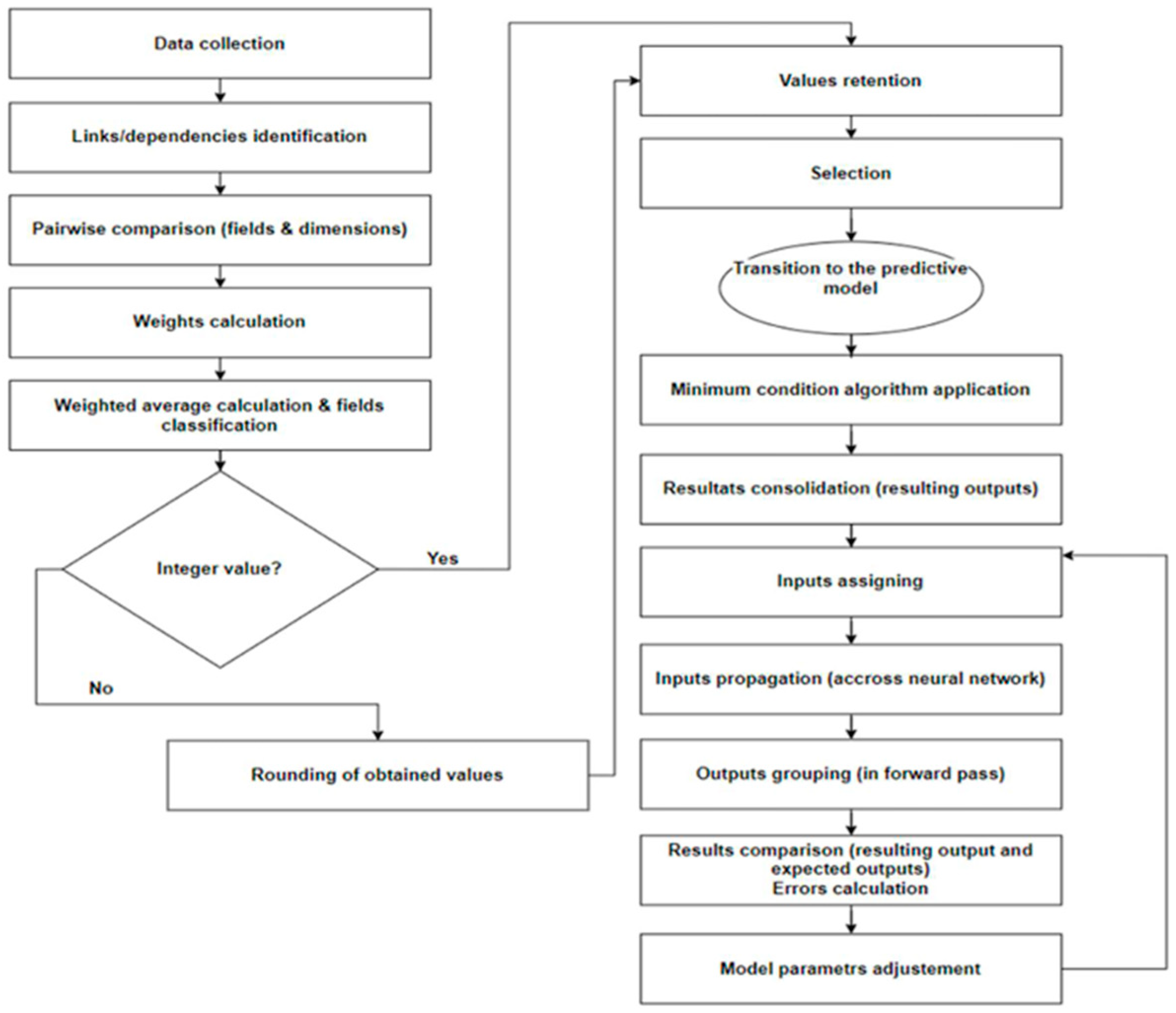
3.2. Means and Methods
3.2.1. FANP-Based Decision-Making
3.2.2. Weighted Sum and Weighted Average
3.2.3. Presentation of the “Minimum Condition Algorithm”
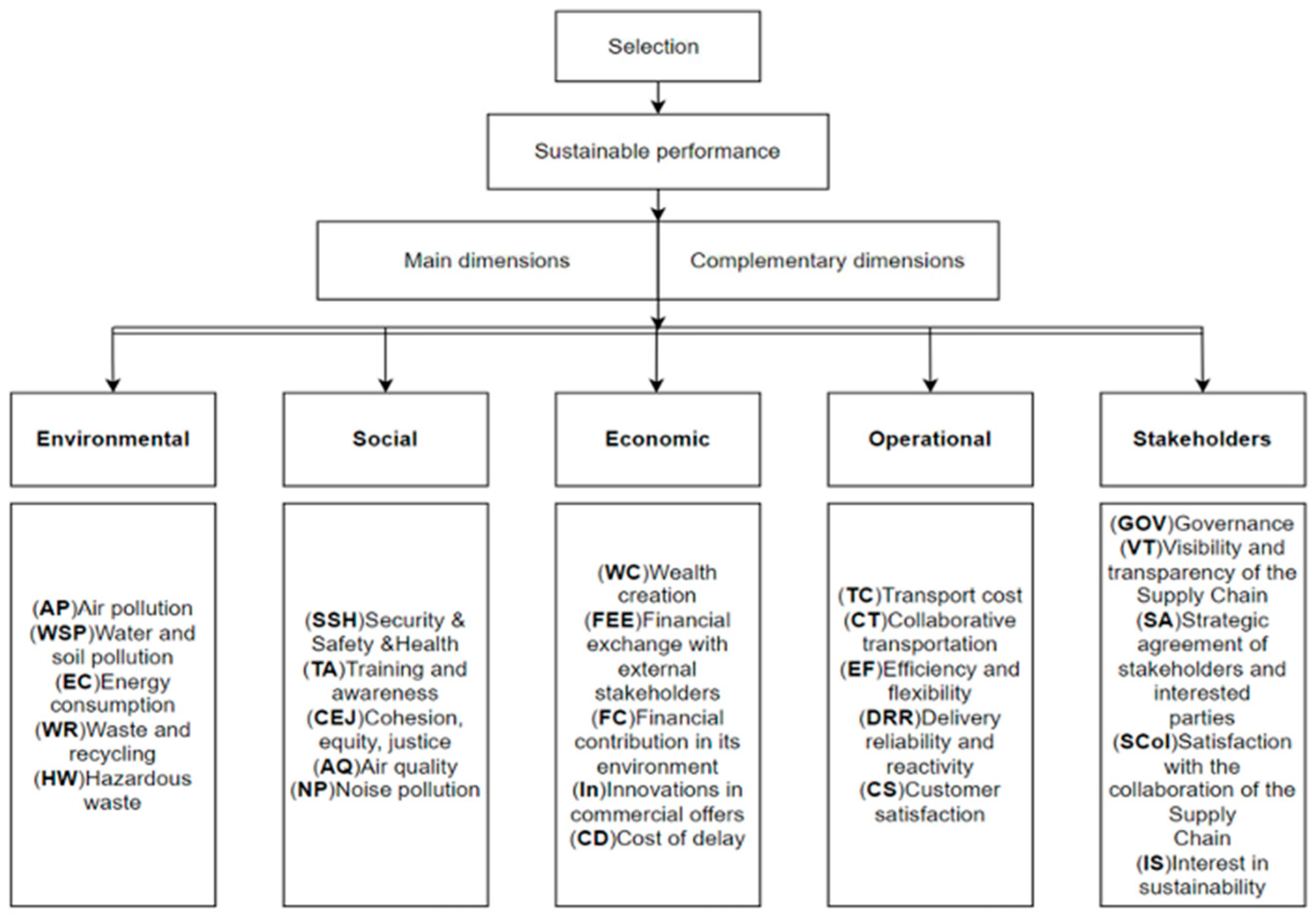
- Evaluation at the Field Level: Each specific field within a dimension receives a rating on a scale from 1 to 9.
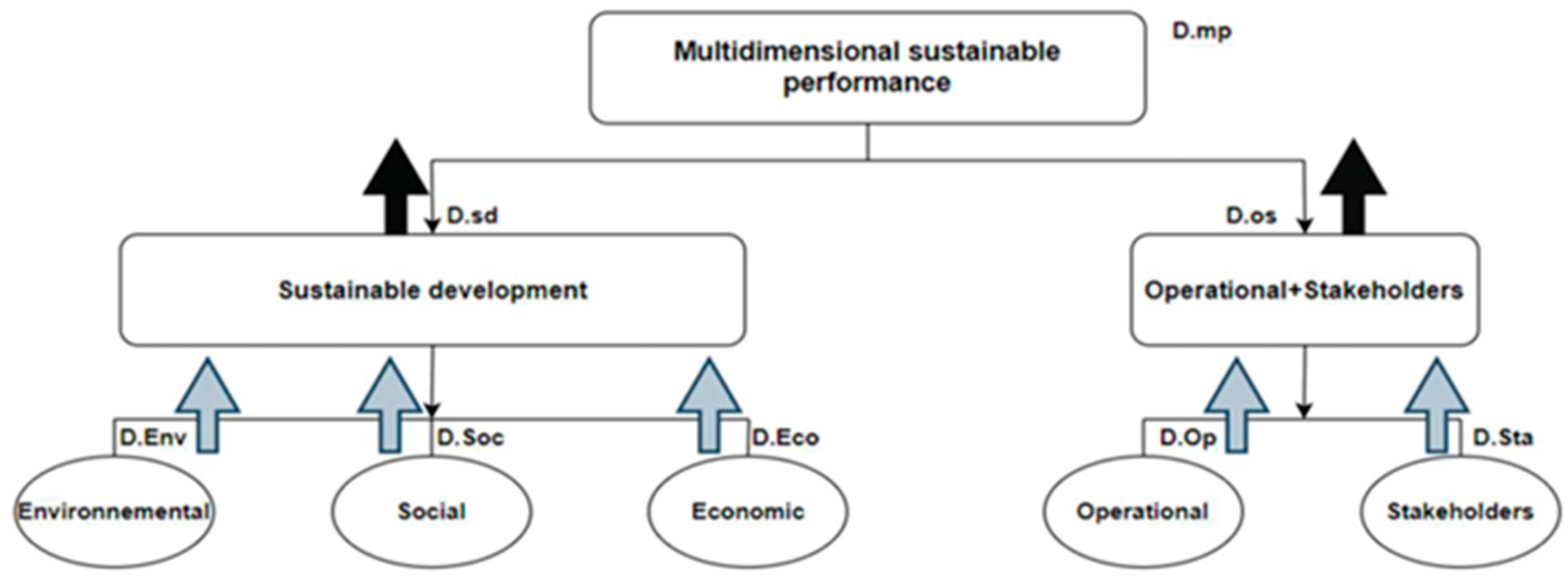
- Dimension Scoring: The overall score for each dimension corresponds to the lowest rating among its fields, meaning that a dimension’s performance is limited by its weakest area.
- Comparing Dimensions: Scores across all dimensions are analyzed to reveal differences and identify areas that may need improvement.
- Sustainable Development Indicator (D.sd): This value is determined by selecting the minimum score from the economic, environmental, and social dimensions.
- 5.
- Operational and Stakeholder Indicator (D.os): Calculated as the lowest value between the operational and stakeholder dimensions.
- 6.
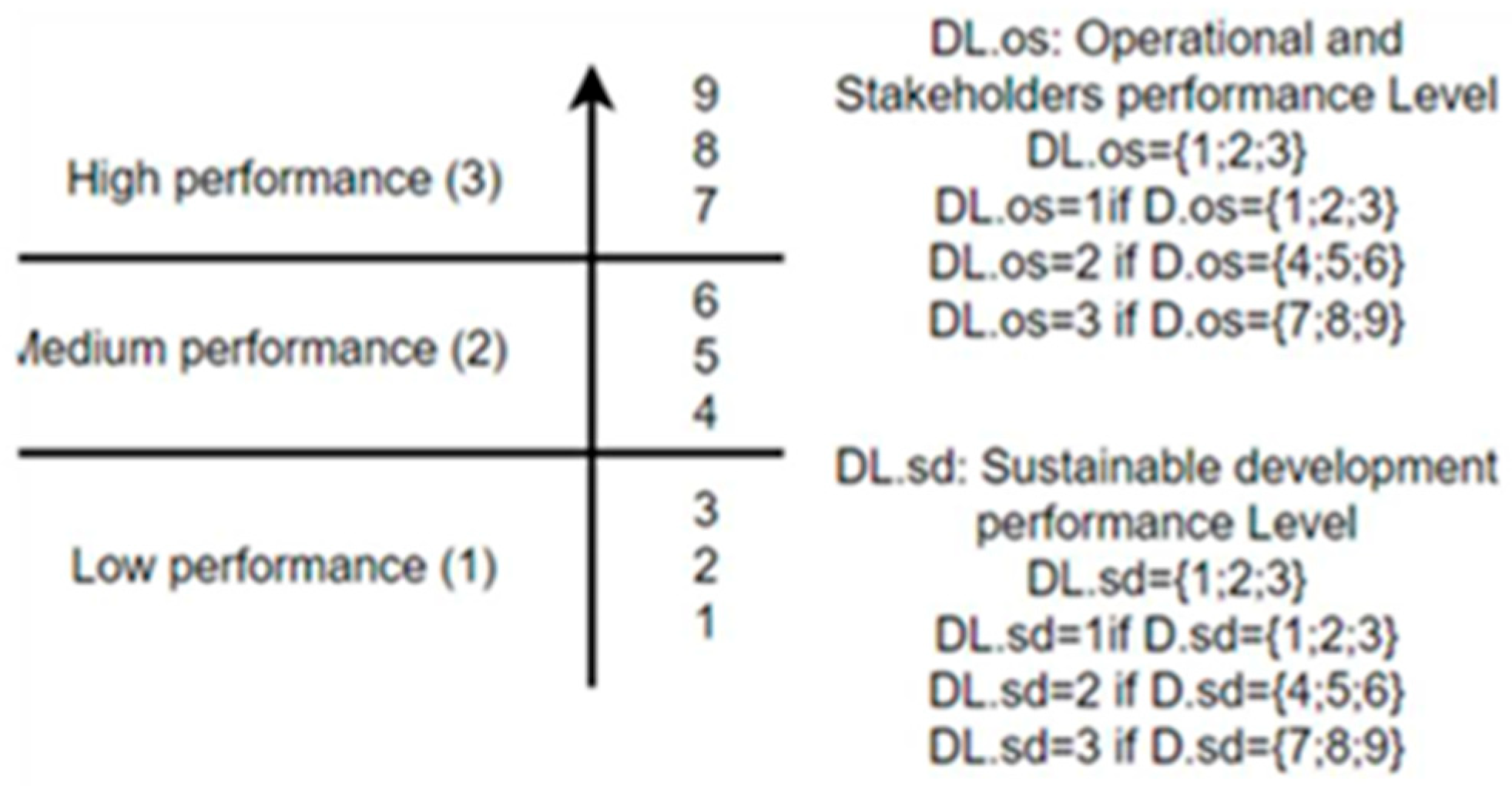
- Performance Levels for D.sd and D.os: The performance categories for these indicators are assigned based on their minimum scores.
- 7.
- Overall Multidimensional Sustainability Score (D.mp): The final sustainability performance is the lesser of the two key indicators, D.sd and D.os.
3.2.4. Artificial Neural Network (ANN)
4. Practical Case
4.1. Application of ANN
- Dimensions and Fields Prioritization
- b
- Sustainable Performance Calculation
4.2. Minimal Condition Algorithm and Artificial Neural Network
4.3. Outcomes of the Contribution
5. Discussion of Results
6. Conclusions
Author Contributions
Funding
Institutional Review Board Statement
Informed Consent Statement
Data Availability Statement
Conflicts of Interest
References
- Marques, A.V.; Rodrigues, J.F.D. Assessing the sustainable development of mining regions: A multidimensional approach. Resour. Policy 2021, 72, 1–11. [Google Scholar]
- Liang, W.-Z.; Dai, B.; Zhao, G.-Y.; Wu, H. Performance Evaluation of Green Mine Using a Combined Multi-Criteria Decision Making Method With Picture Fuzzy Information. IEEE Access 2019, 7, 174139–174154. [Google Scholar] [CrossRef]
- Ru, W.C.; Chang, C.W.; Lin, H.-L. A fuzzy ANP-based approach to evaluate medical organization performance. Int. J. Inf. Manag. Sci. 2008, 19, 53–74. [Google Scholar]
- Basiago, A.D. Economic, social and environmental sustainability in development theory and urban planning practice. Environmentalist 1999, 19, 145–161. [Google Scholar] [CrossRef]
- Karuppiah, K.; Sankaranarayanan, B.; Ali, S.M. A fuzzy ANP–DEMATEL model on faulty behavior risks: Implications for improving safety in the workplace. Int. J. Occup. Saf. Ergon. 2022, 28, 923–940. [Google Scholar] [CrossRef] [PubMed]
- El Kouihen, F.; Baba, Y.F.; Aitousaleh, H.; Elharrak, A.; Elalami, K.; Bennouna, E.; Faik, A. Investigation of thermal energy storage system based on mining by-products for the recovery of Moroccan mining industrial waste heat. Appl. Therm. Eng. 2023, 230 Pt B, 120708. [Google Scholar] [CrossRef]
- Bouabdellah, M.; Taallah, B. Mineral potential of the Anti-Atlas, Moroccan Hercynian belt: Advances and challenges. Arab. J. Geosci. 2018, 11, 632. [Google Scholar]
- Ghasemi, A.; Pourkhabaz, A. Sustainability assessment of mining areas: A fuzzy multi-criteria approach. Resour. Policy 2018, 58, 109–119. [Google Scholar]
- Ershadi, M.J.; Ashtiyani, F.K. Analyzing the factors affecting environmental risks of projects using a hybrid approach of DEMATEL-ANP, artificial neural network: A case study. Environ. Qual. Manag. 2019, 29, 77–88. [Google Scholar] [CrossRef]
- Saaty, T.L. The Analytic Hierarchy Process; McGraw-Hill: New York, NY, USA, 1980. [Google Scholar]
- Liu, Z. A Survey of Intelligence Methods in Urban Traffic Signal Control. Int. J. Comput. Sci. Netw. Secur. 2007, 7, 105–112. [Google Scholar]
- Widaman, K.F.; Revelle, W. Thinking thrice about sum scores, and then some more about measurement and analysis. Behav. Res. Methods 2023, 55, 788–806. [Google Scholar] [CrossRef] [PubMed]
- Liu, P.; Naz, S.; Akram, M.; Muzammal, M. Group decision-making analysis based on linguistic q-rung orthopair fuzzy generalized point weighted aggregation operators. Int. J. Mach. Learn. Cybern. 2022, 13, 883–906. [Google Scholar] [CrossRef]
- Eskandari, D.; Gharabagh, M.J.; Barkhordari, A.; Gharari, N.; Panahi, D.; Gholami, A.; Teimori-Boghsani, G. Development of a scale for assessing the organization’s safety performance based fuzzy ANP. J. Loss Prev. Process Ind. 2021, 69, 104342. [Google Scholar] [CrossRef]
- Hii, P.K.; Goh, C.F.; Tan, O.K.; Amran, R.; Ong, C.H. An information system success model for e-learning postadoption using the fuzzy analytic network process. Educ. Inf. Technol. 2023, 28, 10731–10752. [Google Scholar] [CrossRef] [PubMed]
- Nayak, J.; Vakula, K.; Dinesh, P.; Naik, B.; Pelusi, D. Intelligent food processing: Journey from artificial neural network to deep learning. Comput. Sci. Rev. 2020, 38, 100297. [Google Scholar] [CrossRef]
- Agatonovic-Kustrin, S.; Loescher, C.M. Qualitative and quantitative high performance thin layer chromatography analysis of Calendula officinalis using high resolution plate imaging and artificial neural network data modelling. Anal. Chim. Acta 2013, 798, 103–108. [Google Scholar] [CrossRef] [PubMed]
- Widiastuti, T.; Robani, A.; Sukmaningrum, P.S.; Mawardi, I.; Ningsih, S.; Herianingrum, S.; Almustofa, M.U. Integrating sustainable Islamic social finance: An analytical network process using the benefit opportunity cost risk (ANP BOCR) framework: The case of Indonesia. PLoS ONE 2022, 17, e0269039. [Google Scholar] [CrossRef] [PubMed]
- Abbasi, S.; Gilani, N.; Javanmardi, M.; Alizadeh, S.S.; Jalilpour, S.; Safari, M. Prioritizing the indicators influencing permit to work system efficiency based on an analytic network process. Int. J. Occup. Saf. Ergon. 2022, 28, 1042–1052. [Google Scholar] [CrossRef] [PubMed]
- Daneshparvar, B.; Rasi Nezami, S.; Feizi, A.; Aghlmand, R. Comparison of results of flood hazard zoning using AHP and ANP methods in GIS environment: A case study in Ardabil province, Iran. J. Appl. Res. Water Wastewater 2022, 9, 1–7. [Google Scholar]



| Importance | Explanation |
|---|---|
| 1 | Signifies minimal importance or extremely low preference. This implies that the criterion is deemed insignificantly important or inferior when compared to the majority of other criteria. |
| 3 | Represents moderate importance or moderate preference. This suggests that the criterion holds a certain level of significance or a moderately preferred position among the other criteria. |
| 5 | Indicates an intermediate level of importance or a neutral preference. This means that the criterion is considered to possess a medium degree of importance or a neutral preference when compared to other criteria. |
| 7 | Denotes a high level of importance or a strong preference. This indicates that the criterion is regarded as having substantial importance or a significantly higher preference relative to the other criteria. |
| 9 | Reflects an extremely high level of importance or preference. This signifies that the criterion is viewed as critically important or holds an exceptionally high preference when compared to other criteria. |
| 2,4,6,8 | These even scores reflect intermediate values between the defined categories above. |
Disclaimer/Publisher’s Note: The statements, opinions and data contained in all publications are solely those of the individual author(s) and contributor(s) and not of MDPI and/or the editor(s). MDPI and/or the editor(s) disclaim responsibility for any injury to people or property resulting from any ideas, methods, instructions or products referred to in the content. |
© 2026 by the authors. Licensee MDPI, Basel, Switzerland. This article is an open access article distributed under the terms and conditions of the Creative Commons Attribution (CC BY) license.
Share and Cite
Farchi, C.; Farchi, F.; Touzi, B.; Mousrij, A. A Comprehensive Sustainable Performance Assessment in Morocco’s Mining Sector Using Artificial Neural Networks and the Fuzzy Analytic Network Process. Eng. Proc. 2025, 112, 82. https://doi.org/10.3390/engproc2025112082
Farchi C, Farchi F, Touzi B, Mousrij A. A Comprehensive Sustainable Performance Assessment in Morocco’s Mining Sector Using Artificial Neural Networks and the Fuzzy Analytic Network Process. Engineering Proceedings. 2025; 112(1):82. https://doi.org/10.3390/engproc2025112082
Chicago/Turabian StyleFarchi, Chayma, Fadwa Farchi, Badr Touzi, and Ahmed Mousrij. 2025. "A Comprehensive Sustainable Performance Assessment in Morocco’s Mining Sector Using Artificial Neural Networks and the Fuzzy Analytic Network Process" Engineering Proceedings 112, no. 1: 82. https://doi.org/10.3390/engproc2025112082
APA StyleFarchi, C., Farchi, F., Touzi, B., & Mousrij, A. (2025). A Comprehensive Sustainable Performance Assessment in Morocco’s Mining Sector Using Artificial Neural Networks and the Fuzzy Analytic Network Process. Engineering Proceedings, 112(1), 82. https://doi.org/10.3390/engproc2025112082