
Proceeding Paper

Assessment of Drought Vulnerability in Faisalabad Through Remote Sensing and GIS †

by
Ebadat Ur Rehman
1,
Laiba Sajid
2 and
Zainab Naeem
1,*
1
Sustainable Development Policy Institute, Islamabad 44000, Pakistan
2
School of Civil and Environmental Engineering, Institute of Environmental Sciences and Engineering, National University of Sciences & Technology, Islamabad 44000, Pakistan
*
Author to whom correspondence should be addressed.
Presented at the 5th International Conference on Advances in Mechanical Engineering (ICAME-25), Islamabad, Pakistan, 26 August 2025.
Eng. Proc. 2025, 111(1), 34; https://doi.org/10.3390/engproc2025111034
Published: 4 November 2025

Abstract

This research has used a multi-indices geospatial framework to combine the utilization of the Normalized Difference Vegetation Index (NDVI), Temperature Condition Index (TCI), and Standardized Precipitation Evapotranspiration Index (SPEI) to measure drought risk in Faisalabad Division, Pakistan (2015–2023). It integrated remote sensing, GIS analysis, and change detection in Land Use Land Cover (LULC) and used Moderate Resolution Imaging Spectroradiometer (MODIS) datasets along with SPEI grids. It was found that the spatial heterogeneity that occurred with District Jhang is at high risk because it is arid (SPEI −1.5), sparsely vegetated (NDVI 0.2), and has high thermal stress (TCI -30), whereas the central/eastern parts are resilient (NDVI 0.4) due to irrigation. Through MODIS LULC analysis, the occurrence of urban growth (13.42 km2 of vegetative cover loss), agricultural intensification, and afforestation (147.34 km2) were identified. As per the risk map, 74 percent of the area was defined as low risk (74 percent), 20 percent as moderate risk, and 6 percent as high risk. The findings highlight the role of water management in climate resilience. Future research should integrate high-resolution imagery, machine learning, and socioeconomic data for improved prediction.

1. Introduction

Droughts are among the most complex and devastating natural hazards globally, affecting over two billion people and causing more than 59% of climate-related economic losses [1]. As climate change intensifies hydrological variability, drought frequency, severity, and spatial extent are expected to rise, posing significant threats to agriculture, water security, and livelihoods [2]. The Intergovernmental Panel on Climate Change [3] emphasizes the critical need for anticipatory drought risk management, grounded in geospatial intelligence, to mitigate cascading socio-environmental disruptions.
In South Asia, Pakistan exemplifies climate vulnerability due to its heavy reliance on monsoon rainfall and limited adaptive infrastructure. Monsoons contribute up to 59% of annual precipitation [4] but changing circulation patterns and erratic intensities have led to alternating cycles of floods and droughts. Being an agrarian economy with 21 percent contribution of agriculture to the gross domestic product, the country is highly reliant on a rainfed cropping system, which thus makes it highly vulnerable to climate extremes [5]. Historical drought episodes, most notably from 1998 to 2002, resulted in water reserves dropping to 51% of their average, causing severe yield declines and groundwater depletion [6,7].
Drought in Pakistan is driven by both natural climatic phenomena, such as the El Niño–Southern Oscillation (ENSO), and anthropogenic factors like unregulated urbanization, industrial expansion, and land-use changes [8,9]. ENSO-induced shifts have repeatedly disrupted the monsoon cycle, with 11 out of 21 historic droughts linked to El Niño years [10]. At the same time, surging population growth, poor water governance, and agricultural intensification have placed unprecedented pressure on limited freshwater resources [1,11]. These pressures are exacerbated in Punjab, where agriculture forms the economic backbone and rainfall fluctuations directly impact cropping cycles, food prices, and rural employment [12]. Within Punjab, Faisalabad Division, which includes the districts of Faisalabad, Jhang, Chiniot, and Toba Tek Singh, faces dual stress from agricultural dependency and rapid industrialization. The division has witnessed recurring drought conditions due to seasonal precipitation failure, land degradation, and irrigation overuse [13]. Traditional drought assessments, relying on point-based meteorological data, offer insufficient spatial resolution for such a heterogeneous region. Pakistan’s meteorological station coverage remains sparse and unevenly distributed, limiting its utility for wide-area drought detection [14].
Conversely, drought monitoring can be achieved by using remote-sensing (RS) and Geographic Information System (GIS) approaches at low costs over large areas. These tools allow continuous tracking of vegetation, land surface temperature, and moisture anomalies across time and space. Indices like the SPEI, NDVI, and TCI, have been formed to be an effective measure of drought condition and spatio-temporal changes [15,16]. The NDVI reflects vegetation health and biomass density by comparing near-infrared and red reflectance [17]. The TCI captures thermal stress using land surface temperature data [18], while the SPEI offers hydrological drought detection by integrating precipitation with potential evapotranspiration [19].
The literature indicates that combining these indices provides superior insights compared to single-index approaches. The NDVI alone, for instance, suffers from saturation under dense vegetation and cannot distinguish between crop types [20]. TCI lacks sensitivity to short-term heat events, and the SPEI requires extensive baseline data for accuracy [21]. When integrated, however, these indices can identify drought onset, intensity, and persistence with greater precision, informing early warning systems and resource allocation [22,23]. Previous studies in Pakistan have applied the SPI, SPEI, and RDI indices to monitor drought conditions at national and provincial scales [24,25]. However, research focused on district-level multi-index drought mapping remains limited, especially for Faisalabad Division. Additionally, most of the researches have not included analysis of LULC change analysis in drought risk assessment even though it is becoming more relevant. Urban sprawl, deforestation, and the expansion of irrigation-intensive agriculture significantly alter local hydrological balances, affecting evapotranspiration and soil moisture retention [26,27]. Recent research underscores that land management practices directly influence drought risk and resilience. For instance, afforestation initiatives can enhance soil water retention, while unregulated urban expansion reduces infiltration and amplifies runoff [28]. The conversion of vegetative cover to built-up areas in Punjab has been linked to declining aquifer recharge rates and increased surface heat islands, further intensifying drought conditions [29]. LULC analysis using satellite-based classification systems can thus identify human-induced vulnerabilities and guide policy interventions in drought-prone regions.
Socioeconomic vulnerability is another critical dimension of drought risk. The impacts of drought are not evenly distributed; marginalized communities lacking access to water infrastructure or diversified livelihoods are disproportionately affected [30,31]. Rural out-migration, food insecurity, and income losses in drought-hit areas are well-documented consequences in Pakistan [32]. Effective drought risk assessments must therefore integrate both biophysical and social variables to support equitable and targeted adaptation strategies [33].
Geospatial modelling platforms such as Google Earth Engine (GEE) enable real-time, cloud-based analysis of multi-temporal satellite imagery, enhancing the capacity for rapid drought detection and mapping. The increasing availability of MODIS and Sentinel-2 datasets (constellation of two satellites from the European Space Agency’s Copernicus program), combined with indices like the NDVI, TCI, and SPEI, allows for the construction of composite risk maps that delineate drought hotspots and resilient zones. MODIS is a NASA sensor that provides multispectral data including the NDVI and land surface temperature (LST) at 250 m to 1 km resolution while Sentinel-2 is a European Space Agency satellite mission that offers high-resolution (10–60 m) multispectral imagery used for detailed vegetation and land surface analysis. Despite these technological advancements, Pakistan lacks localized studies that operationalize such frameworks at sub-regional scales.
While several national-level assessments exist, a significant research gap remains in district-level drought mapping using multi-indices integrated with LULC analysis. Few studies address spatial heterogeneity within divisions like Faisalabad or examine the compounded impacts of anthropogenic land changes and climatic stressors. Moreover, limited work explores how integrated indices can inform early warning systems or provincial water governance. This paper has devised a hybrid, geospatial drought risk assessment model of the Faisalabad Division using the NDVI, TCI, and SPEI along with the LULC change detection of the years 2015 to 2023. Using satellite-derived datasets, remote sensing, and spatial modelling, this research identifies vulnerable zones, quantifies vegetation stress and thermal anomalies, and generates a drought risk classification map. The findings are expected to be of use to local decision-makers and policymakers to develop informed and data-intensive drought mitigation and climate adaptation plans in the semi-arid agro-ecological regions of Pakistan.

2. Methodology

The study took place in Faisalabad Division, which is in the eastern–central Punjab in Pakistan, and it includes four districts, i.e., Faisalabad, Chiniot, Jhang, and Toba Tek Singh [34]. It contains some of the largest industrial areas of the region, such as the Allama Iqbal Industrial City, a 3217-acre Special Economic Zone in line with the China Pakistan Economic Corridor. Administratively, Faisalabad is divided into 157 urban and 414 rural Union Councils [35]. The area of Faisalabad is 5856 and accounts to approximately 5 billion dollars of the Pakistan GDP through exports of textile commodities [36]. It is mainly a semi-arid land with temperature as high as 45.5 degrees Celsius and as low as 4.1 degrees Celsius in summer and the winter seasons and an annual average rainfall of 375 mm, mostly in July and August. It is also gifted in agricultural production by alluvial-loess soil and the Lower Chenab Canal system, which irrigates about 80 percent of the agricultural land [37]. The administrative and geographical characteristics of the four districts are summarized in Table 1.
The study employed satellite-based remote-sensing and climatic data, collected from 2015 to 2023, to assess drought risk. Google Earth Engine (GEE) served as the primary platform for data acquisition and preprocessing. To calculate the TCI the MODIS land surface temperature (MOD11A2) data was used, which is an 8-day composite and has a 1 km resolution [38]. The NDVI was calculated with the aid of MOD13A2 data, which provides 16-day composites on 1 km scale [39]. LULC data of MCD12Q1 was used for 2015 and 2023 at a 500 m resolution [40]. The SPEI values in a 6-month time scale were downloaded from the Spanish National Research Council (CSIC) for all four districts [41]. ArcGIS 10.7.1 facilitated spatial analysis and visualization, while Microsoft Excel supported data cleaning and preparation. Figure 1 depicts the framework of methodology for this paper.
A structured review of the academic literature helped select drought indices widely validated in similar climates. The NDVI was selected for vegetation health, the TCI for thermal stress, and the SPEI for meteorological drought, based on criteria including accessibility, reliability, and applicability in semi-arid regions. These indices and their attributes are presented in Table 2.
Data processing involved multiple stages. Raster data were extracted using the ‘mask’ function and reclassified for spatial analysis. Interpolation was performed using the Inverse Distance Weighting (IDW) method to improve spatial continuity of the SPEI data, which outperformed Ordinary Kriging in this case. The NDVI values were calculated from monthly MODIS images and averaged annually. The TCI was calculated after converting LST values to Celsius. For the SPEI, the climatic water balance (precipitation–PET) was fitted to a log-logistic distribution and standardized [19].
LULC change detection was carried out by converting raster data to polygons, followed by dissolving adjacent polygons with identical class labels to reduce redundancy. Area calculations were performed using the ‘Calculate Geometry’ function in ArcGIS. The Intersect tool allowed for comparison of the 2015 and 2023 datasets, identifying stable and transformed land cover classes. MODIS and ESA WorldCover datasets were used to generate maps for five LULC categories including vegetation, agriculture, built-up, barren, and water bodies. Class values were assigned following [42].
Every drought index was categorized into the levels of severity. The classification of the NDVI was defined as Dry (0.08 to 0.2), Moderate (0.2 to 0.4), and Wet (0.4 to 0.5). The TCI values 26 to 30 were associated with Normal, 30 to 40 as Wet, and 40 to 65 as Extremely Wet situations. The values of the SPEI were between 0.1 and 1.4 and this differentiated the study area into Normal and Moderately Wet zones [43,44].
The Weighted Overlay method was applied to combine all indices to produce a final integrated risk map. Standard weights were given to the NDVI and TCI, as well as the SPEI, and the composite map classified the risk of drought based on High, Moderate, and Low. In this manner, the health of vegetation, the indication of thermal stress, and the climatic moisture were simultaneously measured to enable the vulnerability to drought to be measured within the division.
The applications of the combination of the NDVI with the SPEI/SPI, the TCI, and crop produce data sets in multi-criteria drought assessment has been well-proven, with Pakistan having historically similar environments in other comparable agro-ecological zones [45]. As an example, the severity of drought by using the NDVI, the SPI, and crop yield anomaly analysis of the Thal Doab area during 19 years of the period ensured the researchers Shaheen and Baig (2011) [46]. In a parallel manner, Aziz et al. (2017) used the NDVI, VCI, and TCI obtained by HJ-1A/1B satellite sensors in the Potohar Plateau in 2009 and 2014 and proved their accuracy with the correspondence between the data and an observed crop production anomaly and rainfall trends, as well as highlighted the efficiency of weighted overlay approaches to mapping agricultural drought risks [45,46]. These studies that were carried out in semi-arid and rainfed areas with comparable physiographic conditions provide further evidence of the reliability of the indices and the modeling framework used in this study, and as such, they help strengthen not only the methodological quality but also the transferability of findings.
This study is based on several assumptions and has notable limitations. It assumes equal importance of the NDVI, TCI, and SPEI in assessing drought risk and treats land cover changes as having uniform impact. The SPEI interpolation assumes climatic continuity, and the selected 2015–2023 period is considered representative. Limitations include resolution differences between MODIS and Sentinel-2 data, lack of ground-truth validation, and gaps due to cloud cover. Socioeconomic factors like irrigation access or income were excluded, and other drought drivers such as groundwater depletion were not modelled. These factors may affect the precision and applicability of the drought risk classifications.

3. Results and Discussions

The geospatial analysis of multiple indices revealed significant spatial and temporal variations in drought vulnerability across Faisalabad Division from 2015 to 2023. By integrating the SPEI, the NDVI, the TCI, and LULC change detection, the study developed a comprehensive understanding of drought trends and vegetation health in the region.
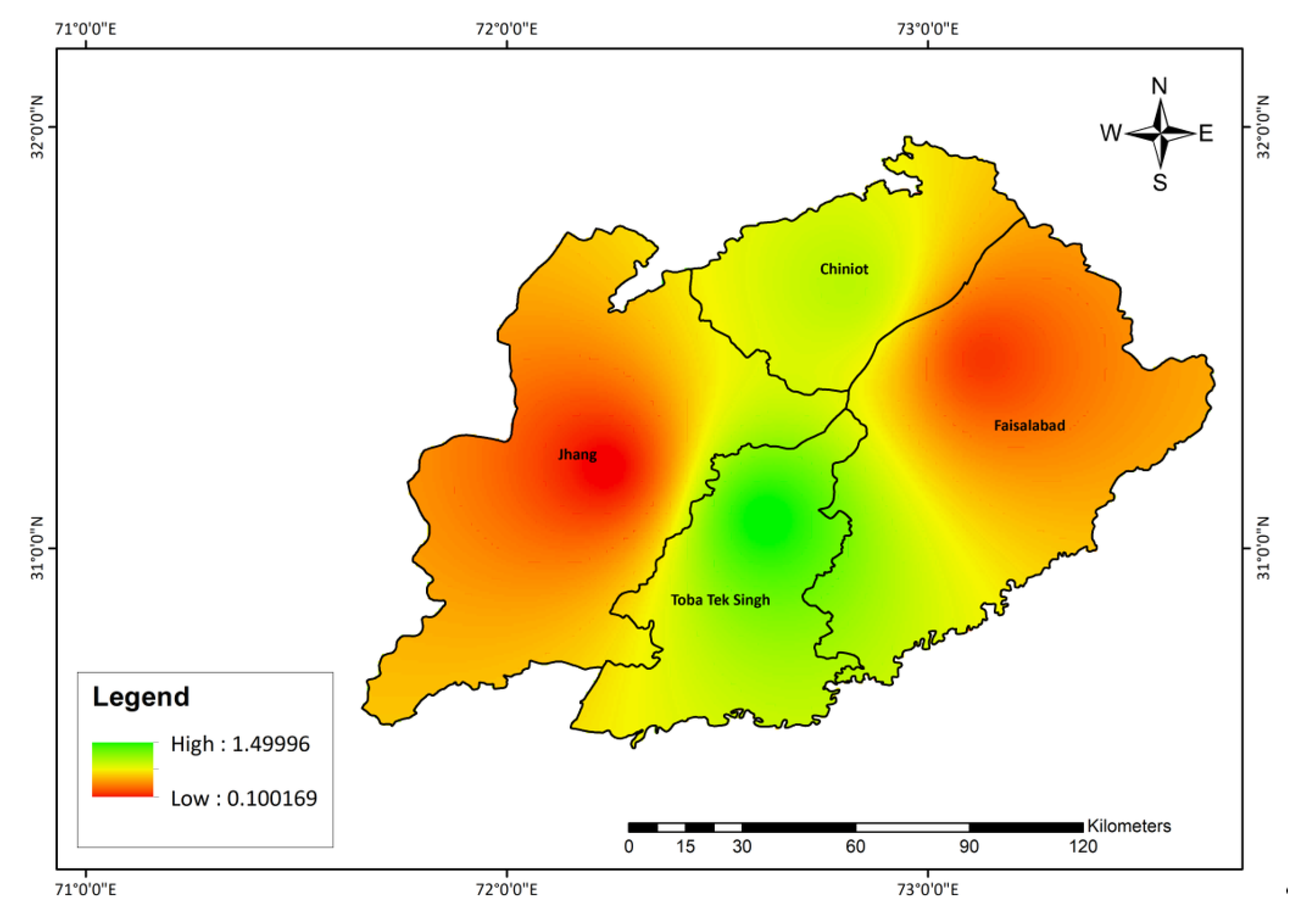
Figure 2 presents the spatial distribution of the SPEI values across the division, showcasing distinct moisture zones. Green zones (SPEI ≈ 1.5) were prevalent in central and southeastern regions, indicating relatively wet conditions, while red areas (SPEI ≈ 0.1) in the western and northeastern parts signaled increased drought stress. These patterns suggest that central Faisalabad and areas along the river system benefit from localized rainfall, improved soil moisture retention, or reduced evapotranspiration losses. In contrast, the peripheries, particularly in Jhang and northeastern Faisalabad, are more susceptible to water scarcity. The classification aligns with the existing literature on Punjab’s semi-arid moisture gradients.
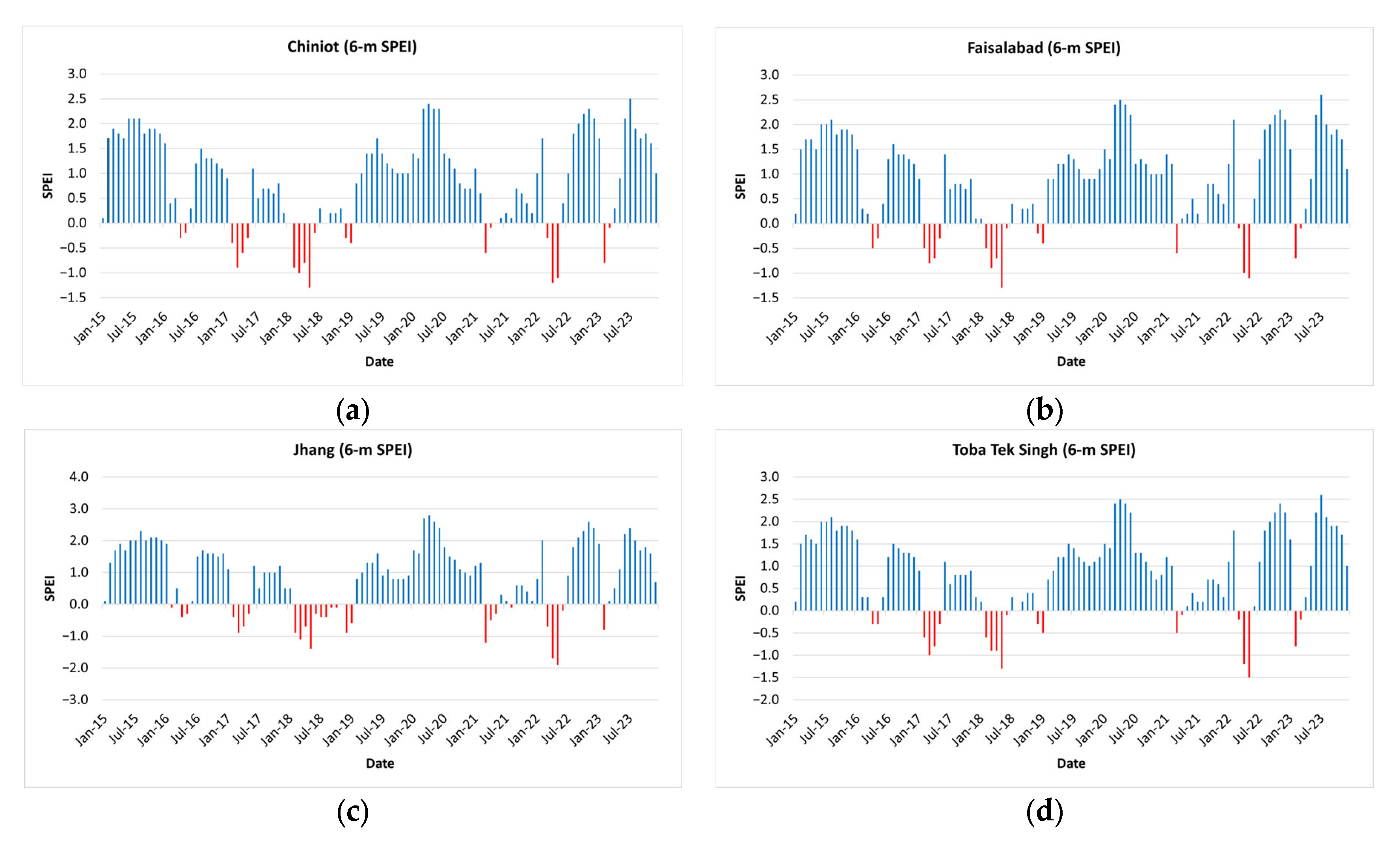
The temporal dynamics of the SPEI across the four districts are shown in Figure 2. Between 2015 and 2017, most districts experienced favorable moisture conditions, with marked wetness in mid-2015 and again from March 2019 to June 2020. Chiniot showed sustained positive SPEI trends during these intervals (Figure 3a), while Faisalabad recorded extended wet periods from June–December 2015 and spring 2020 (Figure 3b). Jhang and Toba Tek Singh mirrored these trends with the SPEI peaking at 2.3 in August 2015 and 2.5 in April 2020, respectively (Figure 3c,d). These moisture surpluses were likely driven by monsoonal anomalies and enhanced precipitation relative to evapotranspiration. However, 2018 and 2022 were notable years of drought and the SPEI became less than −1.5, especially in Toba Tek Singh and Jhang, which indicates growing hydroclimatic volatility.
These findings highlight the region’s dependence on monsoonal rainfall and the growing risk of recurrent droughts, consistent with prior studies reporting 20–40% below-average rainfall and increasing challenges for water and agricultural management [1]. To examine spatial synchronicity, a correlation matrix was constructed between the four districts using 6-month SPEI values (Table 3). The results revealed strong positive correlations (r > 0.85), indicating that climatic events and moisture anomalies tend to affect the entire division concurrently. This suggests regional uniformity in climate drivers, possibly linked to shared monsoonal influence and large-scale atmospheric circulation patterns. As a result, district-level strategies may be insufficient, and a regional approach to drought preparedness and resource management is warranted. This uniformity reinforces the call for integrated monitoring, early warning systems, and coordinated governance, echoing recommendations by international reports [3,47]. Climatic changes now affect the division as a single environmental system, demanding joint adaptation strategies involving all local stakeholders.
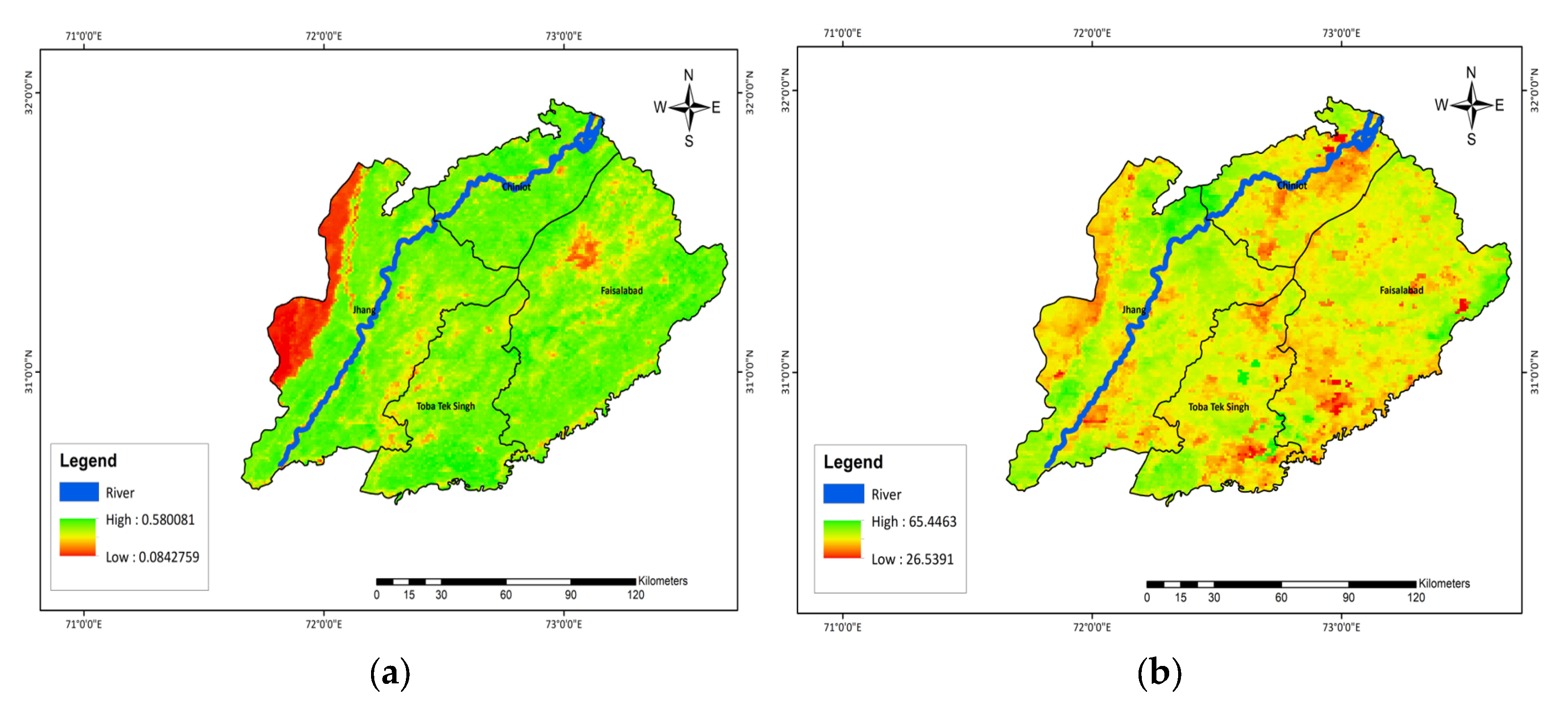
The NDVI analysis revealed vegetation health across Faisalabad Division ranged from 0.08 to 0.58, indicating conditions from poor to healthy (Figure 4a). Higher NDVI values concentrated near rivers and canal-irrigated zones in the east and southeast, highlighting the stabilizing impact of managed irrigation on agricultural productivity. In contrast, western Jhang consistently exhibited low NDVI values (≤0.2), aligning with high-risk areas identified in the SPEI analysis and underscoring spatial heterogeneity in vegetation stress driven by infrastructure and water access. The disparities in vegetation health exposed the unequal impact of water stress and pointed to the necessity of better soil and water management activities. Urban sprawl and uncontrolled water consumption has further aggravated the depletion of groundwater in such places as Lyallpur and Iqbal Town, resulting in further burdening of the local ecosystems [37]. Restoration of groundwater recharge capacity and drought-tolerant crop planning are essential steps forward. The TCI map (Figure 4b) further illustrated thermal stress distribution, with green zones (TCI ≥ 40) in riverine and central/northeastern areas benefiting from microclimatic advantages and irrigation buffering.
Meanwhile, regions with TCI values ≤ 30, especially in Jhang and Toba Tek Singh, experienced elevated thermal stress, intensifying evapotranspiration and reducing soil moisture. These findings demonstrate that without effective water governance, thermal extremes could severely undermine plant resilience and yield consistency in vulnerable districts. Drip irrigation, mulching, and heat-tolerant crop varieties can play a critical role in mitigating productivity losses. Moreover, research emphasized the role of vulnerability mapping in guiding agricultural subsidies and infrastructure investment, a point highly relevant for the most thermally stressed areas in Faisalabad Division [48]. The low TCI at river channels, as seen in Figure 4b, is also concurrent with the impact of evaporative cooling of the nearby water bodies. Pixels near rivers (closer than 500 m to water bodies) have a lower summer LST mean of about 2.7 degrees Celsius relative to the average across the whole division; this information is backed by recent thermal remote-sensing works [49,50]. This local cooling minimizes LST inputs in the TCI algorithm, therefore pushing the TCI value low. Although the TCI is usually applied to show thermal stress, smaller TCI values may not necessarily show vegetation stress when in riverine zones; it may represent the microclimatic impact of surface water, especially when evaporation is more intense.
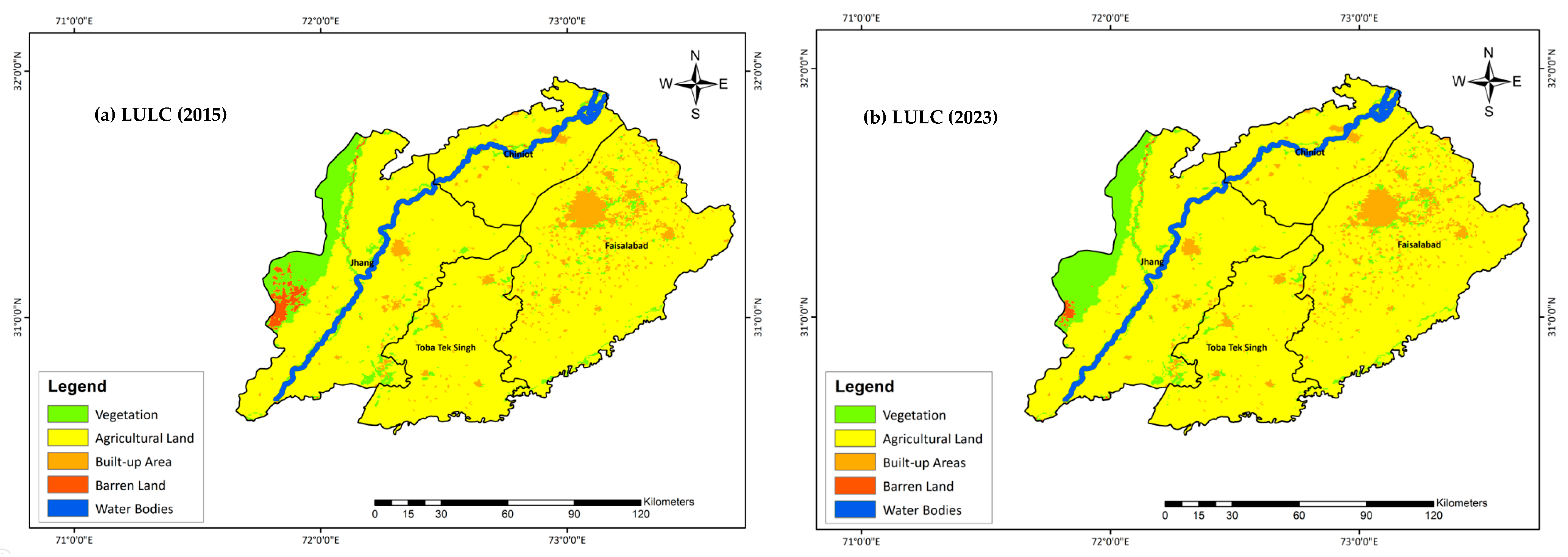
Complementing the biophysical indices, land use change analysis showed a marked anthropogenic impact on drought vulnerability (Figure 5a,b). From 2015 to 2023, approximately 13.42 km2 of vegetated land was converted to urban use, mainly in and around Faisalabad City. This transition from green cover to impermeable surfaces likely exacerbates local temperature anomalies and disrupts water infiltration. At the same time, 147.34 km2 of barren land was converted into vegetative areas, especially in Toba Tek Singh, through afforestation and ecological restoration activities.
Although several signs of ecological restoration were identifiable (e.g., 147.34 km2 of lands with no vegetation have been transformed into vegetated ones, due to the reforestation programs or the natural restoration) [37], these positive trends only decrease the negative ecological balance because 28.73 km2 of vegetated territories have been changed to the category of degraded areas. Urbanization continues to outpace environmental recovery, underscoring the urgent need for urban planning reforms and strict enforcement of land conservation policies.
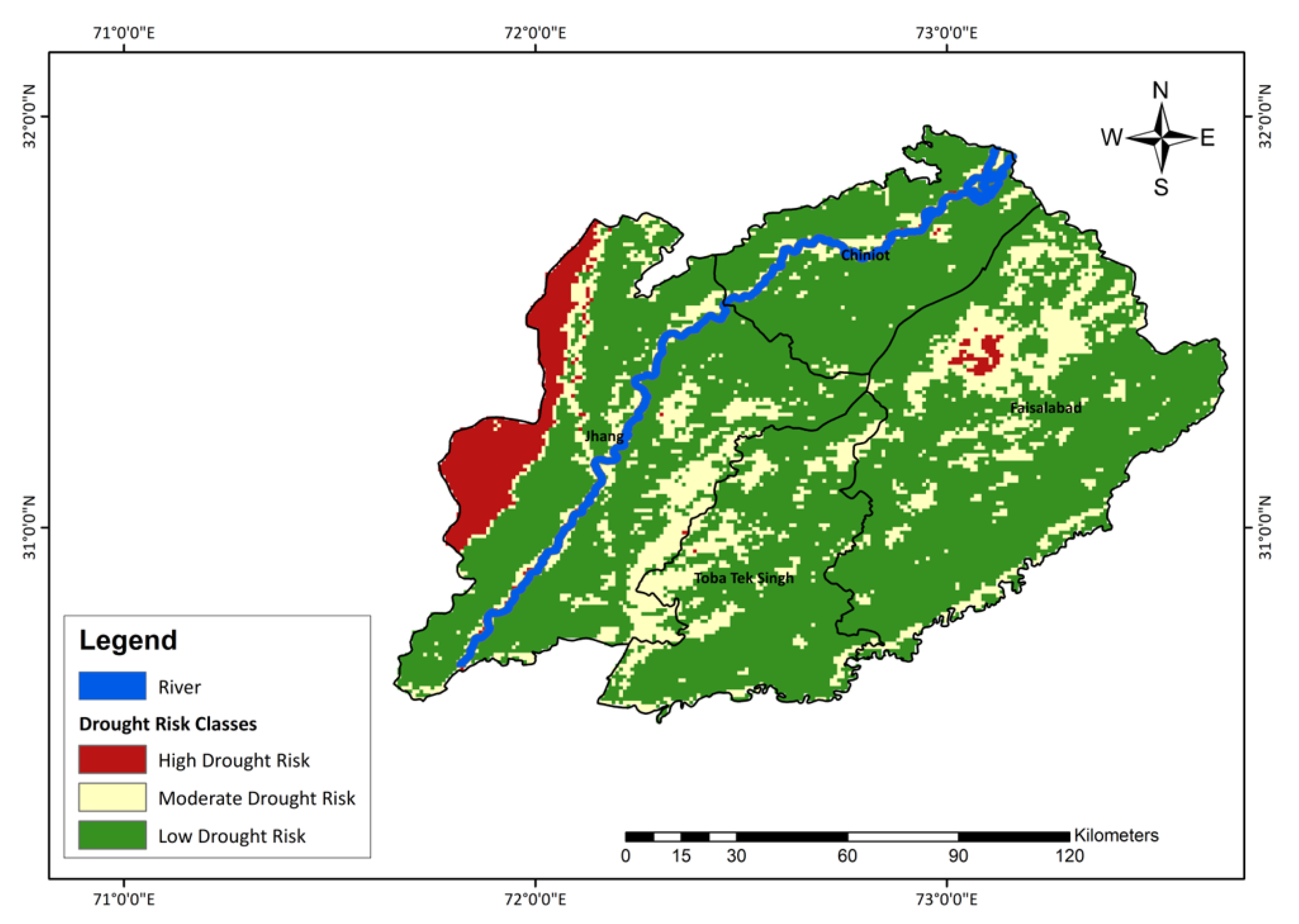
Spatial integration of the NDVI, TCI, and SPEI produced a composite drought risk classification (Figure 6). The NDVI, TCI, and SPEI were not strongly correlated statistically but were selected for their complementary roles in capturing vegetation stress, thermal anomalies, and climatic moisture deficits. They were normalized, equally weighted, and overlaid in ArcGIS to generate the composite drought risk map. The high-risk category, comprising about six percent of the region and mostly covering the arid western region of Jhang, was established.
Comparatively, 20 percent of the territory was of moderate risk, whereas the remaining 74 percent was of low risk due to enhanced vegetation cover, reliable irrigation structures, and reduced thermal stress. This classification highlights the interplay between climatic variables and land management practices. Regions near rivers and canal-fed plains were consistently less vulnerable, indicating that irrigation expansion could enhance drought resilience. The results confirm that drought vulnerability in Faisalabad Division is uneven and shaped by climatic, topographic, and anthropogenic factors. Although some zones remain stable, increasing climate variability, urban sprawl, and soil degradation threaten large parts of the division. The geospatial tools used, especially remote-sensing indices, prove vital for early detection and long-term drought monitoring in semi-arid landscapes. These findings call for urgent policy action. Investments in rainwater harvesting, tank construction, and agroforestry are essential for rain-fed and water-stressed communities. Conservation agriculture and drought-resilient crops can help sustain rural livelihoods. Institutional collaboration is key [51,52], along with early warning systems, farmer outreach, and vulnerability databases. An integrated strategy, combining infrastructure, climate-smart farming, and land-use governance, can greatly enhance drought resilience.

4. Conclusions

This study assessed drought risk in Faisalabad Division (2015–2023) using a geospatial framework integrating the NDVI, the TCI, the SPEI, and LULC analysis. The results demonstrated high risks in western regions such as Toba Tek Singh and Jhang with very low vegetation (NDVI 0.2), thermal pains (TCI 30), and aridity (SPEI −1.5) whereas the canal-based eastern sections insured a high level of resilience (NDVI more than 0.4). The change in the land cover pattern revealed an increase in urban growth (the loss was 13.42 sq. km) and afforestation (a gain of 147.34 sq. km) confirming the anthropogenic effects. A composite risk map classified 6% of the region as high risk, 20% moderate, and 74% low. Going forward, proactive drought management will require stronger spatial planning, integrated water governance, and real-time monitoring systems. Coordinated action between climate, agriculture, and land authorities is essential to build long-term resilience for Pakistan’s vulnerable semi-arid regions. The study analyzes historical trends from 2015 to 2023 but does not employ predictive modeling techniques; therefore, it cannot forecast future NDVI, TCI, or SPEI values. However, the observed spatial–temporal patterns can inform future monitoring efforts and highlight regions that may remain vulnerable under similar climatic conditions.

Author Contributions

Conceptualization, E.U.R.; methodology, E.U.R. and L.S.; software, E.U.R.; formal analysis, E.U.R. and L.S.; data curation and visualization, E.U.R.; writing—original draft preparation, L.S. and E.U.R.; writing—review and editing, E.U.R. and Z.N.; supervision, Z.N. All authors have read and agreed to the published version of the manuscript.

Funding

This research received no external funding.

Institutional Review Board Statement

Not applicable.

Informed Consent Statement

Not applicable.

Data Availability Statement

The data for this study is available and will be provided by the authors upon reasonable request.

Acknowledgments

The authors would like to acknowledge the support received from Carbo-X (Private) Limited. We also appreciate the availability of satellite datasets from NASA’s MODIS (MOD11A2, MOD13A2, MCD12Q1) and the Spanish National Research Council (CSIC) for the SPEI data, which were critical to this study. Moreover, we really appreciate the valuable inputs of Muhammad Tayyab Saeed.

Conflicts of Interest

The authors declare no conflicts of interest.

References

  1. Ali, W.; Hashmi, M.Z.; Jamil, A.; Rasheed, S.; Akbar, S.; Iqbal, H. Mid-century change analysis of temperature and precipitation maxima in the Swat River Basin, Pakistan. Front. Environ. Sci. 2022, 10, 973759. [Google Scholar] [CrossRef]
  2. Furtak, K.; Wolińska, A. The impact of extreme weather events as a consequence of climate change on the soil moisture and on the quality of the soil environment and agriculture—A review. Catena 2023, 231, 107378. [Google Scholar] [CrossRef]
  3. IPCC. Special Report on Climate Change, Desertification, Land Degradation, Sustainable Land Management, Food Security, and Greenhouse Gas Fluxes in Terrestrial Ecosystems. Shukla, J., Skea, E., Calvo Buendia, V., Masson-Delmotte, H.-O., Pörtner, D.C., Roberts, P., Zhai, R., Slade, S., Connors, R., van Diemen, M., et al., Eds.; In press; 2019; Available online: https://www.ipcc.ch/site/assets/uploads/2019/11/SRCCL-Full-Report-Compiled-191128.pdf (accessed on 10 June 2025).
  4. Hina, S.; Saleem, F.; Arshad, A.; Hina, A.; Ullah, I. Droughts over Pakistan: Possible cycles, precursors and associated mechanisms. Geomat. Nat. Hazards Risk. 2021, 12, 1638–1668. [Google Scholar] [CrossRef]
  5. Hussain, S.; Noreen, A.; Younas, T.; Khan, I.; Aziz, H.; Rehman, E.; Saleem, A.; Imam, M.F.; Saeed, A. Cropping pattern to cope with climate change scenario in Pakistan. Biosci. Res. 2022, 19, 957–963. [Google Scholar]
  6. Majid, H. Drought, farm output and heterogeneity: Evidence from Pakistan. J. South Asian Dev. 2022, 17, 32–56. [Google Scholar] [CrossRef]
  7. Goheer, M.A.; Aftab, B.; Farah, H.; Hassan, S.S. Spatio-temporal risk analysis of agriculture and meteorological droughts in rainfed Potohar, Pakistan, using remote sensing and geospatial techniques. Meteorol. Appl. 2023, 30, e2138. [Google Scholar] [CrossRef]
  8. Mukhtar, Z. Environmental pollution and regulatory and non-regulatory environmental responsibility (reviewing Pakistan environmental protection act). Am. J. Ind. Bus. Manag. 2023, 13, 443–456. [Google Scholar] [CrossRef]
  9. Amin, M.; Khan, M.R.; Hassan, S.S.; Khan, A.A.; Imran, M.; Goheer, M.A.; Hina, S.M.; Perveen, A. Monitoring agricultural drought using geospatial techniques: A case study of Thal region of Punjab, Pakistan. J. Water Clim. Change 2020, 11, 203–216. [Google Scholar] [CrossRef]
  10. PMD. Drought Bulletin of Pakistan: January–March 2013; National Drought Monitoring Centre, PMD: Islamabad, Pakistan, 2013. Available online: https://www.pmd.gov.pk/ndmc/quater1.pdf (accessed on 12 June 2025).
  11. Khan, M.A.; Tahir, A.; Khurshid, N.; Husnain, M.I.; Ahmed, M.; Boughanmi, H. Economic effects of climate change-induced loss of agricultural production by 2050: A case study of Pakistan. Sustainability 2020, 12, 1216. [Google Scholar] [CrossRef]
  12. Akram, M.; Khan, F.; Ullah, H.; Ali, S.; Hussain, A. Enhancing Drought Risk Assessment in the Punjab, Pakistan: A Copula-Based Modeling Approach for Future Projections. J. Appl. Meteorol. Climatol. 2024, 63, 1207–1225. [Google Scholar] [CrossRef]
  13. Ashraf, B.; AghaKouchak, A.; Alizadeh, A.; Mousavi Baygi, M.; RMoftakhari, H.; Mirchi, A.; Anjileli, H.; Madani, K. Quantifying anthropogenic stress on groundwater resources. Sci. Rep. 2017, 7, 12910. [Google Scholar] [CrossRef]
  14. AghaKouchak, A.; Farahmand, A.; Melton, F.S.; Teixeira, J.; Anderson, M.C.; Wardlow, B.D.; Hain, C.R. Remote sensing of drought: Progress, challenges and opportunities. Rev. Geophys. 2015, 53, 452–480. [Google Scholar] [CrossRef]
  15. Bai, X.; Wang, Y.; Jin, J.; Qi, X.; Wu, C. Precondition cloud and maximum entropy principle coupling model-based approach for the comprehensive assessment of drought risk. Sustainability 2018, 10, 3236. [Google Scholar] [CrossRef]
  16. Vicente-Serrano, S.M.; Beguería, S.; López-Moreno, J.I. A multiscalar drought index sensitive to global warming: The standardized precipitation evapotranspiration index. J. Clim. 2010, 23, 1696–1718. [Google Scholar] [CrossRef]
  17. Tucker, C.J. Red and photographic infrared linear combinations for monitoring vegetation. Remote Sens. Environ. 1979, 8, 127–150. [Google Scholar] [CrossRef]
  18. Kogan, F.N. Application of vegetation index and brightness temperature for drought detection. Adv. Space Res. 1995, 15, 91–100. [Google Scholar] [CrossRef]
  19. Beguería, S.; Vicente-Serrano, S.M.; Reig, F.; Latorre, B. Standardized precipitation evapotranspiration index (SPEI) revisited: Parameter fitting, evapotranspiration models, tools, datasets and drought monitoring. Int. J. Climatol. 2014, 34, 3001–3023. [Google Scholar] [CrossRef]
  20. Shi, L.; Fan, H.; Yang, L.; Jiang, Y.; Sun, Z.; Zhang, Y. NDVI-based spatial and temporal vegetation trends and their response to precipitation and temperature changes in the Mu Us Desert from 2000 to 2019. Water Sci. Technol. 2023, 88, 430–442. [Google Scholar] [CrossRef]
  21. Uddin, M.J.; Hu, J.; Islam, A.R.; Eibek, K.U.; Nasrin, Z.M. A comprehensive statistical assessment of drought indices to monitor drought status in Bangladesh. Arab. J. Geosci. 2020, 13, 323. [Google Scholar] [CrossRef]
  22. Chen, S.; Zhong, W.; Pan, S.; Xie, Q.; Kim, T.W. Comprehensive drought assessment using a modified composite drought index: A case study in Hubei Province, China. Water 2020, 12, 462. [Google Scholar] [CrossRef]
  23. Abuzar, M.K.; Shafiq, M.; Mahmood, S.A.; Irfan, M.; Khalil, T.; Khubaib, N.; Hamid, A.; Shaista, S. Drought Risk Assessment in the Khushab Region of Pakistan Using Satellite Remote Sensing and Geospatial Methods: Drought Risk Assessment in the Khushab Region of Pakistan Using Satellite Remote Sensing and Geospatial Methods. Int. J. Econ. Environ. Geol. 2019, 10, 48–56. [Google Scholar]
  24. Ahmed, K.; Shahid, S.; Harun, S.B.; Wang, X.J. Characterization of seasonal droughts in Balochistan Province, Pakistan. Stoch. Environ. Res. Risk Assess. 2016, 30, 747–762. [Google Scholar] [CrossRef]
  25. Adnan, S.; Ullah, K.; Gao, S.; Khosa, A.H.; Wang, Z. Shifting of agro-climatic zones, their drought vulnerability, and precipitation and temperature trends in Pakistan. Int. J. Climatol. 2017, 37, 529–543. [Google Scholar] [CrossRef]
  26. Zhu, Y.; Li, B.; Lian, L.; Wu, T.; Wang, J.; Dong, F.; Wang, Y. Quantifying the effects of climate variability, land-use changes, and human activities on drought based on the SWAT–PDSI model. Remote Sens. 2022, 14, 3895. [Google Scholar] [CrossRef]
  27. Ruda, A.; Kolejka, J.; Batelková, K. Geocomputation and spatial modelling for geographical drought risk assessment: A case study of the Hustopeče Area, Czech Republic. In Geoinformatics and Atmospheric Science; Springer International Publishing: Cham, Switzerland, 2017; pp. 203–220. [Google Scholar]
  28. Dwomoh, F.K.; Brown, J.F.; Tollerud, H.J.; Auch, R.F. Hotter drought escalates tree cover declines in blue oak woodlands of California. Front. Clim. 2021, 3, 689945. [Google Scholar] [CrossRef]
  29. Affram, G.; Zhang, W.; Hipps, L.; Ratterman, C. Characterizing the development and drivers of 2021 Western US drought. Environ. Res. Lett. 2023, 18, 044040. [Google Scholar] [CrossRef]
  30. Fan, G.; Zhang, Y.; He, Y.; Wang, K. Risk assessment of drought in the Yangtze River Delta based on natural disaster risk theory. Discret. Dyn. Nat. Soc. 2017, 2017, 5682180. [Google Scholar] [CrossRef]
  31. Hagenlocher, M.; Meza, I.; Anderson, C.C.; Min, A.; Renaud, F.G.; Walz, Y.; Siebert, S.; Sebesvari, Z. Drought vulnerability and risk assessments: State of the art, persistent gaps, and research agenda. Environ. Res. Lett. 2019, 14, 083002. [Google Scholar] [CrossRef]
  32. Mirza, M.M.; Burton, I. Using the adaptation policy framework to assess climate risks and response measures in south Asia: The case of floods and droughts in Bangladesh and India. In Climate Change and Water Resources in South Asia; Taylor & Francis: London, UK, 2005. [Google Scholar]
  33. Alamgir, M.; Mohsenipour, M.; Homsi, R.; Wang, X.; Shahid, S.; Shiru, M.S.; Alias, N.E.; Yuzir, A. Parametric assessment of seasonal drought risk to crop production in Bangladesh. Sustainability 2019, 11, 1442. [Google Scholar] [CrossRef]
  34. Javed, N.; Qureshi, N.N. City profile: Faisalabad, Pakistan. Environ. Urban. ASIA 2019, 10, 233–254. [Google Scholar] [CrossRef]
  35. The Urban Unit. Available online: https://urbanunit.gov.pk/Download/publications/Files/17/2023/Faisalabad%20Regional%20Development%20Plan%20-%20Urban%20Planning_compressed.pdf (accessed on 15 June 2025).
  36. Mahmood, K.; HN, G. Urban development and sustainability milieu: A case study of Faisalabad City, Pakistan. Pak. J. Sci. 2023, 75, 256–263. [Google Scholar] [CrossRef]
  37. Sajjad, M.M.; Wang, J.; Abbas, H.; Ullah, I.; Khan, R.; Ali, F. Impact of climate and land-use change on groundwater resources, study of Faisalabad district, Pakistan. Atmosphere 2022, 13, 1097. [Google Scholar] [CrossRef]
  38. Xie, F.; Fan, H. Deriving drought indices from MODIS vegetation indices (NDVI/EVI) and Land Surface Temperature (LST): Is data reconstruction necessary? Int. J. Appl. Earth Obs. Geoinf. 2021, 101, 102352. [Google Scholar] [CrossRef]
  39. Didan, K.; Barreto-Muñoz, A. MODIS Collection 6.1 (C61) Vegetation Index Product User Guide; University of Arizona, Vegetation Index and Phenology Lab: Tucson, AZ, USA, 2019. Available online: https://lpdaac.usgs.gov/documents/621/MOD13_User_Guide_V61.pdf (accessed on 16 June 2025).
  40. Ahmad, S.; Israr, M.; Ahmed, R.; Ashraf, A.; Amin, M.; Ahmad, N. Land use and cover changes in the Northern Mountains of Pakistan; a spatio-temporal change using MODIS (MCD12Q1) time series. Sarhad J. Agric. 2022, 38, 1419–1429. [Google Scholar] [CrossRef]
  41. Salvador, C.; Nieto, R.; Linares, C.; Díaz, J.; Gimeno, L. Quantification of the effects of droughts on daily mortality in Spain at different timescales at regional and national levels: A meta-analysis. Int. J. Environ. Res. Public Health. 2020, 17, 6114. [Google Scholar] [CrossRef]
  42. Seyam, M.M.; Haque, M.R.; Rahman, M.M. Identifying the land use land cover (LULC) changes using remote sensing and GIS approach: A case study at Bhaluka in Mymensingh, Bangladesh. Case Stud. Chem. Environ. Eng. 2023, 7, 100293. [Google Scholar] [CrossRef]
  43. Huang, C.; Zhang, C.; He, Y.; Liu, Q.; Li, H.; Su, F.; Liu, G.; Bridhikitti, A. Land cover mapping in cloud-prone tropical areas using Sentinel-2 data: Integrating spectral features with Ndvi temporal dynamics. Remote Sens. 2020, 12, 1163. [Google Scholar] [CrossRef]
  44. Rahimabadi, P.D.; Khosravi, H.; Azarnivand, H.; Ahmadi, S. Assessment of the relationship between drought and vegetation cover using remote sensing. Sustain. Earth Rev. 2022, 2, 15–24. [Google Scholar]
  45. Aziz, A.; Umar, M.; Mansha, M.; Khan, M.S.; Javed, M.N.; Gao, H.; Farhan, S.B.; Iqbal, I.; Abdullah, S. Assessment of drought conditions using HJ-1A/1B data: A case study of Potohar region, Pakistan. Geomat. Nat. Hazards Risk. 2018, 9, 1019–1036. [Google Scholar] [CrossRef]
  46. Shaheen, A.; Baig, M.A. Drought severity assessment in arid area of Thal Doab using remote sensing and GIS. Int. J. Water Resour. Arid Environ. 2011, 1, 92–101. [Google Scholar]
  47. FAO. The State of Food and Agriculture 2019. Moving Forward on Food Loss and Waste Reduction. Rome. Licence: CC BY-NC-SA 3.0 IGO. 2019. Available online: https://openknowledge.fao.org/server/api/core/bitstreams/11f9288f-dc78-4171-8d02-92235b8d7dc7/content (accessed on 20 June 2025).
  48. Aubrecht, C.; Özceylan, D. Identification of heat risk patterns in the US National Capital Region by integrating heat stress and related vulnerability. Environ. Int. 2013, 56, 65–77. [Google Scholar] [CrossRef]
  49. Feng, X.; Li, M.; Zhou, Z.; Li, F.; Wang, Y. Quantifying the cooling effect of river and its surrounding land use on local land surface temperature: A case study of Bahe River in Xi’an, China. Egypt. J. Remote Sens. Space Sci. 2023, 26, 975–988. [Google Scholar] [CrossRef]
  50. Ouellet, V.; Caissie, D. Towards a better understanding of the evaporative cooling of rivers: Case study for the Little Southwest Miramichi River (New Brunswick, Canada). Can. Water Resour. J. 2023, 48, 189–205. [Google Scholar] [CrossRef]
  51. You, J. Connecting Land and Water Planning in Colorado. J. Plan. Educ. Res. 2024, 44, 1970–1987. [Google Scholar] [CrossRef]
  52. Singh, A.; Pandey, A.K.; Santhosh, D.T.; Ganavi, N.R.; Sarma, A.; Deori, C.; Das, J.; Kumar, S. A comprehensive review on greenhouse gas emissions in agriculture and evolving agricultural practices for climate resilience. Int. J. Environ. Clim. Change 2024, 14, 455–464. [Google Scholar] [CrossRef]
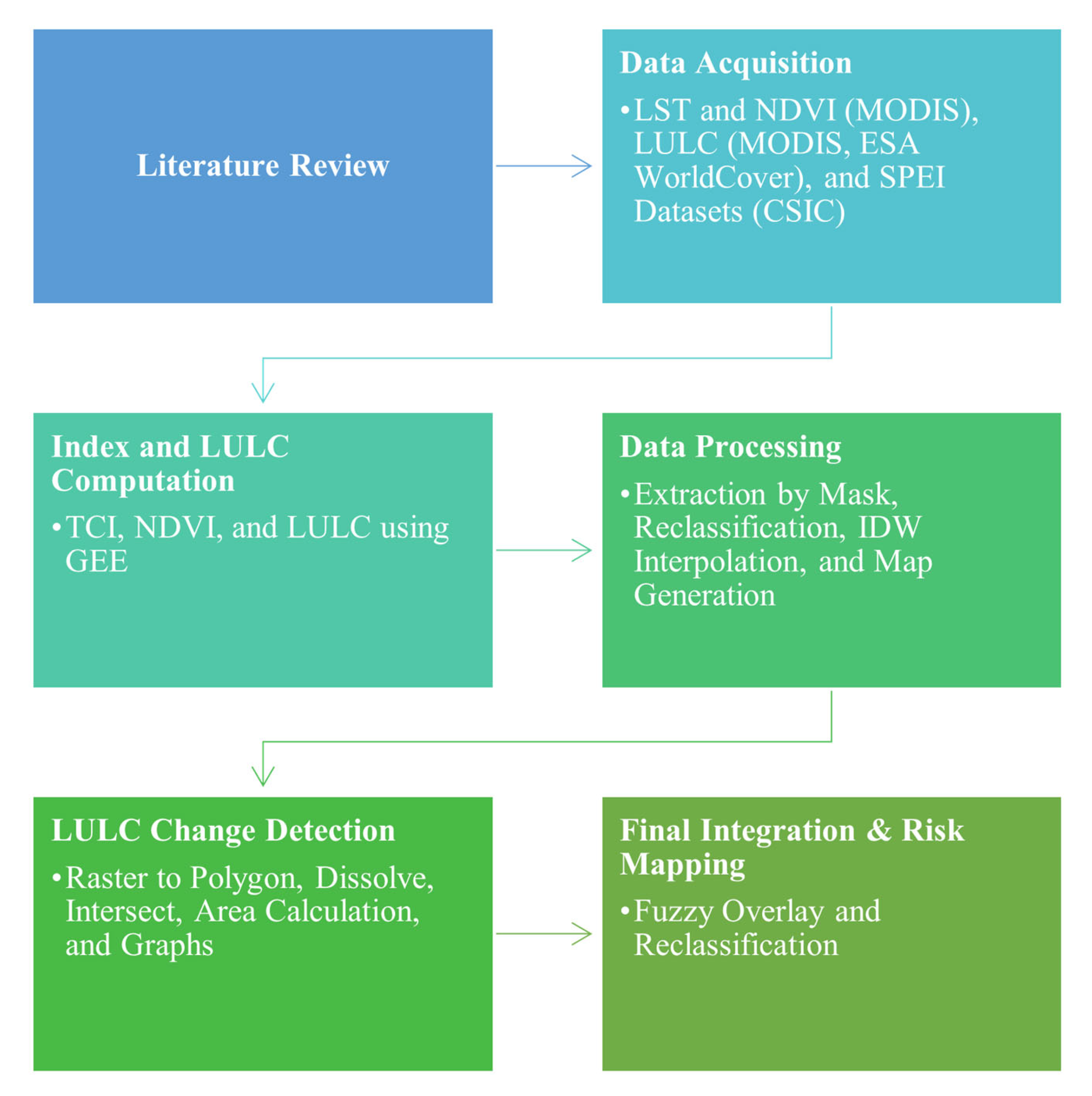
Figure 1. Flow chart of the research methodology.
Engproc 111 00034 g001
Figure 2. Spatial variation of the SPEI in Faisalabad Division (2015–2023).
Engproc 111 00034 g002
Figure 3. District-wise six-month SPEI time series (2015–2023): (a) Chiniot, (b) Faisalabad, (c) Jhang, and (d) Toba Tek Singh.
Engproc 111 00034 g003
Figure 4. The NDVI (a) and TCI (b) across Faisalabad Division.
Engproc 111 00034 g004
Figure 5. LULC maps of Faisalabad Division: (a) 2015 and (b) 2023.
Engproc 111 00034 g005
Figure 6. Composite map showing drought risk levels across Faisalabad Division.
Engproc 111 00034 g006
Table 1. Profile of the districts in Faisalabad Division [35].
DistrictArea (km2)Total UCsUrban UCsRural UCsLatitudeLongitude
Faisalabad585634615718931.450473.135
Chiniot264339-3931.626872.8043
Jhang616691-9131.192972.2364
Toba Tek Singh325285-8531.068572.6151
Table 2. Drought indices used in this study [16,17].
IndexTypeMethodology
SPEIMeteorologicalBased on rainfall and PET
NDVIRemote SensingBased on vegetation reflectance
TCIRemote SensingBased on LST
Table 3. Statistical correlation of the SPEI trends among four districts.
ChiniotFaisalabadJhangToba Tek Singh
Chiniot1.00
Faisalabad0.991.00
Jhang0.970.971.00
Toba Tek Singh0.990.990.981.00
Disclaimer/Publisher’s Note: The statements, opinions and data contained in all publications are solely those of the individual author(s) and contributor(s) and not of MDPI and/or the editor(s). MDPI and/or the editor(s) disclaim responsibility for any injury to people or property resulting from any ideas, methods, instructions or products referred to in the content.