


Synthesis and Characterization of Amine-Functionalized Thiosemicarbazone Cyclopalladated Compounds †

Abstract
:1. Introduction
2. Materials and Methods
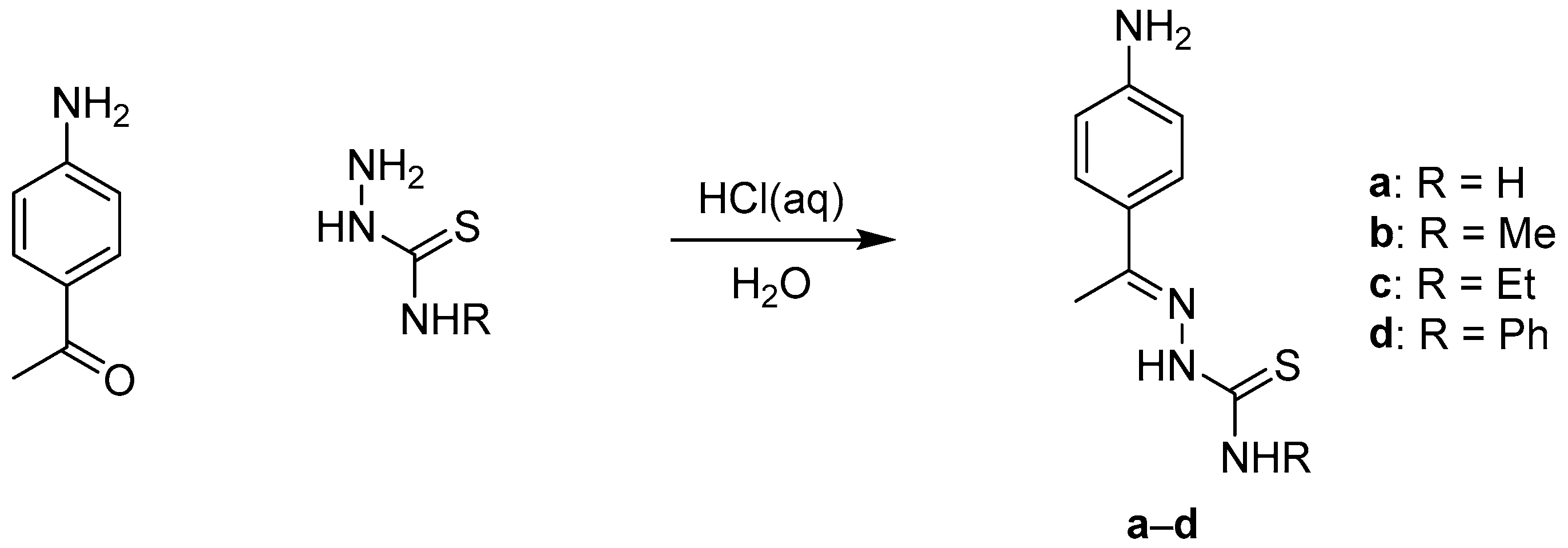
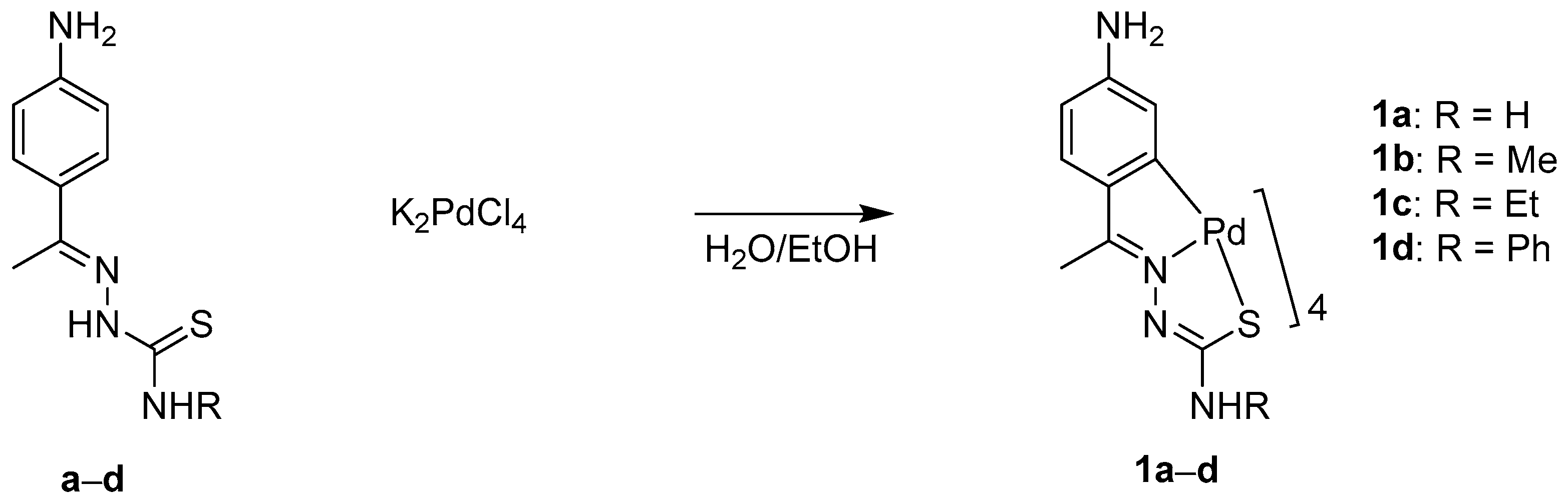
3. Discussion
3.1. NMR
3.2. IR Spectroscopy
4. Results
5. Conclusions
Author Contributions
Funding
Institutional Review Board Statement
Informed Consent Statement
Data Availability Statement
Acknowledgments
Conflicts of Interest
References
- Clarke, C.J.; Tu, W.C.; Levers, O.; Bröhl, A.; Hallett, J.P. Green and Sustainable Solvents in Chemical Processes. Chem. Rev. 2018, 118, 747–800. [Google Scholar] [CrossRef]
- Hayler, J.D.; Leahy, D.K.; Simmons, E.M. A Pharmaceutical Industry Perspective on Sustainable Metal Catalysis. Organometallics 2019, 38, 36–46. [Google Scholar] [CrossRef]
- Vila, J.M.; Pereira, M.T.; Lucio-Martínez, F.; Reigosa, F. Palladacycles as Efficient Precatalysts for Suzuki-Miyaura Cross-Coupling Reactions. In Palladacycles; Elsevier: Amsterdam, The Netherlands, 2019; pp. 1–20. [Google Scholar] [CrossRef]
- Reigosa-Chamorro, F.; Raposo, L.R.; Munín-Cruz, P.; Pereira, M.T.; Roma-Rodrigues, C.; Baptista, P.V.; Fernandes, A.R.; Vila, J.M. In Vitro and in Vivo Effect of Palladacycles: Targeting A2780 Ovarian Carcinoma Cells and Modulation of Angiogenesis. Inorg. Chem. 2021, 60, 3939–3951. [Google Scholar] [CrossRef] [PubMed]
- Khanye, S.D.; Gut, J.; Rosenthal, P.J.; Chibale, K.; Smith, G.S. Ferrocenylthiosemicarbazones conjugated to a poly(propyleneimine) dendrimer scaffold: Synthesis and in vitro antimalarial activity. J. Organomet. Chem. 2011, 696, 3296–3300. [Google Scholar] [CrossRef]
- Moreira, D.R.M.; Santos, D.S.; do Espírito Santo, R.F.; dos Santos, F.E.; de Oliveira Filho, G.B.; Leite, A.C.L.; Soares, M.B.P.; Villarreal, C.F. Structural improvement of new thiazolidinones compounds with antinociceptive activity in experimental chemotherapy-induced painful neuropathy. Chem. Biol. Drug Des. 2017, 90, 297–307. [Google Scholar] [CrossRef]
- Adams, M.; Barnard, L.; de Kock, C.; Smith, P.J.; Wiesner, L.; Chibale, K.; Smith, G.S. Cyclopalladated organosilane-tethered thiosemicarbazones: Novel strategies for improving antiplasmodial activity. Dalt. Trans. 2016, 45, 5514–5520. [Google Scholar] [CrossRef] [PubMed] [Green Version]
- Cipriani, M.; Toloza, J.; Bradford, L.; Putzu, E.; Vieites, M.; Curbelo, E.; Tomaz, A.I.; Garat, B.; Guerrero, J.; Gancheff, J.S.; et al. Effect of the metal ion on the anti T. cruzi activity and mechanism of action of 5-nitrofuryl-containing thiosemicarbazone metal complexes. Eur. J. Inorg. Chem. 2014, 2014, 4677–4689. [Google Scholar] [CrossRef]
- Kovala-Demertzi, D.; Galani, A.; Miller, J.R.; Frampton, C.S.; Demertzis, M.A. Synthesis, structure, spectroscopic studies and cytotoxic effect of novel palladium(II) complexes with 2-formylpyridine-4-Nethyl-thiosemicarbazone: Potential antitumour agents. Polyhedron 2013, 52, 1096–1102. [Google Scholar] [CrossRef]
- Matesanz, A.I.; Hernández, C.; Rodríguez, A.; Souza, P. 3,5-Diacetyl-1,2,4-triazol bis(4N-substituted thiosemicarbazone) palladium(II) complexes: Synthesis, structure, antiproliferative activity and low toxicity on normal kidney cells. J. Inorg. Biochem. 2011, 105, 1613–1622. [Google Scholar] [CrossRef] [PubMed] [Green Version]
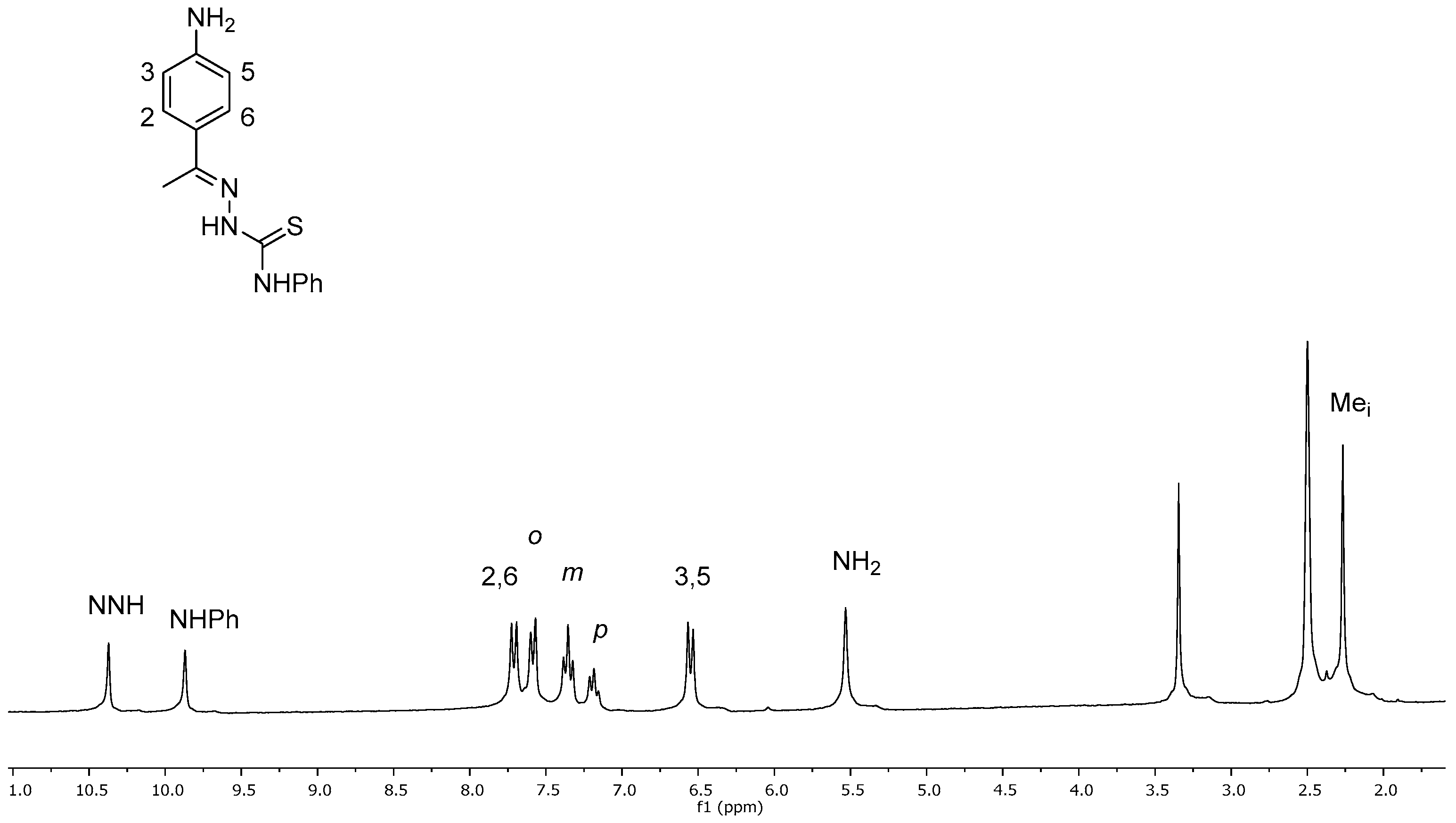

| a | b | c | d | |
|---|---|---|---|---|
| NNH | 10.06 (s, 1H) | 9.99 (s, 1H) | 9.89 (s, 1H) | 9.87 (s, 1H) |
| NHR | 8.16 (s, 1H) | 8.30 (s, 1H) | 8.32 (t, J = 6.0 Hz, 1H) | 10.37 (s, 1H) |
| NH2 | 5.52 (s, 2H) | 5.50(s, 2H) | 5.48 (s, 2H) | 5.53 (s, 2H) |
| H2/H6 | 7.72 (d, J = 8.3 Hz, 2H) | 7.68 (d, J = 8.4 Hz, 2H) | 7.63 (d, J = 8.3 Hz, 2H) | 7.71 (d, J = 8.3 Hz, 2H) |
| H3/H5 | 6.70 (d, J = 8.2 Hz, 2H) | 6.63 (d, J = 8.4 Hz, 2H) | 6.54 (d, J = 8.4 Hz, 2H) | 6.55 (d, J = 8.4 Hz, 2H) |
| R | 7.79 (s, 1H) | 3.01 (s, 3H) | 3.59 (p, J = 6.9 Hz, 2H) 1.13 (t, J = 7.0 Hz, 3H) | 7.58 (d, J = 7.8 Hz, 2H) 7.35 (t, J = 7.6 Hz, 2H) 7.18 (t, J = 7.3 Hz, 1H) |
| Me | 2.20 (s, 3H) | 2.18 (s, 3H) | 2.18 (s, 3H) | 2.27 (s, 3H). |
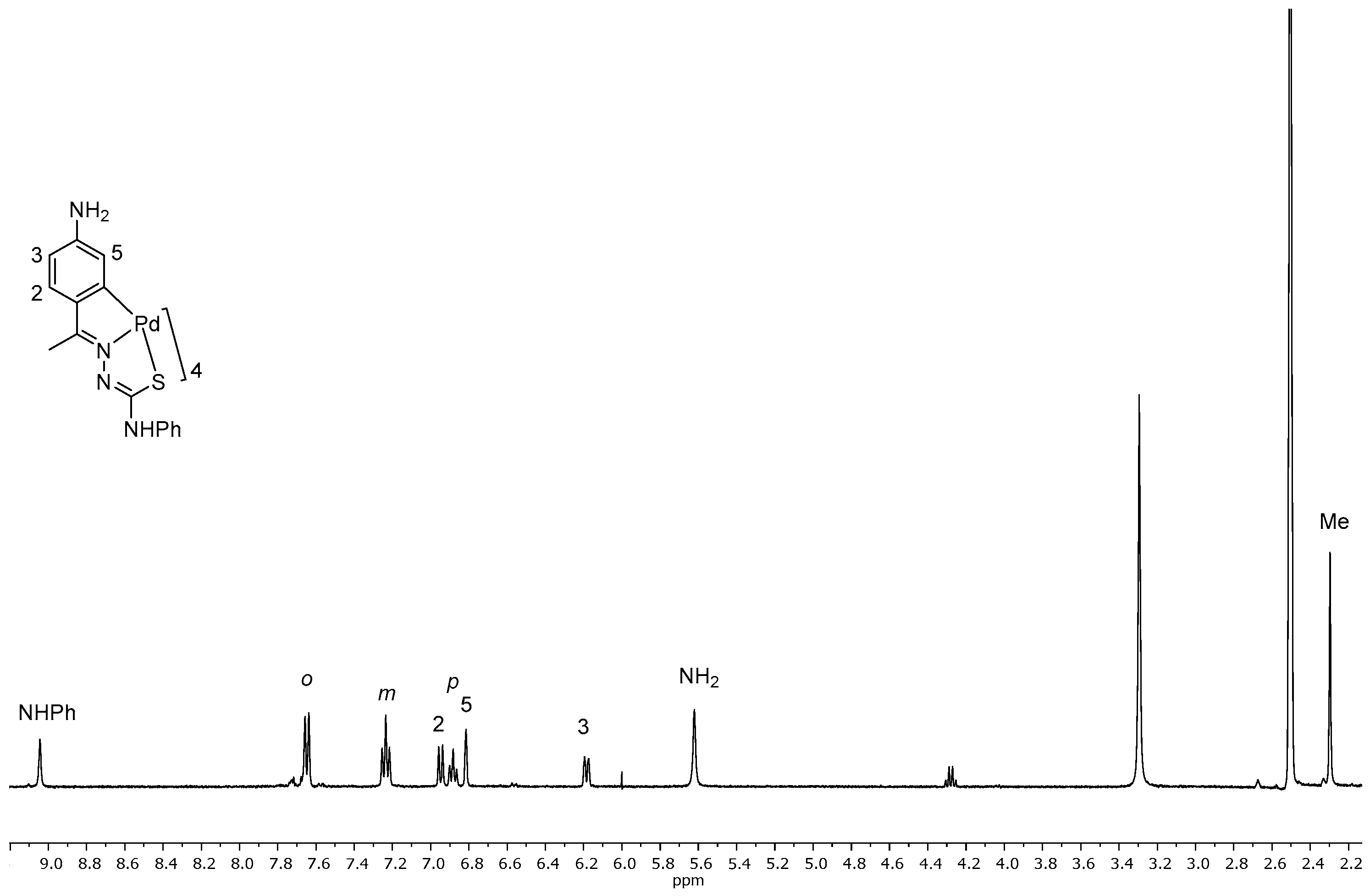
| 1a | 1b | 1c | 1d | |
|---|---|---|---|---|
| NHR | 6.37 (s, 2H) | 6.64 (s, 1H) | 6.66 (s, 1H) | 9.04 (s, 1H) |
| NH2 | 5.43 (s, 2H) | 5.44 (s, 2H) | 5.41 (s, 2H) | 5.62 (s, 2H) |
| H2 | 6.82 (d, J = 8.1 Hz, 1H) | 6.84 (d, J = 8.2 Hz, 1H) | 6.84 (d, J = 8.1 Hz, 1H) | 6.95 (d, J = 8.2 Hz, 1H) |
| H3 | 6.14 (d, J = 8.1 Hz, 1H) | 6.15 (d, J = 8.2 Hz, 1H) | 6.16 (dd, J = 8.2, 2.1 Hz 1H) | 6.18 (dd, J = 8.2, 2.1 Hz 1H) |
| H5 | 6.76 (s, 1H) | 6.78 (s, 1H) | 6.79 (d, J = 2.0 Hz, 1H) | 6.81 (d, J = 2.1 Hz, 1H) |
| R | - | 2.74 (s, 3H) | 3.19 (p, J = 6.9 Hz, 2H) 1.07 (t, J = 7.1 Hz, 3H) | 7.65 (d, J = 8.1 Hz, 2H) 7.23 (t, J = 7.7 Hz, 2H) 6.88 (t, J = 7.3 Hz, 1H) |
| Me | 2.12 (s, 3H) | 2.17 (s, 3H) | 2.17 (s, 3H) | 2.30 (s, 3H) |
| ν(C=N) | Δ(ν(C=N)) | ν(C=S) | |
|---|---|---|---|
| a | 1596 | - | 829 |
| b | 1594 | - | 830 |
| c | 1597 | - | 831 |
| d | 1591 | - | 830 |
| 1a | 1572 | 24 | - |
| 1b | 1571 | 23 | - |
| 1c | 1576 | 21 | - |
| 1d | 1567 | 24 | - |
| Compound | Yield% | IR/cm−1 | EA Found (Calcd) | RMN |
|---|---|---|---|---|
| a | 93 | 3304, 3210, 2971, 2950, 2932 ν(N-H) 1596 ν(C=N) 829 ν(C=S) | C, 52.0; H, 5.7; N, 26.8; S, 15.2 (C, 51.9; H, 5.8; N, 26.9; S, 15.4) | 1H NMR (250 MHz, DMSO-d6) δ 10.06 (s, 1H, NNH), 8.16 (s, 1H, NH2), 7.79 (s, 1H, NH2), 7.72 (d, J = 8.3 Hz, 2H, H2/H6), 6.70 (d, J = 8.2 Hz, 2H, H3/H5), 2.20 (s, 3H, Me) |
| b | 95 | 3302, 3207, 2945 ν(N-H) 1594 ν(C=N) 830 ν(C=S) | C, 53.8; H, 6.6; N, 25.1; S, 14.3 (C, 54.0; H, 6.4; N, 25.2; S, 14.4) | 1H NMR (250 MHz, DMSO-d6) δ 9.99 (s, 1H, NNH), 8.30 (s, 1H, NHMe), 7.68 (d, J = 8.4 Hz, 2H, H2/H6), 6.63 (d, J = 8.4 Hz, 2H, H3/H5), 3.01 (s, 3H, NHMe), 2.18 (s, 3H, Me) |
| c | 94 | 3300, 3205, 2969, 2944, 2928 ν(N-H) 1597 ν(C=N) 831 ν(C=S) | C, 55.6; H, 6.9; N, 23.5; S, 13.4 (C, 55.9; H, 6.8; N, 23.7; S, 13.6) | 1H NMR (250 MHz, DMSO-d6) δ 9.89 (s, 1H, NNH), 8.32 (t, J = 6.0 Hz, 1H, NHEt), 7.63 (d, J = 8.3 Hz, 2H, H2/H6), 6.54 (d, J = 8.4 Hz, 2H, H3/H5), 5.48 (s, 2H, NH2), 3.59 (p, J = 6.9 Hz, 2H, CH2), 2.18 (s, 3H, Me), 1.13 (t, J = 7.0 Hz, 3H, CH3). |
| d | 98 | 3355, 3279, 3182 ν(N-H) 1591 ν(C=N) 830 ν(C=S) | C, 63.1; H, 5.6; N, 19.6; S, 11.2 (C, 63.4; H, 5.7; N, 19.7; S, 11.3) | 1H NMR (250 MHz, DMSO-d6) δ 10.37 (s, 1H, NHPh), 9.87 (s, 1H, NNH), 7.71 (d, J = 8.3 Hz, 2H/H6, H2), 7.58 (d, J = 7.8 Hz, 2H, o-Ar), 7.35 (t, J = 7.6 Hz, 2H, m-Ar), 7.18 (t, J = 7.3 Hz, 1H, p-Ar), 6.55 (d, J = 8.4 Hz, 2H, H3/H5), 5.53 (s, 2H, NH2), 2.27 (s, 3H, Me). |
| 1a | 89 | 3324, 3162, 2912 ν(N-H) 1572 ν(C=N) | C, 34.8; H, 3.3; N, 18.0; S, 10.4 (C, 34.6; H, 3.2; N, 17.9; S, 10.3) | 1H NMR (400 MHz, DMSO-d6) δ 6.82 (d, J = 8.1 Hz, 1H, H2), 6.76 (s, 1H, H5), 6.37 (s, 2H, NH2), 6.14 (d, J = 8.1 Hz, 1H, H3), 5.43 (s, 2H, NH2), 2.12 (s, 3H, Me). |
| 1b | 91 | 3334, 3176, 2912 ν(N-H) 1571 ν(C=N) | C, 36.5; H, 3.5; N, 17.1; S, 9.6 (C, 36.8; H, 3.7; N, 17.2; S, 9.8) | 1H NMR (400 MHz, DMSO-d6) δ 6.84 (d, J = 8.2 Hz, 1H, H2), 6.78 (s, 1H, H5), 6.64 (s, 1H, NHR), 6.15 (d, J = 8.2 Hz, 1H, H3), 5.44 (s, 2H, NH2), 2.74 (s, 3H, CH3), 2.17 (s, 3H, Me) |
| 1c | 86 | 3307, 3150, 2914 ν(N-H) 1576 ν(C=N) | C, 38.7; H, 4.0; N, 16.2; S, 9.2 (C, 38.8; H, 4.1; N, 16.4; S, 9.4) | 1H NMR (400 MHz, DMSO-d6) δ 6.84 (d, J = 8.1 Hz, 1H, H2), 6.79 (d, J = 2.0 Hz, 1H, H5), 6.66 (s, 1H, NHEt), 6.16 (dd, J = 8.2, 2.1 Hz 1H, H3), 5.41 (s, 2H, NH2), 3.19 (p, J = 6.9 Hz, 2H, CH2), 2.17 (s, 3H, Me), 1.07 (t, J = 7.1 Hz, 3H, CH3). |
| 1d | 94 | 3360, 3200, 3022, 2914 ν(N-H) 1567 ν(C=N) | C, 46.5; H, 3.5; N, 14.3; S, 8.1 (C, 46.3; H, 3.6; N, 14.4; S, 8.3) | 1H NMR (400 MHz, DMSO-d6) δ 9.04 (s, 1H, NHPh), 7.65 (d, J = 8.1 Hz, 2H, o-Ar), 7.23 (t, J = 7.7 Hz, 2H, m-Ar), 6.95 (d, J = 8.2 Hz, 1H, H2), 6.88 (t, J = 7.3 Hz, 1H, p-Ar), 6.81 (d, J = 2.1 Hz, 1H, H5), 6.18 (dd, J = 8.2, 2.1 Hz 1H, H3), 5.62 (s, 2H, NH2), 2.30 (s, 3H, Me). |
Publisher’s Note: MDPI stays neutral with regard to jurisdictional claims in published maps and institutional affiliations. |
© 2021 by the authors. Licensee MDPI, Basel, Switzerland. This article is an open access article distributed under the terms and conditions of the Creative Commons Attribution (CC BY) license (https://creativecommons.org/licenses/by/4.0/).
Share and Cite
Reigosa, F.; Pereira, M.T.; Vila, J.M. Synthesis and Characterization of Amine-Functionalized Thiosemicarbazone Cyclopalladated Compounds. Chem. Proc. 2022, 8, 73. https://doi.org/10.3390/ecsoc-25-11762
Reigosa F, Pereira MT, Vila JM. Synthesis and Characterization of Amine-Functionalized Thiosemicarbazone Cyclopalladated Compounds. Chemistry Proceedings. 2022; 8(1):73. https://doi.org/10.3390/ecsoc-25-11762
Chicago/Turabian StyleReigosa, Francisco, María Teresa Pereira, and José Manuel Vila. 2022. "Synthesis and Characterization of Amine-Functionalized Thiosemicarbazone Cyclopalladated Compounds" Chemistry Proceedings 8, no. 1: 73. https://doi.org/10.3390/ecsoc-25-11762
APA StyleReigosa, F., Pereira, M. T., & Vila, J. M. (2022). Synthesis and Characterization of Amine-Functionalized Thiosemicarbazone Cyclopalladated Compounds. Chemistry Proceedings, 8(1), 73. https://doi.org/10.3390/ecsoc-25-11762

