Proceeding Paper

Position-Dependent Epoxidation as a Strategy to Tune Optical Transitions in Nanographenes: Coronene Model Insights †

1
Department of Electrical Engineering and Electronics, Don State Technical University, Rostov-on-Don 344000, Russia
2
Department of Physics, Don State Technical University, Rostov-on-Don 344000, Russia
*
Author to whom correspondence should be addressed.
Presented at the 1st International Online Conference on Photochemistry, 8–9 April 2026; Available online: https://sciforum.net/event/IOCPC2026.
Chem. Proc. 2026, 20(1), 3; https://doi.org/10.3390/chemproc2026020003
Published: 4 September 2026

Abstract

This study investigated the influence of position-dependent edge epoxidation on the electronic and optical properties of nanographenes, using coronene as a model system. Quantum-chemical calculations were employed to examine how local functionalization alters the carbon framework and the nature of π-conjugation, thereby influencing the distribution of frontier molecular orbitals. It was established that the position of the epoxy group determines the nature of the changes within the π-system and the resulting optical response of the functionalized coronene. These structural and electronic modifications are accompanied by variations in the spectral characteristics and the transition probabilities of low-energy electronic transitions. The obtained results demonstrate the interplay between the functional group position, electronic structure, and optical properties of nanographenes, providing a foundation for the rational tuning of their optical response.

1. Introduction

The ability to precisely tune the electronic and optical properties makes nanographenes (NGs) highly promising for applications in optoelectronic and photosensitive materials [1,2]. However, despite their high thermodynamic stability, symmetric NGs exhibit limited optical and electronic properties. The high structural symmetry leads to the degeneracy of their frontier molecular orbitals (FMOs) [3], thereby rendering the low-lying electronic transitions symmetry-forbidden [4].
Controlled functionalization represents an effective approach for lowering the point group symmetry of NGs and tuning their optical properties [5,6]. Specifically, edge epoxidation changes the hybridization state of carbon atoms from sp2 to sp3, disrupts the original π-conjugation of the nanographenes, and can significantly alter the electronic structure and spectral characteristics of the system [7,8].
At the same time, our recent study [9] demonstrated that symmetry breaking induced by epoxidation can either render the S0 → S1 transition allowed or leave it forbidden. However, the mechanism by which the position of the epoxy group influences the distribution of frontier molecular orbitals (FMOs) and the nature of quantum transitions remains poorly understood. Understanding this mechanism is a critical prerequisite for the controlled tuning of the electronic and optical properties of nanographenes via epoxidation.
The aim of the present study is to determine how the epoxidation of various edge configurations of nanographenes (zigzag and K-region) influences their electronic and optical properties. To achieve this goal, we compared two non-equivalent edge sites of coronene, the epoxidation of one of which lifts the symmetry restriction on the S0 → S1 transition, rendering it allowed. This comparison allows us to trace how the position of the epoxy group correlates with the redistribution of FMOs and the resulting changes in the optical response. Clar’s rule [10,11,12], which has proven highly effective in analyzing the electronic properties of nanographenes [9], was employed to analyze and interpret the obtained results.

2. Models and Methods

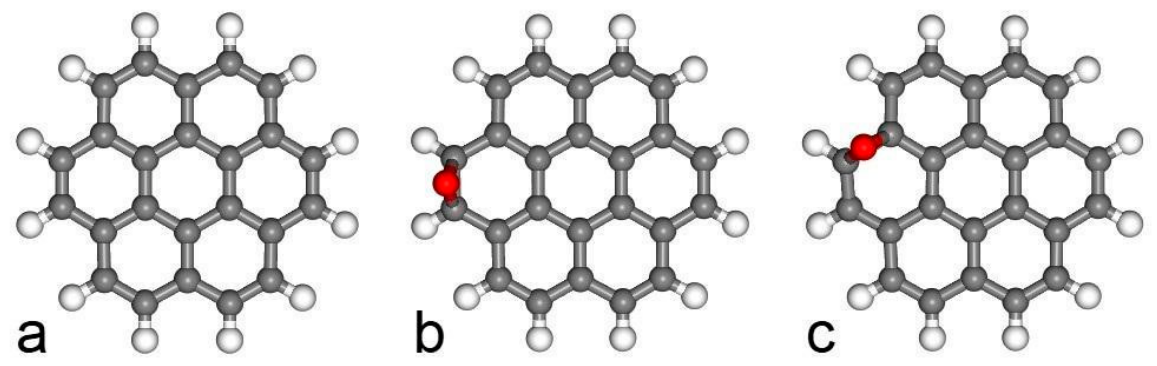
In the present study, coronene, a polycyclic aromatic hydrocarbon (PAH) with the chemical formula C24H12 and D6h point group symmetry, was selected as the model structure. Owing to its well-characterized nature [13,14] and high symmetry, coronene serves as a convenient model system for investigating the impact of edge epoxidation on the electronic and optical properties of NGs. Furthermore, the high symmetry of coronene restricts the number of non-equivalent edge functionalization sites to two, thereby simplifying the comparative analysis. Unmodified coronene, along with its epoxidized forms, is shown in Figure 1.
Geometry optimizations of pristine coronene and its epoxidized isomers for the closed-shell singlet ground state (spin multiplicity = 1) and a total charge of zero, along with calculations of their FMOs, were performed using density functional theory (DFT) [15]. The hybrid B3LYP functional [16] and the def2-SVP basis set [17] were employed in the calculations. The choice of this functional is justified by its ability to accurately describe the electronic structure of π-conjugated systems while providing an optimal balance between accuracy and computational efficiency.
Dispersion interactions were accounted for using the DFT-D3(BJ) empirical correction [18]. Vibrational frequency calculations were performed to verify the absence of imaginary frequencies for both pristine and epoxidized coronene following geometry optimization. Transition states (TS) for the transformation of the epoxy group into an ether bridge were also calculated to assess the kinetic stability of the epoxidized coronene isomers. All calculations were performed using the ORCA 6.1 program system. An SCF convergence threshold of 1 × 10⁻⁸ Ha was used for all calculations. Geometry optimizations were performed with the following convergence criteria: energy change 5 × 10⁻⁶, maximum gradient 3 × 10⁻⁴.
The excited-state geometries of pristine and epoxidized coronene were obtained using single-reference time-dependent DFT (TD-DFT) at the B3LYP-D3(BJ)/def2-SVP level of theory. Absorption and emission wavelengths and oscillator strengths were computed using the density functional theory/multireference configuration interaction (DFT/MRCI) method [19]. This approach ensures high accuracy in calculating excited-state energies and transition dipole moments. In the DFT/MRCI calculations, we used a restricted active space (RAS)-like reference space of single and double excitations from the highest-lying occupied to the lowest-lying empty orbitals. In the active space 12 highest-lying π-electrons were distributed among 12 orbitals (6 occupied and 6 virtual). The configuration selection threshold of 10.9 eV was used in all calculations. For each structure 10 roots were calculated. Absorption wavelengths were calculated at the ground state S0 geometry (vertical excitations), while fluorescence wavelengths were obtained using S1 geometries.

3. Results and Discussion

The high symmetry of coronene imposes strict selection rules, rendering the S0 → S1 and S0 → S2 transitions forbidden, as evidenced by their zero oscillator strength. Consequently, the first allowed transition is S0 → S3, whose absorption band is located in the UV region (~305 nm) [20]. Symmetry constraints are also responsible for the zero oscillator strength of the reverse S1 → S0 transition, rendering it forbidden. These findings are consistent with experimental data demonstrating the low optical activity of pristine coronene in the visible spectral region [20,21,22].
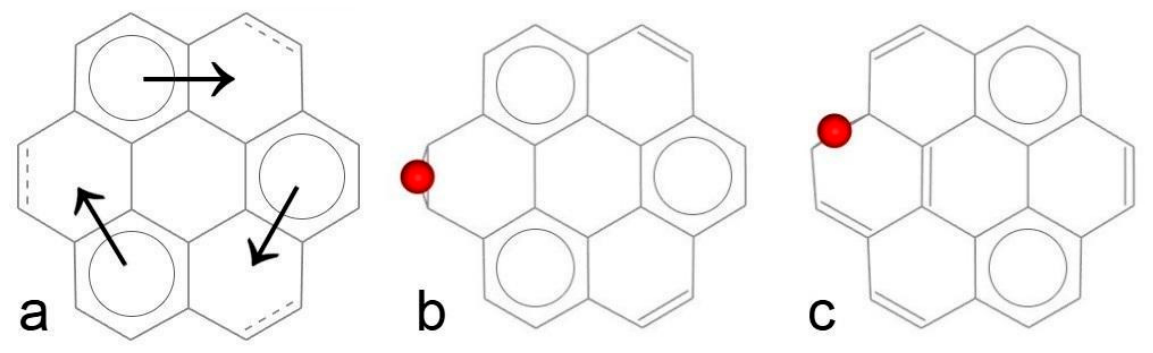
Edge epoxidation of coronene enables symmetry breaking and lifts the forbiddenness of low-energy optical transitions. However, the change in hybridization state of the epoxidized carbon atoms can induce π-electron localization and disrupt π-conjugation within specific benzene rings. The extent to which the epoxy group influences the delocalized π-system largely depends on the position of functional group attachment. As demonstrated in our recent study [9], Clar’s rule is an effective tool for assessing the impact of epoxidation on the structural and electronic properties of NGs. Unmodified coronene and its epoxidized forms, with visualization of aromatic sextets, are presented in Figure 2. The positions of aromatic sextets are indicated by circles, and their possible migration pathways are shown by arrows.
As evident from Figure 2, epoxidation at the β-position induces a profound alteration of the electronic properties of coronene, characterized by extensive π-electron localization and the disruption of the aromatic sextet. Consequently, the epoxy group introduces severe local structural strain, rendering it a kinetically unstable intermediate in the functionalization process [23], as evidenced by the low activation barrier for its transformation into an ether bridge (≈0.1 kcal/mol).
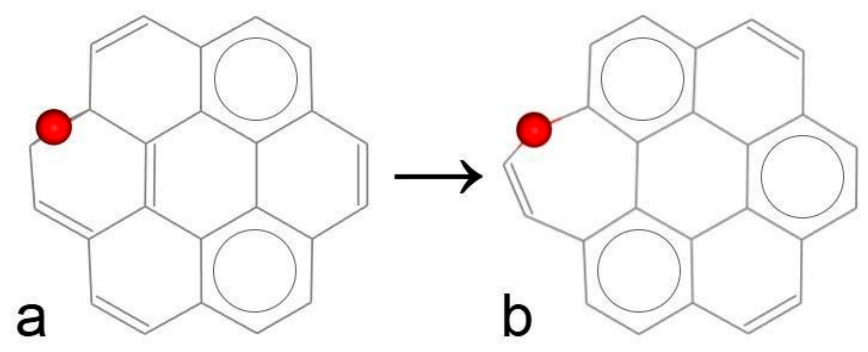
The metastable nature of the epoxy group at the β-position renders its consideration of limited value. Instead, a more rational approach for the β-position is to investigate the impact of the ether bridge on the electronic and optical properties of coronene. Coronene modified at the β-position, both before and after the transformation of the epoxy group into an ether bridge, along with the visualization of aromatic sextets, is depicted in Figure 3. The positions of aromatic sextets are indicated by circles, and their possible migration pathways are shown by arrows. The vertical absorption and emission wavelengths, the configurational composition of the excited states, and the oscillator strengths for pristine coronene and its modified forms are summarized in Table 1.
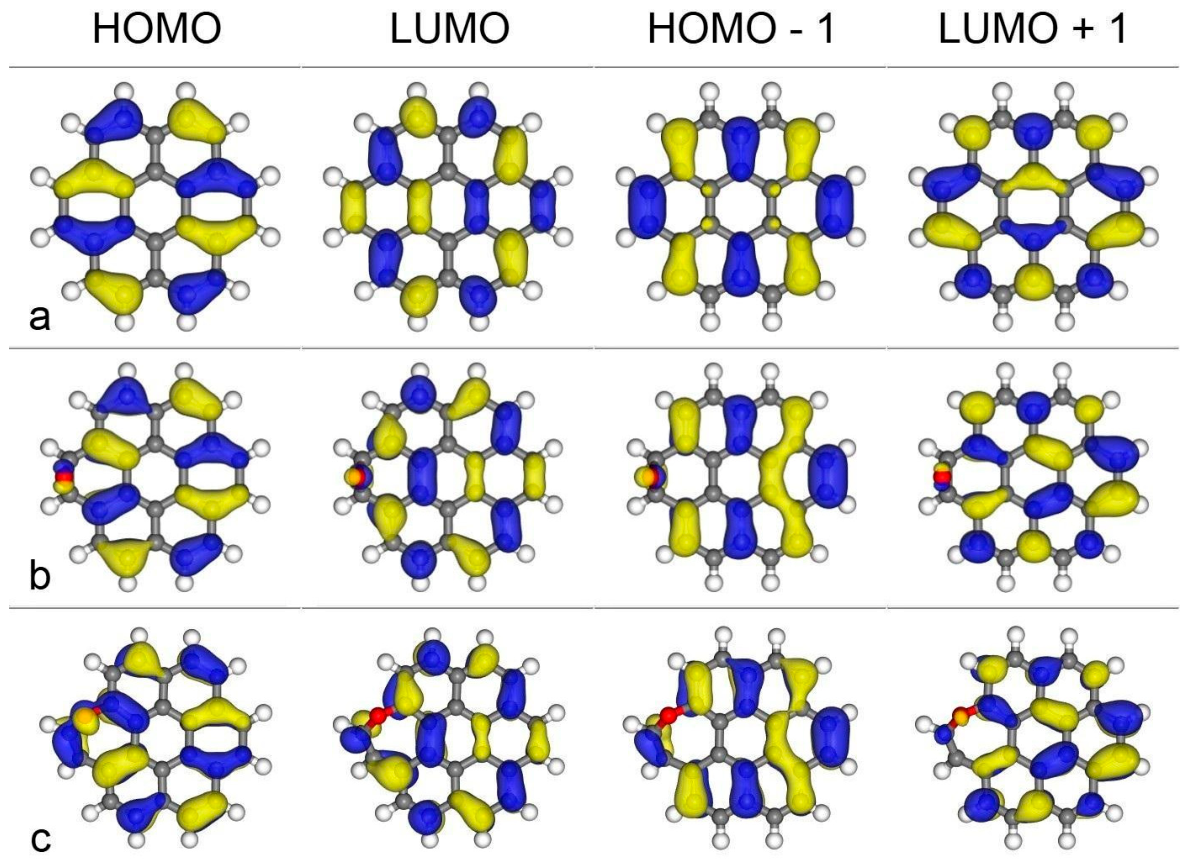
The epoxy group at the α-position and the ether bridge at the β-position disrupt the planarity of coronene and lower its point group symmetry. As a result, the energies of the frontier and adjacent molecular orbitals (HOMO, LUMO, HOMO−1, LUMO+1) are altered, their degeneracy is lifted, and their spatial distributions are modified. Consequently, this induces a shift in the absorption and emission bands and lifts the symmetry restriction on the dipole transition corresponding to the p-band, to which the HOMO → LUMO configuration provides the main contribution. The molecular orbital energy levels of pristine coronene and its modified derivatives are summarized in Table 2. The spatial distributions of the molecular orbitals for pristine coronene and its α- and β-functionalized derivatives are depicted in Figure 4.
As evident from Table 2, functionalization at the α-position leads to a narrowing of the energy gap due to the symmetry lowering of coronene to CS. Meanwhile, the epoxy group does not induce π-electron localization, and its effect is predominantly local: the epoxidized carbon atoms, owing to the change in their hybridization state (sp2 → sp3), cease to participate in the global resonance system.
Meanwhile, the ether bridge at the β-position induces a moderate redistribution of the coronene molecular orbitals, along with a significant localization of the HOMO and HOMO−1 near the functionalization site. As evident from Figure 3, the transformation of the epoxy group into an ether bridge at the β-position alters the local structure of coronene. Specifically, C–C bond cleavage and the restoration of sp2 hybridization at the carbon atoms lead to a reorganization of the local π-conjugation near the functionalization site. Furthermore, Figure 4 shows that the amplitudes of the HOMO and HOMO−1 are localized precisely within the newly formed π-conjugated fragment. Consequently, this results not only in the narrowing of the structure’s energy gap but also in the reordering of its α- and p-bands: the p-band now corresponds to the S1 state and acquires a non-zero oscillator strength, rendering the S0 → S1 transition dipole-allowed.
This observation is particularly important because the non-zero oscillator strength of the S0 → S1 transition also renders the reverse S1 → S0 transition dipole-allowed (f = 0.04). It is important to note, however, that while a non-zero oscillator strength is a necessary condition for the structure to exhibit photoluminescence, it does not guarantee its occurrence. In particular, for efficient luminescence, one must also account for singlet–triplet interactions and the associated non-radiative relaxation channels, which, however, fall beyond the scope of the present study.

4. Conclusions

This study has demonstrated that the epoxidation of coronene affects its optical properties by modifying its delocalized π-system. Specifically, a redistribution of the molecular orbitals occurs, leading to a more pronounced spatial overlap of the FMO wavefunctions for the dipole transition. As a result, the p-band of coronene becomes associated with the S1 state and acquires a non-zero oscillator strength, rendering the S0 → S1 transition dipole-allowed.
Furthermore, it was demonstrated that the redistribution of coronene’s molecular orbitals depends on the degree of structural perturbation: a greater disruption of the delocalized π-system results in a more pronounced overlap of the HOMO and LUMO wavefunctions, whereas a minor perturbation is accompanied by a less pronounced overlap.
The results obtained reveal underlying trends, the further investigation of which paves the way for the controlled tuning of the position and intensity of low-energy absorption and emission bands in symmetric NGs via epoxidation. Importantly, the conclusions drawn herein require further verification and validation on an extended set of model nanographenes of various sizes and point group symmetries.

Author Contributions

Conceptualization, D.R. and I.E.; methodology, D.R. and I.E.; software, D.R. and I.E.; validation, D.R. and I.E.; formal analysis, D.R.; investigation, D.R. and I.E.; resources, I.E.; data curation, D.R.; writing—original draft preparation, D.R.; writing—review and editing, D.R. and I.E.; visualization, D.R. and I.E.; supervision, D.R.; project administration, D.R.; funding acquisition, A.L. All authors have read and agreed to the published version of the manuscript.

Funding

This work was supported by the Russian Science Foundation (project 25-23-00378), https://rscf.ru/project/25-23-00378/ (accessed on 1 July 2026).

Data Availability Statement

The original contributions presented in this study are included in the article. Further inquiries can be directed to the corresponding author.

Acknowledgments

During the preparation of this manuscript, the authors used LLM Qwen3.7-Plus for the purposes of text translation. The authors have reviewed and edited the output and take full responsibility for the content of this publication.

Conflicts of Interest

The authors declare no conflicts of interest.

Abbreviations

The following abbreviations are used in this manuscript:
GQDGraphene Quantum Dot
PAHPolycyclic Aromatic Hydrocarbon
HOMOHighest Occupied Molecular Orbital
LUMOLowest Unoccupied Molecular Orbital
FMOFrontier Molecular Orbital
DFTDensity Functional Theory
B3LYPBecke and Lee–Yang–Parr hybrid density functional
TD-DFTTime-dependent DFT
DFT/MRCIDFT-based Multireference Configuration Interaction

References

  1. Li, X.; Rui, M.; Song, J.; Shen, Z.; Zeng, H. Carbon and Graphene Quantum Dots for Optoelectronic and Energy Devices: A Review. Adv. Funct. Mater. 2015, 25, 4929–4947. [Google Scholar] [CrossRef] [Scilit]
  2. Tian, P.; Tang, L.; Teng, K.S.; Lau, S.P. Graphene Quantum Dots from Chemistry to Applications. Mater. Today Chem. 2018, 10, 221–258. [Google Scholar] [CrossRef] [Scilit]
  3. Pohle, R.; Kavousanaki, E.G.; Dani, K.M.; Shannon, N. Symmetry and Optical Selection Rules in Graphene Quantum Dots. Phys. Rev. B 2018, 97, 115404. [Google Scholar] [CrossRef] [Scilit]
  4. Budyka, M.F. Semiempirical Study on the Absorption Spectra of the Coronene-like Molecular Models of Graphene Quantum Dots. Spectrochim. Acta Part A Mol. Biomol. Spectrosc. 2019, 207, 1–5. [Google Scholar] [CrossRef] [Scilit] [PubMed]
  5. Feng, J.; Dong, H.; Yu, L.; Dong, L. The Optical and Electronic Properties of Graphene Quantum Dots with Oxygen-Containing Groups: A Density Functional Theory Study. J. Mater. Chem. C 2017, 5, 5984–5993. [Google Scholar] [CrossRef] [Scilit]
  6. Mombrú, D.; Romero, M.; Faccio, R.; Mombrú, Á.W. Electronic and Optical Properties of Sulfur and Nitrogen Doped Graphene Quantum Dots: A Theoretical Study. Phys. E Low-Dimens. Syst. Nanostructures 2019, 113, 130–136. [Google Scholar] [CrossRef] [Scilit]
  7. Rano, N.A.; Martsinovich, N. Stability of Sp3 Carbons in Hydrogenated Graphene Quantum Dots and Their Electronic and Optical Properties Studied Using Density Functional Theory. J. Phys. Chem. A 2025, 129, 3790–3806. [Google Scholar] [CrossRef] [Scilit] [PubMed]
  8. Ershov, I.V.; Lavrentyev, A.A.; Romanov, D.L.; Holodova, O.M. Tuning Optical Excitations of Graphene Quantum Dots through Selective Oxidation: Effect of Epoxy Groups. C 2025, 11, 51. [Google Scholar] [CrossRef] [Scilit]
  9. Romanov, D.; Lavrentyev, A.; Ershov, I. Application of Clar’s Rule for Assessing the Effect of an Epoxy Group on the Stability and Energy Gap of Graphene Quantum Dots: A Coronene-Based DFT Study. Chemistry 2025, 7, 183. [Google Scholar] [CrossRef] [Scilit]
  10. Clar, E. The Aromatic Sextet; Springer: Berlin/Heidelberg, Germany, 1972; pp. 49–58. [Google Scholar] [CrossRef] [Scilit]
  11. Balaban, A.T.; Klein, D.J. Claromatic Carbon Nanostructures. J. Phys. Chem. C 2009, 113, 19123–19133. [Google Scholar] [CrossRef] [Scilit]
  12. Solà, M. Forty Years of Clar’s Aromatic π-Sextet Rule. Front. Chem. 2013, 1, 22. [Google Scholar] [CrossRef] [Scilit] [PubMed]
  13. Schulman, J.M.; Disch, R.L. Thermal and Magnetic Properties of Coronene and Related Molecules. J. Phys. Chem. A 1997, 101, 9176–9179. [Google Scholar] [CrossRef] [Scilit]
  14. Ejuh, G.W.; Nya, F.T.; Djongyang, N.; Ndjaka, J.M.B. Theoretical Study on the Electronic, Optoelectronic, Linear and Non Linear Optical Properties and UV–Vis Spectrum of Coronene and Coronene Substituted with Chlorine. SN Appl. Sci. 2020, 2, 1247. [Google Scholar] [CrossRef] [Scilit]
  15. Makkar, P.; Ghosh, N.N. A review on the use of DFT for the prediction of the properties of nanomaterials. RSC Adv. 2021, 11, 27897–27924. [Google Scholar] [CrossRef] [Scilit] [PubMed]
  16. Becke, A.D. Density-functional thermochemistry. III. The role of exact exchange. J. Chem. Phys. 1993, 98, 5648–5652. [Google Scholar] [CrossRef] [Scilit]
  17. Weigend, F.; Ahlrichs, R. Balanced Basis Sets of Split Valence, Triple Zeta Valence and Quadruple Zeta Valence Quality for H to Rn: Design and Assessment of Accuracy. Phys. Chem. Chem. Phys. 2005, 7, 3297–3305. [Google Scholar] [CrossRef] [Scilit] [PubMed]
  18. Grimme, S.; Ehrlich, S.; Goerigk, L. Effect of the Damping Function in Dispersion Corrected Density Functional Theory. J. Comput. Chem. 2011, 32, 1456–1465. [Google Scholar] [CrossRef] [Scilit] [PubMed]
  19. Marian, C.M.; Heil, A.; Kleinschmidt, M. The DFT/MRCI Method. WIREs Comput. Mol. Sci. 2018, 9, e394. [Google Scholar] [CrossRef] [Scilit]
  20. Rieger, R.; Müllen, K. Forever young: Polycyclic aromatic hydrocarbons as model cases for structural and optical studies. J. Phys. Org. Chem. 2010, 23, 315–325. [Google Scholar] [CrossRef] [Scilit]
  21. Sidman, J.W. Vibrational Analysis of the Emission Spectrum of Coronene as a Forbidden Transition. J. Chem. Phys. 1955, 23, 1365–1366. [Google Scholar] [CrossRef] [Scilit]
  22. Kunishige, S.; Kanaoka, A.; Katori, T.; Kawabata, M.; Baba, M.; Yamanaka, T.; Higashibayashi, S.; Sakurai, H. Electronic and Vibrational Structures in the S and S1 States of Coronene. J. Chem. Phys. 2017, 146, 044309. [Google Scholar] [CrossRef] [Scilit] [PubMed]
  23. Romanov, D.; Lavrentyev, A.; Ershov, I. From Intermediate Epoxy Group to Stable Ether Bridge: Insights from DFT Study on Graphene Quantum Dots. Molecules 2026, 31, 2269. [Google Scholar] [CrossRef] [Scilit] [PubMed]
Figure 1. Unmodified coronene and its epoxidized forms: (a) pristine coronene, (b) α-position (epoxy-α), (c) β-position (epoxy-β).
Chemproc 20 00003 g001
Figure 2. Unmodified coronene and its epoxidized forms with visualization of aromatic sextets: (a) pristine coronene, (b) α-position (epoxy-α), (c) β-position (epoxy-β). The positions of aromatic sextets are indicated by circles, and their possible migration pathways are shown by arrows.
Chemproc 20 00003 g002
Figure 3. Coronene modified at the β-position before and after the transformation of the epoxy group into an ether bridge, with visualization of aromatic sextets: (a) epoxy group (epoxy-β), (b) ether bridge (ether-β). The positions of aromatic sextets are indicated by circles.
Chemproc 20 00003 g003
Figure 4. Spatial distribution of molecular orbitals for pristine and functionalized coronene: (a) pristine coronene, (b) epoxy-α position, (c) ether-β position.
Chemproc 20 00003 g004
Table 1. The vertical absorption and emission wavelengths, the configurational composition of the excited states, and the oscillator strengths for pristine coronene and its modified forms.
StructureSinglet
Excited State
Vertical Excitation (nm)Oscillator Strength, fabsTransition Configurations with Dominant Orbital ContributionsVertical Emission (nm)Oscillator Strength, fem
Pristine coroneneS1404 (375 *)0.00H → L (22%); H-1 → L + 1 (21%); H-1 → L (21%); H → L + 1 (21%)431 (420 *)0.00
S2344 (340 *)0.00H-1 → L (23%); H → L + 1 (23%); H → L (22%); H-1 → L + 1 (22%);
Epoxy-αS13900.00H-1 → L (44%);
H → L + 1 (39%)
4140.00
S23730.35H → L (85%)
Ether-βS14090.21H → L (80%)6880.04
S23970.02H-1 → L (39%);
H → L + 1 (39%)
* Experimental values taken from Ref. [20].
Table 2. Molecular orbital energy levels (in eV) of pristine coronene and its modified derivatives.
StructureHOMO LUMO H/L Gap HOMO−1 LUMO+1 H-1/L Gap H/L + 1 Gap
Pristine
coronene
−5.55−1.554.00−5.55−1.554.004.00
Epoxy α−5.44−1.963.48−6.01−1.284.054.16
Ether β−5.22−1.903.32−5.90−1.204.004.02
Disclaimer/Publisher’s Note: The statements, opinions and data contained in all publications are solely those of the individual author(s) and contributor(s) and not of MDPI and/or the editor(s). MDPI and/or the editor(s) disclaim responsibility for any injury to people or property resulting from any ideas, methods, instructions or products referred to in the content.