
Proceeding Paper

In Silico Studies of Biological Activity and Toxicity of Naturally Occurring Buchenavianines †
by
Renata Gašparová
Department of Chemistry, Institute of Chemistry and Environmental Science, Faculty of Natural Sciences, University of St. Cyril and Methodius in Trnava, Nám. J. Herdu 2, SK-917 01 Trnava, Slovakia
Presented at the 29th International Electronic Conference on Synthetic Organic Chemistry, 14–28 November 2025; Available online: https://sciforum.net/event/ecsoc-29.
Chem. Proc. 2025, 18(1), 99; https://doi.org/10.3390/ecsoc-29-26730
Published: 11 November 2025

Abstract

Buchenavianine, or 7-hydroxy-5-methoxy-8-(1-methylpiperidin-2-yl)flavone, along with its related compounds O-Demethylbuchenavianine, N-demethylbuchenavianine, and N,O-bis(dimethyl)buchenavianine, belong to the class of piperidine-flavonoid alkaloids, possessing a piperidine ring connected to the C8-position of the flavonoid skeleton. Buchenavianine derivatives have been primarily isolated from Buchenavia macrophylla and also found in B. capitata. Studies have suggested that buchenavianines may possess anti-inflammatory, antioxidant, anti-HIV, and anticancer properties. Understanding the biological activity of buchenavianine derivatives is crucial for assessing their potential as drug candidates, considering factors such as pharmacokinetics and toxicity. The present study focuses on the in silico prediction of antibacterial, antiviral, and antifungal activities using the AntiBac-pred, antiVir-pred, and AntiFun-pred tools available on the Way2drug platform. Results are presented as confidence values indicating the likelihood of inhibitory or non-inhibitory effects against specific pathogens (bacteria, viruses, or fungi). The calculations suggest that the natural buchenavianines under investigation are likely to exhibit antibacterial activity with confidence values ranging from 0.4980 to 0.3390, even against resistant bacterial strains. Antifungal activity was predicted with confidence values of 0.1250–0.0274, while calculations of antiviral activity resulted in high confidence values of 0.8739 to 0.7500, highlighting their potential as antiviral agents. Toxicity assessments of buchenavianine derivatives were conducted using ProTox 3.0 software. The results indicate that all compounds would be non-toxic with a low probability of neurotoxicity and a high probability of respiratory toxicity.

1. Introduction

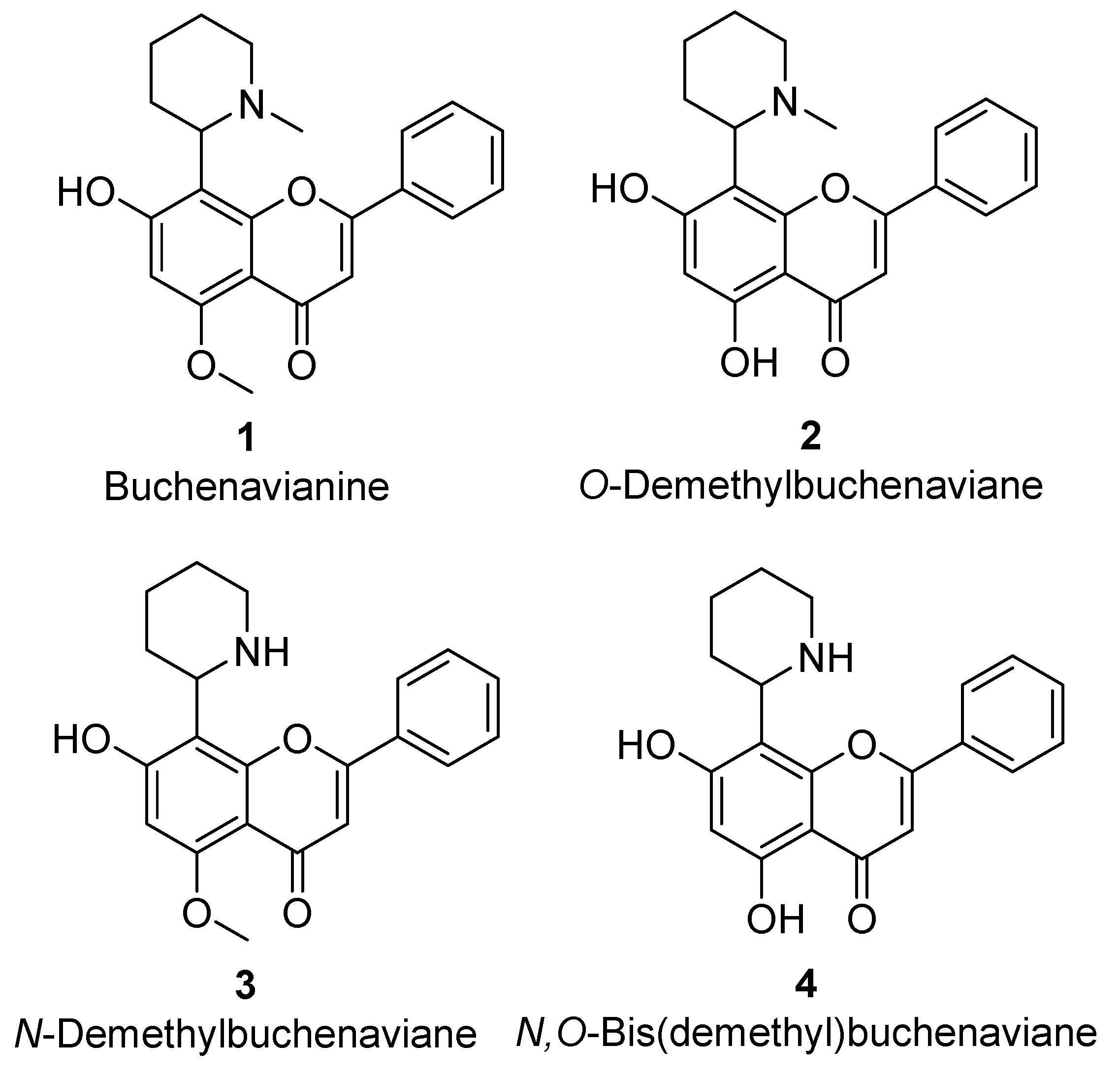
The genus Buchenavia, distributed in Central America, is a rich source of pharmacologically significant flavonoid alkaloids that are currently being investigated for their potential medicinal properties, such as anti-inflammatory, antioxidant, antifungal, and antimicrobial effects [1,2,3,4]. Buchenavianine 1 (Figure 1) is the main alkaloid found in B. macrophylla leaves and is also present in B. capitata [3]. O-Demethylbuchenavianine 2 is found in both species, while N-demethylbuchenavianine 3 and N,O-bis(dimethyl)buchenavianine 4 have been isolated from the leaves and fruits of B. macrophylla [5]. Biological activity evaluation of the chloroform extract of the leaves of B. capitata was conducted by Beutler et al. [6], who discovered potential anti-HIV activity of constituents of B. capitata. O-Demethylbuchenavianine 7 was identified as the most active component. N-Demethylbuchenavianine and buchenavianine were later found to be moderately active in inhibiting cyclin-dependent kinases [7].
Although natural products are a rich source of pharmacologically important substances, the process of drug discovery is challenging due to the isolation, structure elucidation, and biological activity screening required. To address these challenges, various in silico tools have been developed. This work represents a continuation of our research on in silico calculations of the biological activity and toxicity of buchenavianines. AntiBac-pred [8], antiVir-pred [9], and AntiFun-pred [10] are tools on the Way2drug platform [11], which enable consideration of the antibacterial, antiviral, or antifungal properties of a particular structure. Toxicity calculations of buchenavianine derivatives were performed using ProTox 3.0 software [12] and discussed in comparison with previously obtained calculations [13] using Osiris software [14].

2. Materials and Methods

AntiBac-Pred [8] enables the prediction of growth inhibitors or non-inhibitors across 353 different bacterial strains. AntiVir-pred [9] was used to calculate antiviral activity against viruses and predict protein targets. AntiFun-pred [10] was developed to calculate antifungal activity against specific fungi. The score for each compound is expressed as a confidence value, indicating the likelihood of an inhibitory/non-inhibitory effect against specific bacteria. The higher the confidence value, the more accurate the prediction, and compounds with positive confidence values are considered to be active.
ProTox 3.0 [11] was used to calculate the toxicity risk (hepatotoxicity; neurotoxicity; nephrotoxicity; respiratory toxicity; cardiotoxicity; carcinogenity; immunotoxicity; cytotoxicity) of buchenavianines 14. The prediction is expressed in red or green colors, indicating activity or inactivity of the compound towards the particular toxicity target. The more intense the color, the more probable the binding of the toxicity target is. Probability is also expressed as a numerical value (0.0–1.0). ProTox 3.0 also includes information on the toxicity class and predicted median lethal dose (LD50) in mg/kg of body weight.

3. Results and Discussion

3.1. AntiBac-Pred, AntiVir-Pred, and Anti-Fun-Pred Calculations

Results of antibacterial activity predictions from the Way2drug platform are given in Table 1. Calculations using AntiBac-pred showed the best confidence in antibacterial activity for N-demethylbuchenavianine 3 and N,O-bis(demethyl)buchenavianine 4 against a resistant strain of Mycobacterium ulcerans. Compound 4 is predicted to be effective against 17 strains with a confidence level of up to 0.3.
In terms of potential antiviral activity, all derivatives 14 demonstrated high levels of confidence (0.8739–0.7500) against the SARS-CoV-2 virus, while confidences for anti-HIV activity were lower (0.4575–0.2855). The most potent antiviral activity was predicted for compounds 2 and 4, which aligns quite well with experimental results [6].
Finally, all studied buchenavianines 14 were predicted to possess antifungal activity with low confidence values ranging from 0.1250 to 0.0274. No single fungal target for compound 3 was found.

3.2. ProTox 3.0 Calculations of Toxicity

Calculations of toxicity prediction using ProTox 3.0 (Table 2) indicated that compounds 14 have a low probability of exhibiting nephrotoxicity, cardiotoxicity, carcinogenicity, mutagenicity, or cytotoxicity. However, there is a high probability of respiratory toxicity and neurotoxicity for all studied compounds. Nephrotoxic effects were predicted for two buchenavianine-related alkaloids 3 and 4 and a risk of immunotoxicity for buchenavianine 1. ProTox 3.0 calculated the LD50 of 161 mg/kg and assigned a toxicity class 3 to all compounds.
Structures 1 and 3 possess a 5-methoxy group, while buchenavianines 2 and 4 are 5-hydroxy derivatives. In our previous research [13], it appeared that the presence of a 5-methoxy group had an effect on the low risk of mutagenicity. However, calculations using the ProTox 3.0 tool did not confirm the importance of the 5-methoxy group for low mutagenicity.

4. Conclusions

The results of in silico calculations on buchenavianine-derived flavonoid alkaloids show that the studied compounds exhibit positive confidence values for antibacterial, antiviral, and antifungal activity, indicating that they should be considered active. High confidence values were calculated for antiviral activity, suggesting a higher accuracy of the prediction. All compounds are considered non-toxic in five categories (hepatotoxicity, cardiotoxicity, carcinogenicity, mutagenicity, and cytotoxicity), but they are expected to exhibit mainly neurotoxicity and respiratory toxicity.

Funding

This study received no external funding.

Institutional Review Board Statement

Not applicable.

Informed Consent Statement

Not applicable.

Data Availability Statement

Data are contained within the manuscript.

Conflicts of Interest

The author declares no conflicts of interest.

References

  1. Silva, T.F.; Cavalcanti Filho, J.R.N.; Barreto Fonsêca, M.M.L.; Santos, N.M.D.; Barbosa da Silva, A.C.; Zagmignan, A.; Abreu, A.G.; Sant’Anna da Silva, A.P.; Lima, V.L.M.; Silva, N.H.D.; et al. Products derived from Buchenavia tetraphylla leaves have in vitro antioxidant activity and protect Tenebrio molitor larvae against Escherichia coli-induced injury. Pharmaceuticals 2020, 13, 46. [Google Scholar] [CrossRef] [PubMed]
  2. Ferreira, B.A.; da Silva, A.R.A.; Filbido, G.S.; Narita, I.M.P.; de Oliveira Pinheiro, A.P.; De Silva, D.D.C.; Nascimento, E.; Dalla Villa, R.; Narita, I.M.P. In vitro bioaccessibility of the bioactive compounds and minerals in the pulp and peel of Buchenavia tomentosa Eichler fruits and their antioxidant capacities. Meas. Food 2022, 8, 100064. [Google Scholar] [CrossRef]
  3. Teodoro, G.R.; Brighenti, F.L.; Delbem, A.C.B.; Delbem, Á.C.B.; Khouri, S.; Gontijo, A.V.L.; Pascoal, A.C.; Salvador, M.J.; Koga-Ito, C.Y. Antifungal activity of extracts and isolated compounds from Buchenavia tomentosa on Candida albicans and non-albicans. Future Microbiol. 2015, 10, 917–927. [Google Scholar] [CrossRef] [PubMed]
  4. de Oliveira, Y.L.; Nascimento da Silva, L.C.; da Silva, A.G.; Macedo, A.J.; de Araújo, J.M.; Correia, M.T.; da Silva, M.V. Antimicrobial activity and phytochemical screening of Buchenavia tetraphylla (Aubl.) R. A. Howard (Combretaceae: Combretoideae). Sci. World J. 2012, 2012, 849302. [Google Scholar] [CrossRef] [PubMed]
  5. Gaur, R.; Gaur, J.; Kumar, N. Chemistry and Pharmacology of Naturally Occurring Flavoalkaloids. In Medicinal Plants for Cosmetics, Health and Diseases; CRC Press: Boca Raton, FL, USA, 2022; pp. 403–421. [Google Scholar] [CrossRef]
  6. Beutler, J.A.; Cardellina, J.H., II; McMahon, J.B.; Boyd, M.R.; Cragg, G.M. Anti-HIV and Cytotoxic Alkaloids from Buchenavia capitata. J. Nat. Prod. 1992, 55, 207–213. [Google Scholar] [CrossRef] [PubMed]
  7. Nguyen, T.B.; Lozach, O.; Surpateanu, G.; Wang, Q.; Retailleau, P.; Iorga, B.I.; Meijer, L.; Guéritte, F. Synthesis, Biological Evaluation, and Molecular Modeling of Natural and Unnatural Flavonoidal Alkaloids, Inhibitors of Kinases. J. Med. Chem. 2012, 55, 2811–2819. [Google Scholar] [CrossRef] [PubMed]
  8. AntiBac-pred. Available online: https://www.way2drug.com/antibac/ (accessed on 9 May 2025).
  9. AntiVir-pred. Available online: https://www.way2drug.com/antivir/ (accessed on 13 May 2025).
  10. AntiFun-pred. Available online: https://www.way2drug.com/antifun/ (accessed on 15 May 2025).
  11. Way2drug. Available online: https://www.way2drug.com (accessed on 13 May 2025).
  12. ProTox 3.0. Available online: https://tox.charite.de/protox3/index.php?site=compound_input (accessed on 19 May 2025).
  13. Gašparová, R.; Kabaňová, N. In Silico Pharmacological Prediction of Capitavine, Buchenavianine and Related Flavonoid Alkaloids. Chem. Proc. 2024, 16, 55. [Google Scholar] [CrossRef]
  14. OSIRIS Property Explorer. Actelion Pharmaceuticals Ltd.: Allschwil, Switzerland, 2010. Available online: http://www.organic-chemistry.org/prog/peo/ (accessed on 5 June 2024).
Figure 1. Buchenavianine 1 and related natural flavoalkaloids 24.
Chemproc 18 00099 g001
Table 1. Prediction of antibacterial, antiviral, and antifungal activity of 14.
No.AntiBac-Pred AntiVir-PredAntiFun-Pred
Best cfd StrainNo. > 0.3 Best cfdVirusTargetcfd HIV-2Protein TargetBest cfdFunghus
10.3488res. S. simulans30.8192SARS-CoV-2replicase polyprotein 1ab0.2855HIV-2 integrase0.0274T. mentagrophytes
20.3390res. S. simulans30.87390.39190.1032C. dubliniensis
30.4961res. M. ulcerans150.75000.3449--
40.4980res. M. ulcerans170.81260.45750.1250C. dubliniensis
cfd—confidence; res.—resistant.
Table 2. ProTox 3.0 toxicity calculations of 14 in comparison with previously published results using OSIRIS [14].
OsirisPro-Tox 3.0
No.MUTTUMIRRREHEPNEUNEPRESCRDCRCIMMUTCYT
1++++++++0.910.590.560.940.810.580.850.500.62
2++++++0.870.610.530.940.770.570.600.510.68
3++++++++0.800.570.610.810.520.30.900.590.64
4++++++0.780.560.580.830.620.640.990.550.57
MUT—mutagenicity; TUM—tumorigenicity; IRR—irritant; RE—reproductive effect; (++)—low toxicity risk; (−)—high toxicity risk; HEP—hepatotoxicity; NEU—neurotoxicity; NEP—nephrotoxicity; RES—respiratory toxicity; CRD—cardiotoxicity; CRC—carcinogenity; IM—immunotoxicity; CYT—cytotoxicity, green color—inactive compound, red color—active compound.
Disclaimer/Publisher’s Note: The statements, opinions and data contained in all publications are solely those of the individual author(s) and contributor(s) and not of MDPI and/or the editor(s). MDPI and/or the editor(s) disclaim responsibility for any injury to people or property resulting from any ideas, methods, instructions or products referred to in the content.