
Proceeding Paper

Lignin-Catalyzed Synthesis of Phenoxyacetic Acid: A Sustainable Approach to Functional Molecule Development †
1
Department of Chemistry, Rani Laxmibai Mahavidyalaya, Parola 425111, Maharashtra, India
2
Department of Chemistry, SPDM Arts, Commerce & Science College, Shirpur 425405, Maharashtra, India
3
University Institute of Chemical Technology, North Maharashtra University, Jalgaon 425001, Maharashtra, India
*
Authors to whom correspondence should be addressed.
Presented at the 29th International Electronic Conference on Synthetic Organic Chemistry, 14–28 November 2025; Available online: https://sciforum.net/event/ecsoc-29.
Chem. Proc. 2025, 18(1), 95; https://doi.org/10.3390/ecsoc-29-26869
Published: 12 November 2025

Abstract

Phenoxyacetic acid is a common reagent which is synthesized by the reaction of phenol and chloroacetic acid. This study underscores the importance of phenoxyacetic acid derivatives as valuable building blocks for the development of functional molecules with diverse applications. Here we utilize biowaste-derived lignin (BDC) as a catalyst, since the texture of lignin presents a porous surface for a reaction with a mildly acidic nature to occur, as well as speeding up that reaction. The catalyst was isolated and characterized for its surface morphology by BET and SEM analysis. Phenoxyacetic acid (PAA) was synthesized from the reaction of phenol and chloroacetic acid in the presence of the lignin catalyst. The reaction complies with the green protocol performed in water as a solvent. The optimized conditions of the reaction at an ambient temperature range of 60–65 °C and 10 mole % of catalyst and the reaction of phenol with chloroacetic acid under alkaline conditions with a yield in the range of 78–82% were noted. The reaction progress was tracked using thin-layer chromatography (TLC) with a toluene–methanol (9:1) solvent system. Upon completion of the reaction (typically within 20–40 min), 35% HCl was added to acidify the mixture. The reaction mixture was then filtered to recover the catalyst and the resulting filtrate was extracted with benzene. The extract was subsequently subjected to vacuum distillation to obtain the desired product. Catalysts play an important role in chemical reactions where the rate of reaction depends on the surface area available at the catalyst site.

1. Introduction

One of the most common and important chemicals is phenoxyacetic acid because it is widely distributed and used as a plant growth regulator, phenoxyacetic acids are extremely significant compounds. Agricultural herbicides containing 2,4-diphenoxyacetic acid (2,4-D) are used to control broadleaf weeds on cereal crop farms, as well as in parks, golf courses, lawns, and pastures. Chlorophenoxyacetic acid (CPA) is utilized in both agricultural and non-agricultural settings around the world to regulate plant development. It is usually used extensively to eradicate weeds from lawns and cereal crops [1,2]. Calculations using AM1-type semiempirical quantum chemistry were performed to explain variations in herbicidal activity among specific compounds of phenoxyacetic acid. It was discovered that the Phenyl Moiety and the COOH group’s appropriate orientation and shape both independently and mutually impacted the activities that were seen [3,4]. Oxidation of phenoxyacetic acid by acid permanganate in aqueous acetic acid is always first-order. As the concentration of acetic acid rises, the rate increases [5]. Certain compounds in the pharmaceutical sector show encouraging pharmacological activity, such as anti-inflammatory, antibacterial, and anticancer qualities. Certain agrochemical compounds exhibit pesticide and herbicidal properties, supporting crop protection and pest control tactics [6]. Furthermore, several derivatives in materials science have special physicochemical characteristics that make them appropriate for use in material engineering, surface modification, and polymer synthesis [7]. Phenoxyacetic acid is a simple aromatic carboxylic acid, with the chemical formula C8H8O3, that belongs to a crucial class of organic compounds known for its structural adaptability and extensive range of uses [8]. Synthesis, Characterization, and Potential Applications of Phenoxyacetic Acids and Derivatives: Synthesizing phenoxyacetic acids and their derivatives involves several well-established methodologies, such as esterification and etherification, as well as substitution reactions [9]. These methodologies allow the addition of diverse functional groups to the phenoxyacetic acid scaffold, allowing for a customization of molecular properties for specific applications. Characterization of the synthesized derivatives is essential in order to understand their structural characteristics and properties. Techniques such as NMR, IR, and MS provide valuable information on chemical composition and molecular structure, as well as purity [10]. Moreover, in materials science, specific derivatives possess unique physicochemical properties suitable for applications in polymer synthesis, surface modification, and material engineering. Phenoxyacetic acid, a simple aromatic carboxylic acid with the chemical formula C8H8O3, represents a pivotal class of organic compounds renowned for its structural versatility and wide-ranging applications. Initially synthesized in the late 19th century, its significance has since burgeoned across diverse scientific domains, including pharmaceuticals, agrochemicals, and materials science. The structural backbone of phenoxyacetic acid comprises a phenyl ring attached to a carboxylic acid functional group via an aliphatic ether linkage [11,12]. This molecular architecture confers unique physicochemical properties that render it amenable to structural modification, thereby facilitating the synthesis of a myriad of derivatives with tailored functionalities. Several synthetic pathways have been developed for phenoxyacetic acid and its derivatives, differing in their efficiency, selectivity, and scalability. From classic methodologies involving etherification and esterification reactions to modern approaches employing transition metal-catalyzed transformations and green chemistry principles, researchers have continuously expanded the synthetic toolbox for accessing these compounds. In pharmaceutical research, phenoxyacetic acid derivatives have attracted considerable interest due to their wide range of pharmacological effects, such as anti-inflammatory, antimicrobial, and anticancer activities [13,14]. These derivatives serve as key building blocks for drug discovery and development, offering promising leads in the quest for novel therapeutic agents [15]. Furthermore, in agrochemical applications, certain phenoxyacetic acid derivatives exhibit potent herbicidal and pesticidal activities, contributing to crop protection and agricultural productivity. Their selective targeting mechanisms and environmental compatibility make them invaluable components of modern agricultural practices. Beyond pharmaceuticals and agrochemicals, phenoxyacetic acid derivatives find utility in materials science, where they serve as precursors for the synthesis of functional materials, including polymers, coatings, and surfactants. Their incorporation imparts desired properties, such as adhesion, solubility, and thermal stability, thereby expanding the repertoire of materials available for various industrial applications. In light of their multifaceted roles and inherent chemical versatility, phenoxyacetic acid and its derivatives continue to captivate the interest of researchers worldwide. This introductory overview establishes the stage for exploring the synthesis, characterization, and applications of these compounds, underscoring their significance as indispensable tools in modern chemistry and beyond.

2. Experimental Section

2.1. Materials and Methods

The heterogeneous biowaste-derived catalyst (lignin) was synthesized using agricultural residues collected from local farms in the Parola region, Jalgaon District, Maharashtra. All chemicals, reagents, and solvents employed were of analytical grade and obtained from commercial suppliers; they were utilized without any additional purification. Laboratory experiments were performed using calibrated borosilicate glassware procured from Borosil. Throughout the synthesis process, Milli-Q water was used to prevent any potential contamination.

2.2. Catalyst Preparation and Characterization

Catalyst Preparation from Jowar Waste

Bio-derived carbon (BDC) was synthesized from jowar waste collected from the Jalgaon region. The collected waste was first washed with diluted acid to remove inorganic impurities and then sun-dried for seven days. The dried material was crushed into small pieces and subjected to pyrolysis under anaerobic conditions. During pyrolysis, the material was initially heated at a low temperature under an inert atmosphere, followed by a gradual increase in temperature up to 450 °C to eliminate volatile compounds. The process was maintained for 3–4 h before allowing the system to cool naturally to room temperature. The resulting carbonaceous material was then crushed and sieved using a micro-filter sieve under a nitrogen atmosphere. The prepared BDC was packed in polyethylene bags under nitrogen and stored in a cool, dry environment to prevent exposure to air or moisture. The obtained BDC was subsequently used as a catalyst for phenoxyacetic acid synthesis without further modification.
Comprehensive physicochemical characterization of the catalyst was performed using, SEM, TEM, analyses to investigate its structure and morphology. Transmission Electron Microscopy (TEM) was conducted on a Hitachi H-7500 microscope, Tokyo, Japan operating at 90 kV Figure S1 and Figure S2, while Field Emission Scanning Electron Microscopy (FE-SEM) images were obtained using a Bruker S-4800 system, Hitachi, Japan at an accelerating voltage of 15 kV Figure S3 and Figure S4. Nuclear Magnetic Resonance (NMR) spectra of the synthesized compound were recorded on a Bruker NMR spectrometer, Karlsruhe, Germany and mass of compounds are collected using mass spectrophotometer. For compound 1 mass and NMR are given in Figure S5 and Figure S6 respectively, Figures S7 and S8 gives mass and NMR of compound 2, Figures S9 and S10 gives mass and NMR of compound 3, Figure S11 and Figure S12 gives mass and NMR of compound 4 respectively.

2.3. General Procedure for the Synthesis of Phenoxyacetic Acid Framework Using Biowaste-Derived Lignin-Based Heterogeneous Catalyst

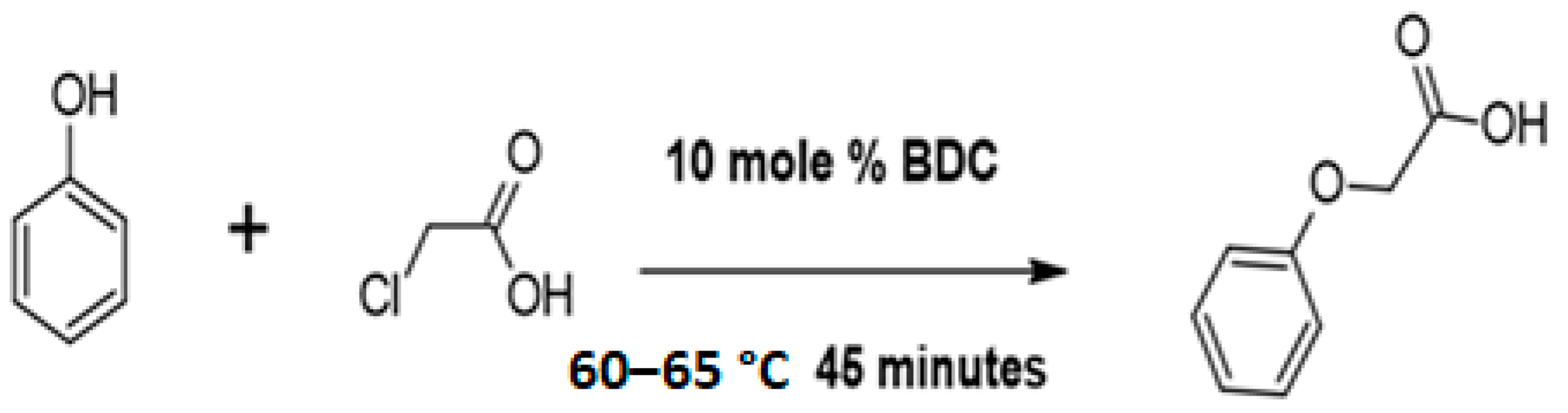
A 50 mL round-bottom flask equipped with a magnetic stirrer and a reflux condenser was used for the synthesis. Phenol (1.21 g, 0.01285 mol) was dissolved in 4.68 g of 25% aqueous NaOH solution. To this mixture, chloroacetic acid (1.46 g, 0.01514 mol), dissolved in 2 g of distilled water, was added, and the reaction mixture was initially heated at 40–45 °C. Subsequently, lignin-derived heterogeneous catalyst (0.12 g, 10 mol%) was introduced, and the temperature was raised to 60–65 °C. The reaction was continued until completion, which was monitored by thin-layer chromatography (TLC) using toluene–methanol (9:1) as the mobile phase. After approximately 15–20 min, the reaction mixture was filtered to recover the catalyst. The filtrate was extracted with benzene, and the solvent was removed under reduced pressure using a rotary evaporator to afford the product (1.28 g, 82% yield). To optimize the yield, parameters such as reaction temperature, reactant molar ratio, reaction time, and catalyst loading were systematically varied. The temperature range studied was 45–55 °C, while the molar ratio of chloroacetic acid to phenol was varied between 1:1 and 2:1. Reaction times were adjusted between 20 and 80 min, and catalyst loading was altered from 5 mol% to 15 mol%. TLC (toluene–methanol, 9:1) was used to monitor reaction progress under each condition. After optimization, subsequent experiments were performed under the identified optimal conditions (Scheme 1; Table 1).

3. Results and Discussion

3.1. Optimization Study

To determine the appropriate reaction time and prevent the formation of undesired by-products due to prolonged reaction duration, all reactions were monitored using thin-layer chromatography (TLC) at regular intervals between 10 and 55 min. The optimized reaction times for each experiment are summarized in Table 2. The primary objective of the optimization study for the molar ratio was to ensure complete consumption of the benzaldehyde component. Excess ethyl acetoacetate and urea were removed during the work-up process. The optimal molar ratio of phenol to chloroacetic acid was determined to be 1:1.2. The minimum effective dosage of BDC catalyst required for complete reaction was 10 mol%, as higher catalyst concentrations showed no significant influence on the reaction progress. Additionally, 5.0 volumes of water were found to be the suitable solvent under the optimized conditions. Table 2 presents the finalized parameters for the synthesis of the target compounds.

3.2. Recovery of BDC

To eliminate BDC from the reaction mixture, magnetic separation was performed, followed by filtration through a 2.5 cm Hyflow bed. The Hyflow bed was subsequently rinsed three times with ethanol to minimize yield loss. The separated BDC was regenerated using dilute HCl and then washed with water until the mother liquor reached a neutral pH. The regenerated BDC was reused in subsequent cycles. The BDC-free reaction mass was quenched by slowly adding it to crushed ice over one hour and maintained at the same condition for an additional hour. The resulting product was extracted with ethyl acetate, which was later distilled under vacuum to obtain the crude product. Purification was achieved by leaching the crude material in two volumes of 70% methanol at 65 °C. Once a clear solution was observed, 2% activated carbon and 0.5% zinc were added, and the mixture was stirred at 65 °C for one hour before Hyflow filtration. To the clear filtrate, 0.1% HEDP was added, followed by controlled cooling to prevent impurity recrystallization. After reaching room temperature, the resulting slurry was further cooled to 0–5 °C using dry ice. The crystalline product formed was filtered under vacuum and washed with methanol under a nitrogen atmosphere. Finally, the obtained snow-white wet powder was dried in a vacuum tray dryer (VTD) under nitrogen until the loss on drying (LOD) was no more than 0.5%.

3.3. Plausible Mechanism

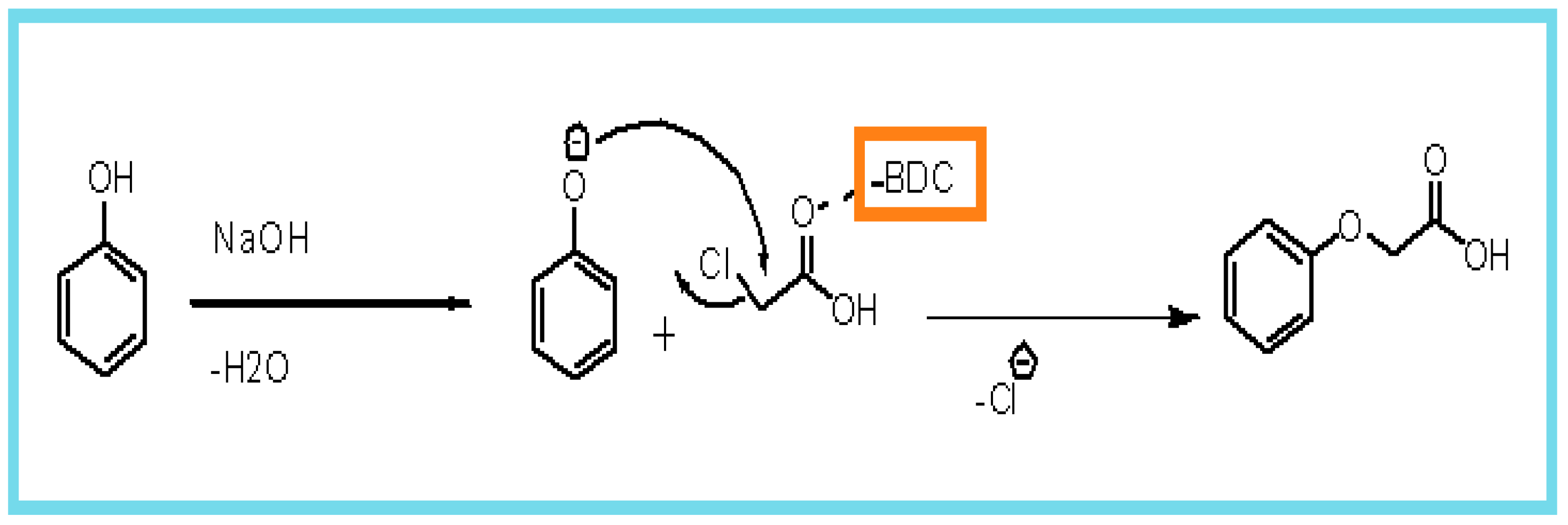
Scheme 2 depicts the proposed reaction mechanism in which phenoxide ion formation using sodium hydroxide facilitates the nucleophilic attack on carbon atom adjacent to carbonyl group of chloroacetic acid. Then, the removal of a halogen atom completes the formation of the product. The BDC catalyst provides its surface area and its acidic nature to complete the reaction.

4. Conclusions

The present study successfully demonstrates a green and sustainable approach for the synthesis of phenoxyacetic acid (PAA) using biowaste-derived lignin as an efficient heterogeneous catalyst. The utilization of lignin not only provides an environmentally benign alternative to conventional catalysts but also adds value to agricultural and industrial biomass waste. The porous texture and mild acidic nature of lignin significantly enhanced the reaction rate and yield, achieving an optimum product yield of 78–82% under mild reaction conditions (60–65 °C, 10 mol% catalyst). Characterization studies such as BET and SEM confirmed the suitable surface morphology and porosity of the catalyst, which facilitated efficient catalytic activity. The reaction, conducted in water as a green solvent, further reinforces the eco-friendly nature of this protocol. Overall, this work highlights the potential of lignin as a renewable, low-cost, and recyclable catalyst for the sustainable synthesis of valuable organic compounds like phenoxyacetic acid, paving the way for broader applications of biomass-derived catalysts in green chemistry.

Supplementary Materials

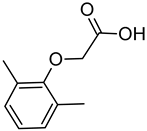
The following supporting information can be downloaded at: https://www.mdpi.com/article/10.3390/ecsoc-29-26869/s1, Synthesis and Characterization of Catalyst BDC, Figure S1: High-magnification TEM images of fresh BDC catalyst. Figure S2: High-magnification TEM images of recovered BDC catalyst. Figure S3: High-magnification SEM images of fresh BDC. Figure S4: High-magnification SEM images of recovered BDC. Synthesis of phenoxyacetic acid from phenol and chloroacetic acid Figure S5: MASS spectrum of compound 01. Figure S6: 1H NMR spectrum of compound 01. Synthesis of 4-chloroPhenoxy acetic acid from 4-chlorophenol and chloroacetic acid. Figure S7: MASS spectrum of compound 02. Figure S8: 1H NMR spectrum of compound 02. Synthesis of (2,4-DichloroPhenoxy) acetic acid from 2,4-Dichlorophenol and chloroacetic acid. Figure S9: MASS spectrum of compound 03. Figure S10: 1H NMR spectrum of compound 03. Synthesis of 2(2,6-dimethylphenoxy) acetic acid from 2,6-Dimethylphenol, and chloroacetic acid. Figure S11: MASS spectrum of compound 04. Figure S12: 1H NMR spectrum of compound 04.

Author Contributions

A.P.; formal analysis, experimental investigation, and validation; writing—review and editing. V.C.; formal analysis and validation; writing—review and editing. S.R.P.; resources and data curation. G.P.B.; conceptualization and supervision. V.P.: writing—review and editing, visualization, and supervision. All authors have read and agreed to the published version of the manuscript.

Funding

This research received no external funding.

Institutional Review Board Statement

Not applicable.

Informed Consent Statement

Not applicable.

Data Availability Statement

The dataset is available on request from the authors.

Acknowledgments

Vikas Patil acknowledged University Grant Commission (UGC) New Delhi for his position UGF FRP.

Conflicts of Interest

The authors declare no conflicts of interest.

References

  1. Alshaye, N.A.; Elgohary, M.K.; Elkotamy, M.S.; Abdel-Aziz, H.A. Design, Synthesis, and Biological Evaluation of Novel Phenoxy Acetic Acid Derivatives as Selective COX-2 Inhibitors Coupled with Comprehensive Bio-Pharmacological Inquiry, Histopathological Profiling, and Toxicological Scrutiny. Molecules 2024, 29, 1309. [Google Scholar] [CrossRef] [PubMed]
  2. Kim, T.Y.; Kim, S.J.; Cho, S.Y. Separation characteristics of Phenoxyacetic Acids in Fixed and Semi-Fluidized Beds. Stud. Surf. Sci. Catal. 2006, 159, 513–516. [Google Scholar]
  3. Kralova, K.; Sersen, F.; Lacova, M.; Mitterhauszerova, L. Inhibitory Effects of Some Polysubstituted Phenoxyacetic Acid Derivatives on Photosynthetic Activity of Chloroplasts and on Chlorophyll Production in Wheat and Chlorella vulgaris. Chem. Paper-Chem. Zvesti 1993, 47, 264. [Google Scholar]
  4. Santagostino, A.; Leone, M.P.; Maci, R.; Casale, A.; Marabini, L. Effects of phenoxyacetic acid herbicides on chicken embryo development. Pharmacol. Toxicol. 1991, 68, 110. [Google Scholar] [CrossRef] [PubMed]
  5. Gurumurthy, R.; Gopalakrishnan, M. Kinnetics & Mechanism of oxidation of phenoxyacetic acid by acid permanganate. Indian J. Chem. 1986, 25, 476–477. [Google Scholar]
  6. Patil, V.S.; Padalkar, V.S.; Umape, P.G.; Sekar, N. Synthesis characterization and antibacterial activity of novel (1H-benzo[d]imidazole-2-yl)-6-(diethylamino)-3H-one-xanthene, phenoxazine and oxazine. J. Heterocycl. Chem. 2015, 52, 124–129. [Google Scholar] [CrossRef]
  7. Shahar Yar, M.; Afroz Bakht, M.; Siddiqui, A.A.; Abdullah, M.M.; Clercq, E.D. Synthesis and evaluation of in vitro antiviral activity of novel phenoxy acetic acid derivatives. J. Enzym. Inhib. Med. Chem. 2009, 24, 876–882. [Google Scholar] [CrossRef] [PubMed]
  8. Lee, K.; Lee, J.H.; Boovanahalli, S.K.; Jin, Y.; Lee, M.; Jin, X.; Kim, J.H.; Hong, Y.S.; Lee, J.J. (Aryloxy acetylamino) benzoic acid analogues: A new class of hypoxiainducible factor-1 inhibitors. J. Med. Chem. 2007, 50, 1675–1684. [Google Scholar] [CrossRef] [PubMed]
  9. Pattan, S.R.; Hullolikar, R.L.; Pattan, J.S.; Kapadnis, B.P.; Dighe, N.S.; Dengale, S.S. Synthesis and evaluation of some new pyrazolo phenoxy acetic acid derivatves for their antitubercular activity. J. Pharm. Sci. Res. 2009, 1, 63–68. [Google Scholar]
  10. Synthesis and biological evaluation of 2-(3-fluoro-4-nitro phenoxy)-n-phenylacetamide derivatives as novel potential affordable antitubercular agents. Molecules 2012, 17, 2248–2258. [CrossRef]
  11. Santosh, N.M.; Manjusha, C.N.; Nikhil, S.S.; Pritam, N.D.; Vishakha, R.S.; Swati, A.B. Synthesis and in vivo hypolipidemic activity of some novel substituted phenyl isoxazol phenoxy acetic acid derivatives. Bioorg. Med. Chem. Lett. 2014, 24, 2155–2158. [Google Scholar]
  12. Santosh, N.M.; Priyanka, T.S.; Devanand, B.S. Synthesis and hypolipidemic activity of novel 2-(4-(2-substituted aminothiazole-4-yl) phenoxy) acetic acid derivatives. Eur. J. Med. Chem. 2010, 45, 3096–3100. [Google Scholar] [CrossRef] [PubMed]
  13. Li, W.; Jia, H.-Y.; He, X.-H.; Shi, W.-G.; Zhong, B.-H. Novel phenoxy alkyl carboxylic acid derivatives as hypolipidaemic agents. J. Enzym. Inhib. Med. Chem. 2012, 27, 311–318. [Google Scholar] [CrossRef] [PubMed][Green Version]
  14. Turan-Zitouni, G.; Yurttas, L.; Kaplancıklı, Z.A. Synthesis and antinociceptive, anti-inflammatory activities of new aroyl propionic acid derivatives including N-acylhydrazone motif. Med. Chem. Res. 2015, 24, 2406–2416. [Google Scholar] [CrossRef]
  15. Prashanth, T.; Lakshmi Ranganatha, V.; Naveen, P.; Gurupadaswamy, H.D.; Bushra Begum, A.; Al-Ghorbani, M.; Khanum, S.A. Synthesis of (4-benzoyl-phenoxy)-acetic acid derivatives and their efficacy as antioxidant agents. Free Radic. Antioxid. 2013, 3, S50–S54. [Google Scholar] [CrossRef]
Scheme 1. General synthesis of phenoxy–acetic acid derivatives, from chloroacetic acid and phenol derivative.
Chemproc 18 00095 sch001
Scheme 2. Plausible mechanism for phenoxy–acetic acid reaction by using BDC catalyst.
Chemproc 18 00095 sch002
Table 1. Synthesis of different derivatives of phenoxyacetic acid derivatives, from chloroacetic acid and phenol derivative.
Sr. No.Reactant 1Reactant 2ProductYieldTime
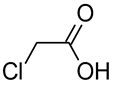
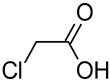
1Chemproc 18 00095 i001Chemproc 18 00095 i002Chemproc 18 00095 i0038220 min
2Chemproc 18 00095 i004Chemproc 18 00095 i005Chemproc 18 00095 i0067840 min
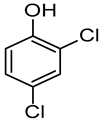
3Chemproc 18 00095 i007Chemproc 18 00095 i008Chemproc 18 00095 i0098245 min
4Chemproc 18 00095 i010Chemproc 18 00095 i011Chemproc 18 00095 i0127840 min
Table 2. Optimum condition for synthesis of phenoxyacetic acid.
CompoundQuantityQualityPotentialMol Wt.MolesMole Ratio
Phenol1.21 g99%1.20 g94.110.012751.0
Chloroacetic acid1.46 g98%1.44 g94.500.01531.2
BDC0.12 g 10 Mole %
NaOH1.18 g99%1.167 g400.029192.29
Water 6 mL 5.0 times
Disclaimer/Publisher’s Note: The statements, opinions and data contained in all publications are solely those of the individual author(s) and contributor(s) and not of MDPI and/or the editor(s). MDPI and/or the editor(s) disclaim responsibility for any injury to people or property resulting from any ideas, methods, instructions or products referred to in the content.