
Proceeding Paper

New Synthetic Applications of 2-Benzylidene-1-indanones: Synthesis of 4b,10,10a,11-Tetrahydro-5H-indeno[1,2-H]quinoline and 1′-(Diisopropylamino)-2,2′-spirobi[indene]-1,3′(1′H,3H)-dione †

Center for Research in Biological Chemistry and Molecular Materials, Department of Organic Chemistry, University of Santiago de Compostela, 15782 Santiago de Compostela, Spain
*
Author to whom correspondence should be addressed.
Presented at the 29th International Electronic Conference on Synthetic Organic Chemistry, 14–28 November 2025; Available online: https://sciforum.net/event/ecsoc-29.
Chem. Proc. 2025, 18(1), 97; https://doi.org/10.3390/ecsoc-29-26867
Published: 12 November 2025

Abstract

2-Benzylidene-1-indanones constitute a family of heterocyclic compounds with a wide range of pharmacological and material applications. Here we present preliminary results of new chemistry in this field. An acid-mediated aldolic condensation of 1-indanone with o-nitrobenzaldehyde provided (E)-2-(2-nitrobenzylidene)-2,3-dihydro-1H-inden-1-one, which, when subjected to catalytic hydrogenation, led directly to 4b,10,10a,11-tetrahydro-5H-indeno[1,2-b]quinoline, as a result of several successive spontaneous reactions. On the other hand, a base-mediated aldolic condensation of 1-indanone with o-methoxycarbonylbenzaldehyde yielded methyl (E)-2-((1-oxo-1,3-dihydro-2H-inden-2-ylidene)methyl)benzoate which, when treated with LDA, led to the formation of 1′-(diisopropylamino)-2,2′-spirobi[indene]-1,3′(1′H,3H)-dione.

1. Introduction

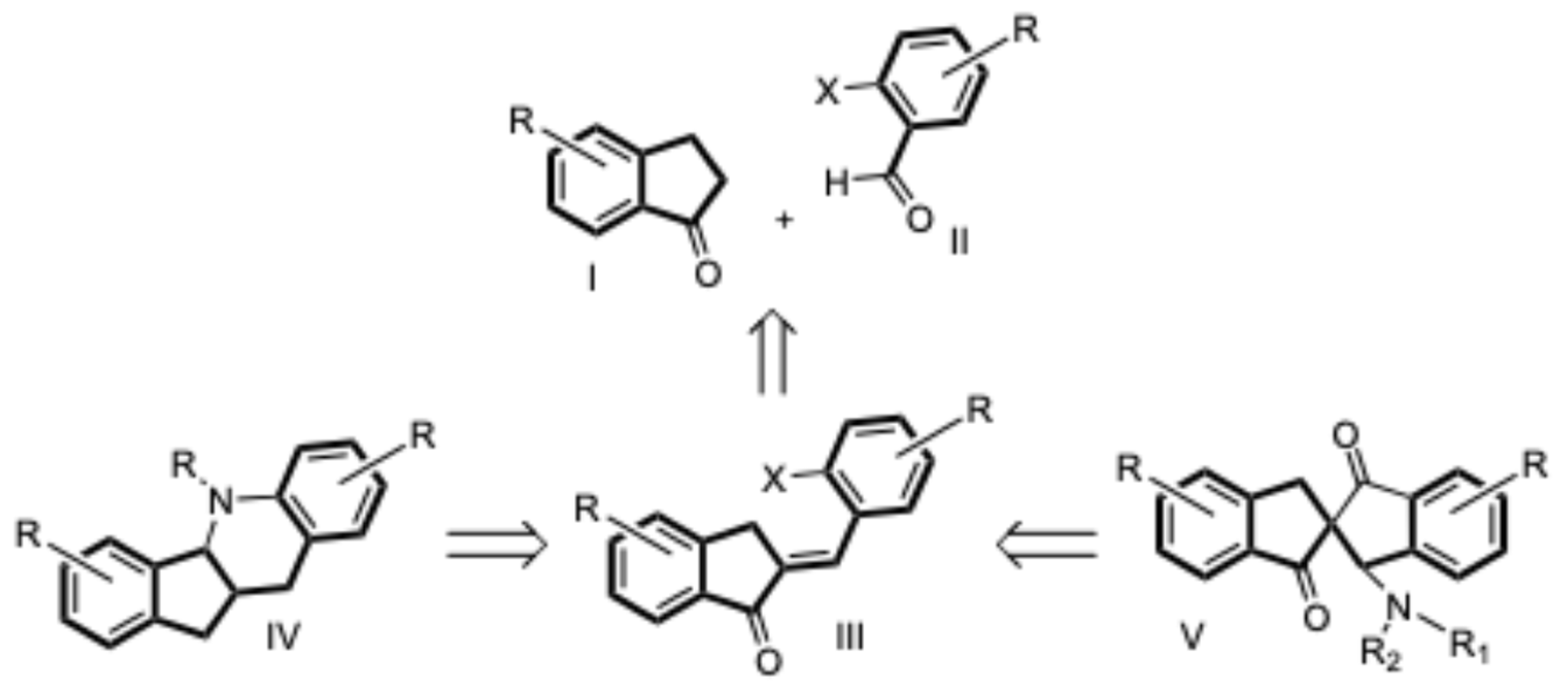
2-Benzylidene-1-indanones constitute a family of indanones [1,2] with a wide range of pharmacological and material applications [3]. Their structure, characterized by an indanone skeleton functionalized with a benzylidene group at the 2- position, confers conjugated properties that promote biological activity, including antioxidant, anti-inflammatory, anticancer and antimicrobial effects [1]. In addition, their synthesis via Knoevenagel-type condensations is efficient and versatile, allowing for extensive structural modification. These characteristics make 2-benzylidene-1-indanones promising candidates in the design of new bioactive entities and functional materials [4]. Furthermore, 2-benzylidene-1-indanones could be useful scaffolds for the access of condensed tetracyclic derivatives in which their carbon skeleton is embedded, like indenoquinolines IV [5] and spirocompounds V [4,6,7] (Scheme 1).
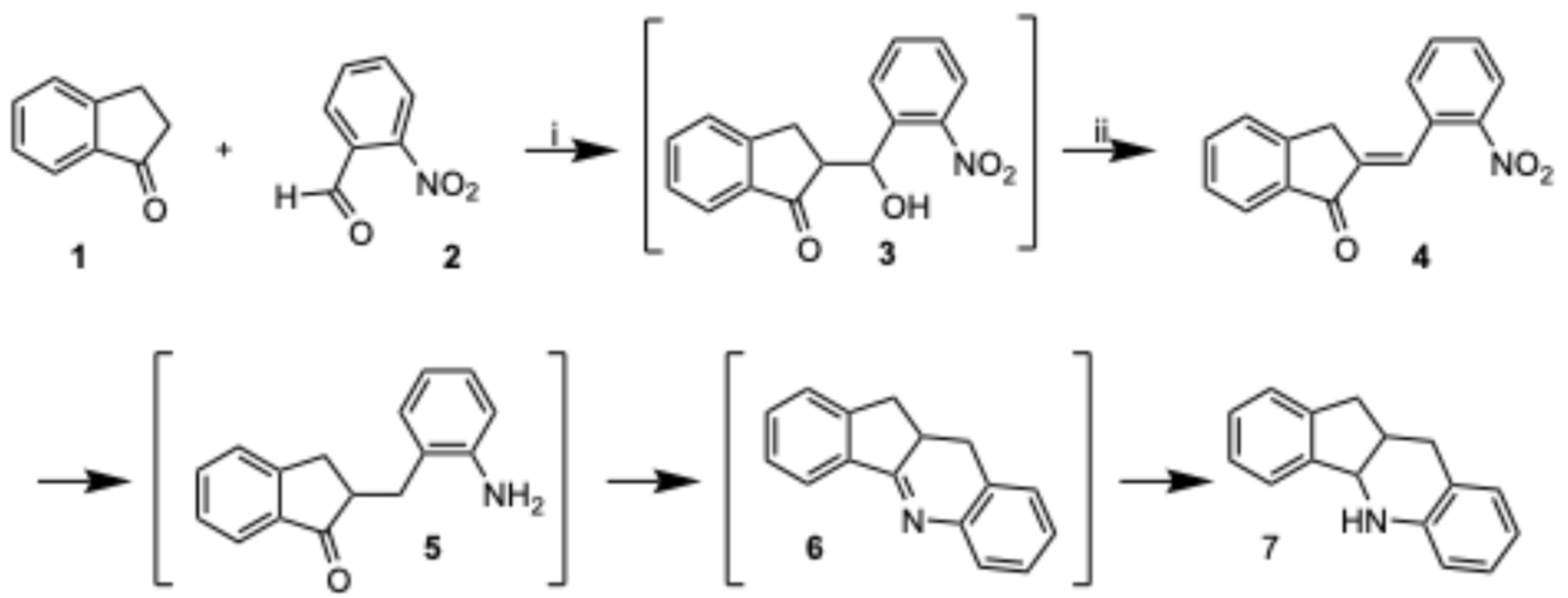
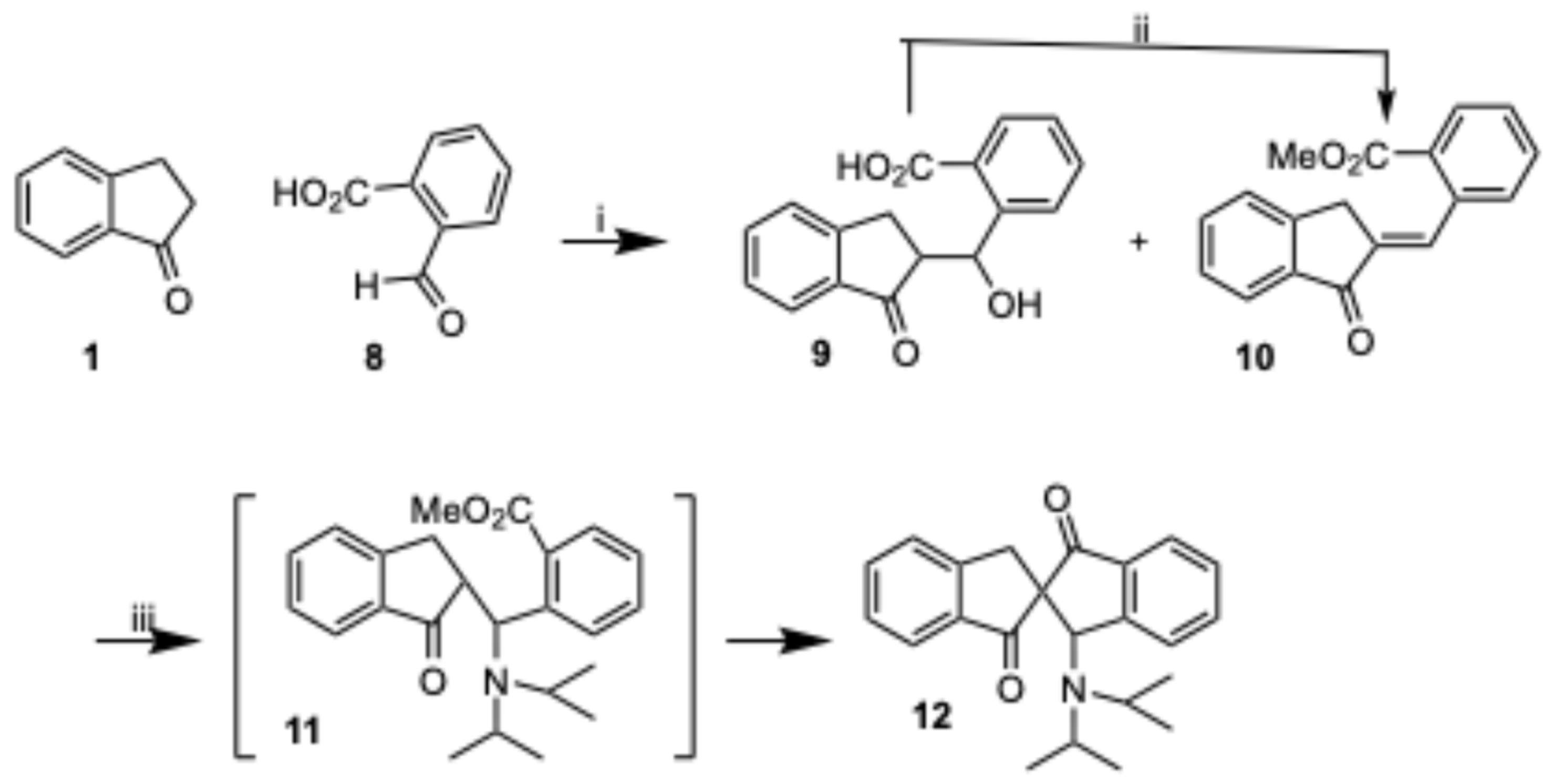
Here we present preliminary results of new chemistry in this field. It consists of (a) the transformation of (E)-2-(2-nitrobenzylidene)-2,3-dihydro-1H-inden-1-one (4) into 4b,10,10a,11-tetrahydro-5H-indeno[1,2-b]quinoline/7) (Scheme 2) and (b) the transformation of methyl (E)-2-((1-oxo-1,3-dihydro-2H-inden-2-ylidene)methyl)benzoate (10) into 1′-(diisopropylamino)-2,2′-spirobi[indene]-1,3′(1′H,3H)-dione (12). (Scheme 3).

2. Results and Discussion

2.1. Synthesis of 4b,10,10a,11-Tetrahydro-5H-indeno[1,2-b]quinoline (7)

An acid-mediated aldolic condensation of 1-indanone with o-nitrobenzaldehyde provided indanone 3, a process that is followed by a spontaneous dehydration to give the nitrobenzylideneindanone 4, as it was established from its analytical and spectroscopic data. Its IR spectrum shows at 1700 cm−1 at the C=O band and at 1512 and 1267 cm−1 the NO2 bands. The 1H NMR spectrum included three signals at 7.35–7.65, 7.85–792 and 8.05 ppm, due to the eight aromatic and the vinyl protons, along with a doublet at 3.79 ppm, due to the methylene group.
Next, catalytic hydrogenation of 4 [2] directly yielded tetrahydroquinoline 7, as deduced from its analytical and spectroscopic data. The most representative signal in this 1H NMR spectrum is a broad singlet at 4.31 ppm, due to the amine proton. And the 13C NMR spectrum shows three quaternary carbon signals at 146.2, 144.3 y 141.5 ppm and the signal of the C-N bond carbon at 121.5 ppm, along with signals of the aromatic CH groups at 128.,7, 127.5, 126.9, 126.7, 125.4, 123.8, 117.0, 113.2 ppm, the signal of the carbon of the CH-N group at 59.8 ppm, the signals from the -CH2- groups at 37.2 and 30.2 ppm and the signal of a -CH- group at 36.8 ppm.
Formation of 7 may be explained assuming that the hydrogenation of 4 resulted in a cascade of reactions in which the reduction of the nitro group to amino and a spontaneous reduction of the exocyclic double bond provided aminoindanone 5. This was followed by subsequent spontaneous intramolecular condensation of the amino and carbonyl groups of this intermediate and finally the reduction of the C=N bond of the resulting compound 6 led compound 7.

2.2. Synthesis of 1′-(Diisopropylamino)-2,2′-spirobi[indene]-1,3′(1′H,3H)-dione

After a failed attempt of aldolic condensation of indanone 1 with 2-formylbenzoic acid 8 under basic conditions (EtONa/EtOH), satisfactory results were obtained when the reaction was undertaken in an acidic media (HCl, EtOH), under reflux for 13 days. This led to a mixture of compounds 9 (30%) and 10 (40%) (Scheme 3), which were isolated by column chromatography and identified from spectroscopic and analytical data.
The IR spectrum of compound 9 shows a broad band at 3716–3100 cm−1 and strong band at 1712 cm−1, due to the carboxyl group, along with a strong band at 1665 cm−1, due to the carbonyl group of the ketone. The representative signals present in its 1H NMR are a singlet at 6.21 ppm, due to the proton at the carbon carrying the OH group, and a signal at 3.31 ppm and two double doublets at 2.89 and 2.53 ppm, which correspond to the other three aromatic protons. And the 13C NMR spectrum includes at 170 and 203.5 ppm the signals corresponding to carbonyl of the carboxylic acid and the ketone groups.
On the other hand, the IR spectrum of compound 104 shows two strong bands, a 1702 and 1635 cm−1, corresponding to the ketone carbonyl and the methoxycarbonyl groups. The 1H NMR spectrum confirms the esterification of the carboxyl group of compound 9, as established by the presence of a singlet at 4.40 ppm, due to the methyl group. In addition, the signal of the vinylic proton appears at 8.23 ppm. The E configuration of the double bond was assigned by comparison with other similar 2-benzylideneindanones prepared by us, and the 13C NMR spectrum includes signals corresponding to the carbonyl groups at 167.0 and 193.8 ppm.
The obtaining of the mixture 9 and 10 was explained by assuming that the hydroxyacid 9 resulting from the aldolic condensation of compounds 1 and 8 spontaneously underwent esterification and dehydration, giving rise to compound 10. This was confirmed because compound 9 was transformed into compound 10 when subjected to the reaction conditions, giving rise to mixture 9 + 10.
Following our plan, the reaction of compound 10 with LDA produced the tetracyclic spirocompound 12 [4], as deduced from its analytical and spectroscopic data. Its IR spectrum shows a ketone carbonyl band at 1694 cm−1 and its 1H NMR spectrum includes signals from eight aromatic protons, along with a singlet at 4.90 ppm, corresponding to the proton of the carbon carrying the amino group, a singlet of two protons, due to the methylene, and the following signals from the two isopropylidene groups: two signals at 3.31 and 2.43 ppm and four doublets at 1.32, 1.03, 0.82 and 0.56 ppm. In addition, representative signals present in its 13C NMR spectrum are two pics at 203.3 and 202.2 ppm, of the two ketone carbonyls, a signal at 72.6 ppm, from the spiranic carbon, and four pics at 24.2, 23.8, 22.2 and 20.90 ppm, due to the four methyl groups.
The formation of compound 12 can be explained in terms of a Michael–Claisen-like cascade involving a conjugated addition of LDA to the α,β-unsaturated carbonylic moiety of compound 10, yielding enolate 11, which spontaneously gives rise to 12 through an intramolecular attack of this enolate on the methoxycarbonyl substituent.

3. Conclusions

These preliminary results on synthetic applications of 2-benzylideneindan-1-ones consist of a new synthesis of 10,10a,11-tetrahydro-5H-indeno[1,2-b]quinoline (7) and the synthesis of 1′-(diisopropylamino)-2,2′-spirobi[indene]-1,3′(1′H,3H)-dione (12).
The interest and novelty of this work lie in the fact that type 7 indenoquinolines have hardly been considered (only one example has been described) and compound 12 is the first example described with an amino substituent at the C-1′ position. Also noteworthy is the direct access to these targets, based on previously undescribed cascade reactions 2-benzylideneindan-1-ones [8,9].
Future work in this field will include the stereoselective synthesis of libraries of compounds 7 and 12, for chemical and biological studies.

Author Contributions

Conceptualization, R.J.E.; methodology, R.J.E. and J.C.E.; software R.J.E.; validation, R.J.E. and J.C.E.; formal analysis, J.C.E. and A.M.M.; investigation, A.M.M.; resources, R.J.E. and J.C.E.; data curation, J.C.E.; writing—original draft preparation, R.J.E.; writing—review and editing, R.J.E.; visualization, J.C.E.; supervision, R.J.E.; project administration, R.J.E.; funding acquisition, R.J.E. All authors have read and agreed to the published version of the manuscript.

Funding

This work has received financial support from the European Union (European Regional Development Fund—ERDF), the Xunta de Galicia (Centro Singular de Investigación de Galicia acreditation 2019–2022, ED431G 2019/03, and grants ED431C 2018/30 and ED431C 2018/04).

Institutional Review Board Statement

Not applicable.

Informed Consent Statement

Not applicable.

Data Availability Statement

Experimental data can be obtained from the authors upon request.

Conflicts of Interest

The authors declare no conflict of interest.

References

  1. Turek, M.; Szczęsna, D.; Koprowski, M.; Bałczewski, P. Synthesis of 1-Indanones with a Broad Range of Biological Activity. Beilstein J. Org. Chem. 2017, 13, 451–494. [Google Scholar] [CrossRef] [PubMed]
  2. Nagle, D.G.; Zhou, Y.-D.; Park, P.U.; Paul, V.J.; Rajbhandari, I.; Duncan, C.J.G.; Pasco, D.S. A New Indanone from the Marine Cyanobacterium Lyngbya m Ajuscula That Inhibits Hypoxia-Induced Activation of the VEGF Promoter in Hep3B Cells. J. Nat. Prod. 2000, 63, 1431–1433. [Google Scholar] [CrossRef] [PubMed]
  3. Patil, S.A.; Patil, R.; Patil, S.A. Recent Developments in Biological Activities of Indanones. Eur. J. Med. Chem. 2017, 138, 182–198. [Google Scholar] [CrossRef] [PubMed]
  4. Martinez, A.; Fernandez, M.; Estevez, J.C.; Estevez, R.J.; Castedo, L. Studies on the Chemistry of 2-(2-Oxo-3-Phenylpropyl)benzaldehydes: Novel Total Synthesis of 3-Phenylnaphthalen-2-Ols and 2-Hydroxy-3-Phenyl-1,4-Naphthoquinones. Tetrahedron 2005, 61, 485–492. [Google Scholar] [CrossRef]
  5. Lee, C.G.; Lee, K.Y.; Gowrisankar, S.; Kim, J.N. Synthesis of 4b,5,10a,11-Tetrahydroindeno[1,2-b]Quinolin-10-Ones from Baylis-Hillman Adducts. Tetrahedron Lett. 2004, 45, 7409–7413. [Google Scholar] [CrossRef]
  6. Rahemtulla, B.F.; Clark, H.F.; Smith, M.D. Catalytic Enantioselective Synthesis of C1 - and C2 -Symmetric Spirobiindanones through Counterion-Directed Enolate C -Acylation. Angew. Chem. Int. Ed. 2016, 55, 13180–13183. [Google Scholar] [CrossRef] [PubMed]
  7. Maslak, P.; Varadarajan, S.; Burkey, J.D. Synthesis, Structure, and Nucleophile-Induced Rearrangements of Spiroketones. J. Org. Chem. 1999, 64, 8201–8209. [Google Scholar] [CrossRef] [PubMed]
  8. Pleshakov, V.G.; Ambacheu, K.D.; Ryashentseva, M.A.; Sergeeva, N.D.; Vener, M.V.; Murugova, L.A.; Zvolinsky, O.V.; Prostakov, N.S. Heterogeneous Catalytic Synthesis and Structure of 5,5a,10a,11-Tetrahydro-10H-Indeno[1,2-b]Quinoline. Russ. Chem. Bull. 1994, 43, 1037–1040. [Google Scholar] [CrossRef]
  9. Zhang, X.Y.; An, Y.; Liu, Z.Z.; Fan, L.T. Claisen-Type Condensation of Ketones with Carboxylic Acids: Synthesis of α,α-Disubstituted β-Keto Carbonyl Compounds. Synthesis 2025, 57, 2337–2344. [Google Scholar] [CrossRef]
Scheme 1. Retrosynthetic plan for the preparation of type IV and type V compounds.
Chemproc 18 00097 sch001
Scheme 2. Conditions: (i) HCl, EtOH, reflux, 6 days (60%). (ii) H2, Pd/C, EtOAc, rt, 2 h (65%).
Chemproc 18 00097 sch002
Scheme 3. Conditions: (i) HCl, MOH, reflux, 13 days (30% of 9, 40%of 10). (ii) H2SO4, MeOH, reflux, 14 h (iii) LDA, THF, −78 °C, 4 h, rt 12 h (50%).
Chemproc 18 00097 sch003
Disclaimer/Publisher’s Note: The statements, opinions and data contained in all publications are solely those of the individual author(s) and contributor(s) and not of MDPI and/or the editor(s). MDPI and/or the editor(s) disclaim responsibility for any injury to people or property resulting from any ideas, methods, instructions or products referred to in the content.