1. Introduction
The chemistry of thioamides containing hydrogen atoms in the α-position to the thiocarbamoyl group represents a promising area of modern organic synthesis, owing to their considerable synthetic potential and the valuable practical properties of the obtained products [
1]. Despite its multifunctional nature and obvious potential for diverse transformations, the reactions of monothiomalondianilide
1 remain insufficiently explored. Only a few papers dealing with the chemistry of monothiomalondianilide
1 [
2,
3,
4,
5,
6,
7] were reported to date. We therefore set out to investigate some new reactions.
2. Results and Discussion
Using a reported procedure [
8], the starting monothiomalondianilide
1 was synthesized by reacting commercially available acetoacetanilide with phenyl isothiocyanate (
Scheme 1). The structure of compound
1 was confirmed by spectral data as well as X-ray diffraction analysis.
The reaction of thioamide
1 with arylidenemalononitriles
2, either prepared via the Knoevenagel condensation (Method A) or in a multicomponent reaction involving aromatic aldehydes and malononitrile in the presence of a base (Method B), afforded cyclic Michael adducts, previously unreported nicotinamides
3 (
Scheme 2).
We studied the capabilities of approaches
A and
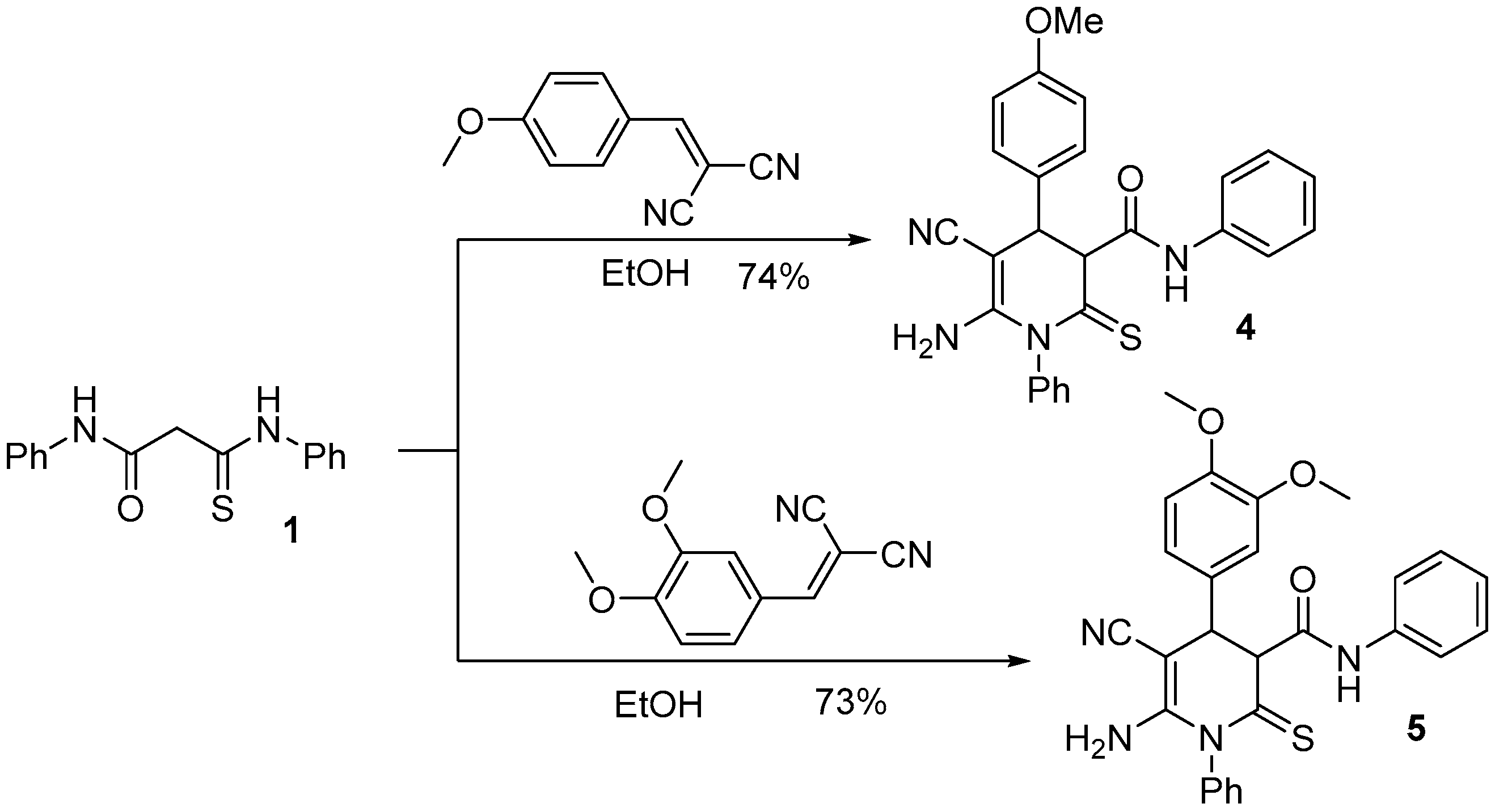
B and found that they produce comparable yields. The highest yields of the target products were obtained for arylidene malononitriles with donor substituents. Thus, the reaction with (3,4-dimethoxybenzylidene)malononitrile and (4-methoxybenzylidene)malononitrile afforded products
4 and
5, respectively (
Scheme 3). In the future, it is planned to expand the library of products, as well as study their properties.
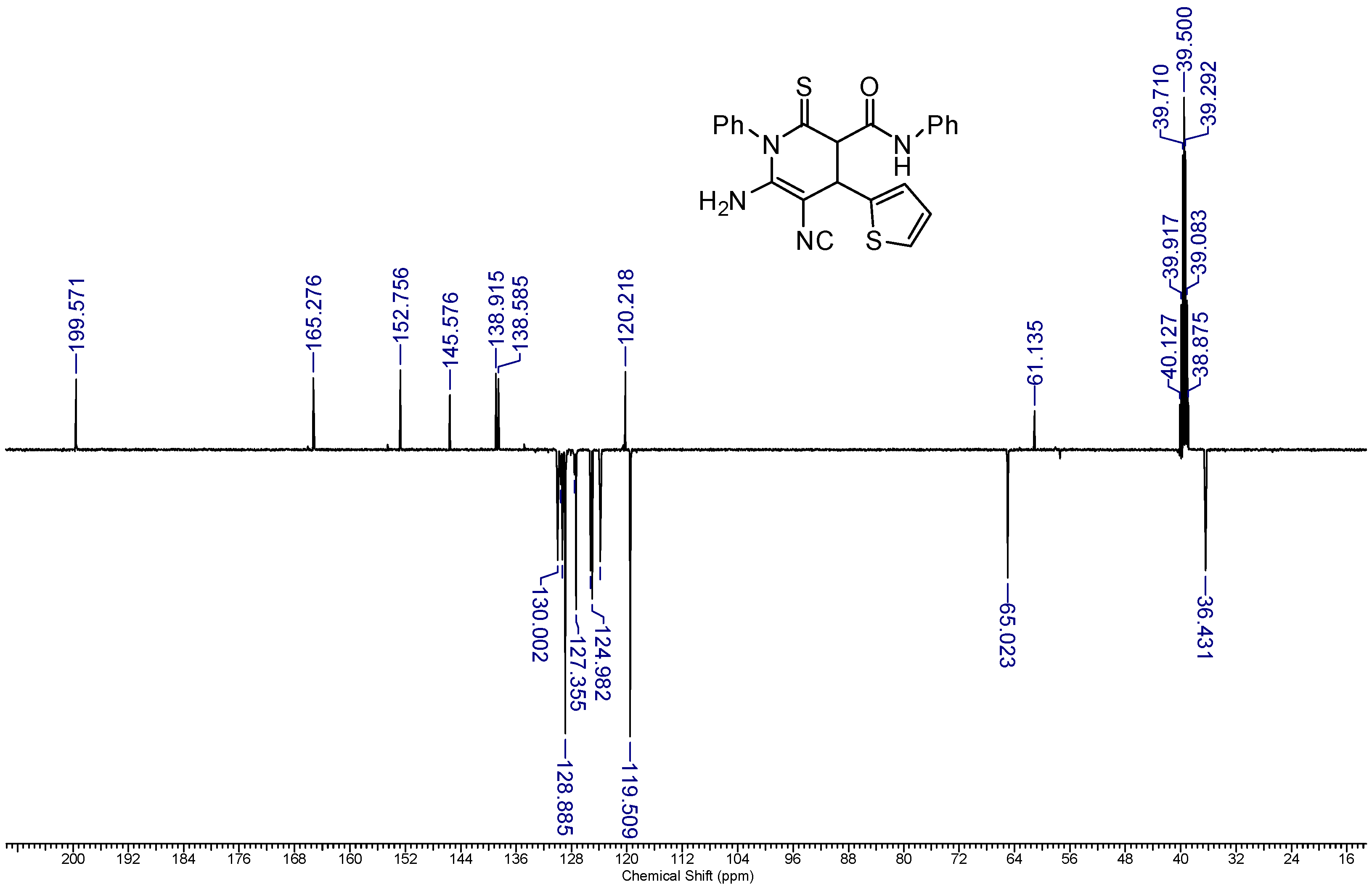
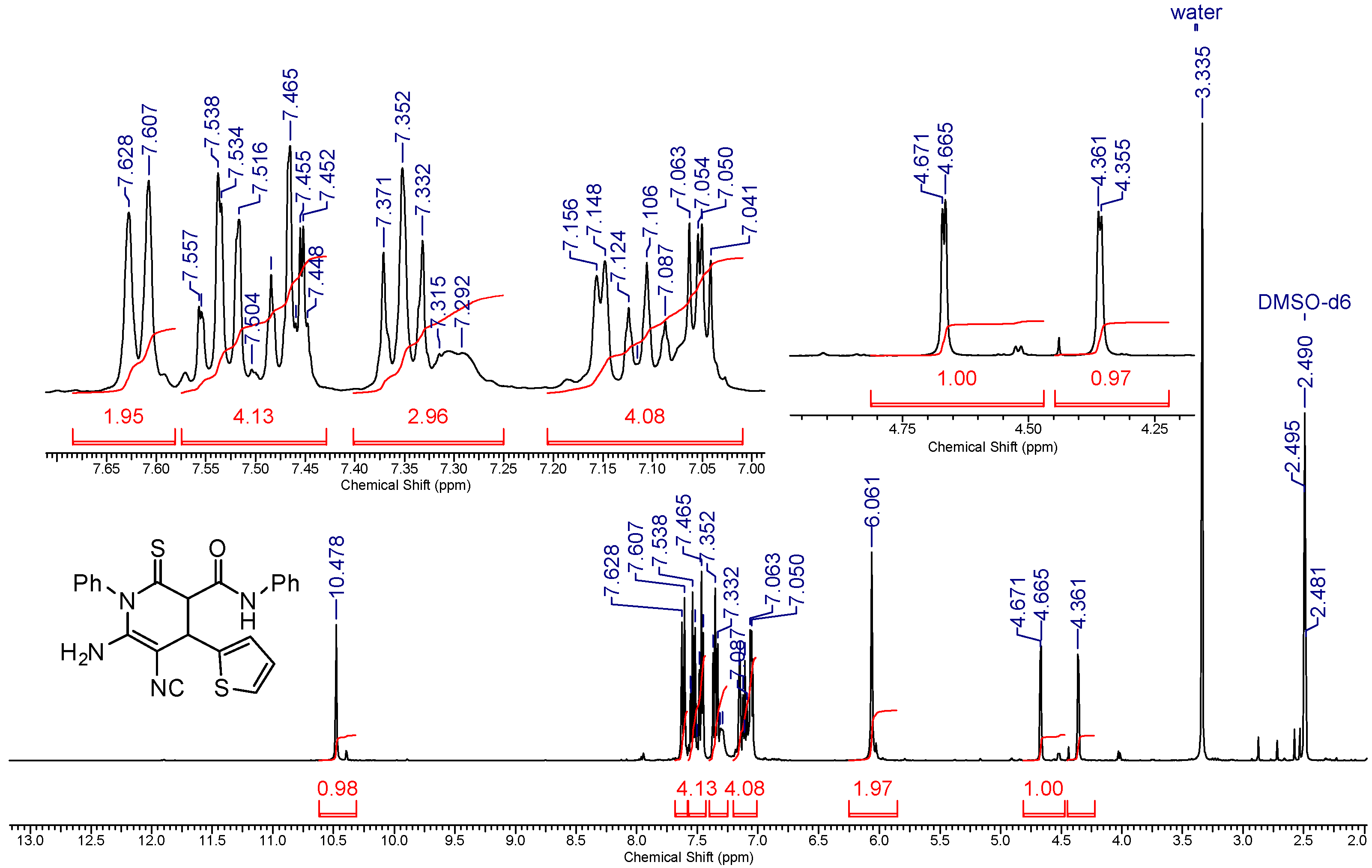
The structures of new compounds were also confirmed by spectral studies. For instance,
Figure 1 and
Figure 2 show the
1H and
13C NMR spectra of compound
3 (Ar = 2-thienyl).
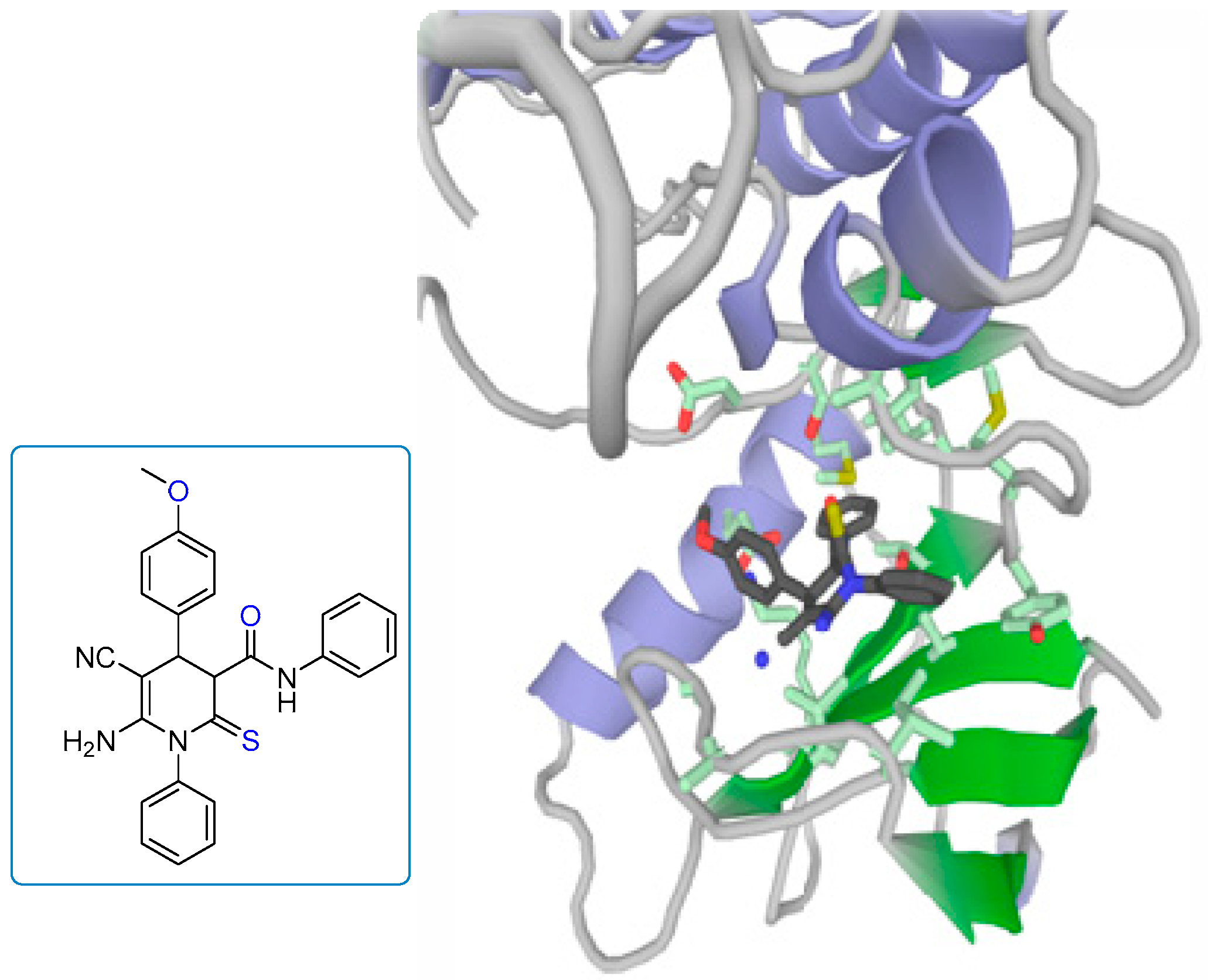
According to the results of molecular docking using the GalaxyWeb Sagittarius protocol, one of the products has affinity (ΔG = -22.586 kcal/mmol) to the protein complex H-Ras:SOS (PDB ID 6pf6, UniprotIDP04818), which indicates the potential prospects of studying the antitumor properties of the compound
3 (Ar = 4-MeOC
6H
4) (
Figure 3).
3. Conclusions
This study explores new chemical reactions of the understudied compound—monothiomalondianilide, successfully using it to synthesize novel nicotinamide derivatives. The structures of new compounds were confirmed by FTIR, NMR, and their synthesis was optimized. Molecular docking studies indicated that one of the new compounds shows strong binding affinity to a specific protein target H-Ras:SOS (PDB ID 6pf6, UniprotIDP04818), suggesting potential for future investigation into its antitumor properties.
4. Experimental
Synthesis of compounds 3 (Approach A). Arylidene malononitrile (0.03 mol) was dissolved in 12 mL of EtOH with gentle heating. Then, monothiomalonanilide 1 (0.03 mol) was added, followed by treatment with 0.03 mol of organic base (diethylamine, morpholine, etc.) The mixture was stirred until starting reagents were consumed (TLC control) and left to stand overnight for crystallization. A yellow, fine crystalline powder was filtered off and washed with EtOH to give 3. For analytical purposes, the product can be recrystallized from suitable solvents (acetone, MeCN, dioxane).
6-Amino-5-cyano-4-(4-methoxyphenyl)-N,1-diphenyl-2-thioxo-1,2,3,4-tetrahydropyridine-3-carboxamide (3) Ar = 4-MeOC6H4
NMR 1H spectrum (400 MHz, DMSO-d6), δH, ppm: 3.75 s (3H, MeO), 4.03 d (1H, CH Ar), 4.55 d (1H, C3H), 5.94 br.s (2H, NH2), 6.99-7.62 m (14H, 3 Ar), 10.40 br.s (1H, CONH).
NMR 13C DEPTQ (DMSO-d6), δC, ppm: 39.6* (CH); 55.1* (OCH3); 60.6 (C5); 64.9* (CH); 114.1* (2C, C3H C5H 4-MeOC6H4); 119.5* (2C, CH Ar); 120.5 (CN); 123.8* (CH Ph); 127.4* (CH Ph); 128.3* (2CH Ph); 128.8* (2CH Ph); 129.6* (2CH Ph); 130.0* (2CH Ph); 132.5 (C1 Ar); 138.7 (C1 Ar); 139.0 (C1 Ar); 152.6 (C6); 158.5 (C-OMe); 165.9 (CONH); 199.9 (C=S). *Signals in antiphase.
Author Contributions
Conceptualization, V.V.D.; methodology, V.V.D.; software, R.N.G. and N.A.A.; formal analysis, N.A.A. and V.V.D.; investigation, I.O.K., R.N.G. and V.V.D.; resources, V.V.D.; data curation, V.V.D.; writing—original draft preparation, R.N.G.; writing—review and editing, V.V.D.; visualization, V.V.D. and R.N.G.; supervision, V.V.D.; project administration, V.V.D. All authors have read and agreed to the published version of the manuscript.
Funding
This research received no external funding.
Institutional Review Board Statement
Not applicable.
Informed Consent Statement
Not applicable.
Data Availability Statement
Available from authors.
Conflicts of Interest
The authors declare no conflicts of interest.
References
- Murai, T. Chemistry of Thioamides; Springer: Singapore, 2019; 238p. [Google Scholar]
- Yuan, W.K.; Liu, Y.F.; Lan, Z.; Wen, L.R.; Li, M. Nickel catalysis enables access to thiazolidines from thioureas via oxidative double isocyanide insertion reactions. Org. Lett. 2018, 20, 7158–7162. [Google Scholar] [CrossRef] [PubMed]
- Huang, P.; Fu, X.; Liang, Y.; Zhang, R.; Dong, D. Divergent synthesis of Benzo[d]thiazoles by PIFA-mediated Cyclization of β-oxo Thioamides. Aust. J. Chem. 2012, 65, 121–128. [Google Scholar] [CrossRef]
- Santeusanio, S.; Majer, R.; Perrulli, F.R.; De Crescentini, L.; Favi, G.; Giorgi, G.; Mantellini, F. Divergent approach to thiazolylidene Derivatives: A perspective on the synthesis of a heterocyclic Skeleton from β-amidothioamides Reactivity. J. Org. Chem. 2017, 82, 9773–9778. [Google Scholar] [CrossRef] [PubMed]
- Meng, X.; Guo, W.; Nan, G.; Li, M. Synthesis of pyrrole disulfides via umpolung of β-ketothioamides. Org. Biomol. Chem. 2022, 20, 7609–7612. [Google Scholar] [CrossRef] [PubMed]
- Żankowska-Jasińoka, W.; GaŁuszka, B. Reaktivität der 1,3-dithiethanderivate. J. Fluor. Chem. 1983, 22, 165–173. [Google Scholar] [CrossRef]
- Barnikow, G. Isothiocyanate. VIII. die Addition N-aryl-substituierter amide der Malonsäure und Acetessigsäure an Arylisothiocyanate. J. Prakt. Chem. 1966, 34, 251–261. [Google Scholar] [CrossRef]
- Liang, Y.; Dong, D.; Huang, P.; Xiang, D.; Zhou, Y.; Na, T. A facile and practical One-pot Synthesis of β-oxo Thioamides from β-oxo Amides and Isothiocyanates. Synthesis 2009, 2009, 1797–1800. [Google Scholar] [CrossRef]
| Disclaimer/Publisher’s Note: The statements, opinions and data contained in all publications are solely those of the individual author(s) and contributor(s) and not of MDPI and/or the editor(s). MDPI and/or the editor(s) disclaim responsibility for any injury to people or property resulting from any ideas, methods, instructions or products referred to in the content. |
© 2025 by the authors. Licensee MDPI, Basel, Switzerland. This article is an open access article distributed under the terms and conditions of the Creative Commons Attribution (CC BY) license (https://creativecommons.org/licenses/by/4.0/).