
Proceeding Paper

Understanding the Therapeutic Potential of Quercetin and Resveratrol: Computational Insights into Antidiabetic Activity †
1
Faculty of Pharmacy, University Business Academy, Heroja Pinkija 4, 21101 Novi Sad, Serbia
2
UCL School of Pharmacy, University College London, 29/39 Brunswick Square, London WC1N 1AX, UK
*
Authors to whom correspondence should be addressed.
Presented at the 29th International Electronic Conference on Synthetic Organic Chemistry, 14–28 November 2025; Available online: https://sciforum.net/event/ecsoc-29.
Chem. Proc. 2025, 18(1), 53; https://doi.org/10.3390/ecsoc-29-26876
Published: 12 November 2025

Abstract

The global population is ageing rapidly, with the number of people aged 60 and above expected to reach 2.1 billion by 2050. This shift is driving a rise in chronic diseases, including diabetes, which is projected to affect 592 million people by 2035. These trends highlight the urgent need for novel therapeutic strategies and better understanding of disease mechanisms. Resveratrol and quercetin, two widely recognized polyphenols, are highly valued for their potent antioxidant and anti-inflammatory properties, demonstrating significant promise in mitigating and improving diabetic conditions by addressing core pathological features such as oxidative stress and insulin resistance. This study leverages computational chemistry techniques to elucidate the putative mechanisms of action of resveratrol and quercetin within the context of diabetic pathogenesis. To achieve this, a target prediction analysis was performed for both molecules using SwissTargetPrediction and EpigeneticTargetProfiler, followed by a structure-based target fishing utilizing TargetFisher. From the list of the predicted targets, we selected three key enzymes: monoamine oxidase A (MAO-A) and monoamine oxidase B (MAO-B), mitochondrial enzymes linked to oxidative stress and inflammation in diabetic conditions, and insulin-like growth factor 1 receptor (IGF-1R), which activates signalling pathways essential for insulin sensitivity and beta-cell function. These targets were chosen due to their established roles in metabolic signalling and oxidative pathways relevant to diabetes progression. Molecular docking analyses indicated the potential of quercetin and resveratrol to modulate the function of these enzymes and to confirm their viability for continued exploration of the therapeutic potential of these natural products in both combating metabolic ageing and managing diabetic disease.

1. Introduction

Ageing is an inevitable biochemical process that results in the body’s inability to regenerate itself, and especially in Western civilizations, it is often accompanied by a high risk of chronic diseases, including cancers and cardiovascular, metabolic, and neurodegenerative disorders [1]. Polyphenols are a well-known group of phytochemicals fundamentally composed of phenolic rings. They are plant-derived compounds found in various types of fruits and vegetables. These secondary metabolites serve a protective function in plants, shielding them from environmental influences and biological stress. When consumed as part of the human diet, polyphenols are known to help prevent various age-related diseases. In particular, they are recognized for their antioxidant properties and their role in providing protection against oxidative stress [2]. The oral administration of polyphenol quercetin led to significant benefits for diabetic patients, suggesting its potential as a supplementary agent in clinical practice as a beneficial intervention for metabolic disorders [3]. Polyphenol resveratrol influences multiple metabolic pathways by increasing cellular glucose uptake, altering glucose metabolism, preserving β-cell function, modulating insulin secretion, and reducing insulin resistance. These mechanisms underlie its beneficial effects on diabetic nephropathy, cardiomyopathy and vasculopathy, inflammation and oxidative stress, apoptosis and autophagy regulation, diabetes-associated ocular diseases, and gastrointestinal complications in diabetic patients [4]. Nonetheless, the precise mechanisms of action (MoA) underlying the effects of these natural compounds have yet to be fully elucidated and confirmed.
This research was undertaken to gain insights into the possible protein targets for these two natural products in a diabetes context. The two compounds investigated (resveratrol and quercetin) are believed to act via phenolic radicals to carry out their antioxidant effects, and therefore are involved in ROS-sequestering events; however, binding to protein targets is likely an important element of their secondary modulating action within the cell. There is a strong likelihood that these interactions significantly contribute to the compounds’ secondary, pleiotropic effects. Conventional antidiabetic agents and non-traditional compounds were selected as a benchmarking set to compare their interactions with a subset of relevant predicted targets. The antidiabetic drugs pioglitazone, rosiglitazone, and metformin were included due to their known direct or indirect effects on one of the three target proteins. While the primary antidiabetic action of rosiglitazone and pioglitazone is mediated by PPAR-gamma, they can also function as MAO-B inhibitors [5,6], a function more associated with an off-target mechanism. Additionally, the anti-neoplastic agents linsitinib and picropodophyllin were selected, as their observed mechanisms of action have demonstrated interaction with at least one of the three target proteins [7,8] and have a recognized impact on patient glucose homeostasis.

2. Materials and Methods

2.1. Target Prediction

The SwissTargetPrediction platform (http://www.swisstargetprediction.ch accessed on 15 July 2025) was utilized within this study to analyze resveratrol and quercetin, aiming to successfully predict and select their most relevant targets. This system for small chemical molecules employs 2D and 3D similarity algorithms relative to known ligands. The probability of target prediction is expressed as a numerical score ranging from 0 to 1 [9]. Furthermore, two complementary prediction tools were utilized: Epigenetic Target Profiler, a currently inactive web server dedicated to predicting epigenetic targets of small molecules, and Target Fisher a structure-based method that combines target-specific machine learning models with docking results for predicting biological activities.

2.2. Structure Preparation of Ligands and Proteins

The three-dimensional structures of selected protein targets, IGF-1R (PDB ID: 3LWO), MAO-A (PDB ID: 2Z5X), and MAO-B (PDB ID: 2BYB), were downloaded from the RCSB Protein Data Bank. The solvent molecules were removed from all selected protein structures before computational studies and missing hydrogens were added using Vega ZZ ver. 3.2.4.9 software. The isomeric SMILES strings of quercetin and resveratrol, as well as of rosiglitazone, pioglitazone, metformin, linsitinib, and picropodophyllin were obtained from the PubChem database “https://pubchem.ncbi.nlm.nih.gov (accessed on 17 July 2025)”. The SMILES strings of selected compounds were converted into mol2 format using VEGA ZZ. Likewise, fixing of atomic potentials and assignment of the atom charges of ligands were performed in VEGA ZZ software version 3.2.4.28.

2.3. Prediction of Protein–Ligand Interactions

Virtual screening studies were executed by Auto Dock Vina ver. 1.1.2 software with Vega ZZ software as a graphical user interface. The crystalized ligand of each protein structure was used to define the docking site. The dimensions of the grid box size(x,y,z) were set as follows: (a) 29 Å, 24 Å,29 Å(IGF-1R), (b) 24 Å, 24 Å,24 Å(MAO-A), (c) 24 Å, 24 Å, 24 Å(MAO-B). The grid centres (x, y, and z) coordinates had the following values: (a) −13.5, 13, and −32,5 (IGF-1R), (b) 40.6, 26.85, and −14.8 (MAO-A), and (c) 52.56, 156.3, and 26.1 (MAO-B) [10,11]. The exhaustiveness value was set to 50 while the binding modes value was set to 5. All screened compounds were ranked by binding energy (in kcal/mol) based on the AutoDock Vina (version 1.1.2) scoring function (a more negative value indicates a higher binding affinity). In addition, the 2D diagram of protein–ligand interactions was verified using the Discovery Studio Visualizer programme.

3. Results and Discussion

3.1. Analysis of Target Predictions

An analysis of the SwissTargetPrediction results for resveratrol and quercetin was conducted and a subset of the protein targets were considered for further study (Table 1) Both quercetin and resveratrol were predicted to have 100 protein targets. However, the score ranges differed: quercetin’s scores spanned from 0.19 to 1, while resveratrol’s range was broader, from 0.0 to 1.
The results were leading to the identification of MAO-A and IGF-1R as possible targets for action for people with diabetes. MAO-B was included as a relevant potential target due to its role in generating oxidative stress. Inhibition of MAO-B has been shown to reduce hydrogen peroxide production, thereby alleviating oxidative damage that contributes to insulin resistance and diabetic complications.
IGF-1R showed high probability as a target for quercetin and a moderate probability for resveratrol, but it represents an important therapeutic avenue in diabetes therapy due to the frequent disruption of the INSR/IGF-1R signalling pathway in insulin resistance. Its overactivation may contribute to insulin resistance in peripheral tissues, influence pancreatic β-cell function, and—as is the case with MAO enzymes—participate in the regulation of oxidative stress and the inflammatory response, both of which play significant roles in the progression of diabetes-associated diseases and the proven link between diabetes and certain tumours whose treatment targets IGF-1R [12]. MAO-A has a high probability of being a target for both quercetin and resveratrol. Considering its role in oxidative stress, it was selected as a target in this study alongside MAO-B. On one hand, elevated oxidative stress affects insulin signalling and contributes to insulin resistance and hyperglycemia; on the other hand, one of the diabetes-related complications is neurodegeneration, which is also closely linked to MAO enzymes.

3.2. Molecular Docking

The potential therapeutic effects of the natural polyphenols resveratrol and quercetin in diabetic patients were further evaluated through molecular docking against three targets—monoamine oxidase A (MAO-A), monoamine oxidase B (MAO-B) and insulin-like growth factor 1 receptor (IGF-1R). The docking was conducted for both polyphenols and a set of reference compounds, including linsitinib, picropodophyllin, rosiglitazone, pioglitazone, and metformin. The binding energy results for each molecule with MAO-A, MAO-B, and IGF-1R suggest that most compounds exhibit favourable binding to all three proteins (Table 2).
The results show that resveratrol exhibited the strongest affinity toward MAO-A (–8.4 kcal/mol) and MAO-B (–8.5 kcal/mol), comparable to rosiglitazone (–8.1 and –9.7 kcal/mol) and pioglitazone (–8.2 and –10.2 kcal/mol). Quercetin showed strong binding to MAO-B (–9.4 kcal/mol) and IGF-1R (–6.9 kcal/mol), nearly identical to rosiglitazone. Interestingly, both linsitinib (–8.1, –9.8) and picropodophyllin (6.5, –9.2) were developed primarily as anticancer agents, with their mechanism of action involving direct IGF-1R inhibition. They have also demonstrated notable interactions with MAO enzymes. The calculated docking scores exhibited similarity with the TargetFisher results, except for the quercetin-MAO-B interaction, where the docking score indicated more favourable interactions.
Metformin, a first-line antidiabetic drug, showed the weakest binding to all three targets. This is consistent with its mechanism of action, which does not involve direct enzyme inhibition with these targets.
The 3D protein ligand plots indicate favourable poses of quercetin and resveratrol within the binding site, as shown in Figure 1.
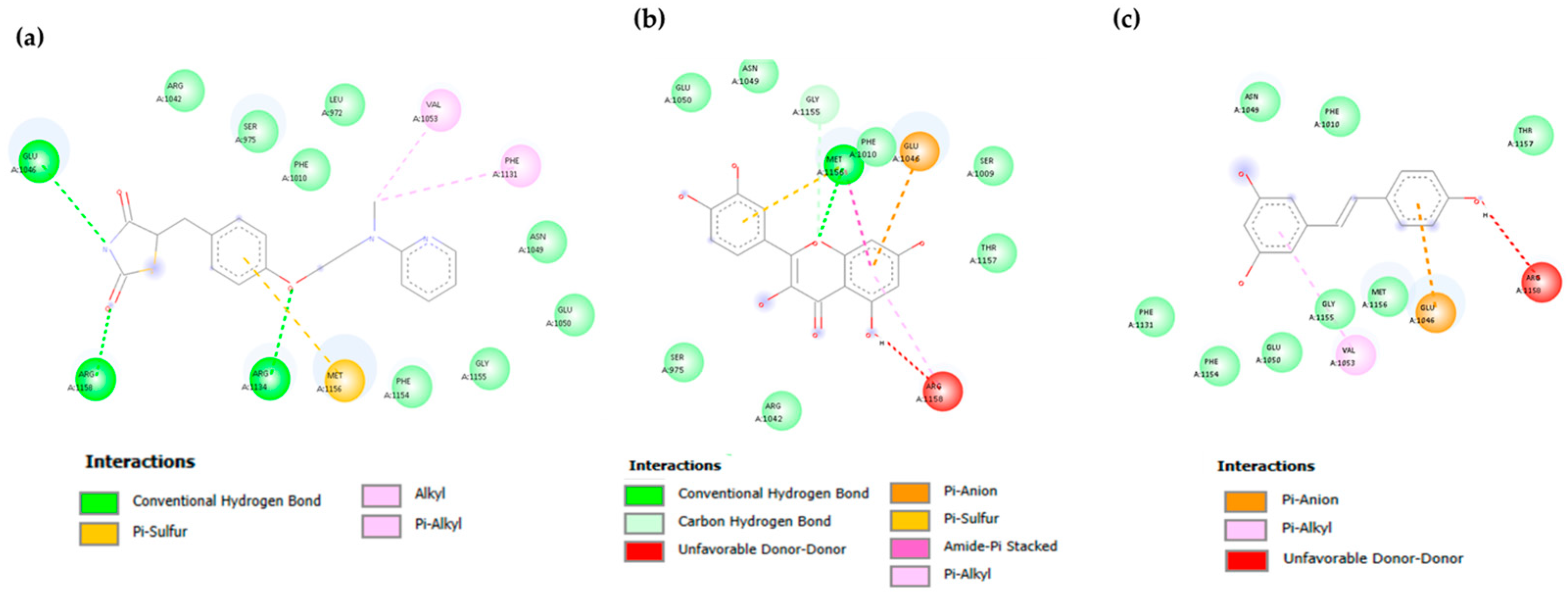
Furthermore, ligand– IGF-1R interactions were analyzed using linsitinib interactions as a reference compound and compared to quercetin and resveratrol interactions (Figure 2). Although linsitinib, resveratrol, and quercetin interact with similar amino acid residues within the binding site, the nature of their interactions differs. For example, Glu1046 forms a conventional hydrogen bond with linsitinib while interacting through pi–anion interactions with both quercetin and resveratrol. Arg1158 forms a conventional hydrogen bond with linsitinib but displays an unfavourable donor–donor interaction with both quercetin and resveratrol. Met1156 engages in a pi–sulphur interaction with linsitinib and forms a conventional hydrogen bond with quercetin. Val1053 is involved in a pi–alkyl interaction with both linsitinib and resveratrol.
Quercetin and resveratrol exhibit favourable interaction potential with IGF1R; however, their binding scores are lower compared to their interactions with other targets. In the context of our analysis, this suggests that these agents exert a stronger influence on the consequences of diabetic disease as antioxidants via MAO enzymes. However, it certainly indicates the potential for research into the use of these two products in antineoplastic therapy.
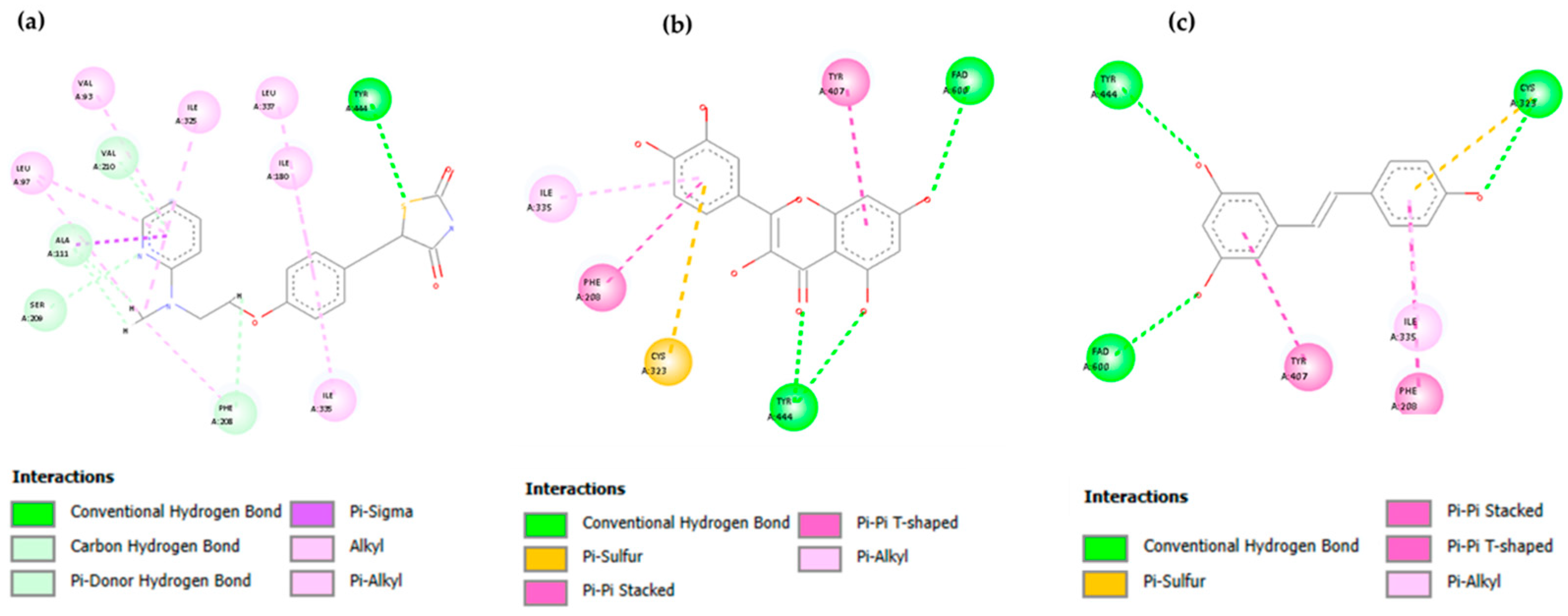
The ligand–protein interaction analysis for MAO-A was conducted by comparing rosiglitazone with quercetin and resveratrol. The most significant structural similarities in their binding modes are as follows: For IleA335, an alkyl/pi–alkyl interaction was observed with this residue across all three ligands; for PheA208, Rosiglitazone forms a pi donor hydrogen bond, whereas quercetin and resveratrol exhibit a pi–pi stacked interaction with this residue; and for TyrA44, a conventional hydrogen bond was present for all three ligands (Figure 3).
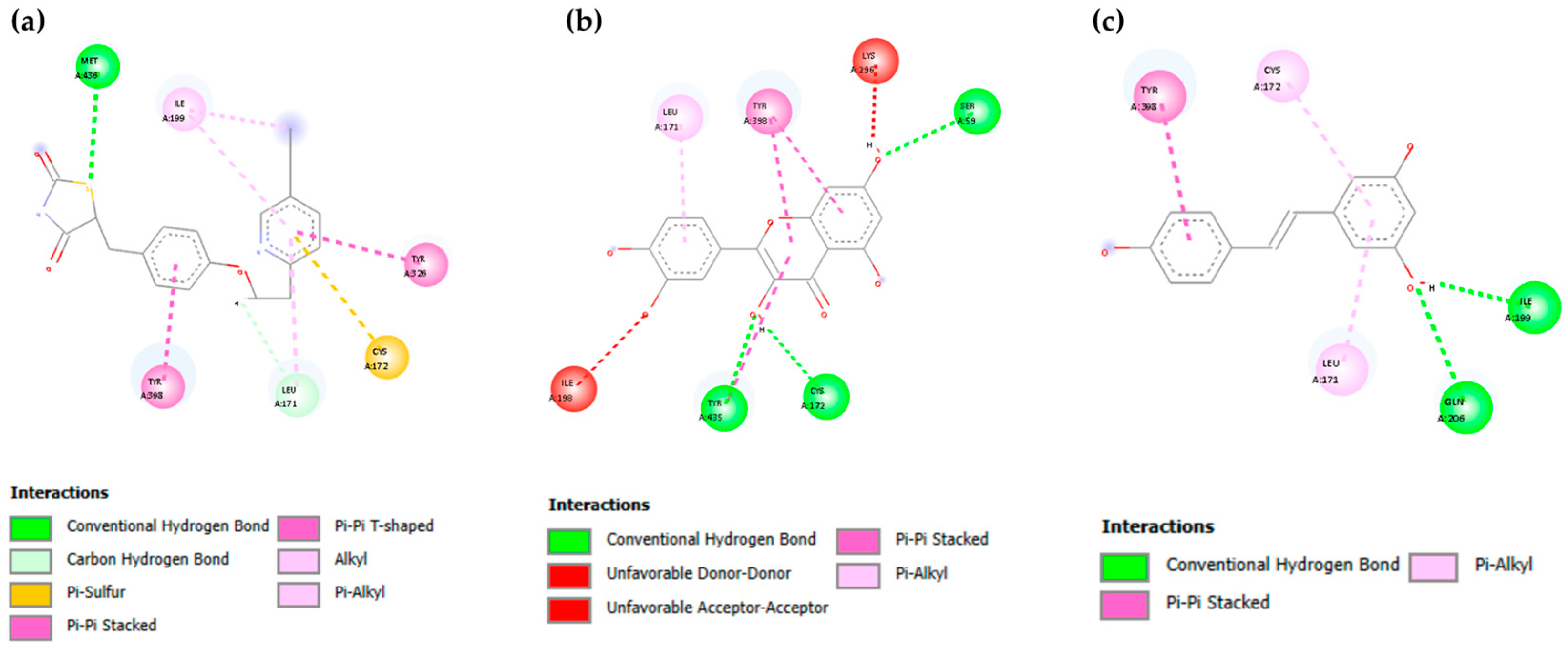
Regarding MAO-B as a target, the interactions of quercetin and resveratrol were compared with those of pioglitazone, and the following observations were made: IleA199 forms an alkyl interaction with pioglitazone and a conventional hydrogen bond with resveratrol. Generally, larger compounds such as pioglitazone and rosiglitazone are docked better in a crystal structure, where Ile 199 adopts the “open” conformation that is not needed for little molecules [13]. CysA172 forms a pi–sulphur interaction with pioglitazone, a pi–alkyl interaction with resveratrol, and a carbon hydrogen bond with quercetin; LeuA171 forms a carbon–hydrogen bond with pioglitazone and pi–alkyl interactions with both quercetin and resveratrol; TyrA398 engages in a pi–pi stacked interaction in all three cases. The interaction of quercetin with Tyr 435 is interesting, as it provides an advantage in increasing the potency of MAO-B inhibition by utilizing a key hydrophobic environment in the enzyme’s active site (Figure 4) [13].

4. Conclusions

Although resveratrol and quercetin are not recognized as conventional antidiabetic drugs, their well-documented antioxidant and anti-inflammatory effects suggest their significant potential in alleviating diabetes-related symptoms and complications. Their increasing use as dietary supplements among diabetic patients highlights the importance of understanding their molecular interactions with key disease-related targets. This study contributes to that understanding by comparing the binding profiles of quercetin and resveratrol with those of established antidiabetic agents (pioglitazone and rosiglitazone) and selected antineoplastic compounds (linsitinib and picropodophyllin), which may exert secondary metabolic effects.
Importantly, this study focuses on non-conventional protein targets associated not only with diabetes itself but also with common comorbidities, particularly those related to ageing, by including classic antidiabetic drugs such as rosiglitazone and pioglitazone—analyzed here at their off-target sites—as well as investigational antineoplastic agents like linsitinib, not just because, in a certain way, they influence metabolic pathways indirectly, but also because significant common biological processes, molecular functions, and pathways from Type 2 diabetes (T2D) are linked to the development of hepatocellular carcinoma HCC and colorectal cancer CRC [12]. The results of this research, which are to be confirmed experimentally, suggest that diabetic patients, who often suffer from multiple comorbid conditions, could benefit from the complementary use of natural polyphenols such as quercetin and resveratrol. These two molecules exhibit promising yet still underexplored properties in terms of their polypharmacology and effects on epigenetic targets, as well as their interactions with targets relevant to both metabolic and age-associated disorders, warranting further investigation into their therapeutic potential.

Author Contributions

Conceptualization, all authors.; methodology, all authors; software, all authors; validation, all authors; formal analysis, all authors; investigation, all authors; resources, M.Z.; data curation, all authors; writing—review and editing, all authors; visualization, all authors; supervision, M.Z.; project administration, M.M.; funding acquisition, all authors. All authors have read and agreed to the published version of the manuscript.

Funding

This research received no external funding.

Institutional Review Board Statement

Not applicable.

Informed Consent Statement

Not applicable.

Data Availability Statement

The research data are available from the authors on request.

Conflicts of Interest

The authors declare no conflicts of interest.

References

  1. Niccoli, T.; Partridge, L. Ageing as a Risk Factor for Disease. Curr. Biol. 2012, 22, R741–R752. [Google Scholar] [CrossRef] [PubMed]
  2. Deepika; Maurya, P.K. Health Benefits of Quercetin in Age-Related Diseases. Molecules 2022, 27, 2498. [Google Scholar] [CrossRef] [PubMed]
  3. Mantadaki, A.E.; Linardakis, M.; Tsakiri, M.; Baliou, S.; Fragkiadaki, P.; Vakonaki, E.; Tzatzarakis, M.N.; Tsatsakis, A.; Symvoulakis, E.K. Benefits of Quercetin on Glycated Hemoglobin, Blood Pressure, PiKo-6 Readings, Night-Time Sleep, Anxiety, and Quality of Life in Patients with Type 2 Diabetes Mellitus: A Randomized Controlled Trial. J. Clin. Med. 2024, 13, 3504. [Google Scholar] [CrossRef] [PubMed]
  4. Ahmadzadeh, A.M.; Aliabadi, M.M.; Mirheidari, S.B.; Hamedi-Asil, M.; Garousi, S.; Mottahedi, M.; Sahebkar, A. Beneficial effects of resveratrol on diabetes mellitus and its complications: Focus on mechanisms of action. Naunyn Schmiedebergs Arch. Pharmacol. 2025, 398, 2407–2442. [Google Scholar] [CrossRef] [PubMed]
  5. Basagni, F.; Di Paolo, M.L.; Cozza, G.; Dalla Via, L.; Fagiani, F.; Lanni, C.; Rosini, M.; Minarini, A. Double Attack to Oxidative Stress in Neurodegenerative Disorders: MAO-B and Nrf2 as Elected Targets. Molecules 2023, 28, 7424. [Google Scholar] [CrossRef] [PubMed]
  6. Binda, C.; Aldeco, M.; Geldenhuys, W.J.; Tortorici, M.; Mattevi, A.; Edmondson, D.E. Molecular Insights into Human Monoamine Oxidase B Inhibition by the Glitazone Antidiabetes Drugs. ACS Med. Chem. Lett. 2012, 3, 39–42. [Google Scholar] [CrossRef] [PubMed]
  7. Almeida-Nunes, D.L.; Silva, J.P.N.; Nunes, M.; Silva, P.M.A.; Silvestre, R.; Dinis-Oliveira, R.J.; Bousbaa, H.; Ricardo, S. Metformin Impairs Linsitinib Anti-Tumor Effect on Ovarian Cancer Cell Lines. Int. J. Mol. Sci. 2024, 25, 11935. [Google Scholar] [CrossRef] [PubMed]
  8. Zheng, J.; Liu, Y.; Zhu, F.; Liu, S.; Cai, Z.; Liu, M.; An, X.; Yao, Y.; Chen, N.; Guo, D. Picropodophyllin induces ferroptosis via blockage of AKT/NRF2/SLC7A11 and AKT/NRF2/SLC40A1 axes in hepatocellular carcinoma as a natural IGF1R inhibitor. Phytomedicine 2025, 143, 156840. [Google Scholar] [CrossRef] [PubMed]
  9. Gfeller, D.; Grosdidier, A.; Wirth, M.; Daina, A.; Michielin, O.; Zoete, V. SwissTargetPrediction: A web server for target prediction of bioactive small molecules. Nucleic Acids Res. 2014, 42, W32–W38. [Google Scholar] [CrossRef] [PubMed]
  10. Oladipo, S.D.; Luckay, R.C.; Olalekan, S.O.; Badeji, A.A.; Matinise, N.; Tshikhudo, F. Investigating the Inhibitory Potential of Halogenated Quinoline Derivatives against MAO-A and MAO-B: Synthesis, Crystal Structure, Density Functional Theory, and Molecular Dynamics Simulations. ACS Omega 2025, 10, 26500–26519. [Google Scholar] [CrossRef] [PubMed]
  11. Shen, Y.; Pang, L.; Wang, H.; Han, Q.; Wan, W.; Luo, S.; Song, Z.; Fang, Y.; Chen, H.; Qiu, Y.; et al. Comprehensive Analysis of Uric Acid and Myasthenia Gravis: IGF1R as a Protective Factor and Potential Therapeutic Target. CNS Neurosci. Ther. 2025, 31, e70361. [Google Scholar] [CrossRef] [PubMed]
  12. Mahmud, S.; Ajadee, A.; Sarker, A.; Ahmmed, R.; Noor, T.; Pappu, M.A.A.; Islam, M.S.; Mollah, M.N.H. Exploring common genomic biomarkers to disclose common drugs for the treatment of colorectal cancer and hepatocellular carcinoma with type-2 diabetes through transcriptomics analysis. PLoS ONE 2025, 20, e0319028. [Google Scholar]
  13. Carroll, R.T.; Dluzen, D.E.; Stinnett, H.; Awale, P.S.; Funk, M.O.; Geldenhuys, W.J. Structure–activity relationship and docking studies of thiazolidinedione-type compounds with monoamine oxidase B. Bioorg. Med. Chem. Lett. 2011, 21, 4798–4803. [Google Scholar] [PubMed]
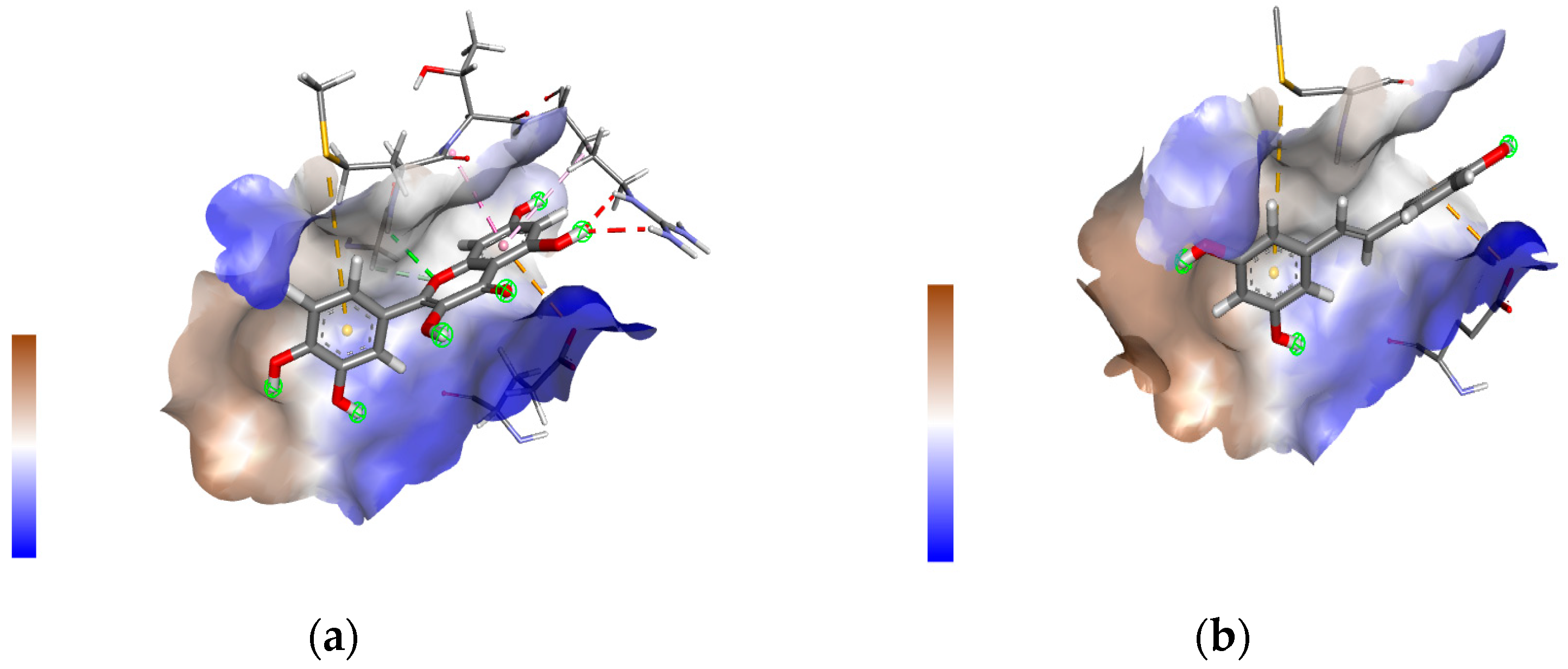
Figure 1. Most favourable poses of the studied molecules within the IGF-1R binding site, shown as a surface coloured according to hydrophobicity (hydrophobic—brown; hydrophilic—blue): (a) quercetin- IGF-1R; (b) resveratrol-IGF-1R.
Chemproc 18 00053 g001
Figure 2. Two-dimensional ligand–protein interaction plots: (a) IGF-1R–linstinib interaction; (b) IGF-1R–quercetin interaction; (c) IGF-1R resveratrol interaction.
Chemproc 18 00053 g002
Figure 3. Two-dimensional ligand–protein interaction plots: (a) MAO-A–rosiglitazone interaction; (b) MAO-A–quercetin interaction; (c) MAO-A–resveratrol interaction.
Chemproc 18 00053 g003
Figure 4. Two-dimensional ligand–protein interactions plots: (a) MAO-B–pioglitazone interaction; (b) MAO-B–quercetin interaction; (c) MAO-B–resveratrol interaction.
Chemproc 18 00053 g004
Table 1. A subset of predicted targets quercetin and resveratrol obtained using SwissTargetPrediction.
Target NameCommon NameProbability
Quercetin
Probability Resveratrol
NADPH oxidase 4NOX41.00
Monoamine oxidase AMAO -A1.01.0
Insulin-like growth factorIGF-1R1.00.049
Cytochrome P450 19A1CYP19A11.00.058
Epidermal growth factorEGFR1.00.049
Tyrosine-protein kinase receptorFLT31.00
Arachidonate 5-lipoxygenaseALOX51.00.058
Table 2. Predicted binding energies (kcal/mol) of selected molecules against MAO-A, MAO-B, and IGF1R.
Molecule NameTherapeutical IndicationMAO-AMAO-BIGF1R
Linsitinibanticancer−8.1−9.8−5.9
Metforminantidiabetic−5.6−4.8−4.2
Picropodophyllinanticancer6.5−9.2−7.5
Pioglitazoneantidiabetic−8.2−10.2−6.8
Rosiglitazoneantidiabetic−8.1−9.7−6.9
Quercetinantioxidant−7.8−9.4−6.9
Resveratrolantioxidant−8.4−8.5−6.5
Disclaimer/Publisher’s Note: The statements, opinions and data contained in all publications are solely those of the individual author(s) and contributor(s) and not of MDPI and/or the editor(s). MDPI and/or the editor(s) disclaim responsibility for any injury to people or property resulting from any ideas, methods, instructions or products referred to in the content.