Proceeding Paper

Oxazole-Based Compounds: Synthesis and Anti-Inflammatory Studies †

by
Sofia Gomes
1,2,
Daniela Correia da Silva
2,
David M. Pereira
2 and
M. Sameiro T. Gonçalves
1,*
1
Chemistry Centre of the University of Minho (CQ-UM), Department of Chemistry, University of Minho, Campus of Gualtar, 4710-057 Braga, Portugal
2
REQUIMTE/LAQV, Laboratory of Pharmacognosy, Department of Chemistry, Faculty of Pharmacy, University of Porto, 4050-313 Porto, Portugal
*
Author to whom correspondence should be addressed.
Presented at the 29th International Electronic Conference on Synthetic Organic Chemistry, 14–28 November 2025; Available online: https://sciforum.net/event/ecsoc-29.
Chem. Proc. 2025, 18(1), 36; https://doi.org/10.3390/ecsoc-29-26668

Published: 11 November 2025

Abstract

A series of linear and angular naphthoxazoles bearing chlorophenyl or aminochlorophenyl substituents at position 2 of the tricyclic system were synthesized and their anti-inflammatory potential was evaluated. Synthesized molecules proved to inhibit multiple pro-inflammatory pathways, providing valuable insights for future drug design.

1. Introduction

Inflammation is a protective response of the immune system to various stimuli, including infections and external aggressions like injuries that result in tissue damage, leading to symptoms such as redness, pain, swelling, and warmth [1,2]. Nuclear Factor kappa B (NF-kB) mediates one major inflammatory signaling pathway. Once activated, it mediates the transcription of genes that encode pro-inflammatory cytokines, adhesion molecules, anti-apoptotic proteins, chemokines, and enzymes such as cyclooxygenase-2 (COX-2), in an attempt to restore homeostasis [3]. COX-2 and lipoxygenase (LOX) are key inflammatory mediators involved in the arachidonic acid cascade, which mediates phospholipid conversion into prostaglandins through the action of COX-2, and the LOX-mediated production of leukotrienes. These lipid mediators, in turn, regulate inflammation and immunity and play roles in multiple diseases, including inflammatory bowel disease, rheumatoid arthritis, asthma, and cancer progression [4].
Nonsteroidal anti-inflammatory drugs (NSAIDs) are commonly used to treat inflammation. However, they have been associated with various adverse effects, including cardiovascular diseases, gastrointestinal and kidney complications [4]. Natural products are an important source of anti-inflammatory agents, providing promising alternatives or complements to synthetic drugs. Their importance stems from their structural diversity and ability to target multiple inflammatory pathways. Being associated with a lower risk of side effects, natural products can be attractive therapeutic options against chronic diseases [4,5,6]. Oxazoles and benzene-ring-fused oxazoles are heterocyclic compounds of natural origin that are currently employed in pharmaceuticals and functional materials [7]. They occur mostly in marine organisms, such as sea sponges, and their diverse biological activities have sparked interest in research into their biosynthesis, chemical synthesis, and potential applications [8,9,10,11]. The five-membered ring structure of these heterocycles, containing nitrogen and oxygen, allows their interaction with various enzymes and receptors, making them attractive for drug development [12]. In fact, natural oxazoles and their derivatives exhibit a wide range of biological activities, showing potential applications against cardiovascular and respiratory diseases, thrombosis, as well as anticancer [13], antimicrobial [14], antifungal [15], anti-inflammatory [16] and analgesic [17] properties.
Considering these aspects, naphtho[2,3-d]oxazole and naphtho[1,2-d]oxazole derivatives were synthesized using polyphosphoric acid (PPA), fully characterized by standard analytical techniques and evaluated for their potential anti-inflammatory activity. The results indicate that naphthoxazole derivatives can modulate multiple inflammatory pathways.

2. Results and Discussion

2.1. Synthesis of Naphthoxazole Derivatives

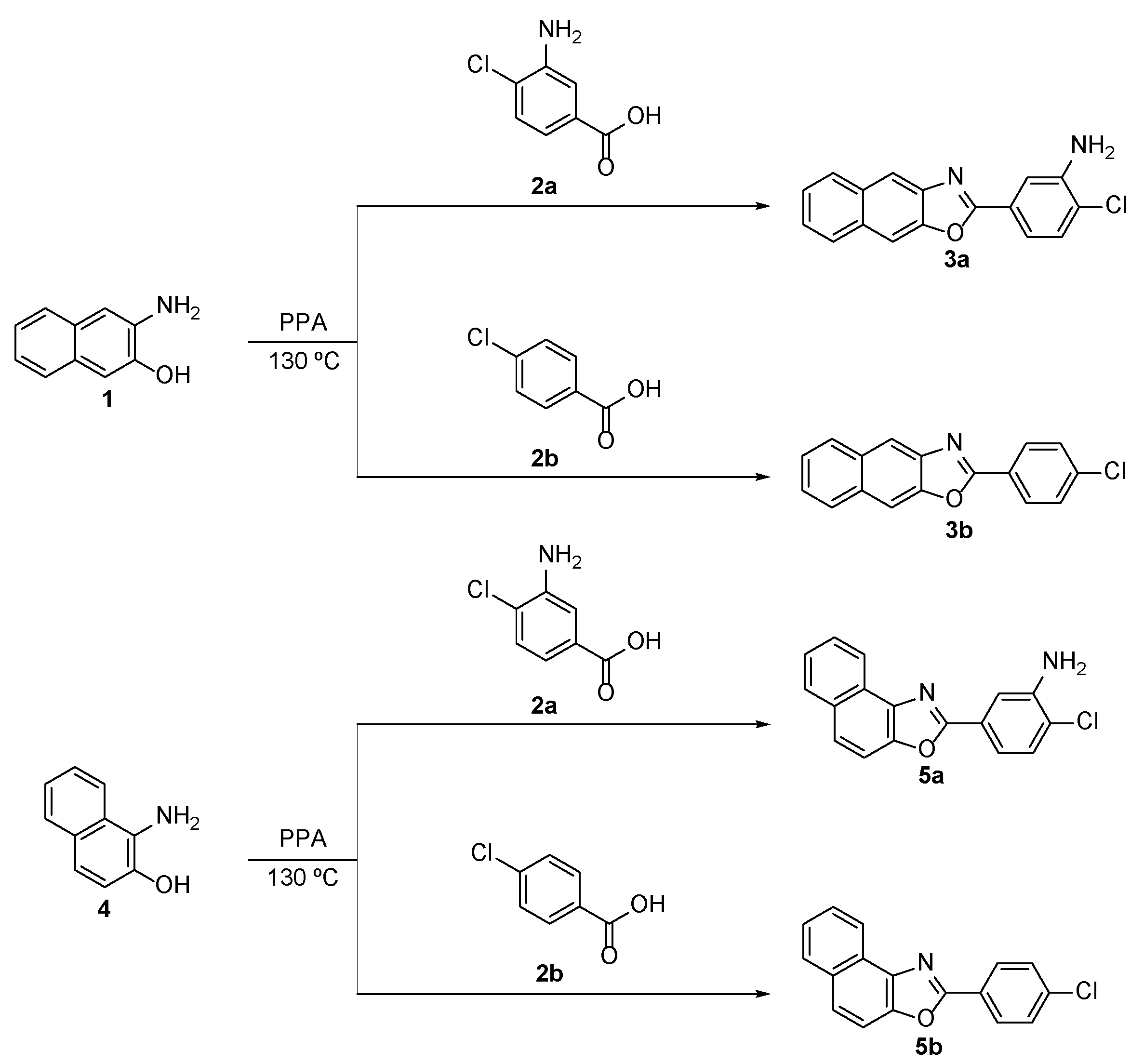
The naphthoxazoles derivatives 3a,b and 5a,b were prepared by reacting 3-amino-2-naphthol 1 or 1-amino-2-naphthol 4 with the 3-amino-4-chlorobenzoic acid 2a or 4-chlorobenzoic acid 2b in PPA, a moderately strong mineral protic acid with powerful dehydrating properties [18], at 130 °C with stirring, followed by dry flash, column or preparative layer chromatography on silica gel using mixtures with increasing polarity of light petroleum and chloroform or dichloromethane as eluents. The expected 2-chloro-5-(naphtho[2,3-d]oxazol-2-yl)aniline 3a, 2-(4-chlorophenyl)naphtho[2,3-d]oxazole 3b, 2-chloro-5-(naphtho[1,2-d]oxazol-2-yl)aniline 5a and 2-(4-chlorophenyl)naphtho[1,2-d]oxazole 5b (Scheme 1) were isolated as yellow solids and their structures confirmed by the usual analytical techniques.
The 1H NMR spectra of compounds 3a,b showed the peaks correspondent to protons of the naphthalene ring system: H-4 appeared as singlets (δH 8.21–8.31 ppm), while H-9 appeared as a singlet or multiplet in the case of 3aH 7.96–8.23 ppm). For compounds 5a,b the peaks corresponding to H-4 (δH 7.73–7.76 ppm) and H-5 (δH 7.81–7.82 ppm) were observed as doublets. The protons associated with the carboxylic acid moiety showed characteristic signals: for 3a, H-4 appeared as a multiplet (δH 7.40–7.46 ppm) and H-6 as a meta doublet (δH 7.75 ppm). In 3b, H-2 and H-6 appeared as a doublet of doublets (δH 8.28 ppm). For 5a, H-4 and H-6 of the carboxylic acid ring appeared as a triplet (δH 7.56 ppm) and a meta doublet (δH 7.41 ppm), respectively; compound 5b exhibited H-2 and H-6 as a double triplet (δH 8.27 ppm).
Regarding the 13C NMR spectra, the quaternary carbon corresponding to the C-2 of the oxazole ring of 3a,bC 164.04–164.14 ppm) and 5a,bC 161.32–161.75 ppm) is exhibit. Signals of the naphthalene ring were also observed: C-4 (δC 116.92–117.46 ppm) and C-9 (δC 106.42–106.44 ppm) for 3a,b and C-4 (δC 110.74 ppm) and C-5 (δC 114.07–126.30 ppm) for 5a,b were shown.

2.2. LOX Inhibition

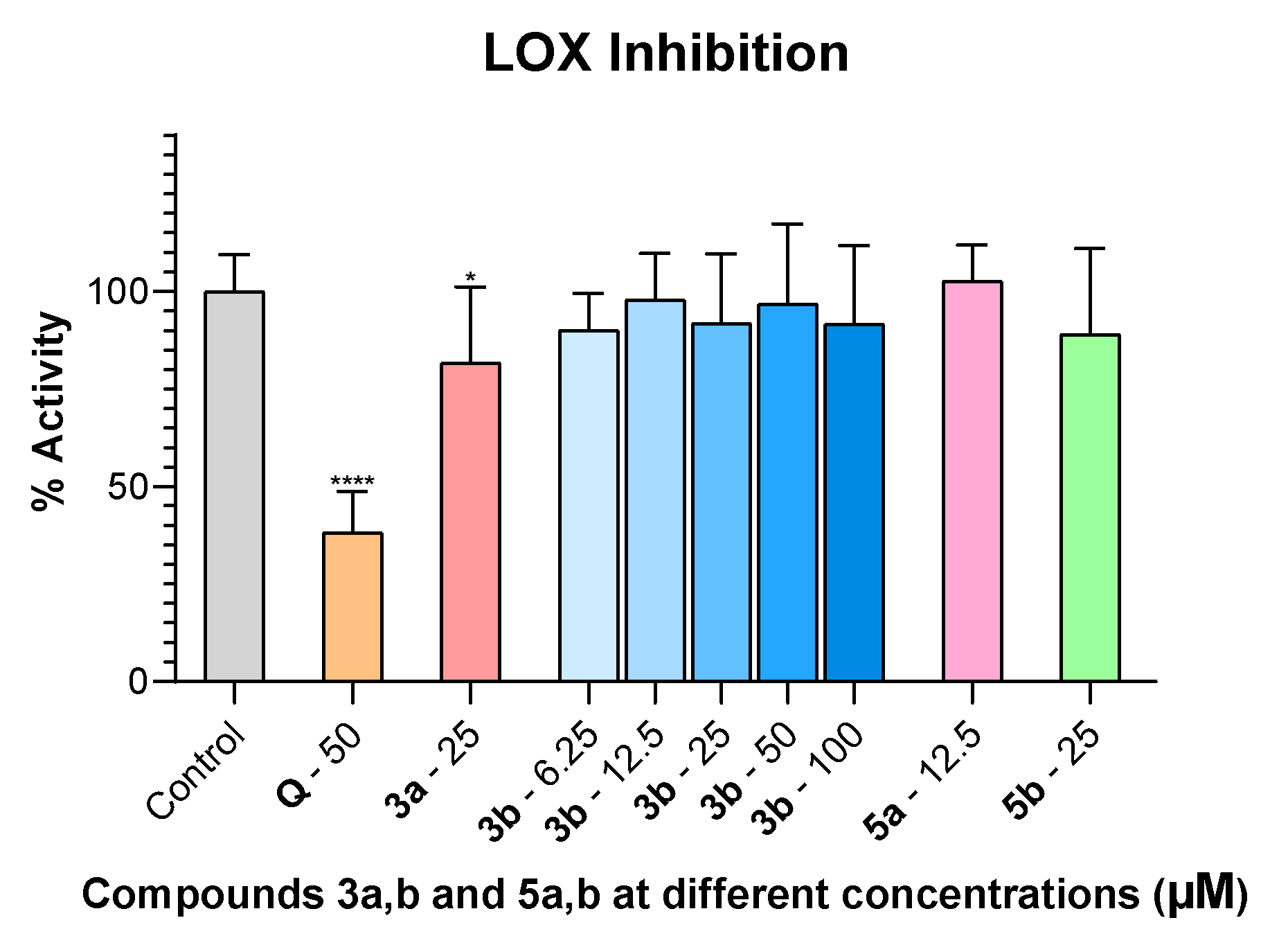
The naphthoxazole derivatives 3a,b and 5a,b were submitted to a LOX inhibition screening in order to evaluate their activity as potential LOX inhibitors (Figure 1). Compound 3b was tested at varying concentrations up to a maximum of 100 µM, while the remaining compounds were tested at 25 µM or 12.5 µM due to limited solubility. Compound 3a significantly inhibited LOX activity at 25 μM, whereas the other compounds were inactive.
In this study, quercetin was used as a positive control due to its well-known ability to inhibit the LOX enzyme [19]. Quercetin is a flavonoid, meaning that it contains a rich structure in hydroxyl groups and a conformation that allows the blockage of the enzyme’s catalytic activity through iron chelation.
The activity of 3a might be associated with the linear structure of the naphthalene in the molecule, complemented by the amino group. Accordingly, the inactivity of the remaining compounds might be due to the absence of the amino group, in the case of 3b, or the angular structure of the naphthalene, in 5a,b. A limitation of this assay is that the enzyme is derived from soybean, and, accordingly, the results warrant subsequent validation in a human model of 5-LOX.

2.3. Viability Assays

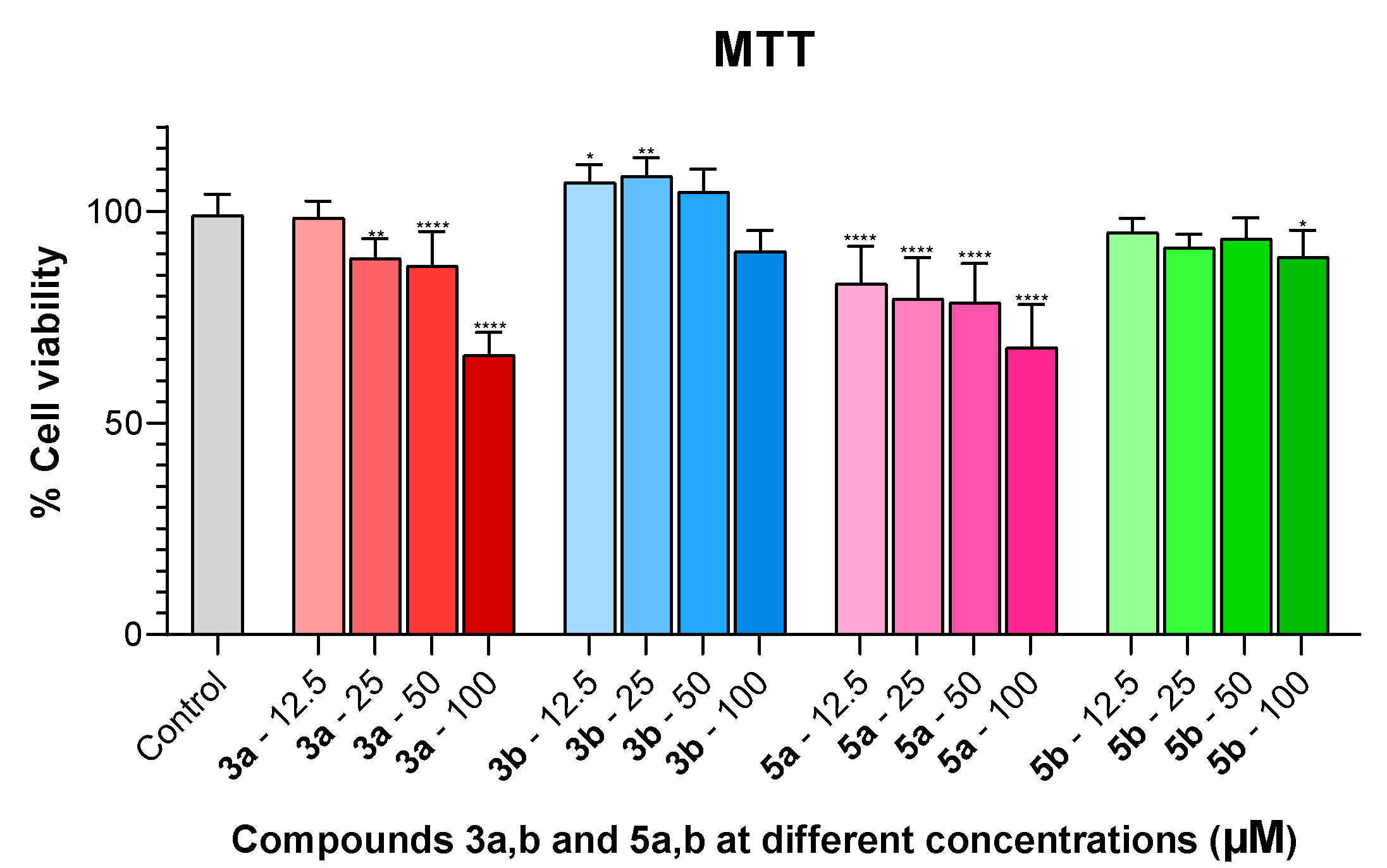
Viability assays in the presence of naphthoxazole derivatives 3a,b and 5a,b were carried out in THP1-Dual™ cells (Invivogen, San Diego, CA, USA) through MTT (3-(4,5-dimethylthiazol-2-yl)-2,5-diphenyltetrazolium bromide) reduction assays (Figure 2).
The results have shown that compound 3a exerts a statistically significant viability loss from 25 μM. In contrast, compound 3b does not exhibit any statistically significant cytotoxicity. Compound 5a caused a statistically significant decrease in viability from 12.5 μM, whereas compound 5b was significantly cytotoxic only at 100 μM. These results suggest that the angular structure of the naphthalene and the presence of the amino group in the molecule increases the cytotoxicity in THP1-Dual™ cells.

2.4. NF-kB Inhibition

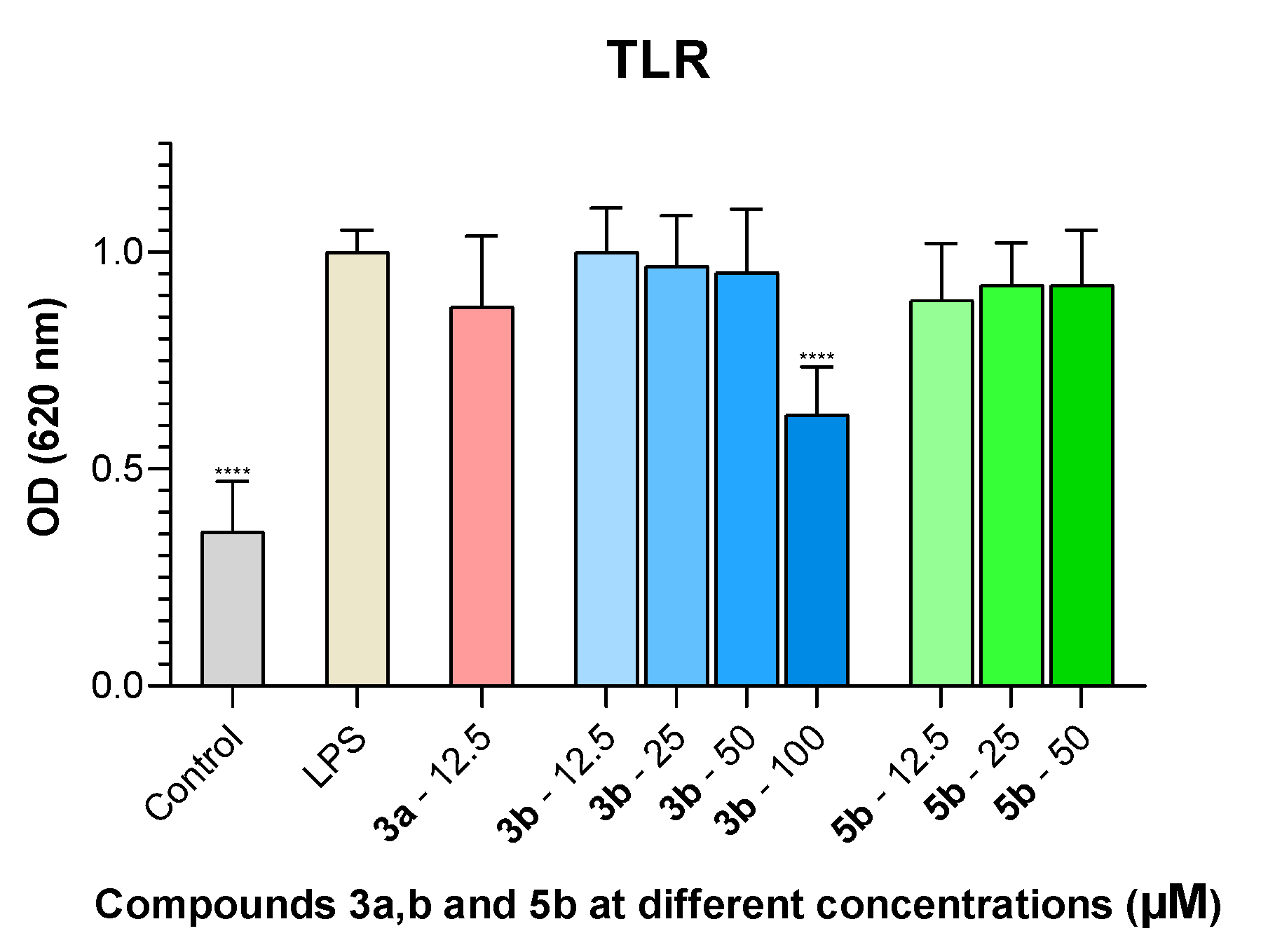
Most of the tested molecules failed to inhibit lipopolysaccharide (LPS)-induced NF-κB activation. The exception was compound 3b, which significantly inhibited TLR (Toll-Like Receptor) signalling at 100 μM (Figure 3). This observation suggests that either the angular structure of the naphthoxazole moiety or the presence of the amino group in the linear naphthalene structure may be responsible for the activity of these compounds as NF-kB inhibitors (Figure 3).

2.5. IFN Inhibition

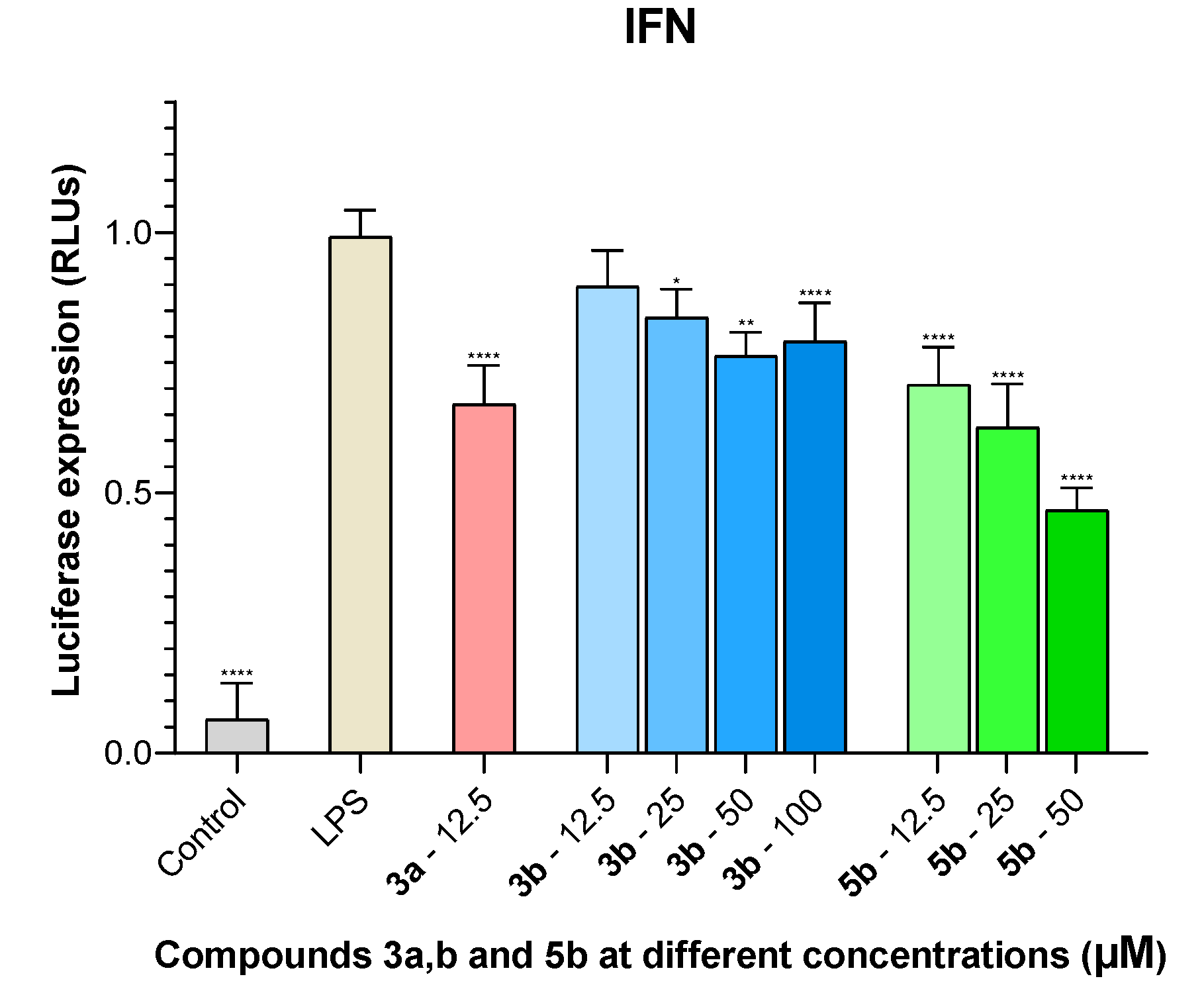
Results revealed that all three evaluated compounds inhibited Interferon Regulatory Factor (IRF) activation. Compound 3a displayed the strongest activity at a 12.5 μM concentration, followed by compound 5b. The latter showed a clear dose-dependent inhibitory activity, while compound 3b exhibited a weaker inhibitory effect (Figure 4). Given that compound 5b combines a stronger inhibitory potency with low cytotoxicity, it may be considered a promising IRF inhibitor candidate. This activity might be due to the presence of its angular naphthalene moiety and the absence of an amino substituent.

3. Materials and Methods

3.1. General Procedure for the Preparation of Naphthoxazole Derivatives 3a,b and 5a,b (Illustrated for 5b)

A mixture of 1-aminonaphthalen-2-ol hydrochloride 4 (0.196 g, 1 mmol) and 4-chlorobenzoic acid 2b (0.157 g, 1 mmol) in PPA (1 g) was gradually heated to 130 °C under stirring for 7 h. The reaction was followed by TLC (light petroleum/dichloromethane, 1:1) and once finished, the mixture was poured into ice-cold water and stirred for 1 h to afford a fine precipitate. The solid was collected by vacuum filtration, washed with cold water to remove the remaining PPA, air-dried, and purified by preparative layer chromatography using light petroleum and dichloromethane (1:1) as the eluent, yielding compound 5b as a yellow solid (0.035 g, 13% yield). Rf = 0.55 (light petroleum/dichloromethane, 1:1). m.p. = 189.0–191.8 °C. IR: υmax (solid) 3057, 2918, 1638, 1602, 1528, 1476, 1237, 1089, 784, 728 cm−1. 1H NMR (CDCl3, 400 MHz): δH 7.53 (2H, dt, J = 8.8 and 2.4 Hz, H-3 (4-Cl-Ph) and H-5 (4-Cl-Ph)), 7.57(1H, td, J = 6.8 and 1.2 Hz, H-7), 7.70 (1H, td, J = 6.8 and 1.2 Hz, H-8), 7.73 (1H, d, J = 8.8 Hz, H-4), 7.82 (1H, d, J = 8.8 Hz, H-5), 7.98 (1H, d, H-6), 8.27 (2H, dt, J = 8.8 and 2.4 Hz, H-2 (4-Cl-Ph) and H-6 (4-Cl-Ph)), 8.58 (1H, dt, J = 8.4 and 1.0 Hz, H-9) ppm. 13C NMR (CDCl3, 100.6 MHz): δC 110.74 (C-4), 122.20 (C-9), 125.49 (C-7), 126.00 (C-1 (4-Cl-Ph)), 126.30 (C-5), 126.51 (C-9a), 127.08 (C-8), 128.56 (C-2 (4-Cl-Ph) and C-6 (4-Cl-Ph)), 128.60 (C-6), 129.24 (C-3(4-Cl-Ph) and C-5 (4-Cl-Ph)), 131.25 (C-5a), 137.23 (C-4 (4-Cl-Ph)), 137.54 (C-9b), 148.07 (C-3a), 161.32 (C-2) ppm.

3.2. Biological Assays

3.2.1. Statistical Analysis

GraphPad Prism 8 software (version 8.0.2) was utilized for the statistical analysis, namely, to perform One-way ANOVA. Multiple comparisons Dunnett test was used to compare single treatments with control groups, with values of p < 0.05 considered statistically significant. Furthermore, outliers were detected with Grubbs’ test.

3.2.2. LOX Inhibition Procedure

The LOX activity assay from Glycine max (soybean) (Sigma-Aldrich, St. Louis, MO, USA) was based on the linoleic acid (Sigma-Aldrich, St. Louis, MO, USA) oxidation. The formation of conjugated hydroperoxides was spectrophotometrically monitored at 234 nm, and the procedure was carried out at 25 °C in a sodium phosphate-buffer solution (pH 9.0, 0.1 M) (Sigma-Aldrich, St. Louis, MO, USA).
Samples were added in phosphate buffer in a 96-well UV transparent microplate. Quercetin (Sigma-Aldrich, St. Louis, MO, USA) at 50 μM was used as a positive control for enzyme inhibition. Enzyme at 1.25 μL/mL, previously dissolved in phosphate buffer, was added, and the microplate was incubated at 25 °C for 5 min. At this point, linoleic acid at 1.3 μL/mL was added, and the reaction was monitored for 3 min at 234 nm.

3.2.3. Cell Culture Conditions

THP1-Dual™ monocytes (Invivogen, San Diego, CA, USA), containing the NF-kB and IRF reporter systems, were maintained at 37 °C with 5% CO2 in RPMI 1640 medium (Invivogen, San Diego, CA, USA) supplemented with 10% heat-inactivated fetal bovine serum (FBS) (Invivogen, San Diego, CA, USA), 2 mM L-glutamine (Invivogen, San Diego, CA, USA), 25 mM HEPES (Invivogen, San Diego, CA, USA), 100 μg/mL Normocin™ (Invivogen, San Diego, CA, USA) and Pen-Strep (100 U/Ml–100 μg/mL) (Invivogen, San Diego, CA, USA). Additionally, as recommended by the supplier, 10 µg/mL of Blasticidin (Invivogen, San Diego, CA, USA) and 100 μg/mL of Zeocin® (Invivogen, San Diego, CA, USA) were added to the growth medium every other passage to ensure selective pressure.

3.2.4. MTT Reduction Assays

Cellular viability was assessed by MTT (Sigma-Aldrich, St. Louis, MO, USA) reduction assays conducted in 96-well plates. THP1-Dual™ monocytes were seeded at a density of 6 × 10⁴ cells/well. To promote the monocyte differentiation into macrophages, PMA (Sigma-Aldrich, St. Louis, MO, USA) at 50 nM was added when seeding. After 24 h, the medium containing PMA was discarded and replaced with fresh medium. Macrophages were then incubated with the test compounds for 24 h. Then, the medium was replaced with MTT at 0.5 mg/mL. After incubation for 2 h, the MTT solution was removed, and the resulting formazan crystals were dissolved in a 3:1 DMSO:isopropanol (Fisher Chemical, Loughborough, UK and Merck, Darmstadt, Germany, respectively). solution. Absorbance was then measured at 560 nm in a Thermo Scientific™ Multiskan™ GO microplate reader (Thermo Fisher Scientific Oy, Vantaa, Finland).

3.2.5. TLR Stimulation Assay

The NF-κB pathway in THP1-Dual™ cells was monitored by the colorimetric quantification of the expression of a secreted embryonic alkaline phosphatase (SEAP) acting as a reporter gene. Activation of this pathway was induced by LPS, a TLR agonist. Cytotoxic concentrations were excluded from this assay to preserve the veracity of the results. Seeding of THP1-Dual™ monocytes was performed as described for the MTT reduction assays. After 2 h of incubation with the molecules of interest, LPS (from Escherichia coli) (Sigma-Aldrich, St. Louis, MO, USA) at 1 µg/mL was added to all wells except for the control group, promoting polarization of the macrophages into their pro-inflammatory phenotype. After 24 h of incubation with compounds, or after 22 h of the addition of LPS, 20 µL of medium from each well was transferred to a flat-bottom 96-well plate, where 50 µL of QUANTI-Blue™ Solution (Invivogen, San Diego, CA, USA), a SEAP detection reagent, was added to each well, according to the instructions of the supplier. To determine SEAP levels, absorbance was read at 620 nm using a CytationTM 3 (BioTek Instruments, Inc., Winooski, VT, USA) microplate reader 620 nm.

3.2.6. IFN Induction Assay

The IRF pathway was monitored by resorting to a luciferase reporter gene in the THP1-Dual™ cells. Increased luciferase activity indicates IRF activation and consequent interferon (IFN) production. As in the TLR activation assay, LPS at 1 µg/mL was employed as a positive control for IFN activation, and concentrations that compromised cell viability were excluded. THP1-Dual™ monocyte seeding was performed as described for the TLR assay. After 24 h of incubation with compounds, or after 22 h of the addition of LPS, 10 µL of THP1-Dual™ cell culture medium from each well per well was transferred to a 96-well white (opaque) plate, where 50 µL of QUANTI-Luc™ 4 Lucia/Gaussia substrate solution (Invivogen, San Diego, CA, USA), a Lucia and Gaussia luciferase detection reagent, was added to each well, as according to the instructions from the supplier. Luminescence was immediately read in a CytationTM 3 (BioTek) microplate reader.

4. Conclusions

The present work involved the synthesis and characterization of naphthoxazole derivatives and the evaluation of their potential anti-inflammatory activity in the LOX, NF-kB and IRF pathways. Regarding their activity as LOX inhibitors, compound 3a exhibited activity, which might be associated with the linear structure of the naphthalene in the molecule, complemented by the amino group. At nontoxic concentrations, compound 3b exerted statistically significant activity as an NF-kB inhibitor and compound 3a exhibited the most significant inhibition as an IRF inhibitor. These results enable the acquisition of structure–activity relationship knowledge for the design of new derivatives with improved activity.
Future prospects may include new trials to better characterize these compounds as anti-inflammatory agents, particularly through performing additional COX-2 inhibitor screening assays.

Author Contributions

Conceptualization: M.S.T.G. and D.M.P.; investigation: S.G. and D.C.d.S.; formal analysis: S.G.; resources: M.S.T.G. and D.M.P.; supervision: M.S.T.G. and D.M.P.; writing—original draft preparation: S.G.; writing—review and editing: M.S.T.G. and D.C.d.S. All authors have read and agreed to the published version of the manuscript.

Funding

This work was supported by the Portuguese Foundation for Science and Technology (FCT) in the framework of the Strategic Funding UID/00686/2025. https://doi.org/10.54499/UID/00686/2025: Centro de Química da Universidade do Minho (CQ-UM/UM). The NMR spectrometer Bruker Avance III 400 is part of the National NMR Network and was purchased within the framework of the National Program for Scientific Re-equipment, contract REDE/1517/RMN/2005 with funds from POCI 2010 (FEDER) and FCT. The work was also supported through projects UIDB/50006/2020 and UIDP/50006/2020, funded by FCT (Fundação para a Ciência e Tecnologia, Portugal)/MCTES (Ministério da Ciência, Tecnologia e Ensino Superior) through national funds, and also COMPETE2030-FEDER-00679600, operation 15697, funded by FEDER under COMPETE 2030 and FCT national budget.

Institutional Review Board Statement

Not applicable.

Informed Consent Statement

Not applicable.

Data Availability Statement

The data presented in this study are available on request from the corresponding author.

Conflicts of Interest

The authors declare no conflicts of interest.

Abbreviations

The following abbreviations are used in this manuscript:
COX-2Cyclooxygenase-2
IFNInterferon
IRFInterferon Regulatory Factor
LOXLipoxygenase
LPSLipopolysaccharide
MTT3-(4,5-dimethylthiazol-2-yl)-2,5-diphenyltetrazolium bromide
NF-kBNuclear Factor kappa B
NSAIDsNonsteroidal Anti-inflammatory Drugs
PMAPhorbol 12-myristate 13-acetate
PPAPolyphosphoric Acid
SEAPSecreted Embryonic Alkaline Phosphatase
TLRToll-Like Receptor

References

  1. Jacob, P.J.; Manju, S.L.; Ethiraj, K.R.; Elias, G. Safer anti-inflammatory therapy through dual COX-2/5-LOX inhibitors: A structure-based approach. Eur. J. Pharm. Sci. 2018, 121, 356–381. [Google Scholar] [CrossRef]
  2. Megha, K.B.; Joseph, X.; Akhil, V.; Mohanan, P.V. Cascade of immune mechanism and consequences of inflammatory disorders. Phytomedicine 2021, 91, 153712. [Google Scholar] [CrossRef] [PubMed]
  3. Soares, C.L.R.; Wilairatana, P.; Silva, L.R.; Moreira, P.S.; Barbosa, N.M.M.V.; da Silva, P.R.; Coutinho, H.D.M.; de Menezes, I.R.A.; Felipe, C.F.B. Biochemical aspects of the inflammatory process: A narrative review. Biomed. Pharmacother. 2023, 168, 115764. [Google Scholar] [CrossRef]
  4. Mukhopadhyay, N.; Shukla, A.; Makhal, P.N.; Kaki, V.R. Natural product-driven dual COX-LOX inhibitors: Overview of recent studies on the development of novel anti-inflammatory agents. Heliyon 2023, 9, e14569. [Google Scholar] [CrossRef] [PubMed]
  5. Guo, Y.; Peng, X.; Liu, F.; Zhang, Q.; Ding, L.; Li, G.; Qiu, F. Potential of natural products in inflammation: Biological activities, structure–activity relationships, and mechanistic targets. Arch. Pharm. Res. 2024, 47, 377–409. [Google Scholar] [CrossRef] [PubMed]
  6. Gouda, N.A.; Alshammari, S.O.; Abourehab, M.A.S.; Alshammari, Q.A.; Elkamhawy, A. Therapeutic potential of natural products in inflammation: Underlying molecular mechanisms, clinical outcomes, technological advances, and future perspectives. Inflammopharmacology 2023, 31, 2857–2883. [Google Scholar] [CrossRef] [PubMed]
  7. Li, S.; Mei, Y.; Jiang, L.; Yang, X.; Zeng, W.; Du, Y. Oxazole and isoxazole-containing pharmaceuticals: Targets, pharmacological activities, and their SAR studies. RSC Med. Chem. 2025, 16, 1879–1890. [Google Scholar] [CrossRef] [PubMed]
  8. Wong, X.K.; Yeong, K.Y. A Patent Review on the Current Developments of Benzoxazoles in Drug Discovery. ChemMedChem 2021, 16, 3237–3262. [Google Scholar] [CrossRef] [PubMed]
  9. Di Martino, S.; De Rosa, M. The Benzoxazole Heterocycle: A Comprehensive Review of the Most Recent Medicinal Chemistry Developments of Antiproliferative, Brain-Penetrant, and Anti-inflammatory Agents. Top. Curr. Chem. 2024, 382, 33. [Google Scholar] [CrossRef] [PubMed]
  10. Chen, J.; Lv, S.; Liu, J.; Yu, Y.; Wang, H.; Zhang, H. An Overview of Bioactive 1,3-Oxazole-Containing Alkaloids from Marine Organisms. Pharmaceuticals 2021, 14, 1274. [Google Scholar] [CrossRef] [PubMed]
  11. Skrzypek, A.; Karpińska, M.; Juszczak, M.; Grabarska, A.; Wietrzyk, J.; Krajewska-Kułak, E.; Studziński, M.; Paszko, T.; Matysiak, J. Cholinesterases Inhibition, Anticancer and Antioxidant Activity of Novel Benzoxazole and Naphthoxazole Analogs. Molecules 2022, 27, 8511. [Google Scholar] [CrossRef] [PubMed]
  12. Li, Z.; Xiao, X.; Xue, Y.; Zhou, H.; Huang, C.; Zhu, M.; Zhuang, T.; Chen, Y.; Huang, L. Discovery of a novel class of benzoxazole derivatives as histamine H3 receptor ligands for the treatment of neuropathic pain. Bioorg. Chem. 2022, 127, 106039. [Google Scholar] [CrossRef] [PubMed]
  13. Chiacchio, M.; Lanza, G.; Chiacchio, U.; Giofrè, S.V.; Romeo, R.; Iannazzo, D.; Legnani, L. Oxazole-based compounds as anticancer agents. Curr. Med. Chem. 2020, 26, 7337–7371. [Google Scholar] [CrossRef] [PubMed]
  14. Apostol, T.; Marutescu, L.G.; Draghici, C.; Socea, L.-I.; Olaru, O.T.; Nitulescu, G.M.; Pahontu, E.M.; Saramet, G.; Enache-Preoteasa, C.; Barbuceanu, S.-F. Synthesis and Biological Evaluation of New N-Acyl-α-amino Ketones and 1,3-Oxazoles Derivatives. Molecules 2021, 26, 5019. [Google Scholar] [CrossRef] [PubMed]
  15. Luo, B.; Li, D.; Zhang, A.-L.; Gao, J.-M. Synthesis, Antifungal Activities and Molecular Docking Studies of Benzoxazole and Benzothiazole Derivatives. Molecules 2018, 23, 2457. [Google Scholar] [CrossRef] [PubMed]
  16. Wang, L.-X.; Shi, S.-J.; Long, L.-P.; He, X.-P.; Zhang, P.; Yang, X.-W.; Liu, Y.; Niu, X.-M.; Guo, K.; Li, S.-H. Anti-inflammatory oxazole-, nitro- and hexahydropyrrolo[2,1-b]oxazole-containing abietane diterpenoid alkaloids from Salvia miltiorrhiza. Phytochemistry 2024, 229, 114300. [Google Scholar] [CrossRef] [PubMed]
  17. Zheng, X.; Liu, W.; Zhang, D. Recent Advances in the Synthesis of Oxazole-Based Molecules via van Leusen Oxazole Synthesis. Molecules 2020, 25, 1594. [Google Scholar] [CrossRef] [PubMed]
  18. Chen, X.; Li, Z.; Liu, F.; Sun, Q.; Li, J. Synthesis and properties of poly(imide-benzoxazole) fibers from 4,40 -oxydiphthalic dianhydride in polyphosphoric acid. Eur. Polym. J. 2015, 64, 108. [Google Scholar] [CrossRef]
  19. Nawaz, Z.; Riaz, N.; Saleem, M.; Iqbal, A.; Ejaz, S.A.; Muzaffar, S.; Bashir, B.; Ashraf, M.; Rehman, A.-U.; Bilal, M.S.; et al. Probing N-substituted 4-(5-mercapto-4-ethyl-4H-1,2,4-triazol-3-yl)-N-phenylpiperdine-1-carboxamides as potent 15-LOX inhibitors supported with ADME, DFT calculations and molecular docking studies. Heliyon 2024, 10, e35278. [Google Scholar] [CrossRef] [PubMed]
Scheme 1. Synthesis of naphthoxazole derivatives 3a,b and 5a,b.
Chemproc 18 00036 sch001
Figure 1. LOX inhibition in compounds 3a,b and 5a,b at 25 μM, 6.25–100 μM, 12.5 μM and 25 μM, respectively. Q - 50 μM refers to quercetin used as a positive control at a concentration of 50 μM. Experiments carried out in triplicate. * p < 0.05, **** p < 0.0001.
Chemproc 18 00036 g001
Figure 2. Effects of 3a,b and 5a,b in the cell viability of THP1-Dual macrophages after 24 h of incubation, determined by MTT reduction assays. Experiments carried out in triplicate. * p < 0.05, ** p < 0.01, **** p < 0.0001.
Chemproc 18 00036 g002
Figure 3. Effect of the nontoxic concentrations of each studied molecule upon NF-κB activation by LPS in THP1-Dual™ cells. Results express relative NF-kB expression compared to the positive control, LPS. Experiments carried out in triplicate. **** p < 0.0001.
Chemproc 18 00036 g003
Figure 4. Effect of each studied molecule upon LPS-induced IRF activation in THP1-Dual™ cells. Results express relative IRF compared to the positive control. Experiments carried out in triplicate. * p < 0.05, ** p < 0.01, **** p < 0.0001.
Chemproc 18 00036 g004
Disclaimer/Publisher’s Note: The statements, opinions and data contained in all publications are solely those of the individual author(s) and contributor(s) and not of MDPI and/or the editor(s). MDPI and/or the editor(s) disclaim responsibility for any injury to people or property resulting from any ideas, methods, instructions or products referred to in the content.