


Proceeding Paper

A Computational Study to Determine Thermodynamic Properties for Hydrogen Production from Sodium Borohydride Reaction †
Department of Chemical Engineering, Faculty of Engineering, Bilecik Şeyh Edebali University, Bilecik 1100, Türkiye
Presented at the 29th International Electronic Conference on Synthetic Organic Chemistry, 14–28 November 2025; Available online: https://sciforum.net/event/ecsoc-29.
Chem. Proc. 2025, 18(1), 39; https://doi.org/10.3390/ecsoc-29-26733 (registering DOI)
Published: 11 November 2025

Abstract

Because of fossil fuel depletion and its inevitable danger to the environment, researchers have worked on alternative fuel sources like hydrogen (H2), which can be obtained via renewable energy sources like biomass, solar, geothermal, ocean, wind, hydropower, and nuclear. H2 has many advantages. It has a high heating value compared to traditional fossil fuels. It can be synthesized from water or biomass without releasing any greenhouse gases (GHGs). Nowadays, the most popular hydrogen production methods are sodium borohydride (NaBH4) hydrolysis, photocatalysis, and water electrolysis. Among them, the NaBH4 hydrolysis reaction is preferred due to its advantages. It is possible to reach high hydrogen generation rates under mild conditions with this reaction. In this work, thermodynamic analysis was carried out with Gaussian 09W software. At first, the products and reactants of the reaction were drawn. Then, enthalpy and free energy information were taken for the reaction. Calculations were carried out via the Hartree–Fock Method for each molecule. Basis set was selected as 6-31G(d). Reaction conditions were assumed as 298 K and 1 atm. As a result of the computations, the enthalpy and free energy of the reaction were found as −58.0315 kcal/mol and −72.6141 kcal/mol, respectively. This means that this reaction was exothermic because of the negative sign of enthalpy, and the negative sign of Gibbs energy is related to spontaneous reaction.

1. Introduction

Hydrogen is a fuel that has a low environmental impact. This means that after its burning, no CO2 emissions occur. H2 production can be achieved using several methods, such as water electrolysis, steam reforming, and coal gasification. Besides its production, transportation is another important research area for H2. Its high flammability and low density cause difficulties in storing and transporting it over long distances. NaBH4 is a chemical utilized in both the storage and production of hydrogen [1]. This reaction can be conducted in a non-catalytic or catalytic way at room temperature [2].
Thermodynamic computational modeling of a given reaction enables us to observe the reaction system without making any experiments [3].
Quantum chemical methods can be applied to a process to define its thermodynamic properties. In this way, it is possible to determine the enthalpy and free energy of a given reaction. Gibbs Free Energy gives information about the probability of a reaction. Via GaussView 6.0.16 Software, one can reach these values via non-empirical ways [4].
In this study, the aim was to determine the thermodynamic properties of the NaBH4 hydrolysis reaction. The study was based only on computational studies.

2. Computational Method

Thermochemical values were computed in Gaussian 09W software. First, every reactant and product was drawn. Regarding their calculation results, the free energy and enthalpy of the reaction were determined. The NaBH4 hydrolysis reaction was as follows:
NaBH4 + 2H2O → NaBO2 +4H2

3. Results of the Thermodynamic Study

For Gaussian calculations, firstly, molecules were drawn based on the reaction in GaussView. Figure 1 shows images of each molecule with bond lengths in Å. Then, calculations were carried out via the Hartree–Fock method for each molecule. Basis set was selected as 6-31G(d). Reaction conditions were assumed at 298 K and 1 atm. The Gaussian calculation summary for each molecule was obtained as shown in Table 1. In this table, ε0, εZPE, Etot, Hcorr, and Gcorr mean the total electronic energy, zero-point energy of the molecule, total internal energy, correction to the enthalpy due to internal energy, and correction to the Gibbs free energy due to internal energy, respectively. Enthalpy of the reaction was calculated via Equation (1). It was computed by taking the difference between the heat of formation for products and reactants. The same method was applied to calculate the Gibbs energy of the reaction by utilizing Equation (2). As a result of the computations, enthalpy and free energy of the reaction were found to be−58.0315 kcal/mol and −72.6141 kcal/mol, respectively. This means that this reaction was exothermic because of the negative sign of enthalpy. The enthalpy value coincided with the literature [5]. The negative sign of the Gibbs energy is related to a spontaneous reaction.
rH° (298K) = Σ ∆fproduct (298K) − Σ ∆freactant (298K) = Σ (ε0 + Hcorr)products − Σ (ε0 + Hcorr)reactants
rG° (298K) = Σ ∆fproduct (298K) − Σ ∆freactant (298K) = Σ (ε0 + Gcorr)products − Σ (ε0 + Gcorr)reactants
The Gaussian software also gave information about entropy and heat capacity values for each compound in the reaction. The values are presented in Table 2. The experimental data were found for hydrogen as 53.14 J/gK for entropy and 10.16 J/gK for constant volume heat capacity in the literature [6]. The computational data nearly coincided with the experimental data.

4. Conclusions

A computational thermodynamic study for the NaBH4 hydrolysis reaction was carried out. Thermodynamic analysis was carried out with the Gauss software. Products and reactants of the reaction were drawn. Then, the enthalpy and free energy information were taken for the reaction. Recently, computational studies have gained attention in chemistry. There is scarce information about thermodynamics studies for a given reaction via Gaussian software, so this study can be accepted as novel. This approach can be applied to any reactions in the future because of the decrease in the number of chemicals and energy used in the research.

Funding

This research received no external funding.

Institutional Review Board Statement

Not applicable.

Informed Consent Statement

Not applicable.

Data Availability Statement

The data presented in this study are available within this manuscript.

Conflicts of Interest

The author declares no conflict of interest.

References

  1. Rivarolo, M.; Improta, O.; Magistri, L.; Panizza, M.; Barbucci, A. Thermo-economic analysis of a hydrogen production system by sodium borohydride (NaBH4). Int. J. Hydrogen Energy 2018, 43, 1606–1614. [Google Scholar] [CrossRef]
  2. Mirshafiee, F.; Rezaei, M. Engineering of the ferrite-based support for enhanced performance of supported Pt, Pd, Ru, and Rh catalysts in hydrogen generation from NaBH4 hydrolysis. Sci. Rep. 2024, 14, 20818. [Google Scholar] [CrossRef] [PubMed]
  3. Demirel, E.; Ayas, N. Thermodynamic modeling of the water-gas shift reaction in supercritical water for hydrogen production. Theor. Found. Chem. Eng. 2017, 51, 76–87. [Google Scholar] [CrossRef]
  4. Nazarova, G.; Ivanchina, E.; Ivashkina, E.; Kiseleva, S.; Stebeneva, V. Thermodynamic analysis of catalytic cracking reactions as the first stage in the development of mathematical description. Procedia Chem. 2015, 15, 342–349. [Google Scholar] [CrossRef]
  5. Dragan, M. Hydrogen storage in complex metal hydrides NaBH4: Hydrolysis reaction and experimental strategies. Catalysts 2022, 12, 356. [Google Scholar] [CrossRef]
  6. Hydrogen Tools Portal. Available online: https://h2tools.org/basic-hydrogen-properties-chart (accessed on 1 September 2025).
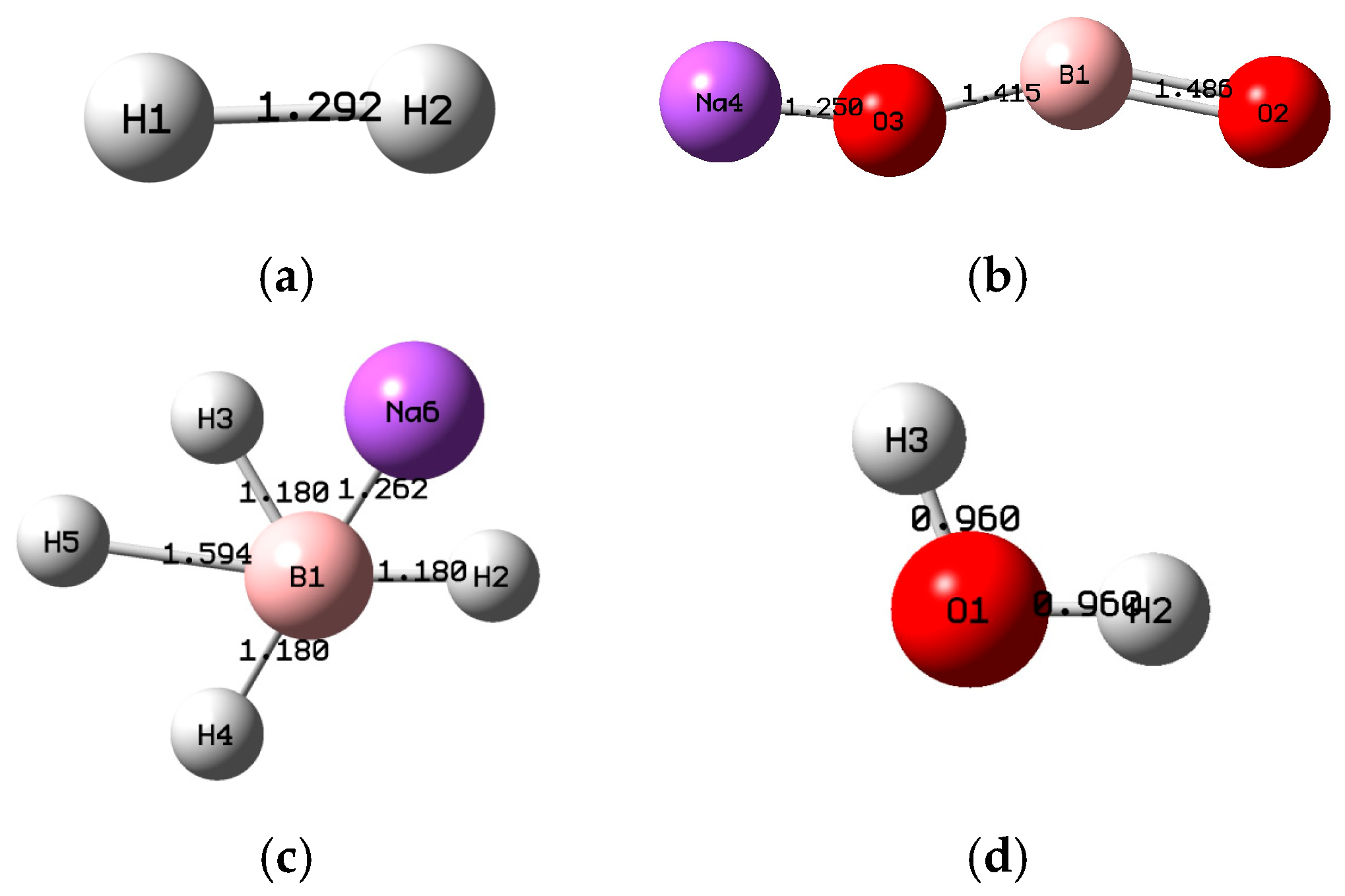
Figure 1. Related molecules for the NaBH4 reaction: (a) Hydrogen; (b) Sodium metaborate; (c) Sodium borohydride; (d) Water.
Chemproc 18 00039 g001
Table 1. Calculated thermochemistry values from Gaussian for sodium borohydride hydrolysis. All values are in Hartrees. (298 K, 1 atm).
NaBH4H2ONaBO2H2NaBHO
ε0−187.976351−76.009862−335.860216−1.037482−161.841435−24.522037−0.498233−74.656604
εZPE0.0500720.0221290.0099460.0000000.0000000.0000000.0000000.000000
Etot0.0531870.0249630.0133740.0023600.0014160.0014160.0014160.001416
Hcorr0.0541310.0259070.0143180.0033050.0023600.0023600.0023600.002360
Gcorr0.0272740.004514−0.015115−0.012532−0.015083−0.014040−0.010654−0.013915
ε0 + εZPE−187.926279−75.987733−335.850270−1.037482−161.841435−24.522037−0.498233−74.656604
ε0 + Etot−187.923163−75.984899−335.846842−1.035121−161.840019−24.520621−0.496817−74.655188
ε0 + Hcorr−187.922219−75.983954−335.845898−1.034177−161.839075−24.519677−0.495872−74.654244
ε0 + Gcorr−187.949077−76.005348−335.875331−1.050014−161.856518−24.536078−0.508887−74.670519
Table 2. Entropy and heat capacity values for molecules in NaBH4 hydrolysis.
Thermodynamic PropertyUnitCompound
NaBH4H2ONaBO2H2
Entropy (S)Cal/mol·K56.52645.02761.94733.331
Heat Capacity (Cv)8.0525.9869.1344.968
Disclaimer/Publisher’s Note: The statements, opinions and data contained in all publications are solely those of the individual author(s) and contributor(s) and not of MDPI and/or the editor(s). MDPI and/or the editor(s) disclaim responsibility for any injury to people or property resulting from any ideas, methods, instructions or products referred to in the content.



