
Proceeding Paper

Comparison Between the Volatile Compounds of Essential Oils Isolated from Rosemary (Salvia rosmarinus L.) and Its Antioxidant Capacity from Ecuadorian Highlands †
by
Tamara Fukalova Fukalova
1,*,
Ana Cristina Calderón Jácome
1,
Christian David Alcívar León
1,
Marcos Geovany Garofalo García
2 and
Elena Villacres
3
1
Facultad de Ciencias Químicas, Universidad Central del Ecuador, Quito 170521, Ecuador
2
Laboratorio OSP, Facultad de Ciencias Químicas, Universidad Central del Ecuador, Quito 170521, Ecuador
3
Estación Santa Catalina, Instituto Nacional de Investigaciones Agropecuarias (INIAP), Quito 170148, Ecuador
*
Author to whom correspondence should be addressed.
Presented at the 29th International Electronic Conference on Synthetic Organic Chemistry, 14–28 November 2025; Available online: https://sciforum.net/event/ecsoc-29.
Chem. Proc. 2025, 18(1), 15; https://doi.org/10.3390/ecsoc-29-26742
Published: 12 November 2025

Abstract

S. rosmarinus L., an aromatic species introduced to Ecuador, is valued in gastronomy and traditional medicine. Introduced plants adapt to new environments and may exhibit variations in bioactive compounds. This study evaluates the essential oil composition and antioxidant activity of rosemary from urban and rural areas. The oil extracted by microwave showed different yield (0.93% in urban and 1.02% rural) and significant variation in volatile profiles. Antioxidant activity was determined by DPPH and ABTS assays. Tetrachloroethylene was the main component, with 2.87% in urban and 13.10% in rural oil. These findings highlight rosemary’s potential as an ecological indicator of ecosystem quality.

1. Introduction

The use of medicinal and aromatic plants for therapeutic purposes has become increasingly popular worldwide. These plants constitute a traditional alternative resource, about which our ancestors possessed extensive knowledge, used as an essential component of complementary and ancestral medicine. In Ecuador, there are 3118 species belonging to 206 families of plants used for medical purposes, of which 75% of medicinal species are native and introduced plants and 5% are endemic plants [1].
Salvia rosmarinus, commonly known as “rosemary,” is a plant of significant importance within the Lamiaceae family. Plants in this family have different uses in traditional medicine, such as in treatments for asthma, depression, stress, headaches, etc. Despite being a widely used medicinal plant in Ecuador, there is still a lack of scientific research to support and explain the various medicinal uses attributed to rosemary and its essential oil.
Secondary metabolites such as essential oils are complex mixtures of volatile compounds [2]. Characterizing the composition of essential oils allows us to relate the biological activity of the plant to the components present in its oil profile. This composition can vary depending on different factors, such as geographical origin, growing conditions, and extraction process [3].
Rosemary contains two main active constituents: flavonoids and terpenes. The identification of these chemotypes allows for direct relationships to be established between their chemical profile and their potential biological activity, particularly their antimicrobial, antifungal, and antioxidant activity [4,5]. Furthermore, different chemotypes may be present within the same plant species. Most of the essential oil from the S. rosmarinus plant is extracted from its leaves. Studies have shown that the yield of essential oil varies according to seasonality, growing conditions, and the phenological age of the plant [6].
The objective of this research was to evaluate the differences in the chemical composition of essential oils using gas chromatography coupled with mass spectrometry and their antioxidant bioactivity using DPPH and ABTS methods. The extraction was carried out from the aerial parts of the rosemary plant from two different locations in Ecuador: an urban area and a rural area. Both areas are in the Andean region of the country.

2. Materials and Methods

2.1. Raw Material

This study includes two rosemary plants differentiated by their area of origin. Both ecotypes were collected under the same phenological conditions in quantities of 1 kg per location. Detailed specifications of the samples collected and their georeferencing are presented in Table 1.

2.2. Sample Preparation and Extraction

Fresh leaves were dried outdoors in clean, ventilated, and shaded environment for 3 weeks at a temperature of 18 °C and a relative humidity of 78%. The extraction of volatile compounds was successfully performed on plant material that had been previously moistened with water for 30 min, kneading every 5 min (with a sample-to-water ratio of 1:2.5). The solvent-free extraction utilized advanced microwave technology to extract essential oils at atmospheric pressure without the addition of solvents (ETHOS X, Millestone Srl, Sorisole, Bergamo, Italy). The extraction was carried out under tree different conditions: equipment power settings of 500 MW, 900 MW, and 1350 MW, with duration of 40 min, 20 min, and 7 min, respectively. The obtained oil was collected and stored in heavy cryovials that had been previously labeled.

2.3. Physicochemical Parameters

The density of the essential oil was measured according to the AOAC 920.212 method, and the refractive index was determined using a Baush&Lomb Abbe Refractometer (Optical Company, Rochester, NY, USA). Additionally, the solubility of the essential oil in ethanol was assessed.

2.4. Analytical Methods

The antioxidant activity of the extracts was evaluated using in vitro assays based on the DPPH method and ABTS methods, with calibration curves prepared in advance. For the DPPH method, a solution was prepared by dissolving 10 mg of DPPH in 96% ethanol (v/v) and then mixing 2 mL of this solution with 45 mL of the same solvent. The ABTS solution was prepared by mixing two solutions in equal parts (1:1): a 7 mM standard ABTS solution and a 1.45 mM K2S2O8 solution. The mixture was allowed to react in the dark for 16 h at room temperature to generate the ABTS+ radical. Subsequently, 1 mL of this solution was mixed with 10–20 µL of the antioxidant sample. Trolox was used as the standard antioxidant, and the results are expressed as micromoles of Trolox equivalents per gram (μmol TE·g−1). All chemical reagents were sourced from Sigma-Aldrich Co., St. Louis, MI, USA.
The chemical composition of the essential oil was analyzed using GC-MS (Agilent Technology 5975C; Santa Clara, CA, USA). A 10 µL sample was injected after being diluted in 1 mL of ethanol. The chromatographic conditions are detailed in Table 2.

2.5. Determination of Volatiles

The identification of volatile compounds was carried out by combining two approaches: comparing their mass spectra and gas chromatography (GC) retention times with commercial standards (from RS, Sigma-Aldrich Co., Taufkirchen, Germany) and assessing the matching degree in the NIST 2017 Mass Spectral Library. Compounds were considered identified if their mass spectrum exhibit a match the NIST library that exceeded 80% or if they corresponded with the available standards.

2.6. Data Analysis

Data processing and organization were conducted using Microsoft Excel (v.17.0, 2021), enabling the systematization and comparison of the information collected. Statistical analysis was performed using a one-way analysis of variance (ANOVA). Arithmetic means and standard deviation values were calculated to compare the refractive index and density of the essential oil. These data were categorized based on the location where the rosemary was grown, considering that these properties are intrinsic to the oil, irrespective of the extraction conditions applied.

3. Results

3.1. Oil Extraction Yield

The oil extraction yield related to the amount of oil extracted over mass of the leaves, expressed as a percentage (g·100 g−1). The variability between the extraction conditions of each yield is show in Figure 1.
In microwave-assisted extraction performed under different conditions of power (MW) and time (minutes), the yield or rosemary from each location was similar under minimum operating conditions. Under intermediate conditions, the lowest-yield plant was recorded as rural rosemary, with 0.60%. In contrast, under maximum extraction conditions, rural rosemary yielded more, with 1.32% compared to 0.79% for urban rosemary. The extraction yield combining the three conditions average 0.93% for urban plants and 1.02% for rural plants, with the rural ones exceeding the urban ones by 10%.
The physicochemical analysis was carried out for each essential oil obtained to establish the differences due to cultivation in different geoclimatic zones. The analysis is detailed in Table 3.
In appearance, the urban rosemary oil turned out to be slightly yellow, with no noticeable turbidity. In contrast, the oil from the rural area showed greater turbidity. The odor was more intense in the rural plant. The density values for urban species ranged from 0.7370 to 1.027 g·mL−1, while for rural species they ranged from 0.8850 to 1.0080 g·mL−1. Notably, density increased with higher power settings and shorter extraction times. The refractive index remained relatively consistent across all samples, regardless of their location or the extraction conditions applied. The solubility of the essential oil in ethanol is 10% (v/v), a value that supports its qualitative classification as “very soluble” in this solvent.
One-way analysis of variance (ANOVA) was performed to identify significant differences between the density of the oil extracted from both locations according to the process conditions without revealing statistically significant differences between the groups evaluated. No difference has been found for the refractive index either.

3.2. Antioxidant Capacity

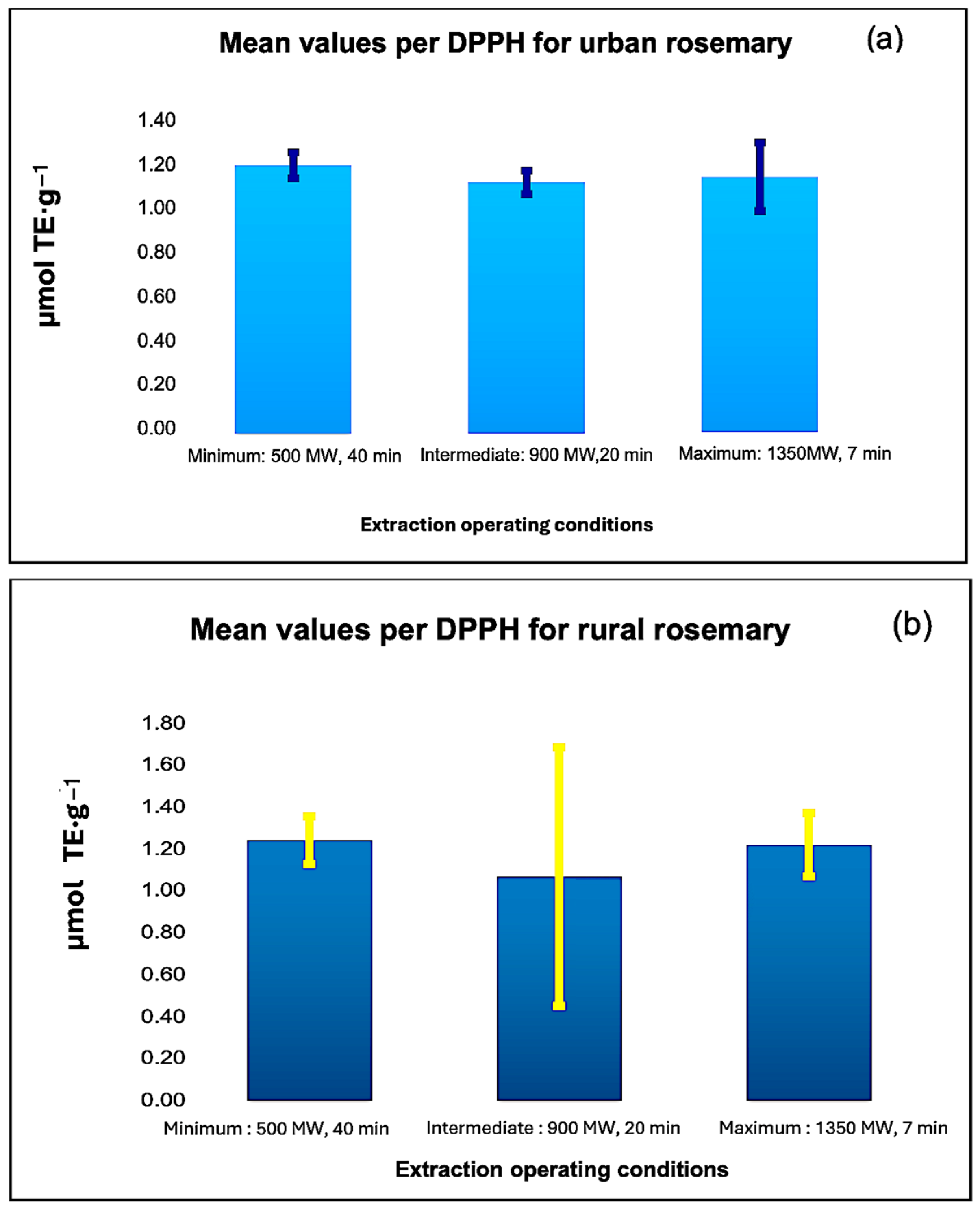
Using the DPPH method, the calibration curves exhibited a strong linear relationship with an R2 = 0.9865, demonstrating a correlation between absorbance and Trolox concentration. The oil extracted under maximum conditions, derived from urban rosemary sourced (Figure 2a), showed the highest antioxidant capacity with 1.3086 µmol TE·g−1. This value surpassed those obtained under minimum conditions (1.1763 µmol TE·g−1) and intermediate conditions (1.1252 µmol TE·g−1). The greatest variability occurred under maximum conditions.
The oil extracted from rosemary grown in rural areas (Figure 2b) showed the highest antioxidant capacity under both minimum (1.2528 µmol TE·g−1) and maximum (1.2311 µmol TE·g−1) conditions with moderate dispersion. On the other hand, the sample of intermediate conditions presented the lowest value (1.0779 µM TE·g−1) and greater variability.
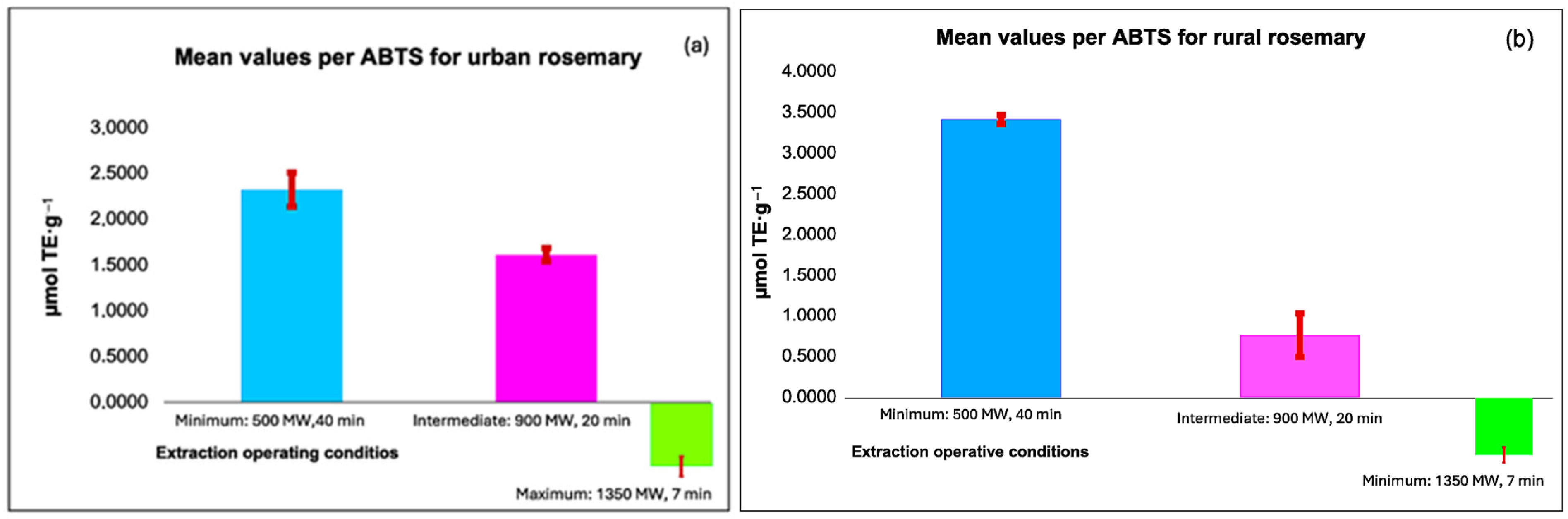
Using the ABTS method, the calibration curves exhibited a strong linear relationship with an R2 = 0.9867. The oil extracted under minimal and intermediate conditions, derived from the rosemary urban area, achieved antioxidant activities of 2.4814 µM TE·g−1 and 1.6575 µM TE·g−1, respectively, and are shown in Figure 3.
The species originating in rural areas achieved antioxidant activity of 3.4591 µM TE·g−1 (minimum) and 1.0688 µM TE·g−1 (intermediate conditions). In contrast, under maximum conditions, urban and rural rosemary essential oil did not show antioxidant activity.

3.3. Volatile Profile Analysis

The following are the volatile compounds present at the highest concentrations that could be quantified.
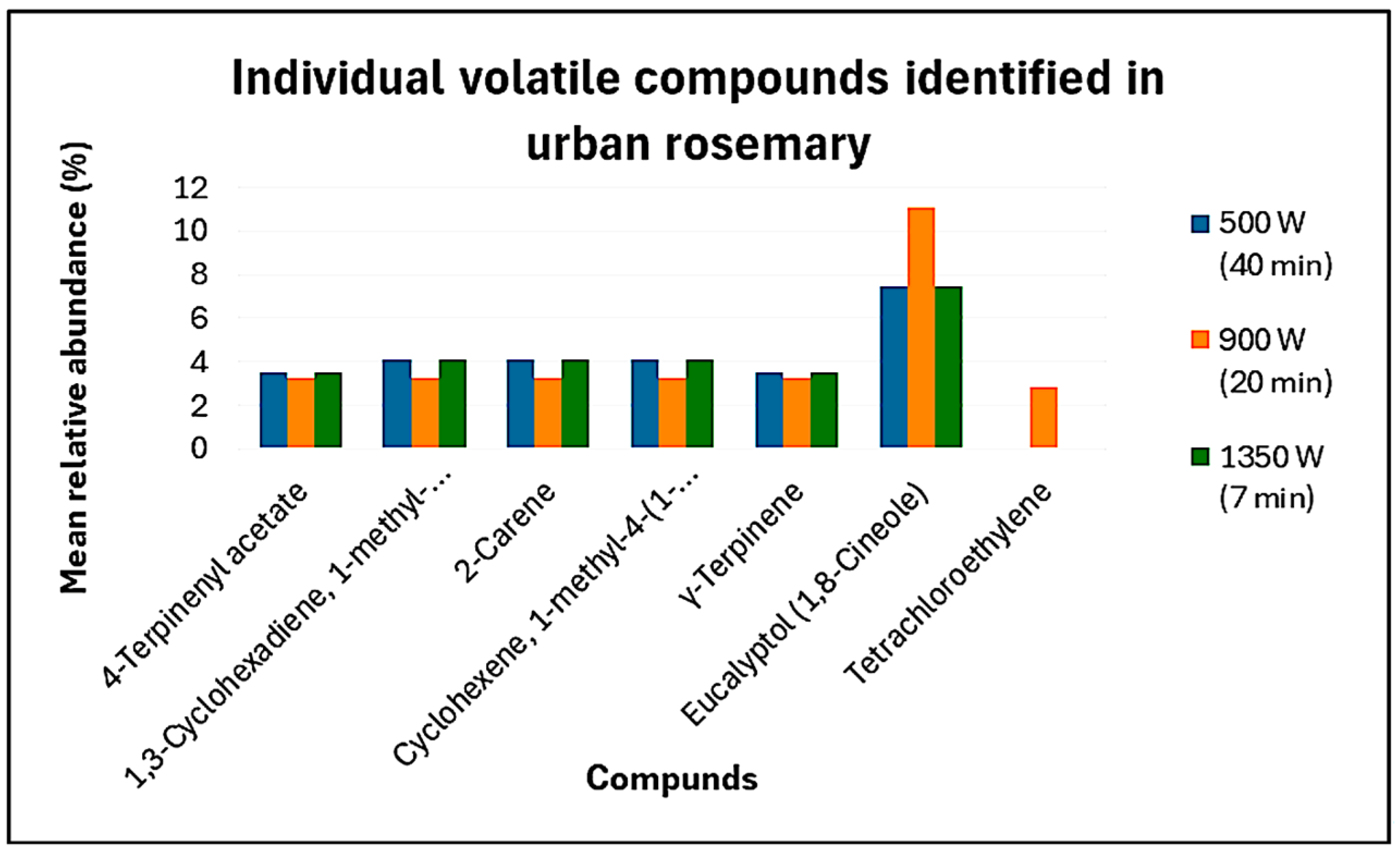
A total of seven compounds have been identified in volatile profile of urban rosemary essential oil (Figure 4). Six of them were present in the essential oil extracted under different operating conditions: minimum (500 MW, 40 min), intermediate (900 MW, 20 min), and maximum (1350 MW, 7 min). These compounds are 4-terpinenyl acetate; 1,3-cyclohexadiene 1-methyl-4-(1-methylethyl); 2-carene; cyclohexene 1-methyl-4-(1-methylethylidene); γ-terpinene; and eucalyptol (1,8-cineole).
Eucalyptol is the primary component of rosemary essential oil, reaching its highest concentration of 11.1% under the intermediate condition. The compounds γ-terpinene (3.25–3.52%) and 2-carene (3.25–4.11%) maintain relatively stable proportions across all three tested conditions. Only tetrachloroethylene (2.87%) was present under intermediate extraction conditions (900 MW and 20 min).
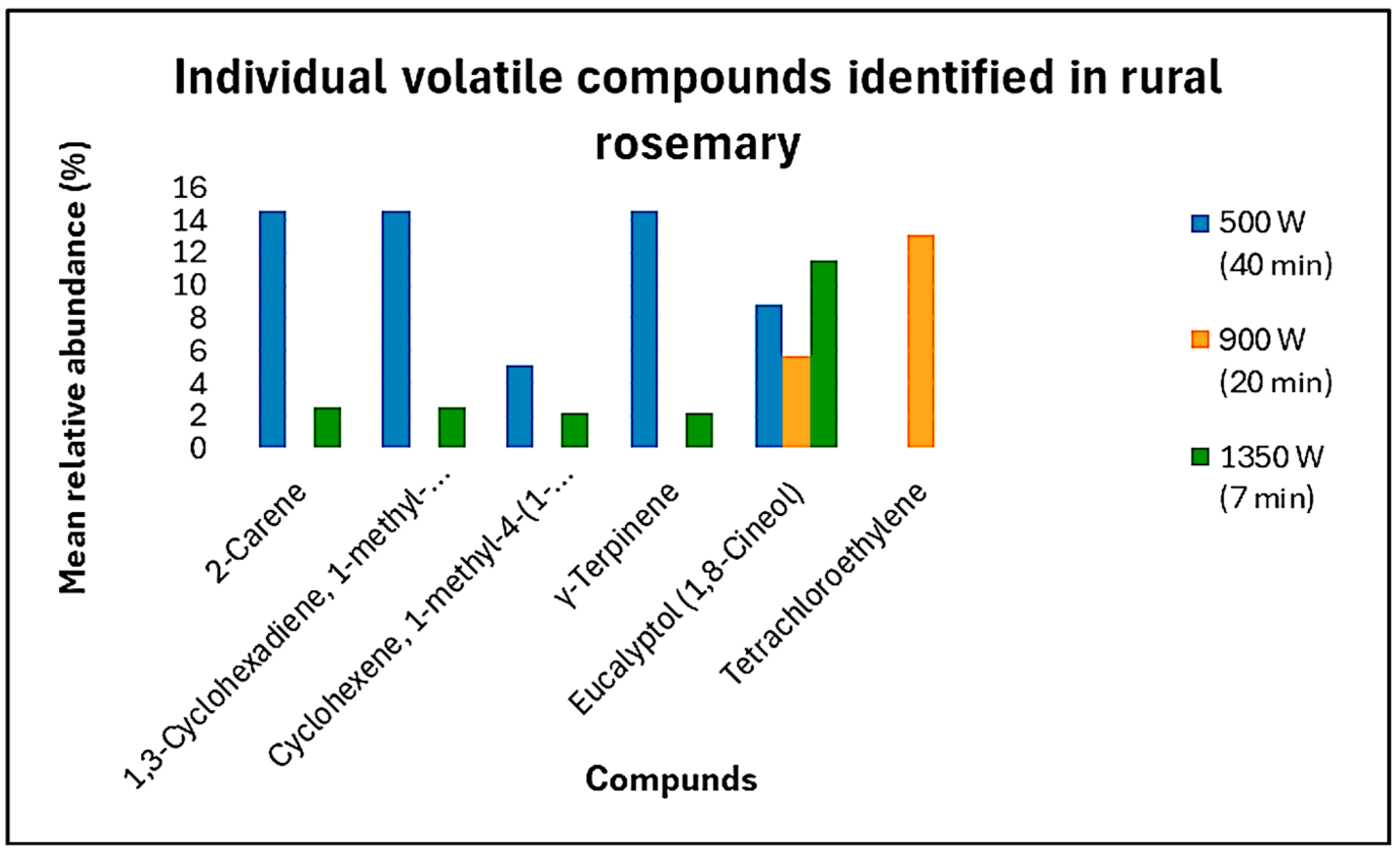
A total of six compounds have been identified in the volatile profile of rural rosemary essential oil (Figure 5). Five of them were present in the essential oil extracted under different operating conditions.
The predominant compounds under minimum conditions were 2-carene, 1,3-cyclohexadiene 1-methyl-4-(1-methylethyl), and γ-terpinene, reaching concentrations close to 15%. In contrast, under conditions of higher power and shorter time (1350 MW and 7 min), eucalyptol (1,8-cineole) is the main metabolite with 11.5%. In addition, tetrachloroethylene is observed under intermediate conditions (900 MW and 20 min) in a concentration of 13.10%.

4. Discussion

The introduced species, S. rosmarinus L., studied in this research is widely used in the country. The physicochemical properties and volatile profiles of this essential oil were characterized using rosemary leaves from two deferent areas of Ecuador: one urban and one rural. The extraction yield was evaluated under three operating conditions.
Under minimum extraction conditions, plants from both locations exhibited consistent yields. Under intermediate conditions, the increase in power and reduction in extraction time resulted in a lower essential oil yield from both locations. The decrease was more pronounced in the rural area (approximately double), likely due to the presence of volatile compounds that are more vulnerable to degradation under these specific conditions [7,8,9]. The lowest yield was observed under maximum operating conditions for urban rosemary. In contrast, rural rosemary achieved the highest yield of all extracts when subjected to maximum operating conditions. The anomaly in the performance of the rural species under maximum conditions may indicate that there is the extraction of some component favored under these conditions.
In the analysis of the physicochemical parameters of essential oils, differences in the visual appearance of the oils were presented. The turbidity of rural rosemary can be influenced by proceeding conditions in microwave-assisted extractions [10]. Multiple studies indicate that increasing power and time initially increases performance to a maximum, after which quality may decline due to thermal degradation and turbidity increases due to the formation of secondary compounds and precipitates [11,12,13]. Also, this is probably due to the mixture of insoluble particles, possibly water or air in suspension, and chemical degradation induced by microwave heat, generating this cloudy appearance. For example, phenolic compounds are thermooxidative under these conditions [14], and the rural species has them in greater quantities. The rural samples had slightly higher densities and a more intense odor [15], which can be explained by the higher content of oxygenated monoterpenes such as eucalyptol (1,8-cineole) and borneol. These compounds, having greater molecular weight and polarity, tend to increase density and refractive index. This behavior is related to that described by [16], who report that environmental factors associated with the origin of the silver, extraction method, and storage conditions influence the composition of the oil. Likewise, the study by [17,18] showed that, even within the same species and plant population, there is notable chemical variability, attributed to genetic factors and the environment, which coincides with the variability observed between both locations. The refractive index remains relatively constant in all samples, regardless of location and extraction conditions, which may be associated with a similar chemical composition or a higher presence of terpenes [19], as well as being an optical property inherent to plant material. This physicochemical parameter is characteristic of essential oils based on their chemical composition, and is independent of its place of origin. Despite the high solubility of rosemary essential oil in ethanol (approximately 80%), in this study, the solubility did not reach the expected values. The extraction method and the chemical composition of the essential oils may be responsible for this outcome [20]. An antioxidant activity assay showed that rural essential oil had greater antioxidant capacity than city essential oil under minimum extraction conditions for both tests (DPPH and ABTS). This behavior, as reported in previous studies [21,22], is attributed to the elevated concentration of oxygenated monoterpenes in rural samples, which are compounds known for their antioxidant activity. Under maximum extraction conditions, the antioxidant activity of urban rosemary, as measured by the DPPH assay, was higher than that of rural rosemary. However, when evaluated using the ABTS assay under the same conditions, the oil did not demonstrate any antioxidant activity. The discrepancy may be due to the nature of the free radicals involved and the chemical composition of the essential oil. Some compounds present in rosemary essential oil may react effectively with the DPPH radical, but not with ABTS. Furthermore, the absence of antioxidant activity in the ABTS method may be related to the low concentration or absence of specific phenolic compounds or antioxidants that specifically trap the ABTS+ radical, such as carvacrol [21,23,24].
The volatile profiles of both essential oils showed differences in the content of volatile compounds. The main component in urban rosemary essential oil was eucalyptol, with the highest concentration found under intermediate extraction conditions. In conditions of higher power and shorter time (1350 MW and 7 min), eucalyptol (1,8-cyneol) was positioned as the main metabolite, demonstrating that this oxygenated compound is more stable despite the intense extraction conditions. 2-carene and γ-terpinene were also quantified, exhibiting consistent behavior across all extraction conditions. In rural rosemary essential oil, 2-carene, 1,3-cyclohexadiene 1-methyl-4-(1-methyl), and γ-terpinene appeared as the main components in similar concentrations. This indicates that certain hydrocarbon monoterpenes are preferentially extracted under mild conditions [25,26], likely due to their greater volatility. These findings confirm that microwave-assisted extraction parameters selectively shape the essential oil profile, favoring different compound groups depending on the applied energy level [25].
A very relevant finding was the detection of tetrachloroethylene, a halogenated compound used in industrial or cleaning processes and considered an environmental contaminant [27]. It has not been reported as a component of rosemary essential oil; however, its presence has been detected in the volatile profiles analyzed in this study. Some studies have verified that tetrachloroethylene can accumulate in plants that are exposed to contaminated environments, having been detected in essential oils of species such as Mentha spicata grown near industrial areas [28] or in Ocimum basilicum collected in contaminated urban areas [29]. This finding suggests that the ability to absorb and accumulate chlorinated compounds is not exclusive to rosemary, but is a common characteristic among aromatic plants, which take up these contaminants from soil, water, and air. The detection of tetrachloroethylene further demonstrates rosemary’s capacity to absorb environmental pollutants, supporting its potential use as a natural bioindicator of pollution.

5. Conclusions

This study shows that the environment in which rosemary grows directly influences its yield and quality. Plants grown in rural areas have higher yields and a richer chemical profile, demonstrating that geoclimatic factors typical to rural areas stimulate the synthesis of secondary metabolites. However, the differences between the two locations reflect the phenotypic plasticity of rosemary in response to different environmental conditions. This work constitutes an important contribution to the knowledge of Ecuadorian essential oils, demonstrating that geographical origin should be considered a determining factor in final quality. The findings obtained allow for further research on the effect of agricultural practices and toxicological evaluation of detected contaminants.

Author Contributions

Conceptualization, T.F.F.; methodology, T.F.F. and A.C.C.J.; software, A.C.C.J.; formal analysis, C.D.A.L., E.V. and M.G.G.G.; investigation, A.C.C.J.; data curation, C.D.A.L. and M.G.G.G.; writing—original draft preparation, A.C.C.J.; writing—review and editing, T.F.F. and A.C.C.J.; supervision, T.F.F. All authors have read and agreed to the published version of the manuscript.

Funding

This research received no external funding.

Institutional Review Board Statement

Not applicable.

Informed Consent Statement

Not applicable.

Data Availability Statement

The data supporting the findings of this study are openly available in this link: https://mega.nz/folder/iIs2mIjI#wOn_TgQD1VPkDQ44k69B6g (accessed on 23 November 2025).

Acknowledgments

We would like to thank the Research and Sustainable Development, Tourism, and Heritage Group (GIDESTUR, code 051-GI-DI-2025), Central University of Ecuador, for collaborating and managing contact with agriculture producers in the sample collection area.

Conflicts of Interest

The authors declare no conflicts of interest.

References

  1. De la Torre, L.; Navarrete, H.; Muriel, P.; Macía, M.J.; Balslev, H. Enciclopedia de las Plantas Útiles del Ecuador (Con Extracto de Datos), 1st ed.; Herbario QCA de la Escuela de Ciencias Biológicas de la Pontificia Universidad Católica del Ecuador & Herbario AAU del Departamento de Ciencias Biológicas de la Universidad de Aarhus: Quito, Ecuador, 2008; p. 949. Available online: https://scholarspace.manoa.hawaii.edu/server/api/core/bitstreams/b80ee8d6-b073-4788-b63e-176042ec952d/content (accessed on 20 March 2025).
  2. Sánchez, M.F.O. Manual Práctico de Aceites Esenciales; Aiyana Ediciones: Avalon Beach, Australia, 2006; p. 247. Available online: https://books.google.com.ec/books?hl=es&lr=&id=cW5TsDKqx9wC&oi=fnd&pg=PA159&dq=S%C3%A1nchez,+M.+F.+O.+ACEITES+ESENCIALES,+AROMAS+Y+PERFUMES,+MANUAL+PRACTICO+DE&ots=LpU2KTiznl&sig=KWCoRsi7xXydYegfYQ-8zFEIzk0&redir_esc=y#v=onepage&q&f=false (accessed on 25 March 2025).
  3. Camus, J.A.; Trujillo, M.A. Contribucion a la química de los aceites esenciales provenientes del oregano. Rev. Boliv. Química 2011, 28, 1–5. [Google Scholar]
  4. Luca, S.V.; Skalicka-Woźniak, K.; Mihai, C.-T.; Gradinaru, A.C.; Mandici, A.; Ciocarlan, N.; Miron, A.; Aprotosoaie, A.C. Chemical profile and bioactivity evaluation of Salvia species from Eastern Europe. Antioxidants 2023, 12, 1514. [Google Scholar] [CrossRef]
  5. Flores-Villa, E.; Sáenz-Galindo, A.; Castañeda-Facio, A.O.; Narro-Céspedes, R.I. Romero (Rosmarinus officinalis L.): Su Origen, Importancia y Generalidades de Sus Metabolitos Secundarios. TIP Rev. Espec. Cienc. Químico-Biológicas 2020, 23, 1–17. [Google Scholar] [CrossRef]
  6. Nature India. Timing of Rosemary Harvest Determines Essential Oil Yield. Nat. India 2022. [Google Scholar] [CrossRef]
  7. Silva, C. Extracción, caracterización y purificación de aceites esenciales de las hojas de laurel de cera (Morella pubescens) y romero (Rosmarinus officinalis) como alternativa de Desarrollo agroindustrial para el departamento de Nariño. Bachelor Thesis, Universidad de Nariño, San Juan de Pasto, Colombia, 2010. Available online: https://sired.udenar.edu.co/11481/1/81550.pdf (accessed on 2 September 2025).
  8. Quinatoa, O. Estudio Comparativo de la Dinámica de Destilación del Aceite Esencial de Pimenta racemosa (mill) j.w. Moore por los Métodos de Hidrodestilación e Hidrodestilación Asistida por Microonda. Bachelor Thesis, Universidad de Guayaquil, Guayaquil, Ecuador, 2017. [Google Scholar]
  9. Leon, G.; Osorio, M.R.; Martínez, S.R. Comparison of two methods for extraction of essential oil from Citrus sinensis L. Rev. Cubana Farm. 2015, 49, 4. [Google Scholar]
  10. Moradi, S.; Fazlali, A.; Hamedi, H. Microwave-assisted hydro-distillation of essential oil from rosemary: Comparison with traditional distillation. Avicenna J. Med. Biotech. 2018, 10, 22. [Google Scholar]
  11. Nateghi, L.; Rashidi, L.; Pourahmad, R.; Nodeh, H.R. Effect of essential oils of chaville (Ferulago contracta), rosemary (Rosmarinus officinalis) and lavender (Lavandula officinalis) on the thermal stability of camelina oil under accelerated conditions. J. Food Sci. Technol. 2024, 21, 146–155. [Google Scholar]
  12. Yeasmin, F.; Prasad, P.; Sahu, J.K. Effect of ultrasound on physicochemical, functional and antioxidant properties of red kidney bean (Phaseolus vulgaris L.) proteins extract. Food Biosci. 2024, 57, 103599. [Google Scholar] [CrossRef]
  13. Tran, K.N.T.; Tran, H.T.; Pham, D.H.; Nguyen, V.T.; Le, T.X. Comparison Of Chemical Composition Of Essential Oil Of Rosemary (Rosmarinus officinalis L.) Obtained By Three Extraction Methods: Hydrodistillation, Steam Distillation, And Microwave-Assisted Hydrodistillation. Egypt. J. Chem. 2023, 66, 1583–1587. [Google Scholar] [CrossRef]
  14. Kishimoto, N. Microwave Heating Induces Oxidative Degradation of Extra Virgin Olive Oil. Food Sci. Technol. Res. 2019, 25, 75–79. [Google Scholar] [CrossRef]
  15. Sakar, E.H.; Zeroual, A.; Kasrati, A.; Gharby, S. Combined Effects of Domestication and Extraction Technique on Essential Oil Yield, Chemical Profiling, and Antioxidant and Antimicrobial Activities of Rosemary (Rosmarinus officinalis L.). J. Food Biochem. 2023, 1, 6308773. [Google Scholar] [CrossRef]
  16. Álvarez, M.R.; Meléndez, L.A.; Cosío, S.M.R. Procedimientos para la Extracción de Aceites Esenciales en Plantas Aromáticas, 1st ed.; Centro de Investigaciones Biológicas del Noroeste: La Paz, Baja California Sur, México, 2012; Available online: https://cibnor.repositorioinstitucional.mx/jspui/bitstream/1001/540/1/rodriguez_m.pdf (accessed on 10 April 2025).
  17. Lax Vivancos, V. Estudio de la Variabilidad Química, Propiedades Antioxidantes y Biocidas de Poblaciones Espontáneas de Rosmarinus officinalis L. en la Región de Murcia. Ph.D. Thesis, Universidad de Murcia, Murcia, Spain, 2014. Available online: https://conocimientoabierto.carm.es/jspui/bitstream/20.500.11914/1003/1/Tesis%20Vanesa%20Lax%20.pdf (accessed on 5 September 2025).
  18. Dhouibi, I.; Flamini, G.; Bouaziz, M. Comparative Study on the Essential Oils Extracted from Tunisian Rosemary and Myrtle: Chemical Profiles, Quality, and Antimicrobial Activities. ACS Omega 2023, 8, 6431–6438. [Google Scholar] [CrossRef]
  19. Teshale, F.; Narendiran, K.; Beyan, S.M.; Srinivasan, N.R. Extraction of Essential Oil from Rosemary Leaves: Optimization by Response Surface Methodology and Mathematical Modeling. Appl. Food Res. 2022, 2, 100133. [Google Scholar] [CrossRef]
  20. Vella, F.M.; Laratta, B. Rosemary Essential Oil Extraction and Residue Valorization by Means of Polyphenols Recovery. Biol. Life Sci. Forum 2023, 26, 8. [Google Scholar] [CrossRef]
  21. Farhani, F.; El Aboudi, A.; Boujraf, A.; Dallahi, Y. Influence of Harvest Time and Environmental Factors on the Yield and Chemical Composition of Rosemary (Rosmarinus officinalis L.) Essential Oil in Northeast Morocco. Ecol. Eng. Environ. Technol. 2024, 25, 1–17. [Google Scholar] [CrossRef]
  22. Akhbari, M.; Masoum, S.; Aghababaei, F.; Hamedi, S. Optimization of Microwave Assisted Extraction of Essential Oils from Iranian Rosmarinus officinalis L. Using RSM. J. Food Sci. Technol. 2018, 55, 2197–2207. [Google Scholar] [CrossRef] [PubMed]
  23. Liu, T.; Wang, J.; Gong, X.; Wu, X.; Liu, L.; Chi, F. Rosemary and tea tree essential oils exert antibiofilm activities in vitro against Staphylococcus aureus and Escherichia coli. J. Food Prot. 2020, 83, 1261–1267. [Google Scholar] [CrossRef] [PubMed]
  24. Magtalas, T.J.; Anapi, G.R. Evaluation of Bacteriostatic Effect of Rosemary and Oregano Essential Oils Against a Non-pathogenic Surrogate of Salmonella spp. (E. coli ATCC 9637). Biol Life Sci. Forum 2025, 40, 7. [Google Scholar] [CrossRef]
  25. Rahbardar, M.G.; Hosseinzadeh, H. Therapeutic Effects of Rosemary (Rosmarinus officinalis L.) and Its Active Constituents on Nervous System Disorders. Iran. J. Basic Med. Sci. 2020, 23, 1100–1112. [Google Scholar] [CrossRef]
  26. Chetia, M.P.; Ashraf, G.J.; Sahu, R.; Nandi, G.; Karunakaran, G.; Paul, P.; Dua, T.K. Rosemary (Rosmarinus officinalis L.) Essential Oil: A Review of Extraction Technologies, and Biological Activities. Next Res. 2025, 2, 100545. [Google Scholar] [CrossRef]
  27. Nijhuis, N.; Loh, M.; Harrison, P. Tetrachloroethylene. In WHO Guidelines for Indoor Air Quality: Selected Pollutants; World Health Organization: Geneva, Switzerland, 2010; p. 9. Available online: https://www.ncbi.nlm.nih.gov/books/NBK138706/ (accessed on 25 April 2025).
  28. Ebrahimzadeh, G.; Omer, A.K.; Naderi, M.; Sharafi, K. Human Health Risk Assessment of Potentially Toxic and Essential Elements in Medicinal Plants Consumed in Zabol, Iran, using the Monte Carlo simulation method. Sci. Rep. 2024, 14, 23756. [Google Scholar] [CrossRef] [PubMed]
  29. Andrade, J.M.; Faustino, C.; Garcia, C.; Ladeiras, D.; Reis, C.P.; Rijo, P. Rosmarinus officinalis L.: An Update Review of Its Phytochemistry and Biological Activity. Future Sci. OA 2018, 4, FSO283. [Google Scholar] [CrossRef] [PubMed]
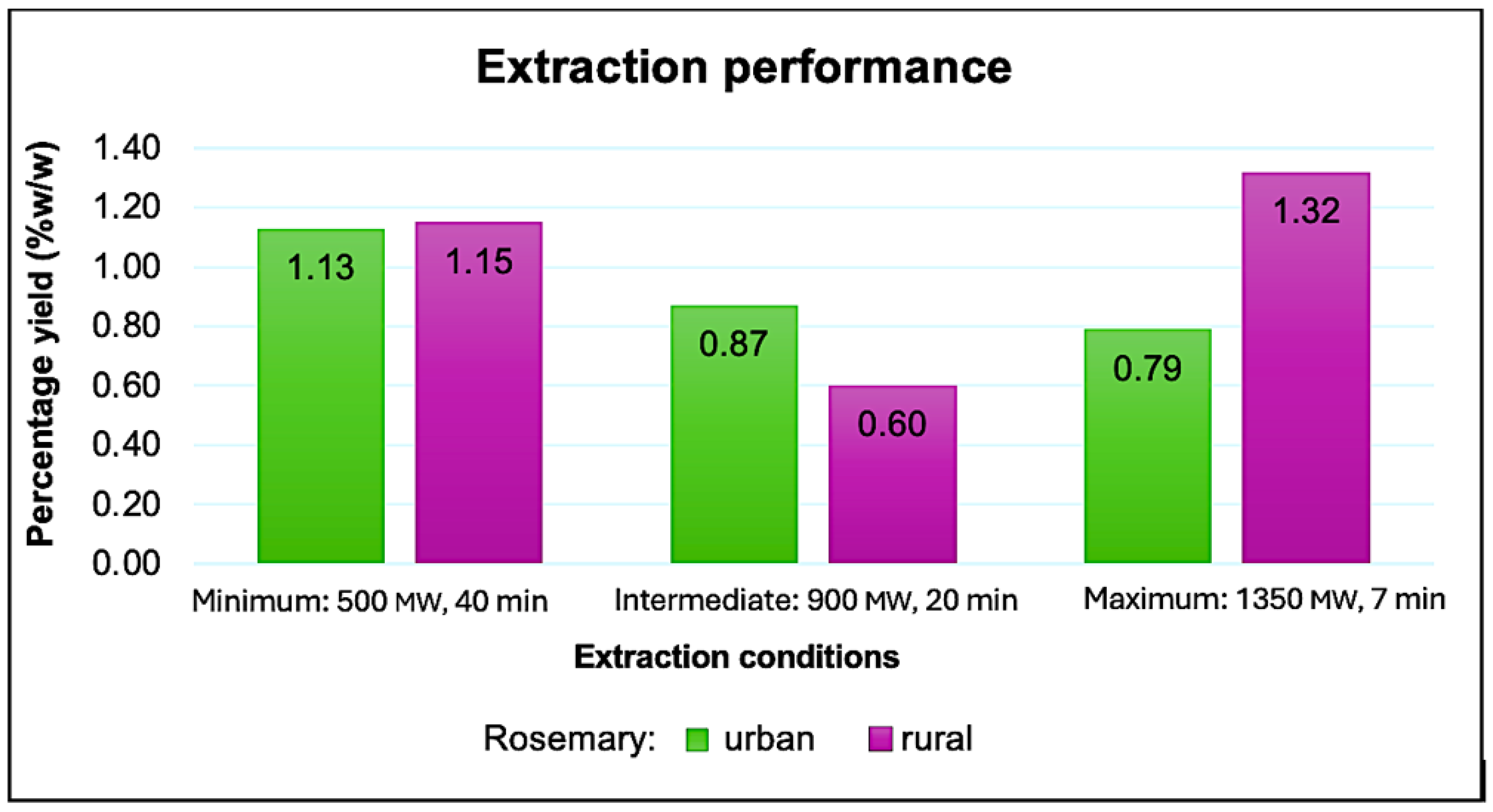
Figure 1. Extraction yield as a function of operating conditions and origin of rosemary.
Chemproc 18 00015 g001
Figure 2. Mean DPPH scavenging activity for rosemary samples under different extraction conditions. Panels (a) and (b) compare the antioxidant capacity—expressed as μmol TE·g−1 of urban rosemary (a) and rural rosemary (b) subjected to three microwave-assisted extraction conditions: Minimum (500 W, 40 min), Intermediate (900 W, 20 min), and Maximum (1350 W, 7 min).
Chemproc 18 00015 g002
Figure 3. Variability analysis for antioxidant activity: (a) urban species; (b) rural species.
Chemproc 18 00015 g003
Figure 4. Volatile profile of urban rosemary essential oil under different extraction conditions.
Chemproc 18 00015 g004
Figure 5. Volatile profile of rural rosemary essential oil under different extraction conditions.
Chemproc 18 00015 g005
Table 1. Parts of the plant collected and their georeferencing.
ParametersDescription
Part of S. rosmarinus L.Fresh areal parts visually inspected before sampling (intact and healthy leaves)
Area locationQuito city: 0°07′47.6″ S 78°27′60.0″ W
Atuntaqui: 0°20′00.6″ N 78°13′35.6″ W
Altitude above sea levelQuito city: 2.850 m
Atuntaqui: 2.360 m
Collection dateQuito: 19 January 2025
Atuntaqui: 23 January 2025
Table 2. Chromatographic analysis conditions.
ParametersConditions
GC-detectorMS
ColumnAgilent DB-5MS UI de 0.25 mm × 50 m × 0.25 μM
Injector temperature, °C325 °C
Split rate10:1
Injection volume, μM2
Carrier gasgrade 5.0 Helium 5.0, 99.99% purity
Average gas velocity, cm·s−131.232
Pressure, psi19.185
Table 3. The physicochemical parameters evaluated.
Operative Conditions
ParametersMinimum:
Potential 500 MW/Time 40 min
Intermediate:
Potential 900 MW/Time 20 min
Maximum:
Potential 1350 MW/Time 7 min
Appearanceurbanruralurbanruralurbanrural
slightly
yellow
cloudyslightly
yellow
cloudyslightly
yellow
cloudy
Odormoderateintensemoderateintensemoderateintense
Density (g·mL−1)0.73700.88500.88800.91101.02701.0080
Refractive index1.47201.47101.46951.46951.46901.4700
Solubility in ethanol (%v/v)101010101010
Disclaimer/Publisher’s Note: The statements, opinions and data contained in all publications are solely those of the individual author(s) and contributor(s) and not of MDPI and/or the editor(s). MDPI and/or the editor(s) disclaim responsibility for any injury to people or property resulting from any ideas, methods, instructions or products referred to in the content.