
Proceeding Paper

Synthesis and In Silico Screening of Biological Activity of Novel Bisazomethines Containing 1,3-Diazine Fragment: Perspectives in Organic Synthesis and Pharmaceuticals †
by
Aleksandr V. Dambaev
*,
Denis A. Kolesnik
,
Igor P. Yakovlev
,
Tamara L. Semakova
and
Polina O. Levshukova
Department of Organic Chemistry, State Federal-Funded Educational Institution of Higher Education «Saint Petersburg State Chemical and Pharmaceutical University of the Ministry of Healthcare of the Russian Federation», Professor Popov str., 14, lit. A, 197022 St. Petersburg, Russia
*
Author to whom correspondence should be addressed.
Presented at the 29th International Electronic Conference on Synthetic Organic Chemistry, 14–28 November 2025; Available online: https://sciforum.net/event/ecsoc-29.
Chem. Proc. 2025, 18(1), 112; https://doi.org/10.3390/ecsoc-29-26907
Published: 13 November 2025

Abstract

Bridged 1,3-diazine bisazomethines were synthesized via the nucleophilic addition of phenylenediamines to 4,6-dihydroxypyrimidine-5-carbaldehydes in methanol/water. Structures were confirmed by NMR spectroscopy. In silico screening (PASS-online, CLC-pred, Antivir-pred, GUSAR-online) revealed broad bioactivity (antibacterial, antifungal, antiviral) and OECD Class 4 toxicity, indicating high safety and therapeutic potential.

1. Introduction

The pyrimidine heterocycle, being a key pharmacophore, continues to be a focus of intensive research in medicinal chemistry. In particular, hybrid structures that combine a pyrimidine core with an azomethine fragment have attracted significant interest due to their broad spectrum of biological activities [1,2,3,4]. However, bisderivatives based on functionalized pyrimidine aldehydes remain poorly studied.
The conjugation of two or more pharmacophoric fragments into a single molecular architecture is a powerful strategy for creating new chemical entities with promising biological properties. We assumed that 4,6-dihydroxy-2-methylpyrimidine-5-carbaldehydes could serve as an ideal platform for constructing such systems. The one-step approach we propose enables the efficient synthesis of complex, polyfunctional compounds from readily available starting materials.
The aim of the present work was to develop a synthetic method for novel, previously unreported bisazomethines based on 4,6-dihydroxypyrimidine-5-carbaldehydes and to confirm their structures. The potential of the synthesized compounds as candidates for pharmacological studies was indirectly supported by preliminary in silico screening.

2. Materials and Methods

The potential biological profiles of the target compounds were evaluated through in silico screening. A broad spectrum of activities was predicted using PASS Online [5], while more focused assessments of antitumor and antiviral potential were conducted with the CLC-pred and Antivir-pred tools, respectively. Prospective acute toxicity was estimated using the GUSAR-online service.
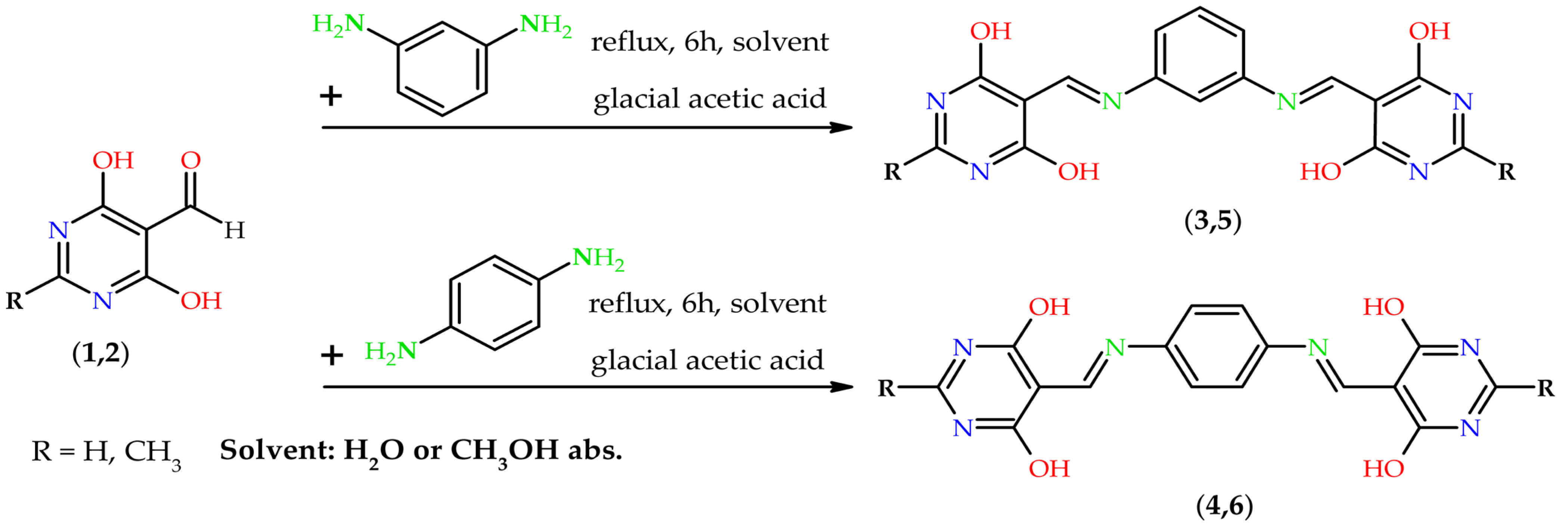
The target bisazomethines—5,5′-{1,3-phenylenebis[azanylidenemethylylidene]}bis (2-methylpyrimidine-4,6-diol) (3), 5,5′-{1,4-phenylenebis[azanylidenemethylylidene]} bis(2-methylpyrimidine-4,6-diol) (4), 5,5′-{1,3-phenylenebis[azanylidenemethylylidene]} bis(pyrimidine-4,6-diol) (5), and 5,5′-{1,4-phenylenebis[azanylidenemethylylidene]} bis(pyrimidine-4,6-diol) (6)—were synthesized by condensing 4,6-dihydroxypyrimidine -5-carbaldehyde (1) or 4,6-dihydroxy-2-methylpyrimidine-5-carbaldehyde (2), prepared according to a known procedure [6], with the corresponding bisnucleophilic component (benzene-1,3-diamine or benzene-1,4-diamine) in a 2:1 molar ratio. The reactions were performed in either aqueous or absolute methanolic medium with the addition of glacial acetic acid (Figure 1).
The reaction progress was monitored by thin-layer chromatography (TLC) by tracking the disappearance of the corresponding phenylenediamine. A mixture of methanol, dichloromethane, and hexane (1:9:1) was used as the mobile phase. Detection was performed under UV light at a wavelength of 254 nm. The structures of the synthesized compounds were confirmed by 1H and 13C nuclear magnetic resonance (NMR) spectroscopy.

Synthesis of 5,5′-{Phenylenebis[azanylylenemethylidenyl]}bis(pyrimidine-4,6-diols) (36)

Preparation of bisazomethine derivatives 36: In a typical experiment, the corresponding carbaldehyde (1 or 2, 3.14 mmol) was suspended in 25 mL of either absolute methanol or water. Benzene-1,4-diamine or its 1,3-isomer (1.57 mmol) and glacial acetic acid (0.8 mmol) were introduced to the suspension. The system was equipped with a reflux condenser and heated for 6 h with constant stirring. The consumption of the aromatic diamine was tracked by TLC. Upon completion, the precipitated product was filtered off, providing compounds 36. Isolated yields are compiled in Table 1.
The structure of the compounds was confirmed by NMR spectroscopy using a Bruker AM-600 (PubCompare, Sion, Switzerland). Compounds 3, 4, 5, 6 were analyzed solely in deuterated trifluoroacetic acid.
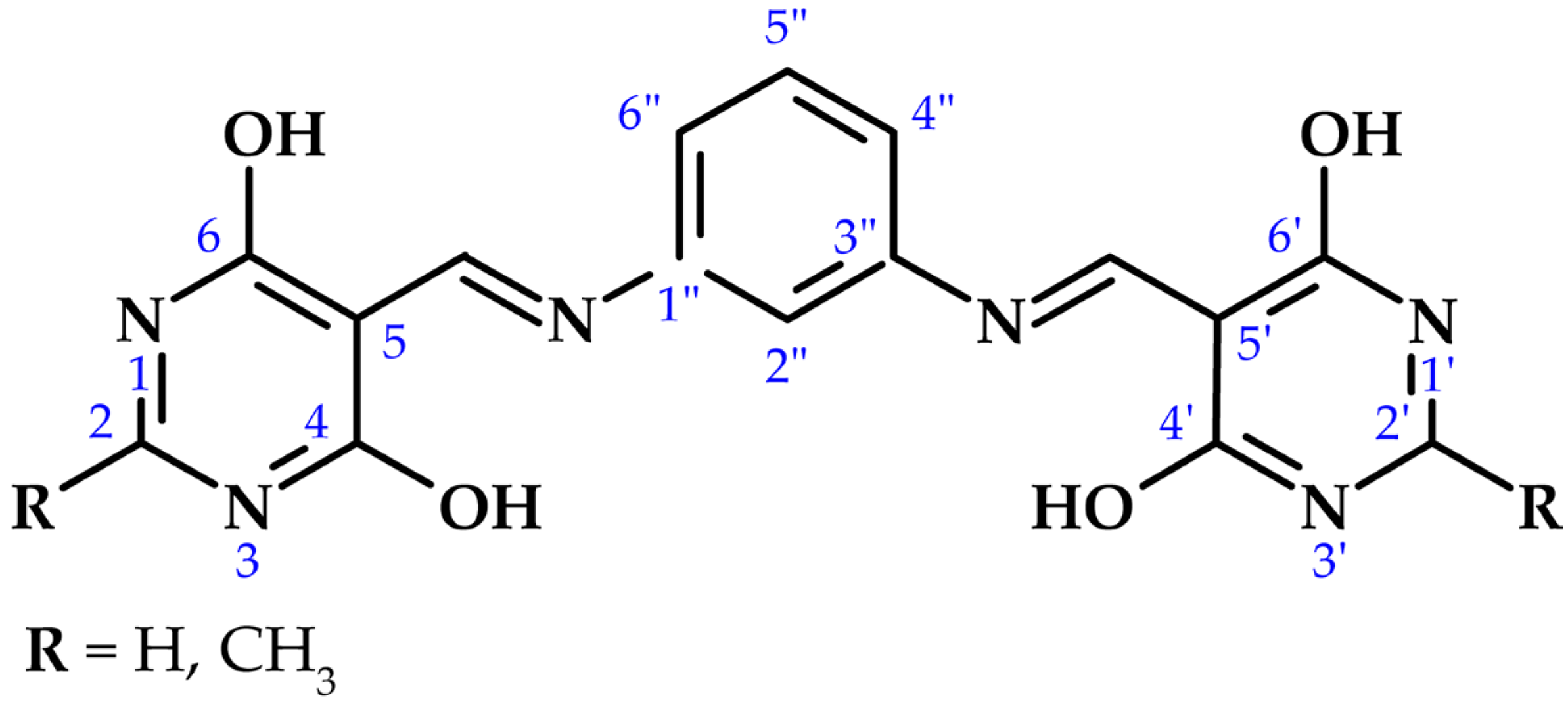
Nuclear magnetic resonance spectrum data 1H (400 MHz, TFA-d), δ, ppm, of product 3 (Figure 2): 3.21 s (5.98H, -CH3), 8.03 d (2.09 H, H: C4″, C6″), 8.11 t (1.16 H, H: C5″), 8.37 s (1.02 H, H: C2″), 9.62 s (2.08 H, -N=CH-).
Nuclear magnetic resonance spectrum data 13C (100 MHz, TFA-d), δ, ppm, of product 3: 12.84 (-CH3), 90,98 (C–5, 5′), 104.11 (C–2″), 116.21 (C–4″, 6″),127.11 (C–5″), 135,63 (C–1″, 3″), 149.65 (C–2, 2′), 154.23 (C–4, 4′, 6, 6′), 161.91 (-N=CH-).
Nuclear magnetic resonance spectrum data 1H (400 MHz, TFA-d), δ, ppm, of product 5: 8.06 d (2.09 H, H: C4″, C6″), 8.15 t (1.16 H, H: C5″), 8.40 s (1.02 H, H: C2″), 8.93 s (1.97 H, H: C2, C2′), 9.69 s (2.08 H, -N=CH-).
Nuclear magnetic resonance spectrum data 13C (100 MHz, TFA-d), δ, ppm, of product 5: 90,08 (C–5, 5′), 104.11 (C–2″), 116.41 (C–4″, 6″),127.71 (C–5″), 135,83 (C–1″, 3″), 149.78 (C–2, 2′), 153.34 (C–4, 4′, 6, 6′), 161.48 (-N=CH-).
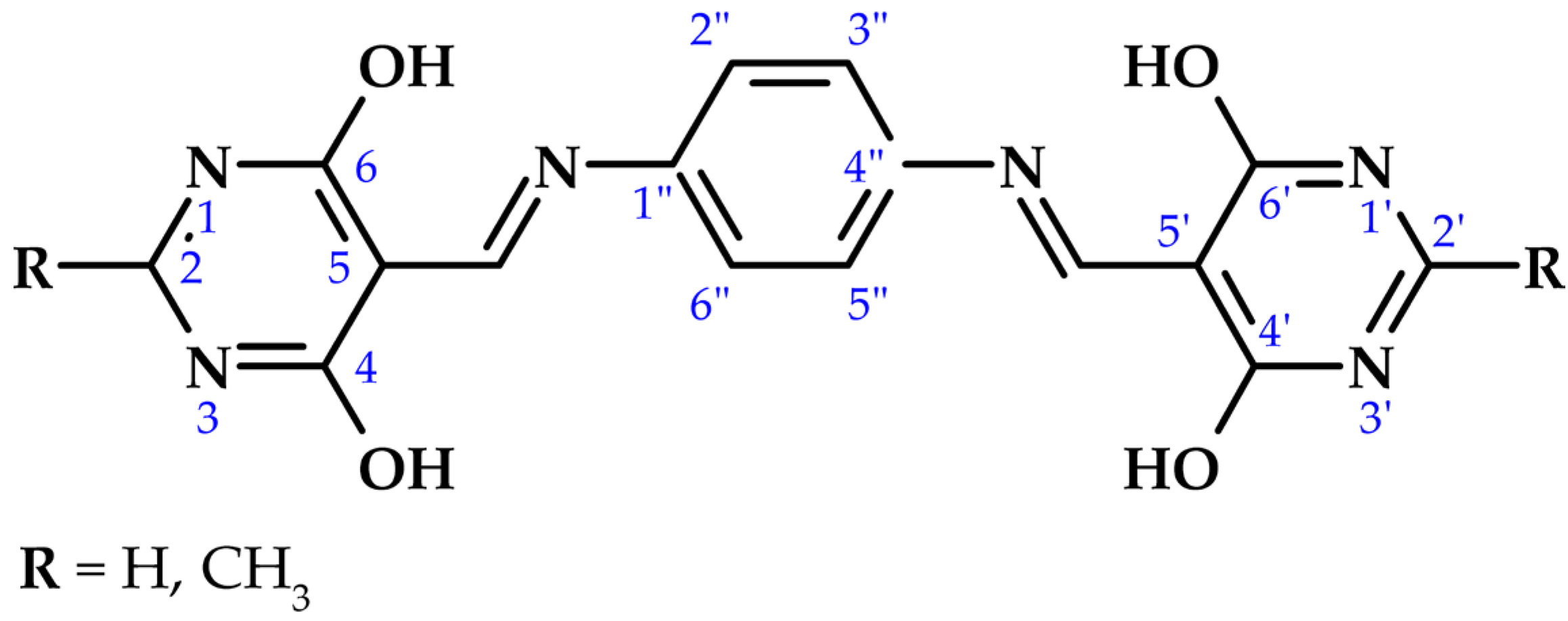
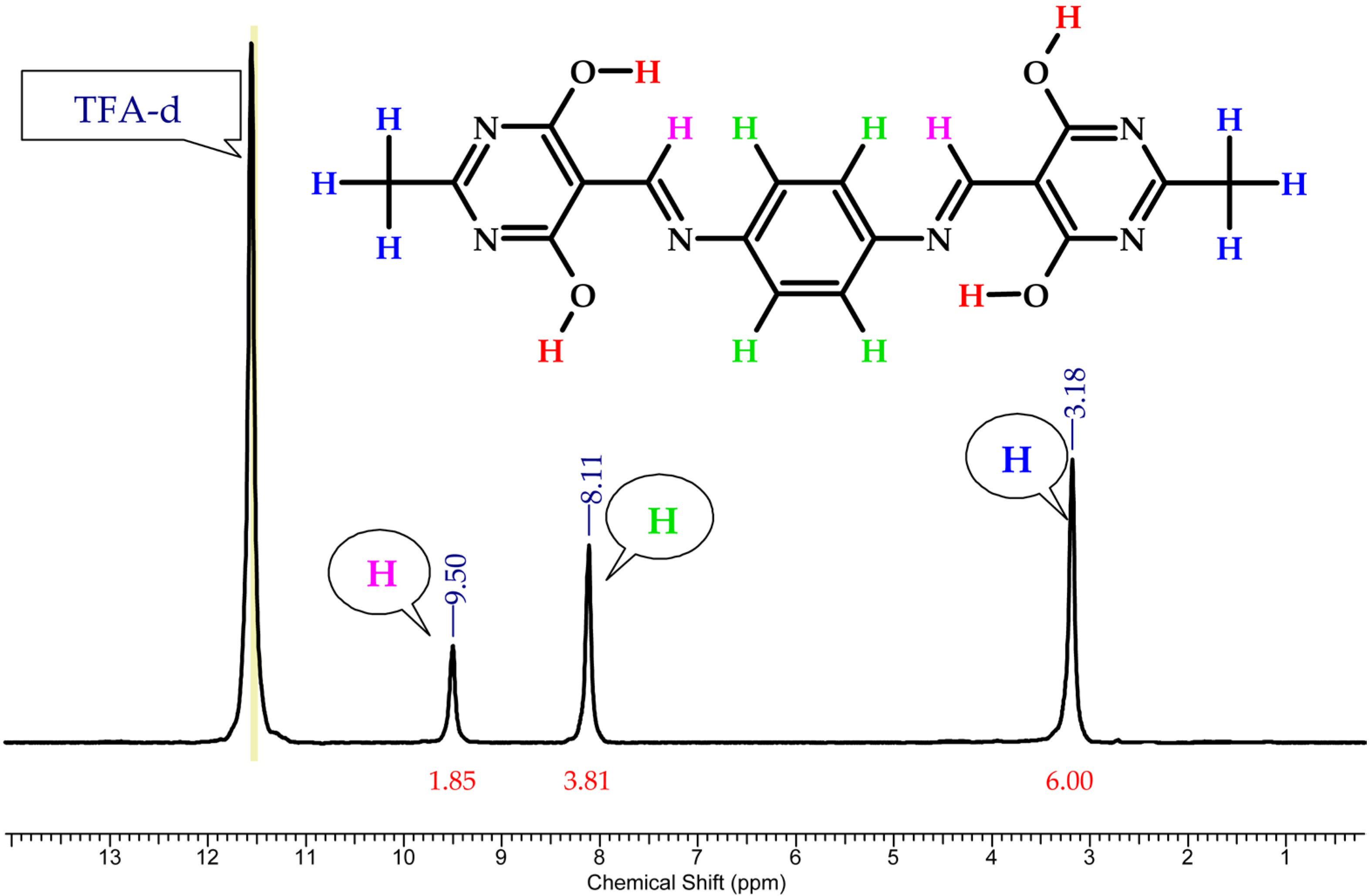
Nuclear magnetic resonance spectrum data 1H (400 MHz, TFA-d), δ, ppm, of product 4 (Figure 3): 3.18 s (6.00 H, -CH3), 8.11 s (4.21 H, H-Ar), 9,50 s (1.85 H, -N=CH-).
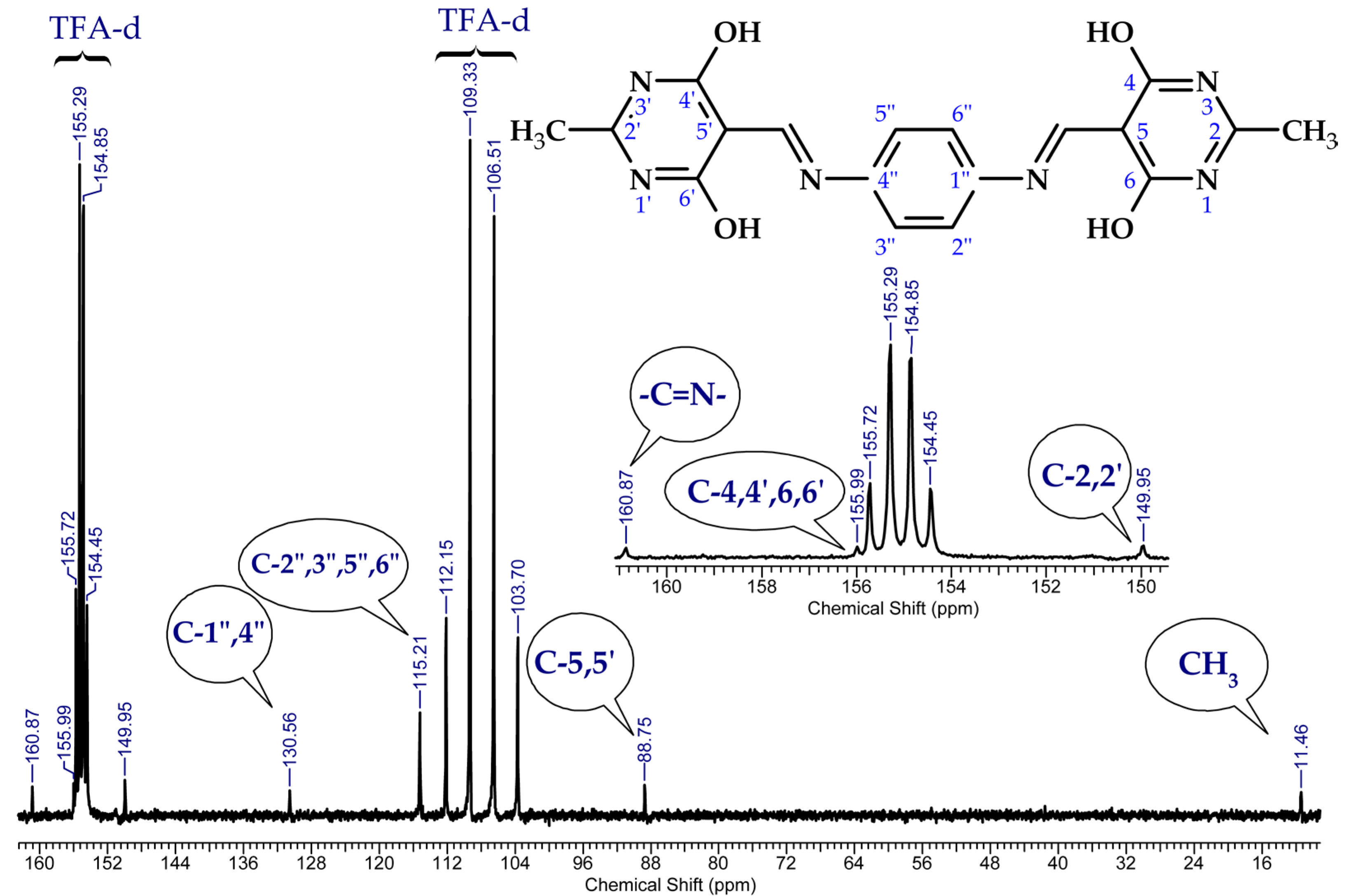
Nuclear magnetic resonance spectrum data 13C (100 MHz, TFA-d), δ, ppm, of product 4: 11.46 (-CH3), 88.75 (C–5, 5′), 115.21 (C–2″, 3″, 5″, 6″), 130.56 (C–1″, 4″), 149.95 (C–2, 2′), 155.99 (C–4, 4′, 6, 6′), 160.87 (-N=CH-).
Nuclear magnetic resonance spectrum data 1H (400 MHz, TFA-d), δ, ppm, of product 6: 8.14 s (4.00 H, H-Ar), 8.65 s (2.01 H: C 2, 2′), 9.62 s (1.89 H, -N=CH-).
Nuclear magnetic resonance spectrum data 13C (100 MHz, TFA-d), δ, ppm, of product 6: 89.01 (C–5, 5′), 116.11 (C–2″, 3″, 5″, 6″), 131.96 (C–1″, 4″), 148.15 (C–2, 2′), 155.91 (C–4, 4′, 6, 6′), 161.03 (-N=CH-).

3. Results

According to the screening results obtained via the web resources PASS Online, CLC-pred, and Antivir-pred, the synthesized compounds demonstrate a high likelihood of exhibiting antihypertensive effects, activity targeting cisplatin-resistant ovarian carcinoma, and antiviral efficacy activity against influenza virus (Table 2).
The in silico assessment of acute toxicity, performed using the GUSAR online platform, categorized the synthesized compounds under toxicity class 4 for intravenous, oral, and subcutaneous routes of administration. In contrast, a classification of toxicity class 5 was predicted for intraperitoneal injection (Table 3).
From the data presented in the table above, it can be concluded that these compounds potentially exhibit a high safety profile.
The target compounds 3, 4, 5, and 6 were obtained by condensation reaction between pyrimidine-5-carbaldehydes (1, 2) and *o*- or *p*-phenylenediamine. The use of absolute methanol as the solvent increases the yield of the target product compared with water. This effect is likely due to the higher solubility of the starting materials in absolute methanol. Their structure was reliably proved by 1H and 13C NMR spectroscopy.
The structural assignment of product 4 was supported by its 1H NMR spectrum (TFA-d, Figure 4). Diagnostic resonances comprise a singlet at 9.50 ppm (integrated intensity 1.85) for the azomethine (CH=N) protons and a singlet at 3.18 ppm (integrated intensity 6.00) for the methyl groups attached to the pyrimidine cores. Additionally, the aromatic protons of the p-phenylene bridge give rise to a set of signals at 8.11 ppm (integrated intensity 3.81).
As illustrated in Figure 5, the 13C NMR spectrum (TFA-d) of product 4 provided full assignment of the carbon skeleton. Key resonances were assigned to the following structural motifs: the azomethine carbons at 160.87 ppm; the hydroxyl-substituted pyrimidine carbons (C–4, C–4′, C–6, C–6′) at 155.99 ppm; the *p*-phenylene bridge carbons (C–1″, C–4″: 130.56 ppm; C–2″, C–3″, C–5″, C–6″: 115.21 ppm); the C–2, C–2′ and C–5, C–5′ pyrimidine carbons at 88.75 ppm; and the methyl carbons at 11.46 ppm.

4. Conclusions

The studied bisazomethine derivatives exhibit a high probability of possessing a broad spectrum of biological activity, particularly antihypertensive, antitumor, and antiviral, as predicted by the PASS online, CLC-pred, and Antivir-pred web resources.
The condensation of 4,6-dihydroxypyrimidine-5-carbaldehyde precursors with *o*- and *p*-phenylenediamines (2:1 molar ratio) provided direct access to previously unreported bisazomethine systems. Reaction optimization studies identified absolute methanol as the optimal medium, consistently furnishing the target molecules in high yields of 80-90%, markedly outperforming aqueous conditions. The significance of these bisazomethines is twofold: their inherent molecular architecture suggests potential for diverse biological activities, while their functional group richness positions them as privileged scaffolds for subsequent medicinal chemistry exploration.

Author Contributions

A.V.D., D.A.K., I.P.Y., T.L.S. and P.O.L. contributed equally to this work. All authors have read and agreed to the published version of the manuscript.

Funding

This research received no external funding.

Institutional Review Board Statement

Not applicable.

Informed Consent Statement

Not applicable.

Data Availability Statement

Data are contained within the article.

Conflicts of Interest

The authors declare no conflicts of interest.

References

  1. Farooq, S.; Ngaini, Z. One-pot and two-pot methods for chalcone derived pyrimidines synthesis and applications. J. Heterocycl. Chem. 2021, 58, 1209–1224. [Google Scholar] [CrossRef]
  2. Abu-El-Wafa, S.M.; El-Wakiel, N.A.; Issa, R.M.; Mansour, R.A. Formation of novel mono-and multi-nuclear complexes of Mn (II), Co (II) and Cu (II) with bis azo-dianils containing the pyrimidine moiety: Thermal, magnetic and spectral studies. J. Coord. Chem. 2005, 58, 683–694. [Google Scholar] [CrossRef]
  3. Gulcan, M.; Özdemir, S.; Dündar, A.; Ispir, E.; Kurtoğlu, M. Mononuclear Complexes Based on Pyrimidine Ring Azo Schiff-Base Ligand: Synthesis, Characterization, Antioxidant, Antibacterial, and Thermal Investigations. Z. Anorg. Allg. Chem. 2014, 640, 1754–1762. [Google Scholar] [CrossRef]
  4. Thakor, P.M.; Patel, J.D.; Patel, R.J.; Chaki, S.H.; Khimani, A.J.; Vaidya, Y.H.; Chauhan, A.P.; Dholakia, A.B.; Patel, V.C.; Patel, A.J.; et al. Exploring new Schiff bases: Synthesis, characterization, and multifaceted analysis for biomedical applications. ACS Omega 2024, 9, 35431–35448. [Google Scholar] [CrossRef] [PubMed]
  5. PASS Online. Prediction of Activity Spectra for Substances, version 2.0; Institute of Biomedical Chemistry: Moscow, Russia; Available online: https://way2drug.com/PassOnline/predict.php (accessed on 17 October 2022).
  6. Dambaev, A.V.; Kolesnik, D.A.; Yakovlev, I.P.; Semakova, T.L. Formylation of 2-Methylpyrimidine-4,6-diol Under the Conditions of the Vilsmeier–Haack Reaction. Chem. Proc. 2024, 16, 104. [Google Scholar] [CrossRef]
Figure 1. Synthesis scheme of bisazomethine derivatives 36.
Chemproc 18 00112 g001
Figure 2. Structural formula of 5,5′-{1,3-phenylenebis[azanylylenemethylidenyl]} bis(pyrimidine-4,6-diols) (3,5).
Chemproc 18 00112 g002
Figure 3. Structural formula of 5,5′-{1,3-phenylenebis[azanylylenemethylidenyl]} bis(pyrimidine-4,6-diols) (4,6).
Chemproc 18 00112 g003
Figure 4. 1H NMR spectrum of 5,5′-{1,4-phenylenebis[azanylylenemethylidenyl]}bis (2-methylpyrimidine-4,6-diol).
Chemproc 18 00112 g004
Figure 5. 13C NMR spectrum of 5,5′-{1,4-phenylenebis[azanylylenemethylidenyl]}bis(2-methylpyri midine-4,6-diol).
Chemproc 18 00112 g005
Table 1. Yields of products 36.
Compound Number3456
Yield in water (%)83858784
Yield in methanol (%)88909391
Table 2. Results of in silico biological activity screening.
Web ResourceActivityPredicted Probability (Pa)
PASS onlineAntihypertensive0.7
CLC-predActivity against cisplatin-resistant ovarian carcinoma0.7
Antivir-predAnti-influenza activity0.2
Table 3. Predicted LD50 values depending on route of administration in mg/kg with preliminary assignment to OECD * toxicity classes.
IntraperitonealIntravenousOralSubcutaneous
5301781801856
Class 5Class 4Class 4Class 4
* The organisation for economic co-operation and development.
Disclaimer/Publisher’s Note: The statements, opinions and data contained in all publications are solely those of the individual author(s) and contributor(s) and not of MDPI and/or the editor(s). MDPI and/or the editor(s) disclaim responsibility for any injury to people or property resulting from any ideas, methods, instructions or products referred to in the content.