1. Introduction
Human immunodeficiency virus (HIV) infection has historically been linked to decreased food intake, malabsorption, and nutritional deficiencies due to high metabolic demands and increased protein turnover. However, obesity rates among people living with HIV (PLWH) have risen, particularly in regions like the USA. Hyperphagia may act as a compensatory response to the hypermetabolic state associated with HIV [
1].
Contrary to earlier beliefs, both developing and developed countries are experiencing rising obesity rates among PLWH [
2,
3], particularly among women and those with lower socioeconomic status [
4,
5,
6]. Initiation of antiretroviral treatment (ART) can enhance appetite, giving rise to weight maintenance, and nutrient absorption, leading to the so-called “return to health” phenomenon [
7]. Starting ART can result in overweight and obesity states, beginning 1–2 years post-initiation [
3,
8].
Accordingly, weight gain and higher body mass index (BMI) in PLWH are associated with a lower risk of disease progression [
9]. Studies indicate that obesity and higher baseline BMI before initiation of ART correlate with better immune outcomes, such as increased CD4 counts [
10,
11], while very low BMI is linked to poor viral suppression [
11]. At the same time, increased BMI in PLWH increases cardiometabolic risk and is related to poor health outcomes [
12,
13]. On the other hand, glucagon-like peptide-1 (GLP-1) is an incretin hormone that plays a crucial role in glucose metabolism and appetite regulation. It is secreted by the intestinal L-cells in response to food intake and has several physiological effects, including stimulating insulin secretion and promoting satiety [
14]. These actions make GLP-1 a key target in the management of obesity and type 2 diabetes (T2DM). Recent studies have demonstrated that GLP-1 receptor agonists (RAs), or dual GLP-1 and glucose-dependent insulinotropic polypeptide (GIP) RAs can lead to significant weight loss in individuals with obesity, regardless of their diabetes status [
15]. Moreover, GLP-1 RAs have consistently demonstrated cardiovascular benefit across high-risk populations with conditions such as T2DM, established atherosclerotic cardiovascular disease, as well as overweight or obesity, with all trials showing improvement in adverse cardiovascular outcomes [
16,
17,
18,
19,
20].
In the context of HIV, where individuals often experience weight fluctuations and metabolic disturbances due to antiretroviral therapy, GLP-1-related therapies offer a promising option for managing obesity and diabetes in this population. Despite preliminary data suggesting potential benefits, these effects have not been thoroughly investigated [
21,
22]. To address this gap, we conducted a retrospective study involving a diverse cohort of PLWH in the Bronx, New York, with obesity and/or T2DM, prescribed either GLP-1 or dual GLP-1/GIP RA. Our aim was to evaluate the impact of these medications on weight management and related metabolic outcomes, hoping to shed light on effective obesity treatment strategies for this patient group.
2. Materials and Methods
2.1. Study Design
In this retrospective study, we evaluated a diverse cohort of PLWH with obesity and/or T2DM with low socioeconomic status, treated with GLP-1 or GLP-1/GIP RA for at least 3 months, at NYC Health and Hospitals/Jacobi Medical Center in the Bronx, NY. Baseline measurements, including weight, glycated hemoglobin (HbA1c), and lipid panel, were collected before and after the treatment. Potential confounding factors for the effect of treatment on weight loss, including types of ART, comorbidities, and other diabetic medication use, were also compared and analyzed. This study was approved by the institutional review board of our institution and adhered to the current Good Clinical Practice guidelines. All authors contributed to the data collection process, as well as reviewing, interpreting, and editing the results.
2.2. Patient Selection
Patients eligible for inclusion were considered those who had a confirmed HIV diagnosis and who were on any dose of GLP-1 or dual GLP-1/GIP RA treatment for at least 12 weeks, during the time period between August 2020 and March 2024, with concomitant obesity and/or T2DM. Our initial search yielded 239 eligible participants. Participants whose duration of treatment was less than 12 weeks were excluded. Also, a small group that was listed with the diagnosis of HIV due to a positive screening test but later was confirmed to be HIV negative was excluded. Eventually, 202 patients were deemed eligible for the final analysis.
2.3. Data Collection
Data were collected retrospectively using the Electronic Medical Record system at NYC Health and Hospitals/Jacobi Medical Center, Bronx NY. We collected baseline data, including HbA1c, low-density lipoprotein (LDL), triglycerides, BMI, and weight, before and after the initiation of GLP-1 or GLP-1/GIP RA, up to March 2024 when the study was initiated. To address missing data, we employed a complete-case analysis approach. Consequently, only individuals with sufficient clinical measurements for each specific statistical evaluation were incorporated into the study.
Data regarding GLP-1-related therapy (length of treatment and types of medications used), comorbidities (hyperlipidemia, hypertension, chronic kidney disease, diabetes, and its complications), other antidiabetic medication use during GLP-1 RA treatment [i.e., insulin, metformin, pioglitazone, sulfonylureas, and sodium-glucose cotransporter 2 inhibitors (SGLT-2i)], statin use, individual HIV parameters (types of ART use, duration of current type of ART, duration of HIV positive status, CD4 count, and viral load), as well as demographics (age, gender, and race) were simultaneously recorded.
2.4. Data Analysis
Before analysis, we assessed the normality of key clinical indicators, including HbA1c, LDL, triglycerides, BMI, and weight, using the Shapiro–Wilk test. Since none of the variables were normally distributed, Wilcoxon’s Signed Rank test was utilized. To examine factors associated with HbA1c reduction, weight loss, and percentage of weight loss, we applied the Mann–Whitney U test and the Kruskal–Wallis test. Furthermore, we conducted univariate and multivariate logistic regression analyses to assess factors associated with an HbA1c reduction of more than 1%, weight loss of more than 10 kg, and weight loss of more than 5%.
3. Results
In
Table 1, we present the baseline demographic data, characteristics, and comorbidities of the cohort of PLWH on GLP-1 or GLP-1/GIP RA therapy. In total, 202 patients were included in the final study based on inclusion criteria. Among these, 47.5% were male and 52.5% were female. The cohort was primarily represented by Black (49.5%) and Hispanic (40.1%) individuals. A total of 86.6% of these individuals fit the criteria for overweight (defined as BMI ≥ 25 and <30 kg/m
2) or obesity (defined as a BMI ≥ 30 kg/m
2), and 92.0% had prediabetes (defined as HbA1c 5.7–6.4%) or T2DM (defined as HbA1c ≥ 6.5%). The baseline mean HbA1c of participants was 8.7% [SD 2.4], mean weight 95.9 kg [SD 28.4], and mean BMI 33.8 kg/m
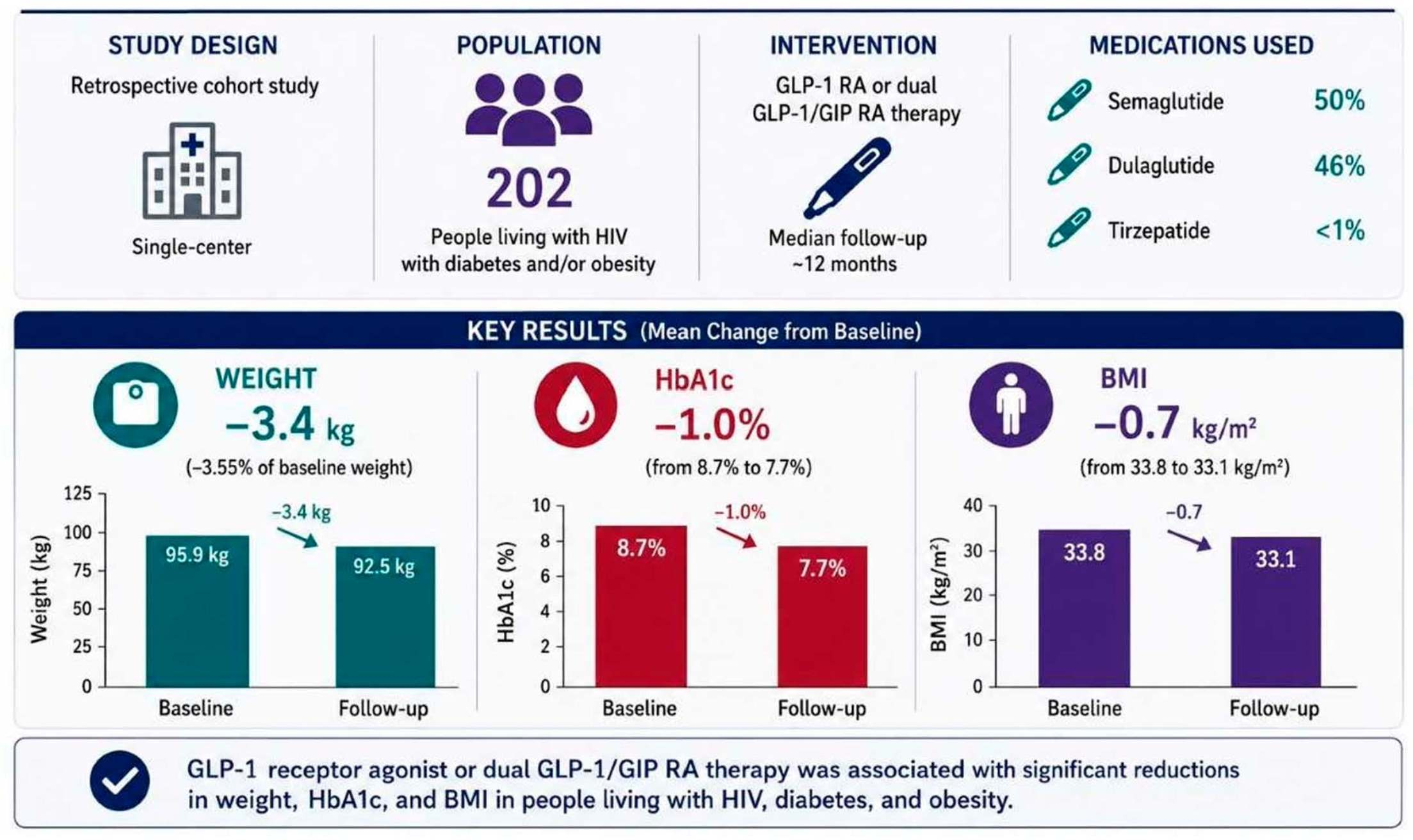
2 [SD 8.2]. Regarding GLP-1-related treatments, 50.5% of patients received semaglutide, 46% received dulaglutide, 3% received liraglutide, and 0.5% received tirzepatide, with a mean treatment duration of 24.2 months [SD 18.0]. Concurrent antidiabetic therapies included insulin (50%), metformin (63.4%), sulfonylureas (9.9%), pioglitazone (8.9%) and SGLT-2i (20.3%). Of the participants, 65.3% had an undetectable viral load. The ART regimens were divided into five groups: Group I [tenofovir alafenamide (TAF)-based regimens], which included emtricitabine/rilpivirine/tenofovir alafenamide, bictegravir/emtricitabine/tenofovir alafenamide, darunavir/cobicistat/emtricitabine/tenofovir alafenamide, and elvitegravir/cobicistat/emtricitabine/tenofovir alafenamide, accounting for 72.3% of patients; Group II [Tenofovir disoproxil fumarate (TDF)-based regimens], including emtricitabine/rilpivirine/tenofovir disoproxil fumarate, elvitegravir/cobicistat/emtricitabine/tenofovir disoproxil fumarate, efavirenz/emtricitabine/tenofovir disoproxil fumarate, and doravirine/lamivudine/tenofovir disoproxil fumarate, making up 3% of the cohort; Group III (NNRTI regimen), including dolutegravir/rilpivirine, accounting for 4.5% of patients; Group IV (non-tenofovir NRTI), including dolutegravir/lamivudine, making up 11.9% of patients; and Group V (other medications), accounting for 8.4% of patients. The mean duration of ART was 44.9 months [SD 23.0].
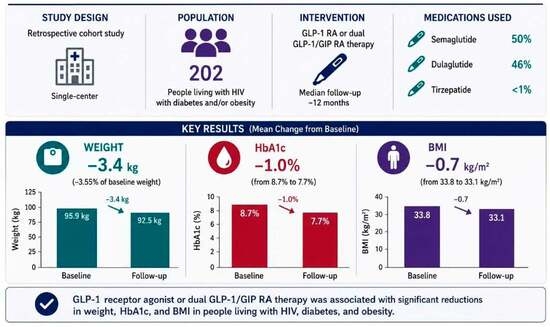
After treatment with GLP-1 or dual GLP-1/GIP RAs, we observed a mean HbA1c reduction of 1%, from 8.7% to 7.7% (
p < 0.001). Additionally, there was a mean decrease in BMI of 0.7 kg/m
2, dropping from 33.8 kg/m
2 to 33.1 kg/m
2 (
p < 0.001). The mean weight reduction was 3.4 kg, from 95.9 kg to 92.5 kg (
p < 0.001) (
Table 2), corresponding to a 3.55% reduction from baseline. No significant associations were found between sex or race and the decrease in HbA1c. As evidenced in
Table 3, various comorbidities were not associated with changes in HbA1c. However, concurrent use of sulfonylureas was associated with a lower HbA1c reduction (
Table 4). As expected, insulin use was associated with less weight reductions, compared to insulin non-users (
Table 5).
When analyzing the response by the ART regimen group, we observed a mean HbA1c reduction of 1.1% in Group I, 0.8% in Group II, 0.1% in patients on dolutegravir/rilpivirine, and 1.3% in those on dolutegravir/lamivudine (
p = 0.07). Univariate logistic regression analysis showed that microalbuminuria (OR 1.852, 95% CI [1.023–3.355],
p = 0.042), insulin use (OR 1.808, 95% CI [1.013–3.224],
p = 0.045), and the duration of GLP-1 RA use (OR 1.027, 95% CI [1.010–1.0],
p = 0.002) were associated with an HbA1c reduction greater than 1% (
Table 6). The only factor independently associated with an HbA1c reduction greater than 1% was the duration of GLP-1 RA use (OR 1.021, 95% CI [1.002–1.039],
p = 0.027).
Factors associated with weight loss were analyzed. The absence of insulin use was associated with greater weight loss, with a mean reduction of 4.4 kg in non-insulin users compared to a 1.8 kg loss in insulin users (
p = 0.048). No significant differences in weight loss were observed when the population was stratified by sex, race, comorbidities, type of GLP-1 RA therapy, other antidiabetic treatment, or ART regimens. Of note, younger age (
Table 7) was found to be associated with weight loss greater than 10 kg (OR 0.965, 95% CI [0.934–0.997],
p = 0.030). In terms of mean percentage weight loss across different sexes, races, comorbidities, GLP-1 or GLP-1/GIP RA regimens, and ART regimens, non-insulin users achieved a weight loss of 2.4% while insulin users achieved only 0.2% (
p = 0.049). Additionally, hyperlipidemia was independently associated with a higher likelihood of achieving more than 5% of weight loss (OR 2.359, 95% CI [1.114–4.995],
p = 0.025). Conversely, a CD4 count above 500 was independently associated with a lower likelihood of exceeding 5% weight loss (OR 0.355, 95% CI [0.189–0.668],
p = 0.001), suggesting that poorer HIV control may predict greater weight loss (
Table 8). Interestingly, no correlation was found between the duration of GLP-1 or dual GLP-1/GIP RA use and percentage weight loss (Pearson’s r = 0.111,
p = 0.126).
4. Discussion
Understanding the mechanisms leading to the increased risk of obesity in PLWH and strategies for its prevention is complex due to the multifaceted nature of obesity and the impact of ART on severe metabolic complications, including lipodystrophy, insulin resistance, and dyslipidemia [
23,
24,
25]. These heightened effects are likely due to a combination of HIV-related pathophysiology, immune dysfunction, and ART-associated toxicity. Notably, PLWH receiving ART treatment are at a four-fold increased risk of developing T2DM with increased insulin resistance, compared to individuals without HIV [
26]. Additionally, altered fat distribution patterns have been observed in individuals undergoing ART. Thymidine analogs are associated with facial lipoatrophy, while protease inhibitors tend to cause an accumulation of fat in the trunk region. Integrase inhibitors and tenofovir alafenamide have been linked to generalized fat gain, whereas efavirenz and tenofovir disoproxil fumarate seem to limit weight gain [
27].
Liraglutide and semaglutide, two prominent GLP-1 RAs, as well as tirzepatide, a dual GLP-1/GIP RA, promote weight loss through a combination of central and peripheral mechanisms. These medications enhance glucose-dependent insulin secretion while suppressing glucagon production, effectively managing hyperglycemia. Beyond their effects on glucose metabolism, they assist in weight reduction by delaying gastric emptying, which increases satiety and reduces caloric intake. Additionally, interaction with GLP-1 receptors in the hypothalamus and the solitary tract modulates hunger signals and enhances satiety. This combination of metabolic and appetite-regulating effects has led to their widespread use in managing obesity and weight-related comorbidities [
28,
29,
30]. Semaglutide has shown promise in HIV-negative populations, with clinical trials reporting up to a 15% weight loss and significant improvements in glycemic control among individuals with prediabetes [
31,
32]. Additionally, in a randomized controlled trial including 108 PLWH with well-controlled HIV infection on ART and lipohypertrophy but with no diabetes, semaglutide 1.0 mg weekly for 32 weeks offered significant weight decreases compared to placebo [
33]. On the other hand, in HIV-negative patients with obesity, tirzepatide has also demonstrated 20% weight loss at the highest doses [
30], while a retrospective study on PLWH on different GLP-1 RAs found that tirzepatide was much more likely to decrease weight by 5%, compared to other GLP-1-related treatments. In the same study, dulaglutide showed a lower likelihood of causing weight loss greater than 5% [
34].
Although effectiveness of GLP-1 and GLP-1/GIP RAs is well-documented in the general population, their effects in PLWH remain less well known. Data on liraglutide is limited to case reports, which need more evidence for broad conclusions [
35,
36]. In contrast, a few studies have highlighted the effectiveness of semaglutide for weight and glucose management in PLWH. A recent observational study demonstrated an average weight loss of 6.5 kg (a 5.7% reduction in body weight) and a 1.1% reduction in HbA1c after one year of semaglutide, consistent with results from non-HIV populations [
37]. Additionally, the first randomized controlled trial evaluating semaglutide effects on weight loss in non-diabetic PLWH with lipohypertrophy showed achievement of weight loss of more than 5% [
38]. As expected, non-diabetic PLWH experienced significantly greater weight loss with GLP-1RA or GLP-1/GIP RAs, compared to those with diabetes [
34].
Our study, representing one of the largest and diverse cohorts of 202 PLWH, with a majority of Black or Hispanic patients at a large public hospital in New York City, emphasizes the significant metabolic benefits of GLP-1 RA therapy in this population. Firstly, GLP-1 RA therapy led to a mean HbA1c reduction of 1%, with the duration of treatment emerging as the only independent predictor of more significant reductions. Treatment duration was relatively prolonged in our cohort, with a mean duration of 24.2 months. Secondly, patients experienced an average weight loss of 3.4 kg (which is 3.55% of the 95.9 kg baseline) and a BMI reduction of 0.7 kg/m
2, with non-insulin users losing more weight than insulin users. Although, the overall degree of weight loss over 24 months is modest and should be interpreted cautiously, it is important to consider that the mean HbA1c in our cohort was 8.7%, indicating poor diabetes control. Given that our sample also included people without diabetes, the mean HbA1c among those with T2DM was likely even higher. Studies and clinical experience support that patients with poorly controlled T2DM may experience less weight loss on GLP-1 RAs, compared to those with better glycemic control [
38]. We believe that the relatively modest weight changes observed may, at least in part, reflect the aforementioned metabolic characteristics of our population, including high prevalence of poorly controlled T2DM. Accordingly, only 62% of the cohort was obese, which could have diluted the observed weight loss effect, as GLP-1 RA-related weight reduction tends to be more pronounced in individuals with obesity. It is also worth noting that the study was conducted in the Bronx where medication adherence challenges are quite common; therefore, the modest weight changes may partly reflect variable adherence to therapy. Interestingly, we observed that a CD4 count above 500 was associated with less weight loss and that younger patients were more likely to achieve significant weight loss of more than 10 kg. Although efficacy of GLP-1 RA has been shown to be equal in all age groups in the general population [
39], PLWH may experience metabolic-associated steatotic liver disease (MASLD) [
40,
41] and sarcopenia [
42] with a higher prevalence compared to general population, and sarcopenic obesity prevalence is increasing by age [
43]. This might, at least partially, explain why age is related to weight loss in our cohort; however, other unique pathophysiologic mechanisms that encounter HIV infection and ART might also be involved. Lastly, although the changes in weight and HbA1c varied across ART regimens, they did not reach statistical significance.
This study builds on existing evidence that GLP-1 RAs are effective agents for managing weight and metabolic health in PLWH, including Black and Hispanic patients of largely lower socioeconomic status. This population is more likely to be affected by metabolic disorders such as weight gain, insulin resistance, and T2DM in addition to having a higher prevalence of HIV due to complex social, environmental, or genetic factors. Our findings suggested clinically significant weight loss, although to a lesser degree than what has been reported in studies evaluating GLP-1 RA effects in non-PLWH populations. This difference may be attributed to the large Black and Hispanic race in our population, the counteracting effects of ART, and the presence of prediabetes or diabetes in most participants, which is typically associated with lower weight loss.
Our study has some limitations. First, the majority of participants in the cohort were treated with semaglutide (50%) or dulaglutide (46%) and only one participant was receiving tirzepatide. Therefore, the findings might not be fully generalizable to all GLP-1 RAs and, particularly, to GLP-1/GIP dual RAs. Further research is needed to determine whether similar outcomes would be observed. Our inclusion criteria required at least 12 weeks of treatment with GLP-1 RAs or GLP-1/GIP dual RAs. This may introduce survivor bias, as individuals who discontinued treatment earlier because of adverse effects, access limitations, or insufficient response were not captured in our analysis. Consequently, our findings may overrepresent individuals who were able to tolerate and maintain therapy. The absence of a comparator group prevents definitive conclusions regarding causality between GLP-1 RA or GLP-1/GIP RA therapy and the observed metabolic improvements. Concurrent diabetes management, modifications in other medications, lifestyle interventions, or other unmeasured factors may have influenced the observed changes.
Second, we did not have access to specific dosing information of each agent, which prevented us from performing dose–response subgroup analyses. As a result, the effects we observed should not be assumed to apply uniformly across all formulation or dosing regimens. Nonetheless, the results do suggest a consistent metabolic benefit of GLP-1 RAs in this population. Furthermore, medication adherence was not assessed in this study. Variable adherence to GLP-1 RA therapy may have influenced the observed magnitude of weight loss and glycemic improvement. Therefore, this factor should be considered a potential source of residual confounding.
Additionally, we found that hypertension was associated with a greater likelihood of achieving an HbA1c reduction of more than 1%. While this observation warrants further investigation, it may be explained by the metabolic profile of patients with hypertension. In PLWH, hypertension frequently clusters with metabolic syndrome and insulin resistance [
44], conditions that are often accompanied by higher baseline HbA1c levels. Given that baseline HbA1c can predict the magnitude of HbA1c reduction with GLP-1 RA therapy [
45], individuals with hypertension may derive greater glycemic benefit from treatment, leading to the association observed in our cohort.
Interestingly, a longer duration of treatment emerged as a key predictor of HbA1c reduction, particularly in patients with hypertension and diabetic microvascular complications. Although the retrospective design and the lack of body composition analysis are limitations, the insights gained regarding treatment duration and demographic predictors provide a solid foundation for personalizing GLP-1 RA therapy for this population of PLWH with obesity and/or T2DM. These findings reaffirm the utility of GLP-1 RAs in a diverse group of individuals and encourage further prospective studies to validate and refine their role in enhancing metabolic health in PLWH.



 ,
,