1. Introduction
Type 2 diabetes mellitus (T2DM) represents one of the most significant global health challenges, affecting hundreds of millions of individuals worldwide and contributing substantially to morbidity and mortality. Among its most serious complications, atherosclerotic cardiovascular disease (ASCVD) remains the leading cause of death in patients with T2DM. Despite advances in pharmacological therapy and cardiovascular risk management, individuals with diabetes continue to experience a disproportionately high burden of ischemic heart disease, stroke, and peripheral arterial disease [
1,
2,
3].
The relationship between diabetes duration and cardiovascular risk has long been recognized. Prolonged exposure to hyperglycemia, insulin resistance, dyslipidemia, and low-grade inflammation contributes to progressive endothelial dysfunction, arterial stiffness, oxidative stress, and vascular remodeling. Longer diabetes duration is commonly considered a marker of cumulative metabolic exposure and has been associated with increased cardiovascular risk in epidemiological studies. Consequently, longer diabetes duration is often considered a surrogate marker of cumulative metabolic injury and presumed to be associated with greater cardiovascular burden [
4,
5,
6].
However, disentangling the independent contribution of diabetes duration from that of chronological aging remains challenging, as both variables increase over time and may exert overlapping effects on cardiovascular outcomes [
7,
8,
9,
10].
Moreover, clinical observations suggest that cardiovascular damage may already be present at or near the time of diabetes diagnosis. Many individuals experience years of insulin resistance and metabolic dysfunction prior to formal diagnosis, potentially leading to early vascular injury. In such cases, the apparent association between duration and cardiovascular disease may be attenuated by the high baseline prevalence of ASCVD even in patients with recently diagnosed diabetes [
11,
12].
Real-world data examining the cross-sectional relationship between diabetes duration and established cardiovascular disease remain limited, particularly in Eastern European populations. Evaluating this association using complementary statistical approaches—including continuous, categorical, and ordinal analyses—may provide additional insight into whether cardiovascular burden increases linearly with duration, exhibits threshold effects, or is predominantly driven by age.
Although the relationship between diabetes duration and cardiovascular risk has been explored in epidemiologic cohorts, real-world data from high-risk clinical populations remain limited. In particular, few studies have examined this association in settings where baseline cardiovascular burden is already substantial, potentially modifying the observable impact of diabetes duration.
The present study therefore provides additional insight by evaluating the duration–ASCVD relationship in a tertiary care cohort characterized by advanced cardiometabolic risk, using complementary analytical strategies to explore potential ceiling effects and the relative contribution of vascular aging.
Therefore, the aim of the present study was to investigate the association between diabetes duration and cardiovascular burden in a real-world cohort of adults with T2DM. Specifically, we sought to (1) evaluate the relationship between duration of diabetes and the prevalence of composite ASCVD, (2) explore potential nonlinear associations across duration strata across duration strata, and (3) determine whether diabetes duration remains independently associated with cardiovascular disease after adjustment for age and key metabolic covariates.
2. Materials and Methods
2.1. Study Design and Participants
This study represents a real-world, observational, cross-sectional analysis conducted in adult patients with type 2 diabetes mellitus (T2DM) followed at Bihor County Emergency Clinical Hospital, Oradea, Romania. The primary objective was to evaluate the association between diabetes duration and cardiovascular burden in a routine clinical practice setting.
Eligible participants were adults aged 18–80 years with a confirmed diagnosis of T2DM according to American Diabetes Association (ADA) criteria. All patients underwent standardized clinical and laboratory assessment during routine outpatient evaluation between March 2024 and September 2025.
Patients with incomplete medical records, type 1 diabetes, active malignancy, acute cardiovascular events within the preceding 3 months, or severe systemic illness were excluded. All consecutive eligible patients with complete data on diabetes duration and cardiovascular history during the study period were included to reflect real-world clinical practice.
All participants provided informed consent for the use of anonymized clinical data for research purposes.
Due to the real-world observational design and the retrospective nature of data extraction, detailed and standardized information regarding several important cardiovascular risk modifiers was not consistently available for all participants. Detailed longitudinal information regarding treatment exposure, treatment adherence, and long-term blood pressure and lipid control was not consistently available for all participants and therefore could not be comprehensively incorporated into the primary multivariable analyses. However, selected variables available in a subset of participants, including smoking status and use of GLP-1 receptor agonists and SGLT2 inhibitors, were explored in extended sensitivity models.
The study was conducted in accordance with the Declaration of Helsinki and was approved by the Institutional Review Board of the Faculty of Medicine and Pharmacy, University of Oradea (approval no. 5/30 October 2023).
2.2. Clinical and Cardiovascular Assessment
Diabetes duration was recorded in years based on documented date of diagnosis. For categorical analyses, duration was stratified into four predefined groups:
0–4 years;
5–9 years;
10–14 years;
≥15 years.
The primary outcome was the presence of a composite atherosclerotic cardiovascular disease (ASCVD) endpoint, defined as a documented history of at least one of the following:
ASCVD status was derived from documented medical history and confirmed diagnoses in the electronic medical record system.
Secondary cardiovascular parameters included:
Systolic blood pressure (SBP);
Diastolic blood pressure (DBP);
Lipid profile (total cholesterol, LDL cholesterol, HDL cholesterol, triglycerides);
Triglyceride-to-HDL ratio.
ASCVD diagnoses were based on documented medical history confirmed by specialist evaluation and, whenever available, supported by imaging findings or hospital discharge documentation.
2.3. Anthropometric and Laboratory Measurements
Anthropometric measurements included body weight (kg) and body mass index (BMI, kg/m2), calculated using calibrated scales.
Blood pressure was measured in the seated position after at least 5 min of rest using a validated automated sphygmomanometer (Omron Healthcare Co., Ltd., Kyoto, Japan).
Laboratory parameters were obtained from venous blood samples collected after overnight fasting. Fasting plasma glucose was determined using the glucose oxidase method, and HbA1c was measured using high-performance liquid chromatography (HPLC). Serum lipids and creatinine were analyzed using standardized enzymatic methods in an accredited laboratory.
Estimated glomerular filtration rate (eGFR) was calculated using the CKD-EPI equation when relevant for adjustment analyses.
2.4. Statistical Analysis
Continuous variables were expressed as mean ± standard deviation (SD), and categorical variables as counts and percentages.
Comparisons across diabetes duration categories were performed using one-way analysis of variance (ANOVA) for continuous variables and chi-square tests for categorical variables.
To evaluate linear trends in ASCVD prevalence across ordered duration categories, the Cochran–Armitage trend test was applied.
Logistic regression models were constructed to assess the association between diabetes duration and the composite ASCVD endpoint:
Diabetes duration was analyzed both as a continuous variable (per 1-year increase) and as a categorical variable (≥15 years vs. 0–4 years reference group).
Multicollinearity among independent variables was assessed using variance inflation factors (VIF), with values > 5 considered indicative of significant collinearity.
Extended multivariable analyses were performed using available-case data for variables incompletely captured in the dataset, including smoking status and cardioprotective therapies. These analyses were considered exploratory sensitivity analyses.
Adjusted predicted probabilities of ASCVD were derived from the multivariable logistic regression model.
All statistical tests were two-tailed, and statistical significance was defined as p < 0.05. Statistical analyses were performed using IBM SPSS Statistics, Version 30 (IBM Corp., Armonk, NY, USA).
2.5. Ethical Considerations
This study was observational and involved analysis of routinely collected clinical data. No experimental interventions were performed. All procedures complied with national and institutional ethical standards. Data were anonymized prior to analysis to ensure participant confidentiality.
2.6. Sample Size Considerations
This study included 250 adult patients with type 2 diabetes and complete data regarding diabetes duration and cardiovascular status.
Given the observational, cross-sectional design, no formal a priori sample size calculation was performed. Instead, all consecutive eligible patients meeting inclusion criteria during the study period were included to maximize statistical power and external validity.
For logistic regression analysis, the adequacy of sample size was evaluated using the events-per-variable (EPV) principle. The composite ASCVD endpoint was present in approximately 85% of participants, yielding more than 200 outcome events. Considering that the fully adjusted model included five predictors (diabetes duration, age, sex, BMI, and HbA1c), the EPV ratio substantially exceeded the conventional minimum threshold of 10 events per variable, indicating sufficient model stability and low risk of overfitting.
Furthermore, with 250 participants distributed across four diabetes duration strata (n = 52, 54, 96, and 48, respectively), the study had adequate precision to detect moderate effect sizes in unadjusted models. However, subgroup analyses—particularly comparisons involving the ≥15-year category—may have reduced statistical precision, as reflected by wider confidence intervals in adjusted categorical models.
Although the study was not powered for small effect sizes after multivariable adjustment, the available sample size was considered sufficient for detecting clinically meaningful associations between diabetes duration and ASCVD burden in a real-world population.
3. Results
3.1. Baseline Characteristics According to Diabetes Duration
A total of 250 adults with type 2 diabetes mellitus (T2DM) were included and stratified into four groups according to diabetes duration: 0–4 years (n = 52), 5–9 years (n = 54), 10–14 years (n = 96), and ≥15 years (n = 48).
Overall, 213 participants (85.2%) had established ASCVD, reflecting a high baseline cardiovascular burden in this tertiary care cohort.
Mean age increased progressively across duration strata, from 58.21 ± 13.73 years in the 0–4-year group to 67.56 ± 8.70 years in the ≥15-year group (ANOVA p < 0.001). Body mass index (BMI) remained elevated across all groups without significant differences (p = 0.504). Glycemic control differed significantly across categories, with the highest HbA1c observed in the 10–14-year group (8.34 ± 2.06%, p = 0.001).
Regarding cardiovascular risk factors, systolic blood pressure did not differ significantly across duration strata (p = 0.309), whereas diastolic blood pressure showed modest variation (p = 0.038). Lipid parameters, including total cholesterol, LDL cholesterol, HDL cholesterol, triglycerides, and triglyceride-to-HDL ratio, were comparable across groups (all p > 0.05). Renal function, assessed by estimated glomerular filtration rate (eGFR), declined significantly with longer diabetes duration (p < 0.001).
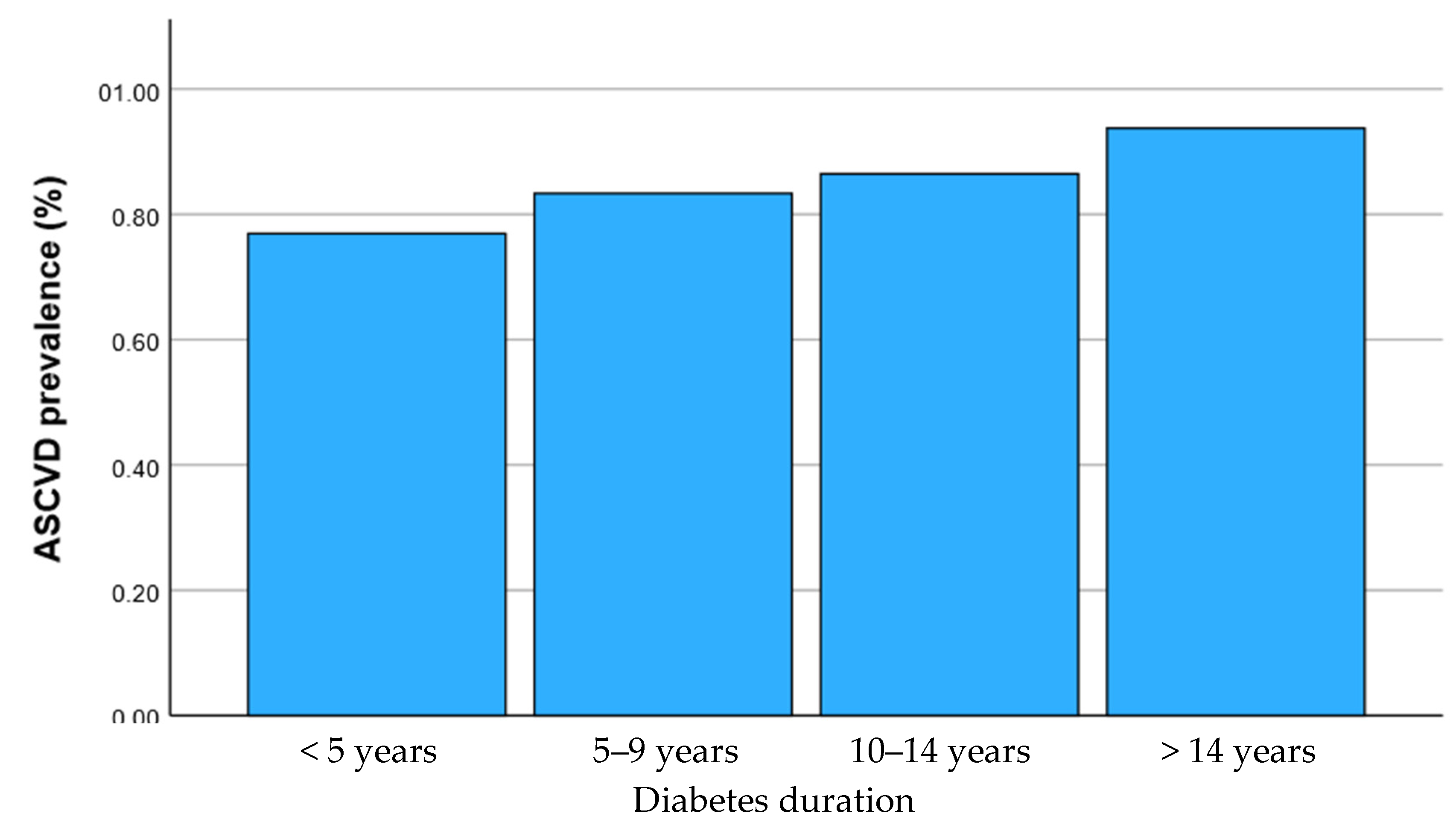
ASCVD prevalence increased numerically across duration categories (76.9%, 83.3%, 86.5%, and 93.8%, respectively), although the difference did not reach statistical significance (χ
2 p = 0.118) (
Table 1).
Additional analyses were performed. In an extended multivariable model additionally including smoking, systolic blood pressure, LDL cholesterol, triglyceride-to-HDL ratio, renal function, and treatment with GLP-1 receptor agonists and SGLT2 inhibitors, diabetes duration remained non-significantly associated with prevalent ASCVD (OR 1.05, 95% CI 0.95–1.15, p = 0.347). No significant age × diabetes duration interaction was observed (p for interaction = 0.257), and nonlinear modeling using a quadratic duration term did not support a non-linear association (p = 0.743). In categorical analyses, the unadjusted excess odds observed in participants with ≥15 years of diabetes were attenuated after both basic and extended adjustment.
To visually illustrate the distribution of cardiovascular burden across diabetes duration categories, the prevalence of composite ASCVD was plotted according to predefined duration strata (
Figure 1). A progressive numerical increase in ASCVD prevalence was observed from early-duration diabetes (<5 years) to long-standing disease (>14 years). Although the pattern suggests a monotonic upward trend, statistical testing did not confirm a significant linear association across ordered categories (Cochran–Armitage
p = 0.118). This graphical representation underscores the high baseline cardiovascular burden present even in early diabetes and highlights the modest incremental increase observed with longer disease duration.
3.2. Association Between Diabetes Duration and ASCVD
In univariate logistic regression analysis, diabetes duration was significantly associated with the presence of ASCVD. Each additional year of diabetes was associated with a 9% increase in the odds of ASCVD (OR 1.09; 95% CI 1.02–1.17;
p = 0.012) (
Table 2).
Age remained statistically associated with prevalent ASCVD after adjustment (OR 1.13; 95% CI 1.08–1.19;
p < 0.001). However, given the limited adjustment for several major cardiovascular risk modifiers, this finding reflects a statistical association within a partially adjusted model rather than evidence of a dominant biological effect (
Figure 2).
The high prevalence of ASCVD (~85%) may limit model discrimination and reduce sensitivity in detecting independent associations.
3.3. Extended Multivariable Analysis
To further address potential confounding, an extended multivariable logistic regression model was constructed including additional cardiometabolic variables available in the dataset: smoking status, systolic blood pressure, LDL cholesterol, triglyceride-to-HDL ratio, renal function (eGFR), and treatment with GLP-1 receptor agonists and SGLT2 inhibitors.
In this extended model, diabetes duration remained non-significantly associated with ASCVD (OR 1.05; 95% CI 0.95–1.15; p = 0.347). The inclusion of these additional covariates did not materially alter the overall pattern of results.
These findings suggest that the attenuation of the duration–ASCVD association is not solely attributable to the limited covariate set used in the primary model, although residual confounding cannot be excluded (
Table 3).
3.4. Categorical Analysis of Diabetes Duration
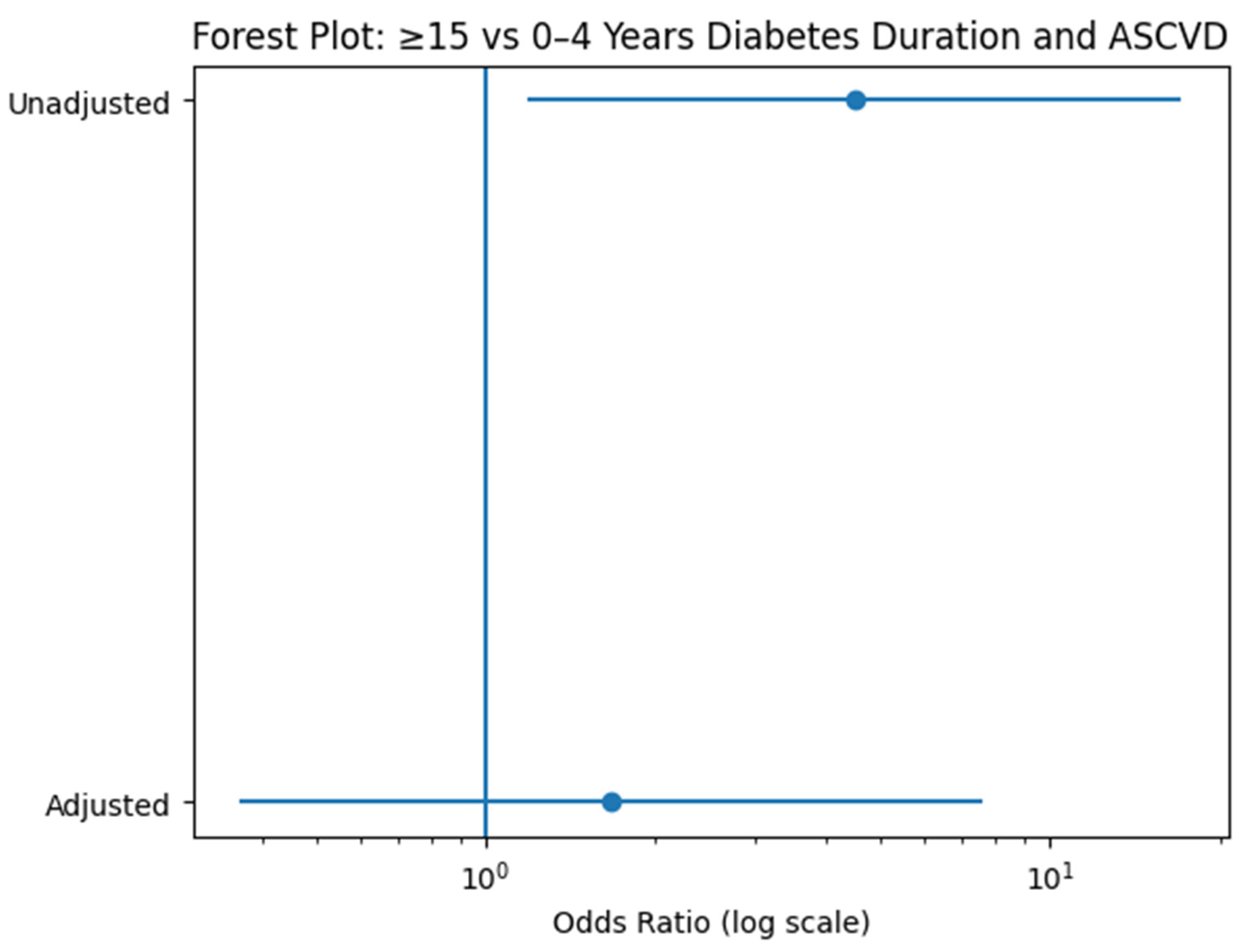
In categorical analysis, patients with ≥15 years of diabetes had significantly higher odds of ASCVD compared with those with 0–4 years in unadjusted models (OR 4.50; 95% CI 1.18–17.10; p = 0.027).
However, this association was attenuated after adjustment for age, sex, BMI, and HbA1c (adjusted OR 1.49; 95% CI 0.29–7.59; p = 0.631), and remained non-significant in the extended model (OR 1.43; 95% CI 0.21–9.71; p = 0.716).
The wide confidence intervals observed in adjusted models indicate reduced precision, likely related to the high baseline prevalence of ASCVD and subgroup size distribution.
The attenuation of the association persisted in both the basic and extended multivariable models, indicating that the observed crude effect is not independent of age, metabolic factors, and additional cardiometabolic covariates (
Table 4).
To further quantify the magnitude of cardiovascular risk associated with long-standing diabetes, a forest plot was constructed comparing patients with ≥15 years of disease duration to those with 0–4 years (reference category) (
Figure 3). In the unadjusted model, long-standing diabetes was associated with substantially higher odds of ASCVD, with an odds ratio exceeding fourfold. However, after adjustment for age, sex, BMI, and HbA1c, the association was markedly attenuated and no longer statistically significant. The graphical representation illustrates the attenuation of the crude association between long-standing diabetes and ASCVD after multivariable adjustment.
3.5. Interaction Analysis Between Age and Diabetes Duration
To explore whether the association between diabetes duration and ASCVD differed across age groups, an interaction term (age × diabetes duration) was included in the multivariable model.
No statistically significant interaction was observed (p for interaction = 0.257), indicating that the association between diabetes duration and ASCVD did not differ significantly across age strata.
The absence of statistical confirmation may reflect the already high baseline prevalence of ASCVD even in early-duration diabetes, limited statistical power due to subgroup sizes, or the substantial overlap between aging and cumulative cardiometabolic burden (
Table 4).
To provide an alternative visual representation of the distribution of ASCVD cases across diabetes duration strata, a relationship map was generated. In this network-style diagram, node size reflects category frequency, while line thickness represents the number of ASCVD cases within each duration group. The visualization illustrates the progressive increase in absolute ASCVD counts from early-duration to long-standing diabetes, with the thickest connections observed in the 10–14-year and ≥15-year strata. Although this graphical approach highlights a clear monotonic pattern in case distribution, statistical testing did not confirm a significant linear trend across ordered categories (Cochran–Armitage p = 0.118). The relationship map therefore complements traditional bar plots by emphasizing the burden of cases within each duration group rather than relative percentages alone.
3.6. Assessment of Nonlinear Associations
To evaluate potential nonlinear relationships between diabetes duration and ASCVD, a quadratic term for diabetes duration (duration2) was introduced into the regression model.
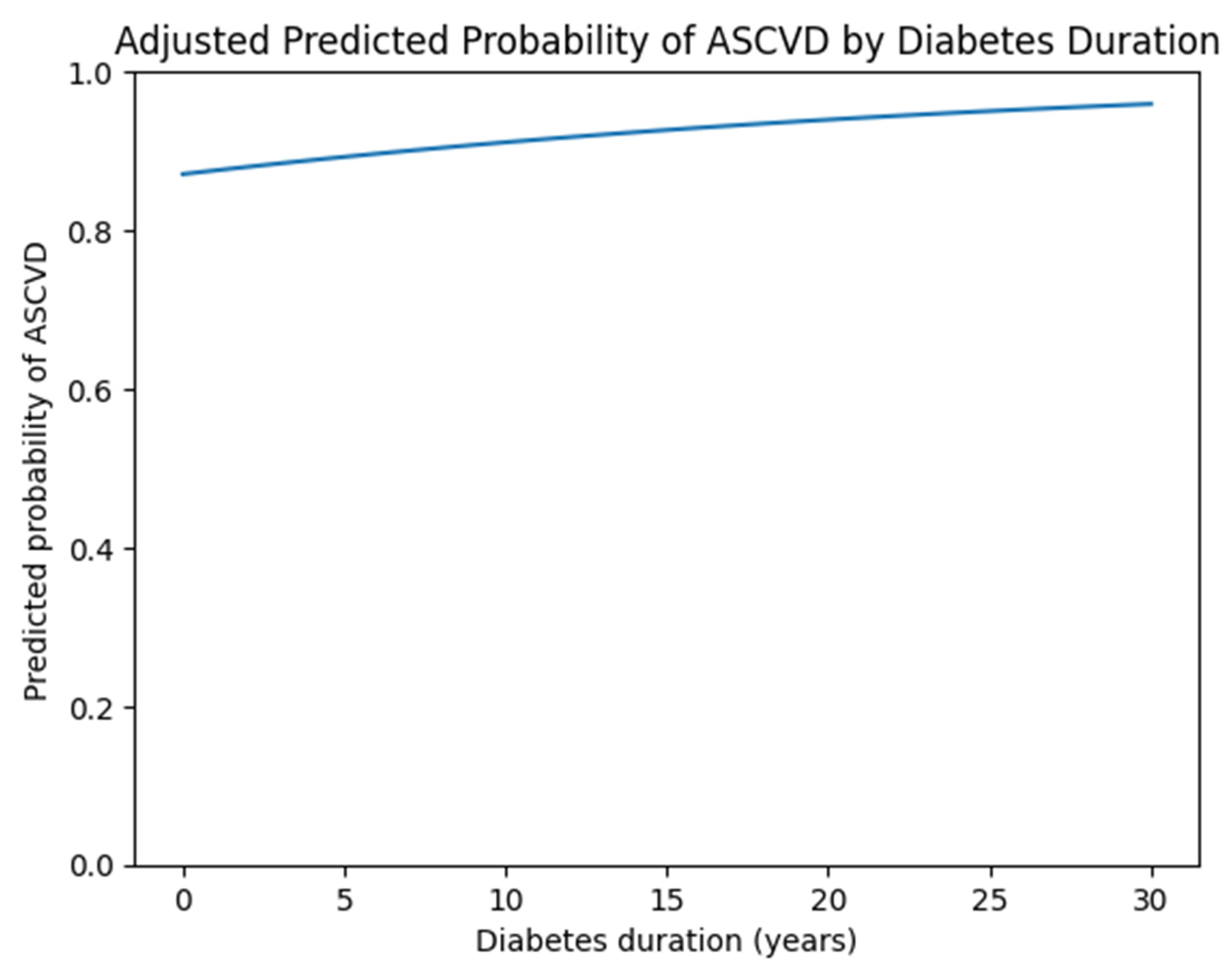
The quadratic term was not statistically significant (p = 0.743), indicating no strong evidence for a nonlinear association. The inclusion of the quadratic term did not materially improve model fit, and the estimated relationship between diabetes duration and ASCVD remained approximately linear across the observed range.
To further explore potential deviations from linearity, predicted probabilities of ASCVD were plotted across the spectrum of diabetes duration. The resulting curve demonstrated a modest and approximately linear increase in ASCVD probability with increasing diabetes duration, without clear evidence of threshold effects or curvature.
These findings suggest that, within the constraints of this dataset, diabetes duration does not exhibit a strong nonlinear relationship with prevalent ASCVD.
3.7. Sensitivity Analyses
Sensitivity analyses were performed to evaluate the robustness of the association between diabetes duration and ASCVD across clinically relevant subgroups.
First, the cohort was stratified according to age (<65 years and ≥65 years), given the association between age and cardiovascular risk. Among participants aged <65 years, diabetes duration showed a marginal trend toward association with ASCVD after adjustment (OR 1.10; 95% CI 1.00–1.21; p = 0.055). In contrast, no significant association was observed among participants aged ≥65 years (OR 1.06; 95% CI 0.90–1.25; p = 0.454).
Second, additional sensitivity analyses were performed by excluding extreme duration categories to evaluate whether the observed associations were driven by patients with very short or very long disease duration. Exclusion of participants with ≥15 years of diabetes did not materially change the results, with diabetes duration remaining non-significantly associated with ASCVD in adjusted models. Similarly, exclusion of the 0–4 year group yielded consistent findings.
Third, analyses using alternative model specifications, including the extended multivariable model incorporating additional cardiometabolic variables, produced similar results, with no statistically significant independent association between diabetes duration and ASCVD.
Taken together, these sensitivity analyses support the overall robustness of the primary findings. However, given the absence of a statistically significant interaction between age and diabetes duration, the observed differences across age strata should be interpreted cautiously and not as evidence of effect modification (
Table 5).
4. Discussion
In this cross-sectional study of 250 adults with type 2 diabetes, we investigated the association between diabetes duration and cardiovascular burden using complementary analytical approaches. While ASCVD prevalence increased numerically across duration strata, the independent contribution of diabetes duration appeared modest after adjustment for age and metabolic covariates.
4.1. Cumulative Metabolic Exposure Versus Chronological Aging
In unadjusted analysis, each additional year of diabetes was associated with a significant 8.9% increase in the odds of ASCVD. Moreover, patients with ≥15 years of diabetes had 4.5-fold higher odds of ASCVD compared with those in the early phase of the disease. These findings are consistent with the concept of cumulative metabolic injury, whereby prolonged exposure to hyperglycemia, insulin resistance, and low-grade inflammation contributes to progressive vascular damage.
However, after adjustment for age, sex, BMI, and HbA1c, the association between diabetes duration and ASCVD was attenuated and no longer statistically significant [
13,
14,
15]. Rather, the attenuation observed after adjustment suggests substantial overlap between diabetes duration, aging, and cardiometabolic risk burden [
16,
17,
18,
19].
In addition, aging has been associated with chronic low-grade inflammation (“inflammaging”), endothelial dysfunction, altered cytokine signaling, oxidative stress, and prothrombotic changes involving fibrinogen and other hemostatic pathways. These mechanisms may further contribute to the increased cardiovascular vulnerability observed in older individuals with T2DM [
20,
21,
22].
Age-related chronic inflammation (“inflammaging”) and obesity-associated metabolic dysfunction are increasingly recognized as important contributors to endothelial dysfunction, vascular remodeling, and ASCVD progression in T2DM [
23,
24,
25].
4.2. High Baseline Cardiovascular Burden at Early Diabetes Stages
A particularly notable finding was the high baseline prevalence of ASCVD even in the 0–4 year duration group (76.9%). This observation suggests that cardiovascular risk may already be elevated at or near the time of clinical diagnosis. Several mechanisms may explain this phenomenon. Subclinical metabolic dysfunction preceding formal diabetes diagnosis and the coexistence of shared cardiometabolic risk factors may partly explain this finding [
26,
27,
28].
The cohort also displayed consistently elevated BMI values across all duration strata, suggesting a substantial obesity burden independent of diabetes duration itself. Obesity may contribute to ASCVD risk through chronic inflammation, adipokine dysregulation, endothelial dysfunction, and worsening insulin resistance, potentially amplifying cardiovascular risk even in earlier stages of diabetes.
The already elevated baseline ASCVD prevalence likely reduced statistical discrimination across duration strata and contributed to the non-significant Cochran–Armitage trend despite a clear monotonic increase.
4.3. Nonlinear Duration Effects
The categorical analysis suggested a potential nonlinear pattern, with a marked increase in unadjusted ASCVD odds in the ≥15-year group. Although this association was largely explained by age in multivariable analysis, the magnitude of the unadjusted effect may reflect the limited distribution of ASCVD events across duration strata in this high-risk cohort.
However, the wide confidence intervals in the adjusted model indicate limited precision, and further studies with larger samples or longitudinal design would be required to confirm this hypothesis [
29,
30,
31].
4.4. Cohort Characteristics and Ceiling Effect
An important feature of the present cohort is the very high prevalence of established ASCVD across all duration strata. This likely reflects the tertiary care setting in which patients are referred for complex metabolic and cardiovascular management. Consequently, individuals with higher baseline risk may be overrepresented compared with general outpatient diabetes populations.
Such a distribution may create a statistical ceiling effect, reducing the ability to detect incremental differences in ASCVD prevalence across diabetes duration categories.
4.5. Methodological Considerations in a High-Risk Real-World Cohort
An important methodological consideration relates to residual confounding associated with therapeutic exposure and cardiovascular risk management. Although the multivariable model included key demographic and metabolic parameters, several clinically relevant determinants could not be systematically evaluated in this real-world dataset. These include medication adherence, statin exposure, duration and type of glucose-lowering therapy, and long-term blood pressure and lipid control, all of which may substantially influence cardiovascular risk estimation.
The absence of these variables may have influenced the observed attenuation of the association between diabetes duration and ASCVD after adjustment.
4.6. Clinical Implications for Early Cardiovascular Risk Stratification
The consistent attenuation of duration effects after age adjustment highlights the central role of vascular aging [
7,
32,
33,
34].
When aging and cumulative metabolic exposure coexist, disentangling their independent contributions becomes challenging in cross-sectional analyses.
From a clinical perspective, these results emphasize that cardiovascular risk assessment in patients with diabetes should not rely solely on disease duration. Even individuals with recently diagnosed diabetes may already carry substantial cardiovascular burden.
Early and aggressive cardiovascular risk stratification at or near the time of diabetes diagnosis may therefore be warranted. Preventive strategies should focus not only on glycemic control but also on comprehensive cardiometabolic management throughout the disease course [
35,
36,
37].
4.7. Strengths and Limitations
This study benefits from a well-characterized cohort and the use of complementary statistical approaches, including continuous, categorical, and ordinal trend analyses. The consistent pattern observed across models strengthens the internal validity of the findings.
However, several limitations must be acknowledged. First, the cross-sectional design precludes causal inference and does not allow assessment of time-to-event relationships. Second, ASCVD prevalence was high across all strata, potentially limiting statistical discrimination.
Another important limitation relates to incomplete adjustment for therapy-related and behavioral determinants of cardiovascular risk. Information on treatment adherence, detailed glucose-lowering regimens (including insulin versus oral agents or cardioprotective therapies), and the adequacy of long-term blood pressure and lipid control was not consistently available. This introduces the possibility of residual confounding and may partly explain the absence of a statistically significant independent association between diabetes duration and ASCVD after multivariable adjustment.
Diabetes duration may have been underestimated in some participants due to delayed clinical diagnosis following prolonged metabolic dysfunction prior to formal diagnosis. In addition, the tertiary referral setting may have introduced selection bias, with overrepresentation of patients with advanced cardiometabolic disease.
Because the study was conducted in a tertiary referral center, the cohort likely overrepresents patients with advanced cardiometabolic disease and established ASCVD. This referral pattern may limit the generalizability of the findings to broader outpatient or community-based T2DM populations.
Future longitudinal studies integrating detailed treatment exposure, lifestyle factors, renal disease staging, and incident cardiovascular outcomes are required to more precisely quantify the independent contribution of diabetes duration.
5. Conclusions
In this cross-sectional study of adults with type 2 diabetes, the association between diabetes duration and prevalent ASCVD was attenuated after adjustment for age and cardiometabolic covariates and remained non-significant in extended analyses.
Although ASCVD prevalence increased numerically across duration strata, the observed associations were substantially influenced by adjustment for age and other cardiometabolic variables. However, the independent contribution of diabetes duration cannot be fully disentangled in this cross-sectional setting.
The high prevalence of ASCVD even among patients with shorter documented diabetes duration suggests that cardiovascular risk may already be elevated at or near the time of clinical diagnosis.
Overall, these findings support the concept that diabetes duration should be interpreted within the broader context of aging and overall cardiometabolic risk burden.
Prospective longitudinal studies are required to clarify the temporal relationship between diabetes duration and incident cardiovascular outcomes and to better define its independent contribution.




 ,
,