
Understanding Oral Self-Care Practices Among People with Diabetes—A Qualitative Study

 , ,
, ,
Abstract
1. Background
2. Methods
3. Results
3.1. Sample
3.2. Sociodemographic Characteristics
3.3. Oral Hygiene Behaviors
3.4. Oral Self-Care Belief and Practice with Diabetes
3.4.1. Codes and Sub-Themes in HBM Construct Categories
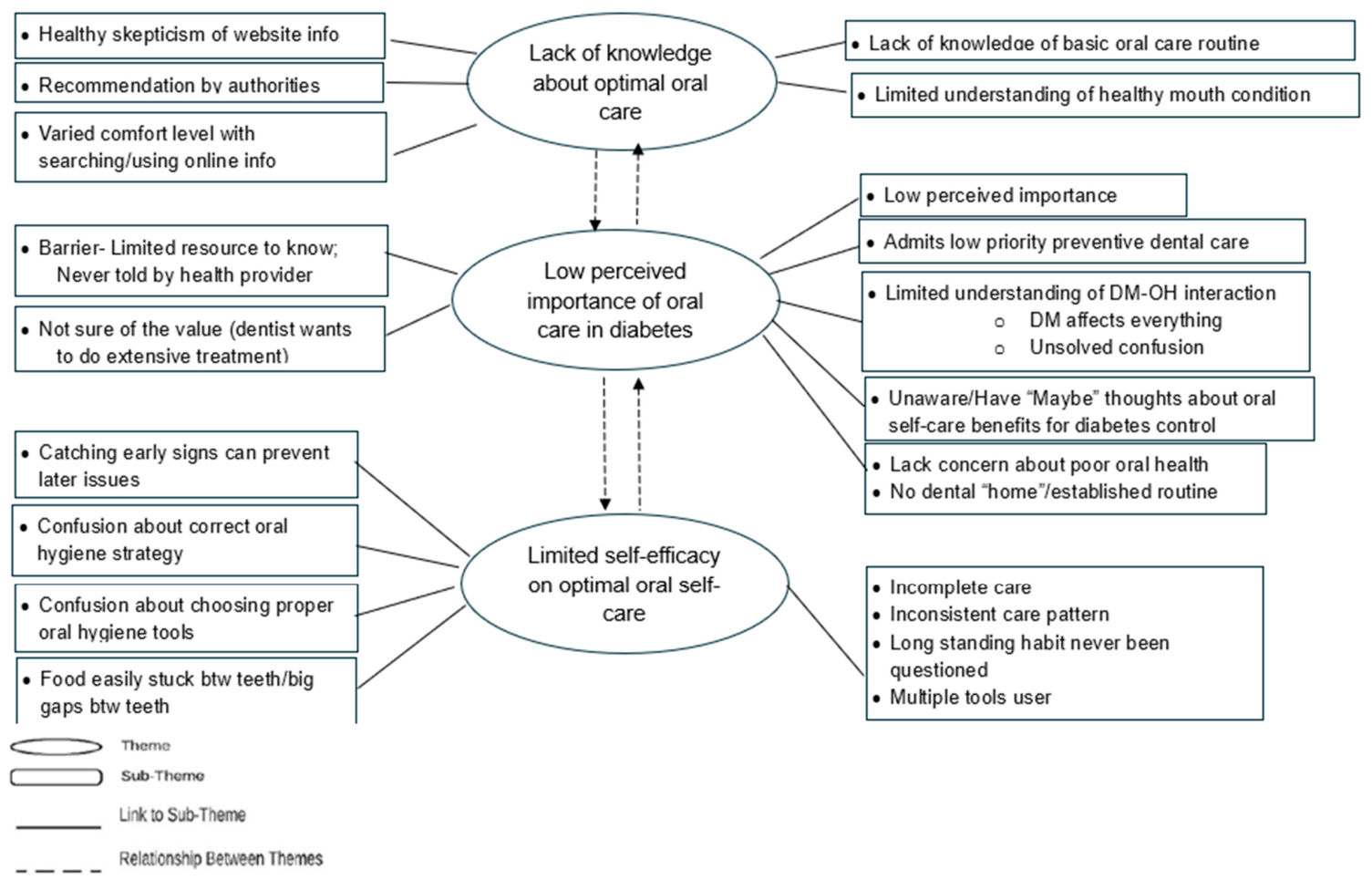
3.4.2. Major Themes
“After 10 years, the facts change. You know, like eggs are good for you and eggs are not good for you. That type of thing. So, you know, like, oh, well, electric toothbrushes are good for you. Oh, no. They do much damage. They do damage…So it’s just like OK, just try if we see what… you know, shoot for the best.”(P14)
“I don’t know whether those [floss picks] are any good compared to flossing yourself with a full piece of floss, you know.”(P15)
“I’m just not sure if it [Waterpik] is really doing what I needed it to do.”(P29)
“It depends. Sometimes I will hold it in my mouth till I maybe get halfway dressed…And then sometimes I spit it out before then. It just depends on what I’m doing. Sometimes it’s longer than others. I would say that routine doesn’t have any set time.”(P9);
“ In a hurry, less than a minute with the mouthwash. And then, when I really take my time, I take at least 5 min”(P14);
“try to floss daily, but that doesn’t always happen because life is busy of course.”(P17);
“[floss or clean between teeth] if I got something stuck in my teeth, like if I was eating corn.”(P26).
3.4.3. Feedback on DiaOral© Blueprint
4. Discussion
Limitations
5. Conclusions
Author Contributions
Funding
Institutional Review Board Statement
Informed Consent Statement
Data Availability Statement
Conflicts of Interest
References
- Centers for Disease Control and Prevention. National Diabetes Statistics Report 2024. Available online: https://www.cdc.gov/diabetes/php/data-research/index.html (accessed on 15 February 2026).
- American Diabetes Association. Statistics About Diabetes 2025. Available online: https://diabetes.org/about-diabetes/statistics/about-diabetes (accessed on 15 February 2026).
- National Institute of Dental and Craniofacial Research. Periodontal Disease in Adults (Age 30 or Older): U.S. Department of Health and Human Services, National Institutes of Health. 2021. Available online: https://www.nidcr.nih.gov/research/data-statistics/periodontal-disease/adults (accessed on 15 February 2026).
- Zhang, Y.; Leveille, S.G.; Shi, L.; Camhi, S.M. Disparities in Preventive Oral Health Care and Periodontal Health Among Adults with Diabetes. Prev. Chronic Dis. 2021, 18, E47. [Google Scholar] [CrossRef]
- Aldosari, M.; Aldosari, M.; Aldosari, M.A.; Agrawal, P. Diabetes mellitus and its association with dental caries, missing teeth and dental services utilization in the US adult population: Results from the 2015-2018 National Health and Nutrition Examination Survey. Diabet. Med. 2022, 39, e14826. [Google Scholar] [CrossRef] [PubMed]
- Zhang, Y.; Leveille, S.; Shi, L.; Camhi, S. Health disparities in periodontal disease prevalence and prevention among US adults with diabetes. Nurs. Res. 2020, 69, E62–E63. [Google Scholar]
- Demmer, R.T.; Squillaro, A.; Papapanou, P.N.; Rosenbaum, M.; Friedewald, W.T.; Jacobs, D.R., Jr.; Desvarieux, M. Periodontal infection, systemic inflammation, and insulin resistance: Results from the continuous National Health and Nutrition Examination Survey (NHANES) 1999–2004. Diabetes Care 2012, 35, 2235–2242. [Google Scholar]
- Sanz, M.; Ceriello, A.; Buysschaert, M.; Chapple, I.; Demmer, R.T.; Graziani, F.; Herrera, D.; Jepsen, S.; Lione, L.; Madianos, P.; et al. Scientific evidence on the links between periodontal diseases and diabetes: Consensus report and guidelines of the joint workshop on periodontal diseases and diabetes by the International Diabetes Federation and the European Federation of Periodontology. J. Clin. Periodontol. 2018, 45, 138–149. [Google Scholar] [CrossRef]
- Lalla, E.; Lamster, I.B.; Drury, S.; Fu, C.; Schmidt, A.N.N. Hyperglycemia, glycoxidation and receptor for advanced glycation endproducts: Potential mechanisms underlying diabetic complications, including diabetes-associated periodontitis. Periodontology 2000 2000, 23, 50–62. [Google Scholar] [CrossRef]
- Taylor, G.W. Bidirectional interrelationships between diabetes and periodontal diseases: An epidemiologic perspective. Ann. Periodontol. Am. Acad. Periodontol. 2001, 6, 99–112. [Google Scholar] [CrossRef]
- Borgnakke, W.S.; Ylöstalo, P.V.; Taylor, G.W.; Genco, R.J. Effect of periodontal disease on diabetes: Systematic review of epidemiologic observational evidence. J. Clin. Periodontol. 2013, 40, S135–S152. [Google Scholar] [CrossRef] [PubMed]
- Shultis, W.A.; Weil, E.J.; Looker, H.C.; Curtis, J.M.; Shlossman, M.; Genco, R.J.; Knowler, W.C.; Nelson, R.G. Effect of periodontitis on overt nephropathy and end-stage renal disease in type 2 diabetes. Diabetes Care 2007, 30, 306–311. [Google Scholar] [CrossRef]
- Larvin, H.; Kang, J.; Aggarwal, V.R.; Pavitt, S.; Wu, J. Multimorbid disease trajectories for people with periodontitis. J. Clin. Periodontol. 2021, 48, 1587–1596. [Google Scholar] [CrossRef] [PubMed]
- Chen, Y.; Zhang, P.; Luman, E.T.; Griffin, S.O.; Rolka, D.B. Incremental Dental Expenditures Associated With Diabetes Among Noninstitutionalized, U.S. Adults Aged ≥18 Years Old in 2016–2017. Diabetes Care 2021, 44, 1317–1323. [Google Scholar] [CrossRef]
- Luo, H.; Pan, W.; Sloan, F.; Feinglos, M.; Wu, B. Forty-Year Trends in Tooth Loss Among American Adults With and Without Diabetes Mellitus: An Age-Period-Cohort Analysis. Prev. Chronic Dis. 2015, 12, E211. [Google Scholar] [CrossRef]
- Glanz, K.; Rimer, B.K.; Viswanath, K. Health Behavior: Theory, Research, and Practice, 5th ed; John Wiley & Sons: San Francisco, CA, USA, 2015; 512p. [Google Scholar]
- Buglar, M.E.; White, K.M.; Robinson, N.G. The role of self-efficacy in dental patients’ brushing and flossing: Testing an extended Health Belief Model. Patient Educ. Couns. 2010, 78, 269–272. [Google Scholar] [CrossRef]
- Xiang, B.; Wong, H.M.; McGrath, C.P.J. The efficacy of peer-led oral health programs based on Social Cognitive Theory and Health Belief Model among Hong Kong adolescents: A cluster-randomized controlled trial. Transl. Behav. Med. 2022, 12, 423–432. [Google Scholar] [CrossRef]
- Jeihooni, A.K.; Jamshidi, H.; Kashfi, S.M.; Avand, A.; Khiyali, Z. The Effect of Health Education Program Based on Health Belief Model on Oral Health Behaviors in Pregnant Women of Fasa City, Fars Province, South of Iran. J. Int. Soc. Prev. Community Dent. 2017, 7, 336–343. [Google Scholar] [CrossRef]
- US Census Bureau. American Community Survey 5-Year Estimates 2018–2022 [Hispanic or Latino Origin by Race B03002]. Available online: https://censusreporter.org (accessed on 15 February 2026).
- City of Cincinnati Health Department. Cincinnati Neighborhood Profile. Available online: https://www.cincinnati-oh.gov/sites/health/assets/File/Cincy%20Neighborhood%20Profiles.pdf (accessed on 15 February 2026).
- Creswell, J.W.; Poth, C.N. Qualitative Inquiry & Research Design: Choosing Among Five Approaches, 5th ed.; Sage: Thousand Oaks, CA, USA, 2025. [Google Scholar]
- Guest, G.; Bunce, A.; Johnson, L. How Many Interviews Are Enough?: An Experiment with Data Saturation and Variability. Field Methods 2006, 18, 59–82. [Google Scholar] [CrossRef]
- Harris, P.A.; Taylor, R.; Minor, B.L.; Elliott, V.; Fernandez, M.; O’Neal, L.; McLeod, L.; Delacqua, G.; Delacqua, F.; Kirby, J.; et al. The REDCap consortium: Building an international community of software platform partners. J. Biomed. Inform. 2019, 95, 103208. [Google Scholar] [CrossRef] [PubMed]
- Xiang, B.; Wong, H.M.; Cao, W.; Perfecto, A.P.; McGrath, C.P.J. Development and validation of the Oral health behavior questionnaire for adolescents based on the health belief model (OHBQAHBM). BMC Public Health 2020, 20, 701. [Google Scholar] [CrossRef]
- Byrne, D. A worked example of Braun and Clarke’s approach to reflexive thematic analysis. Qual. Quant. 2022, 56, 1391–1412. [Google Scholar] [CrossRef]
- Braun, V.; Clarke, V. Thematic analysis. In APA Handbook of Research Methods in Psychology, 2nd ed.; Cooper, H.M., Coutanche, M.N., McMullen, L.M., Rindskopf, D., Panter, A.T., Sher, K.J., Eds.; American Psychological Association: Washington, DC, USA, 2023; pp. 57–71. [Google Scholar]
- Braun, V.; Clarke, V. Reflecting on reflexive thematic analysis. Qual. Res. Sport Exerc. Health 2019, 11, 589–597. [Google Scholar] [CrossRef]
- O’Brien, B.C.; Harris, I.B.; Beckman, T.J.; Reed, D.A.; Cook, D.A. Standards for reporting qualitative research: A synthesis of recommendations. Acad. Med. 2014, 89, 1245–1251. [Google Scholar] [CrossRef] [PubMed]
- Lu, Y.; Yoshida, Y. Trends and Risk Factors of Oral Health and Preventive Dental Care in Adults With Diabetes and Prediabetes: National Health and Nutrition Examination Survey 1999–2000 to 2017–2020. Endocr. Pract. 2025, 31, 867–874. [Google Scholar] [CrossRef] [PubMed]
- Valerio, M.A.; Kanjirath, P.P.; Klausner, C.P.; Peters, M.C. A qualitative examination of patient awareness and understanding of type 2 diabetes and oral health care needs. Diabetes Res. Clin. Pract. 2011, 93, 159–165. [Google Scholar] [CrossRef] [PubMed]
- Bissett, S.M.; Stone, K.M.; Rapley, T.; Preshaw, P.M. An exploratory qualitative interview study about collaboration between medicine and dentistry in relation to diabetes management. BMJ Open 2013, 3, e002192. [Google Scholar] [CrossRef]
- Broder, H.L.; Tormeti, D.; Kurtz, A.L.; Baah-Odoom, D.; Hill, R.M.; Hirsch, S.M.; A Hewlett, S.; Nimako-Boateng, J.K.; Rodriguez, J.Y.; Sischo, L. Type II diabetes and oral health: Perceptions among adults with diabetes and oral/health care providers in Ghana. Community Dent. Health 2014, 31, 158–162. [Google Scholar]
- Lindenmeyer, A.; Bowyer, V.; Roscoe, J.; Dale, J.; Sutcliffe, P. Oral health awareness and care preferences in patients with diabetes: A qualitative study. Fam. Pract. 2013, 30, 113–118. [Google Scholar] [CrossRef]
- Elsous, A.; Fetaiha, A.; Radwan, M. Exploring oral health related awareness, perceptions, practices and experiences among type 2 diabetes mellitus patients: A mixed method design. BMC Oral Health 2025, 25, 781. [Google Scholar] [CrossRef]
- Bowyer, V.; Sutcliffe, P.; Ireland, R.; Lindenmeyer, A.; Gadsby, R.; Graveney, M.; Sturt, J.; Dale, J. Oral health awareness in adult patients with diabetes: A questionnaire study. Br. Dent. J. 2011, 211, E12. [Google Scholar] [CrossRef]
- American Diabetes Association Professional Practice Committee. 5. Facilitating Positive Health Behaviors and Well-being to Improve Health Outcomes: Standards of Care in Diabetes—2025. Diabetes Care 2024, 48, S86–S127. [Google Scholar] [CrossRef]
- Harnagea, H.; Couturier, Y.; Shrivastava, R.; Girard, F.; Lamothe, L.; Bedos, C.P.; Emami, E. Barriers and facilitators in the integration of oral health into primary care: A scoping review. BMJ Open 2017, 7, e016078. [Google Scholar] [CrossRef]
- Estes, K.R.; Callanan, D.; Rai, N.; Plunkett, K.; Brunson, D.; Tiwari, T. Evaluation of an Interprofessional Oral Health Assessment Activity in Advanced Practice Nursing Education. J. Dent. Educ. 2018, 82, 1084–1090. [Google Scholar] [CrossRef]
- Harada, Y.; Prajapati, D.; Poudel, P.; Karmacharya, B.; Sugishita, T.; Rawal, L. Effectiveness of oral health promotion interventions for people with type 2 diabetes delivered by non-dental health care professionals: A systematic review. Glob. Health Action 2022, 15, 2075576. [Google Scholar] [CrossRef]
- Glanz, K.; Rimer, B.K.; Viswanath, K. Health Behavior and Health Education: Theory, Research, and Practice, 4th ed.; Jossey-Bass: San Francisco, CA, USA, 2008. [Google Scholar]
- Nasir, E.; Suliman, N. Application of the health belief model in oral hygiene practice (brushing/flossing): A narrative review. J. Int. Oral Health 2022, 14, 342–348. [Google Scholar] [CrossRef]
- Wang, K.; Lee, G.H.M.; Liu, P.; Gao, X.; Wong, S.Y.S.; Wong, M.C.M. Health belief model for empowering parental toothbrushing and sugar intake control in reducing early childhood caries among young children-study protocol for a cluster randomized controlled trial. Trials 2022, 23, 298. [Google Scholar] [CrossRef]



| Characteristic | n (%) |
|---|---|
| Age, Mean (SD) Min–Max | 59.4 (17.3), 28–87 |
| Gender Female Male | 9 (60.0) 6 (40.0) |
| Race American Indian or Alaska Native Black White Prefer not to say | 1 (6.7) 7 (46.7) 6 (40.0) 1 (6.7) |
| Education Level College graduate or above Some college or Associate Degree | 9 (60.0) 6 (40.0) |
| Marital Status Married or living with a partner Single/Divorced/Separated/Widowed | 9 (60.0) 6 (40.0) |
| Insurance Employer/Private Insurance Medicaid Medicare | 7 (46.7) 2 (13.3) 6 (40.0) |
| Years of DM a, Mean (SD), Min-Max | 15.9 (12.7), 1–37 |
| Type of Diabetes T1DM T2DM | 2 (13.3) 13 (86.7) |
| Residence Urban Suburb | 4 (26.7) 11 (73.3) |
| Oral Hygiene Behaviors | n (%) |
|---|---|
| Tooth brushing Brush twice a day Less than twice a day | 7 (46.7) 8 (53.3) |
| Brush at least 2 min each time No Yes | 2 (13.3) 13 (86.7) |
| Use fluoride toothpaste No Yes Not sure | 1 (6.7) 11 (73.3) 3 (20.0) |
| Preventive dental visit twice a year No Yes | 6 (40.0) 9 (60.0) |
| Use mouthwash No Yes | 5 (33.3) 10 (66.7) |
| Floss every day No Yes, use string floss Yes, use floss picks Yes, use water flosser | 9 (60.0) 2 (13.3) 2 (13.3) 2 (13.4) |
| Use string floss No Yes | 12 (80.0) 3 (20.0) |
| Use electric toothbrush No Yes | 7 (46.7) 8 (53.3) |
| Use toothpicks/pointy end of floss picks No Yes | 7 (46.7) 8 (53.3) |
| Brush tongue No Yes | 7 (46.7) 8 (53.3) |
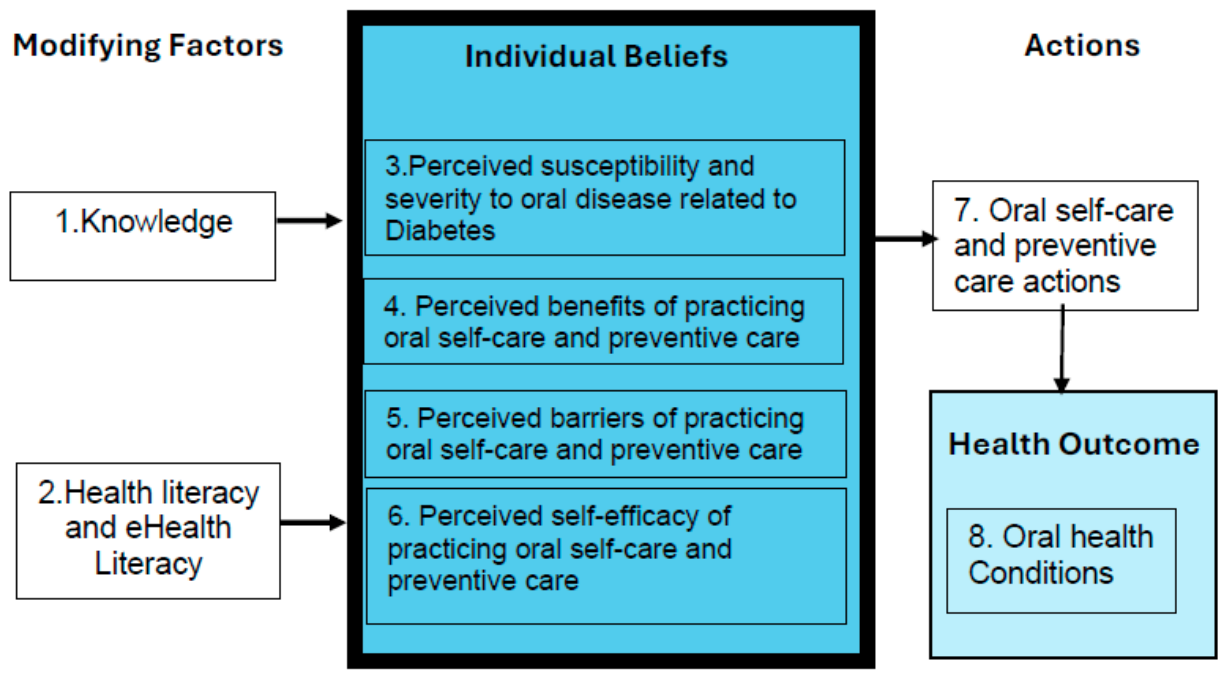
| HBM Constructs in DiaOral© | Sub-Themes and Codes | Sample Quotes * |
|---|---|---|
| HBM—Modifying Factors | ||
| 1. Knowledge (M1, M2, M3) | Lack of knowledge of basic oral care routine | - “How long do [I] brush? until, I don’t know, until I think I’ve covered everything that I need to.” (P12) |
| Limited understanding of healthy mouth condition | - “[gum bleeding a couple times a week] Um, I mean, I don’t… I guess there’s really nothing certain. Maybe I brush too hard.” (P19) | |
Limited understanding of DM-OH interaction
| - “I just think that anything could possibly go wrong with diabetes. “ (P18) - “I know diabetes is linked to an awful lot of things, but as far as the mouth is concerned, I don’t know” (P24) | |
| 2. Health Literacy and eHealth Literacy (M1) | Healthy skepticism of website info | - “You know, obviously everybody uses Google. That’s the first thing you go to get articles and sometimes the first articles that pop up are the advertising ones that, you know, they want you to buy something from them. But I don’t know. I don’t know how to tell a reputable source of health information” (P15) |
| Recommended by authorities | - “a lot of it come from the dentist and a lot of it comes from Google. But. It always is nice when somebody that’s a healthcare provider is telling me and not Google because I would be a Google doctor If I relied on Google to give me the answers that I needed.” (P16) | |
Varied comfort level with online info
| - “Normally I’ll Google it for a time of technology, but I know that even with Google everybody’s body is different.” (P17) - “No, I do it because it’s, it is what is in now.” (P9) - “I use internet… But honestly, I really rely on my wife because she knows how to do that. She knows what to look for.” (P29) | |
| HBM—Individual Beliefs | ||
| 3. Perceived susceptibility to and severity of disease (M1, M2, M3) | Low perceived importance | - “Like the primary thing I’m focused on is weight control and foods. Didn’t even think about teeth. “ (P2) |
| Lack concern about poor oral health | - “it doesn’t really affect it. I can eat. It’s just that I know… I like to eat things that may not need to be chewed with upper teeth, like steak, and you know, meat and things like that. I know that puts a lot of pressure on my front teeth.” (P18) | |
| Barrier—never told by health provider | - “Never. Never. No, I have not had one doctor relate diabetes to the condition of my mouth or my teeth.” (P15) | |
| Barrier—limited resource to know | - “Like when I was diagnosed with diabetes, you know, I went to Web MD, I went to Mayo Clinic. Those standard types of sources to get quick information. [Interviewer: And? You didn’t happen to see anything about oral health on any of those sites?] I did not, no!” (P2) | |
| 4. Perceived benefit of practicing oral self-care and preventive care (M2, M4) | Unaware oral self-care benefit diabetes control | - “I don’t know how your oral health affects your diabetes”(P26) |
| Not sure of the value/dentist wants to do extensive treatment | - “it was something that he observed when I went in for something else [for regular preventive care]. The impression I got is that he tended to want to do gum surgery on every person that walked in the office.(15) | |
| “Maybe” thought about the benefit of good self-care | - “I haven’t got the habit of brushing my teeth at night before I go to bed… I know it would probably… It would probably eliminate the big chunk of the problems that I have all the time with my teeth.” (P15) | |
| Catching early signs can prevent later issues | - “I typically catch things that pop up because I try to be aware of what’s going on, just because I am a diabetic. I don’t want things to get worse if I could catch them.” (P17) | |
| 5. Perceived barriers of practicing oral self-care and preventive care (M4, M5) | Confusion about correct OH strategy | - “after 10 years, the facts change. You know, like eggs are good for you & eggs are not good for you. That type thing. So, you know, like, oh, well, electric toothbrushes are good for you. Oh, no. They do much damage. They do damage…So it’s just like OK, just try if we see what… you know, shoot for the best.” (P14) - “I don’t know whether those [floss picks] are any good compared to flossing yourself with a full piece of floss, you know.” (P15) |
| Confusion about choosing proper OH tools | -“I’m just not sure if it [Waterpik] really doing what I needed it to do.” (P29) | |
| Admits low priority preventive dental care | - “I’m very bad at that. I’d rather go to the doctor. I’m probably opposite than most people. I’d rather go to the doctor than the dentist… So, I don’t go. So, I have not been to the dentist. I hate to say in a year I have not.” (P9) | |
| Food easily stuck btw teeth/big gaps btw teeth | - “But my teeth now have lots of room which is, which is why, in parts of my mouth that I said, I have gaps. Not pretty, pretty good size. Not tooth width but, as far as a piece of floss is concerned, they’re pretty big.” (P12) | |
| No dental “home”/no established routine | - “the last time I probably been to the dentist, it may be about. couple years ago.” (29) | |
| 6. Perceived self-efficacy of practicing oral self-care and preventive care (M4) | Admit do less than should | - “I don’t brush my teeth every day, even though I know I’m supposed to.”(P26) |
| Alerted observer | - “I do try to look at my own gums and look at my own teeth and see if I see anything that’s alarming and try to get that checked out if so.“(P17) | |
| Shame/regret/judgment | - “I should be drawn and quartered, I have. I’ve had dental insurance for years; I haven’t been to the dentist.” (P14) | |
| Want to know more/need additional help | - “They tell us how to take care of, you know, our eyes. But like, how is our oral health like? How is that? How is that? You know, how does that all make sense? Like, how is it all grouped together?” (P16) - “I suppose I could enlist the help of my wife to urge me to brush my teeth at night.” (P15) | |
| Overconfident | - “I think my teeth were fine. I didn’t go to a dentist though”(P26) | |
| HBM—Outcomes | ||
| 7. Oral self-care and preventive care actions (M4, M5) | Incomplete care
| - “No, I don’t brush my tongue. I don’t feel like I need to brush my tongue.” (P12); “I mean. I do it [floss] every day, but I don’t do my whole mouth every day. I guess I do spots.”(19);” I do not floss. Never.” (P13)” |
Inconsistent care pattern
| - “It depends. Sometimes I will hold it in my mouth till I maybe get halfway dressed…And then sometimes I spit it out before them. It just depends on what I’m doing. Sometimes it’s longer than others. I would say that routine doesn’t have any set time.” (P9); “In a hurry, less than a minute with the mouthwash. And then, when I really take my time, I take at least 5 min”(P14);” try to floss daily, but that doesn’t always happen because life is busy of course.”(P17); “if I got something stuck in my teeth, like if I was eating corn.” (P26) | |
Long standing habit never been questioned
| - “Brush twice a day. That’s pretty much it.” (P2); “I only brush once a day and I don’t floss because my gums in great shape, and my teeth have very little tartar. (P13); “When I do it [brush teeth], I do it right, but I don’t do it every day.”(P12) | |
| Multiple tools user | - “I try to floss. You know, daily doesn’t always happen. I use the regular floss that they use at the dentist office. I do get the picks. Sometimes I notice that when I get the picks there it’s easier to use because I can pick it and take it with me.”(P17); “I do something three times a day and there’s something could be two times Waterpik, one time brushing or maybe two times brushing one time Waterpik” (P24) | |
| 8. Oral Health Conditions (M3) | Not good/Bad
| - “I’ve had that gum surgery a long time ago. They check my, what do you call it when they puncture your gums to see the depth of it? I have that done on a somewhat regular basis and my previous dentist has not mentioned any concern over the depth of my… the thing that they checked with the thing that sticks in your gums.” (P15); “Lots of missing teeth…Millions of them. Yeah, right in the back molars.” (P24); because I’ve got two teeth missing, that I’m getting implants for, so they’re in the process of healing. “ (P15);” I had a root canal in August. They just did a crown or they did a temporary crown and I’m waiting for the permanent crown. And then I’m gonna start periodontal treatment. like the deep cleaning” (P16) |
| In good condition | - “I can’t say I am [concern on my oral health]. I mean, my gums aren’t bleeding right. I would be concerned if I had bleeding gums. I’m pretty much free of pain so.” (P24) | |
Disclaimer/Publisher’s Note: The statements, opinions and data contained in all publications are solely those of the individual author(s) and contributor(s) and not of MDPI and/or the editor(s). MDPI and/or the editor(s) disclaim responsibility for any injury to people or property resulting from any ideas, methods, instructions or products referred to in the content. |
© 2026 by the authors. Licensee MDPI, Basel, Switzerland. This article is an open access article distributed under the terms and conditions of the Creative Commons Attribution (CC BY) license.
Share and Cite
Zhang, Y.; Leveille, S.G.; Berger, K.; Cohen, R.M.; Bakas, T. Understanding Oral Self-Care Practices Among People with Diabetes—A Qualitative Study. Diabetology 2026, 7, 101. https://doi.org/10.3390/diabetology7060101
Zhang Y, Leveille SG, Berger K, Cohen RM, Bakas T. Understanding Oral Self-Care Practices Among People with Diabetes—A Qualitative Study. Diabetology. 2026; 7(6):101. https://doi.org/10.3390/diabetology7060101
Chicago/Turabian StyleZhang, Yuqing, Suzanne G. Leveille, Kimberly Berger, Robert M. Cohen, and Tamilyn Bakas. 2026. "Understanding Oral Self-Care Practices Among People with Diabetes—A Qualitative Study" Diabetology 7, no. 6: 101. https://doi.org/10.3390/diabetology7060101
APA StyleZhang, Y., Leveille, S. G., Berger, K., Cohen, R. M., & Bakas, T. (2026). Understanding Oral Self-Care Practices Among People with Diabetes—A Qualitative Study. Diabetology, 7(6), 101. https://doi.org/10.3390/diabetology7060101