
Article

Long-Term Hyperglycemia Affects the Expression of Diaph1 and Its Cytoskeleton Ligands in the Epidermis of Diabetic Patients—A Quantitative Study

by
Bernard Kordas
1,*,
Wojciech Matuszewski
2,
Robert Modzelewski
2,
Jarosław Szuszkiewicz
3,
Michał Załęcki
4,
Joanna Wojtkiewicz
1 and
Judyta Juranek
1,*
1
Department of Human Physiology and Pathophysiology, School of Medicine, Collegium Medicum, University of Warmia and Mazury, 10-082 Olsztyn, Poland
2
Clinic of Endocrinology, Diabetology and Internal Medicine, School of Medicine, Collegium Medicum, University of Warmia and Mazury, 10-561 Olsztyn, Poland
3
Department of Materials and Machines Technology, Faculty of Technical Sciences, University of Warmia and Mazury, 10-719 Olsztyn, Poland
4
Department of Animal Anatomy, Faculty of Veterinary Medicine, University of Warmia and Mazury, 10-719 Olsztyn, Poland
*
Authors to whom correspondence should be addressed.
Diabetology 2026, 7(4), 78; https://doi.org/10.3390/diabetology7040078
Submission received: 15 February 2026 / Revised: 19 March 2026 / Accepted: 7 April 2026 / Published: 10 April 2026

Abstract

Background/Objectives: Diabetic small fiber neuropathy and related sensory and epidermal problems affect up to 70% of all patients with diabetes. Long-term hyperglycemia disrupts cytoskeletal organization and axonal transport; however, molecular changes within human diabetic epidermis remain understudied. Diaph1 and its cytoskeletal ligands, including β-Actin and Profilin, are key regulators of cytoskeletal dynamics and may be associated with diabetes-related alterations in skin structure and innervation. Methods: Sixteen patients with type 2 diabetes, aged 43.3 ± 9.6 years (disease duration 18.9 ± 8.7 years), and twelve non-diabetic controls, aged 43.9 ± 8.9 years, were enrolled in the study. All participants provided informed consent. Skin punch biopsies were obtained under local anesthesia and processed for staining of PGP 9.5, Diaph1, β-Actin, and Profilin. Quantitative image analysis was performed to assess stained area fraction, signal intensity, and intraepidermal nerve fiber density. Statistical comparisons and Spearman’s rank correlation analyses were used to evaluate group differences and associations between staining parameters. Results: Diabetic skin samples exhibited a significant reduction in PGP 9.5-positive intraepidermal nerve fibers, indicating reduced cutaneous innervation. In contrast, Diaph1 and Profilin showed broader and more diffuse epidermal staining, while β-Actin displayed altered staining patterns and intensity. Significant correlations between Diaph1- and β-Actin-related staining measures indicated an association consistent with altered cytoskeletal organization under chronic hyperglycemic conditions. Conclusions: Long-standing type 2 diabetes was associated with reduced PGP 9.5-positive intraepidermal nerve fibers, together with altered epidermal staining patterns of Diaph1, Profilin and β-Actin. These findings indicate coexisting cutaneous denervation and cytoskeletal alterations in diabetic skin.

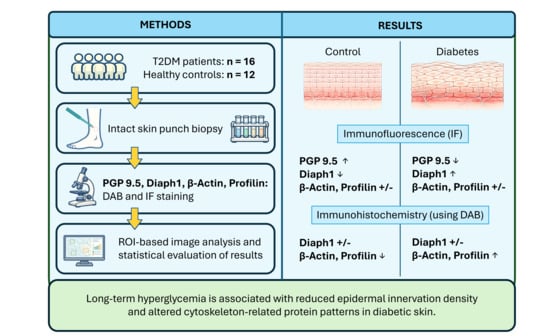
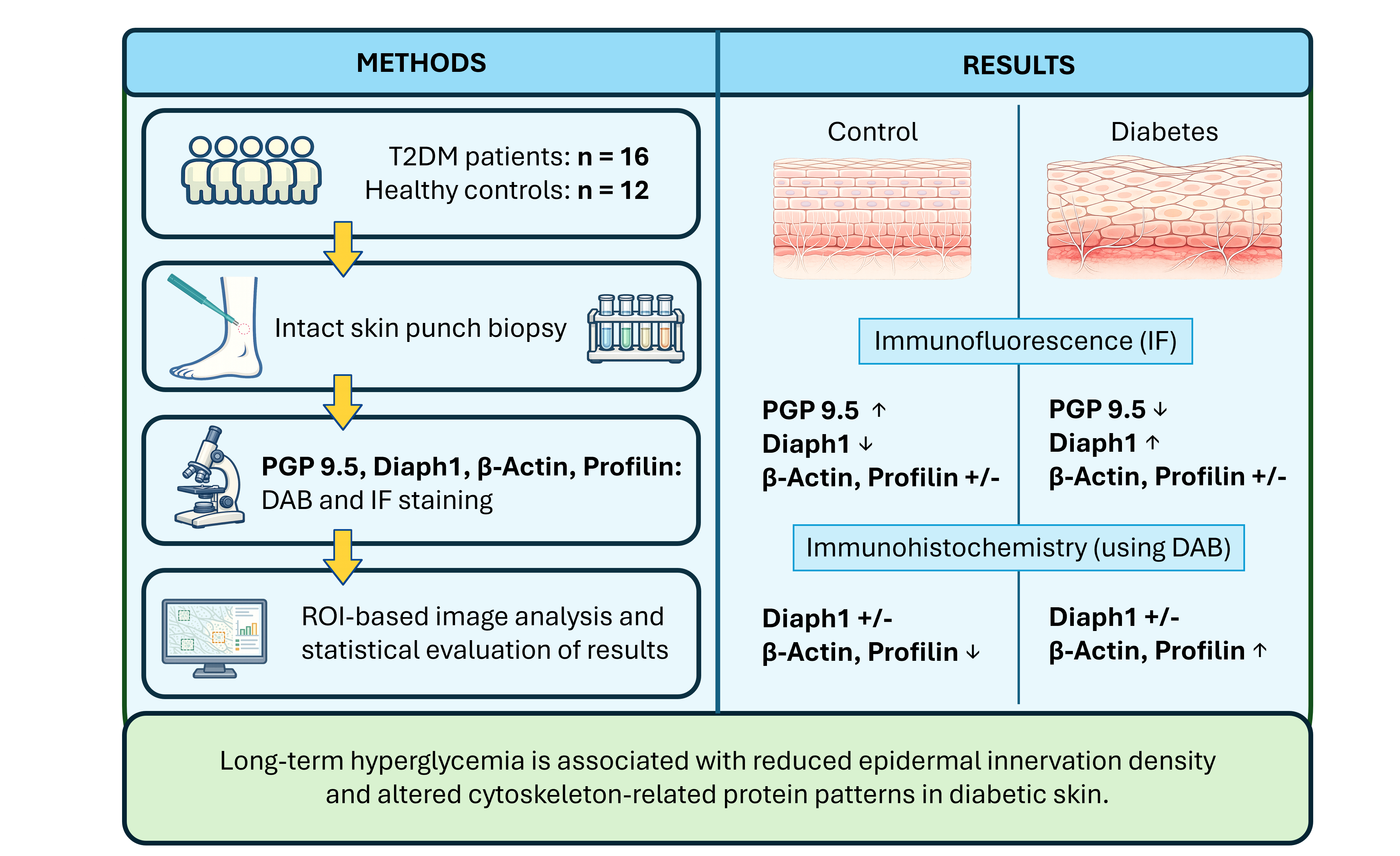
Graphical Abstract

1. Introduction

According to the latest reports by the International Diabetes Federation, 11.1% of the adult population worldwide, approximately 1 in 9 adults, live with diabetes. Predictions estimate that by 2050, approximately 853 million or 1 in 8 adults will have diabetes [1]. Small nerve fiber neuropathy is a common, often underdiagnosed early complication of diabetes. It affects cutaneous nerve fibers and is associated with prolonged hyperglycemia, oxidative stress, perineuronal inflammation, neurovascular perturbations, and alterations in cytoskeletal proteins [2,3]. Along with the loss of sensation, peripheral changes in skin vascularization and innervation are observed, resulting in increased susceptibility to skin injury, neuropathic ulcers and impaired wound healing [4]. If left untreated, these changes lead to loss of nerve function and disruption of skin structural integrity [4,5].
Hyperglycemia is thought to disrupt cytoskeletal proteins such as β-Actin and regulators such as Diaph1 (Diaphanous-related protein 1) and Profilin, potentially accelerating neurovascular damage leading to nerve dysfunction and vascular endothelium deterioration [6,7,8]. Diaph1 belongs to the family of Rho-GTPase formins and facilitates Actin polymerization and remodeling of microtubules and microfilaments [9]. Diaph1, a scaffolding protein, plays a crucial role in numerous cellular processes, including proliferation and movement, and its mRNA is expressed in a wide range of cell types and tissues [10,11].
β-Actin, one of six Actin isoforms found in vertebrates, is a highly conserved, ubiquitous, cytoplasmic protein, crucial for cell structure and division, motility, signaling, and the formation of cellular extensions [12]. Profilin, an Actin-binding protein, is essential for β-Actin cytoskeleton dynamics, influencing and maintaining cell shape, signaling motility, and glucose metabolism. It is present in most cell types [13].
Protein Gene Product 9.5 (PGP 9.5), also known as Ubiquitin Carboxyl-terminal Hydrolase Isozyme L1, regulates protein degradation and turnover within the cell. It cleaves ubiquitin from ubiquitinated proteins, thereby rescuing them from proteasomal degradation [14]. This enzymatic activity is crucial for maintaining cellular proteostasis and has been extensively studied in various contexts, including neurobiology and oncology. PGP 9.5 was identified in neurons and neuroendocrine tissues and has become a neuronal biomarker of significant importance and widespread distribution, as well as a standard marker of peripheral nerve fibers [15,16].
Previous work from our group has highlighted the potential role of Diaph1 signaling in diabetic neuropathy and retinopathy [8,17]. In this study, we aimed to characterize changes in the expression of Diaph1 and related cytoskeletal proteins involved in structural organization, cellular movement, and axonal transport in epidermal cells and intraepidermal nerve fibers (IENFs) in skin biopsies collected from patients with long-standing type 2 diabetes. We sought to determine whether these changes were associated with reduced cutaneous innervation in diabetic skin.

2. Materials and Methods

2.1. Sample Description and Collection

Patients with type 2 diabetes (n = 16; aged 43.3 ± 9.6 years, with a disease duration of 18.9 ± 8.7 years), and non-diabetic, non-neurological controls (n = 12; aged 43.9 ± 8.9 years), participated in the study. Body mass index (BMI) was 36.41 ± 2.12 kg/m2 in the diabetic group and 24.18 ± 2.74 kg/m2 in the control group. Glycated hemoglobin (HbA1c) was 8.83 ± 1.41% in patients with diabetes and 5.16 ± 0.30% in controls. All diabetic patients met the WHO criteria for diabetes and were outpatients at the Clinic of Endocrinology, Diabetology and Internal Medicine at the University of Warmia and Mazury in Olsztyn, Poland.
In the diabetic group, hypertension and dyslipidemia were present but pharmacologically controlled and no other known comorbidities, apart from obesity, were reported. Patients with diabetes had been treated since diagnosis in accordance with contemporary national and European clinical recommendations, including those of the Diabetes Poland (Polskie Towarzystwo Diabetologiczne, PTD) and the European Association for the Study of Diabetes (EASD), as applicable at a given time point. The pharmacological treatment included primarily metformin, incretin-based drugs, and sodium–glucose cotransporter-2 inhibitors (SGLT2 inhibitors, flozins). Glycemic control in the diabetic group was assessed using continuous glucose monitoring systems, capillary blood glucose measurements with test strips, and routine follow-up assessments at the outpatient clinic. In addition, sensory neuropathy of the lower limbs was confirmed by clinical examination in the diabetic group. Controls were normoglycemic, normotensive, free of dyslipidemia, and had no other known diseases. Only non-smokers and individuals not abusing alcohol were included in either group. Before enrollment, all subjects provided informed consent. The study was conducted in accordance with the Declaration of Helsinki and was approved under no. 10/2010 of 25 March 2010 issued by the Bioethics Committee of the Faculty of Medicine, University of Warmia and Mazury in Olsztyn, Poland. The present analysis was performed within the scope of this approved study framework.
Skin biopsies were obtained, under local anesthesia, using sterile disposable punch instruments, to a depth of approximately 3 mm, 10 cm above the lateral malleolus of the non-dominant limb [18]. Biopsies were collected from clinically intact skin, which means skin without visible clinical lesions at the sampling site. After sampling, specimens were immediately fixed in 4% buffered paraformaldehyde (pH 7.4) for 10 min, washed in phosphate buffer and immersed in 20% sucrose solution at 4 °C until they sank to the bottom of the container, before further processing. Subsequently, samples were embedded in Tissue-Tek® O.C.T. Compound (Sakura Finetek, Torrance, CA, USA), frozen at −24 °C in a cryostat (Hyrax C25, Zeiss, Oberkochen, Germany), and cryosectioned at −24 °C. Frozen samples were sectioned into 10 µm slices using a cryostat, air-dried and stored frozen at −22 °C until further immunostaining procedures.

2.2. Immunostaining and Image Acquisition

Sectioned samples were processed for immunostaining according to established laboratory protocols. Sections were blocked in Cas-Block (Thermo Fisher, Waltham, MA, USA) for one hour at room temperature, rinsed in PBS and incubated with primary antibodies overnight at room temperature. The following primary antibodies were used: rabbit anti-Diaph1 (ab129167, 1:200, Abcam, Cambridge, UK), rabbit anti-beta-Actin (ab8227, 1:400, Abcam, Cambridge, UK), rabbit anti-Profilin (ab124904, 1:400, Abcam, Cambridge, UK), rabbit anti-PGP 9.5 (ab10404, 1:200, Abcam, Cambridge, UK). Following primary antibody incubation, sections were further processed for immunofluorescent or immunohistochemical staining. For immunofluorescence, sections were rinsed in PBS and incubated with secondary goat anti-rabbit antibodies, i.e., Alexa 594 or Alexa 488 (A-11037 or A-11034, 1:1000, Invitrogen, Thermo Fisher, Waltham, MA, USA) for one hour at room temperature, rinsed in PBS and cover-slipped with DAPI (4′,6-Diamidino-2-phenylindole) mounting solution (Thermo Fisher, Waltham, MA, USA). The ABC-HRP (Avidin-Biotin Complex-Horseradish Peroxidase) kit protocol was followed (Vectastain ABC-HRP kit, Vector Laboratories, Newark, CA, USA) using DAB (3,3′-Diaminobenzidine) as chromogen. Analyses were performed in batches to ensure consistency of antibody solutions and uniform staining conditions across samples. Immediately after staining, all samples were imaged using identical system acquisition settings. Samples were examined using an Olympus IX83 microscope (Evident, Tokyo, Japan).

2.3. Quantitative and Statistical Analysis

Parameters related to immunostaining in epidermal cells and IENFs were quantified using Fiji/ImageJ2 version 2.16.0/1.54p (National Institutes of Health, Bethesda, MD, USA) [19,20]. For each tissue sample, five sections were analyzed for stained area fraction and signal intensity. Within each section, measurements were performed in five technical replicates. To minimize repeated sampling of the same structures, only one out of every five consecutive sections was included, resulting in a 50 µm interval between analyzed sections. Statistical analysis was performed using the non-parametric Mann–Whitney U test and Spearman’s rank correlation analysis in GraphPad Prism version 10.5.0 for Windows (GraphPad Software, Boston, MA, USA). Spearman’s rank correlation coefficient was used to assess the strength and direction of monotonic associations between measured staining parameters. Coefficients closer to +1 or −1 indicate stronger positive or negative associations, respectively, whereas values closer to 0 indicate weaker associations.

3. Results

3.1. Qualitative Analysis

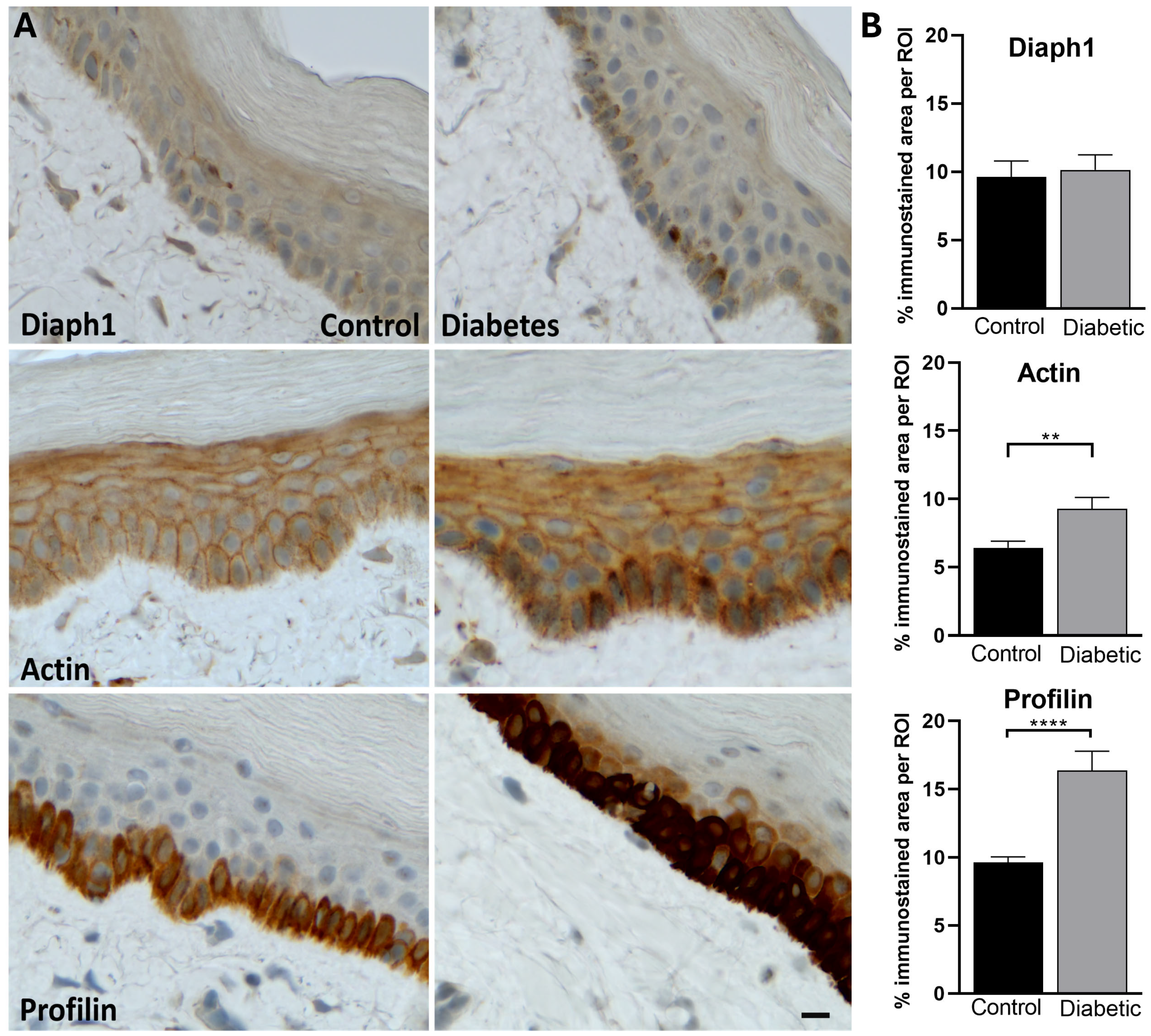
Observational analysis of skin biopsy samples indicated morphological and anatomical differences between control and diabetic samples. DAB-stained skin sections revealed distinct staining patterns for all three cytoskeleton-related proteins studied, both within and between groups. In control samples, Diaph1 immunopositive material was distributed irregularly and concentrated mainly at the apical and basal aspects of basal keratinocytes. In contrast, in diabetic samples, more diffuse and homogeneous DAB labeling was observed throughout the epidermis. Qualitative differences in Diaph1 distribution were present but were less pronounced than those observed for Profilin. β-Actin staining outlined adjacent epidermal cells in both groups, but diabetic samples showed broader and more intense staining. Profilin showed the most pronounced qualitative difference. In control samples, staining was visible mainly within the cytoplasm of basal keratinocytes, whereas in diabetic samples, the signal occupied much of the cell interior, including the perinuclear region, and in some cells, the nuclear area (Figure 1).
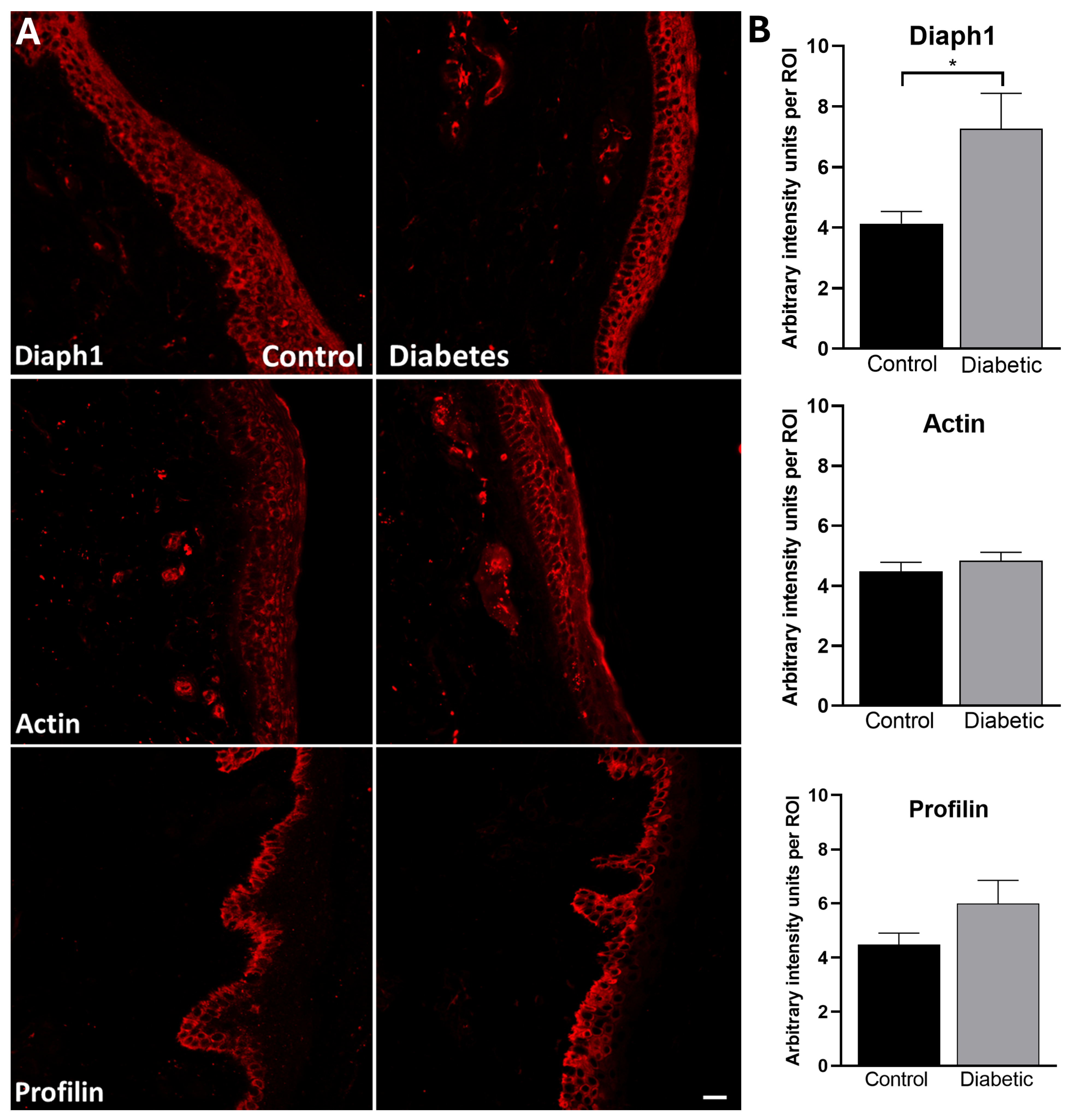
Immunofluorescence staining showed differences broadly analogous to those observed in DAB-stained sections, although the signal was less sharply delineated. In control samples, Diaph1 fluorescence was more prominent at the apical and basal aspects of basal keratinocytes, whereas in diabetic samples, Diaph1-positive signal was observed across keratinocytes in multiple epidermal layers. For β-Actin, control samples showed a more discontinuous intercellular signal, while in diabetic samples, the signal between adjacent cells appeared more continuous. Profilin staining was present in both groups, with a stronger signal in diabetic samples, especially within basal keratinocytes (Figure 2).
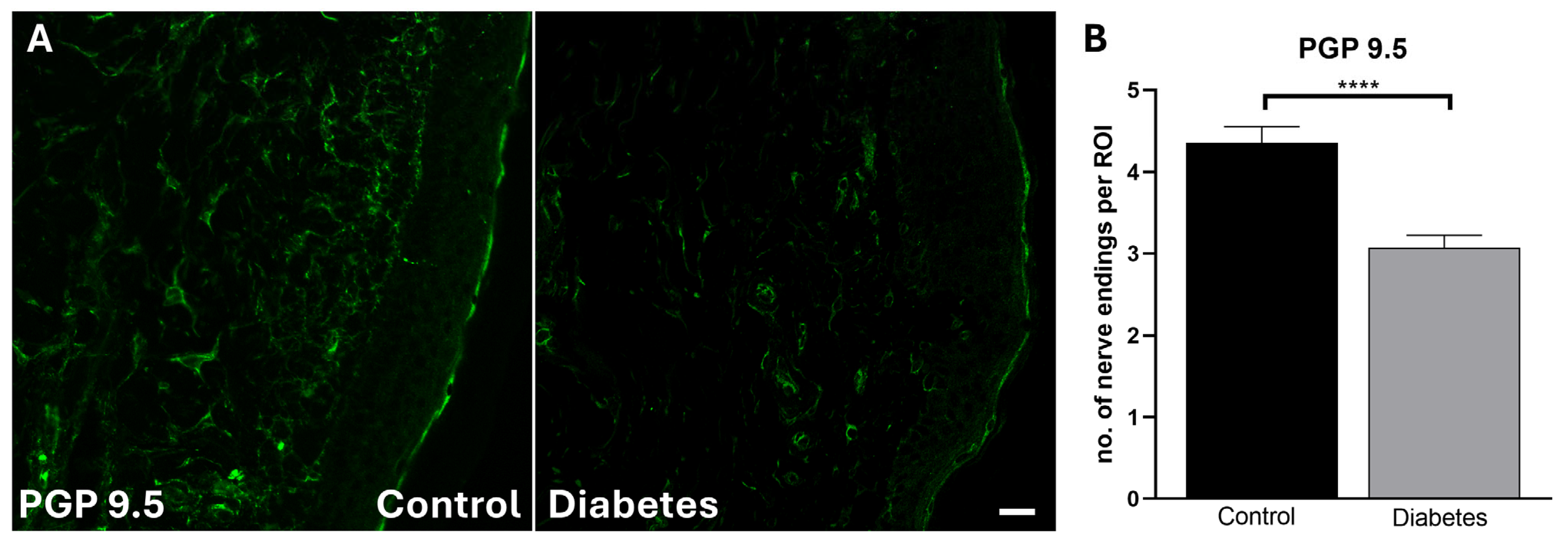
For PGP 9.5, epidermal staining was more prominent in control samples, with PGP 9.5-positive nerve fibers extending along the epidermis. An additional signal was observed in neural structures and fibers beneath the epidermis. In diabetic samples, the number of epidermal nerve fibers appeared markedly reduced relative to controls, and the PGP 9.5 immunofluorescence beneath the epidermis was also diminished (Figure 3).

3.2. Statistical Analysis

Quantitative analysis of DAB-immunostained area fraction revealed differences between control and diabetic samples for selected proteins (Figure 1). For Diaph1, the fraction of stained area was similar between groups. For β-Actin, the stained area fraction differed significantly between control and diabetic samples. For Profilin, the stained area fraction was significantly different, with a higher DAB-immunopositive area observed in diabetic samples.
Quantitative analysis of immunofluorescence signal intensity also revealed group-dependent differences (Figure 2). For Diaph1, signal intensity differed significantly between control and diabetic samples. For β-Actin, signal intensity did not differ significantly between groups. For Profilin, the signal intensity trended toward statistical significance.
In PGP 9.5, only the number of epidermal nerve endings per ROI was calculated, and a statistically significant difference between control and diabetic samples was observed (Figure 3).

3.3. Spearman’s Rank Correlation Analysis

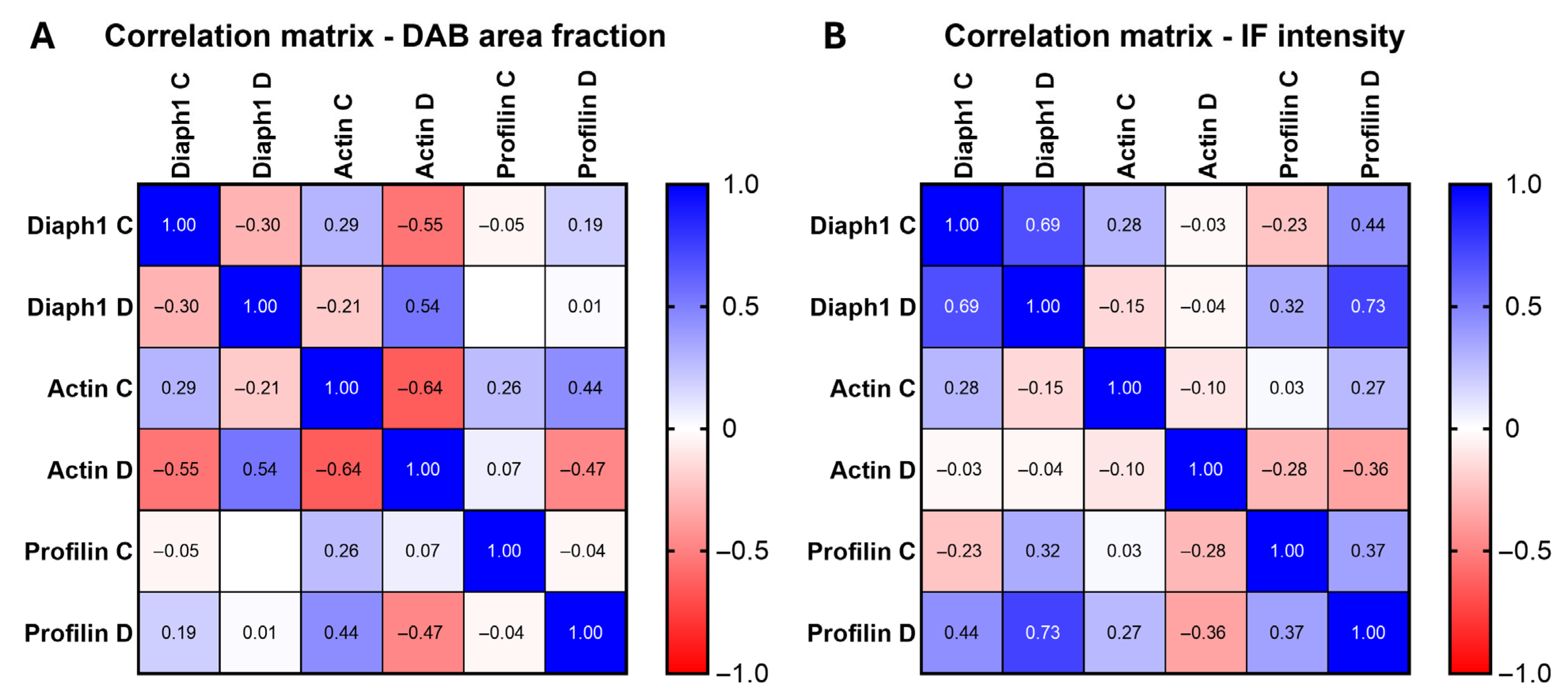
Spearman’s rank correlation analysis was used to assess associations among DAB-immunostained area fraction and immunofluorescence signal intensity measures for Diaph1, β-Actin, and Profilin in control (C) and diabetic (D) samples (Figure 4). For DAB area fraction, the strongest correlations (|rs| ≥ 0.5) involved β-Actin and Diaph1, particularly between Actin D and Diaph1 C (rs = −0.55) and between Actin D and Diaph1 D (rs = 0.54). A strong negative correlation was also observed between Actin C and Actin D (rs = −0.64). For IF signal intensity, strong positive correlations were observed between Diaph1 C and Diaph1 D (rs = 0.69) and between Diaph1 D and Profilin D (rs = 0.73).

4. Discussion

Exploring Diaph1 distribution in human skin, particularly in the context of diabetes, has received limited attention to date. Previous work from our group identified alterations of Diaph1 and its ligands’ expression in prolonged hyperglycemia, providing a rationale for the current investigation [21]. We aimed to elucidate alterations in the epidermis and IENFs under diabetic conditions. Contrary to our expectations, we encountered challenges in observing nerve-ending staining, likely due to the predominance of epidermal staining observed for all studied proteins, potentially masking weak and rare fiber staining.
Distinct non-homogeneous immunohistochemical patterns were observed in the epidermal layers, different for each of the three cytoskeleton proteins studied, that is Profilin, β-Actin, and Diaph1, contrasting the fiber-positive staining of the marker, PGP 9.5, which was significantly diminished. Notably, although Profilin is a Diaph1 ligand, their epidermal staining patterns showed only partial overlap. This suggests that despite their common association with the cytoskeleton, Diaph1 and Profilin may differ in their spatial distribution in the epidermis. Previous studies also suggest that tissue responses associated with advanced glycation end-products (AGEs) may involve Profilin-related alterations that are not necessarily mirrored by Diaph1. In this context, a recent study on diabetic vasculopathy found increased epithelial cell proliferation in rats treated with advanced glycation end-products [22]. Another study suggested that diabetes and its associated overproduction of AGEs lead to increased Profilin expression, which appears independent of Diaph1 [23].
Beyond the direct staining differences observed in the present study, our findings can be considered within the broader context of diabetes-associated tissue remodeling. Chronic hyperglycemia promotes the formation of advanced glycation end-products, oxidative stress, inflammatory activation, and disturbed intracellular signaling, all of which may affect cytoskeletal organization and structural homeostasis in metabolically exposed tissues [6,24,25,26]. In parallel, diabetic peripheral neuropathy has increasingly been viewed not only as a process driven solely by neuronal injury alone, but also as a process shaped by impaired axonal maintenance, vascular dysfunction, and local tissue stress within the neurocutaneous environment [4,7]. From this perspective, diabetic skin should not be regarded as a passive background for nerve fiber loss but rather as a biologically active compartment in which epidermal, vascular, and neural changes may coexist. The altered staining patterns of Diaph1, β-Actin, and Profilin observed in the present study may therefore reflect a local response to sustained metabolic stress occurring in parallel with reduced cutaneous innervation. Although the current work does not establish causality, it supports the interpretation that epidermal cytoskeleton-related alterations and small-fiber pathology may represent interconnected features of long-standing diabetic tissue injury [26].
Similar staining patterns were observed for β-Actin and Diaph1, suggesting coordinated regulation or spatial association between β-Actin and Diaph1. This interpretation is also supported by the correlation analysis, which showed the strongest DAB area-fraction associations between β-Actin and Diaph1, while immunofluorescence signal intensity revealed a strong positive correlation between Diaph1 and Profilin in diabetic samples. However, these associations should be interpreted cautiously and do not by themselves indicate direct mechanistic interaction. Prior studies typically report reduced β-Actin in diabetes. This disparity may reflect differences in tissue context and disease stage. Indeed, one study found increased β-Actin in type 2 diabetic patients’ skin and high glucose levels have been linked to enhanced contractile and cytoskeletal gene expression in vascular smooth muscle involving Rho/Protein Kinase C and β-Actin polymerization [27]. Additionally, the Receptor for Advanced Glycation End-products (RAGE) indirectly pertains to Diaph1. RAGE’s expression was upregulated in the skin of human subjects with diabetes, particularly in the dermal and subcutaneous vascular endothelium. AGER (Advanced Glycosylation End-product Specific Receptor), the gene encoding RAGE, showed higher mRNA expression in diabetic skin, especially in cases with severe neuropathy [28]. The diffuse immunopositive patterns and the significant increase in histochemical immunopositive area fraction for Profilin, trending toward significance for β-Actin, alongside immunofluorescence intensity significance for Diaph1, and trending toward significance for Profilin, may be consistent with cytoskeleton-related alterations associated with chronic hyperglycemic stress. These observations are of interest because cytoskeletal proteins are central to the maintenance of cellular structure and intracellular transport [29]. The marked decline in PGP 9.5-positive fibers in the diabetic epidermis is consistent with reduced cutaneous innervation. It is consistent with small-fiber neuropathy-related changes, corroborating earlier findings of diminished cutaneous innervation in diabetes and peripheral neuropathy [25,30,31]. These alterations may be associated with impaired sensory function [26]. Together, these findings indicate that altered epidermal staining patterns of cytoskeleton-related proteins occur together with reduced cutaneous innervation.
These observations may be relevant to mechanisms underlying the clinical manifestations of diabetic neuropathy. The markedly diminished count of PGP 9.5-positive fibers in the diabetic epidermis is indicative of reduced sensory nerve endings abundance and may reflect early small-fiber involvement, a common complication of diabetes [32,33]. As corroborated by earlier studies, this reduction in cutaneous innervation may be relevant to diminished sensation and loss of protective sensory function, which may predispose individuals to foot ulcers and other cutaneous injuries [34,35]. This clinical context is consistent with review literature emphasizing that diabetic foot complications arise from the combined effects of neuropathy, vascular impairment, skin injury, and delayed recognition, and that prevention and structured foot care remain central to limiting progression [36]. This is also in line with contemporary international guidance, which places strong emphasis on prevention, screening, and integrated management of diabetes-related foot disease [37]. The observed morphological alterations, particularly the dense aggregation of basal cells and the distorted epidermal layers in diabetic samples, may be relevant to structural changes in diabetic skin. Chronic hyperglycemia may impair skin integrity and thereby increase susceptibility to cutaneous injury, infection, and ulceration, which is consistent with broader clinical overviews of diabetic foot complications emphasizing the combined roles of neuropathy, skin lesions and defective tissue repair [38,39]. Altered cytoskeletal protein staining pattern, potentially reflecting adaptive remodeling under hyperglycemia, may affect cellular functionality and tissue integrity, and could be relevant to the progression of diabetic neuropathy [26]. Traditionally, diabetic neuropathy management has been symptomatic, focusing on glycemic control and the underlying molecular derangements, which continued to be elusive until the role of cytoskeletal proteins began to be uncovered [7]. The broader and more diffuse epidermal staining of Diaph1, Profilin and β-Actin may reflect an attempt to maintain or reorganize cytoskeletal integrity under chronic metabolic stress. Modulation of these pathways may enable further mechanistic studies of neuropathic and cutaneous complications of diabetes [17]. Current research is beginning to explore whether cytoskeletal regulatory pathways may be relevant in diabetes-related tissue injury [23,40]. Among others, antioxidant-based approaches, aimed at mitigating oxidative stress, have been studied in the context of diabetes-related tissue injury [41,42,43].
This study has several limitations. The sample size was relatively small, and the cross-sectional design precludes causal inference. The diabetic group was intentionally selected to represent patients with long-standing type 2 diabetes of relatively early onset and mean BMI in the obesity range, reflecting a clinically relevant phenotype rather than a strictly matched metabolic comparison group. In this context, pharmacologically controlled hypertension and dyslipidemia should be viewed as common accompanying features of type 2 diabetes and obesity. In contrast, the control group represented metabolically healthy, non-obese individuals without known major comorbidities. Accordingly, the observed epidermal and neural differences should be interpreted in the context of metabolic phenotypes of the diabetic cohort. Moreover, although distal sensory neuropathy of the lower limbs was confirmed clinically in the diabetic group, neuropathy severity was not systematically characterized using detailed formal clinical scoring systems in all participants. In addition, the immunostaining-based analysis was descriptive and semi-quantitative and was not complemented by independent molecular validation, such as qPCR or Western blotting. Thus, the present findings should be regarded as associative, preliminary and hypothesis-generating. Further studies using larger, clinically stratified cohorts are needed to clarify how the histological changes the authors detected are associated with glycemic control, disease duration, and the severity of neuropathy.

5. Conclusions

Skin samples from patients with long-standing type 2 diabetes showed reduced PGP 9.5-positive intraepidermal nerve fibers density together with altered staining patterns of Diaph1, β-Actin and Profilin. These findings document coexisting cutaneous denervation and cytoskeletal alterations in diabetic skin.

Author Contributions

Conceptualization, J.J. and J.W.; methodology, B.K., M.Z. and J.S.; software, J.J. and B.K.; validation, W.M. and R.M.; formal analysis, J.J., J.S. and M.Z.; investigation, B.K. and J.J.; resources, J.J. and J.W.; data curation, B.K., W.M. and R.M.; writing—original draft preparation, B.K. and J.J.; writing—review and editing, B.K., J.J. and M.Z.; visualization, B.K. and J.J.; supervision, J.J. and J.W.; project administration, J.W.; funding acquisition, J.J. All authors have read and agreed to the published version of the manuscript.

Funding

This research was funded by the National Science Centre (NCN), Poland, 2017/01/X/NZ5/01350 (MINIATURA). BK is supported by NCN PRELUDIUM, 2023/49/N/NZ4/03958; and JJ is supported by NCN OPUS, 2022/47/B/NZ5/00898.

Institutional Review Board Statement

This study was conducted in accordance with the Declaration of Helsinki and was covered by approval no. 10/2010 of 25 March 2010 issued by the Bioethics Committee of the Faculty of Medicine, University of Warmia and Mazury in Olsztyn, Poland.

Informed Consent Statement

Informed consent was obtained from all subjects involved in the study. Samples were anonymized, and no personal data was used in the study.

Data Availability Statement

The original contributions presented in this study are included in the article. The raw data supporting the conclusions of this article will be made available by the authors on request.

Acknowledgments

The authors sincerely thank all volunteers who participated in this study. During the preparation of this manuscript, the authors used ChatGPT (OpenAI, GPT-5.4 Thinking) for the preparation of icons used in the graphical abstract, which was designed and manually assembled by the authors. ChatGPT was not used to generate or modify scientific images, data, analyses, or conclusions. The authors reviewed and edited the output and take full responsibility for the content of this publication.

Conflicts of Interest

The authors declare no conflicts of interest.

Abbreviations

The following abbreviations are used in this manuscript:
AGEsAdvanced Glycation End-products
AGERAdvanced Glycosylation End Product-Specific Receptor
BMIBody Mass Index
DAB3,3′-Diaminobenzidine
DAPI4′,6-Diamidino-2-phenylindole
Diaph1Diaphanous-related protein 1
HbA1cGlycated hemoglobin
IENFsIntraepidermal Nerve Fibers
PBSPhosphate-buffered saline
PGP 9.5Protein Gene Product 9.5
RAGEReceptor For Advanced Glycation End-Products
ROIRegion of Interest
WHOWorld Health Organization

References

  1. Genitsaridi, I.; Salpea, P.; Salim, A.; Sajjadi, S.F.; Tomic, D.; James, S.; Thirunavukkarasu, S.; Issaka, A.; Chen, L.; Basit, A.; et al. 11th Edition of the IDF Diabetes Atlas: Global, Regional, and National Diabetes Prevalence Estimates for 2024 and Projections for 2050. Lancet Diabetes Endocrinol. 2026, 14, 149–156. [Google Scholar] [CrossRef]
  2. Alkotami, A.S.; Elkholy, S.H.; Elshamy, A.M.; Elseidy, E.A.; Fadel, W.A. Diabetic Small Fiber Neuropathy: Clinical and Electrophysiological Study. Egypt. J. Neurol. Psychiatr. Neurosurg. 2024, 60, 148. [Google Scholar] [CrossRef]
  3. Mashayekhi, Y.; Iguh, C.; Baba-Aissa, S.; Iqbal, M.; Nidiginti, T.; Jalali, R.; Kashmoola, A.A.; Abualhab, M.M.; Al Niazi, R.; Shaikh, A.R.; et al. Exploring the Prevalence and Symptom Burden of Small Fiber Neuropathy in Patients with Diabetes Using the Small Fiber Neuropathy Symptoms Inventory Questionnaire (SFN-SIQ). Cureus 2025, 17, e93548. [Google Scholar] [CrossRef] [PubMed]
  4. Ando, A.; Miyamoto, M.; Saito, N.; Kotani, K.; Kamiya, H.; Ishibashi, S.; Tavakoli, M. Small Fibre Neuropathy Is Associated with Impaired Vascular Endothelial Function in Patients with Type 2 Diabetes. Front. Endocrinol. 2021, 12, 653277. [Google Scholar] [CrossRef] [PubMed]
  5. Karlsson, P.; Sjogaard, M.B.; Schousboe, K.; Mizrak, H.I.; Kufaishi, H.; Staehelin Jensen, T.; Randel Nyengaard, J.; Hansen, C.S.; Yderstræde, K.B.; Buhl, C.S. Assessment of Neuropathy Subtypes in Type 1 Diabetes. BMJ Open Diabetes Res. Care 2024, 12, e004289. [Google Scholar] [CrossRef]
  6. Kaur, M.; Misra, S.; Swarnkar, P.; Patel, P.; Das Kurmi, B.; Das Gupta, G.; Singh, A. Understanding the Role of Hyperglycemia and the Molecular Mechanism Associated with Diabetic Neuropathy and Possible Therapeutic Strategies. Biochem. Pharmacol. 2023, 215, 115723. [Google Scholar] [CrossRef]
  7. Yang, C.; Zhao, X.; An, X.; Zhang, Y.; Sun, W.; Zhang, Y.; Duan, Y.; Kang, X.; Sun, Y.; Jiang, L.; et al. Axonal Transport Deficits in the Pathogenesis of Diabetic Peripheral Neuropathy. Front. Endocrinol. 2023, 14, 1136796. [Google Scholar] [CrossRef]
  8. Jarosławska, J.; Kordas, B.; Miłowski, T.; Juranek, J.K. Mammalian Diaphanous1 Signalling in Neurovascular Complications of Diabetes. Eur. J. Neurosci. 2024, 59, 2628–2645. [Google Scholar] [CrossRef]
  9. Theophall, G.G.; Premo, A.; Reverdatto, S.; Omojowolo, E.; Nazarian, P.; Burz, D.S.; Ramasamy, R.; Schmidt, A.M.; Shekhtman, A. Negative Cooperativity Regulates Ligand Activation of DIAPH1 and Other Diaphanous Related Formins. Commun. Biol. 2025, 8, 776. [Google Scholar] [CrossRef]
  10. Bogdan, S.; Schultz, J.; Grosshans, J. Formin’ Cellular Structures. Commun. Integr. Biol. 2013, 6, e27634. [Google Scholar] [CrossRef]
  11. Miao, S.; Schäfer, P.; Nojszewski, J.; Meyer, F.; Windhorst, S. DIAPH1 Regulates Chromosomal Instability of Cancer Cells by Controlling Microtubule Dynamics. Eur. J. Cell Biol. 2021, 100, 151156. [Google Scholar] [CrossRef]
  12. Yu, C.J.; Park, Y.H.; An, M.Y.; Ryu, B.; Jung, H.S. Insights into Actin Isoform-Specific Interactions with Myosin via Computational Analysis. Molecules 2024, 29, 2992. [Google Scholar] [CrossRef]
  13. Pinto-Costa, R.; Sousa, M.M. Profilin as a Dual Regulator of Actin and Microtubule Dynamics. Cytoskeleton 2020, 77, 76–83. [Google Scholar] [CrossRef]
  14. Otsuki, T.; Yata, K.; Takata-Tomokuni, A.; Hyodoh, F.; Miura, Y.; Sakaguchi, H.; Hatayama, T.; Hatada, S.; Tsujioka, T.; Sato, Y.; et al. Expression of Protein Gene Product 9·5 (PGP9·5)/Ubiquitin-C-terminal Hydrolase 1 (UCHL-1) in Human Myeloma Cells. Br. J. Haematol. 2004, 127, 292–298. [Google Scholar] [CrossRef] [PubMed]
  15. Dalsgaard, C.-J.; Rydh, M.; Hagerstrand, A. Cutaneous Innervation in Man Visualized with Protein Gene Product 9.5 (PGP 9.5) Antibodies. Histochemistry 1989, 92, 385–390. [Google Scholar] [CrossRef] [PubMed]
  16. Thakur, V.; Narang, T.; Bishnoi, A.; Dhawan, G.; Sharma, A.; Saikia, U.N.; Razmi, T.M.; Dogra, S.; Handa, S.; Modi, M. Changes in the Cutaneous Nerve Fiber Staining and Distribution of PGP9.5 in Clinically Uninvolved Skin in Leprosy Patients after Completion of Multidrug Therapy and Assessing PGP9.5 as a Marker of Treatment Response. Indian Dermatol. Online J. 2024, 15, 599–604. [Google Scholar] [CrossRef] [PubMed]
  17. Matuszewski, W.; Mazur, U.; Tomaszek, L.; Kordas, B.; Mizia, P.; Mukherjee, K.; Juranek, J. RAGE Signaling Pathway in Inflammatory And Vascular Pathology of Diabetic Retinopathy: Implications for Interventional Strategies. Acta Neurobiol. Exp. 2025, 85, 138–148. [Google Scholar] [CrossRef]
  18. Lauria, G.; Hsieh, S.T.; Johansson, O.; Kennedy, W.R.; Leger, J.M.; Mellgren, S.I.; Nolano, M.; Merkies, I.S.J.; Polydefkis, M.; Smith, A.G.; et al. European Federation of Neurological Societies/Peripheral Nerve Society Guideline on the Use of Skin Biopsy in the Diagnosis of Small Fiber Neuropathy. Report of a Joint Task Force of the European Fe-deration of Neurological Societies and the Peripheral Nerve Society. Eur. J. Neurol. 2010, 17, 903. [Google Scholar] [CrossRef]
  19. Schindelin, J.; Arganda-Carreras, I.; Frise, E.; Kaynig, V.; Longair, M.; Pietzsch, T.; Preibisch, S.; Rueden, C.; Saalfeld, S.; Schmid, B.; et al. Fiji: An open-source platform for biological-image analysis. Nat. Methods 2012, 9, 676–682. [Google Scholar] [CrossRef]
  20. Rueden, C.T.; Schindelin, J.; Hiner, M.C.; DeZonia, B.E.; Walter, A.E.; Arena, E.T.; Eliceiri, K.W. ImageJ2: ImageJ for the next generation of scientific image data. BMC Bioinform. 2017, 18, 529. [Google Scholar] [CrossRef]
  21. Zglejc-Waszak, K.; Mukherjee, K.; Korytko, A.; Lewczuk, B.; Pomianowski, A.; Wojtkiewicz, J.; Banach, M.; Załęcki, M.; Nowicka, N.; Jarosławska, J.; et al. Novel Insights into the Nervous System Affected by Prolonged Hyperglycemia. J. Mol. Med. 2023, 101, 1015–1028. [Google Scholar] [CrossRef]
  22. Xie, Q.; Ma, L.; Xiao, Z.; Yang, M.; Chen, M. Role of Profilin-1 in Vasculopathy Induced by Advanced Glycation End Products (AGEs). J. Diabetes Complicat. 2023, 37, 108415. [Google Scholar] [CrossRef]
  23. Takematsu, E.; Spencer, A.; Auster, J.; Chen, P.-C.; Graham, A.; Martin, P.; Baker, A.B. Genome Wide Analysis of Gene Expression Changes in Skin from Patients with Type 2 Diabetes. PLoS ONE 2020, 15, e0225267. [Google Scholar] [CrossRef] [PubMed]
  24. Eid, S.A.; Rumora, A.E.; Beirowski, B.; Bennett, D.L.; Hur, J.; Savelieff, M.G.; Feldman, E.L. New Perspectives in Diabetic Neuropathy. Neuron 2023, 111, 2623–2641. [Google Scholar] [CrossRef] [PubMed]
  25. Cherief, M.; Gomez-Salazar, M.; Kang, M.; Lee, S.; Ramesh, S.; Qin, Q.; Xu, M.; Kim, S.; Archer, M.; Zhu, M.; et al. Reduced Somatosensory Innervation Alters the Skeletal Transcriptome at a Single Cell Level in a Mouse Model of Type 2 Diabetes. Bone Res. 2025, 13, 67. [Google Scholar] [CrossRef] [PubMed]
  26. Ratan, Y.; Rajput, A.; Pareek, A.; Pareek, A.; Kaur, R.; Sonia, S.; Kumar, R.; Singh, G. Recent Advances in Biomolecular Patho-Mechanistic Pathways behind the Development and Progression of Diabetic Neuropathy. Biomedicines 2024, 12, 1390. [Google Scholar] [CrossRef]
  27. Hien, T.T.; Turczyńska, K.M.; Dahan, D.; Ekman, M.; Grossi, M.; Sjögren, J.; Nilsson, J.; Braun, T.; Boettger, T.; Garcia-Vaz, E.; et al. Elevated Glucose Levels Promote Contractile and Cytoskeletal Gene Expression in Vascular Smooth Muscle via Rho/Protein Kinase C and Actin Polymerization. J. Biol. Chem. 2016, 291, 3552–3568. [Google Scholar] [CrossRef]
  28. Park, S.-Y.; Kim, Y.-A.; Hong, Y.-H.; Moon, M.-K.; Koo, B.-K.; Kim, T.W. Up-Regulation of the Receptor for Advanced Glycation End Products in the Skin Biopsy Specimens of Patients with Severe Diabetic Neuropathy. J. Clin. Neurol. 2014, 10, 334. [Google Scholar] [CrossRef]
  29. Hafner, A.E.; Rieger, H. Spatial Cytoskeleton Organization Supports Targeted Intracellular Transport. Biophys. J. 2018, 114, 1420–1432. [Google Scholar] [CrossRef]
  30. Nowak, N.C.; Menichella, D.M.; Miller, R.; Paller, A.S. Cutaneous Innervation in Impaired Diabetic Wound Healing. Transl. Res. 2021, 236, 87–108. [Google Scholar] [CrossRef]
  31. Cheng, C.; Singh, V.; Krishnan, A.; Kan, M.; Martinez, J.A.; Zochodne, D.W. Loss of Innervation and Axon Plasticity Accompanies Impaired Diabetic Wound Healing. PLoS ONE 2013, 8, e75877. [Google Scholar] [CrossRef] [PubMed]
  32. Jin, H.Y.; Lee, N.Y.; Ko, H.A.; Lee, K.A.; Park, T.S. Comparison of Sensory Tests and Neuronal Quantity of Peripheral Nerves between Streptozotocin (STZ)-Induced Diabetic Rats and Paclitaxel (PAC)-Treated Rats. Somatosens. Mot. Res. 2016, 33, 186–195. [Google Scholar] [CrossRef]
  33. Shillo, P.; Yiangou, Y.; Donatien, P.; Greig, M.; Selvarajah, D.; Wilkinson, I.D.; Anand, P.; Tesfaye, S. Nerve and Vascular Biomarkers in Skin Biopsies Differentiate Painful from Painless Peripheral Neuropathy in Type 2 Diabetes. Front. Pain Res. 2021, 2, 731658. [Google Scholar] [CrossRef] [PubMed]
  34. Crawford, F.; Cezard, G.; Chappell, F.M.; Murray, G.D.; Price, J.F.; Sheikh, A.; Simpson, C.R.; Stansby, G.P.; Young, M.J. A Systematic Review and Individual Patient Data Meta-Analysis of Prognostic Factors for Foot Ulceration in People with Diabetes: The International Research Collaboration for the Prediction of Diabetic Foot Ulcerations (PODUS). Health Technol. Assess. 2015, 19, 1–210. [Google Scholar] [CrossRef] [PubMed]
  35. Panagoulias, G.S.; Eleftheriadou, I.; Papanas, N.; Manes, C.; Kamenov, Z.; Tesic, D.; Bousboulas, S.; Tentolouris, A.; Jude, E.B.; Tentolouris, N. Dryness of Foot Skin Assessed by the Visual Indicator Test and Risk of Diabetic Foot Ulceration: A Prospective Observational Study. Front. Endocrinol. 2020, 11, 625. [Google Scholar] [CrossRef]
  36. Constantin, C.; Georgescu, M.; Staicu, I.M. Progress and Challenges of Diabetic Foot Diagnostic and Treatment. Rom. J. Mil. Med. 2023, 126, 281–286. [Google Scholar] [CrossRef]
  37. Schaper, N.C.; van Netten, J.J.; Apelqvist, J.; Bus, S.A.; Fitridge, R.; Game, F.; Monteiro-Soares, M.; Senneville, E. Practical Guidelines on the Prevention and Management of Diabetes-related Foot Disease (IWGDF 2023 Update). Diabetes. Metab. Res. Rev. 2024, 40, e3657. [Google Scholar] [CrossRef]
  38. Atkin, L.; Chaplin, E.; Dingley, J.; Phillips, K.; Robinson, H. Pressure Ulceration of the Heel: Prevalence, Complexities and Management. Br. J. Nurs. 2026, 35, S10–S15. [Google Scholar] [CrossRef]
  39. Kim, T.; Choi, S.-H. Diabetes Mellitus and Infectious Diseases: Current Evidence and Clinical Implications. Diabetes Metab. J. 2025, 49, 915–933. [Google Scholar] [CrossRef]
  40. Zhou, Q.; Ge, X.; Chen, Z.; Cao, D.; Chen, Y.; Shi, J.; Meng, G. Distinct Types of Protein Modifications in Diabetic Endothelial Dysfunction. Cardiovasc. Diabetol. 2025, 24, 287. [Google Scholar] [CrossRef]
  41. Aladaileh, S.H.; Abukhalil, M.H.; Alfwuaires, M.A.; Algefare, A.I.; Imran, M.R.; Anjum, S.; Alzahrani, S.; Alsubhi, W.A.; Karimulla, S.; Al-Shammari, A.H. Modulation of Oxidative Stress, Inflammation, and Apoptosis and Restoration of Sirt1/Nrf2/HO-1 Signaling by Diosmin Protect Against Diabetes-Induced Testicular Damage in Rats. Int. J. Mol. Sci. 2026, 27, 1268. [Google Scholar] [CrossRef]
  42. Lu, E.; Huang, X.; Zhang, Q.; Luo, K.; Yan, X.; Nie, W.; Zhang, L.; Hu, R.; Bian, J.; Li, Y.; et al. A Precision Nitric Oxide-Releasing Hydrogel Promoting Nanoparticles Permeation for Comprehensive Nerve-Vessel Recovery and Microenvironment Regulation in Diabetic Wounds. J. Control. Release 2026, 392, 114703. [Google Scholar] [CrossRef]
  43. Luo, J.; Lu, F.; Cuciureanu, M.; Xu, X.; Dong, H.; Gong, M. Targeting Mitochondrial Quality Control in Diabetic Kidney Disease: Emerging Therapeutic Opportunities. Ren. Fail. 2026, 48, 2620218. [Google Scholar] [CrossRef]
Figure 1. Comparative DAB immunohistochemical staining of Diaph1, β-Actin (referred to as Actin), and Profilin in epidermis of control and diabetic participants. (A) Representative staining patterns in skin sections from control and diabetic participants. Top Panel: Diaph1 staining was observed mainly in the basal region of the epidermis in control samples, whereas diabetic samples showed a more diffuse epidermal labeling pattern. Middle Panel: β-Actin staining outlined epidermal cells in both groups, with broader and stronger staining in diabetic samples. Bottom Panel: Profilin showed the most pronounced qualitative difference, with markedly stronger staining in basal keratinocytes in diabetic samples than in controls. Scale Bar: 20 µm for all panels. (B) Quantitative Analysis: Quantitative analysis of the percentage of DAB-immunostained area per region of interest (ROI). Statistically significant differences between control and diabetic groups were observed for β-Actin (** indicates p < 0.01) and Profilin (**** indicates p < 0.0001).
Diabetology 07 00078 g001
Figure 2. Comparative immunofluorescent staining of Diaph1, β-Actin (referred to as Actin) and Profilin in the epidermis of control and diabetic participants. (A) Representative immunofluorescence images showing signal distribution in control and diabetic skin sections. Top Panel: Diaph1 showed broader epidermal staining in diabetic samples. Middle Panel: β-Actin staining surrounded epidermal cells in both groups, with a more continuous intercellular pattern in diabetic samples. Bottom Panel: Profilin staining was present in the epidermal basal layer in both groups and appeared stronger in diabetic samples. Scale Bar: 20 µm for all panels. (B) Quantitative analysis of immunofluorescence signal intensity within regions of interest (ROIs). A significant difference between control and diabetic groups was observed for Diaph1 (* indicates p < 0.05).
Diabetology 07 00078 g002
Figure 3. Comparative analysis of PGP 9.5-positive nerve fibers in skin samples from controls and patients with diabetes. (A) Representative PGP 9.5 immunofluorescence images of control and diabetic skin sections. In control samples, PGP 9.5-positive nerve fibers were clearly visible in and beneath the epidermis, whereas diabetic samples showed visibly reduced nerve fiber abundance. Scale Bar: 20 µm. (B) Quantitative comparison of the number of nerve endings per region of interest (ROI). A significant reduction was observed in diabetic samples compared with controls (**** indicates p < 0.0001).
Diabetology 07 00078 g003
Figure 4. Spearman’s rank correlation matrices for DAB and immunofluorescence (IF) signal intensity in control (C), and diabetic (D) samples. (A) Correlation matrix for DAB area fraction. (B) Correlation matrix for IF signal intensity. Cell values and color scale represent Spearman’s rank correlation coefficients (rs) ranging from −1.0 to +1.0, where positive values indicate direct associations and negative values indicate inverse associations.
Diabetology 07 00078 g004
Disclaimer/Publisher’s Note: The statements, opinions and data contained in all publications are solely those of the individual author(s) and contributor(s) and not of MDPI and/or the editor(s). MDPI and/or the editor(s) disclaim responsibility for any injury to people or property resulting from any ideas, methods, instructions or products referred to in the content.