Article

Impact of Preexisting Diabetes on Activities of Daily Living Independence at Hospital Discharge in Critically Ill Patients: A Prospective Cohort Study


1
Department of Rehabilitation, National Hospital Organization, Nagoya Medical Center, Nagoya 460-0001, Japan
2
Department of Physical Therapy, Faculty of Rehabilitation, Gifu University of Health Science, Gifu 500-8281, Japan
3
Department of Rehabilitation, Steel Memorial Yawata Hospital, Kitakyushu 805-8508, Japan
4
Department of Rehabilitation, National Hospital Organization, Shizuoka Medical Center, Shizuoka 411-0905, Japan
5
Department of Rehabilitation, Fujita Health University Hospital, Aichi 470-1192, Japan
6
Department of Critical Care Medicine, National Hospital Organization, Nagoya Medical Center, Nagoya 460-0001, Japan
7
Faculty of Health and Medical Sciences, Aichi Shukutoku University, Nagakute 480-1197, Japan
*
Author to whom correspondence should be addressed.
Diabetology 2026, 7(2), 27; https://doi.org/10.3390/diabetology7020027
Submission received: 28 November 2025 / Revised: 22 January 2026 / Accepted: 23 January 2026 / Published: 1 February 2026

Abstract

Background: Diabetes mellitus is known to affect the prognosis of critically ill patients; however, its impact on independence in activities of daily living (ADL) at hospital dis-charge remains unclear. This study aimed to investigate whether preexisting diabetes is associated with reduced ADL independence at hospital discharge among critically ill patients. Methods: In this prospective cohort study, 423 adult intensive care unit (ICU) patients who were admit-ted for ≥48 h were enrolled and categorized by the presence or absence of diabetes. Primary outcomes included time to achieve walking independence (unassisted walking over 50 m) and the Barthel Index at discharge. Secondary outcomes were handgrip strength, ICU length of stay, and highest ICU Mobility Scale (IMS) scores. Multivariable analyses adjusted for age, illness severity, and other confounders. Results: Among the 101 patients with diabetes, time to achieve walking independence at discharge was significantly longer compared to those without diabetes (p = 0.013). The diabetes group also had a lower Barthel Index (p = 0.020), longer ICU stays (p = 0.003), weaker handgrip strength (p = 0.041), and lower maximum IMS scores (p = 0.002). Multivariable analysis confirmed that diabetes was independently associated with reduced ADL independence and poorer physical function at discharge. Conclusions: Preexisting diabetes is an independent predictor of impaired ADL independence in critically ill patients. These findings highlight the importance of early and individualized rehabilitation strategies for patients with diabetes in the ICU.

1. Introduction

Critically ill patients frequently experience persistent physical dysfunction after intensive care unit (ICU) discharge, resulting in reduced independence in activities of daily living (ADL) and long-term disability [1,2]. Such functional impairment is a core component of post-intensive care syndrome and is associated with decreased quality of life, increased dependency on nursing care, and a higher risk of rehospitalization, particularly among older adults and patients with chronic comorbidities who have limited functional reserve [3,4,5]. Diabetes mellitus is a common comorbidity among ICU patients and may further compromise functional recovery through mechanisms such as peripheral neuropathy, muscle atrophy, microvascular dysfunction, insulin resistance, and chronic inflammation [6,7]. In addition, impaired glycemic control is associated with delayed wound healing and increased susceptibility to infection, which may prolong ICU stay and hinder post-ICU functional recovery [8].
Diabetes mellitus is a chronic disease that is thought to coexist in approximately 20–30% of ICU patients [6] and is known to adversely affect acute treatment and functional recovery through multifaceted pathologies such as neuropathy, muscle atrophy, microcirculatory disorders, insulin resistance, and impaired immune function [7]. In addition, diabetic patients are prone to poor glycemic control and delayed wound healing, which may lead to increased risk of infection and longer ICU stays [8].
Recent reports have shown that critical ill patients with diabetes tend to have significantly lower ADL indices at the time of discharge [9] and that a uniform rehabilitation protocol may not be applicable. A secondary analysis of the TEAM trial by Serpa Neto et al. reported that high-dose early mobilization interventions in diabetic patients were associated with increased mortality [10], emphasizing the need for careful rehabilitation design according to the characteristics of this disease.
However, there has been insufficient verification based on prospective multicenter data regarding how ADL outcomes differ depending on whether or not a patient has a history of diabetes, and what patterns diabetic patients show in terms of the amount of rehabilitation intervention during their stay in the ICU, the timing of its initiation, and the maximum level of achievement. There are few comparative studies using ADL evaluation indexes (Barthel Index and walking independence), and there is currently a lack of evidence regarding the specific impact of diabetes on physical function recovery and return to daily life.
This study aims to clarify the influence of the presence or absence of a history of diabetes on the degree of ADL independence at the time of discharge in critically ill patients admitted to the ICU. In addition, we will compare functional evaluation indices such as the Barthel Index, grip strength, and ICU mobility scale (IMS) between groups to clarify the characteristics of rehabilitation implementation status and outcomes in diabetic patients. This is expected to generate knowledge that will contribute to the formulation of individualized intervention strategies for patients with a high-risk background such as diabetes, as well as the refinement of rehabilitation interventions in the field of intensive care.

2. Materials and Methods

2.1. Study Design and Setting

This was a multicenter, prospective cohort study conducted as an analysis of the RELIFE study (UMIN Clinical Trials Registry ID: UMIN000036503), which investigated post-intensive care syndrome in critically ill patients across 22 ICUs in Japan between October 2021 and December 2023. The present analysis focused on the association between preexisting diabetes mellitus and independence in ADL at hospital discharge. Ethical approval was obtained from the institutional review boards of all participating centers (primary approval ID: HM21-077), and written informed consent was obtained from all patients or their legal representatives.

2.2. Participants

We included adult patients (≥20 years) who were admitted to the ICU and received mechanical ventilation for ≥48 h. Patients were excluded if they (1) had pre-hospital walking disability; (2) had central nervous system disorders affecting motor function; (3) were receiving end-of-life care or died during ICU stay; (4) were unable to provide consent or had severe communication limitations; or (5) did not receive any rehabilitation intervention during ICU stay.

2.3. Exposure and Grouping

Patients were categorized into two groups based on the presence or absence of preexisting diabetes mellitus, as recorded in their medical history at ICU admission.
In this study, we sought to mobilize all patients equally and daily under a five-level protocol (level 1, passive range of motion and respiratory physical therapy; level 2, active range of motion; level 3, sitting exercise; level 4, standing exercise; and level 5, walking exercise) tailored to each participating hospital [11,12]. Upon implementation, the start time, duration, intensity, time, frequency, and other aspects are stipulated (by doctor or physical therapist) depending on the circumstances of the patients.

2.4. Outcome Measures

The primary outcome measures of this study were time to achieve walking independence and the Barthel Index score at hospital discharge. Walking independence was evaluated as the number of days it took to walk 50 m or more without assistance [12]. The Barthel Index is a score ranging from 0 to 100 and is used to evaluate the degree of independence in ADL, with higher scores indicating higher functional independence [13]. Assessments were performed by physiotherapists at the time of discharge or when functional independence was achieved during hospitalization and were based on standard procedures at each institution.
Secondary outcome measures were the duration of mechanical ventilation, the number of days in the ICU, ICU and hospital length of stay, hand grip strength at ICU discharge [14], mean rehabilitation time per day (minute), the highest IMS during ICU stay [15], mean rehabilitation session per day, and time to first mobilization day [16]. These indices were selected to reflect both the physical function and mobility status of patients during and after intensive care.

2.5. Covariates

The following covariates were extracted at baseline for multivariable analyses: age, sex, body mass index (BMI), Charlson Comorbidity Index (CCI), ICU admission diagnosis, clinical frailty scale, Acute Physiology and Chronic Health Evaluation II (APACHE II) score, use of renal replacement therapy and administration of corticosteroids during ICU stay. Detailed nutritional data, including total caloric intake, macronutrient composition (protein and carbohydrate), and routes of nutritional support (enteral, parenteral, or oral), were not systematically collected in the RELIFE multicenter cohort and were therefore not included in the present analyses.

2.6. Statistical Analysis

Descriptive statistics were computed for baseline characteristics. Continuous variables were compared between the diabetes and non-diabetes groups using the Mann–Whitney U test, and categorical variables were compared using Fisher’s exact test.
Multivariable linear regression analyses were performed to evaluate the association between preexisting diabetes and two continuous outcome measures: (1) time to achieve walking independence and (2) Barthel Index score at hospital discharge. The adjusted models included the following covariates: age, sex, BMI, CCI, ICU admission diagnosis, Clinical Frailty Scale, APACHE II score, use of renal replacement therapy, and administration of corticosteroids during ICU stay. All statistical analyses were conducted using JMP version 13.0 (SAS Institute Inc., Cary, NC, USA) and SPSS version 23.0 (IBM Corp., Armonk, NY, USA). A two-tailed p-value of <0.05 was considered statistically significant.

3. Results

3.1. Baseline Characteristics

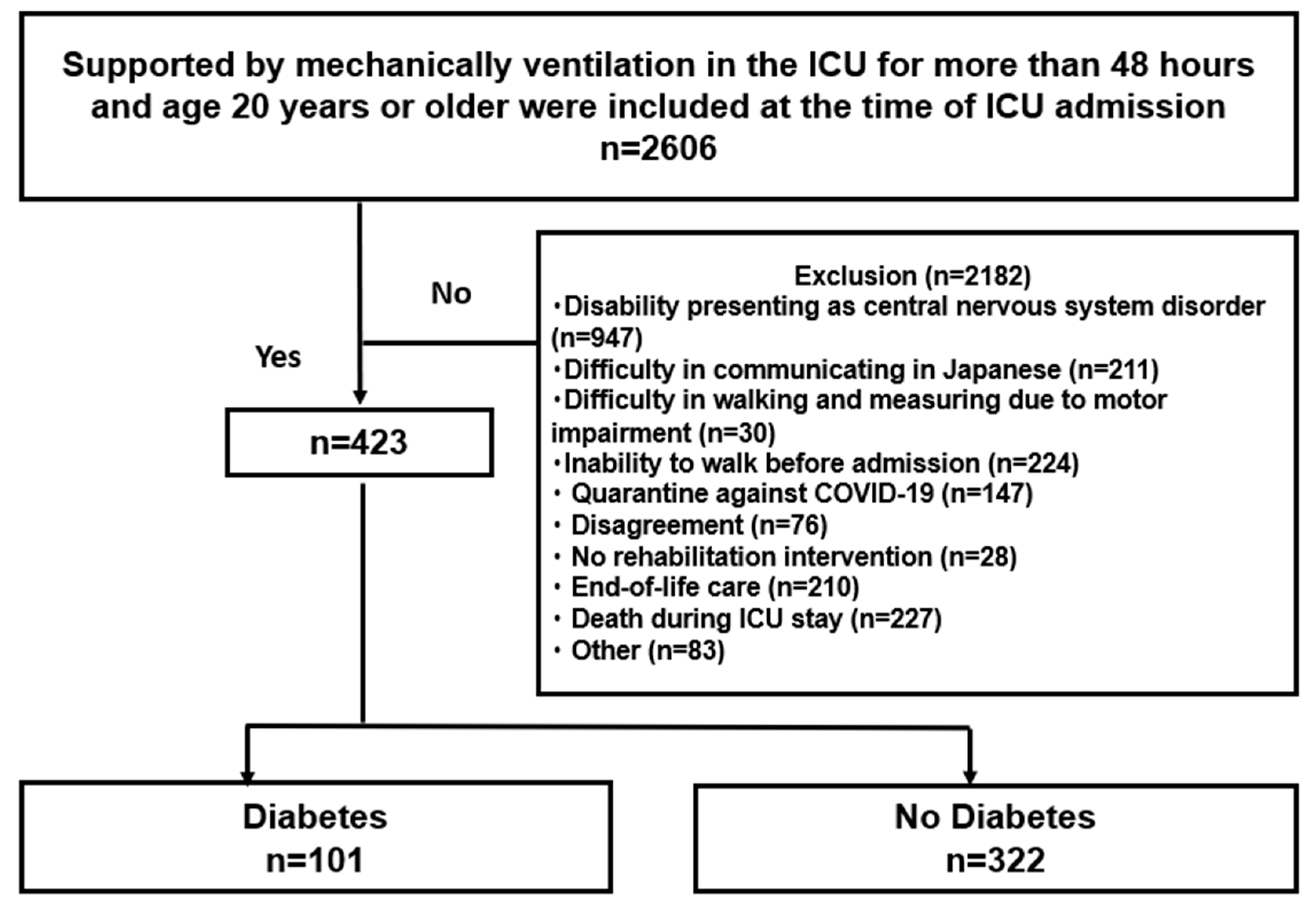
A total of 423 critically ill patients were analyzed, including 101 (24%) with preexisting diabetes mellitus (Figure 1).
There were no significant differences between the diabetes and non-diabetes groups in age (71 vs. 72 years) or sex distribution (63% vs. 64% male). However, patients with diabetes had higher BMI (26 vs. 24 kg/m2, p = 0.002), Charlson Comorbidity Index (2 vs. 1, p < 0.001), and APACHE II scores (24 vs. 20, p = 0.001), indicating greater illness severity. No significant differences were found in frailty status, ICU admission diagnosis, or use of dialysis or corticosteroids during ICU stay (Table 1).

3.2. Primary Outcomes

Time to achieve walking independence was significantly longer in the diabetic group than in the non-diabetic group (17.1 [11.7–29.9] vs. 13.7 [8.8–23.3] days, p = 0.013). The median Barthel index was 95 in both groups, but the diabetic group showed a wider distribution and lower values (IQR: 50–100 vs. 75–100, p = 0.020), suggesting a higher level of functional dependency (Table 2).

3.3. Secondary Outcomes

Patients with diabetes had a significantly longer ICU length of stay (8.6 [6.2–13.7] vs. 7.0 [4.9–11.2] days, p = 0.003) and hospital stay (39.8 [28.4–75.0] vs. 35.9 [23.7–54.9] days, p = 0.030). Handgrip strength at ICU discharge was significantly lower in the diabetes group (15.8 [8.5–22.5] vs. 17.8 [11.7–24.0] kg, p = 0.041). There was no significant difference in the duration of mechanical ventilation (p = 0.093) (Table 2).
Regarding rehabilitation-related variables, patients with diabetes had a significantly lower maximum IMS score during ICU stay (4.0 [3.0–6.0] vs. 6.0 [4.0–7.0], p = 0.002), and mobilization was initiated later (4.6 [2.2–6.7] vs. 3.6 [2.0–5.7] days, p = 0.046). However, there were no significant differences in mean daily rehabilitation time (p = 0.544) or frequency of sessions (p = 0.289).

3.4. Multivariable Analysis

The analysis revealed that diabetes was significantly associated with a longer time to achieve walking independence (β = 6.45 days; 95% confidence interval [CI]: 0.81 to 12.09; p = 0.003). Furthermore, patients with diabetes had a significantly lower Barthel Index score at hospital discharge (β = −9.40; 95% CI: −3.28 to 15.52; p = 0.010), indicating reduced functional independence.
In terms of ICU-related outcomes, preexisting diabetes was associated with a prolonged ICU length of stay (β = 2.16 days; 95% CI: 0.45 to 3.87; p = 0.014). Additionally, patients with diabetes exhibited significantly lower handgrip strength at ICU discharge (β = −2.29 kg; 95% CI: −0.56 to −4.02; p = 0.010), as well as a reduced highest IMS score during ICU stay (β = −0.65; 95% CI: −0.12 to −01.19; p = 0.017) (Table 3).
No significant associations were found between diabetes and the duration of mechanical ventilation, total hospital length of stay, average daily rehabilitation time, mean number of rehabilitation sessions per day, or time to first mobilization in the adjusted models.

4. Discussion

This study examined the impact of a history of diabetes on ADL at the time of discharge in critically ill patients admitted to the ICU based on multicenter prospective data. While diabetes is widely recognized as a risk factor for adverse outcomes in critically ill patients, most previous studies have focused primarily on mortality or ICU-centered endpoints; in contrast, the present study provides a rehabilitation-oriented perspective by evaluating activities of daily living independence and functional recovery at hospital discharge using prospective multicenter data. As a result, patients with diabetes had a significantly longer time to walk independently compared to non-diabetic patients, a lower Barthel Index at the time of discharge, and a significant deterioration in physical function indicators such as length of ICU stay, grip strength, and maximum IMS score. In multivariate analysis, these findings were consistent even after adjusting for age and severity of illness, suggesting that diabetes is an independent influencing factor on functional prognosis after the ICU. Taken together, our findings suggest that preexisting diabetes is independently associated with delayed functional recovery and reduced physical performance among critically ill patients, even after adjustment for illness severity and comorbidities. Several aspects of cohort selection warrant careful consideration. Patients with pre-existing central nervous system disorders or pre-admission walking disability were intentionally excluded to isolate newly acquired functional decline attributable to critical illness. While this approach improves internal validity, it results in a selected cohort and limits external generalizability. Importantly, excluded patients may represent those in whom diabetes exerts the most profound functional impact, such as individuals with prior stroke, amputation, or severe neuropathy. Therefore, the associations observed in this study may represent a conservative estimate of the true effect of diabetes on post-ICU functional recovery. In addition, patients with diabetes were more frequently admitted to the ICU from hospital wards rather than directly from the emergency department. This admission pathway may reflect delayed escalation of care or differences in early inpatient management, which could partially contribute to prolonged recovery. Although diabetes remained independently associated with impaired functional outcomes after adjustment for illness severity and comorbidity burden, residual confounding related to admission pathway and early hospital management cannot be fully excluded and should be considered when interpreting the results.
These results are thought to reflect multiple physiological abnormalities caused by diabetes. Diabetes causes peripheral neuropathy, muscle atrophy, microcirculatory disorders, insulin resistance, chronic inflammation, and other conditions, and the body’s response to acute treatment and mobilization interventions is reduced [6,17]. In addition, blood glucose fluctuations and hyperglycemic states are known to delay wound healing and infection control [6], which may lead to prolonged ICU stays and delayed rehabilitation. In a previous study, a secondary analysis of the TEAM trial by Serpa Neto et al. reported that high-dose early mobilization was associated with increased 180-day mortality in diabetic patients [10,18]. Although mortality was not included in the outcome in this study, it is thought that the poor tolerance of rehabilitation interventions and delayed recovery of muscle function in diabetic patients are actually manifested as a worsening functional prognosis. In particular, it is known that diabetic patients are at higher risk of developing ICU-acquired weakness [19], and the decline in grip strength and sluggish improvement in IMS scores observed in this study strongly suggest this influence. Important diabetes-related modifiers, including long-term glycemic control, diabetes-related complications, and insulin treatment intensity, were not available in the present cohort. These factors may substantially influence muscle metabolism, neuromuscular recovery, and tolerance to rehabilitation interventions. Consequently, the absence of these variables limits mechanistic interpretation and suggests that the observed association reflects the integrated clinical impact of diabetes rather than the effect of a single pathophysiological pathway.
The clinical significance of this study is the importance of risk stratification in the ICU stage. A history of diabetes should be recognized not simply as one of the comorbidities, but as a prognostic factor that affects functional outcomes, and more careful and individualized rehabilitation plans are required from the time of admission. Specifically, when introducing early mobilization, it is desirable to conduct stepwise interventions that avoid overload, taking into account hemodynamics, glycemic control, and neuropathy assessments [20]. Furthermore, the delay in first mobilization observed in diabetic patients may reflect a stricter trigger for starting rehabilitation or a more careful judgment by the rehabilitation provider. On the other hand, since there was no clear difference in the average rehabilitation intervention time or number of sessions, it is possible that the “start time” and “highest achieving level (IMS)” have a greater impact on ADL outcomes than the amount of intervention [21,22]. In the future, it may be possible to maximize functional independence after the ICU for diabetic patients by combining a multifaceted baseline assessment, including glycemic control status (HbA1c), the presence or absence of neuropathy, and physical activity level, with an individualized rehabilitation intervention strategy. Furthermore, future research is needed that focuses not only on the quantity of rehabilitation intervention but also on its quality, timing, and recovery limit [18]. From a clinical perspective, these findings suggest that preexisting diabetes should be recognized as a functional risk marker during post-ICU recovery rather than merely a background comorbidity. Patients with diabetes may benefit from earlier risk stratification, closer monitoring of mobilization milestones, and individualized rehabilitation planning that accounts for delayed functional recovery and reduced physiological reserve, instead of a uniform rehabilitation approach.
This study has several limitations. First, this was an observational study, and causal relationships cannot be determined. Second, detailed pathological information related to diabetes, such as disease classification (type 1 or type 2), duration of diabetes, and indices of glycemic control (e.g., HbA1c), was not available; therefore, differences in functional outcomes according to diabetes severity or long-term control could not be examined. Third, detailed nutritional information, including total caloric intake, macronutrient composition (particularly carbohydrate intake), and routes of nutritional support during hospitalization, was not systematically collected. Given that the post-ICU ward phase was substantially longer than the ICU stay, nutritional management during this period may have influenced anabolic recovery, muscle regeneration, and functional outcomes, especially in patients with diabetes who are often managed with restrictive dietary strategies for glycemic control. Fourth, ADL assessment using the Barthel Index is subject to a ceiling effect, and mild to moderate functional decline may not have been fully captured. Fifth, mortality was not analyzed in the present study because patients who died during ICU stay were excluded by design. Therefore, the relationship between diabetes, rehabilitation exposure, and survival outcomes could not be evaluated and should be addressed in future studies. Finally, variations in rehabilitation intervention protocols and staffing across participating institutions require cautious interpretation of the results. Furthermore, the exclusion of patients with pre-existing neurological disability or pre-admission walking impairment may limit generalizability and suggests that the observed associations could underestimate the true impact of diabetes on functional recovery.

5. Conclusions

This study demonstrated that a history of diabetes significantly negatively impacts ADL independence at the time of discharge in critically ill patients admitted to the ICU. Diabetic patients also tend to have unfavorable outcomes in terms of mobilization and muscle strength recovery during their stay in the ICU, and earlier and more careful intervention strategies are required. In the future, risk stratification based on diabetes pathology information and the establishment of individualized rehabilitation interventions will be necessary.

Author Contributions

Conceptualization, S.W.; methodology, S.W. and K.Y.; formal analysis, S.W.; investigation, S.W., K.Y., Y.N., A.S., Y.M., Y.I. and RELIFE Network; data curation, S.W. and Y.I.; writing—original draft preparation, S.W.; writing—review and editing, Y.M. and Y.I.; visualization, S.W.; supervision, Y.I.; project administration, S.W.; funding acquisition, S.W. All authors have read and agreed to the published version of the manuscript.

Funding

This research received no external funding.

Institutional Review Board Statement

The study was conducted in accordance with the Declaration of Helsinki, and approved by the Institutional Review Board of Fujita Health University (protocol code HM21-077, approved on 23 June 2021) and the ethics committees of all participating institutions.

Informed Consent Statement

Informed consent was obtained from all subjects involved in the study or their legal representatives.

Data Availability Statement

The data supporting the findings of this study are not publicly available due to ethical and privacy restrictions associated with the multicenter prospective cohort design. The data may be made available from the corresponding author upon reasonable request and with approval from the relevant institutional review boards.

Acknowledgments

The authors would like to thank all collaborating ICUs and rehabilitation teams in the RELIFE network for their contributions.

Conflicts of Interest

The authors declare no conflicts of interest.

Abbreviations

The following abbreviations are used in this manuscript:
ADLActivities of Daily Living
APACHE IIAcute Physiology and Chronic Health Evaluation II
BMIBody Mass Index
CCICharlson Comorbidity Index
CIConfidence Interval
HbA1cHemoglobin A1c
ICUIntensive Care Unit
IMSICU Mobility Scale
IQRInterquartile Range
HbA1cglycemic control status

References

  1. Herridge, M.S.; Cheung, A.M.; Tansey, C.M.; Matte-Martyn, A.; Diaz-Granados, N.; Al-Saidi, F.; Cooper, A.B.; Guest, C.B.; Mazer, C.D.; Mehta, S.; et al. One-Year Outcomes in Survivors of the Acute Respiratory Distress Syndrome. N. Engl. J. Med. 2003, 348, 683–693. [Google Scholar] [CrossRef]
  2. Needham, D.M.; Davidson, J.; Cohen, H.; Hopkins, R.O.; Weinert, C.; Wunsch, H.; Zawistowski, C.; Bemis-Dougherty, A.; Berney, S.C.; Bienvenu, O.J.; et al. Improving Long-Term Outcomes after Discharge from Intensive Care Unit: Report from a Stakeholders’ Conference. Crit. Care Med. 2012, 40, 502–509. [Google Scholar] [CrossRef]
  3. Inoue, S.; Hatakeyama, J.; Kondo, Y.; Hifumi, T.; Sakuramoto, H.; Kawasaki, T.; Taito, S.; Nakamura, K.; Unoki, T.; Kawai, Y.; et al. Post-Intensive Care Syndrome: Its Pathophysiology, Prevention, and Future Directions. Acute Med. Surg. 2019, 6, 233–246. [Google Scholar] [CrossRef]
  4. Bagshaw, S.M.; Stelfox, H.T.; McDermid, R.C.; Rolfson, D.B.; Tsuyuki, R.T.; Baig, N.; Artiuch, B.; Ibrahim, Q.; Stollery, D.E.; Rokosh, E.; et al. Association between Frailty and Short- and Long-Term Outcomes among Critically Ill Patients: A Multicentre Prospective Cohort Study. CMAJ 2014, 186, E95–E102. [Google Scholar] [CrossRef]
  5. Schweickert, W.D.; Pohlman, M.C.; Pohlman, A.S.; Nigos, C.; Pawlik, A.J.; Esbrook, C.L.; Spears, L.; Miller, M.; Franczyk, M.; Deprizio, D.; et al. Early Physical and Occupational Therapy in Mechanically Ventilated, Critically Ill Patients: A Randomised Controlled Trial. Lancet 2009, 373, 1874–1882. [Google Scholar] [CrossRef]
  6. van den Berghe, G.; Wouters, P.; Weekers, F.; Verwaest, C.; Bruyninckx, F.; Schetz, M.; Vlasselaers, D.; Ferdinande, P.; Lauwers, P.; Bouillon, R. Intensive Insulin Therapy in Critically Ill Patients. N. Engl. J. Med. 2001, 345, 1359–1367. [Google Scholar] [CrossRef]
  7. Ali, N.A.; O’Brien, J.M., Jr.; Dungan, K.; Phillips, G.; Marsh, C.B.; Lemeshow, S.; Connors, A.F., Jr.; Preiser, J.C. Glucose Variability and Mortality in Patients with Sepsis. Crit. Care Med. 2008, 36, 2316–2321. [Google Scholar] [CrossRef] [PubMed]
  8. Umpierrez, G.E.; Isaacs, S.D.; Bazargan, N.; You, X.; Thaler, L.M.; Kitabchi, A.E. Hyperglycemia: An Independent Marker of In-Hospital Mortality in Patients with Undiagnosed Diabetes. J. Clin. Endocrinol. Metab. 2002, 87, 978–982. [Google Scholar] [CrossRef] [PubMed]
  9. Zhou, Y.; Luo, Z.; Yu, M.; Zhan, C.; Xu, H.; Lin, R.; Bian, S.; Yang, Y.; Jiang, Z.; Tao, X.; et al. Acute Phase Blood Glucose Levels and Functional Outcomes in Patients with Spontaneous Intracerebral Hemorrhage. Neuropsychiatr. Dis. Treat. 2023, 19, 2697–2707. [Google Scholar] [CrossRef] [PubMed]
  10. Serpa Neto, A.; Bailey, M.; Seller, D.; Agli, A.; Bellomo, R.; Brickell, K.; Broadley, T.; Buhr, H.; Gabbe, B.J.; Gould, D.W.; et al. Impact of High-Dose Early Mobilization on Outcomes for Patients with Diabetes: A Secondary Analysis of the TEAM Trial. Am. J. Respir. Crit. Care Med. 2024, 210, 779–787. [Google Scholar] [CrossRef]
  11. Katsukawa, H.; Ota, K.; Liu, K.; Morita, Y.; Watanabe, S.; Sato, K.; Ishii, K.; Yasumura, D.; Takahashi, Y.; Tani, T.; et al. Risk Factors of Patient-Related Safety Events during Active Mobilization for Intubated Patients in Intensive Care Units—A Multi-Center Retrospective Observational Study. J. Clin. Med. 2021, 10, 2607. [Google Scholar] [CrossRef]
  12. Watanabe, S.; Kotani, T.; Taito, S.; Ota, K.; Ishii, K.; Ono, M.; Katsukawa, H.; Kozu, R.; Morita, Y.; Arakawa, R.; et al. Determinants of gait independence after mechanical ventilation in the intensive care unit: A Japanese multicenter retrospective exploratory cohort study. J. Intensive Care 2019, 7, 53. [Google Scholar] [CrossRef]
  13. Needham, D.M.; Sepulveda, K.A.; Dinglas, V.D.; Chessare, C.M.; Friedman, L.A.; Bingham, C.O.; Turnbull, A.E. Core outcome measures for clinical research in acute respiratory failure survivors: An international modified Delphi consensus study. Am. J. Respir. Crit. Care Med. 2017, 196, 1122–1130. [Google Scholar] [CrossRef]
  14. Hermans, G.; Clerckx, B.; Vanhullebusch, T.; Segers, J.; Vanpee, G.; Robbeets, C.; Casaer, M.P.; Wouters, P.; Gosselink, R.; van den Berghe, G. Interobserver agreement of Medical Research Council sum-score and handgrip strength in the intensive care unit. Muscle Nerve 2012, 45, 18–25. [Google Scholar] [CrossRef]
  15. Hodgson, C.; Needham, D.; Haines, K.; Bailey, M.; Ward, A.; Harrold, M.; Young, P.; Zanni, J.; Buhr, H.; Higgins, A.; et al. Feasibility and inter-rater reliability of the ICU Mobility Scale. Heart Lung 2013, 43, 19–24. [Google Scholar] [CrossRef]
  16. Watanabe, S.; Liu, K.; Morita, Y.; Kanaya, T.; Naito, Y.; Suzuki, S.; Hasegawa, Y. Effects of mobilization among critically ill patients in the intensive care unit: A single-center retrospective study. Prog. Rehabil. Med. 2022, 7, 20220013. [Google Scholar] [CrossRef] [PubMed]
  17. van Aerde, N.; Meersseman, P.; Debaveye, Y.; Wilmer, A.; Gunst, J.; Casaer, M.P.; Bruyninckx, F.; Wouters, P.J.; Gosselink, R.; Berghe, G.V.D.; et al. Five-year impact of ICU-acquired neuromuscular complications: A prospective observational study. Intensive Care Med. 2020, 46, 1184–1193. [Google Scholar] [CrossRef] [PubMed]
  18. TEAM Study Investigators and the ANZICS Clinical Trials Group; Hodgson, C.L.; Bailey, M.; Bellomo, R.; Brickell, K.; Broadley, T.; Buhr, H.; Gabbe, B.J.; Gould, D.W.; Harrold, M.; et al. Early active mobilization during mechanical ventilation in the ICU. N. Engl. J. Med. 2022, 387, 1747–1758. [Google Scholar] [CrossRef]
  19. Kress, J.P.; Hall, J.B. ICU-acquired weakness and recovery from critical illness. N. Engl. J. Med. 2014, 370, 1626–1635. [Google Scholar] [CrossRef] [PubMed]
  20. Zang, K.; Chen, B.; Wang, M.; Chen, D.; Hui, L.; Guo, S.; Ji, T.; Shang, F. The effect of early mobilization in critically ill patients: A meta-analysis. Nurs. Crit. Care 2020, 25, 360–367. [Google Scholar] [CrossRef]
  21. Paton, M.; Lane, R.; Paul, E.; Cuthbertson, G.A.; Hodgson, C.L. Mobilization during critical illness: A higher level of mobilization improves health status at 6 months. Crit. Care Med. 2021, 49, e860–e869. [Google Scholar] [CrossRef] [PubMed]
  22. Watanabe, S.; Liu, K.; Kozu, R.; Yasumura, D.; Yamauchi, K.; Katsukawa, H.; Suzuki, K.; Koike, T.; Morita, Y. Association between mobilization level and activity of daily living independence in critically ill patients. Ann. Rehabil. Med. 2023, 47, 519–527. [Google Scholar] [CrossRef] [PubMed]
Figure 1. Flow chart of our study. Of 2530 ICU admissions screened, 423 patients were included in the final analysis. ICU: Intensive Care Unit.
Diabetology 07 00027 g001
Table 1. Baseline characteristics at the time of intensive care unit admissions.
Baseline CharacteristicsTotal
n = 423
Diabetes
n = 101
No Diabetes
n = 322
p Value
Age (years)71 [59–77]71 [60–76]72 [59–78]0.848
Gender (male)271 (64)64 (63)207 (64)0.906
BMI (kg/m2)25 [21–28]26 [22–29]24 [21–27]0.002
CCI1 [0–2]2 [1–3]1 [0–2]<0.001
Admission source, n (%) 0.128
    Emergency department249 (58)54 (53)195 (61)
    Hospital ward87 (16)29 (29)58 (18)
    Expected ICU admission87 (16)18 (18)69 (21)
Clinical frailty scale3 [2–3]3 [2–3]3 [2–3]0.273
ICU admission diagnosis 0.242
    Acute respiratory failure 103 (24)27 (27)76 (24)
    Cardiovascular disease156 (37)32 (31)124 (39)
    Gastric or colonic surgery62 (15)15 (15)47 (15)
    Trauma17 (4)3 (3)14 (4)
    Sepsis, nonpulmonary29 (7)12 (12)17 (5)
    Other diagnoses56 (13)12 (12)44 (13)
APACHE II score21 [14–27]24 [17–29]20 [13–26]0.001
The use of continuous dialysis during ICU stay92 (23)28 (21)64 (20)0.095
The use of steroids during ICU stay65 (14)18 (19)47 (13)0.433
Data are presented as median [interquartile range] or number (%). Frail defined as Clinical Frailty Scale 5–9. Old defined as ≥age 65. Middle and young-age defined as <age 65. BMI = Body mass index; CCI = Charlson comorbidity index; ICU = Intensive Care Unit; APACHE = Acute Physiology and Chronic Health Evaluation.
Table 2. Comparison of clinical outcomes and rehabilitation parameters.
Baseline CharacteristicsDiabetes
n = 101
No Diabetes
n = 322
p Value
Primary outcome
Time to achieve walking independence17.1 [11.7–29.9]13.7 [8.8–23.3]0.013
Barthel Index at hospital discharge90 [50–100]95 [75–100]0.020
Secondary outcome
Duration of mechanical ventilation5.3 [3.1–8.8]4.5 [3.0–8.0]0.093
ICU length of stay8.6 [6.2–13.7]7.0 [4.9–11.2]0.003
Hospital length of stay39.8 [28.4–75.0]35.9 [23.7–54.9]0.030
Hand grip strength at ICU discharge15.8 [8.5–22.5]17.8 [11.7–24.0]0.041
Rehabilitation parameter
Mean rehabilitation time per day (minute)21.4 [13.8–28.7]23.6 [14.9–30.0]0.544
Highest IMS during ICU stay4.0 [3.0–6.0]6.0 [4.0–7.0]0.002
Mean rehabilitation session per day1.0 [0.8–1.3]1.0 [0.8–1.2]0.289
Time to first mobilization day4.6 [2.2–6.7]3.6 [2.0–5.7]0.046
Data are presented as median [interquartile range] or number (%). IMS = ICU mobility scale.
Table 3. Impact of diabetes on clinical outcomes and rehabilitation parameters after adjusting for confounding factors.
Variablesβ95% CIp Value
Time to achieve walking independence
    Adjusted Diabetes6.450.81–12.090.003
Barthel Index at hospital discharge
    Adjusted Diabetes−9.40−3.28–−15.520.010
Duration of mechanical ventilation
    Adjusted Diabetes1.93−0.52–4.370.088
ICU length of stay
    Adjusted Diabetes2.160.45–3.870.014
Hospital length of stay
    Adjusted Diabetes4.40−3.08–11.880.248
Hand grip strength at ICU discharge
    Adjusted Diabetes−2.29−0.56–−4.020.010
Mean rehabilitation time per day (minute)
    Adjusted Diabetes−0.79−3.90–−2.310.615
Highest IMS during ICU stay
    Adjusted Diabetes−0.65−0.12–−1.190.017
Mean rehabilitation session per day
    Adjusted Diabetes−0.42−1.23–0.390.306
Time to first mobilization day
    Adjusted Diabetes0.96−0.32–2.240.140
CI = Confidence Intervals; IMS = ICU mobility scale. APACHE II = Acute Physiology and Chronic Health Evaluation II. Adjusted value: Age, male, Acute respiratory failure, Sepsis, Clinical frailty scale APACHE II. Adjusted value: age, sex, BMI, CCI, ICU admission diagnosis, Clinical Frailty Scale, APACHE II score, use of renal replacement therapy, and administration of corticosteroids during ICU stay.
Disclaimer/Publisher’s Note: The statements, opinions and data contained in all publications are solely those of the individual author(s) and contributor(s) and not of MDPI and/or the editor(s). MDPI and/or the editor(s) disclaim responsibility for any injury to people or property resulting from any ideas, methods, instructions or products referred to in the content.