
Artificial Intelligence Algorithms for Insulin Management and Hypoglycemia Prevention in Hospitalized Patients—A Scoping Review
 and
and
Abstract
1. Introduction
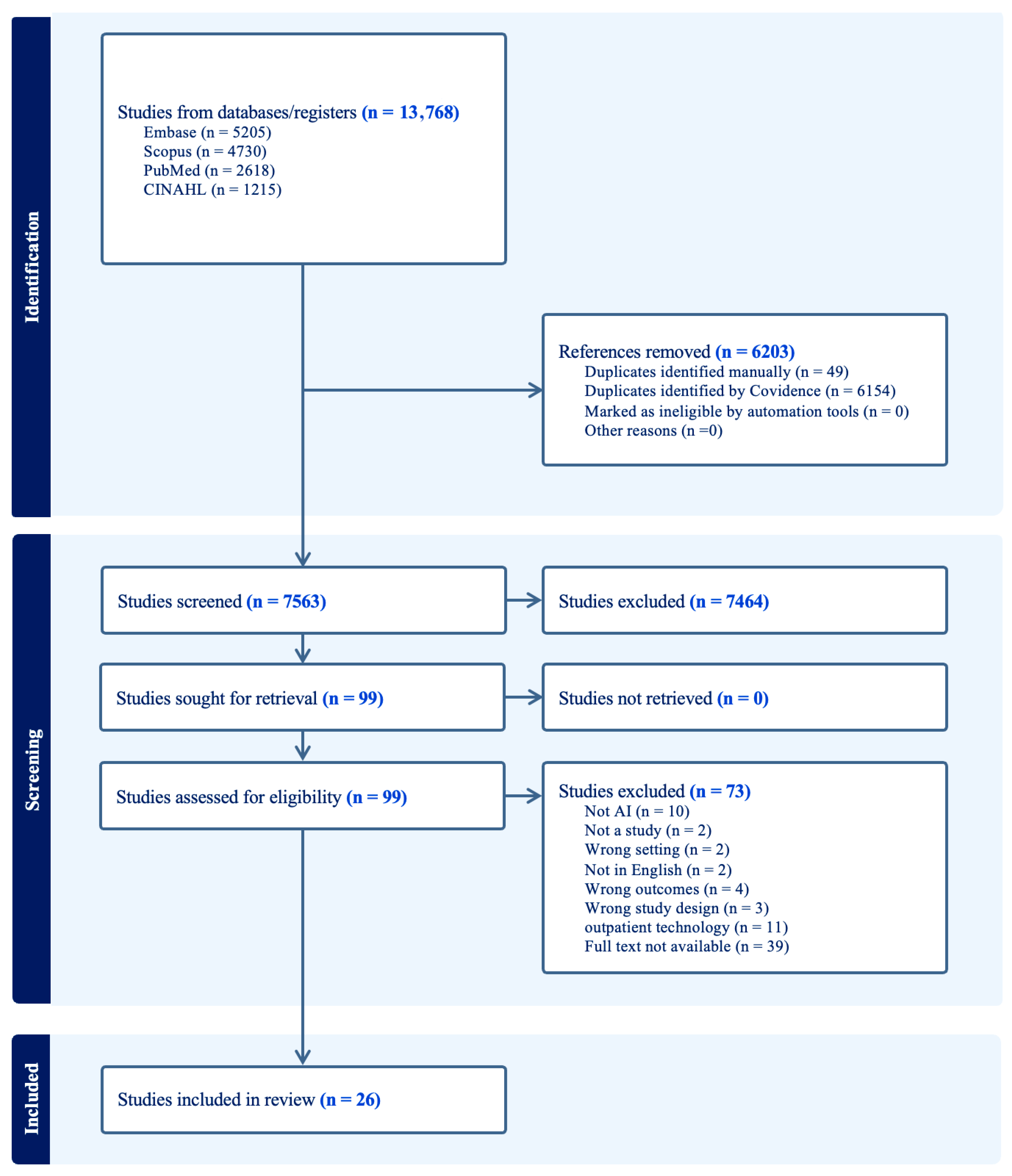
2. Methods
2.1. Search Strategy
2.2. Inclusion and Exclusion Criteria
2.3. Data Extraction
3. Results
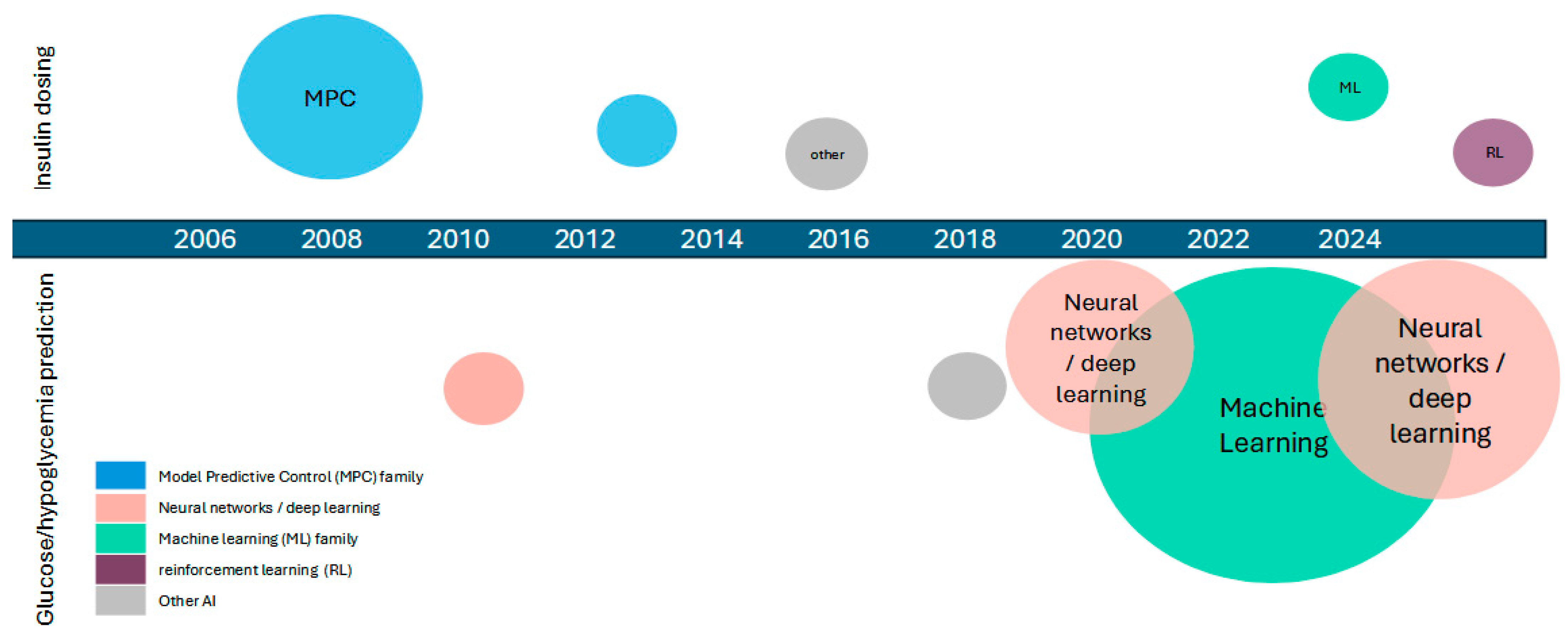
3.1. Study Characteristics
3.2. Study Populations and Inclusion Criteria

| Study ID | Country | Aim of Study | Study Design | Setting | Sample | Number Participants | Inclusion-Exclusion Criteria | AI Type | Input Data | Use Case | Glucose Outcomes | Model Performance Outcomes |
|---|---|---|---|---|---|---|---|---|---|---|---|---|
| Plank, 2006 [31] | Other: Austria, Czech Republic, United Kingdom | To evaluate a fully automated algorithm (MPC) for tight glycemic control in critically ill patients and compare results with routine glucose management protocols across three European ICUs | Multicenter RCT | ICU | Mean age 59 y: mixed medical–surgical population requiring IV insulin for BG < 7.8 mmol/L. | 60 (30 MPC, 30 routine protocol) | Adult patients (18–90 years) Undergoing elective cardiac surgery Post-surgery blood glucose ≥ 6.7 mmol/L at ICU admission With or without established diabetes diagnosis | MPC | Hourly arterial blood glucose Insulin dosage Carbohydrate intake | IV insulin infusion management | TIR 4.4–6.1 mmol/L = 52% vs. 19% (0–24 h, p < 0.01); 65% vs. 25% (24–48 h, p < 0.05); mean BG ≈ 6.5 vs. 7.3 mmol/L; no hypoglycemia events with MPC vs. 2 events in controls. | Automated MPC algorithm using hourly arterial BG inputs; adaptive insulin infusion achieved rapid, stable control across centers; no device failures; hourly sampling required for optimal performance. |
| Pachler, 2008 [32] | Austria | To compare glucose control in ICU patients using an enhanced model predictive control (eMPC) algorithm with time-variant sampling against a standard glucose management protocol. | RCT | ICU | Intervention group: History of DM 8 (32%); Male 16 (64%); age 61.2 ± 14.0; BMI 28.7 ± 6.6; APACHE II 26.6 ± 3.5. Control group: History of DM 11 (44%); Male 17 (68%); age 59.5 ± 16.1; BMI 27.6 ± 4.6; APACHE II 26.7 ± 5.5 | 50 ICU patients randomized: 40 (20 per group) included in final analysis | Mechanically ventilated and assumed to require ≥3 days of intensive care, glucose > 6.1 mmol/L or already on insulin therapy | eMPC | Glucose concentration, insulin dosage, carbohydrate content of enteral and parenteral input | IV insulin | Median BG 5.9 mmol/L (eMPC) vs. 7.4 mmol/L (control, p < 0.05); median hyperglycemia 0.4 mmol/L vs. 1.6 mmol/L (p < 0.05); one mild hypoglycemia episode (<2.22 mmol/L) resolved after glucose bolus. | Mean sampling interval 117 ± 34 min vs. 174 ± 27 min (p < 0.001); median insulin rate 3.0 IU/h (IQR 2.0–5.6) vs. 2.3 IU/h (IQR 1.7–4.0). eMPC achieved tighter control with modestly higher workload and insulin use. |
| Cordingley, 2009 [45] | England and Belgium | To investigate the effectiveness of an eMPC algorithm for IV insulin infusion in critically ill patients compared to standard care over 72 h across two ICUs with different management protocols. | RCT | ICU | 34 patients (20 Hospital 1, 14 Hospital 2); Intervention (eMPC): 16 patients (10 Hospital 1, 6 Hospital 2); Control (standard care): 18 patients (10 Hospital 1, 8 Hospital 2); Age (mean ± SD): Hospital 1 eMPC 59 ± 16 vs. control 57 ± 17; Hospital 2 eMPC 67 ± 9 vs. control 63 ± 7; Male (%): Hospital 1 eMPC 60% vs. control 90%; Hospital 2 eMPC 50% vs. control 63%; BMI (mean ± SD): Hospital 1 eMPC 25.4 ± 5.8 vs. control 28.7 ± 5.9; Hospital 2 eMPC 28.0 ± 3.9 vs. control 26.9 ± 3.7; Diabetes: 1 patient with DM2 (Hospital 2 control); APACHE II (median, range): Hospital 1 eMPC 17 (7–28) vs. control 14 (5–26); Hospital 2 eMPC 16 (11–28) vs. control 16 (10–26). | 34 | Inclusion: Arterial plasma glucose greater than 6.7 mmol/L or already receiving IV insulin, and expected to be receiving mechanical ventilation for ≥72 h from the study initiation Exclusion: Insulin allergy and chronic mental incapacity | eMPC | Weight, arterial plasma glucose concentration, insulin dosing history, carbohydrate intake | IV insulin | Mean time-weighted BG lower with eMPC at Hospital 2 (5.9 vs. 7.1 mmol/L, p < 0.001) and comparable at Hospital 1 (5.7 vs. 5.4 mmol/L). Time in range higher at Hospital 2 (57.7% vs. 23.5%, p < 0.01). No severe hypoglycemia; sampling interval shorter (1.1–1.8 h vs. 1.9–2.5 h). | |
| Amrein, 2010 [33] | Austria | To evaluate the performance of the enhanced eMPC algorithm for glycemic control across the full ICU stay in critically ill patients. | Non-randomized experimental study | Non-ICU cardiovascular, infectious, neurologic, gastrointestinal units | Age 69 ± 11; Male: 16 (80%); BMI 27.4 ± 4.5; APACHE II 25.5 ± 5.2; 6 | 20 | Inclusion: ≥5 days ICU treatment; glucose > 6.1 mmol/L or already on insulin therapy Exclusion: Insulin allergy, presence of ketoacidosis | eMPC | Glucose concentration, insulin dosage, carbohydrate content of enteral and parenteral nutrition | IV insulin infusion/Hypoglycemia prevention and reduction | Mean BG 5.8 ± 0.5 mmol/L; 58% time in target (4.4–6.1 mmol/L); 11% 3.3–4.4 mmol/L; 0.8% 2.2–3.3 mmol/L; 0.02% < 2.2 mmol/L. Three mild hypoglycemia events (0.02 per treatment day), all resolved. | Mean insulin 101 ± 50 IU/day; sampling interval 1.7 ± 0.3 h; 98% compliance with algorithm advice; 2% overridden; no technical failures; nurses reported good efficacy and manageable workload. 2% of time points eMPC was overruled by nurse (42 corrected downwards, 12 corrected upwards) |
| Pappada, 2010 [47] | United States | To demonstrate the use of a predictive model in real-time bedside monitoring to support intelligent insulin therapy recommendations and clinical automation. | Prospective proof-of-concept modeling and real-time validation study using CGM and EHR data from ICU trauma patients. | Trauma ICU | Demographics not provided | 6 | Neural Network | CGM and EHR | Prediction of glycemic states and management | Prospective proof-of-concept modeling and validation study using CGM data in ICU trauma patients; patient-specific neural network model achieved CEGA 95.1% region A vs. 69.8% for general model (MAD 7.9% vs. 15.9%). | ||
| Kopecký, 2013 [34] | Czech Republic | To assess a system combining CGM and an eMPC algorithm for IV insulin therapy in postsurgical patients. | RCT | ICU Postcardiac surgery patients | Intervention: History of DM2 (16.6%); age 68.1 ± 2.2; female 6 (50%); BMI 29.1 ± 0.8; Caucasian 100% Control: History of DM (33.3%); age 67.5 ± 3.3; female: 4(33%); BMI 27.8 ± 1.0; Caucasian 100% | 24 | Inclusion: Undergoing major elective cardiac surgery Exclusion: Insulin allergy and inability to consent | eMPC | Glucose concentration, insulin dosage, carbohydrate intake (CGM served as input for intervention group) | IV insulin | Mean BG 6.2 ± 0.1 vs. 6.1 ± 0.6 mmol/L (ns); % time in target 46.3 ± 5.5 vs. 46.2 ± 6.5; % below target 13.1 ± 2.6 vs. 15.4 ± 2.4; 0 vs. 2 hypoglycemia ≤ 2.9 mmol/L; time to target 7.6 ± 1.0 h vs. 8.8 ± 5.4 h (ns). | CGM accuracy 97.5% (A + B zones of CEGA); 11 of 12 sensors completed 24 h; ≤1 extra calibration in most cases; no technical failures. eMPC + CGM was feasible and safe for tight glucose control postcardiac surgery. |
| DeJournett, 2016 [44] | United States | Evaluate the performance of an artificial intelligence-based closed-loop glucose controller through in silico testing. | Non-randomized experimental study | In silico ICU environment | Patients simulated under varying conditions, representing critically ill adults with diverse insulin sensitivity and nutritional states. | 80 virtual ICU patient profiles | Simulated patients | Knowledge-based, closed-loop model | Initial inputs: Starting glucose concentration, patient weight, desired glucose range, concentrations of insulin and dextrose solutions Dynamic inputs during simulation: Current glucose level, glucose rate of change, current insulin infusion rate, current IV dextrose infusion rate | IV insulin | In silico AI controller achieved 94.2% time in control, 97.8% in 3.9–7.8 mmol/L, hyperglycemia 2.1%, hypoglycemia 0.09%, CV 11.1%. No severe hypoglycemia (<2.5 mg/dL). Vastly improved over “no control” simulation (TIR 98% vs. 20%). | Forward-chaining knowledge-based AI system using 5–10 min control cycles; 126,000 five-day simulations (~107 million glucose values); 95% of simulations reached target within 2 h; stable control across ranges. Demonstrated safety, high precision, and strong in silico performance vs. no control. |
| Benyó, 2018 [35] | New Zealand, Hungary, and Belgium | To analyze the insulin sensitivity and model accuracy of the STAR (Stochastic TARgeted Control) glycemic control protocol across various regions. | In silico, retrospective multicenter modeling study using ICU glycemic control data. | In silico ICU environment | Demographics not provided | 60 | Treated using the STAR protocol | Time-series classification | Blood glucose measurements, insulin administration records, nutrition records | Insulin sensitivity | Median and temporal trajectories of insulin sensitivity (SI) analyzed across three ICU cohorts (Hungary, Belgium, New Zealand). SI patterns differed significantly early in ICU stay, while model-noise (accuracy) parameters did not differ. No direct blood glucose or insulin dose outcomes were reported. | |
| Kim, 2020 [38] | South Korea | To develop a personalized deep learning model using recurrent neural networks to predict blood glucose levels 30 min in advance for hospitalized Type 2 diabetes patients. | Prospective cohort study | ICU | Sex: Female 13 (65%) 30–39 years: 3 40–49 years: 6 50–59 years: 4 60–69 years: 7 | 20 | Age ≥ 20 and <70 years, ICU admission with DM; Dexcom G5 CGM for at least 3–7 days during hospitalization | Recurrent Neural Network, specifically tested Simple RNN, Gated Recurrent Unit, and Long Short-Term Memory, Time-series prediction | Dexcom G5 CGM sensor readings | Glucose prediction | 30 min ahead prediction RMSE = 21.5 mg/dL, MAPE = 11.1%; 87.9% A + 11.1% B zones on CEGA; 99% predictions clinically acceptable. | GRU > LSTM > RNN; best model = 1 GRU + 2 dense layers (batch 50 + shuffle); ≥50% training data required for personalization; performance stable across subjects. |
| Pappada, 2020 [46] | UK | To develop a neural-network-based glucose model for predicting future patient glucose levels up to 135 min ahead in ICU settings | Prospective cohort study | ICU | DM1: 8 (6.3%), DM2: 97 (76.4%), No history of DM: 22 (17.3%); Sex: Female 46 (36%) Women: age 62.1 ± 11.0; BMI 35.3±10.0 Men: age 61.5 ± 10.3; BMI 32.5 ±8.1. | 127 | Admitted to ICU with diagnosis of DM or BG > 8.3 mmol/L | Feed-forward ANN with two hidden layers (15 and 10 nodes) trained on CGM data to predict glucose up to 135 min ahead (5 min intervals). Model weights optimized using Levenberg–Marquardt backpropagation. | CGMS iPro2 (Medtronic) recordings from the first 72 h of ICU admission used as ground truth. Forty-one input features included vital signs (heart rate, respiration rate), laboratory results (lactate, creatinine, WBC count), nutrition status (NPO or tube-feeding rate), insulin delivery data (IV and subcutaneous), inotrope use, and POC glucose values, along with current and historical CGM readings (1 h history; 12 prior CGM values). | Glucose prediction | Successfully predicted CGM hypoglycemia (<4.0 mmol/L) at 53.6%, 34.4%, and 0.0% for 30, 60, and 135 min prediction horizons (PHs); no POC hypoglycemia events observed. Successfully predicted CGM hyperglycemia (>10.0 mmol/L) at 94.4%, 90.7%, and 86.2% for 30, 60, and 135 min PHs; POC hyperglycemia predicted at 74.7%, 66.7%, and 59.8%, respectively. CEGA for predicted CGM glucose values 99.6% zones A + B at 135 min: CEGA for POC glucose 99.4% zones A + B at 135 min. | Feed-forward ANN with two hidden layers (15 and 10 nodes) predicted glucose up to 135 min ahead. Validation set (n = 15 patients): Pearson correlation 0.96–0.97 between predicted and reference glucose values. Mean absolute deviation (MAD%) for predicted vs. CGM: 1.0% (5 min) to 10.6% (135 min); predicted vs. POC: 10.2% (5 min) to 15.9% (135 min). Average error between POC and CGM: 10.0%. ANN accuracy declined with longer prediction horizon; strong performance for short-term forecasting. |
| Ruan, 2020 [36] | UK | To analyze data from inpatients with diabetes admitted to a large university hospital to predict the risk of hypoglycemia through the use of machine learning algorithms. | Retrospective cross-sectional study | inpatients (hospital-wide, non-ICU-specific) | mean age 66 ± 18 y, 47% female, 91% type 2 diabetes: median LOS 7 days (IQR 3–13) | 17,658 (32,758 admissions) | All adult inpatients with a diagnosis of diabetes admitted to Oxford University Hospitals NHS Foundation Trust between January 2014 and December 2018 | Supervised machine learning using XGBoost (selected from 18 ML algorithms evaluated for EHR-based hypoglycemia prediction). | 42 structured EHR variables including demographics (age, sex, ethnicity), vitals, labs (BG, creatinine, potassium, HbA1c), medications (insulin, oral agents, corticosteroids), admission characteristics, and prior hypoglycemia history. Temporal glucose trends and variability metrics over the prior 24 h included. | Hypoglycemia risk prediction | Incidence of biochemical hypoglycemia (<4 mmol/L) = 21.5%; clinically significant (<3 mmol/L) = 9.6%. | XGBoost AUROC = 0.96 (for both <4 and <3 mmol/L); precision = 0.88; recall = 0.70. Logistic regression AUROC = 0.75. Model improved further when insulin dose and prior hypoglycemia were added. |
| Fitzgerald, 2021 [25] | United States | To present a data-driven method for predicting ICU patient response to glycemic control protocols while considering variations in patient care. | Retrospective cohort study | ICU | MIMIC-III database (18,691 admissions; medical, surgical, and cardiac ICUs). Adult patients (≥18 y) with ≥3 BG measurements included. Typical cohort demographics: mean age ≈ 63 y, 56% male, mean BMI ≈ 28 kg/m2. Retrospective EHR data used to train and validate a 2 h-ahead BG prediction model. | 18,961 | Admissions with available blood glucose measurements, EHR data recorded via MetaVision | Gradient-boosted tree machine learning algorithm | EHR | Blood glucose prediction | No direct clinical glucose outcomes: study focused on model-based forecasting of 2 h-ahead BG using ICU EHR data. | CatBoost gradient boosting model achieved MAPE 16.5–16.8%, RMSE ≈ 2.8 mg/dL, 95% interval coverage 93–94%, and CEGA 97% in zones A and B. Accuracy highest for BG 5.5–11.1 mmol/L; lower for hypo/hyperglycemia ranges. Performance consistent across surgical, cardiac, and medical ICU subgroups. |
| Mathioudakis, 2021 [26] | United States | To develop a machine learning model to predict the risk of iatrogenic hypoglycemia within 24 h of each blood glucose measurement during hospitalization. | retrospective cohort study | Non-ICU | Age: 66.0 (56.0–75.0); Male: 27,781; BMI 29.0 (24.6–34.6); Race: White: 30,429 (55.3); Black: 17,806 (32.4). Asian: 2595 (4.7); Other: 4148 (7.5); Weight (kg) 83.0 (68.9–100.2); DM1: 1321 (2.4), DM2: 21,660 (39.4), None: 31,203 (56.8), Other: 794 (1.4) | 35,000 | Inclusion: ≥4 POC BG measurements during hospitalization, received at least 1 subcutaneous insulin during hospitalization Exclusion: LOS < 24 h; missing weight information, and treatment with IV insulin or insulin pumps, POC BG obtained while in ICU; | Stochastic Gradient Boosting (SGB) | 43 clinical predictors of iatrogenic hypoglycemia (unspecified) | Hypoglycemia prediction | Predicted iatrogenic hypoglycemia ≤ 4.0 mmol/L within 24 h after each BG test (3.1% event rate); C = 0.90 internal, 0.86–0.88 external; sensitivity/specificity ≈ 82%; PPV 0.09–0.13; NPV 0.99–1.00; +LR 3.1–4.7; −LR 0.22–0.25. | SGB algorithm using 43 static and time-varying EHR features (basal insulin, BG variability, prior hypoglycemia top predictors); trained on 70% of data, validated internally and externally across five hospitals; false-positive rate 18–27%, false-negative rate 18%; robust discrimination for short-term hypoglycemia risk prediction. |
| Nguyen, 2021 [27] | United States | To determine whether a machine learning model can predict initial inpatient total daily insulin dose more accurately than existing weight-based guideline dosing. | Retrospective cohort study | ICU and non-ICU | Sex: Female 7497 (44.5%). Weight (kg): 84.1 (24.0) | 16,848 | Inclusion: Achieved “good” glucose control (≥3 BG measurements within 5.5–10.0 mmol/L on a calendar day without any out-of-range measurements), received SubQ insulin, weight recorded Exclusion: On TPN, PPN, tube feeds, insulin pumps, insulin infusions, or rarely used insulin formulations | Machine learning; Ensemble SuperLearner algorithm (regularized regression, random forest, gradient-boosted trees), Two-stage prediction framework | EHR data including demographics, labs, medications, diagnoses, diet orders, blood glucose measurements, history of basal insulin use | Initial subcutaneous total daily insulin dose prediction; Two-stage: classify low (≤6 units) vs. higher (>6 units) insulin need, and predict specific TDD for higher insulin users | Average time to achieve target glycemic range (5.5–10.0 mmol/L) = 2.2 ± 4.4 days from admission; no direct hypoglycemia data reported. | Two-stage SuperLearner (ensemble regression, random forest, gradient-boosted trees). Stage I AUROC 0.85 vs. 0.57 (weight-only); Stage II MAPE 51% vs. 60% (weight-only) vs. 136–329% (clinical calculator). MAE 12.2 vs. 14 vs. 25.4. Top predictors: weight, prior glucose metrics, diet, creatinine, basal insulin use. Demonstrated robust discrimination and improved accuracy for insulin dosing prediction. |
| Mantena, 2022 [49] | United States | To develop and validate complex machine learning models predicting hypoglycemia risk using a large, multicenter ICU database. | Retrospective cohort study | ICU | Intervention: Age 62.9 (16.9); Female: 8134 (49.5); African American: 2810 (17.1), Asian: 222 (1.3), Caucasian: 11,511 (70.0), Hispanic: 697 (4.2), Native American: 144 (0.9), Other/unknown: 904 (5.5) Control: Age 63.9 (16.7); Female: 29,440 (44.6); African American: 7690 (11.6), Caucasian: 50,747 (76.9), Hispanic: 2751 (4.2), Other/Unknown: 3016 (4.6) | 82,479 | Inclusion: ≥2 POC BG readings during their ICU stay (eICU-CRD) | XGBoost | eICU database with information on patient demographics, diagnoses, labs, vitals, medications administered in ICU | Hypoglycemia prediction | 19.9% hypoglycemia (<72 mg/dL) across cohort; 38.7% of hypoglycemic patients were non-diabetic; descriptive only, no statistical testing. | XGBoost model AUROC = 0.85; sensitivity = 0.76; specificity = 0.76; precision = 0.44; strong calibration; top predictors included prior hypoglycemia, albumin, creatinine, BG variability, kidney disease, and glucose-lowering therapy; retrospective validation only. |
| Witte, 2022 [37] | Other: Switzerland | To generate a broadly applicable multiclass classification model for predicting hypoglycemia from patients’ EHR to indicate where adjustments in patient monitoring and therapeutic interventions are required | Retrospective multicenter cohort | Hospitalized, 30% ICU | 38,250 adult inpatients (44% women; mean age ≈ 64 years) across six hospitals within the Insel Gruppe network, contributing 63,579 admissions. Approximately 30% were ICU admissions classified as decompensated cases. Median BMI ≈ 27 kg/m2; median hospital stay ≈ 7 days. | 38,250 | Adults ≥ 18 years with ≥1 lab BG during hospitalization. Eligible if they met ≥1 of the following: DM diagnosis, treatment with any antidiabetic medication, or abnormal glucose levels on lab testing (<4.0 or ≥11.1 mmol/L). | XGBoost | EHR records Patient demographics Medication history Previous glucose events | Predict hypoglycemia | No direct glucose or hypoglycemia rates; retrospective EHR-based prediction of dysglycemia events (median prediction horizon = 7 h for hypo, 4 h for hyper). | Multiclass XGBoost ensemble achieved sensitivity 59% (hypo), 63.6% (hyper), specificity ≈ 94–99%, balanced accuracy ≈ 80%; prediction horizon 4–7 h; demonstrated feasibility of early dysglycemia prediction using routine EHR data. |
| Fitzgerald, 2023 [28] | United States | To develop and validate a real-time, EHR-based hypoglycemia prediction model integrated with the insulin-ordering process for general inpatients (non-ICU). | Retrospective multicenter cohort | Hospitalized (non-ICU) | Mean age 63 y; 48% female; Race: ≈55% White, 35% Black, remainder other/unknown; Median length of stay: 5 days (IQR 3–9); DM2 ~85%; | 45,000 patients (≈60,000 admissions) | Adults ≥ 18 y with ≥1 insulin order and BG measurement; excluded pregnancy, ICU, short stays < 24 h, or incomplete EHR data | Supervised ML ensemble (XGBoost + logistic regression) for real-time hypoglycemia risk prediction | 15 EHR variables: age, sex, race, 24 h mean and nadir BG, BG variability (CV), basal/bolus insulin use and dose, creatinine, eGFR, nutrition status (NPO vs. feeding), hospital day, prior hypoglycemia, and steroid/glucose-altering medication use | Hypoglycemia prediction | Predicted hypoglycemia (<4.0 mmol/L) within 24 h of insulin order; 7% event rate. | AUROC 0.88; sensitivity 0.80; specificity 0.84; PPV 0.11; NPV 0.99; calibration Brier score 0.03; externally validated across 4 hospitals |
| Alkhafaf, 2024 [42] | New Zealand, Hungary, and Belgium | To evaluate a new ANN-based insulin sensitivity (SI) prediction method using in silico simulation | In Silico Validation/Modeling | In silico ICU environment | Demographics not provided | 2551 virtual ICU patients derived from the MIMIC-IV dataset | Treated using the STAR protocol | Neural-Network-based Quantile Regression | Blood glucose levels, insulin administration records, and nutrition intake | Insulin sensitivity prediction | In silico simulation over the first 24 h after insulin initiation comparing STAR vs. SPRINT protocols using 2551 virtual ICU patients derived from MIMIC-IV data. STAR achieved lower median BG (5.73 [IQR 5.14–6.43] mmol/L) than SPRINT (6.29 [IQR 5.29–6.83]); mild hypoglycemia (<4.0 mmol/L) more frequent with STAR (85% vs. 49%), while severe (<2.22 mmol/L) rare (2% vs. 0%). No formal significance testing reported. | |
| Gong, 2024 [39] | China | To develop and test multiple machine learning algorithms for predicting nocturnal hypoglycemia in Type 2 diabetes patients. | Retrospective cohort study | Endocrinology and metabolism unit | Intervention: age < 40 years: 67 (11.7), 40–65 years: 239 (41.7), ≥65 years: 257 (46.6); Female: 276 (48.2); Duration of Diabetes <5 years: 359 (62.7) 5–10 years: 39 (6.8) ≥10 years: 175 (30.5). Control: age < 40 years: 385 (11.2), 40–65 years: 1452 (42.2), ≥65 years: 1605 (46.6); Not provided.; Female: 1412 (41.0); Duration of Diabetes <5 years: 1223 (35.5) 5–10 years: 1171 (34.0) ≥10 years: 1048 (30.5) | 440 | Inclusion: Diagnosis of DM2, aged ≥ 18 years, consented to undergo CGM for ≥24 h. Exclusion: Admission for hypoglycemicia, DKA or HHS, infectious diseases, acute coronary syndromes, malignant tumors, anemia or renal failure, deletion of medical records and data duplication | Logistic regression, random forest, light gradient boosting machine | Age, sex, duration of diabetes, use of oral antidiabetic drugs, insulin, creatinine, uric acid, glycated albumin, aspartate aminotransferase, alanine aminotransferase | Hypoglycemia prediction | 14.3% nocturnal hypoglycemia (≤3.9 mmol/L, 00:00–06:00 h); lower mean BG, higher LBGI, and TBR vs. non-hypoglycemia group; descriptive group comparisons only. | LightGBM best performer (AUC = 0.869, specificity = 0.802, recall = 0.797, F1 = 0.255); top predictors: prior TBR, LBGI, M value, duration of diabetes, insulin use before bed; well-calibrated model, no external validation. |
| Szabó, 2024 [50] | New Zealand, Hungary, and Belgium | To propose three AI-based insulin sensitivity prediction methods to enhance prediction accuracy and optimize model parameters for clinical requirements. | Multicenter retrospective modeling and in silico simulation validation study using ICU glycemic control data | ICU | Demographics not provided | 2357 virtual ICU patients derived from real STAR protocol data | ≥12 h in the ICU treated by the STAR protocol | Deep neural network, Mixture Density Network. Quantile Regression | Insulin and nutrition inputs | Insulin sensitivity prediction | In silico multicenter modeling study comparing three AI approaches (CDN, MDN, QR) using STAR ICU data. MDN achieved the best insulin sensitivity prediction accuracy (I-Score ≈ 0.92–1.05). Simulated mean glucose: 6.02–6.11 mmol/L vs. 6.18 mmol/L (STAR); % in target 4.4–6.1 mmol/L: 90.7% vs. 87.1%. No significant hypoglycemia reported. | model accuracy for predicting 90% quantile interval of future insulin sensitivity (SI). MDN achieved lowest RMSE (≈0.067), outperforming QR (≈0.071) and CDN (≈0.076). No direct glucose or clinical outcomes reported. |
| Wright, 2024 [29] | United States | To develop and validate machine learning models that predict inpatient hypoglycemia (<4.0 mmol/L within 24 h) at the time an insulin order is placed, integrating results into clinical decision support. | Retrospective cohort study | Non-ICU | Age (mean): 57; Female: 9006 (43%) | 21,052 orders | Inclusion: Age ≥ 18 years, Hospitalization> 24 h with SubQ insulin orders Exclusion: ICU, palliative care units, orders with missing data (blood glucose) | Logistic regression, random forest, extreme gradient boosting (XGBoost) | EHR data including patient characteristics, vitals, diagnoses, labs, medication orders and administrations, diet orders | Hypoglycemia prediction and prevention within 24 h of a new insulin order placed | 9% of insulin orders followed by hypoglycemia (< 4.0 mmol/L) within 24 h; descriptive only, no inferential analyses. | Trained on 21,052 insulin orders; logistic regression, random forest, and XGBoost achieved AUCs 0.81, 0.80, and 0.79; sensitivity 0.44–0.49 at PPV 0.30. Key predictors: recent BG trends and insulin dose. Internally validated; no external or prospective validation performed. |
| Kim, 2024 [48] | South Korea | To develop and test an attention-based model predicting adverse glycemic events 30 min in advance using past glycemic data. | Prospective cohort study | ICU | Sex overall: Female 40 (39%). With hypoglycemia: Age 52.8 ± 12.6; BMI 24.3 ± 5.1. Without hypoglycemia: Age 55.7 ± 14.2; BMI 26.8 ± 4.7 | 102 | Hospital admission with DM2 diagnosis and aged between 20 and 90 years (inclusive of those in ICU) | Deep learning based predictive model using multi-agent reinforcement learning (MARL) for feature selection | CGM, EHR data including insulin administration times, meal intake times | Prediction of adverse glycemic events | Predicted inpatient hypoglycemia (BG < 4.0 mmol/L) within 24 h following insulin orders in adult non-ICU patients. Observed hypoglycemia rate = 9% (1839/21,052 insulin orders). No direct clinical outcomes (e.g., mean glucose or TIR) reported beyond this event rate; data are descriptive only. | Compared logistic regression, random forest, and XGBoost models trained on 21,052 insulin orders from adult non-ICU patients at Vanderbilt University Medical Center (2019). Model discrimination: AUROC = 0.81 (logistic regression), 0.80 (random forest), 0.79 (XGBoost); PPV ≈ 0.30; sensitivity = 0.44–0.49 across models. Most predictive features: last BG value, lowest and average BG in prior 24 h, coefficient of variation in BG, and insulin dose. Models internally validated using 10-fold cross-validation; no external or prospective validation reported. |
| Mehdizavareh, 2025 [43] | United States | To develop and validate a multi-source irregular time-series transformer model using real-time EHR data to predict blood glucose levels in ICU patients and enable early intervention. | Retrospective cohort study | ICU | Demographics not provided | 86,508 | Inclusion: ≥6 BG measurements during ICU stay, subsequent readings within 5 min–10 h | Multi-source Irregular Time-Series Transformer | Labs, medications, vital signs, diagnoses (ICD-9/ICD-10 codes), patient demographics, admission information, intake/output records, past medical history, treatment records, infusion data, Glasgow Coma Scale scores, sedation scores | BG prediction (hypoglycemia < 4.0 mmol/L, hyperglycemia > 10.0 mmol/L, euglycemia); Clinical decision support for early intervention | No direct glucose or hypoglycemia event rates reported; outcomes limited to model-based predictions. | Multi-source Irregular Time-Series Transformer (MITST) outperformed Random Forest for predicting ICU hypoglycemia and hyperglycemia. AUROC: 0.915 vs. 0.862 (hypo, +5.3 pp, p < 0.001); 0.909 vs. 0.903 (hyper, +0.6 pp, p < 0.001); macro-average 0.900 vs. 0.883 (+1.7 pp). Sensitivity: 0.841 vs. 0.769 (hypo, +7.2 pp); 0.833 vs. 0.818 (hyper, +1.5 pp). AUPRC 0.247 vs. 0.208; specificity 0.845 vs. 0.829; NPV 0.996 vs. 0.995. Demonstrated improved discrimination and calibration for next-glucose-level classification in ICU patients. |
| Park, 2025 [40] | Korea | To bridge the gap between individual biomarker predictors and holistic interaction-based approaches by training the CDLD model to predict ICU patient blood glucose levels. | Retrospective cohort study | ICU | Age (mean) 63.2; Female: 2304 (46%) | MIMIC-IV dataset; 5014 patients hospitalized from de-identified dataset; The dataset used in the study/model includes 5001 glucose level measurements from 2551 patients. | At least one abnormal blood glucose reading during hospital stay | Cyclic Dual Latent Discovery (CDLD), a deep learning framework that explicitly models patient–provider interactions to improve prediction of blood glucose levels. | Although the authors describe the full MIMIC-IV dataset, only selected variables (sex, age, peak glucose, and provider ID) were used as model inputs; other EHR modules were not utilized but referenced for data context. | Glucose prediction | No direct glucose or hypoglycemia results; predictions derived from retrospective ICU data only. | CDLD model RMSE = 0.0336 (training), 0.0852 (validation), 0.0898 (test); training loss 0.0037, validation loss 0.0066; demonstrated high predictive accuracy and generalization for discharge glucose prediction using patient–provider interaction modeling. |
| Symeonidis, 2025 [41] | United States | To develop and validate a DQN (DQN) algorithm for predicting optimal insulin doses and glucose levels in ICU patients to improve glucose control and reduce hypoglycemia risk. | Retrospective cohort study | ICU | Age (mean): 65.5; Female 41.4% | 2493 | Initial ICU admission, diabetes diagnosis or receiving insulin therapy, at least one type of insulin administered, following SSI protocol exclusively, short/rapid acting insulin only, minimum 10 glucose/insulin entries per patient for model training | Reinforcement learning (primary), Deep learning (DQN with neural network) | EHR, labs, vitals, demographics, glucose values, insulin doses | IV insulin, glucose control (hyperglycemia prevention) | DQN achieved MAE = 12.16 mg/dL, RMSE = 15.42 mg/dL, Time in Range = 90.79% (4.4–6.1 mmol/L) vs. 87.14% with linear regression; p < 0.05; no increase in hypoglycemia reported. | Insulin-dose MAE = 1.99 units, RMSE = 2.27 units; improved 2.5% MAE and 6.6% RMSE vs. linear regression; requires DQN with neural network, experience replay, and k-NN selection. |
| Ying, 2025 [22] | China | To evaluate whether an AI-based insulin clinical decision support system (NCDSS) for hospitalized Type 2 diabetes patients achieves noninferior glycemic control compared to standard insulin therapy by physicians. | RCT | Endocrinology and metabolism unit | Intervention: Age (mean) 63.5; Female: 30 (40%) Control: Age (mean) 65; Female: 35 (47%) | 149 randomized (75 intervention, 74 control) | Inclusion: ≥18 years old, DM2 with A1C 7.0–11.0%, on diet/oral antidiabetic/insulin therapy in last 3 months Exclusion: Acute complications of diabetes, BMI ≥ 45, pregnancy or breastfeeding, severe cardiac, hepatic, or kidney diseases, psychiatric or psychological diseases, severe edema, infections, or peripheral circulation disorders, surgery during hospitalization | Machine learning–driven insulin clinical decision support system (iNCDSS) | Capillary blood glucose measurements, patient clinical characteristics, HER | Basal insulin, Basal-bolus insulin and pre-mixed insulin | TIR 4.0–10.0 mmol/L = 76.4% vs. 73.6% (p = 0.33, noninferior); mean glucose ≈ 140 vs. 144 mg/dL; no severe hypoglycemia (<40 mg/dL) or ketoacidosis; time < 54 mg/dL = 0%; insulin dose 27 U vs. 30 U (p = 0.01, ns after adjustment). | AI-based iNCDSS provided real-time insulin titration across multiple regimens; 98.9% of AI recommendations accepted; physicians rated clarity 4.6/5, safety 4.4/5; system integrated seamlessly and achieved noninferior glycemic outcomes to expert endocrinologists. |
3.3. Models
3.4. Data Inputs and Sources
3.5. Glucose Outcomes
3.6. Implementation and Feasibility Outcomes
Methodological Quality
4. Discussion
5. Conclusions
Supplementary Materials
Author Contributions
Funding
Institutional Review Board Statement
Informed Consent Statement
Data Availability Statement
Conflicts of Interest
References
- Pasquel, F.J.; Lansang, M.C.; Dhatariya, K.; Umpierrez, G.E. Management of diabetes and hyperglycaemia in the hospital. Lancet Diabetes Endocrinol. 2021, 9, 174–188. [Google Scholar] [CrossRef]
- Dhatariya, K.; Umpierrez, G.E. Management of Diabetes and Hyperglycemia in Hospitalized Patients. In Endotext; Feingold, K.R., Adler, R.A., Ahmed, S.F., Anawalt, B., Blackman, M.R., Boyce, A., Braverman, L.E., Buse, J.B., Christakis, I., Correa, R., et al., Eds.; MDText.com, Inc.: South Dartmouth, MA, USA, 2000. Available online: https://www.ncbi.nlm.nih.gov/books/NBK279093/ (accessed on 20 October 2024).
- Van den Berghe, G.; Wouters, P.; Weekers, F.; Verwaest, C.; Bruyninckx, F.; Schetz, M.; Vlasselaers, D.; Ferdinande, P.; Lauwers, P.; Bouillon, R. Intensive insulin therapy in critically ill patients. N. Engl. J. Med. 2001, 345, 1359–1367. [Google Scholar] [CrossRef]
- American Diabetes Association. 15. Diabetes Care in the Hospital: Standards of Medical Care in Diabetes-2021. Diabetes Care 2021, 44, S211–S220. [Google Scholar] [CrossRef]
- Clement, S.; Braithwaite, S.S.; Magee, M.F.; Ahmann, A.; Smith, E.P.; Schafer, R.G.; Hirsch, I.B.; on behalf of the Diabetes in Hospitals Writing Committee. Management of diabetes and hyperglycemia in hospitals. Diabetes Care 2004, 27, 553–591. [Google Scholar] [CrossRef]
- Moghissi, E.S.; Korytkowski, M.T.; DiNardo, M.; Einhorn, D.; Hellman, R.; Hirsch, I.B.; Inzucchi, S.E.; Ismail-Beigi, F.; Kirkman, M.S.; Umpierrez, G.E. American Association of Clinical Endocrinologists and American Diabetes Association consensus statement on inpatient glycemic control. Diabetes Care 2009, 32, 1119–1131. [Google Scholar] [CrossRef]
- Bogun, M.; Inzucchi, S.E. Inpatient management of diabetes and hyperglycemia. Clin. Ther. 2013, 35, 724–733. [Google Scholar] [CrossRef]
- Dhatariya, K.; Mustafa, O.G.; Rayman, G. Safe care for people with diabetes in hospital. Clin. Med. 2020, 20, 21–27. [Google Scholar] [CrossRef] [PubMed]
- Umpierrez, G.E.; Isaacs, S.D.; Bazargan, N.; You, X.; Thaler, L.M.; Kitabchi, A.E. Hyperglycemia: An independent marker of in-hospital mortality in patients with undiagnosed diabetes. J. Clin. Endocrinol. Metab. 2002, 87, 978–982. [Google Scholar] [CrossRef] [PubMed]
- Galindo, R.J.; Migdal, A.L.; Davis, G.M.; Urrutia, M.A.; Albury, B.; Zambrano, C.; Vellanki, P.; Pasquel, F.J.; Fayfman, M.; Peng, L.; et al. Comparison of the FreeStyle Libre Pro Flash Continuous Glucose Monitoring (CGM) System and Point-of-Care Capillary Glucose Testing in Hospitalized Patients with Type 2 Diabetes Treated with Basal-Bolus Insulin Regimen. Diabetes Care 2020, 43, 2730–2735. [Google Scholar] [CrossRef] [PubMed]
- American Diabetes Association Professional Practice Committee; ElSayed, N.A.; McCoy, R.G.; Aleppo, G.; Balapattabi, K.; Beverly, E.A.; Early, K.B.; Bruemmer, D.; Echouffo-Tcheugui, J.B.; Ekhlaspour, L.; et al. 16. Diabetes Care in the Hospital: Standards of Care in Diabetes—2025. Diabetes Care 2025, 48, S321–S334. [Google Scholar] [CrossRef]
- Parker, E.D.; Lin, J.; Mahoney, T.; Ume, N.; Yang, G.; Gabbay, R.A.; ElSayed, N.A.; Bannuru, R.R. Economic Costs of Diabetes in the U.S. in 2022. Diabetes Care 2024, 47, 26–43. [Google Scholar] [CrossRef]
- Honarmand, K.M.; Sirimaturos, M.P.; Hirshberg, E.L.M.; Bircher, N.G.M.; Agus, M.S.D.M.; Carpenter, D.L.P.-C.; Downs, C.R.; Farrington, E.A.P.; Freire, A.X.M.; Grow, A.; et al. Society of Critical Care Medicine Guidelines on Glycemic Control for Critically Ill Children and Adults 2024. Crit. Care Med. 2024, 52, e161–e181. [Google Scholar] [CrossRef]
- Wysocki, T.; Taylor, A.; Hough, B.S.; Linscheid, T.R.; Yeates, K.O.; Naglieri, J.A. Deviation from developmentally appropriate self-care autonomy: Association with diabetes outcomes. Diabetes Care 1996, 19, 119–125. [Google Scholar] [CrossRef]
- Davidson, P.C.; Steed, R.D.; Bode, B.W. Glucommander: A computer-directed intravenous insulin system shown to be safe, simple, and effective in 120,618 h of operation. Diabetes Care 2005, 28, 2418–2423. [Google Scholar] [CrossRef]
- Iftikhar, M.M.; Saqib, M.M.; Qayyum, S.N.M.; Asmat, R.M.; Mumtaz, H.M.; Rehan, M.M.; Ullah, I.M.; Ud-Din, I.M.; Noori, S.; Khan, M.M.; et al. Artificial intelligence-driven transformations in diabetes care: A comprehensive literature review. Ann. Med. Surg. 2024, 86, 5334–5342. [Google Scholar] [CrossRef] [PubMed]
- Kudva, Y.C.; Raghinaru, D.; Lum, J.W.; Graham, T.E.; Liljenquist, D.; Spanakis, E.K.; Pasquel, F.J.; Ahmann, A.; Ahn, D.T.; Aleppo, G.; et al. A Randomized Trial of Automated Insulin Delivery in Type 2 Diabetes. N. Engl. J. Med. 2025, 392, 1801–1812. [Google Scholar] [CrossRef] [PubMed]
- Wallia, A.; Umpierrez, G.E.; Rushakoff, R.J.; Klonoff, D.C.; Rubin, D.J.; Golden, S.H.; Cook, C.B.; Thompson, B.; The DTS Continuous Glucose Monitoring in the Hospital Panel. Consensus Statement on Inpatient Use of Continuous Glucose Monitoring. J. Diabetes Sci. Technol. 2017, 11, 1036–1044. [Google Scholar] [CrossRef]
- Van Steen, S.C.J.; Rijkenberg, S.; Limpens, J.; Van der Voort, P.H.J.; Hermanides, J.; DeVries, J.H. The Clinical Benefits and Accuracy of Continuous Glucose Monitoring Systems in Critically Ill Patients—A Systematic Scoping Review. Sensors 2017, 17, 146. [Google Scholar] [CrossRef]
- Yu, Z.; Long, J. Review on advanced model predictive control technologies for high-power converters and industrial drives. Electronics 2024, 13, 4969. [Google Scholar] [CrossRef]
- Qin, S.; Badgwell, T.A. A survey of industrial model predictive control technology. Control. Eng. Pract. 2003, 11, 733–764. [Google Scholar] [CrossRef]
- Ying, Z.; Li, X.; Chen, Y. Artificial intelligence in glycemic management for diabetes: Applications, opportunities and challenges. J. Transl. Intern. Med. 2025, 13, 314–317. [Google Scholar] [CrossRef]
- Jacobs, P.G.; Herrero, P.; Facchinetti, A.; Vehi, J.; Kovatchev, B.; Breton, M.D.; Cinar, A.; Nikita, K.S.; Doyle, F.J.; Bondia, J.; et al. Artificial Intelligence and Machine Learning for Improving Glycemic Control in Diabetes: Best Practices, Pitfalls, and Opportunities. IEEE Rev. Biomed. Eng. 2024, 17, 19–41. [Google Scholar] [CrossRef]
- Page, M.J.; McKenzie, J.E.; Bossuyt, P.M.; Boutron, I.; Hoffmann, T.C.; Mulrow, C.D.; Shamseer, L.; Tetzlaff, J.M.; Akl, E.A.; Brennan, S.E.; et al. The PRISMA 2020 statement: An updated guideline for reporting systematic reviews. BMJ 2021, 372, n71. [Google Scholar] [CrossRef]
- Fitzgerald, O.; Perez-Concha, O.; Gallego, B.; Saxena, M.K.; Rudd, L.; Metke-Jimenez, A.; Jorm, L. Incorporating real-world evidence into the development of patient blood glucose prediction algorithms for the ICU. J. Am. Med. Inform. Assoc. 2021, 28, 1642–1650. [Google Scholar] [CrossRef] [PubMed]
- Mathioudakis, N.N.; Abusamaan, M.S.; Shakarchi, A.F.; Sokolinsky, S.; Fayzullin, S.; McGready, J.; Zilbermint, M.; Saria, S.; Golden, S.H. Development and Validation of a Machine Learning Model to Predict Near-Term Risk of Iatrogenic Hypoglycemia in Hospitalized Patients. JAMA Netw. Open 2021, 4, e2030913. [Google Scholar] [CrossRef]
- Nguyen, M.; Jankovic, I.; Kalesinskas, L.; Baiocchi, M.; Chen, J.H. Machine learning for initial insulin estimation in hospitalized patients. J. Am. Med. Inform. Assoc. 2021, 28, 2212–2219. [Google Scholar] [CrossRef] [PubMed]
- Fitzgerald, O.; Perez-Concha, O.; Gallego-Luxan, B.; Metke-Jimenez, A.; Rudd, L.; Jorm, L. Continuous time recurrent neural networks: Overview and benchmarking at forecasting blood glucose in the intensive care unit. J. Biomed. Inform. 2023, 146, 104498. [Google Scholar] [CrossRef]
- Wright, A.P.; Embi, P.J.; Nelson, S.D.; Smith, J.C.; Turchin, A.; Mize, D.E. Development and Validation of Inpatient Hypoglycemia Models Centered Around the Insulin Ordering Process. J. Diabetes Sci. Technol. 2024, 18, 423–429. [Google Scholar] [CrossRef]
- Ying, Z.; Fan, Y.; Chen, C. Real-time Artificial Intelligence Assisted 1 Insulin Titration System for Glucose Control in Patients with Type 2 Diabetes: A Randomized Controlled Study. JAMA Netw. Open 2025, 8, e258910. [Google Scholar] [CrossRef] [PubMed]
- Plank, J.; Blaha, J.; Cordingley, J.; Wilinska, M.E.; Chassin, L.J.; Morgan, C.; Squire, S.; Haluzik, M.; Kremen, J.; Svacina, S.; et al. Multicentric, randomized, controlled trial to evaluate blood glucose control by the model predictive control algorithm versus routine glucose management protocols in intensive care unit patients: Response to Ligtenberg et al. Diabetes Care 2006, 29, 1987–1988. [Google Scholar] [CrossRef][Green Version]
- Pachler, C.; Plank, J.; Weinhandl, H.; Chassin, L.J.; Wilinska, M.E.; Kulnik, R.; Kaufmann, P.; Smolle, K.-H.; Pilger, E.; Pieber, T.R.; et al. Tight glycaemic control by an automated algorithm with time-variant sampling in medical ICU patients. Intensiv. Care Med. 2008, 34, 1224–1230. [Google Scholar] [CrossRef]
- Amrein, K.; Ellmerer, M.; Hovorka, R.; Kachel, N.; Parcz, D.; Korsatko, S.; Smolle, K.; Perl, S.; Bock, G.; Doll, W.; et al. Hospital glucose control: Safe and reliable glycemic control using enhanced model predictive control algorithm in medical intensive care unit patients. Diabetes Technol. Ther. 2010, 12, 405–412. [Google Scholar] [CrossRef]
- Kopecký, P.; Mráz, M.; Bláha, J.; Lindner, J.; Svačina, Š.; Hovorka, R.; Haluzík, M. The use of continuous glucose monitoring combined with computer-based eMPC algorithm for tight glucose control in cardiosurgical ICU. BioMed Res. Int. 2013, 2013, 186439. [Google Scholar] [CrossRef]
- Benyó, B.; Palancz, B.; Szlávecz, Á.; Stewart, K.; Homlok, J.; Pretty, C.G.; Chase, J.G. Unsupervised classification-based analysis of the temporal pattern of insulin sensitivity and modelling noise of patient groups under tight glycemic control. IFAC-PapersOnLine 2018, 51, 62–67. [Google Scholar] [CrossRef]
- Ruan, Y.; Bellot, A.; Moysova, Z.; Tan, G.D.; Lumb, A.; Davies, J.; van der Schaar, M.; Rea, R. Predicting the risk of inpatient hypoglycemia with machine learning using electronic health records. Diabetes Care 2020, 43, 1504–1511. [Google Scholar] [CrossRef]
- Witte, H.; Nakas, C.; Bally, L.; Leichtle, A.B. Machine Learning Prediction of Hypoglycemia and Hyperglycemia From Electronic Health Records: Algorithm Development and Validation. JMIR Form. Res. 2022, 6, e36176. [Google Scholar] [CrossRef] [PubMed]
- Kim, D.-Y.; Choi, D.-S.; Kim, J.; Chun, S.W.; Gil, H.-W.; Cho, N.-J.; Kang, A.R.; Woo, J. Developing an Individual Glucose Prediction Model Using Recurrent Neural Network. Sensors 2020, 20, 6460. [Google Scholar] [CrossRef]
- Gong, C.; Cai, T.; Wang, Y.; Xiong, X.; Zhou, Y.; Zhou, T.; Sun, Q.; Huang, H. Development and Validation of a Nocturnal Hypoglycaemia Risk Model for Patients with Type 2 Diabetes Mellitus. Nurs. Open 2024, 11, e70055. [Google Scholar] [CrossRef]
- Park, S.; Kim, S.; Rim, D. Cyclic dual latent discovery for improved blood glucose prediction through patient–provider interaction modeling: A prediction study. Ewha Med. J. 2025, 48, e34. [Google Scholar] [CrossRef] [PubMed]
- Symeonidis, P.; Rizos, E.; Andras, C.; Hairistanidis, S.; Manolopoulos, Y.; Zanker, M. Deep reinforcement learning for personalized insulin dosing and glucose control of hospitalized in ICU patients. Int. J. Data Sci. Anal. 2025, 20, 6841–6854. [Google Scholar] [CrossRef]
- Alkhafaf, O.S.; Alsultani, A.; Roel, A.N.; Szabó, B.; Pintár, P.; Szlávecz, Á.; Paláncz, B.; Kovács, K.; Chase, J.G.; Benyó, B. In-silico validation of insulin sensitivity prediction by neural network-based quantile regression. IFAC-PapersOnLine 2024, 58, 368–373. [Google Scholar] [CrossRef]
- Mehdizavareh, H.; Khan, A.; Cichosz, S.L. Enhancing glucose level prediction of ICU patients through hierarchical modeling of irregular time-series. Comput. Struct. Biotechnol. J. 2025, 27, 2898–2914. [Google Scholar] [CrossRef]
- DeJournett, L.; DeJournett, J. In Silico Testing of an Artificial-Intelligence-Based Artificial Pancreas Designed for Use in the Intensive Care Unit Setting. J. Diabetes Sci. Technol. 2016, 10, 1360–1371. [Google Scholar] [CrossRef] [PubMed]
- Cordingley, J.J.; Vlasselaers, D.; Dormand, N.C.; Wouters, P.J.; Squire, S.D.; Chassin, L.J.; Wilinska, M.E.; Morgan, C.J.; Hovorka, R.; Berghe, G.V.D. Intensive insulin therapy: Enhanced Model Predictive Control algorithm versus standard care. Intensiv. Care Med. 2009, 35, 123–128. [Google Scholar] [CrossRef]
- Pappada, S.M.; Owais, M.H.; Cameron, B.D.; Jaume, J.C.; Mavarez-Martinez, A.; Tripathi, R.S.; Papadimos, T.J. An Artificial Neural Network-based Predictive Model to Support Optimization of Inpatient Glycemic Control. Diabetes Technol. Ther. 2020, 22, 383–394. [Google Scholar] [CrossRef]
- Pappada, S.M.; Borst, M.J.; Cameron, B.D.; Bourey, R.E.; Lather, J.D.; Shipp, D.; Chiricolo, A.; Papadimos, T.J. Development of a neural network model for predicting glucose levels in a surgical critical care setting. Patient Saf. Surg. 2010, 4, 15. [Google Scholar] [CrossRef]
- Kim, S.-H.; Kim, D.-Y.; Chun, S.-W.; Kim, J.; Woo, J. Impartial feature selection using multi-agent reinforcement learning for adverse glycemic event prediction. Comput. Biol. Med. 2024, 173, 108257. [Google Scholar] [CrossRef]
- Mantena, S.; Arévalo, A.R.; Maley, J.H.; Vieira, S.M.d.S.; Mateo-Collado, R.; Sousa, J.M.d.C.; Celi, L.A. Predicting hypoglycemia in critically Ill patients using machine learning and electronic health records. J. Clin. Monit. Comput. 2022, 36, 1297–1303. [Google Scholar] [CrossRef] [PubMed]
- Szabó, B.; Szlávecz, Á.; Paláncz, B.; Alkhafaf, O.S.; Alsultani, A.B.; Kovács, K.; Chase, J.G.; Benyó, B.I. Comparison of three artificial intelligence methods for predicting 90% quantile interval of future insulin sensitivity of intensive care patients. IFAC J. Syst. Control 2024, 30, 100284. [Google Scholar] [CrossRef]
- Naskinova, I.; Kolev, M.; Karova, D.; Milev, M. Hybrid Stochastic–Machine Learning Framework for Postprandial Glucose Prediction in Type 1 Diabetes. Algorithms 2025, 18, 623. [Google Scholar] [CrossRef]
- Koca, Ö.A.; Kılıç, V. Trend-weighted multi-resolution transformer for multi-parametric glucose prediction and control. Biomed. Signal Process. Control 2026, 113, 108885. [Google Scholar] [CrossRef]
- Faulds, E.R. Assessing the Impact of AI in Inpatient Diabetes Management. JAMA Netw. Open 2025, 8, e258924. [Google Scholar] [CrossRef] [PubMed]
- Salinas, P.D.; Mendez, C.E. Glucose Management Technologies for the Critically Ill. J. Diabetes Sci. Technol. 2019, 13, 682–690. [Google Scholar] [CrossRef] [PubMed]
- Olinghouse, C. Development of a computerized intravenous insulin application (Auto Cal) at Kaiser Permanente Northwest, integrated into Kaiser Permanente HealthConnect: Impact on safety and nursing workload. Perm. J. 2012, 16, 67–70. [Google Scholar] [CrossRef] [PubMed]
- Mann, E.A.; Jones, J.A.; Wolf, S.E.; Wade, C.E. Computer decision support software safely improves glycemic control in the burn intensive care unit: A randomized controlled clinical study. J. Burn. Care Res. 2011, 32, 246–255. [Google Scholar] [CrossRef] [PubMed]
- Newton, C.A.; Smiley, D.; Bode, B.W.; Kitabchi, A.E.; Davidson, P.C.; Jacobs, S.; Steed, R.D.; Stentz, F.; Peng, L.; Mulligan, P.; et al. A comparison study of continuous insulin infusion protocols in the medical intensive care unit: Computer-guided vs. standard column-based algorithms. J. Hosp. Med. 2010, 5, 432–437. [Google Scholar] [CrossRef]
- NICE-SUGAR Study Investigators; Finfer, S.; Chittock, D.R.; Su, S.Y.; Blair, D.; Foster, D.; Dhingra, V.; Bellomo, R.; Cook, D.; Dodek, P. Intensive versus conventional glucose control in critically ill patients. N. Engl. J. Med. 2009, 360, 1283–1297. [Google Scholar] [CrossRef]


| AI/Algorithm Type | What It Does (Clinically) | Best Suited for | Why It Helps (Strengths) | Watch-Outs (Limitations) | Representative Studies |
|---|---|---|---|---|---|
| Model Predictive Control (MPC/eMPC) | Uses a mathematical model of glucose–insulin physiology and element of intelligence by forecasting future glucose trends and optimizing insulin delivery in real time. | IV insulin dosing (ICU) | Stable, safe glucose control in prospective trials; reduces manual calculations; smooth dosing adjustments | Requires frequent glucose input; does not “learn” from new data (not true AI); still limited by intermittent POC testing | Plank, 2006 [31]; Pachler, 2008 [32]; Amrein, 2010 [33]; Kopecký, 2013 [34] |
| Feed-forward Artificial Neural Networks (ANN) | Mimics the brain’s neuron layers to find patterns between inputs (vitals, labs, insulin, nutrition) and outputs (future glucose). Predicts short-term glucose levels from complex clinical data. | Short-horizon glucose prediction | Captures nonlinear, multivariable relationships; accurate for near-term glucose prediction | Opaque (“black box”) reasoning; large, diverse data required; struggles with rare hypo events | Pappada, 2020 [46]; Benyó, 2018 [35] |
| Recurrent Neural Networks (RNN/LSTM) | Processes sequential time-series data (like a continuous glucose record) and “remembers” prior values to predict the next glucose or classify state (hypo/normo/hyper). | Temporal glucose forecasting; pattern recognition | Excellent at using trends; strong short-term predictive accuracy | Can degrade with missing or irregular data; requires dense CGM-like inputs | Kim, 2020 [38] |
| Gradient Boosting Trees (e.g., XGBoost, CatBoost) | Uses hundreds of small decision trees trained on tabular EHR data (labs, meds, demographics) to predict risk of hypo/hyperglycemia or classify insulin requirements. Each tree learns from prior errors to improve accuracy. | Hypoglycemia risk prediction; insulin requirement classification | High accuracy (AUROC often >0.85); robust to missing EHR data; interpretable importance scores | Model calibration and thresholds required for safe use; may not generalize across hospitals | Ruan, 2020 [36]; Mantena, 2022 [49]; Fitzgerald, 2021 [25], 2023 [28] |
| Random Forest/Logistic Regression Ensembles | Combines multiple trees or regression models to produce stable probability estimates for glycemic events or insulin dose needs. | Dysglycemia risk stratification | Transparent coefficients and feature ranking; interpretable for clinical teams | May miss subtle nonlinearities; relies on well-labeled EHR data | Nguyen 2021 [27]; Wright, 2024 [29] |
| Reinforcement Learning (RL/DQN) | Learns optimal insulin dosing “policies” through trial and error in a simulated environment. Observes the effect of dose decisions on glucose outcomes and adjusts its strategy over time to maximize time in range and minimize hypoglycemia. | Policy discovery for insulin dosing (simulation/ICU) | Can personalize insulin delivery dynamically; learns long-term optimal strategies | Mostly validated in silico; requires safety constraints and real-world testing | Kim, 2024 [48]; Symeonidis, 2025 [41] |
| Transformers (e.g., MITST) | Uses attention mechanisms to look across all prior glucose and treatment data to weigh which past events matter most for predicting the next glucose level. Think of it as “smart focus” over time. | ICU next-glucose-level classification | State-of-the-art sequence modeling; excels at long-range temporal dependencies | Data-hungry; difficult to interpret clinically; requires high-performance computation | Mehdizavareh, 2025 [43] |
| Cyclic Deep Latent Discovery (CDLD) | Learns hidden (“latent”) factors that represent both patient physiology and provider decision behavior, then uses those traits to predict outcomes like discharge glucose or variability. | Retrospective glucose prediction; provider–patient interaction modeling | Incorporates provider patterns (e.g., dosing aggressiveness) alongside patient factors; strong predictive accuracy (low RMSE) | No direct decision support yet; limited to retrospective EHR data | Park, 2025 [40] |
| Quantile Regression/Mixture Density Networks (MDN) | Predicts ranges or probability intervals (e.g., 90% confidence for future insulin sensitivity) rather than a single value. Helps set safer dose bounds by quantifying uncertainty. | Insulin sensitivity forecasting; safety bounds | Communicates prediction confidence; supports conservative dosing | Typically, in silico; requires validation with real patient data | Szabó, 2024 [50]; Alkhafaf, 2024 [42] |
| Dimension | Common Strengths | Common Limitations | Overall Appraisal |
|---|---|---|---|
| Study Design | Inclusion of early RCTs for MPC algorithms; detailed reporting of model development steps | Majority of studies are retrospective, observational, or in silico only; limited prospective clinical validation | Evidence base is dominated by developmental or exploratory studies rather than rigorous clinical trials |
| Data Sources | Use of diverse datasets including EHR, CGM, and large ICU databases (e.g., MIMIC) | Many studies rely on single-center data; variable glucose measurement density; input features differ widely | Limited generalizability and difficulty comparing across datasets |
| Validation Approaches | Internal validation commonly performed; some studies include external or multicenter validation | External, multicenter, and real-time validation remain rare; calibration and error analysis often underreported | Predictive performance promising but lacks robust clinical readiness |
| Outcome Reporting | Many studies provide detailed model performance metrics (AUROC, RMSE, etc.) | Clinical outcomes (e.g., TIR, hypoglycemia, LOS) inconsistently reported; outcome definitions vary | Hard to evaluate clinical meaningfulness or compare across studies |
| Implementation Considerations | Some MPC and AI-based CDSS studies assess feasibility or workflow integration | Most ML/RL studies do not evaluate usability, clinician acceptance, or workflow burden | Evidence insufficient to judge real-world adoption potential |
Disclaimer/Publisher’s Note: The statements, opinions and data contained in all publications are solely those of the individual author(s) and contributor(s) and not of MDPI and/or the editor(s). MDPI and/or the editor(s) disclaim responsibility for any injury to people or property resulting from any ideas, methods, instructions or products referred to in the content. |
© 2026 by the authors. Licensee MDPI, Basel, Switzerland. This article is an open access article distributed under the terms and conditions of the Creative Commons Attribution (CC BY) license.
Share and Cite
Faulds, E.R.; Rayan, M.N.; Mlachak, M.; Dungan, K.M.; Allen, T.; Patterson, E. Artificial Intelligence Algorithms for Insulin Management and Hypoglycemia Prevention in Hospitalized Patients—A Scoping Review. Diabetology 2026, 7, 19. https://doi.org/10.3390/diabetology7010019
Faulds ER, Rayan MN, Mlachak M, Dungan KM, Allen T, Patterson E. Artificial Intelligence Algorithms for Insulin Management and Hypoglycemia Prevention in Hospitalized Patients—A Scoping Review. Diabetology. 2026; 7(1):19. https://doi.org/10.3390/diabetology7010019
Chicago/Turabian StyleFaulds, Eileen R., Melanie Natasha Rayan, Matthew Mlachak, Kathleen M. Dungan, Ted Allen, and Emily Patterson. 2026. "Artificial Intelligence Algorithms for Insulin Management and Hypoglycemia Prevention in Hospitalized Patients—A Scoping Review" Diabetology 7, no. 1: 19. https://doi.org/10.3390/diabetology7010019
APA StyleFaulds, E. R., Rayan, M. N., Mlachak, M., Dungan, K. M., Allen, T., & Patterson, E. (2026). Artificial Intelligence Algorithms for Insulin Management and Hypoglycemia Prevention in Hospitalized Patients—A Scoping Review. Diabetology, 7(1), 19. https://doi.org/10.3390/diabetology7010019