
Forensic Reliability of Body Fluids in Sexual Assault Investigations: A Systematic Review



Abstract
1. Introduction
2. Materials and Methods
3. Results and Discussion
3.1. Detectability and Persistence of Major Body Fluids on Porous and Non-Porous Substrates
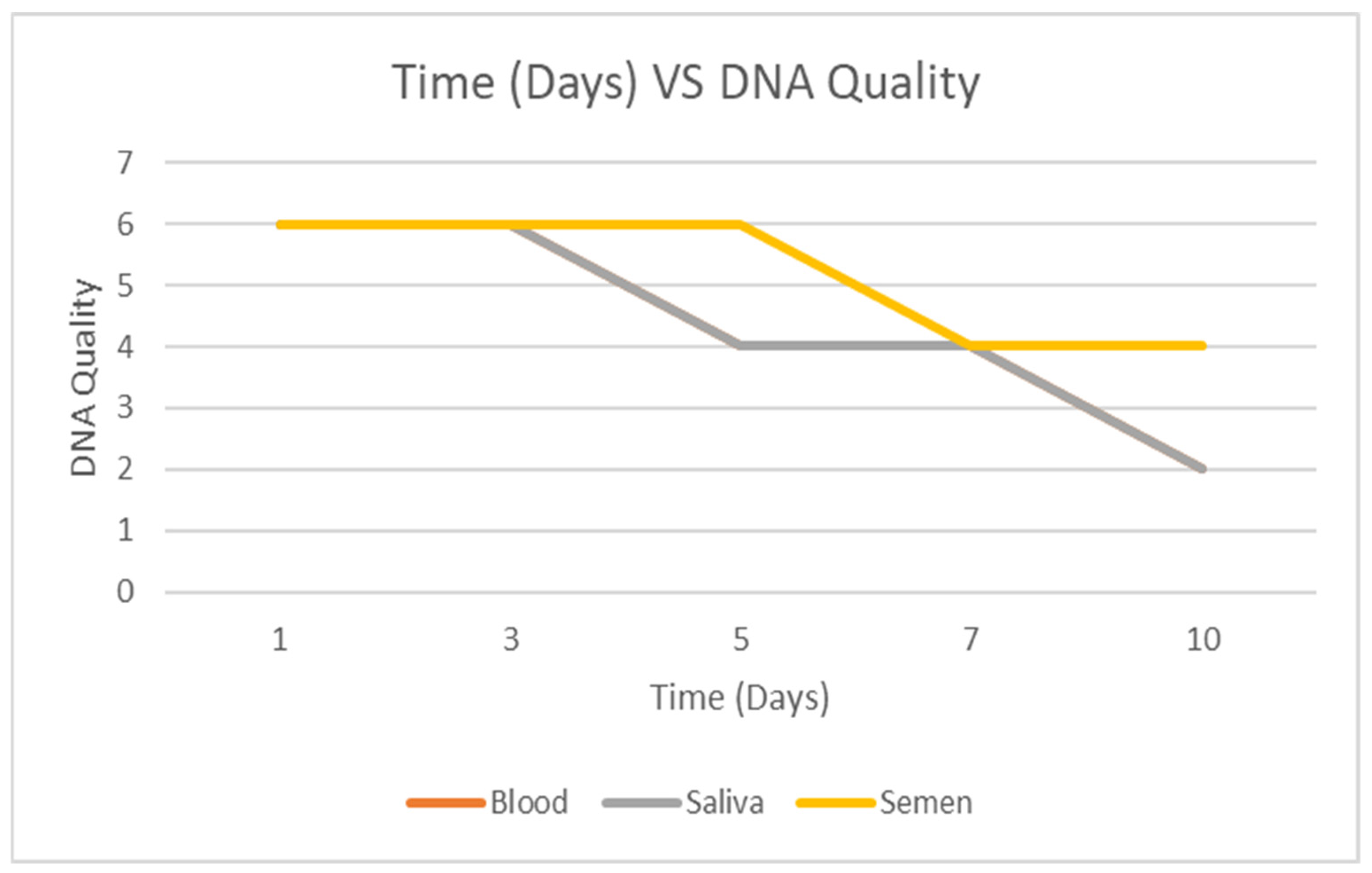
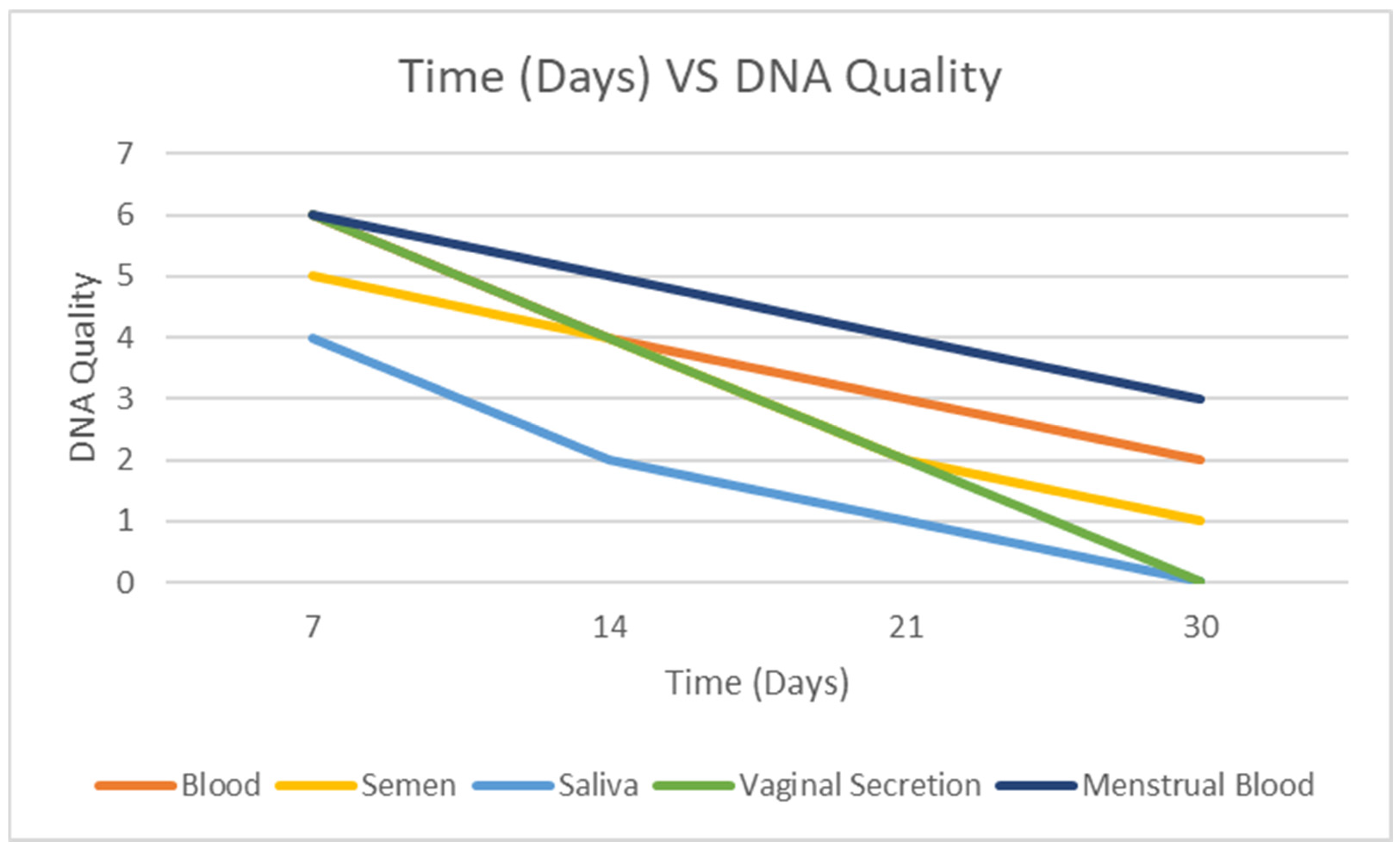
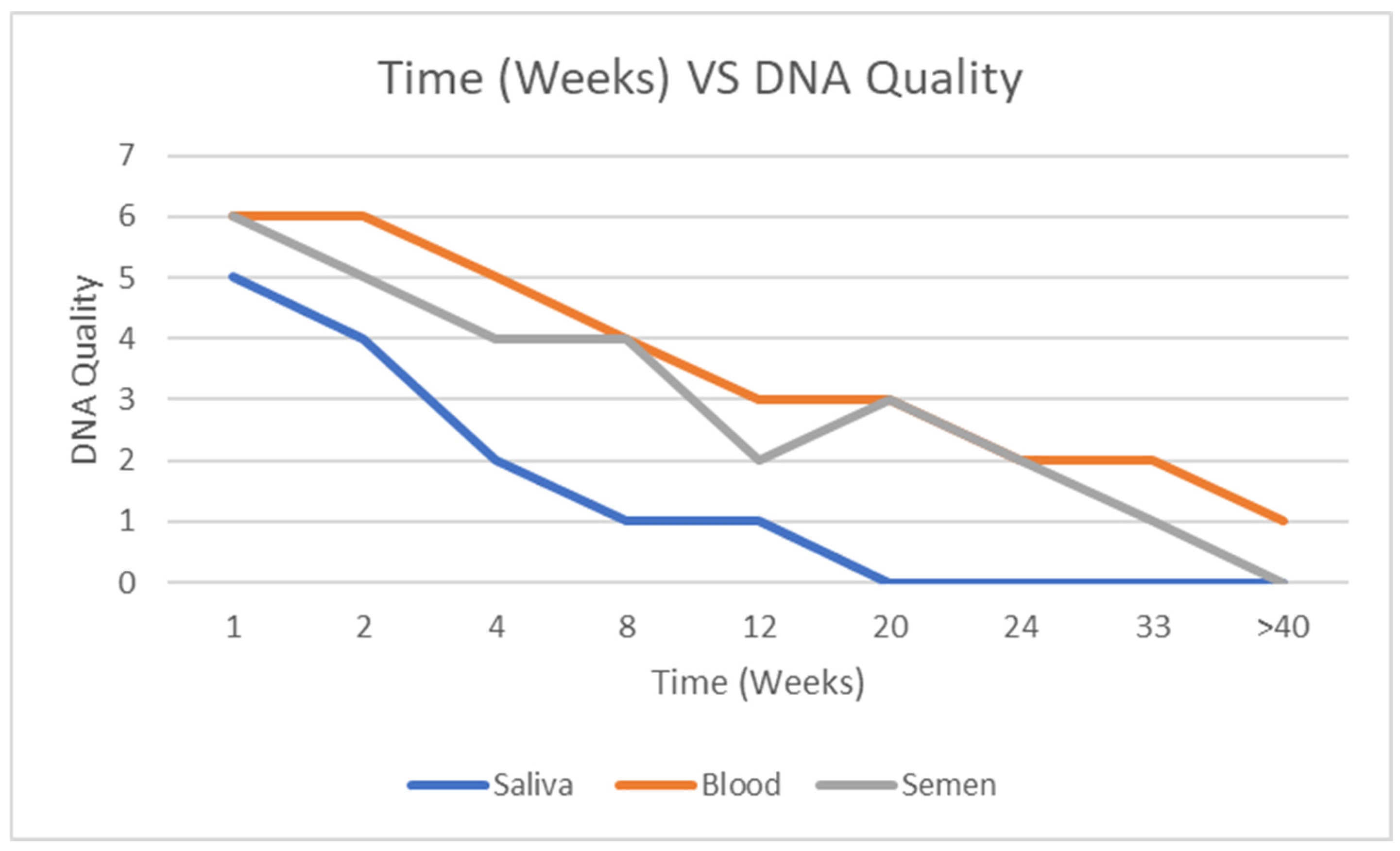
3.2. Effects of Time Since Deposition on DNA Quality and Quantity Across Biological Fluids
- High: 6
- Moderate—High: 5
- Moderate: 4
- Moderate—Low: 3
- Low: 2
- Very Low: 1
- None: 0
3.3. Comparative Reliability of Body Fluids Under Variable Environmental and Evidence Collection Conditions
3.4. Emerging Proteomic Approaches for Body Fluid Identification
4. Conclusions
Author Contributions
Funding
Data Availability Statement
Acknowledgments
Conflicts of Interest
Abbreviations
| ALS | Alternate Light Source |
| ATR-FTIR | Attenuated Total Reflectance-Fourier Transform Infrared Spectroscopy |
| AP | Acid Phosphatase |
| DNA | Deoxyribonucleic Acid |
| GC-MS | Gas Chromatography-Mass Spectrometry |
| IA-MS | Immunoaffinity Mass Spectrometry |
| LC-MS/MS | Liquid Chromatography with Tandem Mass Spectrometry |
| MS | Mass Spectrometry |
| mRNA | Messenger Ribonucleic Acid |
| MSRE-PCR | Methylation-Sensitive Restriction Enzyme-PCR |
| PRISMA | Preferred Reporting Items for Systematic Reviews and Meta-Analyses |
| PROSPERO | International Prospective Register of Systematic Reviews |
| PSA | Prostate-Specific Antigen |
| Py-GC-MS | Pyrolysis-Gas Chromatography-Mass Spectrometry |
| RNA | Ribonucleic Acid |
| RSID | Rapid Stain Identification |
| SAMFE | Sexual Assault Medical Forensic Examination |
| SG test | Specific Gravity test |
| STR | Short Tandem Repeat |
| TMB | Tetramethylbenzidine |
| UV | Ultraviolet |
References
- Zapata, F.; Gregório, I.; García-Ruiz, C. Body Fluids and Spectroscopic Techniques in Forensics: A Perfect Match? J. Forensic Med. 2016, 1, 1–7. [Google Scholar]
- Harbison, S.A.; Fleming, R.I. Forensic body fluid identification: State of the art. Res. Rep. Forensic Med. Sci. 2016, 6, 11–23. [Google Scholar] [CrossRef]
- Vyas, B.; Halámková, L.; Lednev, I.K. A universal test for the forensic identification of all main body fluids including urine. Forensic Chem. 2020, 20, 100247. [Google Scholar] [CrossRef]
- Johnson, D.; Peterson, J.; Sommers, I.; Baskin, D. Use of forensic science in investigating crimes of sexual violence: Contrasting its theoretical potential with empirical realities. Violence Against Women 2012, 18, 193–222. [Google Scholar] [CrossRef] [PubMed]
- Magalhães, T.; Dinis-Oliveira, R.J.; Silva, B.; Corte-Real, F.; Nuno Vieira, D. Biological Evidence Management for DNA Analysis in Cases of Sexual Assault. Sci. World J. 2015, 2015, 365674. [Google Scholar] [CrossRef] [PubMed]
- Tiry, E.; Zweig, J.; Walsh, K.; Farrell, L.; Yu, L. Beyond Forensic Evidence: Examining Sexual Assault Medical Forensic Exam Mechanisms that Influence Sexual Assault Case Outcomes. J. Interpers. Violence 2022, 37, Np5693–Np5727. [Google Scholar] [CrossRef]
- Salem, K.A.; Goodwin, W. The Impact of Area Size and Fabric Type on Touch DNA Collected from Fabric. J. Forensic Sci. Crim. Investig. 2022, 16, 555926. Available online: https://juniperpublishers.com/jfsci/JFSCI.MS.ID.555926.php (accessed on 27 January 2026).
- Sakurada, K.; Watanabe, K.; Akutsu, T. Current Methods for Body Fluid Identification Related to Sexual Crime: Focusing on Saliva, Semen, and Vaginal Fluid. Diagnostics 2020, 10, 693. [Google Scholar] [CrossRef]
- Johannessen, H.; Gill, P.; Shanthan, G.; Fonneløp, A.E. Transfer, persistence and recovery of DNA and mRNA vaginal mucosa markers after intimate and social contact with Bayesian network analysis for activity level reporting. Forensic Sci. Int. Genet. 2022, 60, 102750. [Google Scholar] [CrossRef]
- Sijen, T.; Harbison, S. On the Identification of Body Fluids and Tissues: A Crucial Link in the Investigation and Solution of Crime. Genes 2021, 12, 1728. [Google Scholar] [CrossRef]
- Ghemrawi, M.; Ballantyne, J.; McCord, B.; Parker, G. Comparative Assessment of Emerging Technologies for Body Fluid Identification Office of Justice Programs’ National Criminal Justice Reference Service. 2024. Available online: https://nij.ojp.gov/library/publications/comparative-assessment-emerging-technologies-body-fluid-identification (accessed on 27 January 2026).
- Miranda, G.E.; Prado, F.B.; Delwing, F.; Daruge, E., Jr. Analysis of the fluorescence of body fluids on different surfaces and times. Sci. Justice J. Forensic Sci. Soc. 2014, 54, 427–431. [Google Scholar] [CrossRef]
- Spiker, J.O.; Brodeur, A.N.; Manolakis, A.; Spiker, K.J. Identification of Spermatozoa on Sexual Assault Swabs: A Comparative Analysis of Traditional Tube Extraction and Direct Slide Elution Methods by Kolby; Boston University School of Medicine: Boston, MA, USA, 2014. [Google Scholar]
- Gregório, I.; Zapata, F.; García-Ruiz, C. Analysis of human bodily fluids on superabsorbent pads by ATR-FTIR. Talanta 2017, 162, 634–640. [Google Scholar] [CrossRef] [PubMed]
- Rodriguez, J.J.R.B.; Calacal, G.C.; Laude, R.P.; De Ungria, M.C.A. Integrating presumptive and confirmatory semen tests into DNA profiling of sexual assault evidence: A Philippine example. Egypt. J. Forensic Sci. 2019, 9, 45. [Google Scholar] [CrossRef]
- Burnier, C.; Kelly, M.; DeTata, D.; Pitts, K. Investigation of condom evidence in cases of sexual assault: Case studies. Forensic Sci. Int. Rep. 2021, 4, 100221. [Google Scholar] [CrossRef]
- Ethan, C.; Layla, H. Forensic Semen Identification in Sexual Assault Investigations. Am. J. Med. Sci. Pharm. Res. 2025, 7, 1–5. [Google Scholar]
- Newton, M. The forensic aspects of sexual violence. Best Pract. Res. Clin. Obstet. Gynaecol. 2013, 27, 77–90. [Google Scholar] [CrossRef]
- Astrup, B.S.; Thomsen, J.L.; Lauritsen, J.; Ravn, P. Detection of spermatozoa following consensual sexual intercourse. Forensic Sci. Int. 2012, 221, 137–141. [Google Scholar] [CrossRef]
- Maynard, P.; Allwell, K.; Roux, C.; Dawson, M.; Royds, D. A protocol for the forensic analysis of condom and personal lubricants found in sexual assault cases. Forensic Sci. Int. 2001, 124, 140–156. [Google Scholar] [CrossRef]
- Laffan, A.; Sawyer, I.; Quinones, I.; Daniel, B. Evaluation of semen presumptive tests for use at crime scenes. Med. Sci. Law 2011, 51, 11–17. [Google Scholar] [CrossRef]
- Rankin-Turner, S.; Kelly, P.F.; King, R.S.P.; Reynolds, J.C. Using mass spectrometry to transform the assessment of sexual assault evidence. Forensic Chem. 2020, 20, 100262. [Google Scholar] [CrossRef]
- Cano-Trujillo, C.; García-Ruiz, C.; Ortega-Ojeda, F.E.; Romolo, F.; Montalvo, G. Forensic analysis of biological fluid stains on substrates by spectroscopic approaches and chemometrics: A review. Anal. Chim. Acta 2023, 1282, 341841. [Google Scholar] [CrossRef] [PubMed]
- Medina-Paz, F.; Kuba, B.; Kryvorutsky, E.; Roca, G.; Zapico, S.C. Assessment of Blood and Semen Detection and DNA Collection from Swabs up to Three Months after Deposition on Five Different Cloth Materials. Int. J. Mol. Sci. 2024, 25, 3522. [Google Scholar] [CrossRef] [PubMed]
- Kaesler, T.; Kirkbride, K.P.; Linacre, A. Persistence of touch DNA on commonly encountered substrates in different storage conditions. Forensic Sci. Int. 2023, 348, 111728. [Google Scholar] [CrossRef] [PubMed]
- Hanson, E.K.; Ballantyne, J. Highly specific mRNA biomarkers for the identification of vaginal secretions in sexual assault investigations. Sci. Justice J. Forensic Sci. Soc. 2013, 53, 14–22. [Google Scholar] [CrossRef]
- Ryan, L.M. Sexual Assault Crime Scene Specialisation: Best Practice for Seminal Stain Location and Visualisation Utilising ALS; In-Field vs Laboratory; Chapman, B., Ed.; Murdoch University: Perth, WA, Australia, 2022. [Google Scholar]
- Virkler, K.; Lednev, I.K. Analysis of body fluids for forensic purposes: From laboratory testing to non-destructive rapid confirmatory identification at a crime scene. Forensic Sci. Int. 2009, 188, 1–17. [Google Scholar] [CrossRef]
- Marr, A.M. Sampling Techniques for the Recovery of Offender Cellular Material on Victim Skin Surfaces; Chapman, B., Ed.; Murdoch University: Perth, WA, Australia, 2023. [Google Scholar]
- Al-Kandari, N.M.; Singh, J.; Sangar, V.C. Time-Dependent Effects of Temperature and Humidity on Quality of DNA in samples of Human Saliva, Blood and Semen in Kuwait. Int. J. Pharm. Sci. Res. 2016, 7, 2852–2873. [Google Scholar] [CrossRef]
- Sirker, M.; Schneider, P.M.; Gomes, I. A 17-month time course study of human RNA and DNA degradation in body fluids under dry and humid environmental conditions. Int. J. Legal Med. 2016, 130, 1431–1438. [Google Scholar] [CrossRef]
- Zhang, J.; Yu, D.; Wang, T.; Gao, N.; Shi, L.; Wang, Y.; Huo, Y.; Ji, Z.; Li, J.; Zhang, X.; et al. Body fluids should be identified before estimating the time since deposition (TsD) in microbiome-based stain analyses for forensics. Microbiol. Spectr. 2024, 12, e0248023. [Google Scholar] [CrossRef]
- Siuta, J.; Dobosz, A.; Kawecki, J.; Dobosz, T. DNA Content of Various Fluids and Tissues of the Human Body. Genes 2023, 15, 17. [Google Scholar] [CrossRef]
- Wang, J.; Cheng, X.; Zhang, J.; Liu, Z.; Cheng, F.; Yan, J.; Zhang, G. Estimating the time since deposition (TsD) in saliva stains using temporal changes in microbial markers. Forensic Sci. Int. Genet. 2022, 60, 102747. [Google Scholar] [CrossRef]
- Díez López, C.; Kayser, M.; Vidaki, A. Estimating the Time Since Deposition of Saliva Stains with a Targeted Bacterial DNA Approach: A Proof-of-Principle Study. Front. Microbiol. 2021, 12, 647933. [Google Scholar] [CrossRef]
- Shrivastava, P.; Kumawat, R.K.; Kushwaha, P.; Rana, M. Biological Sources of DNA: The Target Materials for Forensic DNA Typing. In Handbook of DNA Profiling; Dash, H.R., Shrivastava, P., Lorente, J.A., Eds.; Springer: Singapore, 2022; pp. 51–67. [Google Scholar] [CrossRef]
- Rylander-Rudqvist, T.; Håkansson, N.; Tybring, G.; Wolk, A. Quality and quantity of saliva DNA obtained from the self-administrated oragene method--a pilot study on the cohort of Swedish men. Cancer Epidemiol. Biomark. Prev. 2006, 15, 1742–1745. [Google Scholar] [CrossRef] [PubMed]
- Park, J.L.; Kwon, O.H.; Kim, J.H.; Yoo, H.S.; Lee, H.C.; Woo, K.M.; Kim, S.Y.; Lee, S.H.; Kim, Y.S. Identification of body fluid-specific DNA methylation markers for use in forensic science. Forensic Sci. Int. Genet. 2014, 13, 147–153. [Google Scholar] [CrossRef] [PubMed]
- Hsu, C.T.; Tsai, L.C.; Liu, K.L.; Lin, Y.C.; Huang, N.E.; Lee, J.C.; Linacre, A.; Hsieh, H.M. Identification of menstrual blood and vaginal fluid using a 4-plex MSRE-PCR system applicable to alleged sexual assault cases. Int. J. Legal Med. 2025, 139, 1553–1568. [Google Scholar] [CrossRef] [PubMed]
- Divya, K.; Mathur, G.; Umema, A.; Daga, S.S. Environmental Factors Affecting the Concentration of DNA in Blood and Saliva Stains: A Review. J. Forensic Sci. Res. 2024, 8, 9–15. [Google Scholar] [CrossRef]
- Mayes, C.; Houston, R.; Seashols-Williams, S.; LaRue, B.; Hughes-Stamm, S. The stability and persistence of blood and semen mRNA and miRNA targets for body fluid identification in environmentally challenged and laundered samples. Leg. Med. 2019, 38, 45–50. [Google Scholar] [CrossRef]
- Borde, Y.M.; Tonnany, M.B.; Champod, C. A Study on the Effects of Immersion in River Water and Seawater on Blood, Saliva, and Sperm Placed on Objects Mimicking Crime Scene Exhibits. Can. Soc. Forensic Sci. J. 2008, 41, 149–163. [Google Scholar] [CrossRef]
- Holtkötter, H.; Dias Filho, C.R.; Schwender, K.; Stadler, C.; Vennemann, M.; Pacheco, A.C.; Roca, G. Forensic differentiation between peripheral and menstrual blood in cases of alleged sexual assault-validating an immunochromatographic multiplex assay for simultaneous detection of human hemoglobin and D-dimer. Int. J. Legal Med. 2018, 132, 683–690. [Google Scholar] [CrossRef]
- Nolan, M.; Handt, O.; Linacre, A. Persistence of cellular material after exposure to water. J. Forensic Sci. 2023, 68, 2128–2137. [Google Scholar] [CrossRef]
- McKiernan, H.E.; Danielson, P.B.; Brown, C.O.; Signaevsky, M.; Westring, C.G.; Legg, K.M. Developmental validation of a multiplex proteomic assay for the identification of forensically relevant biological fluids. Forensic Sci. Int. 2021, 326, 110908. [Google Scholar] [CrossRef]
- Brown, C.O.; Robbins, B.L.; McKiernan, H.E.; Danielson, P.B.; Legg, K.M. Direct seminal fluid identification by protease-free high-resolution mass spectrometry. J. Forensic Sci. 2021, 66, 1017–1023. [Google Scholar] [CrossRef]
- Davidovics, R.; Saw, Y.L.; Brown, C.O.; Prinz, M.; McKiernan, H.E.; Danielson, P.B.; Legg, K.M. High-throughput seminal fluid identification by automated immunoaffinity mass spectrometry. J. Forensic Sci. 2022, 67, 1184–1190. [Google Scholar] [CrossRef]
- Pieri, M.; Siano, F.; Basilicata, P.; Simonelli, A.; Addeo, F.; Picariello, G. Proteomics for forensic identification of saliva and vomit in a case of alleged rape. Anal. Bioanal. Chem. 2025, 417, 627–639. [Google Scholar] [CrossRef]




| Study ID | Study Design | Surface Type | Surface Detail | Body Fluid | Detection Method | Detectability | Persistence |
|---|---|---|---|---|---|---|---|
| Miranda et al. 2014 [12] | Experimental laboratory | Porous | Cloth, wood | Blood | ALS | High when dry; weak when wet | Up to 60 days |
| Miranda et al. 2014 [12] | Experimental laboratory | Porous | Cloth, wood | Semen | ALS | Strong fluorescence | Up to 60 days |
| Miranda et al. 2014 [12] | Experimental laboratory | Porous | Cloth, wood | Saliva | ALS | Moderate | Up to 60 days |
| Miranda et al. 2014 [12] | Experimental laboratory | Porous | Cloth, wood | Urine | ALS | Detectable but weaker | Up to 60 days |
| Miranda et al. 2014 [12] | Experimental laboratory | Non-porous | Ceramic tile | Blood | ALS | Strong detection | Up to 60 days |
| Miranda et al. 2014 [12] | Experimental laboratory | Non-porous | Ceramic tile | Semen | ALS | High fluorescence | Up to 60 days |
| Miranda et al. 2014 [12] | Experimental laboratory | Non-porous | Ceramic tile | Saliva | ALS | Good detection | Up to 60 days |
| Miranda et al. 2014 [12] | Experimental laboratory | Non-porous | Ceramic tile | Urine | ALS | Detectable | Up to 60 days |
| Spiker et al. 2014 [13] | Controlled laboratory | Non-porous | Smooth ceramic tile | Spermatozoa | Microscopy | Highest recovery (polyester swab best) | Short-term |
| Spiker et al. 2014 [13] | Controlled laboratory | Semi-porous | Rough tile | Spermatozoa | Microscopy | Moderate recovery | Short-term |
| Spiker et al. 2014 [13] | Controlled laboratory | Semi- porous | Quarry tile | Spermatozoa | Microscopy | Lowest recovery | Short-term |
| Gregório et al. 2017 [14] | Experimental | Porous | Pads, diapers, panty liners | Semen | ATR-FTIR | Clear spectral peaks | Not Reported |
| Gregório et al. 2017 [14] | Experimental | Porous | Pads, diapers, panty liners | Vaginal fluid | ATR-FTIR | Strong vs. markers | Not Reported |
| Gregório et al. 2017 [14] | Experimental | Porous | Pads, diapers, panty liners | Urine | ATR-FTIR | Detectable but weaker | Not Reported |
| Rodriguez et al. 2019 [15] | Experimental | Porous | Underwear (cotton) | Semen | ALS, Sg test | High detectability | Stains visible for days |
| Rodriguez et al. 2019 [15] | Experimental | Non-porous | Condom (inner and outer) | Semen | ALS, Sg test | Internal positive; external weak–negative | Several days; degradation when stored 55–69 days |
| Burnier et al. 2021 [16] | Proficiency + casework | Non-porous | Latex condom | Blood | Py-GC-MS/GC-MS | Blood detectable on condom surface | Not Reported |
| Clarke & Hassan 2025 [17] | Experimental | Non-porous | Plastic/Glass | Semen | PSA, AP, microscopy | High | PSA decreases after 8–24 h |
| Clarke & Hassan 2025 [17] | Experimental | Porous | Cotton fabric | Semen | PSA, AP, microscopy | Moderate | Reduced after 24–48 h |
| Newton 2013 [18] | Experimental | Non-porous | Plastic & Metal | Vaginal fluid | Fluorescent markers | Positive | Fluorescence fades with time |
| Astrup et al. 2012 [19] | Experimental | Non-porous | Slide | Spermatozoa | Microscopy, staining | Strong detection | Detectable several hours |
| Maynard et al. 2001 [20] | Experimental | Non-porous | Condom | Semen | GC-MS, Py-GC-MS | Often negative (condom barrier | Very low transfer; dependent on brand |
| Laffan et al. 2011 [21] | Laboratory evaluation | Porous | Cotton fabric, swabs | Semen | RSID-Semen, PSA | High sensitivity; RSID more specific | Short-term (post-coital) |
| Rankin-Turner 2020 [22] | Experimental | Non- porous | Glass, metal, plastic, ceramic tile | Blood | In situ mass spectrometry | High (strong and distinct chemical profiles) | Moderate–High (ageing signatures detectable longer due to surface retention) |
| Rankin-Turner 2020 [22] | Experimental | Porous | Fabric | Blood | In situ mass spectrometry | Moderate–Low (reduced signal due to absorption) | Low–Moderate (faster chemical degradation) |
| Rankin-Turner 2020 [22] | Experimental | Non-porous | Condom | Semen | In situ mass spectrometry | High (clear semen-specific chemical signatures) | Moderate (persistence enhanced by impermeable substrates) |
| Rankin-Turner 2020 [22] | Experimental | Porous | fabric | Semen | In situ mass spectrometry | Low–Moderate (signal loss due to absorption) | Low (reduced persistence compared with non-porous surfaces) |
| Time (Days) | Blood: DNA Quantity | Blood: DNA Quality | Saliva: DNA Quantity | Saliva: DNA Quality | Semen: DNA Quantity | Semen: DNA Quality |
|---|---|---|---|---|---|---|
| 1 | High | High | High | High | High | High |
| 3 | High | High | High | High | High | High |
| 5 | Moderate | Moderate | Moderate | Moderate | High | High |
| 7 | Moderate | Moderate | Moderate | Moderate | Moderate | Moderate |
| 10 | Low | Low | Low | Low | Moderate | Moderate |
| Time (Weeks) | Saliva (DNA Quality) | Blood (DNA Quality) | Semen (DNA Quality) |
|---|---|---|---|
| 1 | Moderate-High | High | High |
| 2 | Moderate | High | High—Moderate |
| 4 | Low | High-Moderate | Moderate |
| 8 | Very low | Moderate | Moderate |
| 12 | Very low | Moderate-Low | Low |
| 20 | None | Moderate-Low | Moderate-Low |
| 24 | None | Low | Low |
| 33 | None | Low | Very low |
| >40 | None | Very low | None |
| Time (Days) | Blood | Semen | Saliva | Vaginal Secretion | Menstrual Blood |
|---|---|---|---|---|---|
| 7 | High | Moderate—High | Moderate | High | High |
| 14 | Moderate | Moderate | Low | Moderate | High—Moderate |
| 21 | Low—Moderate | Low | Very Low | Low | Moderate |
| 30 | Low | Very low | None | Very low—None | Moderate—Low |
| Score | Detectability | Persistence | Environmental Stability (Robustness) |
|---|---|---|---|
| 3 | Strong (high success rates; strong signals) | Long-term (weeks–months) | Highly robust (little effect) |
| 2 | Moderate (some dropout, still detectable) | Medium-term (days–weeks) | Moderately robust |
| 1 | Weak (partial signals only) | Short-term (hours–days) | Sensitive |
| 0 | Absent | Rapidly degraded | Extremely sensitive |
| Study ID | Body Fluid | Detectability (3) | Persistence (3) | Environmental Stability (3) | Substrate Type (Porous/Non-Porous) | Environmental Conditions (Controlled/Heat/Humidity/UV Exposure) | Time Since Deposition | Collection Method | Analytical Method Used | Total Score (12) |
|---|---|---|---|---|---|---|---|---|---|---|
| Sirker et al. 2016 [31] | Semen | 3 | 2 | 2 | Porous | Humidity | 2 | Freshly ejaculated semen was collected in a sterile 50 mL plastic tube | mRNA profiling, STR profiling, Capillary Electrophoresis | 9 |
| Sirker et al. 2016 [31] | Blood | 3 | 3 | 2 | Porous | Humidity | 3 | Venous blood was collected from a female donor by venipuncture with anticoagulation treatment. | mRNA profiling, STR profiling, Capillary Electrophoresis | 11 |
| Sirker et al. 2016 [31] | Saliva | 2 | 1 | 0 | Porous | Humidity | 1 | Saliva was collected from a female donor in a sterile 1.5-μL Eppendorf tube. | mRNA profiling, STR profiling, Capillary Electrophoresis | 4 |
| Zhang et al. 2024 [32] | Semen | 2 | 2 | 1 | Porous | Controlled indoor (18.4–19.4 °C), Humidity (30–40%) | 2 | Swabbing: Self-collected into sterile tubes, then transferred to sterile cotton swabs | 16S rRNA gene high-throughput sequencing | 7 |
| Zhang et al. 2024 [32] | Saliva | 2 | 1 | 0 | Porous | Controlled indoor (18.4–19.4 °C), Humidity (30–40%) | 0 | Swabbing: Self-collected into sterile tubes, then transferred to sterile cotton swabs | 16S rRNA gene high-throughput sequencing | 3 |
| Zhang et al. 2024 [32] | Vaginal Secretion | 2 | 2 | 1 | Porous | Controlled indoor (18.4–19.4 °C), Humidity (30–40%) | 0 | Swabbing: Self-collected directly onto sterile cotton swabs | 16S rRNA gene high-throughput sequencing | 5 |
| Zhang et al. 2024 [32] | Menstrual blood | 3 | 3 | 2 | Porous | Controlled indoor (18.4–19.4 °C), Humidity (30–40%) | 3 | Swabbing: Self-collected directly from the vagina using sterile cotton swabs during days 2–5 of the menstrual cycle. | 16S rRNA gene high-throughput sequencing | 11 |
| Johannessen et al. 2022 [9] | Vaginal Secretion | 3 | 1 | 0 | Porous | Controlled | 1 | Swabbing | mRNA profiling, STR profiling | 5 |
| Al-Kandari et al. 2016 [30] | Blood | 3 | 2 | 1 | Porous | Heat | 3 | Swabbing | Real-time PCR | 6 |
| Al-Kandari et al. 2016 [30] | Saliva | 2 | 1 | 0 | Porous | Heat | 1 | Swabbing | Real-time PCR | 3 |
| Khorwal et al. 2024 [40] | Blood | 3 | 3 | 2 | Porous | UV exposure, Heat | 2 | Blood deposited on cotton, air dried, stain cutting collected | Organic extraction + Agarose gel + RFLP | 8 |
| Khorwal et al. 2024 [40] | Saliva | 2 | 2 | 1 | Porous | UV exposure, Heat | 1 | Saliva deposited on cotton, air dried, stain cutting collected | Organic extraction + Agarose gel + RFLP | 5 |
| Mayes et al. 2019 [41] | Blood | 3 | 3 | 2 | Porous | Heat, Humidity, UV exposure | 3 | blood was collected by venipuncture into BD Vacutainer™ tubes treated with an anticoagulant (EDTA) | RT-qPCR (real-time quantitative PCR) | 11 |
| Mayes et al. 2019 [41] | Semen | 3 | 2 | 2 | Porous | Heat, Humidity, UV exposure | 2 | Semen was provided in specimen containers | RT-qPCR (real-time quantitative PCR) | 9 |
| Borde et al. 2008 [42] | Blood | 2 | 1 | 0 | Porous | Water Immersion: Submerged at a depth of 5 m in either a freshwater river or seawater | 0 | Blood deposited on fabric, air-dried, cutting collected | DNA STR profiling | 3 |
| Borde et al. 2008 [42] | Semen | 3 | 2 | 2 | Porous | Water Immersion: Submerged at a depth of 5 m in either a freshwater river or seawater | 1 | Semen deposited on fabric, air-dried, cutting collected | DNA STR profiling | 8 |
| Borde et al. 2008 [42] | Saliva | 2 | 1 | 0 | Porous | Dry | 0 | Saliva deposited on fabric, air-dried, cutting collected | DNA STR profiling | 3 |
| Biological Fluid | Optimal Substrate for Recovery | Recommended Collection Window | Preferred Analytical Methods | Key Environmental Vulnerabilities | Major Interpretation Limitations | Practical Best-Practice Recommendation |
|---|---|---|---|---|---|---|
| Semen | Non-porous surfaces (plastic, metal) for surface recovery; porous fabrics may retain DNA internally | Within 72–96 h post-assault | Acid phosphatase (screening), PSA/p30, RSID-Semen, STR profiling, mRNA markers, emerging proteomics | Heat and humidity accelerate DNA degradation; UV reduces stain visibility | Azoospermic samples; mixed vaginal fluid; dilution | Prioritise early collection; combine immunological and molecular methods; interpret mixed samples cautiously |
| Blood (Peripheral) | Both porous and non-porous; relatively stable on dry substrates | Up to several days if protected from extreme conditions | TMB presumptive test, confirmatory haem tests, STR profiling | Prolonged humidity promotes microbial growth; UV exposure reduces DNA integrity | Cannot indicate timing of deposition without contextual data | Ensure proper drying before storage; document environmental exposure |
| Menstrual Blood | Porous fabrics may retain cellular material | As early as possible due to reduced haemoglobin concentration | Microscopy (cellular composition), haemoglobin quantification, ABH typing, emerging proteomics | Degradation of cellular components in high humidity | Misclassification as peripheral blood | Combine cellular, biochemical, and molecular markers for differentiation |
| Saliva | Non-porous surfaces yield easier surface recovery; porous substrates reduce detectability | Within 24–48 h preferred | RSID-Saliva (α-amylase), mRNA markers, microbiome profiling, proteomics | Rapid enzymatic degradation; environmental contamination | α-amylase present in other fluids (false positives) | Use confirmatory molecular markers; avoid sole reliance on amylase-based assays |
| Vaginal Secretions | Porous textiles may retain epithelial cells | Within 24–72 h | mRNA profiling (e.g., MYOZ1), DNA profiling, proteomic biomarkers | Heat and moisture accelerate RNA degradation | Difficult differentiation from menstrual blood or mixed semen samples | Use multi-marker approach (mRNA + proteomics where possible) |
| Mixed Fluids | Recovery depends on dominant fluid and substrate | Immediate collection strongly advised | STR mixture interpretation, probabilistic models, mRNA multiplex, proteomics | Differential degradation rates complicate interpretation | High risk of false exclusion or misinterpretation | Apply probabilistic interpretation frameworks; report limitations explicitly |
Disclaimer/Publisher’s Note: The statements, opinions and data contained in all publications are solely those of the individual author(s) and contributor(s) and not of MDPI and/or the editor(s). MDPI and/or the editor(s) disclaim responsibility for any injury to people or property resulting from any ideas, methods, instructions or products referred to in the content. |
© 2026 by the authors. Licensee MDPI, Basel, Switzerland. This article is an open access article distributed under the terms and conditions of the Creative Commons Attribution (CC BY) license.
Share and Cite
Mohd Nasir, A.; Mohd Kamal, N.H.N.; Hamzah, N.H. Forensic Reliability of Body Fluids in Sexual Assault Investigations: A Systematic Review. Analytica 2026, 7, 21. https://doi.org/10.3390/analytica7010021
Mohd Nasir A, Mohd Kamal NHN, Hamzah NH. Forensic Reliability of Body Fluids in Sexual Assault Investigations: A Systematic Review. Analytica. 2026; 7(1):21. https://doi.org/10.3390/analytica7010021
Chicago/Turabian StyleMohd Nasir, Atikah, Nur Hanis Najihah Mohd Kamal, and Noor Hazfalinda Hamzah. 2026. "Forensic Reliability of Body Fluids in Sexual Assault Investigations: A Systematic Review" Analytica 7, no. 1: 21. https://doi.org/10.3390/analytica7010021
APA StyleMohd Nasir, A., Mohd Kamal, N. H. N., & Hamzah, N. H. (2026). Forensic Reliability of Body Fluids in Sexual Assault Investigations: A Systematic Review. Analytica, 7(1), 21. https://doi.org/10.3390/analytica7010021