Article

Tandem High-Dose Chemotherapy and Autologous Stem Cell Transplantation for Relapsed and Refractory Germ Cell Tumors: A Single-Center Experience


Specialized Hospital for Active Treatment of Hematological Diseases (SHATHD), 1756 Sofia, Bulgaria
*
Author to whom correspondence should be addressed.
Submission received: 19 March 2026 / Revised: 20 April 2026 / Accepted: 29 June 2026 / Published: 20 July 2026

Abstract

Background: High-dose chemotherapy (HDCT) followed by autologous stem cell transplantation (ASCT) is an established salvage therapy for relapsed or refractory (R/R) germ cell tumors (GCTs). Methods: We conducted a retrospective analysis of 9 patients (23–41 years of age) with relapsed/refractory (R/R) GCTs treated according to the Swedish–Norwegian Testicular Cancer Group Clinical Protocol (SWENOTECA), at the Specialized Hospital for Active Treatment of Hematological Diseases (SHATHD) in Sofia, Bulgaria. The study evaluates the efficacy and safety of HDCT followed by ASCT in R/R GCTs eligible for second-line consolidation. The cohort was predominantly high-risk, with 77.7% of patients exhibiting stable or progressive disease (SD/PD) after first-line platinum therapy. Response was assessed via RECIST 1.1 criteria and tumor marker monitoring. Results: Median OS and PFS were 8.4 and 5.9 months, respectively. While the ORR post-ASCT was 33.3% (all CR), the 2-year survival plateau (33.3%) suggests curative potential in a subset of patients. Notably, there was no treatment-related mortality (TRM). Conclusions: Tandem HDCT is a feasible salvage strategy with manageable toxicity and no TRM in this small, heavily pre-treated cohort. Although efficacy results are exploratory due to the limited number of patients, the observed long-term remissions confirm the curative potential of this standard-of-care consolidation in a real-world clinical setting.

1. Introduction

Germ cell tumours (GCTs) are the most common solid malignancies in young men aged 15–45. Diagnosis and disease staging are performed in accordance with the international guidelines established by the National Comprehensive Cancer Network (NCCN) [1] and the European Society for Medical Oncology (ESMO) [2]. Clinical prognosis and risk stratification are primarily determined by the International Germ Cell Consensus Classification (IGCCCG) [3], which was validated in a large-scale analysis by Einhorn et al. [3]. More recent updates to this classification continue to refine risk categories for metastatic cases [4].
Published data show that treatment for GCTs is highly successful: the cure rate is often over 95% in early stages [5], and even in metastatic forms, it is 80–90% [2]. The first step in the treatment of the primary tumour is radical inguinal orchiectomy, which serves simultaneously for diagnosis and therapy. Subsequent treatment depends on the histological variant and stage of the tumour. For early-stage disease (stage I), the most common approach is active surveillance. Alternatively, adjuvant chemotherapy, typically a single course of carboplatin, can be administered to reduce the risk of relapse. In high-risk stage I non-seminomatous GCTs, the administration of two cycles of the BEP (bleomycin, etoposide, cisplatin) regimen has demonstrated long-term efficacy in reducing relapse rates [6]. For advanced stages (II and III), the main method is platinum-based chemotherapy, most often administered through the BEP regimen (bleomycin, etoposide and cisplatin). Radiotherapy is used less frequently today, but can be effective in certain stage II cases. Prospective data confirm that radiotherapy remains a highly effective treatment modality for patients with stage IIA/B testicular seminoma [7].
The clinical management of relapsed/refractory (R/R) germ cell tumours (GCTs) remains a subject of active debate, centred on the choice between standard chemotherapy and high-dose chemotherapy followed by autologous stem cell transplantation (ASCT) [8]. Standard salvage chemotherapy for refractory GCTs typically involves cisplatin-based combination regimens such as TIP (paclitaxel, ifosfamide, and cisplatin) or VeIP (vinblastine, ifosfamide, and cisplatin). However, in the setting of primary platinum-refractory disease, the efficacy of these conventional-dose regimens is limited, which justifies the escalation to HDCT with autologous stem cell support. Retrospective data, notably from Indiana University [9] and large analyses of the Center for International Blood and Marrow Transplant Research (CIBMTR)/European Society for Blood and Marrow Transplantation (EBMT) [10], suggest that HDCT and ASCT provide superior long-term survival, particularly when used as an early salvage intervention. Tandem HDCT cycles aim to maximise dose intensity while mitigating cumulative organ toxicity [11].
In Northern Europe and Scandinavia, the SWENOTECA Group [12] has established robust management guidelines that have standardised the approach to GCTs. The SWENOTECA protocols emphasise a risk-adapted strategy, ensuring that patients at high risk of failure receive intensified treatment early in their clinical course.
In Bulgaria, implementing such intensive protocols at a single centre requires significant coordination between oncology, haematology and transplant units. At the SHATHD in Sofia, we have adopted the HDCT approach as a consolidation strategy for patients with relapsed or refractory GCT. The aim of this study is to provide a detailed analysis of our experience of tandem HDCT/ASCT at a single centre. By presenting our clinical outcomes and toxicity profiles, we hope to contribute to the growing body of evidence regarding the feasibility and efficacy of this intensive treatment in Eastern European clinical practice. Our focus will be on long-term survival and the management of treatment-related complications.

2. Materials and Methods

2.1. Study Design and Population

We conducted a retrospective, single-centre study which included nine male patients with R/R GCTs who were referred to our HSCT centre at SHATHD by their treating oncologist between 2019 and 2022. Relapsed disease was defined as progression after a period of complete remission, while refractory disease was defined as progression during treatment or within four weeks of completing a platinum-based regimen. Risk stratification at the start of HDCT was performed according to the criteria of the International Prognostic Factors Study Group (IPFSG). All patients were candidates for tandem cycles of HDCT followed by ASCT after failing at least one line of platinum-based chemotherapy.
Patients were eligible for inclusion in the study and treatment with the tandem HDCT/ASCT protocol if they met the following criteria:
  • Age and Diagnosis: Patients aged ≥18 years with a confirmed diagnosis of R/R seminoma GCTs.
  • Performance Status: ECOG performance status of 0–2.
  • Organ Function:
    • Renal: Creatinine clearance (CrCl) ≥ 60 mL/min.
    • Hepatic: Total bilirubin ≤ 1.5 × ULN; AST/ALT ≤ 2.5 × ULN (up to 5 × ULN in cases of liver metastases).
    • Cardiac/Pulmonary: LVEF ≥ 50% and FEV1 ≥ 70% of predicted values.
  • Hematological Reserve: Successful mobilization of peripheral blood stem cells (PBSC) with a target CD34+ yield of 5–7 × 10⁶/kg for tandem transplantation, with a minimum requirement of 2 × 10⁶/kg per cycle.
  • Ethical Requirements: Provision of signed informed consent prior to any study-related procedures.
Serum tumor markers (AFP, β-hCG, and LDH) were measured at baseline, before each HDCT cycle, and during follow-up. Normal reference ranges were defined as: AFP < 7.0 ng/mL, β-hCG < 2.0 mIU/mL, and LDH < 250 U/L. Renal function was assessed via 24 h creatinine clearance to ensure precise dosing of Carboplatin according to the Calvert formula.
All patients achieved successful PBSC mobilization with a target CD34+ yield of 5–7 × 10⁶/kg (minimum 2 × 10⁶/kg per cycle) and provided signed informed consent. The study was approved by the local Ethics review board.

2.2. Treatment Protocol

The therapeutic strategy followed the SWENOTECA IV protocol. The decision to utilize the SWENOTECA IV protocol instead of the more recent SWENOTECA VIII (2011) was based on the clinical requirement for a more intensive, three-drug tandem regimen. Given that 77.7% of our cohort presented with primary platinum-refractory disease, the inclusion of Cyclophosphamide and Thiotepa in a tandem setting was prioritized to overcome extreme chemoresistance in these high-risk patients.
The tandem regimen consisted of two distinct HDCT cycles:
  • Cycle 1: Carboplatin 7 × (GFR+25), max 800 mg (Day 1–4), Cyclophosphamide 1500 mg/m2 (Day 1–4), and Etoposide 440 mg/m2 (Day 1–4).
  • Cycle 2: Carboplatin 7 × (GFR+25), max 800 mg (Day 1–4), Cyclophosphamide 1500 mg/m2 (Day 1–4) and Thiotepa 120 mg/m2 (Day 1–4).
GFR was determined by 24 h creatinine clearance. Doses were capped at 800 mg/day. Supportive care included antiemetics, oral cryotherapy for mucositis prophylaxis, and G-CSF administration starting on Day +5.
Peripheral blood stem cells (PBSCs) were mobilized during second-line salvage therapy using either chemo-mobilization (77.8%) or G-CSF alone (10 µg/kg; 22.2%). Leukapheresis was performed using the Spectra Optia Apheresis System (Terumo BCT, Lakewood, CO, USA). The target CD34+ cell count was set at 5–7 × 10⁶/kg to ensure a sufficient dose for both cycles of the tandem transplant, with a minimum required dose of ≥2.0 × 10⁶ CD34+ cells/kg per transplant. Cryopreservation was conducted using 10% dimethyl sulfoxide (DMSO) and controlled-rate freezing, with the grafts stored in the vapor phase of liquid nitrogen until use. All procedures followed the standard operating protocols of the SHATHD transplant unit.

2.3. Statistical Analysis

The primary endpoints were OS and PFS, calculated from the date of the first ASCT. Survival probabilities were estimated using the Kaplan–Meier method. Statistical analysis was performed using Python software, version 3.10 (Python Software Foundation, Wilmington, DE, USA), utilizing the open-source lifelines library for survival modelingutilizing the lifelines library for survival modeling. Toxicities were graded according to the NCI Common Terminology Criteria for Adverse Events (CTCAE) v5.0 [13].

3. Results

3.1. Patient Characteristics and Mobilization

A total of nine male patients with relapsed or refractory (R/R) germ cell tumors were included in this analysis. The median age at the time of the first ASCT was 34 years (range 23–41). Patient characteristics, risk stratification, and treatment history are summarized in Table 1.
The cohort was characterised by a high burden of features indicative of a poor prognosis. At initial diagnosis, most patients presented with advanced metastatic disease. According to the criteria of the International Prognostic Factors Study Group (IPFSG) at the start of HDCT, 7 (77.7%) of patients were classified as high or very high risk, while 2 (22.3%) were classified as intermediate risk. Furthermore, 7 (77.7%) of the cohort exhibited primary platinum-refractory disease, which is defined as progression during or within four weeks of completing first-line therapy. Elevated tumour markers (AFP and/or β-hCG) were present in 6 (66.7%) of patients prior to HDCT.
All patients had previously received first-line BEP/PEI regimens. In this high-risk group, only two patients (22.2%) achieved an objective response (1 CR, 1 PR) to first-line treatment, while 7 patients (77.7%) demonstrated stable or progressive disease. Consequently, patients proceeded to second-line salvage therapy with TIP (8) or PEI (1). Following salvage therapy, 5 (55.5%) of patients achieved an objective response (CR/PR), while 4 (44.5%) remained with SD or PD. Stem cell mobilization was successful in all patients with a mean CD34+ yield of 8.38 × 10⁶/kg. Mobilization was primarily achieved using chemotherapy plus G-CSF in 7 patients, while 2 required G-CSF alone.

3.2. Survival and Response

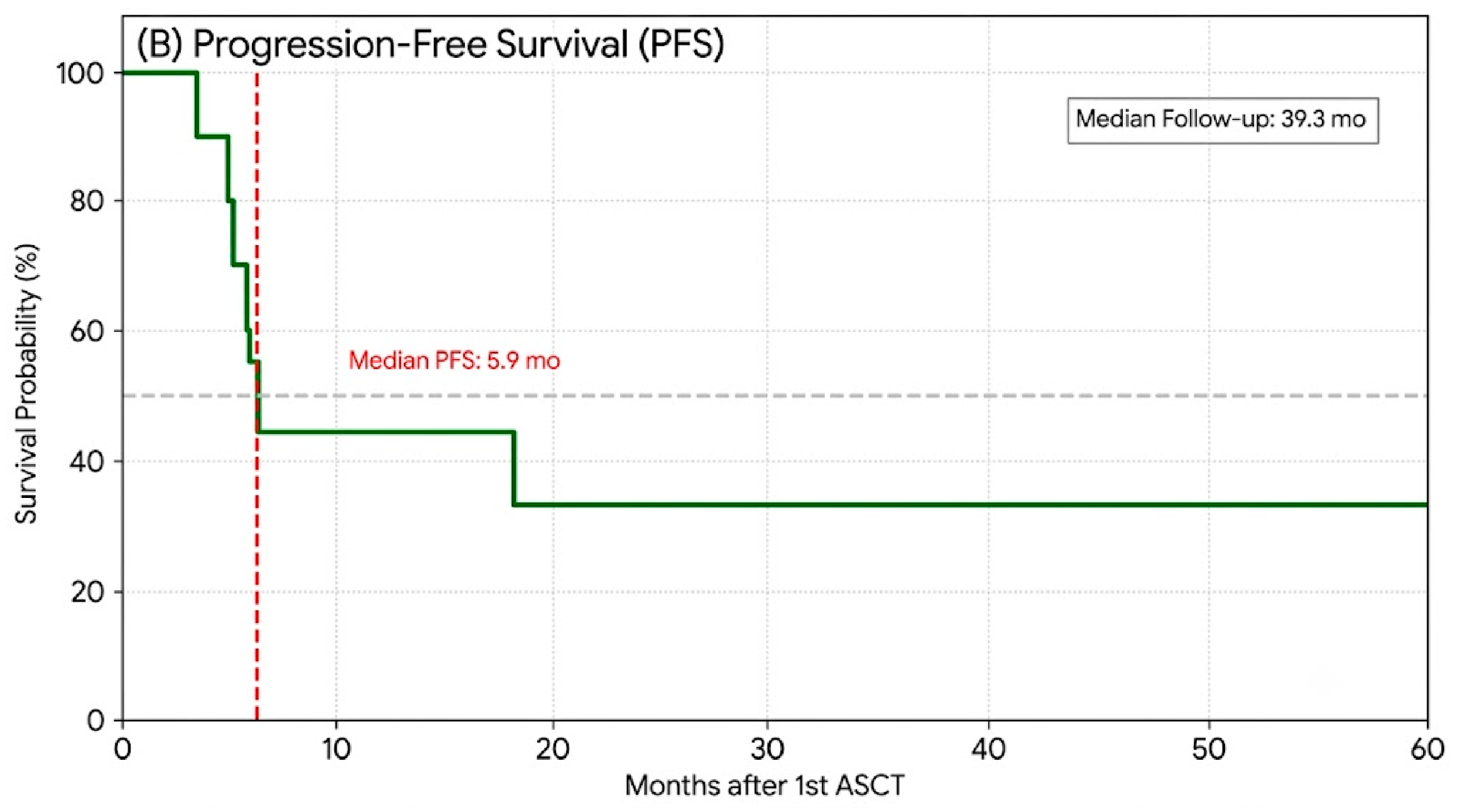
With a median follow-up period of 39.3 months for survivors, the OS was 8.4 months (95% CI: 4.2–12.6) and the median PFS was 5.9 months (95% CI: 2.1–9.7). These outcomes reflect the high-risk nature of a cohort heavily enriched with primary refractory cases.
The overall response rate (ORR) post-ASCT was 33.3% (n = 3), with all responders achieving a complete response (CR). Response assessment followed RECIST 1.1 criteria combined with serum tumor marker evaluation. A comparative analysis of tumor markers showed that while 6 (66.7%) patients had elevated markers pre-HDCT, 3 (33.3%) achieved full biochemical normalization post-tandem ASCT, corresponding to the observed CR rate.
Kaplan–Meier analysis (Figure 1A,B) showed 1-year OS and PFS rates of 44.4%. The survival curve reached a stable plateau after the initial 18-month period, with three patients remaining in durable long-term remission beyond 24 months. While this plateau suggests curative potential, the finding must be interpreted with caution due to the small number of surviving patients (number at risk = 3).
A descriptive stratified analysis was performed to evaluate the impact of pre-HDCT status. Notably, all patients who achieved long-term survival (n = 3) had demonstrated an objective response (CR or PR) to second-line salvage chemotherapy prior to HDCT. In contrast, none of the patients categorized as having progressive disease (PD) before transplantation survived beyond 6 months. This suggests that even within this high-risk cohort, response to prior salvage therapy remains a critical prognostic indicator for post-ASCT outcomes.

3.3. Safety and Engraftment

Haematopoietic recovery was consistent across both cycles. The mean time to neutrophil engraftment was 14 days for both Cycle 1 and Cycle 2. Platelet recovery (>20 × 109/L) was achieved on days 18 and 16, respectively.
The cumulative safety profile is detailed in Table 2. Grade 4 haematological toxicity was universal (100%). Febrile neutropenia occurred in 88.9% of cases and was managed using standard institutional antibiotic protocols. Gastrointestinal toxicities (mucositis and diarrhoea) of Grade 2–3 were frequent.
With regard to organ toxicity, grade 3–4 nephrotoxicity was observed in one patient (11.1%) during the second HDCT cycle, necessitating temporary haemodialysis. Most importantly, there was no treatment-related mortality (TRM = 0%), with all patients surviving the procedure. These findings demonstrate that tandem HDCT is a feasible approach with predictable and manageable toxicities, even in a high-risk, heavily pre-treated population.

4. Discussion

The management of R/R GCTs remains a clinical challenge, particularly in patients who show limited response to initial salvage chemotherapy. Our study confirms that the tandem HDCT approach, established by the SWENOTECA group, is a feasible and safe strategy even in a heavily pre-treated cohort.

4.1. Comparative Efficacy and Population Risk

Our observed 2-year OS rate of 33.3% is lower than the 63–66% reported by the Indiana University group [9]. However, this discrepancy is likely due to the high-risk nature of our small cohort: 4 (44.4%) of our patients underwent ASCT with stable or progressive disease (SD/PD), whereas the best outcomes in the literature are typically seen in patients who are ‘platinum-sensitive’ or who are at least in partial remission before HDCT [14]. Nevertheless, the survival plateau observed by us at 24 months aligns with international data, suggesting that HDCT has curative potential in a subset of patients.
Our CR rate of 33.3% is consistent with several international reports, although it is at the lower end of the range seen in high-volume centres of excellence. For example, the landmark study by Einhorn et al., which used tandem HDCT as a second-line or later salvage treatment, reported a long-term remission rate of around 60%. Similarly, the TICE protocol (paclitaxel, ifosfamide, followed by high-dose carboplatin and etoposide) has demonstrated impressive durable response rates.
The discrepancy between our results and those of these major trials is likely due to the high proportion of patients with primary refractory disease in our cohort. Specifically, over 55% of our patients exhibited PD during or immediately after first-line BEP therapy. According to the IPFSG criteria, these patients are categorised as high or very high risk, with significantly compromised survival outcomes regardless of the salvage strategy employed.
Compared to conventional-dose salvage regimens such as TIP or VeIP, which often show limited efficacy in primary refractory cases, the tandem HDCT approach remains a preferred consolidation strategy. Furthermore, emerging strategies, including immunotherapy (e.g., PD-1 inhibitors) and targeted therapies, have thus far shown disappointing results in GCTs, reinforcing the role of HDCT as the current standard of care for high-risk relapsed/refractory patients.”

4.2. The Safety of the Tandem Approach

The most striking finding of our study is the absence of TRM. In larger multicentre series, TRM for HDCT typically ranges from 3.5% to 7% [15,16]. Our results demonstrate that, with rigorous supportive care and a multidisciplinary team, significant toxicities associated with high-dose carboplatin and thiotepa (including febrile neutropenia and mucositis) can be effectively mitigated. The stability of engraftment between the first and second cycles also suggests that the initial high-dose burst does not cause prohibitively severe damage to the bone marrow microenvironment.

4.3. Biological Rationale for Tandem Transplantation and Future Trends (The TIGER Trial) [17]

The choice of a tandem transplant approach, as recommended by the SWE-NOTECA guidelines and adopted at our centre, is based on the principle of maximising the cumulative dose of platinum agents while enabling haematological recovery between cycles. This ‘dose-intensive’ strategy is specifically designed to eradicate chemoresistant clones that might survive a single cycle of high-dose therapy. While newer protocols like SWENOTECA VIII focus on Carboplatin and Etoposide, the SWENOTECA IV approach adopted here allows for a higher cumulative dose intensity of alkylating agents. This is particularly critical for the Bulgarian clinical context, where patients often present with advanced, heavily pre-treated, or primary refractory disease.”
However, the high mortality rate observed in our cohort (six out of nine patients) highlights that even the most intensive consolidation therapy cannot always overcome the aggressive biology of primary refractory germ cell tumours (GCTs). A key point of current debate is the optimal number of HDCT cycles. While our institutional protocol utilises a tandem (two-cycle) approach, the international community is closely monitoring the ongoing Phase III TIGER trial. This trial is evaluating a three-cycle TI-CE (paclitaxel, ifosfamide, carboplatin and etoposide) regimen as a first-line salvage treatment. While the three-cycle approach theoretically increases dose intensity, it also raises concerns regarding cumulative toxicity, the increased demand for CD34+ stem cells and longer hospital stays.
Our data show that the tandem approach provides a high yield of CD34+ cells and manageable toxicity, making it a viable option in real-world clinical settings. If the TIGER trial eventually demonstrates a significant survival advantage for three cycles of HDCT, a shift in international protocols may be warranted. However, for centres treating highly refractory patients with limited physiological reserves, the tandem approach remains a validated and potentially safer standard.

4.4. The Bulgarian Context and Single-Center Limitations

To our knowledge, this is one of the few reports detailing the use of tandem autologous stem cell transplantation (ASCT) for germ cell tumors (GCTs) in Eastern Europe. Implementing such protocols in Bulgaria presents unique challenges, including limited access to specialized salvage agents and the logistical complexities of cryopreserving stem cells for multiple cycles.
The recent findings from the SWENOTECA group [18] further support the clinical utility of tandem HDCT. Their large-scale data demonstrated that intensive consolidation significantly improves long-term outcomes in high-risk relapsed GCTs. Our single-center experience aligns with these benchmark results, showing that even in a very high-risk Eastern European cohort, the SWENOTECA IV protocol remains feasible and offers a chance for durable remission.
However, the primary limitations of this study are its retrospective nature and small sample size (n = 9), which inherently limit the scope of the statistical analysis. While the observation of a survival plateau after 18 months is encouraging, we emphasize extreme caution in its interpretation. As this finding is based on only three surviving patients, the statistical uncertainty remains high. Therefore, these results should be viewed as descriptive evidence of the feasibility and potential curative role of the tandem protocol in a real-world high-risk setting, rather than definitive proof of efficacy, which would require larger, multi-center prospective cohorts.

4.5. Future Directions

Moving forward, better patient selection is paramount. Emerging biomarkers, such as serum microRNA-371a-3p (miR-371) [19], may help clinicians to identify earlier those patients who are likely to fail conventional salvage therapy and who should be fast-tracked to HDCT. Additionally, exploring the role of novel agents or immunotherapy in combination with HDCT remains a promising area for clinical research in patients with platinum-refractory disease [20].

5. Conclusions

Tandem HDCT followed by ASCT is an intensive but safe salvage therapy for patients with recurrent or refractory germ cell tumours. The procedure is characterised by predictable toxicities and excellent haematopoietic recovery. Although long-term survival is lower in highly refractory cases, achieving a survival plateau confirms the curative potential of this treatment. Future results from the TIGER trial will clarify whether intensification to three cycles of HDCT and ASCT should become the new international standard.
In conclusion, our single-centre experience confirms that tandem HDCT with ASCT is a feasible and potentially curative salvage strategy for patients with relapsed or refractory germ cell tumours in Bulgaria. Despite the small cohort, the observed survival plateau after 24 months suggests that long-term remission can be achieved, even in patients who have undergone previous treatment. Future efforts should focus on the early identification of high-risk patients using molecular biomarkers, with the aim of optimising the timing of this intensive intervention.

Author Contributions

Conceptualization, K.K. and I.T.; methodology, I.T.; validation, K.V. and M.M.; formal analysis, K.K. and M.M.; investigation, M.M. and I.T.; resources, K.V. and A.B.; data curation, K.V.; writing—original draft preparation, K.K.; writing—review and editing, A.B. and G.M.; supervision, G.M. All authors have read and agreed to the published version of the manuscript.

Funding

This research received no external funding.

Institutional Review Board Statement

The study was conducted in accordance with the Declaration of Helsinki, and approved by the Ethics Committee for Scientific Research at the “Specialized Hospital for Active Treatment of Hematological Diseases” EAD (SBAHLZ EAD). (protocol code 13) on 17 February 2026.

Informed Consent Statement

Informed consent was obtained from all subjects involved in the study.

Data Availability Statement

The data presented in this study are available on request from the corresponding author. The data are not publicly available due to privacy.

Acknowledgments

The authors have reviewed and edited the output and take full responsibility for the content of this publication.

Conflicts of Interest

The authors declare no conflicts of interest.

Abbreviations

The following abbreviations are used in this manuscript:
ASCTAutologous Stem Cell Transplantation
BEPBleomycin, Etoposide, Platinum
CIBMTRCenter for International Blood and Marrow Transplant Research
CRComplete Response
CTCAECommon Terminology Criteria for Adverse Events
EBMTEuropean Society for Blood and Marrow Transplantation
EPEtoposide, Platinum
ESMOEuropean Society for Medical Oncology
GCTsGerm Cell Tumors
HDCTHigh-Dose Chemotherapy
HSCTHematopoietic Stem Cell Transplantation
IGCCCGInternational Germ Cell Consensus Classification
NCCNNational Comprehensive Cancer Network
ORROverall Response Rate
OSOverall Survival
PBSCPeripheral Blood Stem Cells
PEICisplatin, Etoposide, Ifosfamide
PFSProgression-Free Survival
PRPartial Response
R/RRelapsed or Refractory
SD/PDStable Disease/Progressive Disease
SHATHDSpecialized Hospital for Active Treatment of Hematological Diseases
SWENOTECASwedish–Norwegian Testicular Cancer Group
TI-CEPaclitaxel, Ifosfamide, Carboplatin, Etoposide
TIPPaclitaxel, Ifosfamide, Cisplatin
TRMTreatment-Related Mortality

References

  1. National Comprehensive Cancer Network (NCCN). Clinical Practice Guidelines in Oncology: Testicular Cancer, 1st ed.; NCCN: Plymouth Meeting, PA, USA, 2024. [Google Scholar]
  2. Oldenburg, J.; Fosså, S.D.; Nuver, J.; Heidenreich, A.; Schmoll, H.-J.; Bokemeyer, C.; Horwich, A.; Beyer, J.; Kataja, V. Testicular seminoma and non-seminoma: ESMO Clinical Practice Guidelines for diagnosis, treatment and follow-up. Ann. Oncol. 2013, 24, vi125–vi132. [Google Scholar] [CrossRef] [Scilit] [PubMed]
  3. Mead, G.; Stenning, S. The international germ cell consensus classification: A new prognostic factor-based staging classification for metastatic germ cell tumours. Clin. Oncol. 1997, 9, 207–209. [Google Scholar] [CrossRef] [Scilit]
  4. Gillessen, S.; Sauvé, N.; Collette, L.; Daugaard, G.; de Wit, R.; Albany, C.; Tryakin, A.; Fizazi, K.; Stahl, O.; Gietema, J.A.; et al. Predicting Outcomes in Men with Metastatic Nonseminomatous Germ Cell Tumors (NSGCT): Results from the IGCCCG Update Consortium. J. Clin. Oncol. 2021, 39, 1563–1574. [Google Scholar] [CrossRef] [Scilit]
  5. Bagrodia, A.; Haugnes, H.S.; Hellesnes, R.; Dabbas, M.; Millard, F.; Nappi, L.; Daneshmand, S.; Kollmannsberger, C.; Einhorn, L.H. Key Updates in Testicular Cancer: Optimizing Survivorship and Survival. Am. Soc. Clin. Oncol. Educ. Book 2025, 45, e472654. [Google Scholar] [CrossRef] [Scilit]
  6. Chevreau, C.; Thomas, F.; Couteau, C.; Dalenc, F.; Mourey, L.; Chatelut, E. Ototoxicity of High-Dose Carboplatin. J. Clin. Oncol. 2005, 23, 3649–3650. [Google Scholar] [CrossRef] [Scilit] [PubMed]
  7. Classen, J.; Schmidberger, H.; Meisner, C.; Souchon, R.; Sautter-Bihl, M.-L.; Sauer, R.; Weinknecht, S.; Köhrmann, K.-U.; Bamberg, M. Radiotherapy for Stages IIA/B Testicular Seminoma: Final Report of a Prospective Multicenter Clinical Trial. J. Clin. Oncol. 2003, 21, 1101–1106. [Google Scholar] [CrossRef] [Scilit] [PubMed]
  8. McHugh, D.J.; Feldman, D.R. Conventional-Dose versus High-Dose Chemotherapy for Relapsed Germ Cell Tumors. Adv. Urol. 2018, 2018, 7272541. [Google Scholar] [CrossRef] [Scilit] [PubMed]
  9. Adra, N.; Abonour, R.; Althouse, S.K.; Albany, C.; Hanna, N.H.; Einhorn, L.H. High-Dose Chemotherapy and Autologous Peripheral-Blood Stem-Cell Transplantation for Relapsed Metastatic Germ Cell Tumors: The Indiana University Experience. J. Clin. Oncol. 2017, 35, 1096–1102. [Google Scholar] [CrossRef] [Scilit] [PubMed]
  10. Kilari, D.; D’Souza, A.; Fraser, R.; Qayed, M.; Davila, O.; Agrawal, V.; Diaz, M.A.; Chhabra, S.; Cerny, J.; Copelan, E.; et al. Autologous Hematopoietic Cell Transplantation for Male Germ Cell Tumors: Improved Outcomes Over 3 Decades. Biol. Blood Marrow Transplant. 2019, 25, e207–e216. [Google Scholar] [CrossRef] [Scilit]
  11. Nichols, C.R.; Williams, S.D.; Haintz, M. High-dose chemotherapy with autologous bone marrow transplantation for relapsed testicular cancer. Semin Oncol. 1992, 19, 462–469. [Google Scholar]
  12. Haugnes, H.S.; Laurell, A.; Stierner, U.; Bremnes, R.M.; Dahl, O.; Cavallin-Ståhl, E.; Cohn-Cedermark, G. High-dose chemotherapy with autologous stem cell support in patients with metastatic non-seminomatous testicular cancer—A report from the Swedish Norwegian Testicular Cancer Group (SWENOTECA). Acta Oncol. 2011, 51, 168–176. [Google Scholar] [CrossRef] [Scilit] [PubMed]
  13. U.S. Department of Health and Human Services. Common Terminology Criteria for Adverse Events (CTCAE) Version 5.0. 27 November 2017. Available online: https://dctd.cancer.gov/research/ctep-trials/for-sites/adverse-events/ctcae-v5-8x11.pdf (accessed on 12 October 2025).
  14. The International Prognostic Factors Study Group Prognostic Factors in Patients with Metastatic Germ Cell Tumors Who Experienced Treatment Failure with Cisplatin-Based First-Line Chemotherapy. J. Clin. Oncol. 2010, 28, 4906–4911. [CrossRef] [Scilit] [PubMed]
  15. Zhang, H.; Alimohamed, N.S.; Basappa, N.S.; Cheng, T.; Chu, M.; Cox-Kennett, N.; Ernst, D.S.; Fontaine, A.; Ghosh, S.; Heng, D.Y.; et al. High-dose chemotherapy with autologous stem-cell transplantation for relapsed metastatic germ cell tumors. Can. Urol. Assoc. J. 2023, 18, E73–E79. [Google Scholar] [CrossRef] [Scilit] [PubMed]
  16. European Society for Blood and Marrow Transplantation (EBMT). High-Dose Chemotherapy with Autologous Stem Cell Transplants in Adult Primary Non-Seminoma Mediastinal Germ-Cell Tumors: A Report from the Cellular Therapy and Immunobiology Working Party (CTIWP); EBMT: Barcelona, Spain, 2024. [Google Scholar]
  17. Wallis, C.J.D. GSRGT 2020: Clinical Trials Corner: TIGER Trial. UroToday. Available online: https://www.urotoday.com/conference-highlights/gsrgt-2020/testicular-cancer/126584-gsrgt-2020-clinical-trials-corner-tiger-trial.html (accessed on 22 July 2025).
  18. Jansson, A.K.; Cohn-Cedermark, G.; Negaard, H.F.S.; Tandstad, T.; Ståhl, O.; Hedlund, A.; Karlsdottir, Å.; Hellström, M.; Langberg, C.W.; Sköld, C.; et al. High-dose chemotherapy in male germ cell cancer patients—A study by the SWENOTECA group. Br. J. Cancer 2026, 134, 746–753. [Google Scholar] [CrossRef] [Scilit] [PubMed]
  19. Dieckmann, K.P.; Radtke, A.; Geczi, L.; Matthies, C.; Anheuser, P.; Eckardt, U.; Sommer, J.; Zengerling, F.; Trenti, E.; Pichler, R.; et al. Serum Levels of MicroRNA-371a-3p (M371 Test) as a Biomarker for Testicular Germ Cell Tumors: Results of a Prospective Multicentric Study. J. Clin. Oncol. 2019, 37, 1412–1423. [Google Scholar] [CrossRef] [Scilit] [PubMed]
  20. Adra, N.; Einhorn, L.; Althouse, S.; Ammakkanavar, N.; Musapatika, D.; Albany, C.; Vaughn, D.; Hanna, N. Phase II trial of pembrolizumab in patients with platinum-refractory germ-cell tumors: A Hoosier Cancer Research Network Study. Ann. Oncol. 2017, 29, 209–214. [Google Scholar]
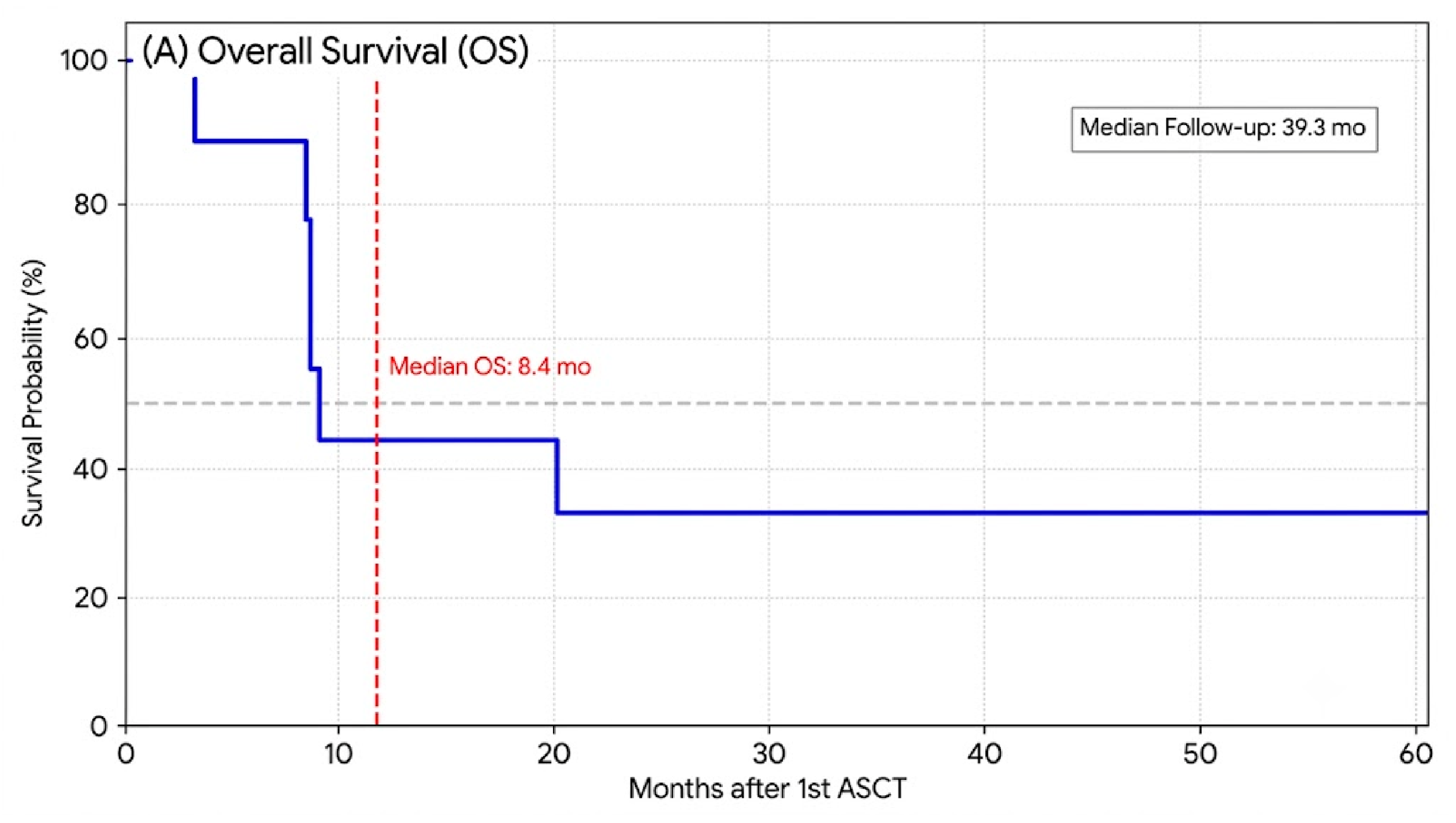
Figure 1. Survival analysis: (A) Overall Survival (OS) and (B) Progression-Free Survival (PFS) post-tandem ASCT. The solid lines (blue for OS, green for PFS) represent the Kaplan–Meier survival curves. The horizontal grey dashed line indicates the 50% survival reference threshold, and the vertical red dashed line marks the median survival point (8.4 months for OS and 5.9 months for PFS).
Uro 06 00020 g001aUro 06 00020 g001b
Table 1. Patient, Disease, and Treatment Characteristics (n = 9).
CharacteristicPatients (n)Percentage (%)
Baseline Disease Detail
Platinum Sensitivity
    Primary Refractory (Progression ≤4 weeks)777.7%
    Relapsed (>4 weeks)222.3%
IPFSG Risk Category at HDCT
    High/Very High Risk777.7%
    Intermediate Risk222.3%
Tumor Markers pre-HDCT
    Elevated (AFP and/or β-hCG)666.7%
    Normal333.3%
Treatment Characteristics
    First-Line Therapy (BEP/PEI)5/455.5%/44.5%
    Second-Line Therapy (TIP/PEI)8/188.8%/11.1%
    Mobilization Regimen (CT + G-CSF/G-CSF alone)7/277.7%/22.3%
Response Assessment
Response after 1st Line Therapy
    Objective Response (CR + PR)222.3%
    Refractory Disease (SD + PD)777.7%
Response before HSCT (after Salvage)
    Objective Response (CR + PR)555.5%
    Stable Disease (SD)333.3%
    Progressive Disease (PD)111.1%
Final Response after Tandem HSCT
    Complete Response (CR)333.3%
    Progressive Disease (PD)555.5%
    Not Accessible (NA)111.1%
Table 2. Cumulative Adverse Events observed during the first and second ASCT cycles (n = 9).
Adverse EventAll Grades, n (%)Grade 3–4, n (%)
Gastrointestinal (GI)
    Mucositis9 (100%)2 (22.2%)
    Nausea/Vomiting9 (100%)2 (22.2%)
    Erosive gastritis2 (22.2%)1 (11.1%)
    Toxic colitis1 (11.1%)1 (11.1%)
Systemic & Organ Toxicities
    Febrile neutropenia8 (88.9%)1 (11.1%)
    Infections7 (77.8%)2 (22.2%)
    Hepatotoxicity2 (22.2%)0 (0%)
    Nephrotoxicity2 (22.2%)1 (11.1%)
Disclaimer/Publisher’s Note: The statements, opinions and data contained in all publications are solely those of the individual author(s) and contributor(s) and not of MDPI and/or the editor(s). MDPI and/or the editor(s) disclaim responsibility for any injury to people or property resulting from any ideas, methods, instructions or products referred to in the content.