Review

Ribosomal Quality Control at the Crossroads of Proteostasis and Diseases: A Guardian and Potential Enabler of Malignant Adaptation

1
InventX Scientia, Anantnag 192101, India
2
Department of Urology, Post Graduate Institute of Medical Education and Research, Chandigarh 160012, India
*
Author to whom correspondence should be addressed.
Submission received: 17 November 2025 / Revised: 26 January 2026 / Accepted: 25 February 2026 / Published: 4 March 2026

Abstract

Cancer cells rely on elevated ribosomal biogenesis and protein synthesis to sustain their rapid proliferation. This heightened translational demand imposes significant stress on the fidelity of protein synthesis, thereby necessitating ribosomal quality control (RQC) activation, which safeguards proteostasis by degrading incomplete nascent polypeptide chains. At present, RQC is no longer only a peripheral pathway, it is a decisive arbiter of proteostasis whose malfunction rewires the course of cancer progression. Emerging evidence suggests that RQC factors can function as pro-tumorigenic or anti-tumorigenic in a context-dependent manner across different cancer types. This review highlights mechanistic models of how translation stalling, ribosome collision, and ribotoxic stress response influence neurodegeneration, tumor progression, metastasis, stemness, and drug resistance. By framing RQC as a critical regulator of cancer fate, we will identify verifiable and experimentally tractable hypotheses for therapeutic targeting and biomarker discovery in cancer.

1. Introduction

Translation is an essential energy-driven process, vital for proper functioning of the cells. This significant energy investment emphasizes the critical role of translational control, especially during cellular stress responses [1]. Ribosomes, the remarkable machinery that orchestrate translation, navigate the fidelity of the translational process at various steps [2]. Due to continuous demand of protein synthesis, ribosomes may slow down or get stalled, and present formidable challenges including long polyA sequences due to missing stop codons, altered polyadenylation patterns, damaged mRNAs, or complex higher-order mRNA structures [3]. These obstacles are further compounded by factors such as insufficient supplies of aminoacyl-tRNAs, inefficient termination, recycling of ribosomes, and environmental stresses during ribosomal stalling or collision [4,5,6,7,8].
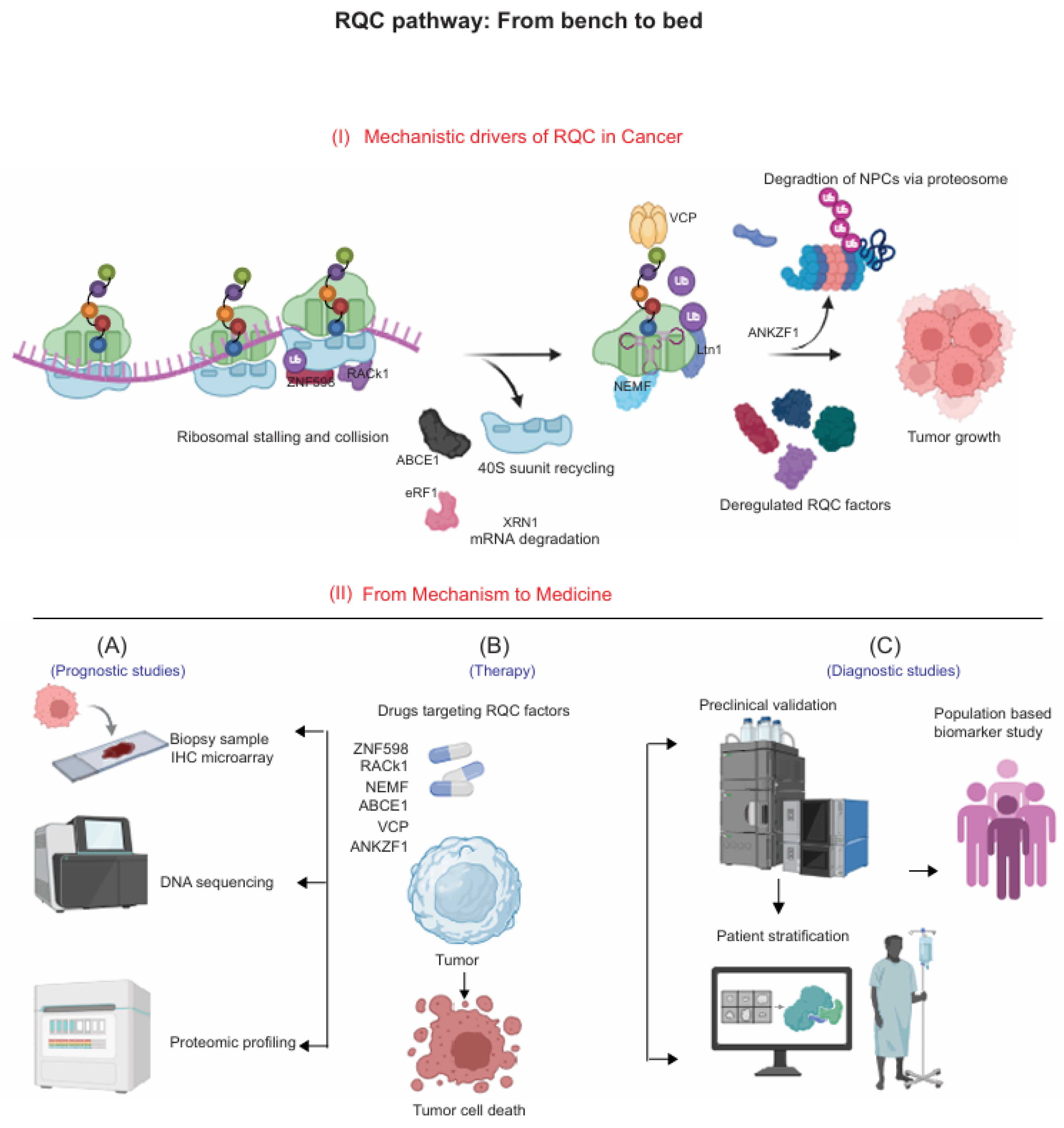
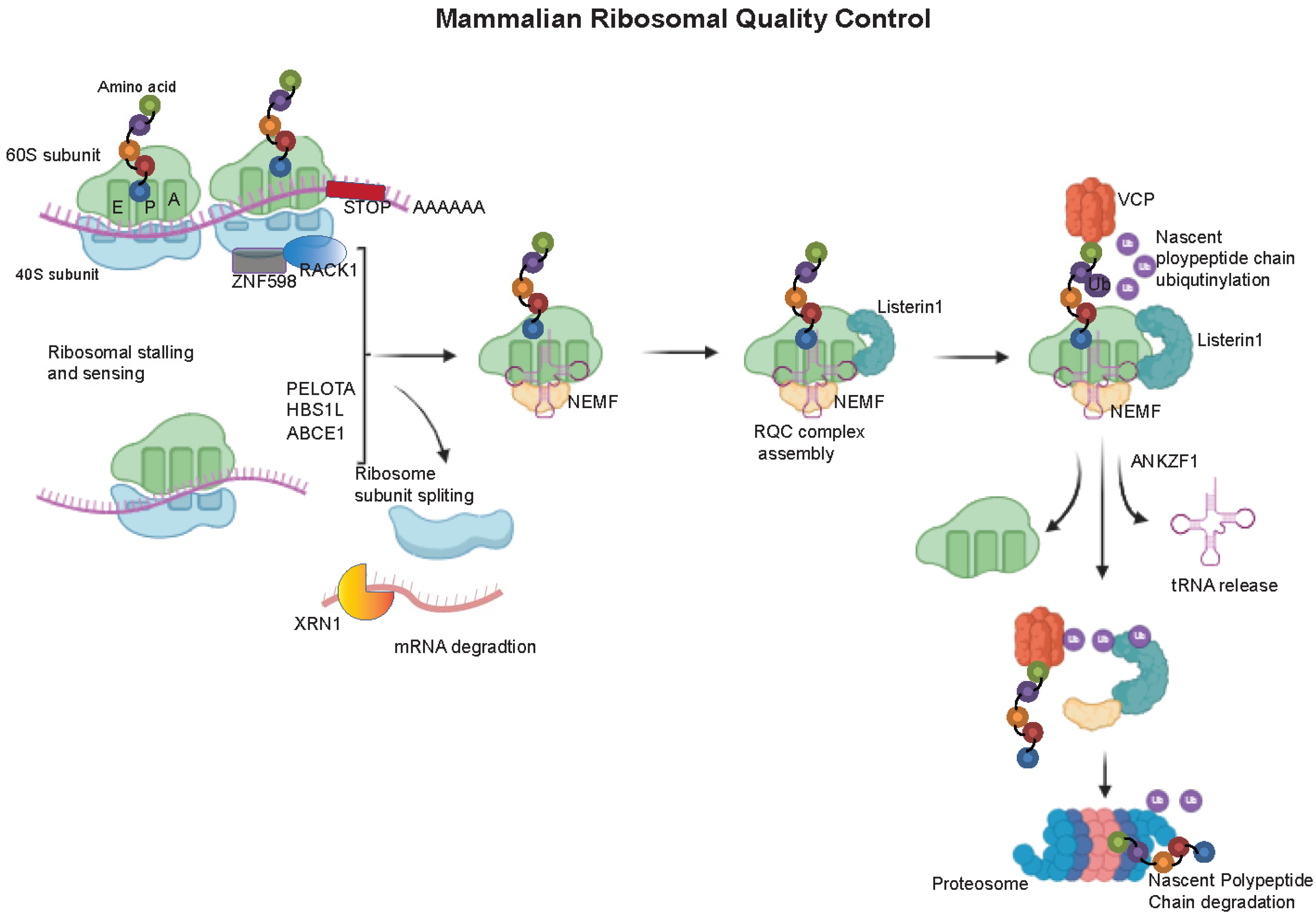
When ribosomes encounter stalling or collisions, cells recognize this event as a signal for abnormal translation. To prevent the accumulation of faulty or incomplete translational products, cells rapidly engage the ribosomal quality control (RQC) pathway, a highly conserved surveillance mechanism [9,10]. This pathway effectively detects and resolves ribosomal stalling events, ensuring the timely degradation of malfunctioned nascent polypeptide chains and facilitating the recycling of ribosomal subunits (Figure 1). To carry out these functions, it relies on a coordinated set of specialized factors, such as ZNF598, RACK1, NEMF, Listerin 1 (Ltn1), PELOTA, HBS1L, ABCE1, ANKZF1, and VCP. Among these factors, the early recognition of stalled ribosomes, primarily via sensing of ribosome collisions, where elongating ribosomes stack behind a stalled leading ribosome on the same mRNA, is a critical step in initiating the RQC pathway. This process is mediated by the pre-RQC complex, ZNF598 and RACK1, which work together to identify and target the unique interface presented by collided ribosomes. This recognition leads to the ubiquitination of specific 40S subunit proteins, including RPS10, RPS20, RPS2, and RPS3 [11,12]. The ASC-1 complex, including ASCC3, ASCC1, and ASCC2, plays a crucial role in disassembling the leading collided ribosome [13,14]. This disassembly process activates several downstream steps in the quality control mechanism. These steps include the splitting and recycling of ribosomal subunits by ABCE1 [15], modifications of nascent polypeptide chains (NPCs) still linked to the 60S subunit through a process known as C-terminal Ala and Thr addition (CAT-tailing) [16], and the release of NPCs from the 60S complex by ANKZF1 [17,18]. Although the exact physiological roles of CAT-tails are still being investigated, they are thought to have the potential to act as degrons, facilitating the degradation of faulty NPCs [19,20] or assisting in the ubiquitination of lysine residues housed within the ribosome exit channel through Ltn1 [15]. However, under conditions where RQC is compromised, excessive accumulation of CAT-tails can disrupt proteostasis due to their tendency to form detergent-insoluble protein aggregates [21,22]. In parallel, stalled and collided ribosomes induce translational dysfunction and serve as potent activators of other cellular stress pathways. One such critical pathway is the Integrated Stress Response (ISR), a conserved signaling network that regulates global protein synthesis and restores homeostasis under various stress conditions, including nutrient deprivation, oxidative stress, viral infection, and ER stress. Activation of the ISR involves phosphorylation of the eukaryotic initiation factor eIF2α by GCN2, PERK, HRI, and PKR, leading to inhibition of cap-dependent translation while selectively enhancing the translation of specific transcripts such as ATF4, which mediates adaptive gene expression programs. Recent studies have linked persistent ribosomal stalling and collision events to activation of the ISR, which senses aberrant ribosomal states as a signal of translational stress. This connection implies that unresolved ribosomal collisions not only impair proteostasis but may also lead to chronic ISR activation, tipping the balance from adaptive to death outcomes [23,24,25,26]. While significant progress has been made in structural aspects of individual RQC factors including their domains, binding partners, and catalytic motifs, the functional implications of these features in cancer remain largely unknown. To date, no comprehensive studies have examined whether these structural elements undergo cancer-associated mutations, post-translational modifications, or alterations in interaction networks that could modulate RQC activity in tumor cells. This review not only highlights existing knowledge but also pinpoints the unexplored intersections between RQC and tumor biology. For clarity, the review is organized by individual RQC factors, and under each factor, we discuss its binding partners, signaling networks, functional roles, and implications in cancer. Additionally, we underscore their therapeutic potential while emphasizing critical gaps, including the limited understanding of cancer-specific RQC mechanisms, their modulation by tumor micro-environmental stress, and the absence of selective clinical modulators. Lastly, we conclude this review by outlining actionable priorities such as integrating RQC profiling into precision oncology pipelines, identifying biomarker-guided patient stratifications, and developing combination strategies that exploit RQC vulnerabilities to transform cancer therapy.

2. ZNF598

2.1. Structure

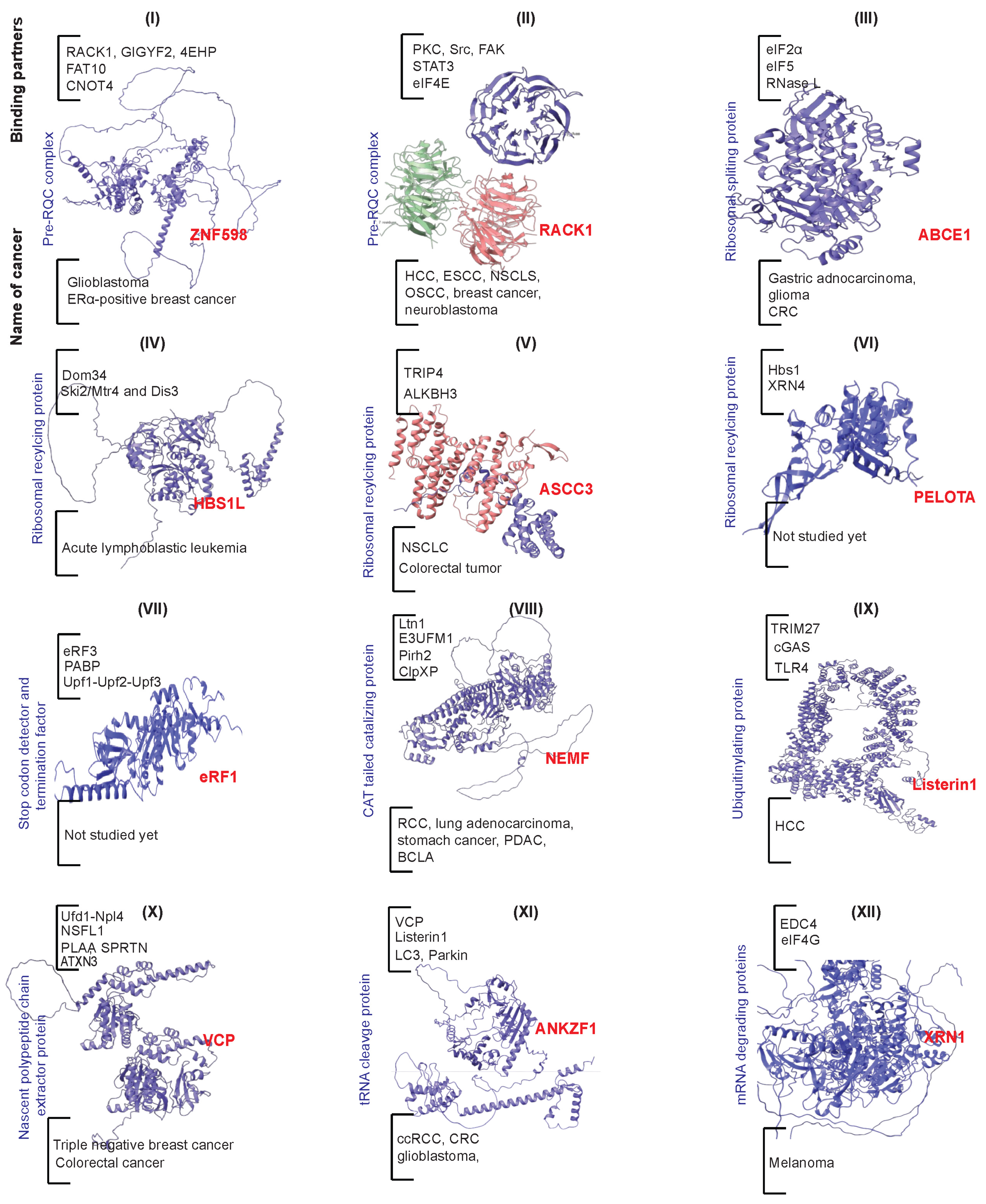
The Zinc Finger Protein 598 (ZNF598) comprises an N-terminal RING domain, three C2H2-type zinc finger domains, and a C-terminal proline-rich domain [27]. The RING and C2H2-ZnF domains are essential for ubiquitination. The C-terminal proline-rich domain appears dispensable for No-Go Decay (NGD) [28]. However, this domain is still essential for Listerin1 (Ltn1)-dependent ubiquitination and so for RQC. Therefore, ZNF598 appears responsible for independently activating both RQC and NGD [11,29]. This finding was validated by Simms et al., who demonstrated that ribosomal collisions also trigger NGD, suggesting a shared molecular signal between NGD and RQC. Furthermore, a study by Ikeuchi et al. provides strong evidence that ubiquitination of ribosomal proteins by ZNF598 is an early and essential step common to both NGD and RQC pathways, initiating divergent downstream responses to translation stalling. Future research should address how ZNF598 selectively supports RQC while being dispensable for NGD, and what factors dictate whether ZNF598-mediated ubiquitination drives NGD versus RQC. Mechanistically, when ribosomes encounter obstacles such as truncated mRNAs or poly (A) sequences, translation stalls. If a trailing ribosome identifies the stalling, a ribosome collision occurs. This collision forms a distinct interface between the leading and trailing 80S ribosomes, which creates a unique structural conformation. ZNF598 specifically recognizes this conformational change and binds to the 40S subunit of the stalled ribosome within the collided pair. Structural studies demonstrated that ZNF598 localizes near ribosomal proteins RPS20 and RPS10 sites that become spatially exposed or reoriented during ribosomal collision [27]. These conformational changes facilitate specific docking of ZNF598, which positions its RING E3 ligase domain to catalyze K63-linked ubiquitination of these ribosomal proteins. These observations point to ZNF598’s role as a sensor of ribosomal collision. Notably, monosome stalling is insufficient to activate ZNF598; instead, the collision-induced composite surface provides the structural cue for its recruitment. This allows the cell to distinguish between minor pauses in translation and more deleterious ribosomal traffic jams that require active resolution [30]. Defining the molecular thresholds that distinguish minor translational pauses from collision events sufficient to activate ZNF598, and understanding how these thresholds are altered in stress or disease contexts, such as cancer, could uncover novel therapeutic opportunities.

2.2. Binding Partners, Signaling, and Function

ZNF598 binds to collided ribosomes and ubiquitinates RPS3, RPS10 and RPS20 on the 40S subunit to signal ribosomal stalling. ZNF598 requires RACK1 for stable association with the ribosome. In mammals, ZNF598 works alongside NEMF, Ltn1, Pelota, and HBS1L. These are recruited downstream of ZNF598 activity to carry out nascent chain ubiquitination and ribosomal recycling. This modification is crucial for downstream ribosome disassembly and degradation of the aberrant nascent peptide [10]. In addition, ZNF598 binds with the GRB10-interacting GYF Protein 2 (GIGYF2) and eIF4E-homologous protein (4EHP) complex to repress translation of faulty mRNAs. This mechanism works via translation inhibition rather than degradation [31]. Apart from the RQC-associated conventional binding partners, an interesting study by Mah et al. demonstrated that FAT10 (UBD), an ubiquitin-like modifier, interacts with ZNF598. This interaction appears to influence ZNF598’s stability and function, potentially through FAT10-mediated modification and proteasomal targeting. By modulating ZNF598, FAT10 may affect downstream processes such as ribosomal ubiquitination and the resolution of stalled translation, which are crucial for antiviral responses. This regulatory axis adds another layer to the ZNF598 interaction network and its role in fine-tuning immune signaling, particularly in the context of interferon induction and viral defenses [32]. ZNF598 signaling sits at the heart of the RQC pathway, acting as a sensor and effector for the ribosomal collision cascade. Its function is not part of a classical linear signaling cascade like MAPK or Wnt, but rather it’s involved in a surveillance-signaling mechanism that detects and resolves translational stress on the ribosome. Recently, Geng et al. showed that ZNF598 is regulated through K63-linked ubiquitination mediated by CCR4-NOT transcription complex subunit 4 (CNOT4) during mitochondrial stress. Functionally, ZNF598 facilitates the resolution of stalled ribosomes and prevents the accumulation of aberrant translation products in an ubiquitination-dependent manner. Overexpression of ZNF598 reduces stalled translation on mitochondrial outer membrane-associated mRNAs, clears toxic proteins, and restores mitochondrial and tissue health [33]. These findings highlight ZNF598’s crucial role in maintaining mitochondrial homeostasis under stress conditions.

2.3. ZNF598 Role in Cancer

ZNF598 has emerged as a stress-responsive E3 ubiquitin ligase that may play a context-specific role in tumorigenesis. Treatment with 5-fluorouracil (5-FU) has been shown to trigger mTOR signaling, mRNA translation initiation, and ribosomal collisions. Impairment of RQC further potentiates 5FU-induced cell death. Notably, 5-FU enhances expression of key RQC factors ZNF598 and GIGYF2 through mTOR-dependent post-translational modifications. ZNF598 knockdown confers resistance to UV-induced apoptosis, indicating its role in pro-apoptotic stress signaling [34]. In another context, ZNF598 plays a key role in maintaining Myc protein levels. During translation of the N-terminal region of c-Myc, ribosomal stalling occurs, producing aberrant c-Myc species and triggering the recruitment of ZNF598 to resolve this stress and restore proper translation. ZNF598 is upregulated in human glioblastoma (GBM) and correlates with c-Myc expression. Loss of ZNF598 impairs GBM neurosphere formation and suppresses Myc-driven tumor growth in a Drosophila model [35]. These findings reveal ribosomal stalling during c-Myc translation as a cancer vulnerability and highlight RQC as a critical modulator of Myc-driven oncogenesis. This finding also supports a previously unknown role for ZNF598 in maintaining cancer stem cell properties and promoting tumor growth. Furthermore, a study by Ryder et al. identified that elevated levels of nitric oxide reduce translation, leading to ribosome stalling and activation of the ribotoxic stress response via leucine-zipper-containing kinase (ZAKα), along with ZNF598-mediated RPS10 ubiquitination and GCN2-driven integrated stress response in bone tumor cell line U2OS [36]. These findings highlight ZNF598 as a central node that integrates stress signals with translational control and oncogenic regulation. Another interesting research identified Growth Regulating Estrogen Receptor Binding 1 (GREB1), an estrogen receptor α (ERα)-inducible enzyme, catalyzes O-GlcNAcylation of ERα at residues T553/S554, which stabilizes ERα protein by inhibiting association with the ubiquitin ligase ZNF598 in human breast adenocarcinoma cell line MCF7. Loss of GREB1-dependent glycosylation leads to decreased ERα protein levels and diminished cellular responsiveness to estrogen. Clinically, elevated GREB1 expression in ERα-positive breast cancer correlates with improved survival in patients treated with tamoxifen, an ERα modulator [37]. These findings highlight ZNF598 as a critical ubiquitin ligase whose interaction with ERα is modulated by glycosylation, linking protein quality control with hormone receptor stability and breast cancer outcomes. Future research should explore the therapeutic potential of targeting ZNF598 and its downstream pathways in cancers characterized by translational deregulation or elevated cellular stress.

3. RACK 1

3.1. Structure

Human Receptor for Activated C-Kinase 1 (RACK1) is encoded by the gene GNB2L1, belonging to the tryptophan-aspartate repeat (WD-repeat) family of proteins, which shares significant homology with the β-subunit of G-proteins. Several structural studies of eukaryotic ribosomes have shown RACK1 to be ubiquitously present on the small subunit [38]. RACK1 lies at the outer edge of the 40S subunit head domain with several of its β-propellers facing outward to the cytosol, which allows it to bridge kinases and initiation factors to the ribosome. This position on the ribosome, close to the mRNA entry and exit tunnels, offers RACK1 the opportunity to interact with regulators of translation. Notably, RACK1 binding to the ribosome does not appear to be essential for ribosomal biogenesis or for maintaining the structural stability and integrity of the ribosome itself [38,39]. This is supported by studies demonstrating that ribosomes lacking RACK1 can still translate mRNAs efficiently. Rather than serving a structural role, RACK1 is proposed to function primarily as a scaffold protein that recruits regulatory factors to the ribosome or directs ribosomes to specific subcellular locations [40]. Despite its well-established role as a docking platform for E3 ligases and signaling molecules, an important unresolved question is whether RACK1 actively contributes to the detection of ribosomal stalling or functions solely as a passive scaffold. Another question remains: Does RACK1 undergo conformational changes or post-translational modifications in response to ribosomal stress? Additionally, whether RACK1’s interaction with specific mRNA-binding proteins or signaling kinases modulates its ability to participate in stalled ribosome detection remains to be fully elucidated.

3.2. Binding Partners, Signaling Network, and Function

RACK1 is a multifunctional scaffold protein that coordinates signals from various pathways to regulate essential processes like cell growth, transcription, protein synthesis, and neuronal activity [41]. Its seven WD40 repeats form a structure that provides multiple binding sites, allowing interactions with diverse signaling proteins, including kinases (e.g., Src, Fyn), dynamin, p120GAP, and PKC. This enables RACK1 to act as a central hub linking signaling to cellular function. RACK1 was originally identified as a receptor for activated protein kinase C (PKC), functioning to anchor PKC to specific subcellular locations and enhance its activity [42]. Additionally, RACK1 has been implicated in modulating the cAMP/PKA signaling pathway across various cancer types. The interaction of Src and RACK1 is mediated by the SH2 domain of Src and by phosphotyrosines in the sixth WD repeat of RACK1, and is enhanced by serum or platelet-derived growth factor stimulation, protein kinase C activation, and tyrosine phosphorylation of RACK1 in vitro and in vivo. This interaction occurs at the WD6 domain of RACK1, which remains accessible even when RACK1 is bound to the ribosome [43]. In addition, RACK1 functions as an adaptor protein that specifically mediates insulin and insulin-like growth factor 1 receptor (IGF-1R)-dependent activation of STAT3. Through N-terminal WD1-4 domains, RACK1 binds intracellularly with the insulin receptor (IR) and IGF-1R, with this interaction being enhanced upon ligand stimulation, while its association with STAT3 remains constitutive. In vitro assays using purified proteins demonstrate that RACK1 or its WD1-4 domain directly binds IR, IGF-1R, and STAT3. Insulin stimulation induces the formation of a multiprotein complex comprising RACK1, IR, and STAT3. Modulating RACK1 levels augmented IR/IGF-1R-dependent STAT3 activation and downstream target gene expression-overexpression enhances, whereas depletion diminishes, these effects. Moreover, site-specific IR and IGF-1R mutants defective in RACK1 binding fail to recruit and activate STAT3 and are unable to mediate insulin- or IGF-1-induced resistance to anoikis. Importantly, RACK1-dependent STAT3 activation plays a critical role in insulin- and IGF-1-driven anchorage-independent growth in ovarian cancer cells [44]. A study by Gallo et al. has shown that ribosome-bound RACK1 is critical for efficient translation of capped mRNAs and effective recruitment of eukaryotic initiation factor 4E (eIF4E). In vitro experiments demonstrated that supplementing RACK1-depleted ribosomes with wild-type RACK1 restores translational activity, whereas a ribosome-binding-deficient RACK1 mutant fails to do so. Notably, free RACK1, unbound to ribosomes, exhibits reduced stability and, when accumulated in cells, inhibits cell cycle progression and suppresses global translation [45]. These findings highlight ribosome-bound RACK1 as a key regulator of translation, potentially through its interactions with signaling molecules both on and off the ribosome.

3.3. RACK1 Role in Cancer

RACK1 regulates various cellular functions, including proliferation, adhesion, and migration in cancer cells [46]. Its role as a key signaling integrator is particularly evident in cancer, where RACK1 is emerging as both a prognostic biomarker and a potential therapeutic target. High RACK1 expression often correlates with poor prognosis, metastatic potential, and therapy resistance in various cancer types, including non-small cell lung cancer (NSCLS), pulmonary adenocarcinoma, hepatocellular carcinoma (HCC), glioma, esophageal squamous cell carcinoma (ESCC), and oral squamous cell carcinoma (OSCC) [47]. Ribosomal RACK1 undergoes extensive O-GlcNAc modification at Ser122, a post-translational modification that markedly enhances its protein stability, ribosome association, and interaction with PKCβII. This modification promotes eIF4E phosphorylation and consequently upregulates the translation of oncogenic mRNAs in hepatocellular carcinoma (HCC) cells. Genetic ablation of RACK1 O-GlcNAcylation at Ser122 significantly impaired tumorigenesis, angiogenesis, and metastasis both in vitro and in a diethylnitrosamine-induced HCC mouse model. Moreover, elevated RACK1 O-GlcNAcylation was shown in HCC patient samples, correlating strongly with tumor progression and post-chemotherapy recurrence [48]. The contribution of RACK1 to cancer progression is further highlighted in neuroblastoma, where it ranks among the top ten genes associated with poor disease survival. Depletion of RACK1 in neuroblastoma (in vitro) models showed significant impairment of cell proliferation, invasion, and migration [49], suggesting that targeting RACK1 could be a promising strategy for improving therapeutic outcomes in neuroblastoma. As a scaffold, RACK1 serves as a signaling hub that assembles and stabilizes various kinases, including PKC, Src, and FAK, in cancer-related signaling [41]. In breast cancer, RACK1 enhances cell motility via interaction with Ras homolog family member A (RhoA) and activation of the RhoA/Rho kinase signaling pathway. Silencing of RACK1 and pharmacological inhibition of Rho kinase impaired breast cancer migration. A total of 160 breast carcinoma samples showed strong correlations between RACK1 expression and RhoA levels. High RACK1 expression was also associated with poorer patient survival. These findings establish RACK1 as a prognostic factor in breast cancer [50]. Another study showed that RACK1 is required for the invasion and metastasis through modulation of Annexin 2 (Anxa2) phosphorylation at the Tyr23 position by Src kinase, highlighting RACK1/Src’s role in drug resistance and metastatic potential in breast cancer cells [51]. Similarly, another study on breast cancer showed RACK1’s requirement for cancer cell proliferation via RACK1-mediated β-catenin stability and activation of the WNT signaling pathway. Furthermore, PSMD2, a key component of the proteasome, has been found to be a novel binding partner for RACK1 and β-catenin. Collectively, these findings uncover a novel mechanism by which RACK1 increases β-catenin stability and promotes breast cancer progression [52]. Additionally, RACK1 has been demonstrated to act as a scaffold protein for Minichromosome Maintenance Complex Component 7 (MCM7)/AKT complex, promoting AKT-dependent phosphorylation of MCM7. This modification promotes MCM7’s association with chromatin and assembly of the MCM complex, thereby promoting DNA replication and cell proliferation. Overexpression of RACK1 strengthens the AKT-MCM7 interaction and accelerates cell cycle progression in non-small cell lung cancer [53]. In case of melanoma, RACK1 expression has been associated with cancer progression and is considered as a biomarker. In primary melanoma cells derived from Tyr::Rack1-HA, Tyr::NRasQ61K mice, RACK1 facilitates tumor development by reprogramming ERK, JNK, and STAT3 signaling pathways. These oncogenic interactions promote tumor progression, leading to accelerated aggressive melanoma development in vivo [54]. RACK1 expression correlates with poor prognosis and stem-like phenotype in breast cancer. Mechanistically, RACK1 stabilizes the E2F1 protein by preventing its ubiquitination, thereby enhancing SOX2 transcription and maintaining cancer stem cell properties. These findings reveal a novel oncogenic mechanism and suggest that targeting the RACK1-E2F1-SOX2 pathway may offer a promising strategy to combat breast cancer progression [55]. In ovarian cancer, RACK1 binds constitutively to STAT3 and is associated with insulin and IGF-1 receptors (IR/IGF-1R) via its N-terminal WD1-4 domains in a ligand-dependent manner. Silencing of RACK1 significantly alters IR/IGF-1R-mediated STAT3 activation, and thereby prevents anchorage-independent growth in ovarian cancer cells [44]. These findings highlight RACK1 as a critical adaptor enabling STAT3 activation by receptor tyrosine kinases in ovarian cancer. In osteosarcoma, higher expression of tripartite motif-containing protein 26 (TRIM26) is associated with improved patient prognosis. Functional studies demonstrate that TRIM26 suppresses cell proliferation and invasion by inhibiting the epithelial-mesenchymal transition (EMT) and MEK/ERK signaling. Mechanistically, TRIM26 directly interacts with RACK1 and promotes its proteasomal degradation. By targeting RACK1, TRIM26 effectively disrupts downstream signaling events that drive EMT and tumor progression. Collectively, these findings highlight a TRIM26-RACK1-MEK/ERK axis as a critical regulatory pathway in osteosarcoma malignancy [56]. RACK1’s regulatory role also extends into tumor immunology, as documented in B-cell biology. Zhang et al. identify RACK1 as a key regulator of B-cell development and function. Conditional deletion of RACK1 impairs B-cell maturation and reduces downstream signaling via BCR and TLR pathways through stabilization of Paired box 5 (Pax5) by preventing its ubiquitination. These findings highlight RACK1’s critical function in B-cell lineage progression [57]. Additionally, RACK1 has been demonstrated as a negative regulator of NF-κB signaling via binding with Inhibitor of κB Kinase (IKK) complex in a TNF-dependent manner. This interaction inhibits the recruitment of the IKK complex to Tumor Necrosis Factor Receptor-associated Factor 2 (TRAF2). This modulation provides new insights into the regulation of inflammatory responses [58]. Altogether, these findings show RACK1 as a multifaceted regulator of oncogenic signaling, immune function, and translational control. Its context-dependent roles across different cancer types and cellular systems underscore its potential as both a prognostic biomarker and a therapeutic target in cancer.

4. ANKZF1

4.1. Structure

Ankyrin Repeat and Zinc Finger Domain-Containing Protein 1 (ANKZF1) acts as a potential cofactor of the AAA-ATPase Cdc48 (VCP) and directly releases stalled nascent polypeptides from the 60S ribosomal subunit. Functionally, ANKZF1 operates as an endonuclease that cleaves the ester bond between peptidyl-tRNA and the nascent polypeptide chain within the 60S-RQC complex. Specifically, it targets the conserved CCA trinucleotide (positions 74–76) at the 3′ end of the tRNA, producing a tRNA fragment with a 2′, 3′-cyclic phosphate at the discriminator base (N73). This cleavage event serves dual functions; it releases aberrant nascent chains for proteasomal degradation and generates modified tRNAs. In the cytosol, recycling ANKZF1-cleaved tRNAs involves a two-step process, removing the 2′, 3′ cyclic phosphate and re-addition of the CCA sequence by the CCA-adding enzyme tRNA nucleotidyl transferase 1 (TRNT1) [59]. Genetic evidence further supports ANKZF1’s critical role in proteostasis. Loss of ANKZF1 leads to the accumulation of unresolved RQC substrates. Recent structural and biochemical studies have shown a shared mechanism between ANKZF1 and the translation termination factor eRF1 for hydrolyzing the peptidyl-tRNA bond [60]. Despite these advances, several key questions remain open. It is still unclear how ANKZF1 is selectively recruited to specific stalled ribosomes and what determines its substrate specificity in various cellular contexts. The structural basis of its interaction with 60S subunits and peptidyl-tRNA and the potential involvement of cofactors or regulatory post-translational modifications remain to be elucidated. Moreover, how ANKZF1 functionally coordinates with other RQC components, such as Ltn1, NEMF, and ZNF598 during ribosome rescue, and whether its activity is integrated with other stress response pathways like ISR, represent important directions for future research.

4.2. Binding Partners, Signaling Network, and Functions

ANKZF1 acts downstream of ribosomal stalling events to resolve stalled translation complexes and maintain protein homeostasis. ANKZF1 acts downstream of Listerin (Ltn1), an E3 ubiquitin ligase that ubiquitinates aberrant nascent chains on the 60S subunit, to release these ubiquitinated peptides from the ribosome [61]. ANKZF1 is not a classic signaling molecule like kinases or transcription factors, but it plays a key regulatory role at the intersection of translation stress, RQC, and proteostasis signaling. Its activity is triggered in response to ribosomal stalling, linking translation surveillance to broader stress signaling and cell fate decisions. Notably, ANKZF1 has been shown to be localized on mitochondria, and thus may influence mitochondrial stress signaling, especially during proteotoxic stress and oxidative damage [62]. A recent study by Ali et al. has identified that ANKZF1 is as a key regulator of PINK1-Parkin-dependent mitophagy. Notably, ANKZF1 recruitment on mitochondria was enhanced in Parkin overexpressing cells, and interacts with both Parkin and LC3 under stress conditions. ANKZF1 contains six predicted LC3-interacting region motifs, among which LIR4 (residues 333–336) is particularly critical for its interaction with LC3. Functional studies showed that ANKZF1-deficient cells exhibit impaired clearance of damaged mitochondria, indicating that ANKZF1 is essential for efficient mitophagy under stress [62]. There is limited but growing evidence that shows that prolonged ribosome stalling, if unresolved by ANKZF1, can lead to proteotoxic stress accumulation, activation of p53, and apoptosis induction. ANKZF1 may thus serve a gatekeeper function, determining whether cells recover from translational stress or undergo death.

4.3. Role of ANKZF1 in Cancer

ANKZF1 is essential for maintaining proteostasis under conditions of translational stress. A study by Miao et al. has shown that N-acetyltransferase 10 (NAT10) plays a critical role in promoting tumor progression and lymphangiogenesis in clear cell renal cell carcinoma (ccRCC), primarily through regulation of the ANKZF1-Yes1-associated transcriptional regulator (YAP1) signaling axis. Functional assays demonstrated that NAT10 facilitates the nuclear import of YAP1, thereby activating transcriptional programs linked to lymphangiogenesis. NAT10 enhanced ANKZF1 expression via ac4C-dependent mRNA stabilization. ANKZF1, in turn, interacted with YWHAE (14-3-3ε) to antagonize cytoplasmic sequestration of YAP1, enabling its nuclear translocation and transcriptional activation of pro-lymphangiogenic genes. Collectively, these findings demonstrated that the NAT10/ANKZF1/YAP1 axis drives lymphangiogenesis and tumor aggressiveness in ccRCC [63]. Zhang et al. showed that ZNF169 promotes cell proliferation in ccRCC via binding to the ANKZF1 promoter and activating its transcription. Importantly, elevated ANKZF1 expression was associated with poor prognosis in colorectal cancer (CRC) patients. Collectively, these findings identify the ZNF169/ANKZF1 axis as a novel regulatory pathway driving CRC cell growth and proliferation. Targeting this axis may offer a promising therapeutic strategy for CRC patients with high ZNF169 expression [64]. Another study demonstrated that ANKZF1 knockdown in glioblastoma cells led to mitochondrial accumulation of CAT-tailed proteins, triggering activation of the mitochondrial unfolded protein response and suppressing tumor progression. Excessive CAT-tail accumulation sequestered key mitochondrial chaperones (HSP60, mtHSP70) and proteases (LONP1), as well as respiratory chain components (ND1, Cytb, mtCO2, ATP6), ultimately disrupting oxidative phosphorylation, impairing mitochondrial membrane potential, and inducing apoptosis via the mitochondrial pathway [65]. These findings establish ANKZF1 as a critical regulator of mitochondrial proteostasis in glioblastoma and suggest that targeting ANKZF1 may offer a novel therapeutic strategy by disrupting mitochondrial quality control and inducing tumor cell vulnerability. The contribution of ANKZF1 to tumor development and therapy resistance is an emerging area of interest. However, there are several questions that need to be addressed regarding ANKZF1’s role in cancer. Therapeutically, targeting ANKZF1 is promising, but its essential role in RQC and proteostasis raises concerns about potential toxicity in normal tissues. Although ANKZF1 is known for its role in RQC, how this function intersects with its oncogenic roles in other compartments, such as the nucleus and mitochondria, remains unexplored. These gaps highlight the need for further research into how ANKZF1’s RQC activity is regulated independently of its cancer-promoting functions.

5. NEMF

5.1. Structure

The mammalian Nuclear Export Mediator Factor (NEMF) is a multi-domain protein of approximately 110–120 kDa, primarily localized in the cytoplasm, where it binds with the 60S ribosomal subunit. NEMF has four prominent domains: The N- and C-lobe connected by a coiled-coil to the middle (M) domain. NEMF is closely sandwiched between the P stalk of the ribosome, the sarcin–ricin loop (H95), and two N-terminal helices of Listerin (Ltn1). These interactions effectively oriented Ltn1’s N-terminal helix, comprising residues 13–27, to the 60S subunit. Once bound to the 60S subunit, NEMF promotes proteolytic tagging by stabilizing the binding of Ltn1 to the ribosomal complex. NEMF promotes nascent-chain proteolysis by modifying them with C-terminal peptides (“tails”), with diverse functions.

5.2. Binding Partners, Signaling Network, and Function

NEMF plays a scaffolding and organizing role in recognizing and processing stalled 60S ribosomes. Though not a classical signaling protein, NEMF is a vital hub in translation surveillance and proteostasis signaling. NEMF recruits and stabilizes Ltn1 on the 60S ribosomal subunit. Ltn1 ubiquitinates stalled nascent polypeptides emerging from the ribosome, marking them for proteasomal degradation [66]. Ltn1’s effective association with ribosomes depends on NEMF’s proper anchoring to the P-stalk and rRNA regions. NEMF binds directly to the 60S subunit and stalled peptidyl-tRNAs. It stabilizes the tRNA within the P-site, preventing premature subunit rejoining and facilitating downstream rescue.
NEMF helps prevent the accumulation of misfolded or stalled proteins by ensuring their ubiquitination and degradation. Failure of this system can lead to proteasome overload and unfolded protein response activation. While NEMF is cytoplasmic, it indirectly influences mitochondrial health by clearing aberrant nascent chains, including some destined for mitochondrial import, thereby preventing mitochondrial dysfunction. A study by Lv et al. uncovered a specialized, Listerin (Ltn1)-independent mitochondrial RQC pathway that ensures the quality control of stalled mitochondrial proteins. This pathway targets NEMF-mediated C-terminal poly-alanine (poly-Ala) extensions on stalled mitochondrial proteins. The cytosolic E3 ligase Pirh2 and the mitochondrial ClpXP protease collectively recognize and process these defective proteins. Disruption of this pathway leads to the accumulation of NEMF-driven protein aggregates, resulting in compromised mitochondrial integrity and underscoring the importance of this specialized RQC mechanism in maintaining mitochondrial function and preventing mitochondrial-related human diseases [67]. Another recent interesting study by Ennis et al. has uncovered a novel translocation-associated quality control (TAQC) pathway that resolves ribosome stalling during ER translocation. This study demonstrates that substrates translated from mRNAs containing ribosome-stalling poly (A) sequences are cleared through both lysosomal and proteasomal degradation pathways. Defective nascent chains produced from nonstop mRNAs are processed via ER-associated degradation (ERAD). This process involves ER-to-Golgi trafficking, KDEL receptor-mediated retrieval, and NEMF-dependent CAT-tailing, which adds aggregation-prone C-terminal extensions to mark stalled proteins for degradation. This study proposes that NEMF-mediated CAT-tailing directs a specific subset of TAQC substrates toward ERAD via Golgi retrieval, thereby playing a key role in protecting ER function and protein quality control. Structural analysis of ER-RQC intermediates by Penchev et al. has shown that the UFMylation and RQC machineries can bind simultaneously to the 60S ribosomal subunit. During peptidyl-tRNA arrest, NEMF forms a direct interaction with the UFM1 E3 ligase complex (E3UFM1) through its UFL1 subunit [68]. This coordinated binding occurs while the 60S subunit remains associated with the ER translocon. However, the recruitment of Ltn1 and degradation of the stalled nascent peptide require UFMylation-dependent release of the 60S from the translocon. These findings reveal a coordinated mechanism by which the UFMylation cycle regulates ER-RQC to ensure effective resolution of stalled translation at the ER. Another interesting study by Tesina et al. revealed that eIF5A is a critical RQC factor required for efficient peptidyl transfer. The study demonstrated dynamic conformations of RQC components and tRNAs, supporting a model in which CAT tailing proceeds processively without external energy input [69]. These findings highlight both unique and shared mechanistic features of CAT tailing compared to canonical translation. More studies are needed regarding the broader functional landscape of NEMF. Future studies could significantly advance our understanding of how NEMF contributes to cellular homeostasis and disease pathology.

5.3. NEMF Role in Cancer

The exact role of NEMF in cancer and its underlying mechanisms remain largely unexplored. To date, only one study [70] has reported that NEMF overexpression can suppress cell proliferation and migration by inhibiting the PI3K/mTOR signaling pathway, resulting in cell cycle arrest, supporting its potential function as a tumor suppressor in ovarian cancer. On the other hand, our unpublished data showed NEMF’s role in bladder cancer aggressiveness. Mechanistically, we have shown that blocking mitochondria-localized translation causes mitochondrial entrapment of key RQC components, ABCE1, ZNF598, and NEMF, leading to mitochondrial unfolded protein response and triggering apoptosis. These findings point to a role of NEMF in linking translational quality control to mitochondrial stress signaling and cell fate decisions. The discrepancies in NEMF’s role in cancer raise several key questions about the molecular cues governing its dual nature. The regulatory mechanisms for controlling NEMF expression in different tumors also remain unclear. Addressing these questions will be critical for understanding NEMF’s contribution to tumor pathology and its potential utility in cancer management.

6. ABCE1

6.1. Structure

The ABCE1 protein, a highly conserved ATP-binding cassette (ABC) enzyme, is pivotal in ribosomal recycling and translation initiation. It is found in many normal cells and organs, including testis, lung, PBMCs, spleen, placenta, and heart. ABCE1 uses ATP binding and hydrolysis in two conserved nucleotide-binding domains (NBDs) for mobility activity via accessory domains. ABCE1 has a distinct N-terminal FeS cluster domain with two diamagnetic [4Fe-4S]2+ clusters (FeS). The FeS cluster domain is responsible for ribosomal splitting in conjunction with the NBDs’ ATP-dependent mobility. NBD1 is distinguished from NBD2 by a unique helix-loop-helix (HLH) insertion. The two functionally asymmetric NBSs play unique functions during ribosomal recycling and can adopt numerous isoenergetic structural states. ABCE1 binds to terminated or stalled 80S ribosomes in the presence of eRF1 or Pelota, forming a pre-splitting complex. ABCE1 recycles conventional 80S post-termination complexes following stop codon-dependent termination and non-canonical post-termination complexes during mRNA monitoring. In both cases, a translational GTPase delivers a decoding A-site factor to the ribosomal A-site and forms an interaction platform for ABCE1 to establish the 80S pre-splitting complex. ABCE1 works with the A-site factor to divide the pre-splitting complex into small and large ribosomal subunits.

6.2. Binding Partners, Signaling Network, and Function

The ABCE1 protein is a highly conserved ATPase, integral to various stages of protein synthesis, including translation initiation, termination, and ribosome recycling. Beyond its canonical roles, ABCE1 interacts with multiple proteins, forming a complex signaling network that influences cellular homeostasis and stress responses. ABCE1 binds with eIF2α and eIF5 factors to form a pre-initiation complex, facilitating the assembly of the 43S pre-initiation complex essential for translation initiation. ABCE1 interacts with components of the eIF3 complex, aiding in the recruitment of the 40S ribosomal subunit and other initiation factors during the early stages of translation. ABCE1 associates with the small ribosomal subunit, playing a crucial role in ribosome recycling by facilitating the dissociation of post-termination ribosomal complexes. ABCE1 forms a heterodimer with RNase L to inhibit the interferon-dependent 2-5A/RNase L pathway, thereby regulating diverse biological processes such as viral infection, tumor cell proliferation, and resistance to apoptosis [71]. ABCE1 has also been shown to regulate long non-coding RNA (lncRNAs). LncABCE1-5 was significantly downregulated in Idiopathic pulmonary fibrosis lung tissues compared to donor control. Functional assays showed that lncABCE1-5 silencing enhanced cell migration, apoptosis, and extracellular matrix protein expression, while its overexpression suppressed TGF-β-induced fibrogenesis in vitro and alleviated bleomycin-induced lung fibrosis in vivo. Furthermore, lncABCE1-5 binds to keratin 14 mRNA, reducing its stability and expression. Loss of lncABCE1-5 elevated krt14 levels, activating the mTOR/AKT signaling pathway [72]. Collectively, these findings underscore ABCE1’s multifaceted role as a central regulator of translation, immune signaling, and non-coding RNA-mediated gene expression, highlighting its therapeutic potential in fibrotic diseases and cancer.

6.3. ABCE1’s Role in Cancer

Functionally, ABCE1 has been implicated in promoting cancer cell proliferation, survival, and chemoresistance across various tumor types. In lung cancer, ectopic ABCE1 expression enhances clonogenicity and anchorage-independent growth via suppression of the tumor suppressor gene GADD45α [73]. In gastric adnocarcinoma, ABCE1 silencing markedly reduces cell proliferation, migration, and invasion, while also enhancing the sensitivity of cancer cells to paclitaxel and cisplatin. Interestingly, ABCE1 knockdown was also associated with the promotion of EMT, suggesting a complex role in tumor progression and therapy resistance [74]. In glioma, ABCE1 is significantly upregulated in tumor tissues and cell lines. Its inhibition not only reduces resistance to temozolomide in vitro and in vivo but also affects downstream signaling through the PI3K/Akt/NF-κB pathway. Taken together, these findings underscore the oncogenic potential of ABCE1 and support its candidacy as a promising therapeutic target across multiple cancer types, including lung cancer, gastric adenocarcinoma, and glioma [75]. ABCE1 contains two iron-sulfur (Fe-S) clusters that are essential for its function in ribosome dissociation and translation reinitiation. Interestingly, a study by Yu et al. has shown that Fe-S clusters are critical for ABCE1’s binding to β-actin. Overexpression of wild-type ABCE1 significantly enhanced cell proliferation, migration, and cytoskeletal polymerization; in contrast, deletion of the Fe-S clusters reversed these effects, indicating that these domains are indispensable for ABCE1-mediated tumor-promoting functions. This study highlights the crucial role of ABCE1’s Fe-S clusters as potential therapeutic targets to inhibit lung cancer metastasis [76]. In CRC, ABCE1 has been shown as a potential oncogenic driver. Silencing of ABCE1 has been shown to activate the p53 signaling pathway, reduce cell proliferation, suppress aerobic glycolysis, and induce apoptosis. These findings highlight ABCE1 as a promising biomarker and therapeutic target in CRC [77]. Further research is essential to delineate the conditions under which ABCE1 acts as an oncogene versus a tumor suppressor, which could inform therapeutic strategies targeting ABCE1 in a cancer-type-specific manner. Collectively, while ABCE1 has emerged as a compelling oncogenic factor in multiple cancers, current studies remain limited in scope and depth. Addressing these open questions could significantly enhance our understanding of ABCE1’s multifaceted roles in cancer biology and its potential for therapeutic exploitation.

7. Listerin

7.1. Structure

Listerin (Ltn1) is a RING finger E3 ubiquitin ligase. Ltn1 is a 180-kDa protein containing various HEAT repeats, a RING finger, and WD-domain-containing proteins and a DEAD-like helicase domain (RWD) that immediately precedes its C-terminal RING E3 ligase domain. Ltn1 exhibits minimal affinity for isolated 60S ribosomal subunits or intact ribosomes; its recruitment has been shown to be mediated by the NEMF M-domain, which anchors the N-terminus of Ltn1 [17]. This anchoring allows the RWD domain to sandwich between two ribosomal proteins, positioning the RING domain near the ribosomal exit tunnel. Most of Ltn1 makes limited or no direct contact with the 60S subunit. Together, NEMF and Ltn1 establish at least eight distinct contact points with the 60S subunit and associated peptidyl-tRNA. While each individual interaction is weak, collectively they form a stable complex that recognizes aberrant 60S subunits, prevents re-association with the 40S subunit, and strategically positions the Ltn1 RING domain to recruit E2-Ub conjugates and mediate ubiquitylation of the stalled nascent polypeptide chain [17].

7.2. Binding Partners, Signaling Network, and Function

The study by Qin et al. has shown that Ltn1 recruits TRIM27, which initiates K63-linked polyubiquitination of cyclic GMP-AMP synthase (cGAS), subsequently promoting its sorting and degradation on the endosome via an endosomal sorting complex required for transport (ESCRT)-dependent pathway. In Ltn1-deficient mice, there was a marked increase in neuroinflammation and more severe amylotrophic lateral sclerosis-related neurobehavioral symptoms. These findings highlight the importance of Ltn1 in maintaining cellular homeostasis by controlling cGAS degradation and suggest that targeting Ltn1 may offer a promising therapeutic approach to reduce inflammation [78]. Another recent study demonstrated the role of Ltn1 in modulating Alzheimer’s disease (AD) pathology. It has been shown that Ltn1 inhibits brain inflammation and cognitive decline. Microglia-specific Ltn1 knockout worsens cognitive deficits following extracellular Aβ or lipopolysaccharide (LPS) treatment. Further, it was shown that Ltn1 binds Toll-like receptor (TLR4) mRNA and promotes its IRE1α-dependent cleavage and degradation, thereby suppressing TLR4-mediated inflammatory signaling [79]. These findings establish Ltn1 as a key inhibitor of microglial inflammation and a promising therapeutic target for AD [67]. These findings position Ltn1 as a promising therapeutic target for conditions like ALS and Alzheimer’s disease. However, to fully understand the breadth of Ltn1’s biological roles, further research is needed to elucidate its detailed molecular mechanisms and expand its investigation across diverse pathological conditions and cellular stress.

7.3. Listerin’s Role in Cancer

Only limited studies have investigated the role of Ltn1 in cancer, leaving its contribution to tumorigenesis largely unclear. Peng et al. (2023) identified Ltn1 as a tumor suppressor in hepatocellular carcinoma (HCC) using an in vivo CRISPR knockout library screen [80]. The authors have shown that Ltn1 expression correlates with fair patient prognosis. Mechanistically, Ltn1 directly interacts and ubiquitinates Insulin-like growth factor 2 mRNA-binding protein 1 (IGF2BP1), an oncogenic RNA-binding protein that stabilizes transcripts like c-Myc and insulin growth factor 1 receptor (IGF-1R). By promoting IGF2BP1 degradation, Ltn1 downregulates these proliferative pathways [80]. These findings position Ltn1 as a key negative regulator of tumor growth in HCC and a potential therapeutic target. Further studies are needed to delineate its broader role in different cancer types.

8. ASCC3

8.1. Structure

The Activating Signal Cointegrator 1 Complex (ASC-1 complex), composed of ASCC1, ASCC2, ASCC3, and TRIP4, is a multifunctional regulatory complex involved in transcriptional coactivation, alkylation damage repair, and RQC. Within this complex, ASCC3 plays a central role, particularly through its long isoform, which possesses helicase activity, while the shorter isoform, lacking helicase domains, is more associated with transcriptional regulation. Structurally, ASCC3 contains distinct functional domains that underpin its activity in RQC. The N-terminal region (residues 1-207) is critical for its interaction with ASCC2. This interaction is essential for recruiting ASCC3 to sites of ribosome stalling or DNA damage. The central region contains two RecA-like helicase domains, which provide 3′–5′ ATP-dependent helicase activity. This core is essential for unwinding structured RNA or disassembling stalled ribosome-mRNA complexes during RQC. The C-terminal region is less well characterized but may facilitate additional protein–protein interactions or regulatory functions, potentially involving co-factors in RNA metabolism or translation surveillance. In the context of RQC, the ASC-1 complex is recruited on the collided ribosomes following ZNF598-mediated ubiquitination of stalled 40S subunits. ASCC2 recognizes these ubiquitin marks and recruits the helicase-active ASCC3 to the stalled translation machinery. ASCC3 then likely remodels ribonucleoprotein complexes or unwinds obstructive RNA structures to promote ribosome disassembly and recycling. This function is coordinated with other RQC components, including HBS1L and PELOTA. Loss or dysfunction of ASCC3 disrupts ribosome clearance and sensitizes cells to translation inhibitors, highlighting its essential role in maintaining translational homeostasis and cellular fitness, particularly in cancer cells.

8.2. Binding Partners, Signaling Network, and Function

ASCC3 plays a vital role in genome maintenance, gene expression processes, ribosome surveillance, and transcriptional regulation. As part of the RQC pathway, ASCC3 interacts with several proteins, including ASCC1, ASCC2, ASCC4, and ZNF598, facilitating the resolution of ribosomal collisions. It helps dissociate stalled ribosomal subunits, often in binding with eIF3j and ribosomal proteins such as RPS3 and RPL10, thereby maintaining translational fidelity under various stress conditions. ASCC3 also plays a critical role in DNA alkylation damage repair, where its helicase activity unwinds DNA to facilitate AlkB-mediated demethylation, ensuring genomic stability [81]. In another study by Jia et al. showed that Thyroid Hormone Receptor Interactor 4 (TRIP4) interacts with ASCC3 through a zinc finger domain and enhances its helicase activity by positioning an ASC-1 homology domain adjacent to ASCC3’s C-terminal helicase cassette to facilitate substrate engagement and promoting DNA exit. Notably, TRIP4 and the DNA/RNA dealkylase ALKBH3 bind to ASCC3 in a mutually exclusive manner, thereby directing ASCC3 toward distinct functional pathways [82]. Collectively, ASCC3 involvement in these interconnected networks highlights ASCC3 as a potential regulatory node at the interface of translation, DNA repair, and transcriptional responses.

8.3. ASCC3’s Role in Cancer

A recent study by Ao et al. (2024) [83] identified ASCC3 as a key driver of tumor progression and immune evasion in non-small cell lung cancer (NSCLC). ASCC3 is overexpressed in NSCLC and correlates with poor prognosis. Mechanistically, it stabilizes STAT3 via Cullin-associated and neddylation dissociated 1 (CAND1) recruitment, which inhibits ubiquitin-mediated degradation of STAT3, suppressing type I interferon responses and reducing immune cell infiltration. ASCC3 knockdown inhibited tumor growth and enhanced the efficacy of anti-PD1 immunotherapy, suggesting its potential as both a prognostic marker and therapeutic target in NSCLC. Another study by Jia et al. (2020) [84] sheds light on how cancer-associated mutations can impair DNA repair by disrupting the interaction between two key RQC proteins: ASCC2 and ASCC3. ASCC3 acts as a helicase that unwinds damaged DNA, allowing the repair enzyme AlkBH3 to remove harmful alkylation lesions. This process depends on a stable complex formed between ASCC3 and ASCC2, which regulates and activates ASCC3’s helicase function. The crystal structure of this complex showed that many of the amino acids at the interaction surface are highly conserved and frequently found to be mutated in cancer. These mutations weaken the ASCC2-ASCC3 interaction, likely preventing ASCC3 from being properly recruited to damage sites and limiting its ability to unwind DNA for repair. As a result, DNA damage may go unrepaired, leading to mutational accumulation and genomic instability. This study highlights a clear mechanistic link between cancer-associated mutations and defective DNA repair, providing insight into how disruptions in this pathway may contribute to tumor development. Another study by Dango et al. (2011) [81] demonstrated how ASCC3 plays a critical role in helping cancer cells repair alkylation-induced DNA damage. ASCC3 functions as a 3′ to 5′ DNA helicase and forms part of a repair complex with the demethylase ALKBH3. ASCC3 unwinds damaged double-stranded DNA in this interaction, allowing ALKBH3 to assess and demethylate alkylated bases on the single-stranded DNA. When ASCC3 or ALKBH3 is depleted, cells accumulate DNA lesions such as 3-methylcytosine, triggering DNA damage responses (like increased γH2A.X and 53BP1 foci) and reducing cell proliferation. This study highlights how ASCC3 supports genome stability by facilitating ALKBH3 function, particularly in tumor cells that rely on this repair mechanism to survive alkylation stress, underscoring its relevance in cancer biology. Another interesting study by Cao et al. (2025) [85] identified a p53-driven mechanism of chemoresistance involving a circular RNA, circASCC3, derived from the ASCC3 locus. Upon genotoxic stress, p53 promotes circASCC3 expression, stabilizing the RNA helicase DEAD-Box Helicase 5 (DDX5) by preventing degradation. Stabilized DDX5 resolves harmful R-loops, maintaining genomic stability under stress. Although circASCC3 has minimal effect under normal conditions, it significantly enhances cancer cell survival during chemotherapy. Clinically, higher circASCC3 levels are observed in colorectal tumors and correlate with poorer prognosis. Overall, this study pinpoints the p53–circASCC3–DDX5 axis as a key player in chemoresistance and a potential therapeutic target in colorectal tumor. Collectively, these studies underscore the dual roles of ASCC3, in both its linear and circular forms, in promoting tumor progression, impairing DNA repair, evading immune responses, and conferring chemoresistance. Given its central involvement in genomic stability and immune modulation, ASCC3 represents a promising biomarker and therapeutic target across various cancer types.

9. PELOTA

9.1. Structure

Pelota (PELO) is an mRNA surveillance factor involved in ribosomal recycling to ensure proper ribosome turnover after translation termination. PELO is a structurally conserved protein that exhibits significant similarity to eukaryotic release factor 1 (eRF1). Its eRF1-like domain is organized into three conserved segments: the N-terminal domain (NTD; eRF1-1), the central M domain (eRF1-2), and the C-terminal domain (eRF1-3). This domain organization allows PELO to structurally resemble eRF1 and engage stalled ribosomes in a similar manner [86]. The central M domain is responsible for binding the GTPase Hbs1, while the NTD contributes to substrate specificity and interactions with other components of the mRNA surveillance machinery. These domains are highly conserved across various species, underscoring PELO’s essential and evolutionarily conserved role in translational quality control. Importantly, mutations within the N-terminal region can impair PELO’s ability to bind ribosomes and mediate decay processes, potentially affecting its function in pathological conditions.

9.2. Binding Partners, Signaling Network, and Function

PELO forms a heterodimeric complex with the GTPase Hbs1 (Hsp70 subfamily B suppressor 1), acting as a central component of the NGD and NMD pathways. Upon detection of abnormal ribosomal stalling, the PELO-HBS1 complex initiates endonucleolytic cleavage of the defective mRNA. Following cleavage, the resulting 3′ RNA fragment is degraded by the 5′-3′ exonuclease XRN4, while the 5′ fragment is processed by a 3′-5′ exonuclease complex in a SKI2-dependent manner. A study by O’Connel et al. identified a novel human phenotype linked to a mutation in the Hbs1L gene, characterized by facial dysmorphism, severe growth restriction, hypotonia, developmental delay, and retinal pigmentary deposits [87]. These mutations led to reduced expression of HBS1L transcripts V1 and V2, with complete loss of Hbs1L protein in patient cells. Polysome profiling revealed abnormal 80S monosome accumulation and increased rRNA translation efficiency. Concomitantly, upregulation of mTOR and 4-EBP expression was also observed. Notably, PELO protein levels were depleted despite unchanged PELO mRNA [87]. This finding suggests that, beyond its canonical role in mRNA surveillance, PELO has also been implicated in several essential cellular and developmental processes, including regulation of the cell cycle, embryogenesis, meiosis, organismal growth, and maintenance of genomic integrity. Dysregulation of PELO or its cofactors may impair ribosomal homeostasis, contributing to diseases such as cancer and neurodegeneration, where abnormal translation or defective protein clearance is a hallmark.

9.3. PELOTA’s Role in Cancer

So far, no study has documented the role of PELO in cancer. However, considering its essential function in resolving ribosomal stalling, PELO may indirectly influence cancer by regulating cellular homeostasis and stress signaling pathways. Further research is needed to clarify PELO’s specific contributions to cancer, particularly in clinical settings, and to explore its potential as a therapeutic target.

10. VCP

10.1. Structure

The Valosin-Containing Protein (VCP), also known as p97, is a highly conserved member of the ATPase family, playing a central role in numerous cellular processes that require mechanical unfolding or disassembly of protein complexes. VCP regulates several quality control pathways, including RQC, mainly through acting as a ‘segregase’ to extract ubiquitinated proteins from protein complexes, as well as by functioning as a molecular chaperone to deliver targets for proteasomal degradation. Structurally, VCP consists of three main domains: an N-terminal domain (N-domain), a first ATPase domain (D1), and a second ATPase domain (D2). In the context of RQC, the N-domain is primarily involved in substrate recognition and interacts with various cofactors, such as Ufd1 and Npl4. The heterodimeric Ufd1–Npl4 complex acts as an ubiquitin-binding adaptor that specifically recognizes K48-linked polyubiquitin chains on stalled nascent polypeptides and facilitates their recruitment to the VCP for processing [88]. The D1 domain is essential for ATP binding and is crucial for the hexameric assembly of VCP, while the D2 domain provides the main mechanical force for substrate processing through ATP hydrolysis. The protein assembles into a homohexameric ring structure, with the D1 and D2 domains stacking to form two-tiered rings and a central pore through which substrates are threaded. VCP contains key functional motifs, including Walker A and B motifs in both D1 and D2 for ATP binding and hydrolysis, as well as arginine fingers that facilitate communication between subunits. Structural studies using cryo-electron microscopy and X-ray crystallography have revealed that VCP undergoes large conformational changes during its ATPase cycle, which are critical for its function. Through interactions with specific cofactors, VCP can also be directed to diverse cellular pathways, including protein degradation and membrane fusion.

10.2. Binding Partner, Signaling Network, and Function

VCP is a highly conserved and essential ATPase involved in numerous cellular processes through its role in protein quality control. In the RQC pathway, VCP helps to extract stalled nascent chains from 60S ribosomal subunits under translational stress. Acting as a molecular segregase, VCP recognizes and remodels ubiquitinated protein substrates, often targeting them for degradation via the ubiquitin–proteasome system or autophagolysosome. Its functional versatility is driven by its ability to interact with a wide range of binding partners that determine its localization, substrate specificity, and participation in distinct signaling pathways. Key VCP-binding partners include Ufd1-Npl4 complex, which facilitates the extraction of polyubiquitinated proteins. Other notable partners include NSFL1C (p47) and members of the UBX Domain Protein 10 (UBXN) protein family (such as UBXN1 and UBXN6), which regulate VCP’s roles in membrane fusion, trafficking, and autophagy. VCP also associates with Polylactic Acid (PLAA) and SprT-Like N-Terminal Domain (SPRTN) during DNA repair processes, and ASPL has been shown to regulate VCP oligomer disassembly. Additionally, its interaction with the deubiquitinase ATXN3 fine-tunes the processing of ubiquitinated substrates.
Functionally, VCP is a central player in several critical cellular networks. In ERAD, it removes misfolded proteins from the ER membrane for proteasomal degradation. It also plays a significant role in the DNA damage response, where it regulates the turnover of DNA repair proteins and chromatin dynamics. VCP contributes to autophagy and mitophagy by facilitating the clearance of protein aggregates and damaged organelles, often in coordination with ubiquitin-binding autophagy receptors such as p62/SQSTM1. Moreover, VCP is involved in regulating NF-κB signaling through stabilization of IκB kinase complexes and contributes to cell cycle progression by controlling the degradation of cyclins and other regulators. Due to its central role in maintaining cellular proteostasis and stress responses, dysregulation of VCP is implicated in several diseases, including neurodegenerative disorders like ALS and inclusion body myopathy, as well as in various cancers. Its enzymatic domains and functional flexibility make VCP an attractive target for therapeutic development in diseases characterized by protein misfolding and impaired proteostasis.

10.3. VCP Role in Cancer

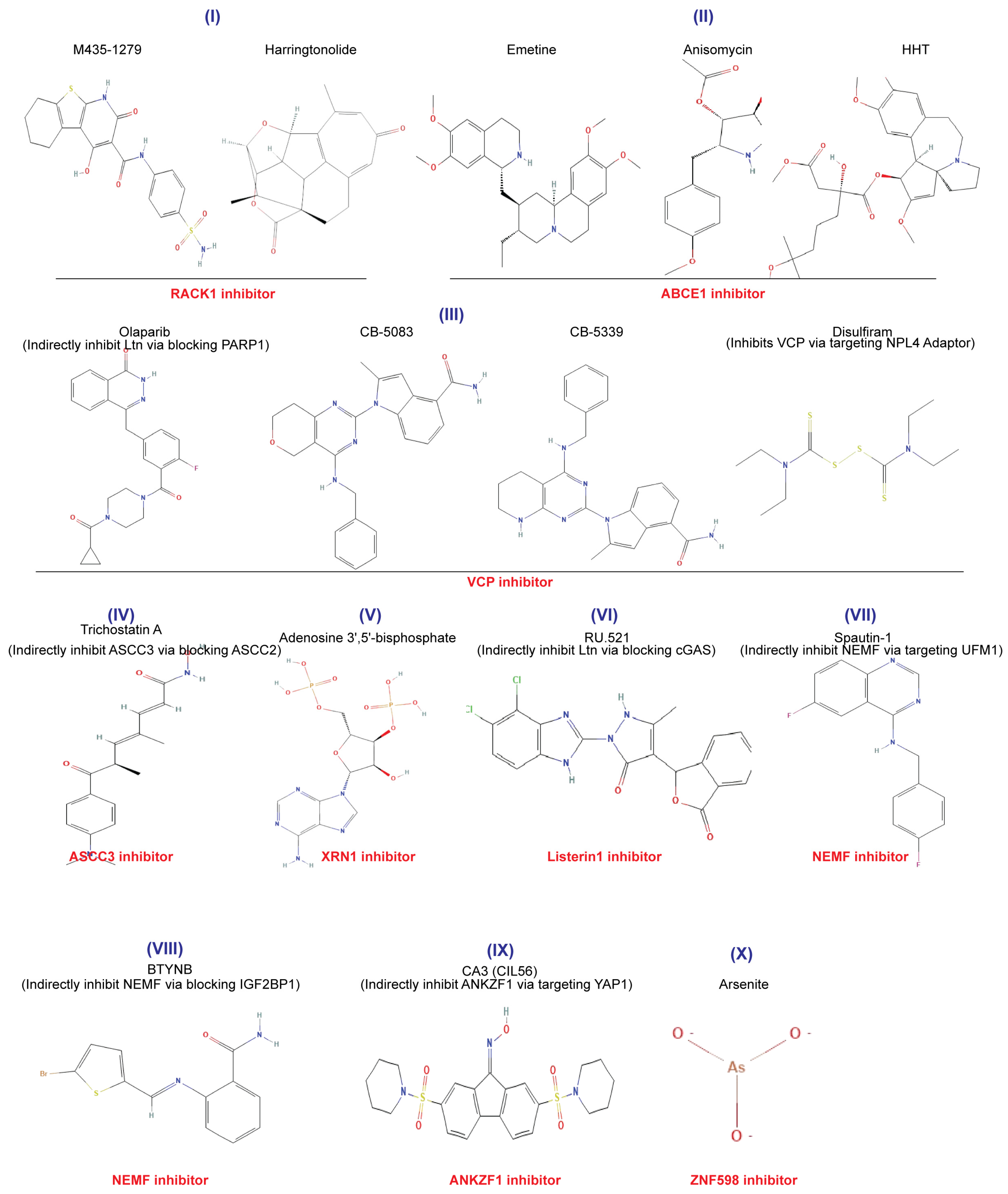
Beyond its well-established role in proteostasis, VCP has emerged as a potential anticancer drug target. A study by Parzych et al. demonstrated that cancer cell dependency on VCP for maintaining proteostasis was heightened under glucose and glutamine deprivation. This stress not only increases reliance on VCP function but also activates compensatory pathways to maintain cellular homeostasis. In this context, the amino acid-sensing kinase GCN2 mitigated stress responses and cell death induced by VCP inhibition and nutrient deprivation. GCN2 was also demonstrated to modulate ERK signaling, autophagy, and glycolytic metabolic flux. Collectively, these findings highlight an integrated role for VCP and GCN2 in coordinating metabolic and proteostatic adaptation in cancer cells [89]. In triple-negative breast cancer, TMEM63A (transmembrane protein 63A) is identified as a novel oncogene. TMEM63A localizes on the endoplasmic reticulum and lysosomal membranes, where it interacts with VCP and its cofactor derlin 1 (DERL1). TMEM63A is degraded via the autophagy receptor TOLLIP, but is stabilized by VCP, which prevents its lysosomal turnover. Importantly, pharmacological inhibition of VCP using CB-5083 or knockdown of DERL1 partially reverses the oncogenic effects of TMEM63A in both in vitro and in vivo models. Together, these findings uncover a previously unknown role of TMEM63A in triple negative breast cancer progression and suggest that targeting the TMEM63A-VCP-DERL1 axis may offer a novel therapeutic strategy in triple negative breast cancer [90]. Another interesting study by Wang et al. showed that VCP undergoes UFMylation at lysine 109 by the E3 ligase UFM1-specific ligase 1 (UFL1), promotes Beclin1 stabilization and facilitates assembly of the PtdIns3K complex via ataxin 3-mediated deubiquitination, thereby contributing to autophagy initiation. These findings highlight VCP UFMylation as a crucial regulator of autophagy initiation and a potential therapeutic target in diseases linked to autophagy dysfunction [91]. Poly (ADP-ribose) polymerase (PARP) inhibitors are effective against homologous recombination-deficient cancers by trapping PARP1 on chromatin. PARP1 has been shown to interact with VCP. Mechanistically, PARP1 is first SUMOylated by Protein Inhibitor of Activated STAT 4 (PIAS4) and then ubiquitylated by the SUMO-targeted E3 ligase RNF4, which facilitates VCP recruitment and subsequent removal of PARP1 from chromatin. Inhibition of the VCP complex by disulfiram prolonged PARP1 trapping on the chromosome and increased the cytotoxic effects of PARP inhibitors in homologous recombination-deficient cancer cells and patient-derived organoids. These findings establish VCP as a key regulator of chromatin-trapped PARP1 and a potential target to enhance PARP inhibitor efficacy in cancer therapy [92]. In colorectal cancer, XIAP-associated factor 1 (XAF1) has been shown to function as a novel adaptor for VCP, facilitating VCP-dependent deubiquitination of the E3 ligase RNF114. This, in turn, enhances RNF114-mediated K48-linked ubiquitination and degradation of junction plakoglobin (JUP), a protein known to suppress cell migration. Disruption of the XAF1-VCP-RNF114-JUP axis significantly impairs CRC cell migration and metastasis [93]. The VCP role has also been investigated in the cancer stem cell population. VCP expression positively correlates with histological grade, tumor size, and lymph node metastasis in breast cancer. VCP is highly expressed in CSC populations, and its levels are positively associated with SOX2, a key stemness factor. VCP inhibition activated the UPR pathway and various stemness regulators, including C/EBPδ, c-MYC, SOX2, and SKP2. In conclusion, VCP plays a central role in maintaining breast cancer stem cell integrity through regulation of ER proteostasis and UPR signaling [94]. Given its broad impact on tumor biology, VCP has emerged as a promising therapeutic target. Small-molecule VCP inhibitors, CB-5083 and CB-5339, which reached clinical trials by demonstrating effective anti-tumor activity across various tumor models, provide an effective alternative to targeting protein degradation for cancer therapy [95]. However, toxicity concerns and off-target effects have posed challenges in clinical translation. Ongoing efforts focus on developing selective VCP modulators and exploring combination strategies to enhance anticancer efficacy while minimizing adverse effects. Although numerous studies have highlighted the role of VCP in cancer progression via autophagy, our current review has focused on presenting a broader overview of the diverse signaling pathways involving VCP in cancer progression. Due to space constraints and the scope of this article, we were unable to include all relevant publications. We acknowledge the valuable contributions of many researchers in this field and apologize for any omissions.

11. HBS1L

11.1. Structure

HBS1-like translational GTPase (HBS1L) is a GTP-binding protein that plays a pivotal role in RQC by facilitating the rescue of stalled ribosomes. Structurally, HBS1L comprises a conserved GTPase domain, essential for its interaction with the ribosome and its function in translation surveillance pathways. This domain enables HBS1L to bind and hydrolyze GTP, a critical step in the disassembly of stalled ribosomal complexes. Additionally, HBS1L forms a complex with PELO to recognize and resolve translational stalling, thereby maintaining the fidelity of protein synthesis. Despite significant progress in understanding HBS1L’s function in ribosomal rescue, several open questions remain unanswered. One central area of inquiry is how HBS1L is specifically recruited to stalled ribosomes across different cellular contexts. The precise molecular cues and recognition mechanisms that guide its localization to translationally arrested complexes are not fully elucidated. Another unresolved question is whether additional, unidentified cofactors or signaling molecules exist that modulate HBS1L activity during ribosomal rescue.

11.2. Binding Partner, Signaling Network, and Function

HBS1L plays a critical role in maintaining translational fidelity and ribosomal homeostasis, particularly under stress conditions. It functions primarily in the ribosomal rescue pathway by recognizing stalled ribosomes and promoting their disassembly to sustain efficient protein synthesis. A key binding partner of HBS1L is PELOTA. Together, HBS1L and PELO form a functional complex where HBS1L provides the GTPase activity necessary for ribosomal splitting. This process is essential in mRNA surveillance pathways such as NGD and NMD, which target faulty mRNAs for degradation. In addition to PELO and ABCE1, HBS1L functions within a broader network that includes upstream ribosomal-collision sensors such as RACK1 and ZNF598. Overall, HBS1L serves as a key translational regulator and quality control factor essential for cellular adaptation to stress. Another study by Saita et al. demonstrates that unstable non-stop mRNAs are degraded in a translation-dependent manner. This decay process requires the HBS1, its partner Dom34, and components of the exosome-Ski complex, including Ski2/Mtr4 and Dis3, to mediate mRNA degradation [96]. Beyond its role in translation, genetic variations in the HBS1L gene have been linked to hematological traits, such as fetal hemoglobin levels and erythrocyte counts, indicating its broader significance in human physiology.

11.3. HBS1L Role in Cancer

While HBS1L’s well-established functions centre on RQC and mRNA surveillance, its potential involvement in cancer is only beginning to emerge. To date, only one study has reported an association between elevated HBS1L expression and unfavorable prognosis in acute lymphoblastic leukemia [97]. However, the mechanistic basis of HBS1L’s role in cancer remains largely unexplored. Further studies are needed to elucidate how HBS1L contributes to tumorigenesis and whether it plays a broader role across different cancer types.

12. eRF1

12.1. Structure

Eukaryotic release factor 1 (eRF1) comprises three domains: the N-terminal (N) domain, essential for stop-codon recognition; the middle (M) domain, which contains the highly conserved GGQ motif responsible for catalyzing peptide release; and the C-terminal (C) domain, which mediates interactions with the class-II release factor eRF3 and the ribosome recycling factor ABCE1. eRF1 is delivered to the ribosomal A-site as part of a ternary complex with the GTPase eRF3. Upon stop-codon recognition by eRF1, eRF3 hydrolyzes GTP to GDP and dissociates from the ribosome. eRF1 then adopts an extended conformation within the A-site, positioning its M domain’s GGQ motif into the peptidyl transferase center to facilitate peptide release. Following this, ABCE1 binds to the ribosome-eRF1 complex, further promotes peptide release, and initiates ribosome recycling through subunit dissociation [86,98]. Extensive biochemical and mutational studies have identified several conserved motifs within the N domain, specifically, the TAS-NIKS motif (residues 58–64), the GTS loop (residues 31–33), and the YxCxxxF motif (residues 125–131), as critical for stop-codon recognition.

12.2. Binding Partners, Signaling Network, and Function

eRF1 plays a central role in translation termination by functioning as a critical binding partner of eRF3. The interaction between eRF1 and eRF3 enhances the stability of GTP binding to eRF3 by facilitating the formation of a stable eRF1-eRF3-GTP ternary complex. Although not directly involved in stop codon recognition, eRF1 can associate indirectly with Poly (A)-Binding Protein (PABP) via eRF3, linking translation termination to mRNA deadenylation and decay. In addition, eRF1 is also implicated in the NMD pathway, where it transiently interacts with the Upf1-Upf2-Upf3 complex to facilitate the degradation of aberrant mRNAs. Through these interactions, eRF1 coordinates multiple processes beyond peptide release, integrating translation termination with ribosome recycling and mRNA surveillance mechanisms. Despite these critical functions, studies investigating the signaling roles and regulatory dynamics of eRF1 remain limited. The current understanding is largely structural and mechanistic, with minimal exploration into how eRF1 might be regulated under stress or pathological conditions. Given its central position at the interface of translation and mRNA quality control, eRF1 warrants deeper investigation as a potential node in stress signaling and disease progression, particularly in cancer and neurodegeneration.

12.3. eRF1 Role in Cancer

Given eRF1’s involvement in fundamental cellular processes such as ribosome recycling, mRNA surveillance, NMD, and translation termination, it is plausible that dysregulation of eRF1 function could impact oncogenic pathways. However, its contribution to tumor progression remains uncharacterized. This notable gap in the literature underscores the need for focused mechanistic studies to investigate whether and how eRF1 may influence cancer-related signaling networks. Uncovering such roles may reveal novel therapeutic vulnerabilities in malignancies where translational control is deregulated.

13. XRN1

13.1. Structure

Xrn1 is a large, evolutionarily conserved 5′–3′ exoribonuclease that plays a central role in cytoplasmic mRNA degradation. The human XRN1 protein is approximately 1706 amino acids long, with a molecular weight of ~194 kDa. Structurally, Xrn1 consists of several domains that coordinate RNA binding, catalysis, and interactions with other regulatory proteins. The N-terminal region (residues ~1–250) contains the highly conserved catalytic domain, known as the DEDD-type nuclease domain, which forms a deep groove accommodating the 5′-monophosphorylated RNA substrate, followed by a zinc finger domain that aids substrate binding and specificity. The central region includes additional exoribonuclease domains, contributing to its enzymatic activity. The C-terminal region, spanning roughly residues 1200–1706, is less conserved, highly disordered, and rich in short linear motifs (SLiMs) that mediate interactions with RNA decay machinery components, such as DCP1A/B and EDC4 in P-bodies. This C-terminal domain, unique to Xrn1 compared to Xrn2, facilitates protein-protein interactions critical for mRNA decay pathways, including decapping and deadenylation-dependent degradation. Structural studies, including cryo-EM data, reveal a compact active site with a winged-helix domain that enhances RNA threading. Xrn1 localizes primarily to the cytoplasm and P-bodies, with post-translational modifications like phosphorylation (~20 sites) and ubiquitination (~8 sites) regulating its stability and activity. Mutations or dysregulation of Xrn1 are associated with diseases like osteosarcoma and developmental disorders, highlighting its role in RNA homeostasis and cellular function.

13.2. Binding Partners, Signaling Network, and Function

Xrn1 plays a pivotal role in coordinating the expression of mRNAs encoding membrane proteins by promoting both their translation and localization to the endoplasmic reticulum, where membrane protein synthesis occurs. These mRNAs typically possess long, highly structured 5′UTRs that pose barriers to translation initiation. Xrn1 overcomes these challenges through a physical and functional interaction with the translation initiation factor eIF4G, facilitating efficient translation. Notably, the same group of mRNAs also shows strong dependence on Xrn1 for their transcription and decay, revealing a tightly linked regulatory network. This coordinated control of transcription, translation, and degradation by Xrn1 ensures balanced production of membrane proteins and may serve to prevent their toxic aggregation, thereby maintaining cellular homeostasis [99]. Another study demonstrates that the cytoplasmic 5′-3′ exoribonuclease Xrn1 in Saccharomyces cerevisiae acts as a NAD cap decapping (deNADding) enzyme, releasing intact NAD prior to RNA degradation. A deNADding-deficient Xrn1 mutant, retaining normal 5′-monophosphate exonuclease activity, reveals that Xrn1’s deNADding function is essential for proper growth on non-fermentable carbon sources and for regulating mitochondrial NAD-capped RNA levels. This activity may also influence mitochondrial NAD homeostasis. These findings highlight a previously unrecognized role of Xrn1 in linking RNA metabolism to cellular NAD regulation through its deNADding function [100]. The removal of the 5′ cap from mRNA by the decapping enzyme DCP2 triggers rapid 5′-3′ degradation by XRN1, indicating that these processes are tightly coordinated, though the precise mechanism has remained unclear. It has now been shown that XRN1 directly interacts with decapping activators, EDC4 in human cells and DCP1 in Drosophila melanogaster. In Drosophila, this interaction is mediated by the EVH1 domain of DCP1 and a conserved DCP1-binding motif (DBM) within the C-terminal region of XRN1. Structural analysis showed that the DBM binds to a conserved aromatic cleft in the EVH1 domain, a common site for recognizing proline-rich motifs. These findings uncover a direct molecular link between decapping and 5′-3′ exonucleolytic decay, positioning XRN1 as an integral component of the mRNA turnover machinery [101]. Based on the collective studies, XRN1 emerges as a multifaceted regulator of gene expression, extending beyond its canonical role in mRNA decay to actively coordinate transcription, translation, and RNA metabolism. These findings position XRN1 as a central hub linking RNA processing to protein synthesis and mitochondrial function, with potential implications for understanding stress responses and disease pathogenesis.

13.3. Xrn1 Role in Cancer

Recent CRISPR-based analysis identified XRN1 as a potential cancer target, particularly in certain non-small cell lung cancer cell lines, where its loss impairs proliferation, induces apoptosis, and activates innate immune sensors such as pPKR and MDA5. To advance XRN1 as a therapeutic target, researchers developed robust assays and characterized the non-selective nuclease inhibitor pAp as a nanomolar inhibitor, supported by a co-crystal structure showing its binding within the XRN1 active site, paving the way for the development of selective XRN1 inhibitors for cancer therapy [102]. Despite the success of immune checkpoint blockade therapy, its efficacy remains limited to a subset of patients. Accumulation of aberrant RNA can activate interferon (IFN) signaling and enhance immune responses, suggesting that disrupting RNA decay pathways could sensitize tumors to immunotherapy. In this context, XRN1 was identified as a promising therapeutic target by Ran et al. study. Silencing XRN1 enhanced the efficacy of immunotherapy in immunocompetent mouse models, but not in immunodeficient mice, underscoring the role of immune engagement. XRN1 depletion activated IFN signaling via RIG-I/MAVS-dependent sensing of aberrant RNAs, which was essential for the observed immune activation. Pan-cancer CRISPR screening further confirmed that XRN1 loss consistently triggers IFN signaling across various cancer types. These findings highlight the immunomodulatory role of XRN1 and provide a compelling rationale for targeting XRN1 in combination with immunotherapy to enhance antitumor immune responses [103].

14. Emerging Hypothesis and Research Gap

The RQC pathway in cancer not only maintains proteostasis but also actively rewires cellular signaling to promote immune evasion, chemotherapy resistance, and therapy failure. Hyperactivation or dysregulation of RQC factors drives selective stabilization of oncogenic or repair-promoting translation products, while accelerating the removal of immunogenic or pro-apoptotic nascent peptides. This tumor-specific “oncoselective” RQC is shaped by altered post-translational modifications, modified collision-recognition thresholds, and differential cofactor expression. Therapeutically, reversing this biased RQC should restore antigen presentation, increase proteotoxic stress, and sensitize tumors to chemotherapy and immunotherapy to overcome resistance.
Recent studies strongly implicate the critical role of RQC mechanisms that handle stalled ribosomes and ribosome collisions in the maintenance of proteostasis, and defects in these mechanisms can contribute to the pathogenesis of various diseases, from neurodegenerative diseases to cancer (Figure 2, Table 1). These studies have begun to offer new RQC-based strategies for treating major diseases. Our understanding of the mechanisms and function of RQC in mammalian systems remains fragmentary and far from complete, mainly because most of the initial studies of RQC were done in yeast and bacteria using artificial mRNA substrates. There is emerging evidence that mammalian RQC may deploy mechanisms distinct from those in yeast or bacteria. Further studies of RQC in mammalian systems will help address many unanswered questions, including but not limited to the following: (1) Do RQC factors work through similar mechanisms and pathways under pathological conditions as during RQC in normal cells? (2) How is RQC activity compartmentalized between cytosolic, ER-bound, and mitochondrial ribosomes, and how does this change during disease progression? (3) What are the upstream signaling cascades that regulate RQC in settings of neurodegeneration and oncogenesis? (4) What are the structural determinants of RQC components that confer disease-specific functions? (5) How do tumor-microenvironmental factors such as hypoxia, nutrient deprivation, inflammatory signals, and metabolic reprogramming influence RQC activity? (6) How do post-translational modifications such as ubiquitination, phosphorylation, SUMOylation, NEDDylation, and acetylation dynamically regulate RQC factor activity? (7) What are the consequences of chronic ribosome collisions in tissues with high translational demand, such as neurons, muscle, and proliferating tumor cells? (8) Can aberrant RQC generate defective ribosomal products (DRiPs) for alteration of antigen presentation and influence immune recognition of tumors? (9) Which RQC components or collision signatures could serve as non-invasive biomarkers for early disease detection or treatment response? (10) How can patient-specific defects in RQC be mapped and matched with tailored therapeutic strategies in cancer? (11) Can small molecules or gene therapies safely modulate RQC activity to restore proteostasis without causing its collapse? (12) Does RQC efficiency decline with age, and could enhancing RQC extend healthy lifespan or delay age-related diseases? Answers to these questions may lead to a new understanding of translational control mechanisms in proteostasis regulation under normal conditions and may offer new clues on how this fresh insight can be harnessed to combat major diseases.

15. Computational Modeling as an Emerging Lens for RQC-Cancer Mechanisms

Computational modeling has emerged as a pivotal tool in elucidating the intricate dynamics of the Ribosome-associated Quality Control (RQC) pathway, bridging molecular mechanisms with disease implications, particularly in cancer. Kinetic simulations of RQC factors, such as those employing stochastic modeling or ordinary differential equations, enable researchers to predict the temporal orchestration of events like Rqc2-mediated CAT tailing and Ltn1-dependent ubiquitination on stalled ribosomes, revealing rate-limiting steps and potential bottlenecks under proteotoxic stress. Complementarily, biophysical models of ribosome collisions, often utilizing molecular dynamics simulations or coarse-grained approaches, simulate the spatial and energetic consequences of queue formation on polysomes, quantifying how factors like ZNF598 and Hel2 sense and resolve these collisions to prevent aberrant protein synthesis. These computational methods provide in-depth insights into RQC dysregulation in cancer, where hyperactive translation in malignant cells exacerbates ribosome stalling; for instance, simulations have demonstrated how impaired RQC leads to accumulation of toxic protein aggregates that fuel genomic instability and oncogenic signaling, while also highlighting adaptive scenarios where cancer cells exploit partial RQC functionality to tolerate proteotoxic burdens, thereby promoting tumor progression and therapeutic resistance. By integrating experimental data with predictive modeling, these approaches not only decipher the mechanistic links between RQC perturbations and malignant adaptation but also guide the development of targeted interventions to restore proteostatic balance in diseased states.

16. RQC Pathways from Bench to Bed

RQC is increasingly being recognized as a critical driver of cancer biology, offering unique opportunities for therapeutic translation in cancer diagnosis, treatment, and overall disease management. One of the most direct applications lies in using these proteins as biomarkers for diagnosis and prognosis. For instance, elevated expression of ZNF598, ABCE1, or VCP in tumor tissues could reflect heightened adaptation to translational stress, a hallmark of aggressive cancers. These proteins could be measured using techniques like immunohistochemistry, RNA sequencing, or proteomic profiling of biopsy samples, helping stratify patients based on tumor biology. Moreover, many RQC components represent novel therapeutic targets (Figure 3). Compounds such as emetine, anisomycin, and homoharringtonine (HHT) inhibit translation elongation, thereby indirectly affecting RACK1 and ABCE1 function, while olaparib interferes with Ltn1 activity via PARP1 inhibition. VCP inhibitors, including CB-5083, CB-5339, and disulfiram, disrupt protein quality control and proteostasis, leading to cancer cell vulnerability. This approach is particularly promising in cancers with high translational demand, such as triple-negative breast cancer, bladder cancer, and multiple myeloma. Tumors with compromised NEMF function may be highly vulnerable to inhibitors of ABCE1 or VCP, leading to a collapse in proteostasis and selective tumor cell death, similar to how PARP inhibitors are used in BRCA-deficient cancers. Other agents, such as trichostatin A (ASCC3 inhibitor), BTYNB (IGF2BP1-mediated NEMF inhibition), CA3/CIL56 (YAP1-dependent ANKZF1 inhibition), and RU.521 (direct NEMF inhibitor), specifically modulate RQC effectors or their upstream regulators. ZNF598 can be suppressed by adenosine 3′,5′-bisphosphate, while harringtonolide blocks cGAS to indirectly inhibit Ltn1. These inhibitors, by targeting key translational surveillance and protein homeostasis pathways, represent a novel therapeutic frontier for selectively impairing cancer cell survival while sparing normal cells. Furthermore, RQC profiling may guide precision medicine approaches by informing treatment choices based on a patient’s tumor-specific expression of these factors. Combining RQC component inhibitor with chemotherapy or radiotherapy, which induces protein damage, may increase therapeutic effectiveness. Similarly, impairing protein quality control can augment immunotherapy responses by enhancing tumor antigen presentation. From a translational research perspective, this knowledge enables the development of diagnostics to guide the use of RQC-targeted therapies (Figure 4). Diagnostic kits using antibodies or transcript-level profiling could be integrated into clinical workflows to personalize treatment plans. Furthermore, in elderly cancer patients, who often have diminished proteostasis capacity, modulating RQC pathways could help reduce off-target toxicity and allow for dose-adjusted regimens that maintain efficacy with fewer side effects. Finally, a rational clinical implementation strategy would begin with preclinical validation in patient-derived cell cultures and animal models, followed by biomarker-based correlation studies using patient datasets like TCGA. In the bench-to-bedside framework, repurposing FDA-approved drugs that modulate RQC components offers a time- and cost-efficient strategy for preclinical validation, accelerating the path toward clinical application while minimizing developmental risks. However, extensive preclinical validation is still required to establish the safety and efficacy of FDA-approved drugs for repurposing. Proof-of-concept studies should be expanded, and comprehensive pharmacokinetic and pharmacodynamic evaluations must be undertaken before considering RQC-targeting drugs for human clinical trials and eventual clinical application.
From a translational perspective, this mechanistic insight enables a pipeline from “bench to bedside” encompassing biomarker discovery through proteomic profiling, immune-histochemistry, and patient stratification studies, functional validation in preclinical cancer models, and the development of small-molecule inhibitors targeting key RQC proteins. Ultimately, integrating prognostic, diagnostic, and therapeutic applications of RQC modulation could transform these molecular mechanisms into precision oncology interventions, paving the way for first-in-class RQC-targeting drugs in the clinic. Importantly, RQC research in cancer remains at an early and largely descriptive stage, with no systems-level framework currently available to define its integration with other cellular quality control pathways. While individual core RQC factors have been implicated in cancer progression, how RQC functions as a coordinated regulatory network in tumor cells remains unexplored. Addressing this gap will be essential for establishing the global role of RQC in cancer and its potential therapeutic relevance.

17. Conclusions

The RQC pathway is an emerging pivotal regulatory mechanism in cancer biology, highlighting the connection between protein translation accuracy, cellular stress responses, and tumor progression. Dysregulation of RQC components plays a significant role in various cancer types, contributing to processes like oncogenic transformation, resistance to stress-induced apoptosis, and adaptation to proteotoxic environments. Additionally, several RQC factors actively modulate critical signaling pathways, including the integrated stress response, unfolded protein response, and DNA damage response. Recognizing that cancer cells often exploit translational reprogramming to sustain growth and evade immune detection, targeting components of the RQC machinery holds potential to be a game changer in precision oncology, offering a new dimension to therapeutic management in cancer treatment. By mapping the tumor-specific dependencies within translational surveillance and proteostasis networks, RQC research may facilitate the way for innovative therapeutic strategies that selectively target cancer cells while minimizing harm to normal tissues. Although emerging studies suggest a potential role for RQC in cancer adaptation to translational stress, this field remains largely exploratory. Direct mechanistic evidence linking RQC to cancer stem cell maintenance is currently lacking, underscoring the need for future studies to determine whether RQC pathways contribute to CSC-driven therapy resistance and disease recurrence. Moreover, a comprehensive systems-level understanding of how RQC integrates with tumor progression and microenvironmental stress remains to be established. The identification of druggable RQC components and their integration as biomarkers can refine patient stratification, guide treatment selection, and enable dynamic monitoring of therapeutic responses. Furthermore, the strategic use of both novel agents and repurposed FDA-approved drugs targeting RQC pathways can expedite clinical translation, reduce developmental costs, and overcome treatment resistance. With continued mechanistic and preclinical validation, RQC-targeted interventions have the potential to significantly uplift therapeutic management, offering more effective, personalized, and durable outcomes in cancer treatment.

Author Contributions

Conceptualization, R.O.; methodology, R.O. and I.T.; software, R.O. and I.T., validation, R.O. and I.T.; formal analysis, R.O. and I.T. investigation, R.O. and I.T.; resources, R.O.; data curation, R.O.; writing— R.O. and I.T.; writing—review and editing, R.O. and I.T.; visualization, R.O. and I.T.; supervision, R.O.; project administration, R.O.; funding acquisition, R.O.; All authors have read and agreed to the published version of the manuscript.

Funding

This research was funded by ANRF-SRG, India and PGIMER Intramural Grant grant number SRG/2022/001693 and PGIMER; IM/437/24-07-25-2544 and The APC was funded by ANRF-SRG, India.

Institutional Review Board Statement

Not applicable.

Informed Consent Statement

Not applicable.

Data Availability Statement

No new data were created or analyzed in this study.

Acknowledgments

During the preparation of this work the author(s) used Grammarly in order to correct the grammatical mistakes. After using this tool/service, the author(s) reviewed and edited the content as needed and take(s) full responsibility for the content of the publication.

Conflicts of Interest

Author Ishaq Tantray was employed by the company InventX Scientia. The remaining authors declare that the research was conducted in the absence of any commercial or financial relationships that could be construed as a potential conflict of interest.

References

  1. Tahmasebi, S.; Khoutorsky, A.; Mathews, M.B.; Sonenberg, N. Translation deregulation in human disease. Nat. Rev. Mol. Cell Biol. 2018, 19, 791–807. [Google Scholar] [CrossRef] [PubMed]
  2. Li, G.W.; Burkhardt, D.; Gross, C.; Weissman, J.S. Quantifying absolute protein synthesis rates reveals principles underlying allocation of cellular resources. Cell 2014, 157, 624–635. [Google Scholar] [CrossRef] [PubMed]
  3. Smith, T.J.; Tardu, M.; Khatri, H.R.; Koutmou, K.S. mRNA and tRNA modification states influence ribosome speed and frame maintenance during poly(lysine) peptide synthesis. J. Biol. Chem. 2022, 298, 102039. [Google Scholar] [CrossRef] [PubMed]
  4. Ito-Harashima, S.; Kuroha, K.; Tatematsu, T.; Inada, T. Translation of the poly(A) tail plays crucial roles in nonstop mRNA surveillance via translation repression and protein destabilization by proteasome in yeast. Genes. Dev. 2007, 21, 519–524. [Google Scholar] [CrossRef]
  5. Bengtson, M.H.; Joazeiro, C.A. Role of a ribosome-associated E3 ubiquitin ligase in protein quality control. Nature 2010, 467, 470–473. [Google Scholar] [CrossRef]
  6. Harigaya, Y.; Parker, R. No-go decay: A quality control mechanism for RNA in translation. Wiley Interdiscip. Rev. RNA 2010, 1, 132–141. [Google Scholar] [CrossRef]
  7. Buskirk, A.R.; Green, R. Ribosome pausing, arrest and rescue in bacteria and eukaryotes. Philos. Trans. R. Soc. Lond. B Biol. Sci. 2017, 372, 1716. [Google Scholar] [CrossRef]
  8. Lu, B. Translational regulation by ribosome-associated quality control in neurodegenerative disease, cancer, and viral infection. Front. Cell Dev. Biol. 2022, 10, 970654. [Google Scholar] [CrossRef]
  9. Filbeck, S.; Cerullo, F.; Pfeffer, S.; Joazeiro, C.A.P. Ribosome-associated quality-control mechanisms from bacteria to humans. Mol. Cell 2022, 82, 1451–1466. [Google Scholar] [CrossRef]
  10. Joazeiro, C.A.P. Mechanisms and functions of ribosome-associated protein quality control. Nat. Rev. Mol. Cell Biol. 2019, 20, 368–383. [Google Scholar] [CrossRef]
  11. Sundaramoorthy, E.; Leonard, M.; Mak, R.; Liao, J.; Fulzele, A.; Bennett, E.J. ZNF598 and RACK1 Regulate Mammalian Ribosome-Associated Quality Control Function by Mediating Regulatory 40S Ribosomal Ubiquitylation. Mol. Cell 2017, 65, 751–760.e4. [Google Scholar] [CrossRef] [PubMed]
  12. Juszkiewicz, S.; Hegde, R.S. Initiation of Quality Control during Poly(A) Translation Requires Site-Specific Ribosome Ubiquitination. Mol. Cell 2017, 65, 743–750.e4. [Google Scholar] [CrossRef] [PubMed]
  13. Juszkiewicz, S.; Slodkowicz, G.; Lin, Z.; Freire-Pritchett, P.; Peak-Chew, S.Y.; Hegde, R.S. Ribosome collisions trigger cis-acting feedback inhibition of translation initiation. eLife 2020, 9, e60038. [Google Scholar] [CrossRef] [PubMed]
  14. Maruyama, T.; Sasaki, A.; Iijima, S.; Ayukawa, S.; Goda, N.; Tazuru, K.; Hashimoto, N.; Hayashi, T.; Kozawa, K.; Sato, N.; et al. ZAK Inhibitor PLX4720 Promotes Extrusion of Transformed Cells via Cell Competition. iScience 2020, 23, 101327. [Google Scholar] [CrossRef]
  15. Shao, S.; Hegde, R.S. Reconstitution of a minimal ribosome-associated ubiquitination pathway with purified factors. Mol. Cell 2014, 55, 880–890. [Google Scholar] [CrossRef]
  16. Shen, P.S.; Park, J.; Qin, Y.; Li, X.; Parsawar, K.; Larson, M.H.; Cox, J.; Cheng, Y.; Lambowitz, A.M.; Weissman, J.S.; et al. Protein synthesis. Rqc2p and 60S ribosomal subunits mediate mRNA-independent elongation of nascent chains. Science 2015, 347, 75–78. [Google Scholar] [CrossRef]
  17. Brandman, O.; Stewart-Ornstein, J.; Wong, D.; Larson, A.; Williams, C.C.; Li, G.W.; Zhou, S.; King, D.; Shen, P.S.; Weibezahn, J.; et al. A ribosome-bound quality control complex triggers degradation of nascent peptides and signals translation stress. Cell 2012, 151, 1042–1054. [Google Scholar] [CrossRef]
  18. Verma, R.; Reichermeier, K.M.; Burroughs, A.M.; Oania, R.S.; Reitsma, J.M.; Aravind, L.; Deshaies, R.J. Vms1 and ANKZF1 peptidyl-tRNA hydrolases release nascent chains from stalled ribosomes. Nature 2018, 557, 446–451. [Google Scholar] [CrossRef]
  19. Sitron, C.S.; Brandman, O. CAT tails drive degradation of stalled polypeptides on and off the ribosome. Nat. Struct. Mol. Biol. 2019, 26, 450–459. [Google Scholar] [CrossRef]
  20. Lytvynenko, I.; Paternoga, H.; Thrun, A.; Balke, A.; Muller, T.A.; Chiang, C.H.; Nagler, K.; Tsaprailis, G.; Anders, S.; Bischofs, I.; et al. Alanine Tails Signal Proteolysis in Bacterial Ribosome-Associated Quality Control. Cell 2019, 178, 76–90.e22. [Google Scholar] [CrossRef]
  21. Yonashiro, R.; Tahara, E.B.; Bengtson, M.H.; Khokhrina, M.; Lorenz, H.; Chen, K.C.; Kigoshi-Tansho, Y.; Savas, J.N.; Yates, J.R.; Kay, S.A.; et al. The Rqc2/Tae2 subunit of the ribosome-associated quality control (RQC) complex marks ribosome-stalled nascent polypeptide chains for aggregation. eLife 2016, 5, e11794. [Google Scholar] [CrossRef] [PubMed]
  22. Choe, Y.J.; Park, S.H.; Hassemer, T.; Korner, R.; Vincenz-Donnelly, L.; Hayer-Hartl, M.; Hartl, F.U. Failure of RQC machinery causes protein aggregation and proteotoxic stress. Nature 2016, 531, 191–195. [Google Scholar] [CrossRef] [PubMed]
  23. Ishimura, R.; Nagy, G.; Dotu, I.; Chuang, J.H.; Ackerman, S.L. Activation of GCN2 kinase by ribosome stalling links translation elongation with translation initiation. eLife 2016, 5, e14295. [Google Scholar] [CrossRef] [PubMed]
  24. Yan, L.L.; Zaher, H.S. Ribosome quality control antagonizes the activation of the integrated stress response on colliding ribosomes. Mol. Cell 2021, 81, 614–628.e4. [Google Scholar] [CrossRef]
  25. Inglis, A.J.; Masson, G.R.; Shao, S.; Perisic, O.; McLaughlin, S.H.; Hegde, R.S.; Williams, R.L. Activation of GCN2 by the ribosomal P-stalk. Proc. Natl. Acad. Sci. USA 2019, 116, 4946–4954. [Google Scholar] [CrossRef]
  26. Meydan, S.; Guydosh, N.R. Disome and Trisome Profiling Reveal Genome-wide Targets of Ribosome Quality Control. Mol. Cell 2020, 79, 588–602.e586. [Google Scholar] [CrossRef]
  27. Ikeuchi, K.; Tesina, P.; Matsuo, Y.; Sugiyama, T.; Cheng, J.; Saeki, Y.; Tanaka, K.; Becker, T.; Beckmann, R.; Inada, T. Collided ribosomes form a unique structural interface to induce Hel2-driven quality control pathways. EMBO J. 2019, 38, EMBJ2018100276. [Google Scholar] [CrossRef]
  28. Yan, L.L.; Zaher, H.S. Ubiquitin-a beacon for all during quality control on the ribosome. EMBO J. 2019, 38, EMBJ2019101633. [Google Scholar] [CrossRef]
  29. Juszkiewicz, S.; Speldewinde, S.H.; Wan, L.; Svejstrup, J.Q.; Hegde, R.S. The ASC-1 Complex Disassembles Collided Ribosomes. Mol. Cell 2020, 79, 603–614.e8. [Google Scholar] [CrossRef]
  30. Juszkiewicz, S.; Chandrasekaran, V.; Lin, Z.; Kraatz, S.; Ramakrishnan, V.; Hegde, R.S. ZNF598 Is a Quality Control Sensor of Collided Ribosomes. Mol. Cell 2018, 72, 469–481.e7. [Google Scholar] [CrossRef]
  31. Morita, M.; Ler, L.W.; Fabian, M.R.; Siddiqui, N.; Mullin, M.; Henderson, V.C.; Alain, T.; Fonseca, B.D.; Karashchuk, G.; Bennett, C.F.; et al. A novel 4EHP-GIGYF2 translational repressor complex is essential for mammalian development. Mol. Cell Biol. 2012, 32, 3585–3593. [Google Scholar] [CrossRef] [PubMed]
  32. Mah, M.M.; Roverato, N.; Groettrup, M. Regulation of Interferon Induction by the Ubiquitin-Like Modifier FAT10. Biomolecules 2020, 10, 951. [Google Scholar] [CrossRef] [PubMed]
  33. Geng, J.; Li, S.; Li, Y.; Wu, Z.; Bhurtel, S.; Rimal, S.; Khan, D.; Ohja, R.; Brandman, O.; Lu, B. Stalled translation by mitochondrial stress upregulates a CNOT4-ZNF598 ribosomal quality control pathway important for tissue homeostasis. Nat. Commun. 2024, 15, 1637. [Google Scholar] [CrossRef] [PubMed]
  34. Chatterjee, S.; Naeli, P.; Onar, O.; Simms, N.; Garzia, A.; Hackett, A.; Coyle, K.; Harris Snell, P.; McGirr, T.; Sawant, T.N.; et al. Ribosome Quality Control mitigates the cytotoxicity of ribosome collisions induced by 5-Fluorouracil. Nucleic Acids Res. 2024, 52, 12534–12548. [Google Scholar] [CrossRef]
  35. Khaket, T.P.; Rimal, S.; Wang, X.; Bhurtel, S.; Wu, Y.C.; Lu, B. Ribosome stalling during c-myc translation presents actionable cancer cell vulnerability. PNAS Nexus 2024, 3, pgae321. [Google Scholar] [CrossRef]
  36. Ryder, L.; Arendrup, F.S.; Martinez, J.F.; Snieckute, G.; Pecorari, C.; Shah, R.A.; Lund, A.H.; Blasius, M.; Bekker-Jensen, S. Nitric oxide-induced ribosome collision activates ribosomal surveillance mechanisms. Cell Death Dis. 2023, 14, 467. [Google Scholar] [CrossRef]
  37. Shin, E.M.; Huynh, V.T.; Neja, S.A.; Liu, C.Y.; Raju, A.; Tan, K.; Tan, N.S.; Gunaratne, J.; Bi, X.; Iyer, L.M.; et al. GREB1: An evolutionarily conserved protein with a glycosyltransferase domain links ERalpha glycosylation and stability to cancer. Sci. Adv. 2021, 7, eabe2470. [Google Scholar] [CrossRef]
  38. Nielsen, M.H.; Flygaard, R.K.; Jenner, L.B. Structural analysis of ribosomal RACK1 and its role in translational control. Cell Signal. 2017, 35, 272–281. [Google Scholar] [CrossRef]
  39. Sengupta, J.; Nilsson, J.; Gursky, R.; Spahn, C.M.; Nissen, P.; Frank, J. Identification of the versatile scaffold protein RACK1 on the eukaryotic ribosome by cryo-EM. Nat. Struct. Mol. Biol. 2004, 11, 957–962. [Google Scholar] [CrossRef]
  40. Majzoub, K.; Hafirassou, M.L.; Meignin, C.; Goto, A.; Marzi, S.; Fedorova, A.; Verdier, Y.; Vinh, J.; Hoffmann, J.A.; Martin, F.; et al. RACK1 controls IRES-mediated translation of viruses. Cell 2014, 159, 1086–1095. [Google Scholar] [CrossRef]
  41. Adams, D.R.; Ron, D.; Kiely, P.A. RACK1, A multifaceted scaffolding protein: Structure and function. Cell Commun. Signal 2011, 9, 22. [Google Scholar] [CrossRef] [PubMed]
  42. Besson, A.; Wilson, T.L.; Yong, V.W. The anchoring protein RACK1 links protein kinase Cepsilon to integrin beta chains. Requirements for adhesion and motility. J. Biol. Chem. 2002, 277, 22073–22084. [Google Scholar] [CrossRef] [PubMed]
  43. Chang, B.Y.; Chiang, M.; Cartwright, C.A. The interaction of Src and RACK1 is enhanced by activation of protein kinase C and tyrosine phosphorylation of RACK1. J. Biol. Chem. 2001, 276, 20346–20356. [Google Scholar] [CrossRef] [PubMed]
  44. Zhang, W.; Zong, C.S.; Hermanto, U.; Lopez-Bergami, P.; Ronai, Z.; Wang, L.H. RACK1 recruits STAT3 specifically to insulin and insulin-like growth factor 1 receptors for activation, which is important for regulating anchorage-independent growth. Mol. Cell Biol. 2006, 26, 413–424. [Google Scholar] [CrossRef]
  45. Gallo, S.; Ricciardi, S.; Manfrini, N.; Pesce, E.; Oliveto, S.; Calamita, P.; Mancino, M.; Maffioli, E.; Moro, M.; Crosti, M.; et al. RACK1 Specifically Regulates Translation through Its Binding to Ribosomes. Mol. Cell Biol. 2018, 38, e00230-18. [Google Scholar] [CrossRef]
  46. Wang, Q.; Jiang, S.; Wu, Y.; Zhang, Y.; Huang, M.; Qiu, Y.; Luo, X. Prognostic and clinicopathological role of RACK1 for cancer patients: A systematic review and meta-analysis. PeerJ 2023, 11, e15873. [Google Scholar] [CrossRef]
  47. Li, J.J.; Xie, D. RACK1, a versatile hub in cancer. Oncogene 2015, 34, 1890–1898. [Google Scholar] [CrossRef]
  48. Duan, F.; Wu, H.; Jia, D.; Wu, W.; Ren, S.; Wang, L.; Song, S.; Guo, X.; Liu, F.; Ruan, Y.; et al. O-GlcNAcylation of RACK1 promotes hepatocellular carcinogenesis. J. Hepatol. 2018, 68, 1191–1202. [Google Scholar] [CrossRef]
  49. Romano, N.; Veronese, M.; Manfrini, N.; Zolla, L.; Ceci, M. Ribosomal RACK1 promotes proliferation of neuroblastoma cells independently of global translation upregulation. Cell Signal. 2019, 53, 102–110. [Google Scholar] [CrossRef]
  50. Cao, X.X.; Xu, J.D.; Xu, J.W.; Liu, X.L.; Cheng, Y.Y.; Li, Q.Q.; Xu, Z.D.; Liu, X.P. RACK1 promotes breast carcinoma migration/metastasis via activation of the RhoA/Rho kinase pathway. Breast Cancer Res. Treat. 2011, 126, 555–563. [Google Scholar] [CrossRef]
  51. Fan, Y.; Si, W.; Ji, W.; Wang, Z.; Gao, Z.; Tian, R.; Song, W.; Zhang, H.; Niu, R.; Zhang, F. Rack1 mediates tyrosine phosphorylation of Anxa2 by Src and promotes invasion and metastasis in drug-resistant breast cancer cells. Breast Cancer Res. 2019, 21, 66. [Google Scholar] [CrossRef]
  52. Tian, R.; Tian, J.; Zuo, X.; Ren, S.; Zhang, H.; Liu, H.; Wang, Z.; Cui, Y.; Niu, R.; Zhang, F. RACK1 facilitates breast cancer progression by competitively inhibiting the binding of beta-catenin to PSMD2 and enhancing the stability of beta-catenin. Cell Death Dis. 2023, 14, 685. [Google Scholar] [CrossRef] [PubMed]
  53. Fei, L.; Ma, Y.; Zhang, M.; Liu, X.; Luo, Y.; Wang, C.; Zhang, H.; Zhang, W.; Han, Y. RACK1 promotes lung cancer cell growth via an MCM7/RACK1/ Akt signaling complex. Oncotarget 2017, 8, 40501–40513. [Google Scholar] [CrossRef] [PubMed]
  54. Campagne, C.; Reyes-Gomez, E.; Picco, M.E.; Loiodice, S.; Salaun, P.; Ezagal, J.; Bernex, F.; Commere, P.H.; Pons, S.; Esquerre, D.; et al. RACK1 cooperates with NRAS(Q61K) to promote melanoma in vivo. Cell Signal. 2017, 36, 255–266. [Google Scholar] [CrossRef] [PubMed]
  55. Jia, Y.; Zhang, L.; Zhou, W.; Chen, S.; Zhang, H.; Liu, L.; Guo, H.; Wang, Z.; Cui, Y.; Niu, R.; et al. Rack1 promotes breast cancer stemness properties and tumorigenesis through the E2F1-SOX2 axis. Cancer Cell Int. 2025, 25, 40. [Google Scholar] [CrossRef]
  56. Xia, K.; Zheng, D.; Wei, Z.; Liu, W.; Guo, W. TRIM26 inhibited osteosarcoma progression through destabilizing RACK1 and thus inactivation of MEK/ERK signaling. Cell Death Dis. 2023, 14, 529. [Google Scholar] [CrossRef]
  57. Zhang, X.; Ma, C.; Lu, Y.; Wang, J.; Yun, H.; Jiang, H.; Wu, M.; Feng, X.; Gai, W.; Xu, G.; et al. Rack1 regulates B-cell development and function by binding to and stabilizing the transcription factor Pax5. Cell Mol. Immunol. 2024, 21, 1282–1295. [Google Scholar] [CrossRef]
  58. Yao, F.; Long, L.Y.; Deng, Y.Z.; Feng, Y.Y.; Ying, G.Y.; Bao, W.D.; Li, G.; Guan, D.X.; Zhu, Y.Q.; Li, J.J.; et al. RACK1 modulates NF-kappaB activation by interfering with the interaction between TRAF2 and the IKK complex. Cell Res. 2014, 24, 359–371. [Google Scholar] [CrossRef]
  59. Yip, M.C.J.; Keszei, A.F.A.; Feng, Q.; Chu, V.; McKenna, M.J.; Shao, S. Mechanism for recycling tRNAs on stalled ribosomes. Nat. Struct. Mol. Biol. 2019, 26, 343–349. [Google Scholar] [CrossRef]
  60. Aleksandrova, E.V.; Syroegin, E.A.; Basu, R.S.; Vassilevski, A.A.; Gagnon, M.G.; Polikanov, Y.S. Mechanism of release factor-mediated peptidyl-tRNA hydrolysis on the ribosome. Science 2025, 388, eads9030. [Google Scholar] [CrossRef]
  61. Wooters, H.C.; Nimmagadda, N.C.; Darnell, A.M.; Silva, G.M. The ribosome ubiquitination code: Fine-tuning translation under stress. Trends Biochem. Sci. 2025, 50, 766–778. [Google Scholar] [CrossRef] [PubMed]
  62. Ali, M.; Anjali; Mapa, K. ANKZF1 helps to eliminate stress-damaged mitochondria by LC3-mediated mitophagy. Cell Death Discov. 2025, 11, 349. [Google Scholar] [CrossRef] [PubMed]
  63. Miao, D.; Shi, J.; Lv, Q.; Tan, D.; Zhao, C.; Xiong, Z.; Zhang, X. NAT10-mediated ac(4)C-modified ANKZF1 promotes tumor progression and lymphangiogenesis in clear-cell renal cell carcinoma by attenuating YWHAE-driven cytoplasmic retention of YAP1. Cancer Commun 2024, 44, 361–383. [Google Scholar] [CrossRef] [PubMed]
  64. Zhang, J.; Wang, Y.; Hou, S.; Chi, X.; Ding, D.; Xue, M.; Zhang, M.; Wang, J.; Shuai, J.; Sun, H.; et al. Overexpression of ZNF169 promotes the growth and proliferation of colorectal cancer cells via the upregulation of ANKZF1. Oncol. Rep. 2024, 51, 82. [Google Scholar] [CrossRef]
  65. Li, G.; Wang, Z.; Gao, B.; Dai, K.; Niu, X.; Li, X.; Wang, Y.; Li, L.; Wu, X.; Li, H.; et al. ANKZF1 knockdown inhibits glioblastoma progression by promoting intramitochondrial protein aggregation through mitoRQC. Cancer Lett. 2024, 591, 216895. [Google Scholar] [CrossRef]
  66. Inada, T.; Beckmann, R. Mechanisms of Translation-coupled Quality Control. J. Mol. Biol. 2024, 436, 168496. [Google Scholar] [CrossRef]
  67. Lv, L.; Mo, J.; Qing, Y.; Wang, S.; Chen, L.; Mei, A.; Xu, R.; Huang, H.; Tan, J.; Li, Y.; et al. NEMF-mediated Listerin-independent mitochondrial translational surveillance by E3 ligase Pirh2 and mitochondrial protease ClpXP. Cell Rep. 2024, 43, 113860. [Google Scholar] [CrossRef]
  68. Typas, D. UFMylation-dependent quality control of ER-stalled ribosomes. Nat. Struct. Mol. Biol. 2025, 32, 956. [Google Scholar] [CrossRef]
  69. Tesina, P.; Ebine, S.; Buschauer, R.; Thoms, M.; Matsuo, Y.; Inada, T.; Beckmann, R. Molecular basis of eIF5A-dependent CAT tailing in eukaryotic ribosome-associated quality control. Mol. Cell 2023, 83, 607–621.e4. [Google Scholar] [CrossRef]
  70. Wang, Q.; Zhu, Y.; Zhang, Y.; Chen, C.; Fan, J.; Yin, A.; Guo, S.; Liu, Y. NEMF inhibits proliferation and migration of ovarian cancer cells by blocking the PI3K/mTOR pathway. bioRxiv 2024. [Google Scholar] [CrossRef]
  71. Tian, Y.; Han, X.; Tian, D.L. The biological regulation of ABCE1. IUBMB Life 2012, 64, 795–800. [Google Scholar] [CrossRef]
  72. Gao, S.; Wei, Y.; Li, C.; Xie, B.; Zhang, X.; Cui, Y.; Dai, H. A novel lncRNA ABCE1-5 regulates pulmonary fibrosis by targeting KRT14. Am. J. Physiol. Cell Physiol. 2025, 328, C1487–C1500. [Google Scholar] [CrossRef] [PubMed]
  73. Tian, Y.; Tian, X.; Han, X.; Chen, Y.; Song, C.Y.; Jiang, W.J.; Tian, D.L. ABCE1 plays an essential role in lung cancer progression and metastasis. Tumour Biol. 2016, 37, 8375–8382. [Google Scholar] [CrossRef] [PubMed]
  74. Xing, L.; Sun, C.; Han, L.; Zhu, Z. The Expression and Effect of ABCE1 in Gastric Adenocarcinoma. Appl. Biochem. Biotechnol. 2022, 194, 5292–5304. [Google Scholar] [CrossRef] [PubMed]
  75. Zhang, P.; Chen, X.B.; Ding, B.Q.; Liu, H.L.; He, T. Down-regulation of ABCE1 inhibits temozolomide resistance in glioma through the PI3K/Akt/NF-kappaB signaling pathway. Biosci. Rep. 2018, 38, BSR20181711. [Google Scholar] [CrossRef]
  76. Yu, Q.; Han, X.; Tian, D.L. Deficiency of Functional Iron-Sulfur Domains in ABCE1 Inhibits the Proliferation and Migration of Lung Adenocarcinomas By Regulating the Biogenesis of Beta-Actin In Vitro. Cell Physiol. Biochem. 2017, 44, 554–566. [Google Scholar] [CrossRef]
  77. Natarajan, S.R.; Krishnamoorthy, R.; Alshuniaber, M.A.; Alsulami, T.S.; Gatasheh, M.K.; Rajagopal, P.; Palanisamy, C.P.; Govindan, R.; Veeraraghavan, V.P.; Jayaraman, S. ABCE1 facilitates tumour progression via aerobic glycolysis and inhibits cell death in human colorectal cancer cells through the p53 signalling pathway. Sci. Rep. 2025, 15, 24674. [Google Scholar] [CrossRef]
  78. Qin, F.; Cai, B.; Cao, R.; Bai, X.; Yuan, J.; Zhang, Y.; Liu, Y.; Chen, T.; Liu, F.; Sun, W.; et al. Listerin promotes cGAS protein degradation through the ESCRT pathway to negatively regulate cGAS-mediated immune response. Proc. Natl. Acad. Sci. USA 2023, 120, e2308853120. [Google Scholar] [CrossRef]
  79. Qin, F.; Cao, R.; Bai, X.; Yuan, J.; Sun, W.; Zheng, Y.; Qi, X.; Zhao, W.; Liu, B.; Gao, C. Listerin Alleviates Alzheimer’s Disease through IRE1-mediated Decay of TLR4 mRNA. Adv. Sci. 2025, 12, e14956. [Google Scholar] [CrossRef]
  80. Peng, R.; Cao, J.; Zhang, C.; Zhou, J.; Su, B.B.; Tu, D.Y.; Jiang, G.Q.; Jin, S.J.; Xu, Y.P.; Bai, D.S. In vivo CRISPR screen identifies LTN1 as a novel tumor suppressor ubiquitinating insulin-like growth factor 2 mRNA-binding protein 1 in hepatocellular carcinoma. Hepatol. Commun. 2023, 7, e0256. [Google Scholar] [CrossRef]
  81. Dango, S.; Mosammaparast, N.; Sowa, M.E.; Xiong, L.J.; Wu, F.; Park, K.; Rubin, M.; Gygi, S.; Harper, J.W.; Shi, Y. DNA unwinding by ASCC3 helicase is coupled to ALKBH3-dependent DNA alkylation repair and cancer cell proliferation. Mol. Cell 2011, 44, 373–384. [Google Scholar] [CrossRef] [PubMed]
  82. Jia, J.; Hilal, T.; Bohnsack, K.E.; Chernev, A.; Tsao, N.; Bethmann, J.; Arumugam, A.; Parmely, L.; Holton, N.; Loll, B.; et al. Extended DNA threading through a dual-engine motor module of the activating signal co-integrator 1 complex. Nat. Commun. 2023, 14, 1886. [Google Scholar] [CrossRef] [PubMed]
  83. Ao, Y.-Q.; Gao, J.; Jin, C.; Wang, S.; Zhang, L.-C.; Deng, J.; Chen, Z.-W.; Wang, H.-K.; Jiang, J.-H.; Ding, J.-Y. ASCC3 promotes the immunosuppression and progression of non-small cell lung cancer by impairing the type I interferon response via CAND1-mediated ubiquitination inhibition of STAT3. J. Immunother. Cancer 2023, 11, e007766. [Google Scholar] [CrossRef] [PubMed]
  84. Jia, J.; Absmeier, E.; Holton, N.; Pietrzyk-Brzezinska, A.J.; Hackert, P.; Bohnsack, K.E.; Bohnsack, M.T.; Wahl, M.C. The interaction of DNA repair factors ASCC2 and ASCC3 is affected by somatic cancer mutations. Nat. Commun. 2020, 11, 5535. [Google Scholar] [CrossRef]
  85. Cao, M.; Gan, Y.; Huang, Y.; Tong, J.; Xiong, C.; Chen, Y.; Chen, B.; Huang, R.; Xie, B.; Deng, J.; et al. p53 activates circASCC3 to repress R-loops and enhance resistance to chemotherapy. Proc. Natl. Acad. Sci. USA 2025, 122, e2415869122. [Google Scholar] [CrossRef]
  86. Taylor, D.; Unbehaun, A.; Li, W.; Das, S.; Lei, J.; Liao, H.Y.; Grassucci, R.A.; Pestova, T.V.; Frank, J. Cryo-EM structure of the mammalian eukaryotic release factor eRF1-eRF3-associated termination complex. Proc. Natl. Acad. Sci. USA 2012, 109, 18413–18418. [Google Scholar] [CrossRef]
  87. O’Connell, A.E.; Gerashchenko, M.V.; O’Donohue, M.F.; Rosen, S.M.; Huntzinger, E.; Gleeson, D.; Galli, A.; Ryder, E.; Cao, S.; Murphy, Q.; et al. Mammalian Hbs1L deficiency causes congenital anomalies and developmental delay associated with Pelota depletion and 80S monosome accumulation. PLoS Genet. 2019, 15, e1007917. [Google Scholar] [CrossRef]
  88. Li, W.; Scheel, T.; Shen, P.S. Mechanism of nascent chain removal by the ribosome-associated quality control complex. Nat. Commun. 2025, 16, 5792. [Google Scholar] [CrossRef]
  89. Parzych, K.; Saavedra-Garcia, P.; Valbuena, G.N.; Al-Sadah, H.A.; Robinson, M.E.; Penfold, L.; Kuzeva, D.M.; Ruiz-Tellez, A.; Loaiza, S.; Holzmann, V.; et al. The coordinated action of VCP/p97 and GCN2 regulates cancer cell metabolism and proteostasis during nutrient limitation. Oncogene 2019, 38, 3216–3231. [Google Scholar] [CrossRef]
  90. Zhang, T.M.; Liao, L.; Yang, S.Y.; Huang, M.Y.; Zhang, Y.L.; Deng, L.; Hu, S.Y.; Yang, F.; Zhang, F.L.; Shao, Z.M.; et al. TOLLIP-mediated autophagic degradation pathway links the VCP-TMEM63A-DERL1 signaling axis to triple-negative breast cancer progression. Autophagy 2023, 19, 805–821. [Google Scholar] [CrossRef]
  91. Wang, Z.; Xiong, S.; Wu, Z.; Wang, X.; Gong, Y.; Zhu, W.G.; Xu, X. VCP/p97 UFMylation stabilizes BECN1 and facilitates the initiation of autophagy. Autophagy 2024, 20, 2041–2054. [Google Scholar] [CrossRef] [PubMed]
  92. Krastev, D.B.; Li, S.; Sun, Y.; Wicks, A.J.; Hoslett, G.; Weekes, D.; Badder, L.M.; Knight, E.G.; Marlow, R.; Pardo, M.C.; et al. The ubiquitin-dependent ATPase p97 removes cytotoxic trapped PARP1 from chromatin. Nat. Cell Biol. 2022, 24, 62–73. [Google Scholar] [CrossRef] [PubMed]
  93. Xia, J.; Ma, N.; Shi, Q.; Liu, Q.C.; Zhang, W.; Cao, H.J.; Wang, Y.K.; Zheng, Q.W.; Ni, Q.Z.; Xu, S.; et al. XAF1 promotes colorectal cancer metastasis via VCP-RNF114-JUP axis. J. Cell Biol. 2024, 223, e202303015. [Google Scholar] [CrossRef] [PubMed]
  94. Li, C.; Huang, Y.; Fan, Q.; Quan, H.; Dong, Y.; Nie, M.; Wang, J.; Xie, F.; Ji, J.; Zhou, L.; et al. p97/VCP is highly expressed in the stem-like cells of breast cancer and controls cancer stemness partly through the unfolded protein response. Cell Death Dis. 2021, 12, 286. [Google Scholar] [CrossRef] [PubMed]
  95. Kilgas, S.; Ramadan, K. Inhibitors of the ATPase p97/VCP: From basic research to clinical applications. Cell Chem. Biol. 2023, 30, 3–21. [Google Scholar] [CrossRef]
  96. Saito, S.; Hosoda, N.; Hoshino, S. The Hbs1-Dom34 protein complex functions in non-stop mRNA decay in mammalian cells. J. Biol. Chem. 2013, 288, 17832–17843. [Google Scholar] [CrossRef]
  97. Borrayo-LoPez, F.J.; Ibarra-Cortes, B.; Perea-Diaz, F.; MunOz-Zuniga, A.I.; Montoya-Fuentes, H.; Soto-Padilla, J.M.; Rizo-De La Torre, L.D.C. Foetal haemoglobin elevation, unfavourable prognosis, and protective role of genetic variants HBG2 rs7482144, HBS1L-MYB rs9399137 and BCL11A rs4671393 in children with ALL. J. Genet. 2024, 103, 17. [Google Scholar] [CrossRef]
  98. Matheisl, S.; Berninghausen, O.; Becker, T.; Beckmann, R. Structure of a human translation termination complex. Nucleic Acids Res. 2015, 43, 8615–8626. [Google Scholar] [CrossRef]
  99. Blasco-Moreno, B.; de Campos-Mata, L.; Bottcher, R.; Garcia-Martinez, J.; Jungfleisch, J.; Nedialkova, D.D.; Chattopadhyay, S.; Gas, M.E.; Oliva, B.; Perez-Ortin, J.E.; et al. The exonuclease Xrn1 activates transcription and translation of mRNAs encoding membrane proteins. Nat. Commun. 2019, 10, 1298. [Google Scholar] [CrossRef]
  100. Sharma, S.; Yang, J.; Grudzien-Nogalska, E.; Shivas, J.; Kwan, K.Y.; Kiledjian, M. Xrn1 is a deNADding enzyme modulating mitochondrial NAD-capped RNA. Nat. Commun. 2022, 13, 889. [Google Scholar] [CrossRef]
  101. Braun, J.E.; Truffault, V.; Boland, A.; Huntzinger, E.; Chang, C.T.; Haas, G.; Weichenrieder, O.; Coles, M.; Izaurralde, E. A direct interaction between DCP1 and XRN1 couples mRNA decapping to 5’ exonucleolytic degradation. Nat. Struct. Mol. Biol. 2012, 19, 1324–1331. [Google Scholar] [CrossRef]
  102. Sreedurgalakshmi, K.; Srikar, R.; Rajkumari, R. CRISPR-Cas deployment in non-small cell lung cancer for target screening, validations, and discoveries. Cancer Gene Ther. 2021, 28, 566–580. [Google Scholar] [CrossRef]
  103. Ran, X.B.; Ding, L.W.; Sun, Q.Y.; Yang, H.; Said, J.W.; Zhentang, L.; Madan, V.; Dakle, P.; Xiao, J.F.; Loh, X.; et al. Targeting RNA Exonuclease XRN1 Potentiates Efficacy of Cancer Immunotherapy. Cancer Res. 2023, 83, 922–938. [Google Scholar] [CrossRef]
Figure 1. Molecular pathway of the mammalian ribosome-associated quality control (RQC) pathway. Upon ribosome stalling, collision is sensed by preRQC complex comprise of ZNF598 and RACK1. This leads to ZNF598-mediated K63-linked ubiquitination of RPS10/RPS20 on the 40S subunit. The rescue factors PELOTA, HBS1L, and ABCE1 mediate 80S ribosome splitting, leaving the stalled nascent chain on the 60S subunit. The RQC complex, comprising NEMF, which initiates CAT-tail addition, and Listerin, which ubiquitinates the nascent polypeptide, is recruited to the 60S subunit. ANKZF1 cleaves CAT-tailed chains to prevent aggregation, while VCP extracts ubiquitylated substrates for proteasomal degradation. The stalled mRNA is degraded by XRN1, and co-factors such as ASCC3 and eRF1 assist in tRNA release and ribosome recycling. This coordinated process ensures clearance of defective polypeptides and maintains translational fidelity and proteostasis.
Uro 06 00008 g001
Figure 2. Cancer relevance of RQC pathway components. The schematic outlines key molecular players in the RQC pathway, organized by their functional roles and associated cancer types. (I) ZNF598, an E3 ubiquitin ligase that senses collided ribosomes and initiates RQC, linked to glioblastoma and ERα-positive breast cancer. (II) RACK1, a ribosomal scaffold involved in collision sensing and signaling (PKC, Src, FAK, STAT3, eIF4E), associated with HCC, ESCC, NSCLC, OSCC, breast cancer, and neuroblastoma. (III) ABCE1, a ribosome recycling factor promoting subunit dissociation, associated with gastric adenocarcinoma, glioma, and CRC. (IV) HBS1L, a ribosome rescue factor acting with PELOTA, linked to acute lymphoblastic leukemia. (V) ASCC3, a helicase resolving stalled ribosomes, associated with NSCLC and colorectal tumors. (VI) PELOTA (PELO), a ribosome rescue protein; cancer relevance remains unclear. (VII) eRF1, a translation termination factor involved in quality control; oncogenic association not yet defined. (VIII) NEMF, a core RQC factor mediating CAT-tail elongation, linked to RCC, lung and gastric cancers, PDAC, and B-cell lymphoma. (IX) Listerin (LTN1), an E3 ligase targeting aberrant nascent chains, associated with HCC. (X) VCP (p97), an ATPase mediating extraction and degradation of ubiquitinated nascent chains, linked to triple-negative breast cancer and CRC. (XI) ANKZF1, an RNA cleavage factor releasing stalled nascent chains, associated with ccRCC, CRC, and glioblastoma. (XII) XRN1, a 5′–3′ exoribonuclease involved in mRNA decay after ribosome stalling, implicated in melanoma.
Uro 06 00008 g002
Figure 3. Pharmacological inhibitors targeting components of the ribosomal quality control pathway in cancer. Schematic representation of small molecules that directly or indirectly inhibit key RQC factors. (I) RACK1 inhibitors, including M435-1279 and harringtonolide, and (II) ABCE1 inhibitors emetine, anisomycin, and homoharringtonine (HHT). (III) VCP inhibitors, including CB-5083 and CB-5339 (direct ATP-competitive inhibitors) and disulfiram, which indirectly inhibits VCP via targeting its adaptor NPL4. (IV) ASCC3 inhibition by trichostatin A via suppression of ASCC2. (V) XRN1 inhibition by adenosine 3′,5′-bisphosphate. (VI) Listerin inhibition by RU.521 through cGAS blockade. (VII,VIII) NEMF inhibition by spautin-1 via targeting UFM1 and BTYNB via IGF2BP1 blockade (IX) ANKZF1 inhibition by CA3 (CIL56) through YAP1 targeting and (X) ZNF598 inhibition by arsenite.
Uro 06 00008 g003
Figure 4. Ribosome-associated quality control (RQC) pathways in cancer: from bench to bedside. (I) Mechanistic drivers of RQC in cancer. Schematic representation of translation stalling, ribosome collision, and ribotoxic stress responses activating core RQC components, including ZNF598, RACK1, NEMF, Ltn1, PELO, ABCE1, ANKZF1, VCP, and XRN1. These proteins mediate processes such as stalled ribosome rescue, 40S subunit recycling (ABCE1, eRF1), and degradation of nascent polypeptides (Ltn1, NEMF, ANKZF1) via the proteasome. Dysregulation of these pathways promotes tumor growth, metastasis, and therapy resistance. (II) From mechanism to medicine. Clinical applications include: (A) Prognostic studies, population-based biomarker analysis using IHC microarrays, proteomic profiling, and DNA sequencing to stratify patients based on RQC factor expression; (B) Therapeutic strategies-pharmacological targeting of RQC proteins such as ZNF598, RACK1, ABCE1, VCP, ANKZF1, and NEMF to induce tumor cell death; and (C) Diagnostic studies, biopsy-based molecular profiling to guide precision oncology approaches. Together, these panels illustrate how mechanistic insights into RQC biology can be translated into biomarker discovery, patient stratification, and targeted therapies for cancer.
Uro 06 00008 g004
Table 1. RQC proteins and its association with cancer.
ProteinFunctionRole & FunctionCancer Relevance/TypeStructural DomainsPost-Translational ModificationsRefs.
ZNF598E3 ubiquitin ligaseSenses ribosome collision; ubiquitinates uS10 on 40S to initiate RQCGlioblastoma, breast; supports survival under translation stressC2H2 zinc finger, RING-type domainAutoubiquitination; phosphorylation (regulatory sites)[35,36]
RACK1Ribosomal scaffolding proteinRecruits ZNF598 to stalled ribosomes; links signaling to ribosomesHCC, glioma, breast; regulates oncogene translationWD40 repeatsPhosphorylation (PKC sites), ubiquitination[48,49]
NEMFCo-translational quality control factorCore RQC complex member; binds nascent chains on 60S, recruits LTN1Breast, prostate; loss induces proteotoxic stressCoiled-coil, N-terminal Rqc2 domainUbiquitination, SUMOylation (stress response)[70]
LTN1E3 ubiquitin ligaseUbiquitinates aberrant nascent chains on stalled ribosomes for degradationHCC, Cancer progression, neurodegenerationRING-type E3 ligase domainUbiquitination, phosphorylation[80]
PELOTARibosome rescue factorRecognizes stalled ribosomes with HBS1L; promotes ribosome recyclingLeukemia, lymphoma; maintains stem cell homeostasiseRF1-like domainPhosphorylation during ribosome rescueNo study yet.
HBS1LGTPasePartners with PELOTA in ribosome rescue and mRNA surveillanceHematologic cancers; polymorphisms affect stress responseGTPase domainGTP-binding/hydrolysis regulated[97]
ABCE1ATPase; ribosome recycling factorPromotes dissociation of ribosomal subunits post-termination or stallingGastric, lung, colorectal; supports high translational demandFe-S cluster binding domain, ATP-binding domainPhosphorylation, oxidative modifications[74,75,77]
ANKZF1Peptidyl-tRNA hydrolase domain proteinCleaves peptidyl-tRNA on collided ribosomes; acts downstream of ZNF598ccRCC; enables adaptation to translation stressPeptidyl-tRNA hydrolase-like domainPhosphorylation, potential ubiquitination[65]
VCPAAA ATPase; protein disaggregaseExtracts ubiquitinated substrates from ribosomes for proteasomal degradationBreast, colorectal; therapeutic target in cancerAAA+ ATPase domains, N-terminal UBX domainUbiquitination, phosphorylation (regulates activity)[90,93]
Disclaimer/Publisher’s Note: The statements, opinions and data contained in all publications are solely those of the individual author(s) and contributor(s) and not of MDPI and/or the editor(s). MDPI and/or the editor(s) disclaim responsibility for any injury to people or property resulting from any ideas, methods, instructions or products referred to in the content.