1. Introduction
Cholangiocarcinoma (CCA) is a heterogeneous group of malignancies originating from the biliary tract epithelium and is the second most common primary liver cancer after hepatocellular carcinoma (HCC). The incidence and mortality of CCA, especially intrahepatic cholangiocarcinoma (iCCA), have risen worldwide over the past two decades, reflecting complex environmental, infectious, and metabolic risk factors that remain incompletely understood [
1]. Notably, epidemiologic data may underestimate the true burden of disease due to coding and classification ambiguities within the International Classification of Diseases (ICD) system.
The clinical presentation of CCA is often insidious, with late-stage diagnosis limiting curative options. The heterogeneity of CCA is not limited to anatomical location, since iCCA, perihilar (pCCA), and distal (dCCA) subtypes show distinct biological and clinical behaviors. Underlying this diversity are complex molecular profiles and multiple cells of origin, including hepatic progenitor cells, hepatocytes, and peribiliary glands (PBGs), whose role in disease initiation and progression is increasingly recognized [
2]. Despite emerging molecular targets such as IDH1/2 mutations and FGFR2 fusions, the clinical application of targeted therapies remains limited by tumor heterogeneity and the lack of robust predictive biomarkers [
3,
4].
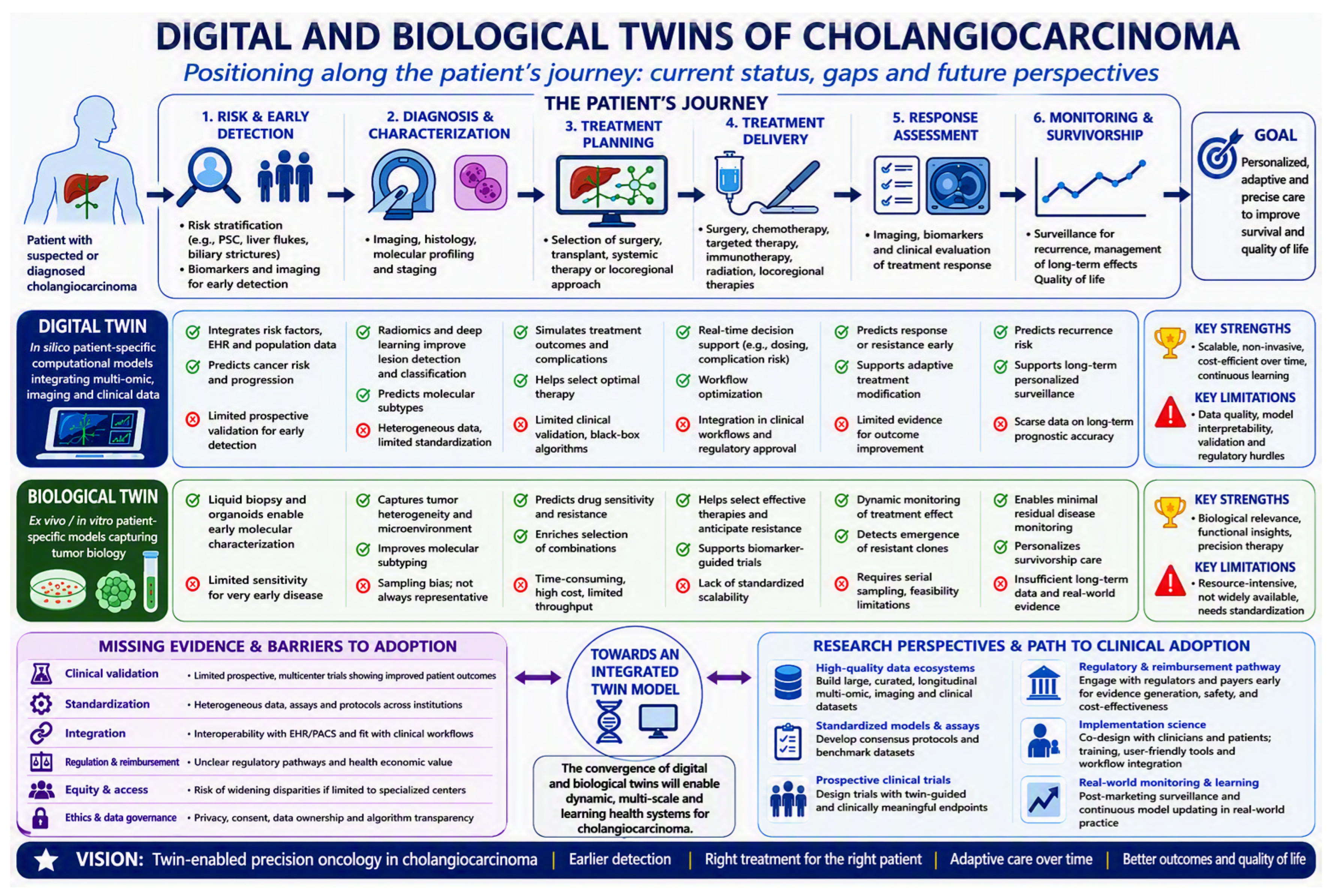
In this context, the integration of advanced computational models (digital twins) with patient-derived biological systems (biological twins) has been proposed as a transformative approach to personalize patient care (
Figure 1). Digital twins (DTs) are in silico frameworks representing dynamic and virtual replicas of patients that integrate multi-omic, imaging, clinical, and environmental data to simulate disease progression and predict therapeutic response [
5]. Biological twins (BTs), including patient-derived organoids (PDOs) and xenografts (PDXs), provide ex vivo platforms to experimentally validate treatment hypotheses. The synergy of DT and BT promises to accelerate precision medicine by bridging the gap between in silico prediction and biological reality.
Despite extensive literature exploring DT concepts, DT-enabling technologies, and BTs in oncology and translational medicine [
6,
7,
8], a disease-specific synthesis within the context of CCA is still missing.
A recent perspective by Miedel et al. [
9] proposed the concept of “integrated patient digital and biomimetic twins” for metabolic dysfunction-associated steatotic liver disease (MASLD), demonstrating the growing interest in twin-based approaches for liver diseases. However, no review has yet extended this paradigm to CCA, a disease whose molecular heterogeneity and limited therapeutic landscape make it particularly suited for such an integrative framework. This narrative review aims to fill this gap by synthesizing the current knowledge on CCA’s clinical and molecular landscape, framing the existing evidence and advances in the integration of digital and BTs for translational and clinical research on CCA, and exploring the future challenges and opportunities of this rapidly evolving field.
Literature Search and Review Approach
This article was conceived as a narrative review aimed at providing a translational and conceptual overview of the emerging field of digital and biological twins in CCA, rather than as a systematic or scoping review.
To inform the sections specifically focused on twin-related approaches (
Section 4,
Section 5,
Section 6 and
Section 7), a structured literature search was performed in PubMed using the following query: cholangiocarcinoma[Title] AND (twin[Title/Abstract] OR chip[Title/Abstract] OR organoid[Title/Abstract] OR xenograft[Title/Abstract] OR platform[Title/Abstract] OR model[Title]).
Publications from 2015 to 2025 were considered. Retrieved articles were reviewed to identify recurring methodological themes and major categories of digital and biological modeling approaches in CCA. Particular attention was devoted to the most recent literature (2024–2025), which underwent detailed evaluation and categorization according to model type, translational objective, and potential relevance to digital twin, biological twin, or hybrid twin frameworks.
Because of the narrative nature of this review, studies were not selected through formal systematic review procedures and no quantitative synthesis was performed. Rather than aiming for exhaustive coverage of all available publications, representative and conceptually relevant studies were selected to illustrate key methodological developments, emerging trends, and translational opportunities within the field. Introductory and perspective sections were additionally informed by landmark publications, clinical practice guidelines, and seminal contributions identified through complementary topic-oriented literature searches.
Accordingly, the review should be interpreted as a qualitative synthesis of the field, and the selection of illustrative examples may not capture the entirety of the available literature.
2. Cholangiocarcinoma: Clinical and Molecular Complexity
CCA is anatomically classified into intrahepatic (iCCA), perihilar (pCCA), and distal (dCCA) subtypes, each arising from distinct biliary segments and associated with unique pathophysiological and molecular characteristics [
1]. The etiology of CCA is multifactorial, involving chronic biliary inflammation like primary sclerosing cholangitis, liver fluke infection, viral hepatitis, metabolic disorders, and environmental carcinogens. PSC is particularly associated with a high risk of CCA development, with disease progression characterized by epithelial injury, fibrosis, and peribiliary gland hyperplasia [
10].
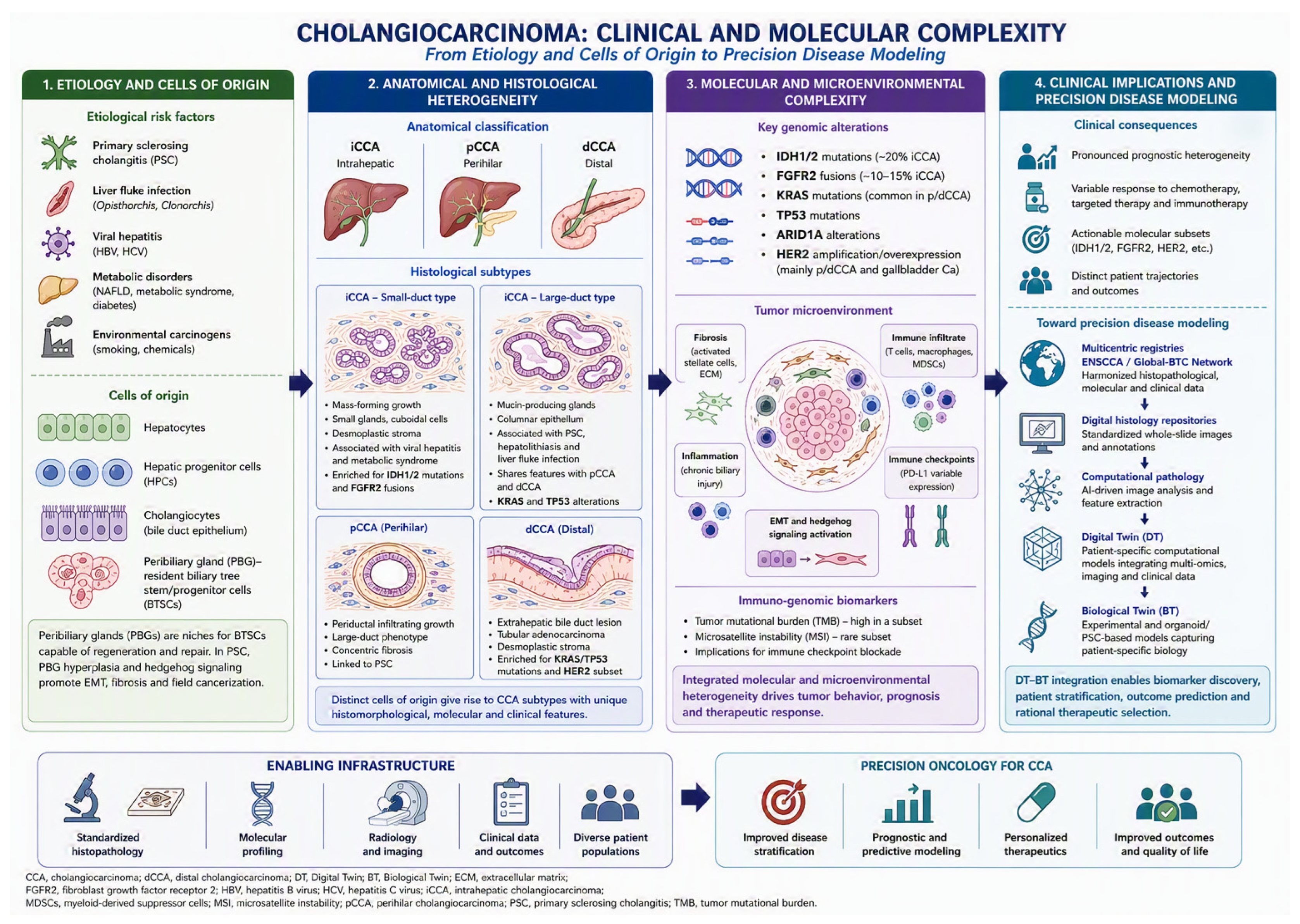
Histologically, iCCA has been reclassified into small and large bile duct subtypes based on tumor morphology, cell of origin, and molecular alterations. The large bile duct subtype shares features with pCCA and dCCA, typically exhibiting mucinous, gland-forming adenocarcinoma and often linked to chronic cholangitis, hepatolithiasis, or liver fluke infection. Conversely, the small bile duct subtype often presents as mass-forming tumors, frequently associated with chronic viral hepatitis and metabolic syndrome, and shows distinct molecular profiles including IDH1/2 mutations and FGFR2 fusions [
3,
11]. (
Figure 2).
Peribiliary glands (PBGs), epithelial structures lining large bile ducts, are now understood to harbor biliary tree stem/progenitor cells (BTSCs) capable of regeneration and repair [
12]. In PSC, PBG hyperplasia and mucinous metaplasia correlate with fibrosis and disease severity, driven by hedgehog signaling pathways that promote epithelial-to-mesenchymal transition [
13,
14]. The field cancerization concept in PSC postulates that widespread epithelial alterations predispose to multifocal carcinogenesis within the biliary tree, paralleling mechanisms observed in inflammatory bowel disease-associated colorectal cancer. Recent morphomolecular analyses have further clarified that CCA may arise from multiple cells of origin, including hepatocytes, hepatic progenitor cells, and PBG-resident BTSCs, with each giving rise to tumors with distinct histological and molecular features [
2].
Beyond its biological relevance, the histological heterogeneity of CCA has important implications for biomarker discovery, prognosis, and therapeutic stratification. Increasing evidence indicates that distinct histological subtypes are associated with specific molecular alterations, cells of origin, tumor microenvironment characteristics, and clinical outcomes [
2,
15]. Consequently, a more refined histopathological classification may improve patient stratification and facilitate the identification of clinically relevant tissue biomarkers.
Large multicentric initiatives are beginning to address this challenge. The European Network for the Study of Cholangiocarcinoma (ENSCCA), recently expanded into the Global-BTC Registry framework, has demonstrated the value of harmonized multicenter collections integrating histopathological, molecular, and clinical data across diverse patient populations. The ENSCCA Registry has already provided important insights into diagnostic patterns, prognostic factors, and therapeutic opportunities in European CCA cohorts [
16].
More recently, ENSCCA-based analyses have shown that refined histological subclassification can identify distinct prognostic groups and reveal tissue biomarkers associated with unfavorable outcomes, supporting the concept that histopathology can contribute not only to diagnosis but also to patient-specific disease modeling [
15]. Such registries may represent a crucial infrastructure for future DT development, providing large-scale, standardized datasets capable of linking tissue architecture, molecular profiles, clinical trajectories, and treatment outcomes.
In this context, the development of multicentric digital histology registries, potentially integrated with international initiatives such as ENSCCA/Global-BTC and other patient registries, could substantially enhance biomarker discovery, support computational pathology approaches, and provide a foundation for more biologically informed hybrid DT-BT frameworks.
At the molecular level, CCA harbors a diverse spectrum of genetic alterations, including single nucleotide variants (SNVs), copy number alterations, and chromosomal rearrangements. IDH1/2 mutations and FGFR2 fusions are most prevalent in iCCA and represent actionable targets with approved inhibitors [
3,
10]. In contrast, p/dCCA and gallbladder carcinoma rarely harbor these mutations but may exhibit HER2 amplification or overexpression, offering alternative therapeutic avenues [
4].
Tumor heterogeneity extends beyond genetics to include the tumor microenvironment, immune infiltrate, and epigenetic landscape, which collectively influence tumor progression and therapeutic response. Immune checkpoint molecules such as PD-L1 are variably expressed across CCA subtypes, with implications for immunotherapy efficacy. Tumor mutational burden (TMB) and microsatellite instability (MSI) define small subsets of patients who may benefit from immune checkpoint blockade [
17,
18].
3. The Clinical Imperative for Precision Medicine
Outcomes for CCA patients remain poor, with 5-year survival rates below 20% in most series [
1]. The clinical management of CCA is challenged by late diagnosis, anatomical complexity, and limited systemic options. Surgical resection offers potential cure but is feasible in a minority of patients; liver transplantation remains controversial and is generally restricted to highly selected cases [
10].
The first-line treatment landscape has been transformed by the TOPAZ-1 trial, which demonstrated that durvalumab plus gemcitabine-cisplatin significantly improved overall survival compared with chemotherapy alone (HR 0.76; 95% CI 0.64–0.91), with a 36-month OS rate of 14.6% vs. 6.9% [
19,
20]. Similarly, the KEYNOTE-966 trial showed that pembrolizumab plus gemcitabine-cisplatin improved OS (HR 0.83; 95% CI 0.72–0.95) [
17]. These regimens now constitute the standard of care for advanced biliary tract cancer [
18].
Molecular profiling has opened new therapeutic opportunities but also revealed significant inter- and intra-tumoral heterogeneity, complicating treatment selection. Clinical trials with targeted agents against IDH1 (ivosidenib), FGFR2 (pemigatinib, futibatinib), BRAF V600E (dabrafenib/trametinib), and HER2 (zanidatamab, trastuzumab deruxtecan) have shown encouraging results in molecularly selected subgroups [
3,
4,
18]. However, the ANITA study—the largest real-world Italian dataset on molecular profiling in CCA (621 patients from 10 centers)—demonstrated that while extended molecular profiling was performed in 79.9% of patients and targeted therapies significantly improved OS (HR 0.49; 95% CI 0.28–0.86), only 18.7% of patients with ESCAT I–III alterations actually received matched therapy [
21]. This gap between molecular profiling availability and therapeutic access underscores the urgent need for strategies that accelerate and optimize treatment selection. However, the ANITA study also highlights that barriers to matched therapy implementation extend beyond biomarker identification and include organizational, logistical, financial, and institutional factors. Therefore, improving precision oncology in CCA will likely require not only better predictive and validation tools but also healthcare system-level interventions capable of facilitating access to molecularly guided treatments.
The Rome Trial further demonstrated the feasibility of integrating comprehensive molecular profiling within multidisciplinary tumor boards: among 303 patients discussed at the molecular tumor board, 71% received a specific therapeutic or diagnostic indication from extended NGS profiling [
22].
Radiologic and histologic biomarkers also contribute to risk stratification and treatment planning. Radiomic analyses can noninvasively predict genetic subtypes and tumor aggressiveness, supporting their incorporation into clinical workflows [
23,
24]. Histological subtype classification, perineural invasion, and microenvironmental features are increasingly recognized as prognostic indicators.
4. Digital and Biological Twins: Concepts and Integration
The concept of a DT originates from engineering, with early precursors traceable to NASA’s Apollo program in the 1960s, where physical replicas of spacecraft were used for ground-based simulation [
25]. The term “digital twin” was subsequently formalized in the manufacturing domain, where a virtual replica of a physical system enables simulation and optimization of products and processes [
26,
27]. In medicine, DTs represent an emerging technology where comprehensive, multidimensional patient data, such as genomics, imaging, clinical records, or environmental exposures, are integrated into dynamic computational models that simulate disease trajectories and predict treatment responses. A recent Lancet Digital Health paper by Sadée et al. [
5] proposed five key components of the medical DT: (i) the patient, (ii) a data connection layer, (iii) a patient-in-silico representation, (iv) a clinical interface, and (v) continuous twin synchronization, providing a useful conceptual framework for clinical implementation.
BTs complement this framework by providing patient-specific in vitro/ex vivo systems, including organ-on-chips (OoC), microphysiological systems (MPS), patient-derived organoids (PDOs) and xenografts (PDXs), and primary cell lines, which recapitulate tumor biology and drug sensitivity. BTs enable experimental validation of hypotheses generated by DT simulations, creating a feedback loop that enhances model fidelity and predictive accuracy [
9].
The integration of digital and BTs embodies the principles of value-based healthcare (VBH) and the “5P” medicine framework—predictive, preventive, personalized, participatory, and precision—which collectively aim to shift healthcare from reactive, population-based approaches toward proactive, individualized strategies [
28,
29]. This approach allows for individualized treatment design, early diagnosis, and dynamic monitoring of disease evolution.
Emerging translational infrastructures, such as CHOLANGIO-PLATFORM, exemplify this paradigm by leveraging multi-source and multidisciplinary data streams, including clinical, molecular, imaging, and pathological data, to iteratively develop and refine integrated DT and BT models in CCA. In parallel, clinical initiatives such as the ROME trial have demonstrated that the integration of comprehensive molecular profiling within multidisciplinary tumor boards can significantly improve patient outcomes in advanced-stage malignancies, comprising CCA [
22].
A comprehensive technical description of digital and BT models, including their theoretical foundations and implementation frameworks, lies beyond the scope of this review and has been extensively discussed elsewhere [
5,
6,
7,
8,
9] Here, we focus instead on their translational applications, emphasizing how these complementary systems can contribute to improving and personalizing therapeutic strategies in CCA.
5. Digital Twin-Enabling Models in Cholangiocarcinoma: From Predictive Modeling to Actionable Simulations
In this review, we adopt the above-mentioned five-component framework proposed by Sadée et al. [
5] for medical digital twins. Within this framework, most of the currently available computational models in CCA should not be regarded as fully realized DTs. Rather, they represent DT-enabling technologies or DT precursors that contribute specific functionalities (e.g., prediction, stratification, simulation, or data integration) but lack one or more core DT components, particularly longitudinal synchronization and real-time bidirectional updating.
5.1. Current Landscape and Quantitative Benchmarks
The development of medical DTs in CCA is rooted in an extensive and rapidly expanding ecosystem of predictive and computational models that are progressively capturing the multidimensional complexity of the disease. Although these approaches do not yet fully embody dynamic, patient-specific digital replicas, DT-enabling technologies are establishing the quantitative, computational, and data integration frameworks necessary for future DT implementation.
Radiomics and machine learning models have emerged as central pillars of this effort. Two recent systematic reviews and meta-analyses provide quantitative benchmarks for the field. Xu et al. [
23] analyzed 58 studies encompassing 12,903 patients and reported that combined radiomic-clinical models achieved pooled C-indices of 0.85–0.91 for iCCA detection, with deep learning-based models reaching a C-index of 0.924. Alidina et al. 6 [
24] pooled 20 studies (8746 participants) and reported a pooled sensitivity of 0.77 (95% CI 0.69–0.84) and specificity of 0.88 (95% CI 0.78–0.94) for differentiating iCCA from non-iCCA hepatic lesions, with CT-based models showing the highest diagnostic performance. These benchmarks demonstrate that imaging-based AI models have reached clinically meaningful accuracy, though both meta-analyses highlighted concerns regarding retrospective design, small cohorts, and limited external validation.
Beyond diagnosis, a substantial body of literature has focused on preoperative characterization of tumor aggressiveness. Multiple independent models have successfully predicted microvascular invasion, perineural invasion, and lymph node metastasis using imaging and clinical data [
30,
31,
32,
33,
34]. These capabilities directly inform surgical decision-making and patient selection, highlighting the immediate translational value of these approaches.
Prognostic modeling represents another highly developed area, with numerous studies integrating radiomics, clinicopathological features, and increasingly multi-omics data to predict overall survival, recurrence-free survival, and early recurrence [
35,
36,
37,
38,
39,
40]. Notably, several models have moved toward explainability and clinical usability through nomograms and interpretable machine learning frameworks. A 2025 ASCO abstract described a transformer-based model integrating MRI, pathology, and proteomics for iCCA prognosis prediction, achieving an AUC of 0.867 in external validation, an example of the kind of multimodal integration that approaches DT functionalities [
41] although it does not yet constitute a fully realized DT.
The integration of molecular data is further strengthening these predictive systems. Multi-omics-based models incorporating genomic, transcriptomic, and epigenetic features have demonstrated improved prognostic and therapeutic prediction performance [
42,
43,
44,
45]. In parallel, studies exploring metabolomics and lipidomics or specific biological signatures such as apoptosis-related genes and immune-related markers [
46] are expanding the biological depth of these models.
In parallel, large-scale integrative efforts based on registry data and multi-institutional cohorts are contributing to a more standardized and generalizable understanding of disease behavior [
15]. These initiatives provide the data diversity, volume, and quality required for robust model training, external validation, and cross-population applicability, essential prerequisites for the development of clinically meaningful medical DTs in CCA.
Representative radiomics- and AI-based studies relevant to DT development in CCA are summarized in
Table 1, highlighting the current performance and translational maturity of these DT-enabling computational approaches.
5.2. Toward Functional and Biologically Informed Digital Twins
While predictive modeling constitutes the dominant paradigm, a subset of studies is beginning to introduce functional elements that move closer to the core concept of medical DTs as simulation platforms. These approaches represent an important transition from descriptive analytics to intervention-aware modeling.
One notable example is the development of biophysical simulation frameworks that model treatment delivery and effects. The work by Lu et al. [
59] demonstrates how computational modeling can simulate nanoparticle distribution and temperature dynamics in magnetic hyperthermia therapy, effectively enabling the optimization of treatment parameters within a patient-specific anatomical context. This represents a clear step toward in silico experimentation, one of the defining functionalities expected in future DT systems.
Similarly, pharmacokinetic (PK) and pharmacodynamic (PD) modeling approaches are beginning to capture inter-patient variability in drug exposure and response. The population PK/PD model developed by Saeheng et al.) [
60] illustrates how dosing strategies can be optimized based on patient-specific characteristics, providing a quantitative framework for personalized therapy planning. These models introduce a temporal and mechanistic dimension that goes beyond static prediction, aligning more closely with the dynamic and longitudinal characteristics expected of DTs.
Beyond purely radiological or clinicopathological variables, several recent approaches integrate immune-related signatures and tumor microenvironment characteristics, enabling the prediction of immunotherapy response and the reconstruction of the tumor immune landscape [
61,
62] These developments reflect a critical shift from descriptive modeling toward biologically grounded representations of disease.
5.3. Liquid Biopsy and Longitudinal Twin Synchronization
One notable component that remains largely underexplored in current CCA twin frameworks is liquid biopsy. Given the limited accessibility of tumor tissue in many patients, particularly those with unresectable or anatomically complex disease, liquid biopsy represents one of the most clinically tractable sources of longitudinal molecular information. Recent studies suggest that circulating tumor DNA (ctDNA), cell-free DNA (cfDNA), circulating tumor cells (CTC), extracellular vesicles, and microRNA-based biomarkers may provide non-invasive access to tumor evolution over time, with potential applications in diagnosis, molecular profiling, treatment monitoring, minimal residual disease detection, and identification of resistance mechanisms [
63,
64].
From a DT perspective, liquid biopsy is particularly relevant because it enables repeated sampling throughout the disease course, thereby supporting one of the defining characteristics of medical DTs: continuous twin synchronization. Unlike static genomic assessments performed on a single tissue specimen, serial ctDNA analyses can provide dynamic information regarding clonal evolution, treatment response, and emerging resistance alterations. Several studies have demonstrated the feasibility of ctDNA-based molecular profiling in biliary tract cancers, including the detection of actionable alterations and longitudinal monitoring of therapeutic response [
65].
Beyond mutation detection, cfDNA methylation profiling represents an additional layer of biological information with potential relevance for future DT architectures. Epigenetic signatures may contribute to early disease detection, risk stratification, and characterization of tumor evolution, thereby enriching computational representations of patient-specific disease states [
66].
Particularly relevant to CCA is the emerging field of bile-derived liquid biopsy [
67]. Because bile is in direct contact with the biliary epithelium and tumor microenvironment, biliary cfDNA and ctDNA may provide a molecular portrait that more closely reflects tumor biology than peripheral blood alone. Recent evidence suggests high concordance with tumor tissue for several genomic alterations and highlights the potential role of biliary liquid biopsy for diagnosis, molecular characterization, and monitoring of disease evolution [
68,
69].
Protein biomarkers within serum extracellular vesicles can support risk prediction, early detection, and prognostic stratification in CCA, offering a tumor cell-derived, minimally invasive liquid biopsy approach with direct relevance to personalized therapeutic decision-making [
70]. A recent study introduced urinary proteomics as a non-invasive tool for predicting and monitoring immune checkpoint inhibitor responsiveness in CCA, while also providing mechanistic insights into tumor microenvironment dynamics [
71].
Finally, Banales et al. [
72] showed that patients with CCA present a specific serum metabolomic profile compared to patients with HCC, PSC and healthy individuals; allowing for early and differential diagnosis of iCCA.
In future hybrid DT-BT frameworks, liquid biopsy could serve as a critical bridge between computational and biological models. Longitudinal molecular data may continuously update DT representations, while simultaneously informing the generation, selection, and recalibration of BT platforms such as organoids or xenografts. In this sense, liquid biopsy may represent one of the most practical and scalable mechanisms through which dynamic twin synchronization can be implemented in CCA precision oncology [
9].
5.4. Digital Twins as an Evolving Continuum
Despite the rapid expansion of computational modeling and data integration approaches, only a few studies to date in CCA fully satisfy the formal definition of a DT as a dynamically updated, patient-specific system capable of simulating therapeutic interventions in real time. Rather, the current landscape is characterized by a constellation of high-resolution predictive and mechanistic models that collectively approximate, but do not yet constitute, true digital twins.
However, this landscape should be viewed not as a field limited by incomplete implementations, but as a continuum of innovation that is steadily progressing toward increasingly sophisticated and clinically relevant systems. Predictive models already deliver tangible clinical value in diagnosis, risk stratification, and prognostication, as demonstrated across a wide range of studies and confirmed by meta-analytic benchmarks [
23,
24]. The emergence of simulation-based and mechanistic models indicates that the field is beginning to incorporate the dynamic and interventional capabilities that define true DTs. Even in their current form, DT-like models could influence clinical decision-making and improve patient stratification. As they continue to incorporate simulation, longitudinal data, and biological complexity, they are likely to evolve into powerful tools capable of guiding personalized therapy in real time.
In this context, DTs in CCA should be understood not as a distant objective, but as an emerging paradigm that is progressively taking shape through the convergence of predictive modeling, simulation data integration, and computational innovation.
6. Biological Twins in Cholangiocarcinoma: Enabling Functional Precision Oncology
6.1. Conceptual Framework and Translational Relevance
The concept of BTs in CCA has emerged as a critical complement to molecular profiling and computational modeling, providing experimental systems that recapitulate patient-specific tumor biology. These platforms enable direct, functional interrogation of therapeutic hypotheses and represent a necessary bridge between predictive insights and clinical actionability. While genomic and transcriptomic analyses identify potential vulnerabilities, BTs allow researchers to test whether these vulnerabilities translate into effective treatment strategies in a physiologically relevant context.
Recent literature has increasingly framed these models as central components of the translational pipeline. Krendl et al. [
73] emphasize their indispensable role in preclinical drug discovery, while Lederer et al. [
74] highlight how patient-derived organoids can capture complex biological interactions, including those involving the microbiota. Montagner et al. [
75] further position three-dimensional systems as evolving platforms that progressively approximate in vivo tumor complexity. A recent comprehensive review on biliary organoids by Chauhdari et al. [
76] provides detailed overviews of construction methods (matrix-independent, matrix-dependent, and tissue engineering-based strategies), signaling pathways driving biliary differentiation, and emerging clinical applications. Collectively, these perspectives underscore a shift in how biological models are conceptualized: from static representations of disease to dynamic systems capable of informing therapeutic decision-making.
6.2. Patient-Derived Xenografts: In Vivo Fidelity and Therapeutic Exploration
PDX remain the most established and biologically faithful form of BTs in CCA. By preserving tumor architecture and, to some extent, intra-tumoral heterogeneity, PDX models provide a robust platform for in vivo evaluation of therapeutic strategies. Their use has expanded significantly in recent years, moving beyond descriptive studies toward more functionally oriented applications.
A substantial body of work demonstrates the utility of PDX models in addressing therapeutic resistance, a major clinical challenge in CCA. Several studies have identified strategies capable of restoring sensitivity to standard chemotherapy, such as the use of doxycycline to reverse gemcitabine resistance [
77] or curcumin-based approaches targeting metabolic dependencies [
78]. Similarly, inhibition of drug efflux mechanisms, including MRP3, has been shown to enhance the efficacy of cytotoxic agents [
79]. These findings illustrate how BTs can uncover actionable strategies that are not readily predictable from molecular data alone.
PDX models have also been instrumental in evaluating targeted therapies and combinatorial approaches. Inhibition of FGFR signaling has revealed metabolic vulnerabilities, while targeting CD73 has been shown to enhance responses to immune checkpoint blockade [
80]. More complex therapeutic regimens, such as the integration of PARG inhibitors with chemotherapy and immunotherapy, further highlight the capacity of these systems to model clinically relevant treatment strategies [
81]. In line with these applications, additional studies have further demonstrated the utility of PDX models for the in vivo assessment of therapeutic candidates and treatment responses [
82]. In addition, the testing of repurposed drugs and novel compounds, including ceritinib, cannabidiol, magnolol, and ferroptosis-inducing agents, demonstrates the versatility of PDX platforms in expanding the therapeutic landscape [
83,
84,
85,
86]. Beyond drug efficacy, PDX models have been used to explore innovative delivery strategies, such as ultrasound-mediated drug penetration [
87] and mitochondria-targeted nanocarriers [
88], thereby extending their relevance to pharmacological optimization. However, a key limitation of traditional PDX systems remains the lack of a functional immune compartment. Recent efforts to address this gap, including orthotopic implantation and the development of platforms for tumor-infiltrating lymphocyte (TIL) therapies [
89], are beginning to enhance their applicability in immuno-oncology. Studies targeting immune checkpoints such as TIGIT [
90], as well as combinatorial approaches involving PD-1 blockade in combination with chemotherapy and targeted agents [
80,
81] flect a growing interest in leveraging BTs to better understand and predict immunotherapeutic responses.
6.3. Organoids and Ex Vivo Systems: Scalability, Clinical Adaptability, and Practical Limitations
While PDX models offer high biological fidelity, their limited scalability and long turnaround times constrain their direct clinical applicability. PDOs have therefore emerged as a complementary platform, offering a more rapid and flexible system for drug testing. PDOs retain key molecular and phenotypic characteristics of the original tumor while enabling parallelized screening of multiple therapeutic options within clinically relevant timeframes [
91,
92].
Recent studies have demonstrated the potential of organoids to identify actionable signaling pathways, such as the IL-6/JAK/STAT3 axis [
91], and to support drug discovery across complex disease contexts, including combined hepatocellular-cholangiocarcinoma [
92]. Importantly, the field is moving beyond simple epithelial models toward more comprehensive systems that incorporate elements of the tumor microenvironment. Co-culture approaches integrating tumor-associated macrophages exemplify this shift, enabling the study of immune-tumor interactions that are critical for therapeutic response [
93]. In parallel, emerging evidence suggests that PDOs can also be leveraged to investigate interactions between tumor cells and microbiota, further expanding their biological relevance [
74].
However, a critical and often underappreciated challenge is the variable success rate of tumor-enriched organoid establishment. While some series report success rates exceeding 70% for hepatobiliary and pancreatic cancers [
94] a 2024 ASCO abstract from Memorial Sloan Kettering reported a tumor-enriched organoid success rate of only 14.6% (11/75) for CCA specifically, with a median time to tumor enrichment of approximately 16 weeks [
95]. This discrepancy likely reflects the difficulty of maintaining tumor cell dominance over normal cholangiocyte outgrowth in organoid culture, a challenge that is particularly pronounced in CCA given its desmoplastic stroma and relatively lower mutational burden compared with other gastrointestinal malignancies. The prolonged timeline and low success rate raise important questions about the feasibility of organoid-based personalized medicine for CCA. From a clinical perspective, a tumor-enriched organoid establishment rate of only 14.6%, combined with a median enrichment time of approximately 16 weeks, substantially limits the applicability of PDO-based therapeutic decision-making for most patients. While organoids remain highly valuable as research and translational platforms, these findings suggest that their current contribution to routine personalized treatment selection in CCA is likely restricted to a small subset of cases. Improving culture efficiency, accelerating tumor enrichment, and developing complementary approaches will therefore be essential for broader clinical implementation.
These developments significantly enhance the translational potential of organoid-based BTs, positioning them as promising tools for real-time therapeutic stratification. However, challenges related to standardization, reproducibility, and the faithful representation of tumor heterogeneity remain areas of active investigation [
75].
6.4. Microfluidic and Organ-on-Chip Platforms: Toward Integrated Physiological Modeling
Microfluidic and organ-on-chip technologies represent a further evolution of the BT paradigm, aiming to recreate tissue architecture and physiological dynamics within controlled experimental environments. These systems enable a more integrated assessment of therapeutic effects by incorporating factors such as fluid flow, spatial organization, and multi-tissue interactions.
Foundational work by Du et al. [
96] established the bile duct-on-a-chip, which phenocopied the tubular architecture of the bile duct in three dimensions, demonstrated organ-level barrier functions including tight junction formation and mechanosensitivity, and enabled proof-of-concept toxicity studies with biliary toxins. This platform provided the first biliary-specific microfluidic system and laid the groundwork for subsequent CCA-focused applications.
In CCA specifically, organ-on-chip platforms have been developed to support personalized drug testing, allowing for the evaluation of treatment responses in a three-dimensional, dynamically regulated context [
97] A very recent advance by Xie et al. [
98] describes a hypoxic microfluidic organoid-on-a-chip system that incorporates patient-derived CCA organoids within a controlled hypoxic microenvironment (O
2 2.5%), faithfully recapitulating the hypoxic tumor microenvironment that drives drug resistance. This platform demonstrated that hypoxia-activatable nanodrugs could effectively reverse hypoxia-induced gemcitabine resistance, illustrating the potential of microfluidic systems to model clinically relevant resistance mechanisms and evaluate novel therapeutic strategies.
More advanced multi-organ systems extend this capability by enabling simultaneous assessment of drug efficacy and systemic toxicity, including effects on liver and kidney function [
99]. This dual evaluation is particularly relevant in oncology, where the therapeutic window is often narrow and patient-specific.
By bridging the gap between reductionist in vitro models and complex in vivo systems, microfluidic platforms offer a promising avenue for enhancing the predictive accuracy of BTs. Their integration into translational workflows may facilitate more informed therapeutic decision-making, particularly when combined with other modeling approaches.
6.5. Complementary In Vitro Models, Bioprinting Technologies, and Emerging Applications
Another emerging component of the BT ecosystem is three-dimensional (3D) bioprinting, which aims to generate highly reproducible tumor and tissue models through the spatially controlled deposition of cells, extracellular matrix components, and biomaterials. In hepato-pancreato-biliary (HPB) and other gastrointestinal malignancies, several bioprinting approaches have been explored, including extrusion-based, inkjet-based, and laser-assisted techniques, each characterized by different trade-offs in printing resolution, cell viability, scalability, and structural complexity [
100].
A wide range of bioinks has been investigated, including alginate-, collagen-, gelatin methacryloyl (GelMA)-, hyaluronic acid-, and decellularized extracellular matrix–based biomaterials, which differ in their mechanical properties, biocompatibility, and ability to reproduce native tissue architecture [
100]. More recently, tissue-engineering strategies specifically focused on the biliary system have highlighted the potential of bioprinting technologies for recreating bile duct structures and supporting more physiologically relevant models of biliary diseases and malignancies [
101].
Although applications in CCA remain at an early stage, the convergence of bioprinting, organoid technologies, and tissue-specific biomaterials may improve microenvironmental control, reproducibility, and scalability compared with conventional three-dimensional culture systems. Such advances could facilitate more sophisticated BT platforms for disease modeling and drug testing and may help address some of the current limitations associated with organoid-based precision oncology approaches [
101,
102].
At a more reductionist level, patient-derived cell lines and engineered resistance models continue to play an essential role in the BT ecosystem. The establishment of novel CCA cell lines provides reproducible platforms for mechanistic studies and high-throughput drug screening [
103,
104,
105] while resistant models enable systematic exploration of therapeutic vulnerabilities [
106]. Although these systems lack the structural and microenvironmental complexity of higher-order models, they serve as critical building blocks within multi-scale experimental pipelines.
Emerging technologies are further expanding the scope of BTs. Biosensor-based approaches, for example, have demonstrated the potential to monitor molecular markers such as miR-29a, opening new possibilities for dynamic assessment of tumor behavior and treatment response [
107]. While still in early stages, such innovations suggest a future in which BTs may evolve from static testing platforms into adaptive systems capable of providing continuous functional feedback.
6.6. Outlook: Integrating Biological Twins into Precision Oncology Workflows
Overall, BTs in CCA are transitioning from predominantly exploratory tools to increasingly functional platforms with direct translational relevance. Their primary strength lies in enabling experimental validation of patient-specific therapeutic strategies, thereby addressing a key limitation of purely data-driven approaches. By allowing the testing of drug combinations, the investigation of resistance mechanisms, and the evaluation of toxicity, these models provide a level of insight that is difficult to achieve through computational methods alone [
73].
Despite these advances, significant challenges remain, including issues related to scalability, standardization, and integration into clinical practice. PDX models are constrained by time and cost, while organoids face variable success rates and require further validation to ensure robustness and reproducibility [
95]. Microfluidic systems, though promising, remain largely in the proof-of-concept stage. Nevertheless, the convergence of these platforms into integrated, multi-scale pipelines, potentially in combination with digital twins, points toward a future in which biological and computational models operate synergistically.
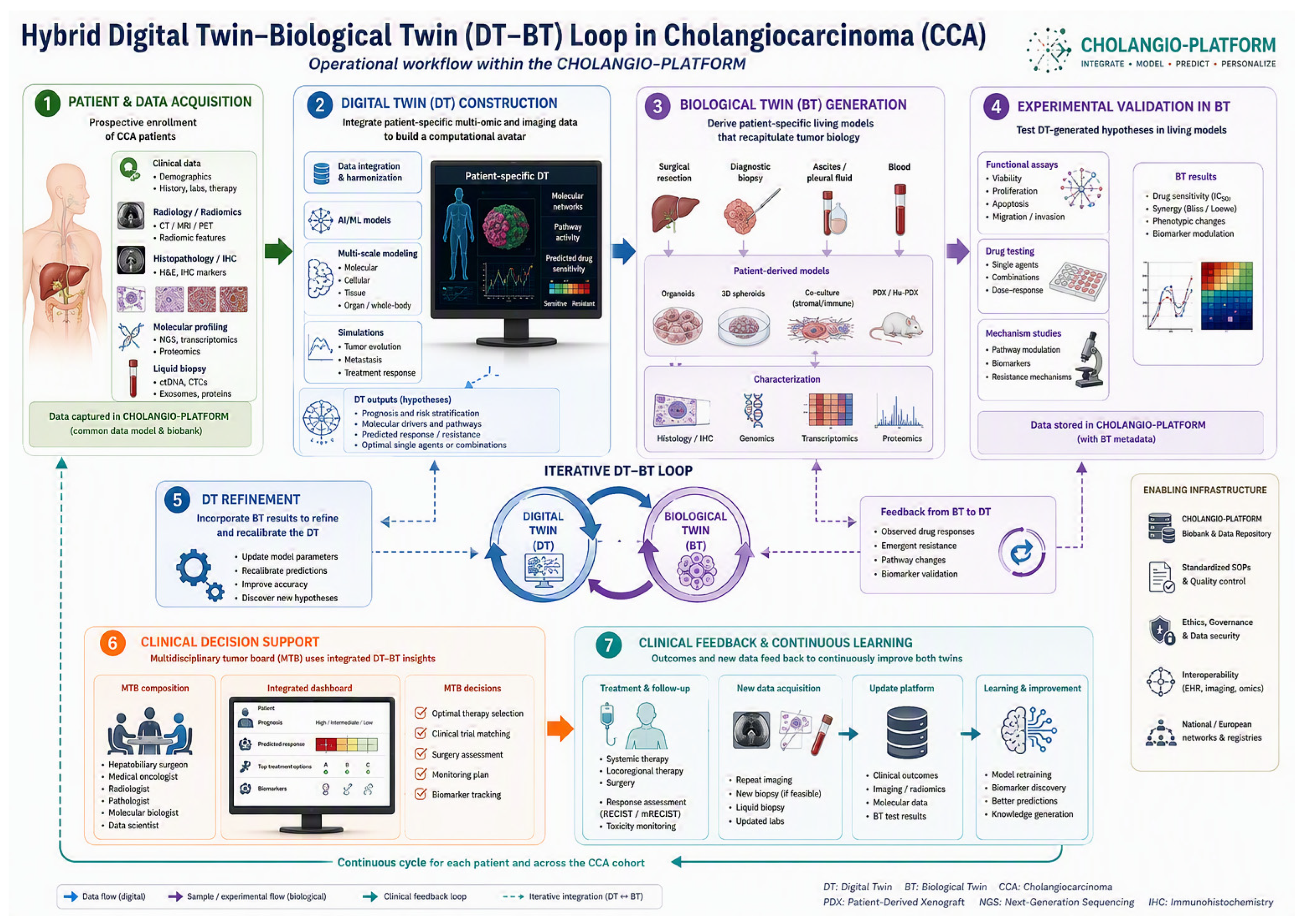
In this context, BTs should be regarded not as standalone tools but as essential components of a broader precision oncology ecosystem. Their continued development and integration will be crucial for translating molecular and computational insights into actionable therapeutic strategies, ultimately improving outcomes for patients with CCA (
Figure 3).
The complementary features, strengths, and limitations of DTs and BTs discussed throughout
Section 5 and
Section 6 are summarized in
Table 2. This comparison highlights the rationale for their integration within hybrid twin frameworks, which are discussed in the following section.
7. Hybrid Approaches in Cholangiocarcinoma: Converging Digital and Biological Twins Toward Actionable Precision Oncology
7.1. Bridging Prediction and Experimentation: The Emergence of Hybrid Twin Frameworks
While DTs and BTs have largely evolved along parallel trajectories, an increasing number of studies in CCA are beginning to converge these domains into integrated, hybrid frameworks. These approaches represent a critical conceptual and translational inflection point: rather than relying solely on predictive modeling or experimental validation, they establish iterative loops in which computational insights inform biological testing, and experimental results refine computational models.
This convergence is particularly significant in the context of CCA, a disease characterized by marked inter-patient heterogeneity and limited therapeutic options. In such a setting, purely predictive models risk remaining associative, while biological systems alone may lack scalability and timeliness. Hybrid approaches address these limitations by combining the breadth of data-driven inference with the depth of functional validation, thereby moving closer to the operational definition of actionable precision oncology. The concept closely parallels the “integrated patient digital and biomimetic twins” framework recently proposed by Miedel et al. [
9] for MASLD, in which patient digital twins (computational models built from clinomics and multi-omics data) are iteratively coupled with patient biomimetic twins (patient-derived organoids or iPSC-derived organ models) to test predictions experimentally.
Several recent studies exemplify this emerging paradigm in CCA. Importantly, however, in most current CCA studies the digital component does not yet correspond to a fully synchronized medical digital twin, but rather to predictive, multimodal, or simulation-based models that contribute individual DT functionalities.
Integrative frameworks that combine multi-omics profiling with patient-derived models are increasingly used to prioritize therapeutic targets and validate them experimentally. For instance, works integrating genomic and transcriptomic analyses with organoid or xenograft systems demonstrate how computational identification of signaling dependencies can be translated into functional drug testing, effectively closing the loop between prediction and intervention. In this context, studies such as those by Mun et al. [
112] and Ji et al. [
113] illustrate how computational stratification of patients can guide downstream biological experimentation, enabling a more efficient and hypothesis-driven use of preclinical models.
7.2. Data-Informed Biological Modeling: Guiding Experimental Design Through Computational Insights
A first layer of integration is represented by the use of DT-enabling computational models to inform the design and prioritization of biological experiments. In this configuration, machine learning, radiomics, and multi-omics analyses are employed to identify high-risk patient subsets, predict therapeutic vulnerabilities, or infer resistance mechanisms, which are then interrogated in biological systems such as PDOs or PDX models.
For example, multi-omics-based stratification approaches [
42,
43,
62], supported by broader integrative efforts [
114], not only improve prognostic accuracy but also generate biologically meaningful hypotheses regarding pathway activation and therapeutic sensitivity. When coupled with patient-derived models, as shown in integrative functional studies [
115] these insights enable targeted drug testing in systems that retain patient-specific characteristics. Similarly, computational analyses of resistance mechanisms, such as those described for FGFR-targeted therapies [
116] and supported by mechanistic investigations [
58,
117], can be functionally validated in PDX or PDO platforms, allowing researchers to explore alternative treatment strategies in a controlled setting.
Radiomics-based models also contribute to this integration by providing non-invasive, spatially resolved information that can guide tissue sampling and model generation. For instance, imaging-derived predictions of tumor aggressiveness or microenvironmental features [
30,
32,
118] may inform the selection of representative tumor regions for organoid derivation or xenograft implantation, thereby enhancing the fidelity and relevance of BTs.
In this sense, DTs, or, more precisely, DT precursors, act as “hypothesis generators”, narrowing the experimental search space and increasing the efficiency of biological validation. This data-informed approach is particularly valuable in CCA, where limited tissue availability and model generation constraints necessitate strategic prioritization.
7.3. Biology-Informed Computational Refinement: Closing the Loop
The integration of biological and digital twins is not unidirectional. A second, equally important layer involves the use of experimental data to refine and enhance computational models. BTs provide high-resolution functional readouts of drug response, resistance evolution, and microenvironmental interactions, which can be fed back into digital frameworks to improve their predictive accuracy and mechanistic grounding.
For example, drug response data generated from PDO or PDX platforms can be used to train or recalibrate machine learning models, transforming them from purely correlative predictors into systems that incorporate functional evidence. Similarly, observations of resistance mechanisms emerging in biological systems, such as adaptive pathway activation or metabolic reprogramming, can inform the development of more sophisticated computational models capable of simulating dynamic treatment responses.
Microfluidic and organ-on-chip systems further enhance this feedback loop by providing temporally resolved data on drug efficacy and toxicity under physiologically relevant conditions [
38,
99]. These platforms enable the generation of rich, multidimensional datasets that capture not only endpoint responses but also dynamic processes, such as drug penetration, cellular adaptation, and inter-tissue interactions. When integrated into computational pipelines, such data can support the development of truly dynamic DTs capable of simulating treatment trajectories over time.
Liquid biopsy may further strengthen this feedback loop by providing a longitudinal and minimally invasive source of patient-specific molecular information. Serial assessment of ctDNA, cfDNA methylation profiles, and bile-derived cfDNA could enable continuous monitoring of clonal evolution, treatment response, minimal residual disease, and emerging resistance mechanisms throughout the disease course. Unlike most current biological models, which are generated at discrete timepoints, liquid biopsy can provide repeated real-time snapshots of tumor evolution and may therefore represent one of the most practical mechanisms for implementing longitudinal twin synchronization. In future hybrid DT-BT frameworks, these molecular data streams could be integrated with functional data derived from organoids, xenografts, or organ-on-chip platforms, enabling iterative refinement of computational models and more dynamic representations of patient-specific disease trajectories.
This iterative exchange between digital and biological domains represents a key step toward the realization of functional twin systems, in which prediction and experimentation continuously inform each other.
7.4. Toward Clinically Actionable Hybrid Twins: Opportunities and Challenges
The ultimate promise of hybrid approaches lies in their potential to support real-time, patient-specific therapeutic decision-making. In a fully realized framework, patient data would be used to generate a continuously synchronized digital representation capable of predicting candidate therapies, which would then be functionally tested in BTs. The results of these experiments would, in turn, refine the digital model, creating a closed-loop system capable of converging on optimal treatment strategies.
Although current implementations remain predominantly based on DT precursors rather than fully realized DTs, early elements of this vision are already visible. Studies combining computational stratification with organoid-based drug screening demonstrate the feasibility of generating patient-specific therapeutic insights within clinically relevant timeframes, particularly when molecular profiling is directly coupled with functional validation in patient-derived systems [
75,
91,
92]. Similarly, the integration of PK/PD modeling [
60] with experimental validation platforms suggests a pathway toward optimizing not only drug selection but also dosing and scheduling.
However, significant challenges remain. The integration of heterogeneous data types, ranging from imaging and multi-omics to functional assay results, requires robust computational infrastructures and standardized workflows. Moreover, aligning the timelines of digital analysis and biological experimentation with clinical decision-making remains a critical hurdle, particularly for time-sensitive conditions such as advanced CCA. The variable success rates of organoid establishment, as low as 14.6% for CCA in some series [
95], further constrain the practical applicability of hybrid frameworks that depend on rapid BT generation. Indeed, if the majority of patients cannot generate clinically usable organoids within actionable timeframes, BT-informed treatment selection becomes inherently difficult to scale and may only be feasible for selected patient populations under current technological conditions. Issues related to reproducibility, scalability, and regulatory validation must also be addressed before hybrid twin systems can be widely adopted in clinical practice.
Importantly, hybrid DT-BT frameworks should not be viewed as stand-alone solutions to the implementation gaps observed in real-world precision oncology. For example, the limited use of matched therapies reported in the ANITA study likely reflects a combination of scientific, organizational, reimbursement-related, and institutional barriers. While twin-based approaches may improve patient stratification, therapeutic prioritization, and confidence in treatment selection, they cannot by themselves overcome limitations related to healthcare infrastructure, access to drugs, reimbursement policies, or referral pathways. Their greatest potential may therefore lie in complementing broader system-level strategies aimed at improving the implementation of precision medicine.
7.5. A Forward-Looking Perspective: Hybrid Twins as the Foundation of Next-Generation Precision Oncology
Despite these challenges, the convergence of DTs and BTs represents one of the most promising directions in CCA research. Rather than viewing these approaches as competing or sequential, hybrid frameworks highlight their complementary nature: digital models provide scalability, integrative capacity, and predictive power, while biological systems offer functional validation and mechanistic insight [
5,
9].
In this context, hybrid twins can be conceptualized as dynamic, multi-layered systems that integrate data, computation, and experimentation into a unified translational pipeline. Such systems have the potential to move beyond static predictions and toward adaptive, continuously updated representations of patient-specific disease. This paradigm aligns closely with the broader vision of precision oncology as a learning system, in which each patient contributes to the refinement of both models and therapies.
Ultimately, the development of hybrid twin approaches may redefine how therapeutic decisions are made in CCA. By enabling the iterative integration of prediction and validation, these systems offer a pathway toward truly actionable precision medicine, in which treatment strategies are not only informed by data but actively tested and optimized in patient-specific models before clinical implementation.
8. Challenges and Future Perspectives
Despite the conceptual maturity and growing translational momentum of DTs and BTs in CCA, their integration into routine clinical workflows remains constrained by a set of interdependent challenges spanning data infrastructure, model development, validation, and clinical adoption.
8.1. Technical and Computational Barriers
A fundamental limitation arises from the intrinsic characteristics of biomedical data in CCA, which is typically fragmented, heterogeneous, and sparsely sampled. The rarity of the disease, coupled with the limited availability of longitudinal and multi-omics datasets, significantly constrains the development of robust patient-specific models. In current practice, imaging, molecular, and clinical data are acquired across different platforms and timepoints, often lacking standardization and completeness, thereby complicating their integration into coherent digital representations.
These issues are well illustrated in the rapidly expanding field of radiomics and AI in CCA, where numerous studies have demonstrated promising performance in tasks such as differential diagnosis, prediction of lymph node metastasis, and early recurrence. However, as highlighted by recent meta-analyses [
23,
24], most of these models remain limited by retrospective design, small cohorts, and lack of external validation, preventing their translation into clinical decision-making. The absence of standardized imaging protocols and feature extraction pipelines further contributes to variability and limits reproducibility across institutions [
119].
Beyond data harmonization, a major challenge lies in capturing the dynamic nature of CCA biology. Tumor progression is governed by complex processes, including clonal evolution, microenvironmental interactions, and therapy-induced selective pressures. Current AI-driven models are predominantly static and correlative, whereas clinically meaningful DTs require the integration of temporal and mechanistic dimensions. Hybrid modeling strategies that combine data-driven approaches with mechanistic frameworks, such as PK/PD modeling, are therefore essential to approximate disease dynamics.
In addition, the lack of interoperability across models remains a critical bottleneck. Most existing tools are developed as task-specific solutions, rather than as modular components of an integrated system. This fragmentation limits scalability and prevents the construction of comprehensive DT architectures capable of incorporating imaging, molecular, and clinical data in a unified and continuously updated framework.
Finally, computational constraints must be considered in the context of clinical applicability. For DTs to inform therapeutic decisions, particularly in advanced disease settings, model outputs must be generated within clinically actionable timeframes. Achieving this balance between model complexity and computational efficiency remains a key technical challenge.
Comparable limitations also affect BT platforms. In particular, the low tumor-enriched organoid establishment rate reported in CCA, together with prolonged culture timelines, currently represents one of the main barriers to the clinical deployment of organoid-guided precision oncology.
8.2. Regulatory and Ethical Considerations
The clinical deployment of DTs and BTs is further complicated by an evolving and fragmented regulatory landscape. In Europe, these systems intersect with multiple frameworks, including the General Data Protection Regulation (GDPR), the European Health Data Space, the AI Act, the Medical Device Regulation, the Clinical Trial Regulation, and cybersecurity directives. This overlap creates uncertainty regarding the classification and validation requirements of DT systems, particularly when they function as clinical decision support tools.
A major unresolved issue concerns the generation of robust clinical evidence. While many AI-based models in CCA report high predictive accuracy, their real-world applicability remains uncertain due to limited prospective validation and poor generalizability. A recent meta-analysis of CT-based AI models for predicting early recurrence in CCA highlighted substantial heterogeneity across studies and emphasized concerns regarding reproducibility, dataset bias, and performance variability across populations [
47]. These findings underscore the need for standardized validation pipelines and prospective clinical trials assessing not only predictive performance but also impact on clinical outcomes.
Data governance represents an additional critical dimension. The development of high-fidelity DTs requires access to large-scale, high-resolution patient data, raising important concerns regarding privacy, consent, and data ownership. Privacy-preserving approaches, such as federated learning, offer potential solutions but require substantial infrastructural and organizational investment.
Ethical considerations also extend to issues of bias and equity. AI models trained on non-representative datasets may inadvertently propagate disparities in healthcare delivery, a risk that is particularly relevant in cholangiocarcinoma given its geographic and etiological heterogeneity. An additional and often overlooked source of potential bias relates to sex and gender representation in model development. Cholangiocarcinoma exhibits important sex-related differences in epidemiology, risk factors, and disease biology, including differences in the prevalence of PSC-associated versus metabolic disease–associated forms [
120], hormonal influences on biliary epithelial biology [
121,
122], and potentially distinct therapeutic responses [
123,
124] owever, most currently available DT-enabling computational models and BT platforms have not been explicitly designed, validated, or reported with sex-stratified analyses. As a result, it remains unclear whether existing twin-oriented approaches capture clinically relevant sex-specific disease trajectories. Future generations of DT and BT systems should therefore incorporate sex as a biological variable and evaluate model performance across different patient subgroups to improve robustness, fairness, and clinical generalizability.
Finally, intellectual property management for data and AI models requires clear policies to promote innovation while protecting stakeholders’ rights.
8.3. Trust, Education, and Adoption
Beyond technical and regulatory barriers, the successful integration of DTs and BTs into clinical practice ultimately depends on their acceptance by clinicians, which is closely linked to issues of interpretability and trust.
A central limitation of many high-performing AI models lies in their lack of transparency. Deep learning systems, in particular, often function as “black boxes”, providing predictions without a clear explanation of the underlying decision-making process. In the context of CCA, where therapeutic decisions are complex and often irreversible, this lack of interpretability represents a significant barrier to clinical adoption. Even in domains such as radiomics, where AI models have shown strong predictive performance, their translation into practice has been hindered by limited explainability and lack of standardized reporting [
119].
Explainable artificial intelligence (XAI) has emerged as a critical strategy to address this gap. By enabling the identification of features driving model predictions, XAI approaches can bridge the gap between computational outputs and clinical reasoning. In imaging-based models, for instance, visualization techniques can highlight tumor regions contributing to classification, while feature attribution methods can quantify the influence of specific clinical or molecular variables on predicted outcomes. These capabilities are particularly relevant in CCA, where integrating radiological, molecular, and clinical features is essential for accurate patient stratification.
However, interpretability alone is insufficient to ensure adoption. The broader framework of trustworthy AI emphasizes additional dimensions, including robustness, reproducibility, fairness, and uncertainty quantification. This is especially important in CCA, where model performance may vary significantly across populations and clinical settings, as highlighted by variability in AI-based recurrence prediction studies [
47]. Communicating uncertainty and defining the limits of model applicability are therefore essential components of clinically usable systems.
From a translational perspective, the presentation of model outputs is equally critical. Clinicians require interpretable and actionable information, rather than abstract probabilistic predictions. The integration of DT and DT-enabling outputs into structured decision-support tools, such as risk scores, nomograms, or tumor board interfaces—as exemplified by the Rome Trial’s molecular tumor board model [
22]—represents a key step toward practical implementation.
Ultimately, fostering trust will also require targeted educational initiatives and the development of interdisciplinary expertise. Clinicians must be equipped not only to use these tools, but also to critically interpret their outputs and understand their limitations, ensuring that DTs and BTs function as decision-support systems rather than replacements for clinical judgment.
9. Epistemological and Ethical Reflections
The emergence of DTs and BTs in CCA reflects a broader shift in the epistemological foundations of medicine, from population-based inference toward individualized and dynamically updated models of disease.
In this context, DTs should not be regarded as objective representations of biological reality, but as probabilistic constructs shaped by data, assumptions, and modeling choices. This perspective is particularly relevant in CCA, where biological heterogeneity and data limitations introduce significant uncertainty. For example, a DT built on the assumption that PBG-derived BTSCs are the primary cell of origin for large bile duct iCCA [
12,
13] may generate systematically different therapeutic predictions than one incorporating hepatocyte-derived carcinogenesis pathways [
2], yet both may be valid for different patient subsets. Recognizing the contingent nature of these models is essential to avoid over-reliance on computational outputs and to preserve the central role of clinical expertise.
At the same time, twin-based approaches offer a unique opportunity to formalize and quantify uncertainty. Unlike traditional clinical frameworks, which often rely on implicit assumptions, these systems can explicitly model variability and simulate alternative therapeutic scenarios. This capability has important implications for decision-making in CCA, where treatment options are limited and outcomes are highly variable. The ANITA study’s finding that only 18.7% of molecularly eligible patients received matched therapy [
21] illustrates how even well-characterized molecular data fails to translate into clinical action without appropriate decision-support infrastructure, a gap that hybrid twin systems could help address.
Ethical considerations are closely intertwined with these epistemological aspects. The reliance on data-driven models introduces risks related to bias, representativeness, and equity, particularly in the context of a disease with marked geographic heterogeneity—CCA driven by liver fluke infection in Southeast Asia differs fundamentally from PSC-associated CCA in Northern Europe, and models trained predominantly on one population may perform poorly in the other [
1]. Ensuring fairness in model development and deployment is therefore a critical priority.
This consideration also invites a broader reflection on the anthropological framework within which these technologies are embedded. Concerns regarding excessive reliance on technological systems, algorithmic decision-making, and the preservation of human agency have been raised across multiple ethical traditions and scholarly perspectives. Contemporary digital ethics scholars have emphasized the need to ensure that artificial intelligence remains aligned with human values and serves to augment, rather than replace, human judgment [
125]. Similarly, discussions on the future of medicine have highlighted the risk that technological innovation may unintentionally shift attention away from the relational and human dimensions of care [
126,
127]. From a different but complementary perspective, the Encyclical Magnifica Humanitas of Pope Leo XIV [
128] raises analogous concerns regarding what it describes as a “technocratic paradigm,” in which efficiency, control, and optimization become dominant criteria for evaluating human activity. In the context of precision oncology, these reflections resonate with the increasing reliance on computational representations of patients, which, if uncritically adopted, may privilege functional abstraction over a more integral understanding of the human person. From this standpoint, DTs should not be understood as neutral or exhaustive representations of biological reality, but as situated and interpretative constructs, whose use requires continuous epistemological and ethical vigilance. Their responsible integration into clinical practice therefore depends on preserving the primacy of human judgment, safeguarding the dignity and relational dimension of the patient, and ensuring that technological innovation remains oriented toward person-centered and equitable care rather than purely technical performance. Building on this perspective, twin-based approaches offer a unique opportunity to formalize and quantify uncertainty.
More broadly, the integration of DTs and BTs into clinical workflows can be seen as a step toward a learning healthcare system, in which each patient contributes to the continuous refinement of models and therapeutic strategies. In this paradigm, knowledge is not static but evolves dynamically through the iterative interaction between data, models, and clinical practice. Transparency in model design, data provenance, and limitations is paramount for trust and ethical governance.
10. Conclusions
DTs and BTs represent a transformative and rapidly evolving paradigm in CCA research and clinical care. While fully realized medical DTs have not yet been implemented in CCA, a growing ecosystem of DT-enabling computational models, together with patient-derived biological systems, is progressively laying the foundations for twin-based precision oncology. By integrating multidimensional patient data into computational models and complementing them with functional validation in patient-derived systems, these approaches enable a more comprehensive and actionable understanding of disease biology.
Although fully realized twin systems capable of real-time clinical decision support are not yet part of standard practice, many of their foundational components are already in place. DT-enabling computational models are increasingly being applied to diagnosis, prognostication, and treatment stratification, while BTs provide opportunities for functional validation and therapeutic exploration. However, important challenges related to validation, reproducibility, scalability, and clinical implementation remain unresolved.
The convergence of DT-enabling computational models, future DT architectures, and BTs into hybrid frameworks represents a promising step toward operational precision oncology in CCA. By integrating computational prediction with functional validation, these approaches may contribute to more adaptive and patient-specific therapeutic strategies. Achieving this vision will require advances in data integration, model interpretability, validation, and regulatory alignment.
Ultimately, the clinical value of DTs and BTs will depend not on their technological sophistication alone, but on their ability to improve patient outcomes in real-world settings. At the same time, technological innovation alone is unlikely to overcome the organizational, financial, reimbursement-related, and systemic barriers that currently limit access to matched therapies in precision oncology. Therefore, the successful implementation of twin-based approaches will require not only advances in computational and biological modeling, but also healthcare system-level efforts to improve access, infrastructure, and translational pathways. If successfully integrated within this broader ecosystem, these systems have the potential to enhance treatment selection, reduce therapeutic inefficiency, and contribute to a more adaptive and patient-centered model of care in cholangiocarcinoma.
Author Contributions
Conceptualization, L.M., G.D.S. and V.C.; writing—original draft preparation, L.M. and V.C.; writing—review and editing, G.D.S., L.J.F., G.C. and V.C.; supervision, V.C., W.-K.S., E.G. and D.A. All authors have read and agreed to the published version of the manuscript.
Funding
Eugenio Gaudio and Guido Carpino were funded by the European Union—Next Generation EU, Mission 4, Component 2, CUP B93D21010860004, Spoke 3, by Project PNC 0000001 D3 4 Health, CUP B53C22006120001, The National Plan for Complementary Investments to the NRRP, Funded by the European Union—NextGenerationEU, by PRIN 2022 (project no. 20222J7W2K), and by BIT-RD Biotecnology—Dulbecco Foundation (CUP: J53C23002920005). Vincenzo Cardinale and Domenico Alvaro were funded by Next Generation Europe Grant PE 6 FONDAZIONE HEAL ITALIA “Health Extended Alliance for Innovative Therapies, Advanced Lab-research and Integrated Approaches of Precision Medicine” PE_00000019—CUP B53C22004000006, and by Next Generation Europe Grant: Rome Technopole Flagship 4 (FP 4)—Development, innovation and certification of medical and non-medical devices for health (Decreto MUR del 23 giugno 2022 prot. no. 105; codice ECS 00000024). Domenico Alvaro, Vincenzo Cardinale, Guido Carpino, and Eugenio Gaudio were funded by PRIN 2022 PNRR, funded by the European Union—Next Generation EU (project n. P202222E45, CUP: B53D23031260001). This study was supported by the Italian Ministry of Research, under the complementary actions to the NRRP “D34Health—Digital Driven Diagnostics, prognostics and therapeutics for sustainable Health care” Grant (# PNC0000001).
Institutional Review Board Statement
Not applicable.
Informed Consent Statement
Not applicable.
Data Availability Statement
No new data were created or analyzed in this study. Data sharing is not applicable to this article.
Acknowledgments
Generative AI disclosure. During the preparation of this manuscript, the authors used several LLMs (namely, ChatGPT (OpenAI GPT-5), Scientific Research AI (Custom GPT based on OpenAI GPT-5), Microsoft Copilot (GPT-5 Chat)) for grammar and spelling checks, or paraphrasing/rewording in compliance with the editorial guidelines of the journal, and the generation of schematic figures to support the presentation of the concepts discussed. After using these tools/services, the authors critically reviewed and edited the content as needed and take full responsibility for the content of the published article.
Conflicts of Interest
Author Lorenzo Manganaro was employed by the company aizoOn Technology & Consulting. He participated in writing in the study. The remaining authors declare that the research was conducted in the absence of any commercial or financial relationships that could be construed as a potential conflict of interest.
Abbreviations
The following abbreviations are used in this manuscript:
| AI | Artificial Intelligence |
| AUC | Area Under the Curve |
| BTs | Biological Twins |
| BTSCs | Biliary Tree Stem/progenitor Cells |
| CART | Classification and Regression Tree |
| CCA | Cholangiocarcinoma |
| cfDNA | Cell-free DNA |
| CT | Computed Tomography |
| CTCs | Circulating Tumor Cells |
| ctDNA | Circulating tumor DNA |
| dCCA | Distal cholangiocarcinoma |
| DCE-MRI | Dynamic Contrast-Enhanced Magnetic Resonance Imaging |
| DL | Deep Learning |
| DTs | Digital Twins |
| ENSCCA | European Network for the Study of Cholangiocarcinoma |
| ESCAT | ESMO Scale for Clinical Actionability of Molecular Targets |
| GelMA | Gelatin Methacryloyl |
| GDPR | General Data Protection Regulation |
| HCC | Hepatocellular carcinoma |
| iCCA | Intrahepatic cholangiocarcinoma |
| ICD | International Classification of Diseases |
| MASLD | Metabolic dysfunction-Associated Steatotic Liver Disease |
| ML | Machine Learning |
| MPS | Microphysiological Systems |
| MRI | Magnetic Resonance Imaging |
| MSI | Microsatellite Instability |
| NGS | Next-Generation Sequencing |
| OoC | Organ-on-Chips |
| OS | Overall Survival |
| PBGs | Peribiliary Glands |
| pCCA | Perihilar cholangiocarcinoma |
| PD | Pharmacodynamic |
| PDOs | Patient-Derived Organoids |
| PDXs | Patient-Derived Xenografts |
| PLC | Primary Liver Cancer |
| PK | Pharmacokinetic |
| PSC | Primary Sclerosing Cholangitis |
| SHAP | Shapley Additive exPlanations |
| SNVs | Single Nucleotide Variants |
| SVM | Support Vector Machine |
| TILs | Tumor-Infiltrating Lymphocytes |
| TMB | Tumor Mutational Burden |
| TME | Tumor Microenvironment |
| TyG | Triglyceride-Glucose Index |
| VBH | Value-Based Healthcare |
| XAI | Explainable Artificial Intelligence |
References
- Valle, J.W.; Kelley, R.K.; Nervi, B.; Oh, D.Y.; Zhu, A.X. Biliary tract cancer. Lancet 2021, 397, 428–444. [Google Scholar] [CrossRef] [Scilit] [PubMed]
- Guest, R.V.; Goeppert, B.; Nault, J.C.; Sia, D. Morphomolecular pathology and genomic insights into the cells of origin of cholangiocarcinoma and combined hepatocellular-cholangiocarcinoma. Am. J. Pathol. 2025, 195, 345–361. [Google Scholar] [CrossRef] [Scilit] [PubMed]
- Ellis, H.; Braconi, C.; Valle, J.W.; Bardeesy, N. Cholangiocarcinoma targeted therapies: Mechanisms of action and resistance. Am. J. Pathol. 2025, 195, 437–452. [Google Scholar] [CrossRef] [Scilit] [PubMed]
- Tesini, G.; Ibrahim, H.; Rimassa, L.; Braconi, C. Evolving precision: Updates in targeted therapy for cholangiocarcinoma. Hepatology 2025. Online ahead of print. [Google Scholar] [CrossRef] [Scilit] [PubMed]
- Sadée, C.; Testa, S.; Barba, T.; Hartmann, K.; Schuessler, M.; Thieme, A.; Church, G.M.; Okoye, I.; Hernandez-Boussard, T.; Hood, L.; et al. Medical digital twins: Enabling precision medicine and medical artificial intelligence. Lancet Digit. Health 2025, 7, 100864. [Google Scholar] [CrossRef] [Scilit] [PubMed]
- Olawade, D.B.; Oisakede, E.O.; Bello, O.J.; Analikwu, C.C.; Egbon, E.; Ojo, A. Digital twins in oncology: From predictive modelling to personalised treatment strategies. Crit. Rev. Oncol. Hematol. 2026, 220, 105171. [Google Scholar] [CrossRef] [Scilit] [PubMed]
- Giansanti, D.; Morelli, S. Exploring the potential of digital twins in cancer treatment: A narrative review of reviews. J. Clin. Med. 2025, 14, 3574. [Google Scholar] [CrossRef] [Scilit] [PubMed]
- Ștefănigă, S.A.; Cordoș, A.A.; Ivascu, T.; Feier, C.V.I.; Muntean, C.; Stupinean, C.V.; Călinici, T.; Aluaș, M.; Bolboacă, S.D. Advancing precision oncology with digital and virtual twins: A scoping review. Cancers 2024, 16, 3817. [Google Scholar] [CrossRef] [Scilit] [PubMed]
- Miedel, M.T.; Schurdak, M.E.; Stern, A.M.; Soto-Gutierrez, A.; Strobl, E.V.; Behari, J.; Taylor, D.L. Integrated patient digital and biomimetic twins for precision medicine: A perspective. Semin. Liver Dis. 2025, 45, 458–475. [Google Scholar] [CrossRef] [Scilit] [PubMed]
- Bowlus, C.L.; Arrivé, L.; Bergquist, A.; Deneau, M.; Forman, L.; Ilyas, S.I.; Lunsford, K.E.; Martinez, M.; Sapisochin, G.; Shroff, R.; et al. AASLD practice guidance on primary sclerosing cholangitis and cholangiocarcinoma. Hepatology 2023, 77, 659–702. [Google Scholar] [CrossRef] [Scilit] [PubMed]
- Bekaii-Saab, T.S.; Bridgewater, J.; Normanno, N. Practical considerations in screening for genetic alterations in cholangiocarcinoma. Ann. Oncol. 2021, 32, 1111–1126. [Google Scholar] [CrossRef] [Scilit] [PubMed]
- Cardinale, V.; Paradiso, S.; Alvaro, D. Biliary stem cells in health and cholangiopathies and cholangiocarcinoma. Curr. Opin. Gastroenterol. 2024, 40, 92–98. [Google Scholar] [CrossRef] [Scilit] [PubMed]
- Carpino, G.; Cardinale, V.; Folseraas, T.; Overi, D.; Grzyb, K.; Costantini, D.; Berloco, P.B.; Di Matteo, S.; Karlsen, T.H.; Alvaro, D.; et al. Neoplastic transformation of the peribiliary stem cell niche in cholangiocarcinoma arisen in primary sclerosing cholangitis. Hepatology 2019, 69, 622–638. [Google Scholar] [CrossRef] [Scilit] [PubMed]
- Carpino, G.; Cardinale, V.; Renzi, A.; Hov, J.R.; Berloco, P.B.; Rossi, M.; Karlsen, T.H.; Alvaro, D.; Gaudio, E. Activation of biliary tree stem cells within peribiliary glands in primary sclerosing cholangitis. J. Hepatol. 2015, 63, 1220–1228. [Google Scholar] [CrossRef] [Scilit] [PubMed]
- Carpino, G.; Overi, D.; Macias, R.I.R.; Cardinale, V.; Izquierdo-Sanchez, L.; Acedo, P.; Rengo, M.; Doukas, M.; Kendall, T.J.; Calderaro, J.; et al. Refinement of histologic subtypes and identification of biomarkers linked to unfavorable prognosis in cholangiocarcinoma: The ENSCCA registries’ framework for digital twin advancement. Hepatology 2026, 83, 753–770. [Google Scholar] [CrossRef] [Scilit] [PubMed]
- Izquierdo-Sanchez, L.; Lamarca, A.; La Casta, A.; Buettner, S.; Utpatel, K.; Klümpen, H.J.; Adeva, J.; Vogel, A.; Lleo, A.; Fabris, L.; et al. Cholangiocarcinoma landscape in Europe: Diagnostic, prognostic and therapeutic insights from the ENSCCA Registry. J. Hepatol. 2022, 76, 1109–1121. [Google Scholar] [CrossRef] [Scilit] [PubMed]
- Kelley, R.K.; Ueno, M.; Yoo, C.; Finn, R.S.; Furuse, J.; Ren, Z.; Yau, T.; Klümpen, H.J.; Chan, S.L.; Ozaka, M.; et al. Pembrolizumab in combination with gemcitabine and cisplatin compared with gemcitabine and cisplatin alone for patients with advanced biliary tract cancer (KEYNOTE-966): A randomised, double-blind, placebo-controlled, phase 3 trial. Lancet 2023, 401, 1853–1865. [Google Scholar] [CrossRef] [Scilit] [PubMed]
- Benson, A.B., 3rd; D’Angelica, M.I.; Abrams, T.; Ahmed, A.; Akce, M.; Anaya, D.A.; Anders, R.; Are, C.; Aye, L.; Bachini, M.; et al. Biliary Tract Cancers, Version 2.2025, NCCN Clinical Practice Guidelines in Oncology. J. Natl. Compr. Canc Netw. 2025, 23, 403–418. [Google Scholar] [CrossRef] [Scilit] [PubMed]
- Oh, D.Y.; He, A.R.; Qin, S.; Chen, L.T.; Okusaka, T.; Kim, J.W.; Suksombooncharoen, T.; Lee, M.A.; Kitano, M.; Burris, H.A.; et al. Durvalumab plus chemotherapy in advanced biliary tract cancer: 3-year overall survival update from the phase III TOPAZ-1 study. J. Hepatol. 2025, 83, 1092–1101. [Google Scholar] [CrossRef] [Scilit] [PubMed]
- Oh, D.Y.; He, A.R.; Qin, S.; Chen, L.T.; Okusaka, T.; Vogel, A.; Kim, J.W.; Suksombooncharoen, T.; Ah Lee, M.; Kitano, M.; et al. Durvalumab plus gemcitabine and cisplatin in advanced biliary tract cancer. NEJM Evid. 2022, 1, EVIDoa2200015. [Google Scholar] [CrossRef] [Scilit] [PubMed]
- Genovesi, V.; Salani, F.; Rimini, M.; Rizzato, M.D.; Pressiani, T.; Pircher, C.; Salvatore, L.; Antonuzzo, L.; Silvestro, L.; Daniele, B.; et al. Molecular profiling and matched targeted treatment in cholangiocarcinoma: Results from the Italian dataset (ANITA). J. Hepatol. 2026, 84, 933–945. [Google Scholar] [CrossRef] [Scilit] [PubMed]
- Marchetti, P.; Curigliano, G.; Westphalen, C.B.; Biffoni, M.; Lonardi, S.; Scagnoli, S.; Fornaro, L.; Guarneri, V.; De Giorgi, U.; Ascierto, P.A.; et al. The role of the molecular tumor board: Learnings from the ROME trial. npj Precis. Oncol. 2026, 10, 213. [Google Scholar] [CrossRef] [Scilit] [PubMed] [PubMed Central]
- Xu, L.; Chen, Z.; Zhu, D.; Wang, Y. The application status of radiomics-based machine learning in intrahepatic cholangiocarcinoma: Systematic review and meta-analysis. J. Med. Internet Res. 2025, 27, e69906. [Google Scholar] [CrossRef] [Scilit] [PubMed]
- Alidina, Z.; Banani, I.; Abiha, U.E.; Sultan, U.; Pawlik, T.M. Radiomics for detection and differentiation of intrahepatic cholangiocarcinoma: A systematic review and meta-analysis. Cancers 2026, 18, 937. [Google Scholar] [CrossRef] [Scilit] [PubMed]
- Dihan, M.S.; Akash, A.I.; Tasneem, Z.; Das, P.; Das, S.K.; Islam, M.R.; Badal, F.R.; Ali, M.F.; Ahamed, M.H.; Abhi, S.H.; et al. Digital twin: Data exploration, architecture, implementation and future. Heliyon 2024, 10, e26503. [Google Scholar] [CrossRef] [Scilit] [PubMed]
- Segovia, M.; Garcia-Alfaro, J. Design, Modeling and Implementation of Digital Twins. Sensors 2022, 22, 5396. [Google Scholar] [CrossRef] [Scilit] [PubMed]
- Jiang, Y.; Yin, S.; Li, K.; Luo, H.; Kaynak, O. Industrial applications of digital twins. Philos. Trans. R. Soc. A 2021, 379, 20200360. [Google Scholar] [CrossRef] [Scilit] [PubMed]
- Hood, L.; Friend, S.H. Predictive, personalized, preventive, participatory (P4) cancer medicine. Nat. Rev. Clin. Oncol. 2011, 8, 184–187. [Google Scholar] [CrossRef] [Scilit] [PubMed]
- Blobel, B.; Kalra, D. Editorial: Managing healthcare transformation towards P5 medicine. Front. Med. 2023, 10, 1244100. [Google Scholar] [CrossRef] [Scilit] [PubMed]
- Miao, G.; Qian, X.; Zhang, Y.; Hou, K.; Wang, F.; Xuan, H.; Wu, F.; Zheng, B.; Yang, C.; Zeng, M. MRI-based radiomics model for preoperative prediction of microvascular invasion and outcome in intrahepatic cholangiocarcinoma. Eur. J. Radiol. 2025, 183, 111896. [Google Scholar] [CrossRef] [Scilit] [PubMed]
- Liu, Z.; Chen, H.; Yang, S.; Zhang, R.; Yang, F.; Feng, J.; Xu, K.; Tan, Z.; Feng, Y.; Ouyang, F.; et al. Preoperative prediction model of microvascular invasion in intrahepatic cholangiocarcinoma patients based on CT radiomics can assist clinical surgical decision-making: A multicenter study. Eur. Radiol. 2026, 36, 1395–1408. [Google Scholar] [CrossRef] [Scilit] [PubMed]
- Qi, Z.; Yuan, H.; Li, Q.; Chen, P.; Li, D.; Chen, K.; Meng, B.; Ning, P.; Yu, H.; Li, D. An MRI-based fusion model for preoperative prediction of perineural invasion status in patients with intrahepatic cholangiocarcinoma. World J. Surg. Oncol. 2025, 23, 164. [Google Scholar] [CrossRef] [Scilit] [PubMed]
- Xie, H.; Hong, T.; Liu, W.; Jia, X.; Wang, L.; Zhang, H.; Xu, C.; Zhang, X.; Li, W.L.; Wang, Q.; et al. Interpretable machine learning-based clinical prediction model for predicting lymph node metastasis in patients with intrahepatic cholangiocarcinoma. BMC Gastroenterol. 2024, 24, 137. [Google Scholar] [CrossRef] [Scilit] [PubMed]
- Mao, S.; Shan, Y.; Yu, X.; Yang, Y.; Wu, S.; Lu, C. Development and validation of a novel preoperative clinical model for predicting lymph node metastasis in perihilar cholangiocarcinoma. BMC Cancer 2024, 24, 297. [Google Scholar] [CrossRef] [Scilit] [PubMed]
- Perez, M.; Palnaes Hansen, C.; Burdio, F.; Sanchez-Velázquez, P.; Giuliani, A.; Lancellotti, F.; de Liguori-Carino, N.; Malleo, G.; Marchegiani, G.; Podda, M.; et al. A machine learning predictive model for recurrence of resected distal cholangiocarcinoma: Development and validation of predictive model using artificial intelligence. Eur. J. Surg. Oncol. 2024, 50, 108375. [Google Scholar] [CrossRef] [Scilit] [PubMed]
- Zhang, S.B.; Wang, Z.; Hu, G.; Cheng, S.H.; Wang, Z.W.; Jin, Z.Y. Multi-Phase Contrast-Enhanced CT Clinical-Radiomics Model for Predicting Prognosis of Extrahepatic Cholangiocarcinoma After Surgery: A Single-Center Retrospective Study. Chin. Med. Sci. J. 2025, 40, 161–170. [Google Scholar] [CrossRef] [Scilit] [PubMed]
- Fu, J.; Lin, Q.; Zheng, L.; Huang, T.; Li, J.; Bi, X.; Wang, J.; Li, F.; Wang, J.; Wang, K.; et al. Preoperative risk stratification for multifocal intrahepatic cholangiocarcinoma after liver resection: A multicenter analysis with CART model. Eur. J. Surg. Oncol. 2025, 51, 110277. [Google Scholar] [CrossRef] [Scilit] [PubMed]
- Liu, B.; Wang, S.; Wen, T.; Qiu, H.; Xiang, L.; Huang, Z.; Wu, H.; Li, D.; Li, H. Developing a Prognostic Model for Intrahepatic Cholangiocarcinoma Patients With Elevated Preoperative Carbohydrate Antigen 19-9 Levels: Volume-Adjusted CA19-9 (VACA) as a Novel Biomarker. Cancer Control. 2025, 32, 10732748251317692. [Google Scholar] [CrossRef] [Scilit] [PubMed]
- Wang, L.; Liu, J.; Zeng, Y.; Shu, J. The value of an MRI-based radiomics model in predicting the survival and prognosis of patients with extrahepatic cholangiocarcinoma. Cancer Med. 2024, 13, e6832. [Google Scholar] [CrossRef] [Scilit] [PubMed]
- Kawashima, J.; Endo, Y.; Rashid, Z.; Altaf, A.; Woldesenbet, S.; Tsilimigras, D.I.; Guglielmi, A.; Marques, H.P.; Maithel, S.K.; Groot Koerkamp, B.; et al. Predictive model for very early recurrence of patients with perihilar cholangiocarcinoma: A machine learning approach. Hepatobiliary Surg. Nutr. 2025, 14, 3–15. [Google Scholar] [CrossRef] [Scilit] [PubMed]
- Mingyu, W.; Yifei, S.; Nong, X.; Jian, R. Transformer-based deep learning model for integrated pathomics and radiomics in predicting postoperative survival of intrahepatic cholangiocarcinoma patients. J. Clin. Oncol. 2025, 43, e16328. [Google Scholar] [CrossRef] [Scilit]
- Jia, Y.; Wan, M.; Shen, Y.; Wang, J.; Luo, X.; He, M.; Bai, R.; Xiao, W.; Zhang, X.; Ruan, J. Predictive nomogram integrating radiomics and multi-omics for improved prognosis-model in cholangiocarcinoma. Clin. Transl. Med. 2025, 15, e70171. [Google Scholar] [CrossRef] [Scilit] [PubMed]
- Yu, Y.; You, Y.; Duan, Y.; Kang, M.; Zhou, B.; Yang, J.; Yin, K.; Ye, W.; Xu, R.; Wang, H.; et al. Multi-omics approaches for identifying the PANoptosis signature and prognostic model via a multimachine-learning computational framework for intrahepatic cholangiocarcinoma. Hepatology 2026, 83, 466–483. [Google Scholar] [CrossRef] [Scilit] [PubMed]
- Fu, S.; Dai, Y.; Zhang, P.; Zheng, K.; Cao, G.; Xu, L.; Zhong, Y.; Niu, C.; Wang, X. Extrachromosomal circular DNA (eccDNA) characteristics in the bile and plasma of advanced perihilar cholangiocarcinoma patients and the construction of an eccDNA-related gene prognosis model. Front. Cell Dev. Biol. 2024, 12, 1379435. [Google Scholar] [CrossRef] [Scilit] [PubMed]
- Meng, X.; Lu, J.; Huang, X.; Shi, Y.; Yu, L.; Guo, X.; Pu, P.; Hu, Z.; Hu, S.; Ye, M.; et al. A noninvasive and highly efficient epigenetic predictive model for efficacy of the GOLP regimen in patients with intrahepatic cholangiocarcinoma. Cancer Lett. 2025, 630, 217911. [Google Scholar] [CrossRef] [Scilit] [PubMed]
- Shen, P.; Shi, Y.; Xu, P.; Rao, L.; Wang, Z.; Jiang, J.; Weng, M. The construction of a prognostic model by apoptosis-related genes to predict survival, immune landscape, and medication in cholangiocarcinoma. Clin. Res. Hepatol. Gastroenterol. 2024, 48, 102430. [Google Scholar] [CrossRef] [Scilit] [PubMed]
- Chen, J.; Xi, J.; Chen, T.; Yang, L.; Liu, K.; Ding, X. Diagnostic performance of CT-based artificial intelligence for early recurrence of cholangiocarcinoma: A systematic review and meta-analysis. J. Med. Internet Res. 2025, 27, e78306. [Google Scholar] [CrossRef] [Scilit] [PubMed]
- Song, Y.; Zhou, G.; Zhou, Y.; Xu, Y.; Zhang, J.; Zhang, K.; He, P.; Chen, M.; Liu, Y.; Sun, J.; et al. Artificial intelligence CT radiomics to predict early recurrence of intrahepatic cholangiocarcinoma: A multicenter study. Hepatol. Int. 2023, 17, 1016–1027. [Google Scholar] [CrossRef] [Scilit] [PubMed]
- Bo, Z.; Chen, B.; Yang, Y.; Yao, F.; Mao, Y.; Yao, J.; Yang, J.; He, Q.; Zhao, Z.; Shi, X.; et al. Machine learning radiomics to predict the early recurrence of intrahepatic cholangiocarcinoma after curative resection: A multicentre cohort study. Eur. J. Nucl. Med. Mol. Imaging 2023, 50, 2501–2513. [Google Scholar] [CrossRef] [Scilit] [PubMed]
- Cheng, M.; Zhang, H.; Guo, Y.; Lyu, P.; Yan, J.; Liu, Y.; Liang, P.; Ren, Z.; Gao, J. Comparison of MRI- and CT-based deep learning radiomics analyses and their combination for diagnosing intrahepatic cholangiocarcinoma. Sci. Rep. 2025, 15, 9629. [Google Scholar] [CrossRef] [Scilit] [PubMed]
- Fiz, F.; Rossi, N.; Langella, S.; Conci, S.; Serenari, M.; Ardito, F.; Cucchetti, A.; Gallo, T.; Zamboni, G.A.; Mosconi, C.; et al. Radiomics of intrahepatic cholangiocarcinoma and peritumoral tissue predicts postoperative survival: Development of a CT-based clinical-radiomic model. Ann. Surg. Oncol. 2024, 31, 5604–5614. [Google Scholar] [CrossRef] [Scilit] [PubMed]
- Pan, Y.J.; Wu, S.J.; Zeng, Y.; Cao, Z.R.; Shan, Y.; Lin, J.; Xu, P.J. Intra- and peri-tumoral radiomics based on dynamic contrast-enhanced MRI to identify lymph node metastasis and prognosis in intrahepatic cholangiocarcinoma. J. Magn. Reson. Imaging 2024, 60, 2669–2680. [Google Scholar] [CrossRef] [Scilit] [PubMed]
- Qin, H.; Hu, X.; Zhang, J.; Dai, H.; He, Y.; Zhao, Z.; Yang, J.; Xu, Z.; Hu, X.; Chen, Z. Machine-learning radiomics to predict early recurrence in perihilar cholangiocarcinoma after curative resection. Liver Int. 2021, 41, 837–850. [Google Scholar] [CrossRef] [Scilit] [PubMed]
- Alaimo, L.; Lima, H.A.; Moazzam, Z.; Ndo, Y.; Yang, J.; Ruzzenente, A.; Guglielmi, A.; Aldrighetti, L.; Weiss, M.; Bauer, T.W.; et al. Development and validation of a machine-learning model to predict early recurrence of intrahepatic cholangiocarcinoma. Ann. Surg. Oncol. 2023, 30, 5406–5415. [Google Scholar] [CrossRef] [Scilit] [PubMed]
- Fang, J.; Zhu, J.; Huang, R.; Dai, X.; Gao, F.; Li, H.; Xue, J.; Liu, C.; Li, Z.; Zheng, J.; et al. Explainable machine learning integrating metabolic and inflammatory signatures for personalized prognosis in resected intrahepatic cholangiocarcinoma. Eur. J. Surg. Oncol. 2026, 52, 111792. [Google Scholar] [CrossRef] [Scilit] [PubMed]
- Brion, E.; Ducret, V.; Nasar, N.; Sauty, B.; McIntyre, S.; Alessandris, R.; Sigel, C.; Jain, M.; Bhanot, U.; Ray-Kirton, J.; et al. Multimodal machine learning models enhance outcome prediction in intrahepatic cholangiocarcinoma. Comput. Biol. Med. 2025, 198, 111189. [Google Scholar] [CrossRef] [Scilit] [PubMed]
- Zhang, R.; Wang, Z.; Yang, M.; Chen, B.; Liu, M.; Zheng, M.; Liu, P.X.; Wang, L. Combining traditional analysis and machine learning to predict early, middle, and long-term recurrence of intrahepatic cholangiocarcinoma. Eur. J. Surg. Oncol. 2025, 51, 110141. [Google Scholar] [CrossRef] [Scilit] [PubMed]
- Kendre, G.; Murugesan, K.; Brummer, T.; Segatto, O.; Saborowski, A.; Vogel, A. Charting co-mutation patterns associated with actionable drivers in intrahepatic cholangiocarcinoma. J. Hepatol. 2023, 78, 614–626. [Google Scholar] [CrossRef] [Scilit] [PubMed]
- Lu, Y.; Huang, C.; Fu, W.; Gao, L.; Mi, N.; Ma, H.; Bai, M.; Xia, Z.; Zhang, X.; Tian, L.; et al. Design of the distribution of iron oxide (Fe3O4) nano-particle drug in realistic cholangiocarcinoma model and the simulation of temperature increase during magnetic induction hyperthermia. Pharmacol. Res. 2024, 207, 107333. [Google Scholar] [CrossRef] [Scilit] [PubMed]
- Saeheng, T.; Karbwang, J.; Na-Bangchang, K. Population-pharmacokinetic/pharmacodynamic model of atractylodes lancea (Thunb.) DC. administration in patients with advanced-stage intrahepatic cholangiocarcinoma: A dosage prediction. BMC Complement. Med. Ther. 2024, 24, 384. [Google Scholar] [CrossRef] [Scilit] [PubMed]
- Chen, L.; Yin, G.; Wang, Z.; Liu, Z.; Sui, C.; Chen, K.; Song, T.; Xu, W.; Qi, L.; Li, X. A predictive radiotranscriptomics model based on DCE-MRI for tumor immune landscape and immunotherapy in cholangiocarcinoma. Biosci. Trends 2024, 18, 263–276. [Google Scholar] [CrossRef] [Scilit] [PubMed]
- Cao, Q.H.; Li, H.; Sun, P.F.; Lu, D.H.; Tian, B.W.; Jiao, K.F.; Tian, J.C.; Wang, Y.X.; Jia, J.S.; Zhang, Z.H.; et al. A pathomics-integrated multimodal model to evaluate chemoimmunotherapy efficacy in unresectable intrahepatic cholangiocarcinoma. JHEP Rep. 2025, 7, 101557. [Google Scholar] [CrossRef] [Scilit] [PubMed]
- de Scordilli, M.; Bortolot, M.; Torresan, S.; Noto, C.; Rota, S.; Di Nardo, P.; Fumagalli, A.; Guardascione, M.; Ongaro, E.; Foltran, L.; et al. Precision oncology in biliary tract cancer: The emerging role of liquid biopsy. ESMO Open 2025, 10, 105079. [Google Scholar] [CrossRef] [Scilit] [PubMed]
- Wu, G.; Xu, X.; Zhang, H.; Peng, L.; Liu, C. Liquid biopsy in biliary tract cancers: Early diagnosis, precision therapy, and prognostic evaluation. Front. Oncol. 2025, 15, 1705162. [Google Scholar] [CrossRef] [Scilit] [PubMed]
- Wang, Y.; Li, Y.; Liang, Z.; Zhang, Y.; Li, T.; Tian, C.; Zhao, J.; Jin, B.; Cao, J.; Lin, Y. Circulating tumor DNA in cholangiocarcinoma: Current clinical applications and future perspectives. Front. Cell Dev. Biol. 2025, 13, 1616064. [Google Scholar] [CrossRef] [Scilit] [PubMed]
- Sidabraite, A.; Mosert, P.L.; Ahmed, U.; Jones, S.K.; Gulla, A. Advancing Cholangiocarcinoma Diagnosis: The Role of Liquid Biopsy and CRISPR/Cas Systems in Biomarker Detection. Cancers 2025, 17, 2155. [Google Scholar] [CrossRef] [Scilit] [PubMed]
- Arechederra, M.; Bik, E.; Rojo, C.; Elurbide, J.; Elizalde, M.; Kruk, B.; Krasnodębski, M.; Pertkiewicz, J.; Kozieł, S.; Grąt, M.; et al. Mutational Analysis of Bile Cell-Free DNA in Primary Sclerosing Cholangitis: A Pilot Study. Liver Int. 2025, 45, e70049. [Google Scholar] [CrossRef] [Scilit] [PubMed]
- Teixeira, M.F.; Borad, M.; Serrano Uson Junior, P.L. Circulating tumor DNA in biliary tract cancers: A review of current applications. World J. Clin. Oncol. 2025, 16, 107875. [Google Scholar] [CrossRef] [Scilit] [PubMed]
- Han, J.Y.; Ahn, K.S.; Kim, M.J.; Kim, T.S.; Kim, Y.H.; Cho, K.B.; Kang, K.J. Optimization of bile preparation for liquid biopsy in cholangiocarcinoma focusing on circulating tumor DNA and protein stability. Sci. Rep. 2025, 15, 12090. [Google Scholar] [CrossRef] [Scilit] [PubMed]
- Lapitz, A.; Azkargorta, M.; Milkiewicz, P.; Olaizola, P.; Zhuravleva, E.; Grimsrud, M.M.; Schramm, C.; Arbelaiz, A.; O’Rourke, C.J.; La Casta, A.; et al. Liquid biopsy-based protein biomarkers for risk prediction, early diagnosis, and prognostication of cholangiocarcinoma. J. Hepatol. 2023, 79, 93–108. [Google Scholar] [CrossRef] [Scilit] [PubMed] [PubMed Central]
- Wang, S.; Guo, Z.; Sun, B.; Liu, K.; Chao, J.; Xun, Z.; Wang, Y.; Xu, Z.; Huang, Z.; Wang, H.; et al. Dynamic urinary proteomics integrates single-cell and spatial transcriptomics to reveal tumour microenvironment and predict immunotherapy response in biliary tract cancer. Gut 2026, 75, 1411–1424. [Google Scholar] [CrossRef] [Scilit] [PubMed] [PubMed Central]
- Banales, J.M.; Iñarrairaegui, M.; Arbelaiz, A.; Milkiewicz, P.; Muntané, J.; Muñoz-Bellvis, L.; La Casta, A.; Gonzalez, L.M.; Arretxe, E.; Alonso, C.; et al. Serum Metabolites as Diagnostic Biomarkers for Cholangiocarcinoma, Hepatocellular Carcinoma, and Primary Sclerosing Cholangitis. Hepatology 2019, 70, 547–562. [Google Scholar] [CrossRef] [Scilit] [PubMed] [PubMed Central]
- Krendl, F.J.; Primavesi, F.; Oberhuber, R.; Neureiter, D.; Ocker, M.; Bekric, D.; Kiesslich, T.; Mayr, C. The importance of preclinical models for cholangiocarcinoma drug discovery. Expert. Opin. Drug Discov. 2025, 20, 205–216. [Google Scholar] [CrossRef] [Scilit] [PubMed]
- Lederer, A.K.; Görrissen, N.; Nguyen, T.T.; Kreutz, C.; Rasel, H.; Bartsch, F.; Lang, H.; Endres, K. Exploring the effects of gut microbiota on cholangiocarcinoma progression by patient-derived organoids. J. Transl. Med. 2025, 23, 34. [Google Scholar] [CrossRef] [Scilit] [PubMed]
- Montagner, A.; Lemberger-Viehmann, L.; Reitberger, N.; Schmidt, M.; Scheruebl, J.; Pion, E.; Wagner, B.J.; Pilarsky, C.; Grützmann, R.; Aung, T.; et al. Applications of 3D models in cholangiocarcinoma. Front. Oncol. 2025, 15, 1598552. [Google Scholar] [CrossRef] [Scilit] [PubMed]
- Chauhdari, T.; Zaidi, S.A.; Su, J.; Ding, Y. Organoids meet microfluidics: Recent advancements, challenges, and future of organoids-on-chip. Vitr. Model. 2025, 4, 71–88. [Google Scholar] [CrossRef] [Scilit] [PubMed]
- Massa, A.; Vita, F.; Peraldo-Neia, C.; Varamo, C.; Basiricò, M.; Raggi, C.; Bernabei, P.; Erriquez, J.; Leone, F.; Aglietta, M.; et al. Doxycycline restores gemcitabine sensitivity in preclinical models of multidrug-resistant intrahepatic cholangiocarcinoma. Cancers 2025, 17, 132. [Google Scholar] [CrossRef] [Scilit] [PubMed]
- Thongpon, P.; Intuyod, K.; Pongking, T.; Priprem, A.; Chomwong, S.; Tanasuka, P.; Mahalapbutr, P.; Suriya, U.; Vaeteewoottacharn, K.; Pinlaor, P.; et al. Curcumin-Loaded Maltodextrin-Based Proniosomes Potentially Effective against Gemcitabine-Resistant Cholangiocarcinoma. ACS Appl. Bio Mater. 2025, 8, 913–930. [Google Scholar] [CrossRef] [Scilit] [PubMed]
- Asensio, M.; Briz, O.; Herraez, E.; Perez-Silva, L.; Espinosa-Escudero, R.; Bueno-Sacristan, D.; Peleteiro-Vigil, A.; Hammer, H.; Pötz, O.; Kadioglu, O.; et al. Sensitizing cholangiocarcinoma to chemotherapy by inhibition of the drug-export pump MRP3. BioMed. Pharmacother. 2024, 180, 117533. [Google Scholar] [CrossRef] [Scilit] [PubMed]
- Sun, B.Y.; Zhang, D.; Gan, W.; Wu, J.F.; Wang, Z.T.; Sun, G.Q.; Zhou, J.; Fan, J.; Yi, Y.; Hu, B.; et al. Targeting CD73 limits tumor progression and enhances anti-tumor activity of anti-PD-1 therapy in intrahepatic cholangiocarcinoma. J. Cancer Res. Clin. Oncol. 2024, 150, 348. [Google Scholar] [CrossRef] [Scilit] [PubMed]
- Yu, M.; Xie, P.; Yu, Q.; Zhao, Y.; Xu, W.; Yang, Z.; Wei, Y.; Zhou, B.; Liu, S.; Dong, S.; et al. PARG inhibition halts cholangiocarcinoma progression via the Hippo pathway and enhances response to chemotherapy and immunotherapy. J. Hepatol. 2026, 84, 599–617. [Google Scholar] [CrossRef] [Scilit] [PubMed]
- Dokduang, H.; Jarernrat, A.; Titapun, A.; Sitthirak, S.; Padthaisong, S.; Kittirat, Y.; Sangkamanon, S.; Sa-Ngiamwibool, P.; Wangwiwatsin, A.; Klanrit, P.; et al. Characterization of patient-derived xenograft models of liver fluke-associated cholangiocarcinoma: From establishment to molecular profiling. Anticancer. Res. 2025, 45, 579–592. [Google Scholar] [CrossRef] [Scilit] [PubMed]
- Myint, K.Z.; Balasubramanian, B.; Venkatraman, S.; Phimsen, S.; Sripramote, S.; Jantra, J.; Choeiphuk, C.; Mingphruedhi, S.; Muangkaew, P.; Rungsakulkij, N.; et al. Therapeutic Implications of Ceritinib in Cholangiocarcinoma beyond ALK Expression and Mutation. Pharmaceuticals 2024, 17, 197. [Google Scholar] [CrossRef] [Scilit] [PubMed]
- Pongking, T.; Intuyod, K.; Thongpon, P.; Thanan, R.; Sitthirach, C.; Chaidee, A.; Kongsintaweesuk, S.; Klungsaeng, S.; Hongsrichan, N.; Sakonsinsiri, C.; et al. Cannabidiol suppresses proliferation and induces cell death, autophagy and senescence in human cholangiocarcinoma cells via the PI3K/AKT/mTOR pathway. J. Tradit. Complement. Med. 2024, 14, 622–634, Erratum in J. Tradit. Complement. Med. 2025, 15, 803. https://doi.org/10.1016/j.jtcme.2025.01.001. [Google Scholar] [CrossRef] [Scilit]
- Luo, W.; Meng, Z.; Li, S. Magnolol targets CCND1 to suppress the proliferation of cholangiocarcinoma cells by inhibiting the Akt and STAT3 pathways. Toxicol. Appl. Pharmacol. 2026, 506, 117619. [Google Scholar] [CrossRef] [Scilit] [PubMed]
- Wang, T.; Zhou, X.; Wang, N.; Su, Z.; Bi, Y.; Sun, L.; Liu, L.; Piao, Y.; Piao, J.; Lin, Z.; et al. 2′,4′-dihydroxychalcone induces ferroptosis through ERO1A/GPX4 regulatory axis in cholangiocarcinoma. Phytomedicine 2025, 147, 157192. [Google Scholar] [CrossRef] [Scilit] [PubMed]
- Hong, S.; Kim, J.; Chung, G.; Lee, D.; Song, J.M. Revolutionizing drug delivery: Low-intensity pulsed ultrasound (LIPUS)-driven deep penetration into hypoxic tumor microenvironments of cholangiocarcinoma. Theranostics 2025, 15, 30–51. [Google Scholar] [CrossRef] [Scilit] [PubMed]
- Duan, Y.; Deng, M.; Liu, B.; Meng, X.; Liao, J.; Qiu, Y.; Wu, Z.; Lin, J.; Dong, Y.; Duan, Y.; et al. Mitochondria targeted drug delivery system overcoming drug resistance in intrahepatic cholangiocarcinoma by reprogramming lipid metabolism. Biomaterials 2024, 309, 122609. [Google Scholar] [CrossRef] [Scilit] [PubMed]
- Wittling, M.C.; Bennett, F.J.; Warren, E.A.K.; Oppat, K.M.; Wyatt, M.M.; Hammons, J.N.; Liu, Y.; Maithel, S.K.; Paulos, C.M.; Lesinski, G.B. Development of a murine tumor-infiltrating lymphocyte therapy model for cholangiocarcinoma. J. Immunol. 2026, 215, vkaf242. [Google Scholar] [CrossRef] [Scilit] [PubMed]
- Cao, S.; Wang, M.; Sun, W.; Ma, Z.; Yang, K.; Li, T.; Zhu, X.; Pei, Y.; Pan, M.; Wang, L.; et al. Identification of a TIGIT-expressing CD8+ T cell subset as a potential prognostic biomarker in colorectal cancer. Front. Immunol. 2025, 16, 1626367. [Google Scholar] [CrossRef] [Scilit] [PubMed]
- Boden, L.; Esser, L.K.; Dold, L.; Langhans, B.; Zhou, T.; Kaczmarek, D.J.; Gonzalez-Carmona, M.A.; Weismüller, T.J.; Kristiansen, G.; Kalff, J.C.; et al. The IL-6/JAK/STAT3 Axis in Cholangiocarcinoma and Primary Sclerosing Cholangitis: Unlocking Therapeutic Strategies Through Patient-Derived Organoids. Biomedicines 2025, 13, 1083. [Google Scholar] [CrossRef] [Scilit] [PubMed]
- Gao, Y.; Chen, X.; Zhu, Y.; Zhou, S.; Zhang, L.; Wu, Q.; Zhang, H.; Wang, Z.; Chen, X.; Xia, X.; et al. Establishment of two novel organoid lines from patients with combined hepatocellular cholangiocarcinoma. Hum. Cell. 2024, 38, 27. [Google Scholar] [CrossRef] [Scilit] [PubMed]
- Zhou, G.; Lieshout, R.; van Tienderen, G.S.; de Ruiter, V.; van Royen, M.E.; Boor, P.P.C.; Magré, L.; Desai, J.; Köten, K.; Kan, Y.Y.; et al. Modelling immune cytotoxicity for cholangiocarcinoma with tumour-derived organoids and effector T cells. Br. J. Cancer 2022, 127, 649–660. [Google Scholar] [CrossRef] [Scilit] [PubMed]
- Hu, J.W.; Pan, Y.Z.; Zhang, X.X.; Li, J.T.; Jin, Y. Applications and challenges of patient-derived organoids in hepatobiliary and pancreatic cancers. World J. Gastroenterol. 2025, 31, 106747. [Google Scholar] [CrossRef] [Scilit] [PubMed]
- Nasar, N.; McIntyre, S.M.H.; Kalvin, H.L.; Gonen, M.; Lecomte, N.; Karnoub, E.; Hong, J.; Soares, K.; Balachandran, V.P.; Drebin, J.A.; et al. Patient-derived biliary tract cancer organoid biobank: Is personalized medicine utilizing organoids feasible for patients with cholangiocarcinoma? J. Clin. Oncol. 2024, 42, 533. [Google Scholar] [CrossRef] [Scilit]
- Du, Y.; Khandekar, G.; Llewellyn, J.; Polacheck, W.; Chen, C.S.; Wells, R.G. A Bile Duct-on-a-Chip With Organ-Level Functions. Hepatology 2020, 71, 1350–1363. [Google Scholar] [CrossRef] [Scilit] [PubMed]
- Polidoro, M.A.; Ferrari, E.; Soldani, C.; Franceschini, B.; Saladino, G.; Rosina, A.; Mainardi, A.; D’Autilia, F.; Pugliese, N.; Costa, G.; et al. Cholangiocarcinoma-on-a-chip: A human 3D platform for personalised medicine. JHEP Rep. 2023, 6, 100910. [Google Scholar] [CrossRef] [Scilit] [PubMed]
- Xie, A.; Yao, Z.; Du, Q.; Xia, M.; Lu, Q.; Wang, J.; Hu, W.; Wu, L.; Sun, C.; Yang, Y.; et al. A hypoxic microfluidic organoid-on-a-chip system for studying the efficacy of metronidazole-modified nanomaterials against cholangiocarcinoma established within the chip. Lab Chip 2026, 26, 4331–4343. [Google Scholar] [CrossRef] [Scilit] [PubMed]
- Liu, J.; Wu, G.; Wu, D.; Wu, L.; Sun, C.; Zhang, W.; Du, Q.; Lu, Q.; Hu, W.; Meng, H.; et al. Microfluidic organoid-slice-on-a-chip system for studying anti-cholangiocarcinoma drug efficacy and hepatorenal toxicity. Lab Chip 2025, 25, 2839–2850. [Google Scholar] [CrossRef] [Scilit] [PubMed]
- Zhuang, X.; Deng, G.; Wu, X.; Xie, J.; Li, D.; Peng, S.; Tang, D.; Zhou, G. Recent advances of three-dimensional bioprinting technology in hepato-pancreato-biliary cancer models. Front. Oncol. 2023, 13, 1143600. [Google Scholar] [CrossRef] [Scilit] [PubMed]
- Gao, B. 3D bioprinting for bile duct tissue engineering: Current status and prospects. Front. Bioeng. Biotechnol. 2025, 13, 1554226. [Google Scholar] [CrossRef] [Scilit] [PubMed]
- Li, Z.; Chen, L.; Wu, J.; Chen, Y.; Zhu, Y.; Li, G.; Xie, G.; Tang, G.; Xie, M. A review of 3D bioprinting for organoids. Med. Rev. 2025, 5, 318–338. [Google Scholar] [CrossRef] [Scilit] [PubMed]
- Xu, H.; Chai, C.P.; Tang, H.; Su, Y.H.; Yu, C.; Li, L.; Yi, J.F.; Ye, Z.Z.; Wang, Z.F.; Hu, J.J.; et al. Establishment and Characterization of a New Intrahepatic Cholangiocarcinoma Cell Line, ICC-X2. World J. Oncol. 2024, 15, 114–125. [Google Scholar] [CrossRef] [Scilit] [PubMed]
- Bai, M.; Jiang, N.; Fu, W.; Huang, C.; Tian, L.; Mi, N.; Gao, L.; Ma, H.; Lu, Y.; Cao, J.; et al. Establishment and characterization of a novel hilar cholangiocarcinoma cell line, CBC3T-1. Hum. Cell 2024, 37, 364–375. [Google Scholar] [CrossRef] [Scilit] [PubMed]
- Dou, S.; Gao, M.; Li, Q.; Chai, M.; Kou, B.; Liu, X. Establishment and characteristic analysis of a novel patient derived cell line of intrahepatic cholangiocarcinoma. Cancer Cell Int. 2025, 25, 357. [Google Scholar] [CrossRef] [Scilit] [PubMed]
- Delgado-Calvo, K.; Lozano, E.; Briz, O.; Cives-Losada, C.; Marin, J.J.G.; Macias, R.I.R. Drug-Resistant Cholangiocarcinoma Cell Lines for Therapeutic Evaluation of Novel Drugs. Molecules 2025, 30, 3053. [Google Scholar] [CrossRef] [Scilit] [PubMed]
- Hao, W.; Chen, C.; Cao, F.; Xu, M.; Zheng, J. Monitoring miR-29a for targeted therapy of cholangiocarcinoma based on a photoelectric sensor. Microchim. Acta 2025, 192, 592. [Google Scholar] [CrossRef] [Scilit] [PubMed]
- Bleijs, M.; van de Wetering, M.; Clevers, H.; Drost, J. Xenograft and organoid model systems in cancer research. EMBO J. 2019, 38, e101654. [Google Scholar] [CrossRef] [Scilit] [PubMed]
- Gao, Y.; Zhou, R.; Huang, J.F.; Hu, B.; Cheng, J.W.; Huang, X.W.; Wang, P.X.; Peng, H.X.; Guo, W.; Zhou, J.; et al. Patient-derived xenograft models for intrahepatic cholangiocarcinoma and their application in guiding personalized medicine. Front. Oncol. 2021, 11, 704042. [Google Scholar] [CrossRef] [Scilit] [PubMed]
- Kinoshita, K.; Tsukamoto, Y.; Hirashita, Y.; Fuchino, T.; Kurogi, S.; Uchida, T.; Nakada, C.; Matsumoto, T.; Okamoto, K.; Motomura, M.; et al. Efficient establishment of bile-derived organoids from biliary cancer patients. Lab Investig. 2023, 103, 100105. [Google Scholar] [CrossRef] [Scilit] [PubMed]
- Loeuillard, E.; Fischbach, S.R.; Gores, G.J.; Ilyas, S.I. Animal models of cholangiocarcinoma. Biochim. Biophys. Acta Mol. Basis Dis. 2019, 1865, 982–992. [Google Scholar] [CrossRef] [Scilit] [PubMed]
- Mun, D.G.; Jessen, E.; Tomlinson, J.L.; Carlson, D.; Budhraja, R.; Alva-Ruiz, R.; Abdelrahman, A.; Watkins, R.; Gregory, L.; McCabe, C.; et al. Multiomics combined with machine learning defines unique molecular subtypes of cholangiocarcinoma and identifies TNK1 as a therapeutic target. Hepatology 2025, 82, 396–410. [Google Scholar] [CrossRef] [Scilit] [PubMed]
- Ji, G.W.; Xu, Z.G.; Liu, S.C.; Cao, S.Y.; Jiao, C.Y.; Lu, M.; Zhang, B.; Yang, Y.; Xu, Q.; Wu, X.F.; et al. Radiogenomics of intrahepatic cholangiocarcinoma predicts immunochemotherapy response and identifies therapeutic target. Clin. Mol. Hepatol. 2025, 31, 935–959. [Google Scholar] [CrossRef] [Scilit] [PubMed]
- Gao, L.; Lin, Y.; Yue, P.; Li, S.; Zhang, Y.; Mi, N.; Bai, M.; Fu, W.; Xia, Z.; Jiang, N.; et al. Correction: Identification of a novel bile marker clusterin and a public online prediction platform based on deep learning for cholangiocarcinoma. BMC Med. 2024, 22, 179, Erratum in BMC Med. 2023, 21, 294. https://doi.org/10.1186/s12916-023-02990-9. [Google Scholar] [CrossRef] [Scilit] [PubMed]
- Cho, S.Y.; Hwang, H.; Kim, Y.H.; Yoo, B.C.; Han, N.; Kong, S.Y.; Baek, M.J.; Kim, K.H.; Lee, M.R.; Park, J.G.; et al. Refining Classification of Cholangiocarcinoma Subtypes via Proteogenomic Integration Reveals New Therapeutic Prospects. Gastroenterology 2023, 164, 1293–1309, Erratum in Gastroenterology 2023, 165, 1313. https://doi.org/10.1053/j.gastro.2023.08.020. [Google Scholar] [CrossRef] [Scilit] [PubMed]
- Goyal, L.; DiToro, D.; Facchinetti, F.; Martin, E.E.; Peng, P.; Baiev, I.; Iyer, R.; Maurer, J.; Reyes, S.; Zhang, K.; et al. A model for decoding resistance in precision oncology: Acquired resistance to FGFR inhibitors in cholangiocarcinoma. Ann. Oncol. 2025, 36, 426–443. [Google Scholar] [CrossRef] [Scilit] [PubMed]
- Bei, Y.; He, J.; Dong, X.; Wang, Y.; Wang, S.; Guo, W.; Cai, C.; Xu, Z.; Wei, J.; Liu, B.; et al. Targeting CD44 Variant 5 with an Antibody-Drug Conjugate Is an Effective Therapeutic Strategy for Intrahepatic Cholangiocarcinoma. Cancer Res. 2023, 83, 2405–2420. [Google Scholar] [CrossRef] [Scilit] [PubMed]
- Guo, J.; Wang, M.; Xue, S.; Wang, Q.; Wang, M.; Sun, Z.; Feng, J.; Feng, Y. Establishment a nomogram model for preoperative prediction of the risk of cholangiocarcinoma with microvascular invasion. Eur. J. Surg. Oncol. 2025, 51, 109361. [Google Scholar] [CrossRef] [Scilit] [PubMed]
- Zerunian, M.; Polidori, T.; Palmeri, F.; Nardacci, S.; Del Gaudio, A.; Masci, B.; Tremamunno, G.; Polici, M.; De Santis, D.; Pucciarelli, F.; et al. Artificial Intelligence and Radiomics in Cholangiocarcinoma: A Comprehensive Review. Diagnostics 2025, 15, 148. [Google Scholar] [CrossRef] [Scilit] [PubMed]
- Catanzaro, E.; Gringeri, E.; Burra, P.; Gambato, M. Primary Sclerosing Cholangitis-Associated Cholangiocarcinoma: From Pathogenesis to Diagnostic and Surveillance Strategies. Cancers 2023, 15, 4947. [Google Scholar] [CrossRef] [Scilit] [PubMed]
- Ismail, A.; Kennedy, L.; Francis, H. Sex-Dependent Differences in Cholestasis: Why Estrogen Signaling May Be a Key Pathophysiological Driver. Am. J. Pathol. 2023, 193, 1355–1362. [Google Scholar] [CrossRef] [Scilit] [PubMed]
- Alvaro, D.; Mancino, M.G.; Onori, P.; Franchitto, A.; Alpini, G.; Francis, H.; Glaser, S.; Gaudio, E. Estrogens and the pathophysiology of the biliary tree. World J. Gastroenterol. 2006, 12, 3537–3545. [Google Scholar] [CrossRef] [Scilit] [PubMed]
- Ledenko, M.; Antwi, S.O.; Arima, S.; Driscoll, J.; Furuse, J.; Klümpen, H.J.; Larsen, F.O.; Lau, D.K.; Maderer, A.; Markussen, A.; et al. Sex-related disparities in outcomes of cholangiocarcinoma patients in treatment trials. Front. Oncol. 2022, 12, 963753. [Google Scholar] [CrossRef] [Scilit] [PubMed]
- Zhao, J.; Wang, Q.; Tan, A.F.; Loh, C.J.L.; Toh, H.C. Sex differences in cancer and immunotherapy outcomes: The role of androgen receptor. Front. Immunol. 2024, 15, 1416941. [Google Scholar] [CrossRef] [Scilit] [PubMed]
- Floridi, L.; Cowls, J. A Unified Framework of Five Principles for AI in Society. Harv. Data Sci. Rev. 2019. [Google Scholar] [CrossRef] [Scilit]
- Topol, E. Deep Medicine: How Artificial Intelligence Can Make Healthcare Human Again. In New York: Basic Books; American Scientific Affiliation: Topsfield, MA, USA, 2019. [Google Scholar]
- Greenhalgh, T.; Wherton, J.; Papoutsi, C.; Lynch, J.; Hughes, G.; A’Court, C.; Hinder, S.; Fahy, N.; Procter, R.; Shaw, S. Beyond Adoption: A New Framework for Theorizing and Evaluating Nonadoption, Abandonment, and Challenges to the Scale-Up, Spread, and Sustainability of Health and Care Technologies. J. Med. Internet Res. 2017, 19, e367. [Google Scholar] [CrossRef] [Scilit] [PubMed]
- Pope Leo XIV. Magnifica Humanitas. Vatican City: Holy See. 2026. Available online: https://www.vatican.va/content/leo-xiv/en/encyclicals/documents/20260515-magnifica-humanitas.html (accessed on 7 July 2026).
| Disclaimer/Publisher’s Note: The statements, opinions and data contained in all publications are solely those of the individual author(s) and contributor(s) and not of MDPI and/or the editor(s). MDPI and/or the editor(s) disclaim responsibility for any injury to people or property resulting from any ideas, methods, instructions or products referred to in the content. |





 ,
,