
Review

Advances in Diagnostic and Therapeutic Strategies for Metabolic Dysfunction-Associated Steatotic Liver Disease

1
Department of Medicine, Northwell Staten Island University Hospital, Staten Island, NY 10305, USA
2
Division of Gastroenterology and Hepatology, Department of Medicine, Northwell Staten Island University Hospital, Staten Island, NY 10305, USA
*
Author to whom correspondence should be addressed.
Livers 2026, 6(3), 35; https://doi.org/10.3390/livers6030035
Submission received: 1 November 2025 / Revised: 26 January 2026 / Accepted: 10 April 2026 / Published: 6 May 2026

Abstract

The recent redefinition of steatotic liver diseases, introducing metabolic dysfunction-associated steatotic liver disease (MASLD) and metabolic dysfunction-associated steatohepatitis (MASH), reflects a growing consensus among liver societies and marks a paradigm shift in disease classification. MASLD subsumes former categories of nonalcoholic fatty liver disease (NAFLD) and incorporates metabolic criteria alongside moderate alcohol intake, while MASH replaces nonalcoholic steatohepatitis (NASH), aligning terminology with disease mechanisms. This evolution clarifies the diagnostic criteria and minimizes stigma, facilitating more consistent epidemiological and clinical investigations. Recent advances in noninvasive diagnostics, including vibration-controlled transient elastography, magnetic resonance elastography, shear-wave elastography, and the Enhanced Liver Fibrosis test, have improved the identification and stratification of patients with advanced fibrosis. Current guidelines recommend targeted screening in populations at elevated metabolic risk, enabling earlier intervention and personalized management. Population studies indicate that MASLD affects over one-third of adults and is a major contributor to cardiovascular and metabolic morbidity. Therapeutic progress is highlighted by the approval of novel agents such as resmetirom and semaglutide for the treatment of MASH with fibrosis. Emerging dual and triple agonists, as well as sodium–glucose cotransporter inhibitors, offer additional promise, although further research is required to define their long-term efficacy and safety. As the disease prevalence escalates globally, the integration of multidisciplinary care, the ongoing refinement of diagnostic tools, and the expansion of therapeutic options will remain essential to optimizing outcomes for affected individuals.

1. Definition and Terminology

Metabolic dysfunction-associated steatotic liver disease (MASLD) has recently been introduced as a replacement for the term “nonalcoholic fatty liver disease” (NAFLD). In June 2023, a multisociety Delphi consensus proposed a “steatotic liver disease” (SLD) framework in which hepatic steatosis is categorized based on metabolic dysfunction and alcohol consumption; within this framework, MASLD is defined by the presence of hepatic steatosis plus at least one cardiometabolic risk factor and includes individuals who consume moderate amounts of alcohol [1]. The inflammatory form of the disease—formerly nonalcoholic steatohepatitis (NASH)—has been renamed metabolic dysfunction-associated steatohepatitis (MASH) [1,2].
Based on the multisociety Delphi consensus statement on the new fatty liver disease nomenclature, at least one of the five cardiometabolic criteria listed below would confer a diagnosis of MASLD after other causes of hepatic steatosis are ruled out [1]:
  • BMI ≥ 25 kg/m2 (≥23 kg/m2 for those of Asian ancestry) or waist circumference > 94 cm (males)/80 cm (females) or ethnicity-adjusted equivalent;
  • Fasting serum glucose ≥ 5.6 mmol/L [100 mg/dL] OR 2 h post-load glucose levels ≥ 7.8 mmol/L [≥140 mg/dL] or HbA1c ≥ 5.7% [39 mmol/L] or type 2 diabetes or treatment for type 2 diabetes;
  • Blood pressure ≥ 130/85 mmHg or specific antihypertensive drug treatment;
  • Plasma triglycerides ≥ 1.70 mmol/L [150 mg/dL] or lipid-lowering treatment;
  • Plasma HDL-cholesterol ≤ 1.0 mmol/L [40 mg/dL] (males) and ≤1.3 mmol/L [50 mg/dL] (females) or lipid-lowering treatment.
The MASLD definition differs from earlier criteria for NAFLD and metabolic dysfunction-associated fatty liver disease (MAFLD). NAFLD was historically defined as hepatic steatosis in individuals who drink little or no alcohol and in whom other causes of liver disease have been excluded [3]. This exclusion-based definition did not require metabolic derangements and led to heterogeneity in clinical studies. The 2020 consensus on MAFLD shifted to an inclusionary approach by diagnosing hepatic steatosis in the presence of metabolic dysregulation—either overweight/obesity or type 2 diabetes or at least two minor criteria, such as hypertension, dyslipidemia, elevated waist circumference, prediabetes, or high C-reactive protein [3]. The MAFLD criteria allowed concomitant viral hepatitis or moderate alcohol intake. The recent MASLD criteria simplify these thresholds: hepatic steatosis is diagnosed as MASLD if at least one cardiometabolic risk factor is present, and alcohol consumption up to 20 g/day for women and 30 g/day for men is permitted [3]. Thus, while MAFLD and MASLD share an emphasis on metabolic dysfunction, MASLD requires only one metabolic criterion and does not distinguish major or minor criteria. By explicitly naming metabolic dysfunction and allowing moderate alcohol consumption, the MASLD/MASH terminology aligns the disease with its underlying pathophysiology and reduces stigma [1].

2. Pathophysiology

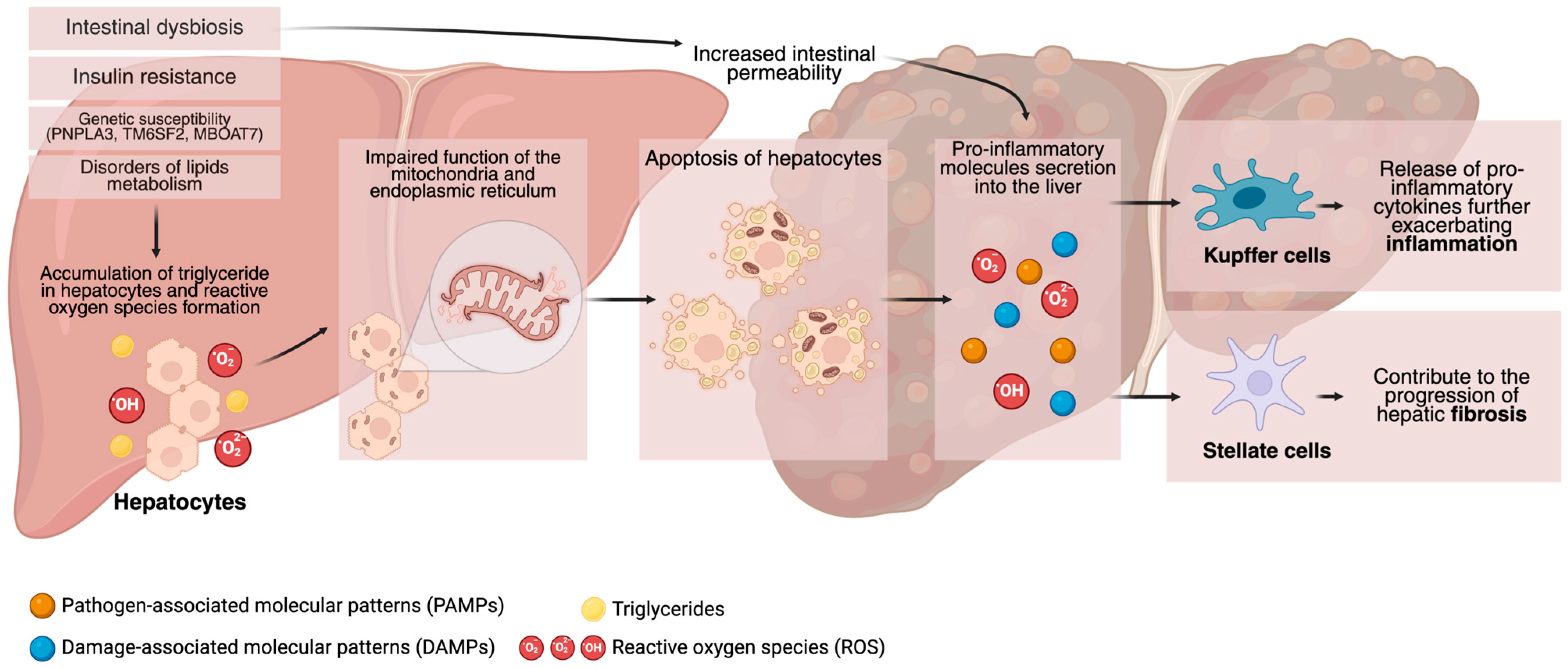
Progression from MASLD to MASH reflects a complex interplay between genetic susceptibility, metabolic dysfunction, and inflammatory signaling that extends beyond the traditional “multihit” hypothesis. Genetic variants in PNPLA3, TM6SF2, and MBOAT7 modulate susceptibility to steatosis and fibrosis [4]. Central to disease pathogenesis is metabolic inflexibility—the impaired capacity to switch between glucose and fatty acid oxidation—which, combined with insulin resistance and disordered lipid metabolism, drives sustained hepatic triglyceride accumulation [5]. Lipid overload generates toxic species (diacylglycerols, ceramides, free cholesterol) that induce lipotoxicity, mitochondrial dysfunction, endoplasmic reticulum stress, and oxidative stress [6]. Progressive impairment of mitochondrial and endoplasmic reticulum function compromises ATP synthesis and enhances reactive oxygen species (ROS) generation, including superoxide anion (O2), hydrogen peroxide, and hydroxyl radicals, contributing to hepatocyte injury and apoptosis—the histological hallmarks of MASH [7].
Contemporary understanding emphasizes the role of immunometabolism in disease progression [8]. Lipotoxic hepatocyte injury and apoptosis release damage-associated molecular patterns (DAMPs) that activate resident Kupffer cells and recruit monocytes, triggering the secretion of proinflammatory cytokines (TNF-α, IL-1β, IL-6) and NLRP3 inflammasome activation. Concurrently, hepatokine dysregulation contributes to systemic metabolic dysfunction: fetuin-A, overexpressed in steatotic livers, promotes insulin resistance and TLR4-mediated inflammation, while, paradoxically, elevated FGF21 levels reflect a state of “FGF21 resistance” analogous to insulin resistance [9]. Dysbiosis of the gut microbiome and increased intestinal permeability further augment hepatic inflammation through the translocation of pathogen-associated molecular patterns (PAMPs), including bacterial lipopolysaccharide, which synergize with DAMPs to perpetuate inflammatory signaling [10].
Fibrosis progression involves hepatic stellate cell activation driven by hepatocyte-derived signals, Kupffer cell-derived cytokines (particularly TGF-β), and oxidative stress. Importantly, while steatosis and inflammation respond relatively rapidly to metabolic improvement, fibrosis regression requires stellate cell apoptosis or senescence—a slower process that explains the temporal dissociation between inflammation resolution and fibrosis improvement observed in clinical trials. This integrated pathophysiological framework underscores the importance of weight loss, insulin sensitization, and emerging targeted therapies that address specific mechanistic nodes, including lipid metabolism (THR-β agonists), insulin sensitivity (GLP-1 receptor agonists), and hepatokine signaling (FGF21 analogs) (Figure 1).

3. Prevalence

Global prevalence estimates illustrate the magnitude of MASLD and MASH. Population-based data indicate that MASLD currently affects approximately 38% of adults and 7–14% of children and adolescents, and its adult prevalence may exceed 55% by 2040 [11]. MASLD is already a leading indication for liver transplantation and is associated with increased risks of cardiovascular disease, type 2 diabetes, chronic kidney disease, and hepatocellular carcinoma [11]. MASLD has a direct correlation with metabolic syndrome (MetS), where increased prevalence is seen with increasing severity of MetS. Using a validated sex–race–ethnicity-specific MetS severity score, Elsaid et al. demonstrated that the age-adjusted MASLD prevalence was 17.4%, 25.7%, 42.5%, and 54.9% in adults with mild, moderate, high, and very high MetS severities, respectively [12].
MASLD’s prevalence increases substantially with advancing years; individuals aged 40–64 and those aged 65 years and older demonstrate significantly higher rates compared to younger adults [13]. This age-related increase reflects the cumulative effects of metabolic risk factor exposure and the progressive nature of hepatic lipid accumulation over time.
MASLD demonstrates a clear male predominance, with men exhibiting approximately 1.5- to 2-fold higher prevalence than premenopausal women across most populations [13]. Notably, while women have lower overall MASLD prevalence, those who do develop the disease may face a higher risk of progression to advanced fibrosis compared to men, underscoring the importance of sex-specific risk assessment [14].
Hispanic populations, particularly those of Mexican ancestry, have the highest prevalence of MASLD, followed by non-Hispanic White populations, while non-Hispanic Black populations consistently demonstrate the lowest prevalence despite having higher rates of obesity and metabolic syndrome [13,15].
Lifestyle modification (caloric restriction, healthy diet, and increased physical activity) remains the cornerstone of management, while pharmacotherapies are currently evolving as an option that provides targeted therapy for MASH with fibrosis [11].

4. Diagnosis and Screening

Recent guidelines from the European Association for the Study of the Liver (EASL) and the American Association for the Study of Liver Diseases (AASLD) advocate for targeted case finding rather than universal screening. The EASL–EASD–EASO 2024 guidelines recommend assessing adults with type 2 diabetes or abdominal obesity plus additional metabolic risk factors, as well as individuals with persistently elevated aminotransferases or imaging evidence of steatosis [16]. Similarly, the AASLD practice guidance endorses the evaluation of individuals with two or more metabolic risk factors, prediabetes, or elevated liver enzymes.
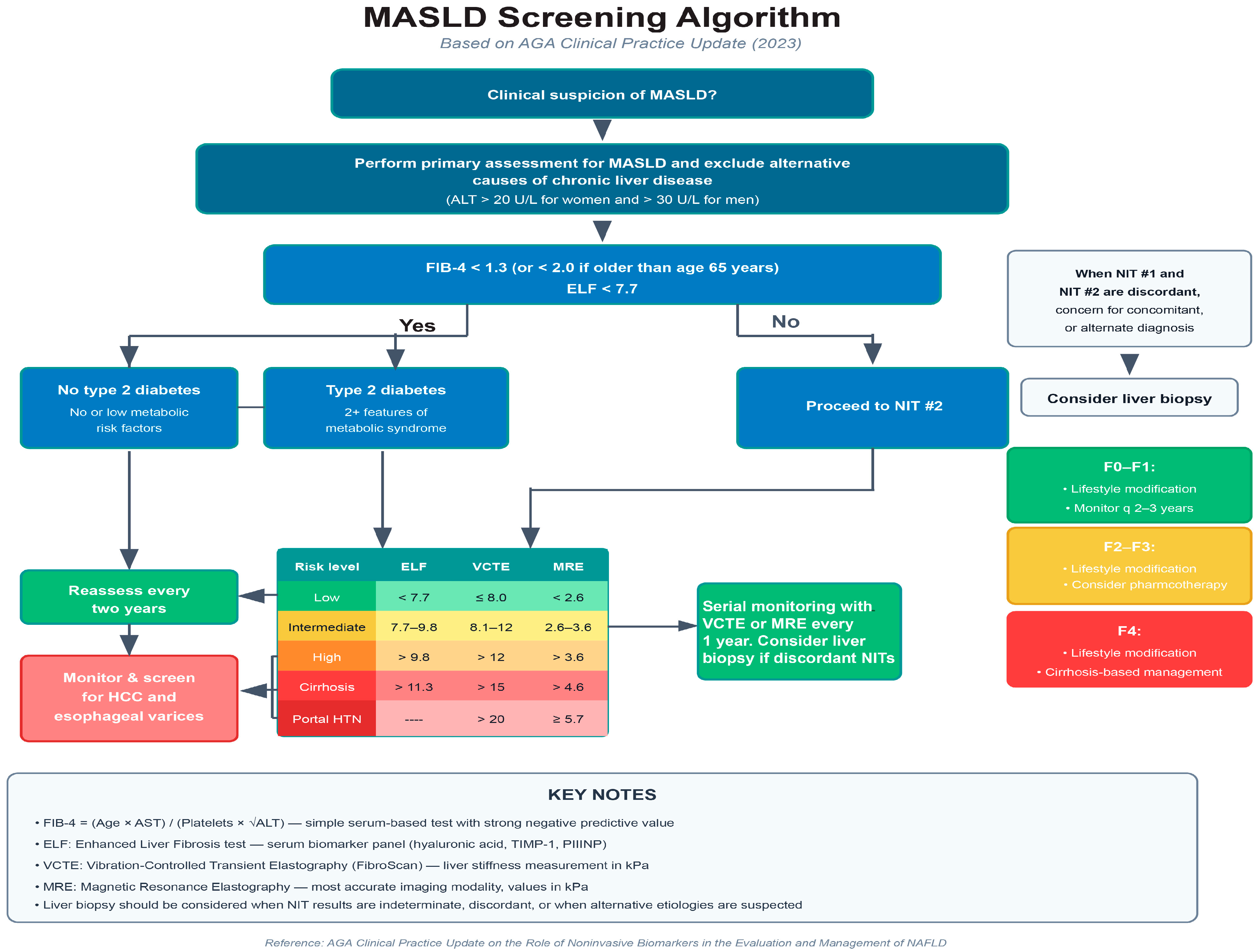
For initial assessment, both societies advise the calculation of the Fibrosis 4 (FIB-4) index based on age, aspartate aminotransferase (AST), alanine aminotransferase (ALT), and platelet count; an FIB-4 < 1.3 in adults under 65 years is considered low risk, whereas a threshold of <2.0 is used for those aged ≥ 65 years, given the greater likelihood of false positives [17]. Those with FIB-4 values above these cut-offs require second-line testing with vibration-controlled transient elastography (VCTE) or alternative modalities such as magnetic resonance elastography (MRE), ultrasound-based shear-wave elastography (SWE), or the Enhanced Liver Fibrosis (ELF) blood test [18,19] (Figure 2 and Table 1).
Vibration-controlled transient elastography (VCTE)—exemplified by FibroScan—measures liver stiffness via the ultrasound-based shear-wave velocity. In NAFLD/MASLD, VCTE values of approximately 7–8 kPa optimally indicate advanced fibrosis (≥F3), with an area under the receiver operating characteristic curve (AUROC) of 0.87–0.90, sensitivity ~80–90%, and specificity ~80% [19,20]. VCTE is widely available, rapid, and cost-effective, but its performance may be limited in patients with a high BMI or narrow intercostal spaces. Despite the presence of two probes developed for adults (M and XL probes), where the M probe is able to quantify stiffness at a distance of 25–65 mm from the skin, as compared to the XL probe, which quantifies stiffness at a depth of 35–75 mm from the skin; the XL probe can be utilized in obese individuals who yield lower liver stiffness measurement (LSM) values. As a result, obesity can affect the transmission of mechanical waves, which can result in LSM failure. VCTE limits quality assessment in those with hepatic congestion and obstructive cholestasis, where the stiffness of the hepatic parenchyma can lead to false elevations in fibrosis estimation [21].
Magnetic resonance elastography (MRE) uses MRI phase-contrast techniques to visualize shear-wave propagation in the liver and is considered the most accurate noninvasive modality. A cut-off of ~3.6 kPa yields AUROC ≈ 0.94 for advanced fibrosis, with both sensitivity and specificity around 85–90% [19,22]. MRE is superior to VCTE for detecting ≥F2 fibrosis and provides whole-liver assessment, but its higher cost, need for MRI availability, and longer acquisition time restrict routine use. MRI–proton density fat fraction (MRI-PDFF) provides a highly accurate, quantitative assessment of hepatic steatosis, with excellent reproducibility across imaging platforms and the ability to detect changes in liver fat content. While MRI-PDFF is the reference standard for noninvasive steatosis quantification, its utility for routine screening is limited by the cost and lack of fibrosis assessment.
Shear-wave elastography (SWE), including point SWE and two-dimensional SWE, is performed with conventional ultrasound systems. Prospective studies demonstrate that 2D-SWE is comparable or slightly superior to VCTE for diagnosing advanced fibrosis in NAFLD, with AUROC values of 0.85–0.88 and specificity up to 90% when similar cut-offs are used [20]. SWE is attractive because it can be integrated into routine abdominal ultrasound exams, although operator experience affects reproducibility.
The Enhanced Liver Fibrosis (ELF) test is a serum biomarker panel (hyaluronic acid, procollagen III N-terminal peptide, and TIMP-1), generating a score that correlates with the fibrosis stage. An ELF score ≥ 9.8 indicates advanced fibrosis with AUROC ≈ 0.80–0.83; lower cut-offs (~9.5) maximize sensitivity (>90%), while higher cut-offs (~11) increase specificity (>90%) [23]. The ELF test is advantageous where elastography is unavailable and can be repeated easily, but the cost and laboratory availability may limit its use.
Depending on these results, patients with high liver stiffness (e.g., VCTE > 12–15 kPa or MRE > 5 kPa) are referred to a hepatologist for comprehensive evaluation, including portal hypertension assessment and consideration of pharmacotherapy trials [18,19,20]. Individuals with indeterminate or moderately elevated results undergo intensified management of metabolic comorbidities with repeat FIB-4 or elastography within ~12 months [16,17].
The American Gastroenterology Association (AGA) proposed a clinical practice update on the use of noninvasive testing to evaluate clinical suspicion for NAFLD where liver functional test enzymes are used to screen for alternative causes of liver disease. Based on the cut-off values with ELF, VCTE, and MRE, it helps to risk-stratify the levels of advanced fibrosis to guide further management, whether this may be lifestyle modifications, pharmacotherapy treatment, or the timing of repeated imaging for the monitoring of disease progression [24]. This proposed algorithm also takes into account the risk factors of metabolic syndrome, including the presence of type 2 diabetes and the potential need to screen for hepatocellular carcinoma and esophageal varices if there is concern for high-risk cirrhosis and portal hypertension [24].
Liver biopsy remains the gold standard for diagnosing MASH and staging fibrosis, but it is now reserved for cases where noninvasive tests yield discordant results or when there is suspicion of an alternative liver disease [18]. The absence of metabolic dysfunction or the presence of another chronic liver disease does not preclude MASLD; in patients without metabolic risk factors or with competing etiologies, the term “cryptogenic SLD” is used [1].

5. Traditional Management

5.1. Lifestyle Approaches

Lifestyle modification remains the cornerstone of MASLD/MASH management. Weight loss demonstrates a dose-dependent relationship with histological improvement: 5–7% reductions in steatosis, ≥7–10% improvements in steatohepatitis, and ≥10% achievement of fibrosis regression [25]. The Mediterranean diet is endorsed by current guidelines for its benefits on hepatic steatosis independently of weight loss [16]. Low-carbohydrate diets reduce intrahepatic triglycerides through decreased de novo lipogenesis, while high fiber intake improves the gut microbiota and may attenuate gut–liver axis-mediated inflammation [26]. Fructose from sugar-sweetened beverages should be minimized, whereas coffee consumption is not discouraged.
Regular physical activity improves hepatic steatosis independently of weight loss. Guidelines recommend 150–300 min/week of moderate-intensity aerobic exercise plus resistance training 2–3 days/week [16]. Sustained lifestyle modification requires behavioral support through structured programs; for patients unable to achieve adequate weight loss, pharmacotherapy or bariatric surgery may be considered, with the latter demonstrating durable histological improvements in selected candidates [27].

5.2. Traditional Pharmacologic Therapy

Prior to the approval of resmetirom and semaglutide, vitamin E and pioglitazone represented the primary pharmacologic options for MASH, although neither agent carries regulatory approval specifically for this indication.
Vitamin E (α-tocopherol) is a lipid-soluble antioxidant that reduces oxidative stress and lipid peroxidation—key drivers of hepatocellular injury in MASH. The landmark PIVENS trial demonstrated that vitamin E 800 IU/day significantly improved steatohepatitis compared to a placebo in non-diabetic adults with biopsy-proven NASH (43% vs. 19% achieved the primary endpoint; p < 0.001), although fibrosis did not improve significantly [28]. Current AASLD and EASL guidelines recommend vitamin E for non-diabetic adults with biopsy-confirmed MASH without cirrhosis [16,17]. Vitamin E is not recommended for patients with diabetes, MASLD without steatohepatitis, MASH-related cirrhosis, or cryptogenic cirrhosis due to insufficient evidence in these populations. Long-term safety concerns include a potential increased risk of hemorrhagic stroke and, in men, an association with prostate cancer, as observed in the SELECT trial, although causality remains uncertain [29]. These considerations warrant individualized risk–benefit discussions.
Pioglitazone, a thiazolidinedione and peroxisome proliferator-activated receptor gamma (PPARγ) agonist, improves hepatic insulin sensitivity and reduces hepatic lipid accumulation, inflammation, and ballooning. In the PIVENS trial, pioglitazone 30 mg/day improved steatohepatitis (34% vs. 19% with placebo), although this did not meet the prespecified significance threshold [28]. Subsequent meta-analyses have confirmed histological benefits, including fibrosis improvement, particularly in patients with type 2 diabetes [30]. Current guidelines support pioglitazone use in patients with biopsy-proven MASH with or without type 2 diabetes, recognizing its metabolic benefits in this high-risk population [16,17]. However, adverse effects—including weight gain (typically 2–4 kg), fluid retention, increased fracture risks (particularly in postmenopausal women), and a possible association with bladder cancer—limit broader adoption and necessitate careful patient selection [31].
Both agents may be considered in patients who are not candidates for or do not have access to newer approved therapies, and their use should be guided by individual patient characteristics, comorbidities, and treatment goals.

6. Current and Investigational Drugs

The therapeutic landscape for MASLD/MASH now encompasses multiple pharmacological classes targeting distinct pathophysiological mechanisms: thyroid hormone receptor-β (THR-β) agonists, incretin-based therapies (GLP-1 receptor agonists and dual/triple agonists), peroxisome proliferator-activated receptor (PPAR) agonists, fibroblast growth factor 21 (FGF21) analogs, farnesoid X receptor (FXR) agonists, acetyl-CoA carboxylase (ACC) inhibitors, and sodium–glucose cotransporter (SGLT) inhibitors. The FDA approvals of resmetirom and semaglutide for MASH with fibrosis represent landmark advances in disease management. This section reviews these approved agents alongside the most clinically advanced investigational therapies, with an emphasis on mechanisms, efficacy data, and the differential effects of each class on steatosis, inflammation, and fibrosis.

6.1. Resmetirom

Resmetirom is an oral, liver-directed, selective thyroid hormone receptor beta (THR-β) agonist [17,31]. Highly expressed in the liver, THR-β regulates lipid metabolism and hepatic inflammation. Resmetirom, through its selective activation of THR-β, has been found to increase hepatic fat metabolism, reducing lipotoxicity, hepatic fat accumulation, and inflammation [32]. Two phase 3 clinical trials (MAESTRO-NASH and MAESTRO-NAFLD-1) led to an accelerated FDA approval in March 2024 for the treatment of MASH with moderate to advanced liver fibrosis (F2–F3) [17]. The recommended daily dose is 80 mg for adults who weigh less than 100 kg and 100 mg for those who weigh 100 kg or more [16,17]. The MAESTRO-NASH trial found MASH resolution without worsening of fibrosis in 25.9% of patients in the 80 mg resmetirom group and 29.9% in the 100 mg resmetirom group, compared with 9.7% in the placebo group (p < 0.001 in both). Moreover, fibrosis improvement by at least one stage without worsening of the MAFLD activity score was seen at rates of 24.2%, 25.9%, and 14.2% in the 80 mg group, 100 mg group, and placebo group, respectively [33]. Resmetirom was associated with clinically meaningful improvements in both MASH resolution and fibrosis; however, the magnitude of fibrosis improvement was slightly lower than that observed for MASH resolution. This difference may reflect, at least in part, the mechanism of THR-β agonism, which primarily modulates hepatic metabolic pathways by enhancing fatty acid oxidation and reducing lipogenesis and lipotoxicity, rather than directly targeting hepatic stellate cell activation or extracellular matrix deposition. As hepatic fibrosis represents a downstream consequence of chronic inflammation and injury, improvements in metabolic drivers may reduce ongoing fibrogenic signaling, whereas regression of established fibrosis is generally slower and may require longer treatment durations.
The MAESTRO-NAFLD-1 trial evaluated the safety of resmetirom in MAFLD patients, and the most common side effects reported were diarrhea (up to 34%) and nausea (up to 22%) [16,17,34]. Additionally, resmetirom has been shown to significantly lower LDL-C, triglycerides, lipoprotein (a), and apolipoprotein B and C-III [32,34]. No significant differences in fasting blood sugar (FBS), HbA1c, or fasting insulin were seen between the resmetirom and placebo groups. A meta-analysis revealed no significant changes in FT3 and TSH levels between the resmetirom and placebo groups; however, there was a significant reduction in FT4 (up to 21%), rarely leading to abnormal levels [17,32,34]. This change is believed to be secondary to an increase in T4-to-T3 conversion in the liver, with a reduction in rT3 levels [32]. The FDA review concluded that thyroid axis function was maintained during resmetirom therapy, and therefore no thyroid therapy is needed [32]. This is attributed to the selectivity of resmetirom for THR-β, as the thyroid axis is mainly mediated by THR-α [16]. Moreover, resmetirom significantly increased sex hormone-binding globulin (SHBG), total testosterone, and estradiol, but not free testosterone. No data on free estradiol were available [17,34].
Regarding the initiation of treatment, the FDA-approved label does not require liver biopsy to confirm fibrotic MASH, and treatment can be initiated based on noninvasive liver disease assessments (NILDAs) of steatosis and fibrosis [17]. However, data are insufficient to guide the initiation of resmetirom in patients already on concomitant therapy with GLP-1 agonists, thiazolidinediones, or vitamin E, as the MAESTRO-NASH trial excluded patients who started or were dose-modified on any of these concomitant therapies in the past 6 months. Clinical judgment should be used in this situation, based on the patient’s comorbidities, stage of liver fibrosis, risk of progression, and response to ongoing therapy [17,33]. Notably, around 14% of patients in the MAESTRO-NASH trial were on a stable dosage of GLP-1RA for at least 6 months with a stable body weight for 3 months prior to the initial screening liver biopsy; therefore, it seems reasonable to use resmetirom in this category of patients. However, further studies are needed to better understand interactions between resmetirom and other concomitant therapies [16,33].
Additionally, resmetirom is a substrate and a weak inhibitor of cytochrome P450 enzyme 2C8 (CYP2C8), and, when taken with another CYP2C8 inhibitor, such as clopidogrel, a dose reduction is recommended (60 mg/d for patients who weigh less than 100 kg and 80 mg/d for those who weigh 100 kg or more) [16,17]. Resmetirom is also a substrate for organic anion-transporting polypeptides 1B1 and 1B3, and its concomitant use with statins may affect statin metabolism. Thus, dose adjustments for statins are recommended when co-administered with resmetirom: the maximum recommended dose of pravastatin and atorvastatin is 40 mg/d, and that for simvastatin and rosuvastatin is 20 mg/d [17,34].
While taking resmetirom, the AASLD guidelines recommend hepatic function panel testing at baseline and at periodic intervals (3, 6, and 12 months; then, every 6 months thereafter) to evaluate the response and adverse events. If hepatotoxicity develops, treatment should be stopped. The AASLD recommends initial thyroid function testing prior to the initiation of resmetirom therapy, and, if abnormal, hypothyroidism or hyperthyroidism should be addressed before starting therapy, with follow-up testing every 6 months per standard of care. If thyroid function tests at baseline are normal, no further testing is indicated [17]. Similarly, if patients have an abnormal lipid profile at baseline, testing should be conducted routinely (every 6 months) [17].
To assess the efficacy of resmetirom therapy, the AASLD guidelines recommend using liver stiffness measurement (LSM) by MRE or VCTE, depending on the modality used to determine treatment candidacy. Despite the lack of reliable evidence correlating imaging-based NILDA tests to histologic changes in liver fibrosis, the AASLD made tentative recommendations based on limited available data. A change in VCTE of at least 25% or MRE of at least 20% from baseline is considered clinically significant [17,33]. If a significant improvement in fibrosis occurs, continuation of resmetirom therapy is recommended. Conversely, if significant clinical worsening of liver disease (suggested by worsening ALT levels or NILDA) occurs, discontinuation of resmetirom should be considered. If no significant change is observed, the decision to continue treatment should be based on clinical judgment [17]. It should be noted that VCTE LSM is not an ideal marker for monitoring the response to resmetirom therapy. In the MAESTRO-NASH trial, a histologic response was occasionally observed without a VCTE LSM improvement, while, sometimes, a 25% decrease in VCTE LSM overestimated the histologic response [17,33]. Therefore, these thresholds may change as new data become available.

6.2. Glucagon-Like Peptide-1 (GLP-1) Agonists

GLP-1 and glucose-dependent insulinotropic polypeptide (also known as gastric inhibitory polypeptide or GIP) are incretins secreted by intestinal L and K cells, respectively, that promote insulin secretion and lower serum glucose levels [35,36]. The incretin effect is defined as higher insulin secretion in response to oral glucose compared to intravenous glucose, mediated by GLP-1 and GIP secretion following oral glucose or nutrient intake [35]. Additionally, GLP-1 decreases glucagon secretion, appetite, and peripheral insulin resistance and delays gastric emptying, which is why GLP-1 receptor agonists (GLP-1RAs) are used in the treatment of T2DM and obesity [35,36,37]. Furthermore, GLP-1RAs appear to improve cardiovascular risk factors by reducing weight, lowering blood pressure, and improving lipid profiles [36,37].
A meta-analysis of several outcome trials, such as LEADER (liraglutide), SUSTAIN-6 (semaglutide), REWIND (dulaglutide), and HARMONY (albiglutide—discontinued), showed reductions in all-cause mortality (12%), heart failure hospitalization (9%), and major adverse cardiovascular events (MACE) (12%), including cardiovascular mortality, stroke, and myocardial infarction [36,38]. Moreover, both the FLOW and SELECT trials showed the nephroprotective effects of GLP-1RA therapy [38,39].
However, despite the lack of GLP-1 receptor expression on hepatocytes, GLP-1RAs have been shown to indirectly affect the liver by improving hepatic insulin resistance, plasma insulin, and glucose levels, while reducing lipotoxicity [35,36]. Furthermore, by promoting insulin secretion and weight loss, GLP-1RAs lead to a reduction in free fatty acids and intrahepatic triglycerides. This, combined with decreased glucagon levels, reduces hepatic gluconeogenesis and de novo lipogenesis, improving hepatic parameters. The reduction of extrahepatic lipolysis, mediated by improved adipose tissue insulin sensitivity, decreases inflammatory markers and increases adiponectin [36,40,41].
This class of medications includes GLP-1RAs, dual agonists (GLP-1/GIP or GLP-1/glucagon receptor [GCGR] RAs), and triple agonists (GLP-1/GIP/GCGR RAs) [42,43].

6.2.1. GLP-1RAs

While several GLP-1RAs have shown positive effects on liver enzymes and liver fat reduction, only liraglutide and semaglutide have undergone clinical trials with histological outcomes [44,45,46]. The phase 2 LEAN study found that liraglutide had higher rates of NASH resolution and lower rates of fibrosis progression. However, further studies were abandoned in favor of semaglutide due to its less frequent dosing and superior effects on metabolic outcomes and weight loss [45,47,48].
A phase 2b clinical trial found that semaglutide achieved dose-dependent MASH resolution (40% [0.1 mg/d] → 59% [0.4 mg/d]) compared to a placebo (17%) but did not demonstrate a significant improvement in liver fibrosis [36,49]. An ongoing phase 3 study (ESSENCE; NCT04822181) is currently underway, involving 1200 patients with biopsy-proven MASH and F2/F3 fibrosis. This study has two parts: Part 1 assesses MASH resolution and fibrosis improvement at 72 weeks, and Part 2 examines cirrhosis-free survival at 240 weeks. Results from 800 patients in a planned interim analysis showed that patients taking semaglutide 2.4 mg once per week had significantly higher rates of MASH resolution (62.9% vs. 34.3%), liver fibrosis reduction (36.8% vs. 22.4%), and combined MASH resolution/fibrosis reduction (32.7% vs. 16.1%) compared to those on a placebo [45,50]. These findings led to the FDA approval of semaglutide for MASH with moderate-to-advanced fibrosis, with anticipated incorporation into future AASLD guidelines [17,51]. The differential magnitude of response between MASH resolution and fibrosis improvement likely reflects differences in dosing, treatment duration, and trial design, as well as the indirect hepatic effects of GLP-1 receptor agonists, which primarily act through weight loss and metabolic improvement rather than the direct inhibition of hepatic stellate cell activation. As fibrosis represents a downstream structural consequence of chronic hepatic injury, its regression typically requires longer treatment durations than the resolution of steatohepatitis.

6.2.2. Dual GLP-1/GIP Agonists

One of the major dual GLP-1/GIP co-agonists studied for MASH treatment is tirzepatide. In the SYNERGY-NASH phase 2 trial (NEJM 2024), tirzepatide achieved MASH resolution without fibrosis worsening in 44–62% of patients, versus 10% with a placebo, and a ≥one-stage fibrosis improvement in 51–55% versus 30% [52]. Other GLP-1/GIP agonists are still in early-phase studies.

6.2.3. Dual GLP-1/GCGR Agonists

Several GLP-1/GCGR agonists are being studied for MASH treatment. Cotadutide, a dual GLP-1/GCGR agonist with approximately fivefold greater GLP-1 activity, has demonstrated favorable hepatic and metabolic effects in early clinical development. In a phase 2a trial, it exhibited a significant reduction in hepatic glycogen and hepatic fat fraction following 28–35 days of treatment, consistent with glucagon receptor engagement and altered glycogen synthesis [53]. Subsequent phase 2b studies in patients with type 2 diabetes revealed significant reductions in liver transaminases (ALT, AST, GGT) and improvements in noninvasive fibrosis markers, including the NAFLD fibrosis score, FIB-4, and PRO-C3 levels [54,55]. However, the subsequent development of cotadutide was abandoned in favor of a weekly-injection dual GLP-1/glucagon agonist (AZD9550).
Similarly, survodutide has been studied in a phase 2 trial, achieving MASH improvement without fibrosis worsening in 43–62% vs. 14% with a placebo. Additionally, a ≥30% reduction in liver fat content occurred in 57–67% vs. 14% with the placebo, and a ≥one-stage fibrosis improvement occurred in 34–36% vs. 22% with the placebo. Major side effects were nausea (66%), diarrhea (49%), and vomiting (41%) [56]. Currently, a phase 3 trial (LIVERAGE, NCT06632444) is underway for survodutide in MASH with moderate-to-advanced liver fibrosis.
Pemvidutide, another dual GLP-1/GCGR agonist, has shown promising results in early clinical studies for MASLD/MASH. In a phase 1b trial of 94 patients, pemvidutide achieved up to a 68.5% reduction in liver fat content (LFC) versus 4.4% with a placebo at 12 weeks, with over 70% achieving a ≥50% LFC reduction and 56% reaching normalization at the 1.8 mg dose. The 1.8 mg dose also showed maximal improvements in weight (−4.3%), ALT (−13.8 IU/L), and corrected cT1 (−75.9 ms), with good tolerability [57]. In a 24-week extension study, LFC decreased by up to 76% and body weight by 6.2%, again with favorable safety [58]. Preliminary phase 2b (IMPACT trial, NCT05989711) results reported MASH resolution without fibrosis worsening in 52–59% of pemvidutide-treated patients versus 19% with a placebo (p < 0.0001), with AI-based assessment confirming significant fibrosis reductions, including 30.6% achieving a ≥60% fibrosis reduction at 1.8 mg, compared to 8.2% with the placebo [59]. Results are planned to be presented at AASLD 2025. Similarly to other GLP-1 receptor agonists and related metabolic therapies, steatosis improves more rapidly than fibrosis because hepatic fat accumulation is metabolically reversible and responds quickly to weight loss and improved insulin sensitivity, whereas fibrosis represents structural tissue remodeling that occurs more slowly.

6.2.4. Triple Agonists

Novel triple agonists simultaneously target the GLP-1, GIP, and glucagon receptors and have recently been studied for obesity and MASH management. Retatrutide (LY3437943) was studied in a phase 2 clinical trial, showing reductions in liver fat of 81.7% and 86% for 8 mg and 12 mg doses, respectively, at 48 weeks, with more than 85% of patients achieving liver fat < 5% at 48 weeks for doses ≥ 8 mg [60]. Current phase 3 trials are underway to assess the effects of retatrutide on cardiovascular outcomes, kidney disease, and obesity; however, no phase 3 trials for MASH with histological outcomes are currently ongoing [61].
HM15211 (efocipegtrutide) is being studied in a phase 2b, double-blind trial in the US and Korea (HM-TRIA-201, NCT04505436), with the primary goal of achieving MASH resolution without fibrosis worsening [62].

6.3. Sodium–Glucose Cotransporter Inhibitors (SGLTi)

6.3.1. SGLT2 Inhibitors

SGLT2 inhibitors are approved for the treatment of type 2 diabetes mellitus and have demonstrated favorable cardiovascular and nephroprotective benefits, even in non-diabetic patients [63,64]. Currently, empagliflozin and dapagliflozin are the only FDA-approved agents for the treatment of heart failure, independently of the ejection fraction or the presence of diabetes [65].
Both the AASLD and EASL–EASD–EASO guidelines do not recommend SGLT2 inhibitors as a MASH-directed therapy due to the limited sample sizes and lack of histological outcomes in available studies [16,17]. However, a recent multicenter, double-blind, randomized, placebo-controlled trial found that dapagliflozin resulted in a histologically proven MASH improvement without fibrosis worsening compared to a placebo (risk ratio 1.73, 95% CI 1.166–2.58, p = 0.006). Additionally, dapagliflozin was associated with higher proportions of MASH resolution and fibrosis improvement (RR 2.91 [p = 0.01] and 2.25 [p = 0.001], respectively) compared to the placebo [66].
Furthermore, while not placebo-controlled, two open-label trials with tofogliflozin and ipragliflozin evaluated histological outcomes. Takeshita et al. found no differences in histological outcomes in patients with type 2 diabetes and MAFLD treated with tofogliflozin versus glimepiride for 48 weeks [67]. Takahashi et al. found that ipragliflozin, compared to lifestyle modifications, in patients with type 2 diabetes and MAFLD for 72 weeks significantly improved features of steatohepatitis, such as ballooning (52% vs. 24%, p = 0.02) and liver fibrosis (57% vs. 16%, p = 0.01), without significant differences in inflammation or steatosis [68]. Further large-scale studies are needed to better assess the therapeutic impact of SGLT2 inhibitors on liver histology.

6.3.2. Dual SGLT1 and SGLT2 Inhibitors

New drugs, such as sotagliflozin and licogliflozin, have been developed for the treatment of diabetes and heart failure and inhibit both SGLT1 and SGLT2 [69]. The SCORED and SOLOIST-WHF trials found that sotagliflozin reduced the risks of non-fatal MI by 32%, non-fatal stroke by 34%, and cardiovascular mortality and heart failure-related hospitalizations and urgent visits by more than 40% [70,71,72]. This led to the FDA approval of sotagliflozin in May 2023 for the treatment of heart failure, independently of the ejection fraction or the presence of diabetes [73].
However, sotagliflozin has not yet been studied in humans for the treatment of MAFLD [69]. A phase 2a, 12-week study on licogliflozin showed improvements in liver enzymes and liver fat content, measured by MRI-PDFF, with the 150 mg dose [69,74]. This study was limited by the short duration and the lack of histologic outcomes, leading to the planning of a 52-week phase 2 study (ELIVATE, ClinicalTrials.gov ID: NCT04065841) to evaluate the efficacy and safety of licogliflozin/tropifexor combination therapy and each monotherapy in patients with NASH and liver fibrosis. However, this study was ultimately terminated due to a business decision [75].

6.4. Peroxisome Proliferator-Activated Receptor (PPAR) Agonists

PPARs are nuclear receptors that bind fatty acids and their derivatives, where there are three main isoforms: PPARα, PPARβ, and PPARγ. PPARα is expressed in the liver, kidneys, and heart and serves as a transcription factor for β-oxidation that reduces hepatic lipid accumulation and suppresses the proinflammatory signaling pathway of nuclear factor κB (NFκB). PPARβ, being found in skeletal muscle, adipose tissue, and skin, enhances insulin signaling pathways and reduces fat deposition in the liver to reduce liver inflammation and fibrosis, while PPARγ, expressed in adipose tissue, reduces free acids in the liver by promoting adipocyte differentiation [76]. Given that PPAR agonists lower serum triglycerides and increase HDL in patients with insulin resistance and metabolic syndrome, pioglitazone is a PPARγ agonist that is approved for the treatment of type 2 diabetes and biopsy-proven MASH, where it also reduces the risk of all-cause mortality for myocardial infarction and stroke [77,78]. As such, Musso et al., in 2017, performed a meta-analysis that evaluated eight randomized controlled trials, of which there were five that evaluated pioglitazone therapy at daily dosages of 30 to 45 mg for up to 24 months. They demonstrated improvements in advanced fibrosis (OR 3.15, p = 0.01), fibrosis of any stage (OR 1.66, p = 0.01), and NASH resolution (OR 3.22, p < 0.001) [30].
Saroglitazar is a dual PPARα/γ agonist and an approved drug in India for the treatment of MASH [77]. The EVIDENCES IV study was a multicenter, randomized, double-blind phase 2 study comparing those taking 1 mg, 2 mg, and 4 mg compared to a placebo group over a 16-week period, where 106 eligible patients were identified and split accordingly into the groups. Based on the results, treatment with saroglitazar resulted in a rapid reduction in ALT levels despite the different dosages compared to the placebo group (p < 0.001). Additionally, the higher 4 mg dose significantly improved liver fat content, adiponectin, and triglyceride levels (p < 0.05) [79]. Although this drug has not received FDA approval in the United States, it has been approved in India for diabetic dyslipidemia and NAFLD. There was also a marked improvement in hepatocyte ballooning and steatosis in patients treated with saroglitazar such that ballooning improved from 1.2 ± 0.41 to 0.3 ± 0.52 at week 24 with a 2 mg dose and from 1.3 ± 0.49 to 0.4 ± 0.53 with a 4 mg dose [80].
Lanifibranor is a pan-PPAR agonist that activates the three isotypes to improve insulin resistance due to the effects of PPARα on glycolysis–gluconeogenesis, to reduce hepatic inflammation with a reduction in macrophage activation via PPARβ, and to counteract stellate cell action to improve the fibrotic response via TGF-β stimulation, which limits the expression of proinflammatory mediators (TNF-α, iNos, IL-6, and CXCL2) [81]. In the phase 2b NATIVE clinical trial involving patients with NASH, 247 patients were assigned at a 1:1:1 ratio to either receive 1200 mg of lanifibranor, 800 mg of lanifibranor, or a placebo once daily for a six-month duration. The primary endpoint of the study was a reduction in the Steatosis, Activity, Fibrosis (SAF) score of at least two points from baseline to week 24. The SAF score considers the degree of steatosis, the presence of lobular inflammation and ballooning degeneration in terms of hepatocyte and cytoplasm sizes, and histological findings of fibrosis [82]. The results from the trial demonstrated a significantly greater percentage of patients with a decrease among those taking the 1200 mg dose of lanifibranor compared to the placebo, at 55% versus 33%, respectively (risk ratio 1.7, p = 0.007) [83]. This drug has not yet received FDA approval; however, it is undergoing phase 3 of the NATIVE trial (NCT04849728) to evaluate the treatment response in biopsy-confirmed MASH and stage F2/F3 fibrosis [84]. Nonetheless, there are no PPAR agonists currently approved for the treatment of NASH or NAFLD on the market.

6.5. Fibroblast Growth Factor 21 (FGF21)

FGF21, part of the fibroblast growth factor family, is created in the liver and fatty tissue and serves as a diagnostic biomarker for MASLD. It reduces hepatic steatosis and lipotoxicity by increasing lipid oxidation, decreasing lipogenesis, modulating iron metabolism, and activating AMP-activated protein kinase [85]. Kupffer cells secrete tumor necrosis factor, which activates nuclear factor-kappa B and CC chemokine ligand 2 to promote proinflammatory macrophages and monocytes, which cause hepatic inflammation; however, FGF21 reduces Kupffer cell activation, which in turn inhibits collagen accumulation and alleviates liver fibrogenesis [86]. Additionally, Rose et al., in 2025, demonstrated that FGF21 can directly signal the central nervous system to reduce liver triglyceride levels and fibrosis by suppressing de novo lipogenesis by acting on Vglut2 glutamatergic neurons, which can increase energy expenditure, lower body weight, and improve insulin sensitivity [87].
Several FGF21 analogs are being studied for the treatment of MASLD, which include but are not limited to pegozafermin, efimosfermin alfa, and efruxifermin. In a phase 2b, multicenter, double-blind, 24-week, randomized controlled study (ENLIVEN trial, NCT04929483) exploring pegozafermin, the percentage of patients with an improvement in fibrosis without NASH worsening was higher in the treatment group as compared to the placebo group for both a weekly 30 mg dose (p = 0.009) and a biweekly 44 mg dose (p = 0.008) [88]. Efimosfermin alfa is a genetically engineered variant of FGF21 with disulfide bonds and has demonstrated a 54% reduction in triglycerides, 7% reduction in total cholesterol, 12% reduction in LDL-C, 36% reduction in HDL-C, and 52% reduction in hepatic fat within a 12-week period [85].
Efruxifermin is a bivalent FGF21 analog that was recently explored via the SYMMETRY phase 2b randomized controlled trial at 45 locations in the United States, Puerto Rico, and Mexico. There were 181 patients who were assigned at a 1:1:1 ratio to groups receiving treatment with either 28 mg, 50 mg, or a placebo weekly, with liver biopsies performed at weeks 36 and 96 and with the primary end goal of evaluating reductions in fibrosis without worsening MASH based on the NAS score. At the 36-week mark, the treatment group with efruxifermin did not show a significant fibrosis reduction. In contrast, there appeared to be a reduction in fibrosis without worsening of MASH at week 96 for the efruxifermin 50 mg group, with a 16% difference compared to the placebo (CI 2 to 30) [89].
At present, there are also no FGF21 analogs currently noted in the literature that are approved for the treatment of NASH or NAFLD, as they are still undergoing phase 3 randomized controlled trials.

6.6. Farnesoid X Receptor (FXR) Agonists/Acetyl-CoA Carboxylase (ACC) Inhibitors

FXR is a nuclear transcription factor that suppresses the expression of cholesterol 7- 7-α-hydroxylase, which is the rate-limiting step for bile acid synthesis, and it plays a role by inhibiting lipogenesis and activating β-oxidation and intracellular triglyceride clearance [90]. It works by inhibiting hepatic de novo lipogenesis by transcriptional downregulation with suppression of the transcription of SREBP-1c and other lipogenic target genes [91]. In the multicenter, randomized controlled FLINT phase 2b trial, 283 patients were randomly assigned to either a treatment group with 6-ethylchenodeoxycholic acid (obeticholic acid), which is a potent activator of FXR, or to a placebo group to be studied over a period of 72 weeks. The primary target for analysis was histological improvement, where 45% of the treatment group versus 21% of the placebo group demonstrated improved liver histology (RR 1.9, CI 1.3–2.8, p = 0002) and a decrease in the NAFLD activity score (p < 0.0001) [92]. Based on the results of the 18-month-long liver biopsy analysis phase 3 REGENERATE trial, there was a greater proportion of individuals achieving a ≥one-stage improvement in fibrosis with no worsening of NASH in patients taking obeticholic acid 25 mg compared to those receiving a placebo, with 22.4% versus 9.6% (p < 0.0001), respectively [93].
ACC is an enzyme that converts acetyl-CoA to malonyl-CoA, which is the rate-limiting step in de novo lipogenesis. There are two isoforms in mammals: ACC1 is present in the cytosol of lipogenic tissues such as liver and adipose tissue; ACC2 is present in the mitochondria of oxidative tissues like skeletal muscle and mediates the transfer of fatty acids into mitochondria for beta-oxidation [91,94,95]. In a study by Matsumoto et al. in 2020, which utilized mouse models to compare ACC1 gene knockout to a control group, where both were fed a high-sucrose diet, there was a reduction in hepatic de novo lipogenesis. Additionally, ACC2 gene knockout mice had higher fatty liver oxidation [94]. GS-0976 (firsocostat), an allosteric inhibitor of isoforms ACC1 and ACC2, was evaluated regarding its effect on hepatic fibrosis. In a phase 2 trial involving 126 patients with NASH and fibrosis using 20 mg daily for 12 weeks, this drug significantly reduced liver fat by 29% but was associated with increased plasma triglyceride levels [95].
With the knowledge that was garnered regarding the aforementioned FXR and ACC inhibitor medications with beneficial effects on NASH, the ATLAS trial was conducted, which was an international, multicenter randomized phase 2b study that enrolled 350 patients with bridging fibrosis of compensated cirrhosis across a 48-week period. They were divided into groups that received either a placebo, the individual drugs, or a combination drug therapy. In the cilofexor (FXR agonist) and firsocostat (ACC inhibitor) combination therapy group, there was a significant improvement in NAS (p = 0.002), steatosis (p = 0.009), lobular inflammation (p = 0.004), and ballooning (p = 0.04) as compared to the placebo group [96]. Compared to the combination drug regimen, where 21% demonstrated a ≥one-stage improvement in fibrosis without worsening of NASH between baseline and 48 weeks based on central pathologist review, both monotherapies with either firsocostat and cilofexor achieved a 12% improvement, but these were found to be not statistically significant [96].
In the more recent double-blind LIVIFY trial in 2023, which explored vonafexor, a second-generation FXR agonist, reductions in liver fat content (LFC) were examined with MRI–proton density fat fraction as the primary end goal. There was a significant decrease in those treated with vonafexor at week 12 as compared to baseline at –4.71% (p = 0.02), and the drug demonstrated a reduction of –8.62% (p = 0.037) when compared to the placebo [97]. However, there are no current drugs within this class that are FDA-approved for NASH or NAFLD treatment.
A comparative summary of the different treatment modalities in MASLD/MASH has been included. (Table 2).

7. Conclusions

In summary, the landscape of steatotic liver diseases has rapidly evolved, with the adoption of new terminology (MASLD/MASH) marking a shift toward definitions that reflect metabolic risk and allow for moderate alcohol consumption. These consensus-driven frameworks improve diagnostic clarity, align pathophysiology with nomenclature, and help to reduce the stigma associated with liver disease.
Progress in noninvasive assessment tools, including VCTE, MRE, and the ELF test, has significantly advanced screening and risk stratification for fibrosis, offering more accessible and repeatable alternatives to biopsy. Contemporary clinical guidelines promote targeted screening in high-risk populations, emphasizing the early detection of liver disease and careful management of comorbidities.
Therapeutic advances—notably the approvals of resmetirom, semaglutide, and promising investigational agents such as tirzepatide and pemvidutide—now enable targeted intervention for MASH with fibrosis. The integration of metabolic, genetic, and environmental insights highlights the interplay of risk factors driving disease progression and underscores the importance of individualized management strategies. As the prevalence and clinical impact of MASLD and MASH continue to rise globally, future research should strive to address the unmet needs in diagnosis, monitoring, and therapy, while focusing on prevention and multidisciplinary care for affected individuals.

Author Contributions

Conceptualization, R.N.; writing—original draft preparation, R.N. and O.A.; writing—review and editing, R.N., O.A., A.S., R.T. and L.D.; supervision, L.D. All authors have read and agreed to the published version of the manuscript.

Funding

This research received no external funding.

Institutional Review Board Statement

Not applicable.

Informed Consent Statement

Not applicable.

Data Availability Statement

No new data were created or analyzed in this study.

Conflicts of Interest

The authors declare no conflicts of interest.

Abbreviations

The following abbreviations are used in this manuscript:
AASLDAmerican Association for the Study of Liver Diseases
ALTAlanine aminotransferase
ASTAspartate aminotransferase
AUROCArea under the receiver operating characteristic curve
BMIBody mass index
CYP2C8Cytochrome P450 enzyme 2C8
EASDEuropean Association for the Study of Diabetes
EASLEuropean Association for the Study of the Liver
EASOEuropean Association for the Study of Obesity
ELFEnhanced Liver Fibrosis
FBSFasting blood sugar
FIB-4Fibrosis-4 index
FT3Free triiodothyronine
FT4Free thyroxine
GCGRGlucagon receptor
GGTGamma-glutamyl transferase
GIPGlucose-dependent insulinotropic polypeptide (gastric inhibitory polypeptide)
GLP-1Glucagon-like peptide-1
GLP-1RAGLP-1 receptor agonist
HbA1cGlycated hemoglobin
LFCLiver fat content
LSMLiver stiffness measurement
MAFLDMetabolic dysfunction-associated fatty liver disease
MACEMajor adverse cardiovascular events
MASHMetabolic dysfunction-associated steatohepatitis
MASLDMetabolic dysfunction-associated steatotic liver disease
MBOAT7Membrane-bound O-acyltransferase domain-containing protein 7
MRI-PDFFMagnetic resonance imaging–proton density fat fraction
MREMagnetic resonance elastography
NAFLDNonalcoholic fatty liver disease
NASHNonalcoholic steatohepatitis
NILDANoninvasive liver disease assessment
PNPLA3Patatin-like phospholipase domain-containing protein 3
PRO-C3N-terminal propeptide of type III collagen
rT3Reverse triiodothyronine
SHBGSex hormone-binding globulin
SGLTSodium–glucose cotransporter
SGLT1Sodium–glucose cotransporter 1
SGLT2Sodium–glucose cotransporter 2
SLDSteatotic liver disease
SWEShear-wave elastography
THR-βThyroid hormone receptor beta
TIMP-1Tissue inhibitor of metalloproteinases 1
TM6SF2Transmembrane 6 superfamily member 2
TSHThyroid-stimulating hormone
T2DMType 2 diabetes mellitus
VCTEVibration-controlled transient elastography

References

  1. Rinella, M.E.; Lazarus, J.V.; Ratziu, V.; Francque, S.M.; Sanyal, A.J.; Kanwal, F.; Romero, D.; Abdelmalek, M.F.; Anstee, Q.M.; Arab, J.P.; et al. A multisociety Delphi consensus statement on new fatty liver disease nomenclature. Hepatology 2023, 78, 1966–1986. [Google Scholar] [CrossRef] [PubMed]
  2. Hagström, H.; Vessby, J.; Ekstedt, M.; Shang, Y. 99% of patients with NAFLD meet MASLD criteria and natural history is therefore identical. J. Hepatol. 2024, 80, e76–e77. [Google Scholar] [CrossRef]
  3. Eslam, M.; Newsome, P.N.; Sarin, S.K.; Anstee, Q.M.; Targher, G.; Romero-Gomez, M.; Zelber-Sagi, S.; Wong, V.W.; Dufour, J.; Schattenberg, J.M.; et al. A new definition for metabolic dysfunction-associated fatty liver disease: An international expert consensus statement. J. Hepatol. 2020, 73, 202–209. [Google Scholar] [CrossRef]
  4. Kim, H.Y.; Ahn, S.H.; Park, J.Y.; Lee, D.H. Genetic risk factors for metabolic dysfunction-associated steatotic liver disease. Gut Liver 2025, 19, 8–18. [Google Scholar] [CrossRef]
  5. Gastaldelli, A.; Cusi, K. From NASH to diabetes and from diabetes to NASH: Mechanisms and treatment options. JHEP Rep. 2019, 1, 312–328. [Google Scholar] [CrossRef]
  6. Bansal, S.K.; Bansal, M.B. Lipotoxicity and inflammatory signaling in metabolic dysfunction-associated steatotic liver disease. Aliment. Pharmacol. Ther. 2024, 59, S10–S22. [Google Scholar] [CrossRef]
  7. Fromenty, B.; Roden, M. Mitochondrial alterations in fatty liver diseases. J. Hepatol. 2023, 78, 415–429. [Google Scholar] [CrossRef]
  8. Peiseler, M.; Hampe, J.; Heikenwälder, M.; Schwabe, R.; Tacke, F.; Kubes, P. Immune mechanisms linking metabolic injury to inflammation and fibrosis in fatty liver disease—Novel insights into cellular communication circuits. J. Hepatol. 2022, 77, 1136–1160. [Google Scholar] [CrossRef] [PubMed]
  9. Stefan, N.; Häring, H.U. The role of hepatokines in NAFLD. Nat. Rev. Endocrinol. 2023, 19, 151–164. [Google Scholar] [CrossRef] [PubMed]
  10. Buzzetti, E.; Pinzani, M.; Tsochatzis, E.A. The multiple-hit pathogenesis of non-alcoholic fatty liver disease (NAFLD). Metabolism 2016, 65, 1038–1048. [Google Scholar] [CrossRef]
  11. Younossi, Z.M.; Kalligeros, M.; Henry, L. Epidemiology of metabolic dysfunction-associated steatotic liver disease. Clin. Mol. Hepatol. 2025, 31, S32–S50. [Google Scholar] [CrossRef]
  12. Elsaid, M.I.; Bridges, J.F.P.; Mumtaz, K.; Li, N.; Sobotka, L.; Rustgi, V.K. The impact of metabolic syndrome severity on racial and ethnic disparities in Metabolic Dysfunction-Associated Steatotic Liver Disease. PLoS ONE 2024, 19, e0299836. [Google Scholar] [CrossRef]
  13. Díaz, L.A.; Lazarus, J.V.; Fuentes-López, E.; Idalsoaga, F.; Ayares, G.; Desaleng, H.; Danpanichkul, P.; Cotter, T.G.; Dunn, W.; Barrera, F.; et al. Disparities in steatosis prevalence in the United States by Race or Ethnicity according to the 2023 criteria. Commun. Med. 2024, 4, 219. [Google Scholar] [CrossRef]
  14. Balakrishnan, M.; Patel, P.; Dunn-Valadez, S.; Dao, C.; Khan, V.; Ali, H.; El-Serag, L.; Hernaez, R.; Sisson, A.; Thrift, A.P.; et al. Women Have a Lower Risk of Nonalcoholic Fatty Liver Disease but a Higher Risk of Progression vs Men: A Systematic Review and Meta-analysis. Clin. Gastroenterol. Hepatol. 2021, 19, 61–71.e15. [Google Scholar] [CrossRef]
  15. Gulati, R.; Moylan, C.A.; Wilder, J.; Wegermann, K. Racial and ethnic disparities in metabolic dysfunction-associated steatotic liver disease. Metab. Target Organ Damage 2024, 4, 9. [Google Scholar] [CrossRef]
  16. European Association for the Study of the Liver; European Association for the Study of Diabetes; European Association for the Study of Obesity. EASL–EASD–EASO clinical practice guidelines on the management of metabolic dysfunction-associated steatotic liver disease (MASLD). J. Hepatol. 2024, 81, 492–542. [Google Scholar] [CrossRef]
  17. Rinella, M.E.; Neuschwander-Tetri, B.A.; Siddiqui, M.S.; Abdelmalek, M.F.; Caldwell, S.; Barb, D.; Kleiner, D.E.; Loomba, R. AASLD practice guidance on the clinical assessment and management of nonalcoholic fatty liver disease. Hepatology 2023, 77, 1797–1835. [Google Scholar] [CrossRef]
  18. Castera, L.; Friedrich-Rust, M.; Loomba, R. Noninvasive assessment of liver disease in patients with NAFLD. Gastroenterology 2019, 156, 1264–1281.e4. [Google Scholar] [CrossRef] [PubMed]
  19. Chon, Y.E.; Yu, J.H.; Kim, S.U. Correspondence to editorial on “Optimal cut-offs of vibration-controlled transient elastography and magnetic resonance elastography in diagnosing advanced liver fibrosis in patients with nonalcoholic fatty liver disease: A systematic review and meta-analysis”. Clin. Mol. Hepatol. 2025, 31, e61–e63. [Google Scholar] [CrossRef]
  20. Cassinotto, C.; Boursier, J.; Paisant, A.; Guiu, B.; Irles-Depe, M.; Canivet, C.; Aube, C.; de Ledinghen, V. Transient versus two-dimensional shear-wave elastography in a multistep strategy to detect advanced fibrosis in NAFLD. Hepatology 2021, 73, 2196–2205. [Google Scholar] [CrossRef]
  21. Sterling, R.K.; Duarte-Rojo, A.; Patel, K.; Asrani, S.K.; Alsawas, M.; Dranoff, J.A.; Fiel, M.I.; Murad, M.H.; Leung, D.H.; Levine, D.; et al. AASLD Practice Guideline on imaging-based noninvasive liver disease assessment of hepatic fibrosis and steatosis. Hepatology 2025, 81, 672–724. [Google Scholar] [CrossRef] [PubMed]
  22. Bi, J.; Liu, L.; Qin, T. Comparison of magnetic resonance elastography and transient elastography in the diagnosis of hepatic fibrosis: A systematic review and meta-analysis. Ann. Palliat. Med. 2021, 10, 8692–8700. [Google Scholar] [CrossRef]
  23. Hinkson, A.; Lally, H.; Gibson, H.; Jones, R.; Rowe, I.A.; Shinkins, B.; Parker, R. Meta-analysis: Enhanced Liver Fibrosis test to identify hepatic fibrosis in chronic liver diseases. Aliment. Pharmacol. Ther. 2023, 57, 750–762. [Google Scholar] [CrossRef] [PubMed]
  24. Wattacheril, J.J.; Abdelmalek, M.F.; Lim, J.K.; Sanyal, A.J. AGA Clinical Practice Update on the Role of Noninvasive Biomarkers in the Evaluation and Management of Nonalcoholic Fatty Liver Disease: Expert Review. Gastroenterology 2023, 165, 1080–1088. [Google Scholar] [CrossRef]
  25. Vilar-Gomez, E.; Martinez-Perez, Y.; Calzadilla-Bertot, L.; Torres-Gonzalez, A.; Gra-Oramas, B.; Gonzalez-Fabian, L.; Friedman, S.L.; Diago, M.; Romero-Gomez, M. Weight Loss Through Lifestyle Modification Significantly Reduces Features of Nonalcoholic Steatohepatitis. Gastroenterology 2015, 149, 367–378. [Google Scholar] [CrossRef]
  26. Ganguly, S.; Muench, G.A.; Shang, L.; Rosenthal, S.B.; Rahman, G.; Wang, R.; Wang, Y.; Kwon, H.C.; Diomino, A.M.; Kisseleva, T.; et al. Nonalcoholic Steatohepatitis and HCC in a Hyperphagic Mouse Accelerated by Western Diet. Cell. Mol. Gastroenterol. Hepatol. 2021, 12, 891–920. [Google Scholar] [CrossRef]
  27. Lassailly, G.; Caiazzo, R.; Ntandja-Wandji, L.C.; Gnemmi, V.; Baud, G.; Verkindt, H.; Ningarhari, M.; Louvet, A.; Leteurtre, E.; Raverdy, V.; et al. Bariatric Surgery Provides Long-term Resolution of Nonalcoholic Steatohepatitis and Regression of Fibrosis. Gastroenterology 2020, 159, 1290–1301.e5. [Google Scholar] [CrossRef]
  28. Sanyal, A.J.; Chalasani, N.; Kowdley, K.V.; McCullough, A.; Diehl, A.M.; Bass, N.M.; Neuschwander-Tetri, B.A.; Lavine, J.E.; Tonascia, J.; Unalp, A.; et al. Pioglitazone, vitamin E, or placebo for nonalcoholic steatohepatitis. N. Engl. J. Med. 2010, 362, 1675–1685. [Google Scholar] [CrossRef]
  29. Klein, E.A.; Thompson, I.M.; Tangen, C.M.; Crowley, J.J.; Lucia, M.S.; Goodman, P.J.; Minasian, L.M.; Ford, L.G.; Parnes, H.L.; Gaziano, J.M.; et al. Vitamin E and the risk of prostate cancer: The Selenium and Vitamin E Cancer Prevention Trial (SELECT). JAMA 2011, 306, 1549–1556. [Google Scholar] [CrossRef] [PubMed]
  30. Musso, G.; Cassader, M.; Paschetta, E.; Gambino, R. Thiazolidinediones and Advanced Liver Fibrosis in Nonalcoholic Steatohepatitis: A Meta-analysis. JAMA Intern. Med. 2017, 177, 633–640. [Google Scholar] [CrossRef]
  31. Cusi, K.; Orsak, B.; Bril, F.; Lomonaco, R.; Hecht, J.; Ortiz-Lopez, C.; Tio, F.; Hardies, J.; Darland, C.; Musi, N.; et al. Long-Term Pioglitazone Treatment for Patients With Nonalcoholic Steatohepatitis and Prediabetes or Type 2 Diabetes Mellitus: A Randomized Trial. Ann. Intern. Med. 2016, 165, 305–315. [Google Scholar] [CrossRef]
  32. Suvarna, R.; Shetty, S.; Pappachan, J.M. Efficacy and safety of Resmetirom, a selective thyroid hormone receptor-β agonist, in the treatment of metabolic dysfunction-associated steatotic liver disease (MASLD): A systematic review and meta-analysis. Sci. Rep. 2024, 14, 19790. [Google Scholar] [CrossRef]
  33. Harrison, S.A.; Bedossa, P.; Guy, C.D.; Schattenberg, J.M.; Loomba, R.; Taub, R.; Labriola, D.; Moussa, S.E.; Neff, G.W.; Rinella, M.E.; et al. A Phase 3, Randomized, Controlled Trial of Resmetirom in NASH with Liver Fibrosis. N. Engl. J. Med. 2024, 390, 497–509. [Google Scholar] [CrossRef]
  34. Harrison, S.A.; Taub, R.; Neff, G.W.; Lucas, K.J.; Labriola, D.; Moussa, S.E.; Alkhouri, N.; Bashir, M.R. Resmetirom for nonalcoholic fatty liver disease: A randomized, double-blind, placebo-controlled phase 3 trial. Nat. Med. 2023, 29, 2919–2928. [Google Scholar]
  35. Nauck, M.A.; Quast, D.R.; Wefers, J.; Meier, J.J. The evolving story of incretins (GIP and GLP-1) in metabolic and cardiovascular disease: A pathophysiological update. Diabetes Obes. Metab. 2021, 23, 5–29. [Google Scholar] [CrossRef]
  36. Abushamat, L.A.; Shah, P.A.; Engel, S.; Kendall, B.J.; Kang, H.; Rinella, M.E. The Emerging Role of Glucagon-Like Peptide-1 Receptor Agonists for the Treatment of Metabolic Dysfunction-Associated Steatohepatitis. Clin. Gastroenterol. Hepatol. 2024, 22, 1565–1574. [Google Scholar] [CrossRef] [PubMed]
  37. Collins, L.; Costello, R.A. Glucagon-Like Peptide-1 Receptor Agonists. In StatPearls; StatPearls Publishing: Treasure Island, FL, USA, 2025. [Google Scholar]
  38. Kristensen, S.L.; Rørth, R.; Jhund, P.S.; Docherty, K.F.; Sattar, N.; Preiss, D.; Kober, L.; Petrie, M.C.; McMurray, J.J. Cardiovascular, mortality, and kidney outcomes with GLP-1 receptor agonists in patients with type 2 diabetes: A systematic review and meta-analysis of cardiovascular outcome trials. Lancet Diabetes Endocrinol. 2019, 7, 776–785. [Google Scholar] [CrossRef]
  39. Taal, M.W.; Selby, N.M. Glucagon-like Peptide-1 Receptor Agonists: New Evidence of Kidney and Cardiovascular Protection From the FLOW and SELECT Trials. Am. J. Kidney Dis. 2025, 85, 115–118. [Google Scholar] [CrossRef]
  40. Havranek, B.; Loh, R.; Torre, B.; Redfield, R.; Halegoua-DeMarzio, D. Glucagon-like peptide-1 receptor agonists improve metabolic dysfunction-associated steatotic liver disease outcomes. Sci. Rep. 2025, 15, 4947. [Google Scholar] [CrossRef] [PubMed]
  41. Abdelmalek, M.F.; Harrison, S.A.; Sanyal, A.J. The role of glucagon-like peptide-1 receptor agonists in metabolic dysfunction-associated steatohepatitis. Diabetes Obes. Metab. 2024, 26, 2001–2016. [Google Scholar] [CrossRef] [PubMed]
  42. Alfaris, N.; Waldrop, S.; Johnson, V.; Boaventura, B.; Kendrick, K.; Stanford, F.C. GLP-1 single, dual, and triple receptor agonists for treating type 2 diabetes and obesity: A narrative review. eClinicalMedicine 2024, 75, 102782. [Google Scholar] [CrossRef]
  43. Anastasiou, I.; Argyrakopoulou, G.; Dalamaga, M.; Kokkinos, A. Dual and Triple Gut Peptide Agonists on the Horizon for the Treatment of Type 2 Diabetes and Obesity. An Overview of Preclinical and Clinical Data. Curr. Obes. Rep. 2025, 14, 34. [Google Scholar] [CrossRef] [PubMed]
  44. Newsome, P.N.; Loomba, R. Therapeutic horizons in metabolic dysfunction-associated steatohepatitis. J. Clin. Investig. 2025, 135, e186425. [Google Scholar] [CrossRef]
  45. Petroni, M.L.; Perazza, F.; Marchesini, G. Breakthrough in the Treatment of Metabolic Associated Steatotic Liver Disease: Is it all over? Dig. Liver Dis. 2024, 56, 1442–1451. [Google Scholar] [CrossRef] [PubMed]
  46. Brouwers, B.; Rao, G.; Tang, Y.; Rodriguez, A.; Glass, L.C.; Hartman, M.L. Incretin-based investigational therapies for the treatment of MASLD/MASH. Diabetes Res. Clin. Pract. 2024, 211, 111675. [Google Scholar] [CrossRef]
  47. Bhopale, K.K.; Srinivasan, M.P. Therapeutics for Metabolic Dysfunction-Associated Fatty Liver Disease (MAFLD). Livers 2023, 3, 597–617. [Google Scholar] [CrossRef]
  48. Armstrong, M.J.; Gaunt, P.; Aithal, G.P.; Barton, D.; Hull, D.; Parker, R.; Hazlehurst, J.M.; Guo, K.; LEAN Trial Team; Abouda, G.; et al. Liraglutide safety and efficacy in patients with non-alcoholic steatohepatitis (LEAN): A multicentre, double-blind, randomised, placebo-controlled phase 2 study. Lancet 2016, 387, 679–690. [Google Scholar] [CrossRef] [PubMed]
  49. Newsome, P.N.; Buchholtz, K.; Cusi, K.; Linder, M.; Okanoue, T.; Ratziu, V.; Sanyal, A.J.; Sejling, A.; Harrison, S.A. A Placebo-Controlled Trial of Subcutaneous Semaglutide in Nonalcoholic Steatohepatitis. N. Engl. J. Med. 2021, 384, 1113–1124. [Google Scholar] [CrossRef]
  50. Sanyal, A.J.; Newsome, P.N.; Kliers, I.; Ostergaard, L.H.; Long, M.T.; Kjaer, M.S.; Cali, A.M.; Bugianesi, E.; Rinella, M.E.; Roden, M.; et al. Phase 3 Trial of Semaglutide in Metabolic Dysfunction-Associated Steatohepatitis. N. Engl. J. Med. 2025, 392, 2089–2099. [Google Scholar] [CrossRef]
  51. FDA Approves Treatment for Serious Liver Disease Known as ‘MASH’. 15 August 2025. Available online: https://www.fda.gov/drugs/news-events-human-drugs/fda-approves-treatment-serious-liver-disease-known-mash (accessed on 10 October 2025).
  52. Loomba, R.; Hartman, M.L.; Lawitz, E.J.; Vuppalanchi, R.; Boursier, J.; Bugianesi, E.; Yoneda, M.; Behling, C.; Cummings, O.W.; Tang, Y.; et al. Tirzepatide for Metabolic Dysfunction–Associated Steatohepatitis with Liver Fibrosis. N. Engl. J. Med. 2024, 391, 299–310. [Google Scholar] [CrossRef]
  53. Parker, V.E.R.; Robertson, D.; Erazo-Tapia, E.; Havekes, B.; Phielix, E.; de Ligt, M.; Roumans, K.H.; Mevenkamp, J.; Sjoberg, F.; Schrauwen-Hinderling, V.B.; et al. Cotadutide promotes glycogenolysis in people with overweight or obesity diagnosed with type 2 diabetes. Nat. Metab. 2023, 5, 2086–2093. [Google Scholar] [CrossRef]
  54. Nahra, R.; Wang, T.; Gadde, K.M.; Oscarsson, J.; Stumvoll, M.; Jermutus, L.; Hirschberg, B.; Amberg, P. Effects of Cotadutide on Metabolic and Hepatic Parameters in Adults With Overweight or Obesity and Type 2 Diabetes: A 54-Week Randomized Phase 2b Study. Diabetes Care 2021, 44, 1433–1442. [Google Scholar] [CrossRef]
  55. Shankar, S.S.; Daniels, S.J.; Robertson, D.; Sarv, J.; Sanchez, J.; Carter, D.; Jermutus, L.; Challis, B.; Sanyal, A.J. Safety and Efficacy of Novel Incretin Co-agonist Cotadutide in Biopsy-proven Noncirrhotic MASH With Fibrosis. Clin. Gastroenterol. Hepatol. 2024, 22, 1847–1857.e11. [Google Scholar] [CrossRef] [PubMed]
  56. Sanyal, A.J.; Bedossa, P.; Fraessdorf, M.; Neff, G.W.; Lawitz, E.; Bugianesi, E.; Anstee, Q.M.; Hussain, S.A.; Newsome, P.N.; Ratziu, V.; et al. A Phase 2 Randomized Trial of Survodutide in MASH and Fibrosis. N. Engl. J. Med. 2024, 391, 311–319. [Google Scholar] [CrossRef] [PubMed]
  57. Harrison, S.A.; Browne, S.K.; Suschak, J.J.; Tomah, S.; Gutierrez, J.A.; Yang, J.; Roberts, M.S.; Harris, M.S. Effect of pemvidutide, a GLP-1/glucagon dual receptor agonist, on MASLD: A randomized, double-blind, placebo-controlled study. J. Hepatol. 2025, 82, 7–17. [Google Scholar] [CrossRef]
  58. Browne, S.K.; Suschak, J.J.; Tomah, S.; Gutierrez, J.A.; Yang, J.; Georges, B.; Roberts, M.S.; Harris, M.S. Safety and efficacy of 24 weeks of pemvidutide in metabolic dysfunction-associated steatotic liver disease: A randomized, controlled clinical trial. JHEP Rep. 2025, 7, 101483. [Google Scholar] [CrossRef]
  59. Altimmune Announces Positive Topline Results from the IMPACT Phase 2b Trial of Pemvidutide in the Treatment of M.A.S.H. 26 June 2025. Available online: https://ir.altimmune.com/news-releases/news-release-details/altimmune-announces-positive-topline-results-impact-phase-2b (accessed on 28 October 2025).
  60. Sanyal, A.J.; Kaplan, L.M.; Frias, J.P.; Brouwers, B.; Wu, Q.; Thomas, M.K.; Harris, C.; Schloot, N.C.; Du, Y.; Mather, K.J.; et al. Triple hormone receptor agonist retatrutide for metabolic dysfunction-associated steatotic liver disease: A randomized phase 2a trial. Nat. Med. 2024, 30, 2037–2048. [Google Scholar] [CrossRef]
  61. Katsi, V.; Koutsopoulos, G.; Fragoulis, C.; Dimitriadis, K.; Tsioufis, K. Retatrutide-A Game Changer in Obesity Pharmacotherapy. Biomolecules 2025, 15, 796. [Google Scholar] [CrossRef]
  62. Abdelmalek, M.F.; Suzuki, A.; Sanchez, W.; Lawitz, E.; Filozof, C.; Cho, H.; Baek, E.; Choi, J.; Baek, S. A phase 2, adaptive randomized, double-blind, placebo-controlled, multicenter, 52-week study of HM15211 in patients with biopsy-confirmed non-alcoholic steatohepatitis—Study design and rationale of HM-TRIA-201 study. Contemp. Clin. Trials 2023, 130, 107176. [Google Scholar] [CrossRef]
  63. McGuire, D.K.; Shih, W.J.; Cosentino, F.; Charbonnel, B.; Cherney, D.Z.; Dagogo-Jack, S.; Pratley, R.; Greenberg, M.; Wang, S.; Huyck, S.; et al. Association of SGLT2 Inhibitors With Cardiovascular and Kidney Outcomes in Patients With Type 2 Diabetes: A Meta-analysis. JAMA Cardiol. 2021, 6, 148–158. [Google Scholar] [CrossRef] [PubMed]
  64. Sarafidis, P.; Ortiz, A.; Ferro, C.J.; Halimi, J.; Kreutz, R.; Mallamaci, F.; Mancia, G.; Wanner, C. Sodium–glucose co-transporter-2 inhibitors for patients with diabetic and nondiabetic chronic kidney disease: A new era has already begun. J. Hypertens. 2021, 39, 1090–1097. [Google Scholar] [CrossRef] [PubMed]
  65. Padda, I.S.; Mahtani, A.U.; Parmar, M. Sodium-Glucose Transport Protein 2 (SGLT2) Inhibitors. In StatPearls; StatPearls Publishing: Treasure Island, FL, USA, 2025. [Google Scholar]
  66. Lin, J.; Huang, Y.; Xu, B.; Gu, X.; Huang, J.; Sun, J.; Jia, L.; He, J.; Huang, C.; Wei, X.; et al. Effect of dapagliflozin on metabolic dysfunction-associated steatohepatitis: Multicentre, double blind, randomised, placebo controlled trial. BMJ 2025, 389, e083735. [Google Scholar] [CrossRef] [PubMed]
  67. Takeshita, Y.; Honda, M.; Harada, K.; Kita, Y.; Takata, N.; Tsujiguchi, H.; Tanaka, T.; Goto, H.; Nakano, Y.; Iida, N.; et al. Comparison of Tofogliflozin and Glimepiride Effects on Nonalcoholic Fatty Liver Disease in Participants With Type 2 Diabetes: A Randomized, 48-Week, Open-Label, Active-Controlled Trial. Diabetes Care 2022, 45, 2064–2075. [Google Scholar] [CrossRef]
  68. Takahashi, H.; Kessoku, T.; Kawanaka, M.; Nonaka, M.; Hyogo, H.; Fujii, H.; Nakajima, T.; Imajo, K.; Tanaka, K.; Kubotsu, Y.; et al. Ipragliflozin Improves the Hepatic Outcomes of Patients With Diabetes with NAFLD. Hepatol. Commun. 2022, 6, 120–132. [Google Scholar] [CrossRef]
  69. Sumida, Y.; Yoneda, M.; Tokushige, K.; Kawanaka, M.; Fujii, H.; Yoneda, M.; Imajo, K.; Takahashi, H.; Eguchi, Y.; Ono, M.; et al. Antidiabetic Therapy in the Treatment of Nonalcoholic Steatohepatitis. Int. J. Mol. Sci. 2020, 21, 1907. [Google Scholar] [CrossRef] [PubMed]
  70. Bhatt, D.L.; Szarek, M.; Pitt, B.; Cannon, C.P.; Leiter, L.A.; McGuire, D.K.; Lewis, J.B.; Riddle, M.C.; Inzucchi, S.E.; Kosiborod, M.N.; et al. Sotagliflozin in Patients with Diabetes and Chronic Kidney Disease. N. Engl. J. Med. 2021, 384, 129–139. [Google Scholar] [CrossRef]
  71. Bhatt, D.L.; Szarek, M.; Steg, P.G.; Cannon, C.P.; Leiter, L.A.; McGuire, D.K.; Lewis, J.B.; Riddle, M.C.; Voors, A.A.; Metra, M.; et al. Sotagliflozin in Patients with Diabetes and Recent Worsening Heart Failure. N. Engl. J. Med. 2021, 384, 117–128. [Google Scholar] [CrossRef]
  72. Pitt, B.; Bhatt, D.L.; Metra, M. Does SGLT1 inhibition add to the benefits of SGLT2 inhibition in the prevention and treatment of heart failure? Eur. Heart J. 2022, 43, 4754–4757. [Google Scholar] [CrossRef]
  73. Tran, B.A.C.; White, R.T.; Bullers, K.; Cornelio, C.K. A Review of the Potential Role of Sotagliflozin: A Dual SGLT2 and SGLT1 Inhibitor-in the Treatment of Heart Failure. J. Pharm. Technol. 2024, 40, 248–256. [Google Scholar] [CrossRef]
  74. Harrison, S.A.; Manghi, F.P.; Smith, W.B.; Alpenidze, D.; Aizenberg, D.; Klarenbeek, N.; Chen, C.; Zuckerman, E.; Ravussin, E.; Charatcharoenwitthaya, P.; et al. Licogliflozin for nonalcoholic steatohepatitis: A randomized, double-blind, placebo-controlled, phase 2a study. Nat. Med. 2022, 28, 1432–1438. [Google Scholar] [CrossRef]
  75. Efficacy, Safety and Tolerability of the Combination of Tropifexor & Licogliflozin and Each Monotherapy, Compared with Placebo in Adult Patients with NASH and Liver Fibrosis. (ELIVATE). ClinicalTrials.gov ID: NCT04065841. Available online: https://clinicaltrials.gov/study/NCT04065841 (accessed on 25 October 2025).
  76. Yu, M.; Ren, X.; Li, R.; Shen, W.; Zhao, B.; Li, Y.; Zhang, X.; Cui, X.; Zhu, J.; Zhang, X.; et al. The peroxisome proliferator-activated receptor α/β/γ agonist NCPC-626 from microbial metabolites alleviates metabolic dysfunction-associated steatohepatitis in mice. Mol. Pharmacol. 2025, 107, 100065. [Google Scholar] [CrossRef]
  77. Stefan, N.; Yki-Järvinen, H.; Neuschwander-Tetri, B.A. Metabolic dysfunction-associated steatotic liver disease: Heterogeneous pathomechanisms and effectiveness of metabolism-based treatment. Lancet Diabetes Endocrinol. 2025, 13, 134–148. [Google Scholar] [CrossRef] [PubMed]
  78. Stahl, E.P.; Dhindsa, D.S.; Lee, S.K.; Sandesara, P.B.; Chalasani, N.P.; Sperling, L.S. Nonalcoholic Fatty Liver Disease and the Heart: JACC State-of-the-Art Review. J. Am. Coll. Cardiol. 2019, 73, 948–963. [Google Scholar] [CrossRef] [PubMed]
  79. Gawrieh, S.; Noureddin, M.; Loo, N.; Mohseni, R.; Awasty, V.; Cusi, K.; Kowdley, K.V.; Lai, M.; Schiff, E.; Parmar, D.; et al. Saroglitazar, a PPAR-α/γ Agonist, for Treatment of NAFLD: A Randomized Controlled Double-Blind Phase 2 Trial. Hepatology 2021, 74, 1809–1824. [Google Scholar] [CrossRef]
  80. Siddiqui, M.S.; Idowu, M.O.; Parmar, D.; Borg, B.B.; Denham, D.; Loo, N.M.; Lazas, D.; Younes, Z.; Sanyal, A.J. A Phase 2 Double Blinded, Randomized Controlled Trial of Saroglitazar in Patients With Nonalcoholic Steatohepatitis. Clin. Gastroenterol. Hepatol. 2021, 19, 2670–2672. [Google Scholar] [CrossRef]
  81. Lefere, S.; Puengel, T.; Hundertmark, J.; Penners, C.; Frank, A.K.; Guillot, A.; de Muynck, K.; Heymann, F.; Adarbes, V.; Defrene, E.; et al. Differential effects of selective- and pan-PPAR agonists on experimental steatohepatitis and hepatic macrophages. J. Hepatol. 2020, 73, 757–770. [Google Scholar] [CrossRef]
  82. Leow, W.Q.; Chan, A.W.; Mendoza, P.G.L.; Lo, R.; Yap, K.; Kim, H. Non-alcoholic fatty liver disease: The pathologist’s perspective. Clin. Mol. Hepatol. 2023, 29, S302–S318. [Google Scholar] [CrossRef]
  83. Francque, S.M.; Bedossa, P.; Ratziu, V.; Anstee, Q.M.; Bugianesi, E.; Sanyal, A.J.; Loomba, R.; Harrison, S.A.; Balabanska, R.; Mateva, L.; et al. A Randomized, Controlled Trial of the Pan-PPAR Agonist Lanifibranor in NASH. N. Engl. J. Med. 2021, 385, 1547–1558. [Google Scholar] [CrossRef]
  84. Targher, G.; Valenti, L.; Byrne, C.D. Metabolic Dysfunction-Associated Steatotic Liver Disease. N. Engl. J. Med. 2025, 393, 683–698. [Google Scholar] [CrossRef] [PubMed]
  85. Cui, X.; Sun, Q.; Wang, H. Targeting fibroblast growth factor (FGF)-21: A promising strategy for metabolic dysfunction-associated steatotic liver disease treatment. Front. Pharmacol. 2025, 16, 1510322. [Google Scholar] [CrossRef]
  86. Liu, C.; Schönke, M.; Spoorenberg, B.; Lambooij, J.M.; van der Zanda, H.J.; Zhou, E.; Tushuizen, M.E.; Andreasson, A.; Park, A.; Oldham, S.; et al. FGF21 protects against hepatic lipotoxicity and macrophage activation to attenuate fibrogenesis in nonalcoholic steatohepatitis. Elife 2023, 12, e83075. [Google Scholar] [CrossRef]
  87. Rose, J.P.; Morgan, D.A.; Sullivan, A.I.; Fu, X.; Inigo-Vollmer, M.; Burgess, S.C.; Meyerholz, D.K.; Rahmouni, K.; Potthoff, M.J. FGF21 reverses MASH through coordinated actions on the CNS and liver. Cell Metab. 2025, 37, 1515–1529.e6. [Google Scholar] [CrossRef]
  88. Loomba, R.; Sanyal, A.J.; Kowdley, K.V.; Bhatt, D.L.; Alkhouri, N.; Frias, J.P.; Bedossa, P.; Harrison, S.A.; Lazas, D.; Baish, R.; et al. Randomized, Controlled Trial of the FGF21 Analogue Pegozafermin in NASH. N. Engl. J. Med. 2023, 389, 998–1008. [Google Scholar] [CrossRef]
  89. Noureddin, M.; Rinella, M.E.; Chalasani, N.P.; Neff, G.W.; Lucas, K.J.; Rodriguez, M.E.; Rudraraju, M.; Patil, R.; Behling, C.; Murch, M.; et al. Efruxifermin in Compensated Liver Cirrhosis Caused by MASH. N. Engl. J. Med. 2025, 392, 2413–2424. [Google Scholar] [CrossRef]
  90. Duell, P.B.; Welty, F.K.; Miller, M.; Chait, A.; Hammond, G.; Ahmad, Z.; Cohen, D.E.; Horton, J.D.; Pressman, G.S.; Toth, P.P. Nonalcoholic Fatty Liver Disease and Cardiovascular Risk: A Scientific Statement From the American Heart Association. Arterioscler. Thromb. Vasc. Biol. 2022, 42, e168–e185. [Google Scholar] [CrossRef]
  91. Gapp, B.; Jourdain, M.; Bringer, P.; Keung, B.; Weber, D.; Osmont, A.; Zurbruegg, S.; Knehr, J.; Falchetto, R.; Roma, G.; et al. Farnesoid X Receptor Agonism, Acetyl-Coenzyme A Carboxylase Inhibition, and Back Translation of Clinically Observed Endpoints of De Novo Lipogenesis in a Murine NASH Model. Hepatol. Commun. 2019, 4, 109–125. [Google Scholar] [CrossRef]
  92. Neuschwander-Tetri, B.A.; Loomba, R.; Sanyal, A.J.; Lavine, J.E.; Van Natta, M.L.; Abdelmalek, M.F.; Chalasani, N.; Dasarathy, S.; Diehl, A.M.; Hameed, B.; et al. Farnesoid X nuclear receptor ligand obeticholic acid for non-cirrhotic, non-alcoholic steatohepatitis (FLINT): A multicentre, randomised, placebo-controlled trial. Lancet 2015, 385, 956–965. [Google Scholar] [CrossRef] [PubMed]
  93. Sanyal, A.J.; Ratziu, V.; Loomba, R.; Anstee, Q.M.; Kowdley, K.V.; Rinella, M.E.; Sheikh, M.Y.; Trotter, J.F.; Knapple, W.; Lawitz, E.J.; et al. Results from a new efficacy and safety analysis of the REGENERATE trial of obeticholic acid for treatment of pre-cirrhotic fibrosis due to non-alcoholic steatohepatitis. J. Hepatol. 2023, 79, 1110–1120. [Google Scholar] [CrossRef]
  94. Matsumoto, M.; Yashiro, H.; Ogino, H.; Aoyama, K.; Nambu, T.; Nakamura, S.; Nishida, M.; Wang, X.; Erion, D.M.; Kaneko, M. Acetyl-CoA carboxylase 1 and 2 inhibition ameliorates steatosis and hepatic fibrosis in a MC4R knockout murine model of nonalcoholic steatohepatitis. PLoS ONE 2020, 15, e0228212. [Google Scholar] [CrossRef] [PubMed]
  95. Alkhouri, N.; Lawitz, E.; Noureddin, M.; DeFronzo, R.; Shulman, G.I. GS-0976 (Firsocostat): An investigational liver-directed acetyl-CoA carboxylase (ACC) inhibitor for the treatment of non-alcoholic steatohepatitis (NASH). Expert Opin. Investig. Drugs 2020, 29, 135–141. [Google Scholar] [CrossRef] [PubMed]
  96. Loomba, R.; Noureddin, M.; Kowdley, K.V.; Kohli, A.; Sheikh, A.; Neff, G.; Bhandari, B.R.; Gunn, N.; Caldwell, S.H.; Goodman, Z.; et al. Combination Therapies Including Cilofexor and Firsocostat for Bridging Fibrosis and Cirrhosis Attributable to NASH. Hepatology 2021, 73, 625–643. [Google Scholar] [CrossRef] [PubMed]
  97. Ratziu, V.; Harrison, S.A.; Loustaud-Ratti, V.; Bureau, C.; Lawitz, E.; Abdelmalek, M.; Alkhouri, N.; Francque, S.; Girma, H.; Darteil, R.; et al. Hepatic and renal improvements with FXR agonist vonafexor in individuals with suspected fibrotic NASH. J. Hepatol. 2023, 78, 479–492. [Google Scholar] [CrossRef] [PubMed]
Figure 1. Pathophysiological mechanisms underlying the progression from metabolic dysfunction-associated steatotic liver disease (MASLD) to steatohepatitis and hepatic fibrosis.
Livers 06 00035 g001
Figure 2. Stepwise algorithm for noninvasive risk stratification in metabolic dysfunction-associated steatotic liver disease (MASLD). This algorithm illustrates a two-step approach to identifying patients at risk for advanced hepatic fibrosis using noninvasive tests (NITs). Step 1 employs the Fibrosis-4 index (FIB-4) or Enhanced Liver Fibrosis (ELF) test as initial risk stratification tools, with age-adjusted thresholds applied for patients ≥ 65 years. Patients exceeding low-risk thresholds proceed to Step 2, which utilizes secondary NITs including vibration-controlled transient elastography (VCTE), magnetic resonance elastography (MRE), or ELF to further characterize fibrosis severity. Sequential testing improves the diagnostic accuracy for ruling in or ruling out advanced fibrosis compared with single-test strategies. Management recommendations are stratified by fibrosis stage, with pharmacotherapy consideration for patients with F2–F3 fibrosis and cirrhosis-based management for F4 disease. Liver biopsy should be considered when NIT results are discordant or indeterminate, or when alternative etiologies are suspected.
Livers 06 00035 g002
Table 1. Comparison of noninvasive tests for advanced fibrosis in adults with MASLD/NAFLD.
TestThreshold(s) for Advanced Fibrosis *AUROC (≈)Sensitivity/SpecificityAdvantagesLimitations and Considerations
Vibration-Controlled Transient Elastography
(VCTE/FibroScan)
∼7.1–7.9 kPa to diagnose advanced fibrosis (≥F3); higher cut-offs (~8–10 kPa) used to “rule in”0.87–0.90Sensitivity ≈ 80–89%; specificity ≈ 67–88% depending on cut-offWidely available, quick, relatively inexpensive, established cut-offsLimited accuracy in obesity, ascites, or narrow intercostal spaces; gray-zone results require repeat testing
Magnetic Resonance Elastography (MRE)∼3.6 kPa optimal cut-off for ≥F3;
≥4.45 kPa for F4
0.92–0.94Sensitivity and specificity ≈ 85–90%Highest accuracy; whole-liver assessment; less operator-dependentHigh cost, MRI availability required, longer acquisition time
Shear-Wave Elastography (SWE) Cut-offs similar to VCTE (~8–12 kPa)0.85–0.90Sensitivity ≈ 75–85%; specificity ≈ 80–90%Can be performed during routine ultrasound; cheaper than MREOperator-dependent, vendor variability, fewer head-to-head data than VCTE/MRE
Enhanced Liver Fibrosis (ELF) Test≥9.8 for advanced fibrosis; ≥11 improves specificity0.80–0.83Sensitivity ≈ 75–80%; specificity ≈ 65–90% (cut-off-dependent)Non-imaging, repeatable, useful where elastography unavailableCost, lab availability, slightly lower accuracy than imaging
* Thresholds represent approximate “rule out” or “rule in” cut-offs for ≥F3 fibrosis. Choice of cut-off depends on clinical objective: lower cut-offs prioritize sensitivity/negative predictive value; higher cut-offs prioritize specificity/positive predictive value. AUROC: Area under the receiver operating characteristic curve (measure of diagnostic performance).
Table 2. Comparison of different tested treatment modalities in MASLD/MASH.
Drug NameTrial/Phase of StudyMechanism of ActionResults/Primary End-Point ComparisonFDA-Approved for MASLD/MASH?
ResmetiromMAESTRO-NASH (Phase 3 Trial)THR-β selective agonistMASH resolution without worsening fibrosis at 25.9% (resmetirom 80 mg) and 29.9% (resmetirom 100 mg) vs. 9.7% (placebo); p < 0.001
At least 1+ stage improvement in fibrosis with 24.2% (resmetirom 80 mg) and 25.9% (resmetirom 100 mg) vs. 14.2% (placebo); p < 0.001
Yes
LiraglutideLEAN (Phase 2 Trial)GLP-1 receptor agonistHistological resolution of NASH without worsening fibrosis at 39% (liraglutide) vs. 9% (placebo); p = 0.019
Progression of fibrosis 9% (liraglutide) vs. 36% (placebo); p = 0.04
No
SemaglutideESSENCE (Phase 3 Trial)GLP-1 receptor agonistSteatohepatitis resolution without worsening fibrosis at 62.9% (semaglutide) vs. 34.3% (placebo); p < 0.001
Fibrosis reduction without worsening steatohepatitis at 36.8% (semaglutide) vs. 22.4% (placebo); p < 0.001
Yes
TirzepatideSYNERGY-NASH (Phase 2 Trial) GLP-1 and GIP receptor agonistMASH resolution without worsening of fibrosis at 52 weeks at 44% (tirzepatide 5 mg), 56% (tirzepatide 10 mg), and 62% (tirzepatide 15 mg) vs. 10% (placebo); p < 0.001No
CotadutidePROXYMO (Phase 2 Trial)GLP-1 and glucagon receptor agonistCodadutide 600 μg with improvement in mean difference in hepatic fat fraction at −5%, AST at −23.5 U/L, and AST at −16.8 U/L compared to placeboNo
SurvodutideNCT04771273 (Phase 2 Trial)GLP-1 and glucagon receptor agonistImprovement in MASH without worsening in fibrosis at 47% (survodutide 2.4 mg), 62% (survodutide 4.8 mg), and 43% (6 mg) vs. 14% (placebo); p < 0.001
Decrease in liver fat content by at least 30% occurred at 63% (survodutide 2.4 mg), 67% (survodutide 4.8 mg), and 57% (survodutide 6 mg) vs. 14% (placebo)
At least 1+ stage improvement in fibrosis at 34% (survodutide 2.4 mg), 36% (survodutide 4.8 mg), and 34% (survodutide 6 survodutide mg) vs. 22% (placebo)
No
PemvidutideIMPACT (Phase 2b Trial)GLP-1 and glucagon receptor agonistMASH without worsening fibrosis at 24 weeks at 59.1% (pemvidutide 1.2 mg) and 52.1% (pemvidutide 1.8 mg) vs. 19.1% (placebo); p < 0.001
Fibrosis improvement without worsening MASH at 31.8% (pemvidutide 1.2 mg) and 34.5% (pemvidutide 1.8 mg) vs. 25.9% (placebo); not statistically significant
No
Retatrutide NCT04881760 (Phase 2a Trial)GIP, GLP-1, and glucagon receptor agonistChanges in liver fat at 24 weeks at −42.9% (retatrutide 1 mg), −57.0% (retatrutide 4 mg), −81.4% (retatrutide 8 mg), and −82.4% (retatrutide 12 mg) vs. +0.3% (placebo); p < 0.001No
DapagliflozinNCT03723252 (Phase 3 Trial)SGLT2 inhibitorMASH improvement (defined by decrease of ≥2 points in nonalcoholic fatty liver disease activity score or nonalcoholic fatty liver disease score ≤ 3 points) at 53% (dapagliflozin) vs. 30% (placebo); RR 1.73; p = 0.06
MASH resolution without worsening fibrosis at 23% (dapagliflozin group) vs. 8% (placebo); p = 0.01
Fibrosis improvement without worsening MASH at 45% (dapagliflozin group) vs. 20% (placebo); p = 0.001
No
IpragliflozinjRCTs071180069 (Phase 3 Trial)SGLT2 inhibitorHepatic fibrosis with ≥1-score/stage reduction at 72 weeks at 57.1% vs. 16% (placebo); p = 0.01
Hepatic ballooning with ≥1-score/stage reduction at 72 weeks at 52.4% (ipragliflozin group) vs.24% (placebo); p = 0.02
No
LicogliflozinNCT03205150 (Phase 2a Trial)SGLT1 and SGLT2 inhibitorsReduction in alanine aminotransferase in 12 weeks by 32% with licogliflozin 150 mg vs. placeboNo
SaroglitazarNCT03061721 (Phase 2 Trial)PPARα/γ agonistChanges in alanine aminotransferase in 16 weeks at −25.5% (saroglitazar 1 mg), −27.7% (saroglitazar 2 mg), and −45.8% (saroglitazar 4 mg) vs. +3.4 (placebo); p < 0.001
Improvement in liver fat content at 4.1% (saroglitazar 4 mg) vs. −19.7% (placebo); p < 0.05
No
LanifibranorNATIVE (Phase 2b Trial)pan-PPAR agonistDecrease of ≥2 points in the activity part of the Steatosis, Activity, and Fibrosis score system at 55% (lanifibranor 1200 mg) vs. 33% (placebo); p = 0.007
NASH resolution without fibrosis worsening at 39% (lanifibranor 800 mg) and 49% (lanifibranor 1200 mg) vs. 22% (placebo)
≥1-point improvement in fibrosis without worsening of NASH at 34% (lanifibranor 800 mg) and 48% (lanifibranor 1200 mg) vs. 29% (placebo)
NASH resolution and ≥1-point improvement in fibrosis at 25% (lanifibranor 800 mg) and 35% (lanifibranor 1200 mg) vs. 9% (placebo)
No
PegozaferminENLIVEN (Phase 2b Trial)FGF21 analogImprovement in fibrosis of 26% (pegozafermin 30 mg) and 27% (pegozafermin 44 mg) vs. placebo; p = 0.009 and p = 0.008, respectively
NASH resolution at 37% (pegozafermin 15 mg), 23% (pegozafermin 30 mg), and 26% (pegozafermin 44 mg) vs. 2% (placebo)
No
EfruxiferminSYMMETRY (Phase 2b Trial)Bivalent fc-FGF21 Patients with compensated cirrhosis caused by MASH did not show significantly reduced fibrosis at 36 weeksNo
Obeticholic Acid4-year follow up after REGENERATE (Phase 3 Trial)FXR agonist≥1-stage improvement in fibrosis with no worsening of NASH at 22.4% (obeticholic acid group) vs. 9.6% (placebo); p < 0.0001
NASH resolution with no worsening of fibrosis at 6.5% (obeticholic acid group) vs. 3.5% (placebo); p = 0.093
No; withdrawn from market by manufacturer following FDA request for liver injury concerns
CilofexorATLAS (Phase 2b Trial)FXR agonistCombination cilofexor/firsocostat patients showed ≥2-point reduction in NAFLD Activity Score, steatosis, lobular inflammation, and ballooning and improvements in ELF score and liver stiffness by VCTE compared to placebo; p ≤ 0.05No
FirsocostatATLAS (Phase 2b Trial)ACC inhibitor
VonafexorLIVIFY (Phase 2a Trial)FXR agonistChange in liver fat content by MRI–proton density fat fraction from baseline to week 12 at −6.3 (vonafexor 100 mg daily) and −5.4% (vonafexor 200 mg daily) vs. −2.3% (placebo); p = 0.002 and 0.012, respectivelyNo
Disclaimer/Publisher’s Note: The statements, opinions and data contained in all publications are solely those of the individual author(s) and contributor(s) and not of MDPI and/or the editor(s). MDPI and/or the editor(s) disclaim responsibility for any injury to people or property resulting from any ideas, methods, instructions or products referred to in the content.