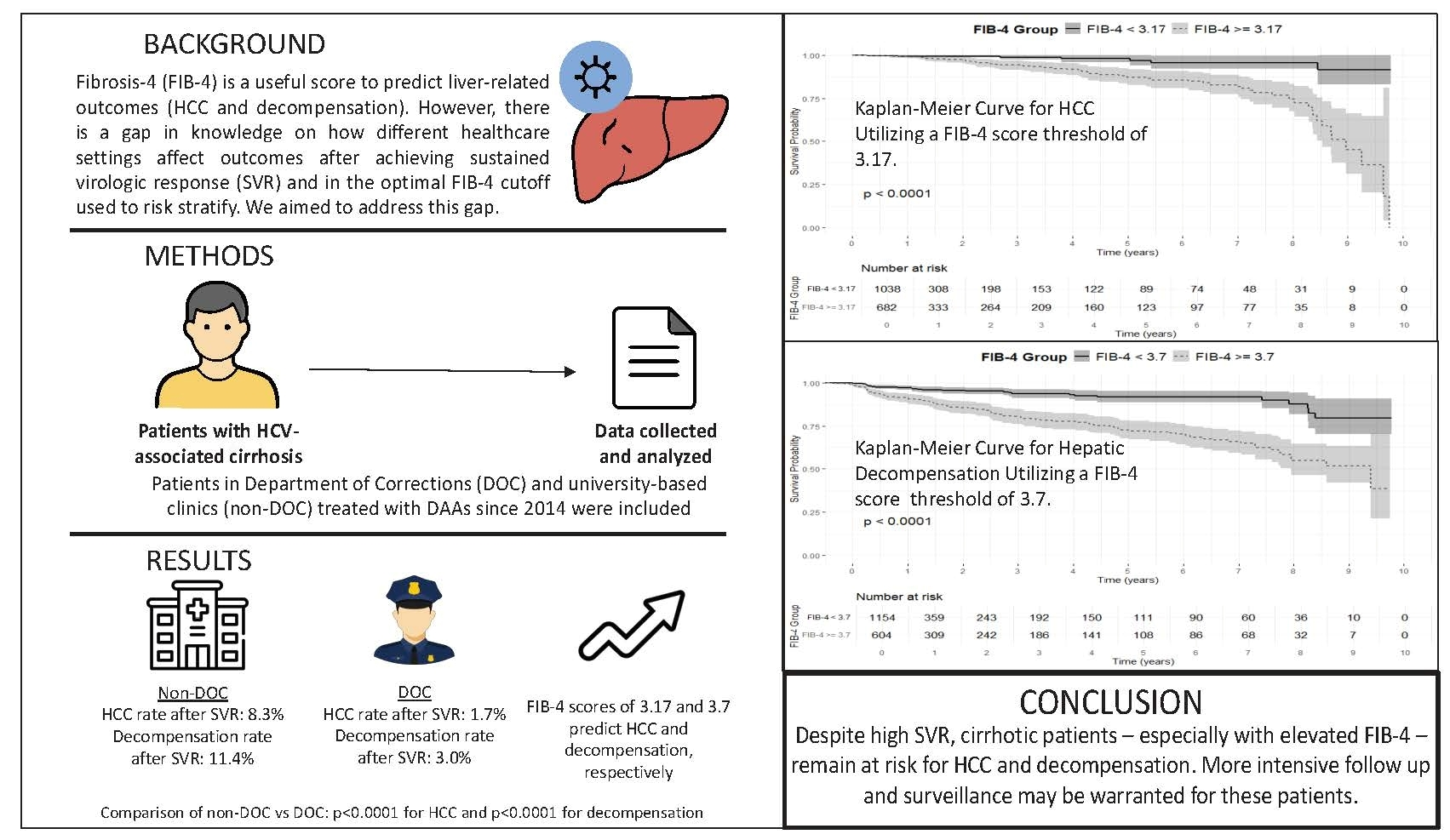
Fibrosis-4 Index Predicts Long-Term Outcomes After Sustained Virologic Response in Hepatitis C Virus Patients with Cirrhosis

 , and
, and
Abstract
1. Introduction
2. Methods
2.1. Study Population
2.2. Clinical and Laboratory Data
2.3. Follow-Up Data
2.4. Statistical Analysis
3. Results
3.1. Patient Characteristics
3.2. Liver-Related Outcomes
3.3. Predictors of Liver-Related Outcomes
4. Discussion
4.1. Engagement in Care by Treatment Site
4.2. Hepatocellular Carcinoma and Decompensation Outcomes in Those Engaged in Care (By Treatment Site)
4.3. Use of FIB-4 to Predict Liver-Related Outcomes
4.4. Strengths and Limitations of the Study
5. Conclusions
Author Contributions
Funding
Institutional Review Board Statement
Informed Consent Statement
Data Availability Statement
Conflicts of Interest
Abbreviations
| AASLD | American Association for the Study of Liver Diseases |
| ALT | alanine aminotransferase |
| AST | aspartate aminotransferase |
| AUROC | Area under the receiver operating curve |
| DAA | direct-acting antiviral |
| DOC | Department of Corrections |
| FIB-4 | fibrosis-4 index |
| HBV | hepatitis B virus |
| HCC | hepatocellular carcinoma |
| HCV | hepatitis C virus |
| HE | hepatic encephalopathy |
| HIV | human immunodeficiency virus |
| IQR | interquartile range |
| IRB | institutional review board |
| LIRADS | Liver Imaging Reporting and Data System |
| MELD | Model for End-Stage Liver Disease |
| REDCap | research electronic data capture |
| SD | standard deviation |
| SVR | sustained virologic response |
| VCTE | vibration-controlled transient elastography |
References
- Tapper, E.B.; Parikh, N.D. Diagnosis and Management of Cirrhosis and Its Complications: A Review. JAMA 2023, 329, 1589–1602. [Google Scholar] [CrossRef] [Scilit] [PubMed]
- Stanciu, C.; Muzica, C.M.; Girleanu, I.; Cojocariu, C.; Sfarti, C.; Singeap, A.-M.; Huiban, L.; Chiriac, S.; Cuciureanu, T.; Trifan, A. An update on direct antiviral agents for the treatment of hepatitis C. Expert Opin. Pharmacother. 2021, 22, 1729–1741. [Google Scholar] [CrossRef] [Scilit]
- Sheehan, Y.; Garg, A.; Sheehan, J.; Maduka, N.; Altice, F.L.; da Costa, F.A.; Cox, S.; Elsharkawy, A.M.; Salah, E.; Stoové, M.; et al. Best practice guidelines for viral hepatitis service delivery in prisons. Lancet Infect. Dis. 2025. [Google Scholar] [CrossRef] [Scilit] [PubMed]
- Syed, T.A.; Cherian, R.; Lewis, S.; Sterling, R.K. Telemedicine HCV treatment in department of corrections results in high SVR in era of direct-acting antivirals. J. Viral. Hepat. 2021, 28, 209–212. [Google Scholar] [CrossRef] [Scilit] [PubMed]
- Freeman, A.J.; Dore, G.J.; Law, M.G.; Thorpe, M.; Von Overbeck, J.; Lloyd, A.R.; Marinos, G.; Kaldor, J.M. Estimating progression to cirrhosis in chronic hepatitis C virus infection. Hepatol. Baltim. Md. 2001, 34, 809–816. [Google Scholar] [CrossRef] [Scilit] [PubMed]
- Chou, R.; Dana, T.; Fu, R.; Zakher, B.; Wagner, J.; Ramirez, S.; Grusing, S.; Jou, J.H. Screening for Hepatitis C Virus Infection in Adolescents and Adults: Updated Evidence Report and Systematic Review for the US Preventive Services Task Force. JAMA 2020, 323, 976–991. [Google Scholar] [CrossRef] [Scilit] [PubMed]
- Jacobson, I.M.; Lim, J.K.; Fried, M.W. American Gastroenterological Association Institute Clinical Practice Update-Expert Review: Care of Patients Who Have Achieved a Sustained Virologic Response After Antiviral Therapy for Chronic Hepatitis C Infection. Gastroenterology 2017, 152, 1578–1587. [Google Scholar] [CrossRef] [Scilit] [PubMed]
- Sterling, R.K.; Lissen, E.; Clumeck, N.; Sola, R.; Correa, M.C.; Montaner, J.; Sulkowski, M.S.; Torriani, F.J.; Dieterich, D.T.; Thomas, D.L.; et al. Development of a simple noninvasive index to predict significant fibrosis in patients with HIV/HCV coinfection. Hepatol. Baltim. Md. 2006, 43, 1317–1325. [Google Scholar] [CrossRef] [Scilit]
- Ioannou, G.N.; Beste, L.A.; Green, P.K.; Singal, A.G.; Tapper, E.B.; Waljee, A.K.; Sterling, R.K.; Feld, J.J.; Kaplan, D.E.; Taddei, T.H.; et al. Increased Risk for Hepatocellular Carcinoma Persists Up to 10 Years After HCV Eradication in Patients With Baseline Cirrhosis or High FIB-4 Scores. Gastroenterology 2019, 157, 1264–1278.e4. [Google Scholar] [CrossRef] [Scilit] [PubMed]
- Duarte-Rojo, A.; Taouli, B.; Leung, D.H.; Levine, D.; Nayfeh, T.; Hasan, B.; Alsawaf, Y.; Saadi, S.; Majzoub, A.M.; Manolopoulos, A.; et al. Imaging-based noninvasive liver disease assessment for staging liver fibrosis in chronic liver disease: A systematic review supporting the AASLD Practice Guideline. Hepatol. Baltim. Md. 2025, 81, 725–748. [Google Scholar] [CrossRef] [Scilit] [PubMed]
- Lee, Y.; Wang, J.J.; Zhu, Y.; Agopian, V.G.; Tseng, H.; Yang, J.D. Diagnostic Criteria and LI-RADS for Hepatocellular Carcinoma. Clin. Liver Dis. 2021, 17, 409–413. [Google Scholar] [CrossRef] [Scilit] [PubMed]
- Marcus, J.L.; Hurley, L.B.; Chamberland, S.; Champsi, J.H.; Gittleman, L.C.; Korn, D.G.; Lam, J.O.; Pauly, M.P.; Quesenberry, C.P.; Ready, J.; et al. Disparities in Initiation of Direct-Acting Antiviral Agents for Hepatitis C Virus Infection in an Insured Population. Public Health Rep. 2018, 133, 452–460. [Google Scholar] [CrossRef] [Scilit] [PubMed]
- Beste, L.A.; Glorioso, T.J.; Ho, P.M.; Au, D.H.; Kirsh, S.R.; Todd-Stenberg, J.; Chang, M.F.; Dominitz, J.A.; Barón, A.E.; Ross, D. Telemedicine Specialty Support Promotes Hepatitis C Treatment by Primary Care Providers in the Department of Veterans Affairs. Am. J. Med. 2017, 130, 432–438.e3. [Google Scholar] [CrossRef] [Scilit] [PubMed]
- Tapper, E.B.; Parikh, N.D. Mortality due to cirrhosis and liver cancer in the United States, 1999–2016: Observational study. BMJ 2018, 362, k2817. [Google Scholar] [CrossRef] [Scilit] [PubMed]
- Kanwal, F.; Kramer, J.R.; Asch, S.M.; Cao, Y.; Li, L.; El-Serag, H.B. Long-Term Risk of Hepatocellular Carcinoma in HCV Patients Treated With Direct Acting Antiviral Agents. Hepatol. Baltim. Md. 2020, 71, 44–55. [Google Scholar] [CrossRef] [Scilit] [PubMed]
- Patel, K.; Asrani, S.K.; Fiel, M.I.; Levine, D.; Leung, D.H.; Duarte-Rojo, A.; Dranoff, J.A.; Nayfeh, T.; Hasan, B.; Taddei, T.H.; et al. Accuracy of blood-based biomarkers for staging liver fibrosis in chronic liver disease: A systematic review supporting the AASLD Practice Guideline. Hepatology 2025, 81, 358–379. [Google Scholar] [CrossRef] [Scilit] [PubMed]



| Characteristic | Total | Non-DOC Clinic | DOC Clinic | p-Value |
|---|---|---|---|---|
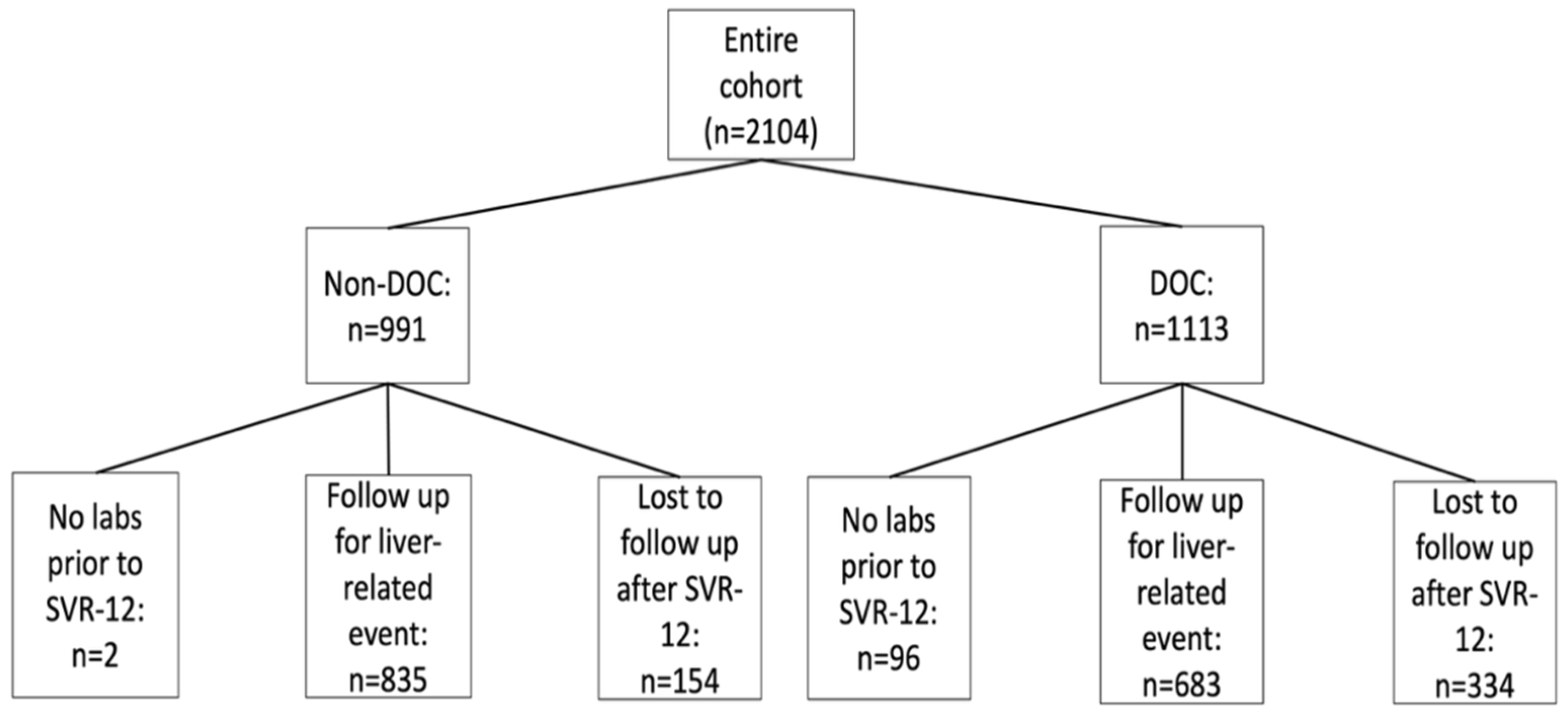
| Number of patients | 2104 | 991 (47%) | 1113 (53%) | |
| Age (years) 1 | 54 (11) | 58 (8) | 50 (11) | <0.0001 |
| Sex (% male) | 76 | 62 | 89 | <0.0001 |
| Race (% White/African-American/Other) | 58/40/2 | 47/51/2 | 69/30/1 | <0.0001 |
| HIV positive (%) | 3.7 | 5.4 | 2.4 | 0.0003 |
| HBV sAg positive (%) | 1.7 | 1.9 | 1.5 | ns |
| AST (U/L) 2 | 69 (46–105) | 76 (50–115) | 63 (42–96) | <0.0001 |
| ALT (U/L) 2 | 73 (45–121) | 70 (44–114) | 76 (45–125) | 0.007 |
| Total bilirubin (mg/dL) 1 | 0.75 (0.43) | 0.87 (0.47) | 0.71 (0.38) | <0.0001 |
| Albumin (g/L) 1 | 4.0 (0.87) | 3.8 (0.52) | 4.1 (0.54) | <0.0001 |
| Platelet count (×1000) 1 | 172 (73) | 159 (74) | 184 (70) | <0.0001 |
| Pre-DAA FIB-4 score | 2.6 (1.5–4.8) | 3.7 (2.1–6.0) | 2.0 (1.2–3.5) | <0.0001 |
| Genotype 1 (%) | 82 | 87 | 77 | <0.0001 |
| CAP (dB/m) 1 | 238 (82) | 250 (58) | 233 (90) | 0.002 |
| In HCC surveillance imaging after SVR-12 (%) | 71 | 81 | 63 | <0.0001 |
| Lost to care before SVR-12 visit (%) | 4 | 1 | 9 | <0.0001 |
| SVR-12 (%) | 91 | 94 | 89 | <0.0001 |
| Remained engaged in care (%) after SVR-12 3 | 80 | 70 | 89 | <0.0001 |
| Total | Non-DOC Clinic | DOC Clinic | p-Values | |
|---|---|---|---|---|
| N | 1518 | 683 | 835 | |
| Yes (%) | 12.9 | 19.3 | 6.8 | <0.0001 |
| Decompensation (%) | 8.1 | 11.4 | 3.0 | <0.0001 |
| Ascites (%) | 7.0 | 11.5 | 2.8 | <0.0001 |
| Hepatic encephalopathy (%) | 5.0 | 7.5 | 2.8 | <0.0001 |
| Portal hypertensive bleeding (%) | 2.5 | 3.5 | 1.6 | 0.009 |
| Jaundice (%) | 1.8 | 1.8 | 1.7 | 0.86 |
| HCC (%) | 4.8 | 8.3 | 1.7 | <0.0001 |
| Alive (%) | 92 | 89 | 96 | <0.0001 |
| Not engaged in care after SVR (%) | 29 | 23 | 36 | p < 0.0001 |
| Hepatic Decompensation | HCC | No Liver Related Outcome | Univariate for Decompensation | Multivariate for Decompensation 3 | Univariate for HCC | Multivariate for HCC 4 | |
|---|---|---|---|---|---|---|---|
| N | 158 | 95 | 1265 | ||||
| Age (years) 1 | 56 (10) | 60 (5) | 53 (11) | 0.01 | <0.0001 | ||
| Sex (% male) | 64 | 76 | 77 | 0.001 | 0.66 | ||
| Race (% White/Black/other) | 67/32/1 | 52/44/4 | 58/41/1 | 0.25 | 0.28 | ||
| HIV positive (%) | 3.2 | 3.2 | 3.9 | 0.86 | 0.51 | ||
| HBV sAg positive (%) | 2.5 | 2.1 | 1.6 | 0.68 | 0.99 | ||
| AST (U/L) 2 | 75 (48–106) | 82 (51–113) | 67 (45–103) | 0.003 | <0.0001 | ||
| ALT (U/L) 2 | 66 (41–116) | 72 (43–124) | 75 (45–124) | 0.01 | 0.255 | ||
| Total bilirubin (mg/dL) 1 | 1.06 (0.47) | 1.38 (0.81) | 0.72 (0.36) | <0.0001 | <0.001 | <0.0001 | |
| Albumin (g/L) 1 | 35 (0.62) | 3.6 (0.55) | 4.07 (0.52) | <0.0001 | 0.0001 | <0.0001 | |
| Platelet count (×1000) 1 | 122 (68) | 118 (66) | 181 (71) | <0.0001 | <0.0001 | ||
| Pre-DAA FIB-4 score 2 | 4.0 (2.1–6.8) | 3.9 (2.0–6.8) | 2.38 (1.4–4.1) | <0.0001 | 0.0002 | <0.0001 | 0.033 |
| Genotype 1 (%) | 72 | 84 | 81 | 0.004 | 0.68 | ||
| CAP (dB/m) 2 | 197 (99) | 238 (95) | 241 (80) | 0.0018 | 0.96 | ||
| SVR-12 (%) | 97 | 88 | 95 | 0.08 | 0.001 | ||
| Non-DOC clinic (%) | 34 | 19 | 56 | <0.0001 | <0.0001 | 0.0003 |
| (a) | |||
| Cox Proportional Hazard on HCC Outcome Using Youden Index | |||
| Predictors | Estimates | CI | p |
| FIB 4 [≥3.24] | 3.96 | 1.76–8.88 | 0.001 |
| TB | 1.62 | 0.84–3.14 | 0.150 |
| Alb | 0.94 | 0.61–1.46 | 0.790 |
| Non-DOC Clinic | 0.77 | 0.39–1.51 | 0.449 |
| (b) | |||
| Cox Proportional Hazard on Decomposition Outcome Using Youden Index | |||
| Predictors | Estimates | CI | p |
| FIB 4 [≥3.7] | 2.66 | 1.25–5.64 | 0.011 |
| Sex [Male] | 0.74 | 0.34–1.61 | 0.450 |
| TB | 2.60 | 1.19–5.69 | 0.017 |
| Alb | 0.54 | 0.37–0.78 | 0.001 |
| CAP | 1.00 | 0.99–1.00 | 0.379 |
| Non-DOC Clinic | 0.61 | 0.27–1.35 | 0.218 |
Disclaimer/Publisher’s Note: The statements, opinions and data contained in all publications are solely those of the individual author(s) and contributor(s) and not of MDPI and/or the editor(s). MDPI and/or the editor(s) disclaim responsibility for any injury to people or property resulting from any ideas, methods, instructions or products referred to in the content. |
© 2026 by the authors. Licensee MDPI, Basel, Switzerland. This article is an open access article distributed under the terms and conditions of the Creative Commons Attribution (CC BY) license.
Share and Cite
Mikati, H.; Aljabi, A.; Cherian, R.; Lewis, S.; Blatzer, L.; Arshad, T.; Ambrosio, M.; Sterling, R.K. Fibrosis-4 Index Predicts Long-Term Outcomes After Sustained Virologic Response in Hepatitis C Virus Patients with Cirrhosis. Livers 2026, 6, 33. https://doi.org/10.3390/livers6020033
Mikati H, Aljabi A, Cherian R, Lewis S, Blatzer L, Arshad T, Ambrosio M, Sterling RK. Fibrosis-4 Index Predicts Long-Term Outcomes After Sustained Virologic Response in Hepatitis C Virus Patients with Cirrhosis. Livers. 2026; 6(2):33. https://doi.org/10.3390/livers6020033
Chicago/Turabian StyleMikati, Husam, Anas Aljabi, Reena Cherian, Shawn Lewis, Leah Blatzer, Tamoore Arshad, Matthew Ambrosio, and Richard K. Sterling. 2026. "Fibrosis-4 Index Predicts Long-Term Outcomes After Sustained Virologic Response in Hepatitis C Virus Patients with Cirrhosis" Livers 6, no. 2: 33. https://doi.org/10.3390/livers6020033
APA StyleMikati, H., Aljabi, A., Cherian, R., Lewis, S., Blatzer, L., Arshad, T., Ambrosio, M., & Sterling, R. K. (2026). Fibrosis-4 Index Predicts Long-Term Outcomes After Sustained Virologic Response in Hepatitis C Virus Patients with Cirrhosis. Livers, 6(2), 33. https://doi.org/10.3390/livers6020033