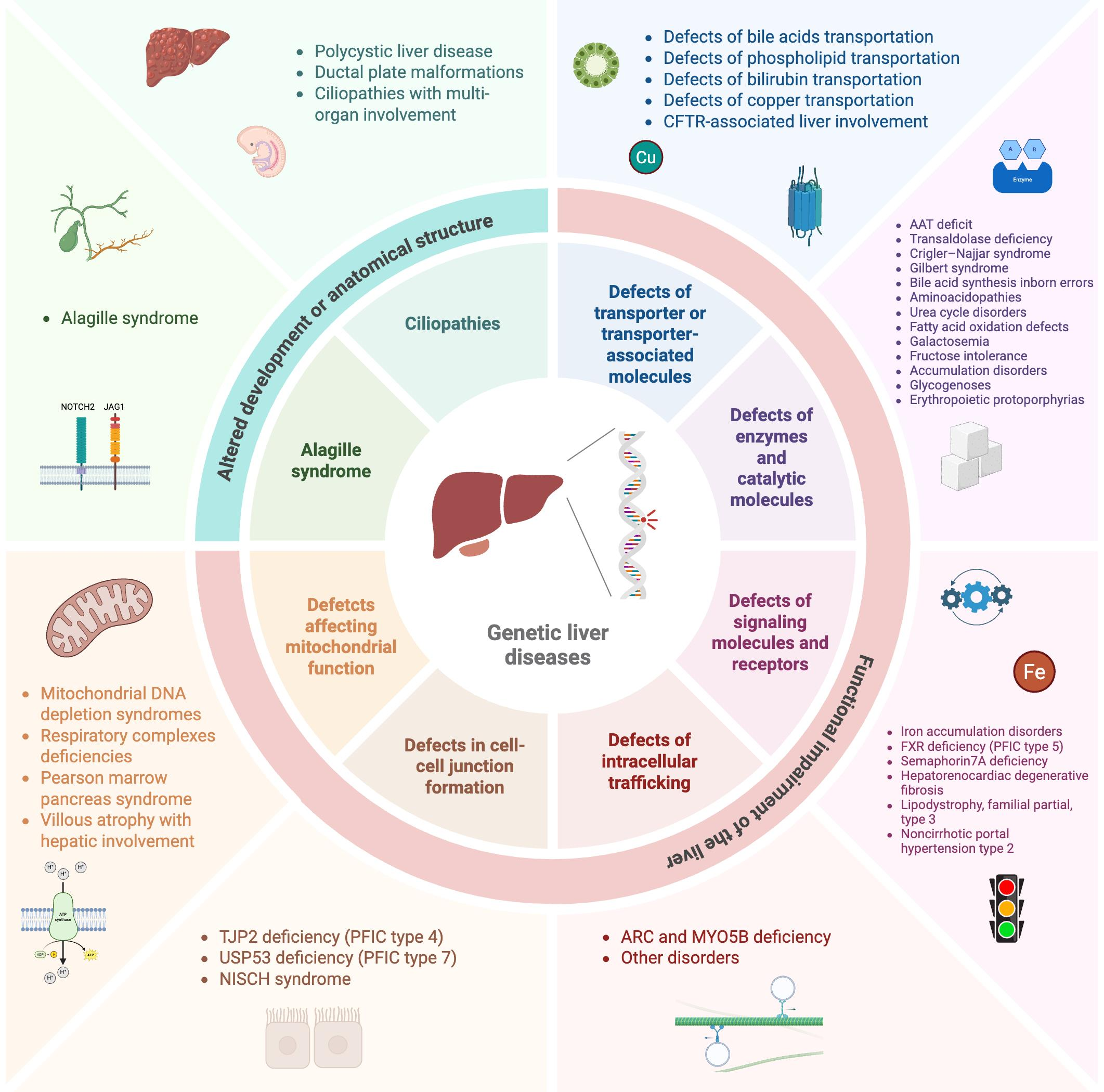

A Mechanistic Framework of Genetic Liver Diseases: From Developmental Defects to Functional Disorders

 , , ,
, , ,  and
and 
Abstract
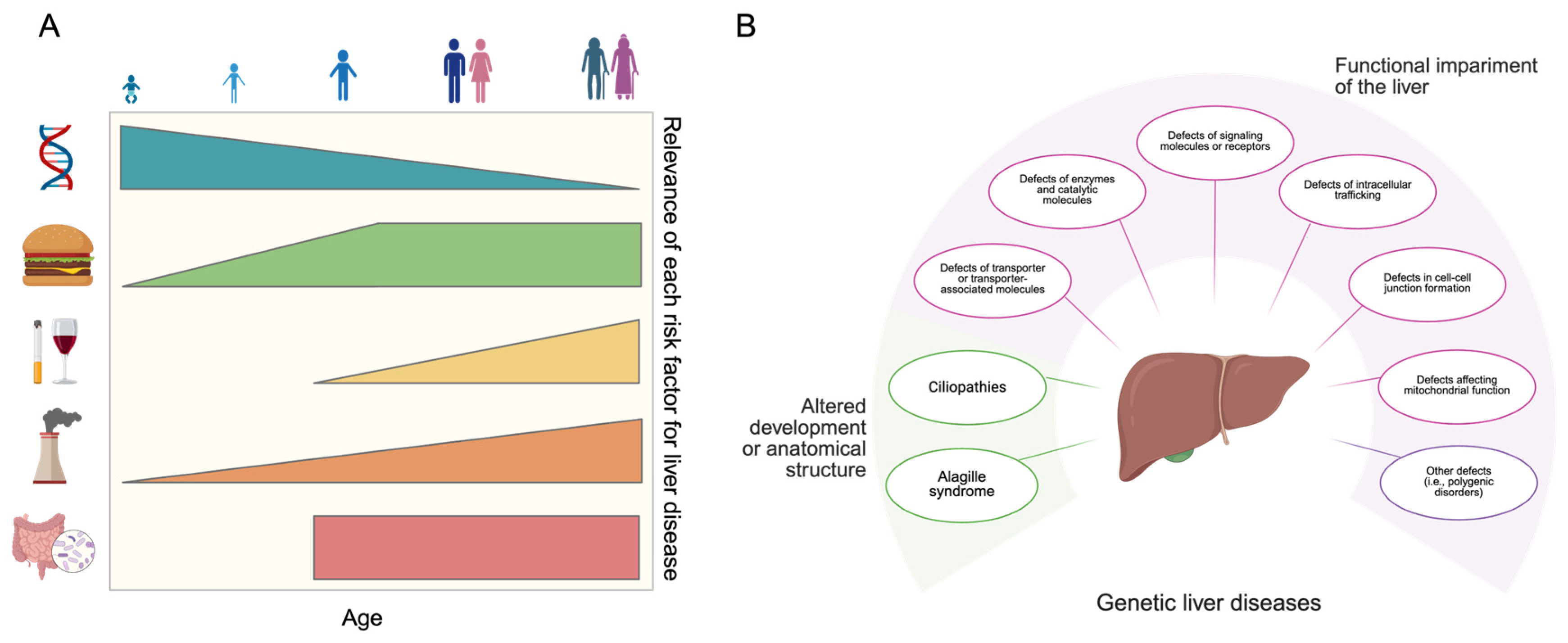
1. Introduction
2. Diseases Caused by Developmental Defects or Anatomical Anomalies
2.1. Ciliopathies
2.1.1. Ductal Plate Malformations
2.1.2. Polycystic Liver Disease
2.1.3. Other Ciliopathies with Liver Involvement
2.2. Alagille Syndrome
3. Diseases Caused by a Functional Impairment of the Liver
3.1. Defects of Transporters or Transporter-Associated Molecules
3.1.1. Defects of Bile Acid Transportation
3.1.2. Defects of Phospholipid Transportation
3.1.3. Defects of Bilirubin Transportation
3.1.4. Defects of Copper Transportation (Wilson’s Disease)
3.1.5. CFTR-Associated Liver Involvement
3.1.6. Other Disorders Associated with Deficits of Other Transporters
3.2. Defects of Enzymes and Catalytic Molecules
3.2.1. Alpha-1 Antitrypsin (AAT) Deficit
3.2.2. Transaldolase Deficiency
3.2.3. Crigler–Najjar Syndrome and Gilbert Syndrome
3.2.4. Inborn Errors of Bile Acid Synthesis
3.2.5. Aminoacidopathies: Tyrosinemia
3.2.6. Urea Cycle Disorders: Citrullinemia and Arginosuccinic Aciduria
3.2.7. Fatty Acid Oxidation Defects
3.2.8. Galactosemia
3.2.9. Fructose Intolerance
3.2.10. Accumulation Disorders
3.2.11. Glycogenoses with Liver Involvement
3.2.12. Erythropoietic Protoporphyrias
3.3. Defects of Signaling Molecules or Receptors
3.3.1. Iron Accumulation Disorders
3.3.2. FXR Deficiency (PFIC Type 5)
3.3.3. Semaphorin-7A Deficiency (PFIC Type 11)
3.3.4. Hepatorenocardiac Degenerative Fibrosis
3.3.5. Lipodystrophy, Familial Partial, Type 3
3.3.6. Noncirrhotic Portal Hypertension Type 2
3.4. Defects of Intracellular Trafficking
3.4.1. ARC and MYO5B Deficiency
3.4.2. Other Disorders
3.5. Defects in Cell–Cell Junction Formation
3.6. Defects Affecting Mitochondrial Functions
3.6.1. Mitochondrial DNA Depletion Syndromes
3.6.2. Respiratory Complex Deficiencies
3.6.3. Pearson Marrow Pancreas Syndrome
3.6.4. Villous Atrophy with Hepatic Involvement
3.7. Genetic Disorders with Lesser Evidence of Liver Involvement
4. Why a Genetic Diagnosis?
5. Next Steps: Multi-Omics and Data Sharing
6. Conclusions
Supplementary Materials
Author Contributions
Funding
Institutional Review Board Statement
Informed Consent Statement
Data Availability Statement
Conflicts of Interest
Acronyms
| ADPKD | Autosomal Dominant Polycystic Kidney Disease |
| AFP | Alpha-Fetoprotein |
| ALD | Alcohol-Associated Liver Disease |
| BRIC | Benign Recurrent Intrahepatic Cholestasis |
| CHF | Congenital Hepatic Fibrosis |
| CLD | Chronic Liver Disease |
| DPM | Ductal Plate Malformation |
| GGT | Gamma-Glutamyl Transferase |
| GSD | Glycogen Storage Disease |
| LAL | Lysosomal Acid Lipase Deficiency |
| LOF | Loss of Function |
| MASLD | Metabolic Dysfunction–Associated Steatotic Liver Disease |
| PCLD | Polycystic Liver Disease |
| PFIC | Progressive Familial Intrahepatic Cholestasis |
| WES | Whole-Exome Sequencing |
| WGS | Whole-Genome Sequencing |
References
- Devarbhavi, H.; Asrani, S.K.; Arab, J.P.; Nartey, Y.A.; Pose, E.; Kamath, P.S. Global Burden of Liver Disease: 2023 Update. J. Hepatol. 2023, 79, 516–537. [Google Scholar] [CrossRef] [Scilit]
- Hassan, S.; Anouti, A.; Tan, Q.K.G.; Wangensteen, K.; Aqul, A. Liver Transplantation for Pediatric Genetic and Metabolic Disorders. Liver Transplant. 2025, 31, 803–814. [Google Scholar] [CrossRef] [Scilit]
- Scorza, M.; Elce, A.; Zarrilli, F.; Liguori, R.; Amato, F.; Castaldo, G. Genetic Diseases That Predispose to Early Liver Cirrhosis. Int. J. Hepatol. 2014, 2014, 713754. [Google Scholar] [CrossRef] [Scilit]
- Zou, Y.-G.; Wang, H.; Li, W.-W.; Dai, D.-L. Challenges in Pediatric Inherited/Metabolic Liver Disease: Focus on the Disease Spectrum, Diagnosis and Management of Relatively Common Disorders. World J. Gastroenterol. 2023, 29, 2114–2126. [Google Scholar] [CrossRef] [Scilit] [PubMed]
- Kong, X.-F.; Bogyo, K.; Kapoor, S.; Shea, P.R.; Groopman, E.E.; Thomas-Wilson, A.; Cocchi, E.; Rasouly, H.M.; Zheng, B.; Sun, S.; et al. The Diagnostic Yield of Exome Sequencing in Liver Diseases from a Curated Gene Panel. Sci. Rep. 2023, 13, 21540. [Google Scholar] [CrossRef] [Scilit]
- Nicastro, E.; D’Antiga, L. Next Generation Sequencing in Pediatric Hepatology and Liver Transplantation. Liver Transplant. 2018, 24, 282–293. [Google Scholar] [CrossRef] [Scilit]
- Gan, C.; Yuan, Y.; Shen, H.; Gao, J.; Kong, X.; Che, Z.; Guo, Y.; Wang, H.; Dong, E.; Xiao, J. Liver Diseases: Epidemiology, Causes, Trends and Predictions. Signal Transduct. Target. Ther. 2025, 10, 33. [Google Scholar] [CrossRef] [Scilit] [PubMed]
- Paris, J.; Henderson, N.C. Liver Zonation, Revisited. Hepatology 2022, 76, 1219–1230. [Google Scholar] [CrossRef] [Scilit] [PubMed]
- Hultcrantz, R.; Mengarelli, S. Ultrastructural Liver Pathology in Patients with Minimal Liver Disease and Alpha 1-Antitrypsin Deficiency: A Comparison between Heterozygous and Homozygous Patients. Hepatology 1984, 4, 937–945. [Google Scholar] [CrossRef] [Scilit]
- Iancu, T.C.; Deugnier, Y.; Halliday, J.W.; Powell, L.W.; Brissot, P. Ultrastructural Sequences during Liver Iron Overload in Genetic Hemochromatosis. J. Hepatol. 1997, 27, 628–638. [Google Scholar] [CrossRef] [Scilit] [PubMed]
- Ma, R.; Martínez-Ramírez, A.S.; Borders, T.L.; Gao, F.; Sosa-Pineda, B. Metabolic and Non-Metabolic Liver Zonation Is Established Non-Synchronously and Requires Sinusoidal Wnts. Elife 2020, 9, e46206. [Google Scholar] [CrossRef] [Scilit]
- Fanni, D.; Guido, M.; Gerosa, C.; Vallascas, V.; Moi, M.; Coni, P.; Vallebona, E.; Van Eyken, P.; Barcellona, D.; Scano, A.; et al. Liver Changes in Wilson’s Disease: The Full Spectrum. A Report of 127 Biopsies from 43 Patients. Eur. Rev. Med. Pharmacol. Sci. 2021, 25, 4336–4344. [Google Scholar] [CrossRef] [Scilit]
- Mirza, H.; Besse, W.; Somlo, S.; Weinreb, J.; Kenney, B.; Jain, D. An Update on Ductal Plate Malformations and Fibropolycystic Diseases of the Liver. Hum. Pathol. 2023, 132, 102–113. [Google Scholar] [CrossRef] [Scilit]
- Horani, A.; Ferkol, T.W. Understanding Primary Ciliary Dyskinesia and Other Ciliopathies. J. Pediatr. 2021, 230, 15–22.e1. [Google Scholar] [CrossRef] [Scilit]
- Gunay-Aygun, M.; Tuchman, M.; Font-Montgomery, E.; Lukose, L.; Edwards, H.; Garcia, A.; Ausavarat, S.; Ziegler, S.G.; Piwnica-Worms, K.; Bryant, J.; et al. PKHD1 Sequence Variations in 78 Children and Adults with Autosomal Recessive Polycystic Kidney Disease and Congenital Hepatic Fibrosis. Mol. Genet. Metab. 2010, 99, 160–173. [Google Scholar] [CrossRef] [Scilit]
- Fabris, L.; Fiorotto, R.; Spirli, C.; Cadamuro, M.; Mariotti, V.; Perugorria, M.J.; Banales, J.M.; Strazzabosco, M. Pathobiology of Inherited Biliary Diseases: A Roadmap to Understand Acquired Liver Diseases. Nat. Rev. Gastroenterol. Hepatol. 2019, 16, 497–511. [Google Scholar] [CrossRef] [Scilit] [PubMed]
- Cnossen, W.R.; Drenth, J.P. Polycystic Liver Disease: An Overview of Pathogenesis, Clinical Manifestations and Management. Orphanet J. Rare Dis. 2014, 9, 69. [Google Scholar] [CrossRef] [Scilit] [PubMed]
- Pirson, Y. Extrarenal Manifestations of Autosomal Dominant Polycystic Kidney Disease. Adv. Chronic Kidney Dis. 2010, 17, 173–180. [Google Scholar] [CrossRef] [Scilit] [PubMed]
- Van Aerts, R.M.M.; Kievit, W.; De Jong, M.E.; Ahn, C.; Bañales, J.M.; Reiterová, J.; Nevens, F.; Drenth, J.P.H. Severity in Polycystic Liver Disease Is Associated with Aetiology and Female Gender: Results of the International PLD Registry. Liver Int. 2019, 39, 575–582. [Google Scholar] [CrossRef] [Scilit]
- Janssen, M.J.; Salomon, J.; Cnossen, W.R.; Bergmann, C.; Pfundt, R.; Drenth, J.P.H. Somatic Loss of Polycystic Disease Genes Contributes to the Formation of Isolated and Polycystic Liver Cysts. Gut 2015, 64, 688–690. [Google Scholar] [CrossRef] [Scilit]
- Gunay-Aygun, M.; Turkbey, B.I.; Bryant, J.; Daryanani, K.T.; Gerstein, M.T.; Piwnica-Worms, K.; Choyke, P.; Heller, T.; Gahl, W.A. Hepatorenal Findings in Obligate Heterozygotes for Autosomal Recessive Polycystic Kidney Disease. Mol. Genet. Metab. 2011, 104, 677–681. [Google Scholar] [CrossRef] [Scilit]
- Besse, W.; Dong, K.; Choi, J.; Punia, S.; Fedeles, S.V.; Choi, M.; Gallagher, A.-R.; Huang, E.B.; Gulati, A.; Knight, J.; et al. Isolated Polycystic Liver Disease Genes Define Effectors of Polycystin-1 Function. J. Clin. Investig. 2017, 127, 1772–1785. [Google Scholar] [CrossRef] [Scilit] [PubMed]
- Besse, W.; Roosendaal, C.; Tuccillo, L.; Roy, S.G.; Gallagher, A.-R.; Somlo, S. Adult Inactivation of the Recessive Polycystic Kidney Disease Gene Causes Polycystic Liver Disease. Kidney360 2020, 1, 1068–1076. [Google Scholar] [CrossRef] [Scilit]
- Diamond, T.; Nema, N.; Wen, J. Hepatic Ciliopathy Syndromes. Clin. Liver Dis. 2021, 18, 193–197. [Google Scholar] [CrossRef] [Scilit]
- Maddirevula, S.; Alhebbi, H.; Alqahtani, A.; Algoufi, T.; Alsaif, H.S.; Ibrahim, N.; Abdulwahab, F.; Barr, M.; Alzaidan, H.; Almehaideb, A.; et al. Identification of Novel Loci for Pediatric Cholestatic Liver Disease Defined by KIF12, PPM1F, USP53, LSR, and WDR83OS Pathogenic Variants. Genet. Med. 2019, 21, 1164–1172. [Google Scholar] [CrossRef] [Scilit]
- Shaheen, R.; Alsahli, S.; Ewida, N.; Alzahrani, F.; Shamseldin, H.E.; Patel, N.; Al Qahtani, A.; Alhebbi, H.; Alhashem, A.; Al-Sheddi, T.; et al. Biallelic Mutations in Tetratricopeptide Repeat Domain 26 (Intraflagellar Transport 56) Cause Severe Biliary Ciliopathy in Humans. Hepatology 2020, 71, 2067–2079. [Google Scholar] [CrossRef] [Scilit]
- Lim, Y.Z.; Zhu, M.; Wang, Y.; Sharma, T.; Kelley, S.; Oertling, E.; Zhu, H.; Corbitt, N. Pkd1l1-Deficiency Drives Biliary Atresia through Ciliary Dysfunction in Biliary Epithelial Cells. J. Hepatol. 2024, 81, 62–75. [Google Scholar] [CrossRef] [Scilit]
- Berauer, J.-P.; Mezina, A.I.; Okou, D.T.; Sabo, A.; Muzny, D.M.; Gibbs, R.A.; Hegde, M.R.; Chopra, P.; Cutler, D.J.; Perlmutter, D.H.; et al. Identification of Polycystic Kidney Disease 1 Like 1 Gene Variants in Children with Biliary Atresia Splenic Malformation Syndrome. Hepatology 2019, 70, 899–910. [Google Scholar] [CrossRef] [Scilit] [PubMed]
- Hartley, J.L. The Molecular Genetic Investigation of Paediatric Liver Disease. Ph.D. Thesis, The University of Birmingham, Birmingham, UK, 2010. [Google Scholar]
- Sharma, P.; Abbey, D. Alagille Syndrome: Unraveling the Complexities of Genotype–Phenotype Relationships and Exploring Avenues for Improved Diagnosis and Treatment. Cell Biol. Int. 2025, 49, 435–471. [Google Scholar] [CrossRef] [Scilit] [PubMed]
- Kohut, T.J.; Gilbert, M.A.; Loomes, K.M. Alagille Syndrome: A Focused Review on Clinical Features, Genetics, and Treatment. Semin. Liver Dis. 2021, 41, 525–537. [Google Scholar] [CrossRef] [Scilit]
- Robert, M.L.P.; Lopez, T.; Crolla, J.; Huang, S.; Owen, C.; Burvill-Holmes, L.; Stumper, O.; Turnpenny, P.D. Alagille Syndrome with Deletion 20p12.2–P12.3 and Hypoplastic Left Heart. Clin. Dysmorphol. 2007, 16, 241–246. [Google Scholar] [CrossRef] [Scilit] [PubMed]
- Zhang, Y.-Q.; Gao, P.-F.; Yang, J.-M.; Zhang, J.; Lu, Y.-L.; Wang, J.-S. Balanced Translocation Disrupting JAG1 Identified by Optical Genomic Mapping in Suspected Alagille Syndrome. Hum. Mutat. 2023, 2023, 5396281. [Google Scholar] [CrossRef] [Scilit] [PubMed]
- Vandriel, S.M.; Li, L.-T.; She, H.; Wang, J.-S.; Loomes, K.M.; Piccoli, D.A.; Jankowska, I.; Czubkowski, P.; Gliwicz-Miedzińska, D.; D’Antiga, L.; et al. Phenotypic Divergence of JAG1- and NOTCH2-Associated Alagille Syndrome & Disease-Specific NOTCH2 Variant Classification Guidelines. Liver Int. 2025, 45, e70251. [Google Scholar] [CrossRef] [Scilit] [PubMed]
- Pinon, M.; Kamath, B.M. What’s New in Pediatric Genetic Cholestatic Liver Disease: Advances in Etiology, Diagnostics and Therapeutic Approaches. Curr. Opin. Pediatr. 2024, 36, 524–536. [Google Scholar] [CrossRef] [Scilit] [PubMed]
- Corpechot, C.; Barbu, V.; Chazouillères, O.; Broué, P.; Girard, M.; Roquelaure, B.; Chrétien, Y.; Dong, C.; Lascols, O.; Housset, C.; et al. Genetic Contribution of ABCC2 to Dubin-Johnson Syndrome and Inherited Cholestatic Disorders. Liver Int. 2020, 40, 163–174. [Google Scholar] [CrossRef] [Scilit] [PubMed]
- van de Steeg, E.; Stránecký, V.; Hartmannová, H.; Nosková, L.; Hřebíček, M.; Wagenaar, E.; van Esch, A.; de Waart, D.R.; Elferink, R.P.J.O.; Kenworthy, K.E.; et al. Complete OATP1B1 and OATP1B3 Deficiency Causes Human Rotor Syndrome by Interrupting Conjugated Bilirubin Reuptake into the Liver. J. Clin. Investig. 2012, 122, 519–528. [Google Scholar] [CrossRef] [Scilit]
- Vitale, G.; Sciveres, M.; Mandato, C.; d’Adamo, A.P.; Di Giorgio, A. Genotypes and Different Clinical Variants between Children and Adults in Progressive Familial Intrahepatic Cholestasis: A State-of-the-Art Review. Orphanet J. Rare Dis. 2025, 20, 80. [Google Scholar] [CrossRef] [Scilit]
- Van Wessel, D.B.E.; Thompson, R.J.; Gonzales, E.; Jankowska, I.; Sokal, E.; Grammatikopoulos, T.; Kadaristiana, A.; Jacquemin, E.; Spraul, A.; Lipiński, P.; et al. Genotype Correlates with the Natural History of Severe Bile Salt Export Pump Deficiency. J. Hepatol. 2020, 73, 84–93. [Google Scholar] [CrossRef] [Scilit]
- McKiernan, P.; Bernabeu, J.Q.; Girard, M.; Indolfi, G.; Lurz, E.; Trivedi, P. Opinion Paper on the Diagnosis and Treatment of Progressive Familial Intrahepatic Cholestasis. JHEP Rep. 2024, 6, 100949. [Google Scholar] [CrossRef] [Scilit]
- Członkowska, A.; Litwin, T.; Dusek, P.; Ferenci, P.; Lutsenko, S.; Medici, V.; Rybakowski, J.K.; Weiss, K.H.; Schilsky, M.L. Wilson Disease. Nat. Rev. Dis. Primers 2018, 4, 21. [Google Scholar] [CrossRef] [Scilit] [PubMed]
- Calvo, J.S.; Heger, T.; Kabin, E.; Mowrey, W.R.; Del Angel, G.; Ding, W.; Lutsenko, S. Functional Screen of Wilson Disease ATP7B Variants Reveals Residual Transport Activities. Hum. Mutat. 2025, 2025, 7485658. [Google Scholar] [CrossRef] [Scilit]
- Beyzaei, Z.; Mehrzadeh, A.; Hashemi, N.; Geramizadeh, B. The Mutation Spectrum and Ethnic Distribution of Wilson Disease, a Review. Mol. Genet. Metab. Rep. 2024, 38, 101034. [Google Scholar] [CrossRef] [Scilit]
- Deng, L.-J.; Ouyang, W.-X.; Liu, R.; Deng, M.; Qiu, J.-W.; Yaqub, M.-R.; Raza, M.-A.; Lin, W.-X.; Guo, L.; Li, H.; et al. Clinical Characterization of NTCP Deficiency in Paediatric Patients: A Case-Control Study Based on SLC10A1 Genotyping Analysis. Liver Int. 2021, 41, 2720–2728. [Google Scholar] [CrossRef] [Scilit]
- Gao, E.; Cheema, H.; Waheed, N.; Mushtaq, I.; Erden, N.; Nelson-Williams, C.; Jain, D.; Soroka, C.J.; Boyer, J.L.; Khalil, Y.; et al. Organic Solute Transporter Alpha Deficiency: A Disorder with Cholestasis, Liver Fibrosis, and Congenital Diarrhea. Hepatology 2020, 71, 1879–1882. [Google Scholar] [CrossRef] [Scilit]
- Dana, J.; Debray, D.; Beaufrère, A.; Hillaire, S.; Fabre, M.; Reinhold, C.; Baumert, T.F.; Berteloot, L.; Vilgrain, V. Cystic Fibrosis-Related Liver Disease: Clinical Presentations, Diagnostic and Monitoring Approaches in the Era of CFTR Modulator Therapies. J. Hepatol. 2022, 76, 420–434. [Google Scholar] [CrossRef] [Scilit]
- Eldredge, J.A.; Oliver, M.R.; Ooi, C.Y. Cystic Fibrosis Liver Disease in the New Era of Cystic Fibrosis Transmembrane Conductance Regulator (CFTR) Modulators. Paediatr. Respir. Rev. 2024, 50, 54–61. [Google Scholar] [CrossRef] [Scilit] [PubMed]
- Fiorotto, R.; Scirpo, R.; Trauner, M.; Fabris, L.; Hoque, R.; Spirli, C.; Strazzabosco, M. Loss of CFTR Affects Biliary Epithelium Innate Immunity and Causes TLR4–NF-κB—Mediated Inflammatory Response in Mice. Gastroenterology 2011, 141, 1498–1508.e5. [Google Scholar] [CrossRef] [Scilit] [PubMed]
- Lindberg, U.; Svensson, L.; Hellmark, T.; Segelmark, M.; Shannon, O. Increased Platelet Activation Occurs in Cystic Fibrosis Patients and Correlates to Clinical Status. Thromb. Res. 2018, 162, 32–37. [Google Scholar] [CrossRef] [Scilit]
- Liang, H.; Zhan, X.; Wang, Y.; Maegawa, G.H.B.; Zhang, H. Development and Validation of a New Genotype–Phenotype Correlation for NIEMANN-PICK Disease Type C1. J. Inherit. Metab. Dis. 2024, 47, 317–326. [Google Scholar] [CrossRef] [Scilit] [PubMed]
- Xu, Y.; Zhang, Q.; Tan, L.; Xie, X.; Zhao, Y. The Characteristics and Biological Significance of NPC2: Mutation and Disease. Mutat. Res. Rev. Mutat. Res. 2019, 782, 108284. [Google Scholar] [CrossRef] [Scilit] [PubMed]
- Kelly, D.A.; Portmann, B.; Mowat, A.P.; Sherlock, S.; Lake, B.D. Niemann-Pick Disease Type C: Diagnosis and Outcome in Children, with Particular Reference to Liver Disease. J. Pediatr. 1993, 123, 242–247. [Google Scholar] [CrossRef] [Scilit] [PubMed]
- Heras, M.L.; Szenfeld, B.; Ballout, R.A.; Buratti, E.; Zanlungo, S.; Dardis, A.; Klein, A.D. Understanding the Phenotypic Variability in Niemann-Pick Disease Type C (NPC): A Need for Precision Medicine. npj Genom. Med. 2023, 8, 21. [Google Scholar] [CrossRef] [Scilit] [PubMed]
- Sharari, S.; Abou-Alloul, M.; Hussain, K.; Khan, F.A. Fanconi-Bickel Syndrome: A Review of the Mechanisms That Lead to Dysglycaemia. Int. J. Mol. Sci. 2020, 21, 6286. [Google Scholar] [CrossRef] [Scilit]
- Hayasaka, K. Pathogenesis and Management of Citrin Deficiency. Intern. Med. 2024, 63, 1977–1986. [Google Scholar] [CrossRef] [Scilit]
- Martinelli, D.; Diodato, D.; Ponzi, E.; Monné, M.; Boenzi, S.; Bertini, E.; Fiermonte, G.; Dionisi-Vici, C. The Hyperornithinemia-Hyperammonemia-Homocitrullinuria Syndrome. Orphanet J. Rare Dis. 2015, 10, 29. [Google Scholar] [CrossRef] [Scilit]
- Galluccio, M.; Tripicchio, M.; Pochini, L. The Human OCTN Sub-Family: Gene and Protein Structure, Expression, and Regulation. Int. J. Mol. Sci. 2024, 25, 8743. [Google Scholar] [CrossRef] [Scilit]
- El-Hattab, A.W.; Scaglia, F. Disorders of Carnitine Biosynthesis and Transport. Mol. Genet. Metab. 2015, 116, 107–112. [Google Scholar] [CrossRef] [Scilit]
- Lemyre, E.; Russo, P.; Melançon, S.B.; Gagné, R.; Potier, M.; Lambert, M. Clinical Spectrum of Infantile Free Sialic Acid Storage Disease. Am. J. Med. Genet. 1999, 82, 385–391. [Google Scholar] [CrossRef]
- Cornelis, T.; Claes, K.; Gillard, P.; Nijs, E.; Roskams, T.; Lombaerts, R.; Nevens, F.; Cassiman, D. Cholestatic Liver Disease in Long-Term Infantile Nephropathic Cystinosis. J. Gastroenterol. Hepatol. 2008, 23, e428–e431. [Google Scholar] [CrossRef] [Scilit]
- Sundaram, V.; Björnsson, E.S. Drug-induced Cholestasis. Hepatol. Commun. 2017, 1, 726–735. [Google Scholar] [CrossRef] [Scilit] [PubMed]
- Nayagam, J.S.; Foskett, P.; Strautnieks, S.; Agarwal, K.; Miquel, R.; Joshi, D.; Thompson, R.J. Clinical Phenotype of Adult-onset Liver Disease in Patients with Variants in ABCB4, ABCB11, and ATP8B1. Hepatol. Commun. 2022, 6, 2654–2664. [Google Scholar] [CrossRef] [Scilit]
- van der Woerd, W.L.; van Mil, S.W.C.; Stapelbroek, J.M.; Klomp, L.W.J.; van de Graaf, S.F.J.; Houwen, R.H.J. Familial Cholestasis: Progressive Familial Intrahepatic Cholestasis, Benign Recurrent Intrahepatic Cholestasis and Intrahepatic Cholestasis of Pregnancy. Best Pract. Res. Clin. Gastroenterol. 2010, 24, 541–553. [Google Scholar] [CrossRef] [Scilit]
- Avena, A.; Puggelli, S.; Morris, M.; Cerny, A.; Andrade, A.R.; Pareti, E.; Bihl, F.; Cassatella, D.; Moix, I.; Merlo, E.; et al. ABCB4 Variants in Adult Patients with Cholestatic Disease Are Frequent and Underdiagnosed. Dig. Liver Dis. 2021, 53, 329–344. [Google Scholar] [CrossRef] [Scilit] [PubMed]
- McKiernan, P.J.; Ganoza, A.; Squires, J.E.; Squires, R.H.; Vockley, J.; Mazariegos, G.; Soltys, K.; Sun, Q.; Sindhi, R. Evolving Trends in Liver Transplant for Metabolic Liver Disease in the United States. Liver Transplant. 2019, 25, 911–921. [Google Scholar] [CrossRef] [Scilit] [PubMed]
- Heubi, J.E.; Setchell, K.D.R.; Bove, K.E. Inborn Errors of Bile Acid Metabolism. Clin. Liver Dis. 2018, 22, 671–687. [Google Scholar] [CrossRef] [Scilit]
- Schwarz, M.; Wright, A.C.; Davis, D.L.; Nazer, H.; Björkhem, I.; Russell, D.W. The Bile Acid Synthetic Gene 3beta-Hydroxy-Delta(5)-C(27)-Steroid Oxidoreductase Is Mutated in Progressive Intrahepatic Cholestasis. J. Clin. Investig. 2000, 106, 1175–1184. [Google Scholar] [CrossRef] [Scilit]
- Cheng, J.B.; Jacquemin, E.; Gerhardt, M.; Nazer, H.; Cresteil, D.; Heubi, J.E.; Setchell, K.D.R.; Russell, D.W. Molecular Genetics of 3beta-Hydroxy-Delta5-C27-Steroid Oxidoreductase Deficiency in 16 Patients with Loss of Bile Acid Synthesis and Liver Disease. J. Clin. Endocrinol. Metab. 2003, 88, 1833–1841. [Google Scholar] [CrossRef] [Scilit]
- Drury, J.E.; Mindnich, R.; Penning, T.M. Characterization of Disease-Related 5β-Reductase (AKR1D1) Mutations Reveals Their Potential to Cause Bile Acid Deficiency. J. Biol. Chem. 2010, 285, 24529–24537. [Google Scholar] [CrossRef] [Scilit] [PubMed]
- Goizet, C.; Boukhris, A.; Durr, A.; Beetz, C.; Truchetto, J.; Tesson, C.; Tsaousidou, M.; Forlani, S.; Guyant-Marechal, L.; Fontaine, B.; et al. CYP7B1 Mutations in Pure and Complex Forms of Hereditary Spastic Paraplegia Type 5. Brain 2009, 132, 1589–1600. [Google Scholar] [CrossRef] [Scilit]
- Setchell, K.D.; Schwarz, M.; O’Connell, N.C.; Lund, E.G.; Davis, D.L.; Lathe, R.; Thompson, H.R.; Tyson, R.W.; Sokol, R.J.; Russell, D.W. Identification of a New Inborn Error in Bile Acid Synthesis: Mutation of the Oxysterol 7alpha-Hydroxylase Gene Causes Severe Neonatal Liver Disease. J. Clin. Investig. 1998, 102, 1690–1703. [Google Scholar] [CrossRef] [Scilit] [PubMed]
- Carlton, V.E.H.; Harris, B.Z.; Puffenberger, E.G.; Batta, A.K.; Knisely, A.S.; Robinson, D.L.; Strauss, K.A.; Shneider, B.L.; Lim, W.A.; Salen, G.; et al. Complex Inheritance of Familial Hypercholanemia with Associated Mutations in TJP2 and BAAT. Nat. Genet. 2003, 34, 91–96. [Google Scholar] [CrossRef] [Scilit] [PubMed]
- Clayton, P.T. Disorders of Bile Acid Synthesis. J. Inherit. Metab. Dis. 2011, 34, 593–604. [Google Scholar] [CrossRef] [Scilit]
- Wanders, R.J.; Ferdinandusse, S. Peroxisomes, Peroxisomal Diseases, and the Hepatotoxicity Induced by Peroxisomal Metabolites. Curr. Drug Metab. 2012, 13, 1401–1411. [Google Scholar] [CrossRef] [Scilit]
- Sundaram, S.S.; Bove, K.E.; Lovell, M.A.; Sokol, R.J. Mechanisms of Disease: Inborn Errors of Bile Acid Synthesis. Nat. Clin. Pract. Gastroenterol. Hepatol. 2008, 5, 456–468. [Google Scholar] [CrossRef] [Scilit]
- Rosewich, H.; Ohlenbusch, A.; Gärtner, J. Genetic and Clinical Aspects of Zellweger Spectrum Patients with PEX1 Mutations. J. Med. Genet. 2005, 42, e58. [Google Scholar] [CrossRef] [Scilit]
- Walter, C.; Gootjes, J.; Mooijer, P.A.; Portsteffen, H.; Klein, C.; Waterham, H.R.; Barth, P.G.; Epplen, J.T.; Kunau, W.-H.; Wanders, R.J.A.; et al. Disorders of Peroxisome Biogenesis Due to Mutations in PEX1: Phenotypes and PEX1 Protein Levels. Am. J. Hum. Genet. 2001, 69, 35–48. [Google Scholar] [CrossRef] [Scilit] [PubMed]
- Wu, L.; Li, Z.; Song, Y.; Li, Y.; Zhang, W.; Zhong, X.; Wang, X.; Huang, J.; Ou, X. Analysis of UGT1A1 Genotype-Phenotype Correlation in Chinese Patients with Gilbert and Crigler-Najjar II Syndrome. Eur. J. Med. Genet. 2024, 71, 104962. [Google Scholar] [CrossRef] [Scilit] [PubMed]
- Sun, L.; Li, M.; Zhang, L.; Teng, X.; Chen, X.; Zhou, X.; Ma, Z.; Qi, L.; Wang, P. Differences in UGT1A1 Gene Mutations and Pathological Liver Changes between Chinese Patients with Gilbert Syndrome and Crigler-Najjar Syndrome Type II. Medicine 2017, 96, e8620. [Google Scholar] [CrossRef] [Scilit]
- Maruo, Y.; Nakahara, S.; Yanagi, T.; Nomura, A.; Mimura, Y.; Matsui, K.; Sato, H.; Takeuchi, Y. Genotype of UGT1A1 and Phenotype Correlation between Crigler–Najjar Syndrome Type II and Gilbert Syndrome. J. Gastroenterol. Hepatol. 2016, 31, 403–408. [Google Scholar] [CrossRef] [Scilit]
- Canu, G.; Minucci, A.; Zuppi, C.; Capoluongo, E. Gilbert and Crigler Najjar Syndromes: An Update of the UDP-Glucuronosyltransferase 1A1 (UGT1A1) Gene Mutation Database. Blood Cells Mol. Dis. 2013, 50, 273–280. [Google Scholar] [CrossRef] [Scilit]
- Hulshof, E.C.; De With, M.; De Man, F.M.; Creemers, G.-J.; Deiman, B.A.; Swen, J.J.; Houterman, S.; Koolen, S.L.W.; Laven, M.; Luelmo, S.; et al. Safety and Pharmacokinetic Analysis of UGT1A1 Genotype-Guided Dosing of Irinotecan. J. Clin. Oncol. 2021, 39, 3574. [Google Scholar] [CrossRef] [Scilit]
- Nguyen, C.T.T.; Nguyen, T.M.T.; Phung, T.H. Meta-Analysis Revisiting the Influence of UGT1A1*28 and UGT1A1*6 on Irinotecan Safety in Colorectal Cancer Patients. Pharmacogenomics 2024, 25, 469–477. [Google Scholar] [CrossRef] [Scilit] [PubMed]
- Verhoeven, N.M.; Huck, J.H.; Roos, B.; Struys, E.A.; Salomons, G.S.; Douwes, A.C.; van der Knaap, M.S.; Jakobs, C. Transaldolase Deficiency: Liver Cirrhosis Associated with a New Inborn Error in the Pentose Phosphate Pathway. Am. J. Hum. Genet. 2001, 68, 1086–1092. [Google Scholar] [CrossRef] [Scilit] [PubMed]
- Williams, M.; Valayannopoulos, V.; Altassan, R.; Chung, W.K.; Heijboer, A.C.; Keng, W.T.; Lapatto, R.; McClean, P.; Mulder, M.F.; Tylki-Szymańska, A.; et al. Clinical, Biochemical, and Molecular Overview of Transaldolase Deficiency and Evaluation of the Endocrine Function: Update of 34 Patients. J. Inherit. Metab. Dis. 2019, 42, 147–158. [Google Scholar] [CrossRef]
- Fromme, M.; Klebingat, F.; Ellis, P.; Strnad, P. Alpha-1 Antitrypsin Deficiency-Associated Liver Disease: From Understudied Disorder to the Poster Child of Genetic Medicine. Hepatol. Commun. 2025, 9, e0699. [Google Scholar] [CrossRef] [Scilit]
- Demirbas, D.; Brucker, W.J.; Berry, G.T. Inborn Errors of Metabolism with Hepatopathy. Pediatr. Clin. N. Am. 2018, 65, 337–352. [Google Scholar] [CrossRef] [Scilit]
- Verdi, J.-M.; Espin, P.C.; Bao, M.; Antala, S. Silent Tyrosinemia Type I with Normal Succinylacetone Presenting as Hepatocellular Carcinoma in a Paediatric Patient. BMJ Case Rep. 2025, 18, e267282. [Google Scholar] [CrossRef] [Scilit]
- Bhushan, S.; Noble, C.; Balouch, F.; Lewindon, P.; Lampe, G.; Hodgkinson, P.; McGill, J.; Ee, L. Hepatocellular Carcinoma Requiring Liver Transplantation in Hereditary Tyrosinemia Type 1 despite Nitisinone Therapy and A1-Fetoprotein Normalization. Pediatr. Transplant. 2022, 26, e14334. [Google Scholar] [CrossRef] [Scilit]
- Jerves, T.; Blau, N.; Ferreira, C.R. Clinical and Biochemical Footprints of Inherited Metabolic Diseases. VIII. Neoplasias. Mol. Genet. Metab. 2022, 136, 118–124. [Google Scholar] [CrossRef] [Scilit]
- Zielonka, M.; Garbade, S.F.; Gleich, F.; Okun, J.G.; Nagamani, S.C.S.; Gropman, A.L.; Hoffmann, G.F.; Kölker, S.; Posset, R.; Urea Cycle Disorders Consortium (UCDC) and the European registry and network for Intoxication type Metabolic Diseases (E-IMD) Consortia Study Group. From Genotype to Phenotype: Early Prediction of Disease Severity in Argininosuccinic Aciduria. Hum. Mutat. 2020, 41, 946–960. [Google Scholar] [CrossRef] [Scilit] [PubMed]
- Faghfoury, H.; Baruteau, J.; De Baulny, H.O.; Häberle, J.; Schulze, A. Transient Fulminant Liver Failure as an Initial Presentation in Citrullinemia Type I. Mol. Genet. Metab. 2011, 102, 413–417. [Google Scholar] [CrossRef] [Scilit] [PubMed]
- De Groot, M.J.; Cuppen, M.; Eling, M.; Verheijen, F.W.; Rings, E.H.H.M.; Reijngoud, D.; De Vries, M.M.C.; Van Spronsen, F.J. Metabolic Investigations Prevent Liver Transplantation in Two Young Children with Citrullinemia Type I. J. Inherit. Metab. Dis. 2010, 33, 413–416. [Google Scholar] [CrossRef] [Scilit]
- Minder, A.-E.; Kluijver, L.G.; Barman-Aksözen, J.; Minder, E.I.; Langendonk, J.G. Erythropoietic Protoporphyrias: Pathogenesis, Diagnosis and Management. Liver Int. 2025, 45, e16027. [Google Scholar] [CrossRef] [Scilit] [PubMed]
- Pericleous, M.; Kelly, C.; Wang, T.; Livingstone, C.; Ala, A. Wolman’s Disease and Cholesteryl Ester Storage Disorder: The Phenotypic Spectrum of Lysosomal Acid Lipase Deficiency. Lancet Gastroenterol. Hepatol. 2017, 2, 670–679. [Google Scholar] [CrossRef] [Scilit]
- Schonfeld, E.A.; Brown, R.S. Genetic Causes of Liver Disease. Med. Clin. N. Am. 2019, 103, 991–1003. [Google Scholar] [CrossRef] [Scilit] [PubMed]
- Ravindranath, A.; Sarma, M.S. Mitochondrial Hepatopathy: Anticipated Difficulties in Management of Fatty Acid Oxidation Defects and Urea Cycle Defects. World J. Hepatol. 2022, 14, 180–194. [Google Scholar] [CrossRef] [Scilit] [PubMed]
- Judkins, A.J.; MacQueen, B.C.; Christensen, R.D.; Comstock, J.; Mao, R.; Flores-Daboub, J. Non-Immune Hydrops, Hypotonia, Encephalopathy, and Liver Failure with Novel Compound Heterozygous AHCY Mutations. Neonatology 2018, 114, 337–340. [Google Scholar] [CrossRef] [Scilit]
- Stender, S.; Chakrabarti, R.S.; Xing, C.; Gotway, G.; Cohen, J.C.; Hobbs, H.H. Adult-Onset Liver Disease and Hepatocellular Carcinoma in S-Adenosylhomocysteine Hydrolase Deficiency. Mol. Genet. Metab. 2015, 116, 269–274. [Google Scholar] [CrossRef] [Scilit] [PubMed]
- Strauss, K.A.; Ferreira, C.; Bottiglieri, T.; Zhao, X.; Arning, E.; Zhang, S.; Zeisel, S.H.; Escolar, M.L.; Presnick, N.; Puffenberger, E.G.; et al. Liver Transplantation for Treatment of Severe S-Adenosylhomocysteine Hydrolase Deficiency. Mol. Genet. Metab. 2015, 116, 44–52. [Google Scholar] [CrossRef] [Scilit]
- Pietrobattista, A.; Martinelli, D.; Spada, M.; Dionisi-Vici, C. The Evolving Trend of Liver Transplantation in Metabolic Diseases: From Origins to Current Perspectives. J. Inherit. Metab. Dis. 2025, 48, e70100. [Google Scholar] [CrossRef] [Scilit]
- Cross, N.; Cox, T.; de Franchis, R.; Sebastio, G.; Dazzo, C.; Tolan, D.; Grégori, C.; Odievre, M.; Vidailhet, M.; Romano, V.; et al. Molecular Analysis of Aldolase B Genes in Hereditary Fructose Intolerance. Lancet 1990, 335, 306–309. [Google Scholar] [CrossRef] [Scilit]
- Singh, S.K.; Sarma, M.S. Hereditary Fructose Intolerance: A Comprehensive Review. World J. Clin. Pediatr. 2022, 11, 321–329. [Google Scholar] [CrossRef] [Scilit] [PubMed]
- Ghannem, L.; Beaufrère, A.; Zucman-Rossi, J.; Paradis, V. Liver Adenomatosis and NAFLD Developed in the Context of Hereditary Fructose Intolerance. Liver Int. 2020, 40, 3125–3126. [Google Scholar] [CrossRef] [Scilit] [PubMed]
- Massese, M.; Tagliaferri, F.; Dionisi-Vici, C.; Maiorana, A. Glycogen Storage Diseases with Liver Involvement: A Literature Review of GSD Type 0, IV, VI, IX and XI. Orphanet J. Rare Dis. 2022, 17, 241. [Google Scholar] [CrossRef] [Scilit]
- Yoshida, K.; Oshima, A.; Shimmoto, M.; Fukuhara, Y.; Sakuraba, H.; Yanagisawa, N.; Suzuki, Y. Human Beta-Galactosidase Gene Mutations in GM1-Gangliosidosis: A Common Mutation among Japanese Adult/Chronic Cases. Am. J. Hum. Genet. 1991, 49, 435–442. [Google Scholar] [PubMed]
- Leal, A.F.; Benincore-Flórez, E.; Solano-Galarza, D.; Jaramillo, R.G.G.; Echeverri-Peña, O.Y.; Suarez, D.A.; Alméciga-Díaz, C.J.; Espejo-Mojica, A.J. GM2 Gangliosidoses: Clinical Features, Pathophysiological Aspects, and Current Therapies. Int. J. Mol. Sci. 2020, 21, 6213. [Google Scholar] [CrossRef] [Scilit] [PubMed]
- Adar, T.; Ilan, Y.; Elstein, D.; Zimran, A. Liver Involvement in Gaucher Disease—Review and Clinical Approach. Blood Cells Mol. Dis. 2018, 68, 66–73. [Google Scholar] [CrossRef] [Scilit]
- Ahrens-Nicklas, R.; Schlotawa, L.; Ballabio, A.; Brunetti-Pierri, N.; De Castro, M.; Dierks, T.; Eichler, F.; Ficicioglu, C.; Finglas, A.; Gaertner, J.; et al. Complex Care of Individuals with Multiple Sulfatase Deficiency: Clinical Cases and Consensus Statement. Mol. Genet. Metab. 2018, 123, 337–346. [Google Scholar] [CrossRef] [Scilit]
- Naumchik, B.M.; Gupta, A.; Flanagan-Steet, H.; Steet, R.A.; Cathey, S.S.; Orchard, P.J.; Lund, T.C. The Role of Hematopoietic Cell Transplant in the Glycoprotein Diseases. Cells 2020, 9, 1411. [Google Scholar] [CrossRef] [Scilit]
- Enns, G.M.; Seppala, R.; Musci, T.J.; Weisiger, K.; Ferrell, L.D.; Wenger, D.A.; Gahl, W.A.; Packman, S. Clinical Course and Biochemistry of Sialuria. J. Inherit. Metab. Dis. 2001, 24, 328–336. [Google Scholar] [CrossRef] [Scilit]
- Raas-Rothschild, A.; Spiegel, R. Mucolipidosis III Gamma. In GeneReviews®; Adam, M.P., Feldman, J., Mirzaa, G.M., Pagon, R.A., Wallace, S.E., Amemiya, A., Eds.; University of Washington, Seattle: Seattle, WA, USA, 1993. [Google Scholar]
- Seyrantepe, V.; Poupetova, H.; Froissart, R.; Zabot, M.-T.; Maire, I.; Pshezhetsky, A.V. Molecular Pathology of NEU1 Gene in Sialidosis. Hum. Mutat. 2003, 22, 343–352. [Google Scholar] [CrossRef] [Scilit] [PubMed]
- Peng, M.-L.; Chau, S.-F.; Chien, J.-Y.; Woon, P.-Y.; Chen, Y.-C.; Cheang, W.-M.; Tsai, H.-Y.; Huang, S.-P. Genetic Insights and Clinical Implications of NEU1 Mutations in Sialidosis. Genes 2025, 16, 151. [Google Scholar] [CrossRef] [Scilit]
- Cathey, S.S.; Leroy, J.G.; Wood, T.; Eaves, K.; Simensen, R.J.; Kudo, M.; Stevenson, R.E.; Friez, M.J. Phenotype and Genotype in Mucolipidoses II and III Alpha/Beta: A Study of 61 Probands. J. Med. Genet. 2010, 47, 38–48. [Google Scholar] [CrossRef] [Scilit]
- Stepien, K.M.; Bentley, A.; Chen, C.; Dhemech, M.W.; Gee, E.; Orton, P.; Pringle, C.; Rajan, J.; Saxena, A.; Tol, G.; et al. Non-Cardiac Manifestations in Adult Patients with Mucopolysaccharidosis. Front. Cardiovasc. Med. 2022, 9, 839391. [Google Scholar] [CrossRef] [Scilit]
- Maddirevula, S.; Shagrani, M.; Ji, A.-R.; Horne, C.R.; Young, S.N.; Mather, L.J.; Alqahtani, M.; McKerlie, C.; Wood, G.; Potter, P.K.; et al. Large-Scale Genomic Investigation of Pediatric Cholestasis Reveals a Novel Hepatorenal Ciliopathy Caused by PSKH1 Mutations. Genet. Med. 2024, 26, 101231. [Google Scholar] [CrossRef] [Scilit]
- Staudacher, O.; von Bernuth, H. Clinical Presentation, Diagnosis, and Treatment of Chronic Granulomatous Disease. Front. Pediatr. 2024, 12, 1384550. [Google Scholar] [CrossRef] [Scilit] [PubMed]
- Rossi, M.; D’Armiento, M.; Parisi, I.; Ferrari, P.; Hall, C.M.; Cervasio, M.; Rivasi, F.; Balli, F.; Vecchione, R.; Corso, G.; et al. Clinical Phenotype of Lathosterolosis. Am. J. Med. Genet. A 2007, 143A, 2371–2381. [Google Scholar] [CrossRef] [Scilit] [PubMed]
- Basel-Vanagaite, L.; Zevit, N.; Zahav, A.H.; Guo, L.; Parathath, S.; Pasmanik-Chor, M.; McIntyre, A.D.; Wang, J.; Albin-Kaplanski, A.; Hartman, C.; et al. Transient Infantile Hypertriglyceridemia, Fatty Liver, and Hepatic Fibrosis Caused by Mutated GPD1, Encoding Glycerol-3-Phosphate Dehydrogenase 1. Am. J. Hum. Genet. 2012, 90, 49–60. [Google Scholar] [CrossRef] [Scilit] [PubMed]
- Sánchez-González, C.; Pérez, B.S.; Reyes, M.P.; Aguilar, J.L.F.; Muñoz, M.Á.S.; Daga, J.A.P.; Santoyo, J.S. Chanarin-Dorfman Syndrome: Exceptional Liver Transplant Indication. Transplant. Proc. 2022, 54, 2535–2536. [Google Scholar] [CrossRef] [Scilit]
- Lawal, O.S.; Mathur, N.; Eapi, S.; Chowdhury, R.; Malik, B.H. Liver and Cardiac Involvement in Shwachman-Diamond Syndrome: A Literature Review. Cureus 2020, 12, e6676. [Google Scholar] [CrossRef] [Scilit]
- Piperno, A.; Pelucchi, S.; Mariani, R. Inherited Iron Overload Disorders. Transl. Gastroenterol. Hepatol. 2020, 5, 25. [Google Scholar] [CrossRef] [Scilit]
- Vitale, G.; Gitto, S.; Vukotic, R.; Raimondi, F.; Andreone, P. Familial Intrahepatic Cholestasis: New and Wide Perspectives. Dig. Liver Dis. 2019, 51, 922–933. [Google Scholar] [CrossRef] [Scilit]
- Devane, J.; Ott, E.; Olinger, E.G.; Epting, D.; Decker, E.; Friedrich, A.; Bachmann, N.; Renschler, G.; Eisenberger, T.; Briem-Richter, A.; et al. Progressive Liver, Kidney, and Heart Degeneration in Children and Adults Affected by TULP3 Mutations. Am. J. Hum. Genet. 2022, 109, 928–943. [Google Scholar] [CrossRef] [Scilit]
- Soares, R.M.V.; da Silva, M.A.; de Melo Campos, J.T.A.; Lima, J.G. Familial Partial Lipodystrophy Resulting from Loss-of-Function PPARγ Pathogenic Variants: Phenotypic, Clinical, and Genetic Features. Front. Endocrinol. 2024, 15, 1394102. [Google Scholar] [CrossRef] [Scilit]
- Ciriaci, N.; Bertin, L.; Rautou, P.-E. Genetic Predisposition to Porto-Sinusoidal Vascular Disorder. Hepatology 2024, 83, 409–424. [Google Scholar] [CrossRef] [Scilit]
- European Association for the Study of the Liver. EASL Clinical Practice Guidelines for HFE Hemochromatosis. J. Hepatol. 2010, 53, 3–22. [Google Scholar] [CrossRef] [Scilit] [PubMed]
- Adams, P.C.; Reboussin, D.M.; Barton, J.C.; McLaren, C.E.; Eckfeldt, J.H.; McLaren, G.D.; Dawkins, F.W.; Acton, R.T.; Harris, E.L.; Gordeuk, V.R.; et al. Hemochromatosis and Iron-Overload Screening in a Racially Diverse Population. N. Engl. J. Med. 2005, 352, 1769–1778. [Google Scholar] [CrossRef] [Scilit] [PubMed]
- Gochee, P.A.; Powell, L.W.; Cullen, D.J.; Du Sart, D.; Rossi, E.; Olynyk, J.K. A Population-Based Study of the Biochemical and Clinical Expression of the H63D Hemochromatosis Mutation. Gastroenterology 2002, 122, 646–651. [Google Scholar] [CrossRef] [Scilit] [PubMed]
- Lucas, M.R.; Atkins, J.L.; Pilling, L.C.; Shearman, J.D.; Melzer, D. HFE Genotypes, Haemochromatosis Diagnosis and Clinical Outcomes at Age 80 Years: A Prospective Cohort Study in the UK Biobank. BMJ Open 2024, 14, e081926. [Google Scholar] [CrossRef] [Scilit]
- Costa-Matos, L.; Batista, P.; Monteiro, N.; Henriques, P.; Girão, F.; Carvalho, A. HFE mutations and iron overload in patients with alcoholic liver disease. Arq. Gastroenterol. 2013, 50, 35–41. [Google Scholar] [CrossRef] [Scilit]
- Lucas, M.R.; Pilling, L.C.; Atkins, J.L.; Melzer, D. Incidence of Liver Complications with Hemochromatosis-Associated HFE p.C282Y Homozygosity: The Role of Central Adiposity. Hepatology 2025, 81, 1522–1534. [Google Scholar] [CrossRef] [Scilit]
- Kong, X.; Xie, L.; Zhu, H.; Song, L.; Xing, X.; Yang, W.; Chen, X. Genotypic and Phenotypic Spectra of Hemojuvelin Mutations in Primary Hemochromatosis Patients: A Systematic Review. Orphanet J. Rare Dis. 2019, 14, 171. [Google Scholar] [CrossRef] [Scilit] [PubMed]
- Hernández, G.; Ferrer-Cortès, X.; Venturi, V.; Musri, M.; Pilquil, M.F.; Torres, P.M.M.; Rodríguez, I.H.; Mínguez, M.À.R.; Kelleher, N.J.; Pelucchi, S.; et al. New Mutations in HFE2 and TFR2 Genes Causing Non HFE-Related Hereditary Hemochromatosis. Genes 2021, 12, 1980. [Google Scholar] [CrossRef] [Scilit]
- Pietrangelo, A. Diagnosis and Management of Non-HFE Hemochromatosis, Ferroportin Disease, and Rare Hereditary Iron-Loading Disorders. In Iron Metabolism in Human Health and Disease; Pantopoulos, K., Ed.; Advances in Experimental Medicine and Biology; Springer Nature: Cham, Switzerland, 2025; Volume 1480, pp. 131–143. ISBN 978-3-031-92032-5. [Google Scholar]
- Uguen, K.; Ka, C.; Collod-Béroud, G.; Le Tertre, M.; Guellec, J.; Férec, C.; Béroud, C.; Callebaut, I.; Le Gac, G. The Spectra of Disease-Causing Mutations in the Ferroportin 1 (SLC40A1) Encoding Gene and Related Iron Overload Phenotypes (Hemochromatosis Type 4 and Ferroportin Disease). Hum. Mutat. 2023, 2023, 5162256. [Google Scholar] [CrossRef] [Scilit]
- Bull, L.N.; Thompson, R.J. Progressive Familial Intrahepatic Cholestasis. Clin. Liver Dis. 2018, 22, 657–669. [Google Scholar] [CrossRef] [Scilit]
- Gomez-Ospina, N.; Potter, C.J.; Xiao, R.; Manickam, K.; Kim, M.-S.; Kim, K.H.; Shneider, B.L.; Picarsic, J.L.; Jacobson, T.A.; Zhang, J.; et al. Mutations in the Nuclear Bile Acid Receptor FXR Cause Progressive Familial Intrahepatic Cholestasis. Nat. Commun. 2016, 7, 10713. [Google Scholar] [CrossRef] [Scilit]
- Pan, Q.; Luo, G.; Qu, J.; Chen, S.; Zhang, X.; Zhao, N.; Ding, J.; Yang, H.; Li, M.; Li, L.; et al. A Homozygous R148W Mutation in Semaphorin 7A Causes Progressive Familial Intrahepatic Cholestasis. EMBO Mol. Med. 2021, 13, e14563. [Google Scholar] [CrossRef] [Scilit]
- Drzewiecki, K.; Choi, J.; Brancale, J.; Leney-Greene, M.A.; Sari, S.; Dalgiç, B.; Aksu, A.Ü.; Şahin, G.E.; Ozen, A.; Baris, S.; et al. GIMAP5 Maintains Liver Endothelial Cell Homeostasis and Prevents Portal Hypertension. J. Exp. Med. 2021, 218, e20201745. [Google Scholar] [CrossRef] [Scilit]
- Szabó, L.; Pollio, A.R.; Vogel, G.F. Intracellular Trafficking Defects in Congenital Intestinal and Hepatic Diseases. Traffic 2024, 25, e12954. [Google Scholar] [CrossRef] [Scilit] [PubMed]
- Hanley, J.; Dhar, D.K.; Mazzacuva, F.; Fiadeiro, R.; Burden, J.J.; Lyne, A.-M.; Smith, H.; Straatman-Iwanowska, A.; Banushi, B.; Virasami, A.; et al. Vps33b Is Crucial for Structural and Functional Hepatocyte Polarity. J. Hepatol. 2017, 66, 1001–1011. [Google Scholar] [CrossRef] [Scilit] [PubMed]
- Qiu, Y.; Liu, T.; Abuduxikuer, K.; Hao, C.; Gong, J.; Zhang, M.; Li, L.; Yan, Y.; Li, J.; Wang, J. Novel Missense Mutation in VPS33B Is Associated with Isolated Low Gamma-glutamyltransferase Cholestasis: Attenuated, Incomplete Phenotype of Arthrogryposis, Renal Dysfunction, and Cholestasis Syndrome. Hum. Mutat. 2019, 40, 2247–2257. [Google Scholar] [CrossRef] [Scilit] [PubMed]
- Overeem, A.W.; Li, Q.; Qiu, Y.; Cartón-García, F.; Leng, C.; Klappe, K.; Dronkers, J.; Hsiao, N.; Wang, J.; Arango, D.; et al. A Molecular Mechanism Underlying Genotype-Specific Intrahepatic Cholestasis Resulting from MYO5B Mutations. Hepatology 2020, 72, 213–229. [Google Scholar] [CrossRef] [Scilit] [PubMed]
- Haack, T.B.; Staufner, C.; Köpke, M.G.; Straub, B.K.; Kölker, S.; Thiel, C.; Freisinger, P.; Baric, I.; McKiernan, P.J.; Dikow, N.; et al. Biallelic Mutations in NBAS Cause Recurrent Acute Liver Failure with Onset in Infancy. Am. J. Hum. Genet. 2015, 97, 163–169. [Google Scholar] [CrossRef] [Scilit]
- Cousin, M.A.; Conboy, E.; Wang, J.-S.; Lenz, D.; Schwab, T.L.; Williams, M.; Abraham, R.S.; Barnett, S.; El-Youssef, M.; Graham, R.P.; et al. RINT1 Bi-Allelic Variations Cause Infantile-Onset Recurrent Acute Liver Failure and Skeletal Abnormalities. Am. J. Hum. Genet. 2019, 105, 108–121. [Google Scholar] [CrossRef] [Scilit]
- Lenz, D.; McClean, P.; Kansu, A.; Bonnen, P.E.; Ranucci, G.; Thiel, C.; Straub, B.K.; Harting, I.; Alhaddad, B.; Dimitrov, B.; et al. SCYL1 Variants Cause a Syndrome with Low γ-Glutamyl-Transferase Cholestasis, Acute Liver Failure, and Neurodegeneration (CALFAN). Genet. Med. 2018, 20, 1255–1265. [Google Scholar] [CrossRef] [Scilit] [PubMed]
- Cullinane, A.R.; Straatman-Iwanowska, A.; Zaucker, A.; Wakabayashi, Y.; Bruce, C.K.; Luo, G.; Rahman, F.; Gürakan, F.; Utine, E.; Ozkan, T.B.; et al. Mutations in VIPAR Cause an Arthrogryposis, Renal Dysfunction and Cholestasis Syndrome Phenotype with Defects in Epithelial Polarization. Nat. Genet. 2010, 42, 303–312. [Google Scholar] [CrossRef] [Scilit]
- Schneeberger, P.E.; Nampoothiri, S.; Holling, T.; Yesodharan, D.; Alawi, M.; Knisely, A.S.; Müller, T.; Plecko, B.; Janecke, A.R.; Kutsche, K. Biallelic Variants in VPS50 Cause a Neurodevelopmental Disorder with Neonatal Cholestasis. Brain 2021, 144, 3036–3049. [Google Scholar] [CrossRef] [Scilit]
- Pagel, J.; Beutel, K.; Lehmberg, K.; Koch, F.; Maul-Pavicic, A.; Rohlfs, A.-K.; Al-Jefri, A.; Beier, R.; Bomme Ousager, L.; Ehlert, K.; et al. Distinct Mutations in STXBP2 Are Associated with Variable Clinical Presentations in Patients with Familial Hemophagocytic Lymphohistiocytosis Type 5 (FHL5). Blood 2012, 119, 6016–6024. [Google Scholar] [CrossRef] [Scilit]
- Esteve, C.; Francescatto, L.; Tan, P.L.; Bourchany, A.; De Leusse, C.; Marinier, E.; Blanchard, A.; Bourgeois, P.; Brochier-Armanet, C.; Bruel, A.-L.; et al. Loss-of-Function Mutations in UNC45A Cause a Syndrome Associating Cholestasis, Diarrhea, Impaired Hearing, and Bone Fragility. Am. J. Hum. Genet. 2018, 102, 364–374. [Google Scholar] [CrossRef] [Scilit]
- Incecik, F.; Bisgin, A.; Yılmaz, M. MEDNIK Syndrome with a Frame Shift Causing Mutation in AP1S1 Gene and Literature Review of the Clinical Features. Metab. Brain Dis. 2018, 33, 2065–2068. [Google Scholar] [CrossRef] [Scilit] [PubMed]
- Hassan, S.; Hertel, P. Overview of Progressive Familial Intrahepatic Cholestasis. Clin. Liver Dis. 2022, 26, 371–390. [Google Scholar] [CrossRef] [Scilit] [PubMed]
- Merlen, G.; Tordjmann, T. Tight Junction Proteins and Biliary Diseases. Curr. Opin. Gastroenterol. 2024, 40, 70–76. [Google Scholar] [CrossRef] [Scilit]
- Gopan, A.; Sarma, M.S. Mitochondrial Hepatopathy: Respiratory Chain Disorders–“Breathing in and out of the Liver”. World J. Hepatol. 2021, 13, 1707–1726. [Google Scholar] [CrossRef] [Scilit] [PubMed]
- Vara, R.; Pinon, M.; Fratter, C.; Hegarty, R.; Hadzic, N. Hepatic Presentations of Mitochondrial DNA Depletion Syndrome in Children: A Single Tertiary Liver Centre Experience. J. Inherit. Metab. Dis. 2023, 46, 634–648. [Google Scholar] [CrossRef] [Scilit]
- Shimura, M.; Kuranobu, N.; Ogawa-Tominaga, M.; Akiyama, N.; Sugiyama, Y.; Ebihara, T.; Fushimi, T.; Ichimoto, K.; Matsunaga, A.; Tsuruoka, T.; et al. Clinical and Molecular Basis of Hepatocerebral Mitochondrial DNA Depletion Syndrome in Japan: Evaluation of Outcomes after Liver Transplantation. Orphanet J. Rare Dis. 2020, 15, 169. [Google Scholar] [CrossRef] [Scilit] [PubMed]
- Uusimaa, J.; Evans, J.; Smith, C.; Butterworth, A.; Craig, K.; Ashley, N.; Liao, C.; Carver, J.; Diot, A.; Macleod, L.; et al. Clinical, Biochemical, Cellular and Molecular Characterization of Mitochondrial DNA Depletion Syndrome Due to Novel Mutations in the MPV17 Gene. Eur. J. Hum. Genet. 2014, 22, 184–191. [Google Scholar] [CrossRef] [Scilit]
- Karadimas, C.L.; Vu, T.H.; Holve, S.A.; Chronopoulou, P.; Quinzii, C.; Johnsen, S.D.; Kurth, J.; Eggers, E.; Palenzuela, L.; Tanji, K.; et al. Navajo Neurohepatopathy Is Caused by a Mutation in the MPV17 Gene. Am. J. Hum. Genet. 2006, 79, 544–548. [Google Scholar] [CrossRef] [Scilit] [PubMed]
- de Lonlay, P.; Valnot, I.; Barrientos, A.; Gorbatyuk, M.; Tzagoloff, A.; Taanman, J.W.; Benayoun, E.; Chrétien, D.; Kadhom, N.; Lombès, A.; et al. A Mutant Mitochondrial Respiratory Chain Assembly Protein Causes Complex III Deficiency in Patients with Tubulopathy, Encephalopathy and Liver Failure. Nat. Genet. 2001, 29, 57–60. [Google Scholar] [CrossRef] [Scilit]
- Valnot, I.; Osmond, S.; Gigarel, N.; Mehaye, B.; Amiel, J.; Cormier-Daire, V.; Munnich, A.; Bonnefont, J.P.; Rustin, P.; Rötig, A. Mutations of the SCO1 Gene in Mitochondrial Cytochrome c Oxidase Deficiency with Neonatal-Onset Hepatic Failure and Encephalopathy. Am. J. Hum. Genet. 2000, 67, 1104–1109. [Google Scholar] [CrossRef] [Scilit]
- Alharbi, H.; Priestley, J.R.C.; Wilkins, B.J.; Ganetzky, R.D. Mitochondrial Hepatopathies. Clin. Liver Dis. 2021, 18, 243–250. [Google Scholar] [CrossRef] [Scilit]
- Lee, W.S.; Sokol, R.J. Mitochondrial Hepatopathies: Advances in Genetics and Pathogenesis. Hepatology 2007, 45, 1555–1565. [Google Scholar] [CrossRef] [Scilit] [PubMed]
- Yoshimi, A.; Ishikawa, K.; Niemeyer, C.; Grünert, S.C. Pearson Syndrome: A Multisystem Mitochondrial Disease with Bone Marrow Failure. Orphanet J. Rare Dis. 2022, 17, 379. [Google Scholar] [CrossRef] [Scilit]
- Black, D.; Reutter, J.; Johnson, M.; Fair, J.; Woosley, J.; Gerber, D. Liver Transplantation in Ellis–van Creveld Syndrome: A Case Report. Pediatr. Transplant. 2002, 6, 255–259. [Google Scholar] [CrossRef] [Scilit] [PubMed]
- Pham, D.-H.; Kudira, R.; Xu, L.; Valencia, C.A.; Ellis, J.L.; Shi, T.; Evason, K.J.; Osuji, I.; Matuschek, N.; Pfuhler, L.; et al. Deleterious Variants in ABCC12 Are Detected in Idiopathic Chronic Cholestasis and Cause Intrahepatic Bile Duct Loss in Model Organisms. Gastroenterology 2021, 161, 287–300.e16. [Google Scholar] [CrossRef] [Scilit] [PubMed]
- Bazerbachi, F.; Conboy, E.E.; Mounajjed, T.; Watt, K.D.; Babovic-Vuksanovic, D.; Patel, S.B.; Kamath, P.S. Cryptogenic Cirrhosis and Sitosterolemia: A Treatable Disease If Identified but Fatal If Missed. Ann. Hepatol. 2017, 16, 970–978. [Google Scholar] [CrossRef] [Scilit]
- Pischik, E.; Kauppinen, R. An Update of Clinical Management of Acute Intermittent Porphyria. Appl. Clin. Genet. 2015, 8, 201–214. [Google Scholar] [CrossRef] [Scilit]
- Selvanathan, A.; Kinsella, J.; Moore, F.; Wynn, R.; Jones, S.; Shaw, P.J.; Wilcken, B.; Bhattacharya, K. Effectiveness of Early Hematopoietic Stem Cell Transplantation in Preventing Neurocognitive Decline in Aspartylglucosaminuria: A Case Series. JIMD Rep. 2021, 61, 3–11. [Google Scholar] [CrossRef] [Scilit] [PubMed]
- Abdel-Khalik, J.; Hearn, T.; Dickson, A.L.; Crick, P.J.; Yutuc, E.; Austin-Muttitt, K.; Bigger, B.W.; Morris, A.A.; Shackleton, C.H.; Clayton, P.T.; et al. Bile Acid Biosynthesis in Smith-Lemli-Opitz Syndrome Bypassing Cholesterol: Potential Importance of Pathway Intermediates. J. Steroid Biochem. Mol. Biol. 2021, 206, 105794. [Google Scholar] [CrossRef] [Scilit]
- Powell, C.A.; Kopajtich, R.; D’Souza, A.R.; Rorbach, J.; Kremer, L.S.; Husain, R.A.; Dallabona, C.; Donnini, C.; Alston, C.L.; Griffin, H.; et al. TRMT5 Mutations Cause a Defect in Post-Transcriptional Modification of Mitochondrial tRNA Associated with Multiple Respiratory-Chain Deficiencies. Am. J. Hum. Genet. 2015, 97, 319–328. [Google Scholar] [CrossRef] [Scilit]
- Warasnhe, K.; Özçay, F.; Aydin, H.İ.; Özgün, G.; Ceylaner, S. A Novel Mutation in TRMT5 Associated with Idiopathic Non-Cirrhotic Portal Hypertension and Hepatopulmonary Syndrome: Case Report of Two Siblings. Clin. Res. Hepatol. Gastroenterol. 2022, 46, 101928. [Google Scholar] [CrossRef] [Scilit]
- Di Filippo, M.; Moulin, P.; Roy, P.; Samson-Bouma, M.E.; Collardeau-Frachon, S.; Chebel-Dumont, S.; Peretti, N.; Dumortier, J.; Zoulim, F.; Fontanges, T.; et al. Homozygous MTTP and APOB Mutations May Lead to Hepatic Steatosis and Fibrosis despite Metabolic Differences in Congenital Hypocholesterolemia. J. Hepatol. 2014, 61, 891–902. [Google Scholar] [CrossRef] [Scilit]
- Uehara, T.; Yamada, M.; Umetsu, S.; Nittono, H.; Suzuki, H.; Fujisawa, T.; Takenouchi, T.; Inui, A.; Kosaki, K. Biallelic Mutations in the LSR Gene Cause a Novel Type of Infantile Intrahepatic Cholestasis. J. Pediatr. 2020, 221, 251–254. [Google Scholar] [CrossRef] [Scilit]
- Chevre, R.; Trigueros-Motos, L.; Castaño, D.; Chua, T.; Corlianò, M.; Patankar, J.V.; Sng, L.; Sim, L.; Juin, T.L.; Carissimo, G.; et al. Therapeutic Modulation of the Bile Acid Pool by Cyp8b1 Knockdown Protects against Nonalcoholic Fatty Liver Disease in Mice. FASEB J. 2018, 32, 3792–3802. [Google Scholar] [CrossRef] [Scilit]
- E Vairo, F.P.; Zimmermann, M.T.; Wagenknecht, J.; Jorge, S.D.; Tian, S.; Vierkant, R.A.; Luehrs, A.C.; De Assunção, T.M.; Mathison, A.; Atwal, P.S.; et al. Discovery of a MET-Driven Monogenic Cause of Steatotic Liver Disease. Hepatology 2025, 82, 1512–1522. [Google Scholar] [CrossRef] [Scilit] [PubMed]
- Stewart, J.D.; Horvath, R.; Baruffini, E.; Ferrero, I.; Bulst, S.; Watkins, P.B.; Fontana, R.J.; Day, C.P.; Chinnery, P.F. Polymerase γ Gene POLG Determines the Risk of Sodium Valproate-Induced Liver Toxicity. Hepatology 2010, 52, 1791–1796. [Google Scholar] [CrossRef] [Scilit] [PubMed]
- Sugatani, J.; Kojima, H.; Ueda, A.; Kakizaki, S.; Yoshinari, K.; Gong, Q.-H.; Owens, I.S.; Negishi, M.; Sueyoshi, T. The Phenobarbital Response Enhancer Module in the Human Bilirubin Udp–Glucuronosyltransferase Ugt1a1 Gene and Regulation by the Nuclear Receptor Car. Hepatology 2001, 33, 1232–1238. [Google Scholar] [CrossRef] [Scilit]
- Ibrahim, S.H.; Kamath, B.M.; Loomes, K.M.; Karpen, S.J. Cholestatic Liver Diseases of Genetic Etiology: Advances and Controversies. Hepatology 2022, 75, 1627–1646. [Google Scholar] [CrossRef] [Scilit]
- Xue, Y.; Ankala, A.; Wilcox, W.R.; Hegde, M.R. Solving the Molecular Diagnostic Testing Conundrum for Mendelian Disorders in the Era of Next-Generation Sequencing: Single-Gene, Gene Panel, or Exome/Genome Sequencing. Genet. Med. 2015, 17, 444–451. [Google Scholar] [CrossRef] [Scilit] [PubMed]
- Marshall, C.R.; Bick, D.; Belmont, J.W.; Taylor, S.L.; Ashley, E.; Dimmock, D.; Jobanputra, V.; Kearney, H.M.; Kulkarni, S.; Rehm, H.; et al. The Medical Genome Initiative: Moving Whole-Genome Sequencing for Rare Disease Diagnosis to the Clinic. Genome Med. 2020, 12, 48. [Google Scholar] [CrossRef] [Scilit]
- Nurchis, M.C.; Radio, F.C.; Salmasi, L.; Alizadeh, A.H.; Raspolini, G.M.; Altamura, G.; Tartaglia, M.; Dallapiccola, B.; Pizzo, E.; Gianino, M.M.; et al. Cost-Effectiveness of Whole-Genome vs Whole-Exome Sequencing Among Children with Suspected Genetic Disorders. JAMA Netw. Open 2024, 7, e2353514. [Google Scholar] [CrossRef] [Scilit]
- Nisar, H.; Wajid, B.; Shahid, S.; Anwar, F.; Wajid, I.; Khatoon, A.; Sattar, M.U.; Sadaf, S. Whole-Genome Sequencing as a First-Tier Diagnostic Framework for Rare Genetic Diseases. Exp. Biol. Med. 2021, 246, 2610–2617. [Google Scholar] [CrossRef] [Scilit]
- Thorpe, E.; Williams, T.; Shaw, C.; Chekalin, E.; Ortega, J.; Robinson, K.; Button, J.; Jones, M.C.; Campo, M.D.; Basel, D.; et al. The Impact of Clinical Genome Sequencing in a Global Population with Suspected Rare Genetic Disease. Am. J. Hum. Genet. 2024, 111, 1271–1281. [Google Scholar] [CrossRef] [Scilit]
- Mergnac, J.-P.; Wiedemann, A.; Chery, C.; Ravel, J.-M.; Namour, F.; Guéant, J.-L.; Feillet, F.; Oussalah, A. Diagnostic Yield of Clinical Exome Sequencing as a First-Tier Genetic Test for the Diagnosis of Genetic Disorders in Pediatric Patients: Results from a Referral Center Study. Hum. Genet. 2022, 141, 1269–1278. [Google Scholar] [CrossRef] [Scilit]
- Hakim, A.; Zhang, X.; DeLisle, A.; Oral, E.A.; Dykas, D.; Drzewiecki, K.; Assis, D.N.; Silveira, M.; Batisti, J.; Jain, D.; et al. Clinical Utility of Genomic Analysis in Adults with Idiopathic Liver Disease. J. Hepatol. 2019, 70, 1214–1221. [Google Scholar] [CrossRef] [Scilit] [PubMed]
- Lindenhofer, D.; Bauman, J.R.; Hawkins, J.A.; Fitzgerald, D.; Yildiz, U.; Jung, H.; Korosteleva, A.; Marttinen, M.; Kueblbeck, M.; Zaugg, J.B.; et al. Functional Phenotyping of Genomic Variants Using Joint Multiomic Single-Cell DNA–RNA Sequencing. Nat. Methods 2025, 22, 2032–2041. [Google Scholar] [CrossRef] [Scilit] [PubMed]
- Cavalli, M.; Diamanti, K.; Pan, G.; Spalinskas, R.; Kumar, C.; Deshmukh, A.S.; Mann, M.; Sahlén, P.; Komorowski, J.; Wadelius, C. A Multi-Omics Approach to Liver Diseases: Integration of Single Nuclei Transcriptomics with Proteomics and HiCap Bulk Data in Human Liver. OMICS J. Integr. Biol. 2020, 24, 180–194. [Google Scholar] [CrossRef] [Scilit] [PubMed]
- Conway, J.; Pouryahya, M.; Gindin, Y.; Pan, D.Z.; Carrasco-Zevallos, O.M.; Mountain, V.; Subramanian, G.M.; Montalto, M.C.; Resnick, M.; Beck, A.H.; et al. Integration of Deep Learning-Based Histopathology and Transcriptomics Reveals Key Genes Associated with Fibrogenesis in Patients with Advanced NASH. Cell Rep. Med. 2023, 4, 101016. [Google Scholar] [CrossRef] [Scilit] [PubMed]
- Wen, W.; Liu, Z.; Tan, W.; Tan, Y.; Li, W.; Wan, J.; Hu, H.; Jiang, Z.; Tang, X.; Yang, J.; et al. Integrating Multi-Omics and Machine Learning Systematically Deciphers Cellular Heterogeneity and Fibrotic Regulatory Networks in the Progression from MASLD to MASH. npj Digit. Med. 2026, 9, 167. [Google Scholar] [CrossRef] [Scilit]
- Saboo, K.; Petrakov, N.V.; Shamsaddini, A.; Fagan, A.; Gavis, E.A.; Sikaroodi, M.; McGeorge, S.; Gillevet, P.M.; Iyer, R.K.; Bajaj, J.S. Stool Microbiota Are Superior to Saliva in Distinguishing Cirrhosis and Hepatic Encephalopathy Using Machine Learning. J. Hepatol. 2022, 76, 600–607. [Google Scholar] [CrossRef] [Scilit]
- Trépo, E.; Goossens, N.; Fujiwara, N.; Song, W.-M.; Colaprico, A.; Marot, A.; Spahr, L.; Demetter, P.; Sempoux, C.; Im, G.Y.; et al. Combination of Gene Expression Signature and Model for End-Stage Liver Disease Score Predicts Survival of Patients with Severe Alcoholic Hepatitis. Gastroenterology 2018, 154, 965–975. [Google Scholar] [CrossRef] [Scilit]
- Sun, Y.; Wu, P.; Zhang, Z.; Wang, Z.; Zhou, K.; Song, M.; Ji, Y.; Zang, F.; Lou, L.; Rao, K.; et al. Integrated Multi-Omics Profiling to Dissect the Spatiotemporal Evolution of Metastatic Hepatocellular Carcinoma. Cancer Cell 2024, 42, 135–156.e17. [Google Scholar] [CrossRef] [Scilit]
- Wang, Z.; Yu, M.; Wang, H. Multi-Omics Tests Identify Novel Shared Genetic Mechanisms of Primary Biliary Cholestasis and Sarcopenia. Sci. Rep. 2025, 15, 35913. [Google Scholar] [CrossRef] [Scilit]
- Ghosh, S.; Zhao, X.; Alim, M.; Brudno, M.; Bhat, M. Artificial Intelligence Applied to ‘omics Data in Liver Disease: Towards a Personalised Approach for Diagnosis, Prognosis and Treatment. Gut 2025, 74, 295–311. [Google Scholar] [CrossRef] [Scilit]
- Zou, R.-Q.; Dai, Y.-S.; Liu, F.; Yang, S.-Q.; Hu, H.-J.; Li, F.-Y. Hepatobiliary Organoid Research: The Progress and Applications. Front. Pharmacol. 2025, 16, 1473863. [Google Scholar] [CrossRef] [Scilit] [PubMed]
- Tanimizu, N.; Ichinohe, N.; Sasaki, Y.; Itoh, T.; Sudo, R.; Yamaguchi, T.; Katsuda, T.; Ninomiya, T.; Tokino, T.; Ochiya, T.; et al. Generation of Functional Liver Organoids on Combining Hepatocytes and Cholangiocytes with Hepatobiliary Connections Ex Vivo. Nat. Commun. 2021, 12, 3390. [Google Scholar] [CrossRef] [Scilit] [PubMed]
- Zheng, M.; Allington, G.; Vilarinho, S. Genomic Medicine for Liver Disease. Hepatology 2022, 76, 860–868. [Google Scholar] [CrossRef] [Scilit] [PubMed]
- Zabaleta, N.; Unzu, C.; Weber, N.D.; Gonzalez-Aseguinolaza, G. Gene Therapy for Liver Diseases—Progress and Challenges. Nat. Rev. Gastroenterol. Hepatol. 2023, 20, 288–305. [Google Scholar] [CrossRef] [Scilit] [PubMed]
- Puzzo, F.; Kay, M.A. The deLIVERed Promises of Gene Therapy: Past, Present, and Future of Liver-Directed Gene Therapy. Mol. Ther. 2025, 33, 1966–1987. [Google Scholar] [CrossRef] [Scilit]

| Disease Name | Associated Gene | Liver Involvement | Ref. N. |
|---|---|---|---|
| Congenital hepatic fibrosis | PKHD1 | Hepatic fibrosis (cholangiocyte ciliary dysfunction) | [13,14,15,16] |
| Polycystic liver disease | PRKCSH, SEC63, LRP5, ALG8, ALG9, GANAB, SEC61B, DNAJB11, PKHD1, PKD1, PKD2 | Liver cysts with no functional impairment (cholangiocyte ciliary dysfunction) | [17,18,19,20,21,22,23] |
| Alstrom syndrome | ALMS1 | Hepatomegaly, hepatic steatosis, chronic active hepatitis (ciliary signaling defects) | [24,25,26,27,28,29] |
| Bardet–Biedl syndrome | ARL6, BBS1, BBS2, BBS4, BBS5, BBS7, BBS9, BBS10, BBS12, CEP290, MKKS, MKS1, TRIM32, TTC8 | Biliary abnormalities with periportal fibrosis, biliary cirrhosis, and portal hypertension (cholangiocyte ciliary dysfunction) | |
| Biliary Atresia Splenic Malformation (BASM) | PKD1L1 | Biliary atresia (abnormal bile duct morphogenesis) | |
| Biliary, renal, neurologic, and skeletal syndrome | TTC26 | Hepatomegaly, neonatal cholestasis, ductal proliferation, fibrosis and cirrhosis (ciliary dysfunction) | |
| COACH syndrome | TMEM67, CC2D2A, RPGRIP1L | CHF, cirrhosis, bile duct dilatation, hepatomegaly, portal hypertension (ciliary dysfunction) | |
| Cranioectodermal dysplasia | IFT122, WDR19, WDR35 | Hepatic fibrosis (cholangiocyte ciliary dysfunction and abnormal ductal plate remodeling) | |
| Glomerulocystic kidney disease | HNF1B | Increase in transaminase levels or, less frequently, cholestatic liver disease (impaired bile duct development) | |
| Jeune chondrodysplasia | IFT80 | Hepatic fibrosis (impaired ciliogenesis) | |
| Joubert syndrome and related disorders | AHI1, ARL13B, CC2D2A, CEP290, NPHP1, RPGRIP1L, TMEM216, TMEM67 | Hepatic fibrosis (cholangiocyte ciliary dysfunction) | |
| KIF12 deficiency (PFIC type 8) | KIF12 | Cholestasis (defective bile canalicular transport) | |
| Mainzer-Saldino syndrome | IFT140 | Cholestasis, hepatic fibrosis, hepatomegaly (ciliary dysfunction) | |
| Meckel-Gruber syndrome | CEP290, CC2D2A MKS1, RPGRIP1L, TMEM67 | Hepatic fibrosis (cholangiocyte ciliary dysfunction) | |
| Nephronophthisis | NPHP1, INVS, NPHP3, NPHP4, NEK8, DCDC2 | Hepatic fibrosis (cholangiocyte ciliary dysfunction) | |
| Oral-facial-digital syndrome type I | OFD1 | Liver cysts (abnormal biliary development) | |
| Renal-hepatic-pancreatic dysplasia | NPHP3 | Enlarged portal areas containing numerous elongated binary profiles with a tendency to perilobular fibrosis (cholangiocyte ciliary dysfunction) | |
| ZFYVE19 deficiency (PFIC type 9) | ZFYVE19 | Intrahepatic cholestasis, bile duct proliferation, hepatomegaly and fibrosis, cirrhosis (defective bile duct) | |
| Alagille syndrome | JAG1, NOTCH2 | Intrahepatic duct deficiency, cholestasis potentially progressive to cirrhosis (defective Notch signaling) | [30,31,32,33,34] |
| Disease Name | Associated Gene | Liver Involvement | Ref. N. |
|---|---|---|---|
| Dubin–Johnson syndrome | ABCC2 | Asymptomatic or chronic idiopathic jaundice, persistent non-hemolytic hyperbilirubinemia without hepatocellular injury (impaired canalicular bilirubin excretion) | [36,37] |
| FIC1, BSEP and MDR3 deficiencies (PFIC/BRIC types 1, 2 and 3) | ABCB11, ABCB4, ATP8B1 | Cholestatic jaundice and pruritus with normal serum levels of gamma-glutamyl transferase (GGT) in most cases. While BRIC is benign and with little to no evolution over time, PFIC can progress to liver fibrosis, cirrhosis and liver cancer (impaired bile acid transport) | [38,39,40] |
| Wilson’s disease | ATP7B | Hepatomegaly, liver failure, cirrhosis, increased risk of hepatocarcinoma (Hepatic copper accumulation) | [41,42,43] |
| Rotor syndrome | SLCO1B1, SLCO1B3 | Conjugated hyperbilirubinemia (impaired hepatic uptake and storage of bilirubin) | [36,37] |
| NTCP deficiency | SLC10A1 | Cholestasis and hepatomegaly with normal liver function (impaired bile acid uptake) | [44] |
| OST alpha/beta deficiency (PFIC type 6) | SLC51A, SLC51B | Cholestasis with portal fibrosis (defective bile acid transport) | [45] |
| Cystic fibrosis | CFTR | Biliary cirrhosis (abnormal chloride and bicarbonate secretion in bile ducts) | [46,47,48,49] |
| Niemann–Pick disease type C | NPC1, NPC2 | Neonatal jaundice and hepatomegaly. Rarely can present with fatal acute liver failure (impaired intracellular lipid trafficking) | [50,51,52,53] |
| Fanconi–Bickel syndrome | SLC2A2 | Hepatomegaly (impaired glucose transport) | [54] |
| Urea cycle defects (Citrin deficiency (citrullinemia type II), Hyperornithinemia–hyperammonemia–homocitrullinemia syndrome) | SLC25A13, SLC25A15 | Hepatic steatosis and fibrosis. Sometimes can present with acute hepatitis (metabolic toxicity) | [55,56] |
| Carnitine deficiency (fatty acid oxidation defects) | SLC22A5 | Hepatomegaly and steatosis (impaired mitochondrial fatty acid oxidation) | [57,58] |
| Infantile sialic acid storage disease * | SLC17A5 | Hepatomegaly (lysosomal storage of sialic acid) | [59] |
| Cystinosis * | CTNS | Hepatomegaly, sclerotic cholangitis (lysosomal cystine accumulation) | [60] |
| Disease Name | Associated Genes | Liver Involvement | Ref. N. |
|---|---|---|---|
| Inborn error of bile acid synthesis | CYP7B1, AKR1D1, HSD3B7, CYP27A1, AMACR, HSD17B4, BAAT, SLC27A5, ACOX2, ABCD3, PEX10, PEX14, PEX19, PEX13, PEX6, PEX3, PEX1, PEX2, PEX16, PEX5, PEX12, PEX26, PEX7, PEX11B | Neonatal liver failure, neonatal cholestasis and CLD (impaired bile acid synthesis and accumulation of hepatotoxic intermediates) | [66,67,68,69,70,71,72,73,74,75,76,77] |
| Crigler–Najjar Syndrome | UGT1A1 | Jaundice complicated by pruritus and progressive liver dysfunction (defective bilirubin conjugation) | [78,79,80,81] |
| Gilbert syndrome | UGT1A1 | Asymptomatic, unconjugated hyperbilirubinemia and episodic jaundice (reduced bilirubin conjugation, typically triggered by fasting or stress) | [81,82,83] |
| Transaldolase deficiency | TALDO1 | Hepatosplenomegaly with thrombocytopenia, hepatic dysfunction (toxic polyol accumulation) | [84,85] |
| AAT deficiency | SERPINA1 | Hepatic fibrosis and cirrhosis (intracellular accumulation of misfolded alpha-1 antitrypsin) | [86] |
| Tyrosinemia type I | FAH | Hepatomegaly, acute liver failure, progression to cirrhosis (accumulation of toxic tyrosine metabolites) | [87,88,89,90] |
| Argininosuccinic aciduria | ASL | Hepatic fibrosis and hepatomegaly (ammonia toxicity and metabolic stress) | [87,91] |
| Citrullinemia, type I | ASS1 | Hepatomegaly and cirrhosis in late-onset cases (urea cycle dysfunction) | [92,93] |
| Erythropoietic protoporphyria type I and X-linked | FECH, ALAS2 | Gallstones and abnormal liver function possibly progressing to liver failure (hepatic protoporphyrin accumulation) | [94] |
| Lysosomal acid lipase deficiency | LIPA | Hepatomegaly with liver fibrosis possibly evolving into liver failure (lysosomal lipid accumulation) | [95,96] |
| Fatty acid oxidation defects | ACADM, HADHA, HADHB, ACADVL, ETFA, ETFB, ETFDH, GCDH, CPT1A, CPT2, SLC25A20 | Hepatomegaly, steatosis and liver dysfunction ranging from mild to severe or Reye-like syndrome. Acute liver failure reported during pregnancy (impaired mitochondrial fatty acid oxidation) | [97,98,99,100] |
| S-adenosylhomocysteine hydrolase deficiency | AHCY | Hepatomegaly and cholestasis (impaired methylation and toxic metabolite accumulation) | [98] |
| Maple syrup urine disease * | DBT, PPM1K, BCKDHB, DLD, BCKDHA | The liver is not usually affected but, for these patients, transplantation is an option | [101] |
| Methylmalonic acidemia * | MMUT, MMAA, MMAB, MMADHC | Hepatomegaly (metabolic stress) | [101] |
| Propionic aciduria * | PCCB, PCCA | Hepatomegaly (metabolic stress) | [101] |
| Fructose intolerance * | ALDOB | Hepatomegaly, steatosis possibly evolving into cirrhosis (fructose-1-phosphate accumulation) | [102,103,104] |
| Glycogen storage diseases with liver involvement * | PGM1, AGL, GBE1, LDHA, SLC37A4, GYS2, PYGL, ALDOA, PHKG2, PHKB, G6PC, GAA, PHKA2 | Hepatomegaly, fibrosis and steatosis, jaundice with chronic hepatitis (abnormal glycogen metabolism) | [105] |
| GM1 gangliosidosis * | GLB1 | Hepatomegaly (lysosomal accumulation of gangliosides) | [106] |
| GM2 gangliosidoses * | HEXA, HEXB, GM2A | Hepatomegaly (lysosomal accumulation of gangliosides) | [107] |
| Gaucher disease * | GBA1 | Hepatomegaly, steatosis (glucocerebroside accumulation) | [108] |
| Multiple sulfatase deficiency * | SUMF1 | Hepatomegaly (lysosomal accumulation of sulfated substrates) | [109] |
| Alfa mannosidosis * | MAN2B1 | Hepatomegaly (lysosomal accumulation of oligosaccharides) | [110] |
| Schindler disease * | NAGA | Hepatomegaly (glycoprotein accumulation) | [110] |
| Fucosidosis * | FUCA1 | Hepatomegaly (lysosomal accumulation of fucose) | [110] |
| Sialuria * | GNE | Hepatomegaly (intracellular sialic acid accumulation) | [111] |
| Mucolipidosis 1–3 | NEU1, GNPTAB | Hepatomegaly (lysosomal storage dysfunction) | [112,113,114,115] |
| Mucopolysaccharidosis type VI * | ARSB | Hepatomegaly (glycosaminoglycan accumulation) | [116] |
| PSK-α deficiency (PFIC type 13) | PSKH1 | Putative association with cholestasis (impaired canalicular transport) | [117] |
| Galactosemia | GALE, GALM, GALT (GALK1) | Hepatomegaly, cholestasis, jaundice and cirrhosis in most severe cases associated with GALT (galactose metabolite toxicity) | [72] |
| Chronic Granulomatous Disease * | NCF1, NCF2, CYBA, CYBB, CYBC1, NCF4 | Hepatomegaly, liver abscesses, and noncirrhotic portal hypertension (chronic inflammation) | [118] |
| Lathosterolosis * | SC5D | From asymptomatic elevation of liver enzymes to cirrhosis and liver failure needing transplantation (abnormal cholesterol biosynthesis) | [119] |
| Transient infantile hypertriglyceridemia and hepatosteatosis * | GPD1 (and CREB3L3 in mild forms) | Hepatomegaly, steatosis or fibrosis with abnormal liver enzymes and jaundice (impaired lipid metabolism) | [120] |
| Chanarin–Dorfman Syndrome * | ABHD5 | Hepatomegaly, steatosis (defective triglyceride hydrolysis) | [121] |
| Shwachman–Diamond Syndrome * | SBDS, EFL1 | Hepatomegaly (ribosomopathy) | [122] |
| Disease Name | Associated Genes | Liver Involvement | Ref. N. |
|---|---|---|---|
| Hemochromatosis | HFE, HFE2, HAMP, TFR2, SLC40A1 | Elevated transaminase, CLD possibly leading to cirrhosis and increased risk of HCC (hepatic iron overload) | [123,128,129,130,131,132,133,134,135,136,137] |
| FXR deficiency (PFIC type 5) | FXR (NR1H4) | Hepatic fibrosis with ductal reaction, diffuse giant cell transformation, ballooning hepatocytes and progression to cirrhosis (impaired bile acid homeostasis) | [124,138,139] |
| Progressive Familial Intrahepatic Cholestasis type 11 | SEMA7A | Cholestasis, jaundice, with normal GGT, elevated serum transaminases and bile acids (impaired hepatobiliary signaling) | [140] |
| Hepatorenocardiac degenerative fibrosis | TULP3 | Liver fibrosis (defective primary cilium-dependent signaling) | [125] |
| Lipodystrophy, familial partial, type 3 | PPARG | Liver steatosis and cirrhosis (severe insulin resistance and altered lipid metabolism) | [126] |
| Noncirrhotic portal hypertension type 2 | GIMAP5 | Hepatomegaly with portal hypertension (vascular and immune-mediated liver injury) | [127,141] |
| Disease Name | Associated Genes | Liver Involvement | Ref. N. |
|---|---|---|---|
| ARC syndrome (PFIC type 12) | VPS33B | Mild cholestasis with hepatomegaly and giant cell formation (defective intracellular vesicular trafficking) | [142,143,144] |
| MYO5B deficiency (PFIC type 10) | MYO5B | Hepatomegaly, cholestasis, fibrosis and giant cell formation (impaired apical membrane trafficking) | [145] |
| Arthrogryposis, renal dysfunction, and cholestasis 2 | VIPAS39 | Cholestasis with bile duct paucity, giant cell hepatitis, pigmentary deposits and portal tract fibrosis (defective vesicle trafficking) | [149] |
| Neurodevelopmental disorder with microcephaly, seizures, and neonatal cholestasis | VPS50 | Neonatal cholestasis with rosetting of hepatocytes and disrupted bile-canaliculus tight junctions (defective vesicle trafficking) | [150] |
| Hemophagocytic lymphohistiocytosis, familial, 5, with or without microvillus inclusion disease | STXBP2 | Hepatomegaly, liver dysfunction possibly evolving to liver failure (immune-mediated liver injury and impaired vesicle exocytosis) | [151] |
| Osteootohepatoenteric syndrome | UNC45A | Neonatal onset jaundice, severe cholestasis, microvesicular steatosis, liver fibrosis (defective protein trafficking) | [152] |
| MEDNIK syndrome | AP1S1 | Hepatic fibrosis, hepatomegaly, cholestasis, and cirrhosis (impaired intracellular protein trafficking) | [153] |
| Keratitis-ichthyosis-deafness syndrome | AP1B1 | Hepatomegaly and liver dysfunction (defective vesicular transport and epithelial polarity) | [153] |
| Infantile liver failure syndrome 2 | NBAS | Acute episodic liver failure (impaired intracellular protein trafficking and ER stress) | [146,147,148] |
| Infantile liver failure syndrome 3 | RINT1 | Acute episodic liver failure with hepatomegaly, steatosis and focal cholestasis (defective ER–Golgi trafficking) | |
| Spinocerebellar ataxia, autosomal recessive 21 | SCYL1 | Acute episodic liver failure with hepatomegaly, steatosis and focal cholestasis (defective ER–Golgi trafficking) |
| Disease Name | Associated Genes | Liver Involvement | Ref. N. |
|---|---|---|---|
| TJP2 deficiency (PFIC type 4) | TJP2 | Intrahepatic cholestasis, increased bilirubin and bile acids, and portal hypertension (defective tight junction integrity in hepatocytes) | [72,138] |
| USP53 deficiency (PFIC type 7) | USP53 | Cholestasis (impaired tight junction function and disrupted bile canalicular integrity) | [154] |
| NISCH syndrome | CLDN1 | Hepatomegaly, cholestasis and fibrosis, sclerosing cholangitis with progression to CLD and portal hypertension (defective tight junction-mediated bile duct barrier function) | [155] |
| Disease Name | Associated Genes | Liver Involvement | Ref. N. |
|---|---|---|---|
| Mitochondrial DNA depletion syndrome | MRM2, TFAM, TWNK, POLG, MPV17, TRMU, DGUOK, TK2, TYMP | Hepatomegaly, steatosis, fibrosis with decreased liver function often leading to fatal hepatic failure (mitochondrial DNA depletion) | [156,157,158,159,160] |
| Respiratory complex deficiencies | ACAD9, BCS1L, SCO1 | Hepatomegaly, steatosis, fibrosis, cholestasis and cholangitis, with decreased liver function possibly leading to liver failure (mitochondrial respiratory chain dysfunction) | [161,162,163] |
| Pearson marrow pancreas syndrome | mtDNA deletions | Liver steatosis and dysfunction (mitochondrial DNA depletion) | [164,165] |
| Villous atrophy with hepatic involvement | mtDNA rearrangements | Mild elevation of liver enzymes, steatosis, hepatomegaly (mitochondrial DNA dysfunction) | [164] |
| Disease Name | Associated Genes | Liver Involvement | Ref. N. |
|---|---|---|---|
| Anatomical Defects | |||
| Ellis–Van Creveld syndrome | EVC, EVC2 | Paucity/dysplasia of bile ducts and cirrhosis, liver hemangioma (abnormal ciliogenesis) | [164,165,166] |
| Senior Løken syndrome | NPHP1, INVS, NPHP3, NPHP4, IQCB1, CEP290, SDCCAG8, WDR19, CEP164 e TRAF3IP1 | Hepatic fibrosis (biliary development defects) | [24] |
| Transporter Defects | |||
| Zimmermann–Laband syndrome 3 | KCNN3 | Hepatomegaly, non-cirrhotic portal hypertension (altered cellular ion transport) | [155] |
| ABCC12 deficiency | ABCC12 | Idiopathic chronic cholestasis (impaired transporter-mediated biliary excretion) | [167] |
| Sitosterolemia | ABCG5, ABCG8 | Reported cases of cirrhosis. Can be treated with LT (sterol accumulation) | [168] |
| Defects of Enzymes and Catalytic Molecules | |||
| Acute intermittent porphyria | HMBS | Increased risk of HCC (chronic hepatic porphyrin accumulation) | [169] |
| Aspartylglucosaminuria | AGA | Hepatomegaly (lysosomal accumulation of glycoprotein degradation products) | [170] |
| Mucopolysaccharidoses | GLB1, HYAL1, IDUA, ARSB, ARSK, GUSB, HGSNAT, GALNS, NAGLU, SGSH, IDS | Hepatomegaly (lysosomal glycosaminoglycan accumulation) | [116] |
| Galactosialidosis | CTSA | Hepatomegaly (lysosomal accumulation of sialylated compounds) | [110] |
| Smith–Lemli–Opitz syndrome | DHCR7 | Cholestatic liver disease (impaired cholesterol biosynthesis) | [171] |
| Peripheral neuropathy with variable spasticity, exercise intolerance, and developmental delay | TRMT5 | Cirrhosis, portal hypertension (impaired mitochondrial function) | [172,173] |
| Abetalipoproteinemia | MTTP | Steatosis (in some patients) (impaired lipoprotein assembly) | [174] |
| Signaling Molecules/Receptor Defects | |||
| Infantile Intrahepatic Cholestasis | LSR | Intrahepatic cholestasis (impaired bile acid transport) | [175] |
| Polygenic Disorders | |||
| MASLD | PNPLA3, GCKR, TM6SF2, MBOAT7, GPAM, HSD17B13, PPP1R3B, CYP8B1 | Genes with putative effect on the phenotype of MASLD patients (polygenic variants affecting hepatic lipid metabolism) | [176,177] |
Disclaimer/Publisher’s Note: The statements, opinions and data contained in all publications are solely those of the individual author(s) and contributor(s) and not of MDPI and/or the editor(s). MDPI and/or the editor(s) disclaim responsibility for any injury to people or property resulting from any ideas, methods, instructions or products referred to in the content. |
© 2026 by the authors. Licensee MDPI, Basel, Switzerland. This article is an open access article distributed under the terms and conditions of the Creative Commons Attribution (CC BY) license.
Share and Cite
Faini, A.C.; Calleri, A.; Pinon, M.; Chiadò, C.; Calvo, P.L.; Vaisitti, T.; Deaglio, S. A Mechanistic Framework of Genetic Liver Diseases: From Developmental Defects to Functional Disorders. Livers 2026, 6, 29. https://doi.org/10.3390/livers6020029
Faini AC, Calleri A, Pinon M, Chiadò C, Calvo PL, Vaisitti T, Deaglio S. A Mechanistic Framework of Genetic Liver Diseases: From Developmental Defects to Functional Disorders. Livers. 2026; 6(2):29. https://doi.org/10.3390/livers6020029
Chicago/Turabian StyleFaini, Angelo Corso, Alberto Calleri, Michele Pinon, Cristina Chiadò, Pier Luigi Calvo, Tiziana Vaisitti, and Silvia Deaglio. 2026. "A Mechanistic Framework of Genetic Liver Diseases: From Developmental Defects to Functional Disorders" Livers 6, no. 2: 29. https://doi.org/10.3390/livers6020029
APA StyleFaini, A. C., Calleri, A., Pinon, M., Chiadò, C., Calvo, P. L., Vaisitti, T., & Deaglio, S. (2026). A Mechanistic Framework of Genetic Liver Diseases: From Developmental Defects to Functional Disorders. Livers, 6(2), 29. https://doi.org/10.3390/livers6020029