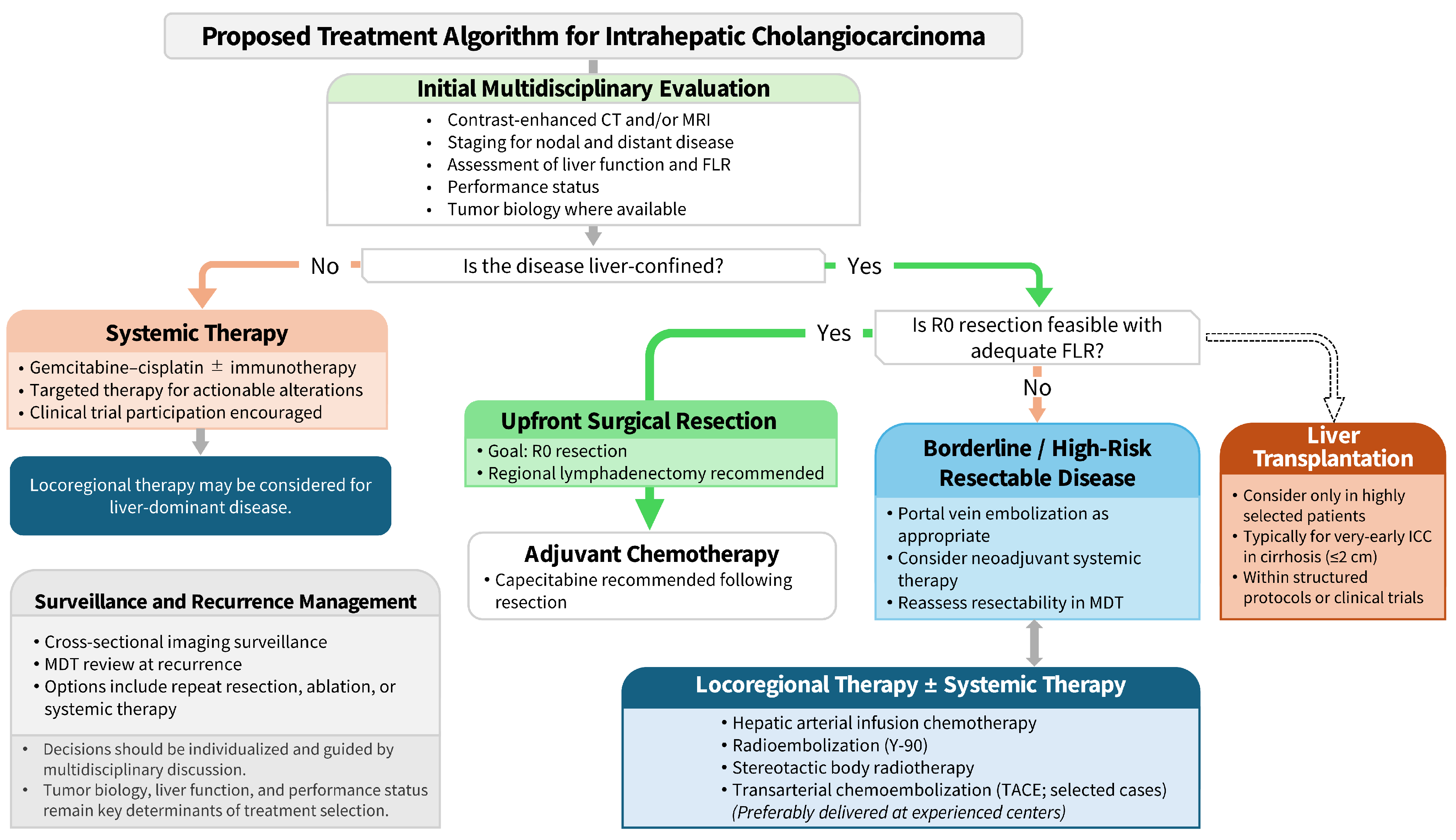


Intrahepatic Cholangiocarcinoma: Contemporary Approaches to Surgical, Systemic, and Liver-Directed Therapy



Abstract
1. Introduction
2. Epidemiology and Risk Factors
3. Workup and Diagnostic Evaluation
4. Imaging Modalities
5. Surgical Management
5.1. Principles of Resectability and Preoperative Assessment
5.2. Lymphadenectomy
5.3. Multifocal Disease
6. Systemic Therapies
6.1. Cytotoxic Chemotherapy
6.2. Targeted Therapies
6.3. Immunotherapy
7. Locoregional Therapies
8. Liver Transplantation in ICC
9. Future Directions
10. Conclusions
Author Contributions
Funding
Institutional Review Board Statement
Informed Consent Statement
Data Availability Statement
Conflicts of Interest
References
- Saha, S.K.; Zhu, A.X.; Fuchs, C.S.; Brooks, G.A. Forty-Year Trends in Cholangiocarcinoma Incidence in the U.S.: Intrahepatic Disease on the Rise. Oncologist 2016, 21, 594–599. [Google Scholar] [CrossRef] [Scilit]
- Mavros, M.N.; Economopoulos, K.P.; Alexiou, V.G.; Pawlik, T.M. Treatment and Prognosis for Patients with Intrahepatic Cholangiocarcinoma: Systematic Review and Meta-Analysis. JAMA Surg. 2014, 149, 565–574. [Google Scholar] [CrossRef] [Scilit] [PubMed]
- Bridgewater, J.; Galle, P.R.; Khan, S.A.; Llovet, J.M.; Park, J.-W.; Patel, T.; Pawlik, T.M.; Gores, G.J. Guidelines for the Diagnosis and Management of Intrahepatic Cholangiocarcinoma. J. Hepatol. 2014, 60, 1268–1289. [Google Scholar] [CrossRef] [Scilit] [PubMed]
- Alvaro, D.; Gores, G.J.; Walicki, J.; Hassan, C.; Sapisochin, G.; Komuta, M.; Forner, A.; Valle, J.W.; Laghi, A.; Ilyas, S.I.; et al. EASL-ILCA Clinical Practice Guidelines on the Management of Intrahepatic Cholangiocarcinoma. J. Hepatol. 2023, 79, 181–208. [Google Scholar] [CrossRef] [Scilit] [PubMed]
- Benson, A.B.; D’Angelica, M.I.; Abrams, T.; Ahmed, A.; Akce, M.; Anaya, D.A.; Anders, R.; Are, C.; Aye, L.; Bachini, M.; et al. Biliary Tract Cancers, Version 2.2025, NCCN Clinical Practice Guidelines in Oncology. J. Natl. Compr. Cancer Netw. 2025, 23, 403–418. [Google Scholar] [CrossRef] [Scilit]
- Tsilimigras, D.I.; Kurzrock, R.; Pawlik, T.M. Molecular Testing and Targeted Therapies in Hepatobiliary Cancers: A Review. JAMA Surg. 2025, 160, 576–585. [Google Scholar] [CrossRef] [Scilit] [PubMed]
- Caringi, S.; Delvecchio, A.; Casella, A.; Ferraro, V.; Dezio, M.; Marini, S.; Calbi, R.; Cortese, F.; Filippo, R.; Stasi, M.; et al. Hot Topics in the Surgical Treatment of Intrahepatic Cholangiocarcinoma: A Narrative Review of Current Managements. Cancers 2025, 17, 3127. [Google Scholar] [CrossRef] [Scilit] [PubMed]
- Vithayathil, M.; Khan, S.A. Current Epidemiology of Cholangiocarcinoma in Western Countries. J. Hepatol. 2022, 77, 1690–1698. [Google Scholar] [CrossRef] [Scilit] [PubMed]
- Clements, O.; Eliahoo, J.; Kim, J.U.; Taylor-Robinson, S.D.; Khan, S.A. Risk Factors for Intrahepatic and Extrahepatic Cholangiocarcinoma: A Systematic Review and Meta-Analysis. J. Hepatol. 2020, 72, 95–103. [Google Scholar] [CrossRef] [Scilit]
- Ruff, S.M.; Pawlik, T.M. Clinical Management of Intrahepatic Cholangiocarcinoma: Surgical Approaches and Systemic Therapies. Front. Oncol. 2024, 14, 1321683. [Google Scholar] [CrossRef] [Scilit]
- Kawashima, J.; Akabane, M.; Woldesenbet, S.; Tsilimigras, D.I.; Endo, Y.; Sahara, K.; Cauchy, F.; Aucejo, F.; Marques, H.P.; Lopes, R.; et al. Oncological Resectability Criteria for Intrahepatic Cholangiocarcinoma: A Preoperative Framework for Multidisciplinary Management. Ann. Surg. Oncol. 2025, 32, 7141–7151. [Google Scholar] [CrossRef] [Scilit]
- Chun, Y.S.; Pawlik, T.M.; Vauthey, J.-N. 8th Edition of the AJCC Cancer Staging Manual: Pancreas and Hepatobiliary Cancers. Ann. Surg. Oncol. 2018, 25, 845–847. [Google Scholar] [CrossRef] [Scilit] [PubMed]
- Childers, B.G.; Denbo, J.W.; Kim, R.D.; Hoffe, S.E.; Glushko, T.; Qayyum, A.; Anaya, D.A. Intrahepatic Cholangiocarcinoma: Role of Imaging as a Critical Component for Multi-Disciplinary Treatment Approach. Abdom. Radiol. 2025, 50, 4110–4124. [Google Scholar] [CrossRef] [Scilit] [PubMed]
- Dong, Y.; Podrascanin, V.; Li, Z.; Santol, J.; Ammann, M.; Fonkoua, L.A.K.; Graham, R.P.; Conboy, C.B.; Tran, N.H.; Warner, S.G.; et al. Real-World Single-Center Experience with Neoadjuvant Gemcitabine, Cisplatin, and Durvalumab in Borderline Resectable Cholangiocarcinoma. Ann. Surg. Oncol. 2025, 32, 7228–7239. [Google Scholar] [CrossRef] [Scilit]
- Matsuyama, R.; Mori, R.; Ota, Y.; Homma, Y.; Yabusita, Y.; Hiratani, S.; Murakami, T.; Sawada, Y.; Miyake, K.; Shimizu, Y.; et al. Impact of Gemcitabine Plus S1 Neoadjuvant Chemotherapy on Borderline Resectable Perihilar Cholangiocarcinoma. Ann. Surg. Oncol. 2022, 29, 2393–2405. [Google Scholar] [CrossRef] [Scilit]
- Vogel, A.; Ducreux, M. ESMO Clinical Practice Guideline Interim Update on the Management of Biliary Tract Cancer. ESMO Open 2024, 10, 104003. [Google Scholar] [CrossRef] [Scilit] [PubMed]
- Kubota, K.; Makuuchi, M.; Kusaka, K.; Kobayashi, T.; Miki, K.; Hasegawa, K.; Harihara, Y.; Takayama, T. Measurement of Liver Volume and Hepatic Functional Reserve as a Guide to Decision-Making in Resectional Surgery for Hepatic Tumors. Hepatology 1997, 26, 1176–1181. [Google Scholar] [CrossRef] [Scilit]
- Vauthey, J.-N.; Chaoui, A.; Do, K.-A.; Bilimoria, M.M.; Fenstermacher, M.J.; Charnsangavej, C.; Hicks, M.; Alsfasser, G.; Lauwers, G.; Hawkins, I.F.; et al. Standardized Measurement of the Future Liver Remnant Prior to Extended Liver Resection: Methodology and Clinical Associations. Surgery 2000, 127, 512–519. [Google Scholar] [CrossRef] [Scilit] [PubMed]
- Shoup, M.; Gonen, M.; D’Angelica, M.; Jarnagin, W.R.; DeMatteo, R.P.; Schwartz, L.H.; Tuorto, S.; Blumgart, L.H.; Fong, Y. Volumetric Analysis Predicts Hepatic Dysfunction in Patients Undergoing Major Liver Resection. J. Gastrointest. Surg. 2003, 7, 325–330. [Google Scholar] [CrossRef] [Scilit]
- Takamoto, T.; Hashimoto, T.; Ichida, A.; Shimada, K.; Maruyama, Y.; Makuuchi, M. Surgical Strategy Based on Indocyanine Green Test for Chemotherapy-Associated Liver Injury and Long-Term Outcome in Colorectal Liver Metastases. J. Gastrointest. Surg. 2018, 22, 1077–1088. [Google Scholar] [CrossRef] [Scilit]
- Smet, H.; Martin, D.; Uldry, E.; Duran, R.; Girardet, R.; Schaefer, N.; Prior, J.O.; Denys, A.; Halkic, N.; Demartines, N.; et al. Tc-99m Mebrofenin Hepatobiliary Scintigraphy to Assess Future Liver Remnant Function before Major Liver Surgery. J. Surg. Oncol. 2023, 128, 1312–1319. [Google Scholar] [CrossRef] [Scilit]
- Robinson, S.M.; Wilson, C.H.; Burt, A.D.; Manas, D.M.; White, S.A. Chemotherapy-Associated Liver Injury in Patients with Colorectal Liver Metastases: A Systematic Review and Meta-Analysis. Ann. Surg. Oncol. 2012, 19, 4287–4299. [Google Scholar] [CrossRef] [Scilit]
- Vigano, L.; De Rosa, G.; Toso, C.; Andres, A.; Ferrero, A.; Roth, A.; Sperti, E.; Majno, P.; Rubbia-Brandt, L. Reversibility of Chemotherapy-Related Liver Injury. J. Hepatol. 2017, 67, 84–91. [Google Scholar] [CrossRef] [Scilit]
- Ribero, D.; Abdalla, E.K.; Madoff, D.C.; Donadon, M.; Loyer, E.M.; Vauthey, J.-N. Portal Vein Embolization before Major Hepatectomy and Its Effects on Regeneration, Resectability and Outcome. Br. J. Surg. 2007, 94, 1386–1394. [Google Scholar] [CrossRef] [Scilit] [PubMed]
- Li, J.; Moustafa, M.; Linecker, M.; Lurje, G.; Capobianco, I.; Baumgart, J.; Ratti, F.; Rauchfuss, F.; Balci, D.; Fernandes, E.; et al. ALPPS for Locally Advanced Intrahepatic Cholangiocarcinoma: Did Aggressive Surgery Lead to the Oncological Benefit? An International Multi-Center Study. Ann. Surg. Oncol. 2020, 27, 1372–1384. [Google Scholar] [CrossRef] [Scilit] [PubMed]
- Chaouch, M.A.; Mazzotta, A.; da Costa, A.C.; Hussain, M.I.; Gouader, A.; Krimi, B.; Panaro, F.; Guiu, B.; Soubrane, O.; Oweira, H. A Systematic Review and Meta-Analysis of Liver Venous Deprivation versus Portal Vein Embolization before Hepatectomy: Future Liver Volume, Postoperative Outcomes, and Oncological Safety. Front. Med. 2024, 10, 1334661. [Google Scholar] [CrossRef] [Scilit]
- Yang, L.; Yang, M.; Wang, T.; Qiu, Y.; Yang, Y.; Wang, W. Comparison of Liver Venous Deprivation with Portal Vein Embolization Alone in Patients Undergoing Major Liver Resection: A Systematic Review and Meta-Analysis. HPB 2024, 26, 1329–1338. [Google Scholar] [CrossRef] [Scilit]
- Jiang, C.; Hou, G.-M.; Zhang, Z.-H.; Qiang, Z.-Y.; Wang, H.-C.; Zhou, J.; Zeng, Y. Anatomic versus Nonanatomic Resection for Intrahepatic Cholangiocarcinoma: A Systematic Review and Meta-Analysis. Int. J. Surg. 2025, 111, 1440–1453. [Google Scholar] [CrossRef] [Scilit] [PubMed]
- Si, A.; Li, J.; Yang, Z.; Xia, Y.; Yang, T.; Lei, Z.; Cheng, Z.; Pawlik, T.M.; Lau, W.Y.; Shen, F. Impact of Anatomical Versus Non-Anatomical Liver Resection on Short- and Long-Term Outcomes for Patients with Intrahepatic Cholangiocarcinoma. Ann. Surg. Oncol. 2019, 26, 1841–1850. [Google Scholar] [CrossRef] [Scilit]
- Jiang, J.-H.; Fang, D.-Z.; Hu, Y.-T. Influence of Surgical Margin Width on Survival Rate after Resection of Intrahepatic Cholangiocarcinoma: A Systematic Review and Meta-Analysis. BMJ Open 2023, 13, e067222. [Google Scholar] [CrossRef] [Scilit]
- Liu, H.; Lin, L.; Lin, Z.; Chen, Y.; Huang, Q.; Ding, L.; Lou, J.; Zheng, S.; Bi, X.; Wang, J.; et al. Impact of Surgical Margin Width on Long-Term Outcomes for Intrahepatic Cholangiocarcinoma: A Multicenter Study. BMC Cancer 2021, 21, 840. [Google Scholar] [CrossRef] [Scilit]
- Zhang, X.-F.; Beal, E.W.; Bagante, F.; Chakedis, J.; Weiss, M.; Popescu, I.; Marques, H.P.; Aldrighetti, L.; Maithel, S.K.; Pulitano, C.; et al. Early versus Late Recurrence of Intrahepatic Cholangiocarcinoma after Resection with Curative Intent. Br. J. Surg. 2018, 105, 848–856. [Google Scholar] [CrossRef] [Scilit] [PubMed]
- Bagante, F.; Spolverato, G.; Weiss, M.; Alexandrescu, S.; Marques, H.P.; Aldrighetti, L.; Maithel, S.K.; Pulitano, C.; Bauer, T.W.; Shen, F.; et al. Defining Long-Term Survivors Following Resection of Intrahepatic Cholangiocarcinoma. J. Gastrointest. Surg. 2017, 21, 1888–1897. [Google Scholar] [CrossRef] [Scilit]
- Dai, Y.-S.; Hu, H.-J.; Lv, T.; Hu, Y.-F.; Zou, R.-Q.; Li, F.-Y. The Influence of Resection Margin Width in Patients with Intrahepatic Cholangiocarcinoma: A Meta-Analysis. World J. Surg. Oncol. 2023, 21, 16. [Google Scholar] [CrossRef] [Scilit]
- Bowlus, C.L.; Arrivé, L.; Bergquist, A.; Deneau, M.; Forman, L.; Ilyas, S.I.; Lunsford, K.E.; Martinez, M.; Sapisochin, G.; Shroff, R.; et al. AASLD Practice Guidance on Primary Sclerosing Cholangitis and Cholangiocarcinoma. Hepatology 2023, 77, 659. [Google Scholar] [CrossRef] [Scilit]
- Zhu, J.; Liu, C.; Li, H.; Ren, H.; Cai, Y.; Lan, T.; Wu, H. Adequate Lymph Node Dissection Is Essential for Accurate Nodal Staging in Intrahepatic Cholangiocarcinoma: A Population-based Study. Cancer Med. 2023, 12, 8184–8198. [Google Scholar] [CrossRef] [Scilit] [PubMed]
- Yu, J.; Zhou, F.; Tan, X.-G.; Guo, J.; Feng, W. Impact of Lymph Node Dissection on the Prognosis of Intrahepatic Cholangiocarcinoma: A Systematic Review and Meta-Analysis. Front. Oncol. 2025, 15, 1590019. [Google Scholar] [CrossRef] [Scilit]
- Umeda, Y.; Takagi, K.; Matsuda, T.; Fuji, T.; Kojima, T.; Satoh, D.; Hioki, M.; Endo, Y.; Inagaki, M.; Oishi, M.; et al. Clinical Implications and Optimal Extent of Lymphadenectomy for Intrahepatic Cholangiocarcinoma: A Multicenter Analysis of the Therapeutic Index. Ann. Gastroenterol. Surg. 2022, 7, 512–522. [Google Scholar] [CrossRef] [Scilit] [PubMed]
- Hyder, O.; Marques, H.; Pulitano, C.; Marsh, J.W.; Alexandrescu, S.; Bauer, T.W.; Gamblin, T.C.; Sotiropoulos, G.C.; Paul, A.; Barroso, E.; et al. A Nomogram to Predict Long-Term Survival After Resection for Intrahepatic Cholangiocarcinoma: An Eastern and Western Experience. JAMA Surg. 2014, 149, 432–438. [Google Scholar] [CrossRef] [Scilit]
- Tsilimigras, D.I.; Sahara, K.; Paredes, A.Z.; Moro, A.; Mehta, R.; Moris, D.; Guglielmi, A.; Aldrighetti, L.; Weiss, M.; Bauer, T.W.; et al. Predicting Lymph Node Metastasis in Intrahepatic Cholangiocarcinoma. J. Gastrointest. Surg. 2021, 25, 1156–1163. [Google Scholar] [CrossRef] [Scilit]
- Jansson, H.; Villard, C.; Nooijen, L.E.; Ghorbani, P.; Erdmann, J.I.; Sparrelid, E. Prognostic Influence of Multiple Hepatic Lesions in Resectable Intrahepatic Cholangiocarcinoma: A Systematic Review and Meta-Analysis. Eur. J. Surg. Oncol. 2023, 49, 688–699. [Google Scholar] [CrossRef] [Scilit]
- Spolverato, G.; Kim, Y.; Alexandrescu, S.; Popescu, I.; Marques, H.P.; Aldrighetti, L.; Gamblin, T.C.; Miura, J.; Maithel, S.K.; Squires, M.H.; et al. Is Hepatic Resection for Large or Multifocal Intrahepatic Cholangiocarcinoma Justified? Results from a Multi-Institutional Collaboration. Ann. Surg. Oncol. 2015, 22, 2218–2225. [Google Scholar] [CrossRef] [Scilit]
- Buettner, S.; Ten Cate, D.W.G.; Bagante, F.; Alexandrescu, S.; Marques, H.P.; Lamelas, J.; Aldrighetti, L.; Gamblin, T.C.; Maithel, S.K.; Pulitano, C.; et al. Survival after Resection of Multiple Tumor Foci of Intrahepatic Cholangiocarcinoma. J. Gastrointest. Surg. 2019, 23, 2239–2246. [Google Scholar] [CrossRef] [Scilit]
- Yin, L.; Zhao, S.; Zhu, H.; Ji, G.; Zhang, X. Primary Tumor Resection Improves Survival in Patients with Multifocal Intrahepatic Cholangiocarcinoma Based on a Population Study. Sci. Rep. 2021, 11, 12166. [Google Scholar] [CrossRef] [Scilit]
- Valle, J.; Wasan, H.; Palmer, D.H.; Cunningham, D.; Anthoney, A.; Maraveyas, A.; Madhusudan, S.; Iveson, T.; Hughes, S.; Pereira, S.P.; et al. Cisplatin plus Gemcitabine versus Gemcitabine for Biliary Tract Cancer. N. Engl. J. Med. 2010, 362, 1273–1281. [Google Scholar] [CrossRef] [Scilit]
- Lamarca, A.; Ross, P.; Wasan, H.S.; Hubner, R.A.; McNamara, M.G.; Lopes, A.; Manoharan, P.; Palmer, D.; Bridgewater, J.; Valle, J.W. Advanced Intrahepatic Cholangiocarcinoma: Post Hoc Analysis of the ABC-01, -02, and -03 Clinical Trials. J. Natl. Cancer Inst. 2020, 112, 200–210. [Google Scholar] [CrossRef] [Scilit] [PubMed]
- Oh, D.-Y.; He, A.R.; Bouattour, M.; Okusaka, T.; Qin, S.; Chen, L.-T.; Kitano, M.; Lee, C.; Kim, J.W.; Chen, M.-H.; et al. Durvalumab or Placebo plus Gemcitabine and Cisplatin in Participants with Advanced Biliary Tract Cancer (TOPAZ-1): Updated Overall Survival from a Randomised Phase 3 Study. Lancet Gastroenterol. Hepatol. 2024, 9, 694–704. [Google Scholar] [CrossRef] [Scilit] [PubMed]
- Kelley, R.K.; Ueno, M.; Yoo, C.; Finn, R.S.; Furuse, J.; Ren, Z.; Yau, T.; Klümpen, H.-J.; Chan, S.L.; Ozaka, M.; et al. Pembrolizumab in Combination with Gemcitabine and Cisplatin Compared with Gemcitabine and Cisplatin Alone for Patients with Advanced Biliary Tract Cancer (KEYNOTE-966): A Randomised, Double-Blind, Placebo-Controlled, Phase 3 Trial. Lancet 2023, 401, 1853–1865. [Google Scholar] [CrossRef] [Scilit] [PubMed]
- Shroff, R.T.; King, G.; Colby, S.; Scott, A.J.; Borad, M.J.; Goff, L.; Matin, K.; Mahipal, A.; Kalyan, A.; Javle, M.M.; et al. SWOG S1815: A Phase III Randomized Trial of Gemcitabine, Cisplatin, and Nab-Paclitaxel Versus Gemcitabine and Cisplatin in Newly Diagnosed, Advanced Biliary Tract Cancers. J. Clin. Oncol. 2025, 43, 536–544. [Google Scholar] [CrossRef] [Scilit]
- Primrose, J.N.; Fox, R.P.; Palmer, D.H.; Malik, H.Z.; Prasad, R.; Mirza, D.; Anthony, A.; Corrie, P.; Falk, S.; Finch-Jones, M.; et al. Capecitabine Compared with Observation in Resected Biliary Tract Cancer (BILCAP): A Randomised, Controlled, Multicentre, Phase 3 Study. Lancet Oncol. 2019, 20, 663–673. [Google Scholar] [CrossRef] [Scilit]
- Nakachi, K.; Ikeda, M.; Konishi, M.; Nomura, S.; Katayama, H.; Kataoka, T.; Todaka, A.; Yanagimoto, H.; Morinaga, S.; Kobayashi, S.; et al. Adjuvant S-1 Compared with Observation in Resected Biliary Tract Cancer (JCOG1202, ASCOT): A Multicentre, Open-Label, Randomised, Controlled, Phase 3 Trial. Lancet 2023, 401, 195–203. [Google Scholar] [CrossRef] [Scilit]
- Lamarca, A.; Palmer, D.H.; Wasan, H.S.; Ross, P.J.; Ma, Y.T.; Arora, A.; Falk, S.; Gillmore, R.; Wadsley, J.; Patel, K.; et al. Second-Line FOLFOX Chemotherapy versus Active Symptom Control for Advanced Biliary Tract Cancer (ABC-06): A Phase 3, Open-Label, Randomised, Controlled Trial. Lancet Oncol. 2021, 22, 690–701. [Google Scholar] [CrossRef] [Scilit]
- Abou-Alfa, G.K.; Sahai, V.; Hollebecque, A.; Vaccaro, G.; Melisi, D.; Al-Rajabi, R.; Paulson, A.S.; Borad, M.J.; Gallinson, D.; Murphy, A.G.; et al. Pemigatinib for Previously Treated, Locally Advanced or Metastatic Cholangiocarcinoma: A Multicentre, Open-Label, Phase 2 Study. Lancet Oncol. 2020, 21, 671–684. [Google Scholar] [CrossRef] [Scilit] [PubMed]
- Goyal, L.; Meric-Bernstam, F.; Hollebecque, A.; Valle, J.W.; Morizane, C.; Karasic, T.B.; Abrams, T.A.; Furuse, J.; Kelley, R.K.; Cassier, P.A.; et al. Futibatinib for FGFR2-Rearranged Intrahepatic Cholangiocarcinoma. N. Engl. J. Med. 2023, 388, 228–239. [Google Scholar] [CrossRef] [Scilit]
- Abou-Alfa, G.K.; Macarulla, T.; Javle, M.M.; Kelley, R.K.; Lubner, S.J.; Adeva, J.; Cleary, J.M.; Catenacci, D.V.; Borad, M.J.; Bridgewater, J.; et al. Ivosidenib in IDH1-Mutant, Chemotherapy-Refractory Cholangiocarcinoma (ClarIDHy): A Multicentre, Randomised, Double-Blind, Placebo-Controlled, Phase 3 Study. Lancet Oncol. 2020, 21, 796–807. [Google Scholar] [CrossRef] [Scilit] [PubMed]
- Sahai, V.; Catalano, P.J.; Zalupski, M.M.; Lubner, S.J.; Menge, M.R.; Nimeiri, H.S.; Munshi, H.G.; Benson, A.B., III; O’Dwyer, P.J. Nab-Paclitaxel and Gemcitabine as First-Line Treatment of Advanced or Metastatic Cholangiocarcinoma: A Phase 2 Clinical Trial. JAMA Oncol. 2018, 4, 1707–1712. [Google Scholar] [CrossRef] [Scilit]
- Maithel, S.K.; Keilson, J.M.; Cao, H.S.T.; Rupji, M.; Mahipal, A.; Lin, B.S.; Javle, M.M.; Cleary, S.P.; Akce, M.; Switchenko, J.M.; et al. NEO-GAP: A Single-Arm, Phase II Feasibility Trial of Neoadjuvant Gemcitabine, Cisplatin, and Nab-Paclitaxel for Resectable, High-Risk Intrahepatic Cholangiocarcinoma. Ann. Surg. Oncol. 2023, 30, 6558–6566. [Google Scholar] [CrossRef] [Scilit]
- Le Roy, B.; Gelli, M.; Pittau, G.; Allard, M.-A.; Pereira, B.; Serji, B.; Vibert, E.; Castaing, D.; Adam, R.; Cherqui, D.; et al. Neoadjuvant Chemotherapy for Initially Unresectable Intrahepatic Cholangiocarcinoma. Br. J. Surg. 2018, 105, 839–847. [Google Scholar] [CrossRef] [Scilit] [PubMed]
- Sutton, T.L.; Billingsley, K.G.; Walker, B.S.; Enestvedt, C.K.; Dewey, E.N.; Orloff, S.L.; Mayo, S.C. Neoadjuvant Chemotherapy Is Associated with Improved Survival in Patients Undergoing Hepatic Resection for Intrahepatic Cholangiocarcinoma. Am. J. Surg. 2021, 221, 1182–1187. [Google Scholar] [CrossRef] [Scilit]
- Ejaz, A.; Pawlik, T.M. Neoadjuvant Chemotherapy for Intrahepatic Cholangiocarcinoma: A Potential Paradigm Shift in Treatment Sequencing. Ann. Surg. Oncol. 2023, 30, 6304–6305. [Google Scholar] [CrossRef] [Scilit]
- Reames, B.N.; Bagante, F.; Ejaz, A.; Spolverato, G.; Ruzzenente, A.; Weiss, M.; Alexandrescu, S.; Marques, H.P.; Aldrighetti, L.; Maithel, S.K.; et al. Impact of Adjuvant Chemotherapy on Survival in Patients with Intrahepatic Cholangiocarcinoma: A Multi-Institutional Analysis. HPB 2017, 19, 901–909. [Google Scholar] [CrossRef] [Scilit]
- Ebata, T.; Hirano, S.; Konishi, M.; Uesaka, K.; Tsuchiya, Y.; Ohtsuka, M.; Kaneoka, Y.; Yamamoto, M.; Ambo, Y.; Shimizu, Y.; et al. Randomized Clinical Trial of Adjuvant Gemcitabine Chemotherapy versus Observation in Resected Bile Duct Cancer. Br. J. Surg. 2018, 105, 192–202. [Google Scholar] [CrossRef] [Scilit]
- Edeline, J.; Benabdelghani, M.; Bertaut, A.; Watelet, J.; Hammel, P.; Joly, J.-P.; Boudjema, K.; Fartoux, L.; Bouhier-Leporrier, K.; Jouve, J.-L.; et al. Gemcitabine and Oxaliplatin Chemotherapy or Surveillance in Resected Biliary Tract Cancer (PRODIGE 12-ACCORD 18-UNICANCER GI): A Randomized Phase III Study. J. Clin. Oncol. 2019, 37, 658–667. [Google Scholar] [CrossRef] [Scilit]
- Yoo, C.; Kim, K.-P.; Jeong, J.H.; Kim, I.; Kang, M.J.; Cheon, J.; Kang, B.W.; Ryu, H.; Lee, J.S.; Kim, K.W.; et al. Liposomal Irinotecan plus Fluorouracil and Leucovorin versus Fluorouracil and Leucovorin for Metastatic Biliary Tract Cancer after Progression on Gemcitabine plus Cisplatin (NIFTY): A Multicentre, Open-Label, Randomised, Phase 2b Study. Lancet Oncol. 2021, 22, 1560–1572. [Google Scholar] [CrossRef] [Scilit]
- Vogel, A.; Saborowski, A.; Wenzel, P.; Wege, H.; Folprecht, G.; Kretzschmar, A.; Schütt, P.; Jacobasch, L.; Ziegenhagen, N.; Boeck, S.; et al. Nanoliposomal Irinotecan and Fluorouracil plus Leucovorin versus Fluorouracil plus Leucovorin in Patients with Cholangiocarcinoma and Gallbladder Carcinoma Previously Treated with Gemcitabine-Based Therapies (AIO NALIRICC): A Multicentre, Open-Label, Randomised, Phase 2 Trial. Lancet Gastroenterol. Hepatol. 2024, 9, 734–744. [Google Scholar] [CrossRef] [Scilit]
- European Association for the Study of the Liver. EASL Clinical Practice Guidelines on the Management of Extrahepatic Cholangiocarcinoma. J. Hepatol. 2025, 83, 211–238. [Google Scholar] [CrossRef] [Scilit]
- Ozer, M.; Sahin, I. The Evolving Landscape of Biliary Tract Cancers: Comparing French and US National Comprehensive Cancer Network Guidelines. Hepatobiliary Surg. Nutr. 2024, 13, 850–853. [Google Scholar] [CrossRef] [Scilit] [PubMed]
- Rimassa, L.; Lamarca, A.; O’Kane, G.M.; Edeline, J.; McNamara, M.G.; Vogel, A.; Fassan, M.; Forner, A.; Kendall, T.; Adeva, J.; et al. New Systemic Treatment Paradigms in Advanced Biliary Tract Cancer and Variations in Patient Access across Europe. Lancet Reg. Health–Eur. 2025, 50, 101170. [Google Scholar] [CrossRef] [Scilit]
- Kawashima, J.; Akabane, M.; Endo, I.; Pawlik, T.M. Recent Advances in the Treatment of FGFR-Altered Cholangiocarcinoma. Expert Opin. Pharmacother. 2025, 26, 1973–1983. [Google Scholar] [CrossRef] [Scilit] [PubMed]
- Subbiah, V.; Lassen, U.; Élez, E.; Italiano, A.; Curigliano, G.; Javle, M.; de Braud, F.; Prager, G.W.; Greil, R.; Stein, A.; et al. Dabrafenib plus Trametinib in Patients with BRAFV600E-Mutated Biliary Tract Cancer (ROAR): A Phase 2, Open-Label, Single-Arm, Multicentre Basket Trial. Lancet Oncol. 2020, 21, 1234–1243. [Google Scholar] [CrossRef] [Scilit] [PubMed]
- Inoue, K.; Nakamura, Y.; Caughey, B.; Zheng-Lin, B.; Ueno, M.; Furukawa, M.; Kawamoto, Y.; Itoh, S.; Umemoto, K.; Sudo, K.; et al. Clinicomolecular Profile and Efficacy of Human Epidermal Growth Factor Receptor 2 (HER2)-Targeted Therapy for HER2-Amplified Advanced Biliary Tract Cancer. JCO Precis. Oncol. 2025, 9, e2400718. [Google Scholar] [CrossRef] [Scilit] [PubMed]
- Normanno, N.; Martinelli, E.; Melisi, D.; Pinto, C.; Rimassa, L.; Santini, D.; Scarpa, A. Role of Molecular Genetics in the Clinical Management of Cholangiocarcinoma. ESMO Open 2022, 7, 100505. [Google Scholar] [CrossRef] [Scilit]
- Yang, X.; Lian, B.; Zhang, N.; Long, J.; Li, Y.; Xue, J.; Chen, X.; Wang, Y.; Wang, Y.; Xun, Z.; et al. Genomic Characterization and Immunotherapy for Microsatellite Instability-High in Cholangiocarcinoma. BMC Med. 2024, 22, 42. [Google Scholar] [CrossRef] [Scilit]
- Hwang, S.; Woo, S.; Kang, B.; Kang, H.; Kim, J.S.; Lee, S.H.; Kwon, C.I.; Kyung, D.S.; Kim, H.-P.; Kim, G.; et al. Concordance of ctDNA and Tissue Genomic Profiling in Advanced Biliary Tract Cancer. J. Hepatol. 2025, 82, 649–657. [Google Scholar] [CrossRef] [Scilit]
- Lowery, M.A.; Ptashkin, R.; Jordan, E.; Berger, M.F.; Zehir, A.; Capanu, M.; Kemeny, N.E.; O’Reilly, E.M.; El-Dika, I.; Jarnagin, W.R.; et al. Comprehensive Molecular Profiling of Intrahepatic and Extrahepatic Cholangiocarcinomas: Potential Targets for Intervention. Clin. Cancer Res. 2018, 24, 4154–4161. [Google Scholar] [CrossRef] [Scilit]
- Nakamura, H.; Arai, Y.; Totoki, Y.; Shirota, T.; Elzawahry, A.; Kato, M.; Hama, N.; Hosoda, F.; Urushidate, T.; Ohashi, S.; et al. Genomic Spectra of Biliary Tract Cancer. Nat. Genet. 2015, 47, 1003–1010. [Google Scholar] [CrossRef] [Scilit]
- Incyte Corporation. A Study to Evaluate the Efficacy and Safety of Pemigatinib Versus Chemotherapy in Unresectable or Metastatic Cholangiocarcinoma (FIGHT-302). Available online: https://clinicaltrials.gov/study/NCT03656536 (accessed on 27 December 2025).
- Oh, D.-Y.; Lee, K.-H.; Lee, D.-W.; Yoon, J.; Kim, T.-Y.; Bang, J.-H.; Nam, A.-R.; Oh, K.-S.; Kim, J.-M.; Lee, Y.; et al. Gemcitabine and Cisplatin plus Durvalumab with or without Tremelimumab in Chemotherapy-Naive Patients with Advanced Biliary Tract Cancer: An Open-Label, Single-Centre, Phase 2 Study. Lancet Gastroenterol. Hepatol. 2022, 7, 522–532. [Google Scholar] [CrossRef] [Scilit]
- Kemeny, N.; Huang, Y.; Cohen, A.M.; Shi, W.; Conti, J.A.; Brennan, M.F.; Bertino, J.R.; Turnbull, A.D.M.; Sullivan, D.; Stockman, J.; et al. Hepatic Arterial Infusion of Chemotherapy after Resection of Hepatic Metastases from Colorectal Cancer. N. Engl. J. Med. 1999, 341, 2039–2048. [Google Scholar] [CrossRef] [Scilit] [PubMed]
- Kemeny, N.E.; Gonen, M. Hepatic Arterial Infusion after Liver Resection. N. Engl. J. Med. 2005, 352, 734–735. [Google Scholar] [CrossRef] [Scilit] [PubMed]
- Franssen, S.; Rousian, M.; Filipe, W.F.; Buisman, F.E.; Ten Haaft, B.H.E.A.; Swijnenburg, R.-J.; Mostert, B.; Haj Mohammad, N.; Hagendoorn, J.; Doukas, M.; et al. Hepatic Arterial Infusion Pump Chemotherapy in Patients with Unresectable Intrahepatic Cholangiocarcinoma-PUMP-2 Trial. J. Clin. Oncol. 2026, 44, 455–465. [Google Scholar] [CrossRef] [Scilit]
- Cercek, A.; Boerner, T.; Tan, B.R.; Chou, J.F.; Gönen, M.; Boucher, T.M.; Hauser, H.F.; Do, R.K.G.; Lowery, M.A.; Harding, J.J.; et al. Assessment of Hepatic Arterial Infusion of Floxuridine in Combination with Systemic Gemcitabine and Oxaliplatin in Patients with Unresectable Intrahepatic Cholangiocarcinoma: A Phase 2 Clinical Trial. JAMA Oncol. 2020, 6, 60–67. [Google Scholar] [CrossRef] [Scilit]
- Jarnagin, W.R.; Schwartz, L.H.; Gultekin, D.H.; Gönen, M.; Haviland, D.; Shia, J.; D’Angelica, M.; Fong, Y.; DeMatteo, R.; Tse, A.; et al. Regional Chemotherapy for Unresectable Primary Liver Cancer: Results of a Phase II Clinical Trial and Assessment of DCE-MRI as a Biomarker of Survival. Ann. Oncol. 2009, 20, 1589–1595. [Google Scholar] [CrossRef] [Scilit] [PubMed]
- Kemeny, N.E.; Schwartz, L.; Gönen, M.; Yopp, A.; Gultekin, D.; D’Angelica, M.I.; Fong, Y.; Haviland, D.; Gewirtz, A.N.; Allen, P.; et al. Treating Primary Liver Cancer with Hepatic Arterial Infusion of Floxuridine and Dexamethasone: Does the Addition of Systemic Bevacizumab Improve Results. Oncology 2011, 80, 153–159. [Google Scholar] [CrossRef] [Scilit] [PubMed]
- Hepatic Arterial Infusion (HAI) with Floxuridine (FUDR) and Dexamethasone (Dex) Combined with Systemic Gemcitabine and Oxaliplatin in Patients with Unresectable Intrahepatic Cholangiocarcinoma (ICC). Available online: https://clinicaltrials.gov/study/NCT01862315 (accessed on 25 December 2025).
- Moris, D.; Palta, M.; Kim, C.; Allen, P.J.; Morse, M.A.; Lidsky, M.E. Advances in the Treatment of Intrahepatic Cholangiocarcinoma: An Overview of the Current and Future Therapeutic Landscape for Clinicians. CA Cancer J. Clin. 2023, 73, 198–222. [Google Scholar] [CrossRef] [Scilit]
- Meyer, C.G.; Penn, I.; James, L. Liver Transplantation for Cholangiocarcinoma: Results in 207 Patients. Transplantation 2000, 69, 1633–1637. [Google Scholar] [CrossRef] [Scilit] [PubMed]
- Robles, R.; Figueras, J.; Turrión, V.S.; Margarit, C.; Moya, A.; Varo, E.; Calleja, J.; Valdivieso, A.; Valdecasas, J.C.G.; López, P.; et al. Spanish Experience in Liver Transplantation for Hilar and Peripheral Cholangiocarcinoma. Ann. Surg. 2004, 239, 265–271. [Google Scholar] [CrossRef] [Scilit]
- Breuer, E.; Mueller, M.; Doyle, M.B.; Yang, L.; Darwish Murad, S.; Anwar, I.J.; Merani, S.; Limkemann, A.; Jeddou, H.; Kim, S.C.; et al. Liver Transplantation as a New Standard of Care in Patients with Perihilar Cholangiocarcinoma? Results from an International Benchmark Study. Ann. Surg. 2022, 276, 846–853. [Google Scholar] [CrossRef] [Scilit]
- Chen, Y.; Shen, H.; Xu, R.; Zhu, J.; Zhu, Y.; Zou, H. Comparative Prognosis of Liver Transplantation versus Liver Resection in Intrahepatic Cholangiocarcinoma: A Systematic Review and Meta-Analysis. Chin. Clin. Oncol. 2025, 14, 3. [Google Scholar] [CrossRef] [Scilit]
- Ma, K.W.; Chok, K.S.H.; She, W.H.; Cheung, T.T.; Chan, A.C.Y.; Dai, W.C.; Fung, J.Y.Y.; Lo, C.M. Hepatocholangiocarcinoma/Intrahepatic Cholangiocarcinoma: Are They Contraindication or Indication for Liver Transplantation? A Propensity Score-Matched Analysis. Hepatol. Int. 2018, 12, 167–173. [Google Scholar] [CrossRef] [Scilit]
- Maspero, M.; Sposito, C.; Bongini, M.A.; Cascella, T.; Flores, M.; Maccauro, M.; Chiesa, C.; Niger, M.; Pietrantonio, F.; Leoncini, G.; et al. Liver Transplantation for Intrahepatic Cholangiocarcinoma After Chemotherapy and Radioembolization: An Intention-To-Treat Study. Transpl. Int. 2024, 37, 13641. [Google Scholar] [CrossRef] [Scilit]
- Yaqub, S.; Busund, S.; Smedman, T.M.; Syversveen, T.; Khan, A.; Solheim, J.M.; Folseraas, T.; Wiencke, K.; Lassen, K.; Dueland, S.; et al. Liver Transplantation for Locally Advanced Non-Resectable Intrahepatic Cholangiocarcinoma Treated with Neoadjuvant Therapy: Early Results from the TESLA Trial. Br. J. Surg. 2025, 112, znaf054. [Google Scholar] [CrossRef] [Scilit]
- Hakeem, A.R.; Isaac, J.; Thorburn, D.; Heaton, N.; Prasad, R. The Role of Liver Transplant for Intrahepatic Cholangiocarcinoma: The UK NHSBT Liver Advisory Group Pilot Programme. Hepatoma Res. 2023, 9, 38. [Google Scholar] [CrossRef] [Scilit]
- Hoogwater, F.J.H.; Kuipers, H.; de Meijer, V.E.; Maulat, C.; Muscari, F.; Polak, W.G.; van Hoek, B.; Jézéquel, C.; Alwayn, I.P.J.; Ijzermans, J.N.M.; et al. Role of Neoadjuvant Chemoradiotherapy in Liver Transplantation for Unresectable Perihilar Cholangiocarcinoma: Multicentre, Retrospective Cohort Study. BJS Open 2023, 7, zrad025. [Google Scholar] [CrossRef] [Scilit] [PubMed]
- Sapisochin, G.; Facciuto, M.; Rubbia-Brandt, L.; Marti, J.; Mehta, N.; Yao, F.Y.; Vibert, E.; Cherqui, D.; Grant, D.R.; Hernandez-Alejandro, R.; et al. Liver Transplantation for “Very Early” Intrahepatic Cholangiocarcinoma: International Retrospective Study Supporting a Prospective Assessment. Hepatology 2016, 64, 1178–1188. [Google Scholar] [CrossRef] [Scilit] [PubMed]
- De Abreu Neto, I.P.; Pugliese, V.; Massarollo, P.C.B.; Benini, B.B.; Marta, M.M.M.; Takenaka, V.S.; Monteiro, F.; Pessoa, J.L.E.; De Azevedo Neto, R.S.; Gonzalez, A.M. Retrospective Comparative Analyses of Liver Transplantation for Intrahepatic Cholangiocarcinoma and Combined Hepatocellular Cholangiocarcinoma versus Hepatocellular Carcinoma in Brazil. HPB 2025, 27, 640–648. [Google Scholar] [CrossRef] [Scilit]


| Setting/Line | Regimen (Arm A vs. Arm B) | Trial (Phase; Design) | Population (Key Notes) | Key Efficacy (OS/PFS) | Notes (ICC-Relevance) |
|---|---|---|---|---|---|
| Advanced/metastatic (1L) | GemCis vs. Gem | ABC-02 (phase III; RCT) [45,46] | Advanced BTC | OS: 11.7 vs. 8.1 mo; HR 0.64 (95% CI 0.52–0.80). PFS: 8.0 vs. 5.0 mo; HR 0.63 (95% CI 0.51–0.77). | Established cytotoxic backbone across BTC (includes ICC). |
| Advanced/metastatic (1L) | Durva + GemCis vs. GemCis | TOPAZ-1 (phase III; RCT) [47] | Advanced BTC | OS: 12.9 vs. 11.3 mo; HR 0.76 (95% CI 0.64–0.91). 24-mo OS: 23.6% vs. 11.5%. PFS: 7.2 vs. 5.7 mo; HR 0.75 (95% CI 0.63–0.89). | Supports chemo-immunotherapy as a 1L standard in BTC; ICC subset included. |
| Advanced/metastatic (1L) | Pembro + GemCis vs. GemCis | KEYNOTE-966 (phase III; RCT) [48] | Advanced BTC | OS: 12.7 vs. 10.9 mo; HR 0.83 (95% CI 0.72–0.95). PFS: 6.5 vs. 5.6 mo; HR 0.86 (95% CI 0.75–1.00). | Another BTC chemo-ICI option; direct comparisons across regimens are indirect. |
| Advanced/metastatic (1L) | GAP vs. GemCis | SWOG S1815 (phase III; RCT) [49] | Advanced BTC | OS: 14.0 vs. 13.6 mo; HR 0.91 (95% CI 0.72–1.14). PFS: 7.5 vs. 6.3 mo; HR 0.89 (95% CI 0.71–1.12). | No OS benefit; higher toxicity reported despite promising phase II data. |
| Adjuvant (post-resection) | Capecitabine vs. observation | BILCAP (phase III; RCT) [50] | Resected BTC | OS (ITT): 51.1 vs. 36.4 mo; HR 0.81 (95% CI 0.63–1.04). OS (PP): 53 vs. 36 mo; HR 0.75 (95% CI 0.58–0.97). | Supports adjuvant capecitabine as common standard; includes ICC. |
| Adjuvant (post-resection) | S-1 vs. observation | JCOG1202 (ASCOT) (phase III; RCT) [51] | Resected BTC | 3-yr OS: 77.1% vs. 67.6%; HR 0.69 (95% CI 0.51–0.94). | Practice-changing mainly in Asia; includes ICC. |
| Advanced/metastatic (2L) | FOLFOX vs. best supportive care | ABC-06 (phase III; RCT) [52] | Advanced BTC after GemCis | OS: 6.2 vs. 5.3 mo; HR 0.69 (95% CI 0.50–0.97). Low ORR, modest benefit. | Standard second-line cytotoxic option; applies broadly to ICC without actionable alterations. |
| Molecular (≥2L) | Pemigatinib (single-arm) | FIGHT-202 (phase II; single-arm) [53] | FGFR2 fusion/rearranged ICC | ORR: 35.5%; PFS 6.9 mo; OS 21.1 mo. | First-in-class FGFR2 inhibitor; ICC-specific; approved post–first-line. |
| Molecular (≥2L) | Futibatinib (single arm) | FOENIX-CCA2 (phase II; single-arm) [54] | FGFR2 fusion/rearranged ICC | ORR: 42%. PFS: 9.0 mo. OS: 21.7 mo. | ICC-specific (FGFR2-altered); typically post–first-line. |
| Molecular (≥2L) | Ivosidenib vs. placebo | ClarIDHy (phase III; RCT) [55] | IDH1-mutant cholangiocarcinoma | OS: 10.3 vs. 7.5 mo; HR 0.79 (95% CI 0.56–1.12). PFS: 2.7 vs. 1.4 mo; HR 0.37 (95% CI 0.25–0.54). | Targeted option for IDH1-mutant disease; crossover affects unadjusted OS interpretation. |
Disclaimer/Publisher’s Note: The statements, opinions and data contained in all publications are solely those of the individual author(s) and contributor(s) and not of MDPI and/or the editor(s). MDPI and/or the editor(s) disclaim responsibility for any injury to people or property resulting from any ideas, methods, instructions or products referred to in the content. |
© 2026 by the authors. Licensee MDPI, Basel, Switzerland. This article is an open access article distributed under the terms and conditions of the Creative Commons Attribution (CC BY) license.
Share and Cite
Yuza, K.; Akabane, M.; Pawlik, T.M. Intrahepatic Cholangiocarcinoma: Contemporary Approaches to Surgical, Systemic, and Liver-Directed Therapy. Livers 2026, 6, 24. https://doi.org/10.3390/livers6020024
Yuza K, Akabane M, Pawlik TM. Intrahepatic Cholangiocarcinoma: Contemporary Approaches to Surgical, Systemic, and Liver-Directed Therapy. Livers. 2026; 6(2):24. https://doi.org/10.3390/livers6020024
Chicago/Turabian StyleYuza, Kizuki, Miho Akabane, and Timothy M. Pawlik. 2026. "Intrahepatic Cholangiocarcinoma: Contemporary Approaches to Surgical, Systemic, and Liver-Directed Therapy" Livers 6, no. 2: 24. https://doi.org/10.3390/livers6020024
APA StyleYuza, K., Akabane, M., & Pawlik, T. M. (2026). Intrahepatic Cholangiocarcinoma: Contemporary Approaches to Surgical, Systemic, and Liver-Directed Therapy. Livers, 6(2), 24. https://doi.org/10.3390/livers6020024