Review

Intrauterine Insemination in the Era of In Vitro Fertilization: Current Evidence, Clinical Indications, and Future Perspectives


1
Division of Obstetrics & Gynecology, Degli Infermi Hospital, 13875 Biella, Italy
2
Division of Obstetrics & Gynecology, Beauregard Hospital, 11100 Aoste, Italy
*
Author to whom correspondence should be addressed.
Women 2026, 6(3), 52; https://doi.org/10.3390/women6030052
Submission received: 24 June 2026 / Revised: 28 July 2026 / Accepted: 3 August 2026 / Published: 4 August 2026

Abstract

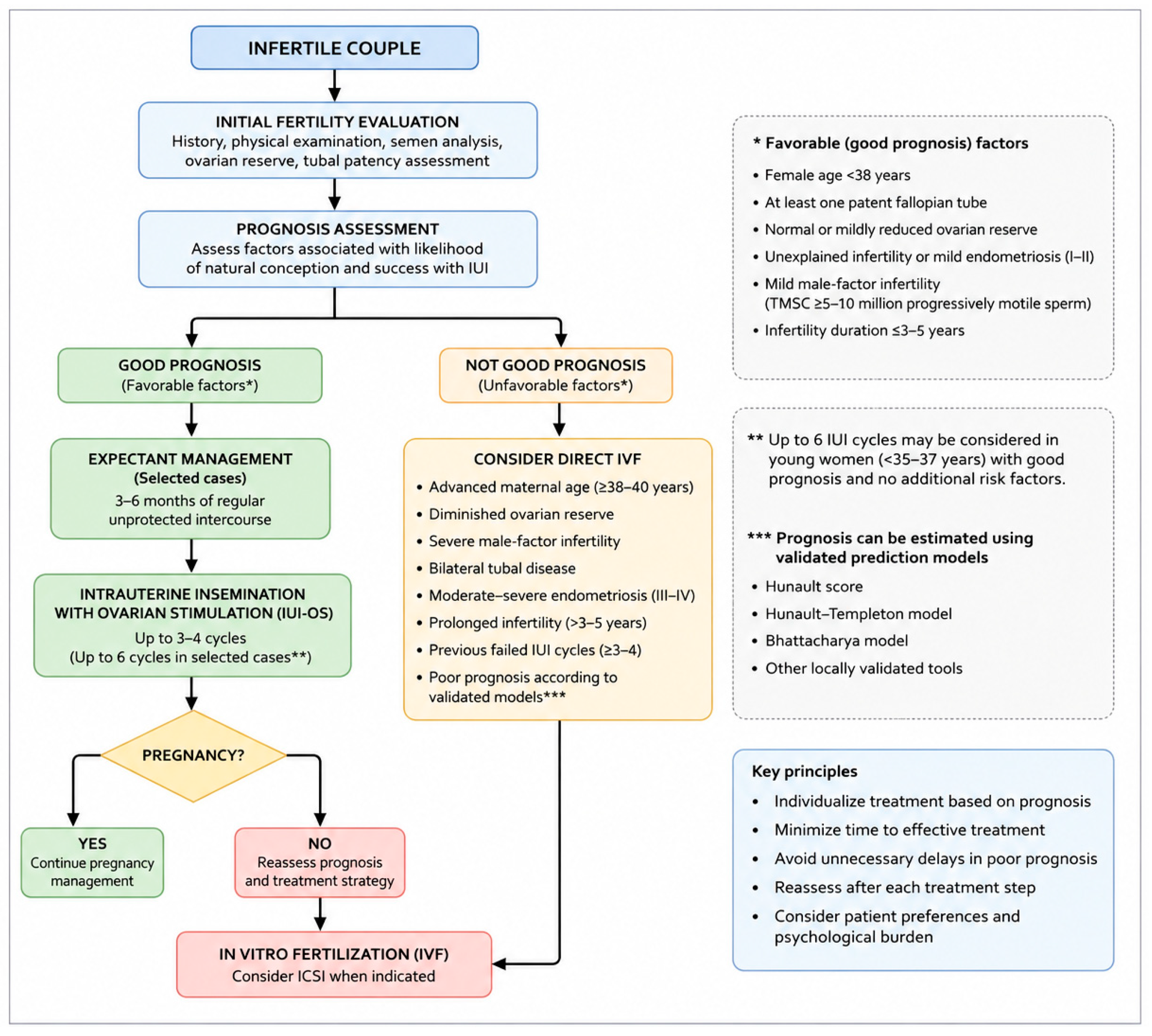
The widespread adoption of in vitro fertilization (IVF) has profoundly transformed the management of infertility and established IVF as the most effective assisted reproductive technology for many clinical indications. Nevertheless, intrauterine insemination (IUI) remains widely used because of its lower invasiveness, reduced treatment burden, lower costs, and broader accessibility. The contemporary role of IUI in an IVF-dominated era remains a subject of ongoing debate. This narrative review aims to critically evaluate the current role of IUI in modern reproductive medicine by examining its clinical indications, effectiveness, limitations, cost-effectiveness, and patient-centered implications in comparison with IVF. A narrative review of the literature was conducted using PubMed/MEDLINE, Scopus, Web of Science, and Google Scholar. Relevant studies, systematic reviews, meta-analyses, randomized controlled trials, and international guidelines published primarily between 2010 and 2025 were identified and synthesized. Particular attention was given to recommendations from the European Society of Human Reproduction and Embryology (ESHRE) and the American Society for Reproductive Medicine (ASRM). Current evidence supports the use of IUI, particularly when combined with ovarian stimulation, as an appropriate first-line treatment in selected couples with unexplained infertility, mild male-factor infertility, and minimal-to-mild endometriosis. Although IVF generally provides higher live birth rates per treatment cycle and remains the preferred option for several infertility diagnoses, IUI continues to offer meaningful clinical benefits in appropriately selected patients. Beyond effectiveness, treatment decisions should also consider cost-effectiveness, accessibility, treatment burden, safety, and patient preferences. Recent evidence increasingly supports individualized and prognosis-based approaches to fertility treatment selection. Evidence also highlights the importance of female age, infertility duration, and ovarian reserve in determining the relative benefit of IUI versus IVF. Despite the clinical dominance of IVF, IUI remains an evidence-based and clinically relevant component of contemporary fertility care. Rather than being viewed as competing interventions, IUI and IVF should be considered complementary treatment options within a personalized infertility management strategy. Appropriate patient selection, particularly considering female reproductive prognosis, remains essential to maximize reproductive outcomes while minimizing treatment burden and healthcare costs.
Keywords: intrauterine insemination; IUI; in vitro fertilization; IVF; unexplained infertility; female infertility; reproductive medicine; assisted reproductive technology; cost-effectiveness; patient-centered care intrauterine insemination; IUI; in vitro fertilization; IVF; unexplained infertility; female infertility; reproductive medicine; assisted reproductive technology; cost-effectiveness; patient-centered care