1. Introduction
Infertility affects millions of couples worldwide and represents a major reproductive health concern, with significant medical, psychological, and socioeconomic consequences [
1]. Because female age remains the strongest determinant of reproductive success and because fertility treatments are often associated with substantial physical, psychological, and economic burden for women, identifying the most appropriate treatment strategy remains a major challenge in contemporary reproductive medicine. In recent decades, assisted reproductive technologies (ART) have evolved substantially, transforming the management of infertility and improving reproductive outcomes across a wide range of clinical conditions [
2].
Among available ART treatments, in vitro fertilization (IVF) has become the cornerstone of modern reproductive medicine owing to its broad applicability, continuous technological development, and relatively high live birth rates per treatment cycle [
2]. Advances in ovarian stimulation protocols, embryo culture systems, cryopreservation techniques, and elective single embryo transfer have further consolidated the central role of IVF in contemporary fertility care [
2].
Despite the widespread adoption of IVF, intrauterine insemination (IUI) remains one of the most frequently utilized fertility treatments worldwide. IUI involves the placement of processed sperm directly into the uterine cavity around the time of ovulation, aiming to increase the number of motile sperm reaching the site of fertilization. Because it is less invasive, technically simpler, and generally less expensive than IVF, IUI continues to be considered an attractive treatment option for selected patient populations [
3,
4].
Current international guidelines support the use of IUI, particularly when combined with ovarian stimulation (IUI-OS), in carefully selected couples with unexplained infertility, mild male-factor infertility, or minimal-to-mild endometriosis [
3,
5]. However, the increasing availability of IVF and its superior per-cycle success rates have generated ongoing debate regarding the contemporary role of IUI within infertility treatment pathways. While some clinicians advocate earlier transition to IVF to shorten time to pregnancy, others support a stepwise approach that includes several IUI cycles before proceeding to more complex interventions [
4,
5,
6].
Importantly, treatment selection should not rely exclusively on comparative effectiveness but should also consider cost-effectiveness, accessibility, safety, treatment burden, patient preferences, and individualized reproductive prognosis [
4,
6]. Recent advances in prognostic modelling have further strengthened personalized approaches to fertility care by identifying couples most likely to benefit from IUI before IVF is considered [
5].
Several narrative reviews have emphasized the need for transparent methodology and balanced interpretation of the available evidence when discussing the role of intrauterine insemination in contemporary fertility care. Furthermore, recommendations from major international scientific societies, including the Canadian Fertility and Andrology Society (CFAS) and the American Society for Reproductive Medicine (ASRM), provide the methodological and clinical framework supporting current evidence-based practice in infertility management [
7,
8,
9,
10].
Given these considerations, the role of IUI in contemporary reproductive medicine warrants critical re-evaluation. The aim of this narrative review is to examine the current evidence regarding the effectiveness, indications, cost-effectiveness, ethical and psychosocial implications, and future perspectives of IUI in the era of IVF, with particular attention to patient selection and individualized treatment strategies.
2. Historical and Clinical Overview of IUI
Intrauterine insemination is one of the oldest and most widely used assisted reproductive techniques. Although the concept of artificial insemination dates back several centuries, modern IUI became clinically established during the second half of the twentieth century following improvements in semen preparation techniques, ovarian stimulation protocols, and cycle monitoring strategies [
11].
The primary objective of IUI is to increase the concentration of motile spermatozoa within the uterine cavity at the time of ovulation, thereby facilitating sperm transport to the fallopian tubes and enhancing the probability of fertilization [
12]. The procedure is relatively simple, minimally invasive, and usually performed in an outpatient setting. Following semen processing through density-gradient centrifugation or swim-up techniques, selected spermatozoa are introduced directly into the uterine cavity using a soft catheter under sterile conditions [
12].
Current evidence supports the use of IUI as a first-line treatment in carefully selected infertility populations. The most common indications include unexplained infertility, mild male-factor infertility, cervical-factor infertility, ovulatory dysfunction after appropriate correction, and minimal-to-mild endometriosis [
5,
6,
9,
13]. In these clinical settings, IUI is frequently combined with ovarian stimulation in order to increase the number of available oocytes and improve the likelihood of conception [
13,
14].
Pregnancy outcomes after IUI are influenced by multiple female, male, and treatment-related factors. Female age remains one of the strongest predictors of success, with pregnancy and live birth rates declining significantly after the age of 38 years [
15]. Additional prognostic factors include duration of infertility, ovarian reserve, cause of infertility, total motile sperm count, sperm morphology, and the ovarian stimulation protocol used during treatment [
14,
15,
16]. Several predictive models have therefore been developed to assist clinicians in identifying couples most likely to benefit from IUI before considering more invasive reproductive technologies [
17]. In clinical practice, appropriate candidates for IUI generally include women younger than 38 years with at least one patent fallopian tube, adequate ovarian reserve, an infertility duration shorter than 3–4 years, a post-wash total motile sperm count of approximately ≥5–10 million, minimal-to-mild endometriosis, and no history of multiple unsuccessful IUI cycles. These factors should be considered collectively within an individualized, prognosis-based approach rather than as absolute eligibility criteria.
In couples with unexplained infertility and favorable prognostic characteristics, IUI combined with ovarian stimulation has demonstrated clinically meaningful pregnancy and live birth rates and continues to be recommended by major international societies as an appropriate initial treatment strategy [
5,
6,
9]. Similarly, in cases of mild male-factor infertility, IUI may provide a less invasive and more cost-effective alternative to IVF when semen parameters remain within acceptable thresholds [
13,
16].
The role of IUI in women with endometriosis depends largely on disease severity. While women with minimal-to-mild endometriosis may benefit from IUI combined with ovarian stimulation, pregnancy outcomes tend to be lower than those observed in unexplained infertility, and IVF is generally preferred in cases of moderate-to-severe disease [
18].
Despite its advantages, IUI has important limitations. Success rates per treatment cycle remain lower than those achieved with IVF, and multiple treatment attempts are often required to obtain a live birth. Furthermore, IUI is generally ineffective in the presence of bilateral tubal disease, severe male-factor infertility, advanced maternal age, or markedly diminished ovarian reserve [
9,
10,
15].
Overall, IUI remains a well-established and evidence-based fertility treatment. Its clinical value lies not in competing with IVF, but in providing a less invasive and more accessible first-line option for appropriately selected patients within a personalized infertility treatment pathway. Although there is broad agreement among international scientific societies regarding the role of IUI, recommendations differ slightly with respect to patient selection, the recommended number of treatment cycles before IVF, and the strength of supporting evidence. A comparison of the principal recommendations from major international societies is presented in
Table 1.
3. Evolution of IVF and Its Clinical Dominance
Since the birth of the first IVF-conceived child in 1978, in vitro fertilization has evolved from an experimental procedure into the most widely utilized and effective assisted reproductive technology worldwide [
19]. Continuous advances in ovarian stimulation protocols, laboratory culture systems, embryo cryopreservation, and embryo selection have substantially improved reproductive outcomes and expanded the indications for treatment [
20,
21].
One of the major factors contributing to the widespread adoption of IVF is its broad applicability across diverse infertility diagnoses. Unlike intrauterine insemination, which is primarily indicated for selected patient populations, IVF can be successfully applied in cases of tubal infertility, severe male-factor infertility, advanced endometriosis, diminished ovarian reserve, recurrent treatment failure, and situations requiring preimplantation genetic testing (PGT) [
20,
22].
Technological developments have further strengthened the effectiveness of IVF. The introduction of vitrification has significantly improved embryo survival after cryopreservation, allowing the widespread implementation of frozen embryo transfer strategies [
23]. Similarly, advances in embryo culture systems and the increasing use of blastocyst-stage transfer have contributed to improved implantation rates and enhanced cumulative live birth outcomes [
21,
23].
In parallel, contemporary IVF practice has increasingly focused on improving safety. The adoption of individualized ovarian stimulation protocols, GnRH antagonist regimens, and elective single embryo transfer (eSET) has reduced the incidence of ovarian hyperstimulation syndrome (OHSS) and multiple pregnancies while maintaining high success rates [
24,
25]. These developments have contributed to the perception of IVF as a highly standardized and predictable treatment option within modern reproductive medicine.
Current international guidelines recognize IVF as the preferred treatment for several infertility conditions in which IUI is unlikely to be effective, including bilateral tubal occlusion, severe male-factor infertility, advanced-stage endometriosis, and prolonged infertility associated with advanced maternal age [
5,
6,
9,
22]. In these settings, IVF consistently provides higher live birth rates and shorter time-to-pregnancy than less invasive treatment approaches [
20,
26].
Nevertheless, the clinical dominance of IVF does not eliminate the need for alternative fertility strategies. IVF remains more invasive, more expensive, and more resource-intensive than IUI. Treatment requires ovarian stimulation, oocyte retrieval, laboratory fertilization procedures, and embryo transfer, all of which may increase physical, emotional, and financial burden for patients [
26,
27]. Furthermore, access to IVF remains uneven across healthcare systems and geographical regions, creating disparities in fertility care worldwide [
27].
Consequently, while IVF represents the most effective assisted reproductive technology for many infertility diagnoses, the question is no longer whether IVF should replace IUI entirely, but rather which patients may benefit from a stepwise treatment strategy in which IUI remains an appropriate first-line option before proceeding to more complex interventions.
4. Comparative Outcomes: IUI vs. IVF
The comparison between intrauterine insemination and in vitro fertilization remains one of the most debated topics in reproductive medicine. Although IVF is generally associated with higher pregnancy and live birth rates per treatment cycle, treatment selection should not be based solely on efficacy outcomes. Differences in invasiveness, cost, treatment burden, accessibility, safety, and patient preferences must also be considered when evaluating the relative role of each intervention [
26,
27].
From a biological perspective, IVF overcomes several limitations inherent to natural fertilization by enabling controlled ovarian stimulation, laboratory fertilization, embryo culture, and embryo selection before transfer. Consequently, IVF generally achieves higher per-cycle pregnancy and live birth rates than IUI across most infertility diagnoses, particularly in women of advanced reproductive age and in couples with severe infertility factors [
20,
22,
28].
However, because IUI and IVF differ substantially in treatment intensity, cost, and clinical burden, comparative evaluations should consider cumulative live birth rates and time-to-pregnancy rather than per-cycle success alone [
28,
29].
Recent individual participant data meta-analysis evidence comparing IVF and IUI combined with ovarian stimulation (IUI-OS) in couples with unexplained infertility found no robust evidence that IVF achieves pregnancy leading to live birth significantly faster than IUI-OS when equivalent follow-up periods are considered [
28]. Furthermore, cumulative live birth outcomes appeared more comparable than suggested by conventional per-cycle analyses, supporting the continued role of IUI as an initial treatment strategy in selected patient populations [
28].
However, although cumulative live birth rates appear comparable in selected populations, the certainty of the available evidence remains moderate owing to heterogeneity in study design, patient selection, stimulation protocols, and outcome reporting. Therefore, additional high-quality randomized controlled trials are warranted to better define the optimal treatment strategy across different prognostic groups. Moreover, current evidence is derived from studies with heterogeneous inclusion criteria and variable follow-up periods, which limits the generalizability of the available findings and highlights the need for individualized interpretation of the evidence.
Patient characteristics remain central to treatment success. These recommendations are broadly consistent with current international guidelines, although some differences remain regarding the optimal number of IUI cycles before proceeding to IVF and the strength of evidence supporting individual indications (
Table 1). In younger women with unexplained infertility, favorable ovarian reserve, and acceptable semen parameters, IUI may provide satisfactory cumulative pregnancy outcomes while avoiding the greater physical and economic burden associated with IVF [
5,
6,
9,
29]. Conversely, the relative effectiveness of IUI decreases in women of advanced maternal age, in severe male-factor infertility, in bilateral tubal disease, and in advanced endometriosis, where IVF is generally considered the most appropriate treatment option [
9,
10,
22].
Safety considerations also influence treatment selection. Historically, concerns regarding multiple pregnancy rates were raised for both IUI and IVF. However, contemporary IVF practice increasingly incorporates elective single embryo transfer (eSET), significantly reducing the risk of multiple gestation [
25]. In IUI, the risk of multiple pregnancy depends largely on the ovarian stimulation protocol employed and the number of developing follicles. Low-dose ovarian stimulation with careful ultrasound monitoring is recommended to minimize the risk of multiple pregnancy while maintaining acceptable pregnancy rates. Furthermore, cycle cancellation should be considered when excessive follicular development occurs (e.g., more than two to three mature follicles), particularly in gonadotropin-stimulated cycles, in order to reduce the risk of multiple gestation and associated maternal and neonatal complications [
24,
30].
Economic considerations represent another important area of comparison. Although IVF often provides higher success rates per treatment cycle, IUI remains substantially less expensive and less resource-intensive. Cost-effectiveness analyses suggest that treatment value depends heavily on patient prognosis, healthcare system characteristics, reimbursement policies, and the number of treatment cycles evaluated [
27,
31]. Consequently, a strategy incorporating several cycles of IUI before IVF may remain economically attractive for selected couples, particularly in healthcare settings where treatment costs are borne largely by patients [
31].
Patient-centered outcomes have gained increasing attention in recent years. Treatment burden, emotional stress, procedural invasiveness, and personal preferences may substantially influence treatment acceptance and adherence. Many couples value the simplicity and lower physical burden of IUI, whereas others prioritize the potentially higher success rates and shorter treatment pathways associated with IVF [
32].
Overall, current evidence suggests that IVF and IUI should not be viewed as competing interventions but rather as complementary components of a personalized infertility treatment strategy. The main comparative characteristics of both techniques are summarized in
Table 2. While IVF remains the most effective treatment for many infertility diagnoses, IUI continues to represent a clinically meaningful first-line option for appropriately selected couples.
5. Cost-Effectiveness and Accessibility
Economic considerations have become increasingly important in infertility care, particularly as demand for assisted reproductive technologies continues to grow worldwide. While treatment effectiveness remains a primary objective, healthcare systems, clinicians, and patients must also consider financial sustainability, accessibility, and resource utilization when selecting the most appropriate fertility treatment strategy [
27,
33].
Compared with in vitro fertilization, intrauterine insemination is generally associated with substantially lower direct treatment costs. IUI requires less intensive ovarian stimulation, does not involve oocyte retrieval or embryo culture, and can usually be performed in an outpatient setting without the need for advanced laboratory procedures [
33,
34]. As a result, the financial burden imposed on both patients and healthcare systems is typically lower than that associated with IVF.
The economic advantage of IUI is particularly relevant in countries where fertility treatments are not fully reimbursed. In these settings, treatment costs may significantly influence patient decision-making and may limit access to reproductive care. Several studies have shown that many couples are unable to pursue IVF because of financial constraints, whereas IUI often remains a more accessible initial treatment option [
27,
35].
Cost-effectiveness analyses have demonstrated that the relative value of IUI and IVF depends largely on patient characteristics, infertility diagnosis, female age, and the time horizon considered for evaluation [
33,
36]. In couples with favorable prognostic factors, including unexplained infertility and mild male-factor infertility, an initial strategy incorporating several cycles of IUI may achieve acceptable cumulative live birth outcomes while reducing overall treatment costs [
28,
33]. Conversely, in patients with severe infertility factors or poor prognosis, direct progression to IVF may be economically justified because of the lower likelihood of success associated with repeated IUI attempts [
22,
36].
Healthcare resource allocation represents an additional consideration. IVF requires highly specialized personnel, embryology laboratories, cryopreservation facilities, and advanced technological infrastructure, whereas IUI can be delivered in a broader range of clinical settings [
27,
34]. This difference may be particularly relevant in low-resource environments and regions with limited access to advanced reproductive technologies.
Accessibility remains a major challenge in reproductive medicine globally. Despite substantial technological progress, access to fertility care remains uneven across countries and socioeconomic groups [
27]. Geographic disparities, reimbursement policies, treatment costs, and regulatory frameworks all contribute to inequalities in access to assisted reproductive technologies. In this context, IUI may play an important role in expanding fertility care by providing a less complex and more affordable treatment option for selected couples [
35].
Importantly, economic evaluations should not focus exclusively on treatment costs. Patient-centered outcomes, including treatment burden, psychological well-being, procedural invasiveness, and quality of life, also contribute to overall treatment value [
32]. Many couples may prefer a less invasive therapeutic approach before proceeding to IVF, even when informed that IVF offers higher per-cycle success rates.
Taken together, current evidence suggests that cost-effectiveness should be interpreted within the broader context of individualized fertility care. While IVF remains the most effective treatment for many infertility diagnoses, IUI continues to represent a valuable and economically attractive option for appropriately selected patients, particularly when accessibility, affordability, and patient preferences are considered alongside reproductive outcomes. Therefore, economic evaluations should not be generalized across all infertility populations but should always be interpreted according to individual reproductive prognosis and expected probability of treatment success. A summary of the main economic and accessibility considerations is presented in
Table 3.
6. Ethical, Psychological, and Patient-Centered Considerations
Infertility is increasingly recognized as a condition that affects not only reproductive outcomes but also psychological well-being, interpersonal relationships, and overall quality of life. Consequently, treatment decisions should not be based exclusively on clinical effectiveness but should also incorporate ethical, emotional, and patient-centered considerations [
32,
37].
The emotional burden associated with infertility is often substantial. Many individuals and couples experience anxiety, depression, stress, social isolation, and reduced quality of life throughout the diagnostic and therapeutic process [
37,
38]. These psychological effects may influence treatment preferences, adherence, and continuation of care. In this context, the perceived invasiveness and complexity of fertility treatments can play an important role in decision-making.
Compared with in vitro fertilization, intrauterine insemination is generally perceived as a less invasive intervention. The procedure does not require oocyte retrieval, embryo culture, or embryo transfer and is associated with lower physical burden and fewer treatment-related procedures [
33,
39]. For some couples, particularly those undergoing fertility treatment for the first time, IUI may therefore represent a more acceptable initial therapeutic option before considering more intensive interventions.
Patient autonomy represents a fundamental ethical principle in reproductive medicine. Contemporary fertility care increasingly emphasizes shared decision-making, whereby clinicians and patients collaboratively evaluate available treatment options in light of medical evidence, prognosis, personal values, financial considerations, and reproductive goals [
39]. Within this framework, patients should receive balanced information regarding the expected benefits, limitations, costs, and potential risks associated with both IUI and IVF.
Equity of access constitutes another important ethical consideration. Significant disparities in access to fertility care persist worldwide, often driven by socioeconomic status, geographic location, healthcare funding policies, and availability of specialized reproductive services [
27,
35]. Because IUI is generally less costly and less technologically demanding than IVF, it may contribute to expanding access to fertility treatment, particularly in healthcare systems with limited resources or restricted reimbursement programs [
35].
The increasing use of IVF has also generated ethical discussions related to embryo creation, embryo cryopreservation, disposition of surplus embryos, and preimplantation genetic testing [
10]. While these issues are beyond the scope of IUI treatment, they may influence individual patient preferences and treatment choices. For some couples, the absence of embryo manipulation represents an important reason for considering IUI before IVF.
Importantly, patient-centered outcomes have gained increasing prominence in reproductive medicine research. Beyond live birth rates, factors such as treatment burden, quality of life, psychological distress, satisfaction with care, and treatment discontinuation are increasingly recognized as meaningful indicators of treatment success [
32,
39]. These outcomes may differ substantially between individuals and cannot be fully captured by conventional reproductive endpoints alone.
Ultimately, the choice between IUI and IVF should be guided by a personalized approach that integrates clinical prognosis with patient values and preferences. While IVF offers superior effectiveness in many clinical situations, IUI may remain an ethically acceptable and psychologically preferable first-line option for selected couples seeking a less invasive pathway to parenthood.
7. Current Controversies and Future Perspectives
Despite the continued use of intrauterine insemination in contemporary fertility care, its precise position within infertility treatment pathways remains controversial. One of the most debated issues concerns whether couples with favorable prognostic characteristics should undergo several cycles of IUI before proceeding to in vitro fertilization, or whether earlier transition to IVF may improve reproductive outcomes and reduce time-to-pregnancy. While IVF consistently achieves higher live birth rates per treatment cycle, recent evidence suggests that comparisons based solely on cycle-specific outcomes may overestimate the relative advantage of IVF and underestimate the cumulative effectiveness of IUI in selected populations [
27,
28].
The increasing availability of IVF has also contributed to concerns regarding potential overtreatment of certain infertility populations. In couples with unexplained infertility, favorable ovarian reserve, and acceptable semen parameters, immediate IVF may expose patients to greater procedural burden, higher costs, and more intensive treatment than may be necessary to achieve pregnancy [
9,
10,
27]. Conversely, excessive reliance on repeated IUI cycles in women of advanced reproductive age may delay access to more effective interventions and reduce the likelihood of achieving a live birth within the remaining reproductive window [
15]. Identifying the optimal balance between these competing considerations remains a major challenge in contemporary reproductive medicine.
A related area of ongoing investigation concerns patient selection. Current evidence consistently demonstrates that female age, duration of infertility, ovarian reserve, and semen quality strongly influence treatment outcomes [
14,
15,
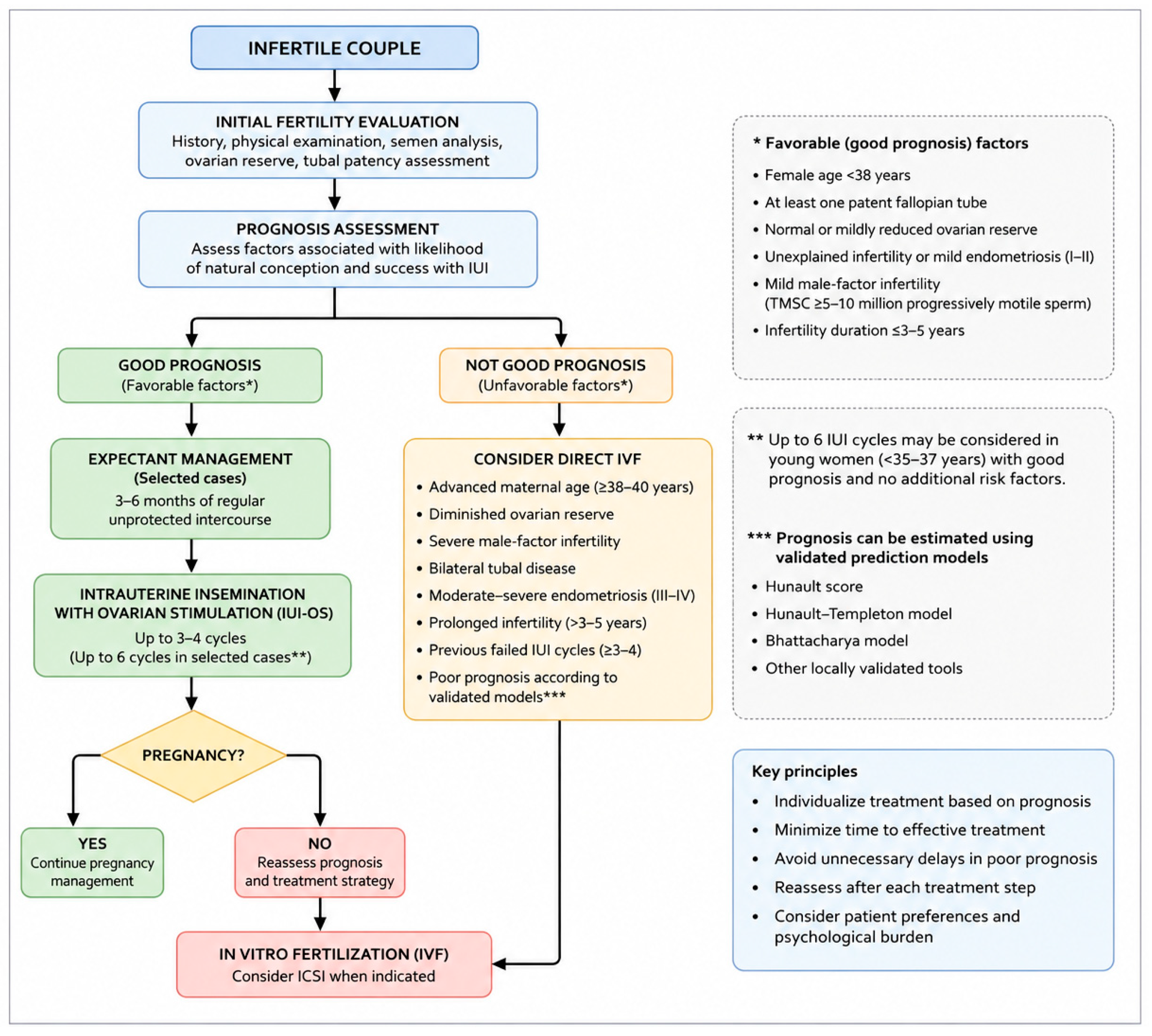
17]. Consequently, increasing attention has been directed toward individualized prognostic models capable of estimating the probability of success with different treatment strategies. A practical prognosis-based clinical pathway summarizing the proposed treatment approach is presented in
Figure 1. Future fertility care is likely to move away from rigid treatment algorithms and toward personalized approaches that integrate clinical, biological, and demographic factors to guide decision-making [
17].
Technological innovations may also contribute to optimizing IUI outcomes. Improvements in ovarian stimulation protocols, cycle monitoring, semen preparation techniques, and predictive analytics have the potential to enhance treatment efficiency while minimizing risks such as multiple pregnancy [
14,
30]. However, despite ongoing technological developments, robust evidence demonstrating substantial improvements in live birth rates following IUI remains limited. Future research should therefore prioritize clinically meaningful outcomes, particularly cumulative live birth rates and patient-centered measures, rather than intermediate reproductive endpoints alone.
Another emerging priority involves the incorporation of patient-reported outcomes into fertility research and clinical practice. Increasing recognition of the psychological burden associated with infertility has highlighted the importance of evaluating treatment success beyond conventional reproductive metrics [
31,
36,
37]. Quality of life, treatment burden, emotional well-being, treatment discontinuation, and patient satisfaction may all influence the real-world value of fertility interventions and should be considered alongside pregnancy and live birth outcomes.
Finally, growing disparities in access to assisted reproductive technologies continue to represent a global challenge. While IVF has become increasingly effective, economic barriers and unequal availability remain important limitations in many healthcare systems [
26,
33,
34]. In this context, IUI may continue to play an important role as a less invasive and more accessible treatment option, particularly when integrated into evidence-based and individualized treatment pathways.
Overall, future developments are unlikely to be characterized by competition between IUI and IVF. Instead, the evolution of reproductive medicine will probably depend on improving patient selection, refining prognostic assessment, incorporating patient-centered outcomes, and identifying the most appropriate treatment for each individual couple. Within this framework, IUI is expected to remain a clinically relevant component of personalized fertility care rather than a historical alternative progressively replaced by IVF.
8. Methods
This narrative review was conducted to provide a comprehensive overview of the current role of intrauterine insemination (IUI) in contemporary infertility management and to critically examine its place within treatment pathways increasingly dominated by in vitro fertilization (IVF) [
7,
8].
A literature search was performed using PubMed/MEDLINE, Scopus, Web of Science, and Google Scholar to identify publications addressing the effectiveness, indications, cost-effectiveness, safety, psychosocial implications, and future perspectives of IUI. The last literature search was performed on 15 March 2025. The search strategy combined controlled vocabulary and free-text terms using Boolean operators, including: (“intrauterine insemination” OR “IUI”) AND (“in vitro fertilization” OR “IVF”) AND (“unexplained infertility” OR “male factor infertility” OR “endometriosis” OR “ovarian stimulation” OR “cost-effectiveness”). Approximately 310 records were identified. After removal of duplicates and screening of titles and abstracts, approximately 145 full-text articles were assessed for eligibility, of which 84 publications were considered relevant and included in the final narrative synthesis. Literature screening and selection were independently performed by two reviewers (A.M. and S.E.), with disagreements resolved through discussion among the authors. The six SANRA domains were addressed by (1) providing a clear rationale for the review, (2) defining explicit objectives, (3) describing a transparent literature search strategy, (4) ensuring appropriate referencing, (5) presenting balanced scientific reasoning by discussing supporting and conflicting evidence, and (6) critically interpreting the available literature while acknowledging current limitations. Publications written in English and considered relevant to the objectives of the review were included. Priority was given to international guidelines, randomized controlled trials, systematic reviews, meta-analyses, and large observational studies. Conference abstracts, non-peer-reviewed publications, duplicate reports, and studies not directly addressing the clinical role of IUI were excluded whenever possible. The search focused primarily on studies published between January 2010 and March 2025, although selected landmark articles published before this period were also considered when relevant to the historical and clinical context of the topic.
The search strategy included combinations of the following terms: “intrauterine insemination”, “IUI”, “in vitro fertilization”, “IVF”, “unexplained infertility”, “male factor infertility”, “endometriosis”, “ovarian stimulation”, “live birth rate”, “cost-effectiveness”, “clinical guidelines”, and “assisted reproductive technology”.
Particular attention was paid to recommendations issued by major reproductive medicine societies, including the European Society of Human Reproduction and Embryology (ESHRE), the American Society for Reproductive Medicine (ASRM), and the Canadian Fertility and Andrology Society (CFAS), as these documents currently represent the most authoritative sources guiding clinical practice in infertility management [
9,
10].
The selected evidence was reviewed and synthesized narratively. The discussion was structured around key themes considered relevant to contemporary reproductive medicine, including the historical evolution of IUI, comparison with IVF, patient selection, economic considerations, psychosocial and ethical aspects, evidence-based recommendations from international scientific societies, and emerging technological developments.
As this work was designed as a narrative review, no formal systematic review protocol, PRISMA framework, quantitative meta-analysis, or formal risk-of-bias assessment was applied. The objective was to provide an evidence-informed synthesis of the available literature and to contextualize current knowledge regarding the role of IUI within modern fertility care [
7,
8].
This review was developed following the methodological principles proposed by SANRA (Scale for the Assessment of Narrative Review Articles). Although a formal systematic review methodology was not applied, efforts were made to ensure transparency of the literature search, critical appraisal of the evidence, and balanced discussion of current controversies regarding the role of intrauterine insemination in contemporary fertility care. This approach was intended to maximize transparency and methodological rigor while acknowledging the inherent limitations of narrative reviews.
The limitations of this review include the absence of a formal systematic search strategy, quantitative synthesis, and risk-of-bias assessment, which may have introduced selection bias in the included evidence.
9. Conclusions
The role of intrauterine insemination in contemporary reproductive medicine continues to be the subject of considerable debate in an era increasingly dominated by in vitro fertilization. Although IVF remains the most effective assisted reproductive technology for many infertility diagnoses, current evidence does not support the complete abandonment of IUI as a therapeutic option.
IUI offers several advantages, including lower invasiveness, reduced treatment burden, lower costs, and greater accessibility compared with IVF. In carefully selected patients—particularly those with unexplained infertility, mild male-factor infertility, or minimal-to-mild endometriosis—IUI remains a clinically reasonable first-line treatment strategy. Conversely, IVF should be considered the preferred approach in the presence of severe male-factor infertility, bilateral tubal disease, advanced endometriosis, advanced maternal age, or after failure of less invasive treatment options.
Importantly, contemporary fertility care is increasingly moving toward individualized and prognosis-based management. Treatment selection should therefore be guided not only by expected live birth rates but also by patient characteristics, reproductive prognosis, treatment burden, economic considerations, and personal preferences. Particular attention should be paid to female age, ovarian reserve, reproductive prognosis, and the psychosocial burden experienced by women undergoing fertility treatment. Within this framework, IUI and IVF should be regarded as complementary rather than competing interventions.
Future fertility care should focus on delivering the right treatment to the right patient at the right time, balancing effectiveness, safety, accessibility, patient-centered outcomes, and individual reproductive prognosis. Emerging technological developments may further optimize IUI outcomes; however, robust evidence demonstrating meaningful improvements in live birth rates remains limited and requires further investigation.
In conclusion, despite the remarkable advances achieved in IVF, IUI continues to represent an evidence-based and clinically relevant component of modern fertility care. Its greatest value lies not in replacing IVF, but in providing an effective, less invasive, and more accessible first-line treatment for appropriately selected couples.




 ,
,