

Article

Emotional Eating Associated with Poor Body Satisfaction in Women with Obesity: Theory-Based Psychosocial Mediators in Weight Management Treatment


1
Kinesiology Department, School of Health Sciences and Human Services, California State University, Monterey Bay, Seaside, CA 93955, USA
2
Nursing Department, School of Health Sciences and Human Services, California State University, Monterey Bay, Seaside, CA 93955, USA
*
Author to whom correspondence should be addressed.
Submission received: 12 November 2025 / Revised: 4 December 2025 / Accepted: 30 December 2025 / Published: 4 January 2026

Abstract

Poor satisfaction with one’s body is associated with obesity and emotional eating (EmE), especially in women. To improve behavioral obesity treatments, this study aimed to identify the effects of targeting the mediators of the body satisfaction–EmE relationship to improve weight-reduction outcomes. Women with Class II obesity (body mass index [BMI] of 35–39.9 kg/m2) were randomized into 6-month treatments targeting either increased physical activity and self-regulation (TARGETED group, n = 44) or standard weight management education (STANDARD group, n = 33). Improvements over 6 months in EmE, body satisfaction, mood, eating-related self-efficacy and self-regulation, and physical activity, and in weight over 6, 12, and 24 months, were significantly greater in the TARGETED group. Mood and eating-related self-efficacy mediated the body satisfaction–EmE relationship at baseline and the group–EmE change relationship. In the consideration of the treatment targets, increased physical activity predicted reduced EmE, mediated by mood change, and increased self-regulation predicted reduced EmE, mediated by self-efficacy change. Reduced EmE predicted weight losses. This research (a) identified psychological/behavioral mediators of the body satisfaction–EmE relationship; (b) ascertained methods associated with the improvement of those variables, their correlates, and interrelations; and (c) confirmed the viability of the indicated behavioral targets on EmE within a community-based obesity treatment. Given the identified associations with short- and longer-term weight losses, treatments were effectively informed.

1. Introduction

In the United States (U.S.), pharmacological and surgical interventions have become common in response to the continued high rates of obesity present in 42% of their adults [1,2,3]. Although the behavioral methods of controlled eating and increased physical activity are generally less invasive, risky, and expensive than those medical means—and will reduce weight in most adults with obesity—the maintenance of those behaviors beyond the very short term is atypical [4,5]. Some researchers suggest that a more comprehensive understanding of psychosocial correlates and their dynamic interactions within behavioral weight management processes is required to improve the unreliable, and generally unsatisfactory, treatment results [6,7,8].
Emotional eating (eating in response to negative mood; EmE) is a highly prevalent psychological issue that affects weight and weight change [9,10], especially in women [11,12]. It is rarely adequately addressed within obesity treatments [12,13]. EmE is associated with poor satisfaction with one’s body [14,15]. In women, this has much to do with non-malleable societal ideals for a thin body [16]. Along with reducing many health risks [17], a decreased weight in adults with obesity reliably improves their body satisfaction along with other psychological factors such as depression, self-esteem, and overall mental health and quality of life [18].
Social cognitive theory [19] and self-efficacy theory [20] posit that individuals’ ability to purposefully control (and feel control over) their environment in goal-oriented pursuits is critical for behavior change to occur. Those theories address the behavioral effects of mental health factors (e.g., mood), one’s ability to actively control their environment (e.g., self-regulation), and perceptions of abilities to be successful in that endeavor in relation to behavior change (e.g., self-efficacy), including health-related behavior change. The interplay of those theory-driven psychosocial factors can apply to EmE, satisfaction with one’s body, and their interrelation [8,10,12,21]. Consistent with social cognitive theory [19] and self-efficacy theory [20], and related research in health behavior change [8,21], this indicates that EmE might be effectively treated by reducing prompts from negative mood and increasing feelings of control over eating under challenging conditions (i.e., self-efficacy for controlling eating) [8,21]. Thus, a treatment that addresses those concerns might be more effective than traditional educationally based processes [8]. A focus on supporting physical activity has been associated with improved mood [8,22], and an emphasis on self-regulatory skills development/usage has been linked to increased feelings of competence and self-efficacy for controlled eating [8,23].
Thus, within this investigation, dynamics related to the relations between body satisfaction, EmE, and weight loss were assessed within community-based obesity treatments either by targeting physical activity and self-regulation or by the administration of standard weight management education. The more specific aims were to evaluate the interactions of changes in EmE through treatment-associated effects on mood, self-regulation and self-efficacy, and satisfaction with one’s body as suggested by social cognitive theory [19] and self-efficacy theory [20]. Another goal was to extend the presently available related research—which has often been based on cross-sectional and post hoc analyses—toward improved obesity treatment that is effective in the long term.
Women with Class II obesity (body mass index [BMI] of 35–39.9 kg/m2) were participants because those with lower degrees of excess weight (i.e., BMI of 25–34.9 kg/m2) might feel minimal dissatisfaction with their bodies given its common occurrence [24]. Also, those with Class III (“severe”) obesity (BMI ≥ 40 kg/m2) might require supervision beyond the planned field setting. Ultimately, the research sought to address gaps regarding how EmE can be effectively targeted within behavioral obesity treatments.
The hypotheses were as follows:
1. At baseline, a significant prediction of EmE by body satisfaction will be significantly mediated by negative mood and self-efficacy for controlling eating.
2. Overall improvements in body satisfaction, EmE, negative mood, self-efficacy, physical activity, self-regulating eating, and weight will be significantly more pronounced in the targeted behavioral treatment group when contrasted with the standard education conditions.
3. The group–EmE change relationship will be significantly mediated by changes in negative mood and self-efficacy. Mediator effects on EmE will be greatest in participants with the lowest body satisfaction.
4. Changes in the treatment-targeted factors of physical activity and self-regulation will significantly predict change in EmE, with negative mood and eating self-efficacy changes separately mediating the respective relationships.
In a sensitivity analysis, reduction in EmE was expected to significantly predict weight losses.

2. Materials and Methods

2.1. Participants

Participant data were from ongoing research in the U.S. on behavioral obesity treatment outcomes within community settings [8]. Women ≥21 years of age with Class II obesity were recruited via local newspapers and social media for a weight loss treatment. Height and weight measurements (and their kg/m2 ratio) falling within that inclusion range were confirmed by study staff via their direct measurement prior to study start. Other inclusion requirements were as follows: no known physical contraindication for safe participation, no participation in another weight management program (past 12 months), no change in a psychotropic medication/dosage (past 6 months), and no current/soon-planned pregnancy. No cost or compensation was provided for participation. The overall sample size was based on an a priori analysis (see Statistical Analyses, Section 2.4, below). After participation within the community health promotion facilities was established, cluster random sampling allocated each participant to either the TARGETED group (n = 44) or the STANDARD group (n = 33). For those fulfilling the inclusion criteria, and after the conditions for their participation were fully explained to them by study staff, 3 and 2 women, respectively, declined to participate.
To avoid cross-contamination, there was only one treatment content type administered per facility. There was no significant between-group difference in age (overall M = 47.7 years, SD = 7.7), BMI (overall M = 37.4 kg/m2, SD = 1.9), racial/ethnic make-up (overall 86% White, 11% Black, 3% Hispanic), educational level (overall 35% below college degree, 65% bachelor’s degree or greater), or self-removal prior to study start (overall N = 5). Nearly all participants reported a middle family income of USD 50,000–USD 140,000/year. A university institutional review board approved the study protocol and the informed consent process that required a signature from each participant. Ethical and privacy requirements of the World Medical Association Helsinki Declaration and the American Psychological Association were upheld throughout.

2.2. Measures

Measured EmE (15 items, possible score range, 0–60) included the dimensions of anxiety, depression, and anger/frustration on the Emotional Eating Scale (e.g., “nervous”, “sad”) [25]. Response options ranged from 0 (no desire to eat) to 4 (an overwhelming urge to eat), which were summed. Internal consistencies for women (represented as Cronbach’s α coefficient, throughout) were reported to range from α = 0.72 to 0.79, with 3-week test–retest reliability reported at 0.79 [25]. Convergent and discriminant validity was previously substantiated through score correspondences with binge eating [26], but not general psychopathology [25]. The present sample α = 0.74.
Body areas satisfaction (BAS; 5 items, possible score range, 0–20) was measured by the Body Areas Satisfaction Scale (e.g., “mid torso”, “lower torso”) [27,28]. Response options ranged from 0 (very dissatisfied) to 4 (very satisfied), which were summed. Internal consistencies for women [27], and women mostly after completing bariatric surgery [29], were reported at α = 0.73 and 0.75, respectively. The 4-week test–retest reliability was reported to be 0.74 [27]. The present sample α = 0.74.
Negative mood (30 items, possible score range, −20–100) included dimensions of anxiety, depression, fatigue, anger, confusion, and vigor on the Profile of Mood States-Brief Form (e.g., “dejected”, “vigorous”) [30]. Response options reflecting the previous 7 days ranged from 0 (not at all) to 4 (extremely). Items corresponding to the first 5 dimensions were summed, then the vigor-related item score total was subtracted. Internal consistency with women was reported at α = 0.90, with 3-week test–retest reliabilities averaging 0.70 [30]. Concurrent validity was previously corroborated through score correspondences with mood measures such as the Minnesota Multiphasic Personality Inventory-2, Manifest Anxiety Scale, and Beck Depression Inventory [31]. The present sample α = 0.84.
Self-efficacy for controlling one’s eating (termed “eating self-efficacy” throughout; 20 items, possible score range, 0–180) was measured by the Weight Efficacy Lifestyle Scale (e.g., “I can resist eating even when others are pressuring me to eat”) [32]. Dimensions of prompts to eating were negative emotions, high food availability, social pressure to eat, physical discomfort, and positive activities. Response options ranged from 0 (not confident) to 9 (very confident), which were summed. Internal consistencies were reported to range from α = 0.70 to 0.90 [32]. Reported predictive validity was supported through score correspondences with perceived control over eating [33] and weight loss [34]. The present sample α = 0.81.
Physical activity (also including “exercise”, as its more structured version) was measured by the Leisure-Time Physical Activity Questionnaire [35]. Completed bouts of ≥15 min of “mild”, “moderate”, and “strenuous” physical activity/exercise intensities recalled over the previous 7 days were each allocated a corresponding score of 3, 5, or 9 metabolic equivalents of task (METs), which were summed (e.g., 4 bouts of mild physical activity [3 METs each] = 12). Concurrent validity was previously confirmed through score correspondences with accelerometry, treadmill stress tests, and body composition results, with 2-week test–retest reliability reported at 0.74 [36,37,38,39,40].
Self-regulating eating (10 items, possible score range, 10–40) was measured by the Eating-Related Self-Regulation Scale (e.g., “When I get off-track with my eating plans, I work to quickly get back to my routine”) [41]. Response options ranged from 1 (never) to 4 (often), which were summed. Internal consistency was reported at α = 0.79, with 2-week test–retest reliability at 0.78 [41]. The reported predictive validity was supported through score correspondences with body composition changes [41]. The present sample α = 0.74.
Body weight was measured to the nearest 0.10 kg by non-instructional study staff using a digital floor scale (Health o Meter Professional Model-800 KL; Atlanta, GA, USA) calibrated the same day of its use. Outer clothing (e.g., jacket) and shoes were removed by the participant prior to weight measurement.

2.3. Procedures

Instructors were current staff members of the participating facilities. Both treatment types lasted 6 months (~11 participant hours total/each), and both addressed EmE indirectly and in a limited manner. Contents of the TARGETED treatment were guided by social cognitive and self-efficacy theories [19,20] and their key tenet that individuals can strategically overcome lifestyle challenges under empowered conditions. It focused first on adherence to self-selected physical activities through the use of self-regulation methods consistent with self-regulation theory [42]. These methods included relapse prevention, cognitive restructuring, proximal goal setting, stimulus control, and dissociation from discomfort, and were based on material from the National Institutes of Health/National Cancer Institute, Evidence-Based Cancer Control Program [8]. Those same self-regulatory skills were adapted for use in controlled eating within group sessions held every 2 weeks (starting at treatment Month 2). Consistent with previous research [8], the focus on physical activity was primarily to improve participants’ mood. The focus on self-regulation methods was primarily to build each participant’s feelings of ability (i.e., self-efficacy) to maintain physical activity and control their eating via successful use of those self-management skills. The group format ranged from 10 to 15 participants.
Contents of the STANDARD treatment were guided by the health belief model [43] and an assumption that participants will increase their physical activity and better control their eating through education on those topics. After an initial one-on-one session with an instructor overviewing what would be covered in the overall treatment, educational materials were adapted from existing resources [44] and provided to participants in segments every 2 weeks. Each was individually supported by a 10 to 15 min communication with an instructor to clarify its contents and address questions.
Structured protocol fidelity checks were conducted on 10% of sessions, with strong protocol adherence detected. Non-instructional staff members administered study measures to participants in a private area.

2.4. Statistical Analyses

Based on established criteria [45], there was no systematic bias based on the presence/absence of the 12% of missing scores. Thus, the associated classification of missing-at-random fulfilled the required conditions for imputation using the expectation-maximization algorithm [46,47]. This facilitated an intention-to-treat analytic design. A minimum overall sample size of 76 was required to detect an effect of Cohen’s f2 = 0.15 at the statistical power of 0.80 (α ≤ 0.05) within the primary regression analyses [48]. Variance inflation factor scores < 2.00 indicated satisfactory multicollinearity [49], with neither floor nor ceiling effects observed.
To assess mediation of direct effects on EmE, both at baseline and on gain (change) scores from baseline to Month 6, separate analyses were conducted. When two mediators were included within those models, they were entered simultaneously (i.e., parallel multiple mediation). Within models addressing change scores, the BAS score at treatment end (Month 6) was subsequently entered as a moderator of the effects of the mediator(s) on EmE (Paths b). This evaluated whether that relationship was more pronounced based on body satisfaction. Mixed-model repeated measures ANOVAs assessed the overall significance of change scores on BAS, EmE, negative mood, eating self-efficacy, physical activity, and self-regulating eating, and whether the associated change terms differed by group (coded: TARGETED group = 1, STANDARD group = 0).
SPSS Statistics version 28.0.1.0 (IBM, Armonk, NY, USA) was used for the statistical testing, incorporating the PROCESS 4.2 macroinstruction Models 4 and 14, with 10,000 percentile-based bootstrap resamples of the data [50]. Based on directionality already established within included relationships [8], statistical significance was set at α ≤ 0.05 (one-tailed). Where bootstrapping was incorporated, a 95% confidence interval (95% CI) assessed significance. Transparent Reporting of Evaluations with Nonrandomized Designs (TREND) guidelines [51] provided guidance for the reporting.

3. Results

3.1. Correlates of Emotional Eating at Baseline

A bivariate analysis demonstrated that EmE at baseline was significantly predicted by baseline BAS, B = −1.44, SEB = 0.55, β = −0.29, p = 0.011, 95% CI [−2.359, −0.524]. That relationship was significantly mediated by baseline scores on both negative mood, B = −0.61, SEB = 0.30, 95% CI [−1.164, −0.219], and eating self-efficacy, B = −0.27, SEB = 0.21, 95% CI [−0.691, −0.001], with a significant total indirect effect, B = −0.87, SEB = 0.35, 95% CI [−1.559, −0.387]. Within that model, the direct effect of EmE on BAS (Path c′) was no longer significant, which indicated complete mediation, B = −0.57, SEB = 0.52, 95% CI [−1.434, 0.299].

3.2. Changes in Study Measures, by Group

Each of the study measures demonstrated a significant overall improvement which was significantly more favorable in the TARGETED group than in the STANDARD group (i.e., significant group × time interaction; Table 1).

3.3. Effects of Group Processes on Emotional Eating and Its Psychosocial Mediators

The prediction of 6-month change in EmE by group was significantly mediated by change scores on both negative mood, B = −1.20, SEB = 0.86, 95% CI [−2.859, −0.011], and eating self-efficacy, B = −1.99, SEB = 0.97, 95% CI [−3.778, −0.627], with a significant total indirect effect, B = −3.19, SEB = 1.09, 95% CI [−5.120, −1.527]. The direct effect of the group on EmE change (Path c′) remained significant after the entry of the mediators, B = 3.89, SEB = 1.79, 95% CI [−6.872, −0.917]. In extensions of the previous multiple mediation models, entry of BAS score at treatment end (Month 6) significantly moderated the eating self-efficacy → EmE change relationship, B = −0.75, SEB = 0.42, 95% CI [−1.520, −0.141], but not the negative mood → EmE change relationship, B = −0.16, SEB = 0.24, 95% CI [−0.577, 0.229].

3.4. Effects of Treatment Targets on Emotional Eating Through Identified Mediators

Change in EmE was significantly predicted by change in physical activity, B = −0.22, SEB = 0.07, β = −0.36, p = 0.001, 95% CI [−0.350, −0.088]. That relationship was significantly mediated by the change score on negative mood, B = −0.08, SEB = 0.04, 95% CI [−0.170, −0.024], with the direct effect (Path c′) remaining significant (Figure 1A). Entry of BAS score at Month 6 significantly moderated the negative mood → EmE change relationship within the previous mediation model, B = −0.02, SEB = 0.01, 95% CI [−0.034, −0.006].
Change in EmE was significantly predicted by change in self-regulation, B = −0.40, SEB = 0.17, β = −0.26, p = 0.021, 95% CI [−0.729, −0.061]. That relationship was significantly mediated by change in eating self-efficacy, B = −0.40, SEB = 0.17, 95% CI [−0.729, −0.061], with the direct effect (Path c′) then no longer significant (Figure 1B). The entry of BAS score at Month 6 significantly moderated the self-regulation → EmE change relationship within that mediation equation, B = −0.13, SEB = 0.04, 95% CI [−0.200, −0.073].

3.5. Sensitivity Analyses

For weight change over 6, 12, and 24 months, improvements were each significantly greater in the TARGETED group. With aggregated data, baseline–Month 6 reduction in EmE significantly predicted weight loss over 6 months, B = −0.16, SEB = 0.05, β = 0.35, p = 0.002, 95% CI [0.076, 0.238], 12 months, B = 0.19, SEB = 0.07, β = 0.31, p = 0.006, 95% CI [0.076, 0.300], and 24 months, B = 0.40, SEB = 0.10, β = 0.42, p < 0.001, 95% CI [0.233, 0.561]. Changes in BAS and weight over 6 months were inversely related, B = −0.46, SEB = 0.06, β = −0.63, p < 0.001, 95% CI [−0.586, −0.329].

4. Discussion

Aims related to informing behavioral obesity interventions were largely met. The TARGETED treatment was linked to significantly greater 6-month improvements than the STANDARD educational treatment on the theory-derived psychosocial/behavioral variables shown to be relevant for decreasing EmE and weight. Specifically, the TARGETED group demonstrated a 54% greater reduction in EmE, and larger between-group effects for reductions in weight, than the STANDARD group.
As hypothesized, change in negative mood and eating self-efficacy significantly mediated the BAS → EmE relationship at baseline. Consistent with the theory [19,20] and studies on the psychosocial factors in weight control [6,7,8], this substantiated their relevance as behavioral treatment targets. Improvement in EmE via changes in those psychosocial variables was confirmed to be associated with treatment foci, with lower BAS associated with greater strength in the Path b relationships. This further confirmed the relevance for improving mood and eating self-efficacy as intervention emphases, being especially germane for those with the least satisfaction with their bodies.
It was also verified that focusing on increasing physical activity was useful for improving negative mood, and pursuing advancements in participants’ self-regulatory skills was beneficial for raising eating self-efficacy. The degree of relevance was, again, related to BAS. This extended earlier, more generalized, research on treating excess weight through behavioral means [8,51]. The present sensitivity analyses reinforced the expected relationship between changes in EmE, BAS, and body weight previously found across adult samples [52,53].
The findings extended the available related research through improved analyses of the theory-driven correlates of EmE that emerged from both the accepted theory [19,20] and the previous research [8,10,12,13,21]. Uniquely, they also contrasted the effects from standard weight loss processes which emphasize dietary education vs. a more theoretically grounded focus on psychosocial processes such as self-regulatory abilities and how self-efficacy emerges from the participants’ increased abilities to better negotiate lifestyle challenges and barriers through self-regulation [6,7,8]. Further, analyses of the psychosocial mediators of the effects of changes in physical activity and self-regulating eating on EmE changes suggest novel theory- and research-based refinements and extensions of the intervention processes that are sensitive to EmE and BAS in women with obesity.
Although the field setting facilitated the high generalizability of the findings [54], limitations requiring future research considerations were also present. These included the following: (a) no true control condition to account for expectation/social support effects [55], (b) an absence of findings if EmE and/or body satisfaction had been specifically addressed in treatment, (c) a volunteer sample of mostly White women of middle age, and (d) reliance on (validated) self-reports. For example, rather than relying on the participants’ recall of their physical activities, accelerometry might be a more objective measurement modality for extensions of this research. Also, variations in income and socioeconomic strata were not considered, and those factors could have affected findings enough to require increased attention in future related research [56].

5. Conclusions

Based on the present results, gaps in the extant research were addressed. Specifically, the well-accepted cognitive-behavioral and self-efficacy theories were leveraged to shape (a) the selection of psychosocial variables, (b) the analytic framework, and (c) the longitudinal findings. These were all atypical within the previously available research. The findings suggested that behavioral obesity treatments should focus on the use of physical activity to improve mood and self-regulatory skills to increase self-efficacy related to controlled eating, regardless of whether BAS and/or EmE are specifically focused upon. The TARGETED treatment suggests a framework for those processes that can be carried out within settings capable of large-scale applications.

Author Contributions

Conceptualization: J.J.A. and M.B.; methodology, J.J.A. and M.B., formal analysis, J.J.A.; writing—original draft preparation, J.J.A. and M.B. All authors have read and agreed to the published version of the manuscript.

Funding

This research received no external funding.

Institutional Review Board Statement

The study was conducted in accordance with the Declaration of Helsinki, and approved by the institutional review board of Kennesaw State University (Study 13173, 29 March 2019).

Informed Consent Statement

Informed consent was obtained from all subjects involved in the study.

Data Availability Statement

Based on institutional review board requirements for subjects’ anonymity and privacy, the data set supporting the findings within this article will be made available only by reasonable request made to the corresponding author.

Conflicts of Interest

The authors declare no conflicts of interest.

Abbreviations

The following abbreviations are used in this manuscript:
EmEEmotional eating
BASBody areas satisfaction
BMIBody mass index

References

  1. Cannon, C.P.; Kumar, A. Treatment of overweight and obesity: Lifestyle, pharmacologic, and surgical options. Clin. Cornerstone 2009, 9, 55–71. [Google Scholar] [CrossRef]
  2. Stierman, B.; Afful, J.; Carroll, M.D.; Te-Ching, C.; Orlando, D.; Fink, S.; Fryar, C.D.; Stierman, B.; Chen, T.-C.; Davy, O.; et al. National Health and Nutrition Examination Survey 2017-March 2020 Prepandemic Data Files-Development of Files and Prevalence Estimates for Selected Health Outcomes. National Health Statistics Reports, 2021, Article 158. Available online: https://stacks.cdc.gov/view/cdc/106273 (accessed on 14 June 2021).
  3. GBD 2021 US Obesity Forecasting Collaborators. National-level and state-level prevalence of overweight and obesity among children, adolescents, and adults in the USA, 1990–2021, and forecasts up to 2050. Lancet 2024, 404, 2278–2298. [Google Scholar] [CrossRef]
  4. Dombrowski, S.U.; Knittle, K.; Avenell, A.; Araújo-Soares, V.; Sniehotta, F.F. Long term maintenance of weight loss with non-surgical interventions in obese adults: Systematic review and meta-analyses of randomised controlled trials. BMJ 2014, 348, g2646. [Google Scholar] [CrossRef]
  5. MacLean, P.S.; Wing, R.R.; Davidson, T.; Epstein, L.; Goodpaster, B.; Hall, K.D.; Levin, B.E.; Perri, M.G.; Rolls, B.J.; Rosenbaum, M.; et al. NIH working group report: Innovative research to improve maintenance of weight loss. Obesity 2015, 23, 7–15. [Google Scholar] [CrossRef]
  6. Mata, J.; Silva, M.N.; Vieira, P.N.; Carraça, E.V.; Andrade, A.M.; Coutinho, S.R.; Sardinha, L.B.; Teixeira, P.J. Motivational “spill-over” during weight control: Increased self-determination and exercise intrinsic motivation predict eating self-regulation. Health Psychol. 2009, 28, 709–716. [Google Scholar] [CrossRef] [PubMed]
  7. Teixeira, P.J.; Carraça, E.V.; Marques, M.M.; Rutter, H.; Oppert, J.-M.; De Bourdeaudhuij, I.; Lakerveld, J.; Brug, J. Successful behavior change in obesity interventions in adults: A systematic review of self-regulation mediators. BMC Med. 2015, 13, 84. [Google Scholar] [CrossRef] [PubMed]
  8. Annesi, J.J. Behavioral weight loss and maintenance: A 25-year research program informing innovative programming. Perm. J. 2002, 26, 98–117. [Google Scholar] [CrossRef]
  9. Koenders, P.G.; van Strien, T. Emotional eating, rather than lifestyle behavior, drives weight gain in a prospective study in 1562 employees. J. Occup. Environ. Med. 2011, 53, 1287–1293. [Google Scholar] [CrossRef]
  10. Vasileiou, V.; Abbott, S. Emotional eating among adults with healthy weight, overweight and obesity: A systematic review and meta-analysis. J. Hum. Nutr. Diet. 2023, 36, 1922–1930. [Google Scholar] [CrossRef] [PubMed]
  11. Péneau, S.; Ménard, E.; Méjean, C.; Bellisle, F.; Hercberg, S. Sex and dieting modify the association between emotional eating and weight status. Am. J. Clin. Nutr. 2013, 97, 1307–1313. [Google Scholar] [CrossRef]
  12. Smith, J.; Ang, X.Q.; Giles, E.L.; Traviss-Turner, G. Emotional eating interventions for adults living with overweight or obesity: A systematic review and meta-analysis. Int. J. Environ. Res. Public Health 2023, 20, 2722. [Google Scholar] [CrossRef]
  13. Chew, H.S.J.; Lau, S.T.; Lau, Y. Weight-loss interventions for improving emotional eating among adults with high body mass index: A systematic review with meta-analysis and meta-regression. Eur. Eat. Disord. Rev. 2022, 30, 304–327. [Google Scholar] [CrossRef]
  14. Duarte, C.; Pinto-Gouveia, J. Returning to emotional eating: The emotional eating scale psychometric properties and associations with body image flexibility and binge eating. Eat. Weight. Disord. 2015, 20, 497–504. [Google Scholar] [CrossRef]
  15. Geller, S.; Levy, S.; Goldzweig, G.; Hamdan, S.; Manor, A.; Dahan, S.; Rothschild, E.; Stukalin, Y.; Abu-Abeid, S. Psychological distress among bariatric surgery candidates: The roles of body image and emotional eating. Clin. Obes. 2019, 9, e12298. [Google Scholar] [CrossRef]
  16. Cash, T.F. The influence of sociocultural factors on body image: Searching for constructs. Clin. Psychol. Sci. Pract. 2005, 12, 438–442. [Google Scholar] [CrossRef]
  17. Bray, G.A.; Kim, K.K.; Wilding, J.P.H.; World Obesity Federation. Obesity: A chronic relapsing progressive disease process. A position statement of the World Obesity Federation. Obes. Rev. 2017, 18, 715–723. [Google Scholar] [CrossRef] [PubMed]
  18. Hill, A.; Williams, G.; Fruhbeck, G. Social and Psychological Factors in Obesity. In Obesity: Science to Practice; Williams, G., Fruhbeck, G., Eds.; Wiley: Hoboken, NJ, USA, 2009; pp. 347–366. [Google Scholar]
  19. Bandura, A. Social Foundations of Thought and Action: A Social Cognitive Theory; Prentice Hall: Englewood Cliffs, NJ, USA, 1986. [Google Scholar]
  20. Bandura, A. Self-Efficacy: The Exercise of Control; Freeman: New York, NY, USA, 1997. [Google Scholar]
  21. Frayn, M.; Knäuper, B. Emotional eating and weight in adults: A review. Curr. Psychol. 2018, 37, 924–933. [Google Scholar] [CrossRef]
  22. Arent, S.M.; Walker, A.J.; Arent, M.A. The Effects of Exercise on Anxiety and Depression. In Handbook of Sport Psychology, 4th ed.; Tennenbaum, G., Eklund, R.C., Eds.; Wiley: Hoboken, NJ, USA, 2020; pp. 872–890. [Google Scholar]
  23. Schnoll, R.; Zimmerman, B.J. Self-regulation training enhances dietary self-efficacy and dietary fiber consumption. J. Am. Diet. Assoc. 2001, 101, 1006–1011. [Google Scholar] [CrossRef] [PubMed]
  24. Jones, M.; Grilo, C.M.; Masheb, R.M.; White, M.A. Psychological and behavioral correlates of excess weight: Misperception of obese status among persons with class II obesity. Int. J. Eat. Disord. 2010, 43, 628–632. [Google Scholar] [CrossRef]
  25. Arnow, B.; Kenardy, J.; Agras, W.S. The Emotional Eating Scale: The development of a measure to assess coping with negative affect by eating. Int. J. Eat. Disord. 1995, 18, 79–90. [Google Scholar] [CrossRef]
  26. Ricca, V.; Castellini, G.; Lo Sauro, C.; Ravaldi, C.; Lapi, F.; Mannucci, E.; Rotella, C.M.; Faravelli, C. Correlations between binge eating and emotional eating in a sample of overweight subjects. Appetite 2009, 53, 418–421. [Google Scholar] [CrossRef] [PubMed]
  27. Cash, T.F. The Multidimensional Body-Self Relations Questionnaire Users’ Manual, 3rd ed.; Old Dominion University: Norfolk, VA, USA, 2000. [Google Scholar]
  28. Cash, T.F. Multidimensional Body-Self Relations Questionnaire (MBSRQ). In Encyclopedia of Feeding and Eating Disorders; Wade, T., Ed.; Springer: Princeton, NJ, USA, 2015. [Google Scholar]
  29. de Zwaan, M.; Georgiadou, E.; Stroh, C.E.; Teufel, M.; Köhler, H.; Tengler, M.; Müller, A. Body image and quality of life in patients with and without body contouring surgery following bariatric surgery: A comparison of pre- and post-surgery groups. Front. Psychol. 2014, 5, 1310. [Google Scholar] [CrossRef]
  30. McNair, D.M.; Heuchert, J.W.P. Profile of Mood States Technical Update; Multi-Health Systems: North Tonawanda, NY, USA, 2009. [Google Scholar]
  31. McNair, D.M.; Lorr, M.; Droppleman, L.F. Manual for the Profile of Mood States; Education and Industrial Testing Service: San Diego, CA, USA, 1992. [Google Scholar]
  32. Clark, M.M.; Abrams, D.B.; Niaura, R.S.; Eaton, C.A.; Rossi, J.S. Self-efficacy in weight management. J. Consult. Clin. Psychol. 1991, 59, 739–744. [Google Scholar] [CrossRef]
  33. Ames, G.E.; Heckman, M.G.; Grothe, K.B.; Clark, M.M. Eating self-efficacy: Development of a short-form WEL. Eat. Behav. 2012, 13, 375–378. [Google Scholar] [CrossRef]
  34. Warziski, M.; Sereika, S.M.; Styn, M.A.; Music, E.; Burke, L.E. Changes in self-efficacy and dietary adherence: The impact on weight loss in the PREFER study. J. Behav. Med. 2008, 31, 81–92. [Google Scholar] [CrossRef] [PubMed]
  35. Godin, G. The Godin-Shephard Leisure-Time Physical Activity Questionnaire. Health Fit. J. Can. 2011, 4, 18–22. [Google Scholar] [CrossRef]
  36. Amireault, S.; Godin, G. The Godin-Shephard Leisure Time Physical Activity Questionnaire: Validity evidence supporting its use for classifying healthy adults into active and insufficiently active categories. Percept. Mot. Skills 2015, 120, 604–622. [Google Scholar] [CrossRef]
  37. Amireault, S.; Godin, G.; Lacombe, J.; Sabiston, C.M. Validation of the Godin-Shephard Leisure-Time Physical Activity Questionnaire classification coding system using accelerometer assessment among breast cancer survivors. J. Cancer Surviv. 2015, 9, 532–540. [Google Scholar] [CrossRef]
  38. Jacobs, D.R.; Ainsworth, B.E.; Hartman, T.J.; Leon, A.S. A simultaneous evaluation of 10 commonly used physical activity questionnaires. Med. Sci. Sports Exerc. 1993, 25, 81–91. [Google Scholar] [CrossRef]
  39. Miller, D.J.; Freedson, P.S.; Kline, G.M. Comparison of activity levels using Caltrac accelerometer and five questionnaires. Med. Sci. Sports Exerc. 1994, 26, 376–382. [Google Scholar] [CrossRef]
  40. Pereira, M.A.; FitzGerald, S.J.; Gregg, E.W.; Joswiak, M.L.; Ryan, W.J.; Suminski, R.R.; Utter, A.C.; Zmuda, J.M. A collection of physical activity questionnaires for health-related research. Med. Sci. Sports Exerc. 1997, 29, S1–S205. [Google Scholar] [PubMed]
  41. Annesi, J.J.; Marti, C.N. Path analysis of exercise treatment-induced changes in psychological factors leading to weight loss. Psychol. Health 2011, 26, 1081–1098. [Google Scholar] [CrossRef] [PubMed]
  42. Vohs, K.D.; Baumeister, R.F. (Eds.) Handbook of Self-Regulation: Research, Theory, and Application, 3rd ed.; Guilford: New York, NY, USA, 2017. [Google Scholar]
  43. Champion, V.L.; Skinner, C.S. The Health Belief Model. In Health Behavior: Theory, Research, and Practice, 5th ed.; Glanz, K., Rimer, B.K., Viswanath, K.V., Eds.; Jossey-Bass/Wiley: Hoboken, NJ, USA, 2015; pp. 45–65. [Google Scholar]
  44. Kaiser Permanente Health Education Services. Cultivating Health Weight Management Kit, 9th ed.; Kaiser Foundation Health Plan of the Northwest: Portland, OR, USA, 2009. [Google Scholar]
  45. White, I.R.; Horton, N.J.; Carpenter, J.; Pocock, S.J. Strategy for intention to treat data in randomized trials with missing outcome data. BMJ 2011, 342, d40. [Google Scholar] [CrossRef]
  46. Ding, W.; Song, P.X.-K. EM algorithm in Gaussian copula with missing data. Comput. Stat. Data Anal. 2016, 101, 1–11. [Google Scholar] [CrossRef]
  47. Little, R.J.; Rubin, D.B. Statistical Analysis with Missing Data, 2nd ed.; Wiley: Hoboken, NJ, USA, 2014. [Google Scholar]
  48. Cohen, J.; Cohen, P.; West, S.G.; Aiken, L.S. Applied Multiple Regression/Correlation Analysis for the Behavioral Sciences, 3rd ed.; Erlbaum: Mahwah, NJ, USA, 2003. [Google Scholar]
  49. Thompson, C.G.; Kim, R.S.; Aloe, A.M.; Becker, B.J. Extracting the variance inflation factor and other multicollinearity diagnostics from typical regression results. Basic Appl. Soc. Psychol. 2017, 39, 81–90. [Google Scholar] [CrossRef]
  50. Hayes, A.F. Introduction to Mediation, Moderation, and Conditional Process Analysis: A Regression-Based Approach, 3rd ed.; Guilford: New York, NY, USA, 2022. [Google Scholar]
  51. Des Jarlais, D.C.; Lyles, C.; Crepaz, N.; TREND Group. Improving the reporting quality of nonrandomized evaluations of behavioral and public health interventions: The TREND statement. Am. J. Public Health 2004, 94, 361–366. [Google Scholar] [CrossRef]
  52. Devonport, T.J.; Nicholls, W.; Fullerton, C.A. systematic review of the association between emotions and eating behaviour in normal and overweight adult populations. J. Health Psychol. 2019, 24, 3–24. [Google Scholar] [CrossRef]
  53. Phillips, N.; de Man, A.F. Weight status and body image satisfaction in adult men and women. N. Am. J. Psychol. 2010, 12, 171–184. [Google Scholar]
  54. Green, L.W.; Sim, L.; Breiner, H. (Eds.) Evaluating Obesity Prevention Efforts: A Plan for Measuring Progress; Institute of Medicine of the National Academies: Washington, DC, USA, 2013. [Google Scholar]
  55. Rosenthal, R. Interpersonal Expectations: Effects of the Experimenter’s Hypothesis. In Artifacts in Behavioral Research; Rosenthal, R., Rosnow, R.L., Eds.; Oxford University Press: Cary, NC, USA, 2009; pp. 138–210. [Google Scholar]
  56. Spinosa, J.; Christiansen, P.; Dickson, J.M.; Lorenzetti, V.; Hardman, C.A. From socioeconomic disadvantage to obesity: The mediating role of psychological distress and emotional eating. Obesity 2019, 27, 559–564. [Google Scholar] [CrossRef]
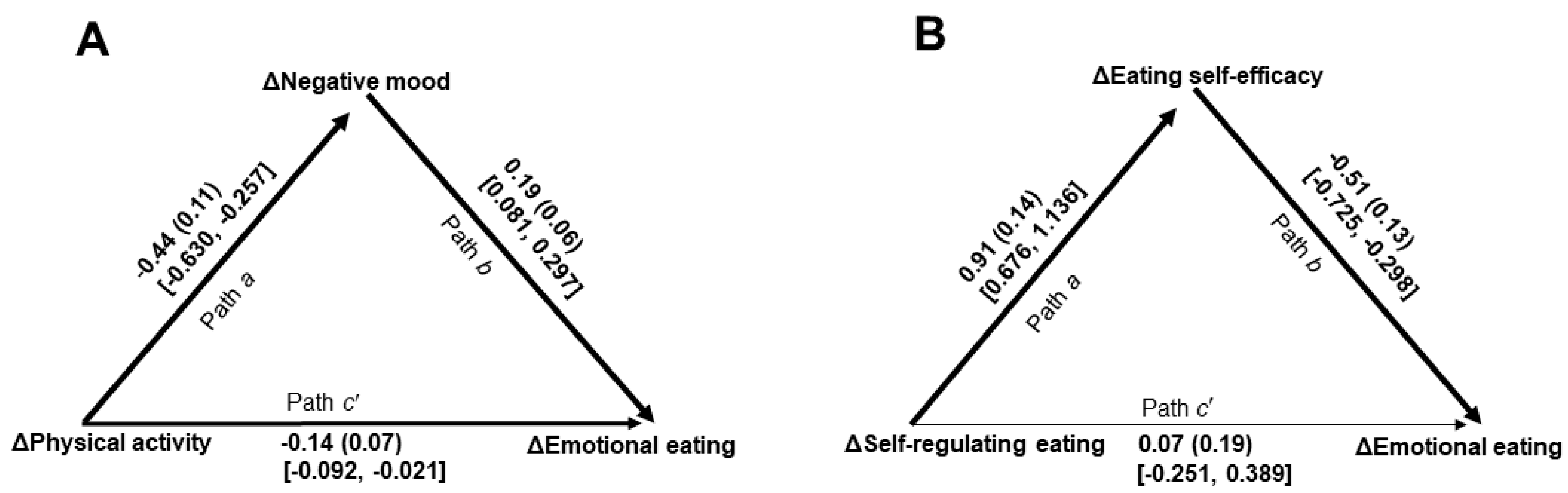
Figure 1. (A) Mediation of the prediction of reduction in emotional eating by physical activity increase through change in negative mood. Δ = change from baseline to Month 6. Path data are given as B (SEB), [95% confidence interval]. A heavy line indicates a significant relationship. (B) Mediation of the prediction of reduction in emotional eating by eating-related self-regulation increase through change in eating self-efficacy. Δ = change from baseline to Month 6. Path data are given as B (SEB), [95% confidence interval]. A heavy line indicates a significant relationship.
Women 06 00003 g001
Table 1. Mixed-model repeated measures ANOVA results.
MeasureEffect for TimeBaselineMonth 6ΔBaseline−Month 6Group × Time Effect
Treatment GroupF(1, 75)pη2pMSDMSDMSDdF(1, 75)pη2p
Body satisfaction32.17<0.0010.30 22.85<0.0010.23
            TARGETED 5.231.968.072.672.842.301.23
            STANDARD 6.091.886.332.580.242.440.10
            Aggregated data 5.601.967.322.761.732.680.65
Emotional eating82.67<0.0010.52 16.23<0.0010.18
            TARGETED 29.398.1018.008.52−11.398.051.41
            STANDARD 24.5211.1820.129.25−4.396.780.65
            Aggregated data 27.309.7818.918.85−8.398.261.02
Negative mood61.39<0.0010.45 14.79<0.0010.17
            TARGETED 23.2713.006.0411.56−17.2413.421.28
            STANDARD 21.9111.8016.0210.76−5.8811.950.49
            Aggregated data 22.6912.4410.3212.21−12.3713.930.89
Self-efficacy for eating69.70<0.0010.48 15.62<0.0010.17
            TARGETED 21.956.6332.626.7210.667.671.39
            STANDARD 22.588.4126.397.803.817.330.52
            Aggregated data 22.227.4029.957.797.738.220.94
Physical activity (METs/week)150.33<0.0010.67 17.78<0.0010.19
            TARGETED 7.256.6030.4714.1723.2213.791.65
            STANDARD 7.707.5519.0310.0611.339.771.16
            Aggregated data 7.446.9825.5613.7418.1213.521.34
Self-regulating eating69.98<0.0010.48 8.210.0050.10
            TARGETED 19.044.3725.473.026.445.391.19
            STANDARD 16.974.9520.124.963.154.360.72
            Aggregated data 18.154.7123.184.765.035.210.97
Weight (kg)75.87<0.0010.50 19.79<0.0010.21
            TARGETED 103.188.1998.157.83−5.043.531.43
            STANDARD 96.218.7794.588.24−1.633.020.54
            Aggregated data 100.199.0896.628.15−3.583.710.96
BaselineMonth 12ΔBaselineMonth 12
Weight (kg)26.48<0.0010.26 14.60<0.0010.16
            TARGETED 103.188.1998.408.24−4.794.011.19
            STANDARD 96.218.7795.508.98−0.715.360.13
            Aggregated data 100.199.0897.168.63−3.045.030.60
BaselineMonth 24ΔBaselineMonth 24
Weight (kg)8.100.0060.10 8.460.0050.10
            TARGETED 103.188.1998.2711.45−4.918.590.57
            STANDARD 96.218.7796.269.230.055.43−0.10
            Aggregated data 100.199.0897.4110.54−2.787.770.36
TARGETED group, n = 44. STANDARD group, n = 33. Aggregated data, N = 77. Δ = change in score during the indicated period. d = Cohen’s measure of effect size for within-group change ([MMonth 6Mbaseline]/SDaggregated), with a negative effect indicating change in the non-favorable direction. η2p = partial eta-squared (SSEffect/[SSEffect + SSError]).
Disclaimer/Publisher’s Note: The statements, opinions and data contained in all publications are solely those of the individual author(s) and contributor(s) and not of MDPI and/or the editor(s). MDPI and/or the editor(s) disclaim responsibility for any injury to people or property resulting from any ideas, methods, instructions or products referred to in the content.


