Article

Prioritization of Elective Hysterectomies in the Brazilian Unified Health System: Consistency Between Clinical Risk, Waiting Time and Implications for Surgical Equity

by
Letícia Calazans Queiroz Cardone
*,
Raphael Federicci Haddad
,
Rômulo Negrini
,
Juliana Jorge Romano
,
Mariana Netto Otsuka
,
Tatiani Araújo Pandim
and
Eduardo Zlotnik
Hospital Israelita Albert Einstein, São Paulo 05652-900, SP, Brazil
*
Author to whom correspondence should be addressed.
Women 2026, 6(1), 2; https://doi.org/10.3390/women6010002 (registering DOI)
Submission received: 14 November 2025 / Revised: 15 December 2025 / Accepted: 22 December 2025 / Published: 25 December 2025

Abstract

This study examined the consistency between clinical criteria, assigned priority level, and waiting time for elective hysterectomy, assessing whether higher priority translates into faster surgical access. We conducted a retrospective cohort study including 846 women who underwent the procedure between January 2018 and January 2024 at a public hospital in São Paulo, Brazil. The median waiting time was 6 months (IQR: 3–10), with wide variability ranging from 0.5 to 53 months. All components of the clinical score were associated with higher priority levels, demonstrating adequate discriminative ability to identify patients at greater clinical risk. However, assigned priority was not associated with shorter waiting times. Criteria reflecting greater clinical vulnerability, including duration of symptoms (β = +2.50 months), age (β = +1.00), and cardiovascular disease (β = +1.00), were paradoxically associated with longer waiting times, whereas anemia was the only factor associated with reduced waiting time (β = −1.00). These findings reveal a marked discrepancy between formal prioritization and actual surgical scheduling, underscoring the need for more objective and equity-oriented criteria in the management of surgical waiting lists.

1. Introduction

The management of elective surgeries within Brazil’s Unified Health System (Sistema Único de Saúde—SUS) is decentralized and relies on digital platforms such as the National Regulation System (SISREG) and the e-SUS Regulation platform, which are responsible for organizing and ensuring transparency in waiting lists [1,2]. In 2023, the Ministry of Health launched the National Surgical Backlog Reduction Program (Programa Nacional de Redução de Filas—PNRF), and in 2024 its actions were incorporated into the Mais Acesso a Especialistas Program (PMAE—Surgical Component), ensuring continuous federal funding and performance monitoring [3,4]. Despite these advances, prioritization criteria remain defined at the state, municipal, and institutional levels, resulting in marked regional heterogeneity in waiting-list management [1,2]. The absence of a nationally standardized score for gynecologic surgeries has favored the adoption of local protocols with wide interregional variability. The experience of Belo Horizonte, which implemented explicit regulatory matrices based on clinical risk and disease severity, demonstrates the feasibility of objective models to organize surgical queues and enhance transparency and equity [5].
Prioritization systems aim to reduce waiting times for patients with greater clinical need; however, robust criteria that adequately balance disease severity and progression are still lacking [6]. Recent models have integrated clinical variables and waiting time to mitigate inequalities and optimize queue management [7], while methodological studies emphasize the need for rigorous validation and expert consensus in the development of clinical scoring systems [8]. In this context, adapting well-established international models emerges as a potential strategy to improve the prioritization of elective surgeries within the Brazilian public health system.
In gynecology, several groups have proposed structured tools to prioritize non-emergency procedures. Notably, Marfori et al. (2020) [9] adapted the medically necessary, time-sensitive (MeNTS) score developed by the American College of Surgeons, creating the gynecologic medically necessary, time-sensitive (Gyn-MeNTS) score. Developed at the University of Chicago, this score was designed to standardize the prioritization of elective gynecologic surgeries based on objective measures of surgical complexity, patient clinical conditions, and risks associated with postponement. In a cohort of 93 patients, the score demonstrated acceptable inter-rater reliability in predicting whether surgeries would proceed or be deferred, particularly when combined with a clinical priority scale for elective procedures [9].
Saleeby et al. (2021) [10] also modified and validated the MeNTS score across multiple specialties within a public health system, confirming its reliability while highlighting the need for local calibration in light of context-specific risks and resource constraints. Collectively, this body of evidence indicates that gynecologic prioritization scores, and their adapted versions, are feasible, reproducible, and useful tools to support surgical triage [10].
Waiting times are not merely technical indicators of health system performance; they also reflect how different social groups access care, with direct implications for distributive equity [11]. Evidence synthesized by Ptacek et al. (2021) [12] shows that Black women, individuals from ethnic minorities, and uninsured patients are less likely to undergo hysterectomy and myomectomy via minimally invasive approaches, despite the well-documented benefits of these techniques in terms of recovery and complication reduction [12]. In universal health systems, Cima et al. (2021) [13] identified a gender gap in waiting times for elective surgeries in Portugal, partially explained by clinical prioritization criteria and institutional variability [13]. Complementarily, García-Corchero and Jiménez-Rubio (2022) [14] interpret waiting times as a form of non-monetary rationing, often disproportionately disadvantaging socioeconomically vulnerable groups [14]. Finally, Gross et al. (2020) [15] argue that classifying most gynecologic procedures as “elective” tends to obscure their central role in reproductive health, legitimizing their deprioritization in contexts of resource scarcity [15].

2. Materials and Methods

2.1. Study Design

A retrospective cohort study was conducted including patients who underwent elective hysterectomy at a public hospital in the southern region of São Paulo, Brazil, between January 2018 and January 2024. The study followed the STROBE (Strengthening the Reporting of Observational Studies in Epidemiology) guidelines [16] and the ethical principles of the Declaration of Helsinki [17].

2.2. Data Collection and Variables

Data were extracted from electronic medical records after approval by the Research Ethics Committee of the São Paulo Municipal Health Secretariat (SMS/SP) (CAAE 83783024.3.0000.0086). After collection, the data were stored in an encrypted system accessible only to the research team authorized by the ethics committee and bound by confidentiality agreements, ensuring standardization, anonymity, and protection of personal information. Each participant was identified using an automatic, non-sequential alphanumeric code, with no possibility of personal identification. Sensitive information and personal identifiers were removed.
Women aged 18 years or older who underwent elective hysterectomy during the study period were eligible. Exclusion criteria included oncologic cases, urgent or emergency procedures, such as puerperal hysterectomies or surgeries for acute hemorrhage, and incomplete clinical records.
Incomplete data were handled using a complete-case analysis approach, with inclusion limited to patients with available information for all required variables. Records lacking the dates necessary to calculate waiting time or insufficient information to compute the clinical score were excluded a priori. No imputation of missing data was performed, as missingness was primarily attributable to documentation failures in medical records rather than a demonstrable random mechanism.
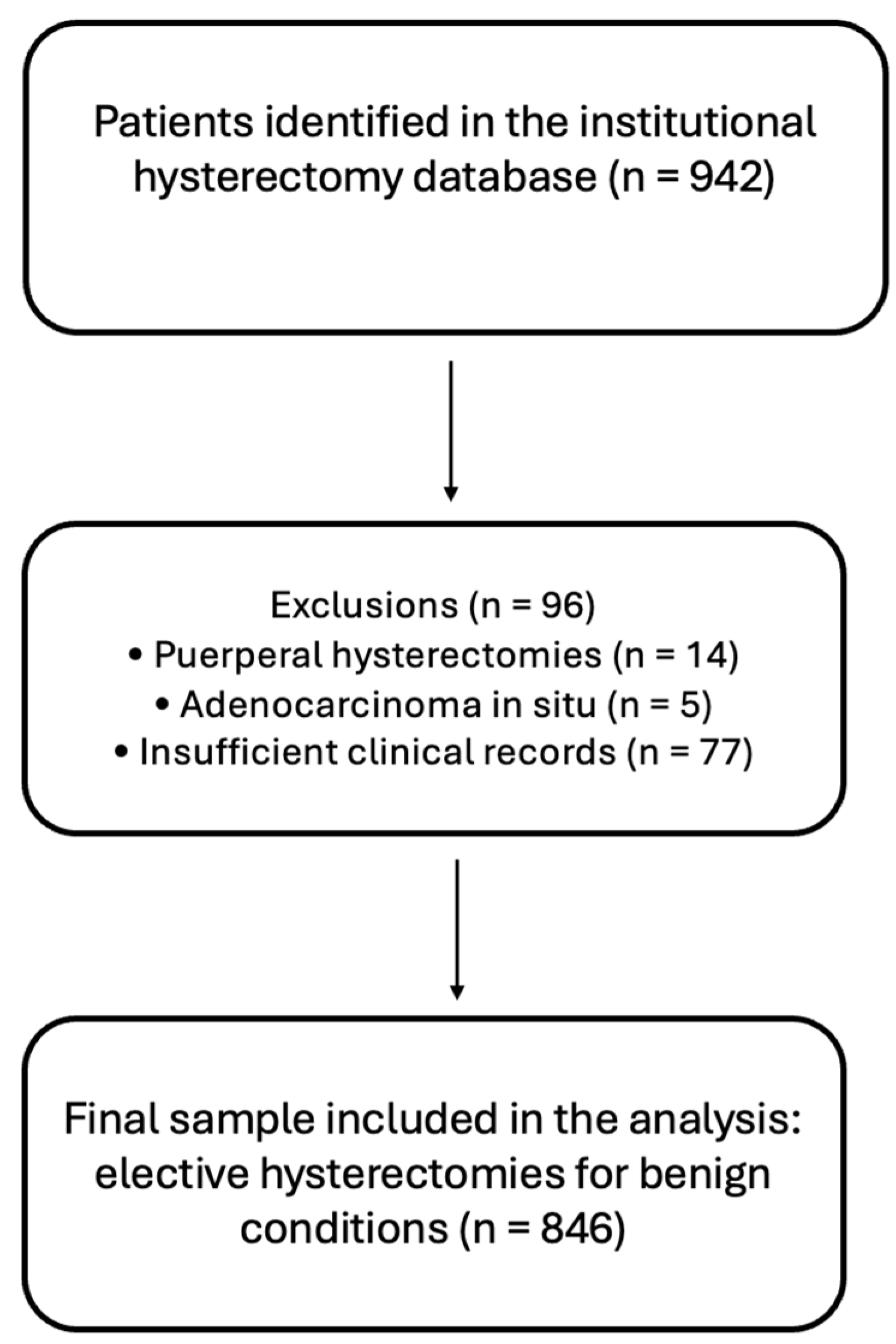
A total of 942 patients who underwent hysterectomy at the hospital during the study period were identified. Of these, 14 were excluded because they were puerperal hysterectomies, classified as emergency procedures, and 5 were excluded due to a diagnosis of adenocarcinoma in situ, as they did not fall within the scope of benign disease and elective surgery. Additionally, 77 patients were excluded because of insufficient clinical records for application of the clinical score and/or calculation of surgical waiting time. The final sample comprised 846 women who underwent elective hysterectomy for benign conditions (Figure 1).
The exclusion of patients with incomplete records may have introduced selection bias if missing information was associated with clinical severity or access barriers. In addition, waiting time depends on the accuracy of dates recorded in electronic medical records, and information bias may have occurred due to documentation inconsistencies. Finally, because the database did not include socioeconomic variables or race/ethnicity, it was not possible to adjust for relevant social determinants, raising the possibility of residual confounding in the interpretation of the observed associations.
The analyzed variables were grouped into five analytical domains:
  • Demographic and obstetric characteristics;
  • Clinical profile and comorbidities;
  • Laboratory parameters and complementary examinations;
  • Gynecologic and surgical factors;
  • Temporal indicators of the care trajectory.
Variables included age, reproductive history, comorbidities, medication use, laboratory results, underlying diagnosis, uterine volume, surgical approach and type of hysterectomy, as well as time intervals between symptom onset, diagnosis, surgical indication, and procedure performance. Surgical waiting time was defined as the interval, in months, between the date of surgical indication (as recorded in the electronic medical record), considered the starting point of the regulatory process for elective hysterectomy, and the date the surgery was performed. The choice of this starting point was based on the fact that surgical indication represents the first formal moment at which the patient becomes eligible for inclusion on a regulatory waiting list and at which clinical prioritization criteria should, in principle, influence surgical scheduling. The interval was calculated using the dates recorded in the electronic medical record and converted into months.

2.3. Elective Hysterectomy

Elective hysterectomies were performed in the operating room of a secondary-level public hospital in the southern region of São Paulo after confirmation of the surgical indication by a specialized gynecology team. Procedures were carried out using minimally invasive approaches (vaginal or laparoscopic) or open laparotomy, according to clinical and anatomical factors, including uterine volume, presence of prolapse, comorbidities, and equipment availability, ensuring safety and individualized surgical planning.

2.4. Risk Stratification Scoring System

This study aimed to adapt the Gyn-MeNTS score (Table 1) to the context of the Brazilian public health system, creating an objective tool for prioritizing patients on the waiting list for elective hysterectomy.
Adaptation of the score was necessary due to substantial differences between the healthcare systems of the United States and Brazil, particularly with respect to hospital infrastructure, resource availability, epidemiological profiles, and anesthetic risk. To address these disparities, the score was modified to incorporate variables that better reflect the realities of the SUS, increasing its sensitivity, feasibility, and applicability within the national public system, while promoting more equitable and efficient allocation of surgical resources.
The adaptation of the Gyn-MeNTS score to the SUS context was conducted through a modified Delphi process aimed at achieving structured consensus among experts regarding the selection, categorization, and weighting of clinical variables. The Delphi panel comprised five senior gynecologic surgeons, all with more than 15 years of clinical and surgical experience in benign gynecology and direct involvement in surgical care and health regulation within the public health system.
The process was carried out in three iterative rounds. In the first round, experts independently evaluated a preliminary list of candidate variables derived from the original Gyn-MeNTS score and from clinical factors commonly documented in the hospital’s electronic medical records. In total, 12 candidate items were analyzed, encompassing clinical severity, comorbidities, and temporal indicators. Each item was scored using a 5-point Likert scale (1 = not relevant; 5 = essential), based on three predefined criteria: clinical relevance, feasibility of extraction from medical records, and potential impact on promoting equity in surgical access.
Items that achieved ≥70% agreement, defined as a score of 4 or 5 assigned by at least 70% of the experts, were provisionally retained. Items that failed to reach consensus were excluded or reformulated based on the qualitative feedback provided by the participants.
In the second round, a refined list containing nine items was redistributed to the experts, incorporating the revisions suggested in the previous stage. At this phase, participants reassessed the retained variables, as well as the proposed categories and severity thresholds. The consensus criterion remained set at greater than 70% agreement. One variable related to operative complexity was excluded during this round due to low practical feasibility and inconsistent documentation within the SUS context.
The third and final round focused on final adjustments to variable definitions, score weighting, and cutoff points for surgical priority classification. Experts reviewed the near-final version of the score, which at that stage comprised eight clinical domains, and formally confirmed their agreement or provided final recommendations. In this round, consensus exceeded 80% agreement for all included variables, with no further inclusion or exclusion of items.
No relevant disagreements persisted after the third round. The final adapted score reflects convergence among clinical relevance, data availability, and applicability to surgical waiting-list management in the public sector. This modified Delphi process ensured methodological transparency, minimized individual bias, and strengthened the content validity of the proposed prioritization instrument.
The final model included eight clinical domains: pelvic pain and/or abnormal uterine bleeding (AUB), anemia, age, pulmonary disease, obesity, cardiovascular disease, diabetes mellitus, and duration of symptoms prior to surgery, all graded according to severity. The variable “time from symptom onset to surgery,” which was not included in the original score, was incorporated and categorized as <6 months, 6–12 months, and >12 months. In addition, the variable “pain,” originally present in the base model, was combined with the AUB criterion to form the composite item “pain and/or AUB,” categorized into three levels: asymptomatic, symptomatic without prior treatment, and symptomatic with symptoms refractory to treatment.
For the anemia criterion, cutoff points were defined in accordance with restrictive transfusion strategies (hemoglobin ≤ 6.5 g/dL or recent transfusion indicating greater severity; 6.6–10 g/dL indicating intermediate severity; and >10 g/dL representing lower risk). Age was categorized into 28–49, 50–65, and ≥66 years to capture the gradient of perioperative risk associated with aging. The variables pulmonary disease, cardiovascular disease, and diabetes mellitus were retained as dichotomous (1 point for absence and 2 points for presence), based on data availability in medical records. Obesity, assessed using body mass index (BMI) (≤29.9, 30–34.9, and ≥35 kg/m2), assigned the highest score to cases with BMI ≥ 35 kg/m2.
This simplification ensured data consistency and reproducibility while reducing subjectivity. The modifications rendered the score more objective, feasible, and aligned with the SUS context, aiming to assess whether patients with greater clinical severity were, in fact, being prioritized in surgical scheduling.
The adapted score preserved the principle of progressive weighting according to clinical severity but streamlined the assessment by prioritizing demographic and clinical data that are readily retrievable. Complex operative parameters were replaced by indicators more closely aligned with the practical realities of surgical waiting-list management in the public healthcare setting.
The cutoff points adopted for surgical priority classification (low, moderate, and high) were defined based on principles of clinical plausibility, the empirical distribution of scores within the study sample, and consistency with prioritization models previously described in the literature. The total score, ranging from 8 to 21 points, resulted from the ordinal summation of independent clinical domains, each reflecting disease severity, perioperative risk, or functional impact of the gynecologic condition.
Low priority (≤12 points) corresponded to patients with a lower burden of aggravating factors, predominantly presenting with controllable symptoms, absence of severe anemia, and fewer comorbidities. The moderate-priority range (13–15 points) encompassed the largest proportion of the sample, reflecting the predominant profile of patients with chronic benign conditions, persistent symptoms, and intermediate risk—a pattern consistent with findings from other public healthcare systems. High priority (>15 points) was reserved for patients with greater clinical complexity, higher functional impairment, and/or objective markers of severity, such as severe anemia, multiple comorbidities, or prolonged symptom duration.
These cutoff points were discussed and agreed upon during the modified Delphi process, taking into account not only clinical severity but also operational feasibility and the need for practical discrimination between risk groups. Although formal predictive performance metrics (such as area under the curve or calibration) were not derived, the adopted thresholds demonstrated internal consistency and the ability to stratify patients according to progressively more complex clinical profiles, supporting their face validity and clinical plausibility within the SUS context.
Variables were organized on an ordinal scale, as presented in Table 2, allowing classification of patients into the following categories:
  • Low Priority (≤12 points);
  • Moderate Priority (13–15 points);
  • High Priority (>15 points).

2.5. Statistical Analysis

Statistical analyses were performed using R software (R Foundation for Statistical Computing, version 4.4.2), employing specific packages for data manipulation (dplyr, tidyr, stringr, purrr), visualization (ggplot2, ggpubr), and statistical modeling (MASS, rstatix, VGAM, ordinal, broom).
An initial descriptive analysis was conducted to characterize the demographic, clinical, and surgical features of the sample. The distribution of surgical waiting time was assessed through graphical inspection (histogram) and summary measures of central tendency and dispersion.
Given that ordinal regression models with very large coefficients are particularly sensitive to quasi-separation, potentially yielding unstable or inflated estimates, the model was fitted using penalized likelihood estimation with Firth’s bias correction. This approach reduces estimation bias and improves numerical stability of the coefficients, especially in scenarios of partial separation between outcome levels. Firth’s correction was adopted for its regularizing effect on the likelihood, constraining coefficient magnitude and ensuring more robust inference without compromising the ordinal structure of the model.
To analyze surgical waiting time, quantile regression at the median (τ = 0.50) was employed, as waiting time exhibited a right-skewed distribution and was highly susceptible to the influence of extreme values. The median was therefore chosen to provide a robust and clinically interpretable estimate of central tendency, reflecting the typical waiting experience of patients in the surgical queue. More extreme quantiles (e.g., τ = 0.25 or τ = 0.75) were not explored, as the primary objective was to assess whether greater clinical severity translated into shorter waiting times for the majority of patients, rather than to characterize extreme waiting scenarios. This model allowed estimation of the effect of clinical criteria on median waiting time, with coefficients expressed in months.
Additionally, the association between the total clinical score and median surgical waiting time was evaluated using simple quantile regression, quantifying the change in waiting time associated with unit increments in the total score. All statistical tests were two-tailed, with a significance level set at 5%.


2.6. Internal Score Assessment

As a simple internal assessment of score performance, we examined its distribution in relation to an objective clinical marker of severity. Severe anemia was defined as hemoglobin ≤ 6.5 g/dL and/or the need for preoperative transfusion. We calculated the proportion of patients with severe anemia within each priority category (low, moderate, and high), interpreting this analysis as evidence of face validity and internal coherence of the score, rather than as formal predictive validation (Table 3).

3. Results

The study population had a mean age of 47.8 (±9.2) years, with clear variation in surgical indications across the life course. As shown in Table 4, uterine fibroids predominated among younger women (80.3% in the 28–49 age group), declining sharply after 65 years of age (9.7%; p = 0.003). An inverse pattern was observed for uterine prolapse, which was rare in younger women (2.6%) and highly prevalent among older women (90.3%; p < 0.001). Adenomyosis was concentrated among middle-aged women (p = 0.018), reflecting the classical epidemiological behavior of these gynecologic conditions.
Table 5 demonstrates that clinical priority classification was strongly associated with body mass index (BMI). Women with normal BMI were predominantly classified as low or medium priority, whereas those with class II/III obesity (≥35 kg/m2) accounted for the highest proportions of high priority (56.0%; p < 0.001). This finding suggests that severe obesity is associated with greater clinical complexity and a higher burden of comorbidities. The presence of severe anemia (hemoglobin ≤ 6.5 g/dL or recent transfusion) was also more prevalent among patients assigned to high priority, supporting the internal coherence of the score with an objective marker of clinical severity (Table 3).
When surgical waiting time was stratified into tertiles (≤3, 4–8, and ≥9 months), as presented in Table 6, distinct patterns emerged. Women with severe anemia (hemoglobin ≤ 6.5 g/dL or recent transfusion) were more likely to undergo surgery earlier (45.2% in the first tertile; p = 0.044), whereas those with cardiovascular disease or advanced age tended to experience longer waiting times (p = 0.014 and p = 0.021, respectively). Symptom duration longer than six months was also associated with prolonged waiting times, indicating that sustained suffering is not adequately captured as a criterion for expedited access. Taken together, these findings reinforce the presence of a dissociation between formal clinical prioritization and the actual dynamics of the surgical queue, in which only conditions of extreme severity appear to translate into a meaningful reduction in waiting time.
Stratification using the adapted score classified 32% of patients as low priority (270/846), 46% as medium priority (389/846), and 22% as high priority (187/846). In the analysis of the association between clinical score components and surgical priority level, all criteria showed a strong relationship with higher priority assignment. In the penalized ordinal logistic regression model (Table 7), increases in pain/abnormal uterine bleeding (AUB), anemia, age, pulmonary disease, obesity, cardiovascular disease, diabetes, and symptom duration significantly increased the odds of classification into higher priority categories.
However, in the quantile regression analysis (τ = 0.50; Table 8), assigned clinical priority did not translate into shorter surgical waiting times. Several criteria associated with higher priority were also associated with longer waiting times. Symptom duration had the greatest impact (β = +2.50 months; 95% CI 1.59–3.41), followed by age (β = +1.00; 95% CI 0.25–1.75) and cardiovascular disease (β = +1.00; 95% CI 0.16–1.84). In contrast, anemia was associated with a shorter median waiting time (β = −1.00; 95% CI −1.61 to −0.39). Obesity and diabetes showed no significant association with time to surgery.
The total clinical score showed a modest association with waiting time: each additional point was associated with an increase of 0.33 months in the median waiting time (95% CI 0.08–0.59; p = 0.011), corresponding to approximately one additional month for every three-point increase. Thus, although the score adequately discriminates clinical severity, its influence on actual access to surgery remained limited.
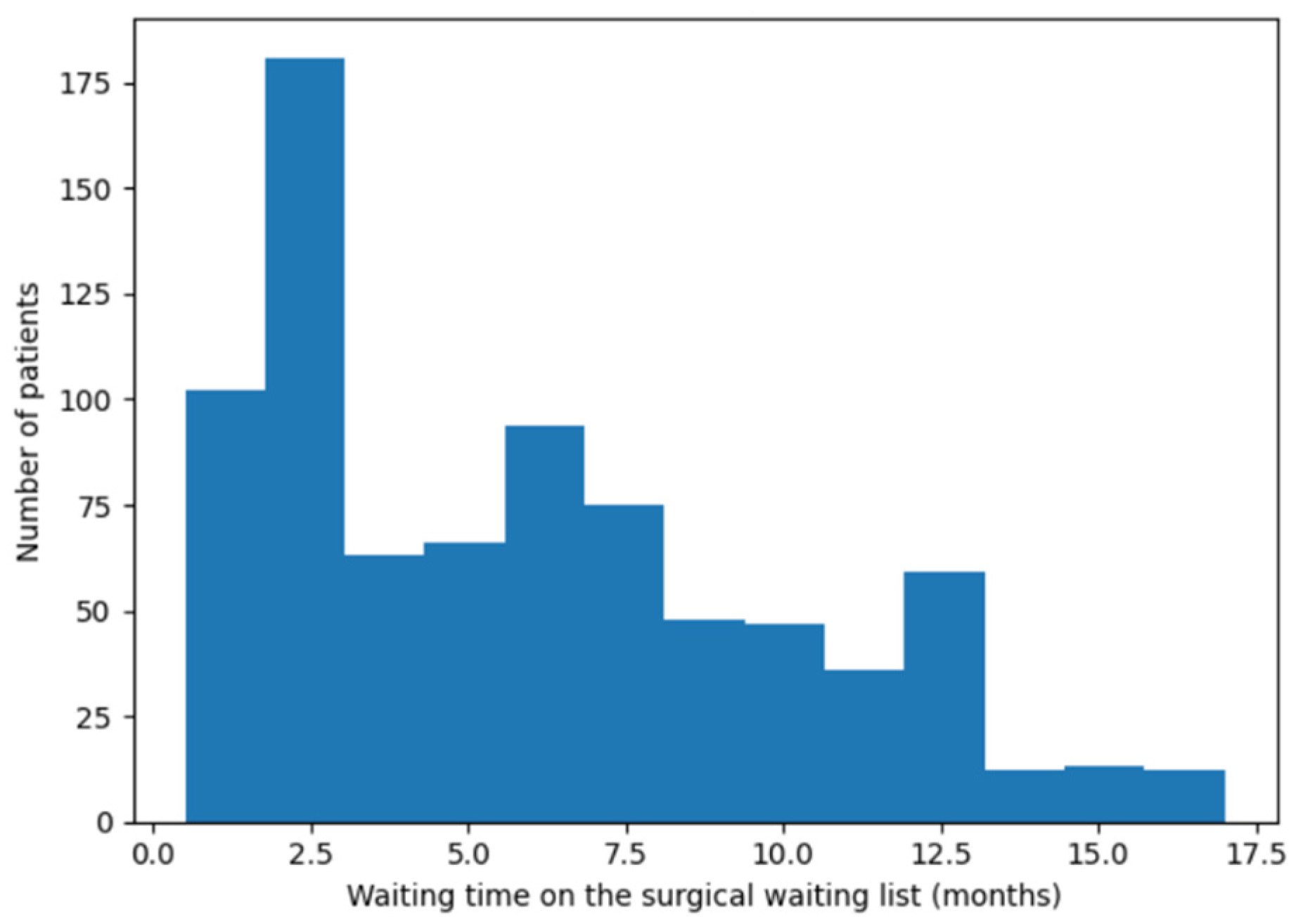
Waiting time for hysterectomy, calculated from the date of surgical indication (as recorded in the electronic medical record) to the date of surgery, showed a strongly right-skewed distribution. The median waiting time was 6 months, with an interquartile range (IQR) of 3 to 10 months, and values ranging from 0.5 to 53 months. The histogram showed a higher concentration of patients in the early months of the waiting list, particularly between 3 and 6 months, followed by a progressive decline in frequencies and a long right-tailed distribution(Figure 2). To enhance visual clarity, the x-axis was truncated at the 95th percentile (≤17 months), while extreme values above this threshold were retained in the dataset and are described in the text.

4. Discussion

The findings of this study reveal a structural mismatch between formal clinical prioritization and effective surgical access in the management of elective hysterectomy within the Brazilian Unified Health System (SUS). The ordinal logistic regression analysis (Table 7) demonstrated that all components of the clinical score were associated with a higher likelihood of classification into elevated priority categories. These substantial effect estimates reflect the system’s theoretical capacity to identify, at the documentary level, patients with greater clinical risk and a higher need for intervention.
However, when the temporal dimension of access was assessed through quantile regression (Table 8), a paradoxical phenomenon emerged: the same criteria that increase clinical priority did not translate into shorter waiting times. On the contrary, several of them, particularly age, symptom duration, and cardiovascular disease, were associated with significantly longer median waiting times, indicating systemic failures in the implementation of prioritization logic.
Among the score components, cardiovascular disease stood out as the strongest predictor of assignment to higher priority (OR = 1.85; 95% CI: 1.40–2.60), followed by age (OR = 1.70; 95% CI: 1.30–2.25), pulmonary disease (OR = 1.45; 95% CI: 1.30–1.65), and anemia (OR = 1.35; 95% CI: 1.05–1.80). Nevertheless, in the quantile regression analysis, the presence of cardiovascular disease was associated with an increase in waiting time of approximately +1.00 month (95% CI: +0.16 to +1.84; p = 0.019). This finding may be explained by the need to postpone elective procedures until cardiovascular conditions are adequately optimized, which in practice may result in longer waiting times for these patients [18].
The variable “time from symptom onset to surgery” was incorporated into the score to capture the temporal dimension of disease as an indirect marker of severity and prolonged suffering and showed a strong association with higher clinical priority (OR = 1.10; 95% CI: 1.02–1.35) (Table 7). However, in the quantile regression analysis, patients with longer symptom duration waited, on average, an additional +2.50 months (95% CI: 1.59–3.41) to undergo surgery. This result is consistent with the findings of Traylor et al. (2021) [19], who demonstrated that prolonged waiting times for benign gynecologic surgeries are strongly associated with functional decline, increased use of emergency services, and a higher risk of hospital readmission. Such patterns reflect an accumulation effect within the waiting list, whereby patients facing greater access barriers remain on the list for longer periods regardless of clinical severity, thereby amplifying structural inequalities [19].
Age was the second most powerful predictor of assignment to higher surgical priority, reflecting its well-established role as a marker of perioperative risk, in line with the literature identifying advanced age as an indicator of increased surgical risk and, therefore, greater need for prioritization [9]. Nonetheless, the present study found a significant increase in waiting time among older women (+1.0 month; 95% CI: 0.25–1.75), which may reflect additional access barriers faced by this population [20] and limitations of the system in translating prioritization into timely care, possibly due to structural and logistical overload.
Understanding the determinants of access to hysterectomy within the Brazilian Unified Health System (SUS) requires examination of the broader landscape of gender-based inequities that permeate the Brazilian healthcare system. Evidence indicates that women face specific barriers related to disproportionate caregiving responsibilities, reduced economic autonomy, and limited access to transportation, factors that may prolong waiting times regardless of clinical severity [13,21]. Moreover, intersections between gender, race, socioeconomic status, and geographic inequality can further amplify disparities in surgical access [22,23].
Beyond clinical impact, abnormal uterine bleeding (AUB) imposes a substantial psychological burden. Studies report a high prevalence of psychiatric disorders, including anxiety and mood disorders, among patients with AUB, at rates significantly higher than those observed in the general population [24]. Although the present study did not collect data on race/ethnicity, income, or psychosocial outcomes, future research should incorporate these dimensions to enable more refined stratification of access barriers and to inform public policies sensitive to the multiple layers of inequality that shape women’s health.
The quantile regression analysis revealed distinct and clinically meaningful patterns for anemia and pulmonary disease in predicting median surgical waiting time. Anemia was significantly associated with shorter waiting time (β = −1.00 month; 95% CI −1.61 to −0.39), indicating that patients with anemia waited approximately one month less than those without this diagnosis. This finding reflects the prioritization system’s sensitivity to anemia as a marker of severity and urgency. Evidence shows that anemia associated with heavy uterine bleeding, such as in cases of uterine fibroids, is linked to increased need for urgent hospitalization, more radical surgical approaches, and higher perioperative complication rates, suggesting that, in clinical practice, anemia is interpreted as a signal of greater severity and justification for prioritization [25]. The higher concentration of severe anemia within the highest priority categories (Table 3) further supports the apparent validity and clinical plausibility of the adapted score in the SUS context.
In contrast, pulmonary disease showed a marginally significant association with reduced waiting time (β = −1.00 month; 95% CI −2.03 to +0.03), a result that lies at the threshold of conventional statistical significance (α = 0.05). Pain and/or AUB, diabetes mellitus, and obesity had a strong impact on priority assignment (p < 0.001 for all). However, their coefficients for waiting time were statistically null.
The model incorporating the total clinical score (Table 8) further reinforces the observed discrepancy: each 1-point increase in the clinical score was associated with an additional 0.33 months of waiting time (95% CI 0.08–0.59). In practical terms, a patient with three additional points would wait approximately one extra month, completely reversing the expected prioritization logic. This finding constitutes clear quantitative evidence that, in the context analyzed, greater clinical severity does not lead to faster surgical access.
Taken together, these findings demonstrate that although the scoring system shows apparent validity for stratifying clinical risk, it does not translate into more timely access to surgery. The predominance of intermediate-priority cases and the relatively low proportion of high-priority cases (<10%) observed in this study mirror patterns reported in other public health systems. Data from the Australian Institute of Health and Welfare indicate that approximately 28% of cases are classified as high priority, while the majority fall into intermediate categories [26].
The scarcity of structured prioritization systems in gynecology becomes evident when compared with more consolidated surgical specialties, such as cardiology and oncology. Although international studies have validated standardized prioritization tools [10,27], the SUS still lacks transparent clinical protocols and regulatory instruments grounded in objective criteria. Recent analyses of surgical access and elective waiting-list management [28], as well as operational guidelines issued by the Ministry of Health, underscore this gap.
In gynecology, the MeNTS and Gyn-MeNTS scores have demonstrated good reliability and applicability for surgical prioritization. Marfori et al. (2020) [9] reported acceptable inter-rater reliability and moderate concurrent validity for benign gynecologic surgeries, with improved performance when combined with the Modified Elective Surgery Acuity Scale (mESAS) [9]. Similarly, Sajo et al. (2023) [29] confirmed intra- and interobserver consistency of the MeNTS score in oncologic settings, while Saleeby et al. (2021) [10] identified a normal score distribution and satisfactory reproducibility in U.S. public hospitals [10,29].
The integration of the proposed score into real-world regulatory systems—such as SISREG and the e-SUS Regulation platform, aligns with the strategic objectives of the Mais Acesso a Especialistas Program (PMAE) [30], a Brazilian Ministry of Health policy aimed at expanding and organizing access to specialized care and surgical procedures within the SUS, with an emphasis on reducing waiting lists and strengthening regulatory processes. In this context, the score could be progressively incorporated, initially as an electronic decision-support tool with automated calculation based on clinical information already recorded in medical records and regulatory systems, without replacing individual clinical judgment.
For implementation within the PMAE framework, structured steps are required, including multicenter validation across diverse regional contexts of the SUS, performance assessment and calibration of the score in heterogeneous populations, and the definition of use protocols aligned with national regulatory guidelines. Furthermore, electronic integration would require system interoperability, standardization of clinical data fields, and the development of simple, auditable interfaces for use by regulatory professionals. Continuous training of clinical and regulatory teams represents a central component of this process, ensuring proper understanding of the score, its limitations, and its role as a decision-support tool rather than a substitute for clinical and regulatory judgment. Collectively, these measures are essential for the score to contribute sustainably to the principles of equity, efficiency, and transparency that underpin the PMAE and the management of surgical waiting lists within the SUS.

5. Conclusions

This study demonstrated that the clinical prioritization system for elective hysterectomies within Brazil’s Unified Health System (SUS) shows apparent validity in identifying patients with greater clinical severity, as evidenced by the strong association between score components and higher levels of surgical priority. However, this formal prioritization did not consistently translate into faster surgical access, as criteria associated with higher priority were paradoxically also associated with longer waiting times. These findings reveal a disconnect between the clinical logic of prioritization and the real-world dynamics of surgical scheduling, highlighting structural limitations of the regulatory system. The integration of objective clinical criteria with dynamic mechanisms for monitoring waiting time may represent a relevant pathway to improve equity, transparency, and effectiveness in the management of surgical queues within the public health system.

6. Limitations

This study has limitations inherent to its retrospective design and the use of secondary data from a single center, which may restrict the generalizability of the findings. The absence of a standardized pain intensity scale in electronic medical records limited the assessment of symptom burden, as the dichotomous recording of pain and bleeding may have underestimated clinical severity and reduced sensitivity for discriminating refractory cases. In addition, the inability to differentiate pain types and associated manifestations restricted the qualitative analysis of this symptom.
The application of the adapted score represents an initial validation step; prospective, multicenter studies are required to confirm its accuracy, reproducibility, and clinical utility, as well as to estimate additional performance metrics. Potential information bias arising from sparse data in low-frequency categories and the limited number of specialists involved in the Delphi process, conducted at a single center, should also be considered.
Finally, variables related to quality of life, patient satisfaction, and postoperative functional outcomes were not included, despite their central role in comprehensive outcome assessment. Taken together, these limitations underscore the need for continuous refinement of prioritization criteria and external validation of the proposed model to enhance equity and efficiency in the management of surgical waiting lists.

Author Contributions

Conceptualization: L.C.Q.C. and R.F.H. Methodology: L.C.Q.C. and R.F.H. Validation: L.C.Q.C. and E.Z. Formal analysis: L.C.Q.C., E.Z. and R.F.H. Investigation: L.C.Q.C., E.Z. and J.J.R. Resources: M.N.O. and T.A.P. Data curation: L.C.Q.C., T.A.P. and M.N.O. Writing—original draft: L.C.Q.C., E.Z., R.F.H. and J.J.R. Writing—review and editing: L.C.Q.C., E.Z., R.F.H., R.N. and J.J.R. Visualization: T.A.P. and M.N.O. Supervision: E.Z., R.F.H., R.N. and J.J.R. Project administration: E.Z. and R.N. All authors have read and agreed to the published version of the manuscript.

Funding

This research received no external funding.

Institutional Review Board Statement

All procedures were conducted in accordance with the Declaration of Helsinki (1975), as revised in 2013. The study was approved by the Research Ethics Committee (CEP) of the Municipal Health Secretariat of São Paulo—SMS/SP (CAAE 83783024.3.0000.0086) on 29 July 2025.

Informed Consent Statement

Because this was a retrospective and observational study based exclusively on secondary data extracted from electronic medical records, with no direct contact with patients and no additional risk, the Ethics Committee waived the requirement for informed consent.

Data Availability Statement

The data supporting the findings of this study are available from the corresponding author upon reasonable request.

Conflicts of Interest

The authors declare no conflicts of interest.

References

  1. Ministério da Saúde (Brasil). Guia Eletrônico do SISREG III—Sistema de Regulação; Ministério da Saúde: Brasília, Brazil, 2024.
  2. Ministério da Saúde (Brasil). e-SUS Regulação—Manual e Informações Institucionais; Ministério da Saúde: Brasília, Brazil, 2024.
  3. Ministério da Saúde (Brasil). Portaria GM/MS n° 90, de 3 de fevereiro de 2023. Institui o Programa Nacional de Redução das Filas (PNRF). In Diário Oficial da União; Ministério da Saúde: Brasília, Brazil, 6 February 2023. [Google Scholar]
  4. Ministério da Saúde (Brasil). Portaria GM/MS n° 5.820, de 16 de dezembro de 2024. Atualiza o PNRF e integra ao Programa Mais Acesso a Especialistas (PMAE—Componente Cirurgias). In Diário Oficial da União; Ministério da Saúde: Brasília, Brazil, 18 December 2024. [Google Scholar]
  5. Prefeitura de Belo Horizonte. Regulação em Saúde: Protocolos de Prioridade e Painel de Filas Cirúrgicas; Secretaria Municipal de Saúde: Belo Horizonte, Brazil, 2025. Available online: https://prefeitura.pbh.gov.br/saude/regulacao-em-saude (accessed on 25 July 2025).
  6. Rathnayake, D.; Clarke, M.; Jayasinghe, V. Patient prioritisation methods to shorten waiting times for elective surgery: A systematic review. PLoS ONE 2021, 16, e0256578. [Google Scholar] [CrossRef]
  7. Powers, J.; McGree, J.; Grieve, D.A.; Aseervatham, R.; Ryan, S.; Corry, P. Managing surgical waiting lists through dynamic priority scoring. Health Care Manag. Sci. 2023, 26, 533–546. [Google Scholar] [CrossRef]
  8. Gentile, G.; Vicentini, F.C.; Montagna, G.; Pérez-Fentes, D.; Roncete, B.; Brito, A.H.A.; Torricelli, F.C.M.; Danilovic, A.; Batagello, C.; Mazzucchi, E. First step to equity and organization in waiting lines for stone surgery. Int. Braz. J. Urol. 2025, 51, 87–95. [Google Scholar] [CrossRef] [PubMed]
  9. Marfori, C.Q.; Klebanoff, J.S.; Wu, C.Z.; Barnes, W.A.; Carter-Brooks, C.M.; Amdur, R.L. Reliability and validity of 2 surgical prioritization systems for reinstating nonemergent benign gynecologic surgery during the COVID-19 pandemic. J. Minim. Invasive Gynecol. 2020, 27, 1568–1575. [Google Scholar] [CrossRef]
  10. Saleeby, E.; Acree, R.; Wieslander, C.; Truong, C.; Garcia, L.; Eckhardt, S.; Hari, A.; Al-Marayati, L.; Greenwell, L.; Holschneider, C.H. Prioritizing surgical services during on-Going pandemic response: Modification and reliability of the Medically Necessary Time-Sensitive (MeNTS) system. J. Med. Syst. 2021, 45, 33. [Google Scholar] [CrossRef]
  11. McIntyre, D.; Chow, C.K. Waiting time as an indicator for health services under strain: Measurement, equity and policy. Inquiry 2020, 57, 46958020910305. [Google Scholar] [CrossRef]
  12. Ptacek, I.; Aref-Adib, M.; Mallick, R.; Odejinmi, F. Each uterus counts: A narrative review of health disparities in benign gynaecology and minimal access surgery. Eur. J. Obstet. Gynecol. Reprod. Biol. 2021, 265, 130–136. [Google Scholar] [CrossRef]
  13. Cima, J.; Guimarães, P.; Almeida, Á. Explaining the gender gap in waiting times for scheduled surgery in the Portuguese National Health Service. Port. J. Public Health 2021, 39, 3–10. [Google Scholar] [CrossRef] [PubMed]
  14. García-Corchero, J.D.; Jiménez-Rubio, D. Waiting times in healthcare: Equal treatment for equal need? Int. J. Equity Health 2022, 21, 184. [Google Scholar] [CrossRef]
  15. Gross, M.S.; Harrington, B.J.; Sufrin, C.B.; Faden, R.R. Rethinking “elective” procedures for women’s reproduction during COVID-19. Hastings Cent. Rep. 2020, 50, 40–43. [Google Scholar] [CrossRef] [PubMed]
  16. Von Elm, E.; Altman, D.G.; Egger, M.; Pocock, S.J.; Gøtzsche, P.C.; Valndenbroucke, J.P. The Strengthening the Reporting of Observational Studies in Epidemiology (STROBE) statement. BMJ 2007, 335, 806–808. [Google Scholar] [CrossRef]
  17. World Medical Association. World Medical Association Declaration of Helsinki: Ethical principles for medical research involving human participants. JAMA 2025, 333, 71–74. [Google Scholar] [CrossRef] [PubMed]
  18. Chalitsios, C.V.; Luney, M.S.; Lindsay, W.A.; Sanders, R.D.; McKeever, T.M.; Moppett, I. Risk of mortality following surgery in patients with a previous cardiovascular event. JAMA Surg. 2024, 159, 140–149. [Google Scholar] [CrossRef]
  19. Traylor, J.; Koelper, N.; Kim, S.W.; Sammel, M.D.; Andy, U.U. Impact of surgical wait time to hysterectomy for benign gynecologic disease. J. Minim. Invasive Gynecol. 2021, 28, 982–990. [Google Scholar] [CrossRef] [PubMed]
  20. Independent Age. Patiently Waiting: Older People’s Experiences of Waiting for Surgery; Independent Age: London, UK, 2021. [Google Scholar]
  21. Mussida, C.; Patimo, R. Women’s family care responsibilities, employment and health: A tale of two countries. J. Fam. Econ. Issues 2021, 42, 489–507. [Google Scholar] [CrossRef] [PubMed]
  22. Vohra-Gupta, S.; Petruzzi, L.; Jones, C.; Cubbin, C. An intersectional approach to understanding barriers to healthcare for women. J. Community Health 2023, 48, 89–98. [Google Scholar] [CrossRef]
  23. Crenshaw, K. Mapping the margins: Intersectionality, identity politics, and violence against women of color. Stanf. Law Rev. 1991, 43, 1241–1299. [Google Scholar] [CrossRef]
  24. Kayhan, A.; Kayhan, F.; Alptekin, H. Mood and anxiety disorders in patients with abnormal uterine bleeding. Eur. J. Obstet. Gynecol. Reprod. Biol. 2016, 199, 192–197. [Google Scholar] [CrossRef]
  25. Antunes, D.; Gante, I.; Carvalho, M.J.; Medeiros-Borges, C.; Águas, F. The impact of anemia on treatment management and clinical outcomes of women hospitalized for uterine leiomyomas. Ginekol. Pol. 2022, 93, 799–805. [Google Scholar] [CrossRef]
  26. Australian Institute of Health and Welfare (AIHW). Elective Surgery Waiting Times 2018–19: Australian Hospital Statistics; AIHW: Canberra, Australia, 2019.
  27. Prachand, V.N.; Milad, M.P.; Angelos, P.; Posner, M.C.; Fung, J.J.; Agrawal, N.; Jeevanandam, V.; Matthews, J.B. Medically necessary, time-sensitive (MeNTS) procedures: Scoring system to ethically and efficiently manage resource scarcity. J. Am. Coll. Surg. 2020, 231, 281–288. [Google Scholar] [CrossRef]
  28. Pazin-Filho, A.; Silva, G.C.; Souza, C.R.; Dallora, M.E.L.D.V.; Velasco, T.R.; Santos, R.d.O.C.d.; Volpe, G.J.; Moroço, D.M.; de Souza, D.A.; Canabrava, C.M.; et al. Surgical waiting lists and queue management in a Brazilian tertiary public hospital. BMC Health Serv. Res. 2024, 24, 290. [Google Scholar] [CrossRef] [PubMed]
  29. Sajo, A.E.; Mouton, A.; Olorunfemi, G.; van Aardt, M.C.; Dreyer, G. Evaluation of the medically necessary, time-sensitive triage score in gynecologic oncology. PLoS ONE 2023, 18, e0284177. [Google Scholar] [CrossRef] [PubMed]
  30. Ministério da Saúde (Brasil). Portaria n° 1.392, de 12 de junho de 2023. Institui o Programa Mais Acesso a Especialistas (PMAE) no âmbito do SUS. In Diário Oficial da União; Ministério da Saúde: Brasília, Brazil, 2023. [Google Scholar]
Figure 1. Flow diagram illustrating patient selection for the study.
Women 06 00002 g001
Figure 2. Distribution of surgical waiting time (months) among women undergoing elective hysterectomy (n = 846).
Women 06 00002 g002
Table 1. Original Gynecologic Medically Necessary Time-Sensitive (Gyn-MeNTS) Score.
DomainVariableCriterion 1Criterion 2Criterion 3Criterion 4
ProcedureSurgical time<30 min31–60 min61–120 min≥121 min
Estimated length of stayOutpatient≤3 h1–2 days≥3 days
Need for postoperative ICUVery unlikely< 5%5–10%≥11–25%
Estimated blood loss (mL)≤100101–250251–600≥601–750
Size of surgical team123≥4
Type of anesthesiaLocal/regionalMAC/sedationGeneral
Surgical siteVaginal/simple hysteroscopyHysteroscopy with electrocauteryVaginal surgery with electrocautery or laparoscopyOpen surgery/laparotomy
DiseaseEffective therapeutic alternativesMultiple options available1–2 attempts performedFrequent treatment requiredNo alternatives
PainSevere (7–10), refractoryModerate to severe (4–6)Mild (1–3), controlledAsymptomatic
Anemia (Hb g/dL)<6.5 or recent transfusion6.6–88.1–10>10
Impact on fertilitySignificant/probableMild/possibleMinimal/stableNone
Impact on overall morbidityProgressiveStableMinimalNone
Impact of delay > 8 weeksSignificant worseningModerate worseningMild worseningNo impact
PatientAge (years)≤2021–4041–50>50
Pulmonary diseaseNoneMild asthma/mild COPDModerate COPDSevere COPD/heavy smoking
Obesity (BMI)<2525–29.930–34.9≥35
Cardiovascular diseaseNoneMild hypertensionCAD/mild heart failureModerate to severe heart failure
DiabetesNoneControlledInsulin-dependentDecompensated
PatientImmunosuppressionNoneMildModerateSevere
COVID-19 exposure (previous 4 weeks)Not exposedPossibleProbableConfirmed
ICU, Intensive Care Unit; MAC, Monitored Anesthesia Care; Hb, Hemoglobin; COPD, Chronic Obstructive Pulmonary Disease; BMI, Body Mass Index; CAD, Coronary Artery Disease; CHF, Congestive Heart Failure; COVID-19, Coronavirus Disease 2019.
Table 2. Adapted score for clinical prioritization of elective hysterectomy in the Brazilian Unified Health System (SUS).
Variable1 Point2 Points3 Points
Pain and/or abnormal uterine bleeding (AUB)SymptomaticSymptomatic, without prior treatmentSymptomatic and refractory to clinical therapy
Anemia (Hb, g/dL)>106.6–10≤6.5 or recent transfusion
Age (years)28–4950–65≥66
Pulmonary disease (asthma, COPD, smoking)NoYes
Obesity (BMI, kg/m2)≤29.930–34.9≥35
Cardiovascular disease (HTN, CHF, CAD)NoYes
Diabetes mellitusNoYes
Time from symptom onset to surgery<6 months6–12 months>12 months
AUB, Abnormal Uterine Bleeding; Hb, Hemoglobin; COPD, Chronic Obstructive Pulmonary Disease; BMI, Body Mass Index; HTN, Hypertension; CHF, Congestive Heart Failure; CAD, Coronary Artery Disease. Refractoriness: failure after ≥3 months of first-line hormonal therapy or nonsteroidal anti-inflammatory drugs (NSAIDs).
Table 3. Baseline clinical characteristics according to clinical priority level.
VariableLow Priority (n = 270)Medium Priority (n = 389)High Priority (n = 187)Total (n = 846)p-Value *
Pelvic pain and/or abnormal uterine bleeding (AUB)233 (30.3%)358 (46.6%)176 (23.0%)767<0.001
Anemia (Hb ≤ 6.5 or recent transfusion)8 (6.8%)41 (35.0%)68 (58.0%)117<0.001
Age ≥ 70 years1 (5.2%)8 (42.0%)10 (52.6%)19<0.001
Pulmonary disease (asthma, COPD, smoking)26 (13.5%)104 (54.0%)62 (32.3%)192<0.001
Obesity (BMI ≥ 35 kg/m2)16 (11.9%)43 (32.1%)75 (56.0%)134<0.001
Cardiovascular disease (HTN, CHF, CAD)31 (9.6%)159 (49.3%)132 (41.0%)322<0.001
Diabetes mellitus3 (3.6%)37 (45.0%)42 (51.2%)82<0.001
Symptom duration ≥ 6 months before surgery245 (30.0%)384 (47.0%)186 (22.8%)815<0.001
The data are presented as absolute numbers and column percentages. * p-values derived from separate chi-square tests of independence comparing each clinical characteristic across clinical priority levels. AUB, Abnormal Uterine Bleeding; Hb, Hemoglobin; COPD, Chronic Obstructive Pulmonary Disease; BMI, Body Mass Index; HTN, Hypertension; CHF, Congestive Heart Failure; CAD, Coronary Artery Disease.
Table 4. Distribution of surgical indications across age groups.
Age Group (Years)Fibroids, n (%)Prolapse, n (%)Adenomyosis, n (%)Other, n (%)
28–49610 (80.3%)20 (2.6%)61 (8.0%)8 (1.1%)
50–65145 (76.3%)40 (21.1%)4 (2.1%)1 (0.5%)
≥663 (9.7%)28 (90.3%)0 (0.0%)0 (0.0%)
p-value *0.003<0.0010.0180.001
Total (n)75888659
Data are presented as absolute numbers and percentages. * p-values refer to separate chi-square tests of independence performed for each surgical indication across age groups. Percentages were calculated within each age group.
Table 5. Association between body mass index (BMI) category and surgical priority level.
BMI Category (kg/m2)Low Priority, n (%)Medium Priority, n (%)High Priority, n (%)Total (n)p-Value *
≤24.996 (46.8%)99 (48.3%)10 (4.9%)205
25–29.9122 (41.1%)141 (47.5%)34 (11.4%)297
30–34.936 (17.1%)106 (50.5%)68 (32.4%)210
≥3516 (11.9%)43 (32.1%)75 (56.0%)134
Total (n)270389187846<0.001
Data are presented as absolute numbers and percentages calculated within each BMI category. * p-value derived from a chi-square test of independence assessing the association between BMI category and surgical priority level (χ2 = 182.48; degrees of freedom = 6). BMI, body mass index.
Table 6. Baseline clinical characteristics according to tertiles of surgical waiting time (months).
VariableTertile 1 (≤3 Months) n (%)Tertile 2 (4–8 Months) n (%)Tertile 3 (≥9 Months) n (%)Total (n)p-Value *
Pelvic pain and/or abnormal uterine bleeding (AUB)260 (33.8%)265 (34.5%)242 (31.5%)7670.700
Anemia (Hb ≤ 6.5 or recent transfusion)53 (45.2%)35 (30.0%)29 (24.7%)1170.044
Age ≥ 70 years6 (31.5%)5 (26.3%)8 (42.0%)190.021
Pulmonary disease (asthma, COPD, smoking)64 (33.5%)63 (33.0%)64 (33.5%)1910.700
Obesity (BMI ≥ 35 kg/m2)45 (33.6%)51 (38.0%)38 (28.3%)1340.750
Cardiovascular disease (HTN, CHF, CAD)89 (27.6%)119 (37.0%)114 (35.0%)3220.014
Diabetes mellitus25 (30.4%)31 (37.8%)26 (31.7%)820.810
Symptom duration ≥ 6 months255 (31.2%)296 (36.3%)264 (32.3%)815<0.001
Data are presented as absolute numbers and percentages calculated within each waiting-time tertile. Comparisons across tertiles were performed using chi-square tests. * p-values derived from separate chi-square tests of independence comparing each clinical characteristic across waiting-time tertiles. AUB, Abnormal Uterine Bleeding; Hb, Hemoglobin; COPD, Chronic Obstructive Pulmonary Disease; BMI, Body Mass Index; HTN, Hypertension; CHF, Congestive Heart Failure; CAD, Coronary Artery Disease.
Table 7. Association between clinical domains and assigned surgical priority (adjusted ordinal regression with Firth penalization).
Clinical CriterionAdjusted OR (95% CI)p-Value
Pain and/or abnormal uterine bleeding (AUB)1.30 (1.05–1.65)0.017
Anemia (Hb, g/dL)1.35 (1.05–1.80)0.020
Age (Years)1.70 (1.30–2.25)<0.001
Pulmonary disease (asthma, COPD, smoking)1.45 (1.30–1.65)<0.001
Obesity (BMI, kg/m2)1.20 (1.05–1.40)0.008
Cardiovascular disease (HTN, CHF, CAD)1.85 (1.40–2.60)<0.001
Diabetes mellitus1.15 (1.05–1.40)0.023
Time from symptom onset to surgery1.10 (1.02–1.35)0.04
Adjusted odds ratios (ORs) and 95% confidence intervals (CIs) estimated using a cumulative ordinal logistic regression model with Firth penalization. ORs represent the change in odds of being assigned to a higher surgical priority category per 1-point increase in continuous domain scores or per 1-category increase in ordinal variables, as defined in the Methods. All models were mutually adjusted for the remaining clinical domains. Statistical significance was set at p < 0.05. AUB, Abnormal Uterine Bleeding; Hb, Hemoglobin; COPD, Chronic Obstructive Pulmonary Disease; BMI, Body Mass Index; HTN, Hypertension; CHF, Congestive Heart Failure; CAD, Coronary Artery Disease.
Table 8. Association between clinical criteria and median surgical waiting time (quantile regression, τ = 0.50).
Clinical Criterionβ (Months)95% CI (Months)p-Value
Pelvic pain and/or abnormal uterine bleeding (score ranging from 1 to 3)+0.50−0.20 to +1.200.160
Anemia (score ranging from 1 to 3)−1.00−1.61 to −0.390.001
Age (score ranging from 1 to 3)+1.00+0.25 to +1.750.009
Pulmonary disease (no = 1/yes = 2)−1.00−2.03 to +0.030.057
Obesity (score ranging from 1 to 3)+0.00−0.60 to +0.600.999
Cardiovascular disease (no = 1/yes = 2)+1.00+0.16 to +1.840.019
Diabetes mellitus (no = 1/yes = 2)+0.00−1.53 to +1.530.999
Time from symptom onset to surgery (score ranging from 1 to 3: <6, 6–12, and >12 months)+2.50+1.59 to +3.41<0.001
Total clinical score +0.33+0.08 to +0.590.011
Quantile regression was performed at τ = 0.50 to estimate effects on median surgical waiting time. β coefficients represent the change in median waiting time (months) associated with a one-unit increase in the predictor, defined according to the specified coding. Ordinal variables were modeled as ordered categorical predictors, and binary variables were modeled as presence versus absence. Positive β values indicate longer waiting time; negative β values indicate shorter waiting time. Statistical significance was set at p < 0.05. AUB, Abnormal Uterine Bleeding; Hb, Hemoglobin; COPD, Chronic Obstructive Pulmonary Disease; BMI, Body Mass Index; HTN, Hypertension; CHF, Congestive Heart Failure; CAD, Coronary Artery Disease; CI, confidence interval.
Disclaimer/Publisher’s Note: The statements, opinions and data contained in all publications are solely those of the individual author(s) and contributor(s) and not of MDPI and/or the editor(s). MDPI and/or the editor(s) disclaim responsibility for any injury to people or property resulting from any ideas, methods, instructions or products referred to in the content.