
Lipid-Lowering Mechanism of Lotus Root Polysaccharides in Drosophila Fed with a High-Fat Diet Based on Transcriptome Analysis

 ,
,
Abstract
1. Introduction
2. Materials and Methods
2.1. Materials and Reagents
2.2. Preparation of Lotus Root Polysaccharide
2.3. Drosophila Culture and Preparation of Medium
2.4. Determination of Drosophila Appetite
2.5. Determination the Lifespan of Drosophila
2.6. Determination of Sod, Cat, Mda, Tc and Tg in Drosophila
2.7. Transcriptome Sequencing Analysis
2.8. Statistical Analysis
3. Results and Discussion
3.1. Extraction and Characterization of Lotus Root Polysaccharides
3.2. Effect of Lotus Root Polysaccharides on the Appetite of D. melanogaster
3.3. Effect of Lotus Root Polysaccharides on the Lifespan of D. melanogaster
3.4. Antioxidant Activity of Lotus Root Polysaccharides in D. melanogaster
3.5. Lipid-Lowering Activity of Lotus Root Polysaccharides in D. melanogaster
3.6. Effect of Lotus Root Polysaccharides on Transcriptional Profiles in D. melanogaster
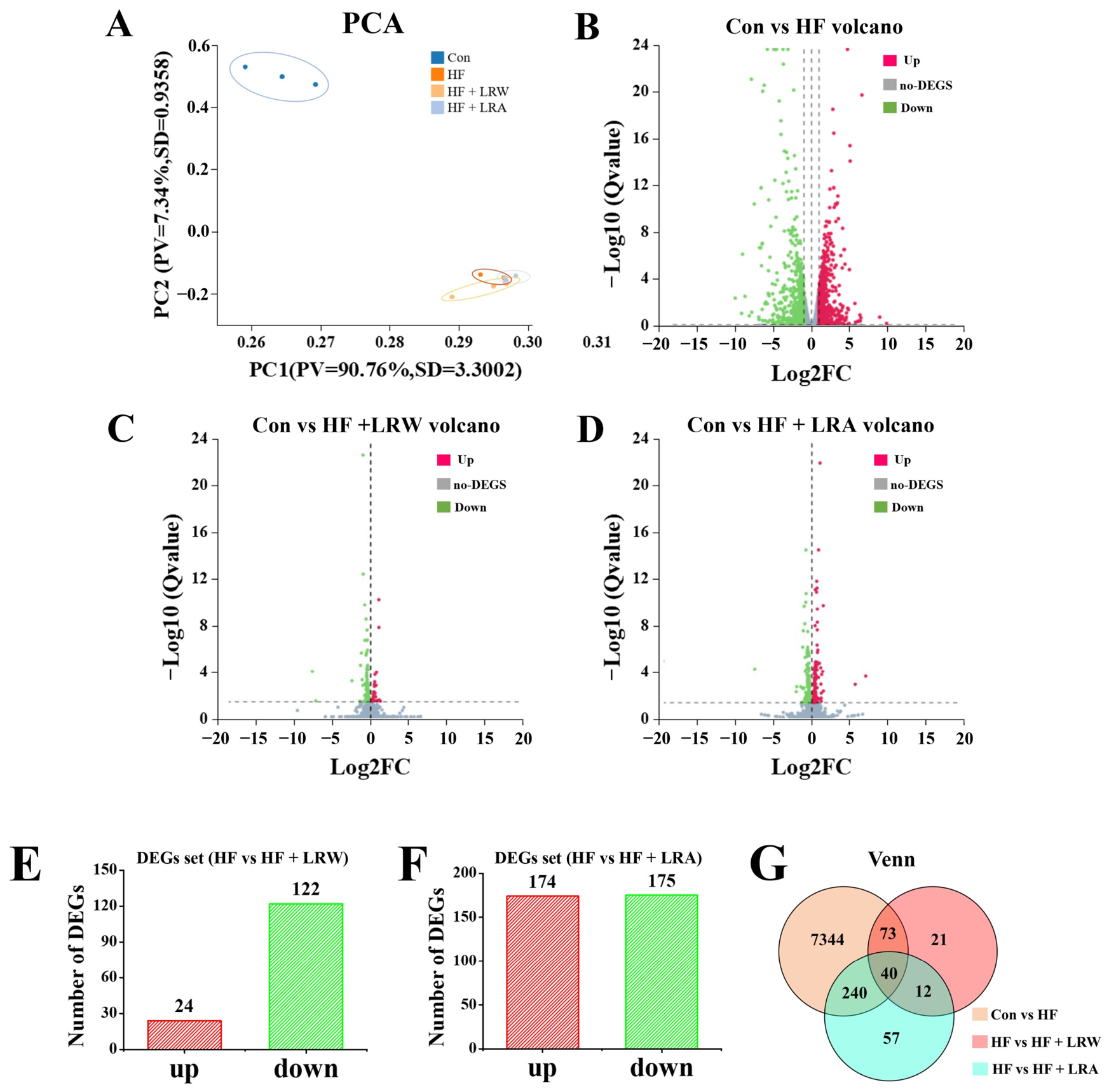
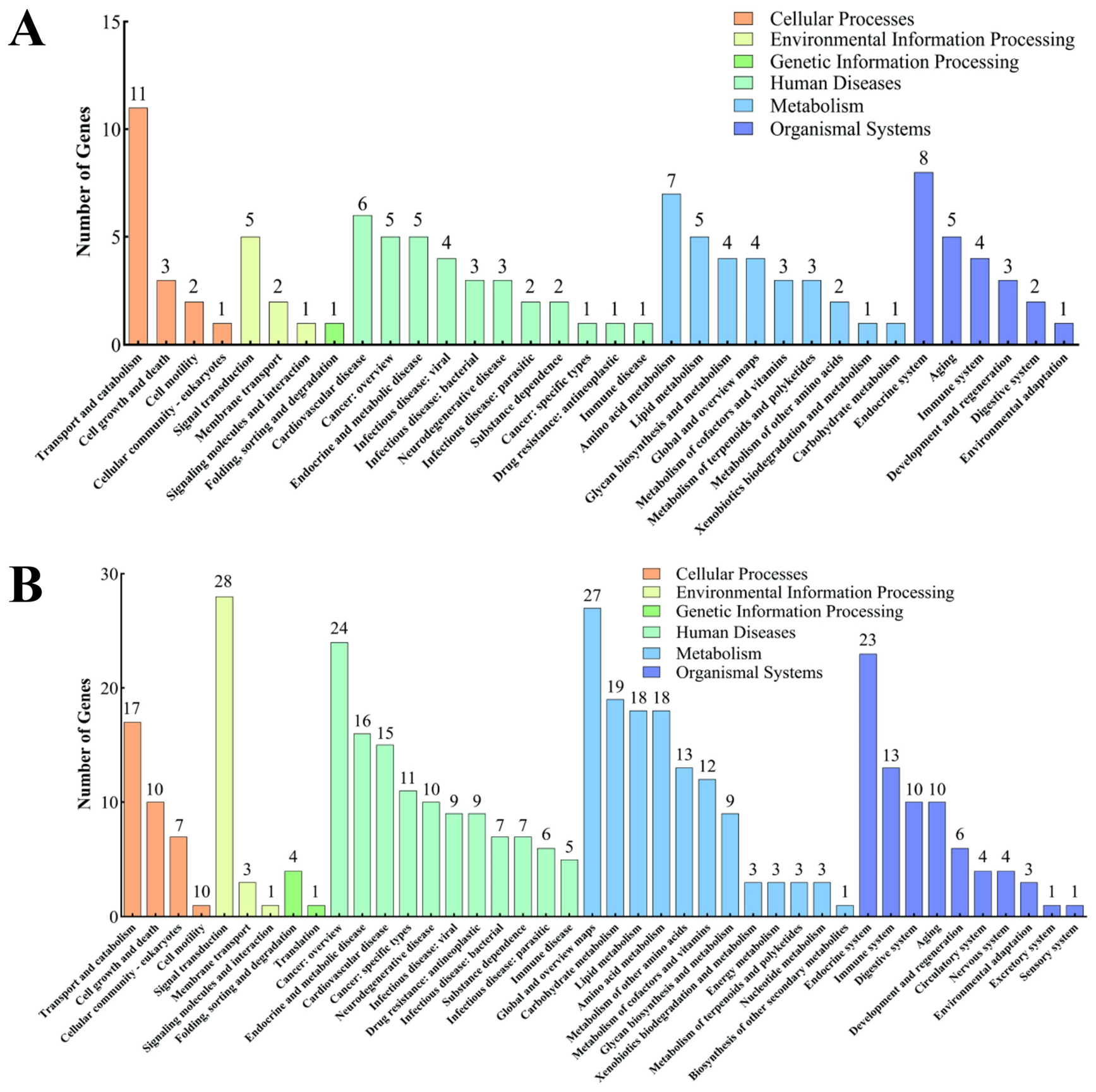
3.6.1. Analysis of Degs and Functional Annotation of Kegg Pathways
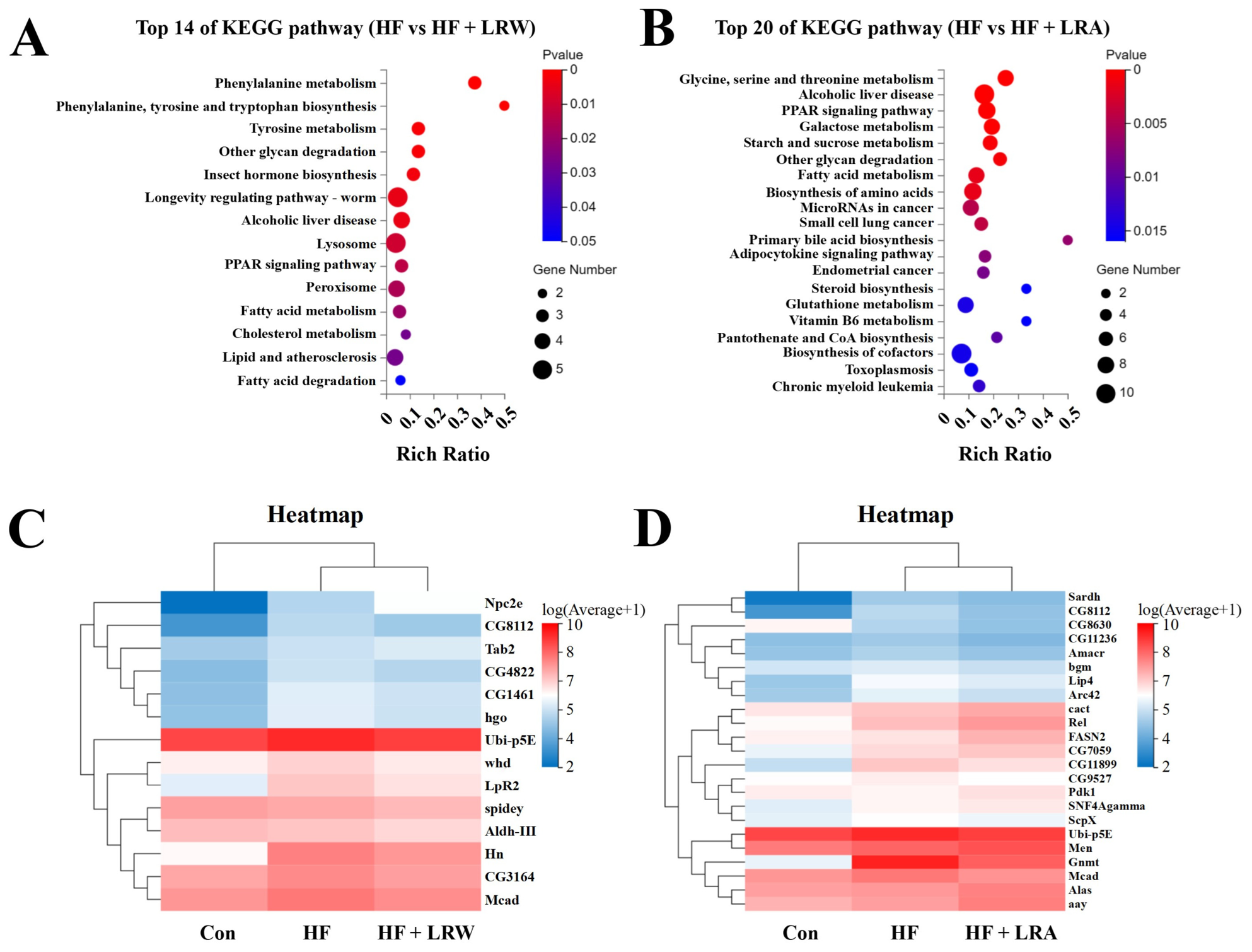
3.6.2. Kegg Pathway Enrichment Analysis
4. Conclusions
Author Contributions
Funding
Data Availability Statement
Conflicts of Interest
References
- Yan, Y.Y.; Wang, Q.; Sun, L.H. Extraction, Preparation, and Carboxymethyl of Polysaccharide from Lotus Root. Food Sci. Technol. 2022, 42, e17822. [Google Scholar] [CrossRef] [Scilit]
- Yang, M.; Hu, D.; Cui, Z.; Li, H.; Man, C.; Jiang, Y. Lipid-Lowering Effects of Inonotus obliquus Polysaccharide In Vivo and In Vitro. Foods 2021, 10, 3085. [Google Scholar] [CrossRef] [Scilit] [PubMed]
- Chen, Y.; Xu, W.; Qian, C.D.; Fenghong, H. Rapeseed Polysaccharides Alleviate Overweight Induced by High-Fat Diet with Regulation of Gut Microbiota in Rats. Oil Crop Sci. 2021, 6, 192–200. [Google Scholar] [CrossRef] [Scilit]
- Wang, X.F.; Chen, X.; Tang, Y.; Wu, J.M.; Qin, D.L.; Yu, L.; Yu, C.L.; Zhou, X.G.; Wu, A.G. The Therapeutic Potential of Plant Polysaccharides in Metabolic Diseases. Pharmaceuticals 2022, 15, 1329. [Google Scholar] [CrossRef] [Scilit] [PubMed]
- Chen, S.; Xi, M.; Gao, F.; Li, M.; Dong, T.; Geng, Z.; Liu, C.; Huang, F.; Wang, J.; Li, X. Evaluation of Mulberry Leaves’ Hypoglycemic Properties and Hypoglycemic Mechanisms. Front. Pharmacol. 2023, 14, 1045309. [Google Scholar] [CrossRef] [Scilit] [PubMed]
- Ji, X.; Yin, M.; Nie, H.; Liu, Y. A Review of Isolation, Chemical Properties, and Bioactivities of Polysaccharides from Bletilla striata. BioMed Res. Int. 2020, 2020, 5391379. [Google Scholar] [CrossRef] [Scilit] [PubMed]
- Ge, H.J.; Chen, W. Cyanidin-3-O-glucoside alleviates non-alcoholic fatty liver disease through modulation of the gut microbiota. Food Qual. Saf. 2025, 9, fyaf035. [Google Scholar] [CrossRef] [Scilit]
- Yin, D.F.; Zhong, Y.D.; Liu, H.; Hu, J.L. Lipid metabolism regulation by dietary polysaccharides with different structural properties. Int. J. Biol. Macromol. 2024, 270, 132253. [Google Scholar] [CrossRef] [Scilit] [PubMed]
- Zheng, Z.; Gao, W.; Zhu, Z.; Li, S.; Chen, X.; Cravotto, G.; Sui, Y.; Zhou, L. Complexes of Soluble Dietary Fiber and Polyphenols from Lotus Root Regulate High-Fat Diet-Induced Hyperlipidemia in Mice. Antioxidants 2024, 13, 466. [Google Scholar] [CrossRef] [Scilit] [PubMed]
- Yi, Y.; Lamikanra, O.; Sun, J.; Wang, L.M.; Min, T.; Wang, H.X. Activity Diversity Structure-Activity Relationship of Polysaccharides from Lotus Root Varieties. Carbohydr. Polym. 2017, 190, 67–76. [Google Scholar] [CrossRef] [Scilit] [PubMed]
- Wang, M.; Hu, W.J.; Wang, Q.H.; Yang, B.Y.; Kuang, H.X. Extraction, purification, structural characteristics, biological activities, and application of the polysaccharides from Nelumbo nucifera Gaertn. (lotus): A review. Int. J. Biol. Macromol. 2023, 226, 562–579. [Google Scholar] [CrossRef] [Scilit] [PubMed]
- Song, J.; Zhang, Z.; Wang, H.; Meng, Y.; Sun, Y.; Yi, Y. Study on the Structure and Lipid-Lowering Activity of Different Components of Lotus Root Polysaccharides. Food Res. Int. 2025, 203, 115801. [Google Scholar] [CrossRef] [Scilit] [PubMed]
- Heidarian, Y.; Tourigny, J.P.; Fasteen, T.D.; Mahmoudzadeh, N.H.; Hurlburt, A.J.; Nemkov, T.; Reisz, J.A.; D’Alessandro, A.; Tennessen, J.M. Metabolomic Analysis of Drosophila melanogaster Larvae Lacking Pyruvate Kinase. G3 Genes Genomes Genet. 2023, 14, jkad228. [Google Scholar] [CrossRef] [Scilit] [PubMed]
- Qian, Q.; Niwa, R. Regulation of Aging in the Fruit Fly Drosophila melanogaster. Zool. Sci. 2024, 41, 4–13. [Google Scholar] [CrossRef] [Scilit] [PubMed]
- Hou, D.; Liu, F.; Ren, X.; Shen, Q.; Zhou, S. Protective Mechanism of Mung Bean Coat Against Hyperlipidemia in Mice Fed with a High-fat diet: Insight from Hepatic Transcriptome Analysis. Food Funct. 2021, 12, 12434–12447. [Google Scholar] [CrossRef] [Scilit] [PubMed]
- Yi, Y.; Xu, W.; Fan, Y.; Wang, H.X. Drosophila as an Emerging Model Organism for Studies of Food-Derived Antioxidants. Food Res. 2021, 143, 110307. [Google Scholar] [CrossRef] [Scilit] [PubMed]
- Vonolfen, M.C.; Altenschildesche, F.; Nam, H.J.; Brodesser, S.; Gyenis, A.; Buellesbach, J.; Lam, G.; Thummel, C.S.; Storelli, G. Drosophila HNF4 acts in distinct tissues to direct a switch between lipid storage and export in the gut. Cell Rep. 2024, 43, 114693. [Google Scholar] [CrossRef] [Scilit] [PubMed]
- Karpova, E.K.; Bobrovskikh, M.A.; Deryuzhenko, M.A.; Shishkina, O.D.; Gruntenko, N.E. Wolbachia Effect on Drosophila melanogaster Lipid and Carbohydrate Metabolism. Insects 2023, 14, 14040357. [Google Scholar] [CrossRef] [Scilit] [PubMed]
- Wang, H.X.; Yi, Y.; Sun, J.; Lamikanra, O.; Min, T. Fingerprint Profiling of Polysaccharides from Different Parts of Lotus Root Varieties. RSC Adv. 2018, 8, 16574–16584. [Google Scholar] [CrossRef] [Scilit] [PubMed]
- Wang, L.J.; Li, Y.M.; Lei, L.; Liu, Y.W.; Wang, X.B.; Ma, K.Y.; Zhang, C.N.; Zhu, H.Y.; Zhao, Y.M.; Chen, Z.Y. Purple sweet potato anthocyanin attenuates fat-induced mortality in Drosophila melanogaster. Exp. Gerontol. 2016, 82, 95–103. [Google Scholar] [CrossRef] [Scilit] [PubMed]
- Zhang, H.; Wang, S.; Jin, L.H. Acanthopanax senticosus Polysaccharide Regulates the Intestinal Homeostasis Disruption Induced by Toxic Chemicals in Drosophila. Phytother. Res. 2019, 34, 193–200. [Google Scholar] [CrossRef] [Scilit] [PubMed]
- Amcheslavsky, A.; Jiang, J.; Ip, Y.T. Tissue Damage-Induced Intestinal Stem Cell Division in Drosophila. Cell Stem Cell 2009, 4, 49–61. [Google Scholar] [CrossRef] [Scilit] [PubMed]
- Ferreira, J.; Marques, A.; Abreu, H.; Pereira, R.; Rego, A.; Pacheco, M.; Gaivão, I. Red Seaweeds Porphyra umbilicalis and Grateloupia turuturu Display Antigenotoxic and Longevity-Promoting Potential in Drosophila melanogaster. Eur. J. Phycol. 2019, 54, 519–530. [Google Scholar] [CrossRef] [Scilit]
- Hafeez, E.; Du, D.S.; Ni, H.; Zhu, K.; Hu, F.; Zhou, J.H.; Chen, D.S. Regulation and mechanism of Bletilla striata polysaccharide on delaying aging in Drosophila melanogaster. Int. J. Biol. Macromol. 2025, 310, 143382. [Google Scholar] [CrossRef] [Scilit] [PubMed]
- Zhou, Y.Z.; Yan, M.L.; Gao, L.; Zhang, J.Q.; Qin, X.M.; Zhang, X.; Du, G.H. Metabonomics Approach to Assessing the Metabolism Variation and Gender Gap of Drosophila melanogaster in Aging Process. Exp. Gerontol. 2017, 98, 110–119. [Google Scholar] [CrossRef] [Scilit] [PubMed]
- Lee, H.Y.; Min, K.J. Betulinic Acid Increases the Lifespan of Drosophila melanogaster via Sir2 and FoxO Activation. Nutrients 2024, 16, 441. [Google Scholar] [CrossRef] [Scilit] [PubMed]
- Su, J.; Jiang, L.; Wu, J.; Liu, Z.; Wu, Y. Effect of Polysaccharides Extracted from Sipunculus nudus (SNP) on the Lifespan and Immune Damage Repair of Drosophila melanogaster Exposed to Cd (VI). Nat. Prod. Res. 2017, 32, 1329–1332. [Google Scholar] [CrossRef] [Scilit] [PubMed]
- Lee, S.H.; Lee, H.Y.; Yu, M.; Yeom, E.; Lee, J.H.; Yoon, A.; Lee, K.S.; Min, K.J. Extension of Drosophila lifespan by Korean red ginseng through a mechanism dependent on dSir2 and insulin/IGF-1 signaling. Aging 2019, 11, 9369–9387. [Google Scholar] [CrossRef] [Scilit] [PubMed]
- Peng, C.; Zuo, Y.; Kwan, K.M.; Liang, Y.; Ma, K.Y.; Chan, H.Y.E.; Huang, Y.; Yu, H.; Chen, Z.-Y. Blueberry Extract Prolongs Lifespan of Drosophila melanogaster. Exp. Gerontol. 2011, 47, 170–178. [Google Scholar] [CrossRef] [Scilit] [PubMed]
- Yang, S.; Xiu, M.; Li, X.; Shi, Y.; Wang, S.; Wan, S.; Han, S.; Yang, D.; Liu, Y.; He, J. The Antioxidant Effects of Hedysarum polybotrys Polysaccharide in Extending Lifespan and Ameliorating Aging-Related Diseases in Drosophila melanogaster. Int. J. Biol. Macromol. 2023, 241, 124609. [Google Scholar] [CrossRef] [Scilit] [PubMed]
- Cai, C.; Cai, J.; Man, J.; Yang, Y.; Wang, Z.; Wei, C. Allomorph Distribution and Granule Structure of Lotus Rhizome C-Type Starch during Gelatinization. Food Chem. 2013, 151, 385–392. [Google Scholar] [CrossRef] [Scilit] [PubMed]
- Yuan, S.; Dong, P.-Y.; Ma, H.H.; Liang, S.L.; Li, L.; Zhang, X.F. Antioxidant and Biological Activities of the Lotus Root Polysaccharide-Iron (III) Complex. Molecules 2022, 27, 7106. [Google Scholar] [CrossRef] [Scilit] [PubMed]
- Luo, Y.; Xu, Y.L.; Gu, Y.P.; Gao, J.K.; Liu, X.J.; Luo, Y.H. Hypoglycemic activity and mechanism of the small bowl of Auricularia auricula-judae polysaccharides before and after degradation: A study based on a type 2 diabetes mellitus (T2DM) mouse model. Food Qual. Saf. 2025, 9, fyaf053. [Google Scholar] [CrossRef] [Scilit]
- Chen, N.; Jiang, T.Y.; Xu, J.X.; Xi, W.J.; Shang, E.; Xiao, P.; Duan, J.A. The relationship between polysaccharide structure and its antioxidant activity needs to be systematically elucidated. Int. J. Biol. Macromol. 2024, 270, 132391. [Google Scholar] [CrossRef] [Scilit] [PubMed]
- Fernandes, P.A.R.; Coimbra, M.A. The antioxidant activity of polysaccharides: A structure-function relationship overview. Carbohydr. Polym. 2023, 314, 120965. [Google Scholar] [CrossRef] [Scilit] [PubMed]
- Han, M.; Zhang, Y.; Fang, J.; Sun, M.; Liu, Q.; Ma, Z.; Hu, D.; Gong, X.; Liu, Y.; Jin, L. Associations between Dietary Magnesium Intake and Hypertension, Diabetes, and Hyperlipidemia. Hypertens. Res. 2023, 47, 331–341. [Google Scholar] [CrossRef] [Scilit] [PubMed]
- Kayode, O.T.; Rotimi, D.; Okoh, E.; Iyobhebhe, M.; Kayode, A.A.A.; Ojo, O.A. Novel Ketogenic Diet Formulation Improves Sucrose-Induced Insulin Resistance in Canton Strain Drosophila melanogaster. J. Food Biochem. 2021, 45, e13907. [Google Scholar] [CrossRef] [Scilit] [PubMed]
- Liu, C.M.; Sun, Y.D.; Tong, X.J.; Xu, Z.C.; Xia, Q.; Xu, K. Structural characterization and hypolipidemic activity of a natural polysaccharide from Suaeda salsa L. Int. J. Biol. Macromol. 2024, 279, 135480. [Google Scholar] [CrossRef] [Scilit] [PubMed]
- Wu, Y.; Zhang, Y.Y.; Gong, C.M.; Fan, B.C.; Li, S.Y.; Zhang, J.Y.; Li, Y.Z.; Song, X.M.; Zhang, D.D. Mechanisms and structure-activity relationship of hypolipidemic effects of polysaccharides from natural resources: A review. Arch. Pharm. Res. 2026, 49, 293–320. [Google Scholar] [CrossRef] [Scilit] [PubMed]
- Li, H.M.; Sun, L.; Mittapalli, O.; Muir, W.M.; Xie, J.; Wu, J.; Schemerhorn, B.J.; Jannasch, A.; Chen, J.Y.; Zhang, F. Bowman-Birk Inhibitor Affects Pathways Associated with Energy Metabolism in Drosophila melanogaster. Insect Mol. Biol. 2010, 19, 303–313. [Google Scholar] [CrossRef] [Scilit] [PubMed]
- Liu, Q.; Li, H.; Chen, X.; Luo, X. Dual Roles and Therapeutic Potential of ALDH3 Family Members in Cancer. Chem.-Biol. Interact. 2025, 418, 111622. [Google Scholar] [CrossRef] [Scilit] [PubMed]
- Fangninou, F.F.; Yu, Z.; Li, W.; Xue, L.; Yin, D. Metastatic Effects of Perfluorooctanoic Acid (PFOA) on Drosophila melanogaster with Metabolic Reprogramming and Dysrhythmia in a Multigenerational Exposure Scenario. Sci. Total Environ. 2023, 912, 169305. [Google Scholar] [CrossRef] [Scilit] [PubMed]
- Formica, M.; Storaci, A.M.; Bertolini, I.; Carminati, F.; Knævelsrud, H.; Vaira, V.; Vaccari, T. V-ATPase Controls Tumor Growth and Autophagy in a Drosophila Model of Gliomagenesis. Autophagy 2021, 17, 4442–4452. [Google Scholar] [CrossRef] [Scilit] [PubMed]
- Livelo, C.; Guo, Y.M.; Daya, F.A.; Rajasekaran, V.; Varshney, S.; Le, H.D.; Barnes, S.; Panda, S.; Melkani, G.C. Time-restricted feeding promotes muscle function through purine cycle and AMPK signaling in Drosophila obesity models. Nat. Commun. 2023, 14, 949. [Google Scholar] [CrossRef] [Scilit] [PubMed]
- Yoshioka, Y.; Anzai, K.; Kowada, R.; Hiratsuka, K.; Hirayabu, T.; Yasuda, M.; Ohkawa, Y.; Sato, T.; Suyama, M.; Yoshida, H.; et al. Drosophila transcription factor NF-Y suppresses transcription of the lipase 4 gene, a key gene for lipid storage. Exp. Cell Res. 2022, 420, 113307. [Google Scholar] [CrossRef] [Scilit] [PubMed]
- Geronazzo, J.; Heimerl, A.; Lindell, L.; McCrimmon, S.; Stormer, C.; Horvai, B.; Johnson, I.P.; Peterson, T.M.; Zuckerman, J.; Scott, A.; et al. Characterizing fatty acid oxidation genes in Drosophila. G3 Genes Genomes Genet. 2025, 15, jkaf139. [Google Scholar] [CrossRef] [Scilit] [PubMed]
- Kim, G.H.; Lee, Y.E.; Lee, G.H.; Cho, Y.H.; Lee, Y.N.; Jang, Y.; Paik, D.; Park, J.J. Overexpression of malic enzyme in the larval stage extends Drosophila lifespan. Biochem. Biophys. Res. Commun. 2015, 456, 676–682. [Google Scholar] [CrossRef] [Scilit] [PubMed]





| Items | LRW | LRA |
|---|---|---|
| Yield (%) | 1.68 | 13.07 |
| Total sugar content (%) | 96.83 | 73.66 |
| Protein content (%) | 1.52 | 2.50 |
| Monosaccharide composition | Glc:Rha:Gal:Ara ≈ 1:0.01:0.007:0.039 | Glc:Man:Rha:Gal:Ara ≈ 1:0.01:0.016:0.107:0.025 |
| Molecular weight | 2.464 × 10⁵ Da | 1.727 × 10⁵ Da |
| Main structure | →4)-α-D-Glcp-(1→ branched with →6)-α-D-Glcp-(1→ | →4)-α-D-Glcp-(1→ branched with →6)-α-D-Glcp-(1→ |
| Gender | Group | Mean Lifespan (Day) | Median Lifespan (Day) | Maximum Lifespan (Day) |
|---|---|---|---|---|
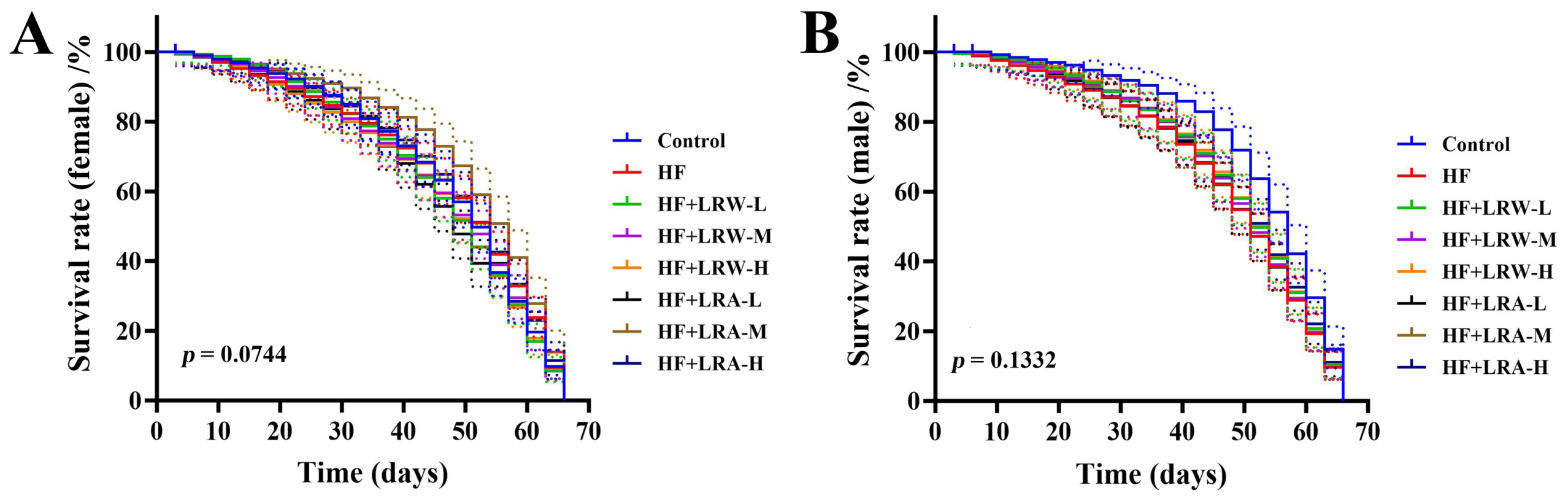
| Female Drosophila | Control | 40.55 ± 2.84 bc | 45.50 ± 2.80 bc | 62.70 ± 0.90 a |
| HF | 36.87 ± 4.22 de | 46.80 ± 3.19 bc | 57.60 ± 3.50 bcd | |
| HF + LRW-L | 33.99 ± 4.10 e | 38.50 ± 4.15 d | 53.25 ± 2.49 d | |
| HF + LRW-M | 39.56 ± 3.07 cd | 47.00 ± 1.00 abc | 57.75 ± 2.49 bcd | |
| HF + LRW-H | 35.90 ± 1.81 e | 44.75 ± 1.09 bc | 54.00 ± 4.24 cd | |
| HF + LRA-L | 34.90 ± 3.25 e | 39.80 ± 5.64 cd | 54.60 ± 3.50 cd | |
| HF + LRA-M | 45.93 ± 3.76 a | 53.40 ± 3.50 a | 60.60 ± 3.50 ab | |
| HF + LRA-H | 42.20 ± 3.28 b | 49.00 ± 4.77 ab | 58.20 ± 4.87 abc | |
| Male Drosophila | Control | 46.87 ± 3.01 a | 48.89 ± 3.90 a | 61.67 ± 2.89 ab |
| HF | 35.82 ± 3.85 c | 41.00 ± 3.52 c | 55.20 ± 1.47 c | |
| HF + LRW-L | 39.54 ± 1.52 bc | 43.20 ± 1.60 ab | 57.60 ± 1.20 bc | |
| HF + LRW-M | 37.20 ± 4.39 bc | 39.60 ± 3.98 c | 54.60 ± 2.24 c | |
| HF + LRW-H | 38.31 ± 1.98 bc | 43.00 ± 0.89 ab | 57.60 ± 2.24 bc | |
| HF + LRA-L | 41.29 ± 4.71 b | 45.00 ± 5.52 ab | 55.50 ± 3.35 c | |
| HF + LRA-M | 38.40 ± 2.58 bc | 41.40 ± 3.93 c | 64.20 ± 1.47 a | |
| HF + LRA-H | 41.20 ± 2.30 b | 45.40 ± 3.44 ab | 61.80 ± 2.40 ab |
| Sample Name | Total Raw Reads (M) | Total Clean Reads (M) | Total Clean Bases (Gb) | Clean Reads Q20 (%) | Clean Reads Q30 (%) | Clean Reads Ratio (%) |
|---|---|---|---|---|---|---|
| Control-1 | 47.19 | 44.49 | 6.67 | 97.78 | 92.53 | 94.28 |
| Control-2 | 47.19 | 45.31 | 6.8 | 98.55 | 95.09 | 96.03 |
| Control-3 | 47.19 | 45.08 | 6.76 | 97.78 | 92.48 | 95.55 |
| HF-1 | 47.19 | 45.44 | 6.82 | 97.83 | 92.66 | 96.31 |
| HF-2 | 47.19 | 45.3 | 6.79 | 97.86 | 92.78 | 96 |
| HF-3 | 47.19 | 45.45 | 6.82 | 97.23 | 90.77 | 96.33 |
| HF + LRW-1 | 47.19 | 44.81 | 6.72 | 97.97 | 93.22 | 94.97 |
| HF + LRW-2 | 47.19 | 45.1 | 6.77 | 97.75 | 92.41 | 95.58 |
| HF + LRW-3 | 47.19 | 45.09 | 6.76 | 97.81 | 92.65 | 95.56 |
| HF + LRA-1 | 47.19 | 45.08 | 6.76 | 97.89 | 92.87 | 95.53 |
| HF + LRA-2 | 47.19 | 45.25 | 6.79 | 97.6 | 91.89 | 95.91 |
| HF + LRA-3 | 47.19 | 45.18 | 6.78 | 97.92 | 92.97 | 95.76 |
| Gene Name | Description | Log2 Ratio a | p Value |
|---|---|---|---|
| Npc2e | Niemann-Pick type C-2e | 1.17 | 6.19 × 10⁻¹² |
| CG8112 | CG8112 | −0.47 | 4.22 × 10⁻⁴ |
| Tab2 | TAK1-associated binding protein 2 | 0.27 | 4.68 × 10⁻⁴ |
| CG4822 | CG4822 | −0.39 | 3.94 × 10⁻⁶ |
| CG1461 | Tyrosine aminotransferase | −0.28 | 3.51 × 10⁻⁴ |
| hgo | homogentisate 1,2-dioxygenase | −0.37 | 1.84 × 10⁻⁵ |
| Ubi-p5E | Ubiquitin-5E | −0.34 | 1.70 × 10⁻⁵ |
| whd | withered | −0.41 | 3.67 × 10⁻⁸ |
| LpR2 | Lipophorin receptor 2 | −0.43 | 1.11 × 10⁻⁹ |
| spidey | spidey | −0.28 | 3.95 × 10⁻⁴ |
| Aldh-III | Aldehyde dehydrogenase type III | −0.32 | 7.11 × 10⁻⁶ |
| Hn | Henna | −0.39 | 5.09 × 10⁻⁵ |
| CG3164 | CG3164 | −0.34 | 1.13 × 10⁻⁷ |
| Mcad | Medium-chain acyl-CoA dehydrogenase | −0.36 | 1.58 × 10⁻⁴ |
| Gene Name | Description | Log2 Ratio b | p Value |
|---|---|---|---|
| Sardh | Sarcosine dehydrogenase | −0.50 | 1.09 × 10⁻⁵ |
| CG8112 | CG8112 | −0.45 | 3.03 × 10⁻⁴ |
| CG8630 | CG8630 | −0.44 | 3.21 × 10⁻⁶ |
| CG11236 | D-amino acid oxidase 2 | −0.35 | 3.04 × 10⁻⁴ |
| Amacr | Alpha-methylacyl-CoA racemase | −0.38 | 5.59 × 10⁻⁴ |
| bgm | bubblegum | −0.30 | 7.48 × 10⁻⁵ |
| Lip4 | Lipase 4 | −0.64 | 2.00 × 10⁻⁷ |
| Arc42 | Activator-recruited cofactor subunit 42 | −0.32 | 1.21 × 10⁻³ |
| cact | cactus | 0.35 | 3.35 × 10⁻⁷ |
| Rel | Relish | 0.50 | 4.92 × 10⁻⁸ |
| FASN2 | Fatty acid synthase 2 | 0.30 | 1.93 × 10⁻⁴ |
| CG7059 | CG7059 | 0.40 | 2.56 × 10⁻⁵ |
| CG11899 | CG11899 | −0.25 | 7.38 × 10⁻⁴ |
| CG9527 | Acyl-CoA oxidase 3 | −0.40 | 1.09 × 10⁻⁴ |
| Pdk1 | Phosphoinositide-dependent kinase 1 | 0.40 | 1.09 × 10⁻⁴ |
| SNF4Agamma | SNF4/AMP-activated protein kinase gamma subunit | 0.32 | 1.21 × 10⁻³ |
| ScpX | Sterol carrier protein X-related thiolase | −0.31 | 2.91 × 10⁻⁴ |
| Ubi-p5E | Ubiquitin-5E | −0.30 | 1.93 × 10⁻⁴ |
| Men | Malic enzyme | 0.77 | 1.64 × 10⁻¹⁵ |
| Gnmt | Glycine N-methyltransferase | −0.32 | 9.22 × 10⁻⁶ |
| Mcad | Medium-chain acyl-CoA dehydrogenase | −0.27 | 6.10 × 10⁻⁴ |
| Alas | Aminolevulinate synthase | 0.35 | 1.33 × 10⁻⁴ |
| aay | astray | 0.95 | 4.61 × 10⁻⁴ |
Disclaimer/Publisher’s Note: The statements, opinions and data contained in all publications are solely those of the individual author(s) and contributor(s) and not of MDPI and/or the editor(s). MDPI and/or the editor(s) disclaim responsibility for any injury to people or property resulting from any ideas, methods, instructions or products referred to in the content. |
© 2026 by the authors. Licensee MDPI, Basel, Switzerland. This article is an open access article distributed under the terms and conditions of the Creative Commons Attribution (CC BY) license.
Share and Cite
Wei, C.; Chen, H.; Zhang, Z.; Sun, Y.; Wang, H.; Xu, X.; Yi, Y. Lipid-Lowering Mechanism of Lotus Root Polysaccharides in Drosophila Fed with a High-Fat Diet Based on Transcriptome Analysis. Polysaccharides 2026, 7, 107. https://doi.org/10.3390/polysaccharides7030107
Wei C, Chen H, Zhang Z, Sun Y, Wang H, Xu X, Yi Y. Lipid-Lowering Mechanism of Lotus Root Polysaccharides in Drosophila Fed with a High-Fat Diet Based on Transcriptome Analysis. Polysaccharides. 2026; 7(3):107. https://doi.org/10.3390/polysaccharides7030107
Chicago/Turabian StyleWei, Chenlu, Huanhuan Chen, Zhao Zhang, Ying Sun, Hongxun Wang, Xiaojuan Xu, and Yang Yi. 2026. "Lipid-Lowering Mechanism of Lotus Root Polysaccharides in Drosophila Fed with a High-Fat Diet Based on Transcriptome Analysis" Polysaccharides 7, no. 3: 107. https://doi.org/10.3390/polysaccharides7030107
APA StyleWei, C., Chen, H., Zhang, Z., Sun, Y., Wang, H., Xu, X., & Yi, Y. (2026). Lipid-Lowering Mechanism of Lotus Root Polysaccharides in Drosophila Fed with a High-Fat Diet Based on Transcriptome Analysis. Polysaccharides, 7(3), 107. https://doi.org/10.3390/polysaccharides7030107