Article

Fabrication of Microcapsule Powders from Red Palm Oil-Loaded Pickering Emulsions Stabilized by Native and Modified Starches


1
Doctor of Philosophy Program in Agro-Industry and Biotechnology, College of Graduate Studies, Walailak University, Nakhon Si Thammarat 80160, Thailand
2
Food Technology and Innovation Research Center of Excellence, Division of Food Science and Innovation, School of Agricultural Technology and Food Industry, Walailak University, Nakhon Si Thammarat 80161, Thailand
3
School of Agriculture and Food, Faculty of Veterinary and Agricultural Sciences, The University of Melbourne, Parkville, VIC 3010, Australia
*
Author to whom correspondence should be addressed.
Polysaccharides 2026, 7(2), 39; https://doi.org/10.3390/polysaccharides7020039
Submission received: 29 November 2025 / Revised: 6 January 2026 / Accepted: 31 March 2026 / Published: 1 April 2026

Abstract

Red palm oil (RPO) is a rich source of bioactive compounds such as carotenoids, tocopherols, and tocotrienols with notable health benefits; however, their vulnerability to oxidation, heat, and light during processing and storage limits their functional application. This study aimed to develop an emulsifier-free, biocompatible Pickering emulsion powder using native and modified starches from tapioca and rice to encapsulate RPO. The powders were evaluated for encapsulation efficiency, antioxidant activity, storage stability, FTIR characteristics, thermal properties, and morphology. Modified rice starch-based Pickering emulsion yielded the highest encapsulation efficiency (27.41%), while native rice starch showed the lowest (17.54%) (p < 0.05). FTIR analysis confirmed successful encapsulation through functional group identification. DSC indicated a higher thermal stability in native starch-based powders, while scanning electron microscopy confirmed RPO entrapment in microcapsules. The microcapsule powder of Pickering emulsion stabilized with modified tapioca starch and stored at room temperature (27–29 °C) showed the lowest water activity, minimal lipid oxidation, and the highest retention of carotenoids, α-tocopherol, and total phenolic contents (p < 0.05), along with superior DPPH and ABTS•+ scavenging activities. Therefore, modified tapioca starch offers a promising, clean-label delivery system for protecting RPO’s bioactive compounds in functional food applications without the need for added emulsifiers.

1. Introduction

Red palm oil (RPO), obtained through the partial refining of crude palm oil (CPO), is a rich source of bioactive compounds, particularly carotenoids, tocopherols, and tocotrienols [1,2,3]. It is used both as a dietary supplement and as a feed ingredient, with studies reporting improvements in egg quality, yolk pigmentation, and overall hen health when incorporated into poultry diets [4,5]. In the food industry, RPO is widely applied as a functional lipid component in products such as cooking oils, margarines, spreads, gravy oils, cereal bars, snacks, and ice creams [1,2,3]. Compared with refined, bleached, and deodorized oils, RPO retains substantially higher levels of carotenoids (≈500–700 ppm) and tocopherols/tocotrienols (≈600–1000 ppm) and has a characteristic fatty acid profile (≈50% saturated, 40% monounsaturated, and 10% polyunsaturated), which contributes to its enhanced resistance to lipid oxidation [3]. Its health-promoting effects have been widely reported, including alleviating vitamin A deficiency, increasing serum retinol, improving antioxidant status, lowering cholesterol, and reducing cancer risk [3].
Despite these advantages, carotenoids are highly sensitive to degradation via oxidation and can be lost under light and heat during processing and storage, reducing their functional efficacy [6]. Encapsulation has therefore attracted increasing attention to improve the stability and delivery of these sensitive compounds. However, many conventional encapsulation approaches rely on synthetic emulsifiers or stabilizers, which may raise concerns related to formulation acceptance, cost, and regulatory constraints. In this context, Pickering emulsions (PEs)—emulsions stabilized by food-grade solid particles—offer a promising route for developing cleaner formulations for RPO delivery.
Starch has gained considerable interest as a Pickering stabilizer because it is abundant, cost-effective, biocompatible, and able to form a protective interfacial barrier around oil droplets [7,8,9,10,11]. Emulsifying performance depends strongly on starch properties, including botanical origin and the degree of modification, which influence wettability, interfacial adsorption, and barrier formation. Modified starches can enhance stability by strengthening interfacial layers and improving particle packing; for example, Kargar et al. [12] reported stability retention for up to 40 days. Chemical modifications such as cross-linking can further improve interfacial performance by increasing surface charge and enhancing barrier formation [11]. In addition, the presence of high-melting-point fats has been suggested to improve oxidative resistance in Pickering systems (e.g., tripalmitin or palm stearin) [13], supporting the suitability of starch-based PE for food-relevant delivery applications [14].
From a practical standpoint, however, emulsion systems may still be inconvenient to store and transport because of their high water content and potential quality changes over time. Converting emulsions into dry powders is therefore an attractive strategy to improve handling and shelf-life, and freeze-drying is particularly suitable for oxidation-sensitive ingredients because it imposes minimal thermal stress and can better preserve labile compounds [15,16]. Compared with spray-drying, freeze-drying is essentially non-thermal and avoids direct exposure to hot air, which can help reduce heat-driven degradation and oxidative stress during processing. In addition, drying by ice sublimation generally causes less collapse and fewer heat-induced changes in biopolymer matrices, thereby minimizing structural damage to encapsulating materials and often improving the re-dispersibility of the resulting powders [17].
Starch particle-stabilized PEs are especially appealing for clean-label applications because starch functionality can be tuned through physical or chemical modification to optimize interfacial adsorption and barrier formation. Importantly, rice and tapioca starches differ in granule size distribution, surface characteristics, and composition—differences that may translate into distinct interfacial packing and resistance to destabilization—making a direct comparison of these botanical sources a formulation-relevant question. Recent work on modified rice starch granules has highlighted their potential as Pickering stabilizers in structured food emulsions and has shown that modification can substantially alter emulsion stability and rheological behavior [18]. Likewise, modified tapioca starch has been reported as an effective Pickering stabilizer for essential oil emulsions, where particle size reduction and hydrophobic modification improved interfacial performance [19].
For carotenoid-rich RPO specifically, Mohan et al. [20] demonstrated that pectin-stabilized Pickering emulsions can improve oil stability and β-carotene bioaccessibility, supporting the relevance of Pickering approaches for RPO delivery; however, that system is not starch-based and does not address a starch-only, stabilizer-free design. Marefati et al. [21] further showed that starch-granule Pickering emulsions can be freeze-dried into reconstitutable, oil-rich powders, illustrating the feasibility of translating Pickering emulsions into practical powder ingredients; nevertheless, their work did not focus on carotenoid-rich RPO and did not evaluate how starch botanical origin (rice versus tapioca), in native and modified forms, governs both emulsion stabilization and the performance of the resulting powders.
Taken together, these studies highlight a clear gap: stabilizer-free, starch-only Pickering emulsions remain underexplored for encapsulating carotenoid-rich RPO, specifically in a freeze-dried powder format, and direct rice-versus-tapioca comparisons within the same framework are still scarce. To address this gap, the present study develops a clean-label, stabilizer-free Pickering emulsion system using native and chemically modified rice and tapioca starches to encapsulate RPO and converts these emulsions into powders via freeze-drying. The work aims to clarify how starch source and chemical modification affect interfacial stabilization and encapsulation efficiency, whether these differences translate into improved carotenoid/antioxidant retention and storage stability, and how they ultimately shape powder functionality relevant to incorporation into functional food and nutraceutical formulations. To enable a controlled evaluation of these effects, all formulation and processing parameters were kept constant across treatments, with starch botanical source and chemical modification serving as the sole variables; native starches therefore functioned as internal controls for their modified counterparts within the same experimental framework.

2. Materials and Methods

2.1. Raw Materials

The red palm oil (RPO) used in this study was obtained from Sangarun Palm Oil Co., Ltd. (Krabi, Thailand). Native and modified tapioca starches were sourced from Thai Flour Industry Co., Ltd., Bangkok, Thailand, and native and modified rice starches were obtained from Cho Heng Rice Vermicelli Factory Co., Ltd., Nakhon Pathom, Thailand. The modified starches used were cross-linked types, commercially prepared through the chemical modification of native starch under controlled conditions. All the chemicals and reagents used in this study were of analytical grade and were procured from Sigma-Aldrich (St. Louis, MO, USA).

2.2. Preparation of Microcapsule Powders from RPO-Loaded Pickering Emulsions Stabilized by Native and Modified Starches

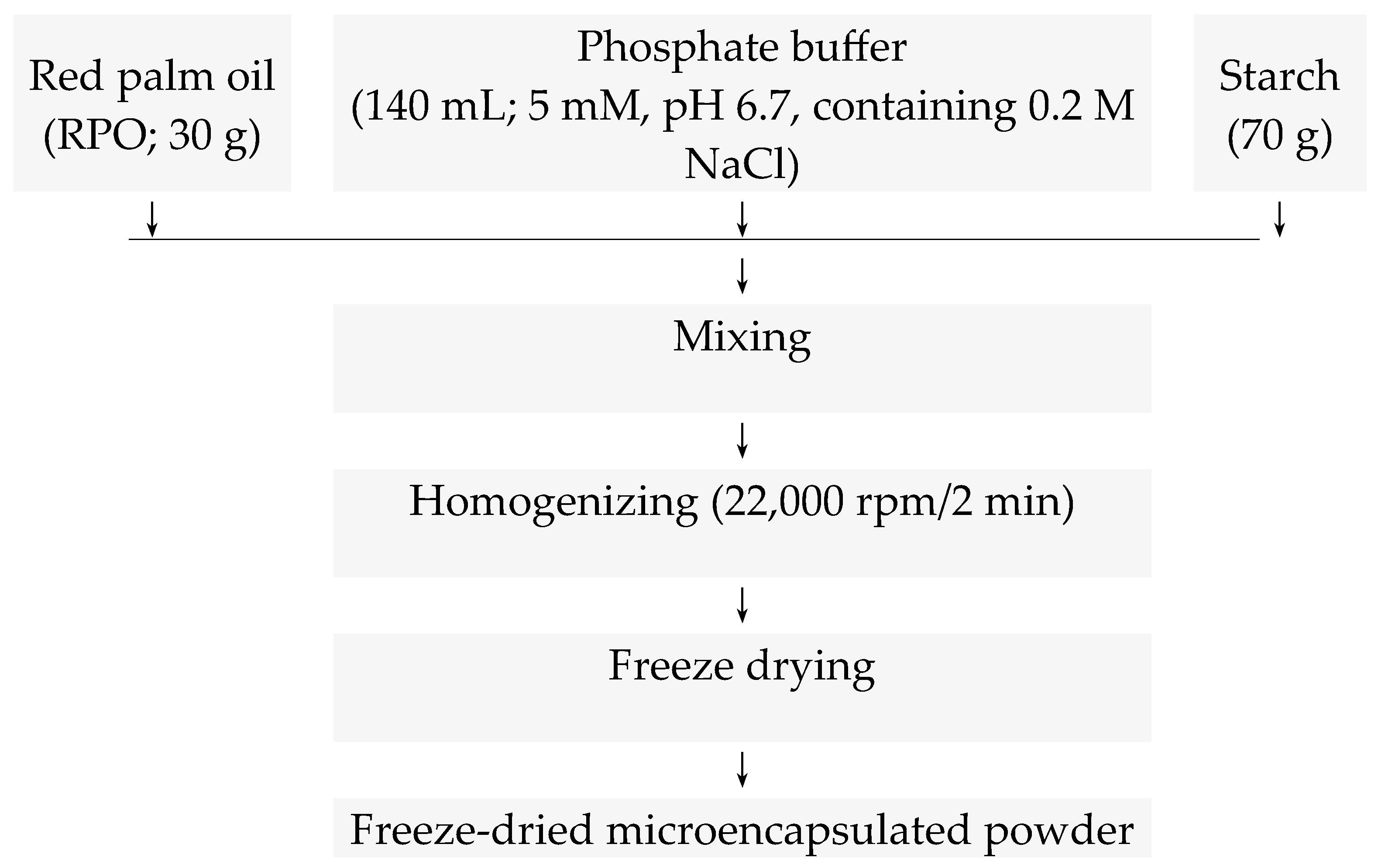
RPO (30 g) was combined with phosphate buffer (140 mL; 5 mM, pH 6.7, containing 0.2 M NaCl) and wall material starch (70 g) consisting of four types: native tapioca starch (NT), modified tapioca starch (MT), native rice starch (NR), and modified rice starch (MR). The mixture was subsequently homogenized using an IKA homogenizer (Model T25 digital Ultra-Turrax, Staufen, Germany) at 22,000 rpm for 2 min, as described by Marefati et al. [21] with slight modifications, to obtain a starch-stabilized oil-in-water emulsion. The oil:starch ratio used throughout this work was 30:70 (w/w) = 3:7 (oil/starch = 0.43). The freshly prepared emulsions showed no visible phase separation prior to freeze-drying. The samples were transferred to stainless-steel trays, covered with aluminum foil, and frozen for 24 h at −20 °C. Prior to freeze-drying, the aluminum foil cover was removed, and the samples were freeze-dried (CoolSafe 55-4 Pro, ScanLaf A/S, Allerød, Denmark) for 24 h at −50 °C in the freezing chamber, followed by 48 h under vacuum in the drying chamber, which minimizes oxygen availability and thereby helps limit oxidation (Figure 1). The freshly freeze-dried microcapsules were collected and ground in a blender (Panasonic, Model MX-898N, Berkshire, UK) for 2 min. The ground material was then sieved through a 100-mesh screen, and the resulting powder was used for subsequent quality characterization.

2.3. Characterization of Microcapsule Powders

2.3.1. Encapsulation Efficiency (EE)

Surface oil was determined by washing 1.0 g of microcapsule powder with 2 × 30 mL hexane using filter paper. Each sample was analyzed in three parallel analyses (n = 3). The solvent was evaporated using a water bath, and the recovered oil was dried at room temperature (27–29 °C) in a hot-air oven (Binder FED400, Tuttlingen, Germany) until constant weight and quantified gravimetrically as surface oil.
Encapsulation efficiency (EE) was calculated as follows [22]:
E E ( % ) = Total   oil     Surface   oil Total   oil × 100
where surface oil refers to the oil removed by hexane washing and total oil refers to the oil initially added to the formulation. This method primarily quantifies unencapsulated (surface) oil; oil not extracted by the hexane wash is considered retained within the microcapsule matrix. However, this approach does not provide a complete oil mass balance, and complementary methods (e.g., exhaustive total oil extraction after matrix disruption or differential scanning calorimeter (DSC) for oils with clear phase transitions) can be used to further verify encapsulation efficiency.

2.3.2. Powder Flow Properties

Bulk and tapped densities were measured at 25 °C using a Pharma Test PT-TD1 density analyzer (Pharma Test Apparatebau AG, Siemensstrasse, Hainburg, Germany). Bulk density was determined by dividing the sample weight (g) by its volume (mL). The cylinder was then tapped 50 times, and tapped density was calculated using the tapped volume (mL) [23,24].
Carr’s compressibility index and Hausner’s ratio for PE powders were calculated using recorded data from bulk and tap densities [24].
Carr’s compressibility index = 100 × (1 − B/T)
Hausner’s ratio = T/B
where B and T are the bulk and tapped densities of the sample, respectively.

2.3.3. Structural, Morphological, and Thermal Analysis

Fourier Transform Infrared (FTIR) spectroscopy analysis was performed with a Bruker Model Vector 33 FTIR spectrometer (Bruker Co., Ettlingen, Germany) equipped with an attenuated total reflection (ATR) diamond crystal cell [25]. Spectra were recorded over the range of 500–4000 cm−1 with 32 scans at a resolution of 4 cm−1. Data analysis was performed using OPUS 8.5 software (Bruker Optik GmbH 2020, Ettlingen, Germany).
For morphological analysis, scanning electron microscopy (SEM) was used. The sample was taped to a circular aluminum specimen tub, coated with gold palladium, and examined with a scanning electron microscope (Gemini SEM, Carl Zeiss Microscopy, ZEISS, Jena, Germany) at a 5 kV accelerator potential [25]. Images were acquired at magnifications of 500×, 1500×, and 2500×.
The thermal properties of the samples were determined using a differential scanning calorimeter (DSC; Perkin Elmer DSC6000, Waltham, MA, USA), following the modified method of Chumsri et al. [25]. The pan was heated at a rate of 10 °C per min from 20 °C to 130 °C, and measurements were taken.

2.4. Changes in Microcapsule Powders from Red Palm Oil-Loaded Pickering Emulsions Stabilized by Native and Modified Starches During Storage

Changes in physicochemical properties, bioactive compounds, antioxidant properties, and the lipid stability of microcapsule powders from red palm oil-loaded Pickering emulsions stabilized by native and modified starches were monitored during storage at room temperature (27–29 °C) for 3 weeks. During storage, samples were randomly taken at Weeks 0, 1, 2, and 3 for analyses.

2.4.1. Color

Color measurement was based on colorimetric values obtained ten times with a portable Hunterlab Miniscan/EX instrument (10° standard observers, illuminant D65, Hunter Assoc. Laboratory; Reston, VA, USA). Before using the instrument, it was calibrated against a black and white standard, and the tristimulus L* (lightness), a* (redness/greenness), and b* (yellowness/blueness) measurement modes were used because they correspond to the human eye’s response to color.

2.4.2. Water Activity (aw) and pH

The aw was measured using a water activity meter (Aqualab, Decagon devices, Inc., Pullman, WA, USA) [26]. The pH of the prepared powder was determined by homogenizing it in distilled water at a weight-to-volume ratio of 1:10 and measuring it with a pH meter (EUTECH PH700, Singapore).

2.4.3. Particle Size Distribution and Zeta Potential

The particle size, polydispersity index (PDI), and zeta potential of the dispersions were determined using a Zetasizer Nano ZS90 (Malvern Instruments Ltd., Worcestershire, UK) after dispersing 0.01 g of the sample in 10 mL of distilled water followed by sonication for 2 min.

2.4.4. Total Carotenoid Content (TCC), α-Tocopherol Content, and Total Phenolic Content (TPC)

TCC was determined spectrophotometrically using a Shimadzu UV-2100 spectrophotometer (Shimadzu Scientific Instruments Inc., Columbia, MD, USA) at 446 nm using the method of Alfrecha and Nyam [27]. Spectrophotometric measurements were done by dissolving the appropriate sample weight in the desired chemical, followed by vortexing for 2 min and then ultrasonication for 2 min, and centrifuging for 10 min at 3600× g at 25 °C (RC-5B Plus, Sorvall, Norwalk, CT, USA).
The α-tocopherol content was determined through spectrophotometric analysis by using the method of Chinarak et al. [28] at 534 nm against ethanol as a blank.
TPC was determined through the Folin–Ciocalteu colorimetric method with absorbance at 765 nm [29].

2.4.5. Antioxidant Activities

Free radical scavenging activities (ABTS•+ and DPPH assays) were evaluated by using the method of Wongnen et al. [29]. Trolox (0–1 mM) was used as a standard, and the results are shown as mg Trolox equivalent per gram (mgTE/g).

2.4.6. Acid Value (AV) and Free Fatty Acid (FFA)

The AV and FFA were determined using the titration method of AOAC [30], with phenolphthalein as an indicator.

2.4.7. Lipid Oxidation

Peroxide value (PV) and thiobarbituric acid reactive substances (TBARS) were measured using the method of Panpipat et al. [31]. PV was reported as milliequivalents (meq/kg) of free iodine per kilogram of the sample, with TBARS reported as mg malondialdehyde (MDA) equivalent per kilogram of the sample. A UV-Vis spectrophotometer was used to measure conjugated diene at 234 nm in comparison to a blank 2-propanol [32].

2.5. Statistical Analysis

All experiments were performed in triplicate. Data were tested for normality and homogeneity of variances (Shapiro–Wilk and Levene’s tests, respectively) prior to analysis. Data were then subjected to one-way analysis of variance (ANOVA), and differences between treatment means were evaluated using Duncan’s multiple range test. Statistical analyses were conducted using SPSS software (version 17.0 for Windows; SPSS Inc., Chicago, IL, USA), with significance set at p < 0.05.

3. Results and Discussion

3.1. Encapsulation Efficiency (EE)

EE is a critical parameter for assessing the capability of starches to encapsulate RPO, as it directly influences the stability and preservation of the emulsion system. In this study, the EE of native and modified tapioca and rice starches used to encapsulate RPO in a starch-stabilized emulsion system following freeze-drying was evaluated (Table 1). The results demonstrated significant differences in EE among the tested samples (p < 0.05), highlighting the impact of starch type and modification on the encapsulation performance. Among all samples, the microcapsules prepared with modified rice starch (MRPE) exhibited the highest EE at 27.41%, while native rice starch (NRPE) showed the lowest EE at 17.54% (p < 0.05). Modified tapioca starch–PE (MTPE) demonstrated a moderately high EE of 24.82%, which was statistically comparable to MRPE and significantly higher than NRPE (p < 0.05). Native tapioca starch-stabilized PE (NTPE) achieved an EE of 22.85%, which, although lower than MTPE, remained significantly greater than NRPE (p < 0.05). These findings are in line with previous research by Yusri et al. [33], who reported EE values of 26.76% and 22.56% for candlenut oil encapsulated with gum Arabic via freeze-drying. Generally, solid particles in Pickering emulsions stabilize oil droplets by adsorbing at the oil–water interface, forming a mechanically robust barrier that inhibits coalescence [34]. However, the relatively lower EE values observed in this study may be attributed to the absence of additional stabilizers in the formulation. This is supported by Marefati et al. [35], who also reported low oil retention in freeze-dried powders due to the limited freezing stability of shea nut oil emulsions. The superior performance of MRPE can be explained by its altered physicochemical properties resulting from modification. Modified starches often exhibit enhanced functional groups that improve the emulsification capacity and reduce oil migration. Specifically, MRPE may possess an increased oil absorption capacity [36], enhanced interfacial activity, and smaller particle size, all of which contribute to more effective droplet stabilization and higher EE. Additionally, the improved hydrophobicity and more organized particle arrangement at the interface help form a denser, more stable interfacial film, thereby enhancing encapsulation efficiency. However, a direct mechanistic correlation between starch modification and interfacial behavior was not established in this study because key interfacial parameters (particle contact angle/wettability, interfacial tension, and zeta potential as a function of pH) were not measured. Future work should quantify these interfacial properties to confirm how modification alters particle adsorption and packing at the oil–water interface and to better explain the observed differences in encapsulation efficiency.
Although the encapsulation efficiency in this study was moderate (≈17–27%), this is likely due to the surfactant-free formulation and the freeze-drying step, which can allow some oil to migrate during freezing and drying. In future work, EE could be improved by optimizing key formulation and processing factors, such as starch particle size distribution, the starch-to-oil ratio (solid content), and homogenization/sonication energy, to increase interfacial coverage and reduce oil loss. In addition, permitted food-grade co-stabilizers or surface coatings (e.g., biopolymer-based coatings) may be explored to further enhance EE while keeping the system aligned with the clean-label concept.

3.2. Powder Flow Properties

The bulk density, tapped density, Hausner’s ratio, and compressibility index are key indicators of powder flow properties [37,38]. These parameters are widely employed in pharmaceutical and food applications to evaluate powder behavior during handling, processing, and compaction, providing insight into flowability and cohesiveness, which are critical for processes such as tableting, encapsulation, and spray drying.
Bulk density (ρb) is a key physical property that reflects the compactness of powder and is influenced by particle size, morphology, and the spatial arrangement of granules, whether in a loose or dense network. In this study, the MTPE exhibited the highest bulk density, followed by MRPE, NRPE, and NTPE (p < 0.05), as presented in Table 1. These results are consistent with previous findings. Musa et al. [39] reported bulk densities ranging from 0.54 to 0.69 g/mL for rice starches, while cassava starch has been reported to range between 0.64 and 0.97 g/mL [40]. Our results also align with the observations of Musa et al. [39], who reported that modified starches typically exhibit higher bulk densities than their native counterparts. The higher bulk density observed for modified starch-based samples may be associated with changes in granule structure and packing behavior after modification. For example, the literature suggests that systems containing smaller particles can fill interstitial spaces between larger particles, leading to denser packing and increased contact points, which can increase bulk density [41]. However, particle size was not measured in the present study; therefore, this explanation is proposed as a possible mechanism rather than a confirmed effect. In contrast, the lower bulk density observed in NRPE compared to MRPE may reflect looser packing and a greater void volume within the powder bed, resulting in a less compact structure.
Tapped density (ρt) represents the maximum packing capacity of a powder after mechanical compaction and provides insight into how particles rearrange under external force. In this study, the highest tapped density was observed in MRPE, while NTPE exhibited the lowest value. NRPE and MTPE showed comparable tapped densities, following the trend MRPE > NRPE > MTPE > NTPE, as summarized in Table 1. Tapped density is influenced by several factors, including particle size distribution, true density, particle shape, and the degree of cohesiveness, often affected by surface forces such as moisture and oil content [42]. The higher tapped densities in the MRPE can be attributed to improved particle rearrangement and compaction, typically associated with increased particle sphericity and reduced porosity following modification. Interestingly, rice starches (both native and modified) had slightly higher tapped densities than tapioca starches. This may be due to the smaller particle size of rice starch (approximately 4.4–4.8 µm) compared to tapioca starch (12–14 µm), as reported by Gregorová et al. [43]. Smaller particles tend to pack more efficiently, leading to denser structures. Additionally, the presence of oil in the formulations appeared to have minimal impact on tapped density across the different starch types, in line with the findings of Mamat et al. [42].
Hausner’s ratio is a key indicator used to assess powder flowability and cohesiveness. In this study, the MTPE sample exhibited the lowest Hausner’s ratio (1.35 ± 0.01) (p < 0.05), indicating excellent flowability. In contrast, NTPE recorded the highest value (1.66 ± 0.02) (p < 0.05), reflecting poor flowability. The NRPE and MRPE starch samples showed intermediate values of 1.49 ± 0.02 and 1.51 ± 0.04, respectively (Table 1), with no significant difference (p > 0.05). Generally, a Hausner’s ratio close to 1.1 suggests excellent flow properties, whereas higher values indicate reduced flowability [44]. The superior flowability of MTPE may be attributed to the relatively larger particle size of tapioca starch compared to rice starch. Smaller particles, such as those found in rice starch, tend to have a higher surface area and surface energy, which promotes particle–particle interactions. These interactions increase cohesion and friction between particles, thereby reducing powder flowability [45].
The compressibility index (Carr’s index) is an important indicator of powder flowability, where lower values reflect better flow characteristics, while higher values suggest poor flowability. As shown in Table 1, the compressibility index varied among the samples, following a trend consistent with Hausner’s ratio. The MTPE sample exhibited excellent flowability, likely attributed to the inherent properties of tapioca starch, including its larger particle size and lower interparticle friction compared to rice starch. In contrast, the NTPE sample showed poor flowability, which may be due to oil leakage from the microcapsules, thereby impairing powder cohesion and increasing resistance to flow. Both NRPE and MRPE samples demonstrated moderate compressibility index values. This can be explained by the smaller particle size of rice starch, which increases surface contact and friction between particles, ultimately reducing flowability [45].

3.3. Thermal Properties

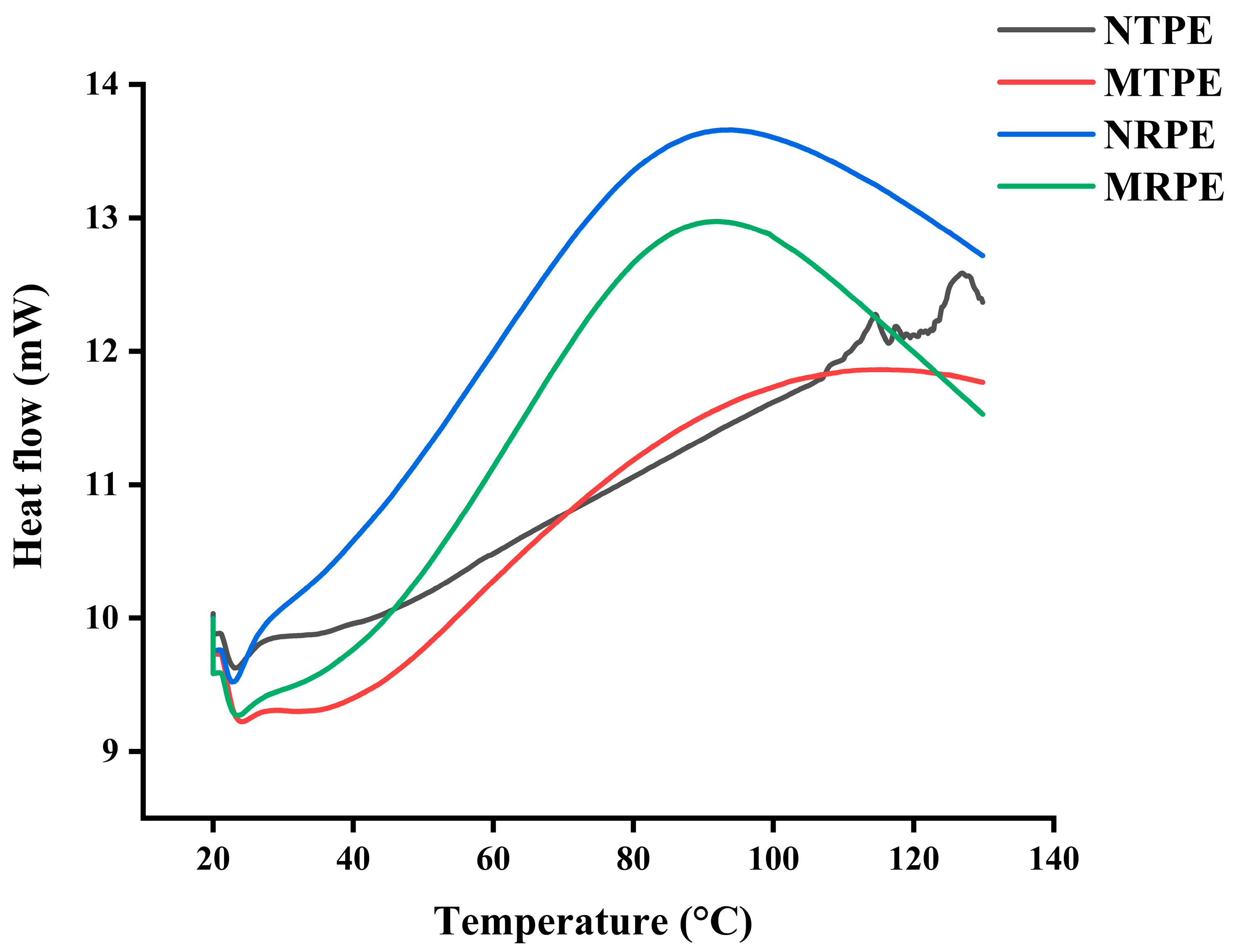
DSC thermograms of RPO-encapsulated powders revealed distinct thermal transitions, as indicated by the thermal parameters shown in Figure 2 and Table 1. The increasing heat flow with temperature signifies endothermic transitions corresponding to various thermal events. The order of peak intensity followed the trend NRPE > MRPE > NTPE > MTPE, suggesting differences in energy absorption among the samples. No significant difference in the initial melting temperature (TO) was observed among all samples (p > 0.05), indicating that moisture evaporation occurred prior to the onset of phase transitions. The recorded peak temperatures (Tm), representing the gelatinization temperatures for NTPE, MTPE, NRPE, and MRPE, were around 93 °C, 91 °C, 114 °C, and 112 °C, respectively. Interestingly, rice-based starch–PE samples (NRPE and MRPE) exhibited higher heat flow at lower peak temperatures than tapioca-based starches–PEs (p < 0.05), implying a greater energy requirement for their phase transitions. The higher peak observed in NRPE may be attributed to stronger molecular interactions within the native rice starch matrix. Although MRPE followed a similar trend, its lower peak suggests a reduction in thermal stability as a result of starch modification. Each sample displayed a characteristic endothermic peak, indicative of gelatinization or melting transitions. Tapioca-based starches–PEs demonstrated a broader melting range and slightly higher peak temperatures compared to rice starches–PEs. According to Liu et al. [46], this broader melting range may be associated with a greater crystallinity in tapioca starch granules. Typically, gelatinization temperatures range from 58.9 to 74.4 °C for rice starch [47] and 63 to 84 °C for tapioca starch [48]. However, in the present study, elevated peak temperatures and broader gelatinization ranges were observed, likely due to interactions between RPO and starches. Additionally, the melting point of crude RPO has been reported as 33.75 ± 0.63 °C [49]. This finding aligns with Liu et al. [46], who reported that RPO can increase gelatinization temperature through the formation of amylose–lipid complexes. The addition of lipids to starch has been shown to increase thermal stability, as confirmed by Maphalla and Emmambux [50], who also noted that such interactions broaden the melting range. The lower peak temperatures in tapioca-based samples compared to rice-based ones may be explained by tapioca starch’s lower amylose content, resulting in fewer amylose–lipid complexes, as also observed by Maphalla and Emmambux [50]. In summary, native starch-stabilized PE exhibited higher melting parameters than modified starch–PE, indicating more stable molecular structures. Regarding ΔH, the rice starch-based powders—particularly MRPE—showed higher enthalpy values than the tapioca-based powders, indicating that more energy was required for the melting/thermal transition detected in DSC. This suggests a stronger association between red palm oil and the starch-based Pickering interface and/or a more ordered lipid phase within the powder matrix, which may restrict lipid mobility and delay phase changes. Overall, these results imply an improved resistance to thermal changes during processing and storage.

3.4. FTIR Spectra

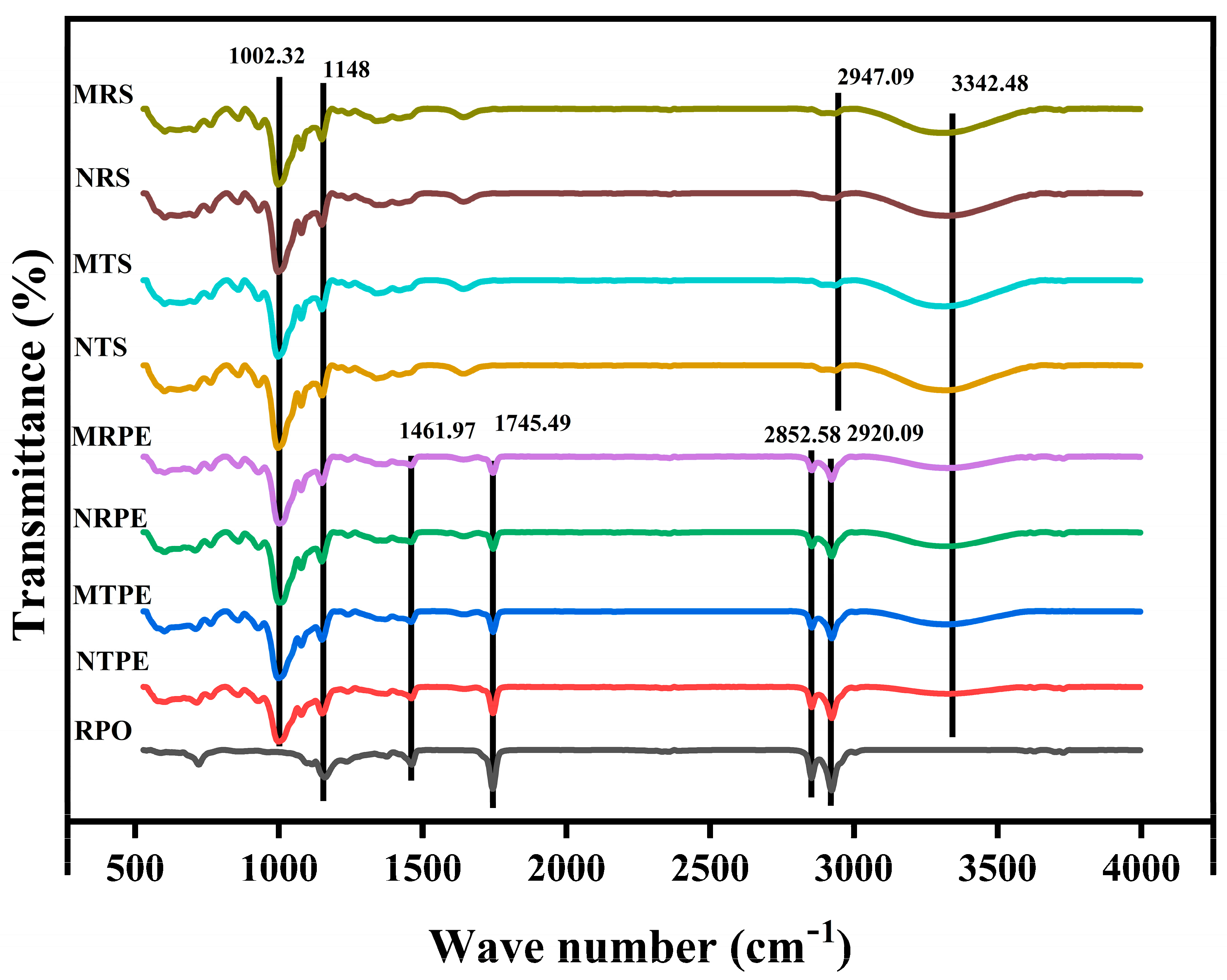
FTIR spectra of raw RPO and the freeze-dried microencapsulated powders showed characteristic bands associated with both lipid and starch components (Figure 3). The absorption near 1002 cm−1 is attributed to C–O stretching [51], while the band around 1148 cm−1 corresponds to C–O–C asymmetric stretching [52], which is typical of glycosidic linkages in polysaccharides such as starch. In addition, the band near 1461 cm−1, assigned to C–H bending vibrations [53], was observed in all samples, with a lower intensity in the microencapsulated powders compared with raw RPO. This reduction suggests a lower contribution of lipid-related vibrations at the sample surface and/or restricted lipid mobility due to entrapment within the starch matrix.
The region at 1735–1750 cm−1 is mainly associated with ester C=O stretching vibrations of triacylglycerols in RPO [54,55]. The carbonyl band in this region showed a reduced intensity in the microencapsulated powders relative to raw RPO, indicating a lower amount of exposed (surface) oil and supporting the effective physical entrapment of RPO within the starch-based matrix. Importantly, no new absorption bands were observed in the microencapsulated samples compared with the raw materials, suggesting that encapsulation occurred predominantly through physical incorporation rather than through the formation of new covalent bonds.
Overall, FTIR confirms the presence of typical starch and lipid functional groups [56] and supports reduced surface oil in the freeze-dried powders. However, the reduction in carbonyl-band intensity alone does not demonstrate specific chemical interactions or the formation of amylose–lipid complexes. The confirmation of such complexes would require complementary structural techniques, such as X-ray diffraction, differential scanning calorimetry, and/or NMR spectroscopy.

3.5. Morphological Characteristics

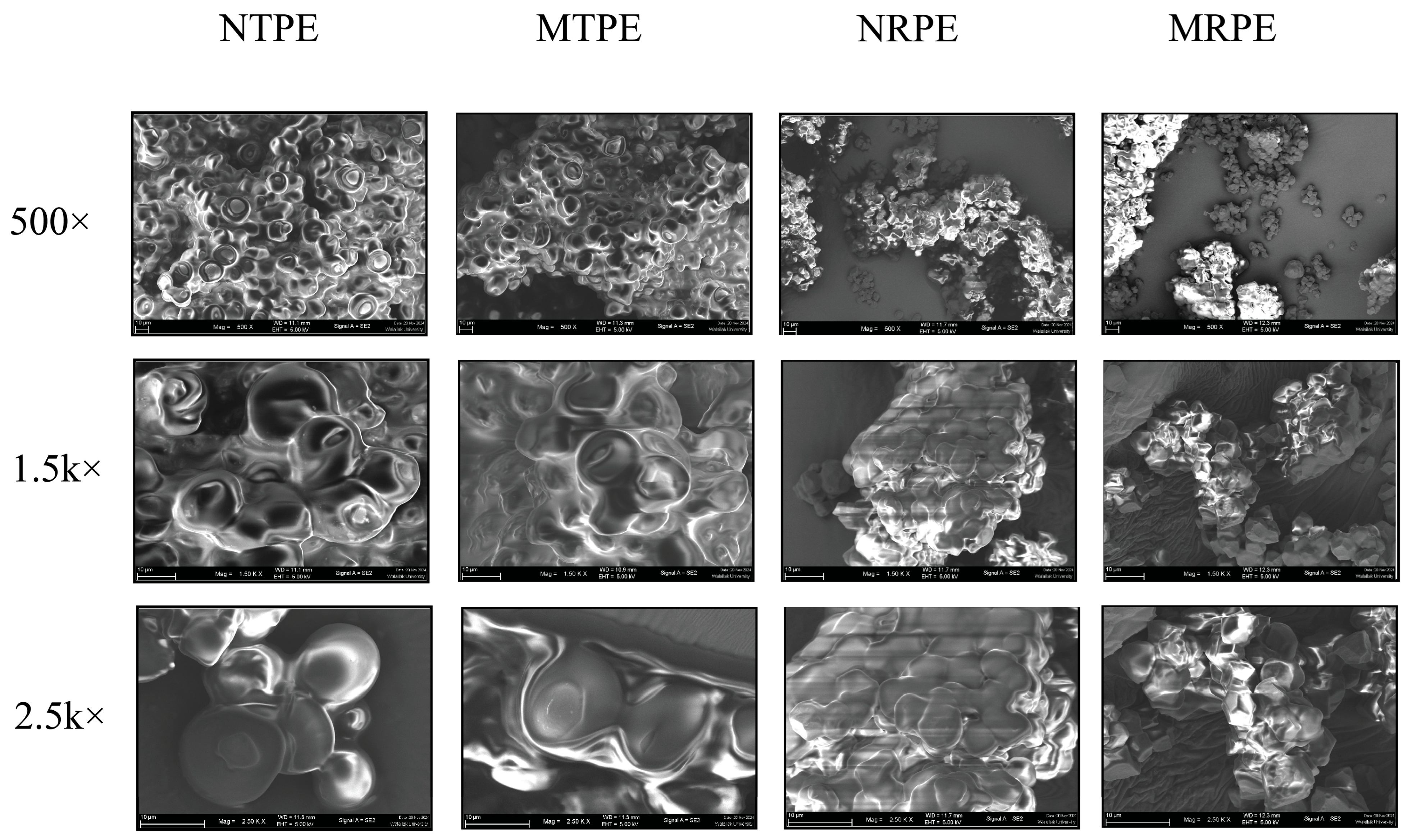
The surface morphology of the microcapsule powders from red palm oil-loaded Pickering emulsions stabilized with various native and modified starches was examined using SEM (Figure 4). The SEM images revealed distinct differences in surface structure among the samples. Notably, MRPE microcapsules displayed a more compact and densely packed structure, with smaller surface voids, indicating efficient encapsulation and tighter particle arrangement. Across all samples, oil encapsulation was evident, with visible traces of oil present on the particle surfaces, further confirming the successful incorporation of RPO into the starch matrices. The presence of surface oil also suggests partial surface deposition during the freeze-drying process; a characteristic often observed in oil-loaded microcapsules. Additionally, SEM images of rice starch-based microcapsules showed their inherent polyhedral shape with relatively smooth surfaces, consistent with previous findings by Hassan et al. [57]. These morphological features play a critical role in influencing the encapsulation efficiency, stability, and flow properties of the final powder products.

3.6. Physicochemical Changes in Microcapsule Powders from Red Palm Oil-Loaded Pickering Emulsions Stabilized by Native and Modified Starches During Storage

3.6.1. Color Stability

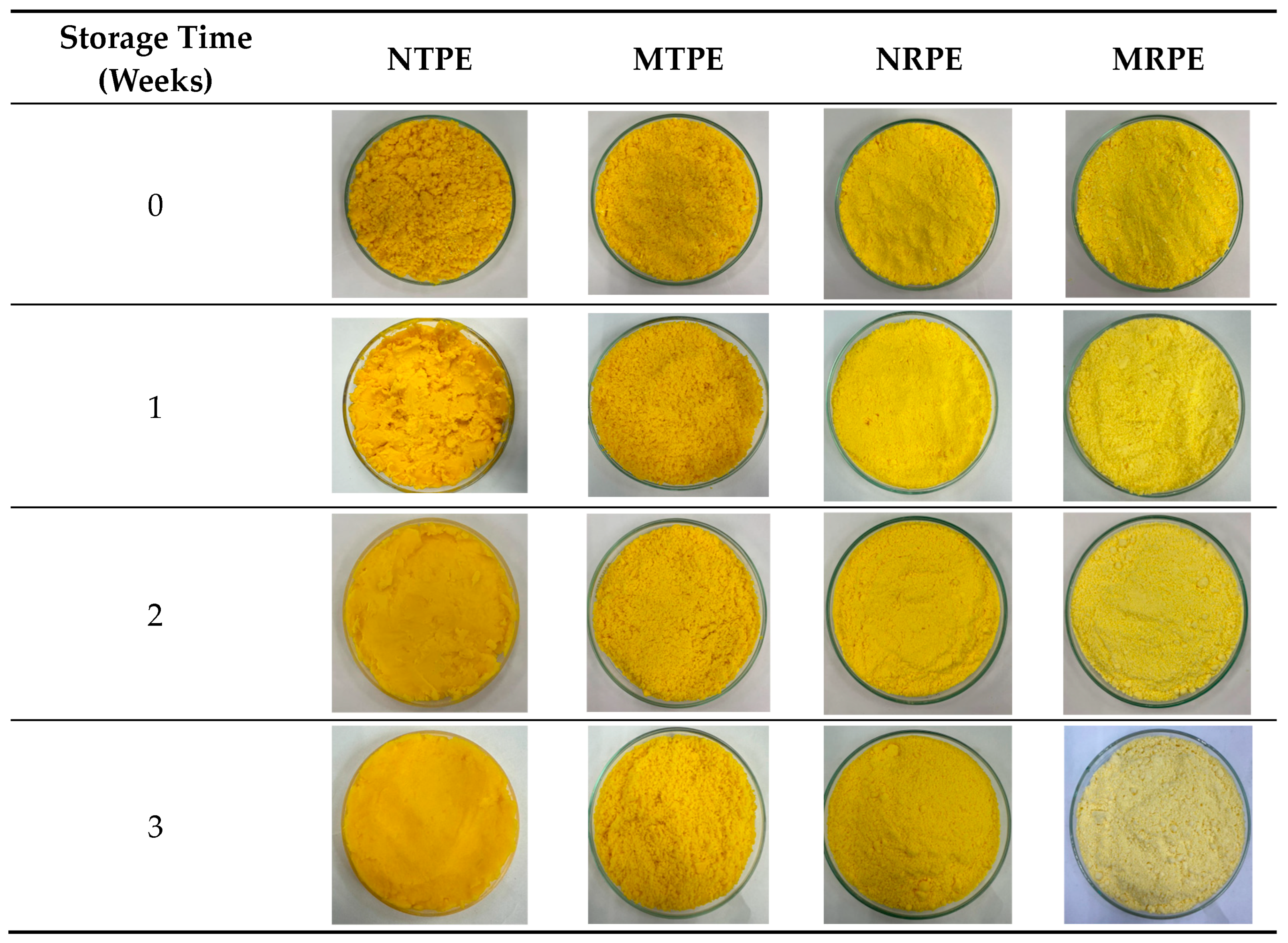
Table 2 presents the changes in color parameters (L*, a*, and b*) of microcapsule powders prepared from red palm oil-loaded Pickering emulsions stabilized by native and modified starches during storage at room temperature, while their visual appearance is shown in Figure 5. The L* values varied among samples, with MRPE exhibiting a significantly higher lightness throughout storage (p < 0.05). In contrast, tapioca starch-based samples showed higher a* and b* values, reflecting stronger pigmentation and greater carotenoid retention. Specifically, NTPE displayed higher values initially, whereas MTPE showed increased values in the later weeks (p < 0.05). These findings are consistent with the role of a* and b* values as indicators of pigmentation and carotenoid stability, with freeze-drying reported to enhance carotenoid retention in microcapsules [58]. The superior performance of tapioca starch may be attributed to its higher amylopectin content compared to rice starch, which could improve pigment stabilization. Overall, color intensity was highest at the beginning of storage but declined after three weeks, most notably in MRPE (Figure 5). The increase in L*, accompanied by reduced a* and b* values, as observed in MRPE at Week 3, corresponded to the discoloration and fading appearance evident in Figure 5.

3.6.2. Water Activity (aw) and pH

Table 2 shows the changes in the aw of microcapsule powders during 3 weeks of storage. All samples exhibited a gradual increase in aw over time (p < 0.05), with initial values ranging between 0.10 and 0.11. By the end of storage, MTPE maintained the lowest aw (0.22), whereas NTPE reached the highest (0.25) (p < 0.05). These differences likely reflect both the structural characteristics of the starches and the integrity of the resulting microcapsules, which influence moisture uptake and retention. The improved performance of MTPE may be attributed to the structural modification of tapioca starch, which enhances the moisture-binding capacity and limits free water availability. In contrast, native starches, with their less compact structures, are more susceptible to moisture absorption. The structural integrity of the microcapsules may further contribute to differences in moisture migration and sorption. These observations are consistent with Biliaderis [59], who reported that starches can form more stable complexes with water depending on their molecular structure and degree of modification. Overall, although aw increased during storage, all microcapsule powders retained low aw values, indicating good stability and the potential for an extended shelf life.
The initial pH of all emulsion formulations was approximately 6.70 prior to freeze-drying. After freeze-drying, slight decreases were observed, with pH values ranging from 5.84 to 6.26; the highest and lowest pH values were found in NTPE and MRPE, respectively (p < 0.05; Table 2). During storage, the pH of all samples remained relatively stable, or in some cases slightly increased, suggesting minimal hydrolysis or microbial degradation and reflecting the buffering effect of the phosphate buffer used in emulsion preparation. At Week 0, NTPE showed the smallest deviation from the initial pH, while MRPE exhibited the greatest change (p < 0.05). The lower pH values in modified starch-based formulations may be attributed to the partial hydrolysis of modified starch chains, leading to the release of acidic functional groups such as carboxyl groups [60]. This observation is consistent with Perrechil et al. [61], who reported that higher concentrations of modified starches were associated with a decreased pH in emulsion systems. Minor pH fluctuations during storage may also reflect starch retrogradation and structural rearrangements. Overall, the limited changes in pH across the 3-week storage period indicate the good chemical stability of the microcapsule powders, supporting their suitability for short- to medium-term storage under the tested conditions.

3.6.3. Particle Size Diameter, Polydispersity Index (PDI), and Zeta Potential

The particle size of the microcapsules showed fluctuations during storage, with slight increases or decreases depending on the formulation and storage time (Table 3). It should be noted that particle size was determined after re-dispersion of the freeze-dried powders; therefore, the reported values represent the apparent size of reconstituted particles/aggregates rather than only the primary microcapsules. At Week 0, immediately after freeze-drying, particle sizes were relatively large, particularly in NTPE (5888 nm) and MTPE (9057 nm), suggesting poor dispersion or temporary particle aggregation during rehydration. These elevated values may also reflect incomplete stabilization and structural disruption caused by the freeze-drying process. During storage, variations in particle size were noted, with occasional increases that could be attributed to powder agglomeration/caking and moisture-induced bridging, which are common in dried systems exposed to moisture migration [62]. Conversely, occasional decreases may result from the break-up of weak agglomerates during sample re-dispersion prior to particle size measurement, leading to a lower apparent size. Accordingly, the large week-to-week shifts (including micron-range changes) are interpreted as changes in the extent of agglomeration and redispersion behavior during storage, rather than true changes in primary microcapsule size. Such changes appear to be influenced by starch type and modification, as starch structure affects emulsion stability and lipid–starch interactions. However, the particle size data alone do not confirm the formation of lipid–starch (amylose–lipid) complexes; therefore, this is presented only as a possible contributing mechanism, and would require complementary structural evidence (e.g., XRD/DSC) for confirmation. Overall, particle size fluctuations during storage highlight the combined effects of starch type, molecular interactions, and physical phenomena such as agglomeration on the stability of microcapsule powders.
The polydispersity index (PDI) reflects the uniformity of particle size distribution, with lower values indicating more homogeneous dispersions [63]. A PDI below 0.40 is generally regarded as characteristic of a stable emulsion system [3]. In this study, several samples exceeded this stability threshold after the first week of storage. MTPE- and MRPE-based powders showed consistently high initial PDI values (PDI > 0.50; Table 3), suggesting broad size distributions, reduced uniformity, and a greater tendency toward phase separation or aggregation. In contrast, NTPE and NRPE displayed significantly lower initial PDI values (p < 0.05). Interestingly, despite its high starting values, MRPE maintained a relatively stable PDI throughout storage and achieved the lowest value by Week 3, implying a superior emulsification efficiency and structural integrity after freeze-drying. MTPE also retained its PDI values over time, although at consistently higher levels. These trends point to the functional advantages of modified starches, particularly modified rice starch, whose structural modifications enhance stability and resistance to breakdown. While previous studies reported that increasing the emulsifier content can reduce the PDI [64], the present results, obtained without added emulsifiers, underscore the crucial role of starch type and modification in controlling particle size distribution. The gradual increase in PDI during storage, especially under stress conditions, is likely driven by particle aggregation and the partial disruption of the Pickering emulsion barrier. Overall, the findings demonstrate that starch modification, particularly with rice starch, contributes to improved emulsion stability and more uniform particle size distribution during storage.
The zeta potential is a key indicator of electrostatic stability in emulsion systems. In this study, all samples initially exhibited negative zeta potential values at Weeks 0 and 1 (−27 to −32 mV), suggesting sufficient electrostatic repulsion to prevent aggregation and maintain stability (Table 3). The negative charges are consistent with the presence of hydroxyl and carboxyl groups in starch molecules [65]. However, by Weeks 2 and 4, a reversal in charge polarity was observed, with values shifting from negative to positive (+18 to +26 mV). Typically, emulsions with zeta potentials beyond ±30 mV are considered stable due to strong repulsive forces [66]. The polarity shift observed here contrasts with the findings of Comunian et al. [67], who reported protein-stabilized emulsions showing positive zeta potentials at low pH (~3) and negative values at high pH (~8). In our starch-based system, the opposite trend emerged, suggesting complex pH-dependent interactions between starch and RPO. Because the zeta potential was measured at weekly intervals, the current dataset indicates that the polarity reversal occurred between Week 2 and Week 3; however, the specific day of transition cannot be identified without higher-frequency measurements.
The reversal of the zeta potential during storage may result from several factors. Increased particle mobility over time can promote partial aggregation, reducing effective surface charge [68]. Lipid oxidation and microcapsule degradation may also modify surface chemistry, while moisture migration and structural rearrangements could redistribute surface ions. Furthermore, pH variation was found to influence charge dynamics, consistent with previous reports [69]. Together, these factors may lead to charge neutralization and subsequent sign reversal; however, confirming the dominant mechanism would require additional supporting evidence (e.g., concurrent monitoring of pH/ionic conditions and complementary surface/chemical analyses), which was beyond the scope of the present study. Collectively, these processes contributed to the observed charge reversal, which is unfavorable for long-term stability. Without additional stabilizers, starch-based formulations may therefore not be ideal for extended storage applications.

3.7. Stability of Bioactive Compounds of Microcapsule Powders from Red Palm Oil-Loaded Pickering Emulsions Stabilized by Native and Modified Starches During Storage

3.7.1. Total Phenolic Content (TPC)

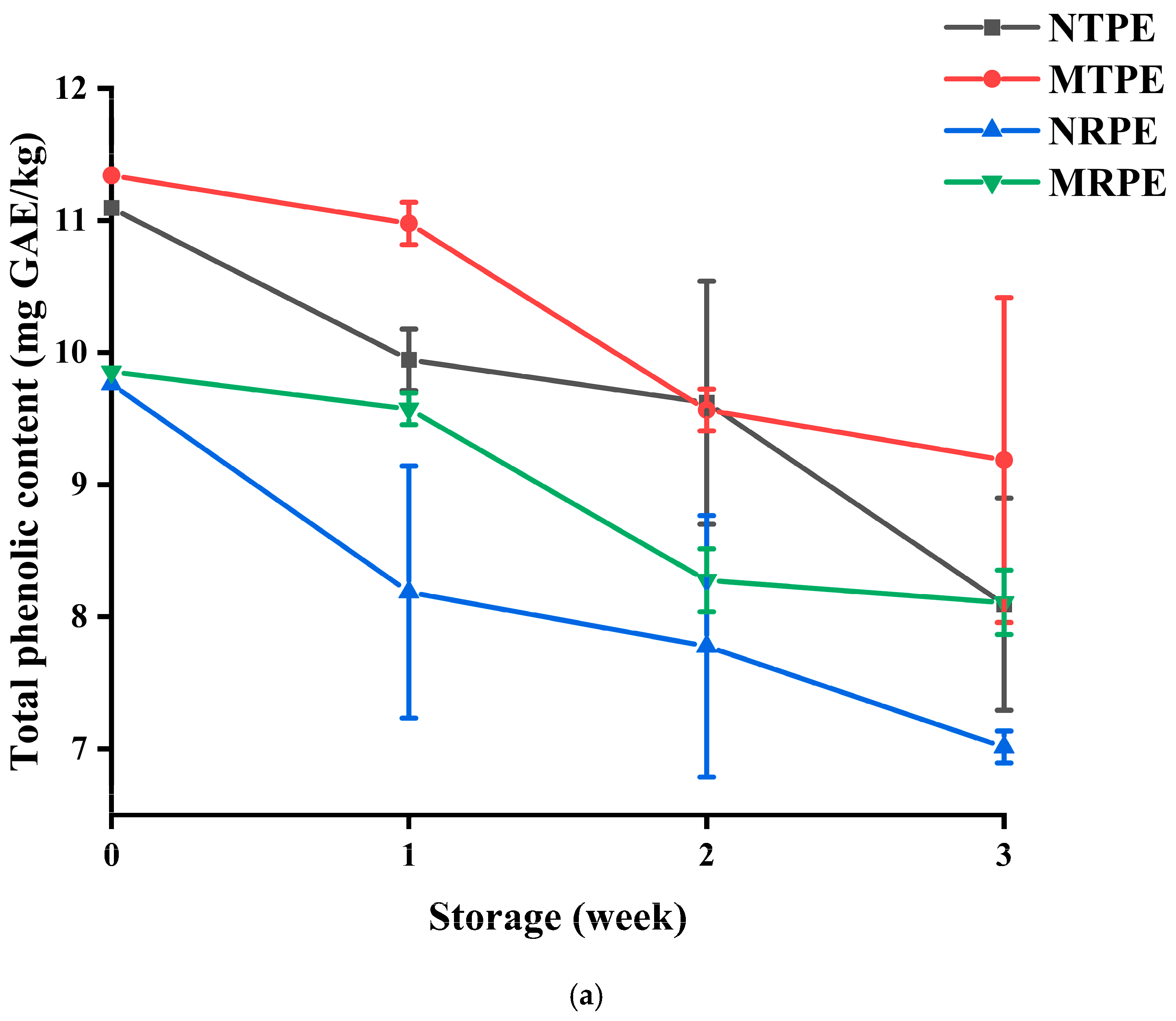
The TPC of the microcapsule powders was highest at Week 0 and gradually declined over the 3-week storage period, as illustrated in Figure 6a. All samples exhibited statistically significant differences (p < 0.05) across the storage weeks. TPC values ranged from 11.34 to 7.01 mg GAE/kg, with the highest recorded in MTPE and the lowest in NRPE (p < 0.05). This overall declining trend is consistent with previous findings by Recamales et al. [70], who reported a reduction in phenolic content over time, particularly under elevated storage temperatures. In food systems, phenolic compounds interact non-covalently with starch molecules through electrostatic, hydrophobic, and hydrogen bonding interactions [71]. These interactions influence the retention and release of phenolics during storage. Phenolic compounds, which contain an aromatic benzene ring substituted with hydroxyl groups, play a crucial role in inhibiting lipid oxidation, reducing off-flavors, and enhancing color stability in meat products [72]. However, their inherent sensitivity to environmental factors such as heat, light, and oxygen makes them prone to oxidative degradation [73]. Among all samples, MTPE maintained the highest TPC throughout storage (p < 0.05), suggesting that the modification of tapioca starch enhanced its capacity to form starch–polyphenol complexes. This structural improvement likely contributed to the better protection, stability, and bioavailability of phenolic compounds during storage. Therefore, the use of modified starches, particularly modified tapioca starch, demonstrates a promising strategy for extending the shelf life and functional efficacy of phenolic-rich emulsion powders.

3.7.2. Total Carotenoid Content

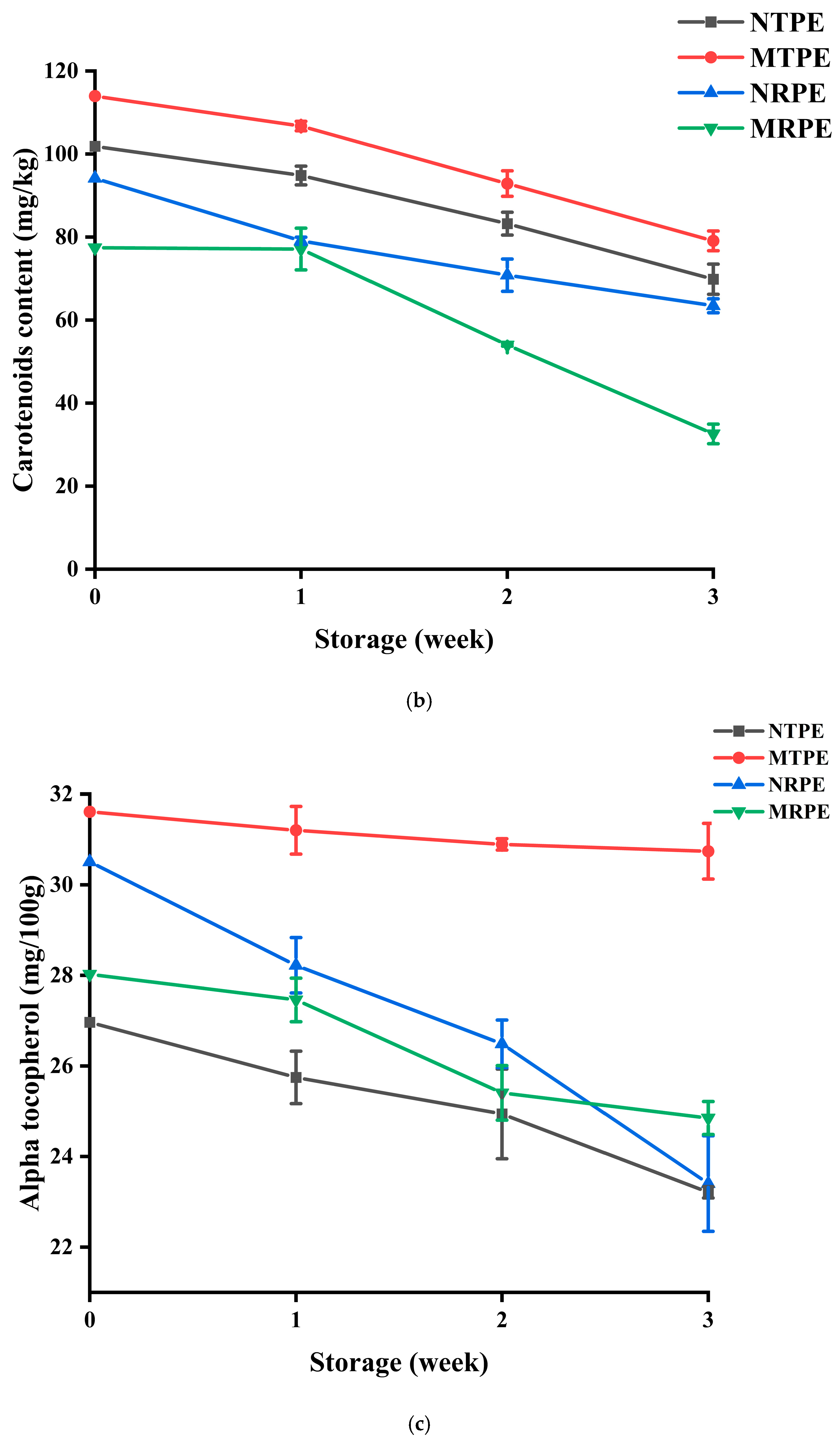
The total carotenoid content of the microcapsule powders was highest at Week 0 and gradually declined through Week 3 (p < 0.05), as shown in Figure 6b. This trend was consistent across all formulations, with MTPE exhibiting the greatest carotenoid retention after 3 weeks of storage. Previous studies have also reported carotenoid instability; for example, Deng et al. [74] observed rapid degradation at temperatures above 25 °C, while Ayetigbo et al. [75] documented carotene losses of 34%, 44%, and 73% after the boiling, hot-air drying, and sun-drying of cassava roots, respectively. Among the tested formulations, MTPE demonstrated a superior carotenoid stability. This enhanced retention can be attributed to the effective encapsulation properties of modified tapioca starch, which forms a denser and more cohesive matrix around RPO droplets. The smoother, larger granules of tapioca starch allow tighter packing, thereby limiting oxygen and light exposure, two key drivers of carotenoid degradation. In addition, the formation of amylose–lipid inclusion complexes within the starch structure contributes to stabilizing sensitive compounds [71]. Although tapioca starch contains slightly less amylose than rice starch, its favorable structural characteristics compensate for this, resulting in the better entrapment and protection of carotenoids. In contrast, while native rice starch also formed inclusion complexes, the modification process in MRPE appeared to disrupt this interaction, leading to a lower carotenoid retention. Overall, these findings underscore the potential of starch-based encapsulants, particularly modified tapioca starch, to preserve carotenoids during storage, offering a promising strategy for stabilizing carotenoid-rich functional food powders.

3.7.3. α-Tocopherol Content

RPO is a rich natural source of vitamin E, with tocopherols representing approximately 30% of its total vitamin E content [76]. The effective encapsulation of α-tocopherol plays a crucial role in enhancing antioxidant activity [77]. In our study, α-tocopherol concentration exhibited a decreasing trend over time, as shown in Figure 6c, consistent with findings from previous research by Francis et al. [78] and Kaur et al. [79]. Among the samples, MTPE demonstrated the highest α-tocopherol retention throughout the storage period (p < 0.05), outperforming its native counterpart, which recorded the lowest retention. Interestingly, NRPE powder initially showed greater α-tocopherol retention than MRPE; however, after two weeks, the MRPE exhibited superior retention, aligning with previous studies reporting enhanced α-tocopherol stability with large-ring cyclodextrin encapsulation [80]. Augustin and Sanguansri [81] also observed that modified wall materials significantly slow tocopherol degradation in oil-based food systems. This improved protection is likely due to structural changes in modified starches, which enhance their ability to encapsulate and shield α-tocopherol from oxidative degradation during storage. Supporting this, Alkandari et al. [82] suggested that starch modification reduces the exposure of bioactive compounds to oxygen and light, thereby improving their retention. Moreover, it is plausible that the bioactive components of RPO interact synergistically with modified starches, especially in the MTPE sample, further enhancing the stability of α-tocopherol throughout storage.

3.8. Stability of Radical Scavenging Activities of Microcapsule Powders from Red Palm Oil-Loaded Pickering Emulsions Stabilized by Native and Modified Starches During Storage

3.8.1. DPPH Scavenging Activity

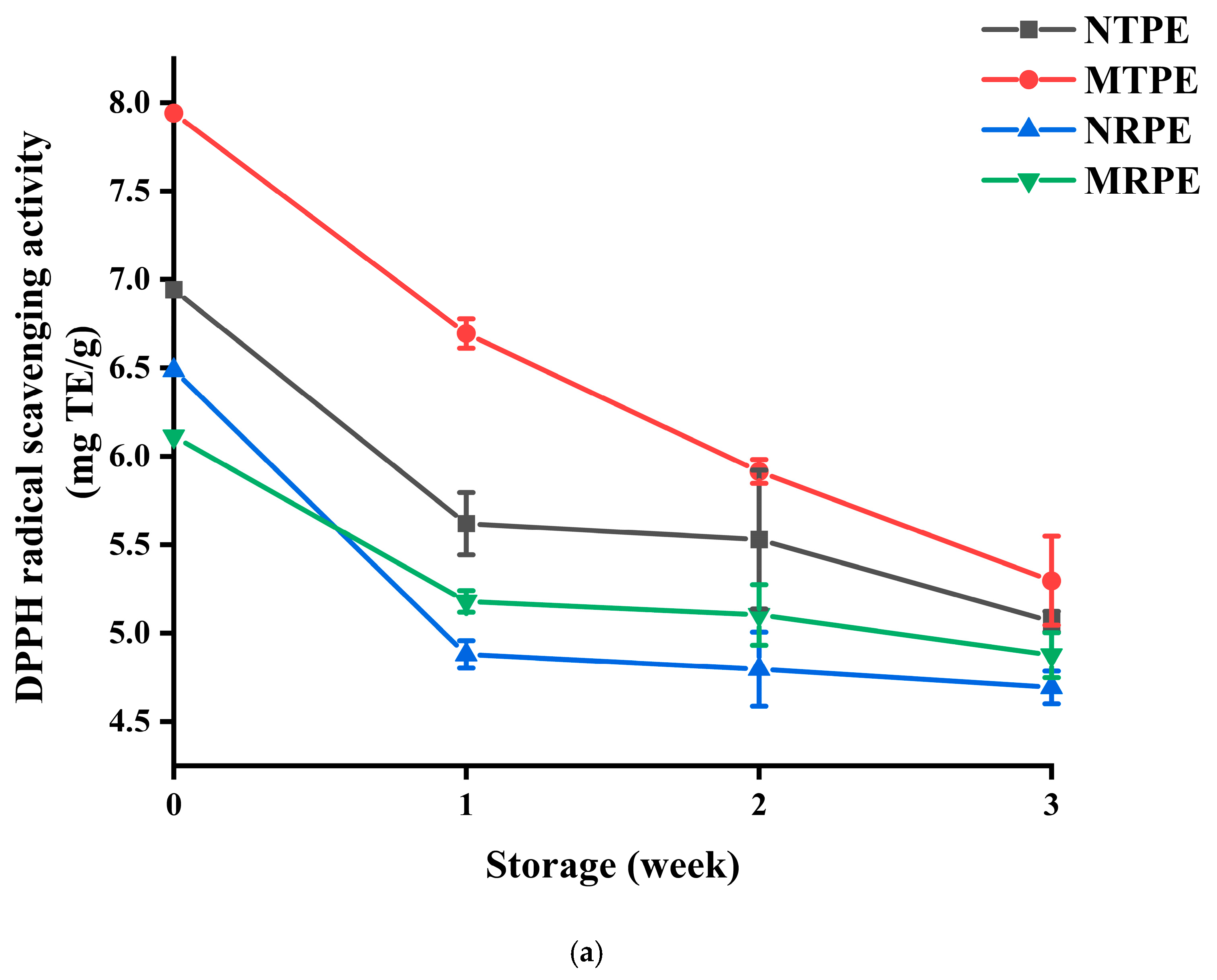
The DPPH scavenging activity of red palm oil-loaded Pickering emulsions stabilized by various native and modified starches was monitored over a 3-week storage period and showed a gradual decline from Week 0 to Week 3 (p < 0.05) for all samples, as illustrated in Figure 7a. This decreasing trend aligns with previous findings by Verma et al. [83], who reported a significant reduction in antioxidant activity in emulsion systems during storage due to oxidative degradation. Among the samples, MTPE consistently exhibited the highest DPPH scavenging activity across all weeks (p < 0.05), while NRPE showed the lowest value at the end of storage. The variation in antioxidant activity among samples may be attributed to the differential retention and stability of lipophilic antioxidants such as carotenoids and tocopherols during encapsulation and storage, as well as the intrinsic sensitivity of the DPPH assay to these compounds. The DPPH assay measures the radical scavenging capacity by evaluating the ability of antioxidants to neutralize DPPH radicals [84]. The superior performance of the MTPE sample suggests a more effective encapsulation and retention of oil-soluble antioxidants, likely due to structural modifications in the tapioca starch, which enhance the accessibility and reactivity of antioxidants. Since DPPH is more soluble in organic solvents, it is particularly responsive to lipophilic antioxidants, which were more effectively preserved in the MTPE formulation. The gradual decline in DPPH scavenging activity over time can be attributed to the generation of free radicals during lipid oxidation, which diminishes antioxidant potential [83]. These findings highlight the influence of starch type and modification on antioxidant preservation, suggesting that chemical modification can improve the encapsulation efficiency and radical scavenging performance of starch-based systems.

3.8.2. ABTS•+ Scavenging Activity

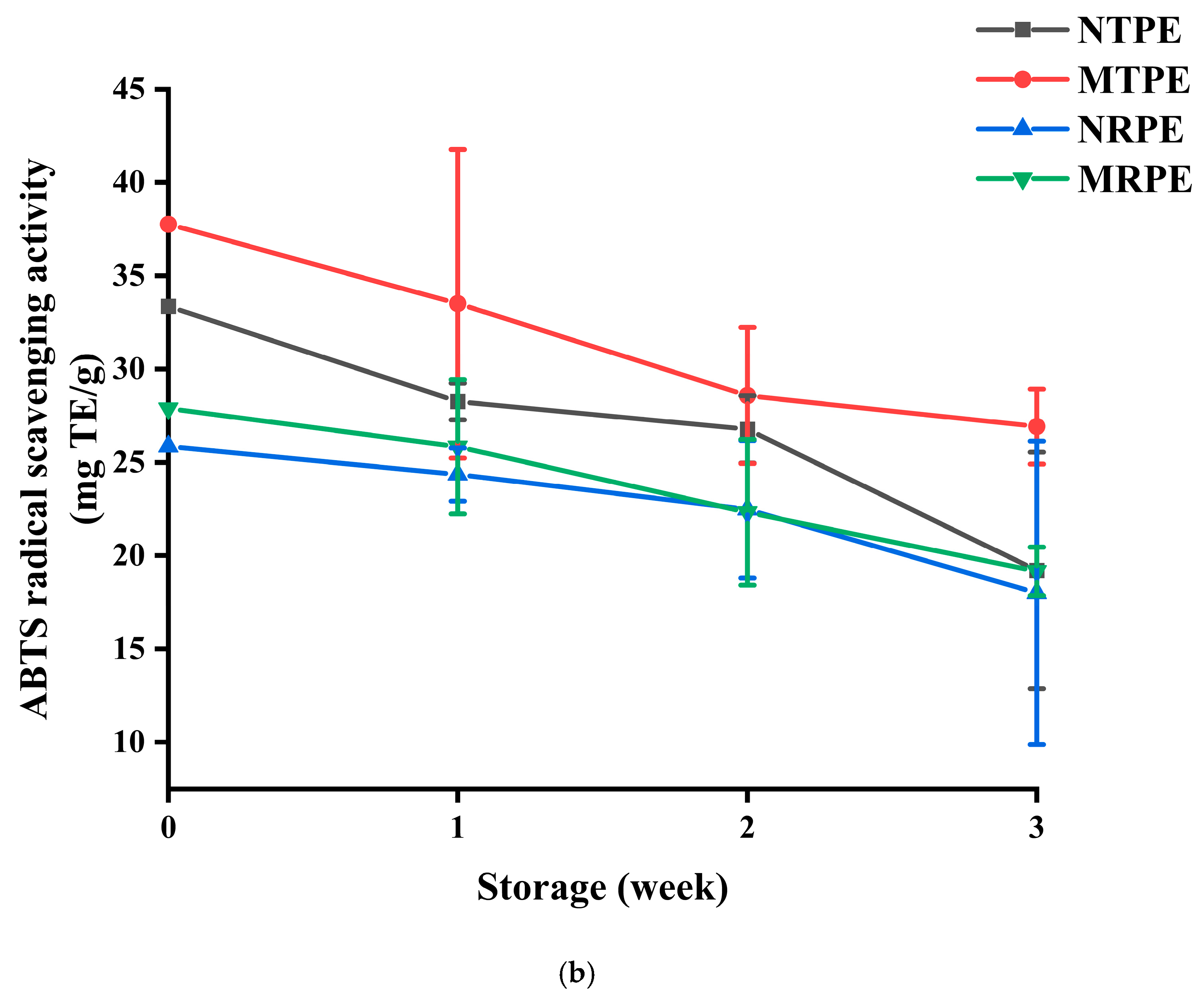
The ABTS•+ scavenging activity of red palm oil-loaded Pickering emulsions stabilized by various native and modified starches exhibited a gradual decline from Week 0 to Week 3 across all samples (p < 0.05), although the differences over time were statistically non-significant (p > 0.05), as shown in Figure 7b. Throughout the storage period, the highest ABTS•+ scavenging activity was consistently observed in the MTPE sample, while NRPE showed the lowest values (p < 0.05), as observed in the DPPH assay. By the third week, the antioxidant activities of all samples converged to similar levels, yet MTPE continued to maintain the highest activity (p < 0.05), followed by NTPE. Notably, MTPE exhibited superior antioxidant activity in both DPPH and ABTS assays, demonstrating its effectiveness against non-polar and polar free radicals. These results highlight the potential of MTPE as a promising agent for enhancing the oxidative stability of emulsion-based systems. The observed decreasing trend in ABTS•+ scavenging activity over time is in agreement with the findings of Verma et al. [83], who reported a similar decline in antioxidant capacity in stored pork emulsions. The relatively higher ABTS•+ scavenging values in MTPE and NTPE suggest that these formulations effectively retained compounds capable of scavenging ABTS radicals. The enhanced performance of the modified starch sample may be attributed to the improved retention of bioactive compounds following starch modification, as also noted by Alkandari et al. [82]. In addition, the elevated ABTS•+ scavenging activity in tapioca-based samples could be linked to a higher content of phenolic compounds, which are more abundant in NTPE and MTPE compared to rice-based samples (NRPE and MRPE). Despite these differences, the overall decline in antioxidant activity across all samples is likely due to progressive oxidative degradation during storage.

3.9. Lipid Stability of Microcapsule Powders from Red Palm Oil-Loaded Pickering Emulsions Stabilized by Native and Modified Starches During Storage

3.9.1. Lipolysis

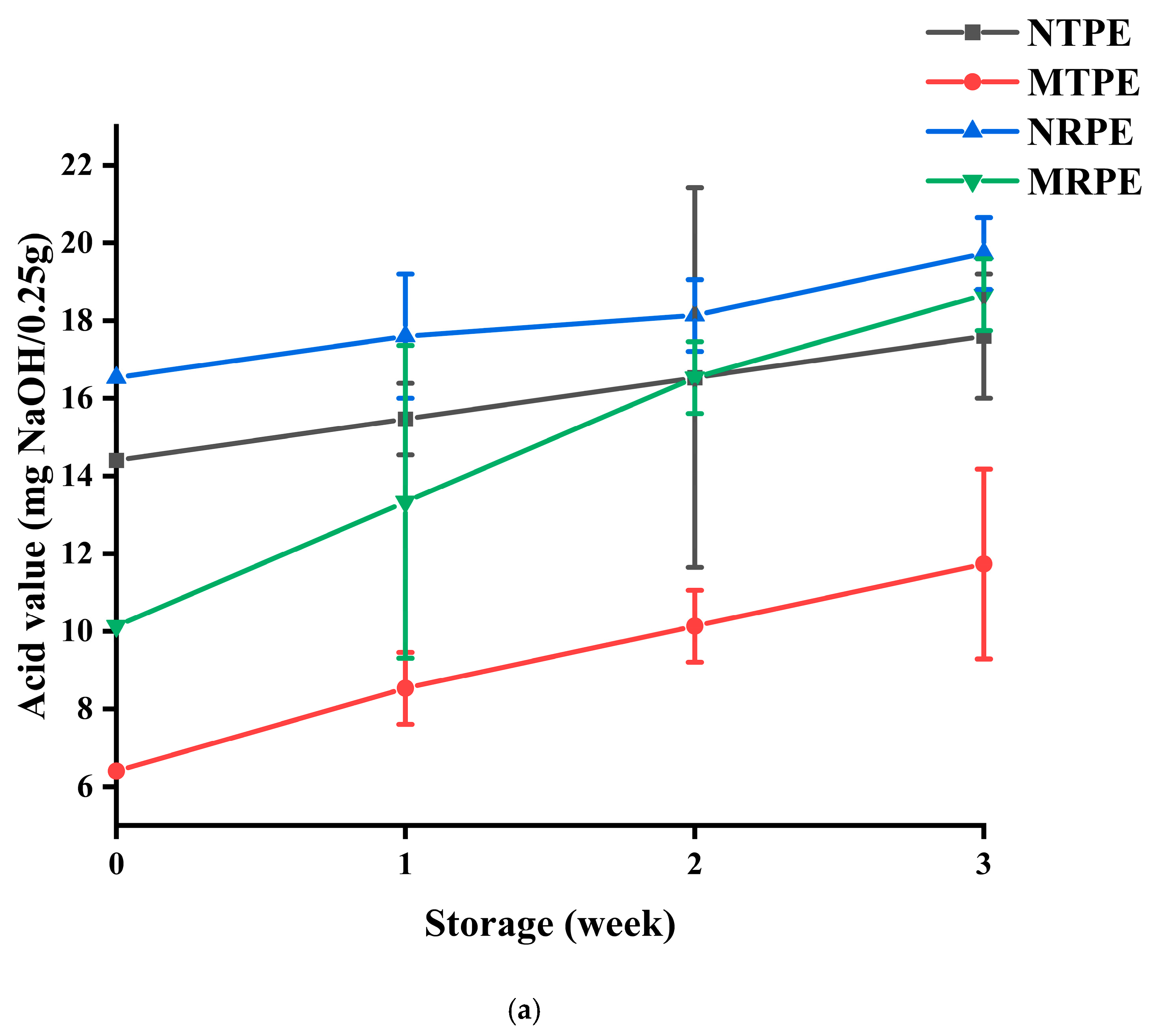
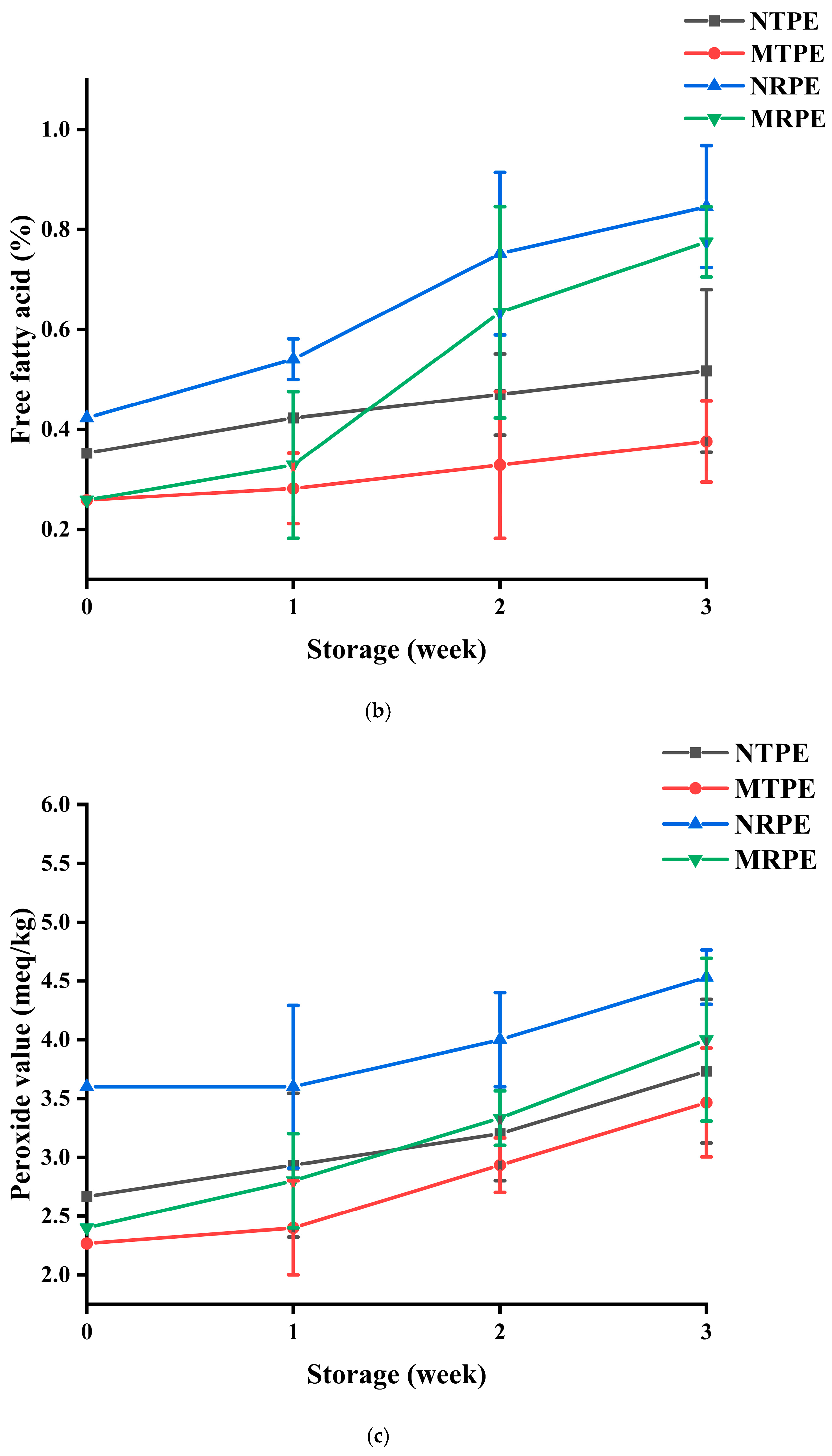
Acid value (AV) is a critical indicator of hydrolytic rancidity in oils and oil-based products, reflecting the extent of free fatty acid (FFA) formation due to lipid hydrolysis [85]. This rancidity accelerates in the presence of heat, enzymatic activity, and microbial contamination, all of which contribute to the breakdown of triglycerides into FFA [86]. In this study, statistically significant differences in AV were observed across all storage weeks (p < 0.05). Both AV and FFA levels showed a consistent increasing trend over time for all starch-based microcapsules (p < 0.05), aligning with previous findings on AV progression and FFA development in emulsion systems [83]. As illustrated in Figure 8a,b, MTPE exhibited the lowest AV and FFA values, while NRPE recorded the highest (p < 0.05). Samples formulated with modified starches demonstrated lower AV and FFA values compared to their native counterparts (p < 0.05). This improvement is likely due to enhanced encapsulation efficiency, which provided a stronger protective barrier against oxidative and hydrolytic degradation. Modification alters the starch structure, reducing the reactivity of radicals and hindering the breakdown of lipid hydroperoxides (LOOH) into reactive alkoxyl (LO) and peroxyl (LOO) species [87]. Furthermore, MTPE outperformed MRPE in limiting hydrolytic rancidity, which may be attributed to the higher amylopectin content in tapioca starch. Amylopectin forms a more compact and denser matrix around oil droplets, effectively restricting oxygen diffusion and protecting encapsulated lipids from degradation. This structural advantage contributes to the superior oxidative and hydrolytic stability observed in MTPE over the storage period.

3.9.2. Lipid Oxidation

The peroxide value (PV) is a key indicator of primary lipid oxidation, reflecting the formation of hydroperoxides during oxidative deterioration. As shown in Figure 8c, PV increased significantly over time across all samples, with statistically significant differences observed each week (p < 0.05). Among the formulations, the NRPE sample exhibited the highest PV, while MTPE consistently recorded the lowest values throughout the storage period (p < 0.05). Increasing aw (Table 2) has been linked to enhanced lipid oxidation, as noted by Charles et al. [88], due to the greater mobility of reactants and oxygen. The lower PV observed during the initial weeks is likely due to the higher endogenous antioxidants like carotenoids, phenolics and tocopherols in the samples, which acted as natural antioxidants and helped suppress early oxidative reactions [89]. However, all samples displayed an increase in PV during storage, suggesting insufficient protection against oxygen diffusion and subsequent hydroperoxide formation within the microcapsules. This observation is consistent with Elik et al. [89], who reported that the PV in microcapsule powders could rise from 28 to 66 meq O2/kg oil after 28 days of storage. The superior oxidative stability of MTPE can be attributed to the functional improvements conferred by starch modification. As reported by Hosseini and Ansari [90] and Javadian et al. [91], modified starches exhibit an enhanced oil absorption capacity and improved matrix formation. These properties likely contributed to a more robust barrier around the encapsulated oil, limiting oxygen exposure and slowing the formation of oxidation products. This explains the lower PVs observed in MTPE, indicating greater protection and improved storage stability against the evolution of primary lipid oxidation products.
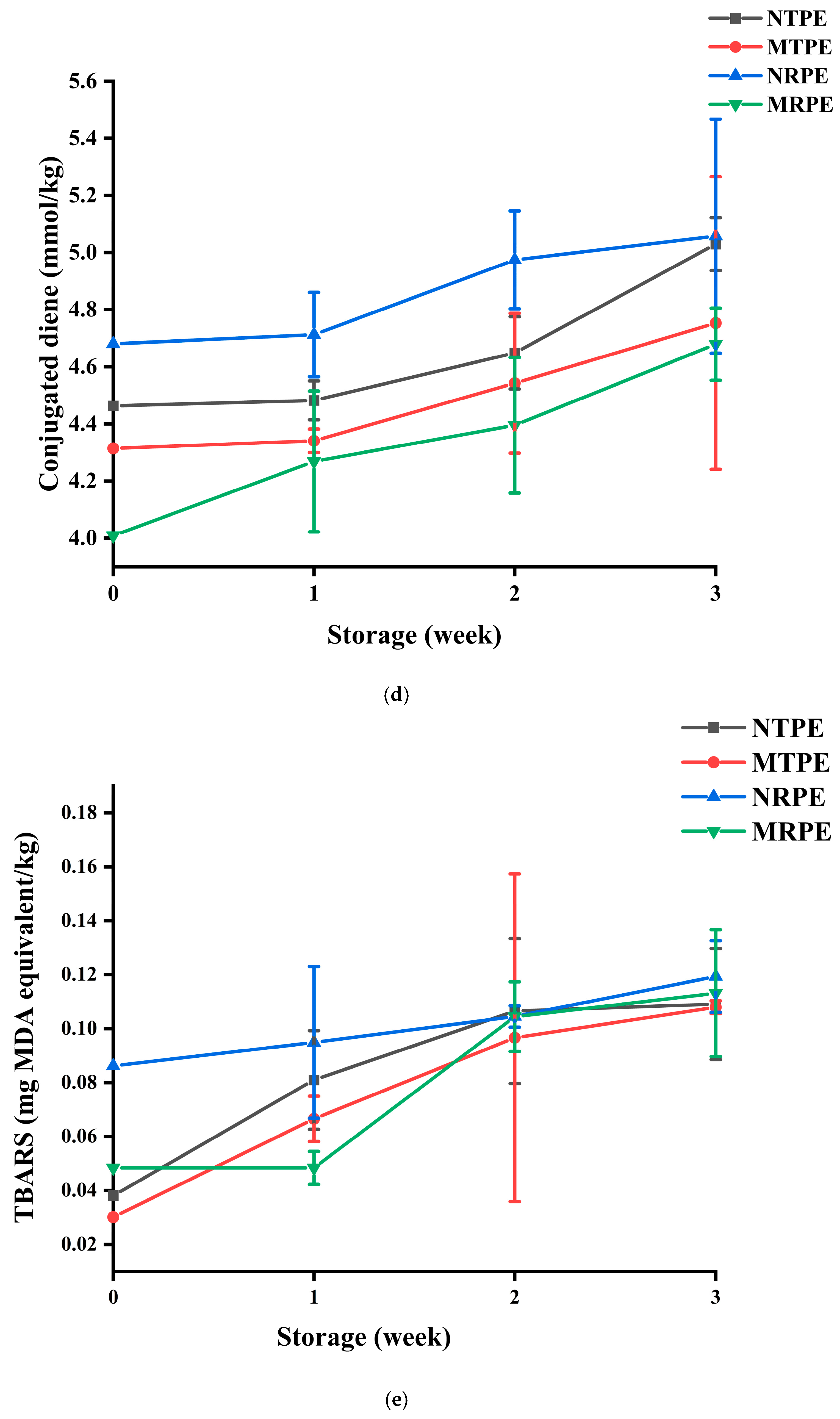
Similarly, the conjugated diene (CD) level, a marker of early-stage lipid oxidation, also increased with time across all samples (p < 0.05), with statistically significant differences (Figure 8d). The highest values were observed in NRPE, including at Week 0, while MRPE showed the lowest levels (p < 0.05). NTPE and MTPE displayed intermediate values with comparable trends. These results are in agreement with prior research by Talón et al. [92], Ribeiro et al. [15], and Orlien et al. [93], who reported increasing CD formation in emulsified and encapsulated oils stored under various conditions. The initially higher CD values, especially in NRPE, could be due to oxidative exposure during emulsion preparation and the incorporation of air, as also suggested by Ribeiro et al. [15]. Additionally, a certain degree of oxidation likely occurs during the drying process itself [94]. Overall, the CD levels observed in our study were lower than those reported by Athanasiadis et al. [95] and Drusch and Schwarz [94], indicating relatively improved oxidative protection. The lower levels observed in modified starch samples, particularly MRPE and MTPE, may be attributed to the structural changes imparted by starch modification. Cross-linking during modification enhances molecular rigidity and forms a more robust three-dimensional matrix, which more effectively entraps the oil and prevents oxidation. This improved encapsulation limits oxygen diffusion and stabilizes the lipophilic contents, thereby reducing the formation of oxidation products during storage.
Thiobarbituric acid reactive substances (TBARS) are key indicators of secondary lipid oxidation products, and, in this study, their levels varied over the 3-week storage period, showing a general increasing trend (Figure 8e). Among the samples, the highest TBARS value was recorded in NRPE, while the lowest was observed in MTPE (p < 0.05). Notably, samples prepared with modified starches exhibited lower TBARS levels than their native counterparts (p < 0.05). Elik et al. [89] observed a TBARS value of 0.18 mmol/kg in freeze-dried flaxseed oil microcapsules. RPO naturally contains potent antioxidants such as tocopherols and carotenoids. It is likely that the modified tapioca starch matrix in MTPE offered a superior encapsulation and retention of these bioactive compounds, thus enhancing oxidative stability. In contrast, native starch matrices may not interact as effectively with lipophilic antioxidants [96]. Rashwan et al. [97] also noted that starch modification improves heat resistance and prolongs antioxidant retention during storage. In conclusion, the lipid oxidation of microencapsulated powders was influenced by the starch used and storage time. All samples had low lipid oxidation during storage for 3 weeks at room temperature, as shown by the low oxidative indices, PV, CD, and TBARS, suggesting the oxidative stability of the starch-based microcapsules of red palm oil-loaded Pickering emulsions.

4. Conclusions

Microcapsule powders from red palm oil-loaded Pickering emulsions were successfully developed using native and modified tapioca and rice starches as natural stabilizers. Among all formulations, MRPE exhibited the highest encapsulation efficiency of RPO, whereas MTPE showed superior storage performance, including the lowest water activity, minimal lipid oxidation, and the highest retention of key bioactive compounds (carotenoids and total phenolics), along with the strongest radical scavenging activity. These findings highlight the potential of modified tapioca starch as an effective stabilizer for emulsifier-free Pickering emulsion powders aimed at delivering lipid-soluble bioactives from RPO in functional food applications. The successful encapsulation with low oxidative deterioration suggests a promising potential for food fortification, dietary supplements, nutraceuticals, and feed additives, particularly where oxidative stability is a critical requirement.
However, the storage period evaluated in this study represents a short-term stability assessment and is not sufficient for reliable kinetic modeling or extrapolation to predict long-term shelf life. Future work should therefore include longer storage studies and/or accelerated testing at multiple temperatures with additional sampling points to enable kinetic analysis and more robust shelf-life prediction. Further research is also warranted to improve encapsulation efficiency while maintaining the clean-label concept, and to evaluate the behavior of these RPO microcapsules in complex food/feed matrices to confirm real-world applicability and functional performance.

Author Contributions

Conceptualization, A.M., M.C., P.R., C.W. and W.P.; methodology, A.M., M.C., P.R., C.W. and W.P.; software, A.M.; validation, A.M., M.C., P.R., C.W. and W.P.; formal analysis, A.M.; investigation, A.M., M.W., K.A. and M.A.; resources, M.C. and W.P.; data curation, A.M., M.W., K.A. and M.A.; writing—original draft preparation, A.M., M.C. and W.P.; writing—review and editing, A.M., M.C., P.R., C.W., L.-Z.C. and W.P.; visualization, A.M., M.C. and W.P.; supervision, M.C., P.R., C.W., L.-Z.C. and W.P.; project administration, M.C. and W.P.; funding acquisition, M.C. and W.P. All authors have read and agreed to the published version of the manuscript.

Funding

This research was funded by Walailak University Ph.D. Scholarships for High Potential Candidates to Enroll in Doctoral Programs, Thailand [Contract No. 21/2023]. Also, this research was financially supported by Walailak University Graduate Research Fund, Thailand [Contract No. CGS-RF-2025/04]. This project is conducted within the Reinventing project for Enhancing Thai Universities into the International Education, the Ministry of Higher Education, Science, Research and Innovation.

Institutional Review Board Statement

Not applicable.

Data Availability Statement

The original contributions presented in this study are included in the article. Further inquiries can be directed to the corresponding author.

Acknowledgments

The authors thank the Food Technology and Innovation Research Center of Excellence, Walailak University, for facility support.

Conflicts of Interest

The authors declare no conflicts of interest. The funders had no role in the design of the study; in the collection, analyses, or interpretation of data; in the writing of the manuscript; or in the decision to publish the results.

References

  1. Tan, C.H.; Lee, C.J.; Tan, S.N.; Poon, D.T.S.; Chong, C.Y.E.; Pui, L.P. Red palm oil: A review on processing, health benefits and its application in food. J. Oleo Sci. 2021, 70, 1201–1210. [Google Scholar] [CrossRef] [PubMed]
  2. Loganathan, R.; Subramaniam, K.M.; Radhakrishnan, A.K.; Choo, Y.-M.; Teng, K.-T. Health-promoting effects of red palm oil: Evidence from animal and human studies. Nutr. Rev. 2017, 75, 98–113. [Google Scholar] [CrossRef]
  3. Rodsamai, T.; Chaijan, M.; Rodjan, P.; Tamman, A.; Supaweera, N.; Yin, M.; Kim, S.R.; Panpipat, W. Design and bioanalysis of nanoliposome loaded with premium red palm oil for improved nutritional delivery and stability. Foods 2025, 14, 566. [Google Scholar] [CrossRef] [PubMed]
  4. Saleh, A.A.; Gawish, E.; Mahmoud, S.F.; Amber, K.; Awad, W.; Alzawqari, M.H.; Shukry, M.; Abdel-Moneim, A.-M.E. Effect of natural and chemical colorant supplementation on performance, egg-quality characteristics, yolk fatty-acid profile, and blood constituents in laying hens. Sustainability 2021, 13, 4503. [Google Scholar] [CrossRef]
  5. Nurdin, S.U.; Nurdjanah, S.; Triyandi, R.; Nurhadi, B. Antioxidant activity, glycemic response, and functional properties of rice cooked with red palm oil. J. Nutr. Metab. 2024, 2024, 3483292. [Google Scholar] [CrossRef]
  6. González-Peña, M.A.; Ortega-Regules, A.E.; Anaya de Parrodi, C.; Lozada-Ramírez, J.D. Chemistry, occurrence, properties, applications, and encapsulation of carotenoids—A review. Plants 2023, 12, 313. [Google Scholar] [CrossRef]
  7. Azfaralariff, A.; Fazial, F.F.; Sontanosamy, R.S.; Nazar, M.F.; Lazim, A.M. Food-grade particle stabilized Pickering emulsion using modified sago (Metroxylon sagu) starch nanocrystal. J. Food Eng. 2020, 280, 109974. [Google Scholar] [CrossRef]
  8. Mao, Z.; Li, F.; Qiao, X.; Zhou, Q.; Yang, L.; Liu, Y.; Wang, X.; Xu, J.; Xue, C. Chitosan/octenyl succinic anhydride starch complex particles stabilize Pickering emulsion for astaxanthin encapsulation. Int. J. Biol. Macromol. 2025, 299, 140056. [Google Scholar] [CrossRef] [PubMed]
  9. Ming, L.; Wu, H.; Liu, A.; Naeem, A.; Dong, Z.; Fan, Q.; Zhang, G.; Liu, H.; Li, Z. Evolution and critical roles of particle properties in Pickering emulsion: A review. J. Mol. Liq. 2023, 388, 122775. [Google Scholar] [CrossRef]
  10. Rayees, R.; Gani, A.; Noor, N.; Ayoub, A.; Ashraf, Z.U. General approaches to biopolymer-based Pickering emulsions. Int. J. Biol. Macromol. 2024, 267, 131430. [Google Scholar] [CrossRef]
  11. Almeida, R.L.J.; Santos, N.C.; Monteiro, S.S.; Rios, N.S.; dos Santos, E.S. Exploring the potential of native and modified starch and starch nanocrystals in Pickering emulsions: Current advances, future perspectives, and challenges. Food Biosci. 2024, 61, 104675. [Google Scholar] [CrossRef]
  12. Kargar, M.; Fayazmanesh, K.; Alavi, M.; Spyropoulos, F.; Norton, I.T. Investigation into the potential ability of Pickering emulsions (food-grade particles) to enhance the oxidative stability of oil-in-water emulsions. J. Colloid Interface Sci. 2012, 366, 209–215. [Google Scholar] [CrossRef]
  13. Schröder, A.; Sprakel, J.; Boerkamp, W.; Schroën, K.; Berton-Carabin, C.C. Can we prevent lipid oxidation in emulsions by using fat-based Pickering particles? Food Res. Int. 2019, 120, 352–363. [Google Scholar] [CrossRef]
  14. Du, M.; Chen, L.; Din, Z.-u.; Zhan, F.; Chen, X.; Wang, Y.; Zhuang, K.; Wang, G.; Cai, J.; Ding, W. Structure and surface properties of ozone-conjugated octenyl succinic anhydride modified waxy rice starch: Towards high-stable Pickering emulsion. Int. J. Biol. Macromol. 2023, 253, 126895. [Google Scholar] [CrossRef]
  15. Franco Ribeiro, E.; Carregari Polachini, T.; Dutra Alvim, I.; Quiles, A.; Hernando, I.; Nicoletti, V.R. Microencapsulation of roasted coffee oil Pickering emulsions using spray- and freeze-drying: Physical, structural and in vitro bioaccessibility studies. Int. J. Food Sci. Technol. 2022, 57, 145–153. [Google Scholar] [CrossRef]
  16. Bhatta, S.; Janezic, T.S.; Ratti, C. Freeze-drying of plant-based foods. Foods 2020, 9, 87. [Google Scholar] [CrossRef]
  17. Muhoza, B.; Yuyang, H.; Uriho, A.; Harindintwali, J.D.; Liu, Q.; Li, Y. Spray-and freeze-drying of microcapsules prepared by complex coacervation method: A review. Food Hydrocoll. 2023, 140, 108650. [Google Scholar] [CrossRef]
  18. Taghavi, E.; Andriani, C.; Nordin, N.; Awang Seruji, A.Z.R.; Wan Rasdi, N.; Abdul Hadi, N. Rheological and stability of mayonnaise-based Pickering emulsions stabilised by modified rice starch granules as a plant-based emulsifier. Int. J. Food Sci. Technol. 2024, 59, 5651–5663. [Google Scholar] [CrossRef]
  19. Kamboon, N.; Thepwatee, S.; Boonsith, S. Pickering emulsions of kaffir lime oil stabilized by modified tapioca starch: Impact of particle size reduction methods and octenyl succinic anhydride grafting. Appl. Sci. Eng. Prog. 2026, 19, 7882. [Google Scholar] [CrossRef]
  20. Mohan, K.; Makebe, C.W.; Jayamurthy, P.; Nisha, P. Red palm oil Pickering emulsion with pectin yields improved in vitro beta carotene bioaccessibility and oil stability: Physicochemical characterization and shelf stability studies. J. Food Process. Preserv. 2022, 12, e16930. [Google Scholar] [CrossRef]
  21. Marefati, A.; Rayner, M.; Timgren, A.; Dejmek, P.; Sjöö, M. Freezing and freeze-drying of Pickering emulsions stabilized by starch granules. Colloids Surf. A Physicochem. Eng. Asp. 2013, 436, 512–520. [Google Scholar] [CrossRef]
  22. Farjami, T.; Glomm, W.R.; Molesworth, P.P.; Jensen, I.-J.; Falch, E. Microencapsulation of fish oil with brewer’s spent grain proteins: Effect of citric acid and emulsion pH. Food Hydrocoll. 2024, 150, 109745. [Google Scholar] [CrossRef]
  23. Oppong, D.; Panpipat, W.; Chaijan, M. Chemical, physical, and functional properties of Thai indigenous brown rice flours. PLoS ONE 2021, 16, e0255694. [Google Scholar] [CrossRef] [PubMed]
  24. Mcconville, C.; Friend, D.R.; Clark, M.R.; Malcolm, K. Preformulation and development of a once-daily sustained-release tenofovir vaginal tablet containing a single excipient. J. Pharm. Sci. 2013, 102, 1859–1868. [Google Scholar] [CrossRef] [PubMed]
  25. Chumsri, P.; Panpipat, W.; Cheong, L.-Z.; Nisoa, M.; Chaijan, M. Comparative evaluation of hydrothermally produced rice starch–phenolic complexes: Contributions of phenolic type, plasma-activated water, and ultrasonication. Foods 2022, 11, 3826. [Google Scholar] [CrossRef]
  26. Tao, H.; Fang, X.-H.; Chen, P.; Yang, B.-Q.; Feng, R.; Zhang, B. Casein/butyrylated dextrin nanoparticles and chitosan stabilized bilayer emulsions as fat substitutes in sponge cakes. Food Chem. 2024, 448, 139043. [Google Scholar] [CrossRef]
  27. Alfrecha, F.; Nyam, K.L. Microencapsulation of red palm oil and its stability during accelerated storage. Mal. J. Nutr. 2018, 24, 597–605. [Google Scholar]
  28. Chinarak, K.; Chaijan, M.; Panpipat, W. Farm-raised sago palm weevil (Rhynchophorus ferrugineus) larvae: Potential and challenges for promising source of nutrients. J. Food Compos. Anal. 2020, 92, 103542. [Google Scholar] [CrossRef]
  29. Wongnen, C.; Ruzzama, N.; Chaijan, M.; Cheong, L.-Z.; Panpipat, W. Glochidion wallichianum leaf extract as a natural antioxidant in sausage model system. Foods 2022, 11, 1547. [Google Scholar] [CrossRef]
  30. AOAC International. Official Methods of Analysis of AOAC International; AOAC International: Rockville, MD, USA, 2000. [Google Scholar]
  31. Panpipat, W.; Chumin, T.; Thongkam, P.; Pinthong, P.; Shetty, K.; Chaijan, M. Relatively low lecithin inclusion improved gelling characteristics and oxidative stability of single-washed mackerel (Auxis thazard) surimi. Foods 2024, 13, 546. [Google Scholar] [CrossRef]
  32. Corongiu, F.P.; Banni, S. Detection of conjugated dienes by second derivative ultraviolet spectrophotometry. Methods Enzymol. 1994, 233, 303–310. [Google Scholar] [CrossRef]
  33. Yusri, S.; Meidiana, C.; Marpaung, A.M.; Sutanto, H. Encapsulation of candlenut oil by freeze-drying method. J. Funct. Food Nutraceutical 2020, 2, 53–61. [Google Scholar] [CrossRef]
  34. Xu, T.; Yang, J.; Hua, S.; Hong, Y.; Gu, Z.; Cheng, L.; Li, Z.; Li, C. Characteristics of starch-based Pickering emulsions from the interface perspective. Trends Food Sci. Technol. 2020, 105, 334–346. [Google Scholar] [CrossRef]
  35. Marefati, A.; Sjöö, M.; Timgren, A.; Dejmek, P.; Rayner, M. Fabrication of encapsulated oil powders from starch granule stabilized W/O/W Pickering emulsions by freeze-drying. Food Hydrocoll. 2015, 51, 261–271. [Google Scholar] [CrossRef]
  36. Wang, X.; Huang, L.; Zhang, C.; Deng, Y.; Xie, P.; Liu, L.; Cheng, J. Research advances in chemical modifications of starch for hydrophobicity and its applications: A review. Carbohydr. Polym. 2020, 240, 116292. [Google Scholar] [CrossRef]
  37. Suhag, R.; Kellil, A.; Razem, M. Factors influencing food powder flowability. Powders 2024, 3, 65–76. [Google Scholar] [CrossRef]
  38. Abdullah, E.C.; Geldart, D. The use of bulk density measurements as flowability indicators. Powder Technol. 1999, 102, 151–165. [Google Scholar] [CrossRef]
  39. Musa, H.; Gambo, A.; Bhatia, P. Studies on some physicochemical properties of native and modified starches from Digitaria iburua and Zea mays. Int. J. Pharm. Pharm. Sci. 2011, 3, 28–33. [Google Scholar]
  40. Awolu, O.O.; Ojewumi, M.E.; Isa, J.; Ojo, D.O.; Olofin, H.I.; Jegede, S.O. Comparative analyses of functional, pasting and morphological characteristics of native and modified tigernut starches with their blends. Cogent Food Agric. 2017, 3, 1306934. [Google Scholar] [CrossRef]
  41. Singh, T.P.; Siddiqi, R.A.; Sogi, D.S. Enzymatic modification of rice bran protein: Impact on structural, antioxidant and functional properties. LWT 2021, 138, 110648. [Google Scholar] [CrossRef]
  42. Mamat, H.; Hamid, M.A.; Hill, S.E. Characterization of cohesive cake formation and stickiness of starches at various water levels in the presence of palm oil and palm oil fractions. Int. J. Adv. Sci. Eng. D Inf. Technol. 2012, 2, 319–324. [Google Scholar] [CrossRef][Green Version]
  43. Gregorová, E.; Pabst, W.; Bohačenko, I. Characterization of different starch types for their application in ceramic processing. J. Eur. Ceram. Soc. 2006, 26, 1301–1309. [Google Scholar] [CrossRef]
  44. Baesso, I.; Karl, D.; Spitzer, A.; Gurlo, A.; Günster, J.; Zocca, A. Characterization of powder flow behavior for additive manufacturing. Addit. Manuf. 2021, 47, 102250. [Google Scholar] [CrossRef]
  45. Das, S.; Das, M.K.; Jamatia, T.; Bhattacharya, B.; Mazumder, R.; Yadev, P.K.; Bishwas, N.R.G.; Deka, T.; Roy, D.; Sinha, B.; et al. Advances of cassava starch-based composites in novel and conventional drug delivery systems: A state-of-the-art review. RSC Pharm. 2024, 1, 182–203. [Google Scholar] [CrossRef]
  46. Liu, C.; Li, M.; Ji, N.; Liu, J.; Xiong, L.; Sun, Q. Morphology and characteristics of starch nanoparticles self-assembled via a rapid ultrasonication method for peppermint oil encapsulation. J. Agric. Food Chem. 2017, 65, 8363–8373. [Google Scholar] [CrossRef] [PubMed]
  47. Wang, S.; Chao, C.; Xiang, F.; Zhang, X.; Wang, S.; Copeland, L. New insights into gelatinization mechanisms of cereal endosperm starches. Sci. Rep. 2018, 8, 3011. [Google Scholar] [CrossRef]
  48. Naz, M.; Sulaiman, S.; Ariwahjoedi, B.; Shaari, K.Z.K. Characterization of modified tapioca starch solutions and their sprays for high temperature coating applications. Sci. World J. 2014, 2014, 375206. [Google Scholar] [CrossRef]
  49. Rakprasoot, J.; Surayot, U.; Raviyan, P. Characterization of red palm oil from Elaeis guineensis produced by multi-step fractionation and assessment of anti-inflammatory activity. ASEAN J. Sci. Technol. Rep. 2025, 28, e256399. [Google Scholar] [CrossRef]
  50. Maphalla, T.G.; Emmambux, M.N. Functionality of maize, wheat, teff and cassava starches with stearic acid and xanthan gum. Carbohydr. Polym. 2016, 136, 970–978. [Google Scholar] [CrossRef]
  51. Rashid, I.; Omari, M.H.A.; Leharne, S.A.; Chowdhry, B.Z.; Badwan, A. Starch gelatinization using sodium silicate: FTIR, DSC, XRPD, and NMR studies. Starch-Stärke 2012, 64, 713–728. [Google Scholar] [CrossRef]
  52. Jan, R.; Saxena, D.C.; Singh, S. Pasting, thermal, morphological, rheological and structural characteristics of Chenopodium (Chenopodium album) starch. LWT—Food Sci. Technol. 2016, 66, 267–274. [Google Scholar] [CrossRef]
  53. Kizil, R.; Irudayaraj, J.; Seetharaman, K. Characterization of irradiated starches by using FT-Raman and FTIR spectroscopy. J. Agric. Food Chem. 2002, 50, 3912–3918. [Google Scholar] [CrossRef]
  54. Siddique, B.M.; Muhamad, I.I.; Ahmad, A.; Ayob, A.; Ibrahim, M.H.; Ak, M.O. Effect of frying on the rheological and chemical properties of palm oil and its blends. J. Food Sci. Technol. 2015, 52, 1444–1452. [Google Scholar] [CrossRef]
  55. Yuzhen, L.; Changwen, D.; Yanqiu, S.; Jianmin, Z. Characterization of rapeseed oil using FTIR-ATR spectroscopy. J. Food Sci. Eng. 2014, 4, 244–249. [Google Scholar]
  56. Aktaş, H.; Napiórkowska, A.; Szpicer, A.; Custodio-Mendoza, J.A.; Paraskevopoulou, A.; Pavlidou, E.; Kurek, M.A. Micro-encapsulation of green tea polyphenols: Utilizing oat oil and starch-based double emulsions for improved delivery. Int. J. Biol. Macromol. 2024, 274, 133295. [Google Scholar] [CrossRef]
  57. Hassan, N.A.; Darwesh, O.M.; Smuda, S.S.; Altemimi, A.B.; Hu, A.; Cacciola, F.; Haoujar, I.; Abedelmaksoud, T.G. Recent trends in the preparation of nano-starch particles. Molecules 2022, 27, 5497. [Google Scholar] [CrossRef]
  58. Rafiq, S.; Sofi, S.A.; Kumar, H.; Kaul, R.K.; Mehra, R.; Awuchi, C.G.; Okpala, C.O.R.; Korzeniowska, M. Physicochemical, antioxidant, and polyphenolic attributes of microencapsulated freeze-dried kinnow peel extract powder using maltodextrin as wall material. J. Food Process. Preserv. 2022, 46, e16177. [Google Scholar] [CrossRef]
  59. Biliaderis, C.G. The structure and interactions of starch with food constituents. Can. J. Physiol. Pharmacol. 1991, 69, 60–78. [Google Scholar] [CrossRef]
  60. Kaur, K.; Jindal, R. Self-assembled GO incorporated CMC and Chitosan-based nanocomposites in the removal of cationic dyes. Carbohydr. Polym. 2019, 225, 115245. [Google Scholar] [CrossRef] [PubMed]
  61. Perrechil, F.; Louzi, V.C.; da Silva Paiva, L.A.; Natal, G.S.V.; Braga, M.B. Evaluation of modified starch and rice protein concentrate as wall materials on the microencapsulation of flaxseed oil by freeze-drying. LWT 2021, 140, 110760. [Google Scholar] [CrossRef]
  62. Christakis, N.; Wang, J.; Patel, M.; Bradley, M.; Leaper, M.C.; Cross, M. Aggregation and caking processes of granular materials: Continuum model and numerical simulation with application to sugar. Adv. Powder Technol. 2006, 17, 543–565. [Google Scholar] [CrossRef]
  63. Fan, C.; Feng, T.; Wang, X.; Xia, S.; Swing, C.J. Liposomes for encapsulation of liposoluble vitamins (A, D, E and K): Comparison of loading ability, storage stability and bilayer dynamics. Food Res. Int. 2023, 163, 112264. [Google Scholar] [CrossRef]
  64. Hidajat, M.J.; Jo, W.; Kim, H.; Noh, J. Effective droplet size reduction and excellent stability of limonene nanoemulsion formed by high-pressure homogenizer. Colloids Interfaces 2020, 4, 5. [Google Scholar] [CrossRef]
  65. Xiao, H.; Lin, Q.; Liu, G.-Q.; Wu, Y.; Tian, W.; Wu, W.; Fu, X. Physicochemical properties of chemically modified starches from different botanical origin. Sci. Res. Essays 2011, 6, 4517–4525. [Google Scholar] [CrossRef]
  66. Xu, Y.; Wei, Y.; Jiang, S.; Xu, F.; Wang, H.; Shao, X. Preparation and characterization of tea tree oil solid liposomes to control brown rot and improve quality in peach fruit. LWT 2022, 162, 113442. [Google Scholar] [CrossRef]
  67. Comunian, T.A.; Silva, M.P.; Moraes, I.C.F.; Favaro-Trindade, C.S. Reducing carotenoid loss during storage by co-encapsulation of pequi and buriti oils in oil-in-water emulsions followed by freeze-drying: Use of heated and unheated whey protein isolates as emulsifiers. Food Res. Int. 2020, 130, 108901. [Google Scholar] [CrossRef] [PubMed]
  68. Ralla, T.; Salminen, H.; Edelmann, M.; Dawid, C.; Hofmann, T.; Weiss, J. Oat bran extract (Avena sativa L.) from food by-product streams as new natural emulsifier. Food Hydrocoll. 2018, 81, 253–262. [Google Scholar] [CrossRef]
  69. Ramos, G.V.C.; Ramírez-López, S.; Pinho, S.C.d.; Ditchfield, C.; Moraes, I.C.F. Starch-based pickering emulsions for bioactive compound encapsulation: Production, properties, and applications. Processes 2025, 13, 342. [Google Scholar] [CrossRef]
  70. Recamales, Á.F.; Sayago, A.; González-Miret, M.L.; Hernanz, D. The effect of time and storage conditions on the phenolic composition and colour of white wine. Food Res. Int. 2006, 39, 220–229. [Google Scholar] [CrossRef]
  71. Zhu, F. Interactions between starch and phenolic compound. Trends Food Sci. Technol. 2015, 43, 129–143. [Google Scholar] [CrossRef]
  72. Mussa, N.J.; Thongkam, P.; Wongnen, C.; Panpipat, W.; Kitipipit, W.; Cheong, L.-Z.; Chaijan, M. Exploring the potential of Mon-Pu (Glochidion wallichianum) leaf extract as a natural antioxidant for Ligor chicken meat gel: Impact on gelation functionality and oxidative stability. Poult. Sci. 2025, 104, 104839. [Google Scholar] [CrossRef]
  73. Kähkönen, M.P.; Hopia, A.I.; Vuorela, H.J.; Rauha, J.-P.; Pihlaja, K.; Kujala, T.S.; Heinonen, M. Antioxidant activity of plant extracts containing phenolic compounds. J. Agric. Food Chem. 1999, 47, 3954–3962. [Google Scholar] [CrossRef]
  74. Deng, L.-Z.; Xiong, C.-H.; Pei, Y.-P.; Zhu, Z.-Q.; Zheng, X.; Zhang, Y.; Yang, X.-H.; Liu, Z.-L.; Xiao, H.-W. Effects of various storage conditions on total phenolic, carotenoids, antioxidant capacity, and color of dried apricots. Food Control 2022, 136, 108846. [Google Scholar] [CrossRef]
  75. Ayetigbo, O.; Latif, S.; Abass, A.; Müller, J. Comparing characteristics of root, flour and starch of biofortified yellow-flesh and white-flesh cassava variants, and sustainability considerations: A review. Sustainability 2018, 10, 3089. [Google Scholar] [CrossRef]
  76. Chong, W.-T.; Tan, C.-P.; Cheah, Y.-K.; Lajis, A.F.B.; Habi Mat Dian, N.L.; Kanagaratnam, S.; Lai, O.-M. Optimization of process parameters in preparation of tocotrienol-rich red palm oil-based nanoemulsion stabilized by Tween80-Span 80 using response surface methodology. PLoS ONE 2018, 13, e0202771. [Google Scholar] [CrossRef]
  77. Chu, C.C.; Hasan, Z.A.B.A.; Tan, C.P.; Nyam, K.L. Application of Kenaf seed oil-nanostructured lipid carrier to palm-based α-tocopherol cream for photoprotection. J. Am. Oil Chem. Soc. 2021, 98, 201–210. [Google Scholar] [CrossRef]
  78. Francis, J.; Rogers, K.; Dickton, D.; Twedt, R.; Pardini, R. Decreasing retinol and α-tocopherol concentrations in human milk and infant formula using varied bottle systems. Matern. Child. Nutr. 2012, 8, 215–224. [Google Scholar] [CrossRef]
  79. Kaur, K.; Singh, J.; Singh, V. Effect of encapsulated vitamin E on physical, storage and retention parameters in cookies. J. Food Sci. Technol. 2020, 57, 3509–3517. [Google Scholar] [CrossRef]
  80. Cao, C.; Xu, L.; Xie, P.; Hu, J.; Qi, J.; Zhou, Y.; Cao, L. The characterization and evaluation of the synthesis of large-ring cyclodextrins (CD9–CD22) and α-tocopherol with enhanced thermal stability. RSC Adv. 2020, 10, 6584–6591. [Google Scholar] [CrossRef]
  81. Augustin, M.; Sanguansri, L. Encapsulation of bioactives. In Food Materials Science: Principles and Practice; Springer: New York, NY, USA, 2008; pp. 577–601. [Google Scholar]
  82. Alkandari, S.; Al-Hassawi, F.; Aldughpassi, A.; Sidhu, J.S.; Al-Amiri, H.A.; Al-Othman, A.; Ahmed, N.; Ahmad, A. Pilot scale production of functional foods using red palm olein: Antioxidant, vitamins’ stability and sensory quality during storage. Saudi J. Biol. Sci. 2021, 28, 5547–5554. [Google Scholar] [CrossRef]
  83. Verma, A.K.; Chatli, M.K.; Mehta, N.; Kumar, P. Assessment of physico-chemical, antioxidant and antimicrobial activity of porcine blood protein hydrolysate in pork emulsion stored under aerobic packaging condition at 4±1 °C. LWT 2018, 88, 71–79. [Google Scholar] [CrossRef]
  84. Gulcin, İ.; Alwasel, S.H. DPPH radical scavenging assay. Processes 2023, 11, 2248. [Google Scholar] [CrossRef]
  85. De Boer, A.A.; Ismail, A.; Marshall, K.; Bannenberg, G.; Yan, K.L.; Rowe, W.J. Examination of marine and vegetable oil oxidation data from a multi-year, third-party database. Food Chem. 2018, 254, 249–255. [Google Scholar] [CrossRef] [PubMed]
  86. Bansal, S.; Sundararajan, S.; Shekhawat, P.K.; Singh, S.; Soni, P.; Tripathy, M.K.; Ram, H. Rice lipases: A conundrum in rice bran stabilization: A review on their impact and biotechnological interventions. Physiol. Mol. Biol. Plants 2023, 29, 985–1003. [Google Scholar] [CrossRef]
  87. Wong, S.K.; Chew, C.L.; Supramaniam, J.; Tey, B.T.; Wong, T.W.; Tang, S.Y. Effect of sodium caseinate/cellulose nanocrystals addition on the physical and oxidative stability of red palm olein-in-water pickering emulsions. J. Oil Palm Res. 2022, 34, 380–393. [Google Scholar] [CrossRef]
  88. Charles, A.L.; Abdillah, A.A.; Saraswati, Y.R.; Sridhar, K.; Balderamos, C.; Masithah, E.D.; Alamsjah, M.A. Characterization of freeze-dried microencapsulation tuna fish oil with arrowroot starch and maltodextrin. Food Hydrocoll. 2021, 112, 106281. [Google Scholar] [CrossRef]
  89. Elik, A.; Yanık, D.K.; Göğüş, F. A comparative study of encapsulation of carotenoid enriched-flaxseed oil and flaxseed oil by spray freeze-drying and spray drying techniques. LWT 2021, 143, 111153. [Google Scholar] [CrossRef]
  90. Hosseini, F.; Ansari, S. Effect of modified tapioca starch on the physicochemical and sensory properties of liquid kashk. J. Food Sci. Technol. 2019, 56, 5374–5385. [Google Scholar] [CrossRef]
  91. Javadian, N.; Mohammadi Nafchi, A.; Bolandi, M. The effects of dual modification on functional, microstructural, and thermal properties of tapioca starch. Food Sci. Nutr. 2021, 9, 5467–5476. [Google Scholar] [CrossRef]
  92. Talón, E.; Vargas, M.; Chiralt, A.; González-Martínez, C. Antioxidant starch-based films with encapsulated eugenol: Application to sunflower oil preservation. LWT 2019, 113, 108290. [Google Scholar] [CrossRef]
  93. Orlien, V.; Risbo, J.; Rantanen, H.; Skibsted, L.H. Temperature-dependence of rate of oxidation of rapeseed oil encapsulated in a glassy food matrix. Food Chem 2006, 94, 37–46. [Google Scholar] [CrossRef]
  94. Drusch, S.; Schwarz, K. Microencapsulation properties of two different types of n-octenylsuccinate-derivatised starch. Eur. Food Res. Technol. 2006, 222, 155–164. [Google Scholar] [CrossRef]
  95. Athanasiadis, V.; Chatzimitakos, T.; Kalompatsios, D.; Bozinou, E.; Lalas, S.I. Exploration of high-nutritional-quality vegetable oil blend with enhanced oxidative stability as a frying medium substitute for palm oil. Lipidology 2024, 1, 75–91. [Google Scholar] [CrossRef]
  96. Ghani, M.A.; Barril, C.; Bedgood, D.R., Jr.; Prenzler, P.D. Substrate and TBARS variability in a multi-phase oxidation system. Eur. J. Lipid Sci. Technol. 2017, 119, 1500500. [Google Scholar] [CrossRef]
  97. Rashwan, A.K.; Younis, H.A.; Abdelshafy, A.M.; Osman, A.I.; Eletmany, M.R.; Hafouda, M.A.; Chen, W. Plant starch extraction, modification, and green applications: A review. Environ. Chem. Lett. 2024, 22, 2483–2530. [Google Scholar] [CrossRef]
Figure 1. Flowchart illustrating the preparation of red palm oil (RPO) microcapsule powders from RPO-loaded Pickering emulsions stabilized with native and modified rice and tapioca starches.
Polysaccharides 07 00039 g001
Figure 2. Differential scanning calorimetry (DSC) thermograms of freshly prepared microcapsule powders from red palm oil-loaded Pickering emulsions stabilized by native and modified starches. NTPE, MTPE, NRPE, and MRPE represent microcapsule powders prepared using native tapioca starch, modified tapioca starch, native rice starch, and modified rice starch, respectively.
Polysaccharides 07 00039 g002
Figure 3. Fourier Transform Infrared (FTIR) spectra of freshly prepared microcapsule powders from red palm oil-loaded Pickering emulsions stabilized by native and modified starches. NTPE, MTPE, NRPE, and MRPE represent microcapsule powders prepared using native tapioca starch, modified tapioca starch, native rice starch, and modified rice starch, respectively. The corresponding empty starch matrices (without oil) are denoted as NTS, MTS, NRS, and MRS, while the spectrum of pure red palm oil is labeled as RPO.
Polysaccharides 07 00039 g003
Figure 4. Scanning electron microscope (SEM) images of freshly prepared microcapsule powders from red palm oil-loaded Pickering emulsions stabilized by native and modified starches. NTPE, MTPE, NRPE, and MRPE represent microcapsule powders prepared using native tapioca starch, modified tapioca starch, native rice starch, and modified rice starch, respectively. Images were captured at magnifications of 500×, 1.5 k×, and 2.5 k× (top to bottom), with an accelerating voltage (EHT) of 5 kV.
Polysaccharides 07 00039 g004
Figure 5. Pictorial representation of color reversion in microcapsule powders from red palm oil-loaded Pickering emulsions stabilized by native and modified starches during storage at room temperature (27–29 °C) for 3 weeks. NTPE, MTPE, NRPE, and MRPE represent microcapsule powders prepared using native tapioca starch, modified tapioca starch, native rice starch, and modified rice starch, respectively.
Polysaccharides 07 00039 g005
Figure 6. Changes in (a) total phenolic content, (b) total carotenoid content, and (c) α-tocopherol content of microcapsule powders from red palm oil-loaded Pickering emulsions stabilized by native and modified starches during storage at room temperature (27–29 °C) for 3 weeks. NTPE, MTPE, NRPE, and MRPE represent microcapsule powders prepared using native tapioca starch, modified tapioca starch, native rice starch, and modified rice starch, respectively. Bars represent standard deviation (SD) from triplicate determinations.
Polysaccharides 07 00039 g006aPolysaccharides 07 00039 g006b
Figure 7. Changes in (a) DPPH radical scavenging activity and (b) ABTS radical scavenging activity of microcapsule powders from red palm oil-loaded Pickering emulsions stabilized by native and modified starches during storage at room temperature (27–29 °C) for 3 weeks. NTPE, MTPE, NRPE, and MRPE represent microcapsule powders prepared using native tapioca starch, modified tapioca starch, native rice starch, and modified rice starch, respectively. Bars represent standard deviation (SD) from triplicate determinations.
Polysaccharides 07 00039 g007aPolysaccharides 07 00039 g007b
Figure 8. Changes in (a) acid value, (b) free fatty acid content, (c) peroxide value (PV), (d) conjugated diene (CD), and (e) thiobarbituric acid reactive substances (TBARS) of microcapsule powders from red palm oil-loaded Pickering emulsions stabilized by native and modified starches during storage at room temperature (27–29 °C) for 3 weeks. NTPE, MTPE, NRPE, and MRPE represent microcapsule powders prepared using native tapioca starch, modified tapioca starch, native rice starch, and modified rice starch, respectively. Bars represent standard deviation (SD) from triplicate determinations.
Polysaccharides 07 00039 g008aPolysaccharides 07 00039 g008bPolysaccharides 07 00039 g008c
Table 1. Encapsulation efficiency, flow properties, and thermal properties of freshly prepared microcapsule powders from red palm oil-loaded Pickering emulsions stabilized with various native and modified starches.
ParameterNTPEMTPENRPEMRPE
Encapsulation efficiency (%)22.85 ± 1.75 b24.82 ± 2.16 ab17.54 ± 2.27 c27.41 ± 2.09 a
Flow properties
   Bulk density (ρb; g/mL)0.42 ± 0.00 d0.59 ± 0.01 a0.54 ± 0.01 c0.56 ± 0.01 b
   Tapped density (ρt; g/mL)0.70 ± 0.01 c0.79 ± 0.01 b0.80 ± 0.01 b0.85 ± 0.02 a
   Hausner’s ratio (H)1.66 ± 0.02 a1.35 ± 0.01 c1.49 ± 0.02 b1.51 ± 0.04 b
   Compressibility index (%)39.89 ± 0.85 a25.78 ± 0.35 c32.86 ± 1.09 b33.82 ± 1.88 b
Thermal properties
   To (°C) NS23.50 ± 0.6524.33 ± 0.7223.17 ± 0.5423.83 ± 0.20
   Tm (°C)93.00 ± 0.64 b90.70 ± 1.94 a114.17 ± 1.86 d111.84 ± 2.02 c
   Tend (°C) NS130 ± 1.26130 ± 1.84130 ± 2.10130 ± 1.86
   ΔH (J/g)51.94 ± 2.6 b46.62 ± 5.7 a75.75 ± 2.3 c86.86 ± 7.5 d
Values are expressed as mean ± standard deviation (SD) from triplicate determinations. Different letters within the same row indicate significant differences (p < 0.05). NTPE, MTPE, NRPE, and MRPE denote microcapsule powders prepared from red palm oil-loaded Pickering emulsions stabilized with native tapioca starch, modified tapioca starch, native rice starch, and modified rice starch, respectively. NS = not significantly different (p > 0.05).
Table 2. Changes in color (L*, a*, and b*), aw, and pH of microcapsule powders from red palm oil-loaded Pickering emulsions stabilized with various native and modified starches stored at room temperature (27–29 °C) for 3 weeks.
ParameterSampleStorage Time (Week)
0123
Color
L*NTPE67.82 ± 3.29 cC69.67 ± 0.71 bcD71.15 ± 1.58 bD73.41 ± 0.46 aB
MTPE74.18 ± 1.17 bB77.99 ± 0.70 aC74.60 ± 1.32 bC75.55 ± 2.62 bB
NRPE83.47 ± 3.84 aA87.01 ± 0.93 aB84.26 ± 0.89 aB87.30 ± 9.52 aA
MRPE86.39 ± 4.93 bA104.69 ± 1.02 aA90.90 ± 1.82 bA87.79 ± 16.94 bA
a*NTPE16.76 ± 0.70 aA17.22 ± 0.40 aA14.70 ± 0.43 bA13.30 ± 0.76 cA
MTPE12.70 ± 0.20 aB12.30 ± 0.50 aB11.90 ± 0.50 aB17.00 ± 19.00 aA
NRPE9.25 ± 0.33 aC9.00 ± 0.47 aC9.00 ± 0.20 aC7.60 ± 0.34 bAB
MRPE4.95 ± 0.27 aD3.76 ± 0.58 bD3.19 ± 0.33 cD1.30 ± 0.36 dB
b*NTPE76.69 ± 2.45 bA87.73 ± 1.54 aA73.27 ± 1.31 cA70.25 ± 1.79 dB
MTPE75.91 ± 0.79 bA77.40 ± 1.40 aB73.76 ± 0.83 cA72.77 ± 1.43 cA
NRPE64.34 ± 1.54 aB66.05 ± 2.37 aC64.91 ± 1.48 aB64.50 ± 1.47 aC
MRPE49.23 ± 2.10 bC58.96 ± 2.14 aD47.40 ± 1.79 bC40.59 ± 1.88 cD
awNTPE0.11 ± 0.00 cA0.17 ± 0.012 bA0.17 ± 0.004 bB0.27 ± 0.004 aA
MTPE0.10 ± 0.008 dB0.11 ± 0.004 cC0.15 ± 0.001 bD0.22 ± 0.005 aD
NRPE0.10 ± 0.004 dC0.13 ± 0.003 cB0.15 ± 0.003 bC0.25 ± 0.005 aC
MRPE0.11 ± 0.005 dA0.16 ± 0.004 cA0.18 ± 0.004 bA0.26 ± 0.003 aB
pHNTPE6.26 ± 0.01 cA6.31 ± 0.03 bA6.39 ± 0.01 aA6.36 ± 0.01 aA
MTPE6.02 ± 0.01 bC6.07 ± 0.02 aC6.08 ± 0.01 aC6.04 ± 0.00 bC
NRPE6.16 ± 0.02 cB6.27 ± 0.02 bB6.31 ± 0.01 aB6.34 ± 0.00 aB
MRPE5.84 ± 0.03 cD5.94 ± 0.01 aD5.92 ± 0.00 abD5.89 ± 0.01 bD
Values are expressed as mean ± standard deviation (SD) from triplicate determinations. Different uppercase letters within the same column and storage time among samples and different lowercase letters within the same row and sample across storage times indicate significant differences (p < 0.05). NTPE, MTPE, NRPE, and MRPE denote microcapsule powders prepared from red palm oil-loaded Pickering emulsions stabilized with native tapioca starch, modified tapioca starch, native rice starch, and modified rice starch, respectively.
Table 3. Changes in particle size diameter, polydispersity index (PDI), and zeta potential of microcapsule powders from red palm oil-loaded Pickering emulsions stabilized with various native and modified starches stored at room temperature (27–29 °C) for 3 weeks.
ParameterSampleStorage Time (Week)
0123
Particle size diameter (nm)NTPE5888 ± 21 aA4025 ± 13 abA1973 ± 21 bcC1530 ± 55 cA
MTPE9057 ± 75 aA3781 ± 22 aA1920 ± 55 aC2395 ± 97 aA
NRPE5182 ± 94 bA4062 ± 19 bA9768 ± 38 aA2215 ± 31 bA
MRPE5125 ± 32 aA5633 ± 35 aA5865 ± 97 aB2715 ± 99 aA
PDINTPE0.30 ± 0.19 bA0.84 ± 0.28 aA0.99 ± 0.01 aA0.88 ± 0.17 aA
MTPE0.75 ± 0.44 aA0.61 ± 0.42 aA0.76 ± 0.23 aA0.68 ± 0.36 aAB
NRPE0.35 ± 0.08 bA0.27 ± 0.05 bA0.81 ± 0.17 aA0.64 ± 0.37 abAB
MRPE0.58 ± 0.26 aA0.32 ± 0.28 aA0.66 ± 0.42 aA0.21 ± 0.05 aB
Zeta potential (mV)NTPE−29.20 ± 0.70 cA−35.33 ± 4.31 dB57.67 ± 3.94 aA24.10 ± 2.72 bAB
MTPE−27.13 ± 3.09 cA−45.47 ± 1.91 dC35.20 ± 2.72 aC17.97 ± 0.31 bC
NRPE−30.07 ± 3.42 cA−28.97 ± 2.07 cA60.23 ± 2.58 aA21.17 ± 0.83 bBC
MRPE−32.73 ± 4.42 cA−35.77 ± 0.95 cB47.30 ± 2.99 aB25.57 ± 2.22 bA
Values are expressed as mean ± standard deviation (SD) from triplicate determinations. Different uppercase letters within the same column and storage time among samples and different lowercase letters within the same row and sample across storage times indicate significant differences (p < 0.05). NTPE, MTPE, NRPE, and MRPE denote microcapsule powders prepared from red palm oil-loaded Pickering emulsions stabilized with native tapioca starch, modified tapioca starch, native rice starch, and modified rice starch, respectively.
Disclaimer/Publisher’s Note: The statements, opinions and data contained in all publications are solely those of the individual author(s) and contributor(s) and not of MDPI and/or the editor(s). MDPI and/or the editor(s) disclaim responsibility for any injury to people or property resulting from any ideas, methods, instructions or products referred to in the content.