
Current Body Mass Index Is Associated with Reported Weight Gain as a Reason for Discontinuing Oral Contraceptive Pill Use
 , , ,
, , ,  ,
,  and
and
Abstract
1. Introduction
2. Materials and Methods
2.1. 2017–2019 National Survey of Family Growth Dataset
2.2. Questionnaires and Data Management
2.3. Variables
2.4. Statistical Analysis
3. Results
3.1. Sample Characteristics
3.2. Reasons for COCP Discontinuation
4. Discussion
5. Conclusions
Author Contributions
Funding
Institutional Review Board Statement
Informed Consent Statement
Data Availability Statement
Acknowledgments
Conflicts of Interest
Abbreviations
| aOR | Adjusted odds ratio |
| BMI | Body mass index |
| CAPI | Computer-assisted personal interview |
| CASI | Computer-assisted self-interview |
| CDC | U.S. Centers for Disease Control and Prevention |
| CI | Confidence interval |
| COCP | Combined oral contraceptive pill |
| NCHS | National Center for Health Statistics |
| NSFG | National Survey of Family Growth |
References
- Guttmacher Institute. Contraceptive Use in the United States by Method. Available online: https://www.guttmacher.org/fact-sheet/contraceptive-method-use-united-states (accessed on 3 July 2025).
- Boyce, T.M.; Neiterman, E. Women in larger bodies’ experiences with contraception: A scoping review. Reprod. Health 2021, 18, 89. [Google Scholar] [CrossRef] [PubMed]
- Goldfield, N.; Neinstein, L. Patient understanding of oral contraceptive side effects. West. J. Med. 1985, 142, 417–418. [Google Scholar]
- Rosenberg, M.J.; Waugh, M.S.; Meehan, T.E. Use and misuse of oral contraceptives: Risk indicators for poor pill taking and discontinuation. Contraception 1995, 51, 283–288. [Google Scholar] [CrossRef]
- Wysocki, S. A survey of American women regarding the use of oral contraceptives and weight gain [abstract]. Int. J. Gynecol. Obstet. 2000, 70, 114. [Google Scholar] [CrossRef]
- Coney, P.; Washenik, K.; Langley, R.G.; DiGiovanna, J.J.; Harrison, D.D. Weight change and adverse event incidence with a low-dose oral contraceptive: Two randomized, placebo-controlled trials. Contraception 2001, 63, 297–302. [Google Scholar] [CrossRef]
- Gallo, M.F.; Lopez, L.M.; Grimes, D.A.; Carayon, F.; Schulz, K.F.; Helmerhorst, F.M. Combination contraceptives: Effects on weight. Cochrane Database Syst. Rev. 2014, 2014, CD003987. [Google Scholar] [CrossRef]
- Lindh, I.; Ellstrom, A.A.; Milsom, I. The long-term influence of combined oral contraceptives on body weight. Human Reprod. 2011, 26, 1917–1924. [Google Scholar] [CrossRef] [PubMed]
- Mayeda, E.R.; Torgal, A.H.; Westhoff, C.L. Weight and body composition changes during oral contraceptive use in obese and normal weight women. J. Womens Health 2014, 23, 38–43. [Google Scholar] [CrossRef]
- Nelson, A.L.; Cohen, S.; Galitsky, A.; Hathaway, M.; Kappus, D.; Kerolous, M.; Patel, K.; Dominguez, L. Women’s perceptions and treatment patterns related to contraception: Results of a survey of US women. Contraception 2018, 97, 256–273. [Google Scholar] [CrossRef]
- Albano, G.; Rowlands, K.; Baciadonna, L.; Coco, G.L.; Cardi, V. Interpersonal difficulties in obesity: A systematic review and meta-analysis to inform a rejection sensitivity-based model. Neurosci. Biobehav. Rev. 2019, 107, 846–861. [Google Scholar] [CrossRef]
- Wu, Y.K.; Berry, D.C. Impact of weight stigma on physiological and psychological health outcomes for overweight and obese adults: A systematic review. J. Adv. Nurs. 2018, 74, 1030–1042. [Google Scholar] [CrossRef]
- Bhuva, K.; Kraschnewski, J.L.; Lehman, E.B.; Chuang, C.H. Does body mass index or weight perception affect contraceptive use? Contraception 2017, 95, 59–64. [Google Scholar] [CrossRef]
- Frederico, G.; Silva dos Santos, P.N.; Ferreira, J.M.; Bahamondes, L.; Fernandes, A. Female body mass index and the selection of a long-acting reversible contraception for the first time. Int. J. Gynecol. Obstet. 2022, 158, 748–753. [Google Scholar] [CrossRef]
- Mosher, W.D.; Lantos, H.; Burke, A.E. Obesity and contraceptive use among women 20–44 years of age in the United States: Results from the 2011–15 National Survey of Family Growth (NSFG). Contraception 2018, 97, 392–398. [Google Scholar] [CrossRef] [PubMed]
- Scott-Ram, R.; Chor, J.; Bhogireddy, V.; Keith, L.; Patel, A. Contraceptive choices of overweight and obese women in a publically funded hospital: Possible clinical implications. Contraception 2012, 86, 122–126. [Google Scholar] [CrossRef]
- Nguyen, B.T.; Elia, J.L.; Ha, C.Y.; Kaneshiro, B.E. Pregnancy intention and contraceptive use among women by class of obesity: Results from the 2006–2010 and 2011–2013 National Survey of Family Growth. Women’s Health Issues 2018, 28, 51–58. [Google Scholar] [CrossRef]
- National Center for Health Statistics. About the National Survey of Family Growth. Available online: https://www.cdc.gov/nchs/nsfg/about_nsfg.htm (accessed on 12 August 2024).
- National Center for Health Statistics. 2017–2019 National Survey of Family Growth (NSFG): Summary of Design and Data Collection; National Center for Health Statistics: Hyattsville, MD, USA, 2020.
- Kuczmarski, R.J. CDC Growth Charts: United States; US Department of Health and Human Services; Centers for Disease Control and Prevention; National Center for Health Statistics: Atlanta, GA, USA, 2000.
- Boucher, T.; Farmer, L.; Moretti, M.; Lakhi, N.A. Maternal anthropometric measurements and correlation to maternal and fetal outcomes in late pregnancy. Womens Health 2022, 18, 17455065221076737. [Google Scholar] [CrossRef] [PubMed]
- National Center for Health Statistics. 2017–2019 National Survey of Family Growth (NSFG): Female Respondent File Codebook; National Center for Health Statistics: Hyattsville, MD, USA, 2021.
- Centers for Disease Control and Prevention (CDC). NSFG 2017–2019: Public Use Data Files. Available online: https://www.cdc.gov/nchs/nsfg/nsfg_2017_2019_puf.htm (accessed on 12 January 2025).
- National Center for Health Statistics. Appendix 7: Restricted-Use Analytic Variables Available Through the RDC; National Center for Health Statistics: Hyattsville, MD, USA, 2020.
- National Center for Health Statistics. 2017–2019 National Survey of Family Growth (NSFG): User’s Guide; National Center for Health Statistics: Hyattsville, MD, USA, 2020.
- Park, H.; Kim, K. Trends and Factors Associated with Oral Contraceptive Use among Korean Women. Healthcare 2021, 9, 1386. [Google Scholar] [CrossRef]
- Guttmacher Institute. Contraceptive Use in the United States by Demographics. Available online: https://www.guttmacher.org/fact-sheet/contraceptive-use-united-states (accessed on 3 July 2025).
- Daniels, K.; Abma, J.C. Current Contraceptive Status Among Women Aged 15–49: United States, 2017–2019; NCHS Data Brief; National Center for Health Statistics: Hyattsville, MD, USA, 2020; pp. 1–8.
- Guttmacher Institute. Contraceptive Effectiveness in the United States. Available online: https://www.guttmacher.org/fact-sheet/contraceptive-effectiveness-united-states (accessed on 15 September 2024).
- Zaman, A.; Lazorwitz, A.; Wierman, M.E. Contraceptive Selection for the Endocrine Patient: What an Endocrinologist Should Know. Endocr. Rev. 2025, 46, 736–759. [Google Scholar] [CrossRef] [PubMed]
- Goldberg, E. ‘Who Am I Without Birth Control?’. The New York Times. 2025. Available online: https://www.myheraldreview.com/news/lifestyle/who-am-i-without-birth-control/article_afa272fe-da79-4abc-96da-79d511069a95.html (accessed on 2 September 2025).
- de Moel-Mandel, C.; Donnelly, A.; Bugden, M. “Do You Know What Birth Control Actually Does to Your Body?”: Assessing Contraceptive Information on TikTok. Perspect. Sex. Reprod. Health 2025, 57, 358–367. [Google Scholar] [CrossRef]
- Doring, N.; Lehmann, S.; Schumann-Doermer, C. Contraception on YouTube, Instagram, and TikTok: A content and quality analysis. Bundesgesundheitsblatt Gesundheitsforschung Gesundheitsschutz 2023, 66, 990–999. [Google Scholar] [CrossRef] [PubMed]
- Pfender, E.J.; Devlin, M.M. What Do Social Media Influencers Say About Birth Control? A Content Analysis of YouTube Vlogs About Birth Control. Health Commun. 2023, 38, 3336–3345. [Google Scholar] [CrossRef] [PubMed]
- Morimont, L.; Haguet, H.; Dogné, J.-M.; Gaspard, U.; Douxfils, J. Combined oral contraceptives and venous thromboembolism: Review and perspective to mitigate the risk. Front. Endocrinol. 2021, 12, 769187. [Google Scholar] [CrossRef]
- Rosano, G.M.C.; Rodriguez-Martinez, M.A.; Spoletini, I.; Regidor, P.A. Obesity and contraceptive use: Impact on cardiovascular risk. ESC Heart Fail. 2022, 9, 3761–3767. [Google Scholar] [CrossRef]
- Pfeifer, S.; Butts, S.; Dumesic, D.; Fossum, G.; Gracia, C.; La Barbera, A.; Mersereau, J.; Odem, R.; Penzias, A.; Pisarska, M.; et al. Combined hormonal contraception and the risk of venous thromboembolism: A guideline. Fertil. Steril. 2017, 107, 43–51. [Google Scholar] [CrossRef]
- Kraft, M.Z.; Rojczyk, P.; Weiss, T.; Derntl, B.; Kikinis, Z.; Croy, I.; Heller, C. Symptoms of mental disorders and oral contraception use: A systematic review and meta-analysis. Front. Neuroendocrinol. 2024, 72, 101111. [Google Scholar] [CrossRef]
- de Wit, A.E.; de Vries, Y.A.; de Boer, M.K.; Scheper, C.; Fokkema, A.; Janssen, C.A.H.; Giltay, E.J.; Schoevers, R.A. Efficacy of combined oral contraceptives for depressive symptoms and overall symptomatology in premenstrual syndrome: Pairwise and network meta-analysis of randomized trials. Am. J. Obstet. Gynecol. 2021, 225, 624–633. [Google Scholar] [CrossRef]
- Noachtar, I.A.; Frokjaer, V.G.; Pletzer, B. Mental Health Symptoms in Oral Contraceptive Users During Short-Term Hormone Withdrawal. JAMA Netw. Open 2023, 6, e2335957. [Google Scholar] [CrossRef]
- Holt, V.L.; Scholes, D.; Wicklund, K.G.; Cushing-Haugen, K.L.; Daling, J.R. Body mass index, weight, and oral contraceptive failure risk. Obstet. Gynecol. 2005, 105, 46–52. [Google Scholar] [CrossRef]
- Simmons, K.B.; Edelman, A.B. Hormonal contraception and obesity. Fertil. Steril. 2016, 106, 1282–1288. [Google Scholar] [CrossRef] [PubMed]
- Teal, S.; Edelman, A. Contraception Selection, Effectiveness, and Adverse Effects: A Review. JAMA 2021, 326, 2507–2518. [Google Scholar] [CrossRef] [PubMed]
- Morse, J.E.; Pathak, P.R. Contraceptive Care of Obese Women. Obstet. Gynecol. Surv. 2018, 73, 56–66. [Google Scholar] [CrossRef] [PubMed]
- Belail Hammad, W.A.; Gupta, N.; Konje, J.C. An overview of contraception in women with obesity. Best Pract. Res. Clin. Obstet. Gynaecol. 2023, 91, 102408. [Google Scholar] [CrossRef] [PubMed]



| Characteristic | Overall n = 3709 N = 46,990,082 | Underweight n = 94 N = 1,201,800 | Normal n = 1174 N = 16,113,033 | Overweight n = 974 N = 12,671,796 | Obese n = 1468 N = 17,003,452 | p-Value |
|---|---|---|---|---|---|---|
| Age (years) | 35.4 (34.9, 35.9) | 34.0 (31.2, 36.8) | 33.9 (33.0, 34.8) | 35.4 (34.8, 36.1) | 36.9 (36.2, 37.5) | <0.0001 |
| Race/Ethnicity | <0.0001 | |||||
| 16.0 (12.3, 19.8) | 8.7 (2.0, 15.5) | 13.4 (10.1, 16.8) | 16.0 (11.5, 20.6) | 19.1 (13.3, 24.8) | |
| 62.2 (58.1, 66.4) | 57.9 (45.4, 70.5) | 68.4 (63.7, 73.1) | 62.4 (56.8, 68.0) | 56.6 (50.8, 62.4) | |
| 12.5 (9.6, 15.3) | 8.5 (0, 18.6) | 5.5 (3.9, 7.1) | 14.2 (10.2, 18.2) | 18.1 (13.5, 22.8) | |
| 9.2 (7.2, 11.3) | 24.9 (15.1, 34.6) | 12.7 (8.7, 16.7) | 7.4 (5.1, 9.6) | 6.3 (4.6, 7.9) | |
| Parity | <0.0001 | |||||
| 34.4 (31.2, 37.6) | 54.9 (40.4, 69.4) | 43.2 (38.5, 47.9) | 33.2 (28.7, 37.6) | 25.6 (21.7, 29.4) | |
| 17.6 (15.8, 19.4) | 20.1 (7.8, 32.3) | 16.0 (12.8, 19.2) | 19.2 (14.7, 23.8) | 17.8 (15.0, 20.5) | |
| 26.2 (24.0, 28.3) | 18.2 (7.1, 29.4) | 23.0 (18.9, 27.1) | 24.5 (20.0, 29.0) | 30.9 (27.3, 34.5) | |
| 21.8 (19.2, 24.4) | 6.8 (1.7, 11.9) | 17.8 (14.5, 21.1) | 23.1 (19.6, 26.7) | 25.7 (21.2, 30.2) | |
| Marital Status | 0.070 | |||||
| 37.3 (34.4, 40.3) | 52.4 (38.0, 66.7) | 40.1 (35.6, 44.6) | 35.7 (31.6, 39.7) | 34.9 (31.0, 38.8) | |
| 47.6 (44.7, 50.4) | 33.9 (18.1, 49.6) | 46.6 (41.6, 51.7) | 50.4 (46.2, 54.5) | 47.3 (42.9, 51.7) | |
| 14.1 (12.3, 15.9) | 13.6 (4.5, 22.6) | 12.1 (9.0, 15.2) | 13.6 (10.9, 16.4) | 16.4 (13.2, 19.5) | |
| 1.0 (0.5, 1.6) | 0.2 (0.0, 0.6) | 1.2 (0.1, 2.3) | 0.3 (0.0, 0.7) | 1.4 (0.3, 2.6) | |
| Education | <0.0001 | |||||
| 5.8 (4.2, 7.4) | 2.5 (0, 5.2) | 3.6 (2.3, 4.8) | 4.3 (2.6, 6.0) | 9.3 (6.0, 12.5) | |
| 22.8 (20.4, 25.2) | 33.0 (18.3, 47.7) | 14.9 (11.6, 18.2) | 24.5 (20.6, 28.4) | 28.3 (23.9, 32.6) | |
| 32.7 (30.4, 34.9) | 33.0 (20.5, 45.4) | 31.2 (27.2, 35.3) | 33.7 (29.2, 38.2) | 33.3 (30.2, 36.4) | |
| 25.6 (23.2, 28.0) | 19.1 (7.3, 30.9) | 35.0 (31.9, 38.2) | 23.7 (19.3, 28.1) | 18.6 (14.8, 22.4) | |
| 13.1 (11.1, 15.2) | 12.5 (3.7, 21.2) | 15.3 (12.3, 18.3) | 13.8 (10.6, 17.0) | 10.6 (7.8, 13.4) | |
| Household Income Level | <0.0001 | |||||
| 21.3 (18.9, 23.7) | 34.0 (19.2, 48.8) | 16.1 (3.0, 19.1) | 20.2 (16.4, 24.0) | 26.1 (22.4, 29.9) | |
| 42.5 (39.9, 45.1) | 42.8 (29.5, 56.1) | 39.5 (34.8, 44.2) | 42.7 (37.7, 47.7) | 45.1 (40.5, 49.8) | |
| 12.1 (10.5, 13.7) | 8.9 (1.2, 16.6) | 15.0 (12.1, 18.0) | 11.0 (7.8, 14.2) | 10.4 (8.3, 12.6) | |
| 24.1 (20.8, 27.4) | 14.3 (4.2, 24.4) | 29.4 (23.8, 35.0) | 26.0 (21.6, 30.4) | 18.3 (14.7, 21.9) | |
| Smoking | 0.032 | |||||
| 21.4 (18.8, 23.9) | 32.0 (18.9, 45.2) | 20.0 (16.4, 23.6) | 22.0 (17.6, 26.3) | 21.5 (17.8, 25.1) | |
| 12.7 (10.7, 14.7) | 1.1 (0, 2.8) | 11.2 (8.6, 13.9) | 13.9 (11.0, 16.8) | 14.1 (11.0, 17.1) | |
| 65.8 (62.6, 69.0) | 66.8 (53.6, 80.1) | 68.6 (64.2, 73.0) | 64.0 (59.1, 68.8) | 64.4 (60.2, 68.6) |
| Reason for Discontinuation | Overall % (95% CI) n = 3709 N = 46,990,082 | Underweight % (95% CI) n = 94 N = 1,201,800 | Normal Weight % (95% CI) n = 1174 N = 16,113,033 | Overweight % (95% CI) n = 973 N = 12,671,796 | Obese % (95% CI) n = 1468 N = 17,003,452 |
|---|---|---|---|---|---|
| Any dissatisfaction | 35.2 | 31.6 | 38.2 | 35.6 | 32.3 |
| (32.3–38.1) | (15.4–47.9) | (34.4–42.0) | (30.9–40.3) | (28.2–36.4) | |
| n = 1311 | n = 29 | n = 453 | n = 341 | n = 488 | |
| N = 16,536,499 | N = 379,936 | N = 6,155,584 | N = 4,509,215 | N = 5,491,764 | |
| Side effects (primary reason) | 20.2 | 11.7 | 22.2 | 21.4 | 18.0 |
| (18.1–22.3) | (4.6–18.8) | (18.5–25.9) | (17.4–25.4) | (14.71–21.23) | |
| n = 732 | n = 13 | n = 245 | n = 209 | n = 265 | |
| N = 9,492,621 | N = 140,922 | N = 3,580,651 | N = 2,716,604 | N = 3,054,443 | |
| Weight gain (coded side effect) | 7.0 | 2.6 | 5.5 | 8.4 | 7.7 |
| (5.6–8.4) | (0–5.6) | (3.3–7.6) | (5.3–11.6) | (5.3–10.1) | |
| n = 239 | n = 3 | n = 55 | n = 75 | n = 106 | |
| N = 3,289,304 | N = 30,005 | N = 877,387 | N = 1,068,105 | N = 1,313,806 | |
| Mood changes/ depression | 8.8 | 15.2 | 10.9 | 8.1 | 6.9 |
| (6.9–10.7) | (0–33.5) | (8.2–13.6) | (5.5–10.8) | (4.5–9.3) | |
| n = 277 | n = 10 | n = 102 | n = 69 | n = 96 | |
| N = 4,136,681 | N = 182,326 | N = 1,756,146 | N = 1,031,385 | N = 1,166,824 |
| Covariate | aOR | 95% CI | p-Value |
|---|---|---|---|
| BMI (kg/m2) | |||
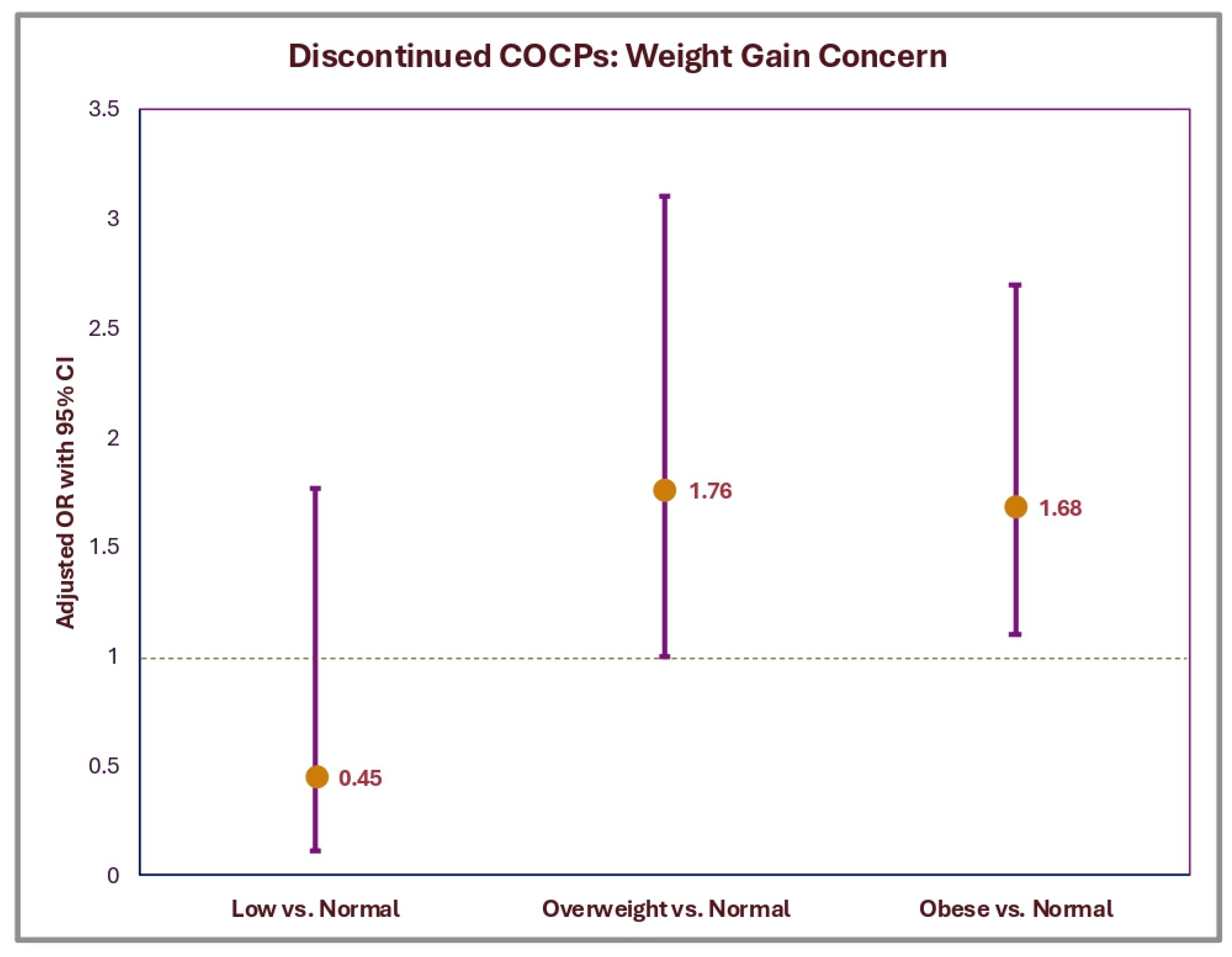
| Underweight (<18.5) | 0.45 | 0.11–1.77 | 0.245 |
| Normal (18.5–24.9) | ref | ref | ref |
| Overweight (25.0–29.9) | 1.76 | 1.01–3.08 | 0.048 |
| Obese (≥30.0) | 1.68 | 1.04–2.72 | 0.033 |
| Race/Ethnicity | |||
| Hispanic | 1.35 | 0.77–2.38 | 0.292 |
| Non-Hispanic White | ref | ref | ref |
| Non-Hispanic Black | 0.83 | 0.41–1.69 | 0.609 |
| Other | 1.58 | 0.76–3.30 | 0.219 |
| Age (per year) | 0.98 | 0.95–1.01 | 0.178 |
| Parity | |||
| 0 (nulliparous) | ref | ref | ref |
| 1 | 1.08 | 0.56–2.07 | 0.813 |
| 2 | 1.10 | 0.53–2.26 | 0.801 |
| 3+ | 0.81 | 0.44–1.50 | 0.498 |
| Marital Status | |||
| Never Married | 1.08 | 0.70–1.66 | 0.720 |
| Married | ref | ref | ref |
| Separated/Divorced | 1.26 | 0.70–2.28 | 0.432 |
| Widowed | 0.68 | 0.08–5.45 | 0.708 |
| Education | |||
| <High School | 0.70 | 0.27–1.81 | 0.457 |
| High School Graduate | ref | ref | ref |
| Some College | 1.34 | 0.84–2.15 | 0.215 |
| College Graduate | 1.28 | 0.69–2.35 | 0.424 |
| Post-College | 1.19 | 0.47–3.00 | 0.710 |
| Household Income | |||
| <$25,000 | 0.88 | 0.35–2.21 | 0.776 |
| $25,000–$74,999 | 0.95 | 0.46–1.94 | 0.879 |
| $75,000–99,999 | ref | ref | ref |
| ≥$100,000 | 0.82 | 0.40–1.69 | 0.582 |
| Smoking (past 12 months) a | |||
| Current | 0.88 | 0.52–1.47 | 0.608 |
| Former | 1.27 | 0.64–2.52 | 0.491 |
| Never | ref | ref | ref |
Disclaimer/Publisher’s Note: The statements, opinions and data contained in all publications are solely those of the individual author(s) and contributor(s) and not of MDPI and/or the editor(s). MDPI and/or the editor(s) disclaim responsibility for any injury to people or property resulting from any ideas, methods, instructions or products referred to in the content. |
© 2026 by the authors. Licensee MDPI, Basel, Switzerland. This article is an open access article distributed under the terms and conditions of the Creative Commons Attribution (CC BY) license.
Share and Cite
Zaman, A.; Strawderman, M.; Groth, S.W.; Lohse, B.; Vitek, W.; Thorpe, R.J., Jr.; Heitman, E. Current Body Mass Index Is Associated with Reported Weight Gain as a Reason for Discontinuing Oral Contraceptive Pill Use. Obesities 2026, 6, 20. https://doi.org/10.3390/obesities6020020
Zaman A, Strawderman M, Groth SW, Lohse B, Vitek W, Thorpe RJ Jr., Heitman E. Current Body Mass Index Is Associated with Reported Weight Gain as a Reason for Discontinuing Oral Contraceptive Pill Use. Obesities. 2026; 6(2):20. https://doi.org/10.3390/obesities6020020
Chicago/Turabian StyleZaman, Adnin, Myla Strawderman, Susan W. Groth, Barbara Lohse, Wendy Vitek, Roland J. Thorpe, Jr., and Elizabeth Heitman. 2026. "Current Body Mass Index Is Associated with Reported Weight Gain as a Reason for Discontinuing Oral Contraceptive Pill Use" Obesities 6, no. 2: 20. https://doi.org/10.3390/obesities6020020
APA StyleZaman, A., Strawderman, M., Groth, S. W., Lohse, B., Vitek, W., Thorpe, R. J., Jr., & Heitman, E. (2026). Current Body Mass Index Is Associated with Reported Weight Gain as a Reason for Discontinuing Oral Contraceptive Pill Use. Obesities, 6(2), 20. https://doi.org/10.3390/obesities6020020