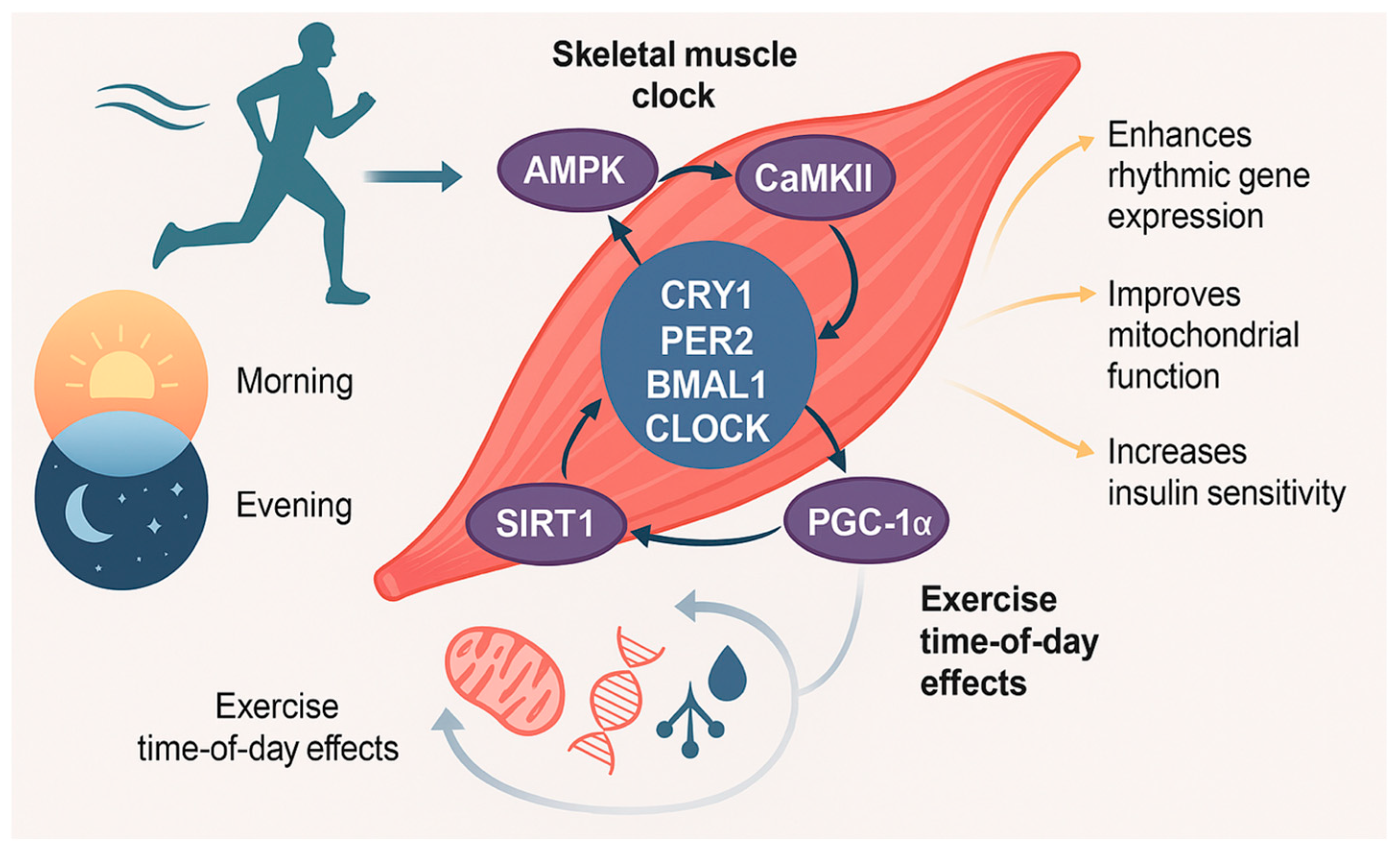

Resetting Time: The Role of Exercise Timing in Circadian Reprogramming for Metabolic Health

Abstract
1. Introduction
2. Skeletal Muscle Is a Central Regulator of Circadian Metabolic Health
3. Circadian Misalignment Contributes to Obesity and Metabolic Disorders
4. Exercise Can Reset Circadian Rhythms to Improve Metabolic Health
5. What-Omics Techniques Can Teach Us in Circadian Obesity Research
Funding
Conflicts of Interest
References
- Takahashi, J.S. Transcriptional architecture of the mammalian circadian clock. Nat. Rev. Genet. 2017, 18, 164–179. [Google Scholar] [CrossRef] [Scilit]
- Partch, C.L.; Green, C.B.; Takahashi, J.S. Molecular Architecture of the Mammalian Circadian Clock. Trends Cell Biol. 2014, 24, 90–99. [Google Scholar] [CrossRef] [Scilit] [PubMed]
- Schibler, U.; Gotic, I.; Saini, C.; Gos, P.; Curie, T.; Emmenegger, Y.; Sinturel, F.; Gosselin, P.; Gerber, A.; Fleury-Olela, F.; et al. Clock-Talk: Interactions between central and peripheral circadian oscillators in mammals. Cold Spring Harb. Symp. Quant. Biol. 2016, 80, 223–232. [Google Scholar] [CrossRef] [Scilit]
- Zurlo, F.; Larson, K.; Bogardus, C.; Ravussin, E. Skeletal Muscle Metabolism Is a Major Determinant of Resting Energy Expenditure. J. Clin. Investig. 1990, 86, 1423–1427. [Google Scholar] [CrossRef] [Scilit]
- Perrin, L.; Loizides-Mangold, U.; Chanon, S.; Gobet, C.; Hulo, N.; Isenegger, L.; Weger, B.; Migliavacca, E.; Charpagne, A.; Betts, J.; et al. Transcriptomic analyses reveal rhythmic and CLOCK-driven pathways in human skeletal muscle. Elife 2018, 7, e34114. [Google Scholar] [CrossRef] [Scilit] [PubMed]
- Dyar, K.A.; Hubert, M.J.; Mir, A.A.; Ciciliot, S.; Lutter, D.; Greulich, F.; Quagliarin, F.; Kleinert, M.; Fischer, K.; Eichmann, T.; et al. Transcriptional programming of lipid and amino acid metabolism by the skeletal muscle circadian clock. PLoS Biol. 2018, 16, e2005886. [Google Scholar] [CrossRef] [Scilit] [PubMed]
- Gabriel, B.M.; Zierath, J.R. Circadian rhythms and exercise—Re-setting the clock in metabolic disease. Nat. Rev. Endocrinol. 2019, 15, 197–206. [Google Scholar] [CrossRef] [Scilit]
- Hodge, B.A.; Zhang, X.; Gutierrez-Monreal, M.A.; Cao, Y.; Hammers, D.; Yao, Z.; Wolff, C.; Du, P.; Kemler, D.; Judge, A.; et al. MYOD1 functions as a clock amplifier as well as a critical co-factor for downstream circadian gene expression in muscle. Elife 2019, 8, e43017. [Google Scholar] [CrossRef] [Scilit]
- Dyar, K.A.; Ciciliot, S.; Wright, L.E.; Biensø, R.; Tagliazucchi, G.; Patel, V.; Forcato, M.; Paz, M.; Gudiksen, A.; Solagna, F.; et al. Muscle insulin sensitivity and glucose metabolism are controlled by the intrinsic muscle clock. Mol. Metab. 2014, 3, 29–41. [Google Scholar] [CrossRef] [Scilit]
- Harfmann, B.D.; Schroder, E.A.; Kachman, M.T.; Hodge, B.; Zhang, X.; Esser, K. Muscle-specific loss of Bmal1 leads to disrupted tissue glucose metabolism and systemic glucose homeostasis. Skelet. Muscle 2016, 6, 12. [Google Scholar] [CrossRef] [Scilit] [PubMed]
- Hansen, J.; Timmers, S.; Moonen-Kornips, E.; Duez, H.; Staels, B.; Hesselink, M.; Schrauwen, P. Synchronized human skeletal myotubes of lean, obese and type 2 diabetic patients maintain circadian oscillation of clock genes. Sci. Rep. 2016, 6, 35047. [Google Scholar] [CrossRef] [Scilit] [PubMed]
- Gabriel, B.M.; Altıntaş, A.; Bsmith, J.A.; Sardon-Puig, L.; Zhang, X.; Basse, A.; Laker, R.; Gao, H.; Liu, Z.; Dollet, L.; et al. Disrupted circadian oscillations in type 2 diabetes are linked to altered rhythmic mitochondrial metabolism in skeletal muscle. Sci. Adv. 2021, 7, eabi9654. [Google Scholar] [CrossRef] [Scilit]
- Wefers, J.; Van Moorsel, D.; Hansen, J.; Connell, N.; Havekes, B.; Hoeks, J.; Van Marken Lichtenbelt, W.D.; Duez, H.; Phielix, E.; Kalsbeek, A.; et al. Circadian misalignment induces fatty acid metabolism gene profiles and compromises insulin sensitivity in human skeletal muscle. Proc. Natl. Acad. Sci. USA 2018, 115, 7789–7794. [Google Scholar] [CrossRef] [Scilit] [PubMed]
- Cedernaes, J.; Schönke, M.; Orzechowski Westholm, J.; Mi, J.; Chibalin, A.; Voisin, S.; Osler, M.; Vogel, H.; Hornaeus, K.; Dickson, S.; et al. Acute sleep loss results in tissue-specific alterations in genome-wide DNA methylation state and metabolic fuel utilization in humans. Sci. Adv. 2018, 4, eaar8590. [Google Scholar] [CrossRef] [Scilit]
- Gutierrez-Monreal, M.A.; Harmsen, J.F.; Schrauwen, P.; Esser, K. Ticking for Metabolic Health: The Skeletal-Muscle Clocks. Obesity 2020, 28, S46–S54. [Google Scholar] [CrossRef] [Scilit]
- Gachon, F.; Loizides-Mangold, U.; Petrenko, V.; Dibner, C. Glucose homeostasis: Regulation by peripheral circadian clocks in rodents and humans. Endocrinology 2017, 158, 1074–1084. [Google Scholar] [CrossRef] [Scilit]
- Adamovich, Y.; Dandavate, V.; Ezagouri, S.; Manella, G.; Zwighaft, Z.; Sobel, J.; Kuperman, Y.; Golik, M.; Auerbach, A.; Itkin, M.; et al. Clock proteins and training modify exercise capacity in a daytime-dependent manner. Proc. Natl. Acad. Sci. USA 2021, 118, e2101115118. [Google Scholar] [CrossRef] [Scilit]
- Shen, B.; Ma, C.; Wu, G.; Liu, H.; Chen, L.; Yang, G. Effects of exercise on circadian rhythms in humans. Front. Pharmacol 2023, 14, 1282357. [Google Scholar] [CrossRef] [Scilit]
- Saner, N.J.; Lee, M.J.; Pitchford, N.W.; Kuang, J.; Roach, G.; Gamham, A.; Stokes, T.; Phillips, S.; Bishop, D.; Bartlett, J. The effect of sleep restriction, with or without high-intensity interval exercise, on myofibrillar protein synthesis in healthy young men. J. Physiol. 2020, 598, 1523–1536. [Google Scholar] [CrossRef] [Scilit]
- Savikj, M.; Gabriel, B.M.; Alm, P.S.; Smith, J.; Caidahl, K.; Bjornholm, M.; Fritz, T.; Krook, A.; Zierath, J.; Wallberg-Henriksson, H. Afternoon exercise is more efficacious than morning exercise at improving blood glucose levels in individuals with type 2 diabetes: A randomised crossover trial. Diabetologia 2019, 62, 233–237. [Google Scholar] [CrossRef] [Scilit] [PubMed]
- Pendergrast, L.A.; Lundell, L.S.; Ehrlich, A.M.; Ashcroft, S.; Schonke, M.; Basse, A.; Krook, A.; Treebak, J.; Dollet, L.; Zierath, J. Time of day determines postexercise metabolism in mouse adipose tissue. Proc. Natl. Acad. Sci. USA 2023, 120, e2218510120. [Google Scholar] [CrossRef] [Scilit]
- DeFronzo, R.A.; Tripathy, D. Skeletal muscle insulin resistance is the primary defect in type 2 diabetes. Diabetes Care 2009, 32 (Suppl. S2), S157. [Google Scholar] [CrossRef] [Scilit] [PubMed]
- Dyar, K.A.; Lutter, D.; Artati, A.; Cegila, N.; Liu, Y.; Armenta, D.; Jastroch, M.; Schneider, S.; de Mateo, S.; Cervantes, M.; et al. Atlas of Circadian Metabolism Reveals System-wide Coordination and Communication between Clocks. Cell 2018, 174, 1571–1585.e11. [Google Scholar] [CrossRef] [Scilit] [PubMed]
- Zhang, R.; Lahens, N.F.; Ballance, H.I.; Hughes, M.E.; Hogenesch, J.B. A circadian gene expression atlas in mammals: Implications for biology and medicine. Proc. Natl. Acad. Sci. USA 2014, 111, 16219–16224. [Google Scholar] [CrossRef] [Scilit] [PubMed]
- Bass, J.; Takahashi, J.S. Circadian Integration of Metabolism and Energetics. Science (1979) 2010, 330, 1349–1354. [Google Scholar] [CrossRef] [Scilit]
- Green, C.B.; Takahashi, J.S.; Bass, J. The Meter of Metabolism. Cell 2008, 134, 728–742. [Google Scholar] [CrossRef] [Scilit]
- Martin, R.A.; Viggars, M.R.; Esser, K.A. Metabolism and exercise: The skeletal muscle clock takes centre stage. Nat. Rev. Endocrinol. 2023, 19, 272–284. [Google Scholar] [CrossRef] [Scilit]
- Schroder, E.A.; Esser, K.A. Circadian rhythms, skeletal muscle molecular clocks, and exercise. Exerc. Sport. Sci. Rev. 2013, 41, 224–229. [Google Scholar] [CrossRef] [Scilit] [PubMed]
- Riley, L.A.; Zhang, X.; Douglas, C.M.; Mijares, J.; Hammers, D.; Wolff, C.; Wood, N.; Olafson, H.; Du, P.; Labeit, S.; et al. The skeletal muscle circadian clock regulates titin splicing through RBM20. Elife 2022, 11, e76478. [Google Scholar] [CrossRef] [Scilit]
- Harmsen, J.-F.; Kotte, M.; Habets, I.; Bosschee, F.; Frenken, K.; Jorgensen, J.; De Kam, S.; Moonen-Kornips, E.; Cissen, J.; Doligkeit, D.; et al. Exercise training modifies skeletal muscle clock gene expression but not 24-hour rhythmicity in substrate metabolism of men with insulin resistance. J. Physiol. 2024, 602, 6417–6433. [Google Scholar] [CrossRef] [Scilit]
- Morris, C.J.; Purvis, T.E.; Mistretta, J.; Scheer, F. Effects of the internal circadian system and circadian misalignment on glucose tolerance in chronic shift workers. J. Clin. Endocrinol. Metab. 2016, 101, 1066–1074. [Google Scholar] [CrossRef] [Scilit]
- Perrin, L.; Loizides-Mangold, U.; Skarupelova, S.; Pulimeno, P.; Chanon, S.; Robert, M.; Bouzakri, K.; Modoux, C.; Roux-Lombard, P.; Vidal, H.; et al. Human skeletal myotubes display a cell-autonomous circadian clock implicated in basal myokine secretion. Mol. Metab. 2015, 4, 834–845. [Google Scholar] [CrossRef] [Scilit] [PubMed]
- Um, J.H.; Pendergast, J.S.; Springer, D.A.; Foretz, M.; Viollet, B.; Brown, A.; Kim, M.; Yamazaki, S.; Chung, J. AMPK regulates circadian rhythms in a tissue- and isoform-specific manner. PLoS ONE 2011, 6, e18450. [Google Scholar] [CrossRef] [Scilit]
- Ramanathan, C.; Kathale, N.D.; Liu, D.; Lee, C.; Freeman, D.; Hogenesch, J.; Cao, R.; Liu, A. mTOR signaling regulates central and peripheral circadian clock function. PLoS Genet. 2018, 14, e1007369. [Google Scholar] [CrossRef] [Scilit]
- Peek, C.B.; Affinati, A.H.; Ramsey, K.M.; Kuo, H.; Yu, W.; Sena, L.; Ilkayeva, O.; Marcheva, B.; Kobayashi, Y.; Omura, C.; et al. Circadian clock NAD+ cycle drives mitochondrial oxidative metabolism in mice. Science (1979) 2013, 342, 1243417. [Google Scholar] [CrossRef] [Scilit] [PubMed]
- Wolff, G.; Esser, K.A. Scheduled exercise phase shifts the circadian clock in skeletal Muscle. Med. Sci. Sports Exerc. 2012, 44, 1663–1670. [Google Scholar] [CrossRef] [Scilit]
- Kemler, D.; Wolff, C.A.; Esser, K.A. Time-of-day dependent effects of contractile activity on the phase of the skeletal muscle clock. J. Physiol. 2020, 598, 3631–3644. [Google Scholar] [CrossRef] [Scilit]
- Viggars, M.R.; Berko, H.E.; Hesketh, S.J.; Wolff, C.; Gutierrez-Monreal, M.; Martin, R.; Jennings, I.; Huo, Z.; Esser, K. Skeletal muscle BMAL1 is necessary for transcriptional adaptation of local and peripheral tissues in response to endurance exercise training. Mol. Metab. 2024, 86, 101980. [Google Scholar] [CrossRef] [Scilit] [PubMed]
- de Alencar Silva, B.S.; Uzeloto, J.S.; Lira, F.S.; Pereira, T.; Coelho-E-Silva, M.J.; Caseiro, A. Exercise as a peripheral circadian clock resynchronizer in vascular and skeletal muscle aging. Int. J. Environ. Res. Public Health 2021, 18, 12949. [Google Scholar] [CrossRef] [Scilit]
- Defronzo, R.A.; Jacot, E.; Jequier, E.; Maeder, E.; Wahren, J.; Felber, J. The Effect of Insulin on the Disposal of Intravenous Glucose Results from Indirect Calorimetry and Hepatic and Femoral Venous Catheterization. Diabetes 1981, 30, 1000–1007. [Google Scholar] [CrossRef] [Scilit]
- Jacobi, D.; Liu, S.; Burkewitz, K.; Kory, N.; Knudsen, N.; Alexander, R.; Unluturk, U.; Li, X.; Kong, X.; Hyde, A.; et al. Hepatic Bmal1 regulates rhythmic mitochondrial dynamics and promotes metabolic fitness. Cell Metab. 2015, 22, 709–720. [Google Scholar] [CrossRef] [Scilit]
- Gemmink, A.; Daemen, S.; Wefers, J.; Hansen, J.; van Moorsel, D.; Astuti, P.; Jorgensen, J.; Kornips, E.; Schaart, G.; Hoeks, J.; et al. Twenty-four hour rhythmicity in mitochondrial network connectivity and mitochondrial respiration; a study in human skeletal muscle biopsies of young lean and older individuals with obesity. Mol. Metab. 2023, 72, 101727. [Google Scholar] [CrossRef] [Scilit]
- Scheer, F.A.J.L.; Hilton, M.F.; Mantzoros, C.S.; Shea, S. Adverse metabolic and cardiovascular consequences of circadian misalignment. Proc. Natl. Acad. Sci. USA 2009, 106, 4453–4458. [Google Scholar] [CrossRef] [Scilit] [PubMed]
- Arble, D.M.; Bass, J.; Laposky, A.D.; Vitaterna, M.; Turek, F. Circadian timing of food intake contributes to weight gain. Obesity 2009, 17, 2100–2102. [Google Scholar] [CrossRef] [Scilit] [PubMed]
- Turek, F.W.; Joshu, C.; Kohsaka, A.; Lin, E.; Ivanova, G.; McDearmon, E.; Laposky, A.; Losee-Olson, S.; Easton, A.; Jensen, D.; et al. Obesity and metabolic syndrome in circadian Clock mutant nice. Science (1979) 2005, 308, 1043–1045. [Google Scholar] [CrossRef] [Scilit]
- Hodge, B.A.; Wen, Y.; Riley, L.A.; Zhang, X.; England, J.; Harfmann, B.; Schroder, E.; Esser, K. The endogenous molecular clock orchestrates the temporal separation of substrate metabolism in skeletal muscle. Skelet. Muscle 2015, 5, 17. [Google Scholar] [CrossRef] [Scilit]
- Boström, P.; Wu, J.; Jedrychowski, M.P.; Korde, A.; Ye, L.; Lo, J.; Rasbach, K.; Bostrom, E.; Choi, J.; Long, J.; et al. A PGC1-α-dependent myokine that drives brown-fat-like development of white fat and thermogenesis. Nature 2012, 481, 463–468. [Google Scholar] [CrossRef] [Scilit]
- Eckel-Mahan, K.L.; Patel, V.R.; De Mateo, S.; Orozco-Solis, R.; Cegila, N.; Sahar, S.; Dilag-Penilla, S.; Dyar, K.; Baldi, P.; Sassone-Corsi, P. Reprogramming of the circadian clock by nutritional challenge. Cell 2013, 155, 1464–1478. [Google Scholar] [CrossRef] [Scilit]
- Kohsaka, A.; Laposky, A.D.; Ramsey, K.M.; Estrada, C.; Joshu, C.; Kobayashi, Y.; Turek, F.; Bass, J. High-Fat Diet Disrupts Behavioral and Molecular Circadian Rhythms in Mice. Cell Metab. 2007, 6, 414–421. [Google Scholar] [CrossRef] [Scilit]
- Buxton, O.M.; Pavlova, M.; Reid, E.W.; Wang, W.; Simonson, D.; Alder, G. Sleep restriction for 1 week reduces insulin sensitivity in healthy men. Diabetes 2010, 59, 2126–2133. [Google Scholar] [CrossRef] [Scilit]
- De Goede, P.; Wefers, J.; Brombacher, E.C.; Schrauwen, P.; Kalsbeek, A. Circadian rhythms in mitochondrial respiration. J. Mol. Endocrinol. 2018, 60, R115–R130. [Google Scholar] [CrossRef] [Scilit]
- Puig, L.S.; Valera-Alberni, M.; Cantó, C.; Pillon, N. Circadian rhythms and mitochondria: Connecting the dots. Front. Genet. 2018, 9, 452. [Google Scholar] [CrossRef] [Scilit]
- Acosta-Rodríguez, V.A.; Rijo-Ferreira, F.; Green, C.B.; Takahashi, J. Importance of circadian timing for aging and longevity. Nat. Commun. 2021, 12, 2862. [Google Scholar] [CrossRef] [Scilit]
- Hesketh, S.J.; Esser, K.A. The clockwork of champions: Influence of circadian biology on exercise performance. Free Radic. Biol. Med. 2024, 224, 78–87. [Google Scholar] [CrossRef] [Scilit]
- Ezagouri, S.; Zwighaft, Z.; Sobel, J.; Baillieul, S.; Doutreleau, S.; Ladeuix, B.; Golik, M.; Verges, S.; Asher, G. Physiological and Molecular Dissection of Daily Variance in Exercise Capacity. Cell Metab. 2019, 30, 78–91.e4. [Google Scholar] [CrossRef] [Scilit]
- Aoyama, S.; Shibata, S. Time-of-Day-Dependent Physiological Responses to Meal and Exercise. Front. Nutr. 2020, 7, 18. [Google Scholar] [CrossRef] [Scilit]
- Hitrec, T.; Petit, C.; Cryer, E.; Muir, C.; Tal, N.; Fustin, J.; Hughes, A.; Piggins, H. Timed exercise stabilizes behavioral rhythms but not molecular programs in the brain’s suprachiasmatic clock. iScience 2023, 26, 106002. [Google Scholar] [CrossRef] [Scilit] [PubMed]
- Lamia, K.A.; Sachdeva, U.M.; DiTacchio, L.; Williams, E.C.; Alvarez, J.G.; Egan, D.F.; Vasquez, D.S.; Juguilon, H.; Panda, S.; Shaw, R.J.; et al. AMPK Regulates the Circadian Clock by Cryptochrome Phosphorylation and Degradation. Science (1979) 2009, 326, 437–440. [Google Scholar] [CrossRef] [Scilit] [PubMed]
- Jordan, S.D.; Lamia, K.A. AMPK at the crossroads of circadian clocks and metabolism. Mol. Cell Endocrinol. 2013, 366, 163–169. [Google Scholar] [CrossRef] [Scilit] [PubMed]
- Nakahata, Y.; Kaluzova, M.; Grimaldi, B.; Sahar, S.; Hirayama, J.; Chen, D.; Guarente, L.; Sassone-Corsi, P. The NAD+-Dependent Deacetylase SIRT1 Modulates CLOCK-Mediated Chromatin Remodeling and Circadian Control. Cell 2008, 134, 329–340. [Google Scholar] [CrossRef] [Scilit]
- Cantó, C.; Houtkooper, R.H.; Pirinen, E.; Youn, D.; Oosterveer, M.; Cen, Y.; Fernandez-Marcos, P.; Yamamoto, H.; Andreux, P.; Cettour-Rose, P.; et al. The NAD+ precursor nicotinamide riboside enhances oxidative metabolism and protects against high-fat diet-induced obesity. Cell Metab. 2012, 15, 838–847. [Google Scholar] [CrossRef] [Scilit]
- Yoshino, J.; Mills, K.F.; Yoon, M.J.; Imai, S. Nicotinamide mononucleotide, a key NAD + intermediate, treats the pathophysiology of diet- and age-induced diabetes in mice. Cell Metab. 2011, 14, 528–536. [Google Scholar] [CrossRef] [Scilit]
- Dreher, S.I.; Irmler, M.; Pivovarova-Ramich, O.; Kessler, K.; Jurchott, K.; Sticht, C.; Fritsche, L.; Schneeweiss, P.; Machann, J.; Pfeiffer, A.; et al. Acute and long-term exercise adaptation of adipose tissue and skeletal muscle in humans: A matched transcriptomics approach after 8-week training-intervention. Int. J. Obes. 2023, 47, 313–324. [Google Scholar] [CrossRef] [Scilit]
- Sato, S.; Basse, A.L.; Schönke, M.; Chen, S.; Samad, M.; Altintas, A.; Laker, R.; Dalbram, E.; Barres, R.; Baldi, P.; et al. Time of Exercise Specifies the Impact on Muscle Metabolic Pathways and Systemic Energy Homeostasis. Cell Metab. 2019, 30, 92–110.e4. [Google Scholar] [CrossRef] [Scilit] [PubMed]
- Youngstedt, S.D.; Elliott, J.A.; Kripke, D.F. Human circadian phase–response curves for exercise. J. Physiol. 2019, 597, 2253–2268. [Google Scholar] [CrossRef] [Scilit] [PubMed]
- Chaix, A.; Lin, T.; Le, H.D.; Chang, M.; Panda, S. Time-Restricted Feeding Prevents Obesity and Metabolic Syndrome in Mice Lacking a Circadian Clock. Cell Metab. 2019, 29, 303–319.e4. [Google Scholar] [CrossRef] [Scilit] [PubMed]
- Depner, C.M.; Stothard, E.R.; Wright, K.P. Metabolic consequences of sleep and circadian disorders. Curr. Diab. Rep. 2014, 14, 1–9. [Google Scholar] [CrossRef] [Scilit] [PubMed]
- Maier, G.; Delezie, J.; Westermark, P.O.; Santos, G.; Ritz, D.; Handschin, C. Transcriptomic, proteomic and phosphoproteomic underpinnings of daily exercise performance and Zeitgeber activity of training in mouse muscle. J. Physiol. 2022, 600, 769–796. [Google Scholar] [CrossRef] [Scilit] [PubMed]
- Wang, C.; Lin, J.; Duan, M.; He, J.; Halizere, S.; Chen, N.; Chen, X.; Jiao, Y.; He, W.; Dyar, K.; et al. Multi-omics reveals different signatures of obesity-prone and obesity-resistant mice. iMetaOmics 2025, 2, e59. [Google Scholar] [CrossRef] [Scilit]

Disclaimer/Publisher’s Note: The statements, opinions and data contained in all publications are solely those of the individual author(s) and contributor(s) and not of MDPI and/or the editor(s). MDPI and/or the editor(s) disclaim responsibility for any injury to people or property resulting from any ideas, methods, instructions or products referred to in the content. |
© 2025 by the author. Licensee MDPI, Basel, Switzerland. This article is an open access article distributed under the terms and conditions of the Creative Commons Attribution (CC BY) license (https://creativecommons.org/licenses/by/4.0/).
Share and Cite
Hesketh, S.J. Resetting Time: The Role of Exercise Timing in Circadian Reprogramming for Metabolic Health. Obesities 2025, 5, 59. https://doi.org/10.3390/obesities5030059
Hesketh SJ. Resetting Time: The Role of Exercise Timing in Circadian Reprogramming for Metabolic Health. Obesities. 2025; 5(3):59. https://doi.org/10.3390/obesities5030059
Chicago/Turabian StyleHesketh, Stuart J. 2025. "Resetting Time: The Role of Exercise Timing in Circadian Reprogramming for Metabolic Health" Obesities 5, no. 3: 59. https://doi.org/10.3390/obesities5030059
APA StyleHesketh, S. J. (2025). Resetting Time: The Role of Exercise Timing in Circadian Reprogramming for Metabolic Health. Obesities, 5(3), 59. https://doi.org/10.3390/obesities5030059