Article

Positioning Hydrogen in ASEAN’s Energy Transition: Insights from Niche and Regime Dynamics


by
Citra Endah Nur Setyawati
* and
Benjamin C. McLellan
Graduate School of Energy Science, Kyoto University, Kyoto 606-8501, Japan
*
Author to whom correspondence should be addressed.
Hydrogen 2026, 7(3), 98; https://doi.org/10.3390/hydrogen7030098
Submission received: 26 June 2026 / Revised: 13 July 2026 / Accepted: 14 July 2026 / Published: 15 July 2026

Abstract

Hydrogen has attracted growing interest across the Association of Southeast Asian Nations (ASEAN) region in recent years, driven by net-zero commitments and national decarbonisation strategies. This study explores the evolving role of hydrogen in the ASEAN energy landscape and its potential to support a just and inclusive transition towards sustainable energy systems. Employing an exploratory research approach, this study integrates two complementary transition management frameworks—Multi-Level Perspective (MLP) and Strategic Niche Management (SNM)—to analyse the dynamics of energy transitions across niche, regime, and landscape levels. The integration of these frameworks supports our understanding of how transitions unfold within complex socio-technical systems. The analysis draws on government documents, the academic literature, and the grey literature on evolving hydrogen development projects across ASEAN. The findings indicate that climate commitments and global hydrogen narratives are placing increasing pressure on fossil-fuel-dominated energy regimes across ASEAN. While hydrogen development remains uneven across the region, several countries have made measurable progress through policy development, pilot projects, and international partnerships. This research contributes to the literature by combining MLP and SNM to provide a multi-level understanding of hydrogen transitions in ASEAN and highlights the importance of nurturing niche innovations to enable long-term systemic transformation.

1. Introduction

Achieving net-zero emissions has become a defining global goal, requiring deep changes in technology systems, institutions, and sociopolitical context. It will require structural changes in energy systems and governance frameworks [1]. Fundamental to this goal is the need for action towards the decarbonisation of hard-to-abate sectors, including heavy industries, aviation, and shipping, at a considerable economic and technological cost [1]. As the world adapts its energy systems, there have been increasingly clearer calls for improved coordination across governance levels and new approaches to energy transitions.
The Association of Southeast Asian Nations (ASEAN) comprises eleven countries (Brunei Darussalam, Cambodia, Indonesia, Lao PDR, Malaysia, Myanmar, Philippines, Singapore, Thailand, Timor Leste, and Vietnam). ASEAN functions as an intergovernmental organisation defined by a strong commitment to national sovereignty and non-interference. According to ASEAN (2010) [2], member states maintain full autonomy over domestic policies, and regional cooperation is governed by consensus and equality rather than supranational authority.
The energy sector plays a central role in achieving ASEAN’s long-term development vision. In line with this, the ASEAN Plan of Action for Energy Cooperation (APAEC) 2026–2030 focuses on strengthening energy security through deeper regional integration and diversification of energy supply while simultaneously accelerating the energy transition, including scaling up the deployment of renewable energies, improving energy efficiencies, and enhancing green innovation [3]]. As a result, regional frameworks such as APAEC serve primarily as coordinating mechanisms rather than legally binding instruments [3]. Although ASEAN expresses shared commitments and collective aspirations, the realisation of these objectives depends largely on national priorities and capacities, leading to differing levels of progress among member states. This situation illustrates that ASEAN integration is a voluntary and evolving process in which regional identity and cooperation are gradually strengthened [4].
Hydrogen, which can function as a fuel, energy carrier, and storage medium, has been described as a “game changer” for decarbonising energy systems [5,6]. The International Energy Agency [7] anticipates hydrogen adoption in ASEAN to start by around 2030 and increase five-fold by 2040 and ten-fold by 2050. Hydrogen is categorised by production method, commonly referred to by colour: grey hydrogen is produced from fossil fuels (such as natural gas via steam methane reforming or coal via gasification) without carbon capture; blue hydrogen uses the same processes, but captures the resulting CO2 emissions; and green hydrogen is produced using electrolysis powered by renewable energy, making it the lowest-carbon option [6].
In a regional context, most ASEAN member nations have made steps towards development of the hydrogen value chain, although at different rates and trajectories. In 2020, Brunei Darussalam launched the region’s first international hydrogen supply chain. Singapore kicked off its national hydrogen strategy in 2022, with Malaysia and Indonesia releasing their roadmaps in 2023, Vietnam in 2024, and Lao PDR in 2025. The other member states are developing similar strategies that reflect the growing regional interest in hydrogen’s contribution to the energy transition.
To understand how this momentum translates into a broader hydrogen transition, this study adopts a systems-based analytical framework drawn from the sustainability transitions literature. Specifically, the article applies a Multi-Level Perspective (MLP) to interpret structural dynamics and regime resistance within existing fossil-based energy systems and Strategic Niche Management (SNM) to examine the incubation and stabilisation of hydrogen as a niche innovation. Whereas MLP provides a macroscopic view by distinguishing between landscape pressures, dominant regimes, and emerging niches, SNM provides a micro-level perspective on how support for hydrogen technologies encompasses experimentation, learning and network-building (see Section 2.2.2. for details). As a whole, these framings can be applied as an analytical lens through which to view the growth of hydrogen within ASEAN as not just a series of technologies, but also a transformative process that is engendered in institutional, political, and market structures.
Current studies on hydrogen in ASEAN have predominantly addressed techno-economic assessments [8], demand–supply [9], environmental and economic competitiveness [10,11], export potential [12], hydrogen for net-zero and decarbonisation [13,14,15], and political economy (interaction between government policies, power dynamics, and economic systems) [16]. Within the ASEAN context, limited attention has been given to the interaction between emerging hydrogen innovations, established fossil-fuel-based energy regimes, and regional governance structures. This research gap is important in ASEAN, where energy transitions are influenced by a distinctive institutional context and diverse national development trajectories.
This article examines the positioning of hydrogen within ASEAN’s broader energy transition using a regional comparative approach. It contributes to the literature by elucidating how interactions among regime structures, niche innovations, and governance conditions influence hydrogen development across ASEAN member states. Employing MLP and SNM frameworks, this study addresses the following questions:
1. How far have ASEAN countries progressed in developing hydrogen energy systems?
2. How does hydrogen interact with existing energy systems?
3. How do current strategies influence hydrogen’s future role in the region’s energy transition?
The remainder of this paper is structured as follows: Section 2 reviews the existing literature on the theoretical frameworks and regional energy transition. Section 3 explains the research design and methodology used. Section 4 applies the MLP and SNM frameworks to assess how hydrogen fits within ASEAN’s energy transition progress. Section 5 discusses the implications of hydrogen development in ASEAN. Finally, Section 6 concludes the paper.

2. Background and Theoretical Framework

2.1. ASEAN Energy Transition and Hydrogen Development

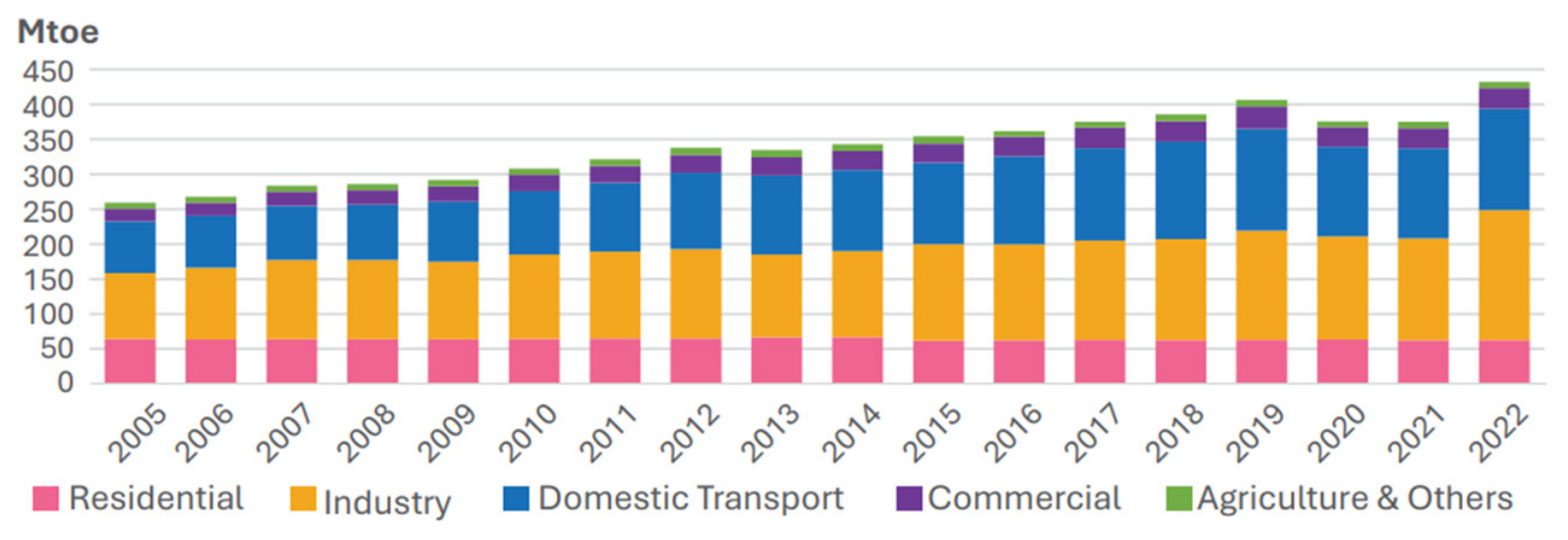
The energy transition in Southeast Asia is unfolding amid robust economic growth, industrialisation, and population expansion. ASEAN has accounted for approximately 11% of global energy demand growth since 2010 and is projected to contribute over one-quarter of global demand growth by 2035 [17]. In 2023, fossil fuels accounted for approximately 86% of ASEAN’s total energy mix [18], with much of it derived from coal, which accounts for nearly half the electricity produced in ASEAN and roughly four-fifths of power-sector emissions [17,19]. Additionally, for the past decade, 70% of the increase in electricity generation in ASEAN was from coal-fired power [20]. Installed renewable energy capacity in the region tripled in size from 33 gigawatts (GW) in 2010 to 102 GW by 2022, with over 80% of this increase was accounted for by hydropower and solar energy [20,21]. At the sectoral level, industrial energy consumption has grown significantly, increasing from 156.2 Mtoe in 2019 to 185.7 Mtoe in 2022, with its share in total final energy consumption (TFEC) rising from 38.4% to 43% [19] as illustrated in Figure 1. Transport energy demand also remains substantial, reaching approximately 145 Mtoe in 2022, although its share declined slightly compared to pre-pandemic levels [19]. These trends highlight the dominant role of industry and transport in shaping ASEAN’s energy demand. In this context, the continued reliance on fossil fuels alongside rising demand underscores the urgency of diversifying the energy system. Low-carbon solutions such as renewable energy, carbon capture and storage (CCS), and emerging low-carbon fuels, especially hydrogen (H2), have become increasingly urgent.
The shift from fossil fuels has become pivotal to national decarbonisation initiatives. This transition involves transforming energy systems to low-carbon and renewable sources while ensuring the security, reliability, access, and affordability of energy [22]. While all countries seek the same end result, they find themselves on different paths as a result of available resources and institutional capacity, technological readiness, and social context. Such identification requires a detailed assessment of the current energy mix and demand trends, resource potential, and structural challenges in each region [22].
ASEAN countries have tightened their decarbonisation targets and policies. A total of eight member states has set net-zero targets: Brunei Darussalam, Cambodia, Lao PDR, Malaysia, Singapore, and Vietnam (targeting 2050), Indonesia (2060), and Thailand (2065). The ASEAN member states have also committed to increasing the share of renewables in the primary energy mix to 23% by 2025, a target that would require approximately USD 27 billion in annual renewable energy investments [23].
The energy transition in ASEAN continues to be characterised by persistent structural tensions between decarbonisation ambitions and continued fossil fuel dependence [24]. Governments are committing to deploying renewables and establishing clean energy industries that attract foreign direct investment and enhance industrial competitiveness [25]. At the same time, fossil fuel expansion is continuing through coal due to lingering concern surrounding affordability, reliability, and domestic resource availability [23]. These dynamics highlight the “energy trilemma” confronting ASEAN: the need to balance energy security, equity, and environmental sustainability amid rapid economic growth and increasing demand [26]. Modelling indicates that achieving net-zero pathways will require sustained technological innovation and significant reductions in fossil energy consumption, estimated at an average decline of 21.8% every five years in ASEAN [27].
Hydrogen is now seen as an important part of ASEAN’s energy transition. Worldwide, hydrogen demand reached almost 100 million tons in 2024, up about 2% from the previous year, mostly for traditional uses like refining and chemicals. New uses made up less than 1% of total demand [28]. Hydrogen also remains dominantly produced from fossil fuels. Although low-emissions hydrogen production grew by 10% in 2024, it retains only <1% of the global supply [28]. This shows that there are still significant challenges, including high costs, uncertain demand, regulatory risks, and slow infrastructure development [29]. Still, there has been progress, with over 200 low-emissions hydrogen projects receiving final investment approval since 2020 and fast innovation across the industry [28].
Within ASEAN, hydrogen already has an important role in industrial systems. Regional demand reached approximately 4 Mt in 2024—around 4% of global demand—with Indonesia accounting for over one-third, followed by Malaysia (22%), Vietnam (15%), and Singapore (12%) [28]. Nearly half of regional hydrogen consumption is used for ammonia production, with two-thirds concentrated in Indonesia alone, while refining accounts for roughly one-third of demand (about 40% in Singapore) and methanol accounts for the remaining share, largely in Malaysia [28]. Hydrogen production represents approximately 8% of the region’s gas supply and about 1% of regional CO2 emissions, while ASEAN currently exports ammonia and imports methanol, reflecting evolving regional trade dynamics [28]. Previous estimates show that hydrogen demand across industrial sectors steadily grew from about 3.27 million ton per annum (MTPA) in 2015 to an estimated 3.75 MTPA in 2021, underlying the product’s embeddedness within regional industrial value chains [9].
Beyond these traditional sectors, hydrogen is a flexible energy carrier that could be used in the future to decarbonise sectors like hard-to-abate heavy industry, long-haul transport, and electricity production. In the near-term, hydrogen in ASEAN looks set to remain focused on hard-to-electrify industries; however, over the longer term, it could be deployed more extensively for power and transport [9]. By 2060, co-firing with hydrogen and ammonia and hydrogen-based power systems could supply more than 26% of population demand in ASEAN [9]. But major economic and institutional barriers remain. Green hydrogen generated from renewables in ASEAN costs about USD 8–13 per kilogram, which is much more than fossil-based options [9]. This highlights the need for improved policies, better infrastructure investment, and continuous technological innovations to speed up adoption.

2.2. Sustainability Transition Perspective

Energy transitions have long been recognised as socio-technical transformations rather than straightforward technological substitutions. Energy transition theory, which has been significantly developed by Geels et al. (2017) [30], describes these types of transitions as structural transformations—particularly in recent decades, as transitions from fossil-fuel-based systems to low-carbon energy systems. These adaptations are driven by technology innovation, policy, institutional arrangements, market structures, and social practices [30,31]. This, in turn, widens the scope to include adjustments of energy demand and user patterns across cultures and politics, as well as techno-economic changes in the supply chain. While techno-economic approaches focus on cost and efficiency in energy flows and distribution, socio-technical perspectives highlight innovation, diffusion, and institutional change, drawing from science and technology studies and the sociology of innovation [32]. This has led many observers to see low-carbon transitions as disruptive, contested, and non-linear processes that are influenced by a range of competing interests, policy uncertainties, and cycles of acceleration and slowdown [33].
Against this backdrop of socio-technical transitions, institutional lock-in and path dependency are central to shaping energy transition trajectories. Existing energy regimes rely on entrenched infrastructures, regulatory frameworks, market arrangements, and vested industrial interests, which reinforce fossil fuel dependence and hinder the adoption of alternative technologies [33]. These dynamics are particularly pronounced in regions such as ASEAN, which are realising rapid energy demand growth as they deal with entrenched fossil fuel systems and diverse institutional maturity. Structural factors such as these generate inertia and friction between incumbent actors and emerging low-carbon technologies. As a result, transitions rarely follow linear paths, but instead progress through contested negotiations, institutional adjustments, and incremental technological learning, influenced by both global pressures and domestic political economies [30,31].
To address these complexities, sustainability transition research increasingly uses integrative frameworks that capture multi-level interactions and dynamic socio-technical processes. Transition management approaches aim to improve our understanding and guidance of long-term systemic change by examining the co-evolution of societal actors, institutions, and technologies across different governance and innovation levels [34]. Building on this, the literature has introduced frameworks such as MLP and SNM to help explain how emerging technologies evolve, spread, and interact with established regimes [35].
This article examines hydrogen development in ASEAN through a sustainability transitions perspective. A transition management approach is adopted to analyse the complex and evolving nature of socio-technical change, including shifts in institutional arrangements, technological systems, and policy pathways toward sustainability [34]. Within this framework, the multi-level perspective (MLP) (described in detail in the next section) is used to capture interactions across the landscape, regime, and niche levels shaping energy transitions [36]. However, while the MLP provides a strong structural lens, it has been criticised for limited explanatory depth regarding early-stage technological emergence and diffusion [37,38]. To address this limitation, this study integrates strategic niche management (SNM), which focuses on bottom-up innovations, including learning processes, actor networks, and institutional support mechanisms enabling new technologies to scale [39,40]. Both MLP and SNM are foundational frameworks within sustainability transitions research [35], and their combined application enables a more comprehensive analysis of hydrogen transitions in ASEAN by linking regime-level structures with niche-level innovation processes.

2.2.1. Multi-Level Perspective (MLP)

The MLP has been extensively applied to analyse transitions in socio-technical systems across various sectors, with particular emphasis on energy studies [41,42]. This framework conceptualises transitions as dynamic interactions among three analytical levels: the socio-technical landscape (macro-level), socio-technical regimes (meso-level), and technological niches (micro-level) [39]. The socio-technical regime represents the dominant and stable configuration of technologies, institutions, and practices to act as a selection environment that reinforces existing systems (such as entrenched infrastructures, sunk investments, established user practices, and regulatory frameworks that favour incumbent technologies) [43,44]. The technological niche describes early-stage settings on the periphery of established systems where new technologies are created by up-and-coming players [44]. These areas allow for learning and testing in situations that are mostly shielded from competition from the mainstream market (e.g., renewable energy technologies such as solar and wind, hydrogen vehicles, and pilot-scale demonstration projects) [43,44].
The socio-technical landscape refers to external forces (such as climate commitments and macroeconomic trends) that exert pressure on regimes and may enable niche innovations to scale [43]. Collectively, these levels explain how radical technological innovations emerge and reshape socio-technical configurations by gradually transforming established practices, infrastructures, and institutional arrangements [38]. Landscape developments such as macroeconomic trends, climate governance pressures, and geopolitical shifts can exert external pressures on incumbent regimes, destabilising existing systems and creating opportunities for niche innovations to develop and scale [36]. Thus, the MLP serves as a systemic analytical model that illustrates how interactions across multiple levels shape transition pathways over time [45].
The socio-technical landscape includes large-scale external factors that shape how systems operate and set the stage for the development of new technologies [46]. These broad changes put pressure on existing systems [47]. Global climate ambitions, for instance, have increased the prominence of hydrogen in international energy strategies. In 2025, the COP30 Presidency materialised hydrogen ambition, including work on a clean hydrogen program and increasing low-emission hydrogen uptake [48]. The concept of the “hydrogen economy,” originally articulated by Bockris (1972), envisioned hydrogen as a universal energy carrier produced from low-carbon sources and used across power, transport, and industry [49]. Contemporary scholarship highlights how this narrative continues to influence energy transition discourse by promoting hydrogen as an abundant, versatile, and zero-emissions solution capable of supporting deep decarbonisation pathways [50]. The socio-technical regime changes from a system that is based around carbon-based fuels and electricity to a hydrogen (and electric) energy regime that would be expected to be driven by pressures from the landscape level and the emergence of niches for hydrogen application.
In this study, the MLP framework helps examine hydrogen transitions in ASEAN by looking at how landscape pressures, like decarbonisation goals and growing energy demand, interact with fossil-fuel-based systems and new hydrogen projects in different countries. This approach helps us to identify how established systems, different institutions, and conditions shape the ways hydrogen develops in the region.

2.2.2. Strategic Niche Management (SNM)

SNM has been described as “more than a useful addition to a spectrum of policy instruments” because it focuses on facilitating the development and diffusion of emerging technologies through protected experimentation environments [51] (p. 185). SNM is a concept that arose in the late 1990s. It explains how emerging technologies develop through processes of expectation formation, network building, and learning within protected spaces [51,52,53]. Central to SNM is the creation of protected spaces that support actors seeking to introduce new technologies into the market by shielding them from dominant regime selection pressures during early development stages [51]. SNM theory distinguishes between active protected spaces, which are deliberately designed to foster innovation, and passive spaces, which arise from existing selection environments that inadvertently provide protection [54,55]. Within these environments, SNM aims to (1) identify necessary technological and institutional changes, (2) assess technical and economic feasibility, and (3) evaluate social desirability to support technology development [51].
Niche development typically follows a non-linear trajectory shaped by the stability of governing rules and the level of protection afforded to emerging technologies [56]. As niches evolve from early breakthroughs toward technological and market niches, they encounter increasing exposure to selection pressures; however, these pressures can be mitigated as learning processes, institutional alignment, and actor coordination strengthen niche viability [54]. The SNM literature highlights the three core indicators shaping niche evolution: network formation among diverse stakeholders, learning processes (including both first-order technical learning and second-order reflexive learning) and the articulation and alignment of expectations regarding technological futures [57]. In the empirical chapters of this study, these SNM indicators will be operationalised through qualitative case-study analysis. This approach will help us to identify how network formation, learning processes, and expectation alignment emerge in practice, and will provide a systematic lens for comparing hydrogen innovation trajectories across the region.
In this study, SNM provides a complementary analytical lens to examine hydrogen development in ASEAN by focusing on bottom-up innovation dynamics such as pilot projects, policy experimentation, and evolving stakeholder networks supporting hydrogen deployment. This perspective is particularly relevant for analysing early-stage hydrogen adoption and sequencing pathways, where niche-level learning, institutional support, and protected experimentation spaces play critical roles in shaping long-term transition trajectories across the region.

3. Research Design and Methods

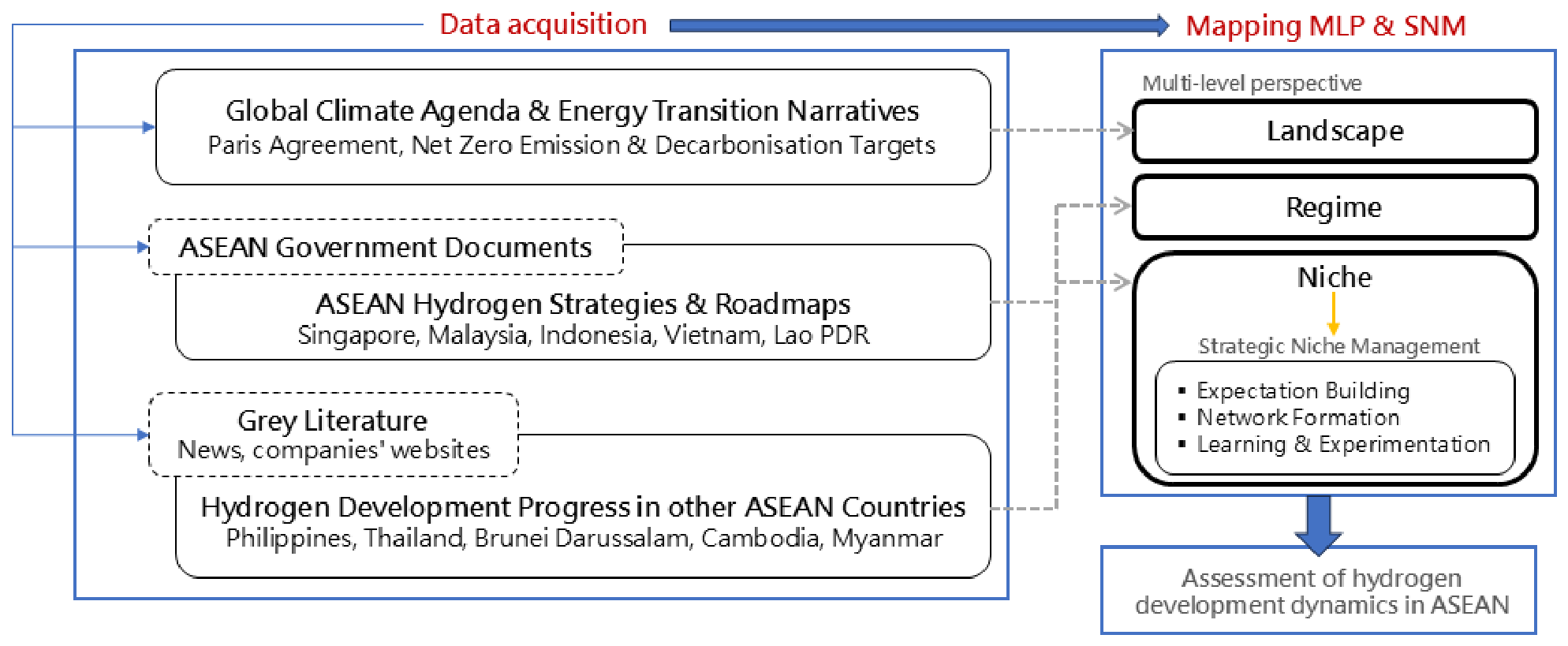
This study adopts a qualitative and exploratory research design to examine hydrogen development dynamics in ASEAN. It focuses on analysing empirical developments in hydrogen policies, projects, and institutional arrangements across the region. To support this analysis, the MLP and SNM frameworks are used to enable a multi-level interpretation of hydrogen transitions across landscape, regime, and niche dimension. Consistent with the analytical framework outlined in Section 2, the research follows a structured multi-stage approach (see Figure 2).

3.1. Data Collection and Sources

The document collection process followed three main steps. First, the academic literature was identified using Google Scholar as an academic search platform. Search queries were constructed using structured keyword sets and organised into thematic categories, as described in Section 3.2 and provided in full in the Supplementary Materials. Google Scholar was selected due to its coverage of the interdisciplinary literature, including the grey literature and papers found in domestic non-SCOPUS-indexed journals, which are prominent across the region. This facilitated the identification of recent developments in the evolving hydrogen discussion in the region. The academic literature was used primarily to provide conceptual grounding and comparative insights, supporting the interpretation of empirical hydrogen developments identified in government documents and the grey literature.
Second, official government documents were collected from official ministry websites. These included hydrogen strategies, roadmaps, policy documents, and official announcements. Such documents were treated as primary data sources for analysing country-level policy developments and the institutional positioning of hydrogen.
Third, grey literature sources such as industry reports, project announcements, and news articles were compiled to capture recent developments not yet reflected in academic publications [58]. The inclusion of the grey literature is particularly important given the emerging and rapidly evolving nature of hydrogen development in ASEAN.

3.2. Selection Criteria

Given the broad range of search results, explicit criteria were applied to ensure analytical consistency and relevance. Rather than a systematic review protocol, this study follows the purposive theory-guided document selection established in qualitative case-study applications of the MLP and SNM frameworks [57,59] in which sources are selected and appraised for their relevance to the analytical framework rather than exhaustively enumerated. This approach is appropriate for an emergent empirical field such as hydrogen development in ASEAN, where the primary evidence base consists of recently issued policy documents and the grey literature, which are not systematically indexed [58], and where the analytical objective is conceptual mapping onto landscape, regime, and niche dynamics rather than the statistical synthesis of a defined population of studies.
Inclusion criteria:
  • Sources directly addressing hydrogen policies, strategies, and roadmaps.
  • Evidence of hydrogen-related projects, investments, and infrastructure development.
  • Academic studies on hydrogen for energy transitions and decarbonisation, hydrogen in ASEAN case studies, and hydrogen in sustainability transitions, particularly those using MLP and SNM.
  • Sources (including newsletter, company news, institutional insights) related to hydrogen in ASEAN countries.
Exclusion criteria:
  • Search results referring to general discussions of hydrogen without country-specific and policy-content.
  • Highly technical and laboratory-scale studies focusing on materials, components, and process optimisation without implications for energy systems and policy analysis.
  • Secondary interpretations of national hydrogen strategies where official government documents were available and used as primary sources.
  • Opinion pieces, short commentaries, and news articles without verifiable sources and substantive analytical content.
  • Duplicate search results and publications that repeated information already captured from primary sources.
For country-level hydrogen strategies, priority was given to official government publications (e.g., national hydrogen strategies and roadmaps) as primary sources. Academic and secondary references discussing these strategies were not systematically included unless they provided additional analytical insights beyond the original policy documents. Priority was given to publications from the last five years (since 2021), reflecting the recent development of hydrogen technologies and policies. Earlier foundational studies were retained where necessary to support theoretical framing.
Search queries were organised into five thematic categories, each corresponding to a distinct analytical aim: (i) climate and decarbonisation narratives to identify landscape-level drivers; (ii) official country-specific hydrogen documents to identify national strategies and roadmaps as primary sources; (iii) hydrogen projects per member state to capture niche-level experimentation; (iv) hydrogen and energy transition in ASEAN to identify the academic literature on regional transition dynamics; and (v) the theoretical framework literature applying MLP and SNM. The full keyword matrix, including search strings for all ten ASEAN member states, is provided in the Supplementary Materials. Each retrieved document was assessed against the inclusion and exclusion criteria and, for news-based sources, subjected to a source-credibility check prior to inclusion. The resulting analytical corpus is fully documented in the Supplementary Materials, comprising (5) national hydrogen strategies analysed in depth, hydrogen-related policy positions for the remaining member states, (25+) MOUs on hydrogen cooperation, (28) documented pilot and investment projects (2019–2025), (7) institutional and intergovernmental reports, and (8) official government announcements, each recorded with the source, URL, and access date. This corpus was iteratively mapped onto the landscape, regime, and niche levels and onto the SNM processes of expectation building, network formation, and learning, as illustrated in Figure 2.

3.3. Analytical Approach

The collected data was analysed using a structured qualitative approach combining inductive categorisation and theory-informed interpretation. First, hydrogen-related developments were organised into empirical categories, including investment activities, international cooperation, pilot projects, policy developments, and research and development, as compiled in a structured database (see Supplementary Materials). Second, these empirical findings were interpreted using the MLP and SNM frameworks. Rather than directly coding documents into predefined theoretical categories, the analysis mapped observed patterns onto MLP levels (landscape, regime, and niche) to understand how external pressures, existing system structures, and emerging innovations interact. In parallel, the data were examined using SNM to identify processes related to expectation-building, network formation, and learning. This interpretive approach enabled the identification of recurring patterns and cross-country differences, thus provides a comprehensive understanding of hydrogen development dynamics across ASEAN. The operationalisation of MLP and SNM concepts into empirical analytical categories used in this study is presented in Appendix A.
As an example of the coding process, the corpus was first coded using the structured database by assigning each document to one or more empirical categories (investment activities, international cooperation, pilot projects, policy developments, research and development), which were then mapped onto the theoretical constructs in Table A1. For example, the announcement of Sarawak’s H2biscus project was coded at the empirical level as an international cooperation and investment activity; analytically, its consortium structure (SEDC Energy with Korean partners) was mapped to network formation, its export capacity targets to dynamic expectations, and its ongoing front-end engineering design to learning processes. A single document might therefore educate numerous constructions, and assignments were cross-checked against the conceptual definitions in Table A1 to verify consistency. Table A1 presents exemplary empirical evidence for each construct, connecting the analytical approach directly to the recorded corpus in the Supplementary Materials.

4. Results and Analysis

Building on the analytical framework of MLP and SNM, the following sections examine hydrogen development dynamics across ASEAN by analysing landscape pressures (Section 4.1), regime characteristics (Section 4.2), emerging niches (Section 4.3), and niche processes through an SNM lens (Section 4.4).
IRENA (2024) [60] differentiates between the definitions of ‘national hydrogen strategy’ and ‘national hydrogen roadmap’. A national hydrogen strategy delineates the “priorities, goals, barriers, opportunities, and stages” (p. 13) of the hydrogen sector, while a national hydrogen roadmap is characterised by a deficiency of defined targets and serves mostly as a platform for discussion [60]. The hydrogen strategies of Singapore, Malaysia, Indonesia, Vietnam, and Lao PDR are summarised in Table 1. Hydrogen strategies across ASEAN reflect both shared regional priorities and country-specific approaches to energy transition planning. Across countries with a hydrogen strategy, hydrogen is primarily positioned as a tool for industrial decarbonisation, energy diversification, and long-term system flexibility. While all countries identify multiple end-use sectors, including power generation, industry, and transport, their strategic focus varies according to national energy systems, resource endowments, and development priorities. Current national strategies suggest that hydrogen will initially develop in targeted sectors such as industry and transport before expanding across energy systems. Most ASEAN countries prioritise domestic hydrogen production to strengthen energy security and support industrial applications, although some also seek roles in emerging regional export markets. Singapore prioritises hydrogen imports due to its limited renewable resources, whereas Malaysia and Lao PDR focus on export-oriented strategies. Indonesia and Vietnam have implemented approaches that balance domestic decarbonisation objectives with long-term export opportunities. Regardless of these variations, all national strategies indicate a gradual shift from grey hydrogen to low-carbon pathways consistent with regional decarbonisation goals.
In addition to countries with hydrogen strategies, other ASEAN member states (Philippines, Thailand, Brunei Darussalam, Cambodia, and Myanmar) are also attempting to initiate hydrogen expansion through policy and institutional development, pilot projects, and international cooperation, as seen in Table 2. Across ASEAN, hydrogen development is increasingly reflected in a growing portfolio of pilot projects and announced investments. Drawing on the IEA Hydrogen Projects Database (2025) [28], as seen in Table 3, ongoing initiatives across the region reveal diverse ongoing project initiatives and varying technological scales of deployment. Table 3 indicates that electrolysis dominates hydrogen project development across ASEAN, with renewable-based pathways emerging alongside CCUS-linked approaches in selected countries. Project distribution also reveals significant regional variation, with Malaysia and Indonesia hosting the largest clusters, while Singapore and the Philippines remain focused on smaller-scale innovation pilots. These trends highlight the early-stage and uneven nature of hydrogen niche formation across ASEAN.

4.1. Landscape Pressures Shaping Hydrogen Development

At the landscape level, hydrogen development in ASEAN is shaped by increasing global pressure to decarbonise energy systems. International climate commitments and net-zero targets have elevated hydrogen as a strategic component of long-term energy planning [69,70]. These landscape pressures are supported by a growing body of global and regional policy commitments, as summarised in Appendix B.
Changes in the region’s energy systems are also increasing interest in hydrogen across ASEAN. Fast economic growth, rising electricity use, and ongoing reliance on fossil fuels have raised concerns about long-term energy security and system stability. Recent global events, such as volatile fuel prices and supply issues following the energy crisis, have prompted policymakers to discuss transitioning to low-carbon fuels [71]. At the same time, international partnerships and geopolitical relations with Japan, South Korea, China, and European countries have helped ASEAN become part of new hydrogen supply chains through technology sharing, investments, and pilot projects in several member states [16].
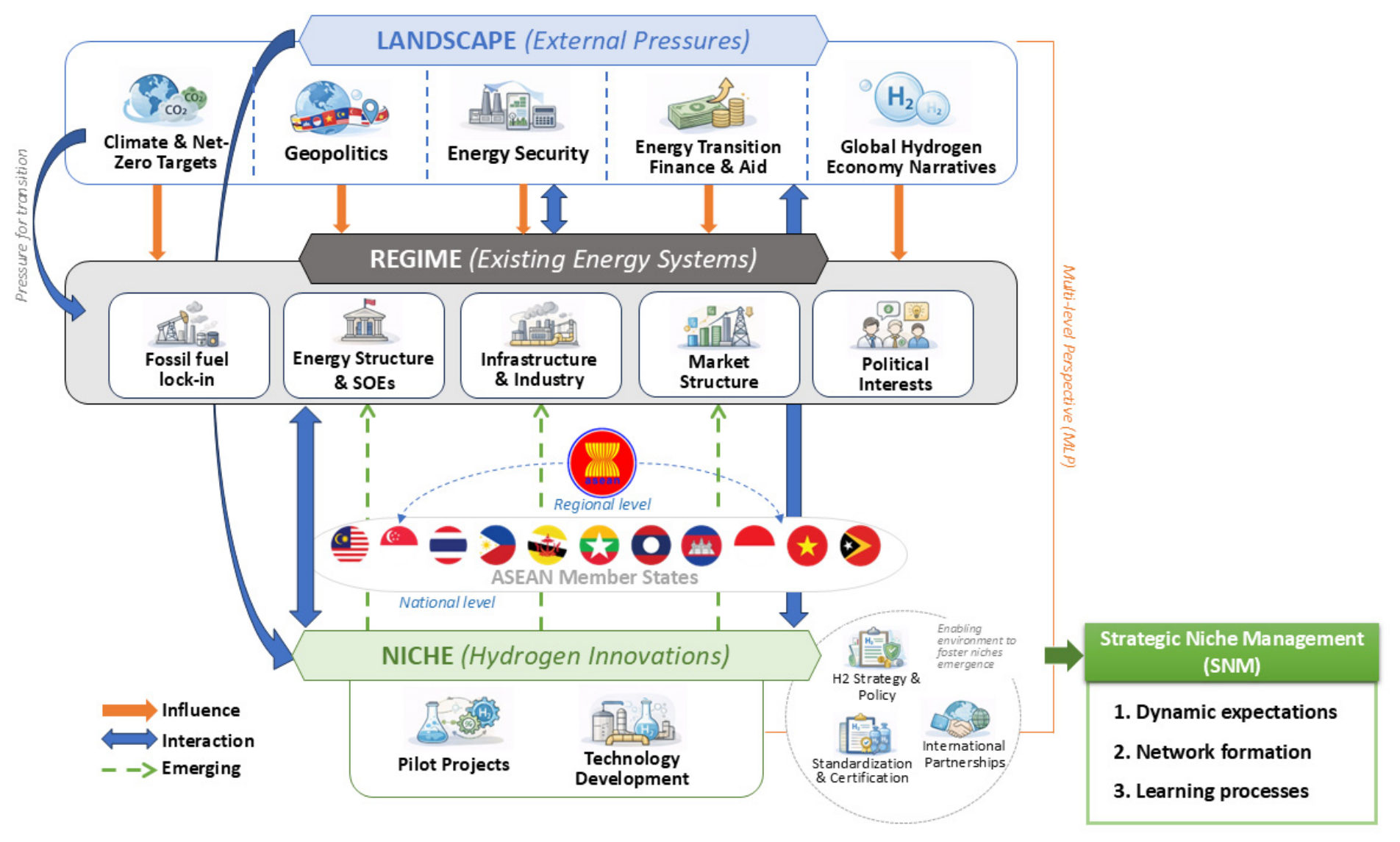
Simultaneously, increased climate funding and international cooperation are shaping how hydrogen development is unfolding in the region. Initiatives such as Just Energy Transition Partnerships (JETPs) in Indonesia and Vietnam [72], multilateral development bank projects, and country-to-country partner agreements are integrating hydrogen into plans for decarbonisation and industrial change. These moves align with the global perspective of hydrogen as being crucial for future energy systems, particularly for reducing emissions in industry, storing energy, and facilitating long-haul transport. The landscape pressures collectively influence the policy choices, investments, and new technology trials that shape hydrogen’s development in the ASEAN region. As financial flows shift toward low-carbon solutions, the trajectory of energy transition finance and policy cooperation will likely redefine how capital is allocated and how investors assess long-term value in an evolving hydrogen landscape. Overall, landscape-level dynamics create external pressures to the regimes and niches shaping policy priorities, investment decisions, and technological experimentation related to hydrogen development across ASEAN. Figure 3 represents the MLP for hydrogen development in ASEAN.

4.2. Regime Characteristics of ASEAN Energy Systems

At the regime level, hydrogen development in ASEAN is shaped by both domestic and regional socio-technical structures that influence technology adoption pathways. The socio-technical regime refers to a relatively stable configuration of rules, infrastructures, actors, and practices that guide system development [39,46]. It encompasses multiple dimensions—including socio-technical systems, actor networks, formal, cognitive, and normative rules—that together coordinate technological change [73]. In ASEAN, regime dynamics operate across two interconnected levels: domestic energy systems shaped by national institutional arrangements and regional coordination mechanisms developed through ASEAN-wide energy cooperation frameworks.
As seen in Figure 3, at the domestic level, fossil fuel lock-in continues to define ASEAN energy systems. The region’s abundant coal, oil, and gas resources, combined with a long-standing reliance on fossil fuels, have resulted in deeply entrenched infrastructures and industrial systems. In 2022, renewable energy made up only 15.6% of ASEAN’s total primary energy supply, and fossil fuels made up around 66% of installed power capacity. Under baseline projections, fossil fuels would still supply around 76% of primary energy in 2050 [19]. Coal-fired power generation remains prevalent in countries such as Indonesia and Vietnam, while oil refining, petrochemical industries, and port infrastructure are well established in Malaysia, Indonesia, Thailand, and Singapore. Extensive natural gas systems, including LNG terminals, pipelines, and processing facilities, are also prominent in Indonesia, Malaysia, and Thailand. These systems are supported by influential industrial networks, including state-owned enterprises (SOEs), national oil and gas companies, multinational corporations, and financial institutions, which collectively shape investment decisions and technological trajectories within domestic energy systems. This entrenchment extends to hydrogen itself. The region already consumes some 4 Mt of hydrogen per year, led by Indonesia (around 35%) and followed by Malaysia, Vietnam and Singapore, of which nearly 80% is produced from unabated natural gas for ammonia, refining, and methanol applications [28].
Infrastructure and industrial development are closely connected to market structures and consumption patterns throughout ASEAN [74]. Fossil fuel subsidies continue to significantly shape market dynamics and consumer preferences, historically maintaining low energy prices to support economic growth. Explicit fossil fuel subsidies in the East Asia and Pacific region, including ASEAN countries, remain substantial and increased markedly after 2020 [75]. Consequently, affordable energy remains a dominant social and political concern throughout ASEAN, which complicates the shift to low-carbon options and reinforces consumption habits that support the need for fossil fuels [76].
Political and institutional interests also shape regime dynamics across ASEAN countries. National energy policies are highly differentiated, reflecting variations in resource endowments, institutional capacities, and development priorities. Several countries have introduced policies supporting emerging technologies such as carbon capture, utilisation, and storage (CCUS) and electrification [77], while hydrogen governance frameworks remain in the early stages, with only a subset of ASEAN countries adopting formal hydrogen strategies. At the regional level, ASEAN cooperation mechanisms influence regime development. Initiatives such as the ASEAN Plan of Action for Energy Cooperation (APAEC), the ASEAN Power Grid (APG), and the Trans-ASEAN Gas Pipeline (TAGP) represent efforts to strengthen regional energy integration, enhance energy security, and improve system efficiency among member states [3].
Techno-scientific developments continue to influence regime evolution across ASEAN. Renewable energy deployment has expanded substantially over the past two decades, not only shaped by domestic policy efforts, but also by global engagement. International technology spillovers and trade networks have contributed to indirect cost reductions associated with renewable energy expansion across countries [78]. Although renewables increasingly contribute to decarbonisation, their intermittency presents persistent challenges for system reliability [79]. In this context, hydrogen is increasingly positioned in domestic and regional energy planning as a potential complement to renewable energy systems, particularly for storage, system balancing, and industrial decarbonisation. Collectively, these domestic and regional regime characteristics determine the structural conditions under which hydrogen technologies are introduced across ASEAN.

4.3. Emerging Hydrogen Niches and Interactions in MLP

Geels (2004, p. 912) describes niches as “incubation rooms for radical novelties,” where technologies develop under uncertain conditions and where design principles, user preferences, behaviours, and policy frameworks are still changing [80]. Hydrogen is becoming more visible in ASEAN through new policies, pilot projects, technology trials, international partnerships, and changing governance structures. Five member states have adopted national hydrogen strategies or roadmaps with quantified targets, ranging from Singapore’s ambition for hydrogen to supply up to half of electricity demand by 2050 to Vietnam’s production target of 10–20 Mt/yr by 2050 and Lao PDR’s phased export-oriented targets reaching 1.4 Mt/yr (See Table 1), indicating growing institutional support for these new areas [61,64,65].
Pilot and demonstration projects, often backed by public–private partnerships and international cooperation, are spreading across the region and testing different technologies, such as renewable-based electrolysis, carbon capture and storage (CCUS), and fuel cells applications. The documented corpus enumerates 28 pilot and investment projects in the region from 2019 to 2025 (See Supplementary Material), encompassing operational facilities (PLN’s 21 green hydrogen plants (191 t/yr) and the Kamojang geothermal-hydrogen facility), as well as pilots under construction, such as Ulubelu (100 kg/day, USD 3 million), and planned plants like TGS Green Hydrogen in Vietnam (24 kt/yr, USD 848 million), in addition to 25 hydrogen cooperation MOUs signed since 2020. These efforts are also supported by growing international involvement, with multinational companies and development partners contributing to project design, funding, and knowledge sharing. At the same time, new governance measures, such as discussions of hydrogen standards, certification, and regulatory alignment, represent early steps toward making these niches more established. As mentioned in Section 4.2, these niches also help us to build social networks, such as supply chains, knowledge-sharing platforms, and relationships between users and producers, which support innovation [39]. Section 4.4 will examine these niches in more detail from a strategic management perspective.

Interactions Among MLP Levels

The way the landscape, regime, and niche levels interact shows how hydrogen development is changing across ASEAN (see Figure 3). The MLP framework highlights that the paths of new technologies depend on both what happens inside niches and on changes in dominant systems and the social and technical environment [39]. Pressures at the landscape level, like climate goals, decarbonisation targets, and geopolitics, have led to policy focus and institutional backing for hydrogen in ASEAN countries. These global pressures have translated into concrete policy instruments at the ASEAN level, such as national hydrogen roadmaps aligned with the Paris Agreement, the introduction of clean hydrogen pilot procurement schemes, and the development of regional certification standards for low-carbon hydrogen. These policy tools not only reflect landscape influences, but also act as actionable entry points for integrating hydrogen into existing energy and industrial regimes into supporting coordinated scale-up across member states.
These changes are connecting more with regime-level trends, especially as established companies get involved in the development of hydrogen niches. Across ASEAN, state-owned enterprises, utilities, and large industrial firms are adding hydrogen to their decarbonisation plans through pilot projects, partnerships, and infrastructure planning. For example, Malaysia’s Gentari, part of PETRONAS, is working on renewable energy and hydrogen projects, and Indonesia’s Pertamina and PLN have included several short-term hydrogen projects in their business plan. The motivations for these incumbents go beyond regulatory compliance. It includes hydrogen support allows them to diversify portfolios, protect market positions as global energy demand shifts, and unlock access to new revenue streams and government incentives. For Gentari and Pertamina, backing hydrogen projects also helps them to manage long-term transition risks by keeping them relevant in low-carbon supply chains and positioning them as key partners for future investments. These companies weigh potential costs and uncertainties against strategic benefits, which can make them cautious and encourages a staged approach to adopting hydrogen. In ASEAN, hydrogen is largely developing through interaction with existing fossil-based systems rather than through direct substitution. As a result, the speed of transition tends to align with both their internal risk calculations and climate investment. This pattern suggests that niche hydrogen operations are mostly being absorbed into established structures and infrastructure, resulting in incremental adaptation rather than a fundamental break from fossil-fuel-based systems.
At the same time, niches still act as safe spaces for testing and learning, which helps us to develop new ways of thinking that could shape larger changes in the system over time [34,37,81]. But the way the MLP levels interact is not always straightforward. Pressures from the environment, such as changes in global energy prices and geopolitics, can potentially speed up hydrogen use in some places, but make it harder in others. For example, rising geopolitical tensions and trade disputes could disrupt cross-border hydrogen infrastructure projects, undermine investment confidence, and cause countries to shift focus to more domestically controlled energy options. Conversely, regional cooperation and shared climate targets may represent a distinct ASEAN strength, potentially encouraging the rapid scaling up of hydrogen pilots and infrastructure and accelerating a shift away from fossil fuels. These divergent futures—one in which geopolitical instability fragments hydrogen innovation, and another where collaboration and policy alignment accelerate change—highlight the fragility and conditional nature of hydrogen’s progress in ASEAN. In the same way, established players often fit niche innovations into current systems, such as by producing blue hydrogen, which uses natural gas infrastructure and leads to slow changes rather than sudden shifts. This shows the main difference in the MLP framework: niches and regimes are shaped by their people, institutions, and technologies, while the landscape mainly affects how the system changes [46]. All these interactions show that hydrogen transitions in ASEAN are changing and context-dependent. Overall, ASEAN countries remain in the early-to-intermediate stages of hydrogen development, with progress concentrated in pilot deployment, policy formation, and early infrastructure planning rather than large-scale commercialisation. The announced low-emissions production capacity would reach around 480 kt/yr by 2030 [28], equivalent to roughly one-tenth of the region’s existing grey hydrogen demand.
The comparison of the uneven tempo of niche growth across the ten member states is not random, but rather reflects significant variances in four circumstances. First, resource endowment for firm renewable power. The most advanced production initiatives are in member states that are endowed with dispatchable low-carbon resources such as Malaysia’s hydropower and Indonesia’s geothermal, which mitigate the electrolyser utilisation constraint identified in Section 4.5. States dependent on variable solar face structurally weaker production economics. Second, the structure of the incumbent regime: countries with large, state-backed energy enterprises (Pertamina and PLN in Indonesia; Petronas and Sarawak’s SEDC Energy in Malaysia) have balance sheets and policy mandates that can support pre-commercial experimentation, an option largely absent where such incumbents do not exist or are not engaged as potential supporters of hydrogen. Third, external demand networks (the most advanced projects are based on Japanese, Korean, and Singaporean offtake interests, including the Brunei–Japan supply chain demonstration, Sarawak’s H2ornbill, and H2biscus consortia) indicating that early niche momentum in ASEAN is mostly externally financed and demand-pulled. Fourth, institutional capacity. Singapore’s approach provides a case study of how regulation and reliable long-term policy signals can enable experimentation even without indigenous renewable resources. However, members that lack these conditions (small industrial bases for hydrogen, no significant energy SOE, weak links with Northeast Asian demand, and insufficient state capacity) have not progressed beyond exploratory assessments, as in the case of Cambodia and Myanmar. Hence, the diversity in hydrogen development across countries is not just a matter of policy aspiration, but also the result of the interplay between niche opportunities and existing regime structures.

4.4. Strategic Niche Management: Hydrogen Innovations Across the Region

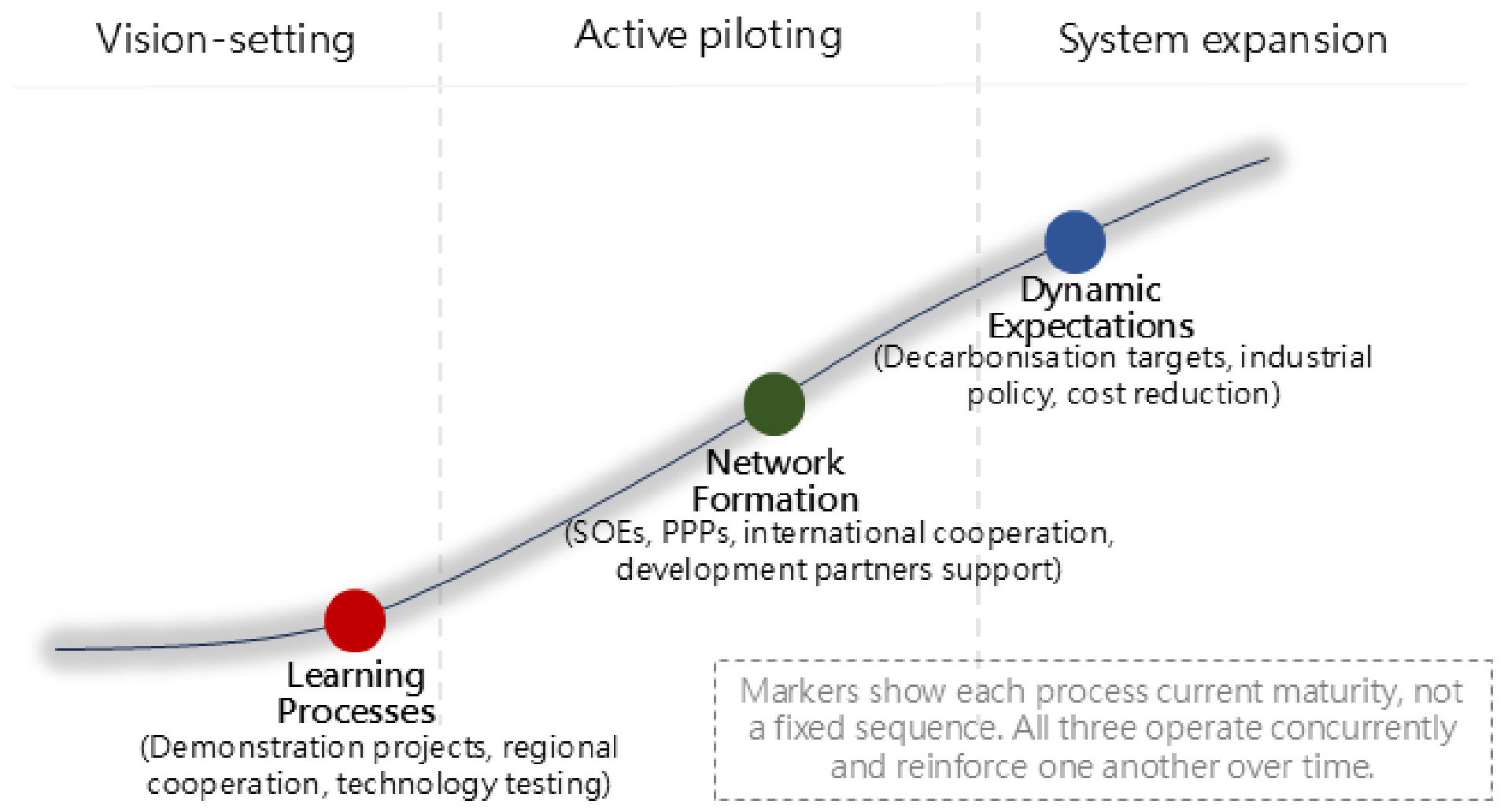
In ASEAN, hydrogen remains an emerging niche within the energy transition landscape. Across the region, niche formation is shaped by evolving expectations around hydrogen’s role in decarbonisation, expanding actor networks spanning domestic and international stakeholders, and ongoing learning through pilot projects and demonstration initiatives. The following sections examine these three SNM processes across ASEAN. The SNM framework identifies three essential elements that are crucial for the effective growth of a niche: dynamic expectations, social network formation, and learning processes [82]. As illustrated in Figure 4, these processes interact to shape the development of hydrogen niches across ASEAN, even though these processes are advancing at different rates, reflecting the uneven maturity of hydrogen niche development across the region.

4.4.1. Dynamic Expectations

Expectations are pivotal in niche development, as they inform investment decisions, attract stakeholder participation, and legitimise sustained policy support [82]. For expectations to facilitate successful niche establishment, they must be shared among actors, sufficiently detailed enough to guide technological direction, and reinforced by ongoing projects that enhance their credibility [82]. In ASEAN, expectations for hydrogen are increasingly influenced by decarbonisation objectives, concerns about industrial competitiveness, and energy security priorities. Governments are actively promoting hydrogen across various sectors, including transport, industry, and power generation, while policy incentives such as subsidies, tax measures, and pilot programmes are increasingly fostering niche experimentation [11]. These expectations are reflected in the development of national hydrogen roadmaps, policy incentives, and sector-specific decarbonisation strategies, which signal government commitment to scaling hydrogen deployment. In particular, ASEAN countries increasingly expect that targeted incentives, pilot support, and binding policy to reduce production costs, stimulate demand, and improve the commercial viability of hydrogen technologies over time [29].

4.4.2. Network Formation

Network formation is essential for mobilising resources, coordinating stakeholders, and supporting technological diffusion within niches [82]. Across ASEAN, hydrogen networks are emerging through collaborations among governments, SOEs, private firms, and international partners. For example, the Brunei–Japan hydrogen shipment in 2020 involved a consortium of Japanese companies and demonstrated early export-oriented collaboration [83]. In Malaysia, hydrogen mobility initiatives (including fuel cell buses and the Kuching hydrogen tram) have been supported by state-linked actors such as Petroleum Sarawak Bhd. (Petros) and the Sarawak Economic Development Corporation [84]. In Indonesia, the Ministry of Energy and Mineral Resources and state-owned enterprise pushing the green hydrogen pilot initiatives and supporting infrastructure development. Additionally, regional and international cooperation platforms also support network formation. The Asia Zero Emission Community (AZEC), comprising nine ASEAN countries, Japan, and Australia, has strengthened collaboration on hydrogen and ammonia development [85]. Development partners from German, France, Japan, South Korea, and the UK also play an important role by supporting feasibility studies, knowledge exchange, and policy and standardisation development. Despite this progress, insufficient actor coordination, funding constraints, and inadequate supporting infrastructure continue to restrict network formation throughout ASEAN. These challenges make it more difficult for networks to unite into stable investment ecosystems, which limits their capacity to accelerate large-scale hydrogen deployment.

4.4.3. Learning Processes

Learning processes within SNM encompass technical, institutional, and market dimensions and play a key role in shaping niche development pathways [82,86]. Across ASEAN, pilot and demonstration projects support technical learning related to hydrogen production, storage, transport, and end-use applications. For example, hydrogen mobility trials—including buses in Malaysia and passenger vehicles in Indonesia—provide opportunities to test technical performance and operational feasibility under local conditions. Learning also extends to institutional and infrastructural dimensions. Regional collaboration enables knowledge exchange on regulatory frameworks, safety standards, and infrastructure deployment strategies. For instance, Indonesia has drawn on lessons from Japan’s experience with hydrogen deployment through demonstration initiatives involving fuel cell vehicles and refuelling infrastructure. In addition, feasibility studies and pilot programmes contribute to our understanding of economic viability and potential deployment pathways, while also informing policy design and investment decisions. However, learning processes in ASEAN remain constrained by the limited scale of pilot projects, regulatory uncertainty, and the slow translation of lessons into commercial deployment. As a result, while knowledge generation is progressing, its impact on accelerating large-scale hydrogen adoption across the region remains gradual.
These three processes are advancing at uneven speeds across ASEAN. As illustrated in Figure 4, dynamic expectations are the furthest along, anchored in active decarbonisation targets, industrial policy, and cost-reduction goals. Network formation sits at an intermediate stage, with SOEs, public–private partnerships, and international cooperation actively engaged, although coordination and financing gaps continue to constrain their consolidation into stable investment ecosystems. Learning processes are still the least developed, and technological testing and demonstration initiatives are still small-scale and take a while to become commercially viable. These markers reflect each process’s current position rather than a fixed sequence; the three operate concurrently and are mutually reinforcing, but their uneven progress suggests that ASEAN hydrogen niches have moved beyond simple vision-setting into active piloting without yet reaching the system-expansion stage required for large-scale deployment. Table 4 summarises the drivers, evidence, and challenges underpinning each process.

4.5. Transition Pathways to a Hydrogen Economy in ASEAN

The type of interactions in Table 5 illustrates the evolving relationship between hydrogen niches and existing energy regimes in ASEAN. In several cases, niche anchoring occurs when hydrogen technologies align with existing systems and support incremental change rather than full substitution [87]. However, the feasibility of these pathways cannot be assessed on institutional evidence alone and ultimately hinges on whether hydrogen can be economically competitive with incumbent technologies. Cost competitiveness in the MLP operates as a regime-level selection pressure. Niche technologies suffer structural diffusion obstacles regardless of policy intent, while fossil-based hydrogen is still lower cost [55].
In 2024, hydrogen demand in Southeast Asia reached 4 Mt/year, led by Indonesia (35%), followed by Malaysia, Vietnam, and Singapore, and concentrated in provision for ammonia, refining, and methanol, with close to 80% supplied from unabated natural gas [28]. Thus, the incumbent regime does not represent a complete absence of hydrogen, but rather the entrenchment of grey hydrogen at USD 1–3/kg vs. USD 2.8–3.5/kg for blue and USD 8–13/kg for renewable-based green hydrogen in ASEAN [9,28]—a cost differential of three to five times that constrains all four pathways.
Three structural factors underpin this gap. First, electrolyser systems manufactured and installed outside China cost USD 2000–2600/kW in 2024 versus USD 600–1200/kW within China [28]. Second, ASEAN’s solar-dominated renewable expansion yields low electrolyser capacity factors that inflate the levelised cost of hydrogen; non-variable renewables such as geothermal and biomass (average capacity factor 80%) offer better production economics, explaining why early Indonesian pilots are anchored on geothermal resources [12]. Third, demand-side conditions remain weak. Long-term offtake agreements are scarce, Singapore’s carbon tax is the region’s only substantive pricing signal [60], and prospective demand relies heavily on external anchor markets in Japan, South Korea, and Singapore [29]. Fourth, financing and infrastructure conditions compound these constraints. The cost of capital in emerging Asian markets is substantially higher than in advanced economies, disproportionately penalising capital-intensive electrolytic hydrogen relative to fuel-cost-dominated incumbent production [28]. Simultaneously, dedicated hydrogen infrastructure (large-scale storage, transmission pipelines, and port conversion facilities) is largely non-existent beyond current industrial zones, meaning that early adopters must bear infrastructure costs that established fossil fuel systems have depreciated over decades.
The result is a gap between announcements and committed capacity: it was announced that low-emissions production could reach 480 kt/year by 2030, concentrated in Indonesia and Malaysia [28]—roughly one-tenth of current regional grey demand and in striking contrast with the more than 25 hydrogen MOUs signed since 2020 (Section 4.4). Hydrogen must also compete with alternative decarbonisation routes. Direct electrification in transport and low-temperature heat, renewables with storage in power, and carbon capture and biofuels in industry [28] confine its medium-term advantage to hard-to-abate applications where few substitutes exist. In the longer term, regional LCOH could fall to 3.8–3.9 USD/kg by 2050 under sustained technology learning [12], but this trajectory presupposes the demand certainty, financing, and infrastructure that current pathways have yet to secure.
Assessed against these conditions, the four transition pathways in Table 5 display distinct degrees of commercial maturity. Transformation remains at the demonstration stage, financed from SOE balance sheets rather than commercial returns. Technological substitution is pre-commercial and confined to protected niches such as remote and island power markets, where the incumbent fuel is costly diesel rather than cheap grey hydrogen. Re-configuration comes closest to economic viability because it leverages sunk infrastructure, although actual hydrogen volumes remain marginal. De-alignment and re-alignment remain a policy vision: the region’s only export-scale initiative has yet to reach a final investment decision. For example, through reconfiguration pathways, hydrogen is increasingly being integrated into transportation and industrial systems without completely replacing incumbent technologies such as internal combustion engine (ICE) vehicles [56,87].

5. Discussion

Hydrogen development across ASEAN remains at an early and uneven stage, primarily influenced by regime-level dynamics and political commitment. Within the MLP framework, the regime level is particularly significant due to entrenched practices, infrastructures, and institutional arrangements that often impede innovation. Overcoming these barriers requires robust political will to facilitate the adoption of hydrogen technologies. As Post et al. [88] emphasised, political will is essential for catalysing action at both local and national scales and for building coalitions capable of driving change. Political commitment to climate agendas shapes progress across all MLP levels, with the regime level demanding systemic transformation, market development, and regulatory reform. Jewell and Cherp (2019) [89] further contend that the feasibility of limiting global warming to below 1.5 °C depends more on political factors than on technical considerations.
ASEAN countries are moving at different paces and the four conditions indicated in Section 4.3 (firm renewable endowment, incumbent SOE capacity, external demand coupling and institutional capacity) explain this difference more effectively than policy ambition alone. Malaysia and Indonesia lead, with all four prerequisites largely aligning. Dispatchable renewables, powerful state-owned incumbents prepared to conduct demonstrations, consortia anchored by Northeast Asian offtakers, and institutionalised hydrogen policy are increasingly present. Singapore’s comparative advantage is on a different foundation (institutional capability and its role as a projected demand and trading hub) substituting resource endowment with regulatory credibility. Vietnam and Thailand are in an intermediate stage, with legislative frameworks ahead of committed efforts. But the remaining member states are mostly without the regime-level vehicles via which niche experimentation is presently financed in the region. This pattern has a theoretical implication where, in ASEAN, hydrogen niches are not developing in opposition to the established regimes, but rather via them, utilising state-owned enterprise financial sheets, existing industrial infrastructure, and government-facilitated overseas alliances. These findings align with recent research indicating that the expansion of niche players and incumbents, particularly state-owned enterprises and energy utilities, is significantly associated with the integration of hydrogen in decarbonisation initiatives.
An international comparison shows the magnitude of the conditions needed for commercially integrated hydrogen value chains. The Songyuan Green Hydrogen-Ammonia-Methanol Integrated Project in Jilin Province, China, involves a total investment of approximately RMB 29.6 billion (USD 4.15 billion) to build 3 GW of dedicated wind and solar capacity to produce 800,000 tonnes of green ammonia and methanol per year at full build-out [90]. The first phase includes 800 MW of renewable generation (750 MW wind and 50 MW solar) and will produce 45,000 tonnes of green hydrogen and 200,000 tonnes of ammonia and methanol per year [90,91], with a phase investment of around USD 1 billion [92]. The realisation of the project depended on a combination of enabling conditions that few other locations have simultaneously, including abundant co-located wind, solar, and water resources, established chemical parks and transport infrastructure, state-backed industrial coordination via China Energy Engineering Corporation, national demonstration-programme support, purpose-developed load-flexible synthesis technology to couple variable renewable generation with continuous chemical production, and secured downstream offtake including the first contract for green ammonia as an ocean-shipping fuel [91,92]. This gap with ASEAN is instructive in light of these conditions. The most advanced similar initiative in the region is Sarawak’s H2biscus and H2ornbill projects (targeting 240,000 tonnes of green hydrogen per year combined), which are still in the front-end engineering design stage with no final investment decision, and most member states are at the stage of policy planning, feasibility studies, or sub-tonne-per-day demonstrations (Table 5). The comparison suggests that the binding constraints for ASEAN are not technological, but systemic, requiring the simultaneous mobilisation of capital at the billion-dollar scale, industrial coordination capacity, infrastructure readiness, and demand certainty that integrated hydrogen value chains require.
Although Songyuan offers the circumstances for success, the latest world record shows how often those conditions do not occur. In 2025, about 60 large clean hydrogen projects were cancelled globally, representing over 4.9 Mt of annual production capacity, although only around 1 Mt per year completed final investment decision or construction during the same period [93]. Projects that were announced or advanced in 2023 include BP’s 1.5 GW Duqm green hydrogen project in Oman (150,000 t/yr) and its H2Teesside blue hydrogen project in the UK, ArcelorMittal’s hydrogen-based direct-reduced-iron plant in Germany, which was scrapped despite EUR 1.3 billion in promised subsidies [93], and RWE’s abandonment of its 300,000 t/yr green ammonia offtake agreement with the USD 10 billion Hyphen project in Namibia, citing slower-than-expected European demand [94]. But these failures were not due to technical infeasibility. Odenweller and Ueckerdt tracked 190 green hydrogen projects for three years and found that only 7% of the announced capacity worldwide was delivered on time. They explain this implementation gap through high costs, low willingness to pay on the demand side, and uncertainty over subsidies and regulation [95]. The IEA also notes that high prices, uncertain demand, immature regulatory regimes, and sluggish infrastructure development are constraining deployment, with new offtake agreements dropping from 2.4 Mt in 2023 to 1.7 Mt in 2024 [28]. The IEA’s 2025 evaluation indicates that projected production for 2030, based on declared projects, has decreased for the first time from 49 to 37 Mt/yr [28]. Electrolysis projects are responsible for over 80% of this decline, with more than half of the announced electrolyser capacity now expected to exceed its intended operational timelines [28]. However, the same evaluation indicates evident signs of sectoral maturation, with more than 200 production projects achieving a final investment decision since 2020, FID-stage capacity rising by nearly 20% annually, and the committed projects anticipated to yield a fivefold increase in low-emissions production by 2030, albeit from under 1% to approximately 4% of global hydrogen supply [28]. Overall, the situation reflects consolidation rather than disintegration. Speculative declarations are being abandoned while a more focused group of dedicated projects progresses. The emerging pattern is predominantly commercial rather than technological. Initiatives were tailored to policy objectives instead of validating customer demand—an unsolved cost disparity that hinders long-term commitments—and business models reliant on subsidies and demand failed to materialise promptly.
This ‘ambition–implementation gap’ [95] is in line with the hype-disappointment cycles typical of emerging technological niches from an SNM perspective. In these cycles, inflated expectations mobilise resources, but collapse when learning fails to bridge the gap between promise and performance [82]. These dynamics will probably be more prominent in ASEAN, where the cost of capital is higher, carbon pricing is mostly absent, domestic offtake is sparse, and projected demand relies significantly on external anchor markets like Japan, Korea, and Singapore. This highlights an important implication of the pathway analysis in Section 4.5: institutional momentum (roadmaps, MOUs, and pilot projects) is a necessary but not sufficient condition for deployment, and unless demand side certainty and financing conditions improve, ASEAN’s transition pathways will continue to be vulnerable to the same commercial attrition as observed globally. Hydrogen in ASEAN’s development future will depend on the interplay between national strategies and existing regime structures. Hydrogen roadmaps in Singapore, Malaysia, Indonesia, Vietnam, and Lao PDR suggest increasing alignment on institutional dynamics, especially for hard-to-decarbonise sectors like industry and transport. However, hydrogen will need substantial investments in infrastructure at scale, including production facilities, pipelines and storage, and refuelling stations. These regional hydrogen initiatives have also received technical knowledge and financial assistance in international partnerships with countries, including Japan, France, and Germany. The key challenges are persistent high production costs, uncertain demand, fragmented regulatory environments, and limited access to long-term financing. Overcoming these barriers is vital for ASEAN to enhance its role in the global hydrogen economy.
For ASEAN’s energy transition, hydrogen should not be seen as a panacea. Hydrogen is likely to function as a supplementary energy carrier that fills in certain system gaps rather than taking the place of renewable energy sources like solar and wind. It has the greatest immediate potential in industries that are hard to electrify, such as energy storage, heavy industry, and long-distance transportation, where there are not many other options for decarbonization. Hydrogen presents opportunities to diversify energy portfolios, improve energy security, and lessen exposure to fluctuations in global fuel prices for ASEAN, which is still largely dependent on fossil fuels. Nonetheless, expectations for hydrogen must be based on realistic evaluations of technological maturity, infrastructure requirements, and alternative transition pathways.
In summary, ASEAN’s hydrogen transition will likely proceed through gradual transformation and reconfiguration rather than rapid substitution. This result is a reflection of both the intentional incorporation of hydrogen into more comprehensive decarbonisation strategies and structural constraints within existing energy systems. To guarantee that hydrogen plays a significant part in ASEAN’s long-term energy transition, improved regional coordination, clearly defined policy frameworks, and continuous investment in infrastructure and innovation will be necessary.
These findings have implications for ASEAN policymakers that are particular to the transition processes mentioned above. Because hydrogen niches in the region emerge mostly via incumbent regimes rather than against them, and because the binding restrictions are commercial rather than technological, policy objectives should be directed at translating institutional momentum into bankable deployment. Six measurements are as follows: First, a regional hydrogen certification and guarantee of origin scheme, developed through existing regional energy cooperation frameworks and aligned with emerging international schemes, would lower transaction costs for the export-oriented projects on which early niche momentum depends; mutual recognition among member states and with the key offtake markets (e.g., Japan) is more important than the stringency of any one national scheme. Second, cross-border infrastructure should be integrated into regional energy connectivity beginning with technical studies on pipeline repurposing, and the designation of joint port and bunkering hubs, for which Singapore’s maritime position could provide as an anchor. Third, targeted financial incentives are needed to overcome the cost-of-capital barrier identified in Section 4.5. Blended-finance and de-risking instruments inspired by existing financing partnership structures and production support contracts anchored to creditworthy external offtakers will do more to close the viability gap than technology subsidies alone. On the demand side, the bankability of domestic offtake is equally critical. In the region’s single-buyer power markets, the state utility is often the only offtaker available, and the absence of standardised long-term power purchase agreement (PPA) frameworks for firm renewable and hydrogen-based power, including capacity payments that remunerate guaranteed availability, remains a binding constraint on project finance; developing standardised, bankable PPA templates would lower transaction costs for developers seeking to replicate projects across multiple member states. Fourth, the harmonisation of regulations governing safety codes, permission procedures, and blending requirements across member states would cut the costs of entry for the multinational consortia that coordinate most existing projects. Fifth, public–private partnership mechanisms should capitalise on the region’s state-owned enterprises with balance sheets to undertake pre-commercial experimentation. However, the selection process of projects should adhere to competitive and transparent award procedures to avoid the governance risks of state-led deployment. Sixth, coordinated market development should sequence demand creation around the region’s existing hydrogen consumption. Public procurement quotas and purchase commitments for low-emissions hydrogen in fertiliser production, refining, and future maritime fuels would create protected early markets in hard-to-abate applications where hydrogen has a comparative advantage. In SNM language, these measures act on the three niche processes identified in Section 4.4: expectations of certification and harmonisation structures, cross-border planning, and PPP mechanisms drive actor networks, and protected early markets support the learning processes that eventual regime change depends on.

6. Conclusions

Five years ago, hydrogen was still a minor concept in ASEAN’s energy plans, with few real-world applications and limited ambition. The region is now going beyond tentative trials toward building the actor networks and technical capacity needed to advance hydrogen development, identifying what works and where the problems lie. ASEAN has made significant advances in hydrogen in the last five years. However, development has been uneven: countries such as Indonesia, Malaysia, and Singapore have established early models with policies, pilot projects, and planning. Current efforts seem promising, but will require greater coordination, more funding, and longer-term initiatives to render hydrogen viable. In the long-term sense, hydrogen will help support ASEAN’s transition towards a cleaner and more diverse energy system rather than replace existing technologies.
ASEAN has already come a long way, with several member states having developed national hydrogen strategies as they increasingly understand the potential hydrogen can play in decarbonising key sectors. Beyond policy commitments, however, regional momentum is evidenced through the growth of international partnerships and the signing of MOUs with global stakeholders focused on accelerating demonstrations and building out infrastructure. Since 2020, ASEAN nations, for instance, have forged more than 25 cross-border MOUs regarding hydrogen cooperation, technology transfer, research, and feasibility studies. These initiatives are particularly aligned with ASEAN’s climate objectives, which aim to cut greenhouse gas emissions while ensuring energy security and sustaining economic growth.
Despite this progress, significant challenges persist. As discussed throughout this study, the pace of hydrogen development is still affected by high production costs, infrastructure limitations, fragmented regulatory frameworks, and limited regional standardisation. Nevertheless, hydrogen, as a niche innovation, exhibits clear transformative potential, particularly as incumbent actors such as oil and gas companies integrate it into their long-term transition strategies. Such trends suggest incremental yet consistent divergence in the direction of integrating hydrogen into mainstream energy systems in ASEAN.
This study examines three central questions. First, hydrogen development in ASEAN is at an early yet advancing stage, exhibiting significant variation among countries. A small group of leading nations is driving initial progress, while others remain in exploratory phases. Second, hydrogen development is shaped by existing socio-technical regimes, including fossil fuel dependence, infrastructure lock-in, and the influence of state-owned enterprises. These factors both constrain and enable potential transition pathways. Third, current strategies suggest that hydrogen will likely play a complementary role in ASEAN’s energy transition, particularly within hard-to-abate sectors. Realising this potential will be contingent upon specific enabling measures, as delineated in Section 5, rather than on additional declarations of intent. These measures include a regional certification and guarantee-of-origin framework, cross-border infrastructure planning, de-risked financing that addresses the cost-of-capital barrier in the region, regulatory harmonisation, disciplined public–private partnerships leveraging state-owned enterprises, and coordinated demand creation in the industrial applications where hydrogen has a comparative advantage.
Future research and policy efforts should also pay closer attention to the social and justice dimensions of hydrogen development within the ASEAN context. There remains a notable gap in research that examines public acceptance, distributional impacts, and the societal implications of hydrogen transitions, particularly considering the unique characteristics of the regions. As ASEAN encompasses a vast range of socio-economic developmental stages, equitable access to hydrogen technologies and their benefits will be critical to ensure that the marginalised do not get left behind. ASEAN can thus enhance the region’s role in the emerging global hydrogen economy by tackling these interlinked challenges and opportunities for a more inclusive and sustainable energy transition.

Supplementary Materials

The following supporting information can be downloaded at: https://www.mdpi.com/article/10.3390/hydrogen7030098/s1, Table S1: ASEAN Hydrogen Strategies; Table S2: Hydrogen development in ASEAN countries without dedicated national strategies; Table S3: MoU between SOEs (state-owned enterprises) and private companies; Table S4: Hydrogen pilots and investment projects; Table S5: Hydrogen development announcements from government sources; Table S6: Institutional and government reports on hydrogen; Table S7: Keyword search (methodology); Table S8: Reference for Table 5. Transition pathways of hydrogen development in ASEAN.

Author Contributions

Conceptualization, C.E.N.S. and B.C.M.; methodology, C.E.N.S.; validation, C.E.N.S. and B.C.M.; formal analysis, C.E.N.S.; data curation, C.E.N.S.; writing—original draft preparation, C.E.N.S.; writing—review and editing, C.E.N.S. and B.C.M.; visualisation, C.E.N.S. and B.C.M.; supervision, B.C.M. All authors have read and agreed to the published version of the manuscript.

Funding

This work was supported by JST SPRING, Grant Number JPMJSP2110.

Data Availability Statement

The data supporting the findings of this study are derived from publicly available sources, including reports from international organisations, government documents, and the existing literature.

Acknowledgments

During the preparation of this manuscript, the authors used ChatGPT (GPT-5.5) to generate icons for Figure 3 and to improve the English grammar and coherence of several sections of the manuscript. The authors reviewed and edited all AI-generated content and take full responsibility for the content of this publication.

Conflicts of Interest

The authors declare no conflicts of interest.

Abbreviations

The following abbreviations are used in this manuscript:
AHEADAdvanced Hydrogen Energy chain Association for technology Development
ALKAlkaline (electrolysis)
APAECASEAN Plan of Action for Energy Cooperation
APACAsia Pacific
APERCAsia Pacific Energy Research Centre
APGASEAN Power Grid
ART Autonomous Rapid Transit
ASEANAssociation of Southeast Asian Nations
AZECAsia Zero Emission Community
BRINBadan Riset dan Inovasi Nasional (National Research and Innovation Agency, Indonesia)
CCSCarbon Capture and Storage
CCUSCarbon Capture, Utilisation and Storage
COP30Conference of the Parties 30
DOEDepartment of Energy (Philippines)
EBTKEDirektorat Jenderal Energi Baru Terbarukan dan Konservasi Energi (Indonesia)
EGATElectricity Generating Authority of Thailand
EGCOElectricity Generating Company (Thailand)
EVElectric Vehicle
FIDFinal Investment Decision
GEDSIGender Equality, Disability and Social Inclusion
GWGigawatt
H2Hydrogen
HEICHydrogen Energy Industry Committee
HETRHydrogen Economy and Technology Roadmap
ICEInternal Combustion Engine
IEAInternational Energy Agency
IRENAInternational Renewable Energy Agency
JETPJust Energy Transition Partnership
kgKilogram
ktKiloton
kWKilowatt
LCOHLevelised Cost of Hydrogen
LNGLiquefied Natural Gas
LOHCLiquid Organic Hydrogen Carrier
MCHMethylcyclohexane
MEMRMinistry of Energy and Mineral Resources (Indonesia)
MeOHMethanol
MLPMulti-Level Perspective
MMTMillion Metric Tons
MOEMinistry of Energy
MOUsMemorandum of Understandings
MtMillion Ton
MTPAMillion Ton Per Annum
MtoeMillion Ton of Oil Equivalent
MWMegawatt
NH3Ammonia
PEMProton Exchange Membrane (electrolysis)
PPAPower Purchase Agreement
PPPPublic–Private Partnership
PTTPTT Public Company Limited (Thailand)
PVPhotovoltaic
R&DResearch and Development
SAFSustainable Aviation Fuel
SEDCSarawak Economic Development Corporation
SEZSpecial Economic Zone
SNMStrategic Niche Management
SOEState-Owned Enterprise
TAGPTrans-ASEAN Gas Pipeline
TFECTotal Final Energy Consumption
t/yrTon Per Year
t H2/yTon of Hydrogen Per Year
USDUnited States Dollar

Appendix A

Table A1. Operationalisation of MLP and SNM framework.
Analytical LevelConceptual DefinitionOperationalisation in ASEAN Hydrogen ContextIllustrative Empirical Evidence
Landscape (MLP)“Sociotechnical landscape forms an exogenous environment beyond the direct influence of niche and regime actors (macro-economics, deep cultural patterns, macro-political developments). Changes at the landscape level usually take place slowly (decades)” (Geels & Schot, 2007, p. 400) [56]- Net-zero targets and global decarbonisation commitments
- Rising energy demand and energy security concerns
- Geopolitical influences (e.g., Japan, Korea, EU hydrogen initiatives)
- International climate finance and partnerships (e.g., JETP)
Indonesia’s JETP commitment (USD 20 billion, 2022); net-zero pledges of all ten AMS; foreign import strategies creating external demand pull (government announcements; institutional reports).
Regime (MLP)“Green niche-innovations face uphill struggles against existing unsustainable systems and the
associated rules and institutions (which are called ‘regimes’), which form the second level. These systems and regimes are difficult to change because they are entrenched and stabilised by various lock-in mechanisms” (Geels, 2024, p. 2) [44]
- Fossil fuel–based energy systems (coal, gas, oil dominance)
- Role of state-owned enterprises (e.g., Pertamina, Petronas, PLN)
- Established industrial hydrogen demand (ammonia, refining, methanol)
- Existing infrastructure (LNG, refineries)
- Policy frameworks (hydrogen roadmaps, energy policies)
- Cultural preference for low-cost energy
80% of regional hydrogen demand supplied from unabated natural gas; PLN’s 21 green hydrogen plants integrated within existing fossil power plants; Pertamina/Petronas incumbent-led pilots (IEA GHR; government web announcements; Supplementary Material).
Niche (MLP)“Technological niches form the micro-level where radical novelties emerge. These novelties are initially unstable sociotechnical configurations with low performance. Hence, niches act as ‘incubation rooms’ protecting novelties against mainstream market selection” (Schot, 1998; Kemp et al., 1998 in Geels & Schot, 2007, p. 400). [56]- Hydrogen pilot and demonstration projects
- Emerging hydrogen supply chains and industrial applications
- Early-stage establishment of certification, standards systems
- Public–private partnerships and experimental deployment
Ulubelu geothermal-hydrogen pilot (100 kg/day, non-commercial trial); Sarawak ART (Autonomous Rapid Transit) hydrogen transit; refuelling station pilots (pilots and investments database, 28 documented projects, 2019–2025).
Dynamic Expectations (SNM)“Expectations are considered crucial for niche development because they provide direction to learning processes, attract attention, and
legitimate (continuing) protection and nurturing.” (Schot & Geels, 2008, p. 540) [82]
- Hydrogen positioned as decarbonisation tool and future energy carrier
- National hydrogen strategies and long-term targets
- Government incentives (subsidies, pilot programmes)
- Export-oriented hydrogen narratives
Five national hydrogen strategies with quantified long-term targets (Singapore, Malaysia, Indonesia, Vietnam, Lao PDR); export-oriented framing in Sarawak and Brunei (hydrogen strategies matrix, Supplementary Material).
Network Formation (SNM)“This process is important to create a constituency behind the new technology, facilitate interactions between relevant stakeholders, and provide the necessary resources (money, people, expertise).” (Schot & Geels, 2008, p. 540) [82]- Collaboration between governments, SOEs, private firms
- International partnerships (Japan, EU, development banks)
- Regional initiatives (AZEC, ASEAN cooperation)
- Public–private partnerships and MOUs
25+ cross-border hydrogen MOUs since 2020 involving SOEs, foreign firms, and development partners; AZEC; Brunei–Japan supply chain consortium (MOU database, Supplementary Material).
Learning Processes (SNM)Processes of knowledge generation “at multiple dimensions: (a) technical aspects and design specifications; (b) market and user preferences; (c) cultural and symbolic meaning; (d) infrastructure and maintenance networks; (e) industry and production networks; (f) regulations and government policy; (g) societal and environmental effects” (Schot & Geels, 2008, p. 540) [82]- Pilot projects and feasibility studies
- Technology testing (electrolysis, refuelling stations, fuel cells)
- Regulatory learning (standards, safety frameworks)
- Knowledge transfer from international partners
Feasibility studies preceding FID (H2biscus/H2ornbill FEED); technology testing at Kamojang; emerging certification and standards work (pilots database; institutional reports).

Appendix B

Table A2. Global targets and landscape-level drivers of hydrogen development.
CategorySourceDocument Focus/TitleKey InsightsImplications for Hydrogen Development
Net-zero targetsWorld Economic Forum (2021) [96]Role of green hydrogen in achieving net-zeroHydrogen identified as a key enabler for decarbonisationPositions hydrogen as a strategic solution within global climate agenda.
IEA (2023) Net-Zero Roadmap [97]Global pathways to limit warming to 1.5 °CHydrogen and CCUS contribute around 20% of emission reductions (2030–2050)Strong quantitative justification for hydrogen deployment.
UK Parliament (2022) [98]Role of hydrogen in national net-zero strategiesCountries (e.g., Japan, Germany) actively developing hydrogen strategiesDemonstrates increasing policy commitment.
Deloitte (2023) [99]Global hydrogen market outlookHydrogen becomes cost-competitive across sectors (2035–2050)Signals future economic feasibility.
Kounchaki-Penchah et al. (2024) [100]The role of hydrogen in a net-zero emission economy under alternative policy scenariosHydrogen is critical for hard-to-abate sectors and reduces reliance on direct air captureReinforces sectoral necessity.
Carbon neutralityASEAN Secretariat (2023) [101]ASEAN Strategy for Carbon NeutralityHydrogen included as part of regional strategyIndicates regional alignment and policy integration.
Evro et al. (2024) [102]Carbon neutrality and hydrogen energy systemsHydrogen enables zero-emission systems and “hydrogen cities”Suggests systemic transformation potential.
Decarbonisation pathwaysLau (2022) [15]Decarbonisation roadmaps for ASEAN and their implicationsHydrogen (especially blue with CCS) relevant for industry and transportHighlights transitional role of hydrogen.
Paris AgreementIRENA (2023) [103]Meeting Paris Agreement Targets: 94% of Hydrogen Production from Renewables94% of all hydrogen would need to come from renewable energy if the sector meets the commitment to the Paris AgreementIndicates scale and urgency of transition.
Bataille (2023) [104]Paris Agreement-Compliant Hydrogen and Electricity ProductionHydrogen complements electrificationShows system integration role.
UNFCCC (2023) [105]Responsible hydrogen deploymentGovernance frameworks emerging globallySignals institutional development.
UN (2021) [106]Green Hydrogen CompactHydrogen critical for global energy transitionReinforces global consensus. Hydrogen produced with renewable energy, “green” hydrogen—can play a
key role in this transformation as a sustainable, carbon-neutral fuel.
Green Hydrogen Organisation (2025) [107]Reflecting on 10 years since the Paris Agreement, and Europe’s efforts to keep up on green hydrogenEurope strengthening hydrogen frameworksEurope continues to finesse its regulatory framework and put in place the conditions for green hydrogen to thrive.

References

  1. Fankhauser, S.; Smith, S.M.; Allen, M.; Axelsson, K.; Hale, T.; Hepburn, C.; Kendall, J.M.; Khosla, R.; Lezaun, J.; Mitchell-Larson, E.; et al. The meaning of net zero and how to get it right. Nat. Clim. Change 2022, 12, 15–21. [Google Scholar] [CrossRef] [Scilit]
  2. ASEAN (Ed.) The Asean Charter; ASEAN Secretariat: Jakarta, Indonesia, 2010; Available online: https://asean.org/wp-content/uploads/images/archive/publications/ASEAN-Charter.pdf (accessed on 20 February 2026).
  3. ACE. ASEAN Plan of Action for Energy Cooperation (APAEC) 2026–2030. 2025. Available online: https://aseanenergy.org/publications/asean-plan-of-action-for-energy-cooperation-apaec-2026-2030 (accessed on 20 February 2026).
  4. ASEAN Secretariat. ASEAN Identity: Now and Beyond–Post-Publication of the Symposium on ASEAN Identity and Strengthening ASEAN-ROK Cooperation; ASEAN Secretariat: Jakarta, Indonesia, 2023; Available online: https://asean.org/wp-content/uploads/2023/10/ASEAN-Identity_now-and-beyond.pdf (accessed on 20 February 2026).
  5. McCay, M.H.; Shafiee, S. Hydrogen: An Energy carreir. In Future Energy; Elsevier: Amsterdam, The Netherlands, 2020; pp. 475–493. [Google Scholar] [CrossRef] [Scilit]
  6. Diab, J.; Fulcheri, L.; Hessel, V.; Rohani, V.; Frenklach, M. Why turquoise hydrogen will Be a game changer for the energy transition. Int. J. Hydrogen Energy 2022, 47, 25831–25848. [Google Scholar] [CrossRef] [Scilit]
  7. International Energy Agency (IEA). Decarbonisation Pathways for Southeast Asia; OECD: Paris, France, 2023. [Google Scholar] [CrossRef] [Scilit]
  8. Hong, X.; Thaore, V.B.; Karimi, I.A.; Farooq, S.; Wang, X.; Usadi, A.K.; Chapman, B.R.; Johnson, R.A. Techno-enviro-economic analyses of hydrogen supply chains with an ASEAN case study. Int. J. Hydrogen Energy 2021, 46, 32914–32928. [Google Scholar] [CrossRef] [Scilit]
  9. ERIA. Hydrogen Demand and Supply in ASEAN’s Industry Sector: Current Situation and Potential of a Greener Future; Purwanto, A.J., Rusli, R.D., Eds.; Economic Research Institute for ASEAN and East Asia (ERIA): Jakarta, Indonesia, 2024; Available online: https://www.eria.org/publications/hydrogen-demand-and-supply-in-aseans-industry-sector (accessed on 22 February 2026).
  10. Li, Y.; Kimura, S. Economic competitiveness and environmental implications of hydrogen energy and fuel cell electric vehicles in ASEAN countries: The current and future scenarios. Energy Policy 2021, 148, 111980. [Google Scholar] [CrossRef] [Scilit]
  11. Li, Y.; Suryadi, B.; Yan, J.; Feng, J.; Bhaskoro, A.G.; Suwanto. A strategic roadmap for ASEAN to develop hydrogen energy: Economic prospects and carbon emission reduction. Int. J. Hydrogen Energy 2023, 48, 11113–11130. [Google Scholar] [CrossRef] [Scilit]
  12. Kim, H.; Song, G.; Ha, Y. Green hydrogen export potential in each Southeast Asian country based on exportable volumes and levelized cost of hydrogen. Appl. Energy 2025, 383, 125371. [Google Scholar] [CrossRef] [Scilit]
  13. Lau, H.C.; Zhang, K.; Bokka, H.K.; Ramakrishna, S. A Review of the Status of Fossil and Renewable Energies in Southeast Asia and Its Implications on the Decarbonisation of ASEAN. Energies 2022, 15, 2152. [Google Scholar] [CrossRef] [Scilit]
  14. Kumaraswamy, A.; Garud, S.S.; Karimi, I.A.; Farooq, S. Hydrogen for net-zero emissions in ASEAN by 2050. Int. J. Hydrogen Energy 2024, 90, 575–587. [Google Scholar] [CrossRef] [Scilit]
  15. Lau, H.C. Decarbonisation roadmaps for ASEAN and their implications. Energy Rep. 2022, 8, 6000–6022. [Google Scholar] [CrossRef] [Scilit]
  16. Purwanto, A.J.; Rusli, R.D.; Setyawati, C.E.N. Political and industrial economy of low carbon hydrogen for large-scale industries in ASEAN. Energy Strategy Rev. 2026, 64, 102135. [Google Scholar] [CrossRef] [Scilit]
  17. IEA. Southeast Asia Energy Outlook 2024; International Energy Agency: Paris, France, 2024; Available online: https://iea.blob.core.windows.net/assets/ac357b64-0020-421c-98d7-f5c468dadb0f/SoutheastAsiaEnergyOutlook2024.pdf (accessed on 25 February 2026).
  18. ACE. Outlook on ASEAN Energy 2023: Key Insights About ASEAN Energy Landscape and Trends; ASEAN Centre for Energy: Jakarta, Indonesia, 2023; Available online: https://asean.org/wp-content/uploads/2023/04/Outlook-on-ASEAN-Energy-2023.pdf (accessed on 25 February 2026).
  19. ASEAN Centre for Energy. 8th ASEAN Energy Outlook 2023–2050. 2024. Available online: https://aseanenergy.org/publications/the-8th-asean-energy-outlook (accessed on 25 February 2026).
  20. Renewable Energy Institute. Renewable Energy: The Top-Priority for Southeast Asia to Fully Blossom; REI: Tokyo, Japan, 2023; Available online: https://www.renewable-ei.org/pdfdownload/activities/REI_SEA2023_EN.pdf (accessed on 28 February 2026).
  21. IRENA. Renewable Capacity Statistics 2023; International Renewable Energy Agency: Abu Dhabi, United Arab Emirates, 2023; Available online: https://www.irena.org/-/media/Files/IRENA/Agency/Publication/2023/Mar/IRENA_RE_Capacity_Statistics_2023.pdf (accessed on 28 February 2026).
  22. Johnstone, I. Energy transition governance in the ASEAN: Current status and future prospects. Fulbright Rev. Econ. Policy 2024, 4, 107–125. [Google Scholar] [CrossRef] [Scilit]
  23. Vakulchuk, R.; Overland, I.; Suryadi, B. ASEAN’s energy transition: How to attract more investment in renewable energy. Energy Ecol. Environ. 2023, 8, 1–16. [Google Scholar] [CrossRef] [Scilit]
  24. IRENA; ACE. Renewable Energy Outlook ASEAN: Towards a Regional Energy Transition, 2nd ed.; International Renewable Energy Agency: Abu Dhabi, United Arab Emirates; ASEAN Centre for Energy: Jakarta, Indonesia, 2022; Available online: https://www.irena.org/-/media/Files/IRENA/Agency/Publication/2022/Sep/IRENA_Renewable_energy_outlook_ASEAN_2022.pdf (accessed on 28 February 2026).
  25. The ASEAN Secretariat; United Nations Trade and Development. ASEAN Investment Report 2025—Foreign Direct Investment and Supply Chain Development; ASEAN Secretariat: Jakarta, Indonesia, 2025; Available online: https://asean.org/wp-content/uploads/2025/10/AIR2025_rev17-Okt.pdf (accessed on 28 February 2026).
  26. Safrina, R.; Utama, N.A. ASEAN energy transition pathway toward the 2030 agenda. Environ. Prog. Sustain. Energy 2023, 42, e14101. [Google Scholar] [CrossRef] [Scilit]
  27. Hu, Y.; Weng, L. Net-zero energy transition in ASEAN countries: The evolutionary model brings novel perspectives to the cooperative mechanism of climate governance. J. Environ. Manag. 2024, 351, 119999. [Google Scholar] [CrossRef] [Scilit] [PubMed]
  28. IEA. Global Hydrogen Review 2025; International Energy Agency: Paris, France, 2025; Available online: https://iea.blob.core.windows.net/assets/12d92ecc-e960-40f3-aff5-b2de6690ab6b/GlobalHydrogenReview2025.pdf (accessed on 4 March 2026).
  29. ERIA; ACE. ASEAN Low-Carbon Energy Technologies Roadmap (ALERT)–Phase I: ASEAN’s Long-Term Strategy on Hydrogen and Ammonia (ERIA Research Project Report FY2025, No. 8); Economic Research Institute for ASEAN and East Asia (ERIA): Jakarta, Indonesia; ASEAN Centre for Energy: Jakarta, Indonesia, 2025; Available online: https://www.eria.org/uploads/ASEAN-Low-carbon-Energy-Technologies-Roadmap-ALERT%E2%80%93Phase_I.pdf (accessed on 4 March 2026).
  30. Geels, F.W.; Sovacool, B.K.; Schwanen, T.; Sorrell, S. The Socio-Technical Dynamics of Low-Carbon Transitions. Joule 2017, 1, 463–479. [Google Scholar] [CrossRef] [Scilit]
  31. Hassan, H.; Xiaoying, W.; Sampene, A.K.; Xu, L. The socio-economic and technological dimensions of energy transition: Do financial mechanisms enhance renewable energy generation? Energy Strategy Rev. 2025, 62, 101895. [Google Scholar] [CrossRef] [Scilit]
  32. Conde, J.J.; Takano-Rojas, H. Rethinking energy transition: Approaches from social representations theory. Energy Res. Soc. Sci. 2025, 122, 104001. [Google Scholar] [CrossRef] [Scilit]
  33. Geels, F.W.; Sovacool, B.K.; Schwanen, T.; Sorrell, S. Sociotechnical transitions for deep decarbonization. Science 2017, 357, 1242–1244. [Google Scholar] [CrossRef] [Scilit] [PubMed]
  34. Kemp, R.; Loorbach, D. Transition Management: A Reflexive Governance Approach. 2006. Available online: https://pure.eur.nl/en/publications/transition-management-a-reflexive-governance-approach/ (accessed on 4 March 2026).
  35. Köhler, J.; Geels, F.W.; Kern, F.; Markard, J.; Onsongo, E.; Wieczorek, A.; Alkemade, F.; Avelino, F.; Bergek, A.; Boons, F.; et al. An agenda for sustainability transitions research: State of the art and future directions. Environ. Innov. Soc. Transit. 2019, 31, 1–32. [Google Scholar] [CrossRef] [Scilit]
  36. Peterson, H.M.; Baker, L.A.; Aggarwal, R.M.; Boyer, T.H.; Chan, N.I. A transition management framework to stimulate a circular phosphorus system. Environ. Dev. Sustain. 2022, 24, 1713–1737. [Google Scholar] [CrossRef] [Scilit] [PubMed]
  37. Geels, F.W. The multi-level perspective on sustainability transitions: Responses to seven criticisms. Environ. Innov. Soc. Transit. 2011, 1, 24–40. [Google Scholar] [CrossRef] [Scilit]
  38. Genus, A.; Coles, A.M. Rethinking the multi-level perspective of technological transitions. Res. Policy 2008, 37, 1436–1445. [Google Scholar] [CrossRef] [Scilit]
  39. Geels, F.W. Technological transitions as evolutionary reconfiguration processes: A multi-level perspective and a case-study. Res. Policy 2002, 31, 1257–1274. [Google Scholar] [CrossRef] [Scilit]
  40. Raven, R. Strategic Niche Management: Past, present, and future. In Earth and Environmental Sciences; Cambridge University Press: Cambridge, UK, 2024. [Google Scholar] [CrossRef] [Scilit]
  41. Ajaz, W.; Bernell, D. Microgrids and the transition toward decentralized energy systems in the United States: A Multi-Level Perspective. Energy Policy 2021, 149, 112094. [Google Scholar] [CrossRef] [Scilit]
  42. Rao, Y. New energy vehicles and sustainability of energy development: Construction and application of the Multi-Level Perspective framework in China. Sustain. Comput. Inform. Syst. 2020, 27, 100396. [Google Scholar] [CrossRef] [Scilit]
  43. Markard, J.; Truffer, B. Technological innovation systems and the multi-level perspective: Towards an integrated framework. Res. Policy 2008, 37, 596–615. [Google Scholar] [CrossRef] [Scilit]
  44. Geels, F. The Multi-Level Perspective on Sustainability Transitions: Background, overview, and current research topics. In Earth and Environmental Sciences; Cambridge University Press: Cambridge, UK, 2024. [Google Scholar] [CrossRef] [Scilit]
  45. Vähäkari, N.; Lauttamäki, V.; Tapio, P.; Ahvenainen, M.; Assmuth, T.; Lyytimäki, J.; Vehmas, J. The future in sustainability transitions—Interlinkages between the multi-level perspective and futures studies. Futures 2020, 123, 102597. [Google Scholar] [CrossRef] [Scilit]
  46. Kanger, L. Rethinking the Multi-level Perspective for energy transitions: From regime life-cycle to explanatory typology of transition pathways. Energy Res. Soc. Sci. 2021, 71, 101829. [Google Scholar] [CrossRef] [Scilit]
  47. Whitmarsh, L. How useful is the Multi-Level Perspective for transport and sustainability research? J. Transp. Geogr. 2012, 24, 483–487. [Google Scholar] [CrossRef] [Scilit]
  48. UNFCCC. Outcomes Report Global Climate Action Agenda at COP 30. 2025. Available online: https://unfccc.int/sites/default/files/resource/COP30%20Action%20Agenda_Final%20Report.docx.pdf (accessed on 4 March 2026).
  49. Bockris, J.O. A Hydrogen Economy. Science 1972, 176, 1323. [Google Scholar] [CrossRef] [Scilit] [PubMed]
  50. Ehrhardt, T.; Rothenberg, G. The hydrogen economy fairytale. Green Chem. 2025, 27, 6690–6698. [Google Scholar] [CrossRef] [Scilit]
  51. Kemp, R.; Schot, J.; Hoogma, R. Regime shifts to sustainability through processes of niche formation: The approach of strategic niche management. Technol. Anal. Strateg. Manag. 1998, 10, 175–198. [Google Scholar] [CrossRef] [Scilit]
  52. Loorbach, D. Strategic Niche Management and Transition Management: Different but Complementary Approaches. 2006. Available online: https://repub.eur.nl/pub/37247/Metis_118209.pdf (accessed on 6 March 2026).
  53. Weber, M.; Hoogma, R.; Lane, B.; Schot, J.W. Experimenting with Sustainable Transport Innovations: A Workbook for Strategic Niche Management; University of Twente: Enschede, The Netherland, 1999; Available online: https://pure.tue.nl/ws/files/1518923/573400255309879.pdf (accessed on 6 March 2026).
  54. O’Connell, A.-L.; Schot, J. A theoretical and systematic examination of finance in strategic niche management. Environ. Innov. Soc. Transit. 2025, 56, 100991. [Google Scholar] [CrossRef] [Scilit]
  55. Smith, A.; Raven, R. What is protective space? Reconsidering niches in transitions to sustainability. Res. Policy Spec. Sect. Sustain. Transit. 2012, 41, 1025–1036. [Google Scholar] [CrossRef] [Scilit]
  56. Geels, F.W.; Schot, J. Typology of sociotechnical transition pathways. Res. Policy 2007, 36, 399–417. [Google Scholar] [CrossRef] [Scilit]
  57. Kamp, L.M.; Bermúdez Forn, E. Ethiopia’s emerging domestic biogas sector: Current status, bottlenecks and drivers. Renew. Sustain. Energy Rev. 2016, 60, 475–488. [Google Scholar] [CrossRef] [Scilit]
  58. Haddaway, N.R.; Bayliss, H.R. Shades of grey: Two forms of grey literature important for reviews in conservation. Biol. Conserv. 2015, 191, 827–829. [Google Scholar] [CrossRef] [Scilit]
  59. Verbong, G.P.J.; Geels, F.W. Exploring sustainability transitions in the electricity sector with socio-technical pathways. Technol. Forecast. Soc. Change 2010, 77, 1214–1221. [Google Scholar] [CrossRef] [Scilit]
  60. IRENA. Green Hydrogen Strategy A Guide to Design; International Renewable Energy Agency: Abu Dhabi, United Arab Emirates, 2024; Available online: https://www.irena.org/-/media/Files/IRENA/Agency/Publication/2024/Jul/IRENA_Green_hydrogen_strategy_design_2024.pdf (accessed on 6 March 2026).
  61. Energy Market Authority (EMA). Singapore’s National Hydrogen Strategy; Energy Market Authority: Singapore, 2022. Available online: https://www.ema.gov.sg/content/dam/corporate/our-energy-story/ebrochure_HPO_Oct_26.pdf (accessed on 10 June 2025).
  62. Ministry of Science Technology and Innovation (MOSTI). Hydrogen Economy and Technology Roadmap (HETR); Kementerian Sains, Teknologi dan Inovasi (MOSTI): Putrajaya, Malaysia, 2023. Available online: https://www.mosti.gov.my/wp-content/uploads/repository/penerbitan/2023/Hidrogen%20Economy%20&%20Technology%20Roadmap.pdf (accessed on 10 June 2025).
  63. Ministry of Energy and Mineral Resources (MEMR). Peta Jalan Hidrogen dan Amonia Nasional; Kementerian Energi dan Sumber Daya Mineral Republik Indonesia: Jakarta, Indonesia, 2025. Available online: https://www.esdm.go.id/assets/media/content/content-peta-jalan-hidrogen-dan-amonia-nasional.pdf (accessed on 10 June 2025).
  64. Prime Minister of the Government. Quyết định số 165/QĐ-TTg của Thủ tướng Chính phủ: Phê duyệt Đề án tái cơ cấu ngành Công Thương giai đoạn đến năm 2030 (Decision Approval of Vietnam’s Hydrogen Energy Development Strategy to 2030, with a Vision to 2050) (Quyết Định 165/QD-TTg). 2023. Available online: https://vanban.chinhphu.vn/?pageid=27160&docid=207512&classid=2 (accessed on 10 June 2025).
  65. Ministry Energy and Mines Lao PDR. Lao PDR National Green Hydrogen and Ammonia Roadmap; Department of Energy Efficiency and Promotion (DEEP), Ministry of Energy and Mines: Vientiane, Laos, 2025. Available online: https://climatecompatiblegrowth.com/wp-content/uploads/Report-Final-Draft_Signed-01-1.pdf (accessed on 10 June 2025).
  66. Philippines Department of Energy. Department Circular No. DC 2024-01-0001. Available online: https://doe.gov.ph/articles/3468313--invitation-to-the-public-consultation-on-the-draft-department-circular-prescribing-amendments-to-dc2024-01-0001-titled-providing-a-national-policy-and-general-framework-roadmap-and-guidelines-for-hydrogen-in-the-energy-sector-and-relevant-issuances?title=Invitation%20to%20the%20Public%20Consultation%20on%20the%20Draft%20Department%20Circular%20Prescribing%20Amendments%20to%20DC2024-01-0001,%20titled%20%22Providing%20a%20National%20Policy%20and%20General%20Framework,%20Roadmap,%20and%20Guidelines%20for%20Hydrogen%20in%20the%20Energy%20Sector%22%20and%20Relevant%20Issuances (accessed on 21 May 2026).
  67. APERC. APERC Hydrogen Report; Asia Pacific Energy Research Centre (APERC): Tokyo, Japan, 2024; Available online: https://aperc.or.jp/file/2025/3/18/APERC_Hydrogen_Report_2024_final.pdf (accessed on 17 April 2026).
  68. Ministry of Energy Thailand. Draft Power Development Plan of Thailand 2024–2037 (PDP2024) and Draft Natural Gas Management Plan 2024–2037 (Gas Plan 2024); Energy Policy and Planning Office: Bangkok, Thailand, 2024. Available online: https://www.oap.go.th/wp-content/uploads/2025/02/%E0%B8%A3%E0%B9%88%E0%B8%B2%E0%B8%87-%E0%B9%81%E0%B8%9C%E0%B8%99%E0%B8%9E%E0%B8%B1%E0%B8%92%E0%B8%99%E0%B8%B2%E0%B8%81%E0%B8%B3%E0%B8%A5%E0%B8%B1%E0%B8%87%E0%B8%81%E0%B8%B2%E0%B8%A3%E0%B8%9C%E0%B8%A5%E0%B8%B4%E0%B8%95%E0%B9%84%E0%B8%9F%E0%B8%9F%E0%B9%89%E0%B8%B2-Power-Development-Plan-PDP.pdf (accessed on 17 April 2026).
  69. IRENA. Global Hydrogen Trade to Meet the 1.5 °C Climate Goal: Part III–Green Hydrogen Cost and Potential; International Renewable Energy Agency: Abu Dhabi, United Arab Emirates, 2022. [Google Scholar]
  70. IRENA. Global Hydrogen Trade to Meet the 1.5 °C Climate Goal Part I Trade Outlook for 2050 and Way Forward; International Renewable Energy Agency: Abu Dhabi, United Arab Emirates, 2022; Available online: https://www.irena.org/-/media/Files/IRENA/Agency/Publication/2022/Jul/IRENA_Global_hydrogen_trade_part_1_2022_.pdf (accessed on 17 April 2026).
  71. Wang, X.; Lu, F.; Safi, A.; Li, X. Unraveling the dynamics of carbon price volatility: A comprehensive analysis of impacts from climate policy, fossil fuel and renewable energy shocks. Energy Strategy Rev. 2025, 62, 101966. [Google Scholar] [CrossRef] [Scilit]
  72. Ordonez, J.A.; Vandyck, T.; Keramidas, K.; Garaffa, R.; Weitzel, M. Just Energy Transition Partnerships and the future of coal. Nat. Clim. Change 2024, 14, 1026–1029. [Google Scholar] [CrossRef] [Scilit]
  73. Van Bree, B.; Verbong, G.P.J.; Kramer, G.J. A multi-level perspective on the introduction of hydrogen and battery-electric vehicles. Technol. Forecast. Soc. Change 2010, 77, 529–540. [Google Scholar] [CrossRef] [Scilit]
  74. Ambashi, M.; Buban, S.; Phoumin, H.; Shrestha, R. Infrastructure Development, Trade Facilitation, and Industrialisation in the Mekong Region. In Subregional Development Strategy in ASEAN After COVID-19: Inclusiveness and Sustainability in the Mekong Subregion (Mekong 2030); Kimura, F., Ed.; Economic Research Institute for ASEAN and East Asia (ERIA): Jakarta, Indonesia, 2020; pp. BP24–BP41. Available online: https://www.eria.org/uploads/media/Books/2020-Subregional-Development-ASEAN-after-COVID19-Mekong/08_Infrastructure-Development-Trade-Facilitation-Industrialisation.pdf (accessed on 17 April 2026).
  75. Black, S.; Liu, A.A.; Parry, I.; Vernon, N. IMF Fossil Fuel Subsidies Data: 2023 Update; WP/23/169; International Monetary Fund: Washington, DC, USA, 2023; Available online: https://www.imf.org/-/media/files/publications/wp/2023/english/wpiea2023169-print-pdf.pdf? (accessed on 17 April 2026).
  76. ADB. Energy Policy Supporting Low-Carbon Transition in Asia and the Pacific [Policy Paper]; Asian Development Bank: Manila, Philippines, 2021; Available online: https://www.adb.org/sites/default/files/institutional-document/737086/energy-policy-r-paper.pdf (accessed on 17 April 2026).
  77. ACE. ASEAN CCS Deployment Framework and Roadmap; ASEAN Centre for Energy: Jakarta, Indonesia, 2024; Available online: https://storage.googleapis.com/aceweb-bucket-261225/files/publication/1766846398_ASEAN-CCS-Deployment-Framework-and-Roadmap.pdf (accessed on 22 April 2026).
  78. Guan, Y.; An, K.; Zheng, X.; Zhang, S.; Wang, C. Global engagement lowers investment gaps in renewable energy deployment. iScience 2025, 28, 113277. [Google Scholar] [CrossRef] [Scilit] [PubMed]
  79. Nguyen, E.; Olivier, P.; Pera, M.-C.; Pahon, E.; Roche, R. Impacts of intermittency on low-temperature electrolysis technologies: A comprehensive review. Int. J. Hydrogen Energy 2024, 70, 474–492. [Google Scholar] [CrossRef] [Scilit]
  80. Geels, F.W. From sectoral systems of innovation to socio-technical systems. Res. Policy 2004, 33, 897–920. [Google Scholar] [CrossRef] [Scilit]
  81. Costa, I.; Bui, S.; De Schutter, O.; Dedeurwaerdere, T. A network perspective to niche-regime interactions and learning at the regime level. Environ. Innov. Soc. Transit. 2022, 43, 62–79. [Google Scholar] [CrossRef] [Scilit]
  82. Schot, J.; Geels, F.W. Strategic niche management and sustainable innovation journeys: Theory, findings, research agenda, and policy. Technol. Anal. Strateg. Manag. 2008, 20, 537–554. [Google Scholar] [CrossRef] [Scilit]
  83. Kumagai, T. AHEAD Launches Brunei-Japan Hydrogen Supply Chain for Power Generation in Tokyo Bay. 2020. Available online: https://www.spglobal.com/commodityinsights/en/market-insights/latest-news/natural-gas/062520-ahead-launches-brunei-japan-hydrogen-supply-chain-for-power-generation-in-tokyo-bay# (accessed on 22 April 2026).
  84. MIDA. Hydrogen: Renewable Power of the Future. 2023. Available online: https://www.mida.gov.my/de/hydrogen-renewable-power-of-the-future/ (accessed on 22 April 2026).
  85. MOFA. Asia Zero Emission Community (AZEC) Leaders’ Joint Statement Action Plan for the Next Decade; Ministry of Foreign Affairs of Japan: Tokyo, Japan, 2024. Available online: https://www.mofa.go.jp/mofaj/files/100737977.pdf (accessed on 22 April 2026).
  86. Cheng, C.S.W. Does time matter? A multi-level assessment of delayed energy transitions and hydrogen pathways in Norway. Energy Res. Soc. Sci. 2023, 100, 103069. [Google Scholar] [CrossRef] [Scilit]
  87. Onorati, A.; Payri, R.; Vaglieco, B.M.; Agarwal, A.K.; Bae, C.; Bruneaux, G.; Canakci, M.; Gavaises, M.; Günthner, M.; Hasse, C.; et al. The role of hydrogen for future internal combustion engines. Int. J. Engine Res. 2022, 23, 529–540. [Google Scholar] [CrossRef] [Scilit]
  88. Post, L.A.; Raile, A.N.W.; Raile, E.D. Defining Political Will. Politics Policy 2010, 38, 653–676. [Google Scholar] [CrossRef] [Scilit]
  89. Jewell, J.; Cherp, A. On the political feasibility of climate change mitigation pathways: Is it too late to keep warming below 1.5 °C? WIREs Clim. Change 2020, 11, e621. [Google Scholar] [CrossRef] [Scilit]
  90. SASAC; State-owned Assets Supervision and Administration Commission of the State Council. Energy China Completes Wind Turbine Installation in Songyuan Industrial Park. 2025. Available online: http://en.sasac.gov.cn/2025/09/10/c_19820.htm (accessed on 7 July 2026).
  91. Global Times. World’s Largest Integrated Green Hydrogen-Ammonia-Methanol Project Officially Begins Operations. 2025. Available online: https://www.globaltimes.cn/page/202512/1350756.shtml (accessed on 7 July 2026).
  92. Ammonia Energy Association. Energy China: 200,000 Tons of Renewable Ammonia Capacity Online This September. 2025. Available online: https://ammoniaenergy.org/articles/energy-china-engineering-corporation-200000-tons-of-renewable-ammonia-capacity-online-this-september/ (accessed on 7 July 2026).
  93. Chemistry World. Clean Hydrogen Project Cancellations Point to Narrower Future. 2026. Available online: https://www.chemistryworld.com/news/clean-hydrogen-project-cancellations-point-to-narrower-future/4023051.article (accessed on 7 July 2026).
  94. Global Banking and Finance Review. RWE Withdraws from $10 Billion Namibia Green Hydrogen Project. 2025. Available online: https://www.globalbankingandfinance.com/RWE-NAMIBIA-HYDROGEN-5ec1e936-8310-4d77-94f5-c35ce6422af9 (accessed on 7 July 2026).
  95. Odenweller, A.; Ueckerdt, F. The Green Hydrogen Ambition and Implementation Gap. Nat. Energy 2025, 10, 110–123. [Google Scholar] [CrossRef] [Scilit]
  96. World Economic Forum. What Is Green Hydrogen? An Expert Explains Its Benefits. Available online: https://www.weforum.org/stories/2021/12/what-is-green-hydrogen-expert-explains-benefits/ (accessed on 1 April 2026).
  97. International Energy Agency. Net Zero Roadmap: A Global Pathway to Keep the 1.5 °C Goal in Reach—2023 Update; IEA: Paris, France, 2023; Available online: https://www.iea.org/reports/net-zero-roadmap-a-global-pathway-to-keep-the-15-c-goal-in-reach (accessed on 1 April 2026).
  98. House of Commons Science and Technology Committee. The Role of Hydrogen in Achieving Net Zero; UK Parliament: London, UK, 2022. Available online: https://publications.parliament.uk/pa/cm5803/cmselect/cmsctech/99/report.html (accessed on 1 April 2026).
  99. Deloitte. Green Hydrogen: Energizing the Path to Net Zero—Deloitte’s 2023 Global Green Hydrogen Outlook; Deloitte Center for Sustainable Progress, 2023. Available online: https://www.deloitte.com/global/en/issues/climate/green-hydrogen.html (accessed on 1 April 2026).
  100. Kouchaki-Penchah, H.; Bahn, O.; Bashiri, H.; Bedard, S.; Bernier, E.; Elliot, T.; Hammache, A.; Vaillancourt, K.; Levasseur, A. The role of hydrogen in a net-zero emission economy under alternative policy scenarios. Int. J. Hydrogen Energy 2024, 49, 173–187. [Google Scholar] [CrossRef] [Scilit]
  101. ASEAN Secretariat. ASEAN Strategy for Carbon Neutrality; ASEAN Secretariat: Jakarta, Indonesia, 2023; Available online: https://asean.org/wp-content/uploads/2023/08/Brochure-ASEAN-Strategy-for-Carbon-Neutrality-Public-Summary-1.pdf (accessed on 1 April 2026).
  102. Evro, S.; Oni, B.A.; Tomomewo, O.S. Carbon neutrality and hydrogen energy systems. Int. J. Hydrogen Energy 2024, 78, 1449–1467. [Google Scholar] [CrossRef] [Scilit]
  103. IRENA. World Energy Transitions Outlook 2023: 1.5 °C Pathway; International Renewable Energy Agency: Abu Dhabi, United Arab Emirates, 2023; Volume 1, Available online: https://www.irena.org/Digital-Report/World-Energy-Transitions-Outlook-2023 (accessed on 1 April 2026).
  104. Bataille, C. Paris Agreement-Compliant Hydrogen and Electricity Production; Center on Global Energy Policy, Columbia University SIPA: New York, NY, USA, 2023; Available online: https://www.energypolicy.columbia.edu/paris-agreement-compliant-hydrogen-and-electricity-production/ (accessed on 1 April 2026).
  105. UN Climate Change High-Level Champions. Joint-Agreement on the Responsible Deployment of Renewables-Based Hydrogen; UNFCCC Climate Champions, 2023. Available online: https://climatechampions.unfccc.int/joint-agreement-on-the-responsible-deployment-of-renewables-based-hydrogen/ (accessed on 1 April 2026).
  106. United Nations. Green Hydrogen Compact Catalogue; UN High-Level Dialogue on Energy: New York, NY, USA, 2021; Available online: https://www.un.org/en/energy-compacts/page/green-hydrogen-compact-catalogue (accessed on 1 April 2026).
  107. Green Hydrogen Organisation. Reflecting on 10 Years since the Paris Agreement, and Europe’s Efforts to Keep Up on Green Hydrogen; GH2, 2025. Available online: https://gh2.org/reflecting-10-years-paris-agreement-and-europes-efforts-keep-green-hydrogen (accessed on 1 April 2026).
Figure 1. ASEAN total final energy consumption by sector, 2005–2022. Source: ASEAN Energy Outlook AEO8 [19].
Hydrogen 07 00098 g001
Figure 2. Research structure.
Hydrogen 07 00098 g002
Figure 3. Multi-level perspective of ASEAN hydrogen pathways. Source: authors’ image, modified based on Geels (2002) [39].
Hydrogen 07 00098 g003
Figure 4. Strategic Niche management of ASEAN hydrogen pathways. Source: Author’s synthesis, adapted from Weber et al. (1999) [53].
Hydrogen 07 00098 g004
Table 1. Summary of hydrogen strategies and roadmaps in ASEAN countries.
CountryStrategy/RoadmapIssuing Ministry (Year)Key End-Use SectorsMarket OrientationHydrogen TargetsStrategic FocusReference
SingaporeSingapore National Hydrogen StrategyMinistry of Trade and Industry (2022)Power generation; maritime, aviation, and land transportDomestic and importHydrogen could supply 50% of electricity demand by 2050Securing hydrogen supply chains, scaling infrastructure, international collaboration, R&D developmentEnergy Market Authority (EMA) (2022) [61]
MalaysiaHydrogen Economy and Technology Roadmap (HETR)Ministry of Science, Technology and Innovation (2023)Industry; transport; heatingDomestic and export (APAC)• 7000 t/yr green hydrogen (local use)
• 600,000 t/yr blue ammonia
• 630,000 t/yr green ammonia
• 460,000 t/yr green methanol
Develop Malaysia as a regional hydrogen hub, promote pilot projects, investment attraction, and public–private partnershipsMinistry of Science, Technology and Innovation (MOSTI) (2023) [62]
Indonesia(1) National Hydrogen Strategy
(2) Hydrogen and Ammonia Roadmap
Ministry of Energy and Mineral Resources (2023 & 2025)Industry; transport; power; gas blendingDomestic self-reliance and export (long-term)Hydrogen demand projected to increase: 39,460–1.23 million t/yr (2025–2034); 1.23–3.38 million t/yr (2035–2045); 3.38–11.77 million t/yr (2046–2060)Hydrogen production from renewables, industrial decarbonization, transport fuel, regulatory development, export potentialMinistry of Energy and Mineral Resources (MEMR) (2025) [63]
VietnamVietnam Hydrogen Energy Development Strategy (Decision 165/QĐ-TTg)Ministry of Industry and Trade (2024)Industry; transport; powerDomestic and export• 100,000–500,000 t/yr (2030)
• 10–20 million t/yr (2050)
Diversify energy mix, develop hydrogen infrastructure, technology transfer, integration into industryPrime Minister of the Government (2024) [64]
Lao PDRNational Green Hydrogen and Ammonia RoadmapMinistry of Energy and Mines (2025)Industry; fertiliser; cementExport-orientedHydrogen production targets:
• Pilot (2025–2027): 700 kg/day
• Phase 1 (2025–2030): 20,000 t/yr
• Phase 2 (2031–2040): 280,000 t/yr
• Phase 3 (2040–2050): 1.4 million t/yr
Utilise hydropower potential, develop export markets, scale electrolyser capacity, promote ammonia value chainsMinistry of Energy and Mines (2025) [65]
Source: authors’ compilation based on countries’ hydrogen strategy/roadmap [61,62,63,64,65], APAC = Asia Pacific, t/yr = ton per year. Note: green hydrogen (produce using renewable energy); blue hydrogen (produce using natural gas with carbon capture).
Table 2. Hydrogen development progress in ASEAN countries without national hydrogen strategies.
CountryPolicy/Institutional DevelopmentKey Projects and Actors InvolvedHydrogen Applications and Export PotentialReference
PhilippinesHydrogen recognised in the Philippine Energy Plan 2022–2040 and Energy Plan 2023–2050. In 2024 the Department of Energy issued Department Circular No. DC 2024-01-0001, establishing a regulatory framework and mandating the development of a national hydrogen roadmap.Department of Energy (DOE); Hydrogen Energy Industry Committee (HEIC); cooperation with Hydrogène de France (HDF Energy) for feasibility studies in Mindanao.Hydrogen is considered for renewable energy storage, power generation, and transport applications, including sustainable aviation fuel (SAF). Export potential remains uncertain at this stage.Philippines Department of Energy (2024) [66], APERC Hydrogen Report (2024) [67]
ThailandHydrogen integrated into the Draft National Energy Plan (2024) aiming for carbon neutrality by 2050 and net-zero by 2065. The plan proposes 5% hydrogen blending in natural gas power generation by 2030.EGAT, PTT, EGCO; pilot projects and MoUs with Mitsubishi Heavy Industries and other partners for hydrogen co-firing and logistics applications.Hydrogen is expected to be used primarily in power generation and transport sectors. Modelling results indicate 373 MMT exportable green hydrogen potential by 2050, representing one of the largest export capacities in ASEAN.Ministry of Energy Thailand (2024), [68]
Kim et al. (2025) [12]
Brunei DarussalamHydrogen development explored following the AHEAD project in 2020, which demonstrated the feasibility of exporting hydrogen using methylcyclohexane (MCH).Government of Brunei and Japanese partners collaborating on hydrogen transport demonstration projects.Hydrogen mainly considered for export supply chains, particularly maritime transport to Japan. However, modelling suggests limited export potential due to constrained renewable energy resources.APERC Hydrogen Report (2024) [67]
CambodiaHydrogen development remains at an exploratory stage supported by international cooperation initiatives.Memorandum of Understanding between the Ministry of Mines and Energy and HDF Energy to explore hydrogen infrastructure development.Hydrogen is expected to support renewable energy integration and power generation. Studies indicate substantial export potential of approximately 121 MMT by 2050 due to renewable resource availability.Kim et al. (2025) [12]
MyanmarNo formal hydrogen strategy yet, although the country possesses significant renewable energy resources, particularly hydropower.Early-stage development with limited hydrogen-specific projects.Potential future green hydrogen production based on renewable electricity resources. Modelling suggests 310 MMT exportable hydrogen potential and the lowest LCOH (3.8 USD/kg H2) among ASEAN countries.Kim et al. (2025) [12]
Source: authors’ compilation based on APERC Hydrogen Report (2024) [67], national policy documents [66,68], and Kim et al. (2025) [12]; MMT = million metric tons.
Table 3. Identified ongoing hydrogen projects in ASEAN.
CountryNumber of ProjectsProject/LocationTechnologyProductAnnounced SizeStatus/Expected Online
Indonesia24PT Panca Amara Utama, LuwukNG + CCUSAmmonia (NH3)660 kt NH3/yFeasibility (n.a)
Ulubelu geothermal plantElectrolysis (RES-based)H2100 kg H2/d (0.5 MW)FID/Construction (2025)
Renewstable SumbaElectrolysis (solar PV)H2300 t H2/yFeasibility (n.a)
Bintan cluster (phases 1–3)Electrolysis (solar PV)H230–115 t H2/dConcept (n.a)
Arun SEZ, AcehElectrolysis (RES-based)H235 kt H2/y (300 MW)Feasibility (n.a)
Batam hydrogen projectALK electrolysis (solar PV)H2600 MWFeasibility (2028)
Malaysia18Sarawak Hydrogen HubElectrolysis (hydropower)H290 kt H2/yFeasibility (2030)
H2biscus (Bintulu) phase 1–3Electrolysis (hydropower)H2/NH3/MeOHup to 850 kt/y (MeOH eq.)Feasibility/Concept (2028 Phase 1–2)
Kerteh (Petronas site)ElectrolysisLOHC50 kt H2/yConcept (2027)
Sabah large-scale projectElectrolysis (RES-based)H210 GWConcept (n.a)
Perak solar hydrogen projectElectrolysis (solar PV)H260 MWFID/Construction (2026)
Singapore7Jurong IslandALK electrolysisH29 MWOperational (2024)
Semakau microgrid (Engie)ElectrolysisH250 kWOperational (2019)
E-methanol plantElectrolysisMeOH50 kt/yFeasibility (2026)
IHI–ISCE2 SAF pilotElectrolysisSynfuelssmall-scaleDemo (2025)
Thailand4Lam Takhong wind hybrid (EGAT)PEM electrolysisH21 MWOperational (2018)
PTT–EGAT–ACWA ammonia projectElectrolysisNH31.2 Mt NH3/yConcept (n.a)
IBCLNG hydrogen plantElectrolysisH225 MWConcept (n.a)
Vietnam6Tra Vinh (Ben Tre) phase 1ALK electrolysisNH3240 MW (183 kt/y)FID/Construction (2027)
Tra Vinh phase 2ElectrolysisNH3375 kt/yConcept (n.a)
Quang Tri projectALK + PEM electrolysisH260 kt H2/yConcept (n.a)
Ninh Thuan hydrogen clusterHybrid electrolysis + CCUSH2up to 500 kt/yConcept (n.a)
Philippines2OlutangaElectrolysis (solar PV)H2607 t H2/yFeasibility (n.a)
MarinduqueElectrolysis (solar PV)H2835 t H2/yConcept (n.a)
Note: No major announced projects were identified in the IEA database for Lao PDR, Cambodia, Myanmar, and Brunei Darussalam as of 2025; n.a = not available; t H2/y = ton hydrogen per year; SEZ = special economic zones; PV = photovoltaic. Source: extended from IEA Hydrogen Projects Database (2025) [28].
Table 4. SNM processes in ASEAN hydrogen development.
SNM ComponentKey DriversASEAN EvidenceMain Challenges
Dynamic expectationsDecarbonisation targets, industrial policy, cost reductionH2 roadmaps; government incentives; pilot deployment plans; sectoral decarbonisation strategies Cost competitiveness; demand uncertainty; fragmented and non-binding policy frameworks
Network formationSOEs, PPPs, international cooperation, development partners supportSOEs pilot projects, PPPs, and international cooperation, MOU’s and partnerships; Brunei–Japan shipment; hydrogen mobility initiativesWeak coordination across actors, Financing constraints; lack of supporting infrastructure
Learning processesDemonstration projects, regional cooperation, technology testingDemonstration projects; refuelling pilots; renewable-based hydrogen pilots; regional knowledge exchange; feasibility studiesLimited scale of pilot projects; regulatory uncertainty; slow translation of learning into commercial deployment
Source: Adapted from Schot & Geels (2008) [82]; authors’ synthesis based on multiple sources (see Appendix). MOU = memorandum of understanding; PPPs: public–private partnerships; SOEs: state-owned enterprises.
Table 5. Transition pathways of hydrogen development in ASEAN.
Transition PathwayDominant ActorsASEAN EvidenceCommercial Maturity and Economic ConditionsSystem Implication
TransformationRegime actors (SOEs, utilities, ministries)Pertamina Geothermal Energy’s Ulubelu pilot (Lampung): 80–100 kg/day, USD 3 million investment, targeted operational Q4 2026 as a non-commercial trial with prospective offtake by Toyota Indonesia; PLN’s 21 green hydrogen plants integrated within existing power plants (inaugurated Nov 2023), producing 199 t/year, of which 124 t/year is tradeable; PLN Kamojang, the first geothermal-based green hydrogen facility in Southeast Asia (2024). Demonstration phase.
Projects are explicitly non-commercial experiments funded from SOE balance sheets. Volumes (<200 t/yr) are low compared with Indonesia’s 1.4 Mt/yr grey demand. Scaling depends on concessional finance and offtake guarantees.
Gradual adaptation of fossil-based regimes through hydrogen integration.
Technological substitutionNew entrants, global firmsHDF Energy’s Renewstable project on Sumba Island (Indonesia): combining solar PV, battery storage, hydrogen storage, and fuel cells to deliver more than 10 MW of firm power, targeting at least 80% renewable penetration of the island grid under the Sumba Iconic Island programme; project preparation financed through blended development finance (GIZ, ADB, UNDP; letters of intent from US DFC and commercial banks; Green Climate Fund funding sought). HDF Energy and other international developers are entering ASEAN hydrogen markets.Pre-commercial.
Entry is confined to island grids below 1 GW with high generation costs, where the incumbent benchmark is imported diesel rather than cheap grey hydrogen or gas; viability depends on long-term PPAs with capacity payments and blended development finance rather than open-market competition. No substitution of incumbent technologies has yet occurred at system scale.
Emerging competition with incumbent actors, still limited in scale.
ReconfigurationRegime actors and suppliersKeppel Sakra 600 MW hydrogen-ready CCGT, Singapore ($750 million; operational May 2026), running on natural gas with capacity for 30% hydrogen co-firing and designed for eventual 100% hydrogen operation; Pertamina’s Daan Mogot integrated refuelling station (Jakarta, 2024); Sarawak’s hydrogen-fuelled ART transit system and Rembus depot production plant (1900 t/yr planned).
Hydrogen blending in gas systems; co-development of refuelling infrastructure alongside EV.
Closest to commercial viability.
As it builds on sunk infrastructure and two-fuel options, hydrogen-ready assets run profitably on gas today, hedging future fuel switching. Actual hydrogen amounts still marginal; blending economics are not established at scale.
Hybrid energy systems where hydrogen complements existing technologies.
De-alignment and re-alignmentMultiple niche actorsSarawak Hydrogen Hub (USD 4.2 billion planned): H2biscus (SEDC Energy with Samsung Engineering, Lotte Chemical, KNOC; 150,000 t/yr hydrogen plus 850,000 t/yr green ammonia for export to South Korea) and H2ornbill (with ENEOS and Sumitomo, for export to Japan); combined target 240,000 t/yr, originally targeting commercial production by 2028, currently in FEED phase with FID pending.
Early experimentation across sectors (mobility, industry, power), with no dominant pathway yet.
Policy vision/pre-FID.
Only ASEAN cases are close to export-scale re-alignment, which rests on hydropower cost advantage, Japanese/Korean offtake, and no FID taken yet. Elsewhere, exploration is still scattered, with no predominant design.
Long-term potential under stronger climate policy pressure.
Source: Adapted from Geels & Schot (2007) [56], Cheng (2023) [86], the grey literature, and the company website (detailed references in the Supplementary Material); authors’ synthesis.
Disclaimer/Publisher’s Note: The statements, opinions and data contained in all publications are solely those of the individual author(s) and contributor(s) and not of MDPI and/or the editor(s). MDPI and/or the editor(s) disclaim responsibility for any injury to people or property resulting from any ideas, methods, instructions or products referred to in the content.