


Abstract
Industries seeking to reduce carbon emissions are considering hydrogen as an alternative fuel or reductive reagent. However, the addition of hydrogen into new and existing infrastructure has triggered concerns for materials compatibility, forming a significant barrier to its implementation. Hydrogen is known to damage and embrittle metals, and despite growing efforts to generate compatibility data for structural materials under hydrogen environments, there is no consensus on how hydrogen degrades such material. This is due to the complex mechanisms in which hydrogen interacts with metals but more so the lack of standardised testing methods. Electrochemical methods are being used increasingly to generate hydrogen materials compatibility data. However, for industries to use electrochemical methods the conditions must be representative of those of gaseous hydrogen environments. Currently, when comparing mechanical properties by samples produced under gaseous and electrochemical environments, results show inconstancies in the mechanical properties produced and reliability issues. In this work, methods of electrochemical hydrogenation are reviewed in comparison to those under gaseous environments. Differences in the charging fugacity, surface effects and damage mechanisms are assessed between gaseous and electrochemical charging that may contribute to the disparities seen in the literature. Based on this comparative assessment, we identify key knowledge gaps and provide an approach for future research to address existing uncertainties.
1. Introduction
Despite the drive for fossil fuel-dependent industries to reduce carbon emissions by using hydrogen in their processes, hydrogen materials compatibility concerns remain a major barrier to its safe and widespread implementation [1,2]. Australian industries such as steel, cement and aluminium production plan to integrate hydrogen as an energy source or a reductive agent into their processes [2]. However, the addition of hydrogen into new and existing infrastructure has triggered concerns for materials compatibility [2,3].
Significant efforts have been made to address many of the risks around process safety, storage and handling through developing new recommended practices [4,5]. However, there remains no consensus on quantifying hydrogen damage [2,3,4]. This is due to both the interplay of multiple damage mechanisms by which hydrogen can degrade materials, but more so the lack of standardised testing protocols for evaluating a material’s susceptibility to hydrogen damage [4,6]. This uncertainty directly reduces the adoption of this data into design codes and lifespan estimates for hydrogen infrastructure, thus impeding the rollout of hydrogen use in industry.
Hydrogen embrittlement of metals has been observed for more than 150 years [7]. The small atomic size of hydrogen allows it to diffuse into metals and alloys, degrading ductility, toughness and fatigue resistance [8,9]. Following several unexpected failures of hydrogen storage vessels, multiple campaigns in the 1960s–1970s generated much of the empirical data still cited today, mainly focused on aerospace-relevant alloys [10,11,12]. In today’s industry, the use of either API RP 941 ‘Nelson curves’ or ISO 11114-4 are standard practice for choosing material suitable for hydrogen environments [13,14]. However, these are based primarily on forensic data or qualitative metrics. This limits their applicability to modern alloys, environments and loading conditions. For infrastructure to be designed safely and reliably for hydrogen service, it is imperative to accurately quantify how hydrogen degrades materials. Integrating hydrogen across industry, energy systems, transport and supporting infrastructure is projected to require a cumulative global investment of $US 6–12 trillion by 2050 [15]. Of this, $US 2–4 trillion is expected to be directed towards the integration of low-emission hydrogen into global industrial systems. A significant proportion of this investment is influenced by materials reliability and compatibility with existing infrastructure. Heavy industrial processing assets are typically designed for service lives of 15–30 years, and depend on accurate predictions of materials degradation under operational conditions. However, such predictions are not yet adequately supported by available data. Prolonged exposure to hydrogen environments introduces multiple challenges across material classes, substantially influencing material selection and long-term reliability. Recent years have seen a growing body of research on hydrogen embrittlement. Despite this, uncertainties and inconsistencies in laboratory results have hindered the translation of experimental findings into robust design rules and reliable lifespan-prediction models. Mechanical testing standards currently offer a range of testing methods that target different mechanical features and hydrogen damage mechanisms. Within specific testing features, results can be highly sensitive to the hydrogen environments adopted [16]. For example, test environments may involve:
- Pure hydrogen gas at various pressures [17];
- Blends of hydrogen and natural gas in differing ratios [18];
- Aqueous hydrogen-charging media of varying composition combined with applied cathodic current [19].
Hydrogen can be introduced to the sample either prior to or during the mechanical testing. The wide range of conditions used, combined with the many different forms of mechanical testing methods, has led to difficulties in correlating hydrogen concentrations to mechanical responses [6,19]. To enable the development of robust hydrogen infrastructure, the inconsistencies in methods used to measure hydrogen embrittlement in materials must be addressed. In this work, we review methods for hydrogen-charging materials and the impact the charging method has on mechanical properties. Through this, we seek to understand the factors that may be contributing to the inconsistencies observed in the literature.
2. Assessing Materials Compatibility Data in a Hydrogen Environment
When producing materials compatibility data with hydrogen, three aspects must be considered:
- Hydrogen charging environment;
- Hydrogen concentration in the material;
- Appropriate mechanical testing.
The charging environment provides the source of hydrogen that diffuses into the sample, and depends on the type of material, effective pressure and time [8,20]. As hydrogen diffuses, the concentration within the sample increases. Mechanical testing can then be done to relate the degradation of mechanical properties to the hydrogen content of the material. Understanding how the amount of hydrogen alters a material’s mechanical properties is crucial for industry, because this data will be used to inform design codes and life estimates of industrial components. The crucial step in this process is knowing whether the charging environment is reliably and accurately introducing hydrogen into the mechanical testing sample. Without this step, the mechanical properties observed cannot be related to the industrial conditions to which the material will be exposed in service.
The two most commonly used hydrogen charging environments are gaseous and electrochemical, with their key differences in conditions and costs summarised in Table 1.
Table 1.
Summary of key differences in conditions and costs between gaseous and electrochemical hydrogen charging methods.
Gaseous hydrogenation is the benchmark for hydrogen charging conditions, as it is the medium used in industrial processes. However, these high-pressure hydrogen systems carry significant risks—and hence associated costs—in design verification, safety components and operation. This limits the accessibility of gaseous testing for groups wanting to produce hydrogen compatibility data needed for engineering design [1].
Electrochemical hydrogenation is more accessible and cost-effective. In this method, hydrogen is generated at the surface of a material within an electrolyte bath using a current. Electrochemical methods eliminate the need for pressure vessels. This significantly reduces the associated hazards, and hence these methods are becoming used more widely [21,22]. However, for electrochemical methods to be adopted successfully, they must create samples representative of gaseous charged samples in a controlled and accurate manner. The current literature shows disparities between the mechanical results obtained under gaseous and electrochemical charging conditions. These disparities must be addressed if electrochemical methods are to be adopted to develop hydrogen materials compatibility data.
2.1. Mechanical Properties Under Gaseous and Electrochemical Hydrogen Exposure
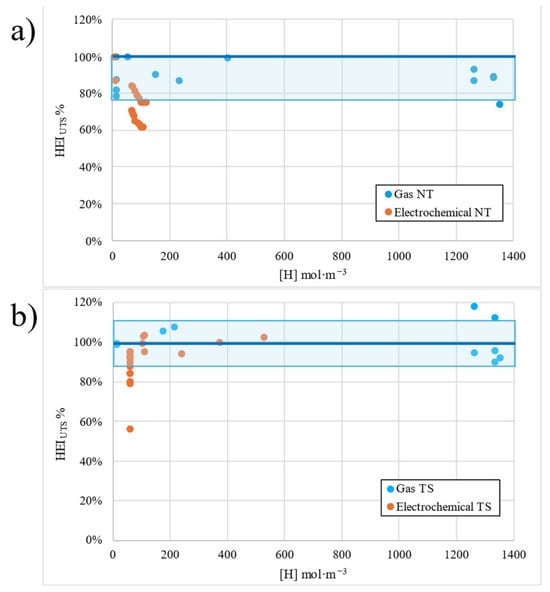
Given equivalent concentration and exposure time, once hydrogen enters a material, the source of hydrogen should not influence the mechanical properties observed. However, the literature contradicts this, showing that the strength of materials varies widely between those produced by gaseous and electrochemical environments. Figure 1 compares the relative strength loss hydrogen embrittlement index (HEI = σUTS-hydrogen/σUTS-air) in notched tensile (Figure 1a) and standard tensile (Figure 1b) tests on 300-series stainless steel under both gaseous and electrochemical environments in the literature. Observing the hydrogen content in the material, the HEI for electrochemically charged samples shows increasing strength loss with increasing hydrogen content for both testing types. Under gas charging conditions, irrespective of hydrogen content, the HEI of notched tensile and standard tensile strengths falls between 75 and 100% and between >90 and 100%, respectively, with the scatter band marked in blue. In contrast, samples with electrochemically charged hydrogen show a distinct trend of reduced strength, with the most severe HEI as low as 55% for the notched tensile samples. This discrepancy suggests that either the hydrogen concentration in electrochemically charged samples is not being accurately quantified, or that the damage observed under electrochemical charging differs from that created by gaseous environments.
Figure 1.
Hydrogen embrittlement index (HEI) % reported in the literature versus hydrogen concentration under gaseous (blue) or electrochemical (orange) charging environments for (a) notched tensile (NT) and (b) tensile strength (TS) [10,20,23,24,25,26,27,28,29,30,31,32,33,34,35,36,37].
In gaseous systems, hydrogen content within a material obeys Sieverts’ law, which links dissolved hydrogen concentration to its partial pressure and solubility of the material [29,38]. To measure the hydrogen concentration, methods such as thermal desorption spectroscopy, melt extraction, scanning kelvin probe and time-of-flight secondary ion mass spectrometry (ToF-SIMS) can be used [39,40,41,42]. These methods have been used to generate hydrogen solubility data for selected materials, which can then be used to calculate the hydrogen content given a system’s temperature and pressure [43,44,45].
However, due to practical constraints such as the small sample size requirements, time investment and novelty of instruments, it is rare to see hydrogen concentration directly measured before mechanical testing. Instead, hydrogen content is calculated based on the gas charging conditions (pressure, temperature, time). This is generally well justified, as sufficient data is available under gaseous environments to link charging conditions with hydrogen content [46]. As a result, mechanical testing studies often report only the charging parameters, rather than the direct hydrogen concentrations, which is widely accepted. However, electrochemical charging has added factors in the generation of hydrogen pressure, such as the current density, electrolyte and surface features. These factors must be considered when calculating hydrogen content.
Work done to correlate electrochemical charging conditions with the effective hydrogen partial pressure, or fugacity, has shown that it is possible to produce a predictable hydrogen concentration in material that relates to pressurised gas conditions. However, where these methods have been applied to testing materials, reliability concerns have been raised.
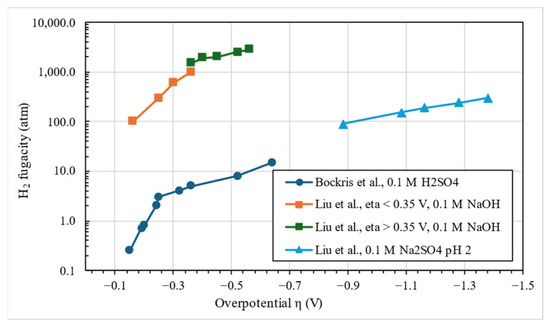
In electrochemical systems, fugacity can be determined by the rate of hydrogen generation at the metal’s surface. This is controlled by the applied current density and electrolyte [47,48,49,50]. Lui et al. demonstrated that hydrogen fugacity could be estimated in agreeance with the proposed models by correlating the fugacity range of 0.1 to 130 MPa for an overpotential of −0.3 to −1.4 VSHE in both 0.1 M NaOH and acidified 0.1 M Na2SO4 electrolytes [48].
Figure 2 shows the calculated fugacities within the range of overpotentials for each electrolyte. This range includes most practical hydrogen applications, and shows that fugacity follows predictable behaviour. However, in subsequent work by Venezuela et al. [51] using this model of fugacity, hydrogen concentrations did not consistently match the predictions, raising concerns regarding the reliability of this approach.
Figure 2.
Electrochemical hydrogen fugacity produced by an overpotential in 0.1 M NaOH and 0.1 M Na2SO4 (from Liu et al. [48] with data from Bockris et al. [50]).
Table 2 displays Venezuela et al.’s measured hydrogen concentration in four selected steels after charging in both gaseous and electrochemical conditions at 200 bar and an overpotential of −0.9 VSHE in 0.1 M NaOH, respectively. Of the four electrochemically charged steel samples, only MS1500 produced hydrogen concentrations predicted by the fugacity applied. The other samples had less than 50% of the predicted hydrogen content. In contrast, gaseous charging produced consistent hydrogen contents for all four samples.
Table 2.
Measured hydrogen concentrations in steel samples charged with an overpotential of −0.9 VSHE (−1.7 VHg/HgO) in 0.1 M NaOH electrochemical and 200 bar of gas (data from Venezuela et al. [51]).
The authors attributed the disparities in hydrogen content to surface variations induced by variation in the experimental conditions, which impeded the ingress of hydrogen and led to non-representative hydrogen distributions in the material [51]. If these suggested surface variations are contributing to such significant inconsistencies in hydrogen content in electrochemical systems, this may be the cause of variation in mechanical properties observed in Figure 1. Therefore, further understanding of these surfaces and their impact of hydrogen content is needed to reliably use electrochemical methods when producing desired hydrogen contents in metals.
2.2. Materials Sensitivity: Stainless Steel and Alloys
Austenitic stainless steels are currently one of the few materials approved for hydrogen service. Within ISO 11114-4:2015 [14], 300-series stainless steels are categorised as ‘slightly or negligibly embrittled’ under hydrogen service, having a tensile and notched tensile HEI of >90% [10,14]. However, under electrochemical conditions, results have shown a HEI below 75%. This would deem the steel ‘severely embrittled’ and therefore not recommended for hydrogen service. For electrochemical methods to be adopted in the development of embrittlement data, these differences in observed mechanical properties must be accounted for.
Austenitic stainless steels are particularly susceptible to the effects of electrochemical conditions for two reasons.
First, austenitic alloys have relatively low hydrogen diffusivity values compared with ferritic or martensitic steels. At low temperatures, such as those of electrochemical conditions (<100 °C), this difference is more significant. Reported values vary from 10−14 to 10−15 m2s−1 for austenitic steel and 10−8 to 10−9 m2s−1 for ferritic steel [12,20,38,43,52,53,54,55,56].
Second, the corrosion resistance of stainless steel comes from the rapid formation of passive oxides from the chromium content. These oxide layers will impede hydrogen entry [12,57,58,59,60,61,62,63,64,65,66,67,68,69]. Their formation depends heavily on the environmental conditions: typical air-formed layers at room temperature range from 2 to 20 nm, while thermally produced layers reach up to tens of micrometres composed of hematite, magnetite and chromium oxides [56,62,70,71,72]. As a result of the reduced diffusion rates limiting hydrogen content and rapid oxide formation, austenitic steels will be increasingly likely to experience variations in mechanical properties under electrochemical conditions.
2.3. Understanding the Impact of Electrochemical Hydrogen Environments
Electrochemical charging exposes the metal–electrolyte interface to large cathodic potentials to achieve high effective hydrogen fugacities. This current/voltage-driven process can alter surface chemistry, modify the kinetics of the hydrogen evolution reaction and promote corrosion mechanisms. This then influences hydrogen charging rates and the uniformity of hydrogen ingress into the material. In contrast, gaseous charging conditions do not create the same surface modifying conditions, and therefore do not suffer from these effects; they consider only pressure and temperature [29,38]. Therefore, to replicate gaseous material damage, the surface effects created by electrochemical conditions must be well understood and controlled.
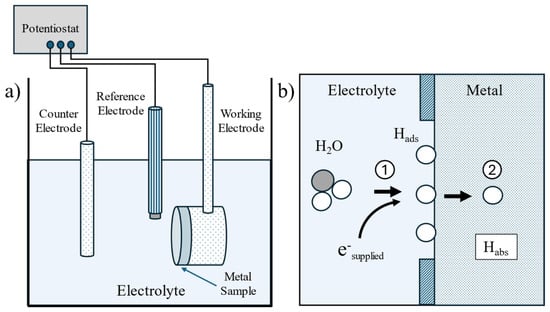
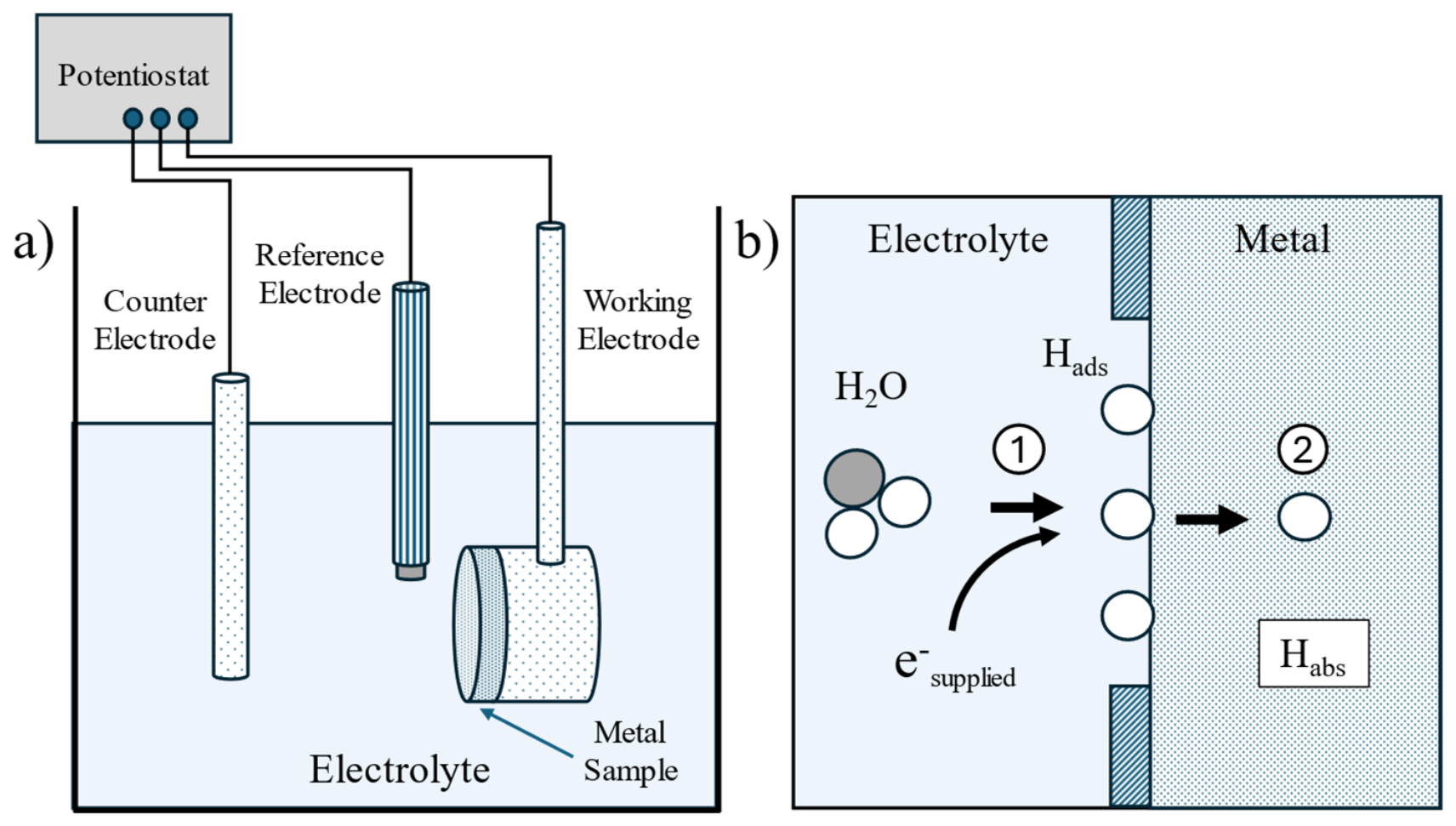
In electrochemical environments, hydrogen is introduced through a surface-mediated, two-step process. In an electrochemical cell, a potential is applied between the counter and working electrode with respect to a reference electrode (Figure 3a). In the first step, water is split (Figure 3b) to generate adsorbed hydrogen (Hads) at the metal surface (Equation (1)). The second step involves entry of the adsorbed hydrogen into the metal as soluble hydrogen (Habs) (Equation (2)).
Figure 3.
(a) Hydrogen charging electrochemical cell; (b) hydrogen-generation mechanism at surface of sample material and diffusion into hydrogen fugacity produced.
Because hydrogen is generated at the surface, and must then transit through it, electrochemical methods are inherently sensitive to electrolyte interactions, surface films and competing reaction pathways [73]. These factors are not present during gaseous exposure. Therefore, even if fugacities are equivalent, the surface-driven aspects can reduce the effective hydrogen flux into the material. For hydrogen charging of mechanical testing samples, the reduced flux or diffusion will result in a smaller amount of hydrogen than predicted. This is rarely accounted for in common practices, leading to non-representative damage being observed when conducting mechanical testing.
The sensitivity of electrochemical charging to surface conditions has been demonstrated extensively by the use of hydrogen permeation experiments. These measure the rate at which hydrogen diffuses through a sample membrane [57,58,59]. Early studies showed the necessity of protective and catalytic coatings to achieve stable and reliable permeation measurements [74,75]. Manolatos et al. [74] compared the permeation of palladium-coated and uncoated samples of pure iron, and observed that a palladium coating increased the measured flux by a factor of seven compared with the uncoated sample. This indicated that the metal–electrolyte interface was impeding hydrogen flux, likely due to inherent oxides formed on the iron surface, which the more noble palladium coating is able to mitigate.
The use of a palladium coating is still recommended in electrochemical permeation standards ASTM G148-2011 [76] and ISO 17081:2014 [77]. Despite this, its use is less common in recent literature, after issues were identified involving the co-deposition of hydrogen during the coating procedure, and trapping of hydrogen that introduced non-diffusible hydrogen. This distorts permeation results [78,79] and is particularly detrimental to permeation studies that rely on defined hydrogen entry conditions and measure hydrogen trapping [40,80].
These findings led to coatings being substituted by methods that manage the surface, such as sufficient reductive treatments that remove oxides prior to measurement. Such treatments have produced reliable results in iron, nickel and steels [21,49,73,81]. However, permeation focuses on the rate of hydrogen diffusion, whereas mechanical testing focuses on the total amount of hydrogen in the material and replicating in-service conditions. As a result, the use of either palladium or hydrogen pretreatments to manage surface effects is rarely ever seen; these coatings are not present in industry, and pretreatments alter the hydrogen content of the material. Despite this, such coatings need to be understood, as they offer a potential way for electrochemical methods to be more representative of gaseous conditions.
Although oxide layers are not accounted for in calculations of hydrogen contents when conducting mechanical testing, permeation experiments have shown that oxides of only a few nanometres thick can significantly reduce the hydrogen diffusion rate.
Ishikawa et al. [62] compared the permeation of 316L stainless steel with varying oxide thicknesses and composition produced by polishing and thermal passivation procedures. The steady-state flux values versus feed pressure (Table 3) show samples with oxide thicknesses of 4, 11 and 24 nm. The 11 and 24 nm samples reduced the hydrogen flux to a third of the value of a polished sample with minimal oxidation (4 nm). Notably, the chromium content within the passive film showed greater correlation with the reduction in flux, with samples B (24 nm) and C (11 nm) having 46% and 71% chromium oxide, respectively.
Table 3.
Steady-state flux versus feed pressure for 316L stainless steel samples: polished (4 nm, 46% Cr2O3), thermally oxidised at 550 °C (24 nm, 46% Cr2O3) and thermally oxidised at 475 °C (11 nm, 71% Cr2O3) (data from Ishikawa et al. [62]).
Standard ferritic steels have oxide layers composed mainly of hematite and magnetite, which have measured diffusivities of 10−16 to 10−22 m2s−1 at room temperature [82,83,84]. These values are orders of magnitude below that of austenitic and ferritic steels, which have diffusivity values of 10−14 to 10−15 m2s−1 and 10−8 to 10−9 m2s−1, respectively [12,20,38,43,52,53,54,55,56]. This difference in hydrogen diffusion rate directly links to the time required to charge a sample. When translating these diffusivities into the time required for hydrogen to diffuse an average of 1 mm, they equate to minutes for ferritic steels, months for austenitic steels and nearly a decade for iron oxides. Hence, small oxide thicknesses play a large role in the total diffusion rate of hydrogen into a sample, and therefore the time required to produce representative hydrogen contents within bulk materials.
Oxide composition has a significant effect on the hydrogen ingress rate, and therefore the time required to achieve the intended hydrogen concentration. In studies that do not consider these aspects, oxides may contribute to the inconsistencies in mechanical properties seen in Figure 1. Therefore, understanding the formation and reaction of oxide layers is important when producing accurate hydrogen contents in mechanical samples.
3. Factors Affecting Hydrogen Diffusion and Implications for Mechanical Testing
Surfaces with low hydrogen diffusion reduce the hydrogen content of a material. This has a direct consequence for the amount of hydrogen present when conducting mechanical testing.
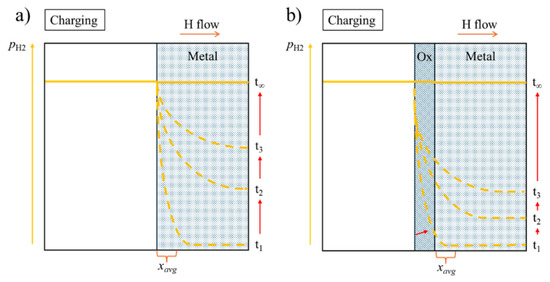
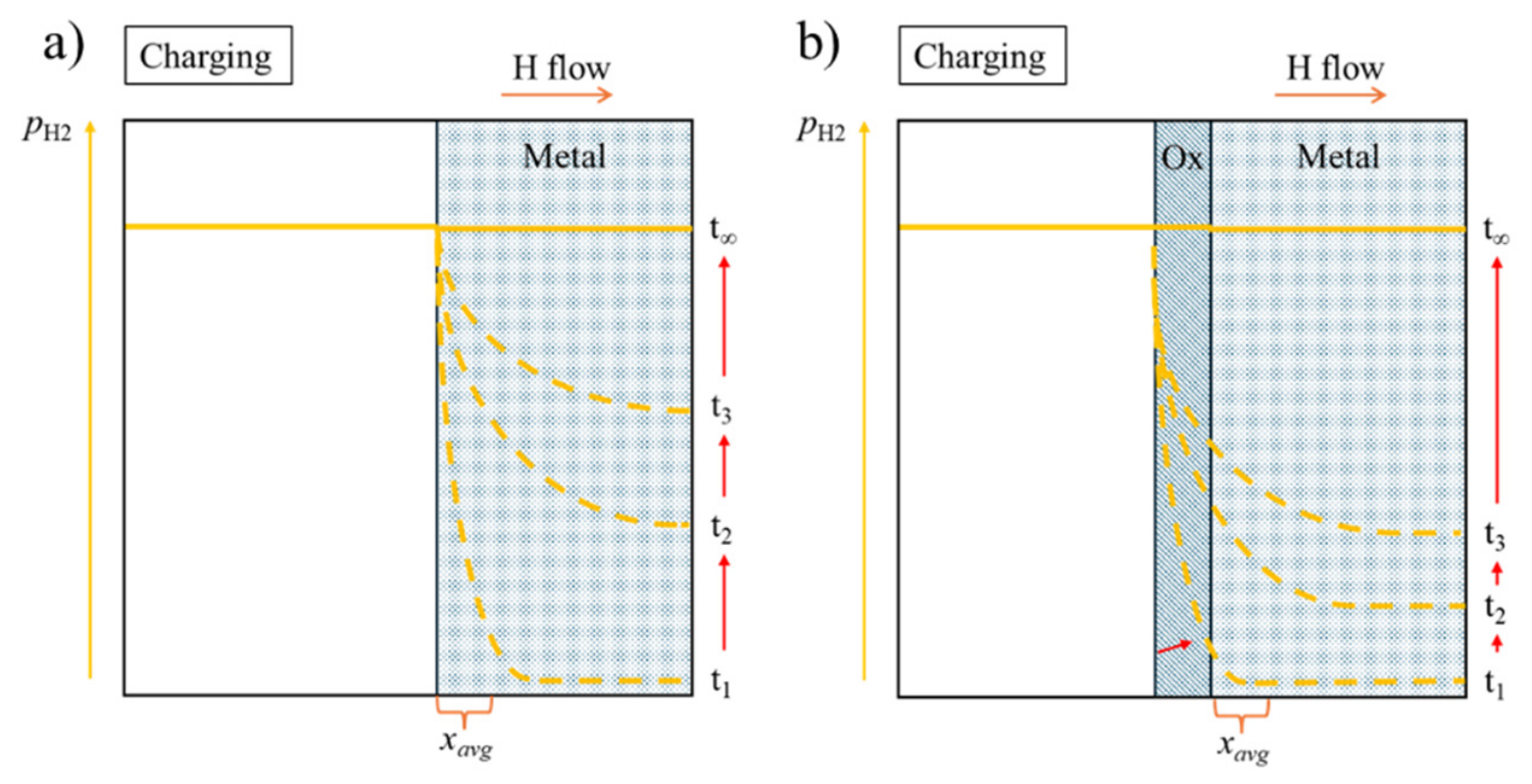
The impact of a surface barrier on the charging rate of the metal sample is described using Fick’s Law with a low-diffusivity layer at the surface of a bulk material. Figure 4a illustrates the hydrogen concentration in a material after arbitrary time steps (t1–3) until the time of saturation (t∞), where the concentration of the material reaches its maximum solubility. The addition of a thin layer with reduced diffusivity at the entry surface (i.e., oxide layer) is shown in Figure 4b. After the same arbitrary time steps, impedance by the surface layer results in a lower amount of hydrogen within the material.
Figure 4.
Comparison of hydrogen distribution in metal (a) without and (b) with an oxide layer. Dotted lines indicate arbitrary time steps from first exposure to hydrogen.
By logic, a longer charging time would be required to reach the target bulk concentration if a barrier layer is present. The amount of extra time required is determined by the scale at which the barrier impedes hydrogen entry. However, without an understanding of surface oxide thickness or composition, this remains unknown.
To compound the issue, electrochemical conditions will modify the surface over time, further altering the hydrogen ingress rate. Therefore, electrochemical charging conditions for mechanical testing need to consider the initial surface state of the material, as well as how the surface reacts and changes under the charging environment.
3.1. Impact of Electrochemical Conditions on Oxide Layers
Oxide layers affect the rate of hydrogen ingress, and therefore the amount of hydrogen within the material. Thus, it is important to understand how electrochemical conditions affect the formation of surface oxides and their interaction with hydrogen.
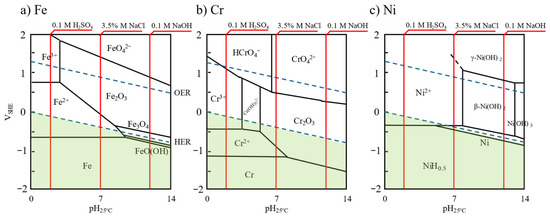
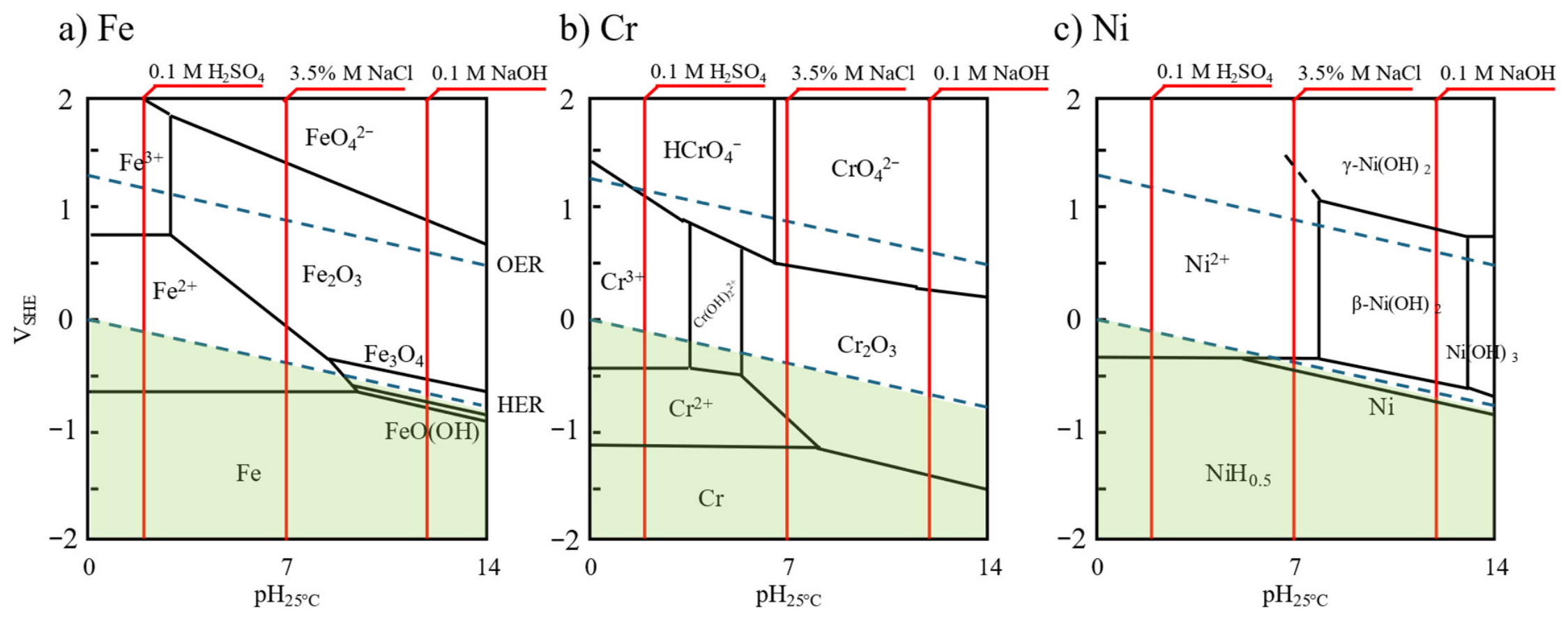
How oxides interact with hydrogen will depend on the initial surface condition, alloy composition, electrolyte chemistry and potential applied. Pourbaix diagrams are commonly used to describe thermodynamically favourable species in an aqueous solution under applied potential and electrolyte pH [85,86,87]. Figure 5 shows Pourbaix diagrams for each of the major alloys of stainless steel (Fe, Cr and Ni), with common electrolytes outlined in standards of 0.1 M NaOH, 0.1 M H2SO4 and 3.5% NaCl corresponding to a pH of 12, 2 and 7, respectively, marked on the figures. From these diagrams, Fe, Cr and Ni are all expected to react with electrolytes to form soluble metal ions (Fe2+, Cr3+, Ni2+), whereas basic solutions favour the formation of oxides and hydroxides.
Figure 5.
Pourbaix diagrams for (a) Fe, (b) Cr and (c) Ni at 25 °C with [M(aq)] = 10−6 M. Diagonal dotted blue lines indicate the hydrogen evolution reaction (HER) and oxygen evolution reaction (OER). Solid red lines indicate a pH corresponding to the identified electrolytes. Shaded green areas highlight electrochemical hydrogen charging potential ranges (modified from Beverskog et al. [85,86,87]).
Considering voltage, hydrogen charging experiments apply negative potentials to the sample below the hydrogen evolution reaction, where the magnitude of this potential is determined by the current density chosen. Over this range of conditions (indicated by green regions in Figure 5), the general trends follow those seen across electrolyte pH.
At sufficiently negative potentials where hydrogen evolution occurs, all species are predicted to be metallic. For example, as indicated in Figure 5b, in a 0.1 M NaOH solution the Cr2O3 species is favoured until a potential lower than −1.5 VSHE is reached. At this point, Cr2O3 will be reduced to metallic Cr, supposedly leaving an oxide-barrier-free surface. However, when surfaces have been analysed after exposure, oxides remain evident [28,81,88].
Flis et al. investigated the surfaces of pure iron produced after electrochemical hydrogen treatment in 0.1 M NaOH at −1.6 VSHE through the use of atomic force microscopy and Auger electron spectroscopy [88]. In their work, the evolution of physical surface features and oxide growth were observed and increased throughout the charging time. This was attributed to the formation of soluble iron oxide species by partial reduction of air-formed oxides, which then redeposited as iron hydroxides (Fex(OH)y) [89]. Through Auger electron spectroscopy depth profiling, the oxide layer was found to be approximately 100 nm thick after 144 h of hydrogen charging. The growth of oxides under electrochemical conditions contradicts those predicted under Pourbaix. This implies that hydrogen must contend with impeded ingress throughout hydrogen charging.
The modification and growth of oxides under electrochemical environments indicate that more complex mechanisms are occurring than those predicted under typical corrosion conditions [71,90,91]. The way these oxides interact under electrochemical environments must therefore be considered to account for their impact on hydrogen diffusion rates.
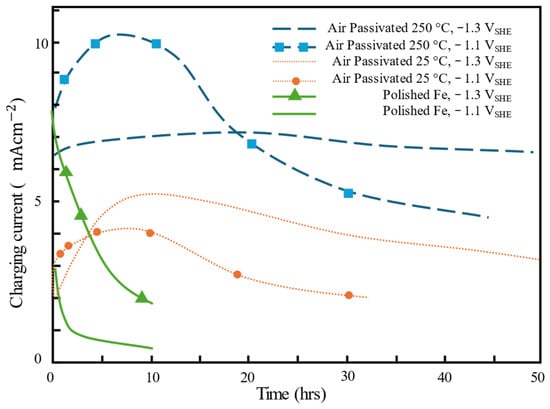
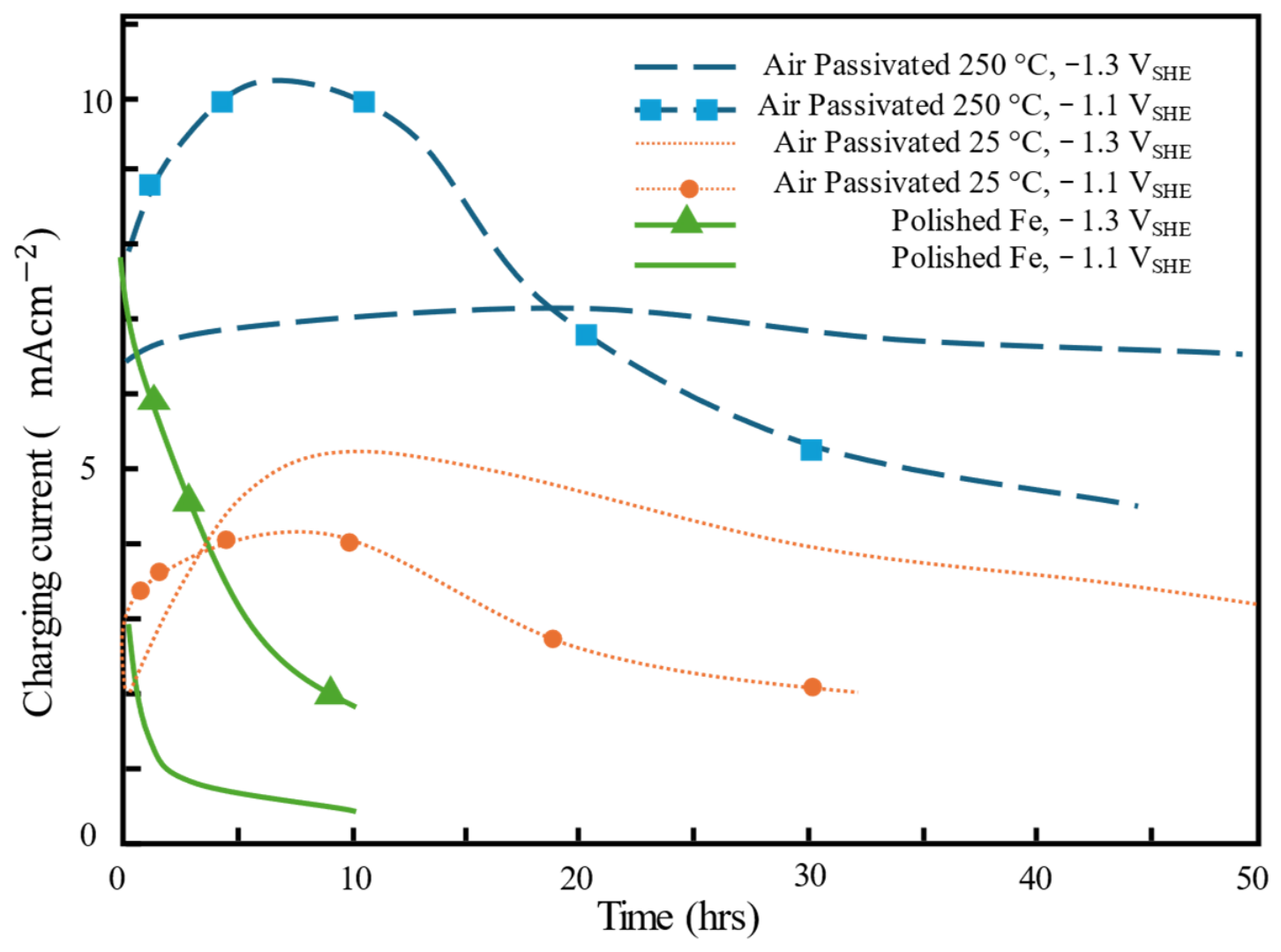
In permeation experiments, stable hydrogen flux indicates the surface has been modified to a consistent state. For pure iron, Zakroczymski et al. [66,92] measured the time to achieve steady-state to be approximately 10–20 h from a polished surface, which is attributed to the point where oxide modification and hydrogen ingress have both reached equilibrium. Brass and Chene [81] compared polished and air-passivated surfaces of Armco iron in 0.1 M NaOH, revealing that variations in time are need to reach steady-state. Figure 6 shows that the polished samples reached a stable baseline after ~10 h of hydrogen exposure at −1.1 VSHE and −1.3 VSHE, compared to 30 and 50 h for samples passivated at 25 and 250 °C, respectively. The prolonged stabilisation time indicates that oxides reach steady-state, which is consistent with other permeation studies [66,92].
Figure 6.
Chronoamperometry (CA) transients (hydrogen charging transients) at −1.1 VSHE and −1.3 VSHE of Arco iron in 0.1 M NaOH, after polishing and air passivation at 25 °C or 250 °C for 15 h (modified from Brass and Chene [81]).
Notably, both passivated samples do not reach steady-state at the same current density as the polished iron sample, and differ based on the applied potential. The higher resistance indicates increased resistance from the surface, and suggests that the initial oxide state and reduction potentials cause changes to the final surface equilibrium state. Thus, hydrogen would diffuse at a different rate due to the different surfaces of each sample affecting the total hydrogen content.
The reaction of surface oxides throughout hydrogen treatment is particularly detrimental to studies that use short charging times (<24 h) [27,32,37]. Throughout this time, the surface is being continually modified. Therefore, the charging time required is uncertain, and the current is not solely generating hydrogen. Knowing the significant ability of oxides to reduce hydrogen diffusion, the thickness and composition of the final surface is important in understanding the charging rate of the material. Therefore, in studies that have short charging exposure times and where surface conditions are not controlled, any assumptions regarding hydrogen diffusion rates are likely to be severely overestimated. Thus, the final hydrogen contents and mechanical properties produced in such studies must be viewed critically.
3.2. Surface Damage
Electrochemical hydrogen charging has higher rates of damages per hydrogen content than gaseous charging methods. This is particularly the case for notched samples, which are more susceptible to surface damage effects. During mechanical testing, surface defects amplify stresses and act as crack initiation sites, creating early mechanical failure. When surfaces have been analysed after electrochemical hydrogen exposure, the formation of martensitic phases and surface cracking have been observed [93,94]. These features have not been directly observed under gaseous conditions [42], suggesting they may result from electrochemical processes rather than from hydrogen-induced damage. Therefore, they need to be considered when comparing samples produced by the two methods.
3.2.1. Martensitic Formation
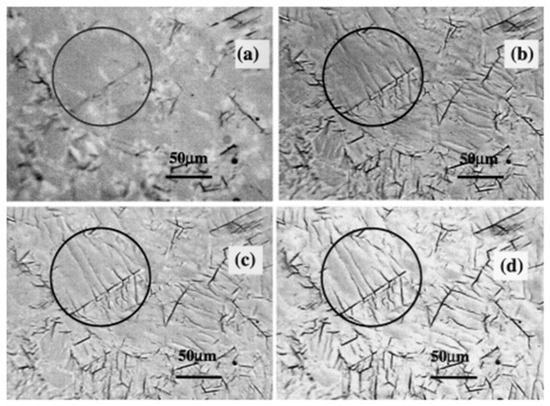
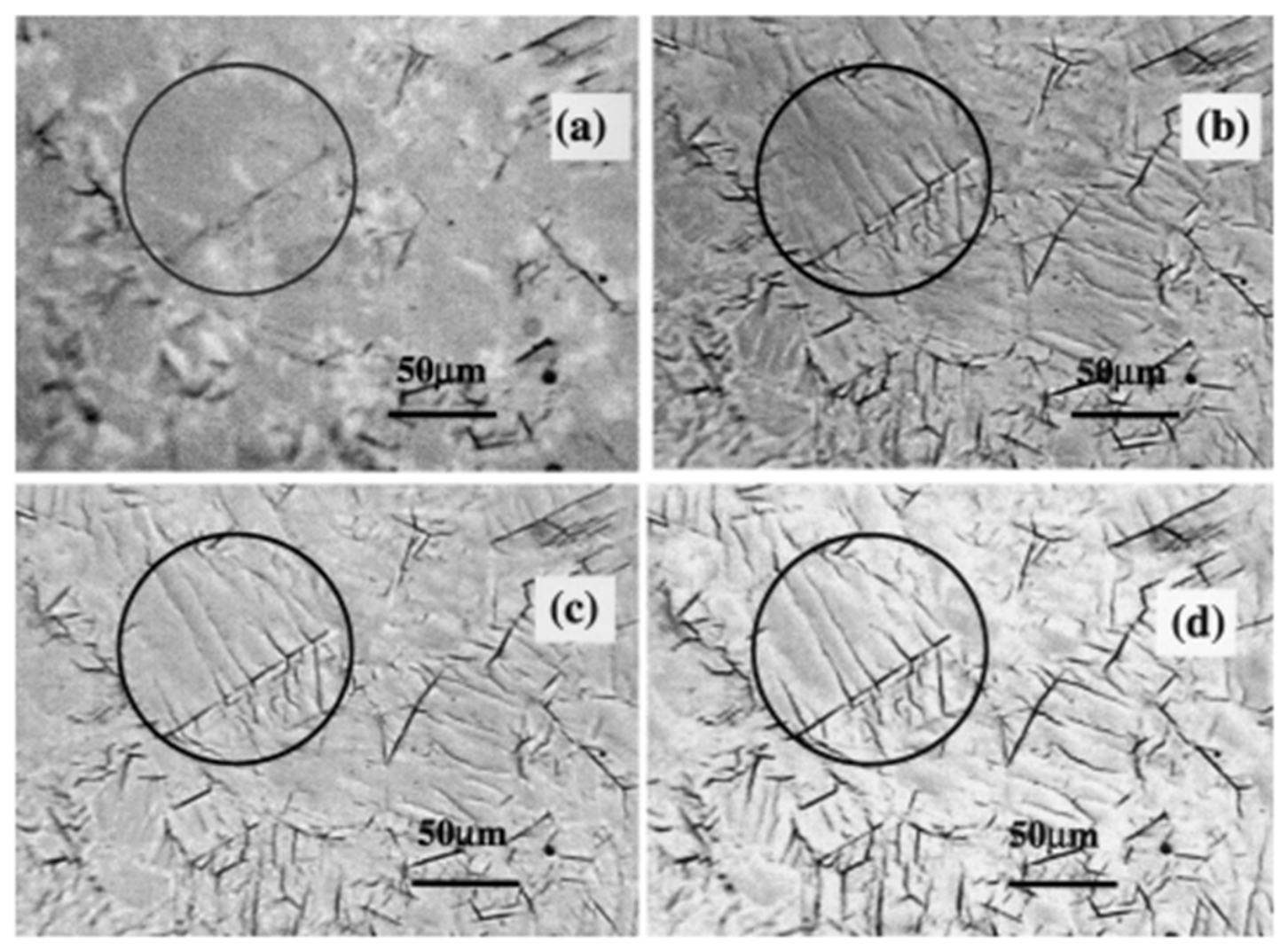
Martensite is a brittle phase that can form in austenitic steels under thermal or mechanical stress. It is well known to impact mechanical properties [95,96]. Martensitic steels typically have extremely high strengths (>1400 MPa) compared with austenitic steels (~500 MPa), but are far less ductile [97]. Therefore, the presence of martensite will heavily influence the mechanical properties observed. Martensitic formations have been frequently reported to occur at the surface of austenitic steels after charging under electrochemical conditions [98,99,100]. While hydrogen has been shown reduce the threshold for thermal and strain-induced martensitic formations [23,25,35,93,101,102,103], martensite formation as a result of charging environment alone has not been observed under gaseous conditions. Yang and Lou [99] investigated the formation of martensite in annealed 304 stainless steel, and showed that even at low current densities of <0.2 mAcm−2, martensitic transformations occurred after 16 h. Figure 7 shows the surface of 304 stainless steel in situ during electrochemical hydrogenation at −20 mAcm−2 in 0.5 M H2SO4 and 0.25 gL−1 As2O3. Surface cracking at the boundary of the newly formed phases can be clearly seen over time.
Figure 7.
In situ images of 304 stainless steel surfaces showing cracking during electrochemical hydrogen exposure of −20 mAcm−2 in 0.5 M H2SO4 and 0.25 gL−1 of As2O3 after (a) 6 min, (b) 60 min, (c) 90 min and (d) 150 min (reproduced from Yang and Lou [99]).
Martensite was only observed at the surface, and not in the bulk of the material. This indicates that other surface effects are contributing to the damage, rather than hydrogen alone. Narita et al. [104] proposed that the formation of martensitic phases are the result of high effective pressure of hydrogen at the surface. These studies used current densities of −100 mAcm−2 and higher (>1000 MPa), of which the reported fugacities agree with the calculations of Lui et al. [48]. However, at a current density of 0.2 mAcm−2 (corresponding to a fugacity of ~70 MPa), Yang and Lou [99] saw martensite formed at the surface, which had not been observed under equivalent gas pressures [10,26]. This discrepancy suggests other aspects of the electrochemical system may contribute to this effect, which are not apparent in gaseous systems.
3.2.2. Corrosion Processes
Corrosion affects mechanical properties by impeding hydrogen content, but can also contribute further damage. Examples of surface corrosion effects observed during electrochemical hydrogen charging include crack formation, blistering and localised corrosion (pitting) [23,25,35,93,101,102]. These effects come from the reaction of metallic species with electrolyte, leading to loss of metal to solution over the exposed area or in targeted regions. It is assumed that under cathodic potentials, metals are immune. However, this assumption is for generalised cathodic conditions [105]. Many studies still report discolouration of electrolytes and sample surfaces [88,106], indicating otherwise.
Under sufficiently negative potentials, like those used in hydrogen-generation conditions, hydroxide ions formed as a byproduct from hydrogen formation reaction (Equation (1)) can react with a metallic substrate. This leads to oxidation and loss of metal ions to solution, known as cathodic corrosion [107]. Corrosion mechanisms can promote damage as follows:
- Localised regions of damage (grain boundaries, machining/grinding marks, passive layer flaws) with severe losses to solution will cause pits, and porosity will cause concentrated points that will add physical defects into the material [108].
- Loss of specific alloys from regions such as chromium and nickel, as well as interstitial carbon and nitrogen, is detrimental because they stabilise austenite from martensitic transformations [96,109].
Any form of corrosion will negatively impact the mechanical properties observed, but will have major implications in studies that use extended pre-charging/charging periods to remove oxide barriers and increase hydrogen content. If corrosion rates are consistent throughout charging, longer exposure will increase the total damage induced. It is therefore important to understand the scale of the corrosion effects and isolate hydrogen’s role in the mechanical damage observed. To do this, studies must assess the amount of corrosion and rate at which corrosion is occurring. They must also determine whether these artefacts are present when the surface is protected (e.g., with a palladium coating), which would support a hydrogen-dominated mechanism rather than a corrosion-assisted artefact.
3.3. Surface and Bulk Hydrogen Exposure
As shown earlier in Figure 1a,b, notched tensile and standard tensile tests show distinct differences in mechanical properties. This leads to the question of what is causing the contrast in this behaviour. Between these mechanical tests, stress is applied at different points throughout the sample; additionally, the charging conditions impact how hydrogen is distributed throughout the sample. Therefore, the mechanical results may be affected by the type of testing and the charging conditions. Under the low-temperature limitations of electrochemical environments, hydrogen diffusion is restricted. Hence, hydrogen is concentrated at the surface, compared with those materials charged for longer times or with higher diffusivities.
Electrochemical studies have the benefit of being able to produce high hydrogen contents in materials quickly. However, this affects the distribution of hydrogen throughout the sample. The penetration depth depends only on diffusivity and time, not pressure or fugacity [110]. A simple approximation of the average penetration depth can be made using Equation (3) [110]:
where xavg is the average diffusion length, D is the hydrogen diffusivity of the material, and t is time.
xavg = 2(Dt)1/2
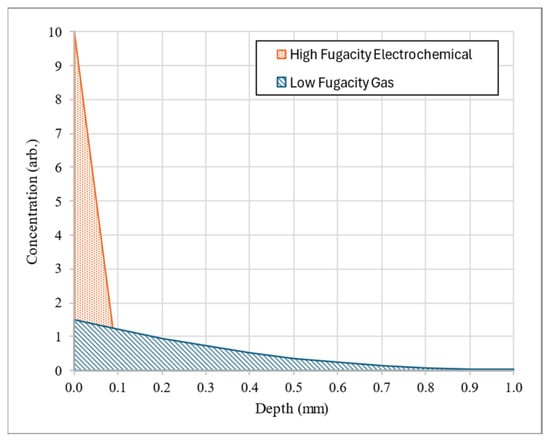
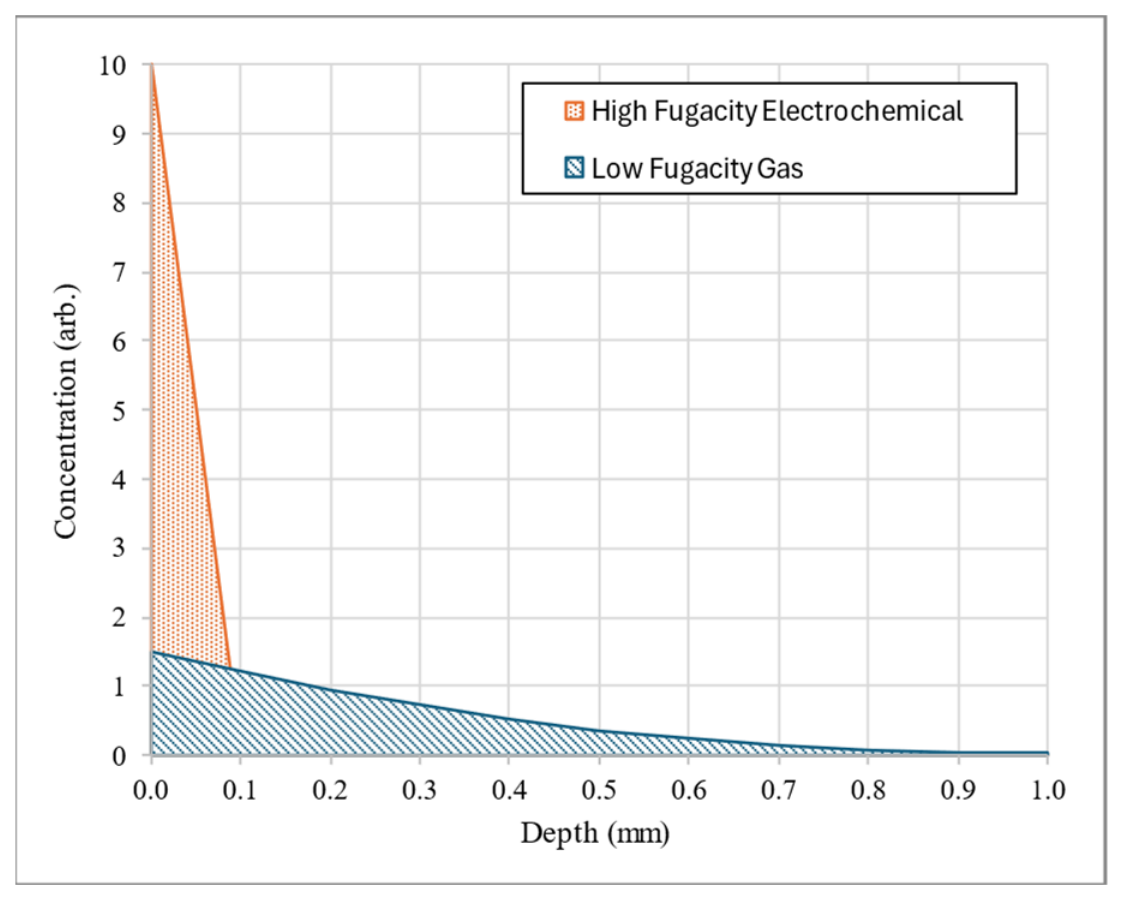
Consequently, exposure over short durations will cause hydrogen to concentrate near the surface of the material, while longer exposure produces more uniform distributions. However, the use of high-fugacity hydrogen will allow the total concentration of hydrogen to be comparable. For stainless steels at room temperature, a charging period of 24–72 h, commonly seen in electrochemical studies [23,27,28,31,32,37], had an average diffusion depth of 60–100 µm. This is significantly smaller than the gauge dimensions of a mechanical testing sample piece. As a result, samples with identical total hydrogen contents (area under the curve) can exhibit very different mechanical responses due to different hydrogen distributions.
An example of the distribution of hydrogen produced by different charging conditions is illustrated in Figure 8. The figure compares an electrochemical sample charged for 24 h with a gaseous sample charged for 2500 h at one-tenth of the fugacity (e.g., electrochemically hydrogenated at a fugacity of 10 bar and gaseous hydrogenation at 1 bar). Even though both components have the same total hydrogen content, which is what is reported in the literature, the depth of penetration varies from 0.1 to 1 mm, directly as a result of exposure time.
Figure 8.
Modelled hydrogen penetration depth under a short-term, high-fugacity electrochemical environment and a long-term, low-fugacity gas charging environment.
The effect of hydrogen distribution is seen when comparing the tensile and fracture toughness properties in Figure 1a,b. In tensile tests that have stress distributed across the bulk, there was a negligible (>90–100%) reduction in HEI. In comparison, in notched tensile/fracture toughness testing where stress is localised at the notch point, HEI was in the range of 65–100%. As previously identified in Figure 1, electrochemical values were in the lower range for both charging conditions.
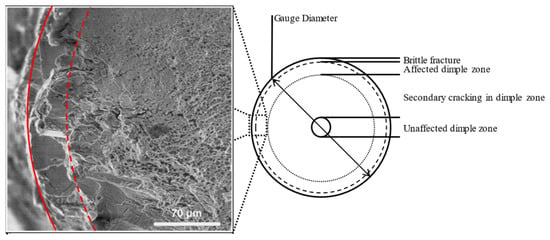
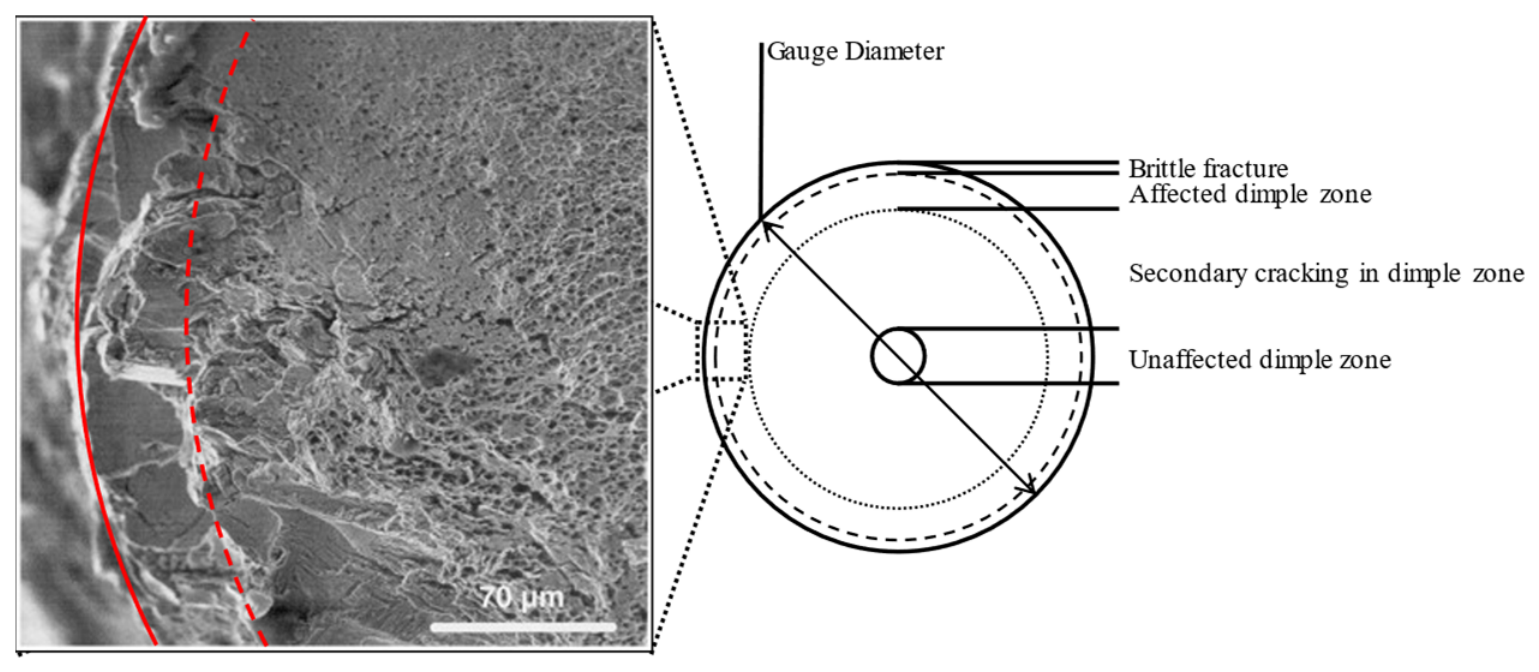
An example of limited hydrogen penetration modifying mechanical behaviour is seen in Herms et al. [27]. In their study, a current density of −100 mAcm−2 was used over 24 h on a 1.5 mm diameter AISI 316L wire. Illustrated in Figure 9, the fracture surface produced after tensile testing shows a clear change in surface from brittle fracture at the hydrogen-exposed surface to the ductile bulk.
Figure 9.
Brittle-to-ductile fracture of tensile-tested AISI 316L steel wire after electrochemical charging at −100 mAcm−2 for 24 h. Solid and dotted lines indicate sample surface and brittle fracture region respectively [27].
Examining the use of electrochemically charged samples in the literature showed that many studies do not achieve hydrogen distribution though the bulk. This is due to low-temperature restrictions (<100 °C) where hydrogen diffusion is limited. In turn, this means the time required to saturate a typical mechanical sample is far greater. Using the same average penetration depth approximation, a 3 mm diameter 300-series steel sample would require ~650 days to saturate at room temperature, without any surface diffusion impediment.
As a result, mechanical testing is reliant on surface-focused methods (e.g., fracture toughness, crack propagation, linearly increasing stress test) [111,112,113] or samples with thin geometries (e.g., burst disc, small punch testing) [114,115] that target stress at regions with hydrogen content. Under these testing systems, the surface becomes more important, as other surface features (e.g., corrosion, surface defects) in the hydrogen-exposed region will greatly influence the observed mechanical properties. Therefore, these features must be understood for the data collected to reflect any hydrogen damage.
4. Hydrogen Barriers as Mitigation Strategies
As described in previous sections, thin layers of low-diffusivity coatings or barriers significantly reduce the rate of hydrogen ingress. When applied to industrial systems, however, they could reduce hydrogen damage, and therefore prolong the service life of materials.
Previous studies have looked at the application of low-diffusion barriers, such as metallic coatings, oxides, nitrides and composite layers, to limit hydrogen uptake in the fields of nuclear science and aerospace [54,64,82,83,84,116,117,118,119,120,121,122]. Materials such as Si3N4, BN and other composite oxides have diffusivities of the order of 10−22 to 10−24 m2s−1, which is far lower than those of typical steel oxides. These coatings significantly reduce the damage induced from hydrogen exposure [123,124].
From an industrial viewpoint, many of the advanced manufacturing techniques needed to apply these coatings, such as vapour and thermal deposition, are not feasible at the scale required. Instead, existing passivation techniques used commonly on steels for corrosion resistance could significantly reduce hydrogen diffusion into materials. Standardised methods of passivation (AS 1627 [125] and ASTM A380-25 [126]) are used widely at scale. They offer chemical, anodic and thermal procedures to modify surfaces by producing oxidation layers to increase corrosion resistance [31,126,127,128]. For industrial applications, this would be an attractive method, as existing methods could be adopted to reduce the use of hydrogen. However, the surfaces produced using these methods must be assessed for their effectiveness as hydrogen barriers.
The thickness and composition of the surface barrier determine how much it reduces hydrogen ingress. Hence, the choice of passivation procedure and the oxide produced as a surface barrier will heavily influence the effectiveness of reducing the hydrogen content. Du et al. [33] compared different passivation processes for 316 stainless steel prior to electrochemical hydrogen exposure. Surfaces were passivated anodically at +0.5 V in 0.5 M, and air-passivated at room temperature for 72 h. X-ray photoelectron spectroscopy and ToF-SIMS analysis identified that the anodic passivation produced higher proportions of FeOOH and Cr2O3 than air-passivated surfaces. After 72 h of hydrogen exposure at −10 mAcm−2 in 0.5 M H2SO4, the relative tensile strength loss was 7% in the anodically passivated sample and 18% in the air-passivated sample [31].
Du et al.’s study shows that the surfaces produced by these passivation procedures reduced hydrogen-induced damage. However, these electrochemically produced coatings are made under laboratory conditions, which are not comparable to passivation processes at an industrial scale. For hydrogen-resistant coatings to be used in industry, existing methods must be tailored to produce them at scale.
5. Conclusions and Outlook
This work has reviewed and contrasted electrochemical charging with hydrogenation in gaseous environments to identify differences in microstructural evolution and their implications for interpreting mechanical test results. Electrochemical methods are being increasingly used in the generation of hydrogen compatibility data due to safety aspects and reduced costs. However, for these electrochemical methods to reliably replicate gaseous environments, work is needed to control experimental conditions and sample parameters. From this review, we have identified the following five key knowledge gaps.
- Surface: Nanometre-scale oxides significantly reduce hydrogen ingress. Oxide thickness and composition (specifically chromium content) can significantly reduce hydrogen flux factors. Understanding the conditioning of surfaces and their interaction with electrolytes and hydrogen during charging is essential to accurately measure hydrogen content. In electrochemical charging, one must carefully consider the impact of inherent oxide films, and validation is needed to verify the impact of thin oxides on the mechanical properties observed.
- Diffusion: Electrochemical charging and gaseous charging are not directly equivalent. Electrochemical and gas conditions can produce equivalent hydrogen concentrations in metals. However, the mechanical properties observed vary between the two. In addition, electrochemical charging environments have shown to be inconsistent in producing hydrogen concentrations in materials. Work determining the effective fugacity and reliability of electrochemical charging environments across materials is needed to correlate between gaseous and electrochemical charging methods.
- Distribution: Hydrogen distribution is key for measuring mechanical properties. High fugacity, low diffusion and sample geometry will affect hydrogen distribution, and therefore the mechanical properties observed. Testing and charging conditions need to be selected appropriately to obtain reliable results.
- Damage: Electrochemistry-specific damage mechanisms exist, but are not considered. Martensite formation and surface cracking are observed during electrochemical charging, but not under gas exposure at similar pressures. This indicates that additional mechanisms (e.g., local chemistry changes, cathodic corrosion) might bias mechanical results. The scale of these surface effects must then be considered when comparing mechanical properties to those exposed under gaseous environments.
- Protection: Hydrogen barriers could be used to prolong material service life. Engineered oxide and passive films can reduce uptake and embrittlement in controlled studies. However, their long-term stability and service durability in hydrogen environments remain insufficiently quantified. If barriers are modified under a hydrogen environment, their integrity will be compromised.
For electrochemical charging to be used as a reliable method for producing hydrogen compatibility data, the above discrepancies must be resolved. Therefore, data is needed that links the selection of electrochemical conditions to those relatable to gaseous hydrogen environments. These electrochemical variables must consider attributes of effective fugacity, surface effects and additional damages present in electrochemical charging conditions. Without addressing these features, hydrogen embrittlement data collected under electrochemical conditions remain disconnected from any application in industrial standards. Addressing these research gaps will link the electrochemical environments used with the mechanical properties observed. Knowing the factors that influence mechanical properties after hydrogen charging will allow methods to be adapted to best represent gaseous testing. This will allow electrochemical methods to be used to collect hydrogen compatibility data more reliably, at a lower risk and higher throughput, and in a more cost-effective manner.
Author Contributions
Conceptualization, R.I. and A.I.; methodology, R.I. and L.S.; formal analysis, R.I. and V.G.; investigation, R.I.; resources, L.S. and V.G.; writing—original draft preparation, R.I.; writing—review and editing, V.G., A.I. and L.S.; supervision, V.G., A.I. and L.S. All authors have read and agreed to the published version of the manuscript.
Funding
The work was supported by the Heavy Industry Low-carbon Transition Cooperative Research Centre (HILT CRC), whose activities are funded by its industry, research, and government partners, along with the Australian Government’s CRC program, and specifically as part of HILT CRC project RP2.015, entitled “Hydrogen utilisation in industrial applications: evaluation of impact on materials and infrastructure.”
Data Availability Statement
No new data was created or analysed in this study. Data sharing is not applicable to this article.
Acknowledgments
The authors are grateful for the financial support provided by the CSIRO Hydrogen Energy Systems Future Science Platform.
Conflicts of Interest
The authors declare no conflicts of interest.
Abbreviations
The following abbreviations are used in this manuscript:
| HEI | Hydrogen Embrittlement Index |
| NT | Notched Tensile |
| TS | Tensile Strength |
| ToF-SIMS | Time-of-Flight Secondary Ion Mass Spectrometry |
| D | Diffusivity of Hydrogen (m2s−1) |
| η | Overpotential (V) |
References
- Rawls, G.B.; Adams, T.; Newhouse, N.L. 1—Hydrogen production and containment. In Gaseous Hydrogen Embrittlement of Materials in Energy Technologies; Gangloff, R.P., Somerday, B.P., Eds.; Woodhead Publishing: Cambridge, UK, 2012; Volume 2, pp. 3–50. [Google Scholar]
- Ilyushechkin, A.; Schoeman, L.; Carter, L.; Hla, S.S. Material Challenges and Hydrogen Embrittlement Assessment for Hydrogen Utilisation in Industrial Scale. Hydrogen 2023, 4, 599–619. [Google Scholar] [CrossRef] [Scilit]
- Islam, A.; Alam, T.; Sheibley, N.; Edmonson, K.; Burns, D.; Hernandez, M. Hydrogen blending in natural gas pipelines: A comprehensive review of material compatibility and safety considerations. Int. J. Hydrogen Energy 2024, 93, 1429–1461. [Google Scholar] [CrossRef] [Scilit]
- ISO/TS 15916:2026; Basic Considerations for the Safety of Hydrogen Systems. BSI Standards Limited: London, UK, 2026.
- Hawksworth, S.; Jordan, T.; Jeffrey, K.; Melideo, D. Chapter 5—Risk assessment. In Hydrogen Safety for Energy Applications; Kotchourko, A., Jordan, T., Eds.; Butterworth-Heinemann: Oxford, UK, 2022; pp. 263–299. [Google Scholar]
- Olawale, O.C.; Beneke, L.W.; Oosthuizen, C.C. Mechanisms of hydrogen embrittlement in metals and alloys used in fuel cell applications. J. Mater. Sci. 2026, 61, 4829–4856. [Google Scholar] [CrossRef] [Scilit]
- Johnson, W.H. On Some Remarkable Changes Produced in Iron and Steel by the Action of Hydrogen and Acids. Nature 1875, 11, 393. [Google Scholar] [CrossRef] [Scilit]
- Nagumo, M. Fundamentals of Hydrogen Embrittlement, 2nd ed.; Springer Nature: Singapore, 2023. [Google Scholar]
- Lynch, S.P. 2—Hydrogen embrittlement (HE) phenomena and mechanisms. In Stress Corrosion Cracking; Raja, V.S., Shoji, T., Eds.; Woodhead Publishing: Cambridge, UK, 2011; pp. 90–130. [Google Scholar]
- Jewett, R.P.; Walter, R.J.; Chandler, W.T.; Frohmberg, R.P. Hydrogen Environment Embrittlement of Metals; NASA: Washington, DC, USA, 1973.
- Walter, R.J.; Jewett, R.P.; Chandler, W.T. On the mechanism of hydrogen-environment embrittlement of iron- and nickel-base alloys. Mater. Sci. Eng. 1970, 5, 99–110. [Google Scholar] [CrossRef] [Scilit]
- Louthan, M.R.; Derrick, R.G. Hydrogen transport in austenitic stainless steel. Corros. Sci. 1975, 15, 565–577. [Google Scholar] [CrossRef] [Scilit]
- API RP 941; Steels for Hydrogen Service at Elevated Temperatures and Pressures in Petroleum Refineries and Petrochemical Plants. American Petroleum Institute: Washington, DC, USA, 2016. Available online: https://www.api.org/~/media/files/publications/whats%20new/941_e8%20pa.pdf (accessed on 1 September 2025).
- ISO 11114-4:2017; Transportable Gas Cylinders—Compatibility of Cylinder and Valve Materials with Gas Contents. European Commitee for Standardization: Brussels, Belgium, 2017.
- IEA. Global Hydrogen Review 2024; IEA: Paris, France, 2024; Available online: https://www.iea.org/reports/global-hydrogen-review-2024 (accessed on 1 September 2025).
- Paterlini, L.; Re, G.; Curia, A.; Ormellese, M.; Bolzoni, F. Mechanical Testing Methods for Assessing Hydrogen Embrittlement in Pipeline Steels: A Review. Metals 2025, 15, 1123. [Google Scholar] [CrossRef] [Scilit]
- Nanninga, N.E.; Levy, Y.S.; Drexler, E.S.; Condon, R.T.; Stevenson, A.E.; Slifka, A.J. Comparison of hydrogen embrittlement in three pipeline steels in high pressure gaseous hydrogen environments. Corros. Sci. 2012, 59, 1–9. [Google Scholar] [CrossRef] [Scilit]
- Meng, B.; Gu, C.; Zhang, L.; Zhou, C.; Li, X.; Zhao, Y.; Zheng, J.; Chen, X.; Han, Y. Hydrogen effects on X80 pipeline steel in high-pressure natural gas/hydrogen mixtures. Int. J. Hydrogen Energy 2017, 42, 7404–7412. [Google Scholar] [CrossRef] [Scilit]
- Djukic, M.B.; Bakic, G.M.; Sijacki Zeravcic, V.; Sedmak, A.; Rajicic, B. The synergistic action and interplay of hydrogen embrittlement mechanisms in steels and iron: Localized plasticity and decohesion. Eng. Fract. Mech. 2019, 216, 106528. [Google Scholar] [CrossRef] [Scilit]
- Caskey, J.G.R. Hydrogen Compatibility Handbook for Stainless Steels. United States. 1983. Available online: https://www.osti.gov/biblio/5906050 (accessed on 1 September 2025).
- Bolzoni, F.; Paterlini, L.; Casanova, L.; Ormellese, M. Hydrogen charging of carbon and low alloy steel by electrochemical methods. J. Appl. Electrochem. 2024, 54, 103–114. [Google Scholar] [CrossRef] [Scilit]
- Koren, E.; Hagen, C.M.H.; Wang, D.; Lu, X.; Johnsen, R.; Yamabe, J. Experimental comparison of gaseous and electrochemical hydrogen charging in X65 pipeline steel using the permeation technique. Corros. Sci. 2023, 215, 111025. [Google Scholar] [CrossRef] [Scilit]
- Hwang, B.-K.; Kim, H.-T.; Cha, S.-J.; Park, G.-S.; Yoon, J.-T.; Kim, J.-H.; Lee, J.-M. Comparative study of hydrogen embrittlement in 310S, 304L, and 316L stainless steels under in situ electrochemical hydrogen charging. Part 1: Experimental study. Eng. Fail. Anal. 2025, 176, 109641. [Google Scholar] [CrossRef] [Scilit]
- Minkovitz, E.; Eliezer, D. Grain-size and heat-treatment effects in hydrogen-assisted cracking of austenitic stainless steels. J. Mater. Sci. 1982, 17, 3165–3172. [Google Scholar] [CrossRef] [Scilit]
- Eliezer, D. The behaviour of 316L stainless steel in hydrogen. J. Mater. Sci. 1984, 19, 1540–1547. [Google Scholar] [CrossRef] [Scilit]
- San Marchi, C.; Michler, T.; Nibur, K.A.; Somerday, B.P. On the physical differences between tensile testing of type 304 and 316 austenitic stainless steels with internal hydrogen and in external hydrogen. Int. J. Hydrogen Energy 2010, 35, 9736–9745. [Google Scholar] [CrossRef] [Scilit]
- Herms, E.; Olive, J.M.; Puiggali, M. Hydrogen embrittlement of 316L type stainless steel. Mater. Sci. Eng. A 1999, 272, 279–283. [Google Scholar] [CrossRef] [Scilit]
- Brass, A.M.; Chêne, J. Influence of tensile straining on the permeation of hydrogen in low alloy Cr–Mo steels. Corros. Sci. 2006, 48, 481–497. [Google Scholar] [CrossRef] [Scilit]
- Caskey, G.R.; Sisson, R.D. Hydrogen solubility in austenitic stainless steels. Scr. Metall. 1981, 15, 1187–1190. [Google Scholar] [CrossRef] [Scilit]
- Lee, S.-Y.; Hwang, B. Hydrogen Embrittlement of Three High-Manganese Steels Tested by Different Hydrogen Charging Methods. Korean J. Met. Mater. 2017, 55, 695–702. [Google Scholar] [CrossRef] [Scilit]
- Du, Z.; Shi, R.; Mi, Z.; Xu, Z.; Zhu, Y.; Liu, S.; Gao, K.; Volinsky, A.A.; Pang, X. Exploring mechanisms and efficacy of passivation films in blocking hydrogen. Corros. Sci. 2025, 247, 112776. [Google Scholar] [CrossRef] [Scilit]
- Shin, S.-H.; Oh, D.-K.; Kim, S.-G.; Hwang, B. Notch tensile behavior of 304L and 316L stainless steels under in-situ and ex-situ electrochemical hydrogen charging. J. Mater. Res. Technol. 2025, 36, 9158–9167. [Google Scholar] [CrossRef] [Scilit]
- Louthan, M.R.; Caskey, G.R.; Donovan, J.A.; Rawl, D.E. Hydrogen embrittlement of metals. Mater. Sci. Eng. 1972, 10, 357–368. [Google Scholar] [CrossRef] [Scilit]
- Nietzke, J.; Konert, F.; Poka, K.; Merz, B.; Sobol, O.; Böllinghaus, T. Comparison of hydrogen effects on additively manufactured and conventional austenitic steels. Eng. Fail. Anal. 2025, 167, 109042. [Google Scholar] [CrossRef] [Scilit]
- Hatano, M.; Fujinami, M.; Arai, K.; Fujii, H.; Nagumo, M. Hydrogen embrittlement of austenitic stainless steels revealed by deformation microstructures and strain-induced creation of vacancies. Acta Mater. 2014, 67, 342–353. [Google Scholar] [CrossRef] [Scilit]
- San Marchi, C.W.; Somerday, B.P.; Tang, X.; Schiroky, G.H. Hydrogen-Assisted Fracture of Welded Aisi 316 Austenitic Stainless Steel; ASM International: Materials Park, OH, USA, 2008. [Google Scholar]
- Lee, J.-C.; Yang, D.C.; Sung, M.Y.; Kim, N.-S.; Park, H.-K.; Choi, M.; Kim, Y.D.; Sohn, S.S.; Park, C.-S. Influence of crystallographic textures on the hydrogen embrittlement resistance of austenitic stainless steel. J. Mater. Res. Technol. 2024, 32, 2757–2766. [Google Scholar] [CrossRef] [Scilit]
- San Marchi, C.; Somerday, B. SANDIA REPORT Technical Reference for Hydrogen Compatibility of Materials Technical Reference for Hydrogen Compatibility of Materials; Sandia National Laboratories: Albuquerque, NM, USA, 2023.
- Tapia-Bastidas, C.V.; Atrens, A.; Gray, E.M. Thermal desorption spectrometer for measuring ppm concentrations of trapped hydrogen. Int. J. Hydrogen Energy 2018, 43, 7600–7617. [Google Scholar] [CrossRef] [Scilit]
- Silverstein, R.; Eliezer, D.; Tal-Gutelmacher, E. Hydrogen trapping in alloys studied by thermal desorption spectrometry. J. Alloys Compd. 2018, 747, 511–522. [Google Scholar] [CrossRef] [Scilit]
- Röhsler, A.; Sobol, O.; Hänninen, H.; Böllinghaus, T. In-situ ToF-SIMS analyses of deuterium re-distribution in austenitic steel AISI 304L under mechanical load. Sci. Rep. 2020, 10, 3611. [Google Scholar] [CrossRef] [Scilit] [PubMed]
- Duportal, M.; Oudriss, A.; Feaugas, X.; Savall, C. On the estimation of the diffusion coefficient and distribution of hydrogen in stainless steel. Scr. Mater. 2020, 186, 282–286. [Google Scholar] [CrossRef] [Scilit]
- Yagodzinskyy, Y.; Todoshchenko, O.; Papula, S.; Hänninen, H. Hydrogen Solubility and Diffusion in Austenitic Stainless Steels Studied with Thermal Desorption Spectroscopy. Steel Res. Int. 2011, 82, 20–25. [Google Scholar] [CrossRef] [Scilit]
- Venezuela, J.; Tapia-Bastidas, C.; Zhou, Q.; Depover, T.; Verbeken, K.; Gray, E.; Liu, Q.; Liu, Q.; Zhang, M.; Atrens, A. Determination of the equivalent hydrogen fugacity during electrochemical charging of 3.5NiCrMoV steel. Corros. Sci. 2018, 132, 90–106. [Google Scholar] [CrossRef] [Scilit]
- Nagumo, M.; Ohta, K.; Saitoh, H. Deformation induced defects in iron revealed by thermal desorption spectroscopy of tritium. Scr. Mater. 1999, 40, 313–319. [Google Scholar] [CrossRef] [Scilit]
- McBreen, J.; Nonis, L.; Beck, W. A Method for Determination of the Permeation Rate of Hydrogen Through Metal Membranes. J. Electrochem. Soc. 1966, 113, 1218. [Google Scholar] [CrossRef] [Scilit]
- Bockris, J.O.M.; Subramanyan, P.K. The equivalent pressure of molecular hydrogen in cavities within metals in terms of the overpotential developed during the evolution of hydrogen. Electrochim. Acta 1971, 16, 2169–2179. [Google Scholar] [CrossRef] [Scilit]
- Liu, Q.; Atrens, A.D.; Shi, Z.; Verbeken, K.; Atrens, A. Determination of the hydrogen fugacity during electrolytic charging of steel. Corros. Sci. 2014, 87, 239–258. [Google Scholar] [CrossRef] [Scilit]
- Atrens, A.; Mezzanotte, D.; Fiore, N.F.; Genshaw, M.A. Electrochemical studies of hydrogen diffusion and permeability in Ni. Corros. Sci. 1980, 20, 673–684. [Google Scholar] [CrossRef] [Scilit]
- Bockris, J.O.M.; McBreen, J.; Nanis, L. The Hydrogen Evolution Kinetics and Hydrogen Entry into a-Iron. J. Electrochem. Soc. 1965, 112, 1025. [Google Scholar] [CrossRef] [Scilit]
- Venezuela, J.; Gray, E.; Liu, Q.; Zhou, Q.; Tapia-Bastidas, C.; Zhang, M.; Atrens, A. Equivalent hydrogen fugacity during electrochemical charging of some martensitic advanced high-strength steels. Corros. Sci. 2017, 127, 45–58. [Google Scholar] [CrossRef] [Scilit]
- Marchi, C.S.; Somerday, B.P.; Robinson, S.L. Permeability, solubility and diffusivity of hydrogen isotopes in stainless steels at high gas pressures. Int. J. Hydrogen Energy 2007, 32, 100–116. [Google Scholar] [CrossRef] [Scilit]
- Zakroczymski, T.; Flis, J.; Lukomski, N.; Mankowski, J. Entry, transport and absorption of hydrogen in low-temperature plasma nitrided austenitic stainless steel. Acta Mater. 2001, 49, 1929–1938. [Google Scholar] [CrossRef] [Scilit]
- Pyun, S.-I.; Oriani, R.A. The permeation of hydrogen through the passivating films on iron and nickel. Corros. Sci. 1989, 29, 485–496. [Google Scholar] [CrossRef] [Scilit]
- Zhang, T.Y.; Zheng, Y.P.; Wu, Q.Y. On the Boundary Conditions of Electrochemical Hydrogen Permeation Through Iron. J. Electrochem. Soc. 1999, 146, 1741. [Google Scholar] [CrossRef] [Scilit]
- Oriani, R.A. The diffusion and trapping of hydrogen in steel. Acta Metall. 1970, 18, 147–157. [Google Scholar] [CrossRef] [Scilit]
- Yamazaki, T.; Ikeshoji, T.T.; Suzumura, A.; Naito, T. Effect of Oxide Film on the Reduction of Hydrogen Permeation Rate in Stainless Steel. JSME Int. J. Ser. A-Solid Mech. Mater. Eng. 2006, 49, 58–62. [Google Scholar] [CrossRef] [Scilit]
- Oya, Y.; Kobayashi, M.; Osuo, J.; Suzuki, M.; Hamada, A.; Matsuoka, K.; Hatano, Y.; Matsuyama, M.; Hayashi, T.; Yamanishi, T.; et al. Effect of surface oxide layer on deuterium permeation behaviors through a type 316 stainless steel. Fusion Eng. Des. 2012, 87, 580–583. [Google Scholar] [CrossRef] [Scilit]
- Katsuta, H.; Furukawa, K. Hydrogen and Deuterium Transport through Type 304 Stainless Steel at Elevated Temperatures. J. Nucl. Sci. Technol. 1981, 18, 143–151. [Google Scholar] [CrossRef]
- Tanabe, T.; Yamanishi, Y.; Sawada, K.; Imoto, S. Hydrogen transport in stainless steels. J. Nucl. Mater. 1984, 123, 1568–1572. [Google Scholar] [CrossRef] [Scilit]
- Xiukui, S.; Jian, X.; Yiyi, L. Hydrogen permeation behaviour in austenitic stainless steels. Mater. Sci. Eng. A 1989, 114, 179–187. [Google Scholar] [CrossRef] [Scilit]
- Ishikawa, Y.; Yoshimura, T.; Arai, M. Effect of surface oxide layers on deuterium permeation through stainless steels with reference to outgassing reduction in ultra- to extremely high vacuum. Vacuum 1996, 47, 357–361. [Google Scholar] [CrossRef] [Scilit]
- Swansiger, W.A.; Musket, R.G.; Weirick, L.J.; Bauer, W. Deuterium permeation through 309S stainless steel with thin, characterized oxides. J. Nucl. Mater. 1974, 53, 307–312. [Google Scholar] [CrossRef] [Scilit]
- Nemanič, V. Hydrogen permeation barriers: Basic requirements, materials selection, deposition methods, and quality evaluation. Nucl. Mater. Energy 2019, 19, 451–457. [Google Scholar] [CrossRef] [Scilit]
- Murphy, O.J.; Pou, T.E.; Bockris, J.O. Investigation of the Anodically Formed Passive Film on Iron by Secondary Ion Mass Spectroscopy. J. Electrochem. Soc. 1984, 131, 2785–2790. [Google Scholar] [CrossRef] [Scilit]
- Casanova, T.; Crousier, J. The influence of an oxide layer on hydrogen permeation through steel. Corros. Sci. 1996, 38, 1535–1544. [Google Scholar] [CrossRef] [Scilit]
- Buchkremer, H.P.; Hecker, R.; Stoever, D. Hydrogen permeation through passive layers on austenitic high temperature alloys. In Passivity of Metals and Semiconductors; Froment, M., Ed.; Elsevier: Amsterdam, The Netherlands, 1983; pp. 675–680. [Google Scholar]
- Stöver, D.; Buchkremer, H.P.; Hecker, R. Hydrogen and deuterium permeation through metallic and surface-oxidized chromium. Surf. Coat. Technol. 1986, 28, 281–290. [Google Scholar] [CrossRef] [Scilit]
- Vecchi, L.; Pecko, D.; Van den Steen, N.; Mamme, M.H.; Özdirik, B.; Van Laethem, D.; Van Ingelgem, Y.; Deconinck, J.; Terryn, H. A modelling approach on the impact of an oxide layer on the hydrogen permeation through iron membranes in the Devanathan-Stachurski cell. Electrochim. Acta 2018, 286, 139–147. [Google Scholar] [CrossRef] [Scilit]
- Sims, C.T.; Stoloff, N.S.; Hagel, W.C. Superalloys II; Wiley: New York, NY, USA, 1987; Volume 8. [Google Scholar]
- Atrens, A.; Baroux, B.; Mantel, M. The Secondary Passive Film for Type 304 Stainless Steel in 0.5 M H2 SO4. J. Electrochem. Soc. 1997, 144, 3697. [Google Scholar] [CrossRef] [Scilit]
- Kirchheim, R.; Heine, B.; Fischmeister, H.; Hofmann, S.; Knote, H.; Stolz, U. The passivity of iron-chromium alloys. Corros. Sci. 1989, 29, 899–917. [Google Scholar] [CrossRef] [Scilit]
- Van den Eeckhout, E.; Verbeken, K.; Depover, T. Methodology of the electrochemical hydrogen permeation test: A parametric evaluation. Int. J. Hydrogen Energy 2023, 48, 30585–30607. [Google Scholar] [CrossRef] [Scilit]
- Manolatos, P.; Jerome, M.; Galland, J. Necessity of a palladium coating to ensure hydrogen oxidation during electrochemical permeation measurements on iron. Electrochim. Acta 1995, 40, 867–871. [Google Scholar] [CrossRef] [Scilit]
- Bruzzoni, P.; Riecke, E. On the mechanism of hydrogen transport through the passive oxide film on iron. Corros. Sci. 1994, 36, 1597–1614. [Google Scholar] [CrossRef] [Scilit]
- ASTM G148-2011; Standard Practice for Evaluation of Hydrogen Uptake, Permeation, and Transport in Metals by an Electrochemical Technique. ASTM International: West Conshohocken, PA, USA, 2011.
- BS EN ISO 17081:2014; Method of Measurement of Hydrogen Permeation and Determination of Hydrogen Uptake and Transport in Metals by an Electrochemcial Technique. CEN-CENELEC Management Centre: Brussels, Belgium, 2014.
- Brass, A.M.; Chene, J.; Boutry-Forveille, A. SIMS analysis of deuterium distribution in palladium coatings on pure iron. Corros. Sci. 1994, 36, 707–716. [Google Scholar] [CrossRef] [Scilit]
- Driver, R. Electrodeposition of Palladium on Iron and Steel for Electrochemical Hydrogen Permeation Studies. J. Electrochem. Soc. 1981, 128, 2367. [Google Scholar] [CrossRef] [Scilit]
- Devanathan, M.A.V.; Stachurski, Z. The adsorption and diffusion of electrolytic hydrogen in palladium. Proc. R. Soc. Lond. Ser. A Math. Phys. Sci. 1962, 270, 90–102. [Google Scholar] [CrossRef] [Scilit]
- Brass, A.M.; Collet-Lacoste, J.R. On the mechanism of hydrogen permeation in iron in alkaline medium. Acta Mater. 1998, 46, 869–879. [Google Scholar] [CrossRef] [Scilit]
- Song, R.H.; Pyun, S.; Oriani, R.A. Hydrogen Permeation Through the Passivation Film on Iron by Time-Lag Method. J. Electrochem. Soc. 1990, 137, 1703. [Google Scholar] [CrossRef] [Scilit]
- Sukhotin, A.M.; Sapelova, E.V.; Reingeverts, M.D. Investigation of passivating film on iron by proton diffusion method. Corros. Sci. 1985, 25, 93–98. [Google Scholar] [CrossRef] [Scilit]
- Bruzzoni, P.; Garavaglia, R. Anodic iron oxide films and their effect on the hydrogen permeation through steel. Corros. Sci. 1992, 33, 1797–1807. [Google Scholar] [CrossRef] [Scilit]
- Beverskog, B.; Puigdomenech, I. Revised pourbaix diagrams for chromium at 25–300 °C. Corros. Sci. 1997, 39, 43–57. [Google Scholar] [CrossRef] [Scilit]
- Beverskog, B.; Puigdomenech, I. Revised Pourbaix diagrams for nickel at 25–300 °C. Corros. Sci. 1997, 39, 969–980. [Google Scholar] [CrossRef] [Scilit]
- Beverskog, B.; Puigdomenech, I. Revised pourbaix diagrams for iron at 25–300 °C. Corros. Sci. 1996, 38, 2121–2135. [Google Scholar] [CrossRef] [Scilit]
- Flis, J.; Zakroczymski, T.; Kleshnya, V.; Kobiela, T.; Duś, R. Changes in hydrogen entry rate and in surface of iron during cathodic polarisation in alkaline solutions. Electrochim. Acta 1999, 44, 3989–3997. [Google Scholar] [CrossRef] [Scilit]
- Tamm, J.; Tamm, L.; Vares, P. Temperature dependence of hydrogen overvoltage on nickel and iron in acid solution. Russ. J. Electrochem. 2000, 36, 1174–1178. [Google Scholar] [CrossRef] [Scilit]
- Abreu, C.M.; Cristóbal, M.J.; Losada, R.; Nóvoa, X.R.; Pena, G.; Pérez, M.C. High frequency impedance spectroscopy study of passive films formed on AISI 316 stainless steel in alkaline medium. J. Electroanal. Chem. 2004, 572, 335–345. [Google Scholar] [CrossRef] [Scilit]
- Haupt, S.; Strehblow, H.H. A combined surface analytical and electrochemical study of the formation of passive layers on FeCr alloys in 0.5 M H2SO4. Corros. Sci. 1995, 37, 43–54. [Google Scholar] [CrossRef] [Scilit]
- Zakroczymski, T. Adaptation of the electrochemical permeation technique for studying entry, transport and trapping of hydrogen in metals. Electrochim. Acta 2006, 51, 2261–2266. [Google Scholar] [CrossRef] [Scilit]
- Rozenak, P.; Bergman, R. X-ray phase analysis of martensitic transformations in austenitic stainless steels electrochemically charged with hydrogen. Mater. Sci. Eng. A 2006, 437, 366–378. [Google Scholar] [CrossRef] [Scilit]
- Pérez Escobar, D.; Miñambres, C.; Duprez, L.; Verbeken, K.; Verhaege, M. Internal and surface damage of multiphase steels and pure iron after electrochemical hydrogen charging. Corros. Sci. 2011, 53, 3166–3176. [Google Scholar] [CrossRef] [Scilit]
- Olson, G.B.; Cohen, M. A mechanism for the strain-induced nucleation of martensitic transformations. J. Less Common Met. 1972, 28, 107–118. [Google Scholar] [CrossRef] [Scilit]
- Lancaster, J.F. 9—Austenitic and high-alloy steels. In Metallurgy of Welding, 6th ed.; Lancaster, J.F., Ed.; Woodhead Publishing: Cambridge, UK, 1999; pp. 310–352. [Google Scholar]
- Koyama, M.; Tasan, C.C.; Tsuzaki, K. Overview of metastability and compositional complexity effects for hydrogen-resistant iron alloys: Inverse austenite stability effects. Eng. Fract. Mech. 2019, 214, 123–133. [Google Scholar] [CrossRef] [Scilit]
- Narita, N.; Birnbaum, H.K. On the role of phase transitions in the hydrogen embrittlement of stainless steels. Scr. Metall. 1980, 14, 1355–1358. [Google Scholar] [CrossRef] [Scilit]
- Yang, Q.; Luo, J.L. Martensite transformation and surface cracking of hydrogen charged and outgassed type 304 stainless steel. Mater. Sci. Eng. A 2000, 288, 75–83. [Google Scholar] [CrossRef] [Scilit]
- Hänninen, H.; Hakarainen, T. On the Effects of α′ Martensite in Hydrogen Embrittlement of a Cathodically Charged AISI Type 304 Austenitic Stainless Steel. Corrosion 1980, 36, 47–51. [Google Scholar] [CrossRef] [Scilit]
- Shubina Helbert, V.; Nazarov, A.; Vucko, F.; Rioual, S.; Thierry, D. Hydrogen effect on the passivation and crevice corrosion initiation of AISI 304L using Scanning Kelvin Probe. Corros. Sci. 2021, 182, 109225. [Google Scholar] [CrossRef] [Scilit]
- Kamachi, K. An X-ray Study of Hydrides Formed in Austenitic Stainless Steels. Trans. Iron Steel Inst. Jpn. 1978, 18, 485–491. [Google Scholar] [CrossRef] [Scilit]
- Kamachi, K.; Touge, M. Hydrogen Induced Phenomena in Austenitic Stainless Steels. Corros. Eng. 1975, 24, 641–649. [Google Scholar] [CrossRef] [Scilit]
- Narita, N.; Altstetter, C.J.; Birnbaum, H.K. Hydrogen-related phase transformations in austenitic stainless steels. Metall. Trans. A 1982, 13, 1355–1365. [Google Scholar] [CrossRef] [Scilit]
- Marcus, P. Corrosion Mechanisms in Theory and Practice, 3rd ed.; Marcel Dekker: New York, NY, USA, 2011; pp. 1–905. [Google Scholar]
- Zakroczymski, T.; Szklarska-Smialowska, Z. Activation of the Iron Surface to Hydrogen Absorption Resulting from a Long Cathodic Treatment in NaOH Solution. J. Electrochem. Soc. 1985, 132, 2548. [Google Scholar] [CrossRef] [Scilit]
- Hersbach, T.J.P.; Koper, M.T.M. Cathodic corrosion: 21st century insights into a 19th century phenomenon. Curr. Opin. Electrochem. 2021, 26, 100653. [Google Scholar] [CrossRef] [Scilit]
- Lynch, S.P. 1—Mechanistic and fractographic aspects of stress-corrosion cracking (SCC). In Stress Corrosion Cracking; Raja, V.S., Shoji, T., Eds.; Woodhead Publishing: Cambridge, UK, 2011; pp. 3–89. [Google Scholar]
- Sohrabi, M.J.; Naghizadeh, M.; Mirzadeh, H. Deformation-induced martensite in austenitic stainless steels: A review. Arch. Civ. Mech. Eng. 2020, 20, 124. [Google Scholar] [CrossRef] [Scilit]
- Crank, J. The Mathematics of Diffusion, 2nd ed.; Clarendon Press: Oxford, UK, 1979. [Google Scholar]
- Blach, J.; Falat, L.; Ševc, P. The influence of hydrogen charging on the notch tensile properties and fracture behaviour of dissimilar weld joints of advanced Cr–Mo–V and Cr–Ni–Mo creep-resistant steels. Eng. Fail. Anal. 2011, 18, 485–491. [Google Scholar] [CrossRef] [Scilit]
- Hosoya, Y.; Inoue, A.; Masumoto, T. Effect of Hydrogen on Crack Propagation Behavior and Microstructures around Cracks in Austenitic Stainless Steels. Tetsu—Hagane 1978, 64, 769–778. [Google Scholar] [CrossRef] [Scilit] [PubMed]
- Liu, Q.; Irwanto, B.; Atrens, A. The influence of hydrogen on 3.5NiCrMoV steel studied using the linearly increasing stress test. Corros. Sci. 2013, 67, 193–203. [Google Scholar] [CrossRef] [Scilit]
- Fidelle, J.P.; Broudeur, R.; Pirrovani, C.; Roux, C. Disk Pressure Technique. Hydrogen Embrittlement Test. 1974, 543, 34. [Google Scholar] [CrossRef] [Scilit]
- Bae, K.-O.; Park, J.; Baek, U.B.; Nguyen, T.T. Establishing thresholds for hydrogen embrittlement in SA-372 Grade J steel: Insights from conventional tensile, disk burst, and small punch testing. Mater. Today Commun. 2026, 51, 114664. [Google Scholar] [CrossRef] [Scilit]
- Bhadeshia, H.K.D.H. Prevention of Hydrogen Embrittlement in Steels. ISIJ Int. 2016, 56, 24–36. [Google Scholar] [CrossRef] [Scilit]
- Laadel, N.-E.; El Mansori, M.; Kang, N.; Marlin, S.; Boussant-Roux, Y. Permeation barriers for hydrogen embrittlement prevention in metals—A review on mechanisms, materials suitability and efficiency. Int. J. Hydrogen Energy 2022, 47, 32707–32731. [Google Scholar] [CrossRef] [Scilit]
- Shi, K.; Xiao, S.; Ruan, Q.; Wu, H.; Chen, G.; Zhou, C.; Jiang, S.; Xi, K.; He, M.; Chu, P.K. Hydrogen permeation behavior and mechanism of multi-layered graphene coatings and mitigation of hydrogen embrittlement of pipe steel. Appl. Surf. Sci. 2022, 573, 151529. [Google Scholar] [CrossRef] [Scilit]
- Nam, T.-H.; Lee, J.-H.; Choi, S.-R.; Yoo, J.-B.; Kim, J.-G. Graphene coating as a protective barrier against hydrogen embrittlement. Int. J. Hydrogen Energy 2014, 39, 11810–11817. [Google Scholar] [CrossRef] [Scilit]
- Rönnebro, E.C.E.; Oelrich, R.L.; Gates, R.O. Recent Advances and Prospects in Design of Hydrogen Permeation Barrier Materials for Energy Applications—A Review. Molecules 2022, 27, 6528. [Google Scholar] [CrossRef] [Scilit] [PubMed]
- Holbrook, J.H.; Cialone, H.J.; Collings, E.W.; Drauglis, E.J.; Scott, P.M.; Mayfield, M.E. 5—Control of hydrogen embrittlement of metals by chemical inhibitors and coatings. In Gaseous Hydrogen Embrittlement of Materials in Energy Technologies; Gangloff, R.P., Somerday, B.P., Eds.; Woodhead Publishing: Cambridge, UK, 2012; Volume 1, pp. 129–153. [Google Scholar]
- Forcey, K.S.; Ross, D.K.; Wu, C.H. The formation of hydrogen permeation barriers on steels by aluminising. J. Nucl. Mater. 1991, 182, 36–51. [Google Scholar] [CrossRef] [Scilit]
- Yu, G.C.; Yen, S.K. Hydrogen diffusion coefficient of silicon nitride thin films. Appl. Surf. Sci. 2002, 201, 204–207. [Google Scholar] [CrossRef] [Scilit]
- Tamura, M.; Noma, M.; Yamashita, M. Characteristic change of hydrogen permeation in stainless steel plate by BN coating. Surf. Coat. Technol. 2014, 260, 148–154. [Google Scholar] [CrossRef] [Scilit]
- AS 1627-1997; Metal Finishing-Preparation and Pretreatment of Surfaces. Standards Australia: Sydney, Australia, 1997.
- ASTM A380-25; Standard Practice for Cleaning, Descaling, Pickling, and Passivation of Stainless Steel Parts, Equipment, and Systems. ASTM International: West Conshohocken, PA, USA, 2025.
- Detriche, S.; Vivegnis, S.; Vanhumbeeck, J.F.; Felten, A.; Louette, P.; Renner, F.U.; Delhalle, J.; Mekhalif, Z. XPS fast depth profile of the native oxide layers on AISI 304, 316 and 430 commercial stainless steels and their evolution with time. J. Electron Spectrosc. Relat. Phenom. 2020, 243, 146970. [Google Scholar] [CrossRef] [Scilit]
- Wang, Z.; Di-Franco, F.; Seyeux, A.; Zanna, S.; Maurice, V.; Marcus, P. Passivation-Induced Physicochemical Alterations of the Native Surface Oxide Film on 316L Austenitic Stainless Steel. J. Electrochem. Soc. 2019, 166, C3376. [Google Scholar] [CrossRef] [Scilit]

Disclaimer/Publisher’s Note: The statements, opinions and data contained in all publications are solely those of the individual author(s) and contributor(s) and not of MDPI and/or the editor(s). MDPI and/or the editor(s) disclaim responsibility for any injury to people or property resulting from any ideas, methods, instructions or products referred to in the content. |
© 2026 by the authors. Licensee MDPI, Basel, Switzerland. This article is an open access article distributed under the terms and conditions of the Creative Commons Attribution (CC BY) license.