
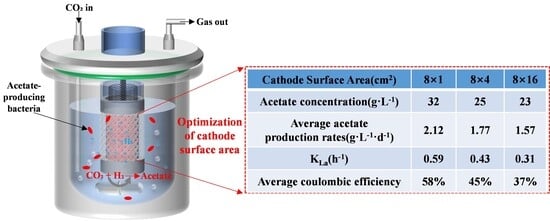
Impact of Cathode Surface Area on Gas–Liquid Mass Transfer and Acetate Production Efficiency in H2-Mediated Microbial Electrosynthesis from CO2


Abstract
Share and Cite
Guo, Y.; Zhao, M.; Yi, Y.; Cao, J.; Wang, B.; Zhang, H.; Cai, W.; Cui, K.; Patil, S.A.; Guo, K. Impact of Cathode Surface Area on Gas–Liquid Mass Transfer and Acetate Production Efficiency in H2-Mediated Microbial Electrosynthesis from CO2. Hydrogen 2026, 7, 42. https://doi.org/10.3390/hydrogen7010042
Guo Y, Zhao M, Yi Y, Cao J, Wang B, Zhang H, Cai W, Cui K, Patil SA, Guo K. Impact of Cathode Surface Area on Gas–Liquid Mass Transfer and Acetate Production Efficiency in H2-Mediated Microbial Electrosynthesis from CO2. Hydrogen. 2026; 7(1):42. https://doi.org/10.3390/hydrogen7010042
Chicago/Turabian StyleGuo, Yuhan, Menglong Zhao, Yan Yi, Jiahao Cao, Bingyan Wang, Hong Zhang, Wenfang Cai, Kai Cui, Sunil A. Patil, and Kun Guo. 2026. "Impact of Cathode Surface Area on Gas–Liquid Mass Transfer and Acetate Production Efficiency in H2-Mediated Microbial Electrosynthesis from CO2" Hydrogen 7, no. 1: 42. https://doi.org/10.3390/hydrogen7010042
APA StyleGuo, Y., Zhao, M., Yi, Y., Cao, J., Wang, B., Zhang, H., Cai, W., Cui, K., Patil, S. A., & Guo, K. (2026). Impact of Cathode Surface Area on Gas–Liquid Mass Transfer and Acetate Production Efficiency in H2-Mediated Microbial Electrosynthesis from CO2. Hydrogen, 7(1), 42. https://doi.org/10.3390/hydrogen7010042