
Pinch-Guided Heat Integration for Hydrogen Production from Mixed Plastic Waste

 ,
,  ,
,
Abstract
1. Introduction
2. Methodology
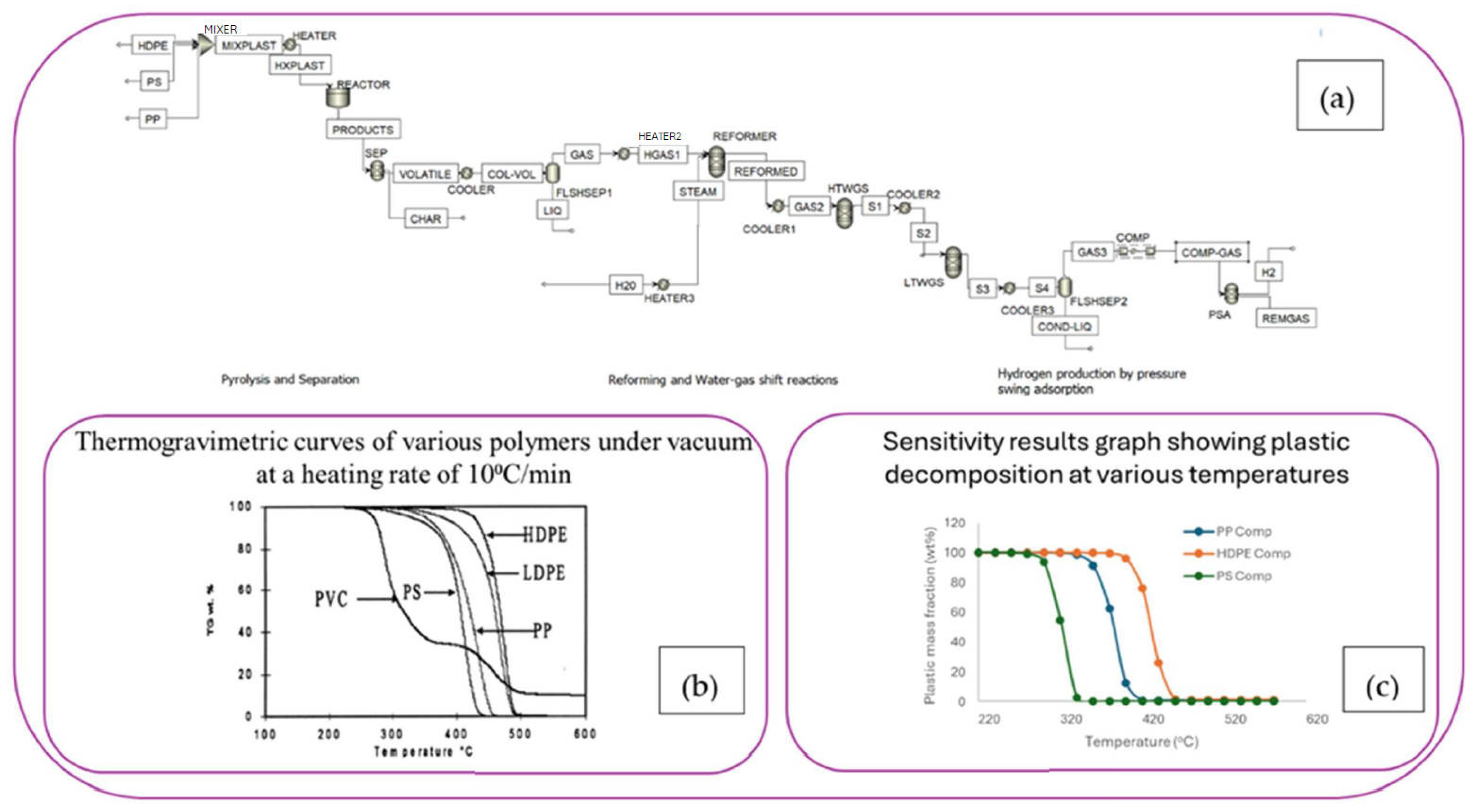
2.1. Modelling and Simulation of the Process
2.2. Baseline Energy Assessment
2.3. Pinch Analysis and Heat Integration
- 1.
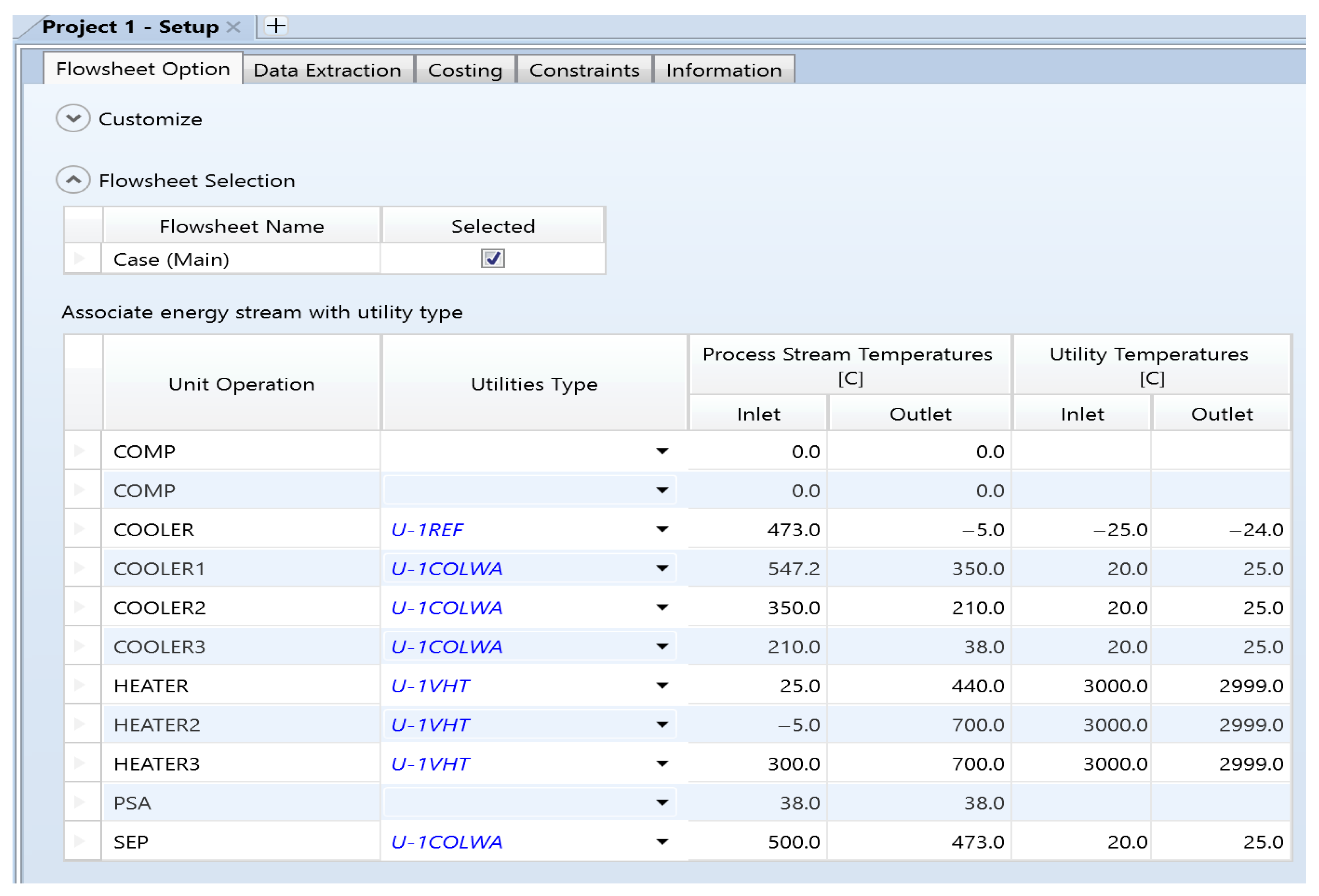
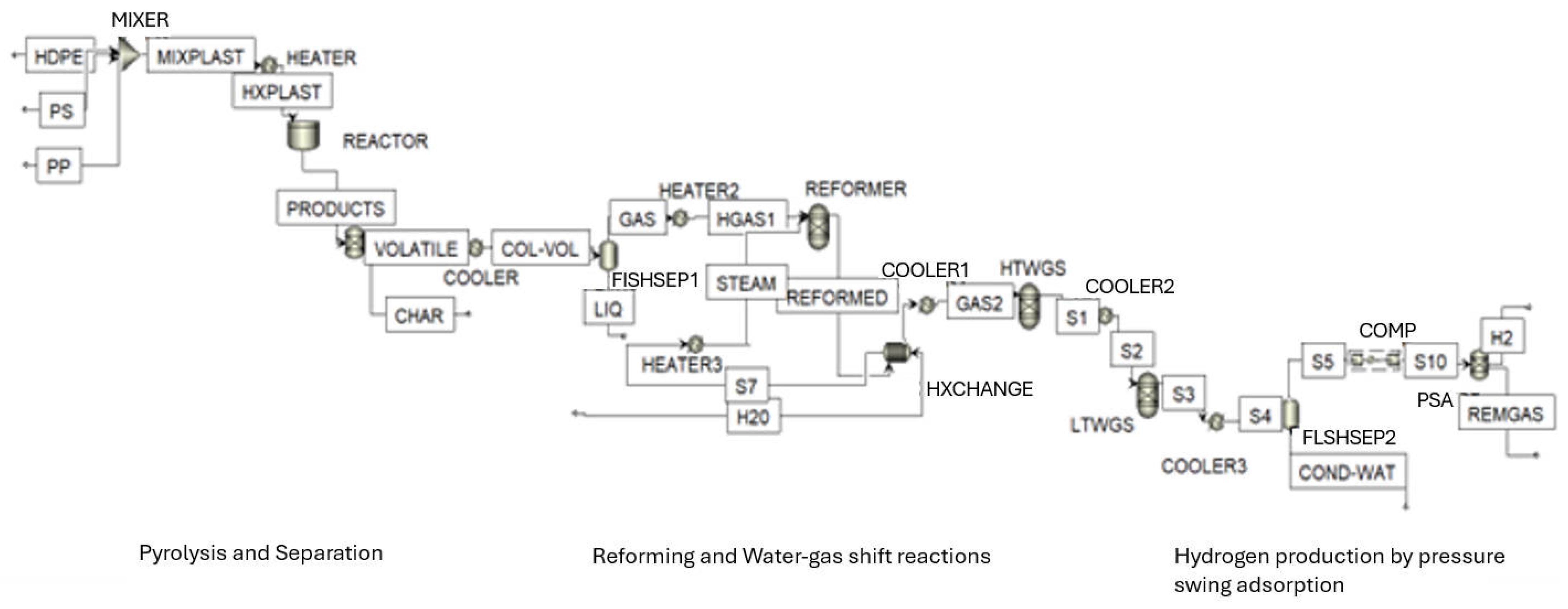
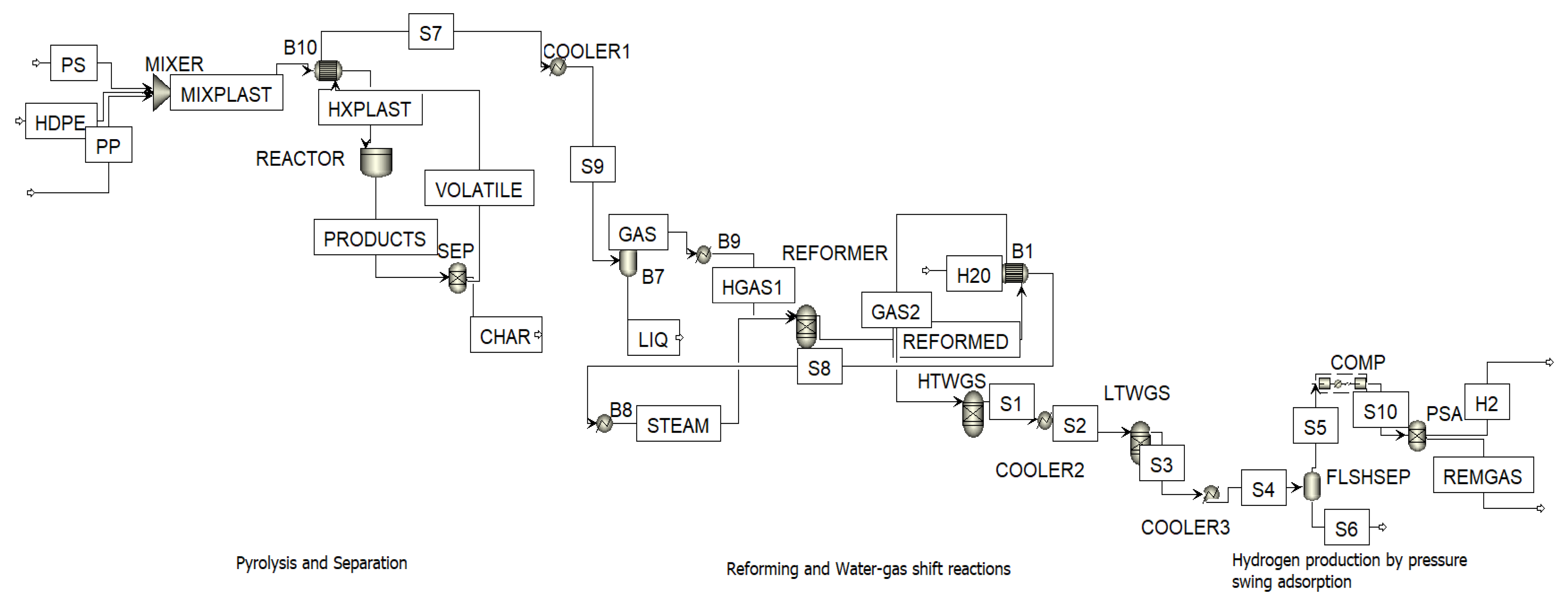
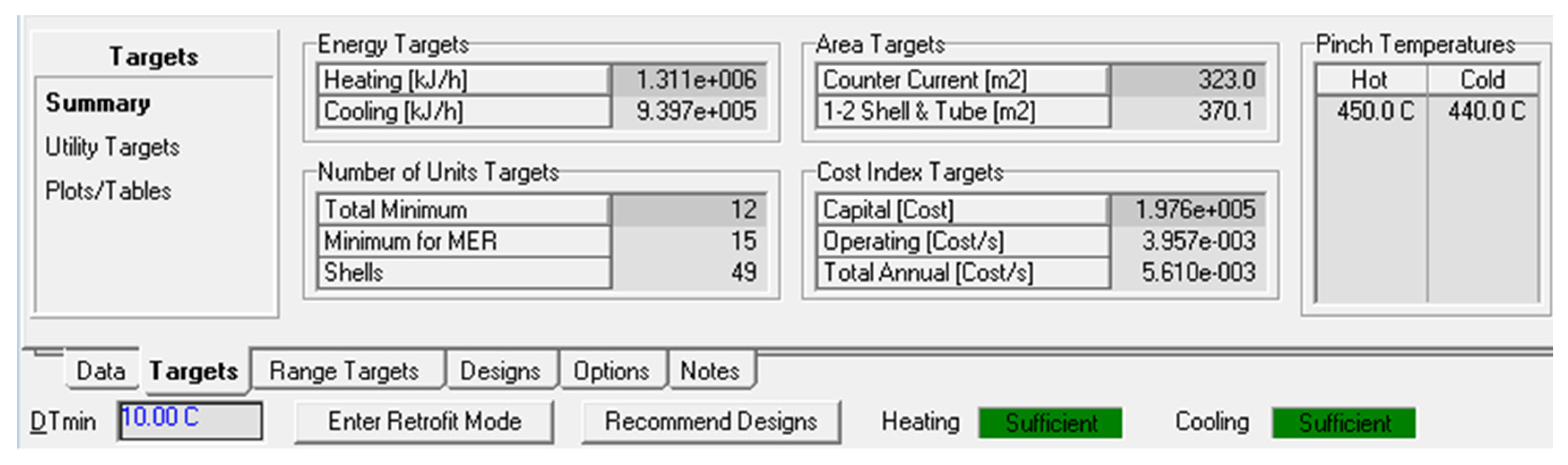
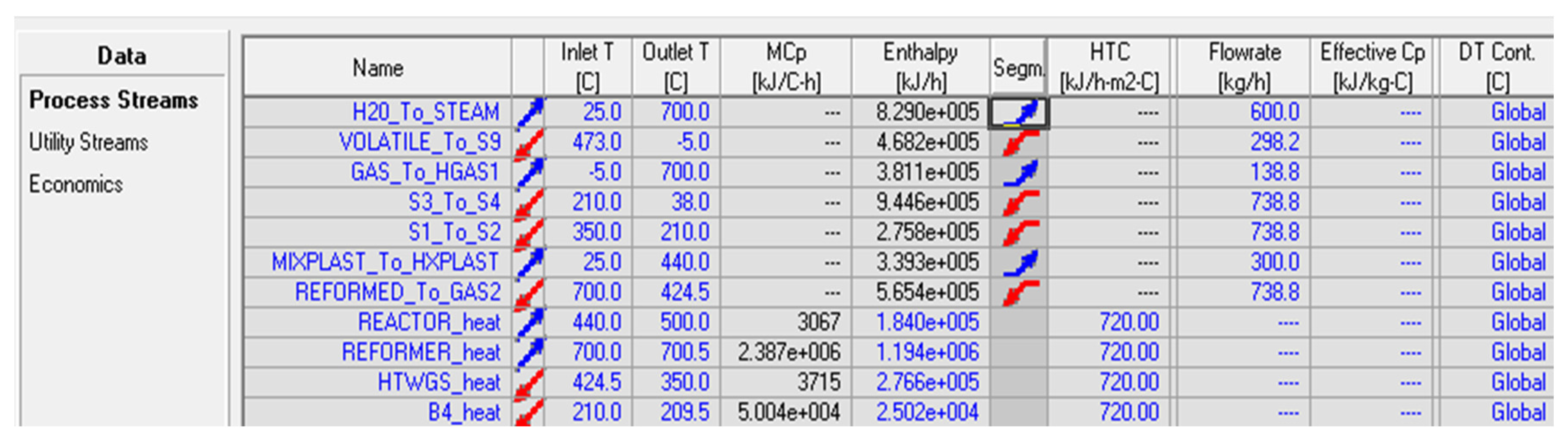
- Data Extraction: Process simulation data from Aspen Plus, including inlet and outlet temperatures, heat capacities, flow rates, and enthalpy changes, was directly exported to AEA, eliminating manual entry and ensuring accurate input for heat integration analysis Figure 4.
- 2.
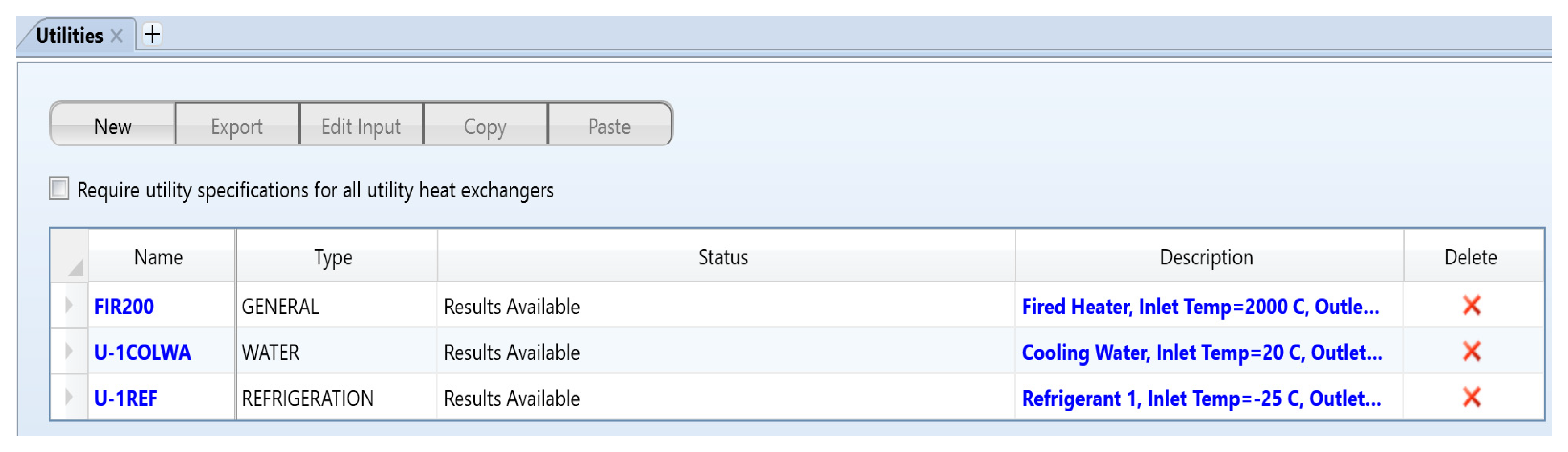
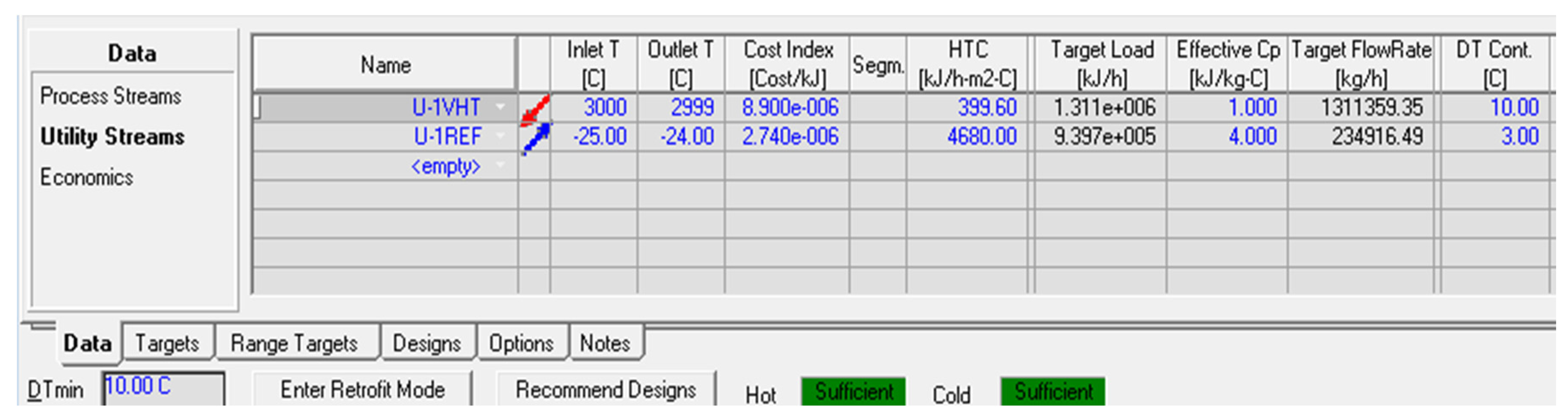
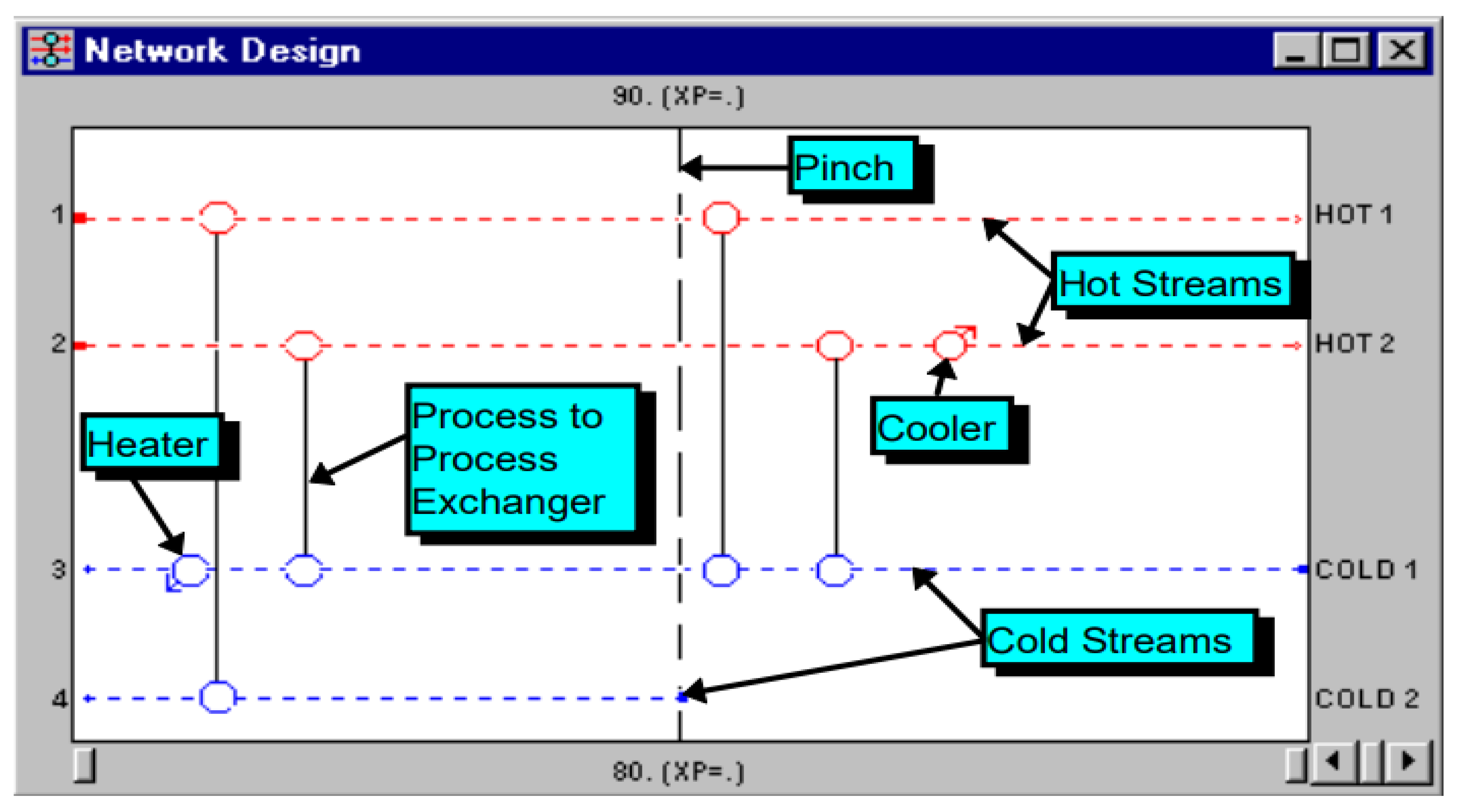
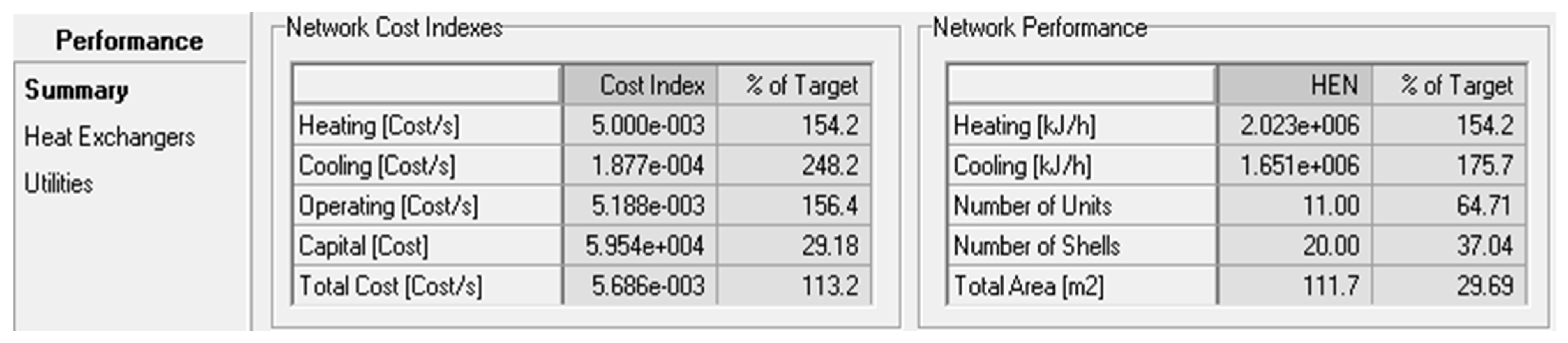
- Utility Stream Definition: Utilities were defined to supply any additional heating or cooling demands that could not be met by matching hot and cold streams. Appropriate heating and cooling utilities were selected to meet all temperature change requirements for both hot and cold process streams Figure 5.
- 3.
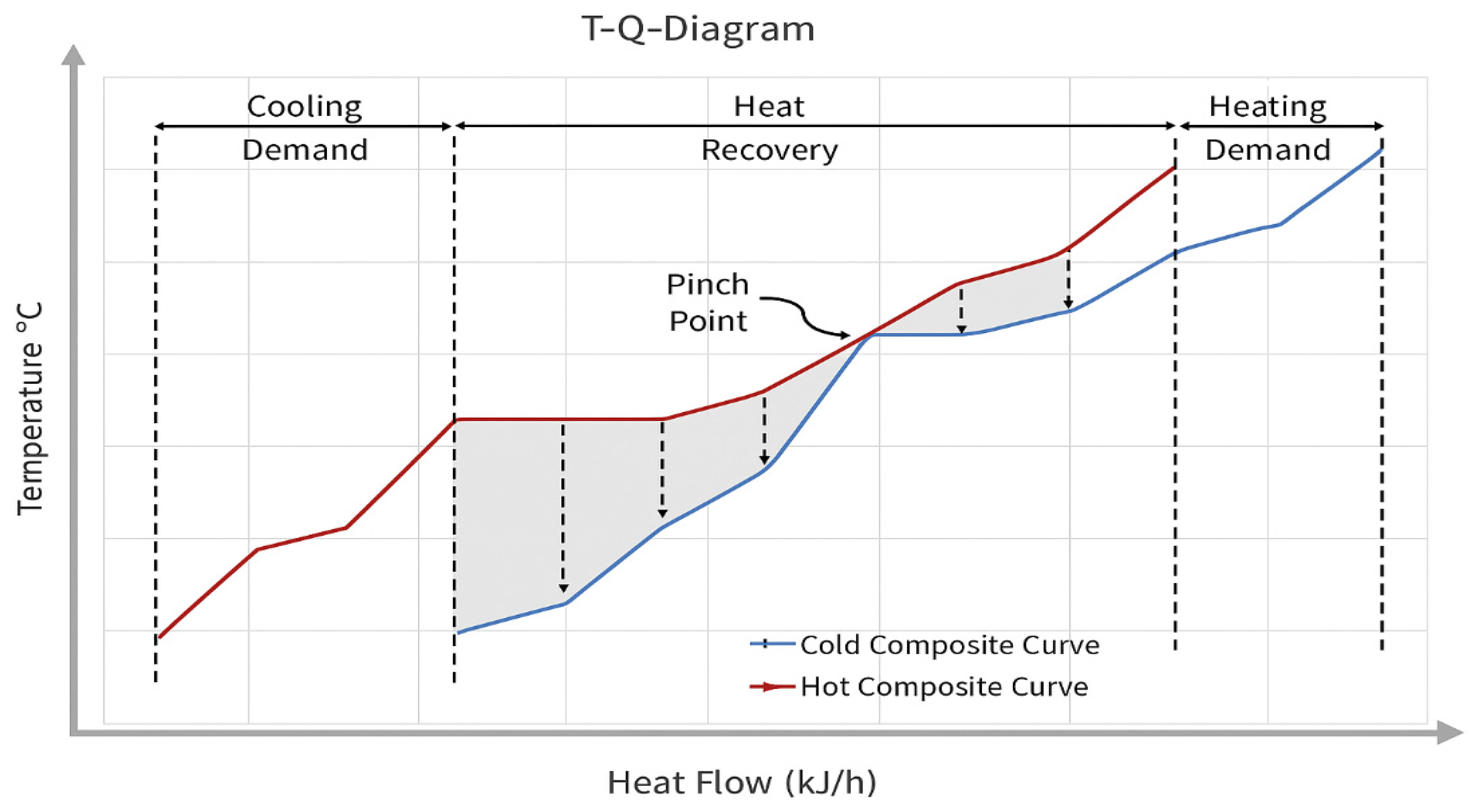
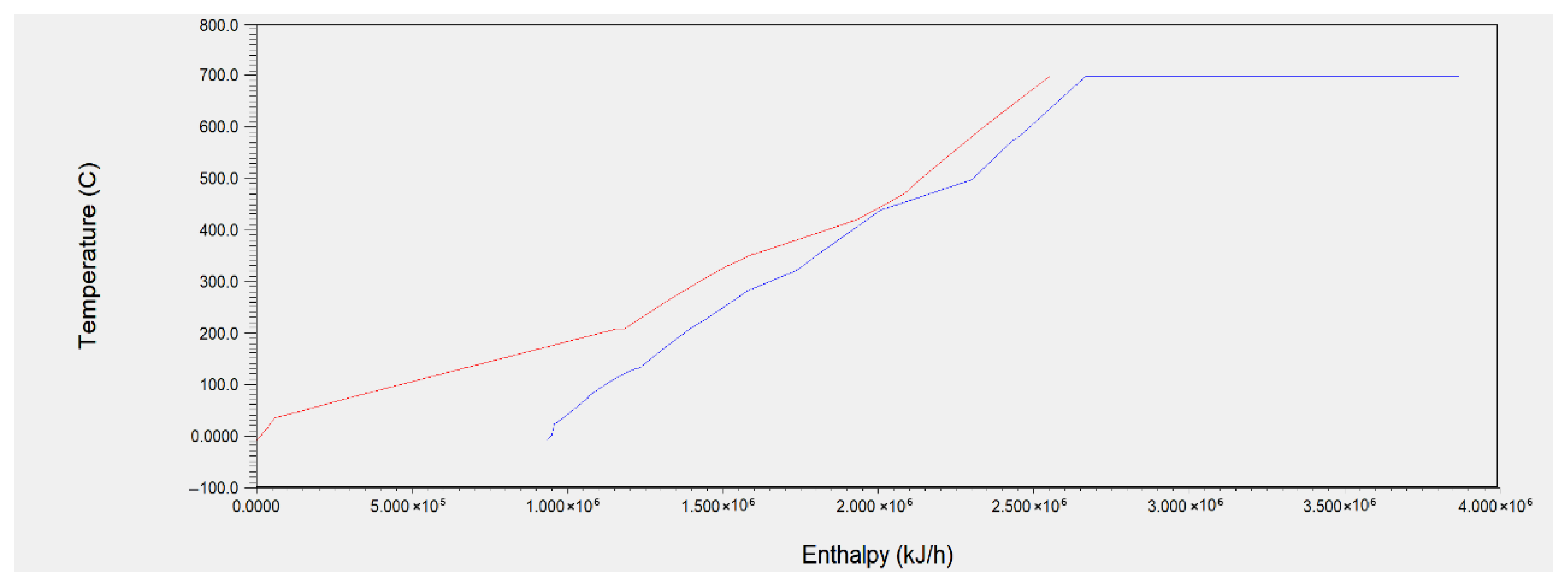
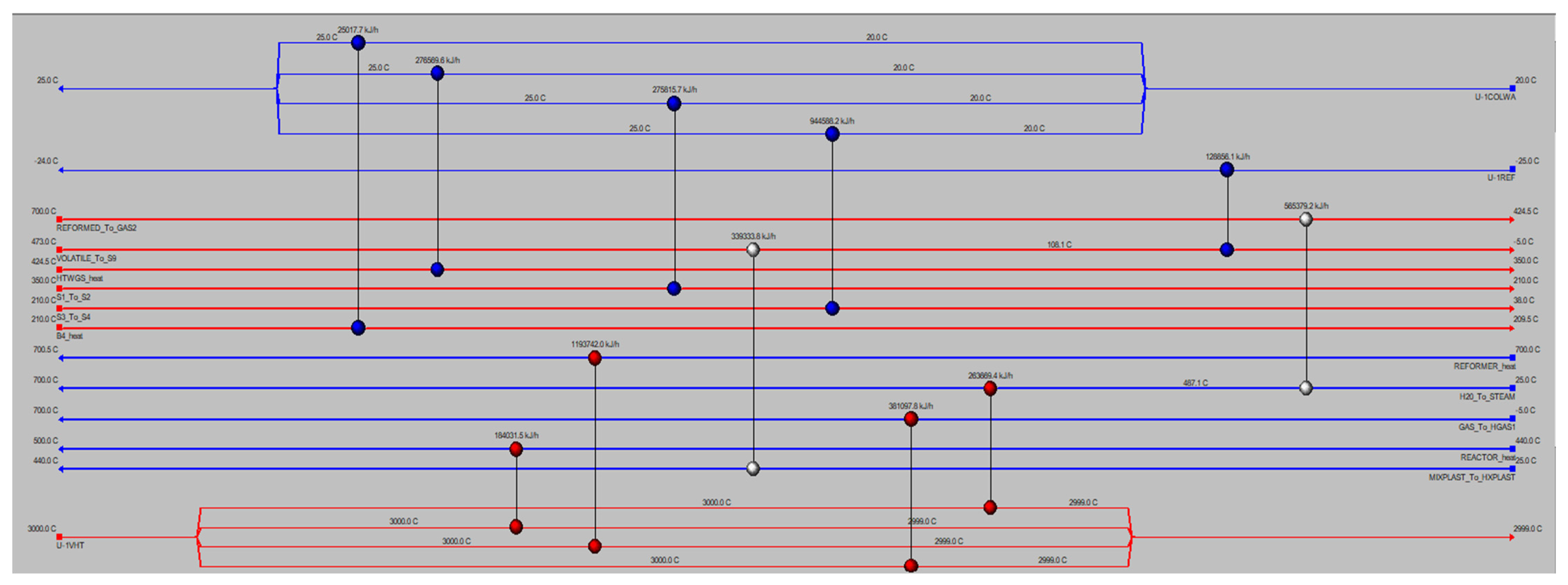
- Heat Exchanger Network Design: Using the exported data, AEA generated composite curves for all hot and cold streams, represented as Temperature-Enthalpy (T-Q) diagrams. The pinch point, which separates regions of excess heat (below the pinch) and required heat (above the pinch), was identified to guide the systematic design of an energy-efficient heat exchanger network [76]. A visual representation of the composite curves and the pinch point is shown in Figure 6.
Principles of Pinch Analysis
- No external heating is added below the pinch, and no external cooling is added above the pinch, to prevent increases in overall utility demand.
- Heat transfer across the pinch is avoided to maintain the minimum energy targets.
- Heat exchangers are strategically positioned to maximise energy recovery from process streams while minimising reliance on external utilities.
2.4. Heat Integration Scenarios
3. Results and Discussion
3.1. Process Improvement and Energy Savings
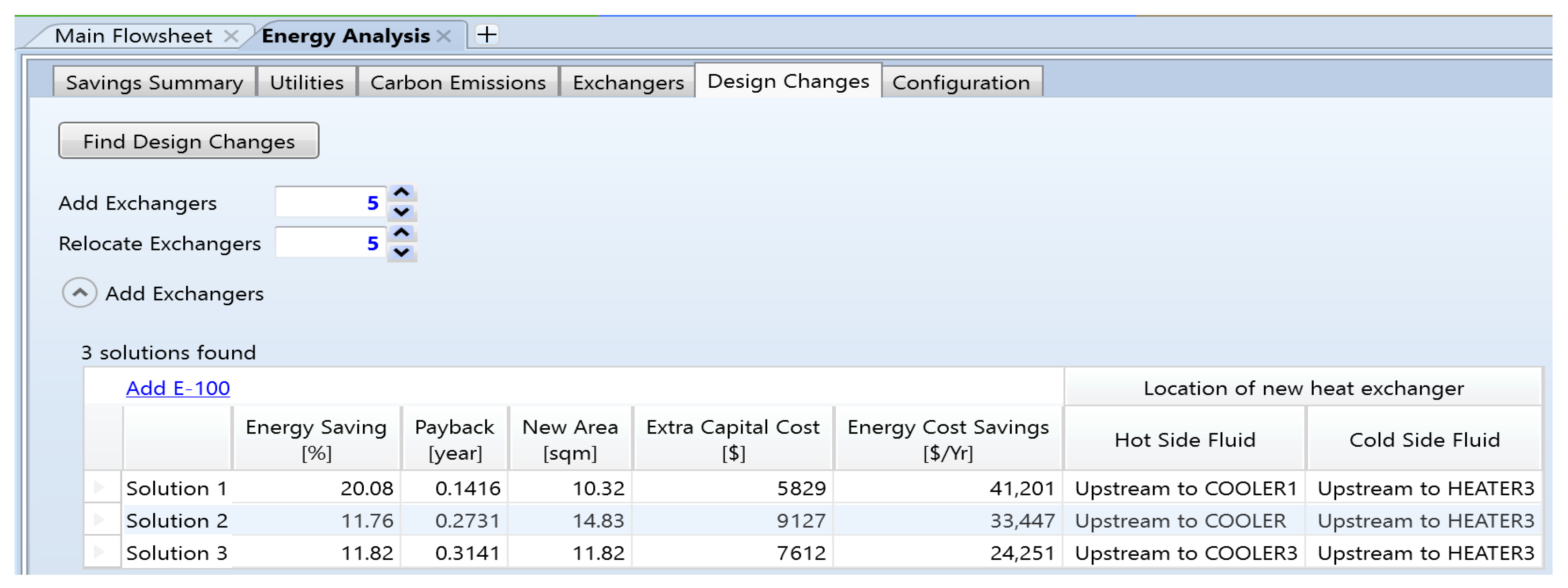
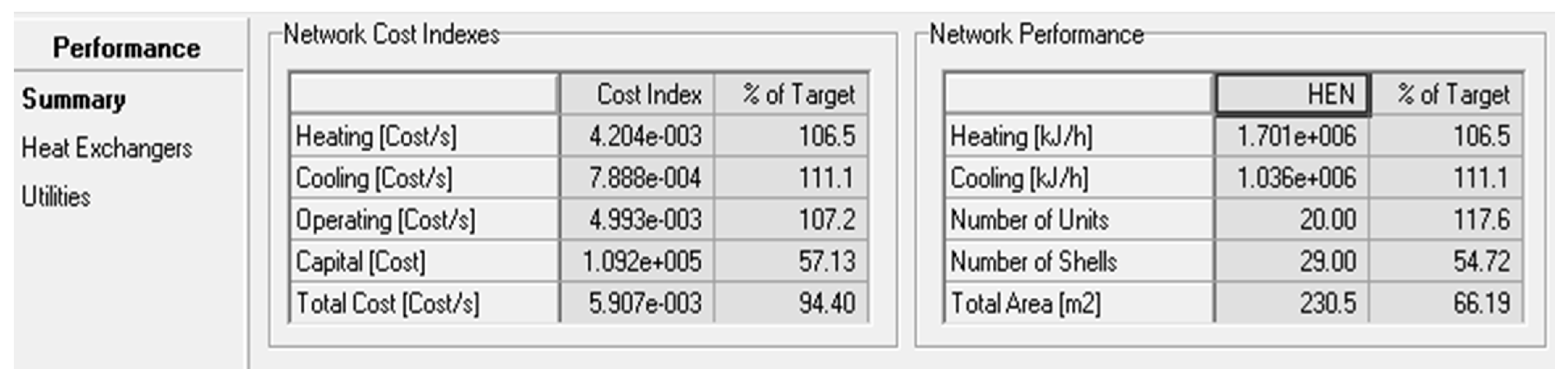
3.2. Energy Analysis and Heat Integration
4. Conclusions
5. Recommendations for Future Work: System-Level Energy Recovery and Power Integration
Author Contributions
Funding
Data Availability Statement
Acknowledgments
Conflicts of Interest
References
- Ghiri, M.N.; Nasriani, H.R.; Khajenoori, L.; Mohammadkhani, S.; Williams, K.S. Dynamic Temperature–Vacuum Swing Adsorption for Sustainable Direct Air Capture: Parametric Optimisation for High-Purity CO2 Removal. Sustainability 2025, 17, 6796. [Google Scholar] [CrossRef]
- Nasiri-Ghiri, M.; Nasriani, H.R.; Khajenoori, L.; Rasmussen, S.K.; Williams, K. Surrogate-assisted cyclic performance optimisation of direct air capture using amine-functionalised metal–organic frameworks. Sep. Purif. Technol. 2025, 383, 136177. [Google Scholar] [CrossRef]
- Kamara-Esteban, O.; Pijoan, A.; Alonso-Vicario, A.; Borges, C.E. On-demand energy monitoring and response architecture in a ubiquitous world. Pers. Ubiquitous Comput. 2017, 21, 537–551. [Google Scholar] [CrossRef]
- Soroush, M.; Shahbakhti, M. Special issue on “Optimal design and operation of energy systems”. Optim. Control. Appl. Methods 2023, 44, 351–354. [Google Scholar] [CrossRef]
- Mohr, T.; Aliyu, H.; Biebinger, L.; Gödert, R.; Hornberger, A.; Cowan, D.; de Maayer, P.; Neumann, A. Effects of different operating parameters on hydrogen production by Parageobacillus thermoglucosidasius DSM 6285. AMB Express 2019, 9, 207. [Google Scholar] [CrossRef]
- Lahafdoozian, M.; Khoshkroudmansouri, H.; Zein, S.H.; Jalil, A.A. Hydrogen production from plastic waste: A comprehensive simulation and machine learning study. Int. J. Hydrogen Energy 2024, 59, 465–479. [Google Scholar] [CrossRef]
- Singla, M.K.; Nijhawan, P.; Oberoi, A.S. Hydrogen fuel and fuel cell technology for cleaner future: A review. Environ. Sci. Pollut. Res. 2021, 28, 15607–15626. [Google Scholar] [CrossRef]
- Nasriani, H.R.; Borazjani, A.A.; Iraji, B.; MoradiDowlatAbad, M. Investigation into the effect of capillary number on productivity of a lean gas condensate reservoir. J. Pet. Sci. Eng. 2015, 135, 384–390. [Google Scholar] [CrossRef]
- Nasriani, H.R.; Asadi, E.; Nasiri, M.; Khajenoori, L.; Masihi, M. Challenges of Fluid Phase Behavior Modeling in Iranian Retrograde Gas Condensate Reservoirs. Energy Sources Part A Recover. Util. Environ. Eff. 2015, 37, 663–669. [Google Scholar] [CrossRef]
- Vardian, M.; Nasriani, H.R.; Faghihi, R.; Vardian, A.; Jowkar, S. Porosity and permeability prediction from well logs using an adaptive neuro-fuzzy inference system in a naturally fractured gas-condensate reservoir. Energy Sources Part A Recover. Util. Environ. Eff. 2016, 38, 435–441. [Google Scholar] [CrossRef]
- Nasriani, H.R.; Kalantariasl, A. Choke Performance in High-rate Gas Condensate Wells Under Subcritical Flow Condition. Energy Sources Part A Recover. Util. Environ. Eff. 2014, 37, 192–199. [Google Scholar] [CrossRef]
- Badiei, A.; Jadowski, E.; Sadati, S.; Beizaee, A.; Li, J.; Khajenoori, L.; Nasriani, H.R.; Li, G.; Xiao, X. The Energy-Saving Potential of Air-Side Economisers in Modular Data Centres: Analysis of Opportunities and Risks in Different Climates. Sustainability 2023, 15, 10777. [Google Scholar] [CrossRef]
- Nasriani, H.R.; Jamiolahmady, M. Flowback cleanup mechanisms of post-hydraulic fracturing in unconventional natural gas reservoirs. J. Nat. Gas Sci. Eng. 2019, 66, 316–342. [Google Scholar] [CrossRef]
- Nasriani, H.R.; Jamiolahmady, M. Maximizing fracture productivity in unconventional fields; analysis of post hydraulic fracturing flowback cleanup. J. Nat. Gas Sci. Eng. 2018, 52, 529–548. [Google Scholar] [CrossRef]
- Nasriani, H.R.; Jamiolahmady, M.; Saif, T.; Sánchez, J. A systematic investigation into the flowback cleanup of hydraulic-fractured wells in unconventional gas plays. Int. J. Coal Geol. 2018, 193, 46–60. [Google Scholar] [CrossRef]
- Nasriani, H.R.; Jamiolahmady, M. Permeability Jailbreak: A Deep Simulation Study of Hydraulic Fracture Cleanup in Heterogeneous Tight Gas Reservoirs. Energies 2025, 18, 3618. [Google Scholar] [CrossRef]
- Nasriani, H.R.; Jamiolahmady, M. Optimising Flowback Strategies in Unconventional Reservoirs: The Critical Role of Capillary Forces and Fluid Dynamics. Energies 2024, 17, 5822. [Google Scholar] [CrossRef]
- Joonaki, E.; Rostaminikoo, E.; Ghanaatian, S.; Nasriani, H. Thermodynamics of Hydrogen; Analysing and Refining of Critical Flow Factor Through Comprehensive Uncertainty Assessment and Experimental Data Integration. In Proceedings of the Abu Dhabi International Petroleum Exhibition and Conference, Abu Dhabi, United Arab Emirates, 4–7 November 2024. Paper Number: SPE-222973-MS. [Google Scholar] [CrossRef]
- Rehman, A.U.; Sanjari, M.J.; Elavarasan, R.M.; Jamal, T. Sustainability-aligned pathways for energy transition: A review of low-carbon energy network solutions. Renew. Sustain. Energy Rev. 2026, 226, 116428. [Google Scholar] [CrossRef]
- Oyedepo, S.O.; Waheed, M.A.; Abam, F.I.; Dirisu, J.O.; Samuel, O.D.; Ajayi, O.O.; Somorin, T.; Popoola, A.P.I.; Kilanko, O.; Babalola, P.O. A critical review on enhancement and sustainability of energy systems: Perspectives on thermo-economic and thermo-environmental analysis. Front. Energy Res. 2025, 12, 1417453. [Google Scholar] [CrossRef]
- Nabwey, H.A.; Ashraf, M.; Nadeem, H.; Rashad, A.M.; Chamkha, A.J. Optimizing renewable energy systems: A comprehensive review of entropy generation minimization. AIP Adv. 2024, 14, 120702. [Google Scholar] [CrossRef]
- Ukoba, K.; Olatunji, K.O.; Adeoye, E.; Jen, T.-C.; Madyira, D.M. Optimizing renewable energy systems through artificial intelligence: Review and future prospects. Energy Environ. 2024, 35, 3833–3879. [Google Scholar] [CrossRef]
- Mohseni, S.; Brent, A.C. Long-term planning optimisation of sustainable energy systems: A systematic review and meta-analysis of trends, drivers, barriers, and prospects. Energy Strat. Rev. 2025, 57, 101640. [Google Scholar] [CrossRef]
- Klemeš, J.J.; Foley, A.; You, F.; Aviso, K.; Su, R.; Bokhari, A. Sustainable energy integration within the circular economy. Renew. Sustain. Energy Rev. 2023, 177, 113143. [Google Scholar] [CrossRef]
- Akpasi, S.O.; Anekwe, I.M.S.; Tetteh, E.K.; Amune, U.O.; Mustapha, S.I.; Kiambi, S.L. Hydrogen as a clean energy carrier: Advancements, challenges, and its role in a sustainable energy future. Clean Energy 2025, 9, 52–88. [Google Scholar] [CrossRef]
- Segovia-Hernández, J.G.; Hernández, S.; Cossío-Vargas, E.; Juarez-García, M.; Sánchez-Ramírez, E. Green hydrogen production for sustainable development: A critical examination of barriers and strategic opportunities. RSC Sustain. 2024, 3, 134–157. [Google Scholar] [CrossRef]
- de Moraes, D.R.; Soares, L.O.; Guimarães, V.d.A.; Santos, D.C.L.e.P.; Boloy, R.A.M. Technology roadmap of low-carbon hydrogen: Trends for risk management strategies. Process. Saf. Environ. Prot. 2025, 203, 107937. [Google Scholar] [CrossRef]
- Badrudeen, T.U.; David, L.O.; Nwulu, N. Management of environmental and economic tradeoffs for the optimization of renewable energy scheme. Int. J. Sustain. Energy 2024, 43, 2355645. [Google Scholar] [CrossRef]
- Rostaminikoo, E.; Ghanaatian, S.; Joonaki, E.; Nasriani, H.R.; Whitton, J. Advanced thermodynamics of hydrogen and natural gas blends for gas transmission and distribution networks. Meas. Sens. 2025, 38, 101765. [Google Scholar] [CrossRef]
- Joonaki, E.; Rostaminikoo, E.; Ghanaatian, S.; Nasriani, H.R. Thermodynamic properties of hydrogen containing systems and calculation of gas critical flow factor. Meas. Sens. 2025, 38, 101587. [Google Scholar] [CrossRef]
- Gholami, S.; Rostaminikoo, E.; Khajenoori, L.; Nasriani, H.R. Density determination of CO2-Rich fluids within CCUS processes. Meas. Sens. 2025, 38, 101739. [Google Scholar] [CrossRef]
- Gandomkar, A.; Torabi, F.; Nasriani, H.R.; Enick, R.M. Maximising CO2 sequestration efficiency in deep saline aquifers through in-situ generation of CO2-in-brine foam incorporating novel CO2-soluble non-ionic surfactants. Chem. Eng. J. 2025, 521, 166102. [Google Scholar] [CrossRef]
- Medaiyese, F.J.; Nasriani, H.R.; Khajenoori, L.; Khan, K.; Badiei, A. From Waste to Energy: Enhancing Fuel and Hydrogen Production through Pyrolysis and In-Line Reforming of Plastic Wastes. Sustainability 2024, 16, 4973. [Google Scholar] [CrossRef]
- Jawarneh, A.M.; Al-Oqla, F.M.; Otair, M. Enhancing Photovoltaic Efficiency through Paraffin–Pomegranate Phase Change Composites: An Experimental Approach with Bibliometric Analysis toward Sustainable Thermal Management Aligned with Sustainable Development Goals (SDGs). ASEAN J. Sci. Eng. Mater. 2026, 5, 249–266. [Google Scholar]
- Sang, J.; Zhang, K.; Fan, Q.; Kan, C.; Pan, R.; Sun, X.; Guo, Z. Autophagy–senescence interplay in kidney disease: Mechanistic insights and therapeutic potential. Mol. Biol. Rep. 2025, 53, 22. [Google Scholar] [CrossRef]
- Marefat, A.; Golzary, A.; Bazargan, A.; Nikoo, M.R.; Chihiro, Y. Economic assessment of waste-to-energy technologies for carbon emissions reduction in developing countries: An innovative methodological approach. Energy Rep. 2026, 15, 108908. [Google Scholar] [CrossRef]
- Allan, A.M.; Hasan, A.N.; Shongwe, T. Optimization of waste heat utilization from green hydrogen PEM electrolyzers for enhanced energy efficiency in hot climates: A Persian Gulf region airport study. Energy Rep. 2026, 15, 108923. [Google Scholar] [CrossRef]
- Jain, H.; Dhupper, R. Holistic strategies for sustainable buildings and their impacts on soil and environmental health. J. Build. Pathol. Rehabil. 2026, 11, 10. [Google Scholar] [CrossRef]
- Indonesia, U.; Fitrianto, F.; Putra, N.; Kusrini, E. Review of Sustainable Jet Fuel Production through Pyrolysis of Waste Tires: Process, The Physicochemical Properties and Catalyst. Kompleks. Ispolz. Miner. Syra 2026, 339, 52–70. [Google Scholar] [CrossRef]
- Miwornunyuie, N.; Hunter, J.; Kang, D.; Chavis, C. Advancing biomass-to-energy pathways: Research and development trends in microbial fuel cells for food waste valorization. Biomass Bioenergy 2026, 208, 108815. [Google Scholar] [CrossRef]
- Jakovac, P. The Influence of Energy Trends on the Global Economy. Available online: https://eman-conference.org/wp-content/uploads/2022/12/EMAN_2022_BoA-WEB.pdf#page=106 (accessed on 29 December 2025).
- Pilapitiya, P.N.T.; Ratnayake, A.S. The world of plastic waste: A review. Clean. Mater. 2024, 11, 100220. [Google Scholar] [CrossRef]
- Dokl, M.; Copot, A.; Krajnc, D.; Van Fan, Y.; Vujanović, A.; Aviso, K.B.; Tan, R.R.; Kravanja, Z.; Čuček, L. Global projections of plastic use, end-of-life fate and potential changes in consumption, reduction, recycling and replacement with bioplastics to 2050. Sustain. Prod. Consum. 2024, 51, 498–518. [Google Scholar] [CrossRef]
- Houssini, K.; Li, J.; Tan, Q. Complexities of the global plastics supply chain revealed in a trade-linked material flow analysis. Commun. Earth Environ. 2025, 6, 257. [Google Scholar] [CrossRef]
- Global Plastic Production|Statista. Available online: https://www.statista.com/statistics/282732/global-production-of-plastics-since-1950/ (accessed on 1 January 2026).
- Plastics the Fast Facts 2025 • Plastics Europe. Available online: https://plasticseurope.org/knowledge-hub/plastics-the-fast-facts-2025/ (accessed on 1 January 2026).
- Ladrero, P.B.; Jeffery, L. Regional Priorities For Tackling Plastic Life Cycle Impacts. 2025. Available online: https://newclimate.org/resources/publications/regional-priorities-for-tackling-plastic-lifecycle-impacts (accessed on 1 January 2026).
- Kan, M.; Wang, C.; Zhu, B.; Chen, W.; Liu, Y.; Ren, Y.; Xu, M. Seven decades of plastic flows and stocks in the United States and pathways toward zero plastic pollution by 2050. J. Ind. Ecol. 2023, 27, 1538–1552. [Google Scholar] [CrossRef]
- Plastics Market Size, Share, Trends|Growth Report [2025–2032]. Available online: https://www.fortunebusinessinsights.com/plastics-market-102176 (accessed on 1 January 2026).
- Plastic Market Size & Industry Report, 2033. Available online: https://www.marketgrowthreports.com/market-reports/plastic-market-113376 (accessed on 1 January 2026).
- Plastics Market Size to Hit USD 980.86 Billion by 2034. Available online: https://www.precedenceresearch.com/plastics-market (accessed on 1 January 2026).
- Ritchie, H.; Samborska, V.; Roser, M. Plastic Pollution. Available online: https://ourworldindata.org/plastic-pollution (accessed on 1 January 2026).
- Lau, W.W.Y.; Shiran, Y.; Bailey, R.M.; Cook, E.; Stuchtey, M.R.; Koskella, J.; Velis, C.A.; Godfrey, L.; Boucher, J.; Murphy, M.B.; et al. Evaluating scenarios toward zero plastic pollution. Science 2020, 369, 1455–1461. [Google Scholar] [CrossRef] [PubMed]
- Ramaswamy, S.; Kaveri, V.; Sutha, V.; Selvakumar, D.; Geethalakshmi, N.; Mohan, S. The Plastic Trade Web: An In-depth Look at Global Production, Consumption, and Export-Import Trends. Int. J. Nov. Res. Dev. 2024, 9, 12. [Google Scholar]
- Jambeck, J.R.; Geyer, R.; Wilcox, C.; Siegler, T.R.; Perryman, M.; Andrady, A.; Narayan, R.; Law, K.L. Plastic waste inputs from land into the ocean. Science 2015, 347, 768–771. [Google Scholar] [CrossRef]
- Mirkarimi, S.M.R.; Bensaid, S.; Chiaramonti, D. Conversion of mixed waste plastic into fuel for diesel engines through pyrolysis process: A review. Appl. Energy 2022, 327, 120040. [Google Scholar] [CrossRef]
- Barbarias, I.; Lopez, G.; Artetxe, M.; Arregi, A.; Bilbao, J.; Olazar, M. Valorisation of different waste plastics by pyrolysis and in-line catalytic steam reforming for hydrogen production. Energy Convers. Manag. 2018, 156, 575–584. [Google Scholar] [CrossRef]
- Alvarez, J.; Kumagai, S.; Wu, C.; Yoshioka, T.; Bilbao, J.; Olazar, M.; Williams, P.T. Hydrogen production from biomass and plastic mixtures by pyrolysis-gasification. Int. J. Hydrogen Energy 2014, 39, 10883–10891. [Google Scholar] [CrossRef]
- Niu, F.; Wu, Z.; Chen, D.; Huang, Y.; Ordomsky, V.V.; Khodakov, A.Y.; Van Geem, K.M. State-of-the-art and perspectives of hydrogen generation from waste plastics. Chem. Soc. Rev. 2025, 54, 4948–4972. [Google Scholar] [CrossRef] [PubMed]
- Devi, L.; Ptasinski, K.J.; Janssen, F.J. A review of the primary measures for tar elimination in biomass gasification processes. Biomass Bioenergy 2003, 24, 125–140. [Google Scholar] [CrossRef]
- Shah, H.H.; Amin, M.; Iqbal, A.; Nadeem, I.; Kalin, M.; Soomar, A.M.; Galal, A.M. A review on gasification and pyrolysis of waste plastics. Front. Chem. 2023, 10, 960894. [Google Scholar] [CrossRef]
- Han, D.; Shin, S.; Jung, H.; Cho, W.; Baek, Y. Hydrogen Production by Steam Reforming of Pyrolysis Oil from Waste Plastic over 3 wt.% Ni/Ce-Zr-Mg/Al2O3 Catalyst. Energies 2023, 16, 2656. [Google Scholar] [CrossRef]
- Alshareef, R.; Nahil, M.A.; Williams, P.T. Hydrogen production by three-stage (i) pyrolysis,(ii) catalytic steam reforming, and (iii) water gas shift processing of waste plastic. Energy Fuels 2023, 37, 3894–3907. [Google Scholar] [CrossRef] [PubMed]
- Pawelczyk, E.; Wysocka, I.; Gębicki, J. Pyrolysis combined with the dry reforming of waste plastics as a potential method for resource recovery—A review of process parameters and catalysts. Catalysts 2022, 12, 362. [Google Scholar] [CrossRef]
- Sudalaimuthu, P.; Sathyamurthy, R. The clean energy aspect of plastic waste—Hydrogen gas production, CO2 reforming, and plastic waste management coincide with catalytic pyrolysis—An extensive review. Environ. Sci. Pollut. Res. 2023, 30, 66559–66584. [Google Scholar] [CrossRef]
- Soleimani, S.; Lehner, M. Tri-reforming of methane: Thermodynamics, operating conditions, reactor technology and efficiency evaluation—A review. Energies 2022, 15, 7159. [Google Scholar] [CrossRef]
- Uddin, M.; Rasul, M.; Chowdhury, A.A.; Hassan, N. Hydrogen production from plastic waste pyrolysis syngas: A review on progresses and challenges. Int. J. Hydrogen Energy 2025, 158, 150512. [Google Scholar] [CrossRef]
- Ren, Z.; Gao, Z.; Guo, Z.; Liu, P.; Yao, D. Sustainable hydrogen production from waste plastics via staged chemical looping gasification with iron-based oxygen carrier. Appl. Energy Combust. Sci. 2025, 23, 100362. [Google Scholar] [CrossRef]
- Boshagh, F.; Yoon, H.-J.; Lee, C.-J. Key parameters influencing steam-reforming performance for hydrogen production. Renew. Sustain. Energy Rev. 2025, 218, 115777. [Google Scholar] [CrossRef]
- Haydary, J. Energy Integration. In Chemical Process Design and Simulation; John Wiley & Sons, Inc.: Hoboken, NJ, USA, 2018; pp. 239–261. [Google Scholar] [CrossRef]
- Heat Exchanger Network Analysis of the Power Plant Industry Using Aspen Energy Analyzer Software—Institut Teknologi Sepuluh Nopember (ITS), Indonesia. Available online: https://scholar.its.ac.id/en/publications/heat-exchanger-network-analysis-of-the-power-plant-industry-using/ (accessed on 29 December 2025).
- Gollangi, R.; NagamalleswaraRao, K. Energy, exergy analysis of conceptually designed monochloromethane production process from hydrochlorination of methanol. Energy 2022, 239, 121858. [Google Scholar] [CrossRef]
- Abdul, A.Z.; Ngulde, A.B.; Khan, G.; Abubakar, A.M.; Abass, A. Energy Analysis of an Existing CO2 Plant Simulated in Aspen Plus V8.8. Asian J. Eng. Soc. Health 2023, 2, 1396–1405. [Google Scholar] [CrossRef]
- Cortazar, M.; Gao, N.; Quan, C.; Suarez, M.A.; Lopez, G.; Orozco, S.; Santamaria, L.; Amutio, M.; Olazar, M. Analysis of hydrogen production potential from waste plastics by pyrolysis and in line oxidative steam reforming. Fuel Process. Technol. 2022, 225, 107044. [Google Scholar] [CrossRef]
- Williams, P.T. Hydrogen and carbon nanotubes from pyrolysis-catalysis of waste plastics: A review. Waste Biomass-Valorization 2020, 12, 1–28. [Google Scholar] [CrossRef]
- Zoughaib, A. From Pinch Methodology to Pinch-Exergy Integration of Flexible Systems; Elsevier: Amsterdam, The Netherlands, 2017. [Google Scholar]
- Oh, T.; Lee, S. Optimization of steam-methane reforming process using PSA off gas. Int. J. Hydrogen Energy 2024, 95, 902–915. [Google Scholar] [CrossRef]
- Sun, M.; Duan, L.; Zhou, Y.; Zhang, H.; Huang, L.; Zheng, N. Study on a novel hydrogen purification approach base on methane steam reforming process with CO-preferential oxidation and CO2 removal. Appl. Energy 2025, 377, 124727. [Google Scholar] [CrossRef]
- Davies, W.G.; Babamohammadi, S.; Yan, Y.; Clough, P.T.; Soltani, S.M. Exergy analysis in intensification of sorption-enhanced steam methane reforming for clean hydrogen production: Comparative study and efficiency optimisation. Carbon Capture Sci. Technol. 2024, 12, 100202. [Google Scholar] [CrossRef]
- Martínez-Rodríguez, A.; Abánades, A. Comparative Analysis of Energy and Exergy Performance of Hydrogen Production Methods. Entropy 2020, 22, 1286. [Google Scholar] [CrossRef]
- Franchi, G.; Capocelli, M.; De Falco, M.; Piemonte, V.; Barba, D. Hydrogen Production via Steam Reforming: A Critical Analysis of MR and RMM Technologies. Membranes 2020, 10, 10. [Google Scholar] [CrossRef]
- Szablowski, L.; Wojcik, M.; Dybinski, O. Review of steam methane reforming as a method of hydrogen production. Energy 2025, 316, 134540. [Google Scholar] [CrossRef]
- Song, C.; Liu, Q.; Ji, N.; Kansha, Y.; Tsutsumi, A. Optimization of steam methane reforming coupled with pressure swing adsorption hydrogen production process by heat integration. Appl. Energy 2015, 154, 392–401. [Google Scholar] [CrossRef]
- Berstad, D.; Gundersen, T. On the exergy efficiency of CO2 capture: The relation between sub-process and overall efficiencies. Carbon Capture Sci. Technol. 2023, 7, 100111. [Google Scholar] [CrossRef]
- Bahzad, H.; Leonzio, G.; Soltani, S.M.; Al Jasmi, A.; Davies, W.G.; Fennell, P.S.; Ali, N. Techno-economic analyses of a novel hydrogen production process via chemical looping water splitting, integrated with sorption enhanced water gas shift. Int. J. Hydrogen Energy 2025, 188, 151996. [Google Scholar] [CrossRef]
- Escribà-Gelonch, M.; Osorio-Tejada, J.; Yu, L.; Wanten, B.; Bogaerts, A.; Hessel, V. Techno-economic and life-cycle assessment for syngas production using sustainable plasma-assisted methane reforming technologies. Energy Environ. Sci. 2025, 18, 6043–6062. [Google Scholar] [CrossRef]
- Li, Y.; Nahil, M.A.; Williams, P.T. Hydrogen/Syngas Production from Different Types of Waste Plastics Using a Sacrificial Tire Char Catalyst via Pyrolysis–Catalytic Steam Reforming. Energy Fuels 2023, 37, 6661–6673. [Google Scholar] [CrossRef]
- Mishra, R.; Shu, C.; Gollakota, A.; Pan, S. Unveiling the potential of pyrolysis-gasification for hydrogen-rich syngas production from biomass and plastic waste. Energy Convers. Manag. 2024, 321, 118997. [Google Scholar] [CrossRef]
- Amlogu, T.O.; Dayo-Odukoya, O.P. Heat Integration Of Hydrogen Production From Glycerol Reforming. Int. J. Adv. Res. 2019, 7, 506–518. [Google Scholar] [CrossRef] [PubMed]
- Venkatesh, G. Pinch analysis, as a technique for optimising resource utilisation and promoting environmental sustainability: A review of recent case studies from the developing world and transition economies. Resour. Environ. Inf. Eng. 2019, 1, 1–17. [Google Scholar] [CrossRef]
- López-Fernández, A.; Bolonio, D.; Amez, I.; Castells, B.; Ortega, M.F.; García-Martínez, M.-J. Design and Pinch Analysis of a GFT Process for Production of Biojet Fuel from Biomass and Plastics. Energies 2021, 14, 6035. [Google Scholar] [CrossRef]
- Koike, M.; Li, D.; Watanabe, H.; Nakagawa, Y.; Tomishige, K. Comparative study on steam reforming of model aromatic compounds of biomass tar over Ni and Ni–Fe alloy nanoparticles. Appl. Catal. A Gen. 2015, 506, 151–162. [Google Scholar] [CrossRef]
- Medaiyese, F.J.; Nasriani, H.R.; Khan, K.; Khajenoori, L. Sustainable Hydrogen Production from Plastic Waste: Optimizing Pyrolysis for a Circular Economy. Hydrogen 2025, 6, 15. [Google Scholar] [CrossRef]
- Safarian, S.; Rydén, M.; Janssen, M. Development and Comparison of Thermodynamic Equilibrium and Kinetic Approaches for Biomass Pyrolysis Modeling. Energies 2022, 15, 3999. [Google Scholar] [CrossRef]
- Kouas, M.; Torrijos, M.; Sousbie, P.; Harmand, J.; Sayadi, S. Modeling the anaerobic co-digestion of solid waste: From batch to semi-continuous simulation. Bioresour. Technol. 2019, 274, 33–42. [Google Scholar] [CrossRef]
- Insel, G.; Ozyildiz, G.; Okutman-Tas, D.; Guven, D.; Zengin, G.E.; Pala-Ozkok, I.; Kurt, E.S.; Atli, E.; Artan, N.; Takács, I.; et al. A comprehensive evaluation of process kinetics: A plant-wide approach for nutrient removal and biogas production. Water Res. 2022, 217, 118410. [Google Scholar] [CrossRef] [PubMed]
- Levine, S.E.; Broadbelt, L.J. Detailed mechanistic modeling of high-density polyethylene pyrolysis: Low molecular weight product evolution. Polym. Degrad. Stab. 2009, 94, 810–822. [Google Scholar] [CrossRef]
- Kruse, T.M.; Wong, H.-W.; Broadbelt, L.J. Mechanistic modeling of polymer pyrolysis: Polypropylene. Macromolecules 2003, 36, 9594–9607. [Google Scholar] [CrossRef]
- Kruse, T.M.; Woo, O.S.; Wong, H.-W.; Khan, S.S.; Broadbelt, L.J. Mechanistic Modeling of Polymer Degradation: A Comprehensive Study of Polystyrene. Macromolecules 2002, 35, 7830–7844. [Google Scholar] [CrossRef]
- Cirillo, D.; Di Palma, M.; La Villetta, M.; Macaluso, A.; Mauro, A.; Vanoli, L. A novel biomass gasification micro-cogeneration plant: Experimental and numerical analysis. Energy Convers. Manag. 2021, 243, 114349. [Google Scholar] [CrossRef]
- Miranda, R.; Yang, J.; Roy, C.; Vasile, C. Vacuum pyrolysis of commingled plastics containing PVC I. Kinetic study. Polym. Degrad. Stab. 2001, 72, 469–491. [Google Scholar] [CrossRef]
- Aas, E. Optimization of Heat Exchanger Networks Using Aspen Energy Analyzer and SeqHENS; Norwegian University of Science and Technology: Trondheim, Norway, 2019. [Google Scholar]
- Muharja, M.; Widjaja, A.; Darmayanti, R.F.; Airlangga, B.; Anugraha, R.P.; Fauziyah, M.; Wijanarto, E.; Sholehuddin, M.; Khamil, A.I. Heat Exchanger Network (HEN) Analysis of The Power Plant Industry Using Aspen Energy Analyzer Software. ASEAN J. Chem. Eng. 2023, 23, 14–27. [Google Scholar] [CrossRef]
- Linnhoff, M. Introduction to Pinch Technology. 1998. Available online: https://scholar.google.com/scholar?hl=en&as_sdt=0%2C5&q=31.%09Linnhoff%2C+M.+%281998%29.+Introduction+to+Pinch+Technology.+Targeting+House.&btnG= (accessed on 29 December 2025).
- Aghahosseini, S.; Dincer, I. Exergy-Based Design and Analysis of Heat Exchanger Networks. In Progress in Clean Energy, Volume 1: Analysis and Modeling; Springer: Cham, Switzerland, 2015; pp. 371–387. [Google Scholar] [CrossRef]
- Pethe, K.R.; Dabhade, P.M.; Kolekar, V.J.; Sardare, M.D. Heat integration and heat exchanger network design with aspen energy analyze. In IOP Conference Series: Materials Science and Engineering; IOP Publishing: Bristol, UK, 2022; Volume 1259, p. 012006. [Google Scholar] [CrossRef]
- Kabeyi, M.J.B.; Olanrewaju, O.A. Review and Design Overview of Plastic Waste-to-Pyrolysis Oil Conversion with Implications on the Energy Transition. J. Energy 2023, 2023, 1821129. [Google Scholar] [CrossRef]
- Moliner, C.; Pasquale, G.; Arato, E. Municipal Plastic Waste Recycling through Pyrogasification. Energies 2024, 17, 1206. [Google Scholar] [CrossRef]
- Akinbomi, J.G.; Oresajo, C.A.; Ogunjobi, M.O.; Omotayo, M.S.; Aminu, K.A.; Abdulkareem, Y.T.; Bakare, L. Electricity generation potential of synthetic human hair, water nylon sachet and plastic waste mixtures. Int. J. Front. Eng. Technol. Res. 2025, 8, 13–18. [Google Scholar] [CrossRef]







| Actual | Target | Available Savings | % of Actual | |
|---|---|---|---|---|
| Total Utilities (GJh−1) | 7.14 | 2.88 | 1.02 | 59.62 |
| Heating Utilities (GJh−1) | 4.67 | 2.53 | 0.51 | 45.65 |
| Cooling Utilities (GJh−1) | 2.48 | 0.348 | 0.51 | 85.92 |
| Carbon Emissions (kg/h) | 206 | 150.7 | 55.20 | 26.80 |
| Actual | Target | Available Savings | % of Actual | |
|---|---|---|---|---|
| Total Utilities (GJh−1) | 4.98 | 2.53 | 0.59 | 49.28 |
| Heating Utilities (GJh−1) | 2.82 | 1.59 | 0.29 | 43.49 |
| Cooling Utilities (GJh−1) | 2.16 | 0.931 | 0.29 | 56.85 |
| Carbon Emissions (kg/h) | 189.7 | 95.13 | 94.52 | 49.84 |
| Actual | Target | Available Savings | % of Actual | |
|---|---|---|---|---|
| Total Utilities (GJh−1) | 3.67 | 2.25 | 0.34 | 38.72 |
| Heating Utilities (GJh−1) | 2.02 | 1.31 | 0.17 | 35.16 |
| Cooling Utilities (GJh−1) | 1.65 | 0.94 | 0.17 | 43.08 |
| Carbon Emissions (kg/h) | 126.2 | 79.04 | 47.14 | 37.36 |
Disclaimer/Publisher’s Note: The statements, opinions and data contained in all publications are solely those of the individual author(s) and contributor(s) and not of MDPI and/or the editor(s). MDPI and/or the editor(s) disclaim responsibility for any injury to people or property resulting from any ideas, methods, instructions or products referred to in the content. |
© 2026 by the authors. Licensee MDPI, Basel, Switzerland. This article is an open access article distributed under the terms and conditions of the Creative Commons Attribution (CC BY) license.
Share and Cite
Medaiyese, F.J.; Nasiri Ghiri, M.; Nasriani, H.R.; Khajenoori, L.; Khan, K. Pinch-Guided Heat Integration for Hydrogen Production from Mixed Plastic Waste. Hydrogen 2026, 7, 38. https://doi.org/10.3390/hydrogen7010038
Medaiyese FJ, Nasiri Ghiri M, Nasriani HR, Khajenoori L, Khan K. Pinch-Guided Heat Integration for Hydrogen Production from Mixed Plastic Waste. Hydrogen. 2026; 7(1):38. https://doi.org/10.3390/hydrogen7010038
Chicago/Turabian StyleMedaiyese, Fiyinfoluwa Joan, Maryam Nasiri Ghiri, Hamid Reza Nasriani, Leila Khajenoori, and Khalid Khan. 2026. "Pinch-Guided Heat Integration for Hydrogen Production from Mixed Plastic Waste" Hydrogen 7, no. 1: 38. https://doi.org/10.3390/hydrogen7010038
APA StyleMedaiyese, F. J., Nasiri Ghiri, M., Nasriani, H. R., Khajenoori, L., & Khan, K. (2026). Pinch-Guided Heat Integration for Hydrogen Production from Mixed Plastic Waste. Hydrogen, 7(1), 38. https://doi.org/10.3390/hydrogen7010038