1. Introduction
The transport sector remains a major decarbonization challenge, accounting for approximately 20% of global CO
2 emissions and 32% of total EU energy demand in 2023. Without mitigation measures, these emissions could increase by nearly 20% toward 2050 [
1,
2,
3,
4]. As a result, decarbonizing transport is nowadays a critical pillar of all international climate strategies [
5]. Aviation, shipping, and rail account for a significant amount of the sector’s carbon footprint, but road transport is the dominant contributor [
6]. The European Union (EU) and the Intergovernmental Panel on Climate Change (IPCC) both acknowledged the importance of substantial emission reductions in transport to achieve the objectives established by the Paris Agreement [
7,
8,
9].
Hydrogen is widely recognized as a crucial element for the energy transition since it can be used directly in transport, industry, and heating, or indirectly in the production of synthetic fuels and chemicals in Power-to-X (PtX) policies [
5,
10]. Unlike conventional fossil fuels, hydrogen can enable zero CO
2 emissions at the point of use and zero-emission energy strategies when produced as “green hydrogen” through renewable zero-emission pathways [
11,
12,
13,
14]. The “green hydrogen” obtained by water electrolysis using renewable electricity represents one of the most promising long-term alternatives for achieving carbon neutrality. Even though green hydrogen production is currently more expensive than that of gray or blue hydrogen obtained by the thermochemical steam reforming of natural gas, the associated costs are expected to fall, and IEA projects that the cost of green hydrogen could decrease from today’s range of USD 4–18/kg H
2 to USD 2–9/kg H
2 by 2030. This will narrow the cost gap in comparison to unabated fossil-based hydrogen production, which is expected to change from about USD 1.5–8/kg H
2 today to USD 1–3/kg H
2. The decrease in the associated green hydrogen production cost will be driven by economies of scale, electrolyzer cost reductions, and renewable energy expansion [
15].
Green hydrogen is expected to play a critical role in the transport sector, especially in heavy-duty trucks, buses, trains, and maritime applications that are challenging for decarbonization by batteries alone. Due to its extremely high gravimetric energy density of approximately 120 MJ/kg and the possibility of refueling times almost comparable to conventional fuels, hydrogen-powered vehicles offer operational dependability for high-utilization fleets and lighter on-board storage than battery-electric alternatives [
16,
17]. As an energy carrier, hydrogen offers system-level benefits as a flexible storage medium for renewable electricity. This also contributes to balancing the variable production that characterizes solar and wind energy, thereby enhancing their reliability [
7,
18,
19]. During the first decades of global efforts to commercialize oil and natural gas production, the infrastructure requirements and financial resources allocated were enormous. Policy and funding were the main factors that led oil and natural gas to their current status. An equivalent initiative is required to accomplish a similar outcome for hydrogen and hydrogen refueling stations (HRSs). A well-established network of HRSs is essential to support the growth of hydrogen-powered vehicles. Within these stations, compression plays a critical role, as it directly determines hydrogen delivery pressure, station throughput, and storage system configuration.
Despite its above-mentioned high gravimetric energy density, hydrogen has a very low volumetric energy density of only 0.01079 MJ/L under standard conditions. Therefore, it requires compression in order to achieve effective storage and dispensing [
20]. Compression is an energy-intensive and expensive component of HRSs, reaching up to 48% of the total capital expenditure (CAPEX) and a main factor causing operational downtime. Hence, selecting the optimal type of compression technology is critical for enhancing station economic feasibility and reliability [
21,
22]. Fuel cell electric vehicles (FCEVs) require hydrogen delivery pressures of 350 bar for heavy-duty transport and 700 bar for passenger vehicles, while practical refueling times and effective onboard storage require hydrogen to be compressed and stored at higher pressures of about 520 bar for 350 bar dispensing and 1000 bar for 700 bar dispensing [
22,
23,
24,
25,
26]. These conditions impose significant energy and economic demands on the hydrogen supply chain. Mechanical compressors are the most commonly implemented technology, although they are associated with high maintenance requirements, vibrations during operation, and risks of hydrogen quality degradation due to possible material wear or lubrication [
22,
23,
27,
28]. Various non-mechanical compression technologies have emerged as alternative solutions to mitigate these issues, but they are generally at lower Technology Readiness Levels (TRLs), mainly due to difficulties in scaling to meet the efficiency demands of HRS applications [
24,
29,
30]. Additionally, the integration of the compressor with the storage and distribution systems creates important technical challenges such as boil-off loss management in cryogenic storage, maintaining stable and consistent supply pressures under dynamic operations, and optimizing the balance between storage volume and compression energy. These engineering tasks often need to be addressed simultaneously, within tight schedules and with strict constraints on space, safety, and costs [
31]. Alongside the high CAPEX, these challenges currently hinder the deployment of HRS infrastructure worldwide. To accelerate the broad development of hydrogen mobility infrastructure, issues related to compression performance and integration challenges are critical to overcome [
18,
23,
32,
33].
The decision on the compression method depends on various operational parameters, including cost, temperature ranges, and pressure requirements that have direct influences on the economic and operational viability of the HRS. Further than the refueling duration and system availability, compliance with fuel quality standards such as ISO 14687 and ISO 19880-1 needs to be considered since it is critical for the durability of the Proton Exchange Membrane (PEM) fuel cell stacks of fuel cell electric vehicles (FCEVs) [
23,
27,
34,
35,
36]. Most mechanical compressors are directly associated with hydrogen purity issues] and, therefore, they require additional purification systems, which increase both CAPEX and OPEX [
25]. Compressor downtime disrupts station availability and reduces user confidence in hydrogen as a transport fuel; therefore, making reliability equally important [
37]. Reciprocating piston compressors (RPCs) and diaphragm compressors (DCs) are the most widely adopted mechanical solutions due to their technical maturity and ability to deliver pressures exceeding 1000 bar, but they display low efficiency at partial load and require frequent maintenance [
22,
37,
38]. Non-mechanical technologies address some of these limitations by offering high hydrogen purity and reduced maintenance requirements, but due to limited flow capacity and low TRL, their widespread adoption is restricted at this stage [
39,
40,
41]. Research has also focused on hybrid systems combining both mechanical and non-mechanical stages. These configurations can reduce the overall electricity demand, particularly when the pre-compression is supported by low-grade thermal energy [
22]. Both the CAPEX and the energy demand of an HRS are highly affected by the compression process. To scale up infrastructure and improve cost-effectiveness, innovations in energy efficiency, component durability, and system integration are considered crucial [
42].
In recent years, hydrogen compression has been the focal point of various literature reviews dealing with stationary and automotive applications [
25], renewable energy integration [
5], energy storage [
42,
43], and research advances in specific compression technologies [
24,
29,
44,
45,
46]. While some recent reviews examine hydrogen compression specifically for applications in HRSs [
30,
47,
48], these are primarily concerned with the fundamental principles linked to hydrogen’s specific properties, the structure and performance of available compressors, and outcomes in discrete research fields. This review provides a holistic analysis of the entire hydrogen compression landscape specifically for HRSs. It presents the latest research advances, discusses critical technological aspects such as thermal management, system integration, and safety within operational stations, and progresses to offer a structured methodology for technology selection while critically discussing the impact of compression selection on HRS economy, operability, reliability, public acceptance, licensing, and permitting. Both established and emerging options are assessed through a multi-criteria framework that addresses key operational and performance parameters, including maximum pressure, hydrogen purity, flow rate, scalability, energy consumption, maintenance requirements, capital and operational expenditure (CAPEX/OPEX), Technology Readiness Level (TRL), suitability for different HRS configurations, and safety. The analysis draws on peer-reviewed literature (Scopus, Web of Science, IEEE Xplore, ScienceDirect databases), “gray” literature (technical data and field reports by DOE/OSTI, NREL, FCH JU, CORDIS, Google Patents, etc.), industry standards (ISO TC 197, SAE International, etc.), and vendor performance validated data (NREL, DOE, UL Solutions, private companies, etc.) to support evidence-based decisions on the selection and use of hydrogen compression systems during HRS design and operation.
2. Technical and Operational Requirements for HRS Compressors
The performance, cost, and safety characteristics of an HRS depend on numerous technical and operational parameters such as discharge pressure limits, mass flow capacity, dynamic loading, hydrogen purity, CAPEX, OPEX, integration with RES, and safety. A thorough review of alternative compression technologies necessitates a comprehensive understanding of all these parameters, as outlined in this section.
2.1. Discharge Pressure Range
The need for compression in HRS applications is determined by storage and on-board tank pressure requirements as defined in the international fueling standards. SAE J2601-5 and ISO 19880-1 define the fueling pressure classes and operational limits for HRS, while practical station design requires compressors to operate over a wide pressure range that extends beyond nominal vehicle tank pressures to provide an offset for line losses, thermal expansion, and pressure drops during rapid fill procedures [
21,
49,
50].
Hydrogen inlet conditions and the station’s supply mode are the main factors defining the required number of compression stages to reach these pressures. Tube trailers and pipelines supply hydrogen at high pressures, while on-site electrolysis and reforming units offer significantly lower output pressures [
21,
51,
52]. Multistage compression systems integrate different stages with intercooling to reach the target discharge pressures while controlling outlet gas temperature and mechanical stress. Hydraulic-driven piston compressors (HDPCs), for example, demand effective thermal management. As demonstrated by Ye et al. [
52], transient cylinder wall temperatures can rise above 314 K even at moderate discharge pressures of 875 bar. Additionally, the interior temperature of FCEV tanks, as emphasized by Sadiq et al. [
53], must not exceed 358.15 K at 700 bar refueling. Therefore, both compression-stage cooling and dispenser pre-cooling are essential.
Operational discharge pressure range is not defined by storage system requirements alone but also by thermodynamic conditions governing the refueling, as rapid filling at high pressure creates a reverse Joule—Thomson heating effect that limits the allowed delivery temperature [
54]. For this reason, compressors must provide stable output pressures with almost zero tolerance to ensure accurate flow control and temperature prediction during the process of fueling [
53,
55]. Pulsation dampers or accumulator stages are used to avoid pressure fluctuations that can reduce fueling precision and increase wear in downstream valves and hoses [
52].
From a design perspective, the maximum discharge pressure has a heavy effect on component selection and lifecycle costs. The NREL independent review of hydrogen station compression systems identified compression as the largest contributor, accounting for 55% to 65% of “Compression, Storage, and Dispensing” (CSD) cost, with achievable outlet pressures of up to 1000 bar in current commercial systems [
51]. The report also indicated that the long-term America’s Department of Energy target, set at USD 0.70 per kilogram of hydrogen dispensed, requires a cost reduction of at least 50%. Subsequent techno-economic analyses also confirm that high discharge pressure capability increases both capital costs and energy consumption but is still vital for 700 bar refueling [
15,
21].
Recent modeling and field studies further indicate that optimal station operation requires a balance between compression energy and cascade utilization. Over-pressurizing storage beyond 1000 bar yields diminishing returns in fill duration while substantially increasing power demand and component fatigue [
35,
56]. The IEA projects that future hydrogen refueling stations will standardize on maximum compressor outlet pressures of 900–1000 bar for light-duty vehicles and 450–550 bar for heavy-duty applications [
56,
57].
2.2. Flow-Rate Demands
The factors defining the required hydrogen mass flow rate for a refueling station are mainly the targeted daily throughput and the refueling profile of the vehicle fleet. Small-scale refueling stations that usually serve passenger vehicles operate in the range of 100 to 250 kg H
2/day, whereas standard commercial stations that refuel urban bus fleets and heavy-duty vehicles have needs that can reach 400–1000 kg/day [
21,
51,
58]. High-capacity installations exceeding 2 t/day are increasingly planned to support hydrogen logistics hubs and highway corridors. The compressor must therefore sustain a nominal mass flow rate that matches the hourly fueling peaks while maintaining system pressure balance with the storage cascade [
59].
At the dispenser level, fueling protocols determine both instantaneous and average flow demands. In the framework of the SAE J2601-5 standard, the fill duration in light-duty vehicles is estimated to be 3–5 min, corresponding to flow rates of 40–60 g/s, whereas for heavy-duty cycles at 30 bar, the required flow rates exceed 120 g/s [
60]. Compressors need to provide sufficient volumetric displacement and dynamic response to absorb rapid load changes and maintain rates under variable back-pressure conditions. The ratio between maximum and average mass flow demand creates requirements for control systems and thermal management to prevent over-pressurization and excessive temperature rise [
51].
Source pressure and supply method strongly affect the compression duty. Tube trailers supply hydrogen at 200–250 bar, reducing the compression ratio to 4:1 for 1000 bar storage. On-site electrolysis produces hydrogen at 30 bar [
61], increasing the ratio to 30:1 along with the mechanical and thermal loads. HRSs with electrolytic hydrogen production require compressors with both high displacement capacity and intercooling. Compression energy consumption from on-site hydrogen production is estimated from 1.7 to 6.4 kWh/kg H
2 without counting the additional needs for pre-cooling at about 0.15 kWh/kg H
2 to maintain fill temperatures below 85 °C [
62,
63].
Temporal fluctuations in hydrogen demand at the station level are unavoidable, as traffic density and fleet operating schedules determine the needs, leading to deviations between average and peak levels within daily operating cycles. Zhou et al. [
64] confirm that hydrogen profiles associated with transport applications are time-dependent, requiring flexible operation rather than steady-state approaches. Compressor load is also affected by demand deviations, requiring coordinated storage utilization and station operation to avoid bottlenecks [
65,
66].
Flow rate is constrained by component durability. An appropriate management of cyclic loads through predictive control and thermal monitoring ensures compliance with safety standards, making the balance between throughput and longevity a key optimization parameter in HRS design [
67,
68].
Next-generation heavy-duty stations are forecasted to operate at higher daily capacities, and flow-rate specifications are expected to increase further as hydrogen mobility advances [
69,
70]. In the framework of the JIVE project, a techno-economic analysis considers heavy-duty HRSs designed to supply up to 100 fuel cell buses, with peak hydrogen flow rates of 95 kg/h at discharge pressures up to 500 bar [
62]. Unstable load conditions require modular compression arrangements and control strategies to improve compressor utilization and efficiency [
71].
2.3. Dynamic Operation and Load Profiles
Fluctuations in inlet conditions, variations in pressure during distribution, and unpredictable demand result in the dynamic operation of the compressor within the HRS [
72]. HRS compressors experience start–stop sequences and load variations that depend on real-time vehicle arrivals and the storage cascade usage pattern, in contrast to the steady-state conditions of the industrial hydrogen compressors [
73,
74,
75,
76].
During peak demand periods, HRS compressors operate at high capacity to serve the consecutive fueling cycles, while during low-demand intervals, the system shifts to partial-load or standby operation to maintain storage balance. Hydrogen storage acts as a buffer that allows partial decoupling between refueling cycles and compression. These conditions distinguish HRS compressors from industrial systems that are designed for continuous operation [
48,
77].
2.4. Hydrogen Purity and Contamination Sensitivity
Hydrogen purity is a critical parameter within the HRS that is imperative to maintain during compression, storage, and dispensing, as it directly affects the durability and performance of FCEVs [
78,
79]. Hydrogen utilized by proton exchange membrane fuel cells (PEMFCs) must have at least a molar purity of 99.97% (Grade D hydrogen) and comply with strict limits regarding the concentration of individual contaminants defined by ISO 14687:2025 [
61,
80]. Concentrations above threshold levels lead to irreversible degradation of membranes, catalyst poisoning, and cell voltage losses. A set of investigation methods to confirm these quality specifications is defined through the complementary standard ISO 21087:2019 [
81,
82,
83,
84].
Hydrogen penetration properties must be considered during the compressor design and material selection. Components exposed to hydrogen may induce degradation processes that result in the presence of contaminants in the process stream. In metallic surfaces, hydrogen diffusion causes embrittlement and microcracking, while polymeric seals and diaphragms are sensitive to permeability effects and chemical degradation [
51,
56,
85,
86].
Humidity concentration is another major aspect affecting hydrogen purity control. Compressor intake lines and outgassing within storage vessels can result in residual moisture affecting the reaction kinetics within the fuel cell and promoting corrosion [
87]. Desiccant dryers and cold traps are deployed to maintain moisture concentrations below 5 µmol/mol, while electrochemical or laser-based analyzers enable real-time verification of hydrogen quality before deviations reach the dispenser [
21,
78,
88].
Thermodynamic and electrostatic effects can also influence hydrogen quality [
57]. Electrostatic discharge associated with high-velocity gas flow in polymeric hoses contributes to liner degradation and particulate release into the hydrogen stream [
68].
2.5. Cost Structure (CAPEX, OPEX, and Lifecycle Cost)
The cost profile of compression within an HRS comprises CAPEX, OPEX, and the discounted sum of both over the asset life captured by lifecycle cost (LCC). CAPEX includes the compressor package and driver, intercoolers and heat rejection, pulsation control, process and safety instrumentation, foundations and enclosure, as well as installation and commissioning. OPEX is dominated by electricity for compression, preventive and corrective maintenance on wear components, and quality assurance activities required to maintain fuel specifications. The LCC is strongly influenced by utilization, inlet-pressure variability, compression ratio, electricity price, and availability targets [
62]. Evidence from NREL shows that compression is the largest single element within CSD, contributing approximately 55–65% of CSD cost for typical forecourt configurations. Using a consistent economic framework, NREL reported CSD costs (in 2007 USD) of 2.00–2.80 USD/kg H
2 for a 1000 kg/day pipeline-fed case, 2.30–3.20 USD/kg H
2 for a 1330 kg/day forecourt production case, and 1.00–1.20 USD/kg H
2 for an 850 kg/day high pressure tube trailer case, with compressor purchase cost, efficiency, and installation factors identified as the principal sources of variance [
51]. The same assessment noted that achieving the DOE 2020 CSD target of 0.70 USD/kg would require a substantial reduction in compressor capital cost together with a step change in efficiency from around 65% to about 80%, a combination considered unlikely at the time [
21,
51].
Electricity use is the dominant OPEX term and depends on inlet pressure, total pressure ratio, staging and intercooling effectiveness, as well as the control strategy [
21] used to track cascade state of charge and dispenser demand. Stations supplied at higher inlet pressure generally exhibit lower specific energy than electrolysis-fed sites that begin at 10–30 bar [
89]. Control choices such as dynamic discharge setpoints and variable-speed operation can reduce energy use by aligning compressor duty with storage conditions and fueling peaks [
62].
The cost of maintenance is a reflection of the severity of the duty and the mechanisms of component wear during transient operation. Start–stop cycling and rapid load changes increase thermal gradients and pressure fluctuations, which accelerate wear in valves, seals, and bearings, shorten replacement intervals, and raise the frequency of corrective work. Experimental and numerical studies of reciprocated conditions show elevated local wall temperatures and higher exhaust-phase pressure fluctuations, which correlate with increased mechanical stress and maintenance demand [
42,
52]. Where hydrogen purity assurance requires downstream polishing to meet ISO 14687, a portion of those costs is attributable to compressor design and material choices that influence contamination risk [
80].
Along with the purchase of the equipment, both installation and site integration have a major impact on CAPEX. Considerable multipliers also include civil works, hazardous-area electrical systems, chilled-water or air-cooling provision, acoustic treatment, and compliance with the national regulations. It is important to optimize storage sizing and compression staging for 700 bar dispensing to prevent oversizing and underutilizing capital. Oversized storage and compression increase CAPEX with no corresponding performance benefit [
51]. Modular and expandable layouts may defer expenses for capital and mitigate the risk of stranded assets as utilization rises during periods of low initial demand [
15,
21].
From an LCC viewpoint, the present value of electricity dominates where utilization and tariffs are high, whereas component replacement and downtime become decisive for highly transient operation. Consequently, to establish a reliable cost per kilogram, a sensitivity analysis is critical with respect to utilization, electricity price, inlet supply mode, and replacement intervals. Aiming to reduce equipment CAPEX, there is a need for manufacturing scale-up and learning.
3. Compression Technologies for HRSs
To meet the challenging criteria related to the HRSs, a diverse array of compression technologies has been investigated with respect to their working principles, energy demands, maintenance requirements, and maturity. Distinct advantages and constraints for their deployment have been considered for various HRS applications. Technologies are classified into three primary categories: (a) mechanical compressors, (b) non-mechanical (chemical) compressors, and (c) hybrid or advanced configurations [
22,
25].
3.1. Mechanical Compressor Technologies (MCTs)
Mechanical compressors (MCs) are the primary compression technology adopted in HRSs. Their extensive industrial history, technical maturity, and the capacity to produce the required discharge pressures for both 350 and 700 bar dispensing systems make them the only compression category with established commercial deployment, operating experience, and mature supply chains [
25,
27,
51].
3.1.1. Reciprocating Piston Compressors (RPCs)
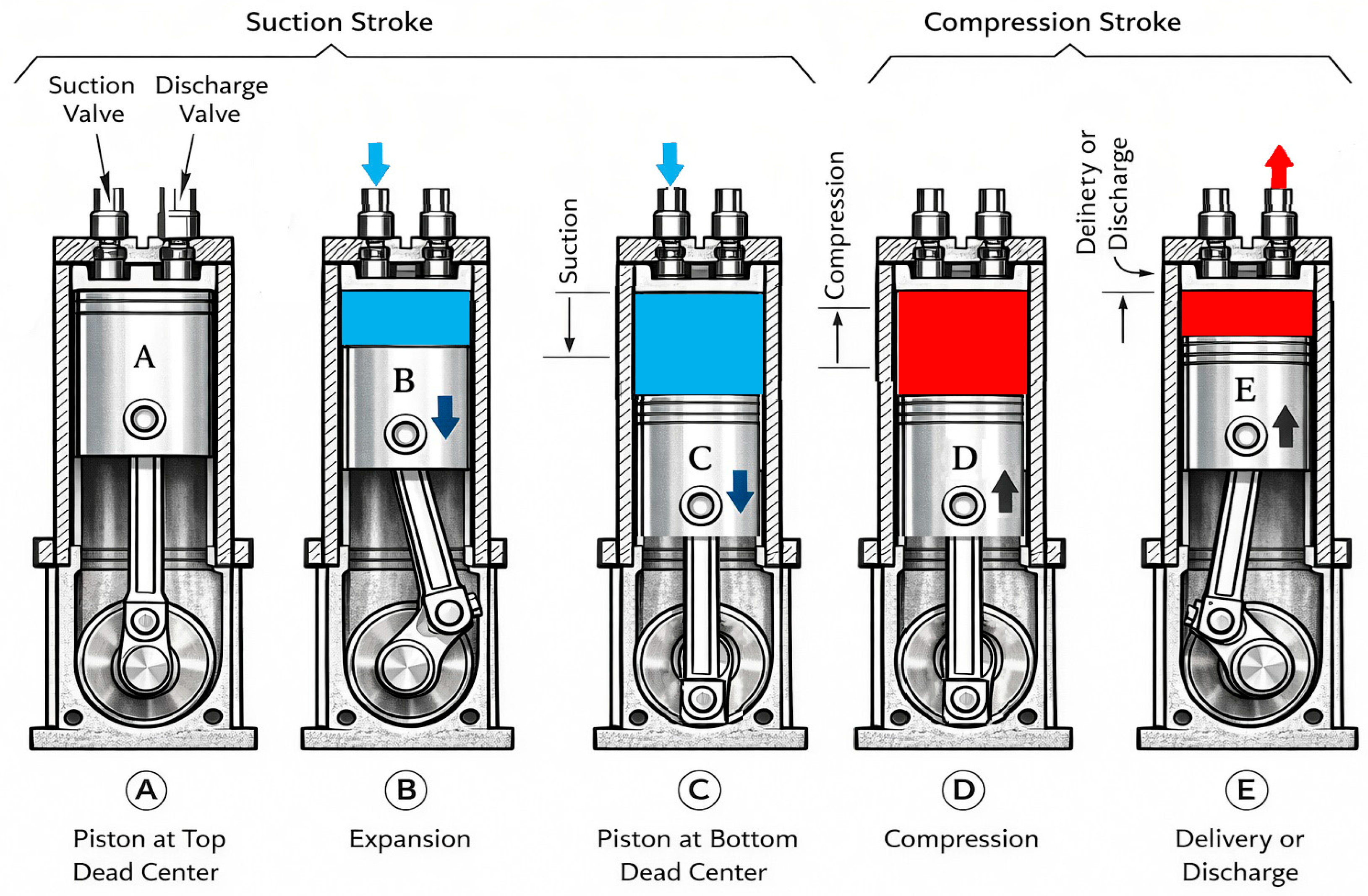
Reciprocating piston compressors (RPCs) are positive displacement machines that compress hydrogen via the linear movement of a piston inside a cylinder (
Figure 1). To achieve the required compression ratios, they use multi-stage compression together with intermediate cooling designs to reduce thermal loads. RPCs are widely applied in HRS because of their robustness and ability to deliver very high pressures [
27,
42].
RPCs can deliver discharge pressures that exceed 1000 bar, a fact that makes them fully compatible with HRS storage requirements of about 520 bar for 350 bar dispensing and 950–1000 bar for 700 bar dispensing [
27,
90]. Flow capacity depends on the configuration. For example, at 250 bar a four-stage machine with 11.2 MW input power can reach 890 kg/h [
91] while at 850 bar the same unit provides around 430 kg/h [
25]. Commercial specifications also report about 430–440 kg/h at elevated pressure, equivalent to approximately 4800 Nm
3/h [
92]. Energy use typically lies between 3.5 and 5.0 kWh/kg H
2, and compressors account for roughly 11.3% of the energy content of dispensed hydrogen at the station level [
63,
90]. Hydrogen purity depends on lubrication: oil-lubricated RPCs require downstream purification to meet ISO 14687 for FCEVs, whereas oil-free variants remove contamination risks but increase wear. Studies of advanced sealing materials, such as PTFE filled with bronze or graphite and polyphenylene sulfide (PPS), confirm improved durability under hydrogen pressures up to 400 bar [
93].
RPCs have high maintenance demands, with valves, rings, and packing elements accounting for 65% of maintenance expenditure. Typical total annual costs are estimated at 48 USD hp
−1 yr
−1. A single failed valve can reduce stage flow by 8–12.5% in multi-valve cylinder configurations and up to 25% in low valve-count stages with four valves [
94]. Thermo-mechanical simulations indicate cyclic stresses up to 14.37 MPa in the cylinder structure, cylinder-block deformation around 0.298 mm, and piston-ring deformation of 0.089 mm [
95]. Vibration and noise are additional issues; however, recent control strategies have reduced vibration by more than 70% during operation [
96].
RPCs are considered moderate relative to the CAPEX of other compressors. However, their OPEX is significantly high due to frequent maintenance breaks and energy intensity [
21]. Recent advancements report reductions of 28.2% in energy demand, 36.5% in OPEX, and 41.9% in lifecycle emissions [
95,
96]. RPCs have reached TRL 9 and are deployed extensively in HRS worldwide, both in urban configurations and high-throughput depots [
22,
27]. Their scalability and maturity make them the reference solution for current HRS designs, despite the higher lifecycle costs compared to emerging technologies. They are often deployed as the primary compressor technology in 700 bar stations and remain the benchmark against which non-mechanical and hybrid solutions are evaluated [
42].
3.1.2. Diaphragm Compressors (DCs)
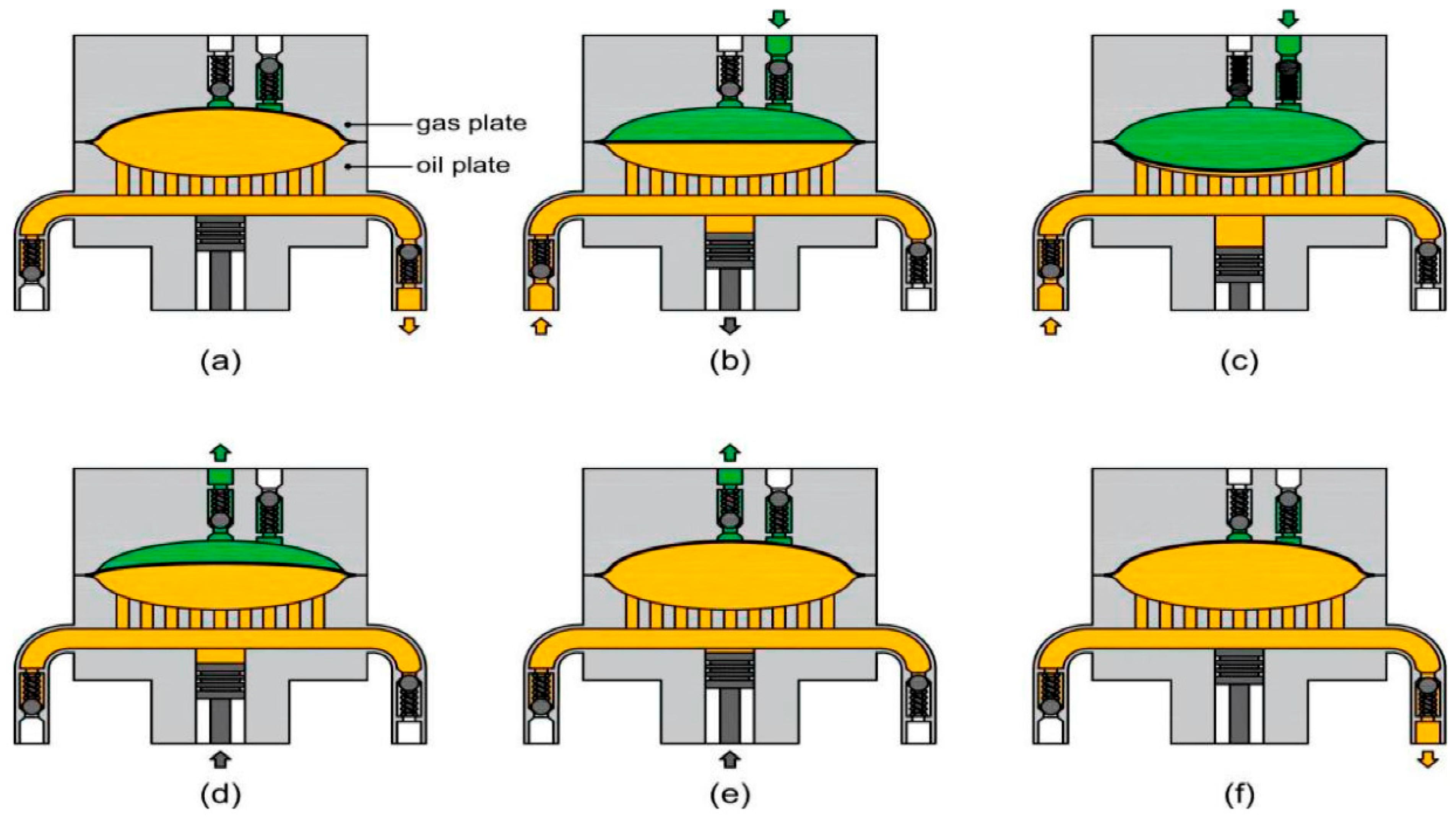
Diaphragm compressors (DCs) are machines that compress hydrogen by flexing a thin metallic diaphragm that has the ability to separate the process gas from the hydraulic oil (
Figure 2). A reciprocating piston pressurizes hydraulic oil and drives diaphragm deflection, reducing the gas chamber volume and increasing hydrogen pressure. The diaphragm retracts as the oil pressure decreases during the return stroke; oil pressure decreases, and hydrogen enters through the inlet valve. During operation there is a complete gas and oil circuit separation, which minimizes the risk of lubricant contamination and ensures high-purity hydrogen that complies with ISO 14687 specifications [
34]. This hermetic operation, together with the ability to achieve very high discharge pressures, explains the widespread adoption of DCs in HRSs, particularly as the final compression stage for 700 bar fueling applications [
97,
98,
99,
100].
Modern DCs can provide discharge pressures up to 1000 bar, which is sufficient for both 350 bar and 700 bar refueling when hydrogen is stored at about 520 bar and 950 bar, respectively. Their flow capacity is lower than that of reciprocating compressors, but sufficient for small- and medium-scale HRSs. Commercial systems can deliver up to 2000 Nm
3/h, corresponding to roughly 180 kg/h of hydrogen [
25].
Experimental testing of a dual-stage DC operating between 16 bar suction and 200 bar discharge at 420 rpm recorded volumetric efficiencies of 59.2% and 56.5% for the first and second stages, respectively. The total hydrogen throughput reached 460.6 kg/h with a motor input power of 68.6 kW and a system isentropic efficiency of 52% [
95,
100]. Efficiency can be directly affected by the behavior of oil and the suction condition. Optimized hydraulic control and stable inlet conditions have been proven to be critical factors through numerical modeling of a 900 bar machine, with volumetric and isentropic efficiencies falling below 15% and 55%, respectively, at a suction pressure of 80 bar [
98]. Multi-stage DCs typically have energy consumption of 3–5 kWh/kg H
2 depending on cooling performance, compression ratio, and hydraulic oil type and viscosity [
28].
One technical problem in DCs is diaphragm fatigue, which may cause rupture and potential leakage if not detected in time. Cylinder-head stress, valve geometry, and sealing integrity are also critical technical aspects requiring careful control and periodic inspection. The behavior of the hydraulic oil has a direct impact on the overall DC performance, as its compressibility and viscosity influence volumetric efficiency, piston force requirements, and diaphragm stress. Under high pressure operation, increased oil viscosity prolongs the discharge phase, raises torque demand, and increases diaphragm loading. A decrease in oil temperature from 50 °C to 10 °C reduces volumetric efficiency from 65.1% to 39.5%, while radial diaphragm stress increases by more than 40 MPa [
28]. Thermal management and cavity profile optimization are therefore essential to maintain high efficiency and reliability. Recent studies on double-arc cavity geometries achieved lower maximum diaphragm stress of approximately 174 MPa and improved swept volume compared with conventional exponential profiles [
100]. Poor head optimization can increase clearance losses beyond 40% of the stroke volume, reducing volumetric efficiency. They offer lower vibration and noise than RPCs [
98].
DCs are a mature technology that is commercially used in HRSs around the world [
25,
92]. Their CAPEX is high due to the fatigue-resistant diaphragm materials and the precision manufacturing requirements, but their OPEX is moderate, dominated by routine diaphragm and valve replacement [
27,
28]. They deliver high-purity hydrogen, reducing the need for downstream purification systems and simplifying balance-of-plant design [
94]. The development of predictive maintenance approaches, such as fatigue-cycle monitoring, acoustic analysis, and pressure-sensor diagnostics, is currently in progress to enhance component reliability and extend component lifetimes. Thus, reduced downtime and total lifecycle costs are expected in the future [
97,
99,
101].
DCs are primarily deployed in HRSs as high pressure boosters for 700 bar dispensing systems [
98]. They mainly operate as the final compression stage, following upstream compressors that deliver pressure to 200–300 bar [
25]. Despite their lower efficiency in comparison to RPCs, they are expected to be a central component of next-generation HRS designs [
28,
100].
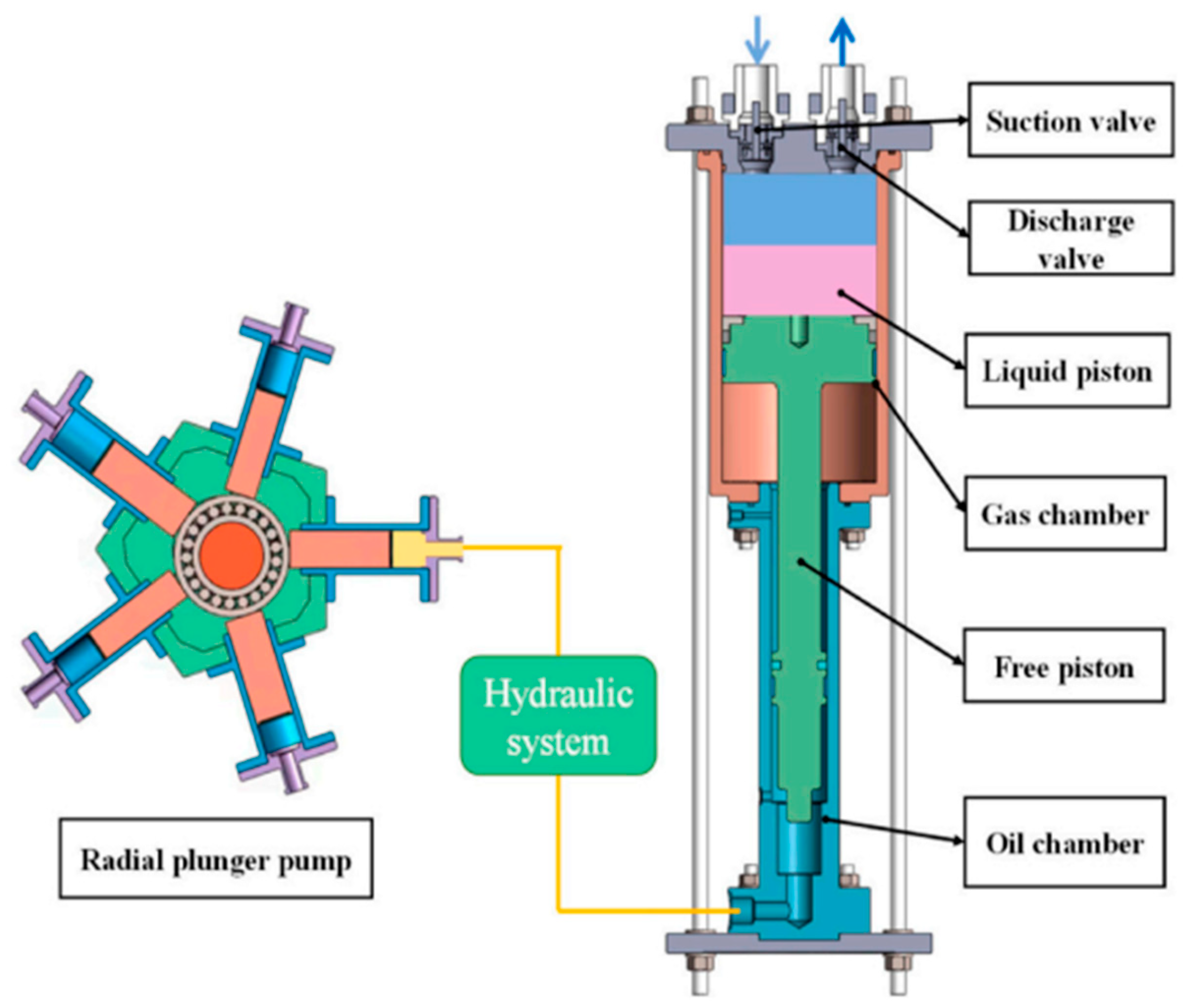
3.1.3. Hydraulic-Driven Piston Compressors (HDPCs)
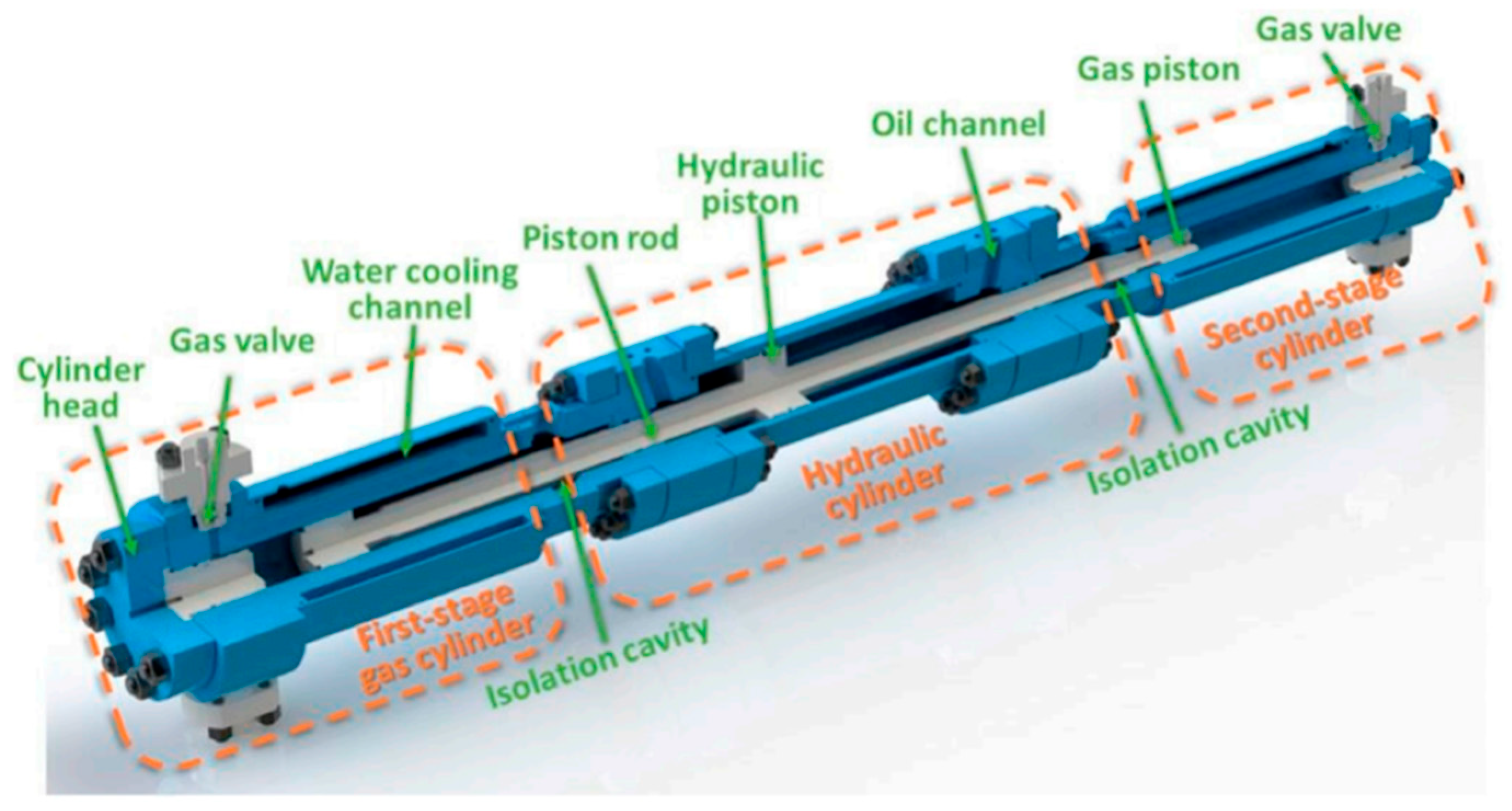
In HDPCs, hydrogen is compressed within a sealed chamber by a piston that is actuated by hydraulic oil. A piston rod connects the piston to a hydraulic cylinder. This rod transmits force from the hydraulic circuit to the gas side without requiring a crank-slider mechanism (
Figure 3) [
52,
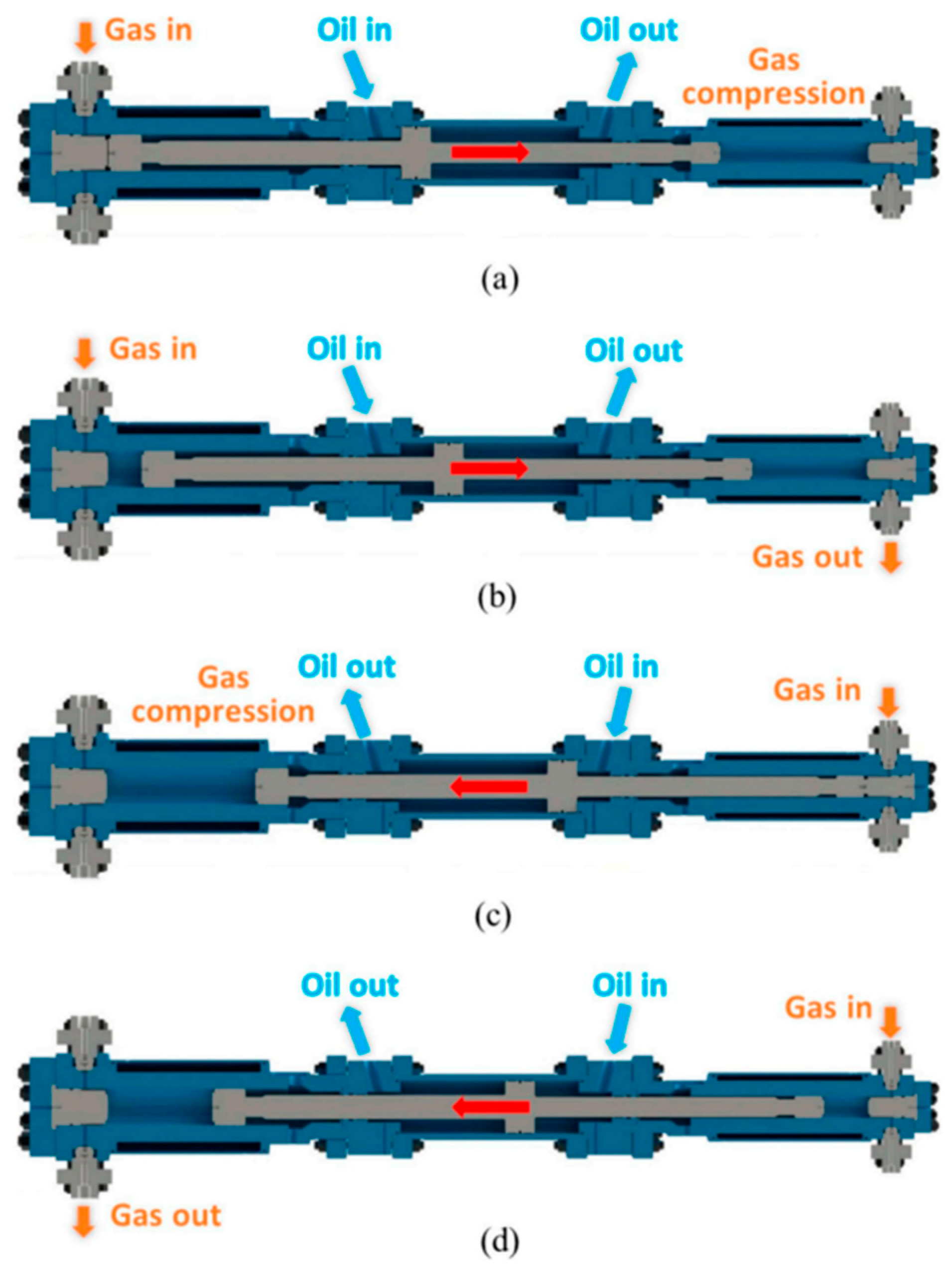
90]. Pumping hydraulic oil into the drive cylinder causes the motion of the piston together with an increase in pressure and a decrease in the volume of the hydrogen chamber. The motion is reversed during expansion as the oil is released, allowing hydrogen to refill the chamber (
Figure 4). The oil and gas sides remain completely separated, ensuring oil-free compression suitable for HRS purity standards [
27,
42].
The two-stage design analyzed by Ye et al. [
52] raised hydrogen pressure from 100 bar to 227 bar per stage through sequential reciprocation. The absence of a crankshaft reduces vibration and mechanical wear, while the sealed structure provides compactness and improved safety. Modern hydraulic systems are equipped with servo-controlled valves and flow-meter feedback loops, which regulate oil and gas flows. This enables precise control of compression cycles and stable multi-stage operation [
42].
Three-dimensional numerical modeling has clarified the transient flow and heat transfer behavior of HDPCs [
42,
52]. Valve opening and closing are the main sources of pressure fluctuations, with exhaust-phase intensities about 2.3 times higher than during intake. Cylinder wall temperature increased from 293 K to 314 K after five cycles, while the maximum instantaneous heat transfer rate reached approximately 15 kW, demonstrating the need for effective thermal control [
52].
HDPCs can reach discharge pressures up to 1000 bar, while efficiency remains around 50–60%, strongly dependent on cycle frequency, valve dynamics, and hydraulic oil–hydrogen coupling [
27,
42]. Local deviations arise near valves due to turbulence and backflow at high reciprocation frequencies, while the bulk compression process approaches adiabatic conditions. In liquid-piston compressors with similar gas–liquid heat transfer behavior, an increase of the heat transfer coefficient by two orders of magnitude reduces the temperature rise by up to 30% under high pressure operation, indicating that intercooling is required to approach quasi-isothermal conditions [
75].
The hydraulic oil properties, such as viscosity and compressibility, are known to have a major effect on the volumetric efficiency and piston response of the HDPC. An increase in the oil temperature reduces its viscosity and can promote internal leakage, lowering the overall efficiency. Under extended operation, cavitation and accelerated wear of sealing materials can also occur [
28]. Since the interaction between the hydraulic and gas subsystems is nonlinear, any imbalances developed between them can result in irregular piston movement and compression ratio deviations [
42].
HDPCs are approaching commercial maturity, with multiple units operating in 700 bar HRSs [
42]. CAPEX is lower than for DCs due to simpler construction and reduced footprint, while OPEX remains moderate and is mainly driven by periodic oil replacement and valve maintenance [
18]. An LCC analysis by Orlova et al. [
42] identifies energy consumption and maintenance frequency as the main contributors to total cost. LCC is expressed as the sum of CAPEX, maintenance (MC), replacement (RC), and OPEX. For HDPCs, both MC and RC are reduced by mechanical simplicity, while OPEX depends mainly on oil system servicing and power consumption of typically 4–5 kWh/kg H
2.
Current designs demonstrate high reliability and a TRL close to 8. Ongoing optimization endeavors are targeting improved isothermal performance and longer maintenance intervals to limit thermally induced wear [
27,
52]. HDPCs are increasingly employed in HRSs as pre-compression or final booster units. The hydraulic drive provides smooth operation, allowing flexible response to fluctuating hydrogen supply. Their modular architecture allows scaling from small on-site to large centralized applications [
46]. Ongoing advancements in real-gas modeling, adaptive valve regulation, and internal cooling are expected to further improve performance in HRS operation [
25,
75].
3.1.4. Ionic Liquid Piston Compressors (ILPCs)
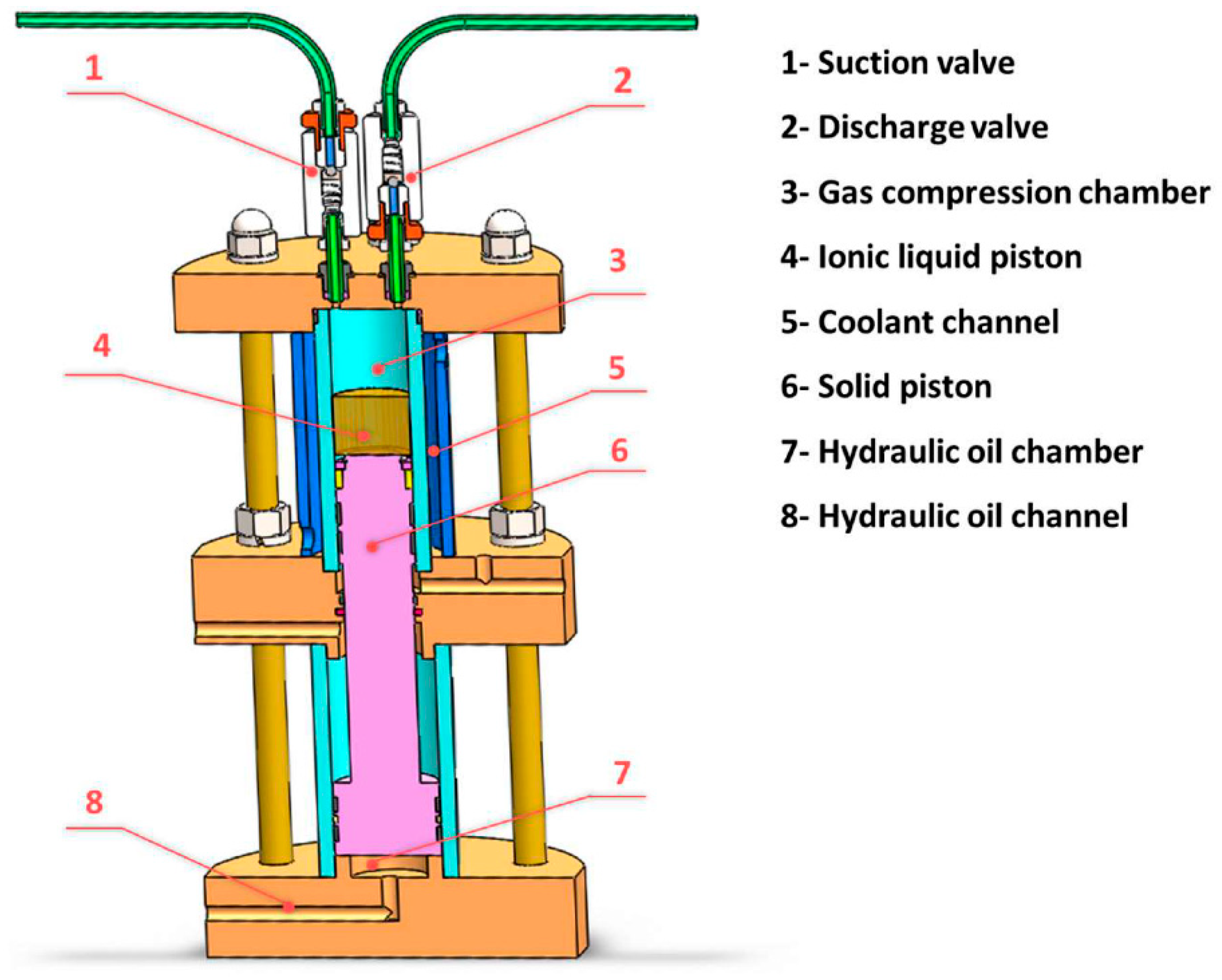
Ionic liquid piston compressors (ILPCs) replace the solid metallic piston of conventional reciprocating compressors with an IL column acting as an incompressible piston medium. Hydrogen compression is achieved as the IL is displaced inside a sealed compression chamber by a hydraulic or electromechanical actuator (
Figure 5) [
102,
103,
104]. Mechanical force transmission and heat absorption occur simultaneously within the same medium, allowing compression to approach near-isothermal conditions. Owing to negligible vapor pressure, low volatility, and high chemical and thermal stability, the IL does not contaminate the gas stream, ensuring compliance with HRS purity requirements [
105].
The hydraulic system driving the IL column provides precise piston position control and smooth motion through servo-regulated valves [
104]. During operation, hydraulic oil actuates a solid piston that displaces the IL column, reducing gas volume on the opposite side of the chamber and increasing hydrogen pressure. A leakage channel or isolation chamber is typically integrated between the IL and the hydraulic oil to prevent fluid crossover. This arrangement eliminates the need for mechanical seals or lubrication at the gas side, preventing unnecessary frictional losses and wear.
ILPCs are suitable for high pressure hydrogen compression, as shown by various recent investigations. Wang et al. [
103] developed a five-stage ILPC employing the ionic liquid [EMIM][Tf
2N], achieving hydrogen pressurization from 5 bar to 900 bar and covering both 350 bar and 700 bar HRS service. The selected IL properties included a density of 1520 kg/m
3, viscosity of 50 mPa s, heat capacity of 1301 J/kg-K, and thermal conductivity of 0.12 W/m-K. These properties support thermal stability and limit hydrogen solubility [
105].
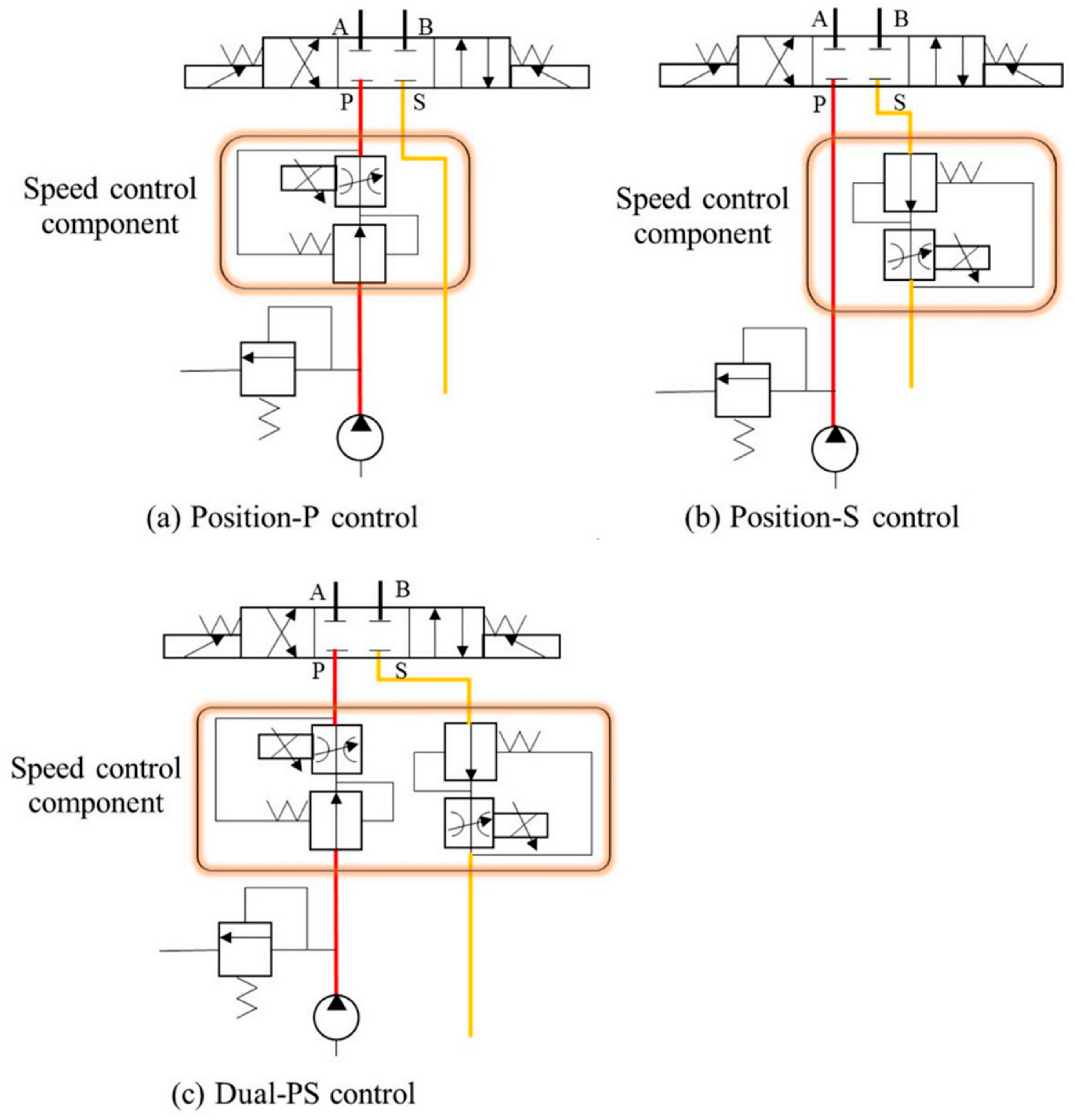
The performance of ILPCs is strongly influenced by piston trajectory control. Guo et al. [
104] defined three hydraulic valve control modes (
Figure 6), namely Position-P, Position-S, and Dual-PS, to regulate piston velocity and displacement. Under Position-P control, a maximum isothermal efficiency of 50.3% was achieved, together with a discharge mass of 1.14 g per cycle and a specific energy consumption of 2395 J/g H
2 (approximately 2.4 kWh/kg H
2).
Simulation results indicate that temperature gradients of 5–15 K can develop along the compression chamber during discharge at pressures above 700 bar, primarily due to local turbulence and non-ideal gas–liquid heat transfer [
103]. Despite these gradients, the quasi-isothermal behavior of the IL column results in discharge temperatures approximately 10–12% lower than those of an adiabatic process. The volumetric efficiency of an ILPC typically lies in the range of 80–90%, and the pressure drop across the IL column remains below 5 bar due to the moderate viscosity and high density of the selected liquids. Operation remains stable at flow rates of approximately 200 Nm
3/h, and scalability is achievable through multi-piston or multi-stage modular arrangements for higher-capacity stations [
103]. Compared with conventional RPCs operating at 3.5–5.0 kWh/kg H
2, ILPC prototypes require lower compression energy, between 2.3 and 3.8 kWh/kg H
2 [
102,
104].
ILPCs face several challenges relevant to the selection and engineering performance of the ionic liquid. Candidate liquids such as [EMIM][Tf
2N] and phosphonium-based compounds exhibit low hydrogen solubility, low compressibility, and thermal stability up to 400 °C [
105], while degradation mechanisms, moisture absorption, and material compatibility remain unresolved. Limited water uptake modifies viscosity and promotes corrosion of metallic components in contact with the IL. Thermal management constitutes an additional constraint since the limited heat transfer between the IL and the chamber wall develops non-uniform temperature fields along the compression chamber [
105]. Furthermore, gas bubbles entrained within the liquid increase apparent compressibility and reduce volumetric efficiency, while IL fluctuation can expose the solid piston to hydrogen, reducing sealing effectiveness and increasing embrittlement risk. Minimum liquid-piston height requirements necessary to maintain gas-phase sealing across different stroke-to-diameter ratios in multistage ILPCs have been defined [
106], while integrated heat-exchange channels, swirl-inducing geometries, and porous inserts are applied to improve gas–liquid interaction and thermal uniformity, provided that hydraulic control accuracy is maintained to limit overshoot and cavitation.
ILPCs are at the stage of laboratory validation and prototype-level development, corresponding to TRLs between 4 and 6 [
25,
27,
103]. CAPEX ranges from moderate to high due to the cost of ionic liquids and the use of corrosion-resistant chamber materials. OPEX remains moderate, reflecting reduced mechanical maintenance requirements alongside additional demands related to ionic liquid handling and conditioning [
73,
103,
105]. At the same time, corrosion, liquid carryover requiring trapping, and cavitation remain practical challenges that can offset maintenance advantages.
ILPCs are regarded as emerging compression units for HRSs, particularly in applications where gas purity, low vibration, and low noise are critical. Their quasi-isothermal operation and negligible contamination risk support their suitability for on-site compression of green hydrogen [
103,
105]. Experimental and numerical studies further indicate that stable high pressure operation depends on maintaining adequate IL column height and sealing integrity, especially in multistage configurations [
106]. Ongoing research focuses on improving hydraulic control accuracy, IL stability, and internal thermal management to enhance performance and operational reliability [
73,
103,
106].
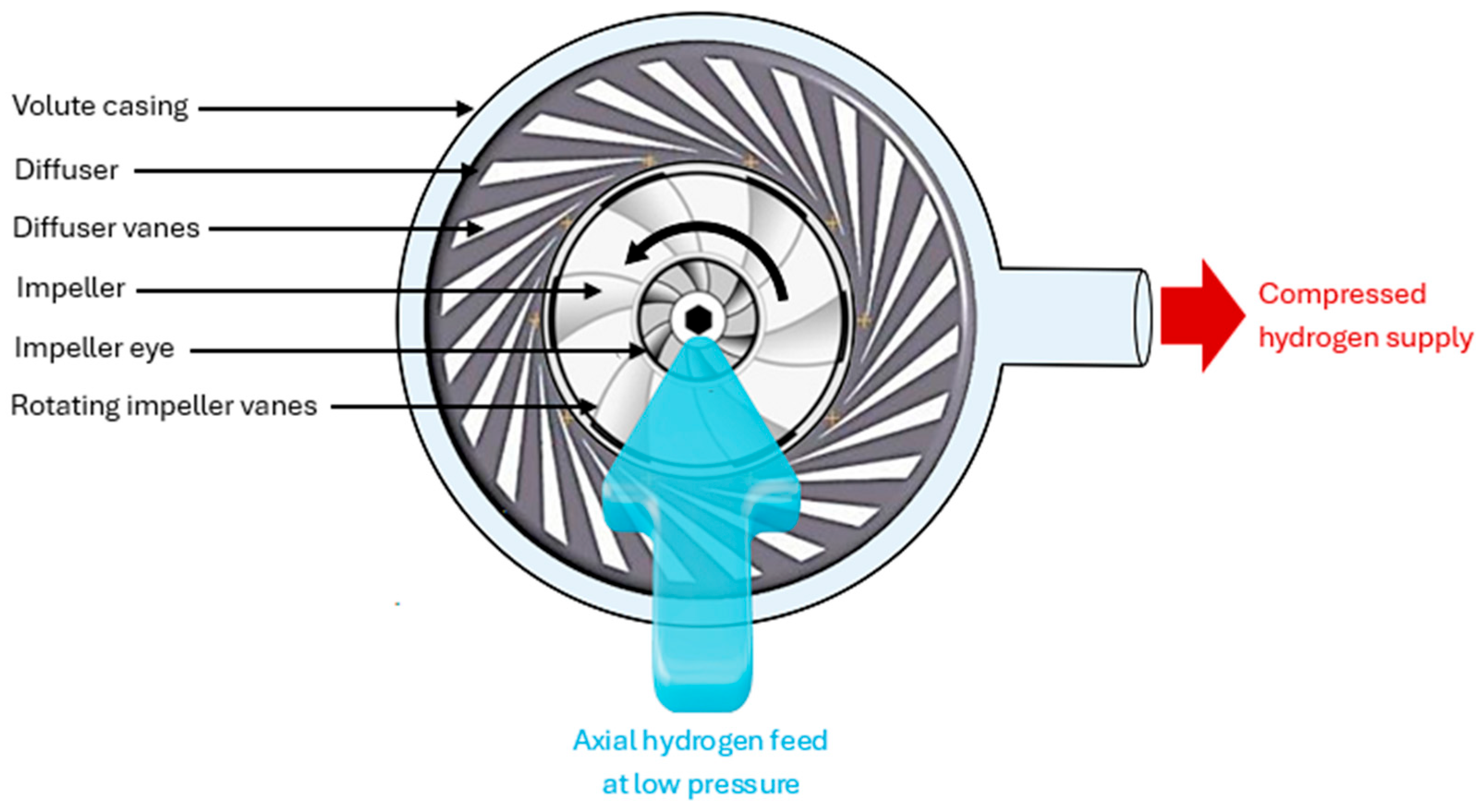
3.1.5. Centrifugal Compressors (CCs)
Centrifugal compressors (CCs) use a high-speed impeller to increase the velocity and pressure of hydrogen as this is reflected radially outward by its blades. Subsequently, the pressure increases even further as the gas is directed inside stationary diffuser channels, where kinetic energy is converted to additional static pressure (
Figure 7). As the gas is accelerated radially outward, pressure recovery occurs downstream, enabling continuous compression with minimal pressure pulsations. The configuration is mechanically simple and oil-free since the gas stream does not contact any lubricated components. CCs are primarily applied in hydrogen systems requiring large volumetric flow rates, particularly in centralized compression and pipeline transport applications [
107,
108,
109].
The very low molecular weight of hydrogen limits the achievable pressure ratio per stage in centrifugal compressors, requiring either elevated impeller tip speeds or multiple compression stages to reach the target discharge pressure. In practice, impeller velocities in the range of 350–700 m/s are necessary to obtain per-stage pressure ratios of approximately 1.2–1.4 [
21,
109]. Hydrogen centrifugal compressors are therefore implemented in multistage configurations, commonly as integrally geared or barrel-type units with intercooling between stages. Under these conditions, the aerodynamic design of the impeller, diffuser, and volute is critical to suppress surge and choke and to ensure stable operation across the operating range [
107,
109,
110].
Detailed experimental validation of centrifugal hydrogen compression is reported for the DOE-sponsored pipeline compressor developed by Concepts NREC. The six-stage, intercooled system operated between 24 bar and 89 bar at 60,000 rpm, delivering approximately 240,000 kg H
2/day with an overall isentropic efficiency of about 80% [
111]. Aluminum 7075-T6 impellers achieved stage efficiencies of 79–81% and demonstrated mechanical stability and hydrogen compatibility under 110% overspeed conditions. Dry-gas seals, tilting-pad hydrodynamic bearings, and intercooling maintained discharge temperatures below 140 °C. The study demonstrated centrifugal hydrogen compression at pipeline pressure levels of approximately 90 bar. More recent industrial experience extends these findings to advanced hydrogen and hydrogen-rich services. Elliott’s Flex-Op compressor train, operating with pure hydrogen at 15,000 rpm, achieved a pressure ratio of 2.78 (25–70 bar) with overall efficiencies approaching 80%. For identical geometry and rotational speed, hydrogen compressors develop a similar head but a lower pressure ratio than natural gas compressors, requiring either an increased number of stages or higher impeller tip speeds, limited by the allowable impeller stress threshold of approximately 827 MPa specified in API 617 to mitigate hydrogen embrittlement [
108,
109].
Current aerodynamic optimization efforts focus primarily on the geometry of high-speed impellers and volutes. High-fidelity numerical simulations and dedicated test rigs indicate that optimized diffuser contours can increase surge margin by approximately 16% and choke-flow capacity by around 30% at rotational speeds of 210,000 rpm [
112,
113]. Variable-geometry diffusers and inlet guide vanes further improve part-load performance and delay the onset of stall [
107,
110]. Under off-design operating conditions, hydrogen centrifugal compressors exhibit reduced polytropic efficiency, typically in the range of 75–90%.
The small size of H
2 molecules increases leakage susceptibility through dynamic seals and bearings. Also, the combination of high impeller tip speeds and steep pressure gradients promotes flow separation, surge, and vibration [
109]. Blade geometry optimization provides a mitigation pathway since increasing the wrap angle and blade count reduces blade loading and suppresses secondary flow structures, improving wave margin and part-load stability [
110]. From a control standpoint, Shehata et al. [
114] implemented a variable structure control algorithm that extended stable operation by approximately 76% beyond the natural surge limit and enabled throttling down to 10% of nominal flow, indicating the relevance of active surge suppression strategies for dynamic hydrogen compression environments such as those encountered in HRSs. In parallel, Lamprakis et al. [
113] developed a body-force-based aerodynamic modeling approach capable of reproducing post-stall and rotating-stall flow fields at substantially lower computational costs than full three-dimensional CFD, supporting efficient design and control-oriented analysis.
Centrifugal compressors are fully commercial for air and natural gas compression, corresponding to TRL 9. For hydrogen service at discharge pressures above 1000 bar, they remain at pilot and demonstration level, typically within TRLs 6–7. Capital costs increase with stage count and material requirements, while techno-economic assessments report installed costs in the range of 0.5–1.0 MUSD per MW of absorbed power, following a cost–capacity scaling exponent of approximately 0.83. Operating expenditure is dominated by electricity consumption and periodic seal maintenance. Within the DOE pipeline compressor program, maintenance costs below 3% of capital value were targeted while maintaining hydrogen purity of 99.99% and avoiding redundant compressor units [
111]. Transition Accelerator analyses indicate that large hydrogen centrifugal compressors operating in the 20–70 bar range can achieve isentropic efficiencies between 55% and 80%, with specific energy consumption of approximately 0.65 kWh/kg H
2 [
21]. Further increases in achievable discharge pressure and reductions in lifecycle costs are associated with ongoing developments in high-strength alloys and advanced manufacturing approaches, including additive techniques [
110].
Centrifugal compressors are primarily applied in pre-compression stages of hydrogen refueling stations, where they raise pressure from electrolyzer or pipeline levels of 10–30 bar to intermediate storage pressures typically between 200 and 500 bar. Final compression to dispensing pressures of 350 or 700 bar is generally achieved using positive displacement or hydraulic-piston compressors [
21,
108]. Current research, therefore, concentrates on hybrid compression architectures that combine centrifugal and reciprocating stages to balance throughput and pressure capability. Within these limits, centrifugal compressors are expected to remain a core element of multi-stage hydrogen refueling infrastructure, providing efficient and reliable pre-compression compatible with high-purity hydrogen service [
109,
110].
3.1.6. Screw Compressors (SCs)
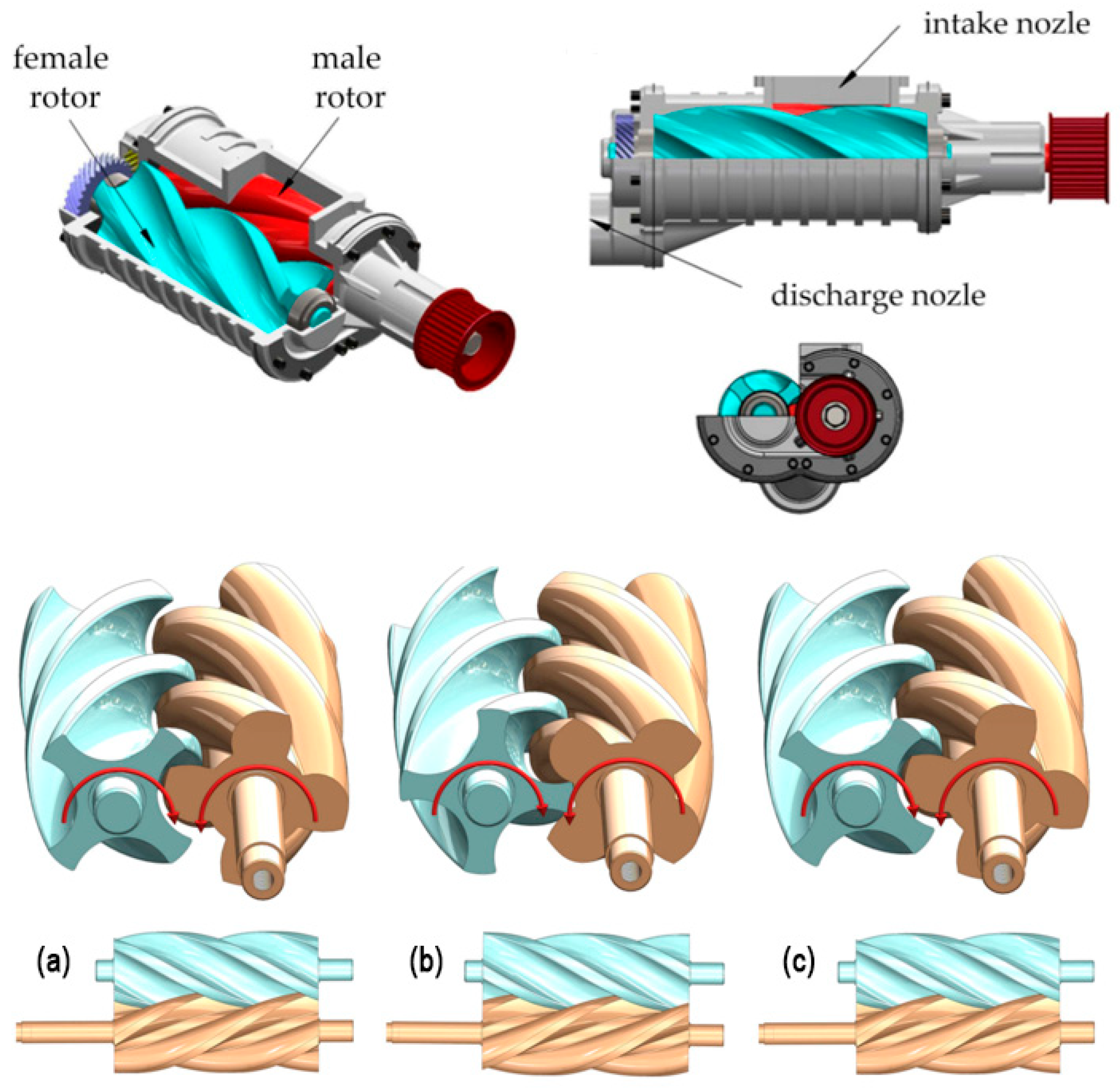
Screw compressors (SCs) are positive displacement machines in which hydrogen is compressed by the meshing action of two counter-rotating helical rotors enclosed within a precision-machined casing (
Figure 8) [
115]. Gas is trapped within successive cavities formed between the rotor lobes and the casing and is conveyed axially along the rotor length. Compression occurs as the effective cavity volume decreases progressively toward the discharge end (
Figure 8) [
116].
Screw compressors operate in oil-flooded or dry configurations, depending on design and application requirements [
118]. In oil-flooded designs, oil is injected into the compression chamber to seal internal clearances, provide cooling, and lubricate the rotors, limiting leakage across inter-lobe and end-face gaps. Dry screw compressors rely on tight manufacturing tolerances and external cooling to maintain compression efficiency and allow oil-free operation in contamination-sensitive processes. In both configurations, compression proceeds continuously with low pressure pulsations [
119]. The number of moving components is limited, and maintenance requirements depend on configuration and operating conditions.
Single-stage screw compressors operate at discharge pressures around 10 bar, achieving pressure ratios of approximately 3.5 per stage in dry configurations and up to about 15 in oil-flooded designs [
27,
115]. The use of a higher discharge pressure increases internal temperature and mechanical loading, constraining performance. Multi-stage configurations with intercooling extend operation to discharge pressures of 25–30 bar in air and inert-gas service [
118]. Interstage cooling improves volumetric efficiency and reduces power consumption by decreasing temperature rise during compression.
An experimental study by Kumar et al. [
118] has shown that a two-stage oil-flooded screw compressor for medium-pressure applications (6–12 bar) can exhibit 20–75% lower energy consumption compared to equivalent single-stage configurations. Stable operation was demonstrated over a power range of 22–315 kW. The overall efficiencies of modern oil-flooded screw compressors lie in the range of 70–85%, with volumetric efficiency exceeding 90% under controlled thermal conditions [
117]. Complementary numerical analyses by Dhrumilkumar et al. [
119] have shown that lobe geometry governs leakage behavior and thermal development within the compression chamber. Increased wrap angle and reduced tip clearance improved pressure uniformity, with 4/5 lobe profiles representing a compromise between throughput and sealing performance.
Screw compressors face significant losses from internal leakages through the inter-lobe gaps, the rotor–casing clearances, and the blowhole [
115]. Patel and Lakhera [
116] experimentally characterized these leakage paths and validated analytical models for blowhole flow using a modified convergent-nozzle formulation. Leakage losses reduced adiabatic efficiency by up to 10% at high tip speeds, with a stronger impact in dry configurations. CFD studies by Dhrumilkumar et al. [
119] verified that the behavior of the leakage depends on local flow separation and tip-clearance geometry. For accurate prediction, an appropriate mesh refinement in the inter-lobe region was required. In multi-stage systems, rotor deformation, bearing wear, and oil-cooling limitations become relevant. In these systems, differential pressure can induce rotor deflection and disturb inter-lobe alignment, while oil degradation at temperatures above 160 °C reduces sealing effectiveness and accelerates wear [
118]. Condensate formation in oil-separation units limits applicability in oil-free hydrogen service. Rack-generated rotor profiles combined with manufacturing tolerances below 10 µm achieved measurable leakage reduction [
115]. Patel and Lakhera [
116] also developed an experimental method capable of estimating blowhole leakage with an accuracy of ±7.2% under operating conditions.
Screw compressors are fully mature for air, refrigeration, and industrial gas applications (TRL 9). Application in high pressure hydrogen service remains limited to TRLs 6–7 due to leakage, oil contamination, and material compatibility constraints. CAPEX is moderate relative to reciprocating compressors due to compact construction and a limited number of moving components. OPEX can increase under operating conditions requiring intensive oil management and cooling. Lifecycle cost reductions of 20–40% are reported for multi-stage screw compressors compared with comparable single-stage configurations, despite higher initial investments, over the assessed system lifetime. Optimized rotor profiles, improved sealing concepts, and intercooling are expected to reduce power demand and lengthen maintenance intervals over a 10-year operating horizon [
118].
Screw compressors are applied in pre-compression and medium-pressure storage stages of hydrogen refueling stations, particularly where continuous operation is required. Oil-flooded configurations are used to compress hydrogen from electrolyzer outlet pressures of 10–30 bar to intermediate pressure levels of 200–300 bar, after which piston or hydraulic compressors are employed for final compression to 350 or 700 bar. Continuous flow, low vibration, and compact design support their application in small- to medium-capacity HRS installations; however, oil contamination remains a constraint for direct dispensing. Today, research focuses on the development of oil-free and water-injected screw compressor concepts incorporating advanced rotor coatings and enhanced heat rejection [
116,
119]. Staged configurations demonstrate reduced lifecycle costs over long-term operation, while optimized rotor geometry and bearing design increase achievable pressure ratios per stage [
115,
118]. These characteristics support the integration of screw compressors into hybrid HRS architectures that combine pre-compression and intermediate storage, particularly in decentralized hydrogen production systems.
3.2. Non-Mechanical Compression Technologies
As mentioned above, conventional mechanical compressors are a mature and widely deployed industrial technology, but they rely on complex assemblies that are susceptible to wear. Moreover, mechanical compression is typically adiabatic or polytropic, generating heat that must be removed, which adds auxiliary systems and parasitic losses [
22,
120]. These challenges are more significant for small hydrogen systems such as refueling stations and power-to-gas hubs [
121,
122], posing a hurdle to the wide adoption of hydrogen. Thus, non-mechanical hydrogen compression is garnering significant interest. There are three basic approaches that can be followed that rely on physicochemical pathways: (i) electrochemical hydrogen compression (EHC), (ii) metal-hydride thermal compression, and (iii) adsorption/desorption-based compression [
24,
123,
124]. These approaches will be discussed in the subsections that follow.
3.2.1. Electrochemical Hydrogen Compressors (EHCs)
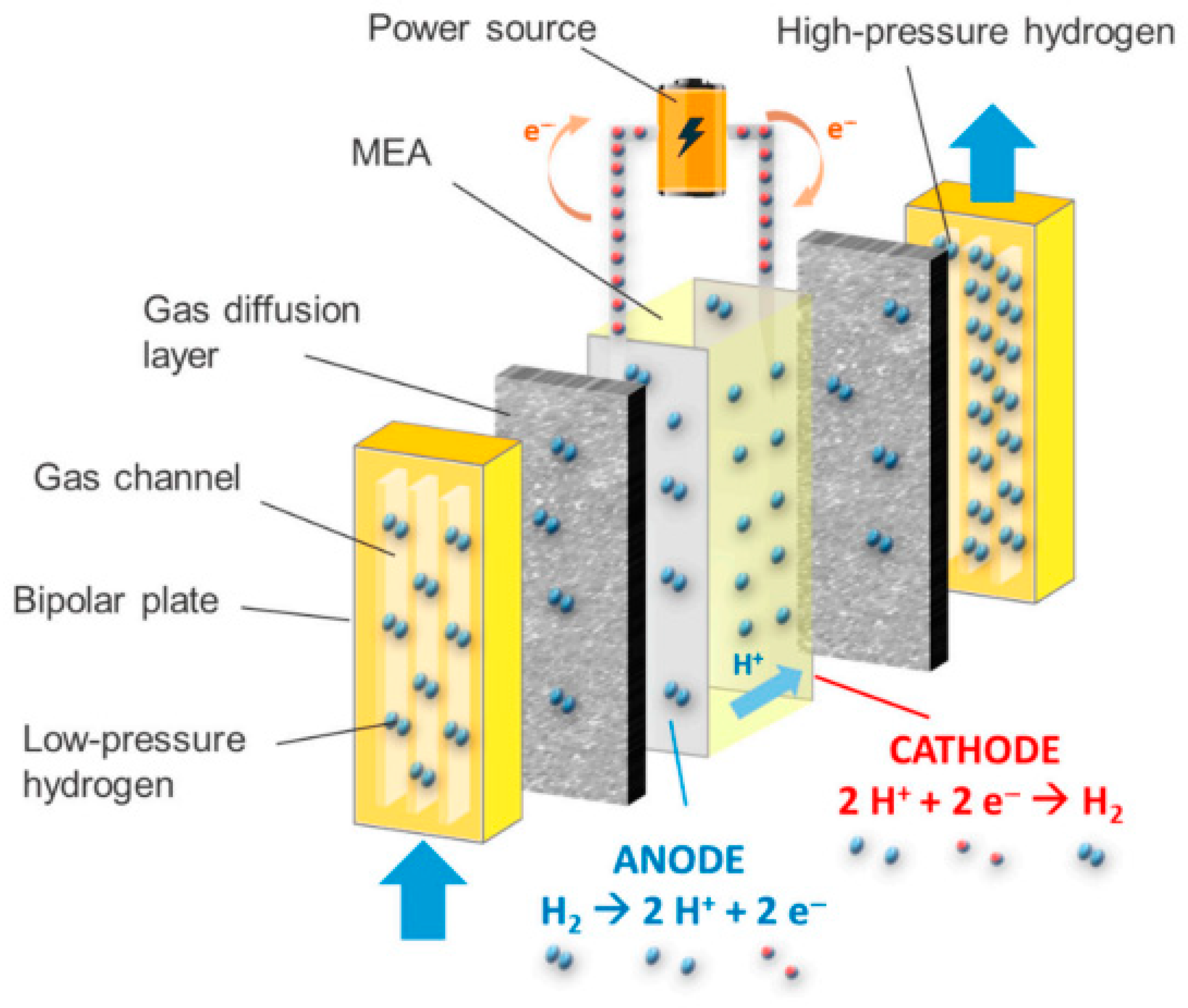
EHCs employ a proton exchange membrane (PEM) in order to electrochemically transport and compress H
2 (
Figure 9). More specifically, at the anode, molecular H
2 dissociates into protons and electrons; the protons migrate through the PEM under an applied voltage and recombine at the cathode to form high pressure H
2 gas. As only hydrogen ions traverse the membrane, the process simultaneously purifies and compresses H
2, eliminating the risk of oil contamination. EHCs are typically used at room temperature and near-isothermal conditions, achieving increased efficiencies (above 80%) and outlet pressures up to 700 bar [
125]. Energy consumption is drastically reduced; for example, to compress hydrogen from 10 to 400 bar, they require merely 3 kWh/kg, almost half that of a mechanical system [
125]. Moreover, this technology presents some advantages, including quiet operation, low cost of maintenance, and modular scalability. Finally, electrochemical devices allow for high gas purity and compact design, which makes them ideal for refueling stations and on-site H
2 production [
125,
126].
Similar to PEM fuel cells, EHCs are also built in modular stacks. Multiple cells connected in series can achieve very high pressures. This design proves capable of attaining discharge pressures near 1000 bar. The main advantage is the inherent production of high-purity hydrogen (up to 99.99%), as the membrane selectively allows only the exchange of protons, and, due to this ability, the need for separate purification units is eliminated. Despite the obvious benefits of this technology, challenges still exist. Durability is compromised by stress on the PEM, catalyst degradation, and sealing issues. Hydrogen back-diffusion through the membrane limits the maximum achievable pressure and can reduce compression efficiency. Also, membrane dehydration and thermal stress can cause cracking or delamination, shortening the lifetime. Furthermore, at high differential pressures, gas crossover may compromise safety and product purity. The high cost of the membrane electrode assembly (MEA), particularly the platinum-group metal catalysts, is also a barrier to widespread adoption. The TRL is advancing but is generally lower than that of mechanical systems, with active research focused on improving durability and scaling up for large-scale HRS applications. Advancements made in the fields of reinforced perfluorosulfonic acid (PFSA) membranes, proton-conducting ceramics, and nanostructured catalyst layers may help alleviate these issues. Multi-cell EHC stacks further enhance scalability and enable integration with electrolyzers or fuel cells, forming all-electrochemical hydrogen systems [
123,
128].
3.2.2. Metal Hydride Compressors (MHCs)
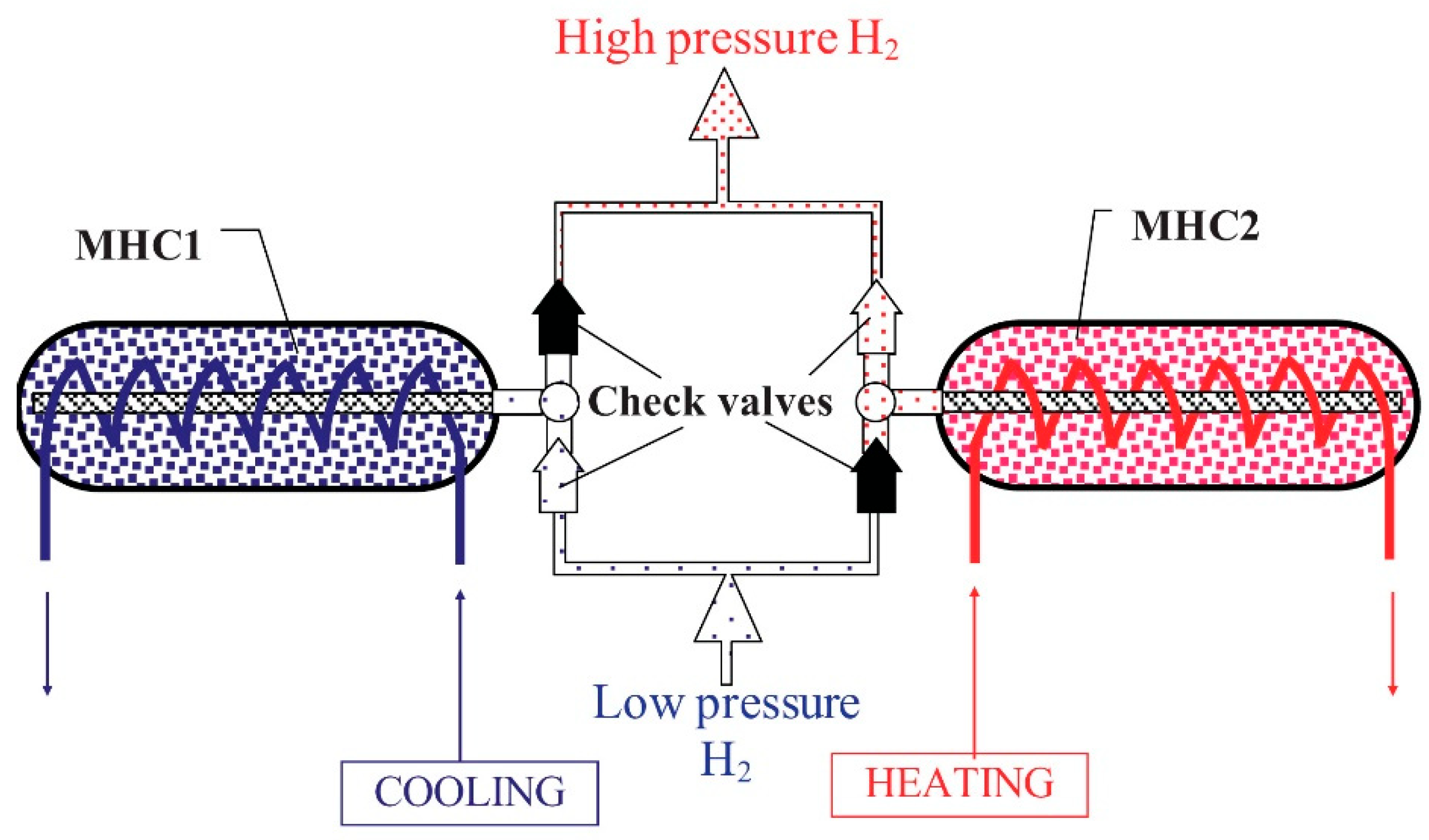
MHCs are using the ability of a specific class of metal alloys to absorb and desorb hydrogen through temperature fluctuations (
Figure 10). Appropriate intermetallic compounds (IMCs), such as LaNi
5, TiFe, Mg
2Ni, or vanadium-based alloys, can absorb hydrogen gas at moderate temperatures and pressures to form metal hydrides (MH
x) [
129,
130] in an exothermic process. Briefly, hydrogen molecules contact the alloy surface and dissociate into atoms, which diffuse into the metal lattice and form a solid hydride phase. After the temperature of the hydride is increased, based on the Van’t Hoff relationship, hydrogen is desorbed at a higher equilibrium pressure. By cycling a metal hydride bed between absorption (low T and P) and desorption (high T and P), H
2 can be compressed without the need for mechanical components [
131]. Therefore, the overall compression is carried out in cycles that involve cooling an alloy to absorb low-pressure hydrogen, then heating it to release the hydrogen at a higher pressure. This process is quiet, vibration-free, and can effectively use low-grade waste or renewable heat (80–150 °C), making its electrical consumption minimal.
Multi-stage systems connect several units in series to achieve very high final pressures. A variety of alloy families are used, including AB
5-type (e.g., LaNi
5-based) for initial stages and AB
2-type (e.g., Laves phase) for intermediate and final stages. Performance has been demonstrated in numerous prototypes, with a single-stage system compressing H
2 from 100 bar to over 700 bar and multi-stage systems achieving compression ratios as high as 84.7. Flow rates are generally low, with an operational HRS in South Africa reporting a productivity of up to 13 Nm
3/h (
1.17 kg/h) [
133].
The thermodynamic behavior of metal-hydrogen systems is typically represented by pressure-composition-temperature (PCT) diagrams, which define the equilibrium pressures for hydrogen absorption and desorption. The pressure ratio achievable in a single stage depends on the pressure that the alloy can withstand at a given temperature (chosen for absorption and desorption) [
131]. For example, LaNi
5-based hydrides may absorb hydrogen at 20–30 °C and 1–5 bar and desorb at 100–150 °C and 20–50 bar. Multiple hydride beds with different alloy compositions and temperature ranges may also be used to increase the overall pressure of the system. For example, it has been reported that three-stage hydride compressors can achieve outlet pressures exceeding 120 bar [
131,
132]. As metal hydride compressors have no mechanical moving parts, this improves wear, and thus they require less maintenance. Moreover, H
2 is stored in a solid-state phase instead of the gas phase during the absorption stage. As hydride materials perform both storage and compression, the systems used tend to be compact. Moreover, industrial waste heat or renewable thermal energy can be utilized, which can improve overall energy efficiency. In addition, the reversible absorption–desorption process provides H
2 with high purity, as contaminants do not typically diffuse into the metal lattice [
134,
135].
Despite these advantages, metal hydride compression has not yet reached the level of maturity for widespread deployment. One critical factor is thermal management, as poor heat transfer slows kinetics and cycle times, affecting the overall performance. Also, the materials currently used tend to degrade after repeated cycles due to pulverization, disproportionation, and contamination, which causes capacity loss and slower kinetics [
132,
136]. To cope with these issues, poison-resistant alloys such as CeNi
5-based materials are being developed [
137]. The cost of the metal alloys, such as LaNi
5 and TiFe-based hydrides, can also be high. Finally, the overall throughput of hydride compressors is relatively limited, given that absorption and desorption rates are inherently slower than mechanical compression. As a result, MHCs are currently restricted to small- and medium-scale applications. Research is ongoing toward the development of new alloys, innovative heat management ideas, and system integration.
Novel hydrides with desired thermodynamic properties are being developed to enable multi-stage compression with fewer materials. Nanostructured hydrides and composites incorporating graphene or metal foams are considered promising for enhancing heat transfer and cycling stability. Integration with electrochemical or adsorption-based compressors is also being explored to design hybrid systems capable of higher pressures and improved efficiency [
138]. In terms of feasibility, MHCs can be competitive, with one analysis estimating a CAPEX of USD 150,000 and annual maintenance of USD 1000, compared to USD 170,000 and USD 9000, respectively, for a mechanical compressor of the same scale [
22]. Their TRL is progressing, with multiple companies already providing commercial products, especially for small-scale applications.
3.2.3. Adsorption/Desorption Compressors (ADCs)
Adsorption/desorption hydrogen compressors (ADCs) are also known as thermal physisorption compressors. They operate on a thermal cycle, utilizing porous materials such as activated carbon (AC), zeolites, or metal-organic frameworks (MOFs). Typically supplied from an LH
2 source, hydrogen is initially adsorbed onto the material’s surface at cryogenic temperatures (e.g., 77 K) and low pressure, and then the system is heated, causing the desorption of hydrogen and a rapid increase in pressure within the confined volume [
139]. As a result, compression is achieved with no mechanical intervention. The fundamental principle of adsorption compression is based on the relationship between temperature, pressure, and the amount of H
2 adsorbed on the surface of the material through weak van der Waals interactions. It follows the thermodynamics of physisorption, where the adsorbed phase behaves somewhat similar to a condensed fluid on the material’s surface. At low temperatures (usually in the cryogenic range between 77 K and 150 K), the adsorption capacity of porous materials for H2 is significantly enhanced. Although MOFs provide exceptionally high surface areas, ACs are frequently chosen due to their superior bulk density, reduced cost, and enhanced durability. The compression ratio achieved depends on the adsorption isotherms of the material, the temperature swing applied, and the system’s void volume [
140].
This class of compressors typically consists of one or multiple adsorption beds, that contain materials with high porosity, placed in vessels that are controlled thermally. These systems also include valves that switch between filling, isolating, and releasing H
2 during different phases of the cycle. In single-bed systems, during adsorption, the temperature of the bed is lowered, and H
2 is physically adsorbed within the pores of the material at low pressure. During desorption, the bed is heated in order to release H
2 at a higher pressure into a storage tank. Multi-bed systems are more efficient, as they can ensure continuous operation. Importantly, as the process relies purely on heat exchange and gas flow, mechanical wear and vibration do not pose issues [
139].
As is well understood, the performance of these systems strongly depends on the choice of the adsorbent. The most widely used are activated carbons, as they have a high surface area (1000–3000 m
2/g), are chemically stable, and are relatively cheap. Other materials that have been tested include zeolites, carbon nanotubes, and MOFs. The latter, despite their high cost, are attractive in this application due to their tunable adsorption enthalpies. However, as physical adsorption is not easy under atmospheric conditions, most of the reported works concern materials that have been tested at cryogenic temperatures. Such an approach increases costs but also the complexity of the systems used. Recent studies have explored intermediate-temperature operation (200–300 K) using adsorbents with moderate binding energies, potentially reducing the need for cryogenic cooling while maintaining effective pressure generation [
141].
Apart from the absence of moving parts (and thus also the need for lubricants), one of the main advantages of this technology is the potential for near-isothermal operation and integration with renewable or waste heat sources. Furthermore, the use of porous adsorbents allows for building systems that can be modular and scalable. However, practical implementation faces several challenges, such as the low adsorption capacity of most materials under ambient conditions and the need for thermal management, as efficient heating and cooling cycles must be achieved without excessive energy losses. Finally, under cyclic temperature and pressure variations, the adsorbent materials undergo structural degradation and pore collapse, which cause gradual loss of performance [
139,
140,
141].
Adsorption-based compressors are capable of providing exceptionally high pressures. A single-stage prototype using activated carbon has successfully demonstrated compression up to 700 bar, and conceptual designs with MOFs aim for pressures as high as 900 bar. Among the non-mechanical configurations, they are considered a safe and sustainable alternative with good potential cycle stability. Risks related to adsorbent degradation over multiple cycles may lead to the release of fine particulates that can contaminate fuel cells. Currently, they remain in the range of experimental validation and prototyping (TRL 3–5) and are not yet commercially deployed in HRSs. Further R&D is required to scale up the systems and gather long-term performance data.
3.2.4. Cryogenic Compression
Cryogenic compression, or cryo-pumping, is used exclusively in HRSs supplied with liquid hydrogen (LH
2). The principle involves pressurizing hydrogen in its dense liquid state, which is far more energy-efficient than compressing it as a gas. A high pressure reciprocating LH
2 pump pressurizes the liquid to a supercritical state (e.g., up to 900 bar), after which it is vaporized and warmed to the target dispensing temperature (e.g., −40 °C) to meet fueling protocols such as SAE J2601 [
142]. This technology is highly efficient. While conventional systems using 900 bar pumps consume around 1.3 kWh/kg, a novel HRS design combining a 500 bar pump with a subsequent thermal compression stage reports a remarkably low energy consumption of just 0.3 kWh/kg. They are scalable and designed for high capacity, with the novel design sized for a station that supplies 400 kg/day [
124].
Although regarded as highly reliable, the operation of LH2 includes particular risks, such as the management of boil-off gas (BOG) and the assurance of pump seal durability at cryogenic temperatures. From an economic perspective, these systems offer benefits; the groundbreaking 500 bar pump design is projected to incur a CAPEX of 1.52 million USD, significantly lower than the 1.80 million USD required for a traditional 900 bar system, while OPEX is reduced due to major energy savings.
3.2.5. Hybrid Non-Mechanical Compression Technologies
Hybrid non-mechanical hydrogen compression systems combine two or more of the previously discussed technologies to overcome the limitations of any single approach and to achieve higher overall compression ratios and energy efficiencies. Thus, by exploiting both physical and chemical processes, hybrid configurations may provide continuous, multi-stage compression with improved flexibility and reduced energy consumption compared to either mechanical or single non-mechanical systems. This integrated strategy has attracted increased attention in recent years as a way to develop compact, efficient, and scalable H
2 compression for refueling stations and decentralized energy systems [
143,
144]. In these systems, EHC is usually combined with either metal hydrides or adsorption/desorption systems. In this case, the EHC is used as a first-stage compressor to increase H
2 pressure from near-ambient to an intermediate level of 10–30 bar. At the same time, it also acts as a hydrogen purifier. Then, the EHC output is fed to a thermally driven compressor (hydride or adsorption-based) that uses heat to further raise the pressure to 700 bar or higher. Thus, in this configuration, the EHC operates within its optimal pressure range, avoiding the problems of excessive H
2 back-diffusion and membrane stress. Also, the thermal stage (metal hydrides or adsorption/desorption systems) takes advantage of the higher-pressure regime, where isothermal efficiency and material performance are favorable [
143,
144].
Hybrid configurations offer several advantages in comparison to standalone systems; for example, higher design flexibility and efficiency. Importantly, they also allow the use of renewable or waste energy streams. However, hybrid configurations also pose several challenges that need to be overcome. The integration of thermal and electrical subsystems demands careful control of temperature gradients, timing, and flow distribution. Scaling up is also challenging, as the different subsystems (electrochemical, adsorption, or hydride) operate optimally under different conditions. Finally, hybrid configurations are also more expensive than standalone technologies [
144,
145,
146].
3.2.6. Advantages and Limitations of Non-Mechanical Compressors
Non-mechanical hydrogen compressors (i.e., electrochemical, metal hydride, and adsorption/desorption systems) offer important advantages over mechanical systems. As discussed previously, the absence of moving parts eliminates frictional losses, vibration, and mechanical wear, thereby reducing maintenance costs. Also, their ability to remove contaminants from the H
2 stream is critical for applications demanding very high purity. EHCs provide integrated compression and purification through the action of the proton exchange membrane that selectively transports hydrogen ions while excluding impurities. Similarly, metal hydride and adsorption-based systems deliver safe, compact, and modular compression. During operation, these systems store hydrogen in solid-state or adsorbed phases rather than as a high pressure gas, thereby minimizing explosion risks [
125,
132,
136,
141].
Non-mechanical hydrogen compressors also offer high thermodynamic efficiency. Various studies on EHCs report typical energy consumptions of 2.5–4 kWh/kg H
2 at pressures up to 700 bar [
125,
127,
147]. Metal hydride and adsorption-based compressors can also exploit waste heat or surplus energy from industrial or renewable sources for desorption; hence, they are attractive for integrated energy systems. Finally, another advantage of non-mechanical compressors is their modularity, which allows utilization in small systems such as on-site refueling stations [
132]. On the other hand, various obstacles impede the wide adoption of non-mechanical hydrogen compressors. EHCs are constrained by hydrogen back-diffusion and membrane degradation, which limit their durability in long operations. Similarly, metal hydride compressors suffer from slow kinetics and complex heat management. Adsorption-based systems require cryogenic or near-cryogenic operation to achieve meaningful storage densities, which makes them energy-intensive and puts a strain on the materials that can be used.
MHCs rely on the reversible absorption/desorption of hydrogen in metal alloys. The cycle time is dominated by the heat transfer rates required to switch the hydride bed between the low-temperature (absorption) and high-temperature (desorption) states. Heat transfer limitations arise from the relatively low thermal conductivity of the powdered hydride bed (typically 0.5–2 W m
−1 K
−1) and the need to supply or remove large amounts of latent heat (
20–40 kJ/mol H
2). Reported cycle times vary widely (20–60 min) because they depend on bed geometry, alloy kinetics, and the efficiency of the external heat-exchange system [
148,
149]. For example, a two-stage MHC using La-Ce-Ni and Hydralloy-C5 alloys needed
20 min just to reach the desorption temperature of 150 °C [
149]. Mitigation approaches include (i) adding high-conductivity additives (graphite, copper foam) to the bed, (ii) using mini-channel heat exchangers, and (iii) operating multiple beds in tandem to overlap absorption and desorption phases.
EHCs use a proton-exchange membrane (typically Nafion
®) to electrochemically pump hydrogen from a low-pressure anode to a high pressure cathode. The main durability issue is membrane degradation under the large pressure differential required for refueling (e.g., 100 bar
875 bar). When the pressure difference exceeds 50–100 bar, the membrane is subjected to high mechanical stress, creep, and plastic deformation, leading to pinhole formation and increased hydrogen crossover. Typical performance loss for perfluoro-sulfonic-acid membranes under high pressure differentials is estimated at 0.1–0.5% per 100 h (based on voltage-increase or H
2 leakage trends). At high operating temperatures (
120 °C), chemical degradation also appears due to the radical attack mechanism that shortens the polymer chain. Quantitative data on long-term degradation under high pressure differences are scarce. The DOE hybrid-compressor project reported that Nafion 117 survived 100 h at 150 °C and 100 bar without failure [
150]. However, for commercial operation (
5000 h), the degradation rate must be kept below
0.1% per 100 h in terms of voltage rise or hydrogen leakage increase. Mitigation strategies include (i) using reinforced composite membranes (e.g., Nafion-PTFE), (ii) operating at moderate temperatures (below 100 °C), and (iii) implementing advanced membrane-electrode assemblies that distribute stress more evenly. Hybrid systems that combine an EHC (for low-pressure compression) with an MHC (for high pressure boost) are being actively researched. Such designs aim to exploit the EHC’s high efficiency at moderate pressure differences and the MHC’s ability to reach very high pressures using waste heat from the EHC stage [
151].
3.3. Hybrid and Advanced Systems
Hydrogen compression technologies can also blend thermodynamic, electrochemical, and mechanical processes in integrated systems that aim to address the limitations of standalone compressors. For example, electrochemical cells can be coupled with thermally driven hydrides, hydrides with mechanical stages, or adsorption systems with waste heat recovery modules. Such configurations allow for dynamic operation, as mechanical components provide rapid pressure control and throughput, while electrochemical or thermal components deal with fine compression, purification, and energy recovery [
152]. Other emerging technologies for H
2 compression are hydraulic-driven piston compressors that offer near-isothermal behavior and electrolyzer-integrated compressors that generate and compress H
2 in a single system [
149]. These systems are discussed in the sub-sections that follow.
Hybrid compression systems combine different technologies in series. They leverage their specific strengths while addressing their weaknesses, representing a strategic advancement in HRS design. The primary goal is to create a more optimized overall system that balances capital cost, operating cost, energy source, and reliability. By intelligently staging technologies, hybrids can drastically reduce electrical energy consumption—a major driver of OPEX—by shifting the energy burden to low-cost or free thermal energy.
3.3.1. Hybrid Metal Hydride Compression + Mechanical Compression Systems (MHC + MC)
Hybrid metal hydride–mechanical compression systems combine the thermochemical versatility of the former with conventional mechanical compressors to achieve high pressure hydrogen storage with improved energy efficiency. The hybrid utilizes the reversible H
2 absorption and desorption characteristics of LaNi
5, TiFe, or Mg-based compounds to perform part of the compression process using thermal energy, while the combination with the mechanical stages allows for better transitions in pressure [
129]. These systems typically use sequential, multi-stage configurations. Hydrogen first enters a hydride bed operating at low temperature and pressure, where it is absorbed exothermically into the alloy to form a metal hydride (MHx). When heated, often by reusing heat recovered from the downstream mechanical compressor, the hydride desorbs H
2 at a higher equilibrium pressure, effectively pre-compressing the gas. The desorbed H
2 is then routed to the mechanical stage for final compression.
One of the main advantages of hybrid MHC + MC systems is their ability to recover and effectively utilize the waste heat generated from mechanical compressors, enhancing overall thermodynamic efficiency and reducing auxiliary heating requirements. Barale et al. [
149] demonstrated the successful development and integration of a two-stage metal hydride compressor into a prototype HRS. Using La
0.9Ce
0.1Ni
5 and hydralloy-C
5 hydrogen was compressed from 28 bar to 250 bar with a total power consumption of 614 W and an average flow rate of 104 NL/min. The system exhibited stable operation for 245 h with an isentropic efficiency of about 11%. On the downside, hydride reactions are limited by thermal conductivity and poor heat management can lead to slow absorption and desorption kinetics. Advanced remedy techniques include the embedment of hydride powders in aluminum foams or graphite to improve heat exchange rates. Also, computational fluid dynamics (CFD) modeling can be effective as a tool for the optimization of reactor geometry and the establishment of uniform temperature profiles [
153,
154].
Hybrid MHC + MC systems are optimal for sites with accessible waste heat from electrolyzers or other industrial processes. Their TRL is progressing (TRL 6–7), reinforced by pilot-scale demonstrations that have effectively integrated MH compressors with PV-powered electrolyzers, attaining pressures of up to 250 bar [
150].
3.3.2. Hybrid Electrochemical Compression + Metal Hydride Compression Systems (EHC + MHC)
This innovative hybrid combines an EHC with an MHC to create a completely non-mechanical system. As it was previously discussed in
Section 3.2.5, EHC is employed for the early compression stages, and then a single-stage MHC follows for the final high pressure increase. Innovative thermal integration with minimal external energy input is possible when the waste heat from a high-temperature EHC (e.g., using PBI membranes) is captured to drive the desorption process in the MHC [
155].
The hybrid EHC + MHC architecture is being developed to meet aggressive U.S. DOE performance targets, including output pressures exceeding 875 bar, very low total energy consumption at about 1.4 kWh/kg, and 80% reliability. The technology is currently in the prototype development and validation stage (TRL 6), featuring a 1–5 kg/day unit developed to compress hydrogen to a maximum pressure of 875 bar. Scaling the technology up to 10–100 kg/h for full-scale HRS applications requires successful validation [
150,
155].
3.3.3. Cascade Compression and Storage Systems
The concept of cascade compression relies on dividing the overall process into different stages, where each stage raises the H
2 pressure in turn. This also requires the use of storage vessels at every step, which are connected in series, and each operates at progressively higher pressures (e.g., 200, 400, and 700 bar) [
156,
157,
158]. The gas is then transferred from one storage tank to the next, either by direct pressure equalization or with the assistance of intermediate compression stages. Such an approach has the advantages of balancing energy use and minimizing compressor load variations, assisting the continuous H
2 supply for downstream processes such as grid injection of fueling stations. In hybrid cascade configurations, non-mechanical compressors such as metal hydride or electrochemical units are used at earlier stages where the required pressure is not as high, and conventional compressors are used at higher pressure ranges. This separation uses each subsystem at the operating regime where it works best, improving overall efficiency [
59,
159]. It also allows for flexible operation as H
2 can be extracted or replenished at different stages depending on demand, which is very useful for refueling stations [
155].
Recent innovations have improved the traditional mechanical cascade into more advanced hybrid systems integrating thermochemical and/or electrochemical stages. For instance, a metal hydride-based first stage can absorb hydrogen at low pressure and release it at moderate pressure, effectively pre-compressing the gas before it enters the mechanical or electrochemical stages. Another advantage is that waste heat recovery can be integrated between the different stages; that is, it is possible to use the heat that is released during the compression step for H
2 desorption in a following step. In some cases, adsorption-based thermal compressors are included as intermediate storage units, offering additional flexibility [
149,
159]. However, these systems exhibit increased complexity and higher capital costs since each stage requires dedicated storage and control systems. They also require a precise synchronization of pressure equalization between vessels to prevent losses or inefficiencies.
3.3.4. Hydraulic-Driven Piston Compressors
Hydraulic-driven piston compressors use a hydraulic pump to pressurize a working fluid (e.g., water) that then drives a gas piston in a separate compression chamber. This simple operational principle combines mechanical robustness and a near-isothermal liquid-driven compression that offers high efficiency, minimal wear, and excellent control over compression rates [
56]. Hydrogen is separated from the hydraulic fluid by a barrier (e.g., a diaphragm), and thus, it remains free of impurities. Also, the incompressible fluid ensures smooth force transfer and near-isothermal behavior under proper cooling. This is a significant advantage over conventional gas-driven reciprocating compressors that experience strong temperature gradients due to adiabatic compression. Furthermore, the heat of compression can be transferred through the hydraulic medium, simplifying thermal management and reducing the risk of overheating [
160]. Various research studies have shown that energy consumption can be below 2.0 kWh/kg H
2 for compression up to 900 bar, which compares favorably to mechanical compression [
125,
147]. On the drawbacks, the hydraulic circuit is quite complex and requires precise sealing, control, and maintenance to prevent cross-contamination or fluid degradation. Also, these systems tend to be more expensive than conventional compressors at a small scale [
56,
160,
161].
3.3.5. Electrolyzer-Integrated Compression Concepts
Electrolyzer-integrated compression is a promising technology that combines hydrogen generation and compression within a single integrated device. Rather than producing H
2 and subsequently compressing it in separate stages, these systems produce hydrogen at elevated pressures, often 30 to 300 bar, using modified proton exchange membrane (PEM) or alkaline electrolyzers [
162]. PEM-based electrolyzers are particularly suitable for this approach, as they can sustain large differential pressures across the membrane. Using advanced membranes and reinforced cells, pressure differentials up to 300 bar can be achieved [
163,
164].
As with all non-mechanical compression technologies, this approach has lower maintenance needs, avoiding parasitic energy consumption from auxiliary cooling. Also, the process is inherently isothermal, as water electrolysis already involves efficient heat management through circulating coolant. The hydrogen exiting the electrolyzer is exceptionally pure (typically exceeding 99.999%) since the membrane acts as an ionic filter [
163,
164]. High purity simplifies downstream processing and enables direct use in fuel cells or high-value industrial applications. However, operating an electrolyzer under differential pressure and repeated pressure cycles can induce stress, delamination, or pinhole formation, leading to gas crossover and reduced lifetime. Therefore, the durability of the materials used is critical, particularly for PEM systems in which membranes degrade under high temperatures and oxidative conditions [
128].
3.3.6. Thermal Energy Storage-Assisted Compression (TESAC)
Thermal energy storage-assisted compression (TESAC) improves H
2 compression efficiency by capturing and reusing waste heat generated during the process. As discussed above, in all conventional mechanical, electrochemical, or thermochemical systems, a significant amount of heat is lost due to thermodynamic irreversibilities [
165].
TESAC systems are effective when integrated with metal hydride compressors (
Figure 11). Since the absorption of hydrogen into a hydride is exothermic and desorption is endothermic, heat from the absorption phase can be temporarily stored and reused for the desorption phase. This self-sustaining thermal cycle reduces the need for external heating or cooling systems, decreases energy consumption, and simplifies the system architecture. Materials commonly used for thermal energy storage in this context include paraffin-based Phase Change Materials (PCMs,), molten salts, and thermochemical salts such as MgCl
2 or Ca(OH)
2, which offer high volumetric heat capacity and stable cycling performance. Advanced designs use modular heat exchangers with embedded PCMs around hydride beds, allowing rapid heat transfer and short response times [
132]. Similar principles can be applied to EHCs, where the heat generated by resistive losses and proton transport is captured and later reused to maintain membrane temperature or preheat the feed gas. However, the design and operation of TESAC systems are complex and require careful balancing between thermodynamic and material parameters. The selected heat storage medium must exhibit high thermal stability, conductivity, and durability during cycling operations. Also, the integration of heat exchangers adds cost and potential pressure losses. For large-scale HRS or industrial applications, the storage and transport of large quantities of PCMs or molten salts pose significant challenges of containment and thermal degradation [
134].
3.3.7. Advanced Ionic Liquid Compression Concepts
Advanced ionic liquid compression (ILC) systems are promising, as they utilize the unique thermophysical properties of ILs to achieve efficient, near-isothermal compression with low mechanical complexity (
Figure 12). Ionic liquids are salts that comprise large asymmetric organic cations and inorganic or organic anions that remain liquid at or near room temperature. These are known for their unique properties, including very low vapor pressure, high thermal stability, non-flammability, tunable viscosity, and excellent gas solubility [
166]. In an ILC, H
2 is pressurized through direct contact with or displacement by an ionic liquid under mechanical, hydraulic, or electrochemical force. The IL serves both as a pressure-transmitting medium and as a thermal regulator that absorbs efficiently the heat generated during compression. Since ionic liquids have very low volatility and high heat capacity, the compression process approaches isothermal conditions. In some configurations, H
2 is first dissolved or partially absorbed into the IL and then released at higher pressure through controlled heating in a combined compression and purification process [
167,
168]. The most common design concept for ILC involves a piston- or diaphragm-based compression chamber filled with an ionic liquid that acts as the working fluid to transfer pressure to the hydrogen gas without any direct gas-metal interface.
ILs are expensive and can degrade over long-term cycling or exposure to impurities, even at trace amounts [
166,
167,
168]. Also, due to the high viscosity of most ILs, these systems often exhibit slower response times and higher pumping losses, especially when rapid cycling is necessary. Another concern pertains to the limited understanding of hydrogen solubility and transport mechanisms in various ionic liquids under high pressure, which complicates predictive design and performance optimization [
169].
4. Comparative Analysis of HRS Compression Technologies
Hydrogen compression is a critical, energy-intensive, and costly component of an HRS, often constituting up to 48% of the total capital investment and a primary driver of operational downtime. According to a study by the US D.O.E. on 29 hydrogen refueling stations, compressors are the leading cause of maintenance events and station downtime [
170,
171]. In this regard, the selection of the appropriate compression technology for a specific HRS application is critical in optimizing its overall economics and reliability.
Diaphragm and piston compressors are mature mechanical technologies that can reach pressures of up to 1000 bar and flow rates of up to 2000 Nm3/h. They are currently selected as the industry standard, but they are also characterized by high energy consumption, generally ranging from 3.7 to 6.0 kWh/kg, and considerable maintenance requirements due to mechanical components. High-volume depots dispensing over 500 kg/day that rely exclusively on these systems incur higher electricity costs and service-related downtime, reducing their competitiveness without strategic hybridization.
Innovative non-mechanical technologies are expected to surpass the constraints of mechanical alternatives. Electrochemical (EHC) stacks have exhibited a pressure capacity of 1000 bars with an energy consumption of approximately 3.0 kWh/kg and are free of moving components, resulting in silent and vibration-free operation. As a result, EHCs are ideal for indoor or urban HRS applications where noise and footprint are major restricting parameters. Similarly, cryogenic pumps in liquid hydrogen (LH2) stations consume very low energy, ranging from 0.3 to 1.3 kWh per kg, which significantly alters the economic framework for large-scale, heavy-duty vehicle hubs situated along LH2 supply routes.
Hybrid compression systems, synthesized by different technologies, offer another significant alternative for overall optimized performance. A hybrid MHC + MC system can reduce electrical demand by over 75% (from 3.83 kWh/kg to 0.93 kWh/kg) using low-grade thermal energy for initial compression stages. This is a game changer for sites with guaranteed waste heat (80–150 °C), such as those co-located with electrolyzers or industrial facilities. However, these hybrid systems are more complex and depend on the availability of a stable thermal source.
Diaphragm, piston, and cryogenic pumps possess a high TRL of 8 to 9, whereas promising alternatives such as EHCs and hybrid systems are still evolving with a lower TRL, currently at 6–7. Emerging technologies face durability challenges, such as the membrane degradation in EHCs and the alloy pulverization in MHCs. These challenges must be integrated into project timelines and maintenance planning. At present, leveraging established technologies to meet current needs is the followed strategic approach, while risks associated with emerging systems for future cost-efficient deployments are being assessed and managed.
4.1. Compression Families Mapped by Selection Metrics
Each hydrogen compression technology, whether mechanical, non-mechanical, or hybrid, exhibits unique benefits, constraints, challenges, and maturity levels. This section compares the different compression systems using key performance indicators and selection parameters.
Table 1 provides a detailed comparison of the compression technologies in terms of critical performance and readiness metrics such as typical pressure range, flow rate, energy consumption, level of estimated CAPEX, level of TRL, primary advantages, and disadvantages. As shown, mature mechanical systems exhibit high throughput but at high energy and maintenance costs. On the other hand, modern non-mechanical and hybrid systems promise higher efficiency and lower OPEX, but face challenges related to scalability, durability, and reliability. A technical comparison in terms of maximum attainable pressure and typical flow rates is provided in
Table 2. This highlights a trade-off between pressure capability and efficiency, as mechanical systems all allow efficient operation at high pressure and high flow, whereas non-mechanical alternatives such as EHC and MHC can achieve or exceed pressure requirements but are not yet competitive in flow rate and level of efficiency for large-scale applications. Finally,
Table 3 compares each technology according to energy efficiency, ability to deliver fuel cell-grade purity, and market maturity. Mechanical technologies exhibit considerable variability, while non-mechanical and cryogenic technologies are shown to provide substantial energy advantages. Diaphragm, EHC, and MHC systems are advantageous as they deliver high-purity hydrogen without the risk of oil contamination. EHCs and ILCs provide superior electrical efficiency, while cryogenic pumping is the most energy-efficient solution, although dependent on an LH
2 supply chain.
4.2. Guidelines for Compression Technology Selection Across HRS Categories
There is no universal optimal compression technology; it is highly dependent on the specific application or archetype of the HRS and its specific operational profile, site constraints, and economic drivers. To provide a structured selection framework for designers and operators, HRS archetypes are first classified along two primary axes: a daily throughput capacity and primary application/operating context. This yields six distinct HRS categories for analysis:
Urban Micro-Station (≤50 kg/day): characterized by very low daily capacity, integrated into existing fuel stations or urban commercial zones. Critical constraints are minimal spatial footprint and ultra-low noise/vibration.
Standard Light-Duty Station (50–500 kg/day): designed primarily for passenger fuel cell electric vehicles (FCEVs), often at 700 bar. Typically located in suburban or peri-urban areas with reliable grid connection. Balances capacity, cost, and moderate noise restrictions.
Heavy-Duty Depot Station (≥500 kg/day): focused on refueling buses, trucks, and fleets, primarily at 350 bar. Prioritizes high reliability, continuous operation, low operating expenditure (OPEX), and high throughput, often with less stringent noise constraints in industrial zones.
Off-Grid/Renewable-Integrated Station (Variable Capacity): serves remote locations or is directly coupled to intermittent renewable generation (solar, wind). Key drivers are energy efficiency, the ability to utilize thermal energy, and operation with variable or off-grid power.
High-Purity Mobile/Backup Unit (Variable Capacity): includes mobile refuelers and stationary backup compressors for critical infrastructure. Paramount requirements are compactness, mobility, guaranteed oil-free operation for fuel cell protection, and high reliability.
High-Capacity Corridor Station (≥1000 kg/day): located on major highways to enable long-distance FCEV travel. Demands very high availability, rapid fueling, and often utilizes liquid hydrogen (LH2) supply chains for efficiency. Shares heavy-duty depot traits but with an emphasis on 700 bar capability and peak demand handling.
Table 4 illustrates an integrated compressor selection roadmap applicable to all HRS categories. Also, the following paragraphs discuss selection guidelines for each HRS category.
4.2.1. Small Urban (≤50 kg/day): EHC and Compact Diaphragm
In small-scale urban or suburban stations, typically incorporated within existing gas stations or commercial establishments, noise levels and spatial footprint are the most critical challenges, and, therefore, electrochemical (EHC) stacks and small, packaged diaphragm compressors are recommended as the most appropriate compression systems. The silent, vibration-free operation of EHCs enables operation in densely populated areas, avoiding the need for expensive soundproof enclosures. Their modular design allows for easy scale-up while occupying a minimal footprint. Packaged diaphragm compressors are also recommended as compact, integrated units that deliver dependable, high-purity hydrogen compression at this scale, though acoustic shielding may be required.
4.2.2. Standard Light-Duty Station (50–500 kg/day): Diaphragm, Piston
For stations serving passenger FCEVs, the balance between reliability, 700 bar capability, moderate cost, and acceptable noise for suburban locations makes mechanical diaphragm compressors the dominant, preferred choice. They offer a proven track record, high purity, and scalable capacity within this range. Oil-free piston compressors present a viable secondary option, particularly where initial CAPEX is a stronger driver than lifetime maintenance costs, though their noise and vibration profile require careful site planning.
4.2.3. Heavy-Duty Depot Station (≥500 kg/day): Diaphragm, Cryo, MH-Hybrid
High-capacity depots refueling bus or truck fleets require high throughput, high reliability, and controlled OPEX under continuous operation at pressures of 350 bar. Mechanical diaphragm compressors continue to be the primary technology, delivering high flow rates with established reliability. Hybrid MH + Mechanical Compressor (MC) systems offer a promising alternative by significantly reducing electricity consumption by exploiting available waste heat during the initial compression stages. If an LH2 supply chain is available, cryogenic pumps are strongly preferred due to their lowest energy consumption (~0.3–1.3 kWh/kg) and superior ability to meet high-throughput demands.
4.2.4. Off-Grid/Renewable Integrated: MHC, EHC + MH Hybrids
For stations powered by intermittent renewables or located in remote areas, key parameters are operational feasibility with diverse energy inputs and overall system efficiency. Metal hydride compressors are ideal, as they are thermally driven and can utilize low-grade waste heat from on-site electrolyzers, drastically reducing the electrical load on the renewable power system. Hybrid EHC + MH systems are specifically promising for this context, with potential for thermal integration to create a highly efficient, self-sustaining system with minimal external energy input. The modularity of EHCs allows effective scaling to match electrolyzer capacity.
4.2.5. High-Purity Mobile/Backup Unit: Oil-Free Diaphragm, EHC Stacks
This HRS category includes mobile refueling units or backup compression systems for critical applications. In these cases, compactness and high reliability are of utmost importance, together with the necessity for guaranteed hydrogen purity to protect sensitive fuel cells. Small, oil-free diaphragm compressors and modular EHC stacks are recommended, as both are inherently oil-free, eliminating contamination risk. Diaphragm compressors are an obvious choice due to their robustness and availability in mobile, road-proven configurations. Solid-state EHC stacks are a recommended alternative due to their compactness, vibration-free operation, and modularity for integration into mobile platforms or as redundant backup systems.
4.2.6. High-Capacity Corridor Station (≥1000 kg/day): Cryogenic Pumps, Diaphragm
These stations demand the highest levels of availability, throughput, and fast fill rates. Where an LH2 supply chain is established, cryogenic pumps are the unequivocally preferred technology, offering unmatched efficiency and flow rates for both 350 and 700 bar buffers. For stations reliant on gaseous pipeline or tube trailer supply, banks of large-capacity diaphragm compressors represent the conventional and reliable “preferred” choice. Hybrid systems may be considered a secondary option if a source of waste heat is available to improve the overall station’s energy footprint.
4.3. Integrated Technology Selection Methodology
To facilitate the selection of the appropriate compressor for a particular HRS project, a structured decision-making process can commence with the identification of non-negotiable constraints (such as regulatory, safety, and site-specific requirements), proceed through quantitative technical evaluation, and culminate in a lifecycle economic analysis. The recommended methodology follows these sequential steps:
Define Core Requirements: quantify the non-negotiable parameters: maximum daily throughput (kg/day), required discharge pressure (350 or 700 bar), and hydrogen purity specification (typically ISO 14687:2019 Grade D or higher).
Assess Site-Specific Constraints: identify limiting physical and regulatory factors: available footprint (m2), maximum permissible noise level (dB(A)), vibration restrictions, and seismic/zone regulations.
Map Energy & Resource Availability: determine available utilities: grid electricity capacity and reliability, presence and grade of waste heat (e.g., from electrolysis), access to liquid hydrogen (LH2) or high pressure gas supply, and availability of cooling water.
Evaluate Economic Drivers: model capital expenditure (CAPEX) sensitivity versus operational expenditure (OPEX) priorities, including electricity cost, expected maintenance intervals, and system lifetime.
Match Technology to Archetype Profile: using the matrix in
Table 4, screen technologies based on Steps 1–4. Shortlisted technologies should align with the archetype’s dominant priorities (e.g., OPEX for Heavy-Duty, footprint/noise for Urban).
Conduct Lifecycle Cost Analysis (LCCA): perform a detailed LCCA for the shortlisted options, incorporating CAPEX, energy consumption, maintenance, and end-of-life costs over a 10–15 year horizon.
To illustrate the actionable guidelines of the proposed compressor selection roadmap, consider, as a case study, a small urban HRS with a maximum capacity of 50 kg/day. The station will primarily serve light-duty passenger vehicles requiring 700 bar refueling pressure. Installation faces stringent constraints as follows: (a) limited footprint of 150 m2 for all hydrogen equipment, (b) strict noise ordinance with a maximum of 65 dB, and (c) operational hours restricted to 6 am–10 pm. Hydrogen is delivered at 200 bar through tube trailers twice weekly, and the station must achieve high reliability (≥98% uptime) while maintaining all required safety standards for operation in a dense urban environment. Grid electricity is available but carries premium commercial rates in this location. This creates a significant incentive for energy efficiency. The previously discussed integrated selection roadmap can move forward through three phases. Based on non-negotiable constraints, Phase 1 eliminates all incompatible technologies such as cryogenic compressors (excessive footprint), large reciprocating compressors (excessive noise), and MHCs (insufficient flow rates for 700 bar dispensing). The remaining options are evaluated in Phase 2 through a weighted decision matrix where, for example, noise (25%), footprint (20%), and reliability (20%) are represented as the most important criteria. Diaphragm compressors demonstrate excellent reliability and high TRL (9) but produce borderline noise levels (60–65 dB) requiring additional acoustic enclosures. ILCs offer superior energy efficiency (approximately 15% lower consumption than a diaphragm compressor) and reduced noise but raise concerns about fluid compatibility and maintenance. EHCs have a minimal footprint and are virtually silent (<50 dB) during operation but at higher CAPEX and marginally lower flow rates. Finally, Phase 3 proceeds through a lifecycle cost analysis incorporating capital investment, maintenance, energy consumption, and estimated lifetime. The proposed three-phase decision pathway can indicate the most appropriate compressor type, for example, a dual-stage ILC with a variable speed drive. This configuration combines acceptable noise levels (58 dB with standard enclosure), low footprint (about 7 m2), and superior energy efficiency of 2.1 kWh/kg (at design conditions), which can save approximately USD 8500 annually in electricity costs. This selection is typical of urban HRS applications, where community integration parameters often outweigh pure economic considerations.
The success of any implementation depends both on technical selection and integration strategy, especially for hybrid and emerging technologies. Some critical implementation insights, valuable for decision-making, are as follows:
1. Hybrid systems require sophisticated control architectures that will allow a realization of their advantages. The required integration complexity of these systems is frequently underestimated during planning.
2. Emerging technologies such as EHC and MHC benefit substantially from pilot deployment before actual scale implementation. Learning-curve effects are known to have significant impacts on the operational economics.
3. Compressor economics can be drastically altered by energy source integration factors (waste heat utilization, direct coupling of renewable energy, time-of-use optimization, etc.).
4. Following modular deployment strategies can mitigate technology risk and may accommodate demand uncertainty. Both these effects are highly valuable in early-stage hydrogen markets.
5. Techno-Economic Analysis—Impact on LCOH and Payback
The selection of a hydrogen compression technology has a direct and heavy impact on the techno-economic feasibility of the HRS. The compression system may account for 40–48% of the initial CAPEX, and also, depending on its operational energy demand, it may constitute a significant portion of the final OPEX. As a consequence, the selection of the HRS compression system may affect the corresponding levelized cost of hydrogen by approximately USD 2/kg.
CAPEX and OPEX vary by technology and HRS scale. To contextualize the following discussion,
Table 5 provides a synthesized summary of key cost parameters for major compression and midstream packaging technologies, based on recent industry data and analysis. Mechanical compressors are typically associated with considerable CAPEX, ranging from several hundred thousand to several million dollars. With operational electricity demands between 1.7 and 6.4 kWh/kg and with frequent maintenance needs due to their various moving parts, the associated OPEX of the mechanical systems is also high. Recent comparative analyses for heavy-duty refueling stations indicate that a complete gaseous hydrogen (GH
2) system with mechanical compression can cost approximately 10 million USD for a 2000–4000 kg/day station, with maintenance costs over two times higher than liquid hydrogen (LH
2) alternatives [
176]. This high OPEX is partly attributed to the maintenance susceptibility of diaphragm compressors under intermittent, heavy-duty cycling [
176].
Non-mechanical compressors are usually preferred due to decreased OPEX, but sometimes this comes at the cost of a higher CAPEX. MHCs can have lower CAPEX (~USD 150,000) than a comparable mechanical unit (~USD 170,000). Their OPEX is also considerably lower, as their annual maintenance costs are estimated at only around USD 1000 when compared with typical annual costs of about USD 9000 for a mechanical compressor. Further, EHCs are likely to incur high CAPEX due to the use of expensive catalysts and membranes, but they exhibit long-term OPEX due to lower maintenance frequency and higher operational efficiency.
Finally, cryogenic pumps can operate with 77% lower OPEX due to lower energy consumption. The fundamental efficiency advantage of pumping a liquid versus compressing a gas is a key driver, with liquid hydrogen pumps requiring significantly less energy than gaseous compressors [
176,
177,
178,
179,
180]. Also, inside a novel HRS design of around 400 kg/day cryogenic pumps are found to have a projected CAPEX of USD 1.52 million, significantly lower than that of a conventional system with an associated CAPEX of around USD 1.80 million. For larger-scale heavy-duty stations (2000–4000 kg/day), a complete LH
2 system package utilizing cryogenic pumps was recently quoted at approximately USD 6 million, representing a
40% CAPEX advantage over an equivalent GH
2 system [
176].
The financial viability of a hydrogen compression technology depends largely on the associated energy costs at the local level, which are primarily influenced by the cost of electricity and the availability of low-cost or waste heat. In regions with high electricity prices, conventional mechanical compressors incur a considerable increase in OPEX. This creates strong potential for the adoption of technologies with high energy efficiency such as EHCs, ILCs, and cryogenic pumps, as well as hybrid systems that can shift the energy load to thermal sources. A sensitivity analysis underscores this point: for electrolysis-based green hydrogen, which requires approximately 45–60 kWh/kg H
2, electricity price is the dominant cost factor [
181]. Consequently, a USD 0.01/kWh variation in electricity cost can alter the production cost by around USD 0.50/kg H
2 [
179]. Compression technologies with lower specific energy consumption (e.g., cryogenic pumps) therefore provide a critical buffer against electricity price volatility and improve the resilience of the overall HRS economics. Also, when access to low-cost or waste heat is guaranteed—e.g., from an electrolyzer, industrial process, or solar thermal energy—the OPEX of MH and MH-hybrid compressors drops dramatically and the cost of hydrogen becomes particularly competitive. For example, the estimated cost of compression via MH in such cases is around 6 €/kg.
The broader integration of the compression system within the HRS and the wider hydrogen value chain is equally critical for economic feasibility. As the sector moves from pilot projects to industrial scale, the ability to seamlessly integrate production, compression, storage, and dispensing—rather than the performance of any single component—is becoming the defining challenge for reducing costs and achieving reliable operation [
180]. This systems-level perspective is essential for accurate techno-economic modeling and for achieving the levelized cost of hydrogen targets, such as the U.S. DOE’s “Hydrogen Shot” goal of USD 1/kg for clean hydrogen [
181].
6. System Integration and Thermal Management
The operational architecture of a modern HRS system requires the integration of the hydrogen compression system with other essential subsystems and the appropriate coordination of all components to ensure safe and reliable operation. Overlooking the interactions between the hydrogen compression system and other HRS subsystems such as cascade storage, pre-cooling, and on-site hydrogen production, can cause negative efficiency and safety issues.
A typical HRS cascade storage system uses three high pressure tanks instead of one, usually at 1000, 700 and 500 bar respectively. When a vehicle arrives, the system initially connects the vehicle’s tank (e.g., 700 bar) to the storage tank of the highest pressure, allowing hydrogen to flow in. As the vehicle’s tank fills and its pressure approaches the pressure of the source tank, the system switches to the next lower pressure tank (medium pressure). Finally, the medium-pressure tank transfers its remaining hydrogen often to the low-pressure tank, and then into the vehicle. The overall filling process is controlled by valves that reduce pressure appropriately and heat exchangers (pre-coolers) that cool the hydrogen to manage the temperature increase from compression and expansion, ensuring safe filling to the target pressure (typically 700 bar for modern cars). The cascade storage system reduces the energy required for hydrogen compression by using pressure differences, minimizes heat buildup, and ensures fast and complete refueling. However, its operation requires a coordinated approach in conjunction with the compressor to achieve the maximum refueling speed and station capacity. A study for a large-capacity three-tank cascade system suggests that the optimal configuration is obtained at pressures of 30 bar, 244.4 bar, and 450 bar, respectively [
156]. In all these situations, hydrogen compression requires an appropriate control strategy for the timing and the method of replenishing the storage tanks. Such a compression control strategy can have a dramatic impact on the overall HRS efficiency as it can maximize the daily replenishment capacity and optimize continuous performance. These observations highlight the imperative for the appropriate co-design of the compressor and storage control systems.
To enable safe and rapid refueling and avoid overheating inside the storage tank of the vehicle, protocols such as SAE J2601 require hydrogen pre-cooling, typically to −40 °C for refueling at 700 bar. This pre-cooling is a significant energy load, estimated at around 0.18 kWh/kg for cooling hydrogen to −20 °C, and must be considered in the total energy consumption of the HRS. The heat generated during compression itself must also be managed. For example, cooling the hydraulic oil in a diaphragm compressor improves its efficiency. Cryogenic compression systems are, by design, integrated with cooling, employing heat exchangers to heat the pressurized liquid hydrogen to the desired distribution temperature using the cold LH2 for pre-cooling. The choice of compressor should as a consequence, take into account these combined thermal loads.
For green hydrogen stations with on-site production, the integration of the compressor into the electrolysis unit is extremely important. Electrolyzers typically provide output pressures of 20–40 bar, and in all these cases hydrogen compression is always required to attain the desired storage pressures. Quite often mechanical staging is employed using a low-pressure screw or scroll compressor in the initial stage and then a high pressure diaphragm or reciprocating compressor for further compression. Alternatively, hybrid integration can be employed to exploit the advantages of hybrid systems. In various pilot projects MH compressors have been successfully implemented with PV-powered electrolysis. An essential innovation is the thermal integration employed in EHC + MHC hybrids, in which waste heat from a high-temperature EHC powers the MH compressor, enhancing overall system efficiency. This configuration is highly preferred in renewable-integrated applications. Due to their modular nature, these systems provide a scalable upgrade according to the electrolyzer capacity.
The integration of non-linear compressors, specifically EHC and MHC systems, with cascade storage introduces distinct co-design complexities due to their discontinuous and state-dependent operation. Unlike conventional mechanical compressors which exhibit relatively linear and predictable pressure-flow characteristics, EHC and MHC systems introduce pronounced non-linearities, discrete operational states, and significant thermal transients. These attributes necessitate a sophisticated co-design of the compression and storage control systems to maintain station efficiency, refueling protocol compliance, and operational safety. This mismatch challenges the pressure setpoint logic of cascade buffers, risking inefficient compressor cycling, buffer depletion, and refueling delays. Effective integration therefore necessitates advanced, predictive control strategies, such as model predictive control (MPC). These strategies must dynamically synchronize compressor states—accounting for MHC thermal cycles or EHC stack availability—with cascade tank pressures and refueling demand forecasts. This is particularly critical in renewable-integrated settings, where intermittent energy supply adds another layer of non-linearity. Furthermore, in hybrid EHC + MHC configurations, waste heat recovery creates an interdependent thermal-hydrogen system, requiring control algorithms to treat storage pressures as active levers for optimizing overall energy efficiency. In such a system where waste heat from the EHC’s operation drives the MHC’s desorption, the control system must synchronize their operational states. The cascade storage pressures become not only targets but also actuators in managing this thermal synergy. For example, allowing the high pressure tank to drain to a lower threshold than normally optimal might be strategically beneficial if it triggers an EHC cycle whose waste heat can then power an MHC cycle to ultimately restore pressure more efficiently. This represents a fundamental shift from viewing storage as a passive buffer to treating it as an active, dynamic component in a tightly coupled thermal-hydrogen energy system. In conclusion, the introduction of non-linear compression devices such as EHC and MHC transforms the system integration and control problem from one of sequential coordination to one of holistic, real-time optimization. The successful co-design of the compression and cascade storage control systems must account for temporal dynamics, energy vector interactions (electrical, thermal, and hydrogen), and demand variability. The solution lies in advanced, adaptive control architectures that can navigate this multi-dimensional optimization space, ensuring that the inherent advantages of these compressors—such as silent operation, modularity, and thermal integration—are fully realized without compromising the refueling station’s primary metrics of availability, speed, and total energy efficiency.
The selection of a hydrogen compression technology fundamentally dictates the thermal and chemical boundary conditions for the entire HRS. It is not an isolated choice but a primary driver for the design, capacity, and energy budget of auxiliary systems, most notably thermal management and purification. A holistic integration view must therefore evaluate how the compression process alters the state (temperature, pressure, and purity) of the hydrogen stream, imposing specific requirements on downstream components. Mechanical compressors often lead to a design with high, continuous cooling loads and mandatory downstream purification trains. EHCs reduce purification burdens but require careful thermal integration of their waste heat. MHCs introduce complex, phasic thermal management but simplify gas purification. Both EHCs and MHCs offer opportunities for thermal and purification integration but require more sophisticated control. Cryogenic systems fundamentally alter the thermal architecture by providing inherent pre-cooling capacity but introduce cryogenic handling complexities.
Table 6 summarizes the impact of these compression technologies on the thermal management and downstream purification needs. Once again, it is concluded that the optimal selection of a hydrogen compression technology is not based on efficiency alone, but on a total system analysis that accounts for the capital and operational costs of the required cooling infrastructure and purification units, the availability of waste heat sinks or sources, and the targeted hydrogen source purity. This integrated perspective is critical to achieving an efficient, reliable, and cost-effective HRS design.
7. Standards, Safety, Environment, and Siting
Since safety and interoperability are of paramount importance in all hydrogen compression facilities, a broad framework of standards and regulations has been established. These must be followed from the very outset of the design phase of an HRS not only for regulatory compliance but also as guidelines for a risk-mitigation design approach that will minimize redesign efforts and will decrease development and insurance costs. At the same time, a step-by-step harmonization with the relevant regulatory framework usually allows a more straightforward and accelerated permitting procedure.
The framework of standards and regulations focusing on the design, installation and operation of HRS compression systems is established in several key documents as listed below:
ISO 19880-1:2020 [
183]: this is the foundational international standard for gaseous HRSs, which defines the minimum requirements for safety and performance of compression, storage, and dispensing systems. It is the foundational document for designing and operating safe, reliable hydrogen refueling infrastructure for vehicles globally.
ISO 14687 [
80]: this standard delineates the rigorous minimum purity standards for hydrogen fuel, particularly for fuel cell electric vehicles (FCEVs) and stationary systems. It specifies the maximum permissible concentrations for over thirteen key impurities, including sulfur, carbon monoxide, and particulates, to prevent fuel cell degradation and to ensure safety. Facilities must demonstrate compliance to support the European Alternative Fuels Infrastructure Directive (AFID). The standard complements the ISO 19880 series [
183] regarding station design and operation by defining the required quality parameters, whereas other standards provide the methods for measurement and construction of stations.
NFPA 2 (Hydrogen Technologies Code) [
184]: this is a significant United States code that establishes the fundamental safety measures related to the production, storage, and use of hydrogen in both gaseous and liquid forms. It provides comprehensive safety regulations for hydrogen refueling stations, including dispenser design, ventilation, fire protection (such as automatic suppression systems), leak detection, separation distances, control of ignition sources (electrical/static), emergency shutdown systems (ESD), and operational safety protocols for gaseous (GH
2) and cryogenic (LH
2) hydrogen. These measures aim to ensure life safety and property protection through meticulous risk assessment and adherence to regulatory standards.
SAE International Standards: these are crucial international standards for hydrogen vehicles, defining the safe refueling process and the vehicle-to-station interconnection. They include SAE J2601 (Fueling Protocol) [
185], SAE J2579 (Vehicle Fuel Systems) [
186], and SAE J2578 (Storage Tank Testing) [
187].
European Union (EU) Directives: the ATEX regulations (2014/34/EU) [
188] set EU-wide rules for equipment and protective systems in potentially explosive atmospheres, ensuring high health and safety standards for workers, animals, and property. In the case of HRSs, these regulations require all equipment (electrical and non-electrical) and protective systems to be designed to prevent ignition of explosive H
2/air mixtures, by defining essential safety requirements, classifying hazardous zones (Zone 0, 1, and 2), mandating ignition source control (sparking, static, and hot surfaces), and requiring appropriate ATEX marking, certification (CE and Ex marking), and documentation for components such as pumps, valves, sensors, and dispensers to ensure safe operation and worker protection.
ASME BPVC [
189]: the Boilers and Pressure Vessels Code ensures the structural integrity of high pressure parts such as compressor cylinders and storage tanks. It mainly covers hydrogen refueling stations through Section VIII, Division 3, Article KD-10, which outlines specific rules for high pressure gaseous hydrogen vessels. These rules emphasize fracture mechanics, fatigue life assessments (da/dN), and hydrogen-specific material toughness (K_IH), requiring more robust designs for these components to maintain safety under demanding H
2 conditions.
The specific properties of hydrogen make it necessary to adopt strong measures against several primary hazards:
Leaks and Flammability: hydrogen has a small molecule and a high leak tendency. Also, its wide flammability range (4–75% in air) poses a serious fire hazard. ISO 19880-1 [
183] outlines essential safety standards for hydrogen fueling stations, focusing on leak prevention through durable components and double block and bleed systems, ventilation designed to disperse gases (not just dilute to 1% LFL), and advanced detection methods (IR/UV) to monitor flammability. It also emphasizes conducting risk assessments and maintaining safety distances, with plans for quick leak response, considering hydrogen’s rapid ascent and dispersion.
Hydrogen Embrittlement: hydrogen can diffuse into metals weakening their structural integrity. This can potentially cause failure in components working under high pressure. Standards address hydrogen embrittlement in fueling stations primarily through material selection (using resistant alloys such as specific stainless steels and nickel-based), stringent testing and certification (ISO 11114 [
190], CSA CHMC 1 [
191]), specific design rules (ASME B31.12 [
192] for pipelines and stress management), protective coatings, and controlling hydrogen sources. All these measures are governed by frameworks such as ISO 19880 [
183] that ensure component integrity in high pressure systems.
Contamination: as previously noted, oil carryover from lubricated mechanical compressors can contaminate fuel cells. One obvious countermeasure is to use oil-free technologies such as DCs, EHCs, or MHCs. Standards such as ISO 14687 [
80] and SAE J2719 [
182], and CGA G-5.3 [
193] specify hydrogen purity requirements for fuel cell electric vehicles (FCEVs) and set limits for contaminants such as oil, water, particles, sulfur, and carbon monoxide that may enter during compression. Additionally, key standards such as ISO 19880-1 guide station design, safety, and quality management, covering aspects such as material compatibility, leak tightness, and sampling for purity verification.
Overpressure: system malfunctions are recognized as potential causes of hazardous overpressure situations. Standards such as ISO 19880 [
183], NFPA 2 [
184], and national regulations such as China’s GB standards [
194,
195,
196,
197] require strict overpressure protection using pressure relief devices (PRDs), safety interlocks and robust design elements—such as suitable materials and proper pipe sizing—to handle high pressures and prevent leaks or bursts. These systems often include features such as non-return valves, sunshades, and quick shut-off mechanisms that activate upon leak detection or pressure irregularities.
Technology-Specific Hazards: cryogenic systems present the apparent danger of causing frostbite and also affect the embrittlement of materials. MHCs may pose the risk of thermal runaway if the exothermic absorption is not carefully managed.
The selection of the compression technology directly impacts the permitting feasibility and timeline of an HRS, especially in urban or suburban settings with stringent local ordinances. Key permitting constraints include noise emission limits (often requiring operation below 55–65 dBA during daytime in residential areas), hazardous area classification (per NFPA 2 [
184], or IEC standards [
198]) which dictates safety distances and equipment ratings and requirements for continuous purity monitoring to comply with fuel quality standards such as ISO 14687 [
80]. Noise and spatial footprint are two important non-technical factors that may influence the public acceptance and the sustainability of an HRS project. The selection of an appropriate compression technology that will minimize these impacts can be decisive in unlocking high-value urban and suburban locations for HRSs. Mechanical compressors such as DCs, RCs, and SCs are known to face issues of high noise and vibration levels. These necessitate costly soundproofing enclosures and larger setback distances that can constrain site options and increase capital expenditure. Even though some advanced DC models operate at sound levels below 85 dBA, they are still a considerable source of noise pollution which usually must be below 55–65 dBA during daytime and even lower at night. Non-mechanical compressors such as EHCs and MHCs, on the other hand, operate quietly with no vibration due to the lack of moving components. Due to quiet performance, compact footprint and reduced need for extensive hazardous zoning (due to fewer moving parts and enclosed designs), these non-mechanical compressors are exceptionally suitable for urban and suburban HRS siting, simplifying compliance with local land-use and fire codes. Similarly, the cryogenic and adsorption compression systems are both expected to have significantly lower noise profiles. In densely populated areas, noise is a significant concern and poses a barrier during permitting. Using quiet technologies can eliminate the need for costly soundproof enclosures while also reducing safety and setback distances. This approach offers greater flexibility in station placement, including integration into existing commercial buildings or traditional gas stations with strict noise regulations. Consequently, it broadens the range of feasible locations and can lower property costs. For stations in noise-sensitive, densely populated, or space-constrained locations, prioritizing low-noise, compact technologies is not merely a technical preference but a strategic decision to accelerate permitting, reduce auxiliary mitigation costs, and unlock high-value sites that would otherwise be inaccessible.
8. R&D Roadmap and Future Outlook
Future developments in hydrogen compression aim to improve efficiency, reduce costs, increase reliability and incorporate smart technologies. Current research develops advanced materials, such as alloys resistant to hydrogen embrittlement and nanomaterials, explores innovative designs, such as hybrid systems or ionic liquids, and seeks improved electrochemical techniques and appropriate control systems for predictive maintenance. Additionally, as was previously discussed, exploring solid-state and metal hydride alternatives to traditional diaphragm and piston compressors is vital. These advancements are essential to making hydrogen fueling more affordable and accessible.
In terms of reliability and durability, the collection of data on failure modes and mean time between failures (MTBFs) can provide a better understanding of the failure mechanism and may lead to better designs and maintenance planning. The implementation of advanced sensors, real-time monitoring, and data analytics for predictive maintenance is expected to further improve safety and lifetime. Research is active on the development of high-strength metals and polymers resistant to hydrogen embrittlement, on the improvement of sealing materials for higher durability and on the optimal design of solid-state storage/compression and thermally driven MH compressors for compact, safe, and clean systems. Interest is also paid to the installation of modular, expandable station designs to reduce initial capital investment risks for operators.
Research in the field of EHC focuses on the improvement of performance, durability, and economic viability for high pressure applications paying specific attention to stack design, membrane and catalyst improvements, degradation mitigation strategies and better thermal and water management. New stacks are designed to attain and withstand continuous safe operation at higher pressures of 700–1000 bar and with increased compression ratios per stage, resulting in more compact systems. New mechanically reinforced membranes are developed to withstand high pressure differentials and new catalytic materials are developed by gradually reducing the loading of expensive platinum group metals (PGM).
By analyzing and addressing the various failure modes, including hydrogen back-diffusion, membrane creep, sealing failures, and performance degradation caused by contaminants, the new EHC designs are anticipated to be more resilient and durable for real-world HRS applications. Finally, optimal heat and water management is crucial for higher efficiency and better longevity, especially in high-temperature variants such as PBI-based EHCs. For the 2025–2030 timeframe, EHC technology is expected to see a significant rise in its TRL, moving from pilot-scale demonstrations to early commercial deployment in HRSs. As part of hybrid systems (e.g., EHC + MHC), they are targeted to meet aggressive U.S. Department of Energy (DOE) goals of output pressures exceeding 875 bar, total energy consumption approaching 1.4 kWh/kg and reliability of 80% with a very low leak rate.
To provide a concise strategic guide and priority framework for future R&D allocation,
Table 7 presents a matrix of key technology categories, their current development status (TRL, maturity of materials, and capacity for manufacturing scalability), the most promising avenues for technological advancements, and their expected leverage effect on critical HRS metrics such as CAPEX reduction, OPEX reduction, efficiency gains and system-wide benefits (e.g., safety, grid integration, and utilization of waste heat). To turn this roadmap into practical actions, fundamental research in high-impact materials science is vital. This includes synthesis, characterization, understanding membrane degradation, and discovering new catalytic materials. The industry should emphasize engineering development and integration, such as scaling up production, designing cost-effective reactors and stack systems, and developing control systems for hybrid platforms. Collaboration through consortia and pilot testing at HRS testbeds is essential. Policymakers also need to provide funding and incentives to mitigate supply chain risks, supporting development, prototyping, and testing. By adopting this targeted, leverage-driven approach, R&D stakeholders can shift from isolated “hotspot” investigations to a coordinated effort, advancing technologies that enable affordable, efficient, and reliable hydrogen compression for future HRS networks.
In all hydrogen compression technologies cost reductions are expected as outcomes from various anticipated innovations in the materials used, in the scaling up of manufacturing processes and in the gradual increase of economic competitiveness of the novel advanced systems compared to traditional mechanical compressors. The successful development of these improved technologies will also have a critical effect on the widespread adoption of hydrogen mobility.
9. Conclusions
The present review illuminates the landscape of all established and emerging HRS compression technologies with the additional aspiration to serve as a comprehensive selection guide for developers, operators, and policymakers. The relevant advantages and disadvantages of each hydrogen compression technology are presented, along with a detailed discussion on its suitability for the various HRS systems, on recent research findings, and on expectations and challenges.
Mechanical hydrogen compression systems such as DCs, PCs, and cryogenic pumps are currently the market leaders as these technologies are commercially available and widely deployed in HRS with a high TRL of 8–9. Diaphragm and piston compressors are the primary mechanisms for gaseous hydrogen stations, mainly owing to their proven reliability and high flow rates. Cryogenic pumps are recognized as the standard for facilities utilizing liquid hydrogen due to unparalleled energy efficiency. ILCs, EHCs, and MHCs are emerging as the rising contenders in this field. These technologies are currently in the early stages of commercialization or are in advanced demonstration phases, with TRL ranging from 6 to 8. ILCs are a highly efficient mechanical alternative, whereas EHCs and MHCs constitute an entirely new category of non-mechanical systems with benefits in purity, noise reduction, and maintenance demands. They are progressively considered for specialized applications and as essential parts of next-generation hybrid systems. Finally, adsorption systems and hybrid MHC + MC or EHC + MHC compression technologies stand as frontier concepts. This group includes novel systems that are still being researched, developed, and evaluated, with a TRL between 4 and 7. Adsorption compression is an emerging thermal-driven technology capable of generating substantial pressure increases. It is well-suited for utilizing low-grade heat to compress hydrogen, overcoming the limitations of traditional mechanical compressors. Hybrid systems that integrate different technologies, such as MHC + MC or EHC + MHC, are actively being developed. These solutions aim to optimize the balance between CAPEX, OPEX, and energy sources, with the goal of achieving ambitious future cost and performance targets.
The selection of the most appropriate hydrogen compression technology requires a thorough assessment of technical features, business goals, site restrictions, and financial factors. There is no universal solution. The present investigation offers a step-by-step guide for HRS developers and operators to manage this complex decision-making process.
Step 1: Determine the application archetype and define the key performance requirements. Start by clearly identifying the main use case for the station. Is it a small urban station, a high-volume heavy-duty depot, an off-grid renewable site, or a mobile unit? This sets the core performance criteria, including throughput (kg/day), pressure levels (350/700 bar), and reliability standards.
Step 2: Assess site and energy constraints by examining the specific limitations of the proposed location. Are there strict noise regulations that could prevent the use of loud mechanical compressors? Is the physical space a significant constraint? Importantly, evaluate the available energy sources: is there reliable, low-cost grid access? Is there a supply of low-grade waste heat? Additionally, determine if the site is within a feasible liquid hydrogen (LH2) supply corridor.
Step 3: Conduct a comprehensive lifecycle cost analysis, encompassing both CAPEX and OPEX. Include variables beyond the initial CAPEX. Calculate the total cost of ownership over the station’s operational lifespan, incorporating energy consumption, maintenance expenses, and potential downtime periods. In high-utilization stations, investing in more efficient or reliable technology (e.g., a hybrid system or cryogenic pump) may lead to a substantially lower levelized cost of hydrogen (LCOH) and a shorter payback period.
Step 4: Assess the TRL and related risks realistically. For mission-critical, high-volume depots, using established TRL 8–9 technologies such as diaphragm compressors or cryogenic pumps helps reduce operational risks. Conversely, for pilot projects or sites focused on innovation, emerging technologies such as EHCs or hybrids with TRL 6–7 may be considered; however, project timelines and budgets should reflect the increased likelihood of durability concerns and potential downtime.
Further, the present work concludes with the following additional recommendations:
For Immediate, Bankable Deployment in High-Volume Depots: default to mechanical diaphragm compressors for their proven high throughput and reliability.
For New-Build Depots with Access to Waste Heat: strongly consider a hybrid (MH + Mechanical) system to drastically reduce long-term electricity costs.
For Urban/Suburban Sites with Permitting Challenges: prioritize electrochemical (EHC) or other non-mechanical systems to leverage their silent, vibration-free operation.
For Large-Scale Hubs in LH2 Corridors: the most economically compelling option is cryogenic pumping due to its extremely low energy consumption.
For All Projects: insist on performance-based service level agreements (SLAs) from vendors that are tied to uptime and mean time between failures (MTBFs), not just a calendar-based service schedule.




 ,
,