Review

Hydrogen and Japan’s Energy Transition: A Blueprint for Carbon Neutrality

1
Department of Energy and Process Engineering, Norwegian University of Science and Technology, Kolbjørn Hejes vei 1, 7034 Trondheim, Norway
2
Nagoya Institute of Technology, Gokiso-cho, Showa-ku, Nagoya 466-8555, Japan
*
Author to whom correspondence should be addressed.
Hydrogen 2025, 6(3), 61; https://doi.org/10.3390/hydrogen6030061

Submission received: 27 May 2025 / Revised: 23 August 2025 / Accepted: 26 August 2025 / Published: 28 August 2025

Abstract

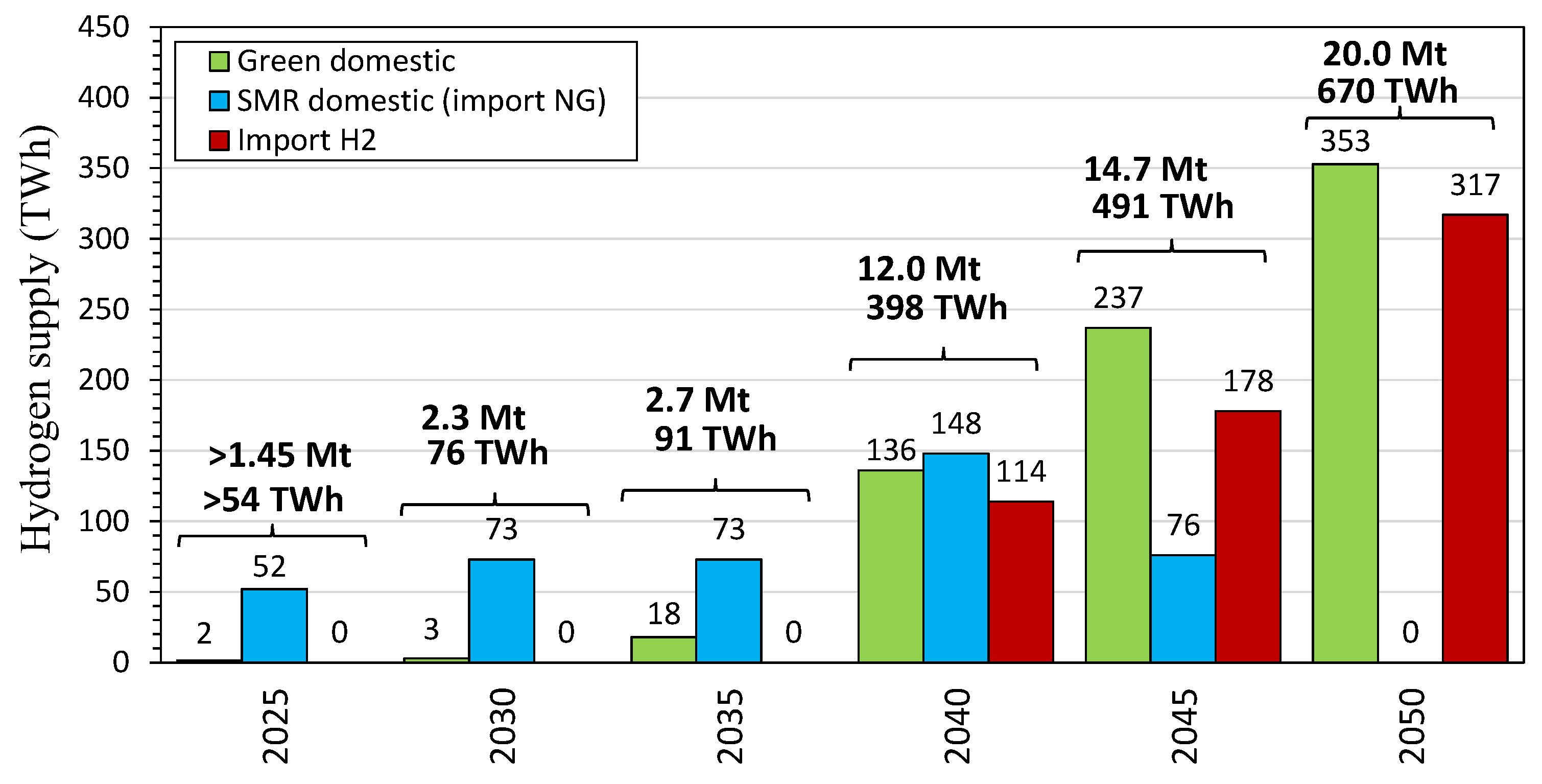
This review presents a critical analysis of Japan’s hydrogen strategy, focusing on the broader context of its decarbonization efforts. Japan aims to achieve carbon neutrality by 2050, with intermediate targets including 3 million tons of hydrogen use by 2030 and 20 million tons by 2050. Unlike countries with abundant domestic renewables, Japan’s approach emphasizes hydrogen imports and advanced storage technologies, driven by limited local renewable capacity. This review not only synthesizes policy and project-level developments but also critically evaluates Japan’s hydrogen roadmap by examining its alignment with global trends, technology maturity, and infrastructure scalability. The review integrates recent policy updates, infrastructure developments, and pilot project results, providing insights into value chain modeling, cost reduction strategies, and demand forecasting. Three policy conclusions emerge. First, Japan’s geography justifies an import-reliant pathway, but it heightens exposure to price, standards, and supply-chain risk; diversification across LH2 and ammonia with robust certification and offtake mechanisms is essential. Second, near-term deployment is most credible in industrial feedstocks (steel, ammonia, methanol) and the maritime sector, while refueling rollout lags materially behind plan and should be recalibrated. Third, cost competitiveness hinges less on electrolyzer CAPEX than on electricity price, liquefaction, transport; policy should prioritize bankable offtake, grid-connected renewables and transmission, and targeted CAPEX support for import terminals, bunkering, and cracking. Japan’s experience offers a pathway in the global hydrogen transition, particularly for countries facing similar geographic and energy limitations. By analyzing both the progress and the limitations of Japan’s hydrogen roadmap, this study contributes to understanding diverse national strategies in the rapidly changing state of implementation of clean energy.
Keywords: hydrogen value chain; liquid hydrogen; ammonia; hydrogen strategy; renewable electricity hydrogen value chain; liquid hydrogen; ammonia; hydrogen strategy; renewable electricity