Article

Effects of Time of Day, Inflorescence Height, and Light–Shade Conditions on Plant–Pollinator Interactions in Lychee (Litchi chinensis Sonn.) in West Bengal, India


1
Department of Botany, Rampurhat College, Rampurhat 731224, India
2
Department of Botany & Forestry, Vidyasagar University, Midnapore 721102, India
*
Author to whom correspondence should be addressed.
Ecologies 2026, 7(3), 63; https://doi.org/10.3390/ecologies7030063
Submission received: 20 May 2026 / Revised: 19 June 2026 / Accepted: 28 June 2026 / Published: 2 July 2026

Abstract

Lychee, an entomophilous fruit crop cultivated in tropical and subtropical regions, depends heavily on pollination services for optimal fruit yield and the economic sustainability of farmers. However, information on its pollinator interactions remains limited. This study was conducted over three flowering seasons to document the pollinator assemblage of lychee and examine variation in their activity under different physical conditions, including time of day, panicle height, and light–shade environments. Several insects (here, 47, including many butterflies, bees and flies) were recorded as flower visitors of lychee. The most effective pollinators were Apis cerana, Apis dorsata, Apis florea, Braunsapis mixta, and Tetragonula pagdeni. Pollinator abundance, species richness, diversity, and foraging traits (e.g., flower visitation rate and flower handling time) varied with daytime, inflorescence height, and light availability (light versus shade). Greater abundance, richness, and diversity were documented between 8:00 and 12:00 h, at mid-canopy height (2–6 m), and on well-lit inflorescences. Flower visitation rate was higher under these conditions, whereas flower handling time was lower. This study uncovered the key pollinators of lychee and demonstrated that plant–pollinator interactions vary across different physical conditions. These findings may help to improve pollinator management and enhance pollination services in lychee cultivation.

1. Introduction

Crops and their flower visitors are closely associated: flower visitors collect floral rewards (nectar and pollen grains), and most provide pollination services. However, some visitors do not function as pollinators and instead exhibit thieving or nectar-robbing behaviour [1,2]. Pollinator species composition varies among plant species and across temporal and spatial scales [3,4,5]. A sound understanding of plant–pollinator interactions is therefore essential for the effective management and optimisation of ecosystem services in crop systems.
Plant–pollinator interactions display marked variation across temporal scales, elevational gradients, and light-intensity regimes [6,7,8]. Temporally, the composition and strength of interactions shift throughout the day in response to flowering phenology, pollinator life cycles, and climatic factors such as light intensity, temperature and relative humidity [9,10]. For example, many solitary and social bees exhibit peak foraging activity during warm daylight hours, whereas moths and certain beetles dominate pollination at night or under low-light conditions in the early morning and late afternoon [11,12]. Such temporal partitioning of resources can reduce interspecific competition. Along fine-scale elevational gradients (e.g., inflorescence height above ground), visitor interactions may be influenced by foraging preferences and anthropogenic disturbance [13,14]. Light intensity further regulates plant–pollinator dynamics by affecting floral visibility, nectar secretion rates, and pollinator activity patterns. Bright light enhances visual signals for diurnal pollinators such as bees and butterflies, whereas low-light environments favour species adapted to crepuscular or nocturnal foraging [11,15,16]. Collectively, these environmental gradients structure pollination networks by shaping resource availability, pollinator behaviour, and interaction strength, ultimately influencing plant reproductive success and ecosystem stability.
Lychee (Litchi chinensis Sonn.) is an economically important horticultural fruit crop originating in southern China and northern Vietnam [17,18]. It is now cultivated widely across tropical and subtropical countries, including China, India, Mexico, Taiwan, Thailand and Vietnam [19,20]. In India, the major lychee-producing states are Assam, Bihar, Jharkhand, and West Bengal [21]. Lychee is predominantly insect-pollinated, and both fruit yield (in terms of quality and quantity) and the associated farm economy depend largely on adequate pollination services [22]. Although there are many studies (e.g., Pandey and Yadava [23]; Abrol [24]; Srivastava et al. [25]; Kumari et al. [26,27]) on flower visitors of lychee, information on lychee pollinators from West Bengal remains limited (e.g., Das et al. [28]; Nath et al. [29]). Furthermore, the influence of time of day, floral height, and light–shade conditions on plant–pollinator interactions is still poorly understood.
This study examined pollinator interactions in lychee with reference to time of day, inflorescence height, and light–shade conditions in West Bengal, India. We hypothesised that pollinator interactions would vary with time of day, inflorescence height, and light–shade patterns. Accordingly, we addressed the following questions: (i) Which insects visit lychee flowers in West Bengal? (ii) Which species function as effective pollinators? (iii) Do pollinator interactions vary with these physical factors, and if so, in what manner?

2. Materials and Methods

2.1. Study Site and Plant Species

The work was conducted in several districts of West Bengal, India (e.g., Bankura, Birbhum, and Hooghly) over three consecutive years (2023 to 2025) during the blooming period of the chosen plant species (February to March). This time (i.e., spring) brings a rapid transition from cool to hot weather, with temperatures ranging from 20 °C to 30 °C and low humidity (RH ~40%). Rainfall is limited, occurring mostly as light thundershowers in late March and April. We collected data about focal plant species from three mixed-type orchards (i.e., with different fruit plant species).
The study was conducted on a horticultural plant, lychee (Litchi chinensis Sonn.). It is a tropical, evergreen tree, growing up to 15 m high with dense foliage. The plant produces many small flowers in an inflorescence (i.e., panicle) from February to March.

2.2. Floral Visitors

The survey was conducted during the lychee flowering season (February–March) over three consecutive years (2023, 2024, and 2025) during the daytime. We collected visitors’ information, considering temporal segregation [daytime divided into six 2 h time slots (6:00–18:00 h)], inflorescence height segregation (<2 m, 2–4 m, >4–6 m, and >6 m) and light–shade segregation. During peak activity of flower visitors (i.e., 8:00–12:00 h), we considered well-lit inflorescences those illuminated with direct sunlight (light intensity: 11,134.70 ± 150.27 lux) and shaded inflorescences those that did not receive direct sunlight and got very little indirect light (light intensity: 1206.51 ± 215.92 lux). We conducted inflorescence-based sampling. Healthy, pest-free inflorescences were randomly selected for observation during each time slot; observers remained stationary to minimise interference, and observations were suspended when it appeared windy to enhance reproducibility. We observed floral visitors by approaching the inflorescences closely (within 1–2 m) without altering their natural foraging behaviour. However, observations at a closer range (0.50–1 m from a focal inflorescence) were conducted to record parameters related to pollination efficacy. Visitors were identified either through direct field observations or by capturing specimens for subsequent identification. The collected specimens were sent to entomologists (ZSI, Kolkata, India) for accurate identification.
We estimated visitor abundance as the number of individuals per inflorescence (i.e., panicle) over a 5 min period [40 observations per time slot considering all orchards (40 × 6 = 240) and 60 observations per height group (60 × 4 = 240); 50 observations for well-lit inflorescences and 50 for shaded inflorescences and these 100 observations came from peak activity time (8:00–12:00 h)]. Based on the total number of visitors (derived from 240 observations; excluding light–shade observations), we estimated the relative abundance (RA) for each species as follows (Layek et al. [30]):
R A ( % ) = n i N × 100
Here, ni is the number of individuals counted for an insect species i, and N is the sum of the number of individuals recorded for all species.
We estimated visitors’ richness (using the index (D) of Margalef [31]) and diversity (using the diversity index (H′) of Shannon–Weaver [32]) for the three sampling modes [viz. (i) among time intervals, (ii) among inflorescence height classes, and (iii) light–shade-wise] as follows:
D = S 1 ln N
H = i n ( p i . ln p i )
S is the number of visitor species, ln is the natural logarithm, N is the number of individuals assigned for the sample (i.e., observed for all species), and pi denotes the proportion of each species in the sample [pi = ni/N, where ni is the number of individuals observed for species i, and N is the total number of individuals recorded in the sample]. The D and H′ values were calculated for each sample corresponding to a single survey, representing a 5 min observation on an inflorescence. Higher values of D and H′ indicate a higher richness and diversity, respectively.
We assessed the types of floral resources (nectar, pollen grains, and floral tissues) that visitors collected. The flower visitation rate (VR) [also called foraging rate] was calculated as the number of flowers visited in a 1 min duration. For visitors exhibiting low visitation rates (e.g., beetles and bugs), the number of flowers visited over a 10 min interval was recorded and subsequently standardised to a per-minute rate. Flower handling time, defined as the duration a visitor spent with a flower (on a single visit), was also measured. For abundant flower-visiting species, we recorded these parameters under three sampling regimes: temporal segregation (n = 20 observations per time slot per species), inflorescence height segregation (n = 30 observations per height class per species), and light–shade segregation (n = 30 observations per species for each condition). For other visitors, we conducted 10–30 observations to estimate the visitation rate and 10–20 observations to estimate flower handling time, without accounting for these segregation factors.
We estimated the flower visit proportion (FV) for the visitor species by dividing the number of flowers visited by that species by the total number of flower visits recorded across all species (N = 1000 visits observed) (following Layek et al. [33]). We also documented the visitation patterns of the visitors on lychee, distinguishing between legitimate and illegitimate visits. We inspected pollen-adherence sites on legitimate visitors using both a stereo microscope (model: Stemi 508, Zeiss; Oberkochen, Germany) and a scanning electron microscope (model: GeminiSEM 450, Gemini 2 column; Oberkochen, Germany). Regarding the SEM study of the insect’s body, the methodology is detailed in Table S1.
For legitimate floral visitors, we recorded different pollination modes (as classified by Layek et al. [34]): (1) nototribic [here, pollen transfer to the stigma takes place via the dorsal surface of the visitor]; (2) sternotribic [pollen transfer take place via the ventral surface]; (3) noto-sternotribic [here, pollen transfer involving both dorsal and ventral surfaces]; and (iv) appendage-mediated [pollen transfer facilitated by finer body parts such as the antennae, proboscis, and legs].
We estimated the anther contact rate (AR) as na/N [na is the number of visits involving anther contact and N is the total number of visits], and the stigma contact rate (SR) as ns/N [ns is the number of visits involving stigma contact]. For abundant flower-visiting species, we recorded these parameters in three sampling modes: temporal segregation (n = 12 samples per time slot for a species), inflorescence height segregation (n = 18 samples per height class for a species) and light–shade segregation (n = 20 samples for a species for each category). For other visitors, we conducted 5–15 sampling observations to estimate anther-stigma contact rates, ignoring these segregation issues. Here, one sample consists of 20 visits of a flower-visiting species.
To identify the effective pollinators of the plant species, we calculated a composite (descriptive) metric, the pollination service index (PSi), by integrating the numerical values of several parameters that determine pollination efficacy for a given plant species; each parameter had a value ranging from 0 to 1 (following Layek et al. [34]).
P S i = F V × F S i × A R × S R
Here, FV is the flower visit proportion, FSi denotes the flower sex-type selection index (here, FSi is set to 1 for all visitor species as the flowers of lychee are hermaphrodite), and AR and SR are the anther contact rate and stigma contact rate, respectively. Therefore, here PSi depends on the proportion of flower visits (which, in turn, depends on abundance and visitation rate) and the legitimacy of the visitors. The values of PSi range from 0 to 1, with greater values indicating more effective pollinators.
For directly assessing the pollination efficiency of some abundant visitors (especially pollinators), we estimated fruit set from three treatments: (1) open pollination, (2) pollinator exclusion, and (3) single-visit pollination. For pollinator exclusion and single-visit pollination, inflorescences were bagged with a nylon net (transparent to light, white colour). Matured buds (prior to opening) in the early morning were marked for open pollination (N = 100 flower buds) and pollinator exclusion (N = 100 flower buds). For a single-visit pollination experiment, we uncovered the inflorescence at the peak foraging time of visitors and monitored the virgin flowers until one of the focal visitors made its first visit. Once visited, we marked the flowers, added tags to the inflorescences, and immediately re-bagged them with netting (n = 15–30 flowers received a single visit from an insect species). We estimate fruit set percentages for these three treatments. Then, we calculated the single-visit pollination efficiency index (PEi) for the visitor species using the method of Spears [35] as follows:
P E i = P i Z U Z
where Pi is the fruit set per flower resulting from a single visit of species i; Z is the fruit set per flower in the pollinator exclusion treatment; and U is the fruit set per flower in open pollination.

2.3. Statistical Analysis

We checked the data in each group, considering assumptions for parametric tests, such as normality (via Q-Q plots and the Shapiro–Wilk test), homogeneity of variance (via Levene’s test) and homoscedasticity (via scatter plots). After that, we performed parametric tests: a one-way ANOVA (to compare the means of flower visitation rate by daytime and by inflorescence height) and an independent-samples t-test (to compare the mean abundance and diversity of visitors between well-lit inflorescences and shaded inflorescences). We conducted non-parametric tests—(1) Kruskal–Wallis H test for some parameters (e.g., among time intervals and among inflorescence height classes: abundance, richness, and diversity of visitors; flower handling time; anther contact and stigma contact rates) and (2) Mann–Whitney test for other some parameters (e.g., well-lit vs. shaded inflorescence: richness of visitors; flower visitation rate; flower handling time; anther contact and stigma contact rate). In the case of comparing means for more than two groups, when the obtained p-value was significant (i.e., p < 0.05), post hoc tests were conducted (viz. DMRT for parametric ANOVA and Dunn’s test for non-parametric Kruskal–Wallis test). We performed the statistical analyses using SPSS (version 26, IBM SPSS Statistics, Chicago, IL, USA) and R programming software (version R 4.5.0; Vienna, Austria).

3. Results

3.1. Flower Visitors

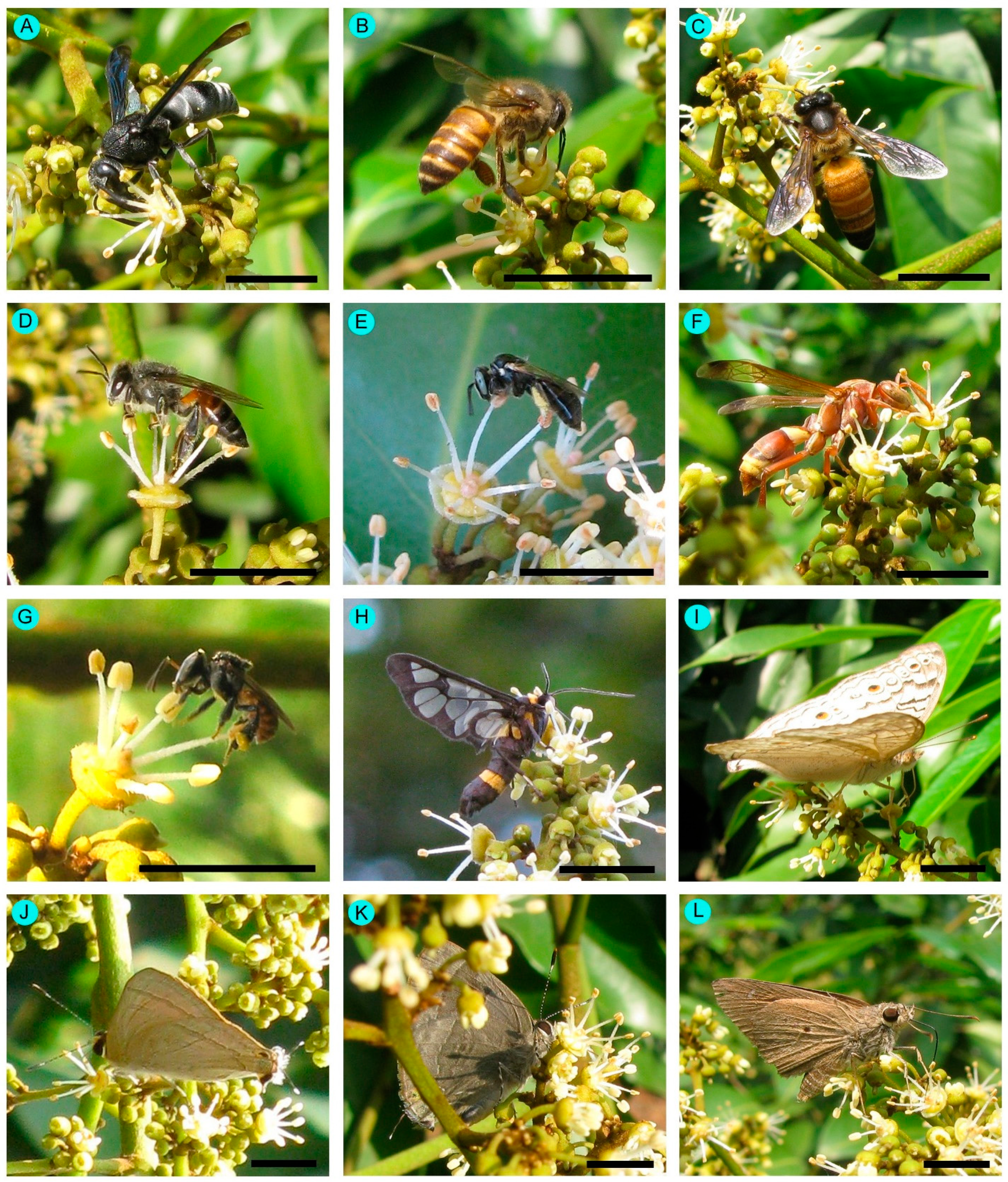
Several groups of insects (viz., ants, bees, beetles, bugs, butterflies, flies, moths, and wasps) visited lychee flowers. A total of 47 insect species were recorded as flower visitors of lychee in West Bengal, India (Table 1; Figure 1 and Figure 2). The dominant insect orders were Diptera (12 species), Hymenoptera (18 species), and Lepidoptera (14 species). The most abundant species included Apis cerana (relative abundance, RA = 10.90%), Apis dorsata (RA = 6.89%), Apis florea (RA = 10.04%), Braunsapis mixta (RA = 6.67%), Eristalinus megacephalus (RA = 5.67%), Graptomyza brevirostris (RA = 8.03%), and Tetragonula pagdeni (RA = 9.76%). The abundance of flower visitors (number of visitors per inflorescence per 5 min), species richness (value of D, Margalef’s index), and diversity (value of H′, Shannon–Weaver index) were 5.81 ± 3.35 (ranged: 0–14), 0.93 ± 0.49 (ranged: 0–2.01), and 0.80 ± 0.42 (0–1.63), respectively.
The flower visitation rate was higher among bees, handmaiden moths, and wasps; slightly lower in butterflies and flies; and very low in ants, beetles and bugs (Table 1). Flower handling time was longer in beetles, bugs, certain butterflies and stingless bees. The bees collected both floral resources (i.e., nectar and pollen); bugs, butterflies, and wasps collected nectar; and coleopteran beetles fed on floral tissues.
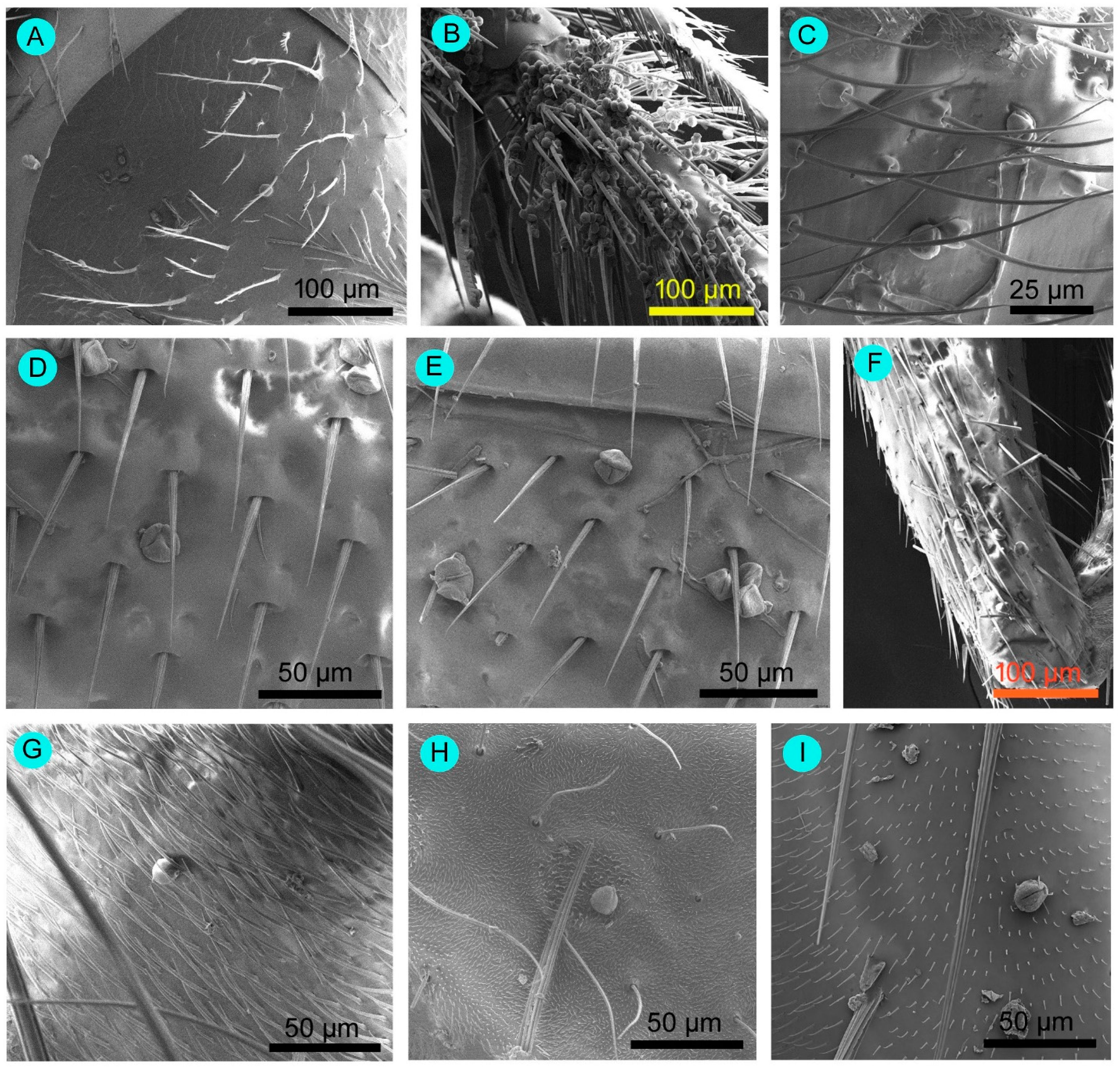
The proportion of flower visits was greatest for Apis cerana, Apis dorsata, Apis florea, Braunsapis mixta, Eristalinus megacephalus, Graptomyza brevirostris, and Tetragonula pagdeni (Table 2). Most visitors acted as legitimate foragers. Pollen adhesion occurred primarily on the head, the ventral surface of the abdomen and thorax, and the legs—body parts that came into contact with the stigma during foraging (Table 2, Figure 3). The principal pollination modes were sternotribic and appendage-mediated. Anther contact and stigma contact rates were highest for Apis cerana, Apis dorsata, Apis florea, Braunsapis mixta, and Tetragonula pagdeni. The values of the pollination service index (PSi) were higher for Apis cerana (PSi = 0.112), Apis dorsata (PSi = 0.075), Apis florea (PSi = 0.105), Braunsapis mixta (PSi = 0.067), and Tetragonula pagdeni (PSi = 0.063). These species were designated as the most effective pollinators of lychee in West Bengal. Single-visit pollination efficiency index (PEi) remained comparatively higher in honeybees (e.g., Apis dorsata: PEi = 0.70) and slightly lower for flies, like Eristalinus megacephalus (PEi = 0.59), Graptomyza brevirostris (PEi = 0.57) (Table 2).

3.2. Temporal Variation in Plant–Pollinator Interactions

Visitors’ abundance, richness and diversity varied significantly across different daytimes (Kruskal–Wallis H test—abundance: H = 142.57, df = 5, p < 0.001; richness: H = 51.68, df = 5, p < 0.001; diversity: H = 51.68, df = 5, p < 0.001). These parameters were highest between 8:00 and 12:00 h and comparatively lower in the early morning (6:00–8:00 h) and late afternoon (16:00–18:00 h) (see Table S2). Flower visitation rate varied among time intervals (e.g., Apis cerana: F5,114 = 22.33, p < 0.001), peaked between 8:00 and 12:00 h, and declined in the early morning and late afternoon (Table S3). Flower handling time also varied across time slots (e.g., Apis cerana: Kruskal–Wallis H = 19.75, df = 5, p < 0.01) and was comparatively higher in the early morning (6:00–8:00 h) and lower during 10:00–14:00 h (Table S4). However, anther and stigma contact rates did not differ significantly among time intervals (e.g., Kruskal–Wallis H test: Apis cerana: anther contact rate: H = 1.54, df = 5, p = 0.91; stigma contact rate: H = 0.26, df = 5, p = 1.00) (Table S5).

3.3. Inflorescence Height on Pollinator Interactions

Visitors’ abundance, richness and diversity varied significantly among inflorescence height classes (Kruskal–Wallis H test—abundance: H = 33.34, df = 3, p < 0.001; richness: H = 23.32, df = 3, p < 0.001; diversity: H = 37.90, df = 3, p < 0.001). These parameters were highest in the middle canopy zone (2–6 m above ground level) and lower both near the ground (<2 m) and at the uppermost canopy level (>6 m) (Table 3). However, a few insects, particularly certain flies and Braunsapis mixta, were more abundant in the lower and mid-elevation zones (up to 6 m). Flower visitation rate also varied with height classes (e.g., Apis cerana: F3,116 = 14.95, p < 0.001), peaking between 2 and 6 m and declining near the ground and in the uppermost canopy (Table S6). Flower handling time of visitors also varied among inflorescence height classes (e.g., Apis cerana: Kruskal–Wallis H = 7.14, df = 3, p < 0.05); it remained shorter near the ground and longer in the upper canopy (Table S7). In contrast, anther and stigma contact rates did not vary significantly among inflorescence height classes (e.g., Apis cerana: Kruskal–Wallis H test: anther contact rate: H = 0.61, df = 3, p = 0.90; stigma contact rate: H = 0.08, df = 3, p = 0.99) (Table S8).

3.4. Light and Shade on Pollinator Interactions

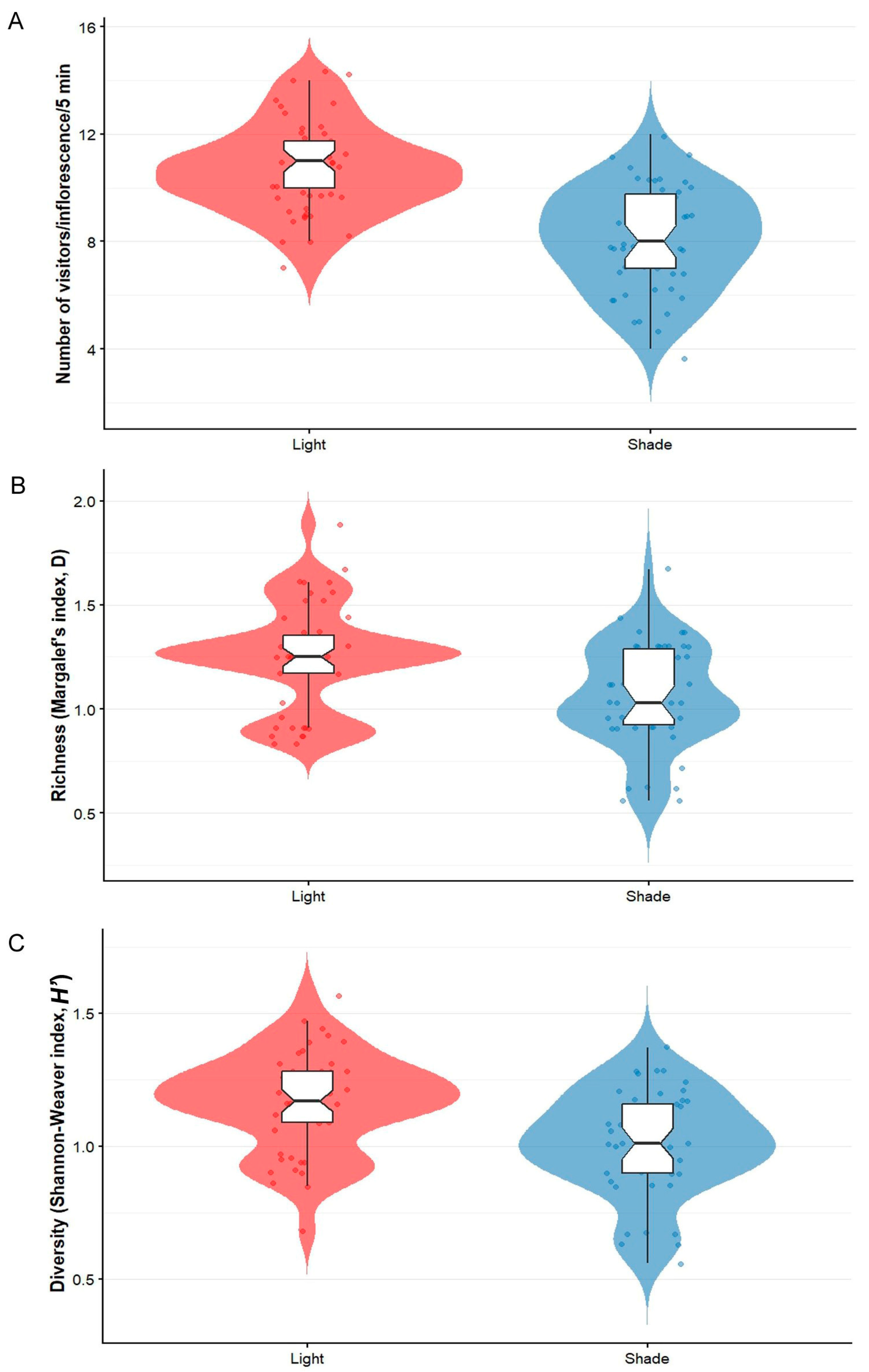
With respect to light intensity (high: exposed well-lit inflorescences; low: shaded inflorescences), visitors’ abundance, richness and diversity differed significantly (abundance: t test, t = 7.34, df = 98, p < 0.001; richness: Mann–Whitney U = 806.50, p < 0.01; diversity: t test, t = 4.29, df = 98, p < 0.001). These parameters were higher in well-illuminated inflorescences than in those under shaded conditions (Figure 4). Flower visitation rate also varied with light intensity (e.g., Apis cerana: Mann–Whitney U = 225.00, p < 0.01, N = 60), being greater on well-lit inflorescences than on shaded ones (Table S9). In contrast, flower handling time showed the opposite trend, being longer on shaded inflorescences (Table S10). However, anther and stigma contact rates did not differ significantly between well-lit inflorescences and shaded inflorescences (e.g., Apis cerana: anther contact rate: Mann–Whitney U = 188.50, p = 0.69, N = 40; stigma contact rate: Mann–Whitney U = 195.00, p = 0.89, N = 40) (Table S11).

4. Discussion

A large number of insect species (i.e., 47) of many groups (e.g., bees, butterflies, flies and wasps) visited lychee flowers. The generalised visitor systems (~pollinator systems) of lychee have been reported across different geographical regions [23,24,25,26,28]. Although the number of visitor species varies across studies, some research (e.g., Kumari et al. [27]; Das et al. [28]; Nath et al. [29]) reports fewer insect species, whereas others (e.g., Kumari et al. [26]) report a much higher number of visitor species for the plant species. Among our identified visitor species, mostly already recognised as flower visitors of lychee in previous works (e.g., Pandey and Yadava [23]; Abrol [24]; Srivastava et al. [25]; Kumari et al. [26]; Das et al. [28]). Only a few (e.g., Dideopsis aegrota, Graptomyzas brevirostris, Odontomia lutatius, Lethe europa and Tetragonula pagdeni) are probably newly reported as flower visitors of lychee from West Bengal. The most abundant visitors were Apis cerana, Apis florea, Braunsapis mixta, Eristalinus megacephalus, Graptomyza brevirostris, and Tetragonula pagdeni. The dominance of honeybees in the visitor fauna of lychee is reported by many researchers (e.g., Srivastava et al. [25]; Kumari et al. [27]; Das et al. [28]). The list of dominant visitor species varies across studies. Some researchers (e.g., Das et al. [28]) recorded rock honeybees (Apis dorsata) as abundant visitors, and others (e.g., Srivastava et al. [25]; Kumari et al. [27]) reported western honeybees (Apis mellifera) as abundant flower visitors of lychee. We did not find the western honeybee in our present study, as the study area relied primarily on wild native bee populations without managed hives, and the occurrence of western honeybees in other studies may be due to beekeeping practices that place this species in close proximity to the study sites. The abundance of flower visitors varies across geographical regions [3,5,36] and depends on the availability of food resources, nesting sites and co-blooming plants [37,38,39].
Several insect species legitimately visited lychee flowers and provided pollination services. Though beetles consumed floral tissues (via illegitimate visits), their destructive behaviour may offset their pollination contributions or even cause negative effects. Based on the pollination service index (PSi), effective pollinators were Apis cerana, Apis dorsata, Apis florea, Braunsapis mixta, and Tetragonula pagdeni. We assessed direct pollination efficiency (i.e., single-visit pollination efficiency) only for abundant visitor species and were unable to assess less abundant insect species. The values of the single-visit pollination efficiency index (PEi) were higher for honeybees. The recognition of honeybees as vital pollinators of lychee has been done by several researchers (e.g., Pandey and Yadava [23]; Abrol [24]; Srivastava et al. [25]; Das et al. [28]). In addition, some researchers (e.g., Pandey and Yadava [23]; Kumari et al. [26]) also endorsed stingless bees as pollinators of lychee. However, the importance of Braunsapis mixta (a subsocial bee species) and Tetragonula pagdeni (a stingless bee species) as pollinators of lychee was first established by us from West Bengal.
Pollinator interactions varied with temporal segregation, inflorescence height classes, and light–shade conditions. Visitor abundance, richness, and diversity were highest between 8:00 and 12:00 h, at heights of 2–6 m above ground level, and in well-lit inflorescences. Temporal variation in flower visitor traits is well documented in many plant species [3,5,36] and likely arises from fluctuations in visitor activity, resource availability, and atmospheric conditions. During the late morning (8:00–12:00 h), greater flower visibility than in the early morning and late afternoon, greater nectar and pollen availability, and optimal foraging conditions (e.g., temperature and relative humidity) may lead to higher values of these visitors’ parameters. In the early afternoon, comparatively higher temperatures and relative humidity may trigger pollinator avoidance behaviour. In the early morning and late afternoon, lower flower visibility (due to low light intensity) may reduce the foraging activity of most insect visitors. In addition, lower resource availability during the very early morning and late afternoon may lead to lower visitor abundance, richness, and diversity. Variation in visitor interactions along large-scale elevational gradients has also been widely reported (e.g., Cuartas-Hernández & Medel [40]; Adedoja et al. [7]). However, the influence of small-scale height gradients within a plant canopy is less well understood, and this study may be among the first to address this aspect in West Bengal. At mid-canopy height, higher values of these visitor traits may be due to greater resource availability, lower disturbance, and a lower risk of being preyed upon. Mid-canopy height may exhibit more inflorescences, longer inflorescence length, and higher floret abundance than other layers. At lower heights (near ground level), increased disturbance and reduced security are presumed to adversely affect visitor traits, including abundance, richness, and diversity. Conversely, at greater heights, the increased energetic cost of flight for foragers may negatively influence these traits. The effect of light intensity on visitor interactions has been recognised by several researchers (e.g., Liporoni et al. [11]; Watson et al. [41]). Low light intensity (i.e., shaded flowers) often results in reduced visitor abundance, species richness, and diversity due to a combination of ecological and behavioural factors, including decreased insect activity, reduced visual detectability of flowers, and altered floral scent emissions.
The flower visitation rate and flower handling time of visitors also varied with temporal patterns, inflorescence height classes, and light–shade conditions. However, the rates of anther and stigma contact did not differ across these regimes. Flower visitation rate was higher between 8:00 and 12:00 h, at heights of 2–6 m above ground level, and in well-lit inflorescences. In these conditions, flower handling time was comparatively lower. During this time period (8:00–12:00 h), most bee species exhibit increased foraging activity (Bordier et al. [42]; Layek et al. [34]), which may contribute to higher visitation rates. Near ground level, greater disturbance and reduced security may lower visitation rates and flower-handling time. Under low light intensity (shaded inflorescences), visitors rely more on olfactory cues than visual signals; consequently, they may take longer to locate flowers, resulting in reduced visitation rates and increased handling time.

5. Conclusions

The present study demonstrates that lychee flowers in West Bengal support a diverse assemblage of insect visitors (including bees, beetles, bugs, butterflies, moths, and wasps), among which Apis cerana, Apis dorsata, Apis florea, Braunsapis mixta, Eristalinus megacephalus, Graptomyza brevirostris and Tetragonula pagdeni were abundant. Most visitors acted as legitimate foragers (except beetles) and facilitated sternotribic and appendage-mediated pollination. Considering the values of the pollination service index (PSi), the most effective pollinators were Apis cerana, Apis dorsata, Apis florea, Braunsapis mixta, and Tetragonula pagdeni. Plant–pollinator interactions showed marked variation with daytime intervals, inflorescence height classes, and light intensity. Visitor abundance, richness, and diversity were greater during mid-morning hours (8:00–12:00 h), at mid-canopy height (2–6 m), and on well-lit inflorescences. Flower visitation rate was highest under these conditions, whereas flower handling time was lower. The anther contact and stigma contact rates of visitors remained largely unaffected across time intervals, height classes, and light gradients. These findings provide an ecological basis for potential orchard management strategies, including the conservation of native pollinators and the optimisation of canopy structure and light exposure to enhance pollination efficiency and lychee yield, although these implications require further orchard-level validation.

Supplementary Materials

The following supporting information can be downloaded at: https://www.mdpi.com/article/10.3390/ecologies7030063/s1, Table S1. The methodologies for the scanning electron microscopic (SEM) study of the visitors’ body surface; Table S2. Daytime-wise abundance (number of visitors/inflorescence/5 min), richness (index of Margalef, D) and diversity (Shannon–Weaver diversity index, H′) of flower visitors of Litchi chinensis in West Bengal, India; Table S3. Daytime-wise flower visitation rate (number of flowers visited per minute) of different visitors on Litchi chinensis in West Bengal, India; Table S4. Daytime-wise flower handling time (time spent per flower per visit) of different visitors on Litchi chinensis in West Bengal, India; Table S5. Daytime-wise anther contact rate (AR) and stigma contact rate (SR) of different visitors on Litchi chinensis in West Bengal, India; Table S6. Inflorescence height-wise flower visitation rate (number of flowers visited per minute) of different visitors on Litchi chinensis in West Bengal, India; Table S7. Inflorescence height-wise flower handling time (time spent per visit per flower) of different visitors on Litchi chinensis in West Bengal, India; Table S8. Inflorescence height-wise anther contact rate (AR) and stigma contact rate (SR) of different visitors on Litchi chinensis in West Bengal, India; Table S9. Flower visitation rate (number of flowers visited per minute) of different visitors in well-lit inflorescences and shaded inflorescences on Litchi chinensis in West Bengal, India; Table S10. Flower handling time (time spent per visit per flower, in seconds) of different visitors in well-lit inflorescences and shaded inflorescences on Litchi chinensis in West Bengal, India; Table S11. Anther contact rate (AR) and stigma contact rate (SR) of different visitors in well-lit inflorescences and shaded inflorescences on Litchi chinensis in West Bengal, India.

Author Contributions

Conceptualisation: P.K. and U.L.; methodology: A.D., A.K. and U.L.; formal analysis: A.K. and U.L.; investigation: A.D., A.K. and U.L.; data curation: A.K. and U.L.; writing—original draft: U.L.; writing—review and editing: A.D., A.K. and P.K.; visualisation: U.L.; supervision: P.K. All authors have read and agreed to the published version of the manuscript.

Funding

There is no funding for this research.

Institutional Review Board Statement

Not applicable.

Informed Consent Statement

Not applicable.

Data Availability Statement

Data were available within the article and Supplementary Materials.

Acknowledgments

We thank the authorities of Rampurhat College (Birbhum, West Bengal), Vidyasagar University (Paschim Medinipur, West Bengal), and Visva Bharati (Birbhum, West Bengal) for providing the necessary laboratory facilities. We are also thankful to orchardists who allow us to conduct the study.

Conflicts of Interest

The authors declare that they have no conflicts of interest to disclose.

References

  1. Layek, U.; Bhandari, T.; Das, A.; Karmakar, P. Floral visitors of sesame (Sesamum indicum L.): Elucidating their nectar-robbing behaviour and impacts on the plant reproduction. PLoS ONE 2024, 19, e0300398. [Google Scholar] [CrossRef]
  2. Merle, I.; Rosado, J.T.P.; Andrade, N.J.P.; Argout, X.; Requier, F. Not all flowers’ visitors are pollinators: Combining indicators to identify their role in the cocoa pollination service. Agric. Ecosyst. Environ. 2025, 390, 109716. [Google Scholar] [CrossRef]
  3. Price, M.V.; Waser, N.M.; Irwin, R.E.; Campbell, D.R.; Brody, A.K. Temporal and spatial variation in pollination of a montane herb: A seven-year study. Ecology 2005, 86, 2106–2116. [Google Scholar] [CrossRef]
  4. Dupont, Y.L.; Padrón, B.; Olesen, J.M.; Petanidou, T. Spatio-temporal variation in the structure of pollination networks. Oikos 2009, 118, 1261–1269. [Google Scholar]
  5. Layek, U.; Das, A.D.; Das, U.; Karmakar, P. Spatial and temporal variations in richness, diversity and abundance of floral visitors of curry plants (Bergera koenigii L.): Insights on plant-pollinator interactions. Insects 2024, 15, 83. [Google Scholar] [CrossRef] [PubMed]
  6. Kilkenny, F.F.; Galloway, L.F. Reproductive success in varying light environments: Direct and indirect effects of light on plants and pollinators. Oecologia 2008, 155, 247–255. [Google Scholar] [PubMed]
  7. Adedoja, O.A.; Kehinde, T.; Samways, M.J. Insect-flower interaction networks vary among endemic pollinator taxa over an elevation gradient. PLoS ONE 2018, 13, e0207453. [Google Scholar] [CrossRef] [PubMed]
  8. Hervías-Parejo, S.; Colom, P.; Beltran Mas, R.; Serra, P.E.; Pons, S.; Mesquida, V.; Traveset, A. Spatio-temporal variation in plant–pollinator interactions: A multilayer network approach. Oikos 2023, 2023, e09818. [Google Scholar]
  9. Elzinga, J.A.; Atlan, A.; Biere, A.; Gigord, L.; Weis, A.E.; Bernasconi, G. Time after time: Flowering phenology and biotic interactions. Trends Ecol. Evol. 2007, 22, 432–439. [Google Scholar] [CrossRef] [PubMed]
  10. Forrest, J.R. Plant–pollinator interactions and phenological change: What can we learn about climate impacts from experiments and observations? Oikos 2015, 124, 4–13. [Google Scholar]
  11. Liporoni, R.; Cordeiro, G.D.; Prado, P.I.; Schlindwein, C.; Warrant, E.J.; Alves-dos-Santos, I. Light intensity regulates flower visitation in Neotropical nocturnal bees. Sci. Rep. 2020, 10, 15333. [Google Scholar] [CrossRef] [PubMed]
  12. Barták, M.; Tropek, R. When the day ends: Review on the importance of nocturnal moths as pollinators in tropical ecosystems. J. Trop. Ecol. 2025, 41, e5. [Google Scholar] [CrossRef]
  13. Carman, K.; Jenkins, D.G. Comparing diversity to flower-bee interaction networks reveals unsuccessful foraging of native bees in disturbed habitats. Biol. Conserv. 2016, 202, 110–118. [Google Scholar] [CrossRef]
  14. Boieiro, M.; Ferreira, M.; Ceia-Hasse, A.; Esposito, F.; Santos, R.; Pozsgai, G.; Borges, P.A.V.; Rego, C. The effects of disturbance on plant–pollinator interactions in the native forests of an oceanic island (Terceira, Azores). Insects 2024, 16, 14. [Google Scholar] [CrossRef] [PubMed]
  15. Kelber, A.; Warrant, E.J.; Pfaff, M.; Wallén, R.; Theobald, J.C.; Wcislo, W.T.; Raguso, R.A. Light intensity limits foraging activity in nocturnal and crepuscular bees. Behav. Ecol. 2006, 17, 63–72. [Google Scholar]
  16. Borges, R.M.; Somanathan, H.; Kelber, A. Patterns and processes in nocturnal and crepuscular pollination services. Q. Rev. Biol. 2016, 91, 389–418. [Google Scholar] [CrossRef] [PubMed]
  17. Wu, S.X. The Flora of China Fruit Tree: The Volume of Litchi; China Forestry Press: Beijing, China, 1998; pp. 94–198. [Google Scholar]
  18. Hai, V.M.; Dung, N.V. Lychee production in Vietnam. In Lychee Production in the Asia-Pacific Region; Papademetriou, M.K., Dent, F.J., Eds.; Food and Agriculture Organization of the United Nations: Bangkok, Thailand, 2002; pp. 114–119. [Google Scholar]
  19. Menzel, C.M.; Waite, G. Litchi and Longan: Botany, Production, and Uses; CABI Publishing: Cambridge, MA, USA, 2005. [Google Scholar]
  20. National Horticulture Board. Final Area and Production Estimates for Horticulture Crops for 2011–2012; National Horticulture Board, Government of India: Gurugram, India, 2012.
  21. Saxena, M.; Gandhi, C.P. Indian Horticulture Database-2014; National Horticulture Board, Government of India: Gurugram, India, 2014; pp. 76–83.
  22. Sinhaseni, K.; Catterall, C.P. Tropical fruit production depends on wild insect communities: Bees and lychees in Thailand. J. Trop. Ecol. 2021, 37, 26–34. [Google Scholar] [CrossRef]
  23. Pandey, R.S.; Yadava, R.P.S. Pollination of litchi (Litchi chinensis) by insects with special reference to honeybees. J. Apic. Res. 1970, 9, 103–105. [Google Scholar] [CrossRef]
  24. Abrol, D.P. Diversity of pollinating insects visiting litchi flowers (Litchi chinensis Sonn.) and path analysis of environmental factors influencing foraging behaviour of four honeybee species. J. Apic. Res. 2006, 45, 180–187. [Google Scholar] [CrossRef]
  25. Srivastava, K.; Sharma, D.; Pandey, S.D.; Anal, A.K.D.; Nath, V. Dynamics of climate and pollinator species influencing litchi (Litchi chinensis) in India. Indian J. Agric. Sci. 2017, 87, 266–269. [Google Scholar] [CrossRef]
  26. Kumari, P.; Rana, S.; Bhargava, B.; Reddy, S.E. Diversity, abundance and impact of insect visitors in Litchi chinensis production. Agronomy 2023, 13, 298. [Google Scholar] [CrossRef]
  27. Kumari, P.; Choudhary, J.S.; Dey, D.; Dhakar, M.K. Diversity, abundance, and foraging behaviour of insect pollinators in litchi (Litchi chinensis Sonn.) under hot and subhumid conditions. Psyche 2024, 2024, 2606870. [Google Scholar] [CrossRef]
  28. Das, R.; Jha, S.; Halder, A. Insect pollinators of litchi with special reference to foraging behaviour of honey bees. J. Pharmacogn. Phytochem. 2019, 8, 396–401. [Google Scholar]
  29. Nath, R.; Saha, S.; Sarkar, S.K.; Chaudhuri, N.; Rameshkumar, A.; Laskar, N.; Senapati, S.K. Bees in litchi bloom: Assessing the diversity and foraging behaviour of bee visitors in a litchi ecosystem. J. Entomol. Res. Soc. 2025, 27, 289–306. [Google Scholar] [CrossRef]
  30. Layek, U.; Kundu, A.; Karmakar, P. Floral ecology, floral visitors and breeding system of Gandharaj lemon (Citrus × limon L. Osbeck). Bot. Pac. 2020, 9, 113–119. [Google Scholar]
  31. Margalef, R. Temporal succession and spatial heterogeneity in phytoplankton. In Perspectives in Marine Biology; Buzzati-Traverso, A., Ed.; University of California Press: Berkeley, CA, USA, 1958; pp. 323–347. [Google Scholar]
  32. Shannon, C.E.; Weaver, W. The Mathematical Theory of Communication; University of Illinois Press: Urbana, IL, USA, 1949; p. 117. [Google Scholar]
  33. Layek, U.; Majhi, P.; Das, A.; Karmakar, P.; Kundu, A. Seasonal variation in flower traits, visitor traits, and reproductive success of Solanum sisymbriifolium Lamarck (Solanaceae) in the Rarh region of West Bengal, India. Biology 2025, 14, 865. [Google Scholar] [CrossRef] [PubMed]
  34. Layek, U.; Bisui, S.; Karmakar, P. Interactions of flower visitors with bitter gourd (Momordica charantia L.) and effects of right target and wrong target flower visits on plant reproduction. Sci. Rep. 2025, 15, 36974. [Google Scholar] [CrossRef] [PubMed]
  35. Spears, E.E. A direct measure of pollinator effectiveness. Oecologia 1983, 57, 196–199. [Google Scholar] [CrossRef] [PubMed]
  36. Eckhart, V.M. Spatio-temporal variation in abundance and variation in foraging behavior of the pollinators of gynodioecious Phacelia linearis (Hydrophyllaceae). Oikos 1992, 65, 573–586. [Google Scholar] [CrossRef]
  37. Torné-Noguera, A.; Rodrigo, A.; Arnan, X.; Osorio, S.; Barril-Graells, H.; da Rocha-Filho, L.C.; Bosch, J. Determinants of spatial distribution in a bee community: Nesting resources, flower resources, and body size. PLoS ONE 2014, 9, e97255. [Google Scholar] [CrossRef] [PubMed]
  38. Layek, U.; Bera, K.; Bera, B.; Bisui, S.; Pattanayek, S.K.; Karmakar, P. Assessment of yield enhancement in cashew (Anacardium occidentale L.) by the pollinator sharing effect of magnetic bee-friendly plants in India. Acta Ecol. Sin. 2021, 41, 243–252. [Google Scholar] [CrossRef]
  39. Vaca-Uribe, J.L.; Figueroa, L.L.; Santamaría, M.; Poveda, K. Plant richness and blooming cover affect abundance of flower visitors and network structure in Colombian orchards. Agric. For. Entomol. 2021, 23, 545–556. [Google Scholar] [CrossRef]
  40. Cuartas-Hernández, S.; Medel, R. Topology of Plant-Flower-visitor networks in a tropical mountain forest: Insights on the role of altitudinal and temporal variation. PLoS ONE 2015, 10, e0141804. [Google Scholar] [PubMed]
  41. Watson, T.L.; Martel, C.; Arceo-Gómez, G. Plant species richness and sunlight exposure increase pollinator attraction to pollinator gardens. Ecosphere 2022, 13, e4317. [Google Scholar] [CrossRef]
  42. Bordier, C.; Dechatre, H.; Suchail, S.; Peruzzi, M.; Soubeyrand, S.; Pioz, M.; Pélissier, M.; Crauser, D.; Le Conte, Y.; Alaux, C. Colony adaptive response to simulated heat waves and consequences at the individual level in honeybees (Apis mellifera). Sci. Rep. 2017, 7, 3760. [Google Scholar] [CrossRef] [PubMed]
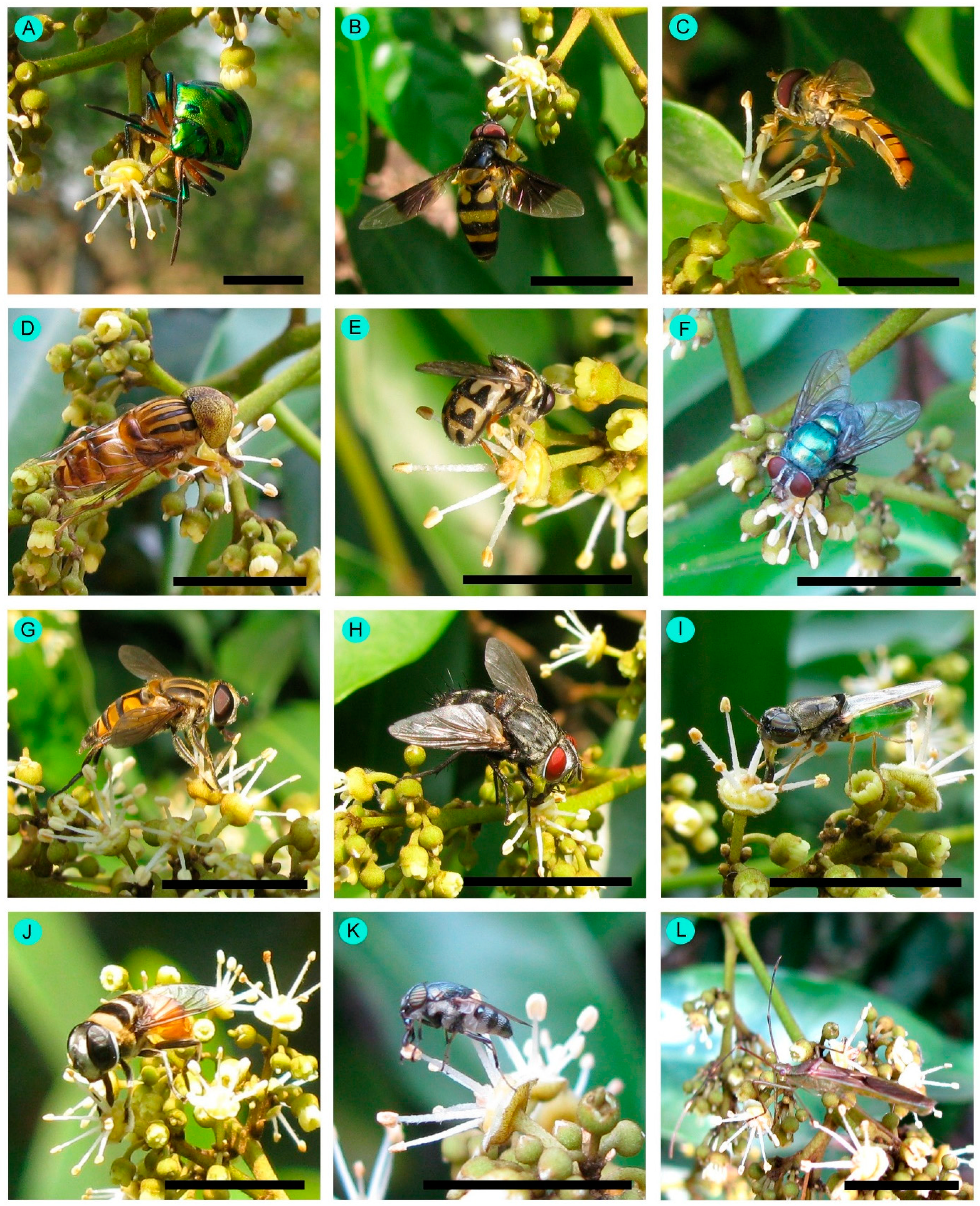
Figure 1. Flower visitors of Litchi chinensis in West Bengal, India. (A). Coleoptera (Chrysocoris stollii). (BK). Diptera [(B). Dideopsis aegrota, (C). Episyrphus balteatus, (D). Eristalinus megacephalus, (E). Graptomyza brevirostris, (F). Lucilia sericata, (G). Mesembrius bengalensis, (H). Musca domestica, (I). Odontomyia lutatius, (J). Phytomia zonata, (K). Stomorhina discolor]. (L). Hemiptera (Leptocorisa acuta). Scale bars = 10 mm.
Ecologies 07 00063 g001
Figure 2. Flower visitors of Litchi chinensis in West Bengal, India. (AG). Hymenoptera [(A). Allorhynchium metallicum, (B). Apis cerana, (C). Apis dorsata, (D). Apis florea, (E). Braunsapis mixta, (F). Ropalidia marginata, (G). Tetragonula pagdeni]. (HL). Lepidoptera [(H). Amata cyssea, (I). Junonia atlites, (J). Rapala manea, (K). Rapala varuna, (L). Suastus gremius]. Scale bars = 10 mm.
Ecologies 07 00063 g002
Figure 3. Visitors’ body surface showing pollen adherence. (A,B). Braunsapis mixta [(A): ventral surface of abdomen, (B): leg], (C). Eristalinus megacephalus (ventral surface of abdomen), (DF). Graptomyza brevirostris [(D,E): ventral surface of abdomen, (F): leg], (G,H). Lucilia sericata (ventral surface of abdomen), (I). Stomorhina subapicalis (ventral surface of abdomen).
Ecologies 07 00063 g003
Figure 4. Visitor abundance (A), richness (B), and diversity (C) varied between well-lit inflorescences and shaded inflorescences of Litchi chinensis in West Bengal, India (abundance: t = 7.34, df = 98, p < 0.001; richness: Mann–Whitney U = 806.50, p < 0.01; diversity: t = 4.29, df = 98, p < 0.001). Light—well-lit inflorescences, Shade—shaded inflorescences.
Ecologies 07 00063 g004
Table 1. Flower visitors of Litchi chinensis in West Bengal, India.
VisitorRelative AbundanceFlower Visitation RateFlower Handling Time (s)Flower Resource
Coleoptera
Chrysocoris stollii0.50-*Floral tissue
Coccinella septempunctata0.36-*Floral tissue
Diptera
Dideopsis aegrota1.656.85 ± 1.345.92 ± 2.14Nectar, Pollen
Episyrphus balteatus2.656.98 ± 1.325.94 ± 2.16Nectar, Pollen
Eristalinus megacephalus5.676.69 ± 1.276.24 ± 2.23Nectar, Pollen
Graptomyza brevirostris8.036.27 ± 1.266.17 ± 2.21Nectar, Pollen
Lucilia sericata2.226.14 ± 1.186.53 ± 2.38Nectar, Pollen
Mesembrius bengalensis1.584.07 ± 1.129.37 ± 2.85Nectar, Pollen
Musca domestica2.515.83 ± 1.058.15 ± 2.67Nectar, Pollen
Odontomyia lutatius0.932.58 ± 0.789.71 ± 2.93Nectar, Pollen
Phytomia zonata0.435.96 ± 1.136.81 ± 2.35Nectar, Pollen
Plagiostenopterina sagarensis1.155.27 ± 0.855.82 ± 2.11Nectar, Pollen
Stomorhina discolor2.804.71 ± 0.827.25 ± 2.74Nectar, Pollen
Stomorhina subapicalis2.014.93 ± 0.847.11 ± 2.69Nectar, Pollen
Hemiptera
Leptocorisa acuta0.36-*Nectar
Hymenoptera
Allorhynchium metallicum0.796.26 ± 3.183.45 ± 1.22Nectar
Amegilla zonata1.299.38 ± 4.252.46 ± 0.47Nectar, Pollen
Apis cerana10.912.76 ± 2.303.51 ± 1.25Nectar, Pollen
Apis dorsata6.8911.63 ± 2.143.83 ± 1.32Nectar, Pollen
Apis florea10.0411.28 ± 2.093.96 ± 1.38Nectar, Pollen
Braunsapis mixta6.6712.37 ± 2.213.61 ± 1.29Nectar, Pollen
Camponotus compressus0.793.16 ± 1.723.19 ± 1.17Nectar, Pollen
Ceratina binghami1.0810.24 ± 2.344.22 ± 1.43Nectar, Pollen
Ceratina hieroglyphica0.5710.79 ± 2.384.07 ± 1.40Nectar, Pollen
Lasioglossum albescens1.437.41 ± 3.524.41 ± 1.52Nectar, Pollen
Lasioglossum cavernifrons3.087.18 ± 3.564.67 ± 1.60Nectar, Pollen
Phimenes flavopictus0.726.72 ± 3.223.30 ± 1.18Nectar
Praestochrysis lusca0.296.25 ± 3.133.42 ± 1.20Nectar
Ropalidia marginata0.366.03 ± 2.983.56 ± 1.26Nectar
Tetragonula pagdeni9.762.57 ± 0.4217.43 ± 6.12Nectar, Pollen
Vespa tropica0.505.73 ± 2.783.61 ± 1.29Nectar
Xylocopa aestuans1.226.87 ± 3.142.93 ± 0.61Nectar, Pollen
Xylocopa fenestrata1.596.67 ± 3.113.05 ± 0.66Nectar, Pollen
Lepidoptera
Amata cyssea0.4310.43 ± 2.642.83 ± 0.55Nectar
Appias libythea0.655.28 ± 2.622.94 ± 0.57Nectar
Borbo cinnara0.863.18 ± 2.1712.72 ± 4.11Nectar
Catopsilia Pomona0.724.90 ± 2.433.07 ± 0.58Nectar
Euploea core0.655.14 ± 2.592.96 ± 0.57Nectar
Hypolimnas bolina0.363.37 ± 2.219.20 ± 4.12Nectar
Junonia almana0.574.85 ± 2.503.18 ± 0.60Nectar
Junonia atlites0.935.07 ± 2.663.09 ± 0.57Nectar
Lethe europa0.222.93 ± 1.7210.26 ± 4.24Nectar
Mycalesis perseus0.502.90 ± 1.6810.81 ± 4.73Nectar
Pelopidas mathias1.153.27 ± 2.1812.59 ± 3.98Nectar
Rapala manea0.862.89 ± 1.5114.30 ± 5.29Nectar
Rapala varuna0.502.76 ± 1.4915.24 ± 5.67Nectar
Suastus gremius0.793.22 ± 2.1612.65 ± 4.03Nectar
Note: * indicates higher flower handling time, but does not determine exact values.
Table 2. Visitor traits regarding pollination services for Litchi chinensis in West Bengal, India.
VisitorFVVisitation PatternPollinating ModePollen Adhering Body Parts Anther Contact RateStigma Contact RatePSiPEi
Coleoptera
Chrysocoris stollii0.003IVNDNDNDND-
Coccinella septempunctata0.002IVNDNDNDND-
Diptera
Dideopsis aegrota0.011LVS, AH, VA, VT, L0.963 ± 0.0300.610 ± 0.0540.006
Episyrphus balteatus0.024LVS, AH, VA, VT, L0.969 ± 0.0310.648 ± 0.0580.015
Eristalinus megacephalus0.040LVS, AH, VA, VT, L0.976 ± 0.0310.757 ± 0.0640.0300.59
Graptomyza brevirostris0.056LVS, AH, VA, VT, L0.965 ± 0.0320.648 ± 0.0590.0350.57
Lucilia sericata0.014LVS, AH, VA, VT, L0.952 ± 0.0290.513 ± 0.0480.007
Mesembrius bengalensis0.010LVS, AH, VA, VT, L0.968 ± 0.0300.520 ± 0.0490.005
Musca domestica0.015LVS, AH, VA, VT, L0.910 ± 0.0310.480 ± 0.0470.007
Odontomyia lutatius0.006LVS, AH, VA, VT, LNDND-
Phytomia zonata0.002LVS, AH, VA, VT, LNDND-
Plagiostenopterina sagarensis0.007LVS, AH, VA, VT, LNDND-
Stomorhina discolor0.017LVS, AH, VA, VT, L0.977 ± 0.0320.635 ± 0.0590.011
Stomorhina subapicalis0.012LVS, AH, VA, VT, L0.972 ± 0.0320.620 ± 0.0570.007
Hemiptera
Leptocorisa acuta0.002LVS, AH, VA, VT, LNDND-
Hymenoptera
Allorhynchium metallicum0.009LVS, AH, VA, VT, LNDND-
Amegilla zonata0.016LVS, AH, VA, VT, L0.950 ± 0.0350.800 ± 0.0820.012
Apis cerana0.142LVS, AH, VA, VT, L0.981 ± 0.0350.804 ± 0.0850.1120.68
Apis dorsata0.093LVS, AH, VA, VT, L0.985 ± 0.0360.823 ± 0.0920.0750.70
Apis florea0.135LVS, AH, VA, VT, L0.978 ± 0.0340.798 ± 0.0920.1050.65
Braunsapis mixta0.090LVS, AH, VA, VT, L0.965 ± 0.0290.777 ± 0.0880.0670.62
Camponotus compressus0.009LVS, AH, VA, VT, LNDND-
Ceratina binghami0.014LVS, AH, VA, VT, L0.925 ± 0.0280.790 ± 0.0890.010
Ceratina hieroglyphica0.007LVS, AH, VA, VT, LNDND-
Lasioglossum albescens0.018LVS, AH, VA, VT, L0.900 ± 0.0270.765 ± 0.0870.012
Lasioglossum cavernifrons0.030LVS, AH, VA, VT, L0.935 ± 0.0290.780 ± 0.0880.022
Phimenes flavopictus0.009LVS, AH, VA, VT, LNDND-
Praestochrysis lusca0.004LVS, AH, VA, VT, LNDND-
Ropalidia marginata0.005LVS, AH, VA, VT, LNDND-
Tetragonula pagdeni0.084LVS, AH, VA, VT, L0.976 ± 0.0290.769 ± 0.0650.0630.63
Vespa tropica0.006LVS, AH, VA, VT, LNDND-
Xylocopa aestuans0.018LVS, AH, VA, VT, L1.000.950 ± 0.0520.017
Xylocopa fenestrata0.023LVS, AH, VA, VT, L1.000.950 ± 0.0520.022
Lepidoptera
Amata cyssea0.003LVS, AH, VA, VT, LNDND-
Appias libythea0.005LVS, AH, VA, VT, L0.550 ± 0.0280.250 ± 0.048<0.001
Borbo cinnara0.006LVS, AH, VA, VT, L0.850 ± 0.0320.750 ± 0.0640.004
Catopsilia Pomona0.005LVS, AH, VA, VT, L0.500 ± 0.0200.300 ± 0.050<0.001
Euploea core0.004LVS, AH, VA, VT, L0.500 ± 0.0200.270 ± 0.049<0.001
Hypolimnas bolina0.003LVS, AH, VA, VT, LNDND-
Junonia almana0.004LVS, AH, VA, VT, L0.540 ± 0.0210.280 ± 0.050
Junonia atlites0.007LVS, AH, VA, VT, L0.570 ± 0.0220.290 ± 0.051
Lethe europa0.002LVS, AH, VA, VT, LNDND-
Mycalesis perseus0.004LVS, AH, VA, VT, LNDND-
Pelopidas mathias0.008LVS, AH, VA, VT, L0.920 ± 0.0320.730 ± 0.0610.005
Rapala manea0.006LVS, AH, VA, VT, L0.940 ± 0.0310.850 ± 0.0590.005
Rapala varuna0.004LVS, AH, VA, VT, L0.950 ± 0.0310.850 ± 0.0590.003
Suastus gremius0.006LVS, AH, VA, VT, L0.930 ± 0.0320.800 ± 0.0600.004
FV—flower visit proportion; visitation pattern: IV—illegitimate visit, LV—legitimate visit; pollinating mode: S—sternotribic, A—appendage-mediated; pollen adhering body parts: H—head, L—legs, VA—ventral side of abdomen, VT—ventral side of thorax; PSi—pollination service index; PEi—single-visit pollination efficiency index. ND—not detected.
Table 3. Inflorescence height (from ground level) wise abundance (number of visitors/inflorescence/5 min), richness (index of Margalef, D) and diversity (Shannon–Weaver diversity index, H′) of flower visitors of Litchi chinensis in West Bengal, India.
HeightAbundanceRichnessDiversity
<2 m4.48 b ± 2.670.79 b ± 0.500.66 b ± 0.41
2–4 m6.75 a ± 3.241.03 a ± 0.460.92 a ± 0.40
>4–6 m7.40 a ± 3.691.12 a ± 0.460.97 a ± 0.39
>6 m4.60 b ± 2.700.78 b ± 0.480.65 b ± 0.39
Statistics (Kruskal–Wallis H Test)H = 33.34, df = 3, p < 0.001H = 23.32, df = 3, p < 0.001H = 37.90, df = 3, p < 0.001
Values are given as the mean ± standard deviation. Different superscript letters indicate a significant difference (Dunn’s post hoc test at the 5% level).
Disclaimer/Publisher’s Note: The statements, opinions and data contained in all publications are solely those of the individual author(s) and contributor(s) and not of MDPI and/or the editor(s). MDPI and/or the editor(s) disclaim responsibility for any injury to people or property resulting from any ideas, methods, instructions or products referred to in the content.