
Next Article in Journal
Early Vegetation Responses to Alien Plant Clearing in Communal Rangelands: A Case from Manzini, Eswatini
Previous Article in Journal
Linking Soil Nutrients and Non-Herbaceous Plant Communities with Bat Diversity in a Tropical Agricultural Landscape in Ecuador
 
 
Correction published on 28 January 2026, see Ecologies 2026, 7(1), 13.
Article

Patterns and Drivers of Mountain Meadow Communities Along an Altitudinal Gradient on the Southern Slope of Wutai Mountain, Northern China


1
School of Resources and Environment, Shanxi University of Finance and Economics, Taiyuan 030006, China
2
School of Life Science, Shanxi Engineering Research Center of Microbial Application Technologies, Shanxi Normal University, Taiyuan 030031, China
3
Research Center for Science Development in Fenhe River Valley, Taiyuan Normal University, Taiyuan 030619, China
*
Author to whom correspondence should be addressed.
Ecologies 2026, 7(1), 9; https://doi.org/10.3390/ecologies7010009
Submission received: 22 December 2025 / Revised: 30 December 2025 / Accepted: 13 January 2026 / Published: 15 January 2026 / Corrected: 28 January 2026

Abstract

Understanding how plant community characteristics and soil properties vary along altitudinal gradients is essential for ecosystem conservation, restoration, and for predicting ecosystem responses to global environmental change. This study investigated altitudinal patterns and their potential drivers in mountain meadow communities on the southern slope of Wutai Mountain, Northern China. Community characteristics and soil physicochemical properties were measured along an altitudinal gradient ranging from 1800 to 3000 m a.s.l. Most community characteristics exhibited clear altitudinal trends. Species richness, Shannon–Wiener index, Simpson index, aboveground biomass and average plant height all declined significantly with increasing altitude. In contrast, vegetation cover showed a unimodal pattern, initially decreasing and then increasing at higher elevations. Soil physicochemical properties also varied significantly along the altitudinal gradient and were closely associated with changes in community characteristics. Variation partitioning analysis revealed that environmental factors, including altitude and soil properties, explained 71.9% of the total variation in mountain meadow communities. Altitude alone contributed more to community variation than soil factors, indicating its dominant role in shaping community structure. Nevertheless, specific soil properties, particularly soil depth, soil bulk density and soil pH, also exerted significant influences on community characteristics. Overall, our results demonstrate that altitude is a key driver of both vegetation and soil variation in mountain meadows on the southern slope of Wutai Mountain. In addition to altitudinal effects, soil physicochemical properties should be considered when developing conservation and management strategies for mountain meadow ecosystems.

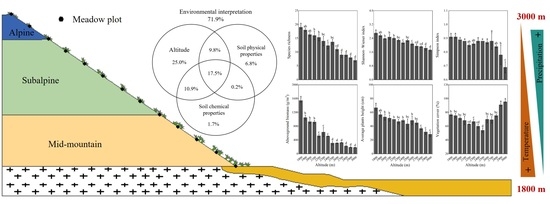
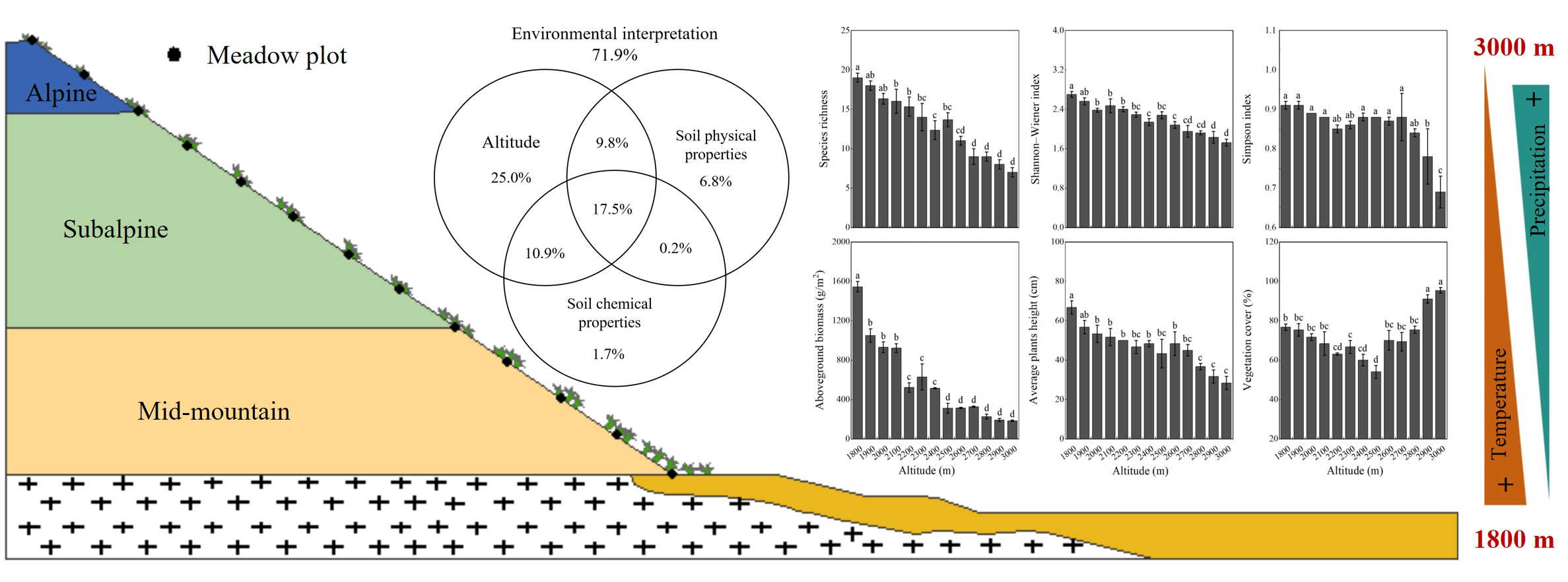
Graphical Abstract

1. Introduction

Mountain meadow communities are important primary producers in mountain ecosystems, particularly in subalpine and alpine regions. They play a vital role in maintaining mountain biodiversity, regulating hydrological processes, and providing essential ecosystem services [1,2]. Unlike zonal vegetation types, the meadow vegetation type is classified as non-zonal vegetation and can occur across a wide range of global zones. This broad distribution makes these communities an ideal system for examining how community characteristics, such as species diversity and biomass, vary along altitudinal gradients, as well as for exploring the relationship between species diversity and productivity within the same vegetation type at different elevations [3,4,5,6]. In mountainous ecosystems, environmental conditions change markedly with altitude, influencing plant community composition, structure, diversity, and stability. As a result, plant communities often exhibit distinct altitudinal patterns in response to elevation-related changes in temperature, moisture, and other environmental factors [7,8,9]. Investigating the effects of altitude on mountain meadow vegetation therefore enhances our understanding of community ecological characteristics under current environmental conditions, provides a scientific basis for regional vegetation conservation and ecological restoration, and is essential for predicting the responses of mountain ecosystems to future climate change.
Plant community characteristics in mountain meadow ecosystems are shaped by multiple interacting biotic and abiotic factors, among which altitude is a key determinant [10,11]. With increasing elevation, species composition often changes substantially; drought-tolerant grasses at lower elevations are gradually replaced by cold-tolerant herbaceous species, leading to the formation of subalpine and alpine meadow communities dominated by cold-adapted plants at higher elevations [6,12,13]. Correspondingly, species diversity indices generally decline with increasing altitude [13,14,15,16]. In addition to vegetation changes, soil physicochemical properties also vary significantly along altitudinal gradients. For example, soil organic carbon (SOC) has been reported to increase with elevation in subtropical and temperate mountain regions [6,17,18], whereas in some mountainous areas of China, such as the Taibai and Tianshan Mountains, SOC exhibits non-linear patterns, either decreasing initially and then increasing, or showing the opposite trend [19,20]. Other soil properties, including soil bulk density, total nitrogen, and total phosphorus, also display substantial altitudinal variation across different mountain regions and elevation ranges [21,22,23,24,25]. Overall, the relationships between vegetation and environmental factors in mountainous regions are highly complex, being jointly influenced by altitude, hydrothermal conditions, soil properties, and their interactions. A comprehensive understanding of these relationships is therefore crucial for effective ecosystem management, biodiversity conservation, and vegetation restoration in mountain meadow ecosystems.
The mountain meadows of Wutai Mountain represent a typical temperate mountain vegetation type and constitute an important component of mountain meadow ecosystems in North China. Shaped by pronounced altitudinal variation, these meadows exhibit one of the most characteristic and well-defined vegetation distribution patterns along elevation gradients in the region, comprising mid-mountain, subalpine, and alpine meadow zones [26]. Previous studies on temperate mountain vegetation have primarily focused on forest-shrub communities or subalpine meadow ecosystems [26,27]. In contrast, comprehensive investigations of mountain meadow community characteristics and their driving factors across mid-mountain, subalpine, and alpine meadow types along an altitudinal gradient in temperate mountainous areas remain limited. Consequently, several key questions remain unresolved: what are the distinct patterns of mountain meadow community characteristics along an elevational gradient? How do changes in altitude and associated environmental factors influence meadow community structure and function? What is the relative importance of altitude versus other environmental drivers? Addressing these questions is essential for advancing our understanding of temperate mountain meadow ecosystems.
Herein, we investigated plant community characteristics and soil properties along an altitudinal gradient encompassing mid-mountain, subalpine, and alpine meadow zones on the southern slope of Wutai Mountain, Northern China. The specific objectives were to (1) determine how plant community characteristics, including species richness (SR), Shannon–Wiener index (SWI), Simpson index (SI), aboveground biomass (AGB), average plant height (APH) and vegetation cover (VC) vary with altitude in a typical mountain meadow ecosystem; (2) assess the effects of altitude on soil physicochemical properties; and (3) evaluate the relative influence of altitude and other environmental factors on plant community characteristics. This research aims to provide a scientific basis for the conservation, sustainable management, and restoration of grassland plant resources in temperate mountainous regions.

2. Materials and Methods

2.1. Study Areas

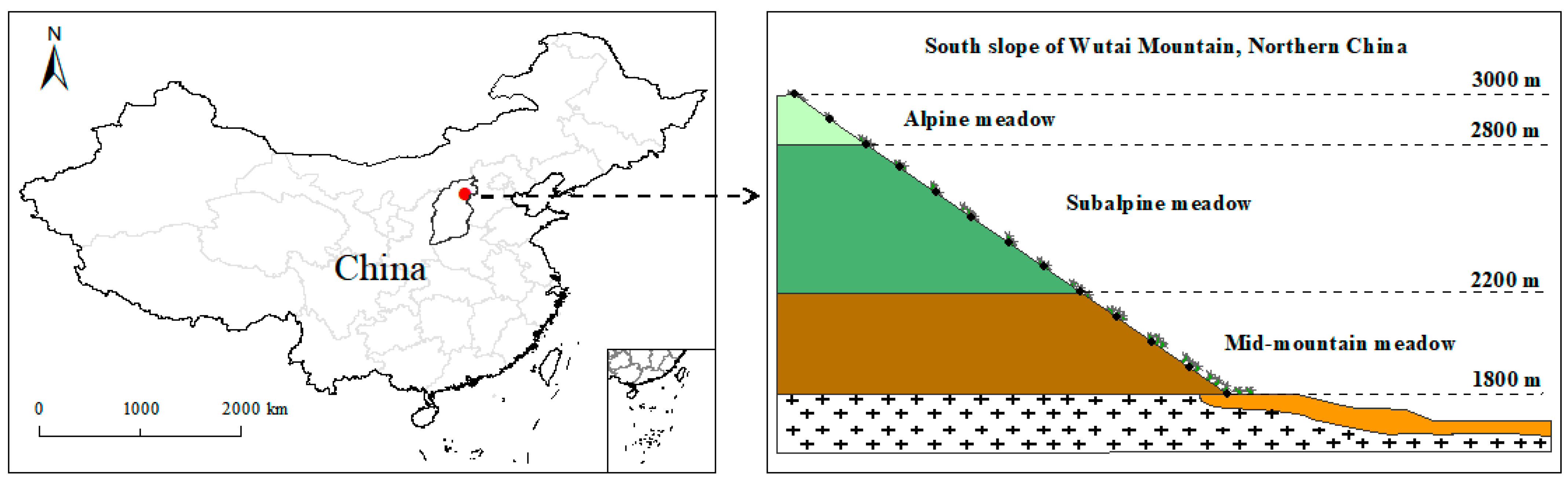
The study region is located on the southern slope of Wutai Mountain in North China (113°33.69′ E–113°34.91′ E, 39°1.45′ N–39°4.50′ N), with elevations ranging from 1800 to 3000 m a.s.l. (Figure 1). The main mountain meadow types in this region include mid-mountain meadows, subalpine meadows, and alpine meadows (Table 1). The region experiences a temperate continental climate, with precipitation primarily occurring between July and September. Owing to pronounced elevational gradients, the mean annual temperature ranges from −5 to 6 °C, and the mean annual precipitation varies between 500 and 1000 mm [28]. Vegetation and soil distributions exhibit clear vertical zonation, forming a relatively complete altitudinal vegetation belt characteristic of warm temperate mountainous regions. The dominant species in mid-mountain meadows are mainly Artemisia sacrorum, Leymus secalinus and Stipa bungeana; those in subalpine meadows are mainly Poa annua, Artemisia sacrorum and Carex subpediformis; and those in alpine meadows are mainly Kobresia pygmaea, Bistorta vivipara and Poa annua. The soil parent material mainly originated from metamorphic rock, and the predominant soil types are mountain brown soils and subalpine-alpine meadow soils [28].

2.2. Plot Survey and Sampling

Field surveys were conducted in mid-August 2024. Thirteen sampling sites (S1–S13) were established along a continuous altitudinal gradient on the southern slope of Wutai Mountain at 100 m elevation intervals, covering altitudes of 1800 to 3000 m a.s.l. (Figure 1, Table 1). To minimize topographic effects, all sampling sites were selected under similar slope and aspect conditions. At each site, three herbaceous quadrats (1 m × 1 m) were randomly established. For each quadrat, geographic and environmental information, including latitude, longitude, elevation, slope, aspect, and soil depth, was recorded. Vegetation surveys documented plant species composition, individual abundance, plant height, and percentage cover. AGB was determined using the total harvest method. All aboveground plant material within each quadrat was clipped, oven-dried at 65 °C for 48 h to constant weight, and weighed to obtain aboveground dry biomass.
Soil sampling was conducted within each vegetation quadrat. Three sampling points were randomly selected, and soil samples were collected from two depth intervals (0–10 cm and 10–20 cm) using a 100 cm3 stainless steel cutting ring (Laito High Technology, Cangzhou, HB, China). Samples were weighed in the field and transported to the laboratory, with three replicates per soil layer. Soil moisture content and bulk density were determined using the oven-drying and cutting-ring methods, respectively [29]. Soil depth was measured using a soil probe, with five measurements per quadrat, and averaged to obtain representative values [30]. Additional soil samples (ca. 200 g) were collected from the 0–10 cm and 10–20 cm layers at each quadrat for chemical analyses, with three replicates per depth. After air-drying, samples were sieved through a 100-mesh sieve for physicochemical measurements. SOC and total nitrogen contents were analyzed using a C/H/N elemental analyzer (Vario EL III, Hanau, Germany), while total phosphorus was determined by inductively coupled plasma atomic emission spectroscopy (iCAP 6300, Thermo Fisher Scientific, Waltham, MA, USA) [6]. Soil pH and electrical conductivity were measured using a pH-meter and conductivity meter, respectively (Multiline F/SET-3, WTW, Weilheim, Germany) [6]. For subsequent analyses, soil physicochemical properties were calculated as the mean values of the 0–20 cm soil layer and expressed on a mass-percentage basis. The mean annual temperature and mean annual rainfall were obtained from the World Climate Data website (http://www.worldclim.org/; accessed on 27 November 2025).

2.3. Data Analysis

Species diversity indices of mountain meadow communities at different elevations were quantified using the SR (Species richness), SWI (Shannon–Wiener index), and SI (Simpson index) [31,32], calculated as follows:
S R = S
S W I = i S P i l n P i
S I = 1 i = 1 S P i 2
where S denotes species number and Pi represents the relative importance value of species i in the community.
One-way ANOVA was employed to test for significant differences in mountain meadow community characteristics and soil physicochemical properties among different elevations. When significant effects were detected, LSD post hoc tests were applied to identify pairwise differences (p < 0.05). Pearson correlation analysis was conducted to examine relationships between plant community characteristics and soil properties. To evaluate the effects of altitude and soil physicochemical properties on meadow community characteristics, elevation and soil parameters were added as explanatory variables in Canoco v5.0. First, non-significant explanatory variables (p > 0.05) were eliminated through Monte Carlo tests in DCCA. The results indicated that the altitude, soil depth, soil bulk density and soil pH were tested (p < 0.05). Then, to further explore evaluate the relative contributions of elevation and environmental factors to variations in meadow community characteristics, the significant explanatory variables identified through testing were categorized into three groups: a (altitude), b (soil physical properties: soil depth and soil bulk density) and c (soil chemical properties: soil pH). Variation partitioning was performed to quantify the independent contributions of elevation, soil physical properties and soil chemical properties, as well as their shared effects, on mountain meadow community characteristics [33]. All statistical analyses were conducted using SPSS v27.0 and Canoco v5.0 [34].

3. Results

3.1. Patterns of Community Characteristics Along the Altitudinal Gradient

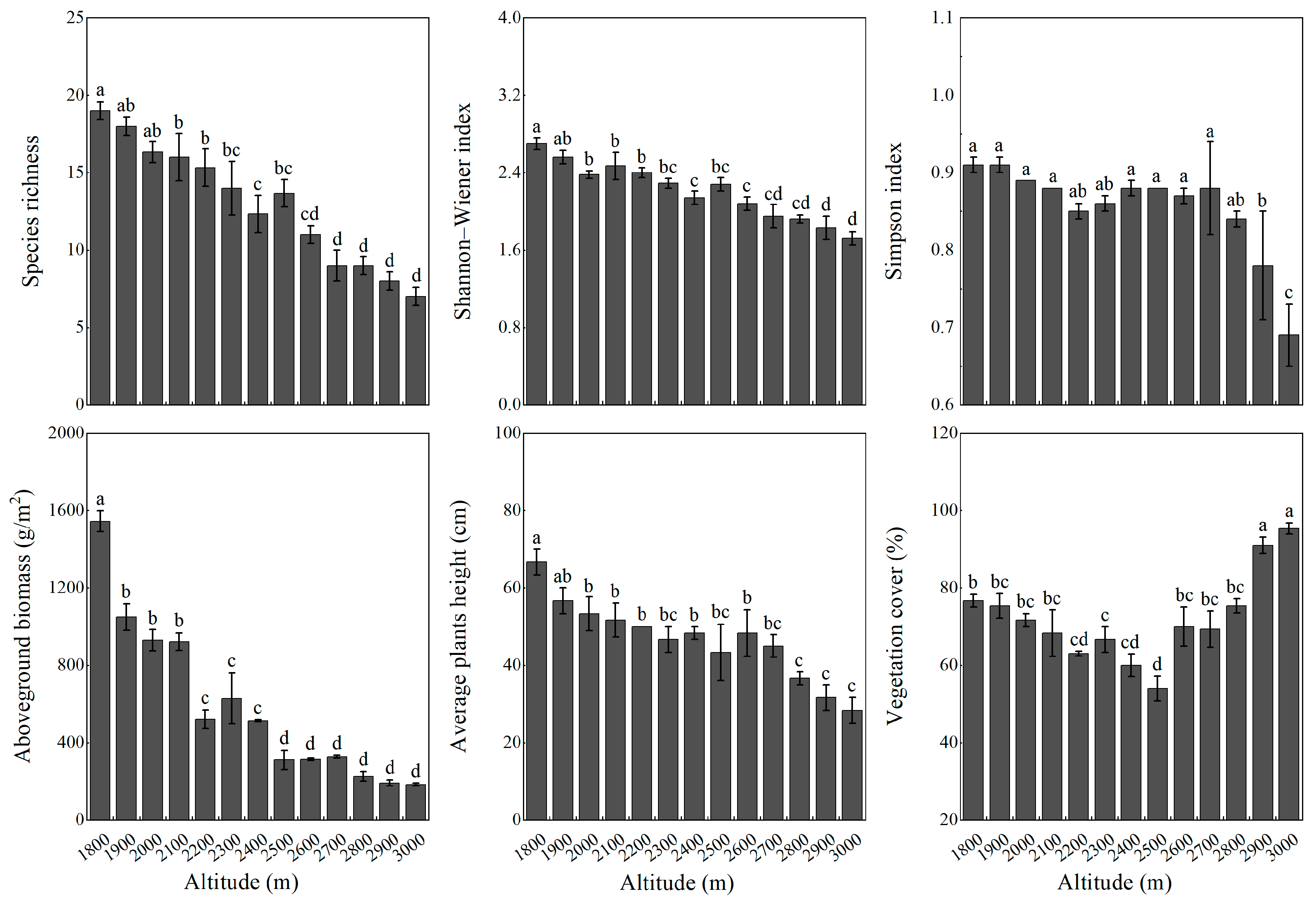
One-way ANOVA revealed significant differences in community characteristics among mountain meadow communities across the altitudinal gradient. SR (F = 32.215, p < 0.001), SWI (F = 19.826, p < 0.001), SI (F = 4.755, p < 0.001), AGB (F = 17.940, p < 0.001), APH (F = 8.150, p < 0.001), and VC (F = 5.598, p < 0.001) all varied significantly with elevation. Overall, most community characteristics exhibited significant altitudinal trends (Figure 2). Notably, SR, SWI, SI, AGB, and APH decreased significantly with increasing altitude. The highest values of these variables were observed at 1800 m, where SR reached 19 species, the SWI was 2.70, the SI was 0.91, AGB was 1543.83 g/m2, and APH was 66.67 cm (Figure 2). In contrast, vegetation cover (VC) showed a non-linear pattern along the altitudinal gradient, initially decreasing and then increasing at higher elevations. The lowest VC (54%) occurred in the subalpine meadow at 2500 m (Figure 2).
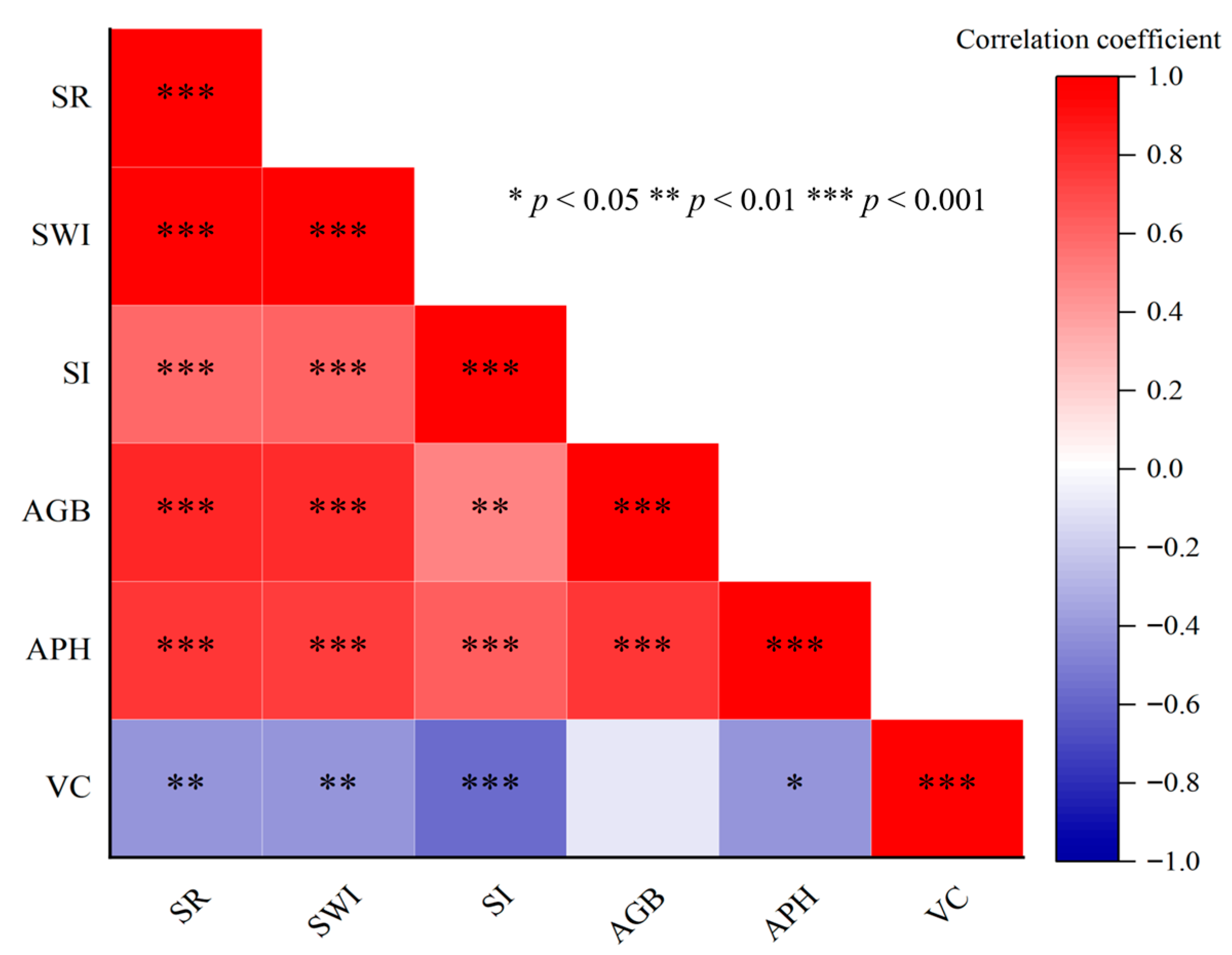
Correlation analysis revealed strong relationships among community characteristics (Figure 3). SR was significantly and positively correlated with both the Shannon–Wiener and Simpson indices. In addition, SR, SWI, and SI were all significantly and positively correlated with AGB and APH, but negatively correlated with VC. APH was also significantly and positively correlated with AGB, while showing a significant negative correlation with VC (Figure 3).

3.2. Patterns of Soil Properties Along the Altitudinal Gradient

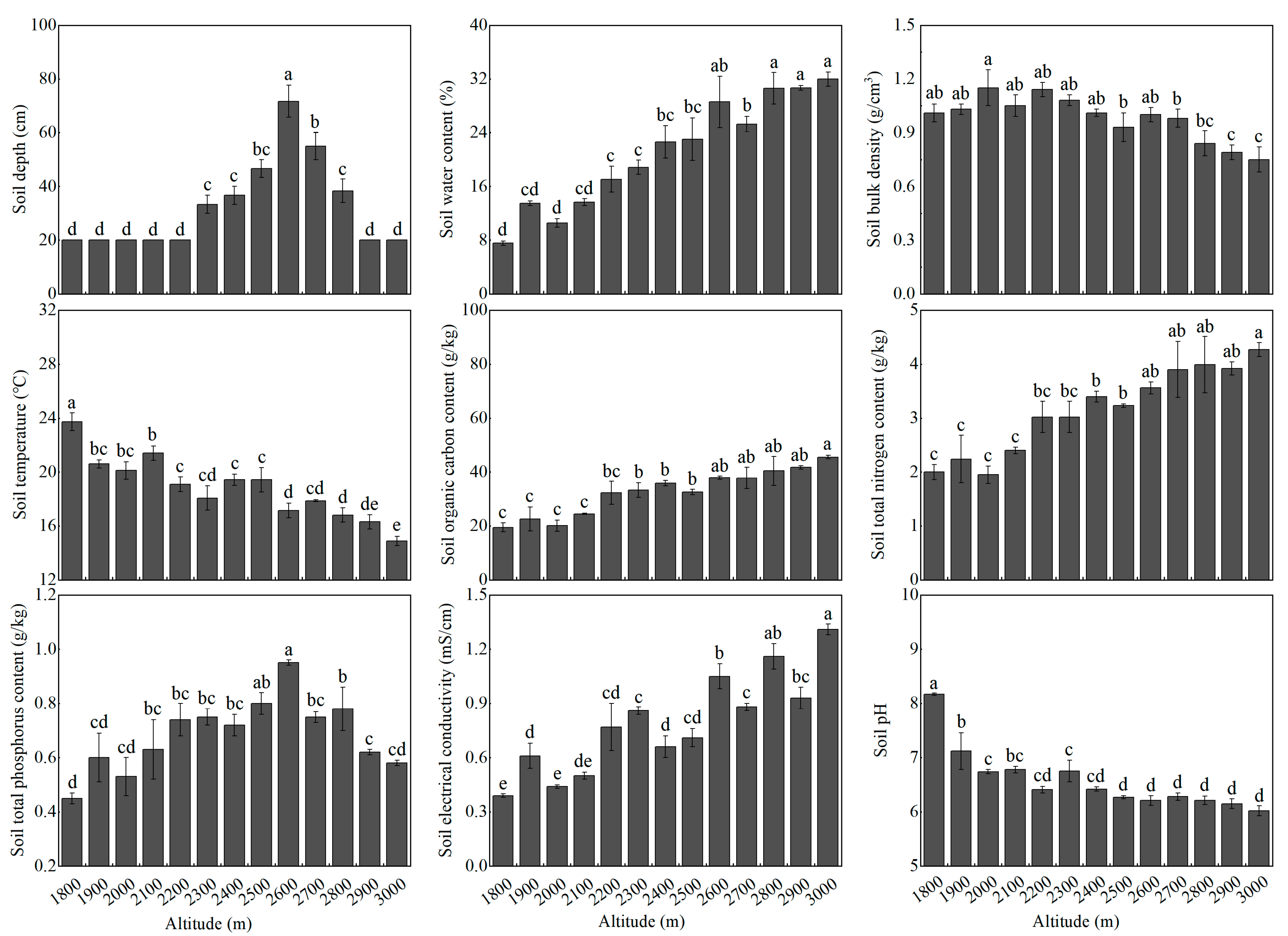
Soil properties exhibited distinct patterns along the altitudinal gradient (Figure 4). Soil depth displayed a unimodal pattern, increasing with elevation and reaching a maximum at 2600 m, with a mean value of 71.67 cm. Soil water content (SWC) increased significantly with altitude, peaking at 3000 m, where the mean value reached 31.95%. In contrast, SBD and soil temperature both showed significant declining trends with increasing altitude. The lowest values of SBD (0.75 g cm3) and soil temperature (14.88 °C) were observed at 3000 m (Figure 4). SOC and STN increased significantly along the altitudinal gradient, with maximum values occurring at 3000 m (45.56 and 4.27 g/kg, respectively). STP exhibited a unimodal pattern, increasing initially and then decreasing with elevation, and reached its peak at 2600 m, with a mean value of 0.95 g/kg (Figure 4). Soil electrical conductivity increased significantly with altitude and reached its highest value (1.31 mS/cm) at 3000 m. In contrast, soil pH decreased significantly along the altitudinal gradient, with the highest value observed at 1800 m (mean pH = 8.17) (Figure 4).

3.3. Relationships Between Community Characteristics and Soil Properties

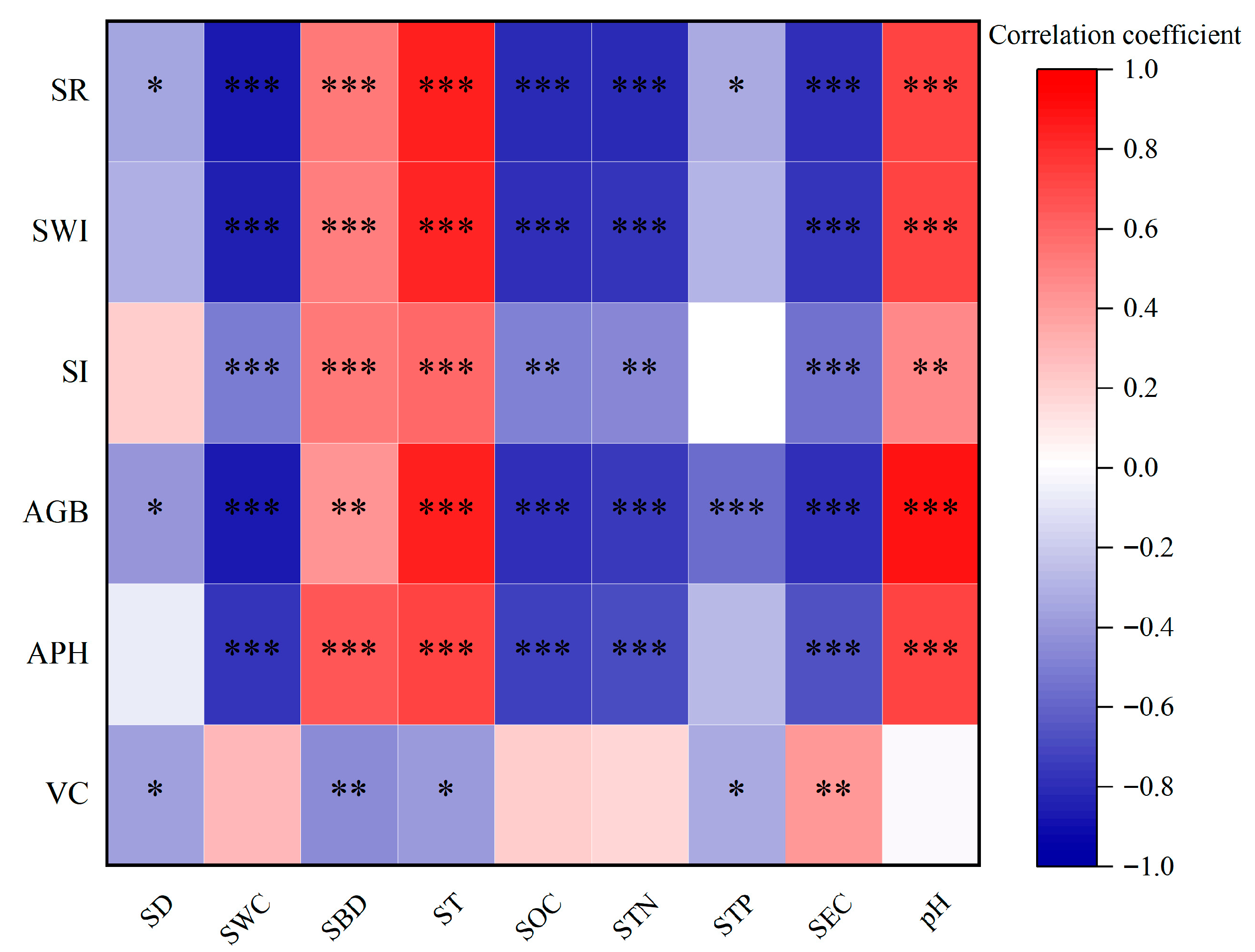
Correlation analysis revealed strong associations between plant community characteristics and soil properties (Figure 5). SR, SWI, SI, AGB, and APH were significantly and positively correlated with SBD and soil temperature. In contrast, these community variables showed significant negative correlations with SWC, Soil organic carbon content, soil total nitrogen content, and soil electrical conductivity. SR and AGB were also significantly and negatively correlated with soil depth and soil total phosphorus content. In addition, VC exhibited significant positive correlations with soil electrical conductivity, but significant negative correlations with SBD, soil temperature, soil depth, and soil total phosphorus content (Figure 5).
Figure 4. Soil physicochemical properties at different altitudes on the southern slope of Wutai Mountain. Lowercase letters indicate significant differences at different altitudes (p < 0.05).
Ecologies 07 00009 g004

3.4. Main Driving Factors of Mountain Meadow Communities

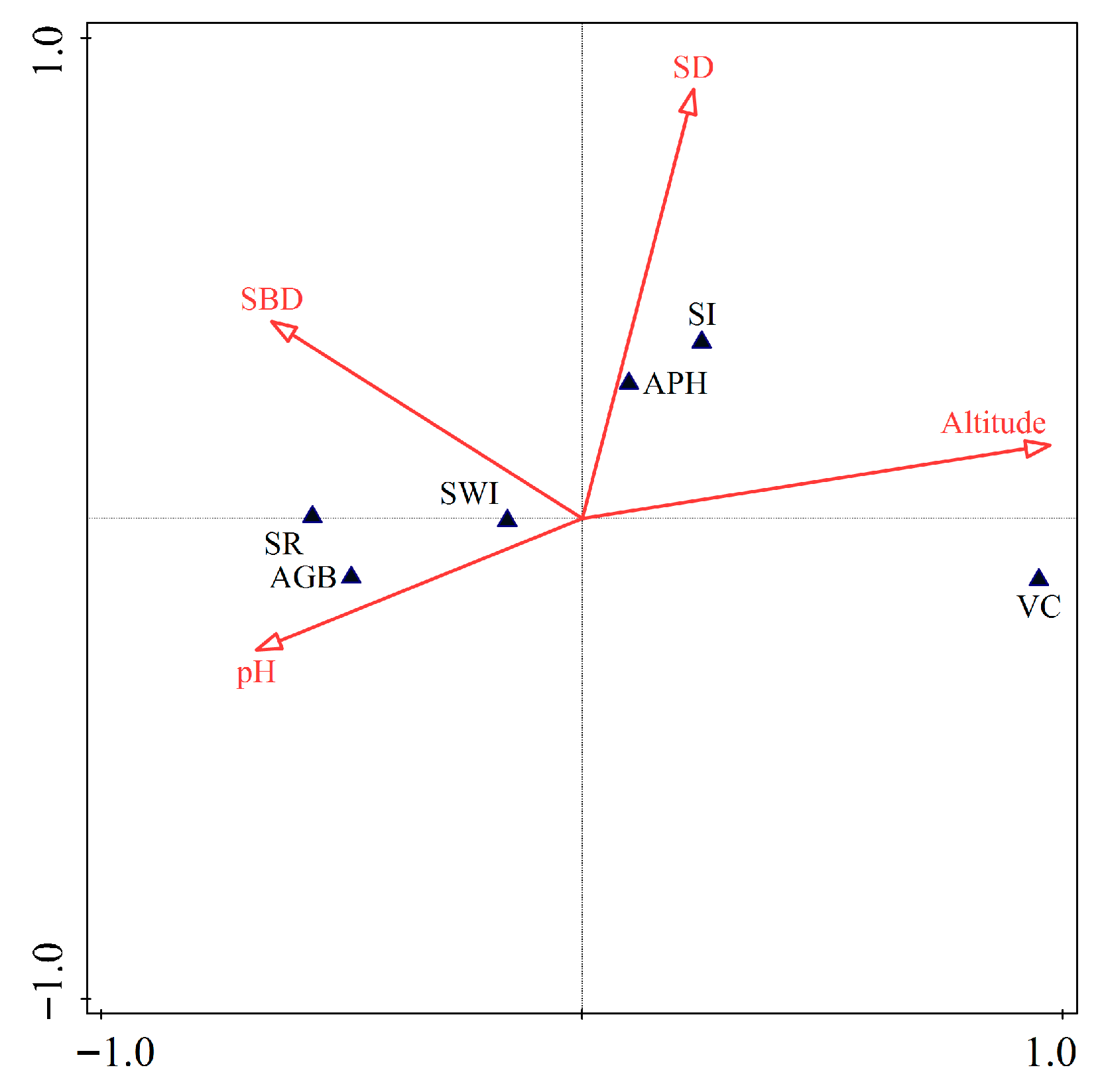
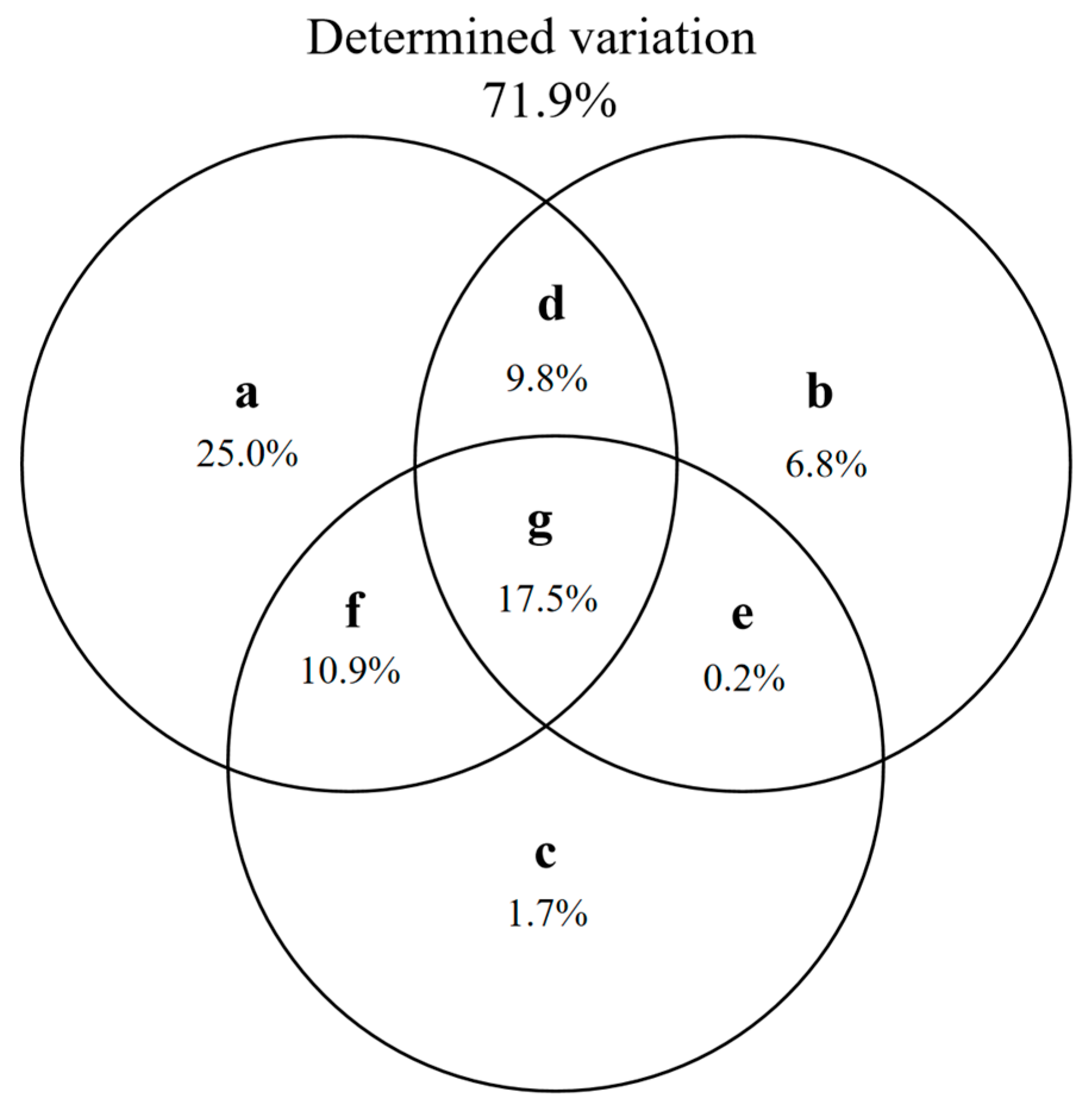
Monte Carlo permutation tests in DCCA indicated that altitude, soil depth, soil bulk density and soil pH were significant explanatory variables for variations in mountain meadow community characteristics (p < 0.05), suggesting that community structure and function are strongly influenced by both elevational and edaphic factors (Figure 6). Variation partitioning analysis showed that altitude and soil properties together explained 71.9% of the total variation in community characteristics (Figure 7). Altitude alone accounted for the largest proportion of explained variance (25.0%), highlighting its dominant role in shaping mountain meadow communities. The joint effect of altitude and soil properties explained 17.5% of the variation, indicating a strong interaction between elevational gradients and soil physical and chemical conditions. In contrast, the interaction between soil depth, soil bulk density and soil pH contributed the least to the explained variation.

4. Discussion

4.1. Responses of Mountain Meadow Community to Altitudinal Change

In mountain ecosystems, altitudinal gradients strongly influence hydrothermal conditions, which in turn directly or indirectly affect vegetation composition, structure, and spatial distribution, ultimately shaping community diversity and stability [3,4,6,9]. In the present study, SR (species richness), SWI (Shannon–Wiener index), and SI (Simpson index) of mountain meadow communities declined significantly with increasing altitude (Figure 2), consistent with previous studies [14,15,16] and supporting the widely reported negative relationship between species diversity and elevation. AGB (aboveground biomass) and APH (average plant height) also decreased significantly along the altitudinal gradient (Figure 2), likely reflecting the strong constraints imposed by decreasing temperature with increasing elevation. In mid-mountain zones, where mean annual temperatures generally remain above 0 °C, meadows are often surrounded by forests, which protect them from strong winds and also influence the temperature, and vegetation is dominated by relatively tall and fast-growing species such as Artemisia sacrorum, Leymus secalinus, and Stipa bungeana [6]. These favorable thermal conditions promote rapid growth and the development of larger plant individuals, resulting in greater APH and AGB. With increasing altitude, temperature declines markedly, and in alpine zones, mean annual temperatures often remain below 0 °C. Such cold and windy conditions strongly limit plant growth and survival, favoring cold-tolerant, low-stature species [6,12], including Kobresia pygmaea, Bistorta vivipara, and Poa annua. These species typically exhibit slow growth rates and compact growth forms, leading to reduced APH and lower AGB at higher elevations. Previous research on mountain meadow communities on the southern slope of Wutai Mountain has shown that leaf phosphorus content decreases significantly with increasing altitude [6]. According to the Growth Rate Hypothesis [35,36], reduced leaf P content is associated with lower growth rates, suggesting that high-altitude meadow plants adopt conservative growth strategies under cold and resource-limited conditions. Consequently, increasing elevation promotes a shift in community composition toward small-sized, slow-growing, and cold-adapted species. This shift provides a mechanistic explanation for the pronounced declines in APH and AGB observed along the altitudinal gradient.
On the southern slope of Wutai Mountain, mountain meadow VC (vegetation cover) exhibited a unimodal pattern along the altitudinal gradient, initially decreasing and then increasing, with the lowest values occurring around 2500 m (Figure 2). This pattern is likely driven by strong competition between the shrub layer and the herbaceous layer in the subalpine zone [13]. In the present study, soils in subalpine plots were relatively deep, averaging approximately 40–50 cm (Figure 4), which favored the establishment of deep-rooted shrub species. As a result, the shrub layer became dominant, with mean shrub cover exceeding 60% [13]. The dense shrub canopy likely reduced light availability in the understory, thereby suppressing herbaceous growth and leading to relatively low herb-layer cover [37,38]. In contrast, above 2800 m, subalpine shrubs gradually disappeared, herbaceous species became dominant, and VC increased markedly with elevation (Figure 2). Variation partitioning analysis demonstrated that altitude and soil factors together explained 71.9% of the total variation in mountain meadow community characteristics in this region. Among the explanatory variables, altitude alone and its interaction with soil properties contributed more to explaining community variation than soil factors alone (Figure 7). These results indicate that elevation is a primary limiting factor for alpine meadow community characteristics and that its effects are strongly mediated by soil conditions. Thus, changes in altitude not only directly influence meadow communities through climatic constraints but also indirectly shape community characteristics by interacting with soil physicochemical properties.
Species richness and aboveground biomass in mountain meadow communities on the southern slope of Wutai Mountain were significantly and positively correlated, consistent with findings from other mountain meadow ecosystems [8,39]. This supports the commonly observed positive relationship between species diversity and ecosystem productivity [40,41]. However, comparisons with historical surveys conducted in the 1980s [28] suggest potential changes in community composition over recent decades. Field investigations from 2019 to 2024 [6,29,34] indicate that although overall species diversity in mountain meadow communities remains relatively high, low-palatability and low-nutrient species such as Artemisia sacrorum have become increasingly dominant. At the same time, the relative abundance of high-quality forage species, including Elymus kamoji, Festuca ovina, and Oxytropis caerulea, has declined. These shifts in species composition suggest that mountain meadows on Wutai Mountain may have experienced varying degrees of degradation. Further long-term monitoring and targeted studies are needed to quantify the extent, drivers, and ecological consequences of this degradation.

4.2. Responses of Soil Physicochemical Properties to Altitudinal Change

Soil provides essential physical support for plants by anchoring root systems, and soil depth is a key factor influencing plant distribution and community structure [30]. On the southern slope of Wutai Mountain, soil depth did not exhibit a simple linear relationship with altitude but instead showed a unimodal pattern, reaching a maximum at approximately 2600 m, with a mean depth of 71.67 cm (Figure 4). This pattern suggests that soil depth is closely linked to altitudinal variation and associated environmental conditions. At higher elevations (>2800 m), soil depth was relatively shallow (ca. 20 cm), which is likely attributable to reduced biological activity and slower soil formation processes under cold, low-temperature conditions. In addition, strong wind exposure and increased precipitation-induced erosion at high elevations can further limit soil accumulation, resulting in thin soils. These conditions may help explain why alpine meadows dominate as the primary vegetation type in these areas [13]. Field observations indicate that shrub communities are mainly distributed between 2300 and 2700 m [13]. In this elevation range, vegetation–soil feedback, relatively favorable hydrothermal conditions, and lower levels of human disturbance compared with lower elevations may promote more active soil formation processes, leading to greater soil depth. Variation partitioning analysis further identified soil depth as a significant factor influencing mountain meadow community characteristics (Figure 6), suggesting that spatial variation in soil depth plays an important role in regulating vegetation growth and distribution. Hence, the interaction between soil depth and vegetation should be carefully considered in mountain meadow conservation and restoration strategies. SBD is closely associated with soil porosity and water-holding capacity and is generally negatively correlated with SWC [42]. This relationship is consistent with our findings, which showed a significant negative correlation between SBD and SWC (Figure 4). The relatively low SBD observed in alpine zones indicates higher soil porosity and stronger water-holding capacity, which likely contributes to the higher SWC at high elevations.
Soil electrical conductivity is an important indicator of soluble salt concentrations in soils [43]. Along the altitudinal gradient, SEC exhibited a trend similar to that of SWC (Figure 4), suggesting a close linkage between these variables. At higher elevations, elevated soil moisture may promote the accumulation of water-soluble ions. In addition, soils at high altitudes often exhibit strong adsorption of H+ and Al3− ions, which can enhance soil acidity. Conversely, in lower-elevation areas, higher temperatures and stronger evaporation favor the accumulation and hydrolysis of alkaline salts (e.g., carbonates and bicarbonates), releasing OH and leading to soil alkalization [44]. In this study, soil pH reached its minimum value (6.08) at 3000 m and its maximum value (8.17) at 1800 m, and soil pH was significantly and negatively correlated with mean annual rainfall (r = −0.753, p < 0.001). This pronounced altitudinal pattern may also be influenced by precipitation effects, as acid deposition associated with regional precipitation increases with elevation, this result was also observed in other mountainous areas [45]. However, whether acid deposition directly drives soil acidification along the altitudinal gradient of mountain meadows requires further investigation through long-term monitoring and experimental studies.
Along the altitudinal gradient, SOC and STN increased significantly with elevation (Figure 4), consistent with patterns reported for subtropical and temperate mountainous regions [17,45,46]. This trend is likely driven by the low temperatures and cold climatic conditions at high elevations, which suppress the activity of soil microorganisms and soil fauna. Reduced biological activity slows the decomposition of organic matter, thereby promoting the accumulation of SOC and nitrogen at higher altitudes [47,48,49]. In contrast to SOC and STN, STP exhibited a unimodal pattern, increasing initially and then declining with elevation (Figure 4). This pattern may reflect the combined influence of soil parent material and climatic conditions along the altitudinal gradient [50]. At intermediate elevations, decreasing temperatures and reduced microbial activity may facilitate phosphorus retention in soils. However, soil phosphorus is largely derived from the weathering of parent rock, and at higher elevations (2800–3000 m), extremely low temperatures strongly constrain rock weathering processes. In addition, enhanced erosion and leaching of topsoil on mountain peaks may further deplete soil phosphorus pools. Together, these processes likely produce the observed single-peak pattern of soil phosphorus along the elevation gradient. Consistent with these interpretations, soil temperature in our study decreased significantly with increasing altitude (Figure 4), mirroring the general pattern of atmospheric temperature decline with elevation. This further confirms that altitude exerts a strong influence on both atmospheric and soil thermal regimes, which in turn regulate soil biogeochemical processes. Mountain ecosystems are characterized by complex ecological and hydrological processes [51], and subalpine–alpine meadow ecosystems are particularly sensitive to climate change [52]. A comprehensive understanding of plant community characteristics and soil properties across altitudinal gradients, as well as their interactions with elevation, is therefore essential for the conservation and restoration of these ecosystems. This study investigated the relationships between plant community characteristics and environmental factors across mid-mountain, subalpine, and alpine meadow zones (1800–3000 m), with particular emphasis on altitudinally driven changes in soil depth, soil physical and chemical properties. In fact, functional analyses (e.g., ecological indicator numbers) may reveal species strategies and environmental adaptations more effectively, while phylogenetic approaches might illuminate the evolutionary drivers of community composition; further research is needed to strengthen these findings. Future studies should incorporate broader spatial coverage (multiple sites and spatial scales) and integrate belowground processes, including root biomass dynamics and soil biogeochemical cycling, to better elucidate the mechanisms underlying plant community assembly and ecosystem functioning in mountain meadow ecosystems.

5. Conclusions

Through altitude gradient meadow field observations and analyses of mountain meadow community characteristics on the southern slope of Wutai Mountain in Northern China, it was found that the characteristics of mountain meadows and soil physical and chemical properties were significantly different on the southern slope of Wutai Mountain. Soil properties are closely related to the characteristics of mountain meadows, and altitude, soil depth, soil bulk density, and soil pH significantly influence the characteristics of mountain meadows. Altitude change contributed more than the soil factor in explaining the total variation in community characteristics. Meanwhile, the interaction between altitude and soil physicochemical properties has strong explanatory power, indicating that altitude plays a significant role in shaping meadow community diversity and structure on the southern slope of Wutai Mountain, but the impact of soil physicochemical properties (such as soil depth soil bulk density and soil pH) on the community characteristics of the mountain meadow should not be ignored. In the future, we should strengthen the monitoring of the meadow ecosystem (especially subalpine–alpine meadow) on the south slope of Wutai Mountain, regularly evaluate the changes in the vegetation characteristics and soil properties of the meadow on the south slope of Wutai Mountain, reduce the frequent interference of human activities on this natural meadow, promote the positive succession of meadow vegetation, and thus improve the productivity and stability of this meadow community and enhance the service capacity of this grassland ecosystem.

Author Contributions

Conceptualization, X.Z. and J.N.; methodology, X.Z.; formal analysis, X.L. and D.Y.; investigation, X.Z., Y.Z. and Y.W.; data curation, X.Z. and X.L.; writing—original draft preparation, X.Z. and X.L.; writing—review and editing, X.Z., X.L., D.Y., Y.W., J.N. and Y.Z.; funding acquisition, X.Z., Y.W. and Y.Z. All authors have read and agreed to the published version of the manuscript.

Funding

This research was funded by the Fundamental Research Program of Shanxi Province [202103021223307], the National Natural Science Foundation of China [32171658] and a Research Project supported by the Shanxi Scholarship Council of China [2024-089].

Data Availability Statement

The raw data supporting the conclusions of this article will be made available by the authors on request.

Conflicts of Interest

The authors declare no conflicts of interest.

Abbreviations

The following abbreviations are used in this manuscript:
SRspecies richness
SWIShannon–Wiener index
SISimpson index
AGBaboveground biomass
APHaverage plant height
VCvegetation cover
SDsoil depth
SWCsoil water content
SBDsoil bulk density
STsoil temperature
SECsoil electrical conductivity
SOCsoil organic carbon
STNsoil total nitrogen
STPsoil total phosphorus

References

  1. Xu, M.H.; Zhang, S.X.; Wen, J.; Yang, X.Y. Multiscale spatial patterns of species diversity and biomass together with their correlations along geographical gradients in subalpine meadows. PLoS ONE 2019, 14, e0211560. [Google Scholar] [CrossRef] [PubMed]
  2. Tang, Z.Y.; Fang, J.Y.; Chi, X.L.; Feng, J.M.; Liu, Y.N.; Shen, Z.H.; Wang, X.P.; Wang, Z.H.; Wu, X.P.; Zheng, C.Y.; et al. Patterns of plant beta diversity along elevational and latitudinal gradients in mountain forests of China. Ecography 2012, 35, 1083–1091. [Google Scholar] [CrossRef]
  3. Liu, B. Vertical patterns in plant diversity and their relations with environmental factors on the southern slope of the Tianshan Mountains (middle section) in Xinjiang (China). J. Mt. Sci. 2017, 14, 742–757. [Google Scholar] [CrossRef]
  4. Zhang, W.X.; Huang, D.Z.; Wang, R.Q.; Liu, J.; Du, N. Altitudinal patterns of species diversity and phylogenetic diversity across temperate mountain forests of northern China. PLoS ONE 2016, 11, e0159995. [Google Scholar] [CrossRef]
  5. Marder, E.; Smiley, T.M.; Yanites, B.J.; Kravitz, K. Direct effects of mountain uplift and topography on biodiversity. Science 2025, 387, 1287–1291. [Google Scholar] [CrossRef] [PubMed]
  6. Zhang, X.L.; Qin, H.; Zhang, Y.B.; Niu, J.J.; Wang, Y.J.; Shi, L.J. Driving factors of community-level leaf stoichiometry patterns in a typical temperate mountain meadow ecosystem of northern China. Front. Plant Sci. 2023, 14, 1141765. [Google Scholar] [CrossRef]
  7. Wang, C.T.; Cao, G.M.; Wang, Q.L.; Jing, Z.C.; Ding, L.M.; Long, R.J. Changes in plant community species composition and biomass along environmental gradients in alpine meadows of the Qinghai-Tibet Plateau. Sci. China Life Sci. 2007, 37, 585–592. [Google Scholar] [CrossRef]
  8. Liu, Z.; Li, Q.; Chen, D.D.; Zhai, W.T.; Zhao, L.; Xu, S.X.; Zhao, X.Q. Patterns of plant species diversity along an altitudinal gradient and its effect on above-ground biomass in alpine meadows in Qinghai-Tibet Plateau. Biodivers. Sci. 2015, 23, 451–462. [Google Scholar] [CrossRef]
  9. Lei, S.L.; Liao, L.R.; Wang, J.; Zhang, L.; Ye, Z.C.; Liu, G.B.; Zhang, C. The diversity-Godron stability relationship of alpine grassland and its environmental drivers. Acta Prataculturae Sin. 2023, 32, 1–12. [Google Scholar] [CrossRef]
  10. Suo, C.X.; Fei, X.; Wu, X.W.; Xiang, S.; Sun, S.C. Coupling relationship between community and soil characteristics in Zoige desertified meadow. Chin. J. Appl. Environ. Biol. 2023, 29, 536–545. [Google Scholar] [CrossRef]
  11. Zhang, Y.L.; Jiang, N.; Wu, Z.D.; Ye, H.; Pei, Z.F.; He, S.L.; Yang, D.L.; Bai, X.Y.; Hong, M. Effects of long-term nitrogen deposition on soil protist communities in Stipa baicalensis steppe. Chin. J. Appl. Environ. Biol. 2025, 31, 186–195. [Google Scholar] [CrossRef]
  12. Wu, H.B.; Shui, H.W.; Hu, G.Z.; Wang, X.X.; Ganzhu, Z.B.; Yan, J.; He, S.C.; Xie, W.D.; Gao, Q.Z. Species diversity and biomass distribution patterns of alpine grassland along an elevation gradient in the Northern Tibetan Plateau. Ecol. Environ. Sci. 2019, 28, 1071–1079. [Google Scholar] [CrossRef]
  13. Zhang, X.L.; Deng, Q.Y.; Qin, H.; Shi, L.J.; Su, Y.Q.; Zhang, Y.B.; Niu, J.J. The distribution characteristics of shrub-meadow community diversity at different elevations: A case study of the southern slope of subalpine-alpine zone in Wutai Mountain. Ecol. Environ. Sci. 2020, 29, 657–664. [Google Scholar] [CrossRef]
  14. Bai, X.H.; Zhang, J.T.; Cao, K.; Wang, Y.Q.; Sehrish, S.; Cao, G. Community characteristics and species diversity of subalpine meadows in Xiaowutai Mountain. Pratacultural Sci. 2016, 33, 2533–2543. [Google Scholar] [CrossRef]
  15. Xiang, C.L.; Zhang, J.T. Changes in species diversity and contributing factors in subalpine meadows in Dongling Mountain. J. Beijing Norm. Univ. (Nat. Sci.) 2009, 45, 275–278. [Google Scholar] [CrossRef]
  16. Deng, Q.Y.; Zhang, X.L.; Niu, J.J.; Qin, H. Species diversity of plant communities along an altitude gradient in Yinmachi Mountain, northwestern Shanxi, China. Ecol. Environ. Sci. 2019, 28, 865–872. [Google Scholar] [CrossRef]
  17. Wang, L.; Ouyang, H.; Zhou, C.P.; Zhang, F.; Bai, J.H.; Peng, K. Distribution Characteristics of Soil Organic Matter and Nitrogen on the Eastern Slope of Mt. Gongga. Acta Geogr. Sin. 2004, 59, 1012–1019. [Google Scholar] [CrossRef]
  18. Wu, X.G.; Guo, J.P.; Tian, X.P.; Yang, X.Y. Distribution characteristics of soil organic carbon and total nitrogen along elevation gradients in Luya Mountain. Ecol. Environ. Sci. 2014, 23, 50–57. [Google Scholar] [CrossRef]
  19. Li, D.W.; Wang, Z.Q.; Tian, H.X.; He, W.X.; Geng, Z.C. Carbon, nitrogen and phosphorus contents in soils on Taibai Mountain and their ecological stoichiometry relative to elevation. Acta Pedol. Sin. 2017, 54, 160–170. [Google Scholar] [CrossRef]
  20. Wu, F.; Sun, H.L.; Tian, Z.P.; Ye, M.; Liu, T.Y.; Yang, H.; Jin, X.L. Vertical distribution patterns of soil organic carbon along elevational gradients and its environmental drivers in the montane forests of the western Tianshan Mountains. Chin. J. Appl. Environ. Biol. 2024, 30, 715–725. [Google Scholar] [CrossRef]
  21. Li, Q.; He, G.X.; Liu, Z.G.; Guan, W.H.; Qiao, H.H.; Zhang, D.G.; Han, T.H.; Sun, B.; Pan, D.R.; Liu, X.N. Response of three-phase composition of soil “Solid-Liquid-Gas”to altitude and slope aspects in alpine meadow of the Eastern Qilian Mountains. J. Soil Water Conserv. 2022, 36, 195–200. [Google Scholar] [CrossRef]
  22. Li, F.Z.; Zhu, H.Z.; Li, Y.Z.; Ouyang, K.H.; Zhong, H.P.; Qiao, Y.X. Spatial pattern analysis of the soil bulk density of grasslands in the Aletai region. Pratacultural Sci. 2018, 35, 2801–2811. [Google Scholar] [CrossRef]
  23. Mu, C.; Wang, H.Y.; Cui, X.; Zhao, H.; Dong, Q.Q. Spatial heterogeneity of soil nutrients and its influencing factors in natural coniferous and broad-leaved mixed forest in Changbai Mountain. Chin. J. Appl. Environ. Biol. 2024, 30, 894–903. [Google Scholar] [CrossRef]
  24. Maisuti, M.; Zhang, J.Z.; Zhang, Z.C.; Aierxiding, A.; Maimaiti, M.; Liu, B.; Tian, Z.P. Microclimate and soil nutrients drive the elevational patterns of species diversity of herbaceous plants in the Ili Valley, Xinjiang. Chin. J. Appl. Environ. Biol. 2023, 29, 1318–1325. [Google Scholar] [CrossRef]
  25. Zhang, H.N.; Zou, W.; Chen, Z.; He, L.J.; Peng, X.F.; Wang, G.Y.; Peng, P.H.; Li, J.J.; Shi, S.L. Distribution pattern of plant communities and its relationship with environmental factors in eastern Xizang. Chin. J. Appl. Environ. Biol. 2023, 29, 1289–1297. [Google Scholar] [CrossRef]
  26. Cui, H.T. On the demarcation of alpine and subalpine zones in North China. Chin. Sci. Bull. 1983, 28, 494–497. [Google Scholar] [CrossRef]
  27. Jiang, Y.; Huang, X.X.; Liu, Q.R.; He, K.J.; Yang, Y.G. Spatial patterns of biodiversity in alpine meadow on Wutai Mountain. J. Beijing Norm. Univ. (Nat. Sci.) 2009, 45, 91–95. [Google Scholar] [CrossRef]
  28. Zhang, J.T. The vegetation types and their distribution on Wutai Mountains in Shanxi province. J. Shanxi Univ. (Nat. Sci. Ed.) 1986, 9, 87–91. [Google Scholar] [CrossRef]
  29. Zuo, X.A.; Wang, S.K.; Lv, P.; Zhou, X.; Zhao, X.Y.; Zhang, T.H.; Zhang, J. Plant functional diversity enhances associations of soil fungal diversity with vegetation and soil in the restoration of semiarid sandy grassland. Ecol. Evol. 2016, 6, 318–328. [Google Scholar] [CrossRef] [PubMed]
  30. Gao, J.; He, C.X.; Zhang, J.S.; Meng, P. Spatial variability of soil thickness and the distribution characteristics of herb and shrub communities in the arid and barren areas of Taihang Mountains. Acta Ecol. Sin. 2020, 40, 2080–2089. [Google Scholar] [CrossRef]
  31. Curtis, J.T.; Mcintosh, R.P. An upland forest continuum in the prairieforest border region of Wisconsin. Ecology 1951, 32, 476–496. [Google Scholar] [CrossRef]
  32. Zhang, J.T.; Dong, Y. Factors affecting species diversity ofplant communities and the restoration process in the loess area of China. Ecol. Eng. 2010, 36, 345–350. [Google Scholar] [CrossRef]
  33. Heikkinen, R.K.; Luoto, M.; Kuussaari, M.; Pöyry, J. New insights into butterfly-environment relationships using partitioning methods. Proc. R. Soc. B Biol. Sci. 2005, 272, 2203–2210. [Google Scholar] [CrossRef]
  34. Zhang, X.L.; Qin, H.; Niu, J.J.; Zhang, Y.B.; Shi, L.J.; Zheng, Y.R. Community diversity and C, N and P stoichiometric characteristics of subalpine-alpine meadows in Wutai Mountain. Res. Environ. Sci. 2022, 35, 2175–2184. [Google Scholar] [CrossRef]
  35. Aerts, R.; Chapin, F.S.I. The mineral nutrition of wild plants revisited: A reevaluation of processes and patterns. Adv. Ecol. Res. 2000, 30, 1–67. [Google Scholar] [CrossRef]
  36. Reich, P.B.; Oleksyn, J. Global patterns of plant leaf N and P in relation to temperature and latitude. Proc. Natl. Acad. Sci. USA 2004, 101, 11001–11006. [Google Scholar] [CrossRef]
  37. Xia, F.C.; Pan, C.F.; Zhao, X.H.; He, H.Y.; Zhou, H.C. Influence of overstory on seasonal variability of understory herbs in primary broad-leaved Korean pine forest of Changbai Mountain. Acta Bot. Boreali-Occident. Sin. 2012, 32, 370–376. [Google Scholar] [CrossRef]
  38. Su, C.; Zhang, X.Y.; Ma, W.H.; Zhao, L.Q.; Liang, C.Z. Altitudinal pattern and environmental interpretation of species diversity of scrub community in the Helan Mountains. Mt. Res. 2018, 36, 699–708. [Google Scholar] [CrossRef]
  39. Yang, Y.H.; Rao, S.; Hu, H.F.; Chen, A.P.; Ji, C.J.; Zhu, B.; Zuo, W.Y.; Li, X.R.; Shen, H.H.; Wang, Z.H.; et al. Plant species richness of alpine grasslands in relation to environmental factors and biomass on the Tibetan Plateau. Biodivers. Sci. 2004, 12, 200–205. [Google Scholar] [CrossRef]
  40. Bai, Y.F.; Wu, J.G.; Pan, Q.M.; Huang, J.H.; Wang, Q.B.; Li, F.S.; Buyantuyev, A.; Han, X.G. Positive linear relationship between productivity and diversity: Evidence from the Eurasian Steppe. J. Appl. Ecol. 2007, 44, 1023–1034. [Google Scholar] [CrossRef]
  41. Tang, Q.H.; Xu, L.; Wang, L.G.; Ning, J.J.; Huang, D.L.; Li, Y.F.; Liu, S.S.; Du, F.Y. Positive linear relationship between phytoplankton diversity and productivity in an artificial reef ecosystem. Aquat. Ecol. 2024, 58, 1267–1279. [Google Scholar] [CrossRef]
  42. Stirzaker, R.J.; Passioura, J.B.; Wilms, Y. Soil structure and plant growth: Impact of bulk density and biopores. Plant Soil 1996, 185, 151–162. [Google Scholar] [CrossRef]
  43. Zhang, X.L.; Guan, T.Y.; Zhou, J.H.; Cai, W.T.; Gao, N.N.; Jiang, L.H.; Lai, L.M.; Zheng, Y.R. Groundwater depth and soil properties are associated with variation in vegetation of a desert riparian ecosystem in an arid area of China. Forests 2018, 9, 34. [Google Scholar] [CrossRef]
  44. Geng, Z.C.; Dai, W. Soil Science; Science Press: Beijing, China, 2011. [Google Scholar]
  45. Yang, S.Z.; Ma, Y.; Jiang, P.; Jiao, J.; Zhu, Y.F.; Zhao, M.S.; Chen, X.Y. Soil physical and chemical properties along altitudes of Western Tianmushan, Zhejiang. J. East China Norm. Univ. (Nat. Sci.) 2009, 6, 101–107. [Google Scholar] [CrossRef]
  46. Wang, B.; Chen, Y.M.; Zhou, Z.Y. Study of Soil Nitrogen Mineralization at Different Altitudes on Western Slopes of Helan Mountains, China. J. Desert Res. 2007, 27, 483–490. [Google Scholar] [CrossRef]
  47. Jobbágy, E.G.; Jackson, R.B. The vertical distribution of soil organic carbon and its relation to climate and vegetation. Ecol. Appl. 2000, 10, 423–436. [Google Scholar] [CrossRef]
  48. He, X.J.; Hou, E.Q.; Liu, Y.; Wen, D.Z. Altitudinal patterns and controls of plant and soil nutrient concentrations and stoichiometry in subtropical China. Sci. Rep. 2016, 6, 24261. [Google Scholar] [CrossRef]
  49. Bangroo, S.A.; Najar, G.R.; Rasool, A. Effect of altitude and aspect on soil organic carbon and nitrogen stocks in the Himalayan Mawer Forest Range. Catena 2017, 158, 63–68. [Google Scholar] [CrossRef]
  50. Vitousek, P.M.; Porder, S.; Houlton, B.Z.; Chadwick, O.A. Terrestrial phosphorus limitation: Mechanisms, implications, and nitrogen-phosphorus interactions. Ecol. Appl. 2010, 20, 5–15. [Google Scholar] [CrossRef] [PubMed]
  51. Körner, C. The use of ”altitude” in ecological research. Trends Ecol. Evol. 2007, 22, 569–574. [Google Scholar] [CrossRef] [PubMed]
  52. Ma, L.; Xu, M.H.; Zhai, D.T.; Jia, Y.Y. Response of alpine meadow vegetation-soil system to climate change: A review. Chin. J. Ecol. 2017, 36, 1708–1717. [Google Scholar] [CrossRef]
Figure 1. Location of the study area and sampling sites.
Ecologies 07 00009 g001
Figure 2. Community characteristics at different altitudes on the southern slope of Wutai Mountain. Different lowercase letters represent significant differences at different altitudes (p < 0.05).
Ecologies 07 00009 g002
Figure 3. Relationships among community characteristics across the altitudinal gradient on the southern slope of Wutai Mountain. SR, species richness; SWI, Shannon–Wiener index; SI, Simpson index; AGB, aboveground biomass; APH, average plant height; VC, vegetation cover.
Ecologies 07 00009 g003
Figure 5. Relationships between community characteristics and soil properties along the altitudinal gradient on the southern slope of Wutai Mountain. SD, soil depth; SWC, soil water content; SBD, soil bulk density; ST, soil temperature; SEC, soil electrical conductivity; SOC, soil organic carbon; STN, soil total nitrogen; STP, soil total phosphorus. *, p < 0.05; **, p < 0.01; ***, p < 0.001.
Ecologies 07 00009 g005
Figure 6. DCCA ordination of mountain meadow community characteristics and environmental factors.
Ecologies 07 00009 g006
Figure 7. Variation partitioning of significant environmental factors influencing mountain meadow community characteristics. a, Altitude; b, soil physical properties, including soil depth and soil bulk density; c, soil chemical properties, including soil pH; d, variation that jointly explained by a and b; e, variation that jointly explained by b and c; f, variation that jointly explained by a and c; g, variation that jointly explained by a, b and c.
Ecologies 07 00009 g007
Table 1. Sampling sites of mountain meadow on the south slope of Wutai Mountain.
SiteMeadow TypeAltitude (m)LatitudeLongitudeMean Annual Temperature (°C)Mean Annual Rainfall (mm)
S1Alpine300039°4′42.6″ N113°33′50.4″ E−4.7776
S2Alpine290039°4′29.4″ N113°33′43.8″ E−3.3740
S3Alpine280039°4′11.4″ N113°33′40.8″ E−3.3690
S4Subalpine270039°4′3.0″ N113°33′47.4″ E−1.4679
S5Subalpine260039°3′47.4″ N113°33′57″ E−1.2652
S6Subalpine250039°3′33″ N113°34′7.2″ E−0.1637
S7Subalpine240039°3′25.2″ N113°34′9.6″ E0.2621
S8Subalpine230039°3′16.8″ N113°34′10.8″ E0.5606
S9Subalpine220039°3′4.2″ N113°34′15.0″ E0.9590
S10Mid-mountain210039°2′56.4″ N113°34′14.4″ E1.5569
S11Mid-mountain200039°2′39″ N113°34′16.2″ E1.5570
S12Mid-mountain190039°2′8.4″ N113°34′54.6″ E1.8559
S13Mid-mountain180039°1′27″ N113°35′15.6″ E2.9522
Disclaimer/Publisher’s Note: The statements, opinions and data contained in all publications are solely those of the individual author(s) and contributor(s) and not of MDPI and/or the editor(s). MDPI and/or the editor(s) disclaim responsibility for any injury to people or property resulting from any ideas, methods, instructions or products referred to in the content.