Article

Early Vegetation Responses to Alien Plant Clearing in Communal Rangelands: A Case from Manzini, Eswatini

by
Sihle Edmund Mthethwa
1,2,* and
Sellina Ennie Nkosi
1,*
1
Department of Environmental Sciences, University of South Africa, Florida Science Campus, Private Bag X6, Roodepoort 1710, South Africa
2
Applied Ecology Unit, African Conservation Trust, P.O. Box 310, Linkhills, Pinetown 3652, South Africa
*
Authors to whom correspondence should be addressed.
Ecologies 2026, 7(1), 10; https://doi.org/10.3390/ecologies7010010 (registering DOI)
Submission received: 5 November 2025 / Revised: 4 January 2026 / Accepted: 13 January 2026 / Published: 17 January 2026

Abstract

Invasive alien plant species pose significant threats to biodiversity and the ecological functioning of ecosystems, necessitating targeted clearing strategies. This study investigated the short-term recovery of native vegetation following the control of Lantana camara and Chromolaena odorata in communal lands of Manzini, Eswatini. Nineteen sites were sampled across cleared and uncleared areas to assess changes in species diversity and veld condition. Cleared sites showed slightly reduced heterogeneity (D′ = 0.722) and higher diversity (H′ = 2.081) compared to uncleared sites (D′ = 0.732) and diversity (H′ = 2.032). Sites free from invasive alien plants had higher species richness (EXP (H′) = 35.693) than invaded sites (EXP (H′) = 28.237). Although statistical analyses showed no significant differences in stem counts between cleared and uncleared sites, effect sizes indicated potential practical significance for C. odorata. The Veld Condition Index (VCI) revealed high spatial variability with no consistent trend associated with clearing. Findings emphasise the complexity of early post-clearing dynamics and the importance of site-specific follow-up and monitoring.

1. Introduction

Although the complete prevention of invasive species introduction is unrealistic, identifying species with invasive potential remains crucial. This is particularly important considering that only a small fraction, approximately 0.1%, of introduced species become invasive [1], and more broadly, 1% become pests [2]. Species that become invasive typically have broad ecological requirements and tolerances [3]. They are generalists capable of exploiting new environments by forming ecological associations with existing mutualists, a process known as ecological fitting [4]. It is postulated that invading species exhibit a greater impact, reducing species diversity in plant communities [5]. Dispersal is just one of many factors influencing plant spread, including climate suitability, habitat fragmentation, and life history traits [6]. Plants tend to be more vigorous and taller, producing more seeds when in alien environments compared to their native environment [7].
Management of invasive plants plays a key role in mitigating the ecological impacts of invasive species on native biodiversity and ecosystem services [8]. Given these dynamics, managing invasive plants requires an understanding of both species’ traits and ecosystem context. Removing or controlling invasive plants can lead to positive and negative outcomes, depending on various factors, including the timing and method of intervention, as well as the specific ecological context. For instance, ref. [9] study indicated that the successful management of invasive species can restore native species diversity and ecosystem function. However, the recovery of native vegetation often depends on the resilience of the ecosystem and the presence of a viable seed bank [10]. The effectiveness of invasive plant management also relies on ensuring that native species of functional importance are not displaced and that removal efforts do not create opportunities for secondary invasions or soil erosion [8,11]. Poorly managed interventions can lead to unintended consequences, such as soil erosion, the proliferation of secondary invasive species or the failure of native species to recolonise cleared areas [11]. Additionally, invasive plant management is often labour-intensive and requires long-term monitoring to ensure sustained success [12]. As invasive species continue to spread globally due to human activities and climate change, adaptive management strategies that incorporate ecological principles and stakeholder collaboration are essential for long-term success [13]. Such approaches are especially critical in communal systems where ecological and social factors intersect. Therefore, while invasive plant management can effectively mitigate negative impacts, it requires a refined approach tailored to specific ecosystems and invasive species.
In Eswatini, Lantana camara L., is listed as a ‘First’ schedule noxious weed by the Plant Control Act of 1981 [14], while Chromolaena odorata (L.) King & Robinson was declared a national disaster in 2005 through a government gazette [15]. First, the schedule of noxious weeds and living material is prohibited in the country, and landowners are obliged to report their occurrence and are duty-bound to eliminate them [14]. In neighbouring South Africa, one of the source regions for these invasions, both Lantana camara and Chromolaena odorata are listed as category 1b invader species under the National Environmental Management Biodiversity Act: Alien and Invasive Species Regulations of 2004 [16]. Category 1 species are further classified into two subcategories, 1a and 1b, based on their threat level. Category 1a species must be eradicated, and any trade or planting of these is strictly prohibited. Category 1b species must be controlled and, where possible, removed and destroyed [16]. Category 1 species have the ability to transform invaded areas, consequently reducing the biodiversity of affected areas [17]. These species are regarded as the top two most invasive alien plants within the moist Savannah biome of Eswatini and Southern Africa [18].
While invasive alien species pose serious challenges to ecological, economic, and social systems [19], the economic benefits of programmes to clear invasive alien plants have historically been underestimated [20]. Over 340 invasive alien plant species (invasive plants) are recorded in Eswatini (formerly Swaziland), as recorded in Eswatini’s invasive alien plant database [21]. Chromolaena odorata (hereafter referred to as C. odorata) is regarded as the most disruptive invasive alien plant species in the country [18,21] and one of the top 100 most invasive alien species in the world [22].
Chromolaena comprises over 165 species, all of which are native to South and Central America and the West Indies [23]. Chromolaena odorata is native to the Americas, from the southern United States to northern Argentina [23]. The first recorded occurrence of C. odorata in South Africa was a specimen from Jamaica, listed in the Cape Town Botanical Gardens in the mid-19th century. By the late 1940s, the species had naturalised in Durban. Since then, it has spread rapidly from Port St. Johns in the south to southern Mozambique and inland through Eswatini into northern South Africa [23]. Chromolaena odorata in eastern Eswatini was first recorded in the Big Bend area in 1987, where it invaded disturbed riparian zones in sugar plantations. By 1990, infestations had spread to Simunye in the north [24].
The southern African biotype of C. odorata thrives in areas with an annual rainfall of 500–1500 mm. In lower rainfall areas, it is mainly confined to drainage lines. It tolerates cooler temperatures and is found in frost-free areas at elevations of up to 850 m above sea level in Eswatini [23]. However, it has been postulated that to effectively control C. odorata, identifying its exact place of origin is imperative to ensure compatibility and success with biological control agents [21]. The digging up of C. odorata in the dry season was found to be more effective as a control method compared to other mechanical and traditional methods [25]. While [26] posits that mechanical control of Chromolaena at a height of 30 mm above the ground, every 3 months, is an effective control method, as it depletes the plant’s stored reserves, without the use of biological or chemical agents.
The earliest recorded introduction of L. camara in South Africa was in Cape Town in 1858 [27]. Lantana camara is a native plant to the Americas, from Florida and Texas in the north to northern Argentina and Uruguay in the south [28]. Since then, it has spread widely and is now present in over 60 countries [28], having naturalised in approximately 60 countries and islands between 35° N and 35° S [28]. Lantana camara causes significant ecological and economic damage in temperate, tropical and sub-tropical regions worldwide, including Eswatini [27]. It has been shown to decrease invertebrate populations, decrease grazing potential by up to 80%, obstruct access to water sources and lower water quality by forming dense stands [29].
Most L. camara varieties are human-made for horticultural selections [30], with over 650 hybrids continuing to evolve worldwide [31]. In South Africa alone, more than 40 recognised varieties exist [32], which invade various biomes but are particularly dominant in the savanna and Indian Ocean coastal belt biomes [33]. However, it has not naturalised in the country’s driest and most frost-prone parts [28]. The effectiveness of biological control is influenced by factors such as intraspecific variation, climate, biology, and the ecology of plants and their control agents [31]. To date, biological control of L. camara has had limited success [29], with a combination of mechanical and chemical methods being considered more effective for managing the species [29].
Chromolaena odorata and Lantana camara have demonstrated aggressive growth patterns, outcompeting native plant species and significantly altering local biodiversity [34]. This study evaluated the early ecological responses of native plant species to the clearing of L. camara and C. odorata in the communal grazing lands of Manzini, Eswatini. This was achieved by examining the diversity of plant species and the overall condition of cleared and uncleared sites, providing valuable insights into the early impacts of invasive plant clearing efforts on the recovery of native species in these communal lands. The condition of the veld was also assessed by comparing cleared and uncleared sites after one season of clearing efforts. With these objectives, we tested the hypothesis that cleared and uncleared sites do not differ in vegetation condition and species diversity after one season of invasive alien plant removal (H0), against the alternative that clearing results in a significant difference in these ecological indicators (H1). The findings of this study are to inform adaptive management decision-making regarding the ecological recovery of native vegetation following the removal of invasive alien plants and to provide insights into the composition and diversity of native vegetation.

2. Materials and Methods

2.1. Study Area Description

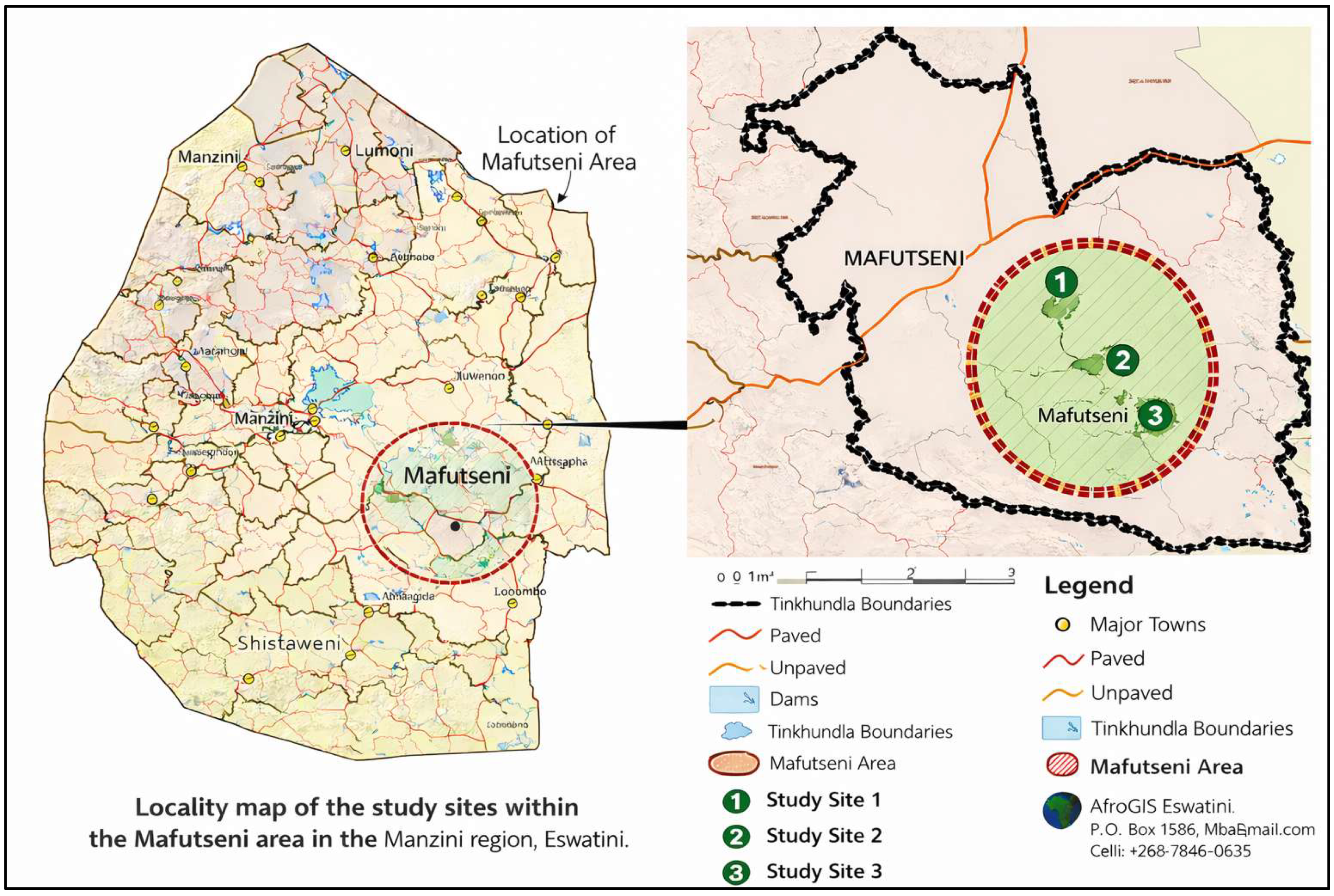
Three study sites were demarcated within the Mafutseni communal area under the Manzini region, the central part of Eswatini, at coordinates 26°27′39.10″ to 26°28′15.18″ South and 31°31′58.15″ to 31°33′26.41″ East on both sides of the Mzimpofu River (Figure 1). The vegetation of the area falls under the Lowveld (Veld type 10) and the Arid Bushveld (Veld type 11), as described by [35]. It was recently classified as Granite Lowveld (SVI-3) by [36]. The geology upon which the vegetation type occurs from north to south consists of the Swazian Goudplaats Gneiss, Makhutswi Gneiss and Nelspruit Suite (granite gneiss and migmatite). Further south, the younger Mpuluzi Granite (Randian) forms the major basement geology of the area [36]. Soils are sandy in upland areas and clayey with high sodium content in lowlands. The region does not experience frost in winter, but it does in frigid years. The mean annual temperature is 20.9 °C, and the average annual rainfall ranges from 450 mm to 900 mm. The mean annual precipitation peaks in a north–south direction in the country [36].
The area is customarily managed as communal rangeland, providing grazing, firewood and medicinal plants. Crop production also occurs in designated fields, where primarily rain-fed crops, such as maize, pumpkins, sweet potatoes, and other crops, are cultivated. The Mzimpofu River divides the site longitudinally. The area is mostly bush encroached by Dichrostachys cinerea (L.) Wight & Arn, Vachellia nilotica (L.) P.J.H. Hurter & Mabb. Subsp. Kraussiana (Benth) Kyal. & Boatwr and various invasive alien plant species. The most important invasive alien plant (by sheer volume) is L. camara, which forms dense, impenetrable stands of up to two metres or more in height. The same applies to the native Dichrostachys cinerea. The riparian vegetation is also invaded by Caesalpinia decapetala (Roth) Alston and C. odorata, with the latter slowly spreading further inland.

2.2. Data Collection and Site Selection

The Ministry of Agriculture in Eswatini launched a nationwide alien and invasive plant clearing programme. The programme utilised contractors who hired local community members to carry out the actual clearing of alien invasive plants in their own communities. Resources for the programme were allocated following the declaration of C. odorata as a national disaster, as stated in a government gazette in 2005 [15]. The alien and invasive plant clearing programme did not solely focus on C. odorata but also cleared other IAPs such as L. camara, Parthenium hysterophorus L., (demonia weed) and Eichhornia crassipes (Mart.) Solms (water hyacinth), among others, which adversely affect both aquatic and terrestrial biodiversity and ecosystems. In the study area, plants were cut at a height of 100–150 mm above ground, and the herbicide was applied to the freshly cut surface (stumps) of all stems. The herbicide Plenum (fluroxypyr and picloram) was used in a mixture at a ratio of 1.5% per 20 L of water, and blue dye comprised 0.5% of the mixture.
Nineteen sample plots within the three study sites were selected to represent a range of invasive and alien plant infestation levels, from no infestation to severe infestation. This selection was made as no pristine sites were present in the area due to the current land management practices of continuous grazing and harvesting of natural resources. All sampled plots were marked using GPS for future referencing. Cleared sites were selected based on the clearing activity that had occurred, as confirmed by the presence of blue dye on cut stems. Uncleared sites were chosen based on their accessibility, as some were inaccessible due to dense stands of L. camara, D. cinerea and erosion gullies. The erosion gullies may result from the poor management of sodic sites (soils with high sodium content), as these soils are vulnerable to erosion and, once eroded, are difficult to control [37]. The representation of local environmental conditions and the presence of invasive species of interest, aligning with practices in ecological fieldwork [38], were among the key considerations in site selection. While baseline data were unavailable, the selected sites were deemed suitable for a ‘snapshot’ analysis because they provided contrasting conditions—areas subjected to management interventions versus unmanaged areas, allowing for comparative assessments of the immediate impacts of invasive plant control efforts on vegetation recovery. In the context of invasive plant removal, early post-management data are critical for understanding the initial effectiveness of control measures and informing adaptive management strategies [12].
Although long-term monitoring is ideal, short-term, post-clearing assessments can reveal the initial trajectory of ecosystem recovery and the potential for further intervention [39]. Furthermore, by selecting sites with similar environmental characteristics, we minimised variability that could confound the results, making the one-season comparison relevant and informative. Sampling was conducted on herbaceous and woody plants at these sites.
Woody plants were enumerated within 200 m2 belt transects (100 m rope by a 2 m pole) moved at 90° along the rope, and all woody plant species were recorded [40,41]. The transects were placed within representative areas (cleared and uncleared sites), where a systematic recording of the presence, abundance, and characteristics of woody plants was conducted [42]. For each encountered woody plant, the species name, height class and the number of stems (single or multi-stem) were recorded [43]. Multi-stemmed plants were recorded to determine the rate of coppicing compared to the regrowth (single stems) of alien invasive species. Growth form categories (tree, shrub, dwarf shrub, graminoid and forb) of the woody and herbaceous data were collected according to [44].
The step-point method [45] was used to enumerate herbaceous plants using a minimum of 200 step points within 10 × 20 m plots [46,47] for each habitat type (cleared and uncleared). Ten transects were done per sampled plot. A survey cane was lowered to the ground at each point, and the herbaceous plant nearest to the cane was recorded at 1 m intervals [47,48]. The dye on the stumps identified the herbicide-treated (cleared) sites. Herbaceous layer sampling was not done before clearing, but was done after one year of clearing to determine the recovery of the native vegetation.
The veld condition index (VCI) was calculated by combining the abundance of grasses obtained through a standardised survey [49]. An ecological index of less than 40% indicates veld in poor condition, 40–60% indicates veld in moderate condition and above 60% indicates veld in good condition [50]. The ecological status and relevant multiplier of each grass species were ascertained using [51]. Each species was classified according to its response to grazing pressure and preference by grazers [50].

2.3. Data Analysis

The Shannon-Weiner and Simpson’s diversity indices were used to measure species richness and evenness. Simpson’s diversity index (SDI) was calculated using the formula for diversity (D) as follows:
D = 1 n n 1 N N 1
where n is the total number of individuals of a given species, and N is the total number of individuals of all species in the sample.
The value of D falls between 0 and 1, where 1 indicates high diversity and 0 indicates low diversity. The index measures the probability that two randomly selected individuals from a sample will be of the same species. The Shannon-Weiner index (H′) combines the variety and evenness components as one overall index of diversity [52]. It was calculated using the following formula:
H′ = −∑ (Pi) log (Pi),
where Pi = is the proportion of individuals belonging to the ith species relative to the total number of individuals.
The JASP software (version 0.18.1.0) was used for all data analysis. Ref. [53] postulated that Levene’s test shows good statistical properties when populations are heavily skewed, overall sample sizes are small, and groups are unbalanced. In contrast, ref. [54] alluded that a non-parametric Levene’s test has suitable type 1 error and power properties. In contrast, type 1 errors may falsely conclude that there is a difference in population variances when there is none. The herbaceous and woody species diversity (invasive alien plant prevalence) was compared between cleared and uncleared sites using the Student t-test [55]. Where data were not normally distributed, the non-parametric Mann–Whitney U-test for two independent samples was used for analysis [56]. Variances of the data were tested using the Shapiro–Wilk and Levene’s tests, respectively, to compare cleared and uncleared sites using 5% significance level.
The VCI for the cleared sites was then compared with the uncleared sites. Herbaceous data were categorised into ecological groups: Decreaser, Increaser I, Increaser II, Increaser III and Invaders, based on their ecological roles within the community [45,57,58]. The percentage cover of each ecological group was calculated by dividing the number of points recorded for each ecological group by the total number of points and multiplying by 100. The veld condition was then assessed using the VCI, which is a weighted index that reflects the overall ecological health of the veld. The VCI was calculated by assigning scores to each ecological group’s percentage cover: Decreaser × 10, Increaser I × 7, Increaser II × 4, Increaser III and invaders × 1 [58].
In addition to these analyses, A generalised linear model (GLM) was then fitted to the Shannon-Wiener diversity values to evaluate the influence of site clearance on overall diversity. GLMs were selected because they extend traditional linear models by allowing response variables to follow non-normal distributions, which is particularly appropriate for ecological indices that are bounded and often skewed [59]. Model performance was assessed using residual deviance and information criteria, including the Akaike Information Criterion (AIC) and the Bayesian Information Criterion (BIC), with lower values indicating a stronger model fit and greater parsimony [60].

3. Results

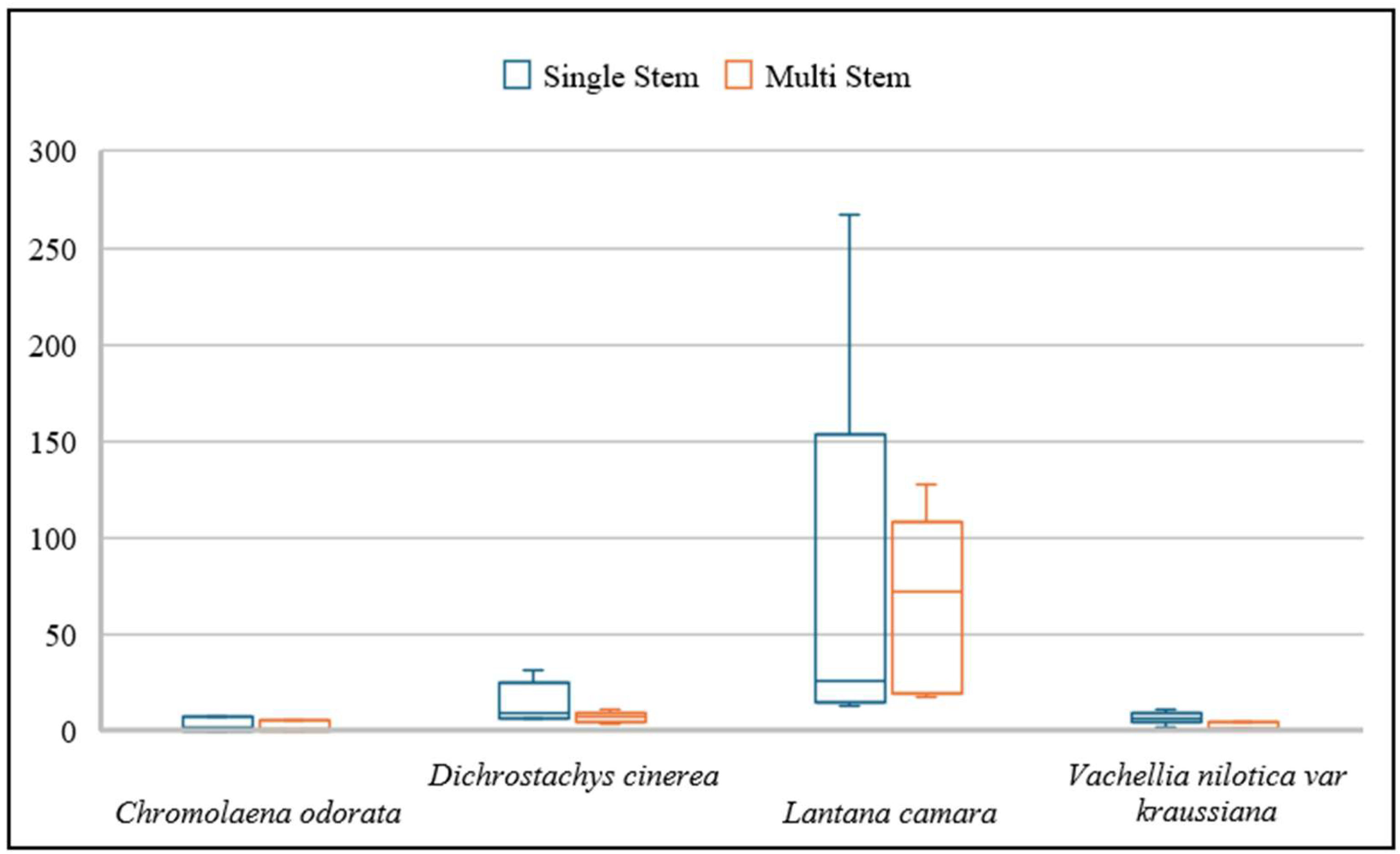
Differences between single- and multi-stemmed individuals were assessed using the equality test of variances (Levene’s), resulting in an F-value of 3.292 × 10⁻⁴ with 1 degree of freedom for both df1 and df2 (Table 1). The stem number patterns are also illustrated in Figure 2.

3.1. Equality and Normality of Variances

The results of the Shapiro–Wilk test indicated a significant result for the p-values of cleared and uncleared C. odorata sites (<0.001). They also show significant results for the p-values of cleared L. camara (<0.001) and uncleared L. camara (<0.003) sites, respectively. Hence, the normality assumption is violated for both C. odorata and L. camara sites (Table 2). Such a violation of normality means that the non-parametric independent test, the Mann–Whitney U-test, will be used to test the difference between the medians, rather than the independent t-test.
The results of Levene’s test also indicated a significant result for the p-value of cleared and uncleared C. odorata sites (<0.003), which is less than the critical value of 0.05. The p-value for L. camara (0.498) indicates a non-significant result, as it exceeds the critical value of 0.05.

3.2. Cleared and Uncleared Sites for C. odorata

The rejection of the null hypothesis was determined by the p-value of Levene’s test, which is less than the significance level of 5% (Table 2), indicating a difference between the variances of cleared and uncleared sites. Therefore, the samples were drawn from populations with unequal variances. Similarly, the acceptance of the null hypothesis was supported by a Mann–Whitney U-test result at a 5% significance level, indicating no statistically significant difference between the medians (U = 57; p < 0.290, Mann–Whitney U-test) at a 5% significance level, indicating that the central tendency of cleared and uncleared sites was similar (Table 3).

3.3. Cleared and Uncleared Sites for the L. camara

The p-value of Levene’s test (Table 2) is greater than the significance level of 5%, also supporting acceptance of the null hypothesis, with no difference in the variances of cleared and uncleared sites. Therefore, the samples were drawn from populations with equal variances. Additionally, the Mann–Whitney U-test result at a 5% significance level led to the rejection of the null hypothesis, indicating a statistically significant difference between the medians, as shown in Table 3.

3.4. Independent T-Test and Welch Test for Chromolaena and Lantana

The independent t-test statistic indicates a difference in means and no statistically significant difference between the cleared and uncleared sites of Chromolaena and Lantana in terms of the recorded number of live stems (Table 3). The Welch test results for both Chromolaena and Lantana reflect no statistically significant difference in means for cleared and uncleared sites (Table 3).

3.5. Floristic Analysis of Woody Vegetation

Cleared sites contained 52 woody plant species comprising 27 plant families, with a Shannon-Weiner index (H′) of 2.081 and 9.974 effective number of species (ENS). Within the cleared sites, Simpson’s diversity index value is 0.722. In contrast, uncleared woody sites recorded 40 woody species from 23 plant families, H′ of 2.032 diversity and 8.620 ENS. Within the uncleared sites, Simpson’s diversity index value of 0.732 was recorded. The Simpson’s diversity index and Shannon-Weiner index values are shown in Table 4.
Site 16 recorded the lowest Shannon-Weiner and Simpson’s diversity indices (0.912 and 0.333), reflecting the highest infestation of L. camara in all the surveyed woody sites. Site 14 recorded the highest Shannon-Wiener and Simpson’s diversity index values (2.863 and 0.928) among all the sites, coupled with the second-lowest recorded L. camara infestation. Site 9 recorded the lowest L. camara count, with the second-highest Shannon-Wiener and Simpson’s diversity index values among all the sites (Table 4).

3.6. Herbaceous Veld Condition Analysis

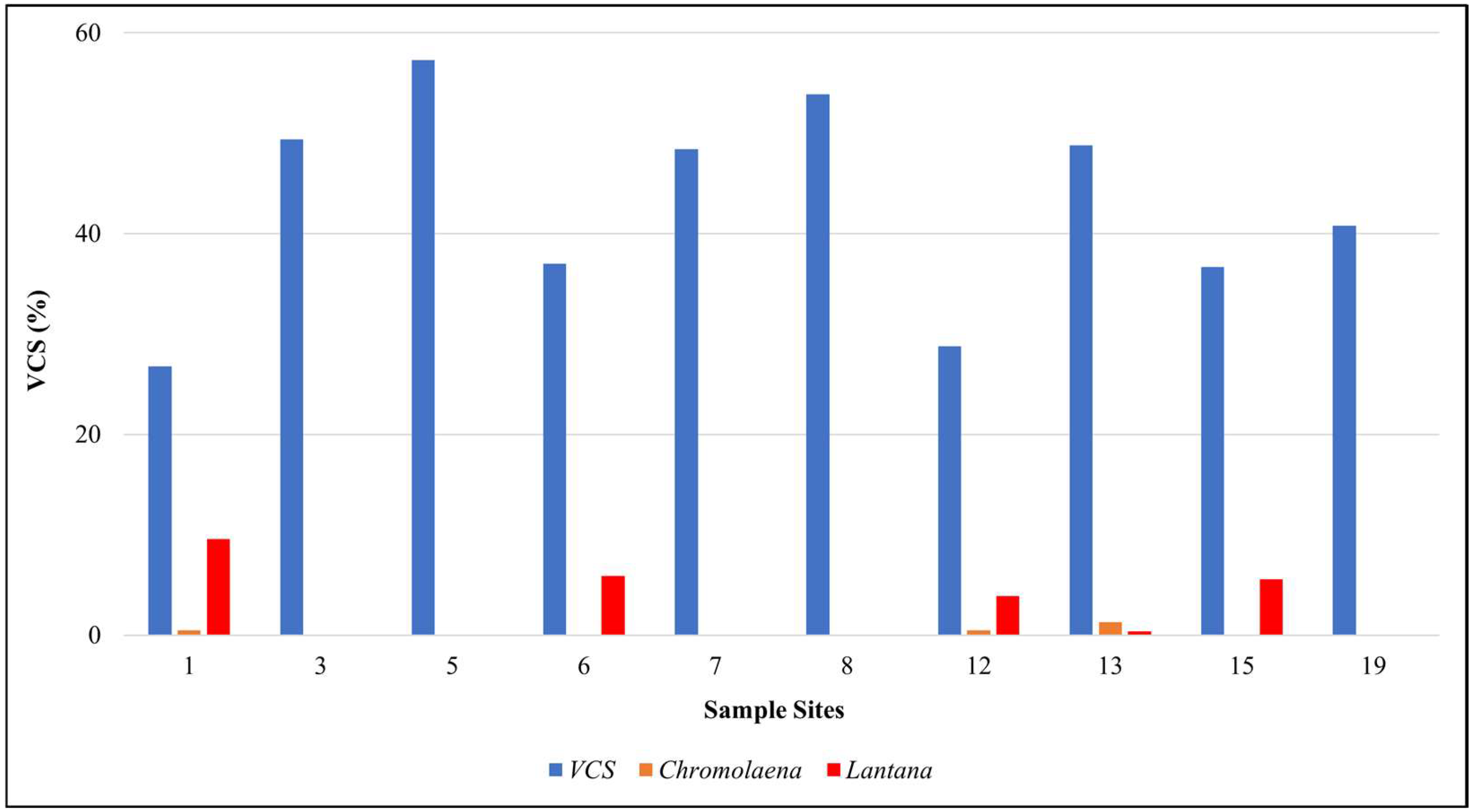
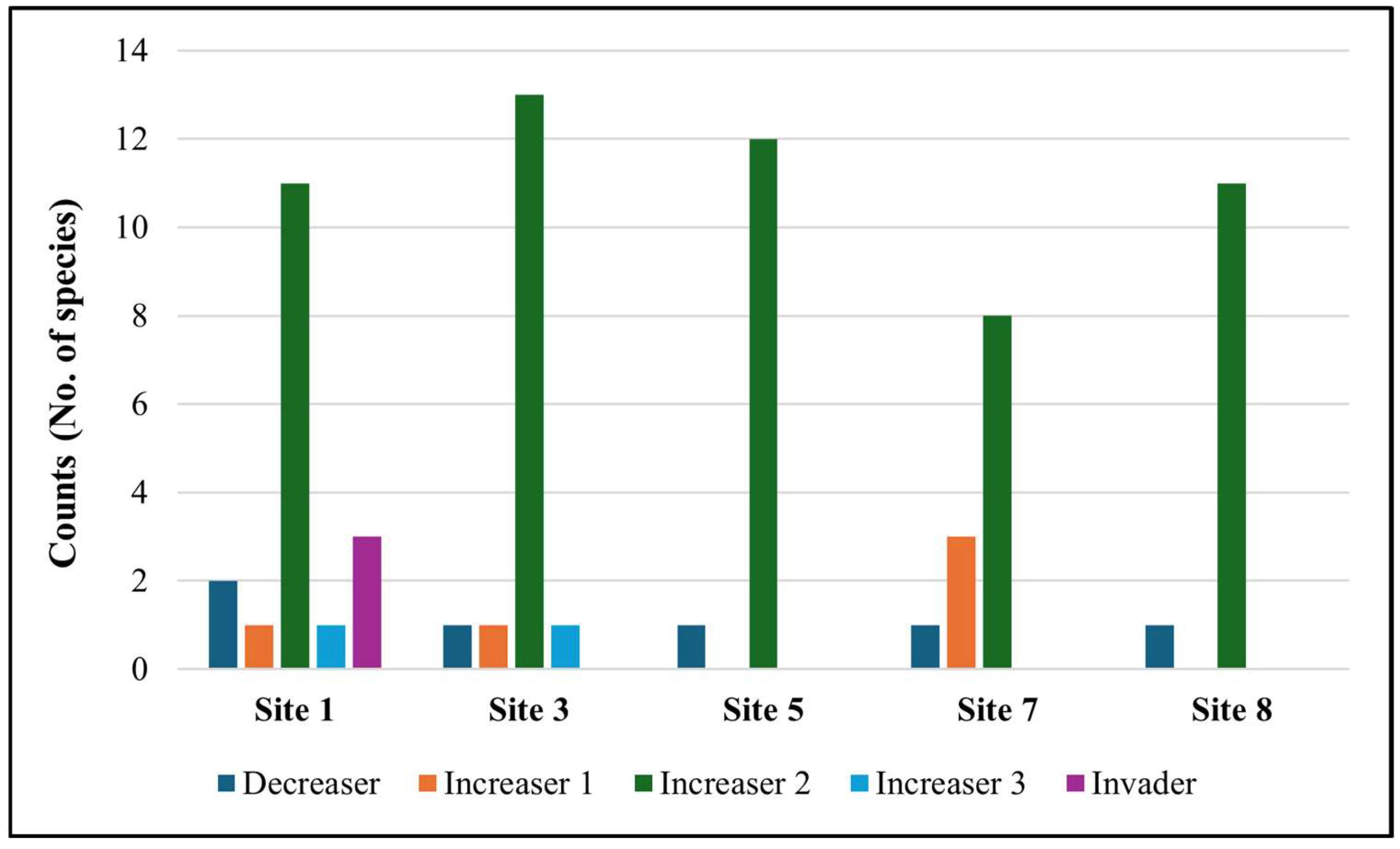
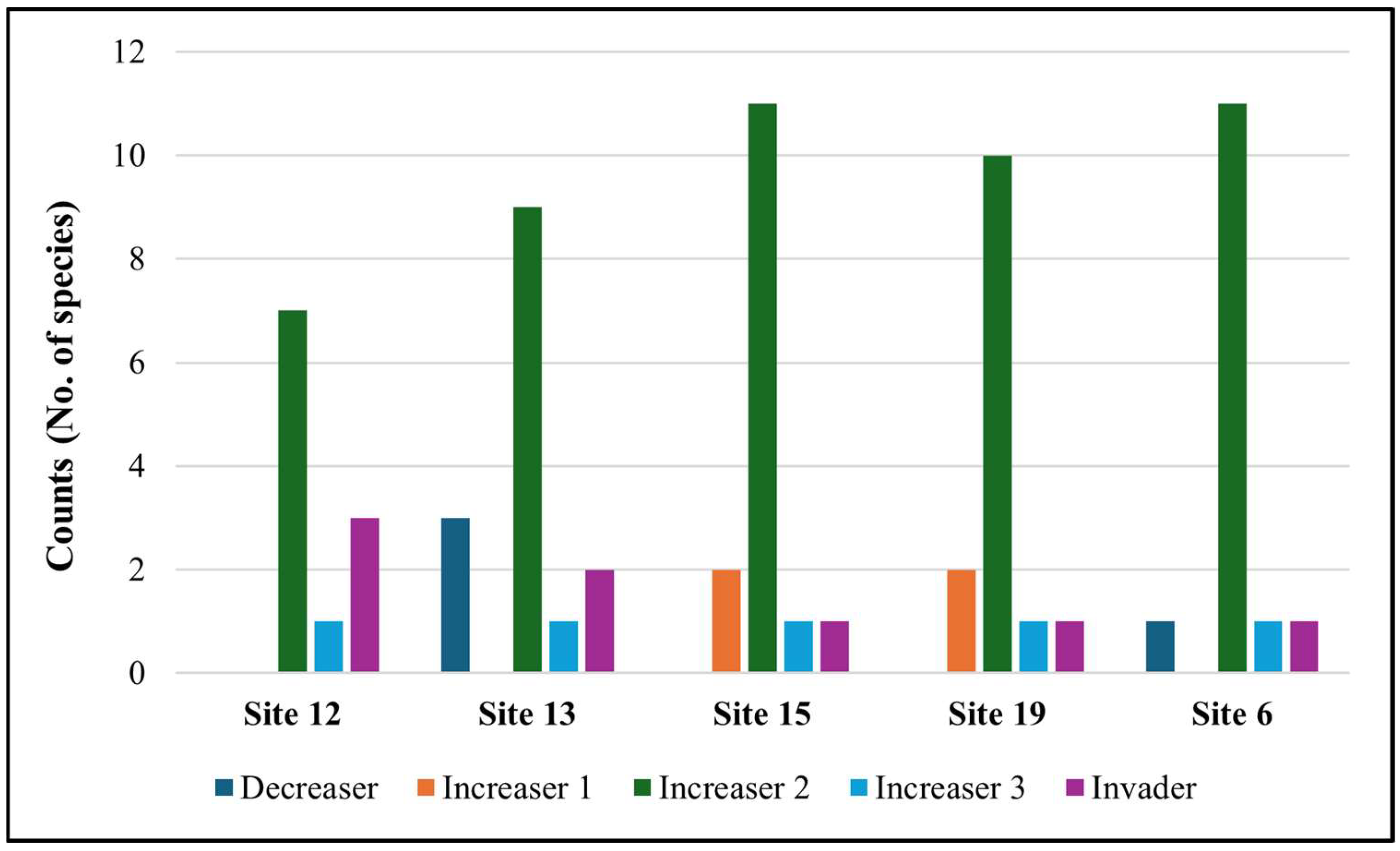
The Veld Condition Score (VCS) results showed sensitivity to the presence of invasive alien plant species, such as C. odorata and L. camara. Sites that did not record any invasive alien plants, such as sites 3, 5, 7, 8, and 19, had a moderate VCS of 40% or greater. Uncleared sites mostly had veld in a moderate condition (between 30% and 60%), while Site 1 was an exception with a poor VCS of 26.8%. As shown in Figure 3, the veld condition of all sites is generally correlated to the infestation rate and diversity of invasive alien plants within individual sites. However, site 13 was an outlier, with the presence of invasive alien plants but a moderate VCS of 43.8%. All other sites, which recorded the presence of C. odorata and L. camara, had poor VCS.
Sites with no recorded invasive alien plants are sites that had a high degree of diversity/heterogeneity, as shown by the Shannon-Weiner (H′) and Simpson’s (D) indices, respectively (Table 5). All cleared sites except site 13 had high diversity/heterogeneity, as shown by the Shannon-Weiner (H′) and Simpson’s (D) indices, respectively. The high diversity of cleared sites can be attributed to the subsequent sprouting of dormant seed banks after the sites were cleared. The low VCS could be attributed to the absence of Decreaser species in these disturbed sites.
Cleared herbaceous sites had a combined richness of 29 grass species, with values of Shannon-Weiner and Simpson’s diversity indices of 1.952 and 0.818, respectively. Two sites recorded Decreaser species: site 6 (Themeda triandra Forssk.,0.85%) and site 13 (Digitaria eriantha Steud., 1.87%, Panicum maximum Jacq., 0.75% and Sporobolus fimbriatus (Nees ex Trin.) 0.37%). In comparison, uncleared sites had a combined richness of 39 species with values of Shannon-Weiner and Simpson’s diversity indices of 1.992 and 0.809, respectively. Decreaser species were recorded in every site, namely site 1 (Digitaria eriantha 1.42% and Phragmites australis (Cav.) Trin. ex Steud., 0.95%), site 3 (Digitaria eriantha 3.45%), site 5 (Digitaria eriantha 19.39%), site 7 (Setaria sphacelata (Schumach.) Stapf & C.E. PHubb. ex M.B. Moss var. sericea (Stapf) Clayton., 0.95%) and site 8 (Panicum maximum 2.36%). The high number of Decreaser species at site 13 may have contributed to the high VCS (43.8%), despite the presence of invasive plants. The full list of species recorded at each site is shown in Table S1.

3.7. General Linear Model

The results of the generalised linear model (GLM) fitted to Shannon–Wiener diversity show a very low residual deviance (0.015) and negative information criteria values, AIC of −18.78 and BIC of −16.06 (Table 6).
These results indicate that the model fits the observed data extremely well, with minimal unexplained variation in Shannon diversity. The coefficients for terrain units 4 and 5 indicate minor and non-significant differences in Shannon-Weiner diversity relative to the reference terrain unit (Table 7). None of the environmental, land-use, or invasive species variables had a significant independent effect on Shannon–Wiener diversity (p > 0.05), indicating that plant species diversity was not strongly driven by any single predictor across the sampled sites. This suggests that Shannon diversity is significantly influenced by terrain, veld condition, land-use status, and the extent of invasive species cover in the study area. Particularly, it implies that changes in vegetation diversity are closely associated with both biotic pressures (IAPs cover) and abiotic or management-related gradients (terrain and clearing status).

4. Discussion

4.1. Post-Clearing Vegetation Responses

Several reasons have been proposed for the lack of, or partial recovery of, native vegetation after clearing invasive alien plants. These may include soil legacy effects, depleted native soil seed banks, re-invasion, secondary invasion and weedy native species dominance [61]. Lantana camara more heavily invaded the study area than C. odorata, whose presence was more sparsely distributed. While L. camara was found to form dense, impenetrable stands, its prevalence might be linked to the right growing conditions, such as unshaded areas caused by wood harvesting and lack of hot fires necessary for killing actively growing plants [62]. Such favourable conditions provide seeds for reinvasion aided by frugivorous birds [17,27,62], pollinating agents such as bees [63], streams and rivers [64], primates [64,65] and rodents [65]. Frugivorous birds prefer visiting and dispersing alien plants over native species; such visitation may not result in the dispersal of native seeds, as they tend to prefer alien plants [66]. When native seeds are dispersed during visitation, they may not germinate due to allelopathy and competition for resources, such as water, light, and nutrients, from L. camara [66]. The sparse invasion by C. odorata may be related to high fire frequency in the area, as it is not fire-adapted [67,68]. Fire is an effective management tool against C. odorata invasion [24,69]. Chromolaena odorata is not highly flammable but fire-sensitive, and fire should be considered a control tool [24]. Ref. [70] state that C. odorata is killed by intense fires, with the ability to survive mild fires. This is significant as residents start veld fires yearly, often burning without being controlled unless they pose a danger to people or property.

4.2. Clearing Efficiency and Re-Invasion

This study defined re-invasion as the re-establishment of nonindigenous species in a location after control measures have been implemented [71]. Multiple stems frequently arise due to inadequate cutting efficiency, primarily stemming from a lack of substantial clearing impact [69]. In this study, single-stem plants found in cleared areas measuring 0–1 m in height were interpreted to indicate growth from the available seed bank. In contrast, those above 1 m were considered to have been missed during the clearing exercise. While no statistical difference was evident between single and multi-stems (Table 1), the results show a higher p-value (0.986) for single stems compared to multi-stems (0.423). Figure 2, on the other hand, shows that a high number of multi-stems exist for L. camara, indicating inadequate plant mortality despite a consistent ankle-high cut height. Single stems were mostly recorded in areas where dense stands of invasive plants have been cleared. The number of L. camara seedlings (0–0.5 cm) per site correlated with the number of plants taller than 1 m, as shown in Figure 4. Such a correlation is evident in sites 16, 17, and 18, to the point that they comprise more than half of the woody species composition in sites 16 and 17. This necessitates a follow-up intervention to deplete seed banks of invasive plants and allow native species to establish in the area, as little is known about the regeneration requirements of native plants in the savanna biome [72]. Follow-up control is important as invasive plants like L. camara produce large quantities of seeds ranging between 6000 and 12,000 per year, albeit with a low and variable germination rate [73].
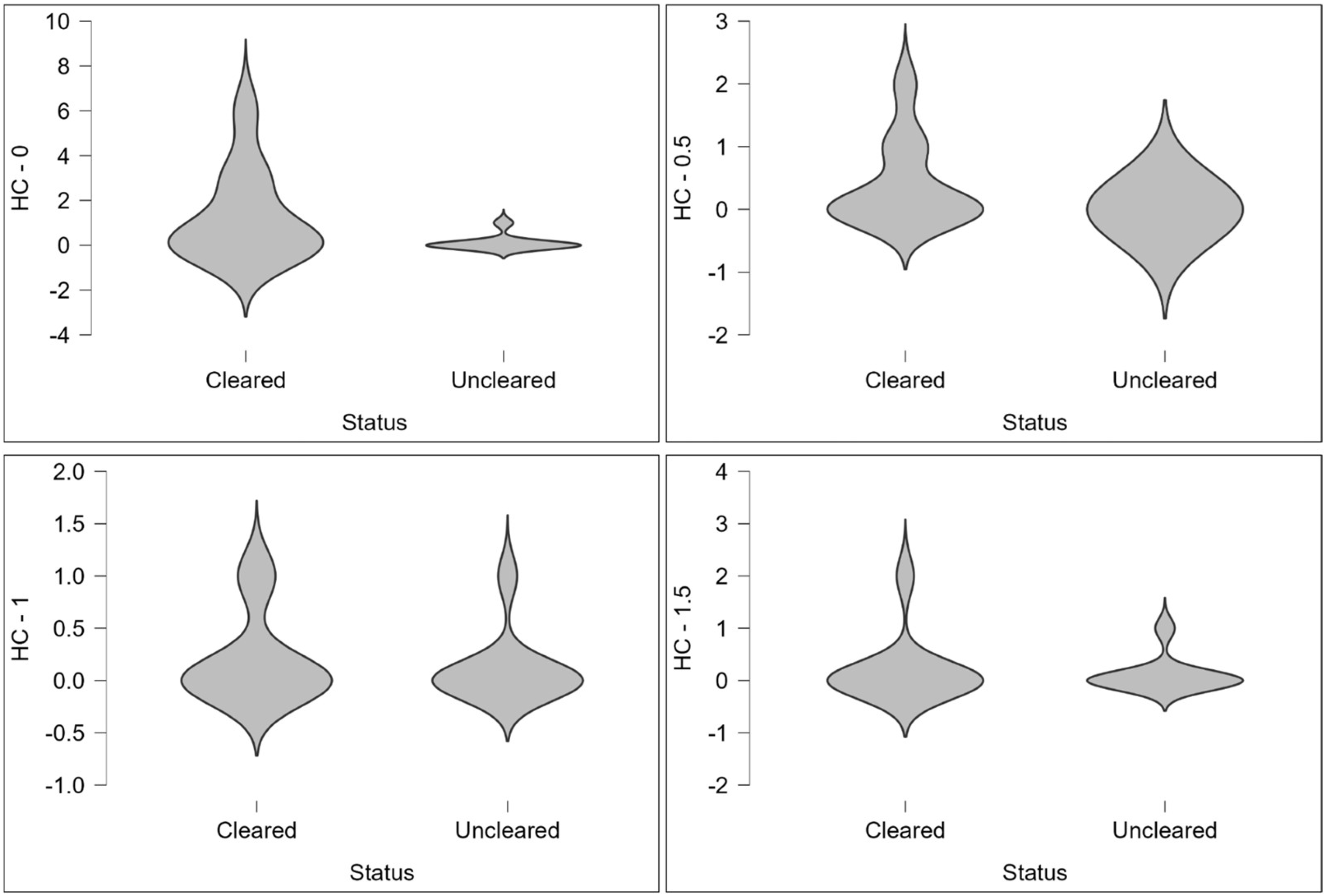
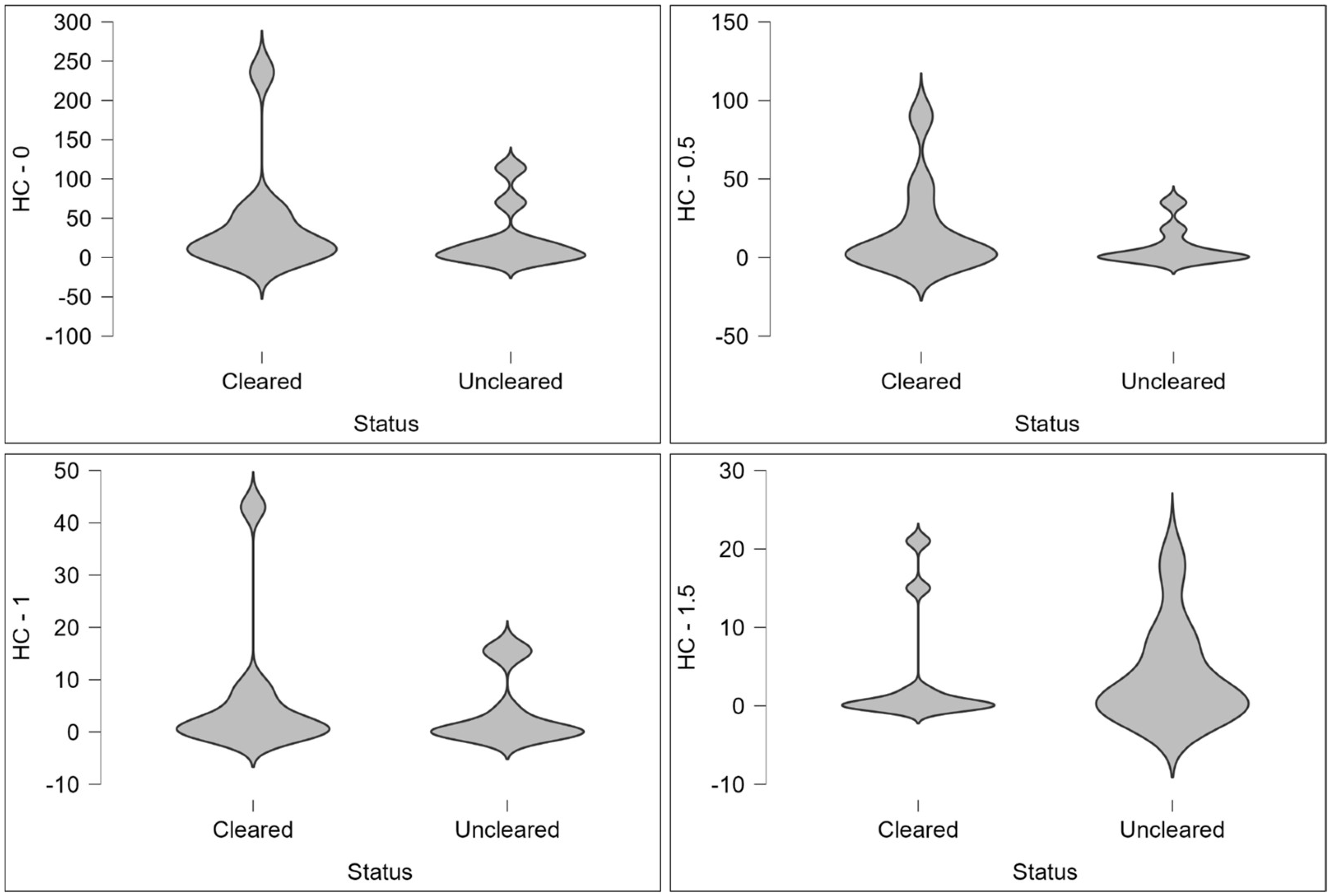
Chromolaena odorata also produces large quantities of seeds and is known to reduce carrying capacity, species diversity [24] and the ability to invade undisturbed habitats [56]. Multiple stems signify the efficiency of the clearing methods employed; invasive plants, which are trees and shrubs, survive clearing efforts by resprouting [69]. High efficiency is achieved by applying the correct cutting height and herbicide, as well as extensive training of those employed to clear invasive plants [69,72]. The results of this study affirm that initial invasive plant clearing effectively reduces infestations dominated by large Height Class (HC; <2 m) individuals and dense stands, while simultaneously increasing the prevalence of resprouts and young saplings (1–2 m in height) (Figure 4) [69].
Clearing was effective in reducing taller C. odorata individuals (HC 1.5 m and HC > 2 m), demonstrating high efficiency in removing mature plants and suppressing vertical structure (Figure 4). However, cleared sites showed markedly higher abundance and variability in lower height classes (HC 0–1 m), indicating rapid post-clearing regeneration through seedling recruitment and resprouting. Ecologically, this shift reflects strong disturbance responses and the species’ ability to exploit open niches created by clearing. From a management perspective, these results show that clearing alone provides only short-term control. Without timely follow-up treatments, cleared sites facilitate renewed invasion driven by juvenile plant dominance. Effective long-term management, therefore, requires integrated strategies that combine clearing with post-treatment monitoring, targeted control of early growth stages, and restoration measures to reduce the risk of reinvasion.
Figure 5 shows contrasting responses of L. camara height classes to clearing. Lower height classes (HC 0, 0.5 m and 1 m) showed markedly higher values and greater variability in cleared sites, while uncleared sites were tightly clustered near zero. This pattern indicates enhanced ground-level recruitment and low-stature regrowth following disturbance, consistent with resprouting and seedling establishment after clearing. In contrast, taller height classes (HC 1.5 m and HC > 2 m) exhibited the opposite trend: uncleared sites showed broader distributions and higher mean values, whereas cleared sites consistently approached zero, reflecting the effective removal of mature plants. Overall, clearing shifts L. camara structure from taller individuals to abundant juvenile and low-height classes, highlighting the importance of follow-up control to prevent reinvasion and vertical re-establishment.

4.3. Woody Species Composition and Diversity

Of the species found in the study area, the plant families Moraceae and Tiliaceae are unique to uncleared sites, while Aquifoliaceae, Bignoniaceae, Boraginaceae, Myrtaceae, Papaveraceae (an alien species), Rubiaceae, and Sapindaceae are unique to cleared sites. The results also show that cleared sites have more individual species (52) than uncleared sites (40). Despite having more individual species and plant families, cleared sites have higher mean Shannon-Weiner (H′) and lower Simpson’s (D) Diversity indices compared to uncleared sites (Table 4). This suggests that clearing influenced species richness and evenness without substantially altering dominance patterns at the community level. Cleared sites also have a lower number of effective species when compared to uncleared sites. Across both site categories, ENS values were consistently lower than the corresponding Shannon–Wiener diversity values, indicating that community structure in both cleared and uncleared sites was influenced by unequal species abundances, with relatively few species contributing disproportionately to overall diversity.
The study opted to use more than one heterogeneity index to analyse species diversity. The reason more than one heterogeneity index is used in the analysis is that the Shannon-Weiner index is mainly affected by (species richness) rare species, while the Simpson index is primarily sensitive to changes in the abundance of the commonest species (dominance), and both indices are sensitive to sample size [74]. The sample size is important, considering the small sample size used in this study. While Simpson’s index emphasises the evenness component of diversity, both Simpson’s and Shannon’s indices have the ability to show reasonable disparity to changes in landscape evenness and richness, respectively [75]. According to [74], Shannon’s transformed index (exp H′) provides the greatest discrimination between sites. The lower diversity indices and effective number of species (ENS) in cleared sites may be due to the higher dominance of L. camara or limited seed banks. This emphasises the importance of clearing revisits after initial invasive alien plant clearance and their timing. Cleared sites may have recorded more individual species due to the proliferation of shade-intolerant species, which can colonise disturbed sites and take advantage of changed environmental conditions. Uncleared sites represent a more stable community occupied mainly by the more established species. As plots may differ in factors other than invasion, the proximity of uncleared sites to cleared sites was significant, as it was not possible to determine the state of the invaded sites prior to their clearance. It is essential to emphasise that it is impossible to state the ideal state of the vegetation, as it has been altered by human activities such as resource extraction, coupled with grazing and browsing pressure from ungulates. Diversity indices are crucial for assessing the impact of pollution or other environmental stressors on a single community or for identifying the most suitable community from a group of similar habitats for conservation purposes [74].

4.4. Statistical Assumptions and Effect Sizes

The assumption of normality necessitates the use of the t-test; however, normality must first be verified [76]. The assumption of normality can be tested, and the Shapiro–Wilk test is used when the sample size is less than fifty [77]. It is suggested that the Shapiro–Wilk test is a preliminary test of the normality of data [78]. This study employed the Shapiro–Wilk test to assess normality, given a sample size of less than fifty. Where the assumption of normality has been rejected, other tests, not the t-test, must be used [76]. The t-test can be unsatisfactory with regard to type 1 error rates when data samples are from populations with unequal variances [79]. The Shapiro–Wilk test revealed evidence of non-normal distribution for all results, with p-values less than 0.001 (except for L. camara in uncleared areas, which had a p-value of 0.003. This indicates that the data is statistically significant and significantly deviates from a normal distribution, suggesting that the normality assumption may be violated. Therefore, a test which does not assume an equality of variances is required to validate such a result.
Before comparing sample means, it is imperative to verify that the underlying populations have a common variance [80]. Levene’s test is used in preliminary testing for equality of variances [78,80]. The Levene’s test was employed to assess whether the variances of the different groups (C. odorata and L. camara in cleared and uncleared sites) are equal. Results indicated relatively low p-values for C. odorata (0.003) and higher values for L. camara (0.498), as they were greater than the alpha value of 0.05. The low C. odorata values suggest a possibility of significant differences in variances among the groups. Hence, observed differences or deviations from the assumptions are unlikely due to random chance. The opposite may be true for the observed results for L. camara, as they are not statistically significant. The significant result of C. odorata necessitates the use of an equivalent non-parametric test [81] to validate the observed results.

4.5. Mann–Whitney U-Test Results for C. odorata

When the normality of the assumption cannot be met, and the sample size is small (n < 25), a non-parametric test, such as the Mann–Whitney U-test, should be used for analysis instead of the parametric t-test [82]. The Mann–Whitney U-test is a non-parametric test for comparing medians from two unmatched samples, as it is distribution-free and suitable for data that is not normally distributed [55]. The results that the null hypothesis was rejected based on the p-value of Levene’s test (Table 2) being less than the significance level of 5% (α = 0.05) means the test found evidence to suggest that there is a statistically significant difference between the variances of the sites (cleared and uncleared). The F-value (11.554, with 17 df) and the p-value of 0.003 also provide statistical evidence for differences in variances. In contrast to Levene’s test, the Mann–Whitney U-test was used to compare the medians of the two groups. The results showed that the null hypothesis was accepted, which states that there is no statistically significant difference between the medians of the cleared and uncleared sites. This acceptance is based on the reported Mann–Whitney U-test result, where U = 57 (Table 3), and the associated p-value of 0.290 at a 5% significance level (α = 0.05). According to the Mann–Whitney U-test, there is no strong evidence of a significant difference in medians between the two groups.
The rejection of the null hypothesis based on Levene’s test implies that the variances between the cleared and uncleared sites are unequal. The acceptance of the null hypothesis based on the Mann–Whitney U-test implies that there is no strong evidence to suggest a significant difference in medians. Exploring the data more deeply and conducting additional analysis may be essential to understanding the relationship between the cleared and uncleared sites and the factors affecting their variances and central tendencies.

4.6. Independent T and Welch Results for Chromolaena and Lantana

The t-test assumes normality of data, and when this assumption is not fulfilled, a parallel non-parametric test should be used [83]. The independent t-test is often used to test the equality of means from independent samples with equal variances [84]. It compares the means of two groups of sample datasets [77]. Ref. [83] states that the independent t-test determines the significant difference between the means of two independent samples. Levene’s test tests the homogeneity of variances before an independent t-test is performed. The results suggest that there are no statistically significant differences in means between the cleared and uncleared groups for both C. odorata and L. camara based on the independent t-test. Therefore, the formulated hypothesis is accepted.
Welch’s test is often preferred when variances are unequal [84]. The Welch test is more reliable when sample variances are unequal, and sample sizes are unequal [79]. While it is widely accepted that there is no such thing as the most potent or unbiased test, Welch’s test is recommended when sample sizes are unequal [78]. Ref. [85] state that Welch’s test assumes normality but not equality of variances. This study employed Welch’s test for analysis, as the sample sizes for woody sites are unequal. The results suggest that there are no statistically significant differences in means between the cleared and uncleared groups for both C. odorata and L. camara based on Welch’s test (Table 3). The p-values are greater than the typical significance level of 0.05, indicating that the observed mean differences are not statistically significant.
Group difference indices often note the magnitude of differences between two or more groups [86], and Cohen’s d was chosen for this study. An effect size is simply a standardised and objective measure of the magnitude of the observed effect [77] and is independent of sample size, unlike significance tests [87]. Ref. [87] states that Cohen’s d is an appropriate effect size measure when comparing two group means. Cohen’s d result indicates that although there may not be a statistically significant difference, there may still be some practical or clinical significance, as the effect sizes are not negligible, around 0.74 for C. odorata and 0.23 for L. camara (Table 2). In interpreting these results, it is necessary to avoid quantifying them as small or large, as this can be misleading [88,89]. However, the focus is on the statistical significance of the differences between groups.
In practical terms, the results indicate that, based on the analysed data, there is no strong evidence to suggest that clearing these invasive plant species significantly impacts the health of vegetation and biodiversity in the communal lands of Manzini when comparing cleared and uncleared sites. While the means are not statistically significantly different, the effect size (Cohen’s d) is not negligible, especially for C. odorata (around 0.74). This suggests that the differences between the groups may have some practical or clinical significance, even though they do not reach statistical significance. This could imply that, while there may be subtle effects of clearing, these may not be strong or consistent enough to be detected with the current sample size and data variability. Again, the lack of statistical significance in mean differences does not necessarily mean that clearing methods are ineffective. This suggests that the measured outcomes in the study are not significantly impacted by clearing when comparing cleared and uncleared sites. However, future studies should consider other factors that may affect outcomes, such as the timing of clearing, ecological conditions, and the specific methods used for clearing.

4.7. Herbaceous Veld Condition

This study focused on species composition as a precursor for the recovery and state of the veld after invasive plant clearing. The VCS indicates veld fuel and forage production, resistance to soil erosion and plant species composition [50]. Veld condition refers to the condition of vegetation in relation to functional characteristics, normally sustained forage production and resistance to soil erosion [90]. The percentage and abundance of Increaser grass species replacing highly palatable Decreaser species are a sign of declining veld. The results align with findings from communal grazing lands in the Eastern Cape, where continuous grazing, uncontrolled fires, and selective grazing contributed to veld deterioration [91]. The study area is subject to uncontrolled winter fires, with fire intensity largely determined by fuel load, which in turn is driven by rainfall during the preceding rainy season and associated vegetation growth. A high VCS percentage typically indicates better veld condition, which can be associated with factors such as grass cover and species diversity. The VCS is unavoidably influenced by recent grazing history [40] and may also be affected by environmental disturbances, such as invasive plant clearing and resource extraction. Where invasive plants are present, high grass density is associated with low shrub density and low grass density is associated with high shrub density [57]. Veld, which is dominated by alien species, is generally considered to be in poor condition [40]. This is observed in the study area, as sites with invasive plants generally recorded lower Veld condition scores. The average VCS for the cleared areas is 37.4%, while for the uncleared areas it is 47.2%.
The VCS percentages for both cleared and uncleared sites vary across the different observations, indicating spatial variability in veld condition. The data suggest that in some cases, cleared areas have higher VCS percentages than uncleared areas, while in other cases, the reverse is true (Table 5). More importantly, the results represent the natural recovery of areas cleared of alien and invasive plants. Recovery of sites may be influenced by dense grass cover, which can hinder the natural recovery of potential savanna areas because the lack of root gaps prevents the successful establishment of tree and shrub seedlings [92]. Thus, varied grass cover may be associated with variability in the VCS of cleared and uncleared sites, as it inhibits the establishment of invasive plant seedlings. Land management practices that degrade the herbaceous layer, such as overgrazing and overstocking, create conducive conditions for the establishment of invasive plants [56]. The study results are consistent with existing research, which indicates that the ecological recovery of areas cleared of invasive plants varies, and in some instances, invasive plants are replaced by other weed species [93].
The variability in VCS percentages between cleared and uncleared areas suggests that the impact of clearing on veld conditions is inconsistent across all locations or conditions. This could depend on various factors, including the type of vegetation, timing of clearing, clearing efficiency and local environmental conditions. These results indicate that there is no universal trend in veld condition improvement or degradation associated with clearing, particularly in the study area. Some cleared areas have higher VCS percentages, suggesting potential benefits, while others do not. These findings highlight the complexity of the relationship between clearing and veld conditions, suggesting that the efficiency of clearing methods may vary and should be considered on a case-by-case basis. To gain a deeper understanding of the factors influencing veld condition, additional analysis and investigation could include assessing specific vegetation types, the extent of clearing and the impact of local environmental factors. Long-term monitoring of veld conditions in cleared and uncleared areas may provide insights into the sustainability of clearing practices over time.
Across uncleared sites, Decreaser species remained moderately represented, despite a clear dominance of Increaser 2 species, indicating that grasslands were under intermediate disturbance (Figure 6). Site 7 was characterised by a notable abundance of Increaser I species, suggesting possible underutilization by grazing and limited fire treatments. In contrast, Site 1 showed a high prevalence of invasive alien plant species, which appeared to suppress the grass component. This pattern suggests that disturbance at Site 1 may have facilitated the establishment of invasive species, leading to the displacement of disturbance-intolerant and more desirable grass species.
Veld Condition Scores (VCS) in cleared sites were negatively affected by the high prevalence of invasive alien plant species, reflecting disturbance and reduced ecological integrity (Figure 7). Sites with minimal to no invasive species (e.g., Sites 13 and 19) recorded VCS values ≥ 40%, underscoring the importance of maintaining veld health. Sites dominated by Increaser II species (e.g., Sites 6, 15 and 19) were largely composed of disturbance-tolerant, subclimax taxa, while the presence of Increaser III grasses indicated overgrazing and declining dominance of desirable species, creating conditions conducive to invasion (Figure 7). Notably, cleared sites with lower VCS exhibited higher effective numbers of species (ENS) than those with higher VCS (Table 5), demonstrating that VCS should be interpreted in conjunction with biodiversity metrics and invasion status rather than in isolation.

4.8. Diversity Patterns and Community Structure

The intercept estimate (β = 2.076, SE = 0.364, p = 0.029) represents the expected Shannon–Wiener diversity value for the reference category, namely cleared sites in the reference terrain unit, at zero veld condition score and zero invasive alien plant cover (Table 7). The statistically significant intercept indicates that baseline species diversity is relatively high in the absence of the explanatory variables. The coefficients for terrain unit 4 (β = −0.020, p = 0.892) and terrain unit 5 (β = 0.039, p = 0.743) indicate negligible and non-significant differences in Shannon diversity relative to the reference terrain unit. Therefore, terrain alone does not strongly influence species diversity in the study area when other factors are held constant.
The positive but non-significant coefficient for uncleared sites (β = 0.063, p = 0.566) suggests a weak tendency towards higher Shannon diversity in uncleared areas compared to cleared sites. However, the lack of statistical significance indicates that clearing history does not exert a strong independent effect on plant species diversity in this dataset. The coefficient for VCS was slightly negative and non-significant (β = −0.002, p = 0.784), implying that variation in veld condition score does not translate into measurable changes in Shannon diversity. Thus, species diversity may be relatively insensitive to changes in veld condition, or VCS captures structural or compositional changes not fully reflected by Shannon diversity.
The negative but non-significant effects for C. odorata (β = −0.130, p = 0.354) and L. camara (β = −0.004, p = 0.848) indicate a tendency for Shannon diversity to decline with increasing invasive plant cover, particularly for C. odorata, although the effects were not strong enough to be statistically significant. This may reflect early or moderate invasion levels, or compensatory increases in ruderal or disturbance-tolerant native species. The interaction between terrain unit 4 and uncleared status (β = −0.154, p = 0.386) was negative but non-significant, suggesting that the effect of land-use status on Shannon diversity does not differ meaningfully between terrain units.
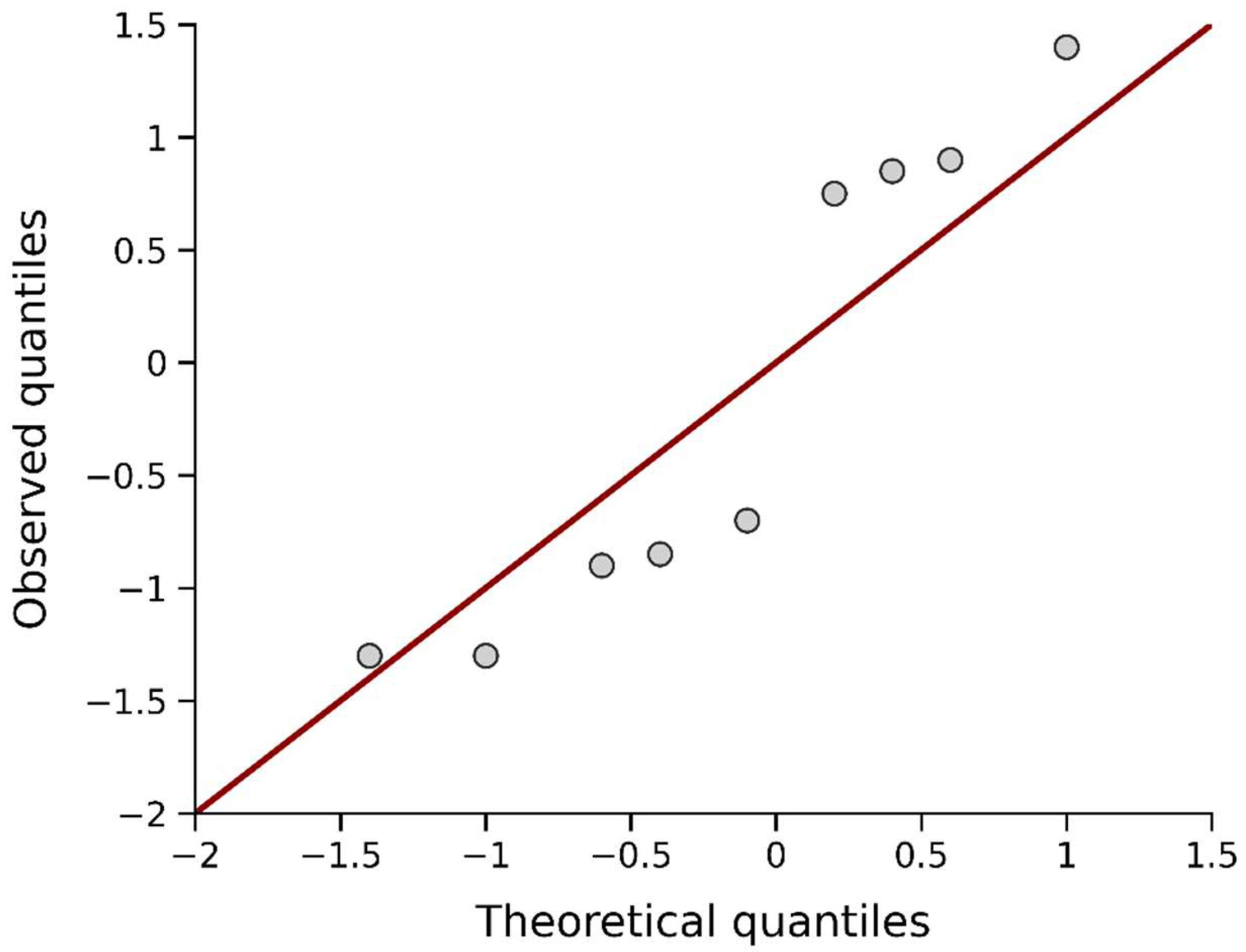
The model was used to evaluate the effects of terrain, land-use status (cleared versus uncleared), veld condition score, and invasive alien plant cover on plant species diversity in the study area. Figure 8 shows that the residuals lie reasonably close to the 1:1 reference line, indicating that the assumption of approximate normality of residuals is largely satisfied. The Shannon–Wiener diversity showed no significant response to any individual predictor, indicating relative stability in overall species richness and evenness across sites. The Simpson’s diversity index and the ENS, in contrast, provided complementary insights by emphasising species dominance. Therefore, it suggests that vegetation change is driven primarily by species replacement rather than overall diversity loss. This implies that disturbance-tolerant or pioneer species and invasive alien species may be substituting for disturbance-sensitive taxa, thereby maintaining diversity values while altering community structure.

5. Conclusions

The study successfully investigated the early vegetation responses to the clearing of C. odorata and L. camara in communal rangelands of Manzini, Eswatini. Among the two invasive species, L. camara was more prevalent and formed dense, impenetrable stands in some areas. Ref. [66] reported that L. camara reduces soil seed bank composition and structure, and invaded sites have lower species density and diversity. L. camara has the propensity to alter floristic structure and habitat quality through the reduction in species diversity, abundance of forage species available to mammals, and an increase in erosion. Invasive alien species are known to lead to habitat loss and threaten the diversity of native species. The density and increase in spatial cover of invasive plants are known to decrease native tree cover; clearing invasive plants leads to uneven recovery of individual plots due to varying local conditions. These impacts are particularly critical in communal landscapes, where biodiversity and grazing capacity are essential for sustaining livelihoods. Therefore, the cumulative clearance of invasive species across terrain units contributes to the overall improvement of species diversity rather than its narrow focus.
This investigation highlighted the importance of follow-up interventions to deplete invasive plant seed banks, particularly in areas heavily infested with L. camara. The analysis of woody vegetation indicated shifts in plant families and species composition between cleared and uncleared sites. This study also revealed that the dominance of L. camara potentially influences lower diversity in cleared sites. The importance of follow-up after initial invasive plant clearance is underscored, given the potential for the proliferation of shade-intolerant species. The VCI indicated spatial variability, with no consistent trend of improvement in cleared sites. This emphasises the complexity of the relationship between clearing and veld condition, suggesting that the effectiveness of clearing methods may vary depending on multiple factors. While the absence of baseline data limits the ability to measure absolute changes, the study’s design still allowed the identification of relative differences between cleared and uncleared sites. These relative differences can indicate the effectiveness of invasive plant management strategies and help direct future restoration efforts.
In conclusion, the findings emphasise the need for tailored, context-specific clearing strategies and long-term monitoring to better understand the dynamics of vegetation recovery in response to invasive plant clearance. Future research should consider additional factors, such as vegetation types, clearing methods, and local environmental conditions, to enhance the effectiveness of conservation and restoration efforts. It is essential to acknowledge the inherent limitations of this study, which stem from its relatively short timeframe and the lack of baseline data. The comparison between cleared and uncleared sites was conducted after only one season of clearing efforts. Therefore, despite these limitations, the site selection and ‘snapshot’ approach provide meaningful insights into the early impacts of invasive plant control, which are essential for refining management practices and developing long-term strategies. Ecological processes and the recovery of native vegetation are inherently dynamic and may require more extended periods for a comprehensive evaluation. Therefore, the findings of this study should be interpreted within the context of this temporal constraint, and future research endeavours should consider implementing long-term monitoring to capture the gradual vegetation recovery over time.


Supplementary Materials

The following supporting information can be downloaded at: https://www.mdpi.com/article/10.3390/ecologies7010010/s1, Table S1: Herbaceous species per site.

Author Contributions

Conceptualisation, S.E.M. and S.E.N.; Methodology, S.E.M.; Software, S.E.M.; Investigation, S.E.M.; Resources, S.E.M.; Data curation, S.E.M.; Writing—original draft preparation, S.E.M. and S.E.N.; Writing—review and editing, S.E.M. and S.E.N.; Visualisation, S.E.M.; Supervision, S.E.N.; Project administration, S.E.M. All authors have read and agreed to the published version of the manuscript.

Funding

This research received no grants from any funding agency, in the commercial or not-for-profit sectors.

Institutional Review Board Statement

Not applicable.

Informed Consent Statement

Not applicable.

Data Availability Statement

The data presented in this study are available in the article.

Conflicts of Interest

The authors declare that they have no conflicts of interest.

References

  1. Alpert, P.; Bone, E.; Holzapfel, C. Invasiveness, invasibility and the role of environmental stress in the spread of non-native plants. Perspect. Plant Ecol. Evol. Syst. 2000, 3, 52–66. [Google Scholar] [CrossRef]
  2. Mooney, H.A.; Cleland, E.E. The evolutionary impact of invasive species. Proc. Natl. Acad. Sci. USA 2001, 98, 5446–5451. [Google Scholar] [CrossRef]
  3. Holzmueller, E.J.; Jose, S. Invasive plant conundrum: What makes the aliens so successful? J. Trop. Agric. 2009, 47, 18–29. [Google Scholar]
  4. Le Roux, J.J.; Clusella-Trullas, S.; Mokotjomela, T.M.; Mairal, M.; Richardson, D.M.; Skein, L.; Wilson, J.R.; Weyl, O.L.F.; Geerts, S. Biotic Interactions as Mediators of Biological Invasions: Insights from South Africa. Biol. Invasions S. Afr. 2020, 35, 387–427. [Google Scholar] [CrossRef]
  5. Hejda, M.; Pyšek, P.; Jarošík, V.; Pysek, P.; Jarosik, V. Impact of invasive plants on the species richness, diversity and composition of invaded communities. J. Ecol. 2009, 97, 393–403. [Google Scholar] [CrossRef]
  6. Higgins, S.I.; Richardson, D.M. Predicting plant migration rates in a changing world: The role of long-distance dispersal. Am. Nat. 1999, 153, 464–475. [Google Scholar] [CrossRef] [PubMed]
  7. Blossey, B.; Notzold, R. Evolution of Increased Competitive Ability in Invasive Nonindigenous Plants: A Hypothesis. J. Ecol. 1995, 83, 887–889. [Google Scholar] [CrossRef]
  8. Prior, K.M.; Adams, D.C.; Klepzig, K.D.; Hulcr, J. When does invasive species removal lead to ecological recovery? Implications for management success. Biol. Invasions 2018, 20, 267–283. [Google Scholar] [CrossRef]
  9. Richardson, D.M.; Van Wilgen, B.W. Invasive alien plants in South Africa: How well do we understand the ecological impacts? S. Afr. J. Sci. 2004, 100, 45–52. [Google Scholar]
  10. Glass, S. Ecological restoration as a strategic framework for invasive species management planning: The University of Wisconsin experience. In Proceedings of the 19th North American Prairie Conferences; University of Nebraska: Lincoln, NE, USA, 2004; Volume 84, pp. 184–187. [Google Scholar]
  11. Pearson, D.; Ortega, Y.; Eren, Ö.; Hierro, J. Quantifying ‘apparent’ impact and distinguishing impact from invasiveness in multispecies plant invasions. Ecol. Appl. 2016, 26, 162–173. [Google Scholar] [CrossRef]
  12. Kettenring, K.M.; Adams, C.R. Lessons learned from invasive plant control experiments: A systematic review and meta-analysis. J. Appl. Ecol. 2011, 48, 970–979. [Google Scholar] [CrossRef]
  13. Vilà, M.; Espinar, J.L.; Hejda, M.; Hulme, P.E.; Jarošík, V.; Maron, J.L.; Pyšek, P. Ecological impacts of invasive alien plants: A meta-analysis of their effects on species, communities and ecosystems. Ecol. Lett. 2011, 14, 702–708. [Google Scholar] [CrossRef] [PubMed]
  14. Plant Control Act, Act No. 8 of 1981 (as Amended to December 1, 1998). Eswatini Legislation. 1981. Available online: https://eswatinilii.org/akn/sz/act/1981/8/eng@1998-12-01 (accessed on 11 February 2025).
  15. The Declaration of National Disaster, Notice; Pub. L. No. 172 of 2005, XLIII 2; Swaziland Government Gazette: Mbabane, Eswatini, 2005.
  16. Department of Environment, Forestry and Fisheries. National Environmental Management: Biodiversity Act, 2004 (Act no. 10 of 2004); Alien and Invasive Species Lists; Government Printing Works: Pretoria, South Africa, 2020.
  17. Bitani, N.; Shivambu, T.C.; Shivambu, N.; Downs, C.T. An impact assessment of alien invasive plants in South Africa generally dispersed by native avian species. NeoBiota 2022, 74, 189–207. [Google Scholar] [CrossRef]
  18. Mamba, H.S.; Singwane, S.S. Effects of Lantana camara and Psidium guajava on the Chemical Properties of the Soil in Eswatini-A Case of Ngudzeni Area. Int. Res. J. Appl. Sci. Res. Artic. 2019, 1, 2663–5585. [Google Scholar]
  19. Davis, M.A.; Grime, J.P.; Thompson, K. Fluctuating resources in plant communities: A general theory of invasibility. J. Ecol. 2000, 88, 528–534. [Google Scholar] [CrossRef]
  20. Turpie, J. The role of resource economics in the control of invasive alien plants in South Africa. S. Afr. J. Sci. 2004, 100, 87–93. [Google Scholar]
  21. Ossom, E.; Lupupa, B.; Mhlongo, S.; Khumalo, L. Implications of Weed Control Methods on Sandanezwe (Chromolaena odorata) in Swaziland. World J. Agric. Sci. 2007, 3, 704–713. [Google Scholar]
  22. van Gils, H.; Delfino, J.; Rugege, D.; Janssen, L. Efficacy of Chromolaena odorata control in a South African conservation forest. S. Afr. J. Sci. 2004, 100, 251–253. [Google Scholar]
  23. Zachariades, C.; Day, M.; Muniappan, R.; Reddy, G.V.P. Chromolaena odorata (L.) King and Robinson (Asteraceae). In Biological Control of Tropical Weeds using Arthropods; Muniappan, R., Reddy, G.V.P., Raman, A., Eds.; Cambridge University Press: Cambridge, UK, 2009; pp. 130–162. Available online: https://keys.lucidcentral.org/keys/v3/eafrinet/weeds/key/weeds/Media/Html/Chromolaena_odorata_(Chromolaena).htm#top (accessed on 15 March 2025).
  24. Goodall, J.M.; Erasmus, D.J. Review of the status and integrated control of the invasive alien weed, Chromolaena odorata, in South Africa. Agric. Ecosyst. Environ. 1996, 56, 151–164. [Google Scholar] [CrossRef]
  25. Rusdy, M.; Sjahril, R.; Riadi, M.; Budiman, B. Integration of mechanical and cultural control treatments to manage invasive shrub Chromolaena odorata and other weeds under drought conditions in Pasture Area. J. Indones. Trop. Anim. Agric. 2013, 38, 65–71. [Google Scholar] [CrossRef]
  26. Ramaano, R.; Moyo, H.; Mugwedi, L.; Tsvuura, Z. Survive or perish: Resprouting ability of repeatedly cut Chromolaena odorata in a reforestation site. Afr. J. Ecol. 2021, 59, 780–783. [Google Scholar] [CrossRef]
  27. Urban, A.J.; Simelane, D.O.; Retief, E.; Heystek, F.; Williams, H.E.; Madire, L.G. The invasive ‘Lantana camara L.’ hybrid complex (Verbenaceae): A review of research into its identity and biological control in South Africa. Afr. Entomol. 2011, 19, 315–348. [Google Scholar] [CrossRef]
  28. Magagula, C.N. Biocontrol Science and Technology Distribution and abundance of the herringbone leaf-miner, Ophiomyia camarae (Diptera: Agromyzidae) on Lantana camara (Verbenaceae) in selected areas of Swaziland. Biocontrol Sci. Technol. 2011, 21, 829–837. [Google Scholar] [CrossRef]
  29. Vardien, W.; Richardson, D.M.; Foxcroft, L.C.; Thompson, G.D.; Wilson, J.R.U.; Le Roux, J.J. Invasion dynamics of Lantana camara L. (sensu lato) in South Africa. S. Afr. J. Bot. 2012, 81, 81–94. [Google Scholar] [CrossRef]
  30. Simelane, D.O.; Katembo, N.; Mawela, K. Current Status of Biological Control of Lantana camara L. (sensu lato) in South Africa. Afr. Entomol. 2021, 29, 775–783. [Google Scholar] [CrossRef]
  31. Day, M.D.; Zalucki, M.P. Lantana camara Linn. (Verbenaceae). In Biological Control of Tropical Weeds Using Arthropods; Muniappan, R., Reddy, G.V.P., Raman, A., Eds.; Cambridge University Press: Cambridge, UK, 2009; pp. 211–246. [Google Scholar] [CrossRef]
  32. Spies, J.J.; Stirton, C.H. Embryo sac development in some South African cultivars of Lantana camara. Bothalia 1982, 14, 113–117. [Google Scholar] [CrossRef]
  33. Subhashni, T.; Lalit, K. Impacts of climate change on invasive Lantana camara L. distribution in South Africa. Afr. J. Environ. Sci. Technol. 2014, 8, 391–400. [Google Scholar] [CrossRef]
  34. Cronk, Q.C.; Fuller, J.L. Plant Invaders: The Threat to Natural Ecosystems; Routledge: Oxfordshire, UK, 2014. [Google Scholar]
  35. Acocks, J.P.H. Veld Types of South Africa. Mem. Bot. Surv. S. Afr. 1988, 57, 1–146. [Google Scholar]
  36. Mucina, L.; Rutherford, M.C. The Vegetation of South Africa, Lesotho and Swaziland; Strelitzia 19; Mucina, L., Rutherford, M.C., Eds.; SANBI Publishing: Pretoria, South Africa, 2006. [Google Scholar]
  37. Zund, P.R. Soil Erodibility: User Guide (Department of Science, Information Technology, Innovation); Queensland Government: Brisbane, Australia, 2017; pp. 1–16.
  38. McGill, B.J.; Enquist, B.J.; Weiher, E.; Westoby, M. Rebuilding community ecology from functional traits. Trends Ecol. Evol. 2006, 21, 178–185. [Google Scholar] [CrossRef]
  39. D’antonio, C.; Meyerson, L.A. Exotic plant species as problems and solutions in ecological restoration: A synthesis. Restor. Ecol. 2002, 10, 703–713. [Google Scholar] [CrossRef]
  40. Teague, W.R.; Danckwerts, J.E. Monitoring Vegetation Change and Assessing Veld Condition. In Veld Management in the Eastern Cape; Danckwerts, J.E., Teague, W.R., Eds.; Department of Agriculture and Water Supply: Pretoria, South Africa, 1989; p. 196. [Google Scholar]
  41. Tainton, N.M. Veld Management in South Africa, 1st ed.; Tainton, N.M., Ed.; University of Natal Press: Pietermaritzburg, South Africa, 1999. [Google Scholar]
  42. Kent, M.; Coker, P. Vegetation Description and Analysis: A Practical Approach; John Wiley & Sons, Ltd.: Chichester, UK, 1994. [Google Scholar]
  43. Fikadu, E.; Melesse, M.; Wendawek, A.; Erenso, F.; Maryo, M.; Abebe, W. Floristic composition, diversity and vegetation structure of woody plant communities in Boda dry evergreen Montane Forest, West Showa, Ethiopia. Int. J. Biodivers. Conserv. 2014, 6, 382–391. [Google Scholar] [CrossRef]
  44. Westfall, R.H.; Van Staden, J.M.; Panagos, M.D.; Breytenbach, P.J.J.; Greeff, A. Scale-Related Vegetation Sampling; Agricultural Research Council: Pretoria, South Africa, 1996. [Google Scholar]
  45. Evans, R.A.; Love, R.M. The Step-Point Method of Sampling: A Practical Tool in Range Research. J. Range Manag. 1957, 10, 208–212. [Google Scholar] [CrossRef]
  46. Tainton, N.M.; Edwards, P.J.; Mentis, M.T. A Revised Method for Assessing Veld Condition. Proc. Grassl. Soc. S. Afr. 1980, 15, 37–42. [Google Scholar] [CrossRef]
  47. Hart, A.G.; Carpenter, W.S.; McTavish, L.; Blades, B.; Clarke, E.; Griffiths, S.; Harding, N.; Walsh, E.; Wilson, L.; Goodenough, A.E. Evaluating veld condition index: How many samples are enough? Afr. J. Ecol. 2020, 58, 596–598. [Google Scholar] [CrossRef]
  48. Ngwenya, P. Herbaceous plant species richness and composition in moist Midlands Mistbelt Grasslands in KwaZulu-Natal: Is there a relationship to veld condition? Afr. J. Range Forage Sci. 2012, 29, 75–83. [Google Scholar] [CrossRef]
  49. Goodenough, A.E.; Carpenter, W.S.; McTavish, L.; Blades, B.; Clarke, E.; Griffiths, S.; Harding, N.; Scott, R.; Walsh, E.; Wilson, L.; et al. The impact of inter-observer variability on the accuracy, precision and utility of a commonly-used grassland condition index. Ecol. Indic. 2020, 117, 106664. [Google Scholar] [CrossRef]
  50. Bothma, J.D.P. (Ed.) Game Ranch Management, 4th ed.; Van Schaik Publishers, University of Pretoria: Pretoria, South Africa, 2002. [Google Scholar]
  51. van Oudshoorn, F. Guide to Grasses of Southern Africa, 2nd ed.; Briza Publications: Pretoria, South Africa, 2002. [Google Scholar]
  52. Das, P.; Joshi, S.; Rout, J.; Upreti, D. Shannon Diversity Index (H) as an Ecological Indicator of Environmental Pollution—A GIS Approach. J. Funct. Environ. Bot. 2012, 2, 22. [Google Scholar] [CrossRef]
  53. Nordstokke, D.W.; Colp, S.M. Investigating the robustness of the nonparametric Levene test with more than two groups. Psicologica 2014, 35, 361–383. [Google Scholar]
  54. Shear, B.R.; Nordstokke, D.W.; Zumbo, B.D. A Note on Using the Nonparametric Levene Test When Population Means Are Unequal. Pract. Assess. Res. Eval. 2018, 23, 1–11. [Google Scholar]
  55. Fowler, J.; Cohen, L.; Jarvis, P. Practical Statistics for Field Biology, 2nd ed.; John Wiley and Sons: West Sussex, UK, 2006. [Google Scholar]
  56. Tefera, S.; Dlamini, B.J.; Dlamini, A.M. Invasion of Chromolaena odorata in the lowveld region of Swaziland and its effect on herbaceous layer productivity. Int. J. Agric. Res. 2008, 3, 98–109. [Google Scholar] [CrossRef]
  57. Foran, B.D.; Tainton, N.M.; Booysen, P.d.V. The development of a method for assessing veld condition in three grassveld types in Natal. Proc. Annu. Congr. Grassl. Soc. S. Afr. 1978, 13, 27–33. [Google Scholar] [CrossRef]
  58. Vorster, M. The Development of The Ecological Index Method for Assessing Veld Condition in The Karoo. Proc. Grassl. Soc. S. Afr. 1982, 17, 84–89. [Google Scholar] [CrossRef]
  59. Burnham, K.P.; Anderson, D.R. Multimodel Inference: Understanding AIC and BIC in Model Selection. Sociol Methods Res. 2004, 33, 261–304. [Google Scholar] [CrossRef]
  60. McCullagh, P.; Nelder, J. Generalized Linear Models, 2nd ed.; Chapman and Hall: London, UK, 1989. [Google Scholar]
  61. Nsikani, M.M.; Geerts, S.; Ruwanza, S.; Richardson, D.M. Secondary invasion and weedy native species dominance after clearing invasive alien plants in South Africa: Status quo and prognosis. S. Afr. J. Bot. 2020, 132, 338–345. [Google Scholar] [CrossRef]
  62. Sankaran, K.V. Lantana Camara. In Encyclopedia of Biological Invasions; University of California Press: Berkeley, CA, USA, 2020; pp. 428–430. [Google Scholar] [CrossRef]
  63. Katembo, N. Impact of biocontrol agents on Lantana camara L. (Verbenaceae) in the lowveld region of Mpumalanga, South Africa. Ph.D. Thesis, University of the Witwatersrand, Johannesburg, South Africa, 2018. [Google Scholar]
  64. Tranter, A.; Brown, L.R.; Barrett, A.S. Analysis of three techniques for controlling invasive Lantana camara in Swaziland. Afr. J. Agric. Res. 2013, 8, 4427–4433. [Google Scholar] [CrossRef]
  65. Swarbrick, J.T.; Willson, B.W.; Hannan-Jones, M.A. The Biology of Australian Weeds. Plant Prot. Q. 1995, 10, 82–95. [Google Scholar]
  66. Ruwanza, S. Soil seed bank depletion as a mechanism of Lantana camara L. invasion. S. Afr. J. Plant Soil 2016, 33, 303–308. [Google Scholar] [CrossRef]
  67. Dew, L.A.; Rozen-Rechels, D.; le Roux, E.; Cromsigt, J.P.G.; Te Beest, M. Evaluating the efficacy of invasive plant control in response to ecological factors. S. Afr. J. Bot. 2017, 109, 203–213. [Google Scholar] [CrossRef]
  68. Holmes, P.M.; Esler, K.J.; Gaertner, M.; Geerts, S.; Hall, S.A.; Nsikani, M.M.; Richardson, D.M.; Ruwanza, S. Biological Invasions and Ecological Restoration in South Africa. In Biological Invasions in South Africa; Springer: Cham, Switzerland, 2020; pp. 665–700. [Google Scholar] [CrossRef]
  69. Witkowski, E.T.F.; Garner, R.D. Seed production, seed bank dynamics, resprouting and long-term response to clearing of the alien invasive Solanum mauritianum in a temperate to subtropical riparian ecosystem. S. Afr. J. Bot. 2008, 74, 476–484. [Google Scholar] [CrossRef]
  70. Witkowski, E.T.F.; Wilson, M. Changes in density, biomass, seed production and soil seed banks of the non-native invasive plant, Chromolaena odorata, along a 15-year chronosequence. Plant Ecol. 2001, 152, 13–27. [Google Scholar] [CrossRef]
  71. Banks, P.B.; Byrom, A.E.; Pech, R.P.; Dickman, C.R. Reinvasion Is Not Invasion Again. BioScience 2018, 68, 792–804. [Google Scholar] [CrossRef]
  72. Beater, M.M.T.; Garner, R.D.; Witkowski, E.T.F. Impacts of clearing invasive alien plants from 1995 to 2005 on vegetation structure, invasion intensity and ground cover in a temperate to subtropical riparian ecosystem. S. Afr. J. Bot. 2008, 74, 495–507. [Google Scholar] [CrossRef]
  73. Katembo, N.; Simelane, D.; Byrne, M.; Witkowski, E.T.F. Impact of biocontrol on the seed regenerative capacity of Lantana camara L. (sensu lato) (Verbenaceae). Biocontrol Sci. Technol. 2022, 32, 685–699. [Google Scholar] [CrossRef]
  74. Magurran, A.E. Ecological Diversity and its Measurement, 1st ed.; Princeton University Press: Princeton, NJ, USA, 1988. [Google Scholar]
  75. Nagendra, H. Opposite trends in response to the Shannon and Simpson indices of landscape diversity. Appl. Geogr. 2002, 22, 175–186. [Google Scholar] [CrossRef]
  76. Hanusz, Z.; Tarasinska, J.; Zielinsji, W. Shapiro–Wilk Test with Known Mean. Stat. J. 2016, 14, 89–100. [Google Scholar] [CrossRef]
  77. Banda, G. A Brief Review of Independent, Dependent and One-Sample t-test. Int. J. Appl. Math. Theor. Phys. 2018, 4, 50–54. [Google Scholar] [CrossRef]
  78. Derrick, B. To preliminary test or not to preliminary test, that is the question. In Proceedings of the Research Students Conference in Probability and Statistics, Sheffield, UK, 26 July 2018; pp. 11–23. Available online: https://uwe-repository.worktribe.com/OutputFile/867731 (accessed on 12 January 2026).
  79. Ahad, N.A.; Yahaya, S.S.S. Sensitivity Analysis of Welch’s t-Test. AIP Conf. Proc. 2014, 1605, 888–893. [Google Scholar] [CrossRef]
  80. Gastwirth, J.L.; Gel, Y.R.; Miao, W. The Impact of Levene’s Test of Equality of Variances on Statistical Theory and Practice. Stat. Sci. 2009, 24, 343–360. [Google Scholar] [CrossRef]
  81. Goss-Sampson, M.A. Statistical Analysis in JASP: A Guide for Students—v1.0, 4th ed.; University of Amsterdam: Amsterdam, The Netherlands, 2018. [Google Scholar] [CrossRef]
  82. Kim, H.-Y. Statistical notes for clinical researchers: The independent samples t-test. Restor. Dent. Endod. 2019, 44, 2–7. [Google Scholar] [CrossRef] [PubMed]
  83. Choudhary, R. Application of “independent t-test” by using SPSS for conducting physical education research. Int. J. Phys. Educ. Sports Health 2018, 5, 237–241. Available online: https://www.kheljournal.com/archives/2018/vol5issue1/PartD/5-4-24-510.pdf (accessed on 12 January 2026).
  84. Lu, Z.L.; Yuan, K.-H. Welch’s t-test. In Encyclopedia of Research Design; Salkind, N.J., Ed.; Sage: Thousand Oaks, CA, USA, 2010; pp. 1620–1623. [Google Scholar] [CrossRef]
  85. Pearce, J.; Derrick, B. Preliminary Testing: The Devil of Statistics? Reinvention Int. J. Undergrad. Res. 2019, 12. [Google Scholar] [CrossRef]
  86. Ferguson, C.J. An Effect Size Primer: A Guide for Clinicians and Researchers. Prof. Psychol. Res. Pract. 2009, 40, 532–538. [Google Scholar] [CrossRef]
  87. McLeod, S. What Does Effect Size Tell You? 2019. pp. 1–3. Available online: https://online210.psych.wisc.edu/ (accessed on 27 February 2025).
  88. Coe, R. It’s the Effect Size, Stupid: What effect size is and why it is important. In Proceedings of the British Educational Research Association Annual Conference, Exeter, UK, 12–14 September 2002; pp. 1–18. [Google Scholar]
  89. Valentine, J.; Cooper, H. Effect Size Substantive Interpretation Guidelines: Issues in the Interpretation of Effect Sizes; What Work. Clgh.: Washington, DC, USA, 2003; Volume 136, pp. 1–7. Available online: https://files.wmich.edu/s3fs-public/attachments/u58/2015/Effect_Size_Substantive_Interpretation_Guidelines.pdf (accessed on 1 March 2025).
  90. Van Rooyen, N.; Bredenkamp, G.; Theron, G. Kalahari Veld Condition: Veld condition and ecological status of species. Koedoe 1991, 34, 61–72. [Google Scholar] [CrossRef]
  91. Tokozwayo, S.; Thubela, T.; Mthi, S.; Nyangiwe, N.; Khetani, T.L.; Gulwa, U.; Goni, S.; Jansen, M.; Qokweni, L.; Guza, B. Evaluation of communal rangeland condition under the East Griqualand veld type of Eastern Cape Province, South Africa. Appl. Anim. Husb. Rural Dev. 2021, 14, 1–8. [Google Scholar]
  92. Wakeling, J.L.; Bond, W.J.; Ghaui, M.; February, E.C. Grass competition and the savanna-grassland “treeline”: A question of root gaps? S. Afr. J. Bot. 2015, 101, 91–97. [Google Scholar] [CrossRef]
  93. Reid, A.M.; Morin, L.; Downey, P.O.; French, K.; Virtue, J.G. Does invasive plant management aid the restoration of natural ecosystems? Biol. Conserv. 2009, 142, 2342–2349. [Google Scholar] [CrossRef]
Figure 1. Locality map of the three study sites within the Mafutseni area in the Manzini region.
Ecologies 07 00010 g001
Figure 2. Boxplots comparing single- and multi-stemmed individuals within cleared sites.
Ecologies 07 00010 g002
Figure 3. Herbaceous sites, prevalence of invasive alien plants, and VCS.
Ecologies 07 00010 g003
Figure 4. Prevalence of C. odorata across height classes in cleared and uncleared sites. (No violin plot for height class 2+ since no specimens were recorded in the study area).
Ecologies 07 00010 g004
Figure 5. Prevalence of L. camara across height classes in cleared and uncleared sites.
Ecologies 07 00010 g005
Figure 6. Relative abundance of ecological response groups (Decreaser, Increaser, Invader) at uncleared sites.
Ecologies 07 00010 g006
Figure 7. Relative abundance of ecological response groups (Decreaser, Increaser, Invader) at cleared sites.
Ecologies 07 00010 g007
Figure 8. Q-Q plot: Standardised deviance residuals used to assess model normality.
Ecologies 07 00010 g008
Table 1. Statistical analysis results comparing single and multi-stemmed plants, including F-values, degrees of freedom, and p-values.
F-ValueDegrees of Freedom (df1)Degrees of Freedom (df2)p-Value
Single Stem3.292 × 10−412070.986
Multi Stem0.64412070.423
Total Stems0.07212070.789
Table 2. Equality and normality variances for Chromolaena and Lantana.
ChromolaenaLantana
ClearerUnclearedClearedUncleared
Normality testShapiro-Wilk0.6790.6170.6440.729
p-value<0.001<0.001<0.001<0.003
Levene’s testF11.55411.5540.4790.479
p-value0.0030.0030.4980.498
Degree of freedom (df1)1111
Degree of freedom (df2)17171717
Table 3. Mann–Whitney U-test, independent t-test and Welch test for C. odorata and L. camara.
ChromolaenaLantana
Mann-Whitney TestClearedUnclearedClearedUncleared
W57575454
p-value0.290.290.4840.484
Hodges Lehmann Estimate2.088 × 10−52.088 × 10−58.0008.000
Rank-Biserial correlation0.2670.2670.2000.200
SE Rank-Biserial correlation0.2660.2660.2660.266
Independent t-testStatistic1.6111.6110.4910.491
p-value0.1260.1260.6300.630
Degree of freedom17171717
Cohen’s d0.7400.7400.2260.226
SE Cohen’s d0.4880.4880.4620.462
Welch testStatistic1.6981.6980.5030.503
p-value0.1220.1220.6220.622
Degree of freedom9.4739.47315.36415.364
Cohen’s d0.7600.7600.2280.228
SE Cohen’s d0.4900.4900.4620.462
Note. For the Mann-Whitney test, effect size is given by the rank biserial correlation.
Table 4. Shannon-Weiner (H′) and Simpson’s diversity (D) indices for woody vegetation.
Cleared SitesSWI (H′)SDI (D)ENS (H′)Uncleared SitesSWI (H′)SDI (D)ENS (H′)
112.7660.91615,89221.4180.5684.130
142.8630.92817,51442.3190.82910,167
160.9120.3332.49092.6880.92214,700
171.7830.6915.947101.7020.6105.483
182.0830.7418.027----
Average2.0810.7229.974 2.0320.7328.620
Table 5. Veld condition Index, Shannon-Weiner (H′), Simpson’s diversity (D) Indices and Effective species for the herbaceous layer.
Cleared SitesVCI (%)SWI (H′)SDI (D)ENS (H′)Uncleared SitesVCI (%)SWI (H′)SDI (D)ENS (H′)
637.01.9600.8217.101126.81.9940.7777.345
1228.82.0380.8557.673349.41.9810.7787.248
1343.81.8470.7696.342557.32.0550.8467.803
1536.71.9840.8227.272748.41.8550.7916.394
1940.81.9300.8226.890853.92.0740.8507.955
Average37.41.9520.8187.056 47.21.9920.8097.349
Table 6. GLM summary for Shannon diversity showing AIC, BIC, degrees of freedom (df), X2, and p-values for the null (H0) and alternative (H1) models.
ModelDevianceAICBICdfX2p
H00.015−18.78−16.062
H10.015−18.78−16.0620.000
Table 7. General linear model coefficients.
Coefficients
EstimateStandard Errortp
(Intercept)2.0760.3645.7020.029
Terrain unit 4−0.020−0.128−0.1540.892
Terrain unit 50.0390.1030.3760.743
Status-Uncleared0.0630.0920.6820.566
VCS−0.0020.007−0.3130.784
C. odorata−0.1300.109−0.1960.354
L. camara−0.0040.019−0.2170.848
Terrain unit 4 * Status-Uncleared−0.1540.140−1.1000.386
* Represents the interaction effect between Terrain unit 4 and Status (Uncleared).
Disclaimer/Publisher’s Note: The statements, opinions and data contained in all publications are solely those of the individual author(s) and contributor(s) and not of MDPI and/or the editor(s). MDPI and/or the editor(s) disclaim responsibility for any injury to people or property resulting from any ideas, methods, instructions or products referred to in the content.